1
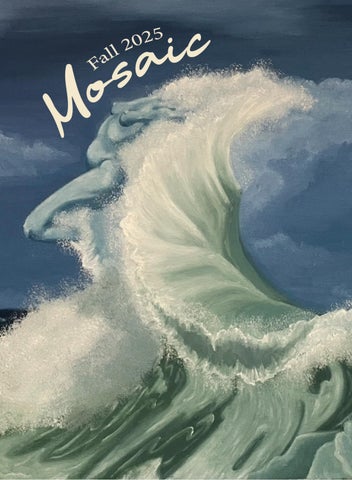
https://maristmosaic.wixsite.com/marist-mosaic maristmosaic@gmail.com 3399 North Road Poughkeepsie, NY 12601 Cover Design by Marisa Brown, Jillian Blaszko Interior Layout by Christina Brown, Angelina Ruiz Cover Image: Wave, Oil painting, Brittany Tinklepaugh, 2026 Opinions expressed in Mosaic do not necessarily reflect the views held by Mosaic staff, students, faculty, or the administration of Marist University. © Mosaic 2025 2
Mosaic Editorial Board Editor-In-Chief Ryann Anderson Associate Editor Riley Mazzocco Art Editor Kaitlin James Poetry Editor Elise Stiefel Fiction Editor Cira Shaw Photography Editor Alice Adams Nonfiction Editor Grace Naccarato Design Editors Christina Brown, Angelina Ruiz Cover Design Editors Marisa Brown, Jillian Blaszko Social Media Committee Mary Kirk, Olivia Pollicino, Margaret Batta, Alexa Gallery Event Planning Committee Angela Buscemi, Samantha Smith Mosaic Advisors Mr. Robert Lynch and Dr. Moira Fitzgibbons
3
A Letter From The Editor The Mosaic Editorial Board is proud to publish the Fall 2025 issue of Mosaic, a literary and arts magazine showcasing the remarkable work of Marist University students. All Mosaic submissions undergo a rigorous blind peer-review process in which student section editors evaluate work for publication. The selection process was especially competitive this year. Thank you to all the students who submitted their work to Mosaic. I encourage each of you to submit again in the spring. It is a privilege to receive work from so many talented and creative students across campus; your skill and passion are what make this magazine successful. The Mosaic Editorial Board extends our sincere gratitude to Robert Lynch for his unwavering support and dedication to Mosaic. We also thank Alex Podmaniczky and the entire Digital Publication Center for printing our nearly 400 copies of the magazine. Thank you as well to Dr. Joshua Kotzin, Chair of the English Department, and to the School of Liberal Arts for helping us spread the word and for encouraging the accomplished students featured in this edition to submit their work. I would also like to personally thank Dr. Moira Fitzgibbons for all she does for Mosaic and for the support she has given me these past few months as I’ve transitioned into this role. Her enthusiasm and love for Mosaic are truly infectious. She is the reason Mosaic has been, and will continue to be, a staple of the Marist community. Thank you to Riley Mazzocco, the previous Editor-in-Chief and current Associate Editor. The impact you have had on this publication over the past three years cannot be overstated—I could not have done this without you. Thank you for everything. I would also like to extend a huge thanks to the Editorial Board for all their hard work this semester. I am so grateful for your commitment, passion, and love of the arts. Additionally, I’d like to give special thanks to my design team, Christina Brown and Angelina Ruiz, who bore with me through the brunt of my growing pains this semester—your patience and creativity are truly unmatched. And finally, thank you to our readers! This magazine continues to flourish because of your support and engagement each semester. We hope you enjoy the Fall 2025 edition of Mosaic. Sincerely, Ryann Anderson
4
TABLE OF CONTENTS Wave Frederic Remington Study Welcome to Earth Signals Crossed When the World Ends Conspiracy on My Shoulders Summer Reading A Song for the Sea In the Fever of a Summer Haze ***12:07 Caged Canary Inconspicuous The Photo Shop A Figure in the Mist See You Again Someday Somewhere in Northern Italy Ode to Regret Venice Canal Support, Lorenzo Quinn, 2017, Venice, Italy Via Dei Servi Take me Home To the Mountains Rosemary, For Remembrance Soup for Breakfast Sweet Song Sunset Over the Marsh The Apple Doesn’t Fall Far From The Tree Autumn in New York The Archeologist Franz Joseph of the Liberty Bridge The Bend ***The Wrath of a Sea Storm Emerald Rush Every April Verdant Dreamway Spring of Soul
Brittany Tinklepaugh Marisa Brown Stella Qadeer Liam Storey Marina Tawil Ruby McMahon Ashley Laub Alexa Gallery Julia Antonio Kevin Reiff Katrina Migliore Christina Brown Stella Qadeer Cayleigh Goberman Kiki Wiehe Christina Brown Cira Shaw Sofia Milojevic Kaitlin James
Cover 8 9 11 12 16 17 18 22 23 28 29 30 33 34 36 37 39 40
Sofia Milojevic Jazi Khraishi Riley Mazzocco Gabby Ganoe Isabella Deluliis Katrina Migliore Laura Sullivan Serafina Reinsdorf
41 42 44 45 46 47 48 49
Ashley Laub Nicholas Ferrari Ryann Anderson Sarah John Gabby Ganoe Claudia Skretkowicz Kiki Wiehe Hannah Sung Cira Shaw
50 51 57 58 59 64 65 66 67
*** = Content may contain themes of abuse, grief, death, suicide, war, mental illness, and body images.
5
Splash ***Hurricane Watch Night Owl Very Strange and Unusual Labyrinth The Surprise of Presence ***The Birth of Despaif Rehahn 13 x 7 Overgrown anteros panopticon Liminalist as easily Built to Last My Gentle Werewolf ***Elena Being Dinner The Astronomer Afiliction ***viscera Once More Deer in Richmond Park. February 2025. I Wish I Could Tell You (..) ***An excerpt from “Arcadia” Ghost Riders To My Future and My Past Through the Window St. Stephen’s Park Someone’s Waiting For You The dark before the dawn You or Me Stagnant . love ya Borrowed Time Love’s Lament Study of a Cat Genoa’s Butterfly Fight Night
6
Samantha Smith Emersen Tolman Gabby Ganoe Kaitlin James Bridget McGuire Adam Lenardson Owen Whelan Emily L. Viesta Kaitlin James El Raiford Grace Noye Lozada Jenna K. Labadessa Taylor Cipriano Julia Antonio Melina Helgeson Julia Antonio Katrina Migliore El Raiford Emma Stuber Khalisah Sanchez Nicholas Ferrari Julia Antonio Sam Blaschak Kaelyn Schmidt Ciara Molloy
68 69 70 71 72 72 23 74 76 77 78 79 80 81 82 83 84 85 87 88 89 93 94 96 97
Bridget McGuire Alexa Gallery Marisa Brown Gabby Ganoe Bella Loiacono Emily Cavanna Francesca DeRosa Grace Nove Lozada Anonymous Brittany Tinklepaugh
98 99 106 107 109 110 112 114 115 117 118 120 121 122 123 128
James-Ray Hernandez
Danielle Motta Cira Shaw Marisa Brown Lauren Meier Christina Brown
***Downpour Back to the 70s rex ludaeorum Beach of Womanhood Holding On Desired Destiny The power of creation Swimming Mallard Portfolio Memory
Liam Storey Marisa Brown Jenna K. Labadessa Cira Shaw Alexa Gallery Emily L. Viesta Grace Nove Lozada Ashley Demino Tom Quinones Christina Brown
129 132 133 134 136 137 140 141 142 150
7
The Winners Frederic Remington Study Pastels Marisa Brown ’27 First Place, Art
8
Welcome to Earth Stella Qadeer ’28 First Place, Fiction
Dawg, you have just wrestled through the most traumatic experience known to man, and have entered a nonstop jawdropping circus where the lights will be loud and the hells will be bright. You have entered an arena where man fights man, and dog eats dog. You have entered a quasidimension of higher thought by the low and low thoughts by the high. Hello, and welcome to Earth. You have been placed here with the express purpose to be purposeless, eloquent and elegant and excellent and irrelevant. It’s a persistent yet prevalent crisis of the elements. For all intense purposes, you are dead. Welcome to Earth. You are the one perspective you can trust, depend on no ulterior motive, and know for certain is true. The way in which you reflect reality’s lights is heavily indicative of the way reality is. It is the only way it is. You define reality. That which you cannot see, or smell, or hear, or touch does not exist. In your vignette of the world, truth is defined by the way you perceive it. To discount yourself is to discount reality. To deny your perspective will spin the world in eternal deaf chambers, of which it itself shall die. Terracotta masses masked by massive masques and dancing in caskets beg for your perspective. Lest the world turn to burning rubber and fluid wax, we call you back to call your senses. Your slice of the all-world is all the world you get. Hold onto your vignette. Welcome to Earth.
9
You are dust. You are nothing. You are a billion million cells comprising a loaf of bacon hallucinating that it’s creating sounds when it reads a bunch of symbols it’s been chemically beaten into perceiving as having meaning. It sounds demeaning and although I’d hate to be mean, in a literal sense it is meant. Cemented in your bones is an eternal uselessness. Your vignette of reality must compete in battle with trillions. Every ant. Every cell in your brain. Everything you think is you is perceiving the entirety of reality separately, and demands it is right and all others are wrong. This is falsehood, love. You are right. They are right. In a sea of everyone screaming, you are somehow not mute. But you aren’t the most important voice. Equally as important. Infinite importance spread infinitely thin. Infinitely thin. Welcome to Earth. You perceive everything. You are nothing. Morality is imperfect. Reality is flawed. I’m writing to put into thoughts everything. Or rather, that which is too much to express. Ideas defined by hallucination I wish to breach into your mind. Welcome to the theatre where no one knows the rules because we’re making it all up. Welcome to the theatre where everyone is right. Welcome to the theatre of geocentric philosophy. Choose what kind of person you are. Choose your fighter. Choose your blood type. Got them made? Good. Welcome to Earth.
10
Signals Crossed Point Reyes, CA Liam Storey ’28
First Place, Photography
11
When the World Ends Marina Tawil ’26
First Place, Nonfiction “Where do you want to be when the world ends?”. I was first asked this question in an intro to philosophy class. It has been something that has sat silently in the back of my mind, plaguing me, haunting me in every dull moment. The answer has always been, alone. I never cared where I would be as long as it was alone. I got comfortable with the silence, I craved it, and I never wanted it to end. That sounds bleak, I’m aware but I never cared to think too far into the future. The end of the world? That definitely met the cutoff of my imagination. In times of reflection, I can still hear the chorus of answers, childhood homes, grandparents’ house, with their friends, and loved ones. I could never imagine anything worse. I always considered myself a loner. I kept a few close friends but I preferred the tranquility of being alone. Trapped in the four walls of my room, my sanctuary, a place so encapsulated by all the things that make up the person I have become. If the world was ending that is where you would find me. In my bed with a good book, or at my desk writing something that would never see the light of day. Doing anything to escape the reality I was living, that is why I liked being alone. The stakes were low, nothing was real, and there were no witnesses to contest that. In being alone I didn’t have to pretend, pretend to care, to pretend to be okay, pretend to be
12
having fun. I could simply just exist, without limits, without boundaries, without expectations. Being alone forces you to get to know yourself, your wants, needs, strengths, weaknesses, and the things you are willing to consume and let consume you. I never really knew who I was, until I was alone. You can only be alone for so long before you let it consume you, I think I teetered that line of no going back for a while. But as much as I loved being alone, I was greatful to not be alone anymore. I can’t pinpoint when that change occured but being alone started to make my skin itch. I liked being alone, because I never felt alone. I didn’t know who I was and that journey of self-discovery was like getting to know someone for the first time. An intangible person who was unlike anyone or anything I had ever known. Being alone started to feel isolating, but I’d never tell anyone that. Sharing my thoughts might be the only thing scarrier than thinking about the future. So I put on a brave face, and started saying yes. Enjoying my alone time slowly started to dissipate, alone time in general started to erase from my daily routine. Early mornings, and late nights getting ready for bed were the few moments of alone I had, they were no longer filled with curiosity, instead they were empty as if there was nothing that could be done to fill that emptiness inside. I started to fill my time with friends and relationships, new and old. Getting to know someone who was virtually a stranger filled that curiosity shaped hole, that getting to know myself left behind. I now knew who I was, the things I wanted and needed, my strengths and
13
weaknesses, and the things I was willing to consume and let consume me. In my year of only saying yes, I opened so many new doors, doors I kept locked and guarded, swearing to never open them. The cutoffs of my imagination never let me imagine the future in detail, I knew what career I would have and where I wanted that course to go but, never could imagine anything more. I am a firm believe that all people are meant to serve a purpose in your life, my friends were there to pull me out of the darkness, to keep my self-isolation from becoming all-consuming. But I never imagined there would be someone whose purpose was to breathe life into the parts of my imagination that seemingly ceased to exist. Until I met him. Met with so much patience and understanding, he slowly unlocked each and every door that I kept locked and guarded, my head and my heart. The two things I swore I’d never let anyone into. I spent so much time getting to know myself, yet I was never able to realize what was missing. Having someone who was always in my corner, where I never had to pretend, pretend to care, to pretend I was okay, pretend to be having fun. Someone who made all of that come so easily, and mirrored those feelings genuinely and whole heartedly. Giving a piece of your heart to someone is terrifying, there’s that chance they might take it and break it or throw it away. But of all the things that plague my anxieties that has never been one. I often find myself thinking about the end of the world now, I think about it differently than I used to. This question doesn’t haunt my mind how it used to, instead
14
it flows in and out of my mindless thoughts. Tempting me to dream about what’s next. If the world was ending, there is still no one place I’d want to be. If the world was ending, my one request would be to be wherever he is. To spend the end times with the one person who sees me beyond the physical. My imaginable future begins and ends with him. I no longer crave being alone, I crave the presence of the person who makes all my days good and my worries disappear. When the world ends I want to be wherever my imagination takes me in that moment, with my person by my side, wherever that may be. There would be no better place to be.
15
Conspiracy on My Shoulders Ruby McMahon ’27 First Place, Poetry
Define me by my sexuality and my sin By the fruit I eat and the fruit I bear My role is not yours It is not to be worldly and full; Mine is to be burdened. I must Play the role of the mother I must nurture and feed Off mine back, the brothers and fathers feel success To me, they relent their extraordinary exhaustion And in my wise way, I can never be tired. It is my divine, yet “fully depreciated” body That is mine in anamatronic control But yours to discover, to handle, to puppeteer In secrecy and in arrogance I am not something to myself, I am a thing. It is that evolutionary chase and the beating Of your heart and fists and places unbeknownst to me That makes you the animal, the victor, the saint And me, the scarlet. Ruby M. McMahon
Ruby 16
Summer Reading Photoshop Ashley Laub ’27 Second Place, Art
17
A Song for the Sea Alexa Gallery ’27
Second Place, Fiction Her people feared the ocean. Once long ago, it is said that her ancestral lands were taken over. Drowned by a great biblical flood. Houses were swept away, towns drowned, and so few made it out. The ones that did moved inland. To where it was dry and always, always safe. They said the gods had punished them for nearing too close to the divine, endless oceans. “Water belongs to the heavens alone,” they said. Once though, she remembered seeing the ocean. It was only for a brief moment, while riding horseback, traveling with her family. She was very small, and high up on her father’s shoulders. “It’s beautiful,” she breathed “Look,” her father said, staring out over the blue expanse. “That is the ocean, little one. It could swallow you in a second. It could eat our entire country without pause. There are creatures in there that will call you, confuse you, hunt you, consume you.” He expected her to be frightened. He expected her to understand. But she felt something grow inside her. She felt drawn to that vast, ever-changing depth. As her father turned the horse around, she saw the thing that would change her life forevermore. A flash of a tail, a glimpse of hair. Dark eyes peering out along the surface
18
of the water. All that surrounded her was land. Arid plains, grassy knolls, dense forests. Only rock and sand and dirt. Her people made sure to steer clear of lakes and rivers when constructing their cities. Swimming, boating, and fishing were archaic processes, long since banned. Even wells and baths were used sparingly. To be submerged was to flirt with death. She loved water. When she was three, her mother found her face first in a bucket used for washing. She had feared the worst until Nova popped up, gurgling and cooing, kicking her baby legs. Her mother furiously dried her off and swore she would keep her safe. She needed the water. She felt it in her blood. And yet her people were hellbent on keeping her from it. So one day she woke before dawn, grabbed her family’s precious map, and set out on her trek. She was scared of that vast blue expanse, but still, she felt a need to be near it, in it, breathing it into her lungs. After many miles and moons, she set her bare feet onto the delicate sand. She tasted salt in the air. She heard the wind whistling, calling out to her. She saw the magnificent, sparkling, crystal clear water in front of her. This was nothing like that dark, mysterious horror her father warned of. At first, she placed one hand in. Felt the delicious chill, the cool smoothness. It wasn’t long before she leapt in, every inch of her body submerged, save for her head.
19
That’s when she saw her. Tangled, twisted, dark mess of hair. Delicate scales, green-tinged skin, pointed ears, dangerous, mildly menacing teeth. Beautiful, primordial eyes, devoid of white, with never-ending pupils. As vast as that depth her father once warned her of. Where her torso ended, her tail began, with infinite layers of intricate, iridescent scales. Nova was enchanted by this strange, beautiful, lethal creature. And frightened. She held out her knife. A meager weapon she stole from her father’s room. She weakly aimed it at the beautiful girl. They stared at each other. “I know you,” Nova said. The strange girl didn’t speak. But Nova felt a whisper against her mind. Felt the word in her skull, reverberating throughout her whole body. “Yes” Carefully, intently, the strange creature slithered into the water. And in an instant was mere inches away from Nova. They stared at each other. Black eyes meeting white and blue. Nova let her weapon drop into the depths. They watched it gently corkscrew down to the bottom, out of reach. Slowly, ever so slowly, the creature reached out and touched its strange hand to Nova’s cheek. Then, for the first time, it opened its mouth and let out the most hypnotizing sound Nova had ever heard. It was pure
20
happiness. The crease of her mother’s forehead. The sound of waves crashing. The laughing of children. It was the sort of sorrow you couldn’t quite look away from. The low mourning cry of a raven. The grave of a child. It was the worst moment of your life. It was the best. It was a horrific, serendipitous mixture of the two, making you feel sick and entranced and hungry all at once. It was pure, unadulterated longing. With that, Nova plunged her head beneath the depths and felt, for the first time in her life, free. She allowed saltwater to fill her orifices, ears, nose, mouth, blinded by the abrasive stuff. Until she knew nothing but water and the sound of that voice. She allowed her hands to encircle the creature’s waist. She drew close, entranced by that intoxicating song. She intertwined her mouth with the creatures as if she could tip the song down her throat and hold it there. As she ran out of air, she thought she could feel scales growing along her arms, legs fusing, hair growing thick. Lungs shifting, changing, slits opening in her chest. The creature, that unearthly primordial girl, placed her hands on either side of Nova’s face. She planted a final kiss on her forehead, and they both succumbed to the deep. Drawing down deeper and deeper. Girl and creature becoming one. Bodies becoming instruments, an infinite song sung by immortal, inseparable musicians.
21
In the Fever of a Summer Haze Quitman, Georgia Julia Antonio ’28
Second Place, Photography
22
12:07
Kevin Reiff ’26
Second Place, Nonfiction The phone lives on my kitchen table like a small animal that could bite. I keep the screen up. The microwave blinks 12:07. I sit where I sat that night and wait for the ring that does not come. I don’t believe in omens; I believe in rings I can’t afford to miss. If you offer me a life with less pain but I have to let that call go to voicemail, keep your life. We were twenty-two and tired down to the bone. You could see it in our wrists, in the way we held our breath like it was borrowed. We had systems. “Count the screws in the vent with me,” you would say, and I would. “Read the cereal box ingredients like you’re the priest of breakfast,” I’d say, and you’d intone thiamine mononitrate until the edge dulled. We didn’t have cures; we had chores. phone.
We were children nobody picked, so we picked up the
Your name flashes and I answer before the second vibration. “Hey,” you say. The hello lands wrong, like a song where the snare never comes in. “What are you doing?” you ask. “Watching the plant try to crawl into the window,” I say. “Tell me something stupid,” you say, and I tell you the grocery put peaches in the apples bin and old women took it personally. “Stay with me,” I say. You count the windows across the alley. I name the room: a chipped mug, yesterday’s spoon, a plant that leans
23
toward any light. You apologize for calling late. I tell you there is nothing to be sorry for. We grew up in houses where parents saved gentleness for other children. stuck.
Some nights survival was a sentence said out loud until it
12:14, the microwave says. I keep you on speaker so I can dial with my thumb. A dispatcher answers, voice calm and thin. I give your name and the street; I give the apartment number I memorized like a password. “Are you with her?” she asks. “On the phone,” I say. “Is she breathing?” she asks. “Yes,” I say. erwise.
I think saying yes can keep the world from choosing oth-
We learned the shape of the knife by the shape of the scar and never told each other how. Love, for us, was the work of not hanging up. The room changes key. “Please don’t be mad,” you say. “I am so tired.” “I am not mad,” I say, and it is only half a lie. I am furious at a thousand doors that never opened for you. “Tell me something ordinary,” you say. “The bus-stop sticker finally peeled off,” I say. “Do you remember the cereal?” you say. “Say it,” I say. “Thiamine mononitrate,” you say, solemn as a priest, and we both breathe. “I love you,” you say. “I love you,” I say, and then I say your name like I am punching through ice to reach you. There is a pause that learns how to be longer. “I am going to do it,” you say. Not dramatic. Administrative. I tell the dispatcher. “Keep her talking,” she says, and I promise like it is a job I can be good at forever.
24
There is a silence that isn’t quiet; it’s a door the world forgot to build. I say your name until it stops meaning person and starts meaning plea. Your voice goes clean and far away. You ask me to forgive you. “Please do not leave,” you say. “I will not,” I say. The truth is a cord between us, pulled tight and useless. The sound that comes is not a scream and not a crash. It is a small, wet change in the air—like a hand withdrawn from water. Your breathing turns into work. “Press a towel,” I say. “Talk to me.” The dispatcher keeps speaking in my other ear. “How long has this been going on?” she asks. “Years,” I tell her. “Her whole life.” “Listen,” I say, and hear how my voice leaves poetry and moves into begging. “It’s us. The bus stop. The screws in the vent—four across, two down. The cereal-box priest. Talk to me like we’re stupid and safe.” “It’s too late,” you say. Something in me stops trying to save you and starts trying to say everything before it ends. The switch is ugly and fast; it breaks something that will not heal. “Evelynn,” I say. “You are the best thing the hurt ever made. You are the only person who could tell my voice from a dial tone. You kept me here.” If the world had one good ear, it would be yours. If there is a heaven, it owes you back pay. I tell you the time I almost left and you said, “Count the slats,” and I did. You loved stray cats like dignitaries and made spaghetti that tasted like a promise.
25
The dispatcher says units are close. The microwave blinks 12:29 like a finish line. I hear knocking somewhere—maybe at her door—and I tell you to answer it. You are crying without sound. Your breath thins to thread. “Stay,” I say. “Stay, please. Stay.” “I am sorry,” you say. I forgive you for a crime you never committed. I will forgive you every day the clocks continue. There is a thud I cannot place, then the long animal of the line when it decides to live without a person. “Evelynn,” I say. “Evelynn.” I say it until the name is light without bulb. My knees hit tile. My teeth click. I bend over the sink and my body throws up water and bile. My chest seizes and lets go. My voice breaks on your name. I hold the counter and watch my knuckles go white. I am on the phone. I am a siren without wheels. I rock until I am empty. Something in me died and stayed dead; the rest of me learned its lines and kept walking. What I have is not closure; it is reception. I was not enough. I answered anyway. That is the only heroism I trust. After, hours behave like days and days like a voicemail I refuse to delete. Your mother touches a casserole like it might tell her what to do next. She thanks me for staying on the phone. “I did not save her,” I say. She nods as if agreement would be a slap. People speak your name with new carefulness, like the letters might bruise. I pick up every unknown number in case God borrowed a phone. People, therapists, doctors, tell me I did everything I could. Believing them changes nothing. I buy a new phone and keep the old one in a drawer; I keep the ringtone. The world sent flowers; I kept the ring. Sometimes the phone rings and it is only a survey. I
26
answer anyway. “Hello,” I say, ready to hear your breath. Sometimes I dream it rings. The microwave still does not know the time. The plant still reaches for a window that is never quite open. I live like the phone might ring and rescue the past from chronology. If the night hands me that moment again, I will pick up and fail more beautifully. People offer reasons—brain chemistry, trauma, better places. I look at the place you are not and it is not better. The place you are not is the bus stop with the sticker gone. It is a bathroom light left on for a person who will not come back. I do not recover. I am a body wearing my own name like a borrowed coat. Most days I pass for alive, barely. I learn to walk with the weight where my ribs used to be. I go to work, I buy groceries, I answer every call. I keep your name under my tongue like a pill. When I see the screws in a vent I still count them out loud. I turn the lamp toward the empty chair and say your name the way you said mine when you meant to wake me. I put the phone on the table, a small animal with teeth. If it rings, I will answer. If it does not, I will sit with the ordinary things that witnessed us—the chipped mug, the plant, the fridge hum, the water glass that keeps sweating itself smaller—until morning decides it can stand to look at me. I was a corpse who kept living, and answering was the heartbeat I had left. I will be the person who answers. The person that stays If I could go back, and the price for peace was to let the call go dark, I would pay nothing. I would pick it up every time, even knowing it would kill something inside me. She deserved everything and more, including my ruined heart.
27
Caged Canary
Katrina Migliore ’29 Second Place, Poetry
I’ve caught a canary for myself. I’ve stepped beside a lonesome tree and cradled a dull flutter of feathers. Hidden behind iron bars, I’ve begun to nurse him back to health. He is granted freedom with the beautiful, melodious notes from my flute. I sit by my canary’s cage and I try to play my song. The sun shines through–his vibrant yellow feathers bristle in harsh light. My canary gains the strength to sing, too, when my notes assuage his fear. But his beady black eyes, averting gaze with mine, reveal an unknown ocean. Have you ever seen a canary with such a soulful beach within? The music stops. I move closer to the cage. I peer into his tiny eyes. Inches away, my nose piercing through, the canary confidently stares back. There, I am met with a scene of the most beautiful eclipse of the sun, Where the canary sinks in the wet sand, and waddles along the horizon line. A bright little sprite–drowning in a wave of emotion–yearning for home. If he continues to sit in this vast cage, shall he ever find fulfillment? When the sun disappears past the horizon line, replaced by a winter gloam, I open my canary’s cage, and I sit beside him instead. I wish for my slithery soul to reside by his fuzziness. This canary is not exactly mine, for I am no bright bird, But I can see in his eyes a beach where I would like to walk alongside him.
28
Inconspicuous
Ball Point Pen on Mixed Media Paper Christina Brown ’27 Third Place, Art
29
The Photo Shop Stella Qadeer ’28 Third Place, Fiction
I want to build a photo shop. No, not like that. Not like the rooms where they used to take pictures and adjust them. Not like the airbrushes, not the dark rooms where they’d develop. Not a photo’s workshop. I mean, like, a little store. More of a gallery, I suppose. I want people to bring in their Polaroids, and I can put them on display. It’d make sense to give them cents for their endeavor, since it is not easy to do. An itty bitty brick ‘n mortar mom n’ pop shop. A little place with little windows and big white T-shirt-fabric curtains. Little frames around all the pictures. A place where nothing gets forgotten. A place where, if just for a moment, your college-age daughter is 5 years old again. Life is messy, but it’s simple. A place where the boys go swimming on July 12th, 2015. August 7th, 2013. February 18th, 2020. Every date remembered. A picture for today, and a picture for tomorrow. So all the little visages never have to fade. Put a little picture in the photo shop today. But the pictures might grey. I’d need to put bigger curtains over the little windows. Put glass covers in the picture frames. I swore this wouldn’t be a dark room, but the pictures like it. The sun bleaches out memories. That’s how it always goes, is it not? We go to work in the hot 30
sun, eat in the sunlight, wake by the daybreak. Who can remember anything anymore? We forget out of survival. Our hearts have only so much room; we can’t remember all of the good times. Good days, bad days, slipping out of my fingers. I look at those dates printed on the back of those pictures. I shake my head in sorrow, knowing they aren’t recent at all. So all the little visages never have to fade. Put a little picture in the photo shop today. We never took any pictures together. Every day, our memories slip just a little bit more. The version of you then, the way I perceived you, dies a little more every day. It’s the slowest funeral for someone still alive. It’s the quietest, too. Memories sun-bleached so easily we forget what we’re forgetting, until it death-spirals into the subconscious. Where I grab the white curtains that descend into a carpet and beg my mind to recall you, and I can’t. Your colors grey, majesty waning. Every day, perspectives die because no one bothers to take care of them. We can’t take care of them, we’re dying. Every day, a person dies, and their photo shop dies with them. A little perspective on the world, every day, every second, uncollected. So all the little visages never have to fade. Put a little picture in the photo shop today. ...The photo shop is burning down. All those little memories. Everything I collected. Rises into black smoke into the wind, orange fires scream31
ing underneath. The light of life fades the memories. The chaos of existence always wins. White curtains char into grey while I am outside. All of those little memories. The quiet moments lying in bed with mom. Life was messy, but it was simple. Dates you’ll never remember. Events that barely happened. Entire realities, little slices of the world, all gone. Forgotten because I didn’t take care of them. I wanted to care. I want to care so badly. Where did the memories go? Put a little picture in the photo shop today. I want to build a photo shop. But...nobody takes pictures anymore. Disposable cameras, they’re funny things. A disposable piece of technology to make something last. To give a disposable memory slightly longer shelf life before it rots all over again. I want to build a...little tiny mother & father in-person store. A little place without windows, and without a door. A place where nothing gets forgotten. So all the little visages never have to fade. Put a little picture in the photo shop today.
32
A Figure in the Mist
Marist University, Poughkeepsie, NY Cayleigh Goberman ’26 Third Place, Photography
33
See You Again Someday Kiki Wiehe ’26
Third Place, Nonfiction I fly home tomorrow night. As I pack everything up, I can remember how the breeze of each new city felt against the clothes I rolled up and shoved into my suitcase. With each item of clothing I picked up came a memory. The patchwork dress I bought in Copenhagen, a huge smile on my face as my friends begged me to buy it. A pair of shorts that never left my suitcase the entire four months that I’ve lived here; they look like they belong to someone else now. A sweater I thrifted just 5 minutes up the street from my apartment now feels more treasurable than ever. As I began to reach the top of my suitcase, folded squares of memories nearly overflowing out of the top, I wondered where I would pack this moment. There had to be space somewhere to fit the girl I am right now, roll her up, and smile about the times we’ve had knowing that when I land back home, I can pull her over my body and wear her just the same. But my suitcase is full, and she is a souvenir I can only keep as a memory. This thought was nearly too much to bear, so I picked up my notebook, zipped up my boots, and headed straight to Piazza San Lorenzo, a familiar square with the perfect steps for sitting and writing. With each step, I dug my heels into the ground, doing all I could to fight back against the passage of time. Like carving your initials into a wooden table, the person I am right now is something I cannot take with me but will forever remain here. It is so cold here tonight; my fingers and toes lightly sting, but I refuse to go back to my apartment. Sure, I can come back here, I can forever hold the memories of these few months close, but I will never be this
34
interwoven with Florence again. Every new experience here crossed a wire of my soul with an aspect of this city. In these streets, on these steps, I unveiled truths about myself that would have forever gone unnoticed if I had never boarded that flight four months ago. When I finally surrendered to the cold and began to walk back to my apartment, I peeked behind shutters, looked down sewer drains, and even picked up a couple of pieces of litter, searching for some sort of proof that I spent so much time here. But deep down, I knew I was looking in the wrong place entirely, and that when I made my dreadful return to the States, nothing would be the same – and that would be proof enough.
35
Somewhere in Northern Italy Digital painting Christina Brown ’27 Art
36
Ode to Regret Cira Shaw ’26
Third Place, Poetry Regret rings through the air like the last call of the night, piercing, and then all at once, disconnected. It muddles in the crippling hangover of a night that cannot be remembered nor undone, and of whispers that unlike cranberry stains embedded in my new white top, cannot be erased. Maybe, if you’re like me, you’ll carefully listen to that ring, searching for what warnings regret heeds. Inside, you’ll find lectures galore about wrong numbers on losing lottery tickets, keys missing from that pocket of your faded jeans, and first kisses forever belonging to a stranger. And maybe, if you’re like me, you’ll listen to regret a little closer, like some skipping record you’re too tired to relieve from the needle, until its surface becomes scratched. You’ll start to feel the emptiness of melodies lost to the island of misfit memories and eternally lost to the laziness of your love. That is the catch, I must warn. Once regret knows you’re listening, it will follow you around until your ears turn tender and its breath prickles the hairs on your neck; constantly ringing to constantly remind you that sleep is a delicacy, and you startle into the world each morning in a poorly matched bra. You’ll try to protect your ears, but regret’s sneaky ring will still slip right through, summoning the sinkhole of
37
what-ifs to sway you in your slumber. You’ll begin to miss life’s quiet, when dreams were not your own Shawshank, trapping you to toss and turn in the pursuit of your redemption. You’ll realize that time will always pass and that for every moment you make is a moment you miss. But then, regret will ring, and burn, and fall through your fingers in a way that almost makes it feel like the forgotten texture of your grandmother’s skin, and suddenly takes you back to the beginning. Regret rings through the air like the last call of the night, and, if you’re like me, you will soon see that this is a game no one can win. Bodies are always either left unfilled or overpoured with last drinks, last words, last chances, last wishes, last smiles, and most fleeting, last blinks. Maybe it is because I sense you are like me, that I stand here with you, speaking almost fondly of regret. I know my cautions spare me the regret of words unsaid, even if befallen on deaf ears. But what I have learned long before you is that only through regret do we actually remember what has been lost.
38
Venice Canal
Venice, Italy Sofia Milojevic ’26 Photography
39
Support, Lorenzo Quinn, 2017, Venice, Italy Kaitlin James ’27 Poetry
There’s a sculpture of two hands reaching out of the Venice Canal. Logically speaking, if all her time was spent holding us so high that we never really understood hell— never really understood that cracks don’t just split on sections of skin that never split before; that tears can well up so high we drown where we never had before; that now some flowers only feel spring’s touch when they’re knocked off knobby limbs too soon to know they can fly —it’s only logical that her body has overgrown itself. Hardened muscles displaced and rolling in skin loose enough we wonder if she’s simply delicate or downright frail despite knowing she could hold us up with her tongue if she spared any care to try It’s funny how the act of comforting is comforting in itself. Fingers tangled in grass like our hand in her oiled hair like our hand is enough for all the hands she’s cut off and given to us.
40
Via Dei Servi
Florence, Italy Sofia Milojevic ’26 Photography
41
Take me Home Jazi Khraishi ’26 Nonfiction
I always felt most at home on airplanes. Escaping into a false fantasy of hope of wherever I was going. Dreaming of home. Building up these expectations of what it would be like to see the palm tree after months of not seeing them, only to be met with the let down of yells and the ghost of memories within a room that is filled with the versions of me that refuse to stop haunting me. Stretching myself across every state to find a version of myself that is happy. Jealousy runs through my veins when I see my friends easily going home, knowing that because I couldn’t find a version of myself I liked in the state I so-called belong to that I had to bolt so far it is impossible for me to go home to see the people I miss. I look around the room that is painted a blue that I picked out when I was only a child, and see all the versions of myself I have abandoned here. I feel the sadness and loneliness that seep out of the walls. I see myself in front of my mirror, picking myself apart like all my family members do at every party. But then I see my laughs, my loves, the versions of me that dreamt the girl who sits here today. I sit here and feel the guilt of hating the person I become the minute I step onto California soil. A girl who can never think straight because of her emotions getting in theway. Not even true love can keep me strapped down here. So I pack my bags. I put my entire life into only two suitcases to trek across America all by myself, and the airport is the loneliest place a person can be. I sit in front of my gate with tears in my eyes every time, knowing that I will be homesick every time I go through this process of going home. I step onto the airplane and feel at home, dreaming of my found family, and then the jealousy comes around again. The yearning for my room that is blue and that is filled with jealousy that makes me feel a guilt I am unable to shake, that turns me into a version
42
of myself that I hate, which I know a home shouldn’t do, but it does every time. Where is the place that I am supposed to fall? In New York, I am brand new. My walls are filled with the ideas that will be written on paper that will build my legacy. On the cliffs of Ireland, I am a student of words, stringing them together to create something beautiful. I smell the salty air on a beach in Ireland, missing the salty air of California, but the minute I come here, I am hit with a wall of writer’s block because I can’t sit at the desk of where tears streamed down my face over things that didn’t matter in a year. I sit at my desk at school and I am ice skating, but I yearn for my mother to come in to interrupt me with her worry, when now she can only do it over the phone. I always felt the most at home on airplanes, because no matter where I was going, I knew I was going to my family, either found or original, I knew I could fall into them. Aren’t I so lucky to miss something, no matter my destination?
43
To the Mountains
Grindelwald, Switzerland Riley Mazzocco ’26 Photography
44
Rosemary, For Remembrance Gabby Ganoe ’26 Poetry
And even now I am thinking about You, as the water slips down the drain, and as I stare into my muddled reflection. You, with your dress billowed around you, You, with your hair expanded like a sun flare. You will be hailed as an angel, depicted with a halo, and yet You will be given no heaven. You are a tragedy but never a hero. A martyr, but never a Saint. I will try to hold You in holiness, to kiss the foot of Your tombstone and read Your epitaph like it is a prayer falling from my lips. But in the end, I know I cannot save you. Fate is cruel and unchanging, and there is nothing to be done for those that wish to be forgotten. So for now, I will watch as the river carries you softly downstream. Smooth, and calm, and gentler than any of the men you have known.
45
Soup for Breakfast Hanoi, Vietnam Isabella DeIuliis ’29 Photography
46
Sweet Song
Katrina Migliore ’29 Poetry
It rings in my ears, your beautiful notes of love. A dove hangs on the edge of their branch as I float towards the sea. See, there you are! Pushed atop a boulder, singing your wonderful song. As my feet lift my boots through the sand, My hand stretches out towards you. Through misty eyes and humid air, I’m pushing myself to see you. You. You’re there. You’re still there. You’re not leaving. You won’t leave just yet. Your sparkling skin, Those shining eyes, Your smooth scaly spots, That elegant ribbing along the tail, Your soft voice that shapes sharp notes. I’m enveloped in all of your sound. I want to be here forever. Can I be here forever? Enamored by your voice 47
And brought closer and closer to nirvana I’m growing impatient. If you are to accept my dirtied skin, my soiled mouth, my decomposing organs, my breaking heart, why shouldn’t I reward you with my love?
Sunset Over the Marsh Hampton, NH Laura Sullivan ’28 Photography
48
The Apple Doesn’t Fall Far From The Tree Serafina Reinsdorf ’27 Poetry
The apple doesn’t fall far from the tree. But sometimes the autumn air picks up stray leaves in its path, Disturbing the calmness of the orchard with its gust. Sometimes the air is strong enough to push the shiny red apple, Enough to send it further down the row of apple trees. Sometimes the well-worn paths of an orchard sway and curve, The apple tumbles, distancing itself from its mother tree. Far from home, life looks a little brighter without branches above. Sometimes the sun beats widely on the apple, warming its mealy core, Ants leave their homes in the chill of autumn to feast. Sometimes the apple rots, the parched skin caving 49
inward on a decaying core. Ruby red, now putrid brown. Long forgotten was the cord that connected tree and fruit, mother and child. The apple doesn’t fall far from the tree, but sometimes it wanders.
Autumn in New York Photoshop Ashley Laub ’27 Art
50
The Archeologist Nicholas Ferrari ’27 Poetry
The caverns are glittering more brightly in recent days. I’m sure there are more crystallizing idols of hope and longing, Solidifying elements of desperation and comfort, And oozing liquified determination and creativity seeping from the walls. These strange gemstones that kept me satisfied in my everyday life Down
I
Descended Into these pits of darkness illuminated by
needs, thoughts, and hopes. I have a habit to never keep any one stone on my shelf for too long. Commitment to any one of these rocks takes all else that my mind can hold And seals it away until away it is cast to the soul for which it begs And a new one sits upon a prized pedestal in my home.
I know that I am no keeper of these rocks, merely a finder. So continue to find them I shall.
51
Admiring their beauty from afar
before returning them to the pool of their proper souls. Though on one particular descent into this hoard of gems,
I saw one like no other that had grown in these walls before. She sat elegantly, with only a fraction of her edge piercing through the wall. She emanated a soft glow of warmth and grace With a coloration of soft hazel, whites, dark reds, and bright yellows. I felt myself drawn in closer by her
presence, The pace of my heart quickened My hands trembled before her thoughts This is it. She released spirals of these colors which filled the caverns divinely. The other gemstones encouraged her shine by refracting it. Letting it scatter further and further into the depths… For trapped within her shimmering geometric frame I found the lone beauty and source of desire of which my life’s purpose exists for. The desire called “love”. Though, a certain branch of love. A true, reciprocated, perpetual, comfortable, and consistent love.
52
The kind that leaves you with everything
For as long as you’ve ever wanted.
In this moment, I wanted nothing more than to pry her from the walls Take her home, and live with her and all her glorious colors. Though, through her incredible shimmering light echoing through the
depths I saw another
Far
Far Below
Lodged above a precipice
And between two thin stalactites Where crumbs of the cave fell
Further
into
the
Depths
She was beautiful, still
No doubt Though in comparison to this other… Her true value lied in the perilous endeavor that I knew would be undertaken to pry her from the stone.
I looked between them.
Both of them angels They are both my angels Though my hands could only bear the weight of one.
… and I made a choice.
53
my next few months were spent through intensely delicate excavation. mounting extravagant scaffolding precarious pricking and chiseling until finally she came loose and broke off into my hand. The moment she did, The earth shook beneath my feet Though I payed the small quake no mind As I felt her warmth fill my body. …
And I was confused, Because for some odd reason I no longer felt a desire to hold any other crystal.
I didn’t need them.
I only needed her.
And so, I took her home from the mine And placed her upon my pedestal
Where she sat For hundreds of L
o
54
n
g y
e
a
r
s
And they were good. I felt no need to return to my caves Or hold any other gem.
Until today. For now whenever I look at this rock in my home, All I can think of is the other from all that time ago.
All her warmth, All her colors, All her possibilities, ``````And all the effort I gave to avoid her in favor of this one. My mind keeps bringing me back to her. I want nothing more than to return to that cave, tear her from the wall, And hold her in my hands. But, I know that doing so would mean The end of she who I currently hold.
I don’t want her to leave But I suffocate in this comfortability
And lack of motivation That she curses me with. So in a flash of this pent up energy, of which I was unallowed to exert on my own, I pull myself out of my home and descend into the glittering caves. The caverns which have been calling to me with their bright shimmering stones For years and years and years… And in my rush to find her, I think of what I might say
55
Or what she might think when I say it…
However, I stop dead in my tracks As I realize that this once wide and traversable tunnel Has been filled with nothing but dull rock and stone.
Through that rock and stone, I could almost still feel
her shine. Almost still see her colors. It was perfectly clear to me now, That there was no amount of excavation
that could relieve her of this prison.
So naturally,
As I have always done when there is an impossible task before me,
I shall grab my shovel
And begin to dig.
… Often, when I’m left alone with my thoughts, I still bring myself back to that moment. I still think of her drunken state and her insatiable
desperate eyes.
56
Franz Joseph of the Liberty Bridge Budapest, Hungary Ryann Anderson ’26 Photography
57
The Bend
Paris, France Sarah John ’26 Photography
58
The Wrath of a Sea Storm Gabby Ganoe ’26 Fiction
There’s the scent of a storm on the air. Captain Cassandra Fenwick stands at the stern of her ship, The Siren, watching as the water droplets dissolve into the ocean. Dark clouds sit heavy on the horizon, thickening against the waning daylight, and kicking up the waves into a flurry of mist and sea foam. Cassandra closes her eyes, feeling as the salt spray coats her cheeks, and imagines what would happen if she just let go. If she took a step forward; let her body break apart in the water and be buried in the sands of distant shores. She knows the ocean would be kind to her. After all the years she’s spent in its service, she knows it would accept her body like a coming home. She can almost feel the way it would cradle her in gentle hands as she sinks deeper and deeper into its embrace, how her thoughts and woes would drift away with her consciousness. How she could finally—for the first time in a while—be at peace. And yet, she takes a step back. She holds a breath deep in her chest, as her fist finds its way to the necklace resting just above her collarbone. She grips it tight to her palm, rubbing her finger over its rigid edges. The wind whips on. “Cap’n.” Cassandra turns to look at Cedric, standing at the bottom of the stairs that lead to the stern. He’s looking up at her, eyes filled with polite fear and his head lowered slightly in a show of respect. Cassandra wonders distantly what kind of bet he lost with the rest of the crew to have to be the one to approach her, and has to stop herself from smiling. It took her a while to convince her crew that she is as capable as any
59
man, that she carries the same leadership and fearlessness and strength as any other captains they’ve had before— and so it’s still a bit of a surprise when she sees her efforts pay off. “Lee says we’ll be approaching the Burning Rose shortly. A day or so at most.” Says Cedric. Cassandra nods, then points towards the oncoming storm, just as a breeze begins to ripple over the deck. “And what’s he say about that?” She squints her eyes as the clouds swirl into billowy darkness, falling over the sky like spun silk. Lightning cracks across them, and the thick sound of thunder courses through the air. Cassandra looks back at Cedric with concern. “He doesn’t think it’ll be a problem, Cap’n.” He says, dropping his head again and shrinking back into his shoulders. “But he did ask to speak with you. Cap’n.” Those words come out much quieter, so soft that Cassandra almost doesn’t hear them. His eyes are locked on the floor. Poor lad, Cassandra thinks. He’s their newest hire and obviously doesn’t want to make a wrong move. “Stop hunching yourself over like that, Cedric. And for God’s sake, quit mumbling.” She waits for him to fix his posture, then says “they’ll be no cowards on this ship.” “Sorry, Cap’n.” “There’ll be no apologies, either.” “Sor—I mean yes, Cap’n.” “Now, go.”
60
He gives her a curt nod, and rushes off below deck—but, notably, keeps his head held upward. Cassandra looks back across the ocean, taking a breath of salty air and evening calm. She stares down at the churning waves one last time, before making her way down the steps and toward the bow of the ship—leaving all her thoughts of the water and its beckoning behind her. She can’t be distracted by urges like that. There’s work to be done. … Screams. A gut-fueled war cry. The squelch of a blade piercing flesh. All these sounds build into a cacophony as Cassandra and her crew attack the soldiers aboard the Burning Rose. They descend upon them like vultures, crawling up the sides of the ship or swinging in with ropes. Cassandra buries the tip of her sword into the chest of one of the men running at her, watching as his body falls with a thud to the floor. She quickly whirls around, dodging another attacker, and using his momentum to push him over the side of the boat. He falls head-first into the water, never to be seen again. Cassandra watches for just a second too long—as his body sinks beneath the surface of the sea, into the deep blue and eternal night— because someone knocks her sword from her, and laces their arm around her neck. She struggles against the restraint, before jamming her elbow into the man’s stomach. He doubles over, and she uses the opportunity to retrieve her sword and block his oncoming swing. They parry for a while, raring against each other in a flurry of clanging and shouts. The man gets Cassandra pinned against the edge of the ship and laughs as he prepares to shove her over. She adverts his attention by looking
61
over her shoulder at the murky water, but secretly grabs her pistol from its holster. She aims it underneath his chin and fires. He falls backward, eyes wide and mouth open. They spend the night on the Burning Rose, soaking in the spoils of their victory. They rummage through all of the valuables on board, heaving gold shillings and fine china back to their own ship. Once night falls, and the moon greets them like an old friend, they all lay on the deck and drink bottles of rum, laughing and singing shanties into the calm quiet of the evening. All, except for Cassandra, who has tucked herself away in what used to be the captain’s quarters, and spread out a map on the desk in front of her. They have a couple of days of sailing ahead, and then the unenviable task of figuring out how to capture and brutally dispose of a high-ranking military official. But she’ll figure it out. She always does. After all, this is the one thing her life has been leading to, the reason why she spent years training in combat, assembling a crew, mastering the seas. This is the reason why she has never known peace since that day on the dock when her world was torn from her small hands and a swell of anger took root in her emptiness. This is the reason why her father is dead—and this is the reason why she needs to avenge him. But, in a moment of weakness, she lets her eyes wander to the sea. There’s a small balcony that juts out the back of the ship, and despite a voice screaming inside her, Cassandra opens the door and steps outside. It’s close enough to the water that she can once again feel the mist cooling against her cheek. And, she can once again feel the urge to fall forward. Or
62
maybe not even something that permanent; she could grab a dingy and float to shore, leave the ocean behind her, and wash her hands clean of bloodshed. She could live the honest life her father had always dreamed for her. Maybe even find someone to love. But then, that wouldn’t be true to herself. That would be ignoring the person she has become, the one who kills men without a thought, who pillages and plunders without any concern for the casualties. The one who enjoys it. Her father was right; she is strong, much stronger than others give her credit for. Which is why she’ll kill Philip Langley. She’ll snake her sword to his heart, pop his brains with a bullet, or even throttle his neck with her own two hands. She’ll watch as his eyes gloss over with pain, as he screams or struggles, as he feels the same crashing of waves she felt when she’d learned what he did. And all the while she’ll be reminding him of her father, of the innocent life he took, of the daughter he ruined by robbing her of her only guiding light. She’ll tell him how it’s his fault she turned out like this, how he has no one but himself to blame. And then she’ll listen as he mumbles his last words, breaths his last breath, and ultimately dies under the heel of her boot. She’ll inhale. Exhale. And her work will be done. Cassandra suddenly rushes back inside the cabin, shutting the doors with a vigor. That’s the last time she lets her thoughts wander to a place other than the path she is set on. This is it. No turning back. She walks back over to the desk and reclines in the large leather chair that’s built like a throne. She kicks her boots up and inhales. Philip Langley has no idea what’s coming for him, and the power of the storm he has evoked.
63
Emerald Rush
Torc, Ireland Claudia Skretkowicz ’26 Photography
64
Every April
Kiki Wiehe ’26 Poetry
When the cherry trees blossom And the wind learns to let go of its sting I’ll see her peeking behind the peeling bark of a sycamore I’ll swear her voice is in the early morning bird song When something in the weather softens Her existence within me will stiffen Keeping me cold in the most forgiving of seasons Oftentimes, she remains in filled diaries and empty pill bottles, collecting dust in a deserted childhood bedroom Every April, she finds me again Floating through time and space, her hands carry awful memories She invades me like a poltergeist immune to exorcism I do not grieve her, mourn her, I dispel her She has a haunting hold on the present The life I live now could not exist without her footsteps I beg to untether us To admit that I am changed I try not to be this ghost of a girl anymore When summer arrives And the trees are used to their blossoms I will believe the sun has burned her out of me She will hide and tease and remind me She will wait for April
65
Verdant Dreamway Lyndhurst Mansion, NY Hannah Sung ’28 Photography
66
Spring of Soul Cira Shaw ’26 Poetry
i am a body of birch not bone planting my stone cut silhouette down as the ground beneath me sinks even a glossy sheen drips to life untouched tracing down broken branches of bark through the tenderness of my ripped skin the forgotten glow soothes the silence broken yawns muffled beneath remains still a laugh flutters free on the breeze a stream gathers in unexplored dance pooling excitement to float far on trickling through and beyond my heels the sunlight’s breath caresses my neck as my frost-bitten cheeks melt away into a delighted flush of ease i look out and see white all around reflection blinding but now sullen spring is near and its secrets are too leafs roots branches all tangle blindly embracing in the return of love but also in the taste of life to come 67
my soul begins to defrost as i stand solid among the tilted trees where i long to clasp hands together like an owls call kisses the moon but for now i shall soak up the shine and become just another root of soul
Splash
Nashville, TN Samantha Smith ’29 Photography
68
Hurricane Watch Emersen Tolman ’27 Poetry
In a crisis, lock up your sharps and don’t cut with the key. Don’t pretend to be asleep when you see me. Follow the light with your eyes. I am not the light. Writing is no different than giving up the caterpillar so you can fly. Do not fall into the pit in your stomach. I do not have the answers. I do not have the key to the sharps. Do not ask me how far away the ground is. You will know when you survive the fall. Do not apologize when your wings spin up hurricanes. You only destroyed what was not strong enough to last. Follow the light with your eyes. The ocean loves you because you are made of salt and scaly creatures. Forgive the ocean. It didn’t intend to swallow you in your own hurricane. Follow the light with your heart. The light is not mine. You don’t need a good sense of direction to follow the coastline. You don’t have to bleed with every poem you write. Your ribcage is not a prison your lungs have to escape from. They might try. Throw the key into the ocean. You are the lighthouse of your own hurricane. Follow the light home.
69
Night Owl
Gabby Ganoe ’26 Poetry
From the crown of my head to the scuff marks on my shoes, I am made of stardust. When the universe exploded into itself, it left traces of its creation in every part of my being; there’s cosmos in my hair and a supernova in my stomach. My heart is bound to a string of runaway constellations, and I make sure to look for them when it’s dark. I was born in the second between the crack of lightning and the boom of thunder, when the world fizzes on the edge of anticipation-I came into this world holding my breath. I have never been able to feel a pulse at my wrist or the weight of an empty chest. When I was a kid, I would float face down in the pool, just to see if someone would notice. My eyes closed, my limbs splayed out, bobbing up and down in an eternal question; does someone care? Sometimes I still ask myself that, when it’s late at night and I can’t see the sky. When I feel a buzzing under my skin. When my eyes become clouds, or stars, or nothingness, when my fingers drip into inky black, when I no longer know what I am. But sometimes, I like the questions. I like not knowing, and I like flickering street lights. I like anything that reminds me there is a language to the world—birds taking formation as they fly South or the wind humming over blades of grass in the spring. And even though we may never understand it or speak it or hear it, it’s there; a constant river ebbing over the core of our Earth. I exist in that river. I exist in the Sun, the rain, the morning dew; I exist in the fundamentals of creation. We all do. At night, I sit by my window. I wish on the stars, look for the planets, and reach. Just reach. And I’m hoping that, one day, I’ll grasp onto myself and all the parts I’m still trying to find. I imagine you can only see them when it’s dark, when the Earth starts again, and we all become stardust.
70
고양이
Seoul, South Korea Kaitlin James ’27 Photography
71
Very Strange and Unusual Bridget McGuire ’26 Poetry
Oh, the little willow-print girl Tossed out by the sea The cabinets are bare In the chateau is a hare So won’t you bite off your fingers for me?
Labyrinth
Charcoal Adam Lenardson ’27 Art
72
The Surprise of Presence Big Pine Key, FL Owen Whelan ’27 Photography
73
The Birth of Despair Emily L. Viesta ’28 Poetry
A hand attempts to draw water from a barren well Its skeletal, cadaverous fingers carved by a sculptor from hell The emaciated needles scrape the surface, sounding a shrill-singing bell It dies for thirst, so here it will dwell Accompanied by the creatures and conjurings of its fear The skeletal hand grows and an eye and an ear Only to conceive the terrors, it may see and may hear Tunnel vision to the sky, the eye sheds a tear Oh, how bright it is, where to watch but never reach The eye, ear, and hand feel a nose betwixt its cheeks The perfume of a single rose springs like a leak But too far to bask in, so the fragrance does reak The ear hears a melody, as though a siren has sung A note and a breath, then two lips and a tongue The mouth craves a melody as sweet as this one Alas, it’s too thirsty to sing, as no water was drunk The eye, ear, hand, tongue, nose, and lips Try to sleep away the thirst, when at once there’s a hip It digs into the stone, as a throat begs for a sip As if just to want is for all it exists
74
The hand has no purpose with no water to hold The hip, cheeks, and nose shiver fiercely in the cold The ear whispers the melody to the lips it was told The eye blinks the shadow-spilled ash into gold This Frankenstein-ed body grows a laugh for no joke Though humor is lost, it chuckles alone Funny, this life, that gave me eyes, ears, lips, and a nose I exist just to want, but that I never chose Oh, at last, it appears I’ve formed a brain I am feature, I am flaw, I am born with no name I have always existed, I’m in everyone the same I am what makes you human, keeps you sane and inane So I have a body, a mind, and a soul Just a single thing left that would make me whole An enemy, a rival, your sense of control I never stop fighting, no, that would be dull
75
Réhahn
Poughkeepsie, NY Kaitlin James ’27 Photography
76
13 x 7
El Raiford ’27 Poetry
We have a lot in common; Oscar Wilde and I. We both live in the attic of our childhood homes with a skylight as a source of a view, neither of us have much control over spending money, and we both lived in a time where loving is the worst thing a person could do. 2 years in a concrete box, 13 by 7 feet. The punishment of loving. Giving into our most fundamental desires makes us hellish creatures that must be shielded away from our children’s eyes. Who was the first to proclaim that our livelihood is that of monsters?. That our very touch contaminates? God? I don’t believe a being of almighty power can create such a complex universe on the basis of love thy neighbor yet make such a detrimental mistake. If God truly was disgusted, then he would come down and smite me. But, I’m still breathing, and I’m still in your world, and I’m still loving the only way I know how. God wouldn’t have made me this way if what you say is true. My God loves and so does yours, even if you don’t.
77
Overgrown
Falkansee, Germany Grace Noye Lozada ’29 Photography
78
anteros
Jenna K. Labadessa ’28 Poetry
my sister tells me if we want something bad enough we must be willing to accept the loss of that thing. say that the love you want is not truly love and perhaps the person who cannot truly love you will change her mind. a coin in the fountain, slipping down, the chance to touch, the water murky, a face reflected. i know what i want and it’s always been you, even before i knew you. next time we will find better ways to lie. next time we will lie in a place that is right. not the ground, not a grave, not this bed which does not belong to us. not not not but love is love even stolen love and now you are swallowing mouthfuls of dirty water, fingers plunging down and mouth opening over and over, the opening and closing, the taking and the loss, always the loss of the moment of the memory of the hand. next time your hand will be a hand and not a mouth, not a tongue and teeth shaping the words i love you.
79
panopticon
Taylor Cipriano ’28 Poetry
i itch at my skin as the central eye looms, the guard always watching. nine feet deep, there is nowhere to hide in my cell of windows. i brush my teeth and avoid the dribble of toothpaste. i cringe at my squeaky shoes i turn down my music i put on mascara to go nowhere at all. six floors of surveilled girls who’ve been told nothing but the truth. i am here to perform. i am here for Him. silence. omniscience. someone waiting for me to err. the guard may take a break, but there is always god. judgement is not optional. if i don’t judge myself the guard will. and there is always god.
80
Liminalist
Alabama Julia Antonio ’28 Photography
81
as easily
Melina Helgeson ’28 Poetry
You say you want to live with me as easily as you offer me food off your plate and a sip of your drink. You want to grow together and hold me and love me forever and always. Forever is a very long time to be stuck with someone like me, and yet you look at me like I’m this world’s greatest creation, like everything you’ve been missing. In truth, you are everything I have missed, A shoulder to lean on, arms to cry in, a hand to hold, and words to tell me that all will be okay. That I’m strong and capable and you’re proud of what I accomplish. I can joke and be me in ways I can’t around others, I can turn my mind off because I know you will take care of me, and I can listen to your breathing as you lay beside me, easily napping in the comfort of my company. You breathe out your love for me as easily as you walk across town to visit, rain or shine, in the heat or the cold, early or late, because all that matters is that we’re together. I could not imagine a life without your touch or your words, your reassuring smile that comes as easily as good morning and goodnight texts that haven’t missed a day in over a year and a half.
82
I look forward to the days where there’s no need to text because you will be sleeping right next to me in our little apartment, filled with plants and comfy blankets and a big kitchen to dance in. Where we can look at each other as if nothing else matters because we have each other, just like we’ve always planned.
Built to Last
Eldred, NY Julia Antonio ’28 Photography
83
My Gentle Werewolf Charcoal Katrina Migliore ’29 Art
84
Elena
El Raiford ’27 Poetry
I think of her often. I think of her curly hair that turned wavy as it grew. How she wanted it to grow as long as it could, despite the dead ends. Her wide eyes and her glowing laugh. Her need to please. The way she ignored herself in order to help others. She held an ache to fix those around her, a need to be a crutch for others to stand on. She knew too much at too young of an age, and yet she knew nothing at all. My mother grieved her for a while, she’s come to accept it now, but I still find her in my mother’s words. I don’t think my father believes she is truly gone, he forgets more often than not. I grieve her nearly every moment of every day and I’m the one who killed her. She didn’t go easy. She didn’t know I was coming, which made her unprepared, But she tried everything she could to fight me back. I wrapped my hands around her throat and squeezed. Squeezed. 85
As hard as I could. I could feel her warm skin and the way her throat constricted. The crimson blood rushing to her head. I watched as her wide eyes turned into a look of terror. Her glowing laugh into choked screams. The tears streaming down her bright cheeks mirrored my own. It was hard work. There were times I almost gave up, let her win and drown me instead. I wanted to kill her. I needed to kill her. I pitied her. We stared into each other’s eyes, my hands tightening in desperation as time ticked by. “Please, please...” She gasped between fading breaths. “I’m sorry,” I replied with a weak smile, “I have to.” I still cry in her name. I’m glad she’s dead.
86
Being
Emma Stuber ’26 Poetry
Allow the earth’s imprint beneath your feet mark your presence. Watch as the winter’s white exhale proves you are breathing, And the bending of grass shows you are moving. Have no mirror provide you this truth Or no photograph furnish you. Let the water’s rippling shadow offer you a guess. Let the bowing of sunlight carve your arms into existence. Know that you are here, And here is more than enough.
87
Dinner
Alcohol marker on cardstock Khalisah Sanchez ’28 Art
88
The Astronomer Nicholas Ferrari ’27 Poetry
I sit and stare at the lead which binds my feet to the earth Interwoven beautifully With flawlessly constructed links and chains. I look down upon my meek planet which I call my one and only home My wonderfully comfortable, Forever loyal, And eternally unwavering Home. The bewildering blues of her sea and sky Those blues with which I sing the joys of all things good! All things good at which I now scoff. All things good which cause a ruthless ringing in my head All things good which I scream at myself for spitting on, I dig my nails into my head as I chant ruthlessly “Stop your cries you detestful demon! Your cries are nothing! They are The contamination of the soil! The smoke of the air! The plastic of the sea! All things wrong with this great existence in which I live!” But the ringing doesn’t stop.
89
But rather it beats, The pounding of an insatiable need
Trapped between my ears
“Stop!” I cry once more.
“Look! Look at what’s around you!”
But all I hear is
Pound
Pound
Pound As the sound gets louder More intense More distinct More desperate I pull the hairs from my head I pull apart the skin at my feet I pull at and shake and raddle the lead which contains me with all the fury the son of a deceased poet can summon And with a soul ejecting howl of hysterical humiliation— My gaze shot upward into the endless expanse of the cosmos And suddenly all was still The fragmented Shards of light
90
Each streaked Across the sky Each more Beautiful than The last. Each streak Full of life, Potential, And love. Each streak, Everything I’ve Ever wanted And all Too impossible To reach. My eyes Swelled in glory At the colors That lay before me Oh! How wonderful They all are! How inspiring! How bewitching! How... Disloyal Dishonest Disdainful Disgusting And in a rush of adrenaline I felt myself struck by genius!
91
“The eyes!” I cried in crazed hysteria. “The eyes are the lustful beasts with which I fight! I have dealt with such fleshy matters before... Behold, foul implements of sight! You are to die a painful and pitiful death For all the poison you’ve poured into my soul!” And without a second thought, I pried the eyes from my skull
and tossed them to the sea!
And down I watched them go...
Sinking to the blue depths of the deep...
“Good. Stay in those depths you
detestable idols of greed. Bask in their blue
and do not you dare
emerge!
Never shall you dare to resurface
Until you have re- learned the love that you once had For being lost in those deep blues.”
And all was good As the lead stayed cold Against my broken skin.
92
Affliction
Poughkeepsie, NY Julia Antonio ’28 Photography
93
viscera
Sam Blaschak ’29
Poetry there is a poem rooted deep in the hollows of my stomach. and i’ve tried to coax it out, to let it come naturally, but it wont budge. i’ve shoved my fingers down my throat, pointer and middle, thick and brooding, shifted around to find the trigger– i’ve sifted through the bile i retched but nothing relieves me; it remains entrenched in my gut. i don’t enjoy the purging, the taste of pennies lingers in my mouth for the rest of the day; but what am i to do? i can’t rectify when the sensation saws my body in half, only clutch at my middle to keep the organs in. 94
i’ve thought about taking a knife to my abdomen, reaching inside myself with both hands to perform the extraction myself. i would pull the verses out by their roots, finally, bloody and intact. but i know the second they meet the air, they would scatter like roaches under a lamp, and find new dark spots in my lungs, my throat, behind my ribs. i feel the words festering in my insides. i need to rid myself of them before they eat through the lining entirely, before i become nothing but poem and stomach acid– words and wanting.
95
Once More
Kaelyn Schmidt ’28 Poetry
Before the light flees my eyes– Tell me once more. Too long I have sunbathed in life And sipped coffee from warm mugs. Tell me–have I done something? My breath is fragile, Rising, falling, as the blue jay’s morning song. Tell me–should I be frightened? I wished to revisit old playgrounds. I close my eyes and ask If I am content with this. My eyes will peek open again, Drawn to the open window Where a light of gold shades The treetops in twinkling hues. Is the sun rising or setting? I cannot tell. I cannot tell.
96
Deer in Richmond Park. February 2025. London, England, UK Ciara Molloy ’26 Photography
97
I Wish I Could Tell You “I Missed You While You Were Gone” Bridget McGuire ’26 Poetry
Why do you make me long for what cannot be? The green light blossoming against the blue, Golden sun blinding my eyes from true beauty. So little to be spoken but so much to be missed. My eyes are transfixed to your face, A portrait with memories so old they are raw to the touch. Only the blue TV screen on our faces, Listening to the quiet, calming sighs against your arm. How I wish for the “what if,” To see the light below from that rooftop again, Saying “I know,” when I meant, “I hope That I will not be the only one to remember this had happened.” All my years of grey days through darkened eyes, Chin tipped away from the television, Mouth pressed in “ignorant” silence when addressed, Perhaps it shall bear fruit. “...It’s good to see you again.”
98
An excerpt from “Arcadia” Alexa Gallery ’27 Fiction Now I kept the flowers until they turned brown and putrid, making the whole house smell. Until my parents looked at me with those pitiful eyes and told me it was time to throw them out. I brought them to the dock. Tossing bouquets one by one. Watching them drift off into the Sound. Their dead petals becoming waterlogged, sinking into the deep, or just swirling there, caught in the never-ending tide. I pick up my phone. “Hey, what’s up? GOTCHA! It’s Robin! You missed me! Call me back later or leave a message after the beep. Byeeeeeee” “Hey Robin. It’s Bailey. I love you. I’m sorry it’s been a while. I just wanted to hear your voice.” I pause, hearing the silence on the end of the line “You know, yesterday I finished this book. You would love it. It’s called Arcadia. In it, this girl finds a whole world where everything seems perfect, just like she always wanted it to be. She stays there for a while and just savours the peace. The tranquility. But then she realizes everything there is simple. And it’s not real. And no matter how bad it was, at least her life at home was real. It reminded me of us, of you. I feel Arcadia when
99
I’m with you. I feel like life can be anything I want it to be. And it’s not messed up, like in the book. It’s true. It’s perfect. It’s endless. Anyways. I just wanted to tell you that. I love you. Bye.” I hang up. And stare out over the Long Island Sound. Watching my zombified flowers meander in the water. Then As the years went on, we grew apart. We each gained other circles of friends and no longer only relied on each other. But still, we were each other’s person. We met up whenever we could. We vowed to remain best friends for life. Like everyone else, we had our ups and downs. Fights and reunions. Once, in the tenth grade, after a particularly brutal, adolescent spat, when we hadn’t hung out for several months, he called me. I froze, seeing his name on my screen. Robin never calls me. “Robin. Hi. What’s up? Is everything ok?” I waited for a response, “I miss you.” “I need to see you, Bailey.” “Alright. Is everything ok?” “Yeah, Bails. I just miss you.” “Ok. I’ll be right over. I just got my license. You can
100
see my new car.” Click. I rushed to Robin’s house. He told me to wait by his mailbox, so I did, eating pins and needles. Finally, I saw his form opening the door, exiting the house. That telltale wild swoop of hair, standing straight up. Some small part of my heart melted at the sight. The part reserved for drunken I-love-you-so-muches, late-night confessions, driving with all the windows down, noticing a new haircut. Crying over something that didn’t happen to you, but instead happened to a part of yourself that lives outside, separate yet tethered to your chest. The part kept for laughing until we couldn’t breathe, fighting so hard we thought we would never be okay again, and lazy, sun-stained memories as we both grew and stretched, learning to fit around each other, learning to wear our own skins. The part of my heart reserved for hugging someone and knowing they chose me, knowing they don’t want anything from me except to be near me. He opened my passenger door. “Robin, tell me what’s going on.” “Please just drive, Bails.” I did. We drove in silence for a while, soaking in each other’s company. Me waiting for him to break the ice. “Bailey.” I pulled over. “Yeah?”
101
“Let’s not ever be distant again, ok? Let’s promise that no matter what happens, we’ll always be in each other’s lives.” “Ok.” I said. “I’m sorry.” “No sorrys. Just promise” “Ok. I promise” And I do. Now Robin died four Mondays ago. Just one day after he fell asleep in my car. It took me one Monday to learn how to speak again. It took me another to get up, get dressed and go to his funeral. A third to go back to school. A fourth to stop calling him, texting him. I counted Mondays like charms on a bracelet, petals off of a flower. I structured my life around them. One day since, five days since, one Monday. Two. Three. In that four-week period, I lived in Arcadia. I imagined that he was still alive, still breathing. I sat at his wake and funeral confused. Confused as to how everyone could be mourning someone so very real, so very alive. I did not cry. Not for those four weeks. I took solace in my books and cared for those flowers, all those cut bouquets from his funeral. His parents didn’t want them, so I took them. Watched over them. I cried when they died. For at that moment, I knew Robin was never coming back. One minute, my world was one thing, and the next it became something else entirely. Only after those four Mondays did I realize what a fragile foundation my life was built on.
102
I was prepared to live the rest of my life in a world with Robin in it. And suddenly, at eighteen, I am forced to live in a world in which he no longer exists. I have no defenses for that, no precedent, no plan. Robin made me who I am today. We are intertwined, inseparable, enmeshed with each other. Our histories tangle, braid, knot together. I don’t know what memories are mine and which ones are stolen from him. Even when we were apart, I lived my life anchored to him, knowing he was somewhere out there, living his. I cannot tell you where I begin and he ends. The flowers died last Wednesday. Robin died four Mondays ago. And I’m not okay. But someday I will be. Someday, I will find again the Arcadia I knew in my childhood, the land Robin and I inhabited, as two fearless, inseparable, powerful, endless knights. Someday, I will be able to remember him with fondness, rather than pain. Someday, I will look back and simply relish in the beauty of the fact that we ever existed within each other’s orbits. I now know that to know love is to know loss. I know that it hurts, with great slicing pains and dull aches right to the core of your spine. I know that it’s worth it. To love. Even if it can’t last forever. Even if you wind up with road rash. Even if forever is a myth and tomorrow is a roll of the dice. Even if you can’t protect anyone, least of all yourself. Then “Hey Bailey”
103
“Yeah?” “Race you to the water.” “You are so on.” We run, feeling as if our feet are barely touching the ground, as if we are high, high above everyone else, levitating over the sand, looking down on the beachgoers below. I move so hard and fast that I kick sand into the blanket of an old couple. “Sorry,” I yelp. But I am long gone, bent on reaching the ocean first. I jump into the water and he is right behind me, so close our splashes are almost synchronized. We laugh in tandem. “I beat you!” “Did not!” “Sure did” We swim around and splash each other, stopping only to look at the dazzling sunset. All reds and pinks and soft oranges, gentle light, and the hard line of the horizon. “It’s beautiful,” he says I look at him and his crooked teeth. A sea of memories floods my mind. Skinned knees against pavement. Popsicles in hands. Terribly, horribly offpitch renditions of Unwritten. Playing mermaids in his pool. Blowout fights, so bad we didn’t speak. Crooked
104
paper plate paintings. Driving to the ocean late at night. Giggling in a darkened theatre. A thousand summers spent basking in the Long Island sun. A thousand school days spent skipping class and meeting up in the library. A thousand secrets, and memories, and laughs, and losses. The silent words that can be passed only between two people who have known each other from eight to eighteen. Who have embraced and loved every iteration of one another. “It is,” I whisper The sunset fades until the sky is blackened at the edges, the stars just coming out to play. But I saw it. It was there. It was real. And it was beautiful. It being gone doesn’t make that any less true. How lucky we are to know one another. How lucky.
105
Ghost Riders
Charcoal Marisa Brown ’27 Art
106
To My Future and My Past Gabby Ganoe ’26 Poetry
As my life is catapulted forward, as I am hurled into the unknown, I feel scared, I feel more scared, scared more than scared I’ve than I’ve ever ever felt. felt. There’s There’s shadows shadows onon thethe walls walls and and cobwebs cobwebsininmy myeyes eyesand andIIcan’t can’tseem seemto tofind find my way back home and my way back home and I will try my best to hold you. Hold you as tight as you are holding all your stuffed animals while you sleep because you don’t want to hurt their feelings. I want to protect you, little one, keep your eyes fixed on rainbows and the mystery of what lies beyond them. Deep Deepininmy myheart, heart,I Iknow knowthere thereisisnothing, nothing, but it’s always been easier to pretend. MyMy but it’s always been easier to pretend. heart breaks thinking thethe world is only asas heart breaks thinking world is only wide as as I have been taught. That there is is wide I have been taught. That there nothing left for meleft to for uncover nothing me tobut uncover but I will drive you to find that pot of gold, those secrets at the edge of the universe; I will take you to the planet beyond the Sun. I read once that is where dragons live, and I
107
dream dream about about it when it when nights nights are are long. long. I think you would be proud of me. Or, at least, I hope so. I am proud of you. Are you proud of me? Though I may not have your same brilliance, your spark and your velocity; I have chosen to keep you deep in the pit of my stomach. When it all hurts to much, I will hug myself to feel you close to me. I have chosen to keep you you in the sunrises I have chosen to keep in the sunrises and and the the corners corners of of my my ceilings, ceilings, so so that that II may may see you every morning. see you every morning. You are the one thing unbroken, my secret and yet my guide. And so I will keep you here; here where the light is warm and the Earth stops spinning, where you stay safe on a page and cannot follow me. IIwant wantto tofollow followyou youbut butIIcannot cannotrun runfast fast enough. Please don’t leave me here; enough. Please don’t leave me here; here, alone, here, alone, I will keep you safe.
108
I will be holding your hand, humming you to sleep, And always looking for ways to live up to you.
And always looking for ways to live up to you.
Through the Window Aruba Bella Loiacono ’27 Photography
109
St. Stephen’s Park Emily Cavanna ’26 Nonfiction
Seagulls are calling to each other across the city like they’re planning a meeting. A woman walks by with a leaf on her forehead. Another one walks through a puddle carefully yet deliberately. A seagull meows behind me. Yes, meows. The sun comes out. A gaggle of schoolboys in matching uniforms saunters across the path. A seagull flies out from behind me and I startle. Another one starts laughing at me. “Ha ha ha ha,” it says. I’m feeling testy so I talk back to it. It walks away. A bird perches in the tree in front of me and I watch it shit on the grass. I almost get clotheslined by a flying pigeon. People walk. People sit. Some alone, some in groups. I came into this park alone, smelling weed and horse shit from some unknown location, hungry for food or company. Or both. A place to sit, at least. My scalp is itchy from neglectful sunburn—I should wear my hat more often. Now I’m on a bench watching the nearby fountain run over, water pooling in puddles at its sides. Two people—a couple, I imagine—lay on the grass together. He plays with her hair. They look happy. I’m nothing more than an observer, a stranger in a strange land, and I feel alone even though I’m sitting with three friends. A small green bug crawls across my page. I try not to crush him with my hand as I write. I stop writing and watch it. A seagull looks at two girls’ food. 110
He walks away. Probably has better things to do. The bug now crawls up my pants, a green speck in a sea of blue. Alone in an ocean of unfamiliar material. He and I aren’t much different, it seems. Now he’s on my shirt, and he’s brought a friend. Two friends. I flick them off; three’s a crowd, and I can only take bugs in small doses. The seagull comes back. An Irish constant. I haven’t been here for a while, but I know that much about seagulls at this point. I close my notebook and choose to sit and watch for a while. I realize that I never notice things this carefully when I’m home. I also realize that it’s sad I had to venture to another continent to have that epiphany. Do native Dubliners feel that way about this park? So desensitized to the land that they neglect to admire the beauty of their home? If that is the case, there’s a small comfort in that. I’m not alone in that regard, at the very least. It would mean that I am truly not alone anywhere. That’s a truth I need to hear more often.
111
Someone’s Waiting For You Francesca DeRosa ’27 Nonfiction
I gave up on piano. It was like a chore when you’re
ten, and at that age, there’s no joy in anything that doesn’t keep you entertained. But when you’re fifteen and overly emotional, and you see the piano untouched by everyone, collecting dust, it reminds you of your PopPop, and that makes you sad. So, you open it and start playing again. Playing the piano is a way I give back to my parents, who do so much for me. My parents tell me it relaxes them and makes them happy to hear my amateur tinkling away at the keys. I don’t like to play for others; it’s for my family, it’s to honor my PopPop. The piano is something sacred to me, like a rosary, like a childhood toy, deeply personal. Over the years, I have improved, playing almost every song in my “Classic Disney for Beginners” piano book. And when I’m at college, there are no keys for me to play, no friends to know that my favorite hobby is the piano. I gave up on making friends. It was like torture when you’re nineteen, and at that age, there’s no honor in being alone at college. So, you take night walks to distract yourself, freeze in the winter wind, you can see your breath, feel where your tears have frozen, and look at the stars to feel like you have a purpose for staying. And on these walks, you blast music in your ears — surely, the god of entertainment — will distract you. My music app, the archive of my life, shuffles my songs, and all of a sudden, “Someone’s Waiting for You” by Shelby Flint from the Disney movie The Rescuers Down Under starts playing, as if I have been listening to it for years. I stop from my anger-induced borderline run to listen; I’ve rarely, if ever, heard this tune sung. I only know it because I’ve played it on the piano, and I can hardly remember the last time I did. But I know it, I can feel it.
112
“Be brave, little one.” It tells me, “Make a wish for each sad little tear. Hold your head up when no one is near. Someone’s waiting for you.” The lyrics struck me hard, like a nice slap to the face. I have been wishing. My head has been up. Who’s waiting? Who? Can they appear now, because I’ve pretty much had it? “Don’t cry, little one. There’ll be a smile where a frown used to be.” She sings, “You’ll be part of the love that you see. Someone’s waiting for you.” I see the friends and the smiles and long to be a part of them. At home, I smile because I can be in the comfort of my loving family. I can play the piano whenever I want. I have people who want my company. At college, I see myself as a pianist – playing to try to get people to stop and listen, to want to hear me, to stay. I am consistently adapting to be likable, flying from one key to another, raising my volume, hitting new notes – sounding different. I gave up on being a piano. It is unauthentic when you’re twenty, and at that age, who you are is all that you’ve got. You’ve got to face the music. I can only be who I am, and that needs to be enough. Right? I have a keyboard now in my dorm, and I’m still waiting. There is something quite frightening and lonely in waiting. Waiting without end. Some wait their whole lives, and I’m only twenty. Waiting blindly, in faith, and I’m on the edge of atheism. “You have got to be brave, little one. Someone’s waiting to love you.” The idea that there is someone out there, waiting to love me — simply like me for who I am — hurts. It hurts deeply in its uncertainty. You can’t give up on waiting, and it doesn’t give up on you. Time passes whether we like it or not. So I wait, and I’ll wait, until there is someone worth waiting for.
113
The dark before the dawn
Watercolor and acrylic paint on canvas Grace Noye Lozada ’29 Art
114
You or Me
Anonymous ’26 Poetry
Three years of my life I’ve spent devoted to you. Hours of each week spent at your beck and call. All of this time, only to be treated like a piece of old gum forever stuck on the bottom of your shoe. You never let your constant disappointment go unknown. I could’ve spent my time doing things that make me happy, Yet I couldn’t help but stay. Each day that goes by I sink farther into your quicksand, Suffocating my every inch. When I do try to leave, you make it impossible. You make me feel noticed for a split second, Giving me the bare minimum amount of attention to keep me. Just enough to foster a glimmer of hope; However, I am stuck in a cycle because, without fail You resort to your ways of making me feel that I am a failure, A failure at everything I do. I will admit I am a failure at one thing, Fleeing from you. 115
When I express my hurt, you don’t even look me in the eyes. You brush me off and belittle my pain. You drag me through depths I cannot name, with never-ending justifications for why I deserve your hell That is when you’re not ignoring me, at least. I want to leave more than words can describe. Yet I can’t, you won’t let me go. I am tethered to you, like a dog on a leash. Here I am, going on year four, with no freedom in sight. I don’t know who to blame more for my misery, You or me.
116
Stagnant
Oil paint Brittany Tinklepaugh ’26 Art
117
. love ya
James-Ray Hernandez ’29 Poetry
I’ve always loved the phrase; “I love you” It’s above discomfort in it’s nest of vulnerability not volatile, but very profound nonetheless, I’ve found that the power of these words and the recognition of that power and the articulation of that power offers a preciseness presented in no other medium but through the words “I love you” I’ve always longed for the phrase; “I love you” to release from these lips of mine, and so “love ya” is said instead and that’s not the same and I wish it could be the same and I hate it’s not the same and I wish it could be the same and it isn’t and I’m still left here left with “love ya”
118
I’ve always said “love ya” sucha sorry phrase it’s not as personal all I’ve done is remove myself from the statement and now it’s lesser and now it’s loudly ringing the sound of absence in my ear and my diction reduces you to a word unworthy of even a full syllable and now I’m comfortable with my reasonable yet deplorable “love ya” and now if you hurt me, and now when you hurt me I’ll say; “I never loved you anyway” and it’s ‘cause I didn’t say that and you didn’t hear me say that and I never said that and you couldn’t hear me say that and it’s ‘cause I I couldn’t say it and now you’re gone and now I’ll say “It doesn’t hurt” I’ve always never hurt
119
Borrowed Time
Harkness Tower at Yale University, New Haven, CT Danielle Motta ’29 Photography
120
Love’s Lament Cira Shaw ’26 Poetry
In dreams you sing a song to those dying, and love is but a taste upon your tongue. To feel should be a thought enlightening, and not death’s march to your chest’s beating drum. The door, the crack, inside my heart is stuck, its pulsing rhythm must my dreams endure. Each beat cries secrets that I must deduct, and traps me in your heart’s endless allure. I’m begging for you to relinquish me, from this embrace I realize is a cell. I find your voice and scent on each new breeze, is this torture the fate that I befell? Perhaps that is the whole point of our dreams, to love is worse than all of life’s great schemes.
121
Study of a Cat Charcoal Marisa Brown ’27 Art
122
Genoa’s Butterfly Lauren Meier ’28 Fiction
Train whistles blew into pitch black night. All clouds, no stars. You can normally see every single one. But not tonight. Not during storm season. “I’m really not coming back.” “Don’t talk shit, Millie.“ “Ain’t talkin’ shit, Cal!” Calvin looked over at Amelia on the porch step and scoffed, hitting her knee lightly with his hand before taking a drag of his cigarette. “Yeah you are, baby girl. Said that ‘bout a million times. I know your story.” “You don’t know nothin’.” Amelia rolled her eyes before pulling her legs tighter to her chest. You can smell the rain in the air. It’s supposed to be bad this year. The radio plays severe weather alerts between calm country oldies. It makes you jump at first, but then joins the melody. Come the fifth or sixth time? Feels like there isn’t any warning at all. Sneaks right past you. Buzzes sound like banjo strings, and the weather man becomes Willie.
123
Calvin let his mouth slowly release the smirk before turning back to the darkness. Lighting flashes in the distances. They’ve got a couple miles yet. He dropped the playfulness from his tone. “Why you bein’ so distant?” Calvin turned to face her now, twisting his body on the seat. His boot rested now on the first step so his flannel-covered elbow came to his knee. “My girl, ain’t ya? You can talk to me, Millie. That’s what I’m here for.” Amelia looked over at him with sternness that melted into guarded vulnerability. She knows. She loves him so much it’s a problem. It’s a huge problem. “It’s because I’m serious this time, Calvin. I’m goin’. Can’t be here anymore. It makes me sick.” Thunder rumbling is the only sound. Calvin moved his foot resting on the gravel a bit and cleared his throat. “Really?” “Yes.” Amelia focused out on the distance too now, holding her knees closer. “There’s a note for my momma, but that’s all I’m leavin’ other than this talk tonight with yourself.” Calvin shook his head. Didn’t make any sense to him why the town’s sweetheart would up and run. “Millie, you love your dad. You’re helpin’ your momma while she’s sick. You love me. Least, gosh, hope you do. This ain’t who you are.”
124
He sighed and stomped his cigarette out, adding that one to the sea of hundreds in this driveway. “I know what’s happenin’ with your mom and your brothers-“ “You don’t know me or anythin’ about me!” Amelia turned her head to him, tears in her eyes. She huffed and threw her arms. “Calvin, I do love you. I love my family. I love it all. But the land makes me sick. I can’t describe it. The earth, the gravel, the stupid trains and storms, I can’t take it!” She stood up and walked into the driveway a bit, covering her face and wiping stray tears before groaning. “I gotta live, Calvin. I gotta live and I gotta do it now. For once in my life, I gotta do it for myself. Not once in eighteen years of living have I done somethin’ just for me. I’m finally taking the damn chance. I’m doing it for me!” Her yelling cut through the night. She’s lucky there’s no neighbors. The horses rustle in the stable a little, soft neighing. Her breath comes out in soft exhausted huffs. Click!...Buzz...Buzz...The National Weather Service has issued a severe thunderstorm warning, effective until 03:00, April 15th. And Calvin just sits there, staring at her. “Millie, you’re too angry to think straight.” “So? What do I care if I am? Maybe angry is what I should be.” Amelia came back over, sitting on the step and putting her head in her hands. Her fingers gripped into her blonde hair, making the braid into
125
a loose mess. “I’ve got so much to be angry about,” she whispered in a way that chills you to the bone with the rawness. “I need to be angry about it. And I need to be so angry that it gets me out of here.” She lifted her head and looked at him, hot tears falling down her cheeks. “Because if I don’t get out of here, I ain’t gon’ be anythin’ but angry. Not one person deserves that of me and I know it.” The watch includes the following counties: Calvin drew his lips into a line. He’d fight to the damn death for her, but until she fights for herself? There is no amount of hope that he carries that can pull her away. He cannot save her from herself. It kills him. Taking his switchblade off the step, it was his turn to stand up and walk back from the stairs, fixing his jacket. Calvin scowled a bit, fighting back some soft emotion, and shook his head. “You right,” he mumbled, as if in spite of himself. “You right, Amelia. Be angry. Angry like I wish I could be at you, the damn fool you are.” Adena County...Albert Township...Cetrine County... Calvin clenched his fist and tore his eyes up to her. If this is it, he has to make it count. And yet, he’s pulled to nearly say nothing at all. He loves her so bad, but he’s never hated her so much for something. He reached in his pocket, looping his finger in the key ring. “Just stay
126
wild, baby girl. Swear to God that you will.” Davidson Township...Eckhart County...Erstate County...Fairfield County...Goldberg Township... Amelia felt guilt. When did she not? It’s run through her veins since birth. It tingled her fingers, tousled her hair, turned her stomach. And yet she sat there and took his words, his spitting and spite, his pain. It’s something she’d inherited from her war-torn father: to take what you deserve right on the chin. ...Genoa County... “I will.” And he left like he was never there. Like love hadn’t been blooming for two years, like it wasn’t supposed to persist for a lifetime. Like he hadn’t carved their initials on the underside of where she’s sitting just months before. Amelia didn’t even shed a tear once he’d gone. She was too afraid it might make her stay, and she’d cried enough just moments before. After Calvin left, her actions were quick. The urgency of the storm just masked the truer fear of this town becoming a prison cell, one that she’s comfortable with, one that’s safe. She had to run as fast as she could. Regret might come, will come, later. But today, she is free. A butterfly on the wind, a dandelion seed in a child’s wish, a squeal of a train whistle into pitch black night. Buzz...Buzz...Click!
127
Fight Night
Digital Painting Christina Brown ’27 Art
128
Downpour
Liam Storey ’28 Fiction
His well-worn sole briefly scraped the concrete only to rise once more, returning to the bike pedal and pushing away before his father could see him through the front door screen. He considered stopping in for a painkiller, but that would mean passing through the mudroom and the kitchen and the TV room where his father slept most days and nights and the bathroom and back again and he doubted he could do it and remain unseen, so he leaned hard into the handlebars and let the sloping road carry him down the way he came. Dead leaves covered potholes and crunched under his wheels. Lenny wasn’t hungry after eating at school; there was nothing to do but wait. He pulled into the diner lot anyway and watched his reflection flicker on the metallic facade as he rode round and around. It started to drizzle. He was thankful because his legs were starting to hurt real bad so he parked his bike by the door and limped into the diner. A pretty waitress attended a man in a pilot’s uniform, and the cook behind the counter idly tore up napkins. Lenny sat in a booth and watched the outside world through a one-way mirror streaked with rain. Dark clouds poured over the horizon where a peeling water tower stood dormant, and all of a sudden he felt very sleepy. “Shouldn’t you be at school young man?” He shrugged and ordered a coffee. The waitress laughed and left his booth. Lenny left a few bills on the empty table and went out to grab his bike. He liked doing nice things like that, making people’s lives easier. He thought about going back to
129
ask for an Advil and cackled into the wind, his father’s blue coat flagging behind him as he coursed down rain-slicked streets towards the school. Lenny’s father worked at a post office when Lenny’s mother was still around, but she hasn’t been around in years. Now he spends all day working on the house and sleeping. He says he gets paid by the government now so he must be doing something important, but he never wears coats anymore. People sometimes say that Father should get “cuh-midded”, like they used to say about Mother. When Lenny asked Father what that meant, he started hitting himself and crying and didn’t leave the couch for days. Electric bells of dismissal drowned out the downpour momentarily and marked Lenny’s timely arrival. He had left school early today because he answered a question incorrectly and felt stupid, but his father’s car in the driveway forced his return. Raincoats crinkled and umbrellas blotted the departing faces from view as Lenny peered out from under the awning of the bus stop. A group of boys shoving and shouting shuffled out from the crowd and swaggered down the sidewalk, their short hairs already soaked through. Lenny left his bike and loped behind, his hood held tight around his face. It took him a few tries to get their attention over the crackle of rain on pavement. The boys eventually turned, incredulous as Lenny made his half-hearted demands. They were howling with laughter by the time he extended his hand for their belongings, failing to notice when it curled into a fist. His closed hand came down on the first boy’s nose with a crack like thunder. He reared back to strike again but by then the rest were on him, and he fell hard as they lunged for his arms and
130
legs. Lenny was a beanpole, and not much of a fighter. Rain and red blood ran down his face and pooled around the knees of the other boys; he felt as if a force of nature was bearing down on him, reducing him to raw material and smearing him in with the concrete and wetness. The pain in his calves from biking all day blurred with the new sensations in his head and he imagined that he really could fall asleep here. He drifted further upwards while the boys got bored, later unable to recall exactly when they slunk away breathless and panting. Lenny opened his eyes but could not see. Flat on his back in the rain, he watched the brewing storm through a cataract haze and felt utterly helpless again. ~ His bike lay horizontal on the unkempt lawn as he let himself in with a key on his lanyard. A golden bulb above the stove blazed away the grey moonlight bleeding through the shuttered windows. Lenny swapped ice between his legs and split lips, currently wondering how he’d spend his weekend. Footsteps sounded in the TV room and he froze; Father stumbled into the kitchen nightblind and cursing; Lenny remained still. His father came close and stretched out his arm, reaching over Lenny’s shoulder to grab the half-spent bottle of painkillers. He shook out a generous handful and dry-swallowed with perceptible effort. Lenny watched his father stagger back to the couch and collapse, and soon his snoring joined the patter of rain and static of television in the nearly empty household.
131
Back to the 70s Charcoal Marisa Brown ’27 Art
132
rex ludaeorum
Jenna K. Labadessa ’28 Poetry
she was built for being on her knees, her spine curved by something like devotion. or rather, a body made not for salvation, but for bearing the weight of a love you don’t think you deserve. god, have you seen the goodness of your child and still turned away? have you looked upon the disfigurement of the truly holy and felt fear? and, what is it that you think you deserve? she thinks it is the pain that comes from being good, from bending low in the face of what you want and deciding instead to look upon suffering. for when we suffer we are made good, and when we are good we are made into gods. tell me, do you hear the wickedness of your son? he has taken the world into himself and made himself us, and by being us he has made himself filthy. why do you cast your child down to save your children? who could deserve more than one made for goodness?
133
Beach of Womanhood Cira Shaw ’26 Poetry
five silhouettes of five figures of five girls dizzily descend the dunes for the shore, hooking pinkies in the promise of pretend. light is forgotten with the set sun and their prickled legs tangle blindly in a welcomed tumble towards the sinking earth. the world is open and the ground is cool, embracing wiggling toes in the dare of each girl’s step to Amphitrite’s altar, where the answering rumble of waves swallows screamed secrets and lets the tails of their dresses bleed away in their lulls. together they present a lantern that shakes with laughter over clicks of a failed spark, 134
but eventually billows with a steady glow. their hands grow softer but still hold tight, letting fingers and flames dance alike in the swell of the lantern and in the swell of hope. the five girls and the blaze entrusted to the breeze, with tilted heads and arms raised in a silent vow, begin to wonder if their wishes belong to the stars. but the lantern is lured to the west, where it will inevitably fall and they will inevitably learn that women have always belonged to the sea.
135
Holding On
Oil paint Alexa Gallery ’27 Art
136
Desired Destiny Emily L. Viesta ’28 Poetry
Consult no Muse in the smithing of thy verse Exert no ink on these elegies of woe Expend no precious air on the oration For it exists within thy bounds To spill thy heart On Another.
Lo! It is false that I am a thief But oh, how thou dost accuse me Of stealing thine eyes, thy attention, thy time Wherefore I poached nothing But caught thee Like the Plague.
What beauty lies in how thy gaze withers me like autumn trees? Where is the poetry in our mutual languishing? It is thy claim that I disarm you so,
137
Well, artist, how is it thou might Expect to write With no Hand?
I speak! I holler! I shout! Yet, my lips resonate no sound As I understand, the vehicle of my mind, My lips, to thee, are merely a sight For which thine eyes might Gaze upon akin to The Starry Sky.
Thy teeming tears, coursing at a river’s pace Garner my sympathy apart from my affection It is not the absence of a heart That keeps my love From thee.
138
If it must be I who bestows the truth It is the sun that wakes thee, not my soul’s luminescence The roses have remained red far afore my blush The stars spot the sky, not the freckles on my cheeks My skin may be fair, but the snow shall always be fairer Beauty, regardless of the vessel Does not belong to the world
Or any other but Itself.
Do not claim thy body is the host of Venus Nor shall thou imply that thou art her mouthpiece Our love is no celestial assignment Claim no synodic alignment Fate is no excuse For desired destiny.
139
The power of creation
Collage, colored pencils, and paint pens Grace Noye Lozada ’29 Art
140
Swimming Mallard Oil paint Ashley Demino ’26 Art
141
Portfolio
Tom Quinones ’28 Fiction
Neither Henry Diamante nor Madison Dotson felt real at times. Madison didn’t consider herself a true artist. Not out of any sort of pretentious, toffee-nosed belief of greatness or anything, but more closely because Madison wished to save herself the shame of titling herself an artist yet having little to show for it. Like most days, Madison found herself buried within her atelier, idly staring upon a blank canvas. At times like these, she wished medieval alchemy had some sort of truth to it: that way, her project would have a soul of its own, and Madison might be able to hear what it wants from her. Unfortunately, like with most projects, Madison had to inject soul into it herself. “Madison, Madison, you seem much too stressed,” Henry said, pacing around the studio with his arms behind his back. He dressed nicely, donning a sleek, red suit with a black tie. He wore circular glasses, tinted black. If it weren’t for style, someone might have assumed him to be blind. “Put down the brush, please.” “Henry, please,” Madison turned on her heel, nibbling on the end of her paintbrush. “This one must be something. It needs to be something,” she said. Compared to Henry, she dressed just as elegant-
142
ly, though a bit less showy than Henry’s choice of red, donning a black asymmetric dress, wrapping over her shoulder. She too had glasses on, with hexagonal frames and colored white. “They wonder where I’ve gone, you know. The critics.” Henry huffed. “Critics do nothing but pluck at flowerheads, at least in mine eyes.” “That doesn’t change the fact that people eat up anything they have to say,” Madison said. “They’re going to say that I’ve gone rogue, or that I’m forgotten, or some odd crap like that. I can’t let them have that satisfaction.” “Then please, tell me, what might you like to make?” Henry asked. “I don’t know,” Madison said. Henry narrowed his eyes. “What might you like to say?” Madison glanced back at Henry. “That’s a mildly better question,” She looked back at the canvas, setting down her brush on the easel. “I think I’d like to say that I’m here. That I’m around. That I still find joy in creation.” “Now there’s something baronial, dear Madison,” Henry twirled around, waltzing over to a velvet chair and slumping down. Madison scoffed. “You should be a poet, you know that? You’re
143
quite verbose, you could throw away all those extra words in a sonnet.” “I’ll take it as a compliment,” Henry said with a smirk. “But please do remember, the artist of the hour here is you.” She looked down. “I’m no artist.” “Madison.” “Oh, fine,” Madison’s hand drifted towards the easel, picking up a pencil and placing the tip upon the canvas. She stood still, her face shifting back into that familiar shape of unfamiliarity. “What does creation, the joy in it, look like to you?” Henry asked. Madison clicked her tongue. “It looks violent.” “Violent?” Henry echoed. “Yes, violent. Painful. Brutal. Bloodied.” “And why so?” “Because there’s joy in creation, but creation is a blade,” Madison said. On the lower right side of the canvas, she traced the shape of a blade. Long, elegant, deadly to the touch, a cultivar of hundreds of years of warfare and a symbol of spilt blood. Along the edge of the blade, Madison traced in the loose images of flower petals, strung along a stem towards the hilt. Within the hilt, she drew in the shape of an oval, evidently some sort of gemstone.
144
“What might that supposed to be?” Henry asked, crossing one leg over the other. “Garnet, I think. A stone of passion.” “Hm, how symbolic. I sense a new Dotson masterpiece in my wake,” Henry said. “I appreciate the uplifting words, but would you please keep shut for a minute or two?” Madison said. With the sketch done, she took up her paintbrush once more and began to paint. Grays for a silver blade, reds for the socketed garnets, and muted, deep pinks for a blood-stained, steel hilt. “You should know by now, dear Madison, that mine self never ceases to speak,” Henry made a show of standing back up, sallying over to get a better view of the canvas. “That looks quite well.” “And yet, it isn’t complete,” Madison said. “Incomplete, or inadequate to your liking?” Henry asked, Madison glaring back at him. He pulled off his glasses, blinking once then blinking twice as he looked at the illustration. “If you don’t mind mine asking, why a blade?” “What’s wrong with a blade?” Madison said. Henry tapped his chin. “Well, why not a gun? How creativity is bursting”
145
“They lack elegance, and gunpowder reeks.” “Then, why not a sword? An adaptive mode for anyone?” “They are much too varied, much too broad. It cannot be for anyone.” “An axe, or a bow, or perhaps even a shield?” “Too violent, too precise, too close to cowardice,” Madison listed off. “And why, dear Madison, a dagger?” To that, Madison had no answer. “Do I sense creative liberty? A dagger, simply because?” Henry asked. “Something along those lines, I suppose,” Madison said. She dropped the paintbrush on the floor and took two steps back. She looked at her piece now: a blank canvas, save for a dagger in the bottom right corner. “I’m reluctant to say this is a finished piece at all,” Henry said. “It’s not, but it’s the start of something, I think,” Madison said, tilting her head as she looked at the canvas. “It tells me the critics will shut up.” “Because it will,” Henry added. “It tells me that I’m still here. That I’m real.”
146
“Because you are,” Henry added, again. “It tells me that there’s joy in creation.” “Because, dear Madison, there is, and this little piece here proves it,” Henry circled around Madison. “A deliberate choice of a dagger, a thoughtful choice for a garnet. All that I ask now, is what might your choice be for the villain?” “The villain?” Madison echoed. “Few heroes wield such a weapon,” Henry clarified. “Then that would imply creation be antagonizing,” Madison said. “Who says it isn’t antagonizing, to the artist?” Madison hummed. She crouched down and picked up her paintbrush once more. “Foregoing the sketch, mine eyes see,” Henry said. “I’ve been inspired, Henry. Keep talking to me, you’re helping me think.” Madison daubed her brush in red, and then in purple, mixing into magenta paint. She began to illustrate, tracing the reddish magenta into loose form. “Let’s help each other, why don’t we?” Henry said, reaching into his red blazer and pulling out a notebook and pen. He fanned the book open, clicking the pen. “Help me spill words into a poem.” “Fine, then,” Madison continued to paint, each brushstroke get-
147
ting increasingly flashy. “What might you like to write a poem about, hm?” “A waltz of fire, mine mind thinks,” Henry said. “Give me a line.” Madison paused, her body going still as she pondered something in trochees. Then, she dragged her brush across the canvas. “Vitriolic passion.” A smile tugged at Henry’s lips. “Sweet as it stings.” “We make art in passing,” Madison continued. “Temporal kings,” “I’ve got a song, now,” “You’ve got a lesson,” “Let’s show how they’re wrong, now,” “Just give me a weapon.” Henry’s hand snaked up Madison’s arm. She glanced back at Henry, dropping her paintbrush and turning to him. Henry dropped his notebook and pen, allowing the two to interlock fingers. Slowly, gracefully, the two entered into a three-step rhythm, circling around the studio as all the paintings and the poems vanished before them. Madison continued to hum verse on the spot.“A knife, or a switchblade, ideally a dagger, to prove what’s right and what’s insane,” Henry joined her in song, each word matching with the one-two-three
148
in their steps. “We’ll curse the art gala, we’ll dress like cadavers, our failures will rise without shame!” “Ashes to ashes, our work unto ashes, and there will be no one to blame,” “Ashes to ashes, mine self unto ashes, wake up, dear, and rise from this flame.” ... Madison blinked once, then blinked twice. Her eyes felt heavy, and if it weren’t for the familiar sting of smoke and ash upon her eyes and nostrils, she would have struggled to push herself out of the velvet chair. Fortunately for her, she wasn’t caught in the midst of a blaze. The fire only seemed to have started recently, burning at the canvas on her easel. She scrambled to grab a nearby towel, patting the flame out before she stepped back, looking at the painting that, strangely, caught flame. It was her most recent work. A painting of a man, or perhaps a woman, donning a red suit and a pair of black, circular glasses. In his left hand, he loosely held a dagger, blood stained and socketed with a garnet upon its hilt.
149
Memory
MICRON pen on mixed media paper Christina Brown ’27 Art
150
151