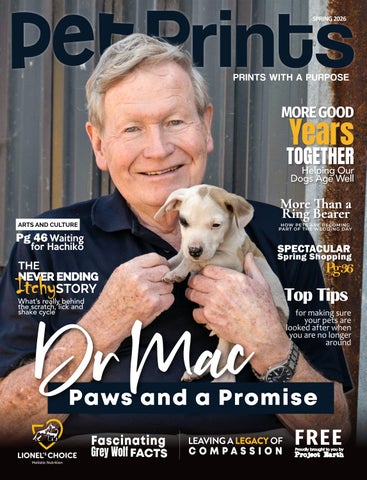
SPRING 2026
MORE GOOD
Years
TOGETHER Helping Our Dogs Age Well
More Than a Ring Bearer
ARTS AND CULTURE
HOW PETS ARE BECOMING PART OF THE WEDDING DAY
Pg 46 Waiting for Hachikō
SPECTACULAR
THE NEVER ENDING
Spring Shopping
Pg36
ItchySTORY
Top Tips
What’s really behind the scratch, lick and shake cycle
c a M r D Paws and a Promise
for making sure your pets are looked after when you are no longer around
Fascinating
Grey Wolf FACTS
FREE COMPASSION
LEAVING A LEGACY OF
I AM DOG I trust you with all my heart. Every moment by your side is a gift, and your touch fills me with warmth. I share your joy and your sorrow, just as if they were my own. Lionel’s Choice Canine Food is specially formulated with a hypoallergenic approach, single-source animal protein diet, enriched with functional botanical extracts to promote gut, skin, and coat health helping to reduce digestive issues and allergies.
I miss you when you’re not with me, but I know you’ll always come back to me. I will love and protect you. I am your companion.
HEALTHY GUT & DIGESTION Contains chicory root, a natural source of prebiotic fiber, and Farmatan®, a blend of gutsupporting chestnut wood tannins, butyrate, and other botanical extracts to promote healthy digestion and function.
SKIN & COAT HEALTH
The right choice makes a lifetime’s difference.
The ideal Omega 3:6 ratio provides a balanced blend of fatty acids to support healthy skin and a shiny coat. Canola oil, rich in Linoleic Acid, plays a key role in maintaining skin hydration.
Protect. Love lionelschoice.com
Lionel’s Choice Holistic Nutrition A Your Companion Brand
Welcome
ISSUE 4, 2026
There is something about spring that always feels a little hopeful. The days become warmer, gardens begin to wake up and the world gently reminds us that, even after the harshest season, new beginnings are always possible. It feels like the perfect time to bring you our Legacy issue.
Of course, the work is far from finished. More than four million dogs and cats in South Africa are still estimated to be without homes. But rather than allowing that number to overshadow this issue, I hope it reminds us why every rescue, every adoption and every act of kindness matters.
When Dr Mac first began working in animal welfare 50 years ago, I wonder if he could ever have imagined how many lives his work would touch. Not only the animals he would treat with his own hands, but the people he would teach, the communities he would serve and the compassion he would quietly pass from one generation to the next.
Throughout these pages, we explore legacy in all its forms. We look at the responsibility of making plans for our pets when we are no longer here, the knowledge passed down by veterinarians, trainers and welfare workers, and the everyday choices that can give our animals healthier, happier lives. You will also find the familiar advice, fascinating facts, heartfelt stories and lighter moments that make Pet Prints feel like home.
Animal welfare has come such a long way during those years. We understand so much more about what animals need, both physically and emotionally. Sterilisation, vaccination, rehabilitation, microchipping and responsible adoption have become part of the everyday language of rescue. At AWS, every animal entering its care is sterilised, while adopted animals are medically and behaviourally assessed, vaccinated, dewormed and microchipped before beginning their new lives. These things may sound routine today, but they represent decades of learning, perseverance and people refusing to accept that “this is just the way things are.”
Because legacy is not only something we leave behind. It is something we build through the lives we touch while we are here. I hope this issue leaves you feeling as proud and hopeful as it has left me. Happy reading!
EDITORIAL Marise Burger Gerhard Maritz Nelda Cilliers Nadia Bruiners Gaironesa Atkins
PHOTOGRAPHY Emma O’Brien Photography
PRINTING Searchlight Publications
CONTRIBUTORS Get-to -Know Dr Adriaan Adank - Hayfields Veterinary Hospital Top Tips for making sure your animals are taken care of when you are gone - By Bryony Van Niekerk More Good Years Together: Helping Our Dogs Age Well By Tanri de Lange The Neverending Itchy Story Jenni Davies
The Project Earth Mission Each person has the power to make a difference in this world. As a magazine focused on animal welfare, we firmly believe in this statement. Our passion for animals has taken us on a whirlwind adventure and we are proud to say that we have been actively involved in paying vet bills, donating food and shelter and even volunteering our time to help the animal welfare organizations that work tirelessly to fight for animals. You can be part of this project by supporting us. The bigger our network, the more animals we will be able to help.
Leaving a Legacy of Compassion- Allan Perrins Following the Footsteps - Zani Koen Ask the Vet - Dr Travis Gray
“The universe does not give you what you ask for with your thoughts; it gives you what you ask for with your actions.” Dr Steve Maraboli
ON THE COVER
CONTACT DETAILS Marise Burger
FEEDBACK AND LETTERS mail@petprints.co.za
071 382 7795 marise@projectearth.org.za
@petprintsmag
COPYRIGHT: All rights reserved. Pet Prints is published by Umsebeni Emhlabeni (Pty) Ltd t/a Project Earth. All profits go towards assisting nonprofit animal welfare organisations in need. The opinions expressed in this magazine do not necessarily reflect those of the editors of this magazine. While every effort is made to ensure editorial and factual accuracy, no responsibility is accepted for any errors.
SPRING 2026
CONTENT 04 GET TO KNOW YOUR VET
Dr Adriaan Adank from Hayfields Veterinary Hospital
06 FROM OUR READERS
Write to us and stand a chance to win a R300 Online Voucher From Marmaduke Pets
08 FEATURE ARTICLE
Dr Mac from AWS Philippi on a promise that’s lasted more than 50 years
14 TOP TIPS
Bryony van Niekerk gives advice on how to make sure your pets are taken care of when you are gone
16
28 FASCINATING GREY WOLF FACTS 36 FASHION SPREAD
SPRING THINGS Adding a little colour to your season
40 RECIPES
Fresh Spring recipes celebrating home cooking, happy pets, and vegetarian goodness.
36
44 KIDS ZONE
Doggy Waterbottle
Track Facts | Help the Bee find the Flower | Design a new animal
The Doggy water bottle is the gym-bag, schoolbag, walk-bag companion for women whose lives orbit a four-legged shadow.
48 PETS NEED A BREAK!
Following the Footsteps Exploring the trails we inherit
16 KINETIX
More Good Years Together: Helping our dogs age Well. Advice from Kinetix Physiotherapy
18 LEAVING A LEGACY OF COMPASSION
56 ADOPTIONS
58 BREED SPECIFIC ADOPTIONS
Even the smallest gift can become a lasting act of kindness
Pitpals
22 KYRON
60 WELFARE DIRECTORY
The Never Ending Itchy Story
22 DOGTOWN
Why dogs keep doing naughty things
Pg 40
Great Value
AWS Philippi and Kysna Animal Welfare
08
FEATURE ARTICLE
Dr Mac from AWS Philippi on a promise that’s lasted more than 50 years
Get to Know
Dr Adriaan Adank from Hayfields Veterinary Hospital
T
hinking back, I never imagined how being a vet would take me on a journey of both miles and mindset. After qualifying from Onderstepoort in 2010, I soon realised that academic knowledge had merely given me a license to learn through daily experiences. After a brief stint in the UK with my veterinary nurse girlfriend at the time – now my wife – I returned home to sunshine and blue skies in Namibia. My first years of ‘vetting’ (as my friends called it) were spent in mixed-animal practice settings in Windhoek, Otjiwarongo, Mariental, and Okahandja. I treated livestock, horses, and pets, while also assisting local wildlife and game capture teams. I was involved with AFSCAN (the African Small Companion Animal Network), and attended inspiring conferences in America, Tanzania, and Uganda. At the end of 2018 my wife and I moved to Hilton in KZN and I have been a partner at Hayfields Vet since 2021. My love of animals and medicine started early. Growing up in a nature reserve, with parents who shared a love of nature and medicine, gave me an early empathy for animals and a real appreciation for the privilege of caring for them. Add in a lifelong fascination with wanting to take things apart just to see how they fit back together, and veterinary medicine turned out to be a natural fit. Solving puzzles and trying to help creatures that can’t speak for themselves. When people ask what a typical day looks like, there really isn’t one. While I now work in an appointment-based clinic, veterinary work remains unpredictable. One moment consulting, performing surgery or taking radiographs, the next removing porcupine quills from an unfortunate puppy’s muzzle… one moment showing an owner how to clean ears or feeding an injured bird, and the next, doing an ultrasound on a koi fish or treating a trauma patient.
04 Pet Prints
I’ve always had a special interest in surgery and I find great satisfaction in repairing a physical injury or an anatomical problem. Whether it is a caesarian, a fractured leg or a horse with a cut running the length of its trunk, I love it. Of course, treating the animal always means navigating the human side of the equation. Veterinary medicine can be emotionally demanding, and compassion fatigue and the heavy mental load are real. Balancing clinical decisions while holding space for an owner’s worry and financial constraints takes a toll, and protecting our well-being helps us stay grounded. I try to read between the lines, tuning in to what owners are saying (spoken and unspoken) so we can untangle the various factors contributing to a pet’s health and welfare together. Away from the surgery, my life looks different now from when I was often on emergency horse and farm callouts. While I certainly enjoyed the exhilaration, I now cherish this more predictable phase of family life far more. Currently, my favourite moments are quieter, spending time with my wife and our two beautiful daughters. I still like taking things apart though, and sometimes get carried away with fixing things. My girls often say, “Pappa likes to fix things… and break things!” Be that as it may, I do believe strongly in leaving things better than you found them - whether that means repairing a fractured leg, easing an old dog’s pain, helping an anxious owner understand what comes next, or occasionally fixing whatever I have just broken at home. Veterinary medicine has taken me much further than I imagined when I left Onderstepoort 16 years ago, but one thing hasn’t really changed: every day still brings something I haven’t seen before. And perhaps that is the privilege of being a vet - we never really stop learning, because our patients never stop teaching us!
POWER CHEWS Calling all pet lovers! Stand a chance to spoil your furry best friend with an amazing M-PETS Power Chews Hamper
05 Pet Prints
FROM OUR READERS
ROMEO This baby boy (Romeo) is still fighting the odds at 18 years old. With a brain tumour, kidney disease, oral cancer and epilepsy all while living his best life, and being the most handsome boy in the world all at the same time. - Braidy Connolly (Vegan Streetfood)
iris Meet Iris, my beautiful pirate pup and, in many ways, the reason I became a dog trainer. Iris was a dog who challenged me to look beyond obedience and really understand what dogs were trying to communicate. She taught me that sometimes the best way to change a dog’s behaviour is to first change the way we understand them. So while I have worked with many dogs since, Iris will always hold a very special place in my heart. - Madhu Oberholzer
justice Justice; The dog who was never supposed to come home. Found in 2019, Justice survived months of oral surgery to become a beloved family member and a powerful ambassador for pit bulls. For six and a half years, he broke stereotypes, taught unconditional love, and changed countless lives through his kindness. He passed away on 19 June 2026, leaving behind an immeasurable legacy of love, resilience and lives forever changed. -Carey-Anne and Fabian Diamond
Tag us on instagram @petprintsmag 06 Pet Prints
django Rescued by TEARS Animal Rescue from a life on a chain and after a life-saving surgery with months of rehabilitation, Django (the unchained) came home with me in 2019. He was meant to be an only dog, but instead became a foster brother to almost 200 rescue puppies, patiently helping the little ones feel safe, loved and at home. Along the way, he chose his own siblings and they absolutely adore him. But more than that, Django changed the trajectory of my life, opening my eyes to the struggles animals face and inspiring Paws-aWhile and my commitment to helping animals in need. - Carolyn Dudgeon
chad Hello world! Meet Chad (Aka Chaddy boy). Rescued at 2 weeks old by Grace Animal Sanctuary, riddled with coccidia, Chad didn’t have the easiest start to life. Thanks to his goofball personality, uncontrollable ears, and the biggest heart, he became a foster fail at 3 months old. Since then, he has raised over 200 foster siblings, attended multiple school talks, rescue events, and gained way too many grey hairs. Our boy may be a senior now, but he’s still a puppy at heart, learning new tricks, prancing around the garden like a show pony, and teaching fosters how to play. Chaddy, you are so loved my boy! - Maxene Lyons
kylo Adopting Kylo from Pit Pals was, without a doubt, the best decision of my life. I knew I wanted to be part of the small group of people willing to give an adult dog a second chance at life. I have never regretted that decision for a second. Watching Kylo grow, nurturing him, and helping him become the confident dog he is today has been one of the most rewarding experiences of my life. In many ways, Kylo helped me find my purpose. He inspired me to always root for the underdogs, and I will continue to adopt, advocate, and stand up for this beautiful and often misunderstood breed. -Cherie Okkers (BodyDog)
Send us a cute pic of your furry baby along with a little description of them, and stand a
CHANCE TO WIN A
R300 VOUCHER One lucky entry from each issue of Pet Prints will win a prize from the Marmaduke Pets online store.
www.marmadukepets.co.za
07 Pet Prints
c a M r DPaws and a Promise
Dr John “Mac” McMullen arrived in Cape Town on his way to America. Fifty years later, the young Irish veterinarian who promised not to let one small welfare society down is still here, and thousands of animals and families are better for it.
Photography by: Emma O’Brien Words by: Marise Burger Hair and Make-up: Lauren Raquel 08 Pet Prints
09 Pet Prints
T
here are some people whose lives seem to be shaped by a single, dramatic decision. For Dr John McMullen, known simply and affectionately as Dr Mac, it was something far quieter. A visit. A handshake. A promise made in a modest animal hospital with very little money, almost no equipment and more need than any one person could possibly meet. When we sit down at the Animal Welfare Society of South Africa in Philippi, the hospital tells a story of its own. Animals rest in clean wards. Staff move purposefully through the passages. Behind theatre doors, lives are being repaired in a hospital offering private-practice standards to those who need them most. It is difficult to reconcile this place with the one Dr Mac first walked into in 1975. Back then, Cape Town was never meant to be home. He had come to visit his brother while on his way to join a colleague in New York. Then his brother and sister-in-law left for the Greek Islands and Dr Mac, bored with babysitting and curious about the possibilities around him, began knocking on the doors of veterinary practices. The answer was not encouraging. The profession was, as he remembers it, a closed shop. A foreign-qualified vet was not particularly welcome. So, he turned to welfare organisations and, through someone connected to the Animal Welfare Society, met the woman who was then its CEO. The Society did not have a veterinarian of its own. Private practices sent out young, inexperienced vets and charged for each item of work. AWS needed someone permanent. Dr Mac offered them a year. He would work exclusively for the Society, he said, provided
10 Pet Prints
“I said I wouldn’t let them down.” he could open his own practice afterwards if everything went well. More importantly, he told them, “I won’t let you down.” There was no lengthy legal agreement and no carefully negotiated package. There was a handshake, a salary of R600 a month and a seven-day working week. His recollection of that first day is wonderfully blunt: “It was terrible.” Not knowing which way was up or
down, a language barrier and a translator was all he had to survive those first few weeks. He jokingly remembers that he quickly got to know all the Afrikaans swear words remarkably fast. The first months were exhausting. The hospital was small and desperately poor. There was no proper surgical equipment, so they searched hospitals for redundant stock and gathered second-hand instruments wherever they could. Piece by piece, they built what he calls their “small arsenal of tools”. In the process, the young vet acquired the surgical skills that necessity demands and textbooks cannot fully teach.
One year passed. Dr Mac opened his own practice with a partner who understood welfare work. It eventually grew into seven practices in Cape Town and two overseas, but the promise remained. “I said I wouldn’t let them down,” he tells me, as though five decades of service were simply the obvious consequence of giving one’s word. For years, that handshake was the entire contract. It was only in 2016, when the executive committee asked to see the paperwork, that everyone discovered there was none. A formal contract was finally drawn up, more than four decades after the work began. There is something beautifully fitting about that. The earliest foundations of this place were trust, loyalty and a man who meant what he said. Today, AWS Philippi has a refurbished hospital and offers almost every service available through a private veterinary practice. The team performs around 30 orthopaedic procedures a month for animals whose owners could never afford that care elsewhere. There are still limitations. Dr Mac would love an ultrasound machine, and funding remains the quiet ache beneath almost every welfare conversation. Donations towards sterilisation projects often cover only a third of what is needed. Yet, what this relatively small team produces is, in his words, phenomenal. Together, they operate not as a corporation but as something much more personal. When I ask him to describe AWS Philippi in one word, he answers without hesitation: “Family.” That word matters here, because Dr Mac’s understanding of welfare has never stopped at the animal in front of him. It reaches down the lead to
the person holding it and, often, to the child walking beside them. Years ago, AWS recognised that changing animal welfare meant teaching children. Without education, young people may grow into adults who do not recognise suffering. The team began visiting schools, welcoming learners to the hospital and working with children in surrounding communities. They became AWS’s “little ambassadors”, watching for animals that needed help.
Some have walked kilometres to find that help. The one particular story that comes to mind is that of Gerry and his brother, Peter, two small boys who travelled five kilometres over unforgiving terrain, without shoes, carrying a sick dog almost as big as they were. The image
is difficult to forget. Little bodies bearing the weight of an animal they loved because leaving her behind was never an option. Their circumstances were dreadful, but their compassion was not diminished by what they lacked. AWS later watched the boys grow, helped by donations that included bicycles, and saw one become a more responsible young adult. This is the truth Dr Mac wants people to understand about pets in lower-income communities. Love is not measured by a bank balance. People love their animals, and their animals love them. What may be missing is access, transport, knowledge or the ability to recognise how serious an injury has become. In earlier years, the welfare team had to travel out and search for animals in need. Today, a mobile phone can bring help to the right place far more quickly.
11 Pet Prints
Nor is financial hardship confined to one community. Private practices also refer clients who, through no fault of their own, cannot afford an operation. They arrive at AWS carrying beloved members of their families. “They’re lucky we are here,” Dr Mac says. He is right, although he would resist the suggestion that much of that luck began with him. One of the things I always ask people working in welfare is: “How do you do it?” “How do you stay so strong and not let the sadness of this work overwhelm you?” It’s a tough question, because the majority of people have always answered this with, “I’m not sure, I just do it” or “It does get to me sometimes.” But Doctor Mac’s answer really got to me. I think in psychology they call this the contrast effect. 12 Pet Prints
A repaired leg is not simply a procedure completed; it is a triumph. A child asking for help is proof that education has taken root. An animal going home is a small victory carried back into a family and a community. You become accustomed to seeing both the best and the worst, he says, and once you have seen the truly terrible cases, “the best is even better”. Against that darkness, every recovery shines more brightly. A repaired leg is not simply a procedure completed; it is
a triumph. A child asking for help is proof that education has taken root. An animal going home is a small victory carried back into a family and a community. This answer to me is the best example of hope that I’ve heard in a very long time. If someone of seventy-eight can see the silver lining after all the things that he’s seen in more than fifty years in welfare, who are we to say that there’s only doom and gloom in the sector. When we speak about legacy, Dr Mac does not describe a plaque, a title or a list of personal achievements. To him, legacy is something taught or left behind that continues to move without you. It becomes self-perpetuating. It grows. It accelerates.
You can see that legacy everywhere at AWS Philippi. It is in four theatres where once there were scavenged instruments. It is in staff who know excellence should not depend on income, in children who notice suffering and in every animal carried through the doors by someone determined not to give up.
QUICK-FIRE WITH DR MAC
But his most important message is also his simplest. If you take on an animal, you take on a life. Not a Christmas present or a birthday surprise to discard when it becomes inconvenient. A life. That animal is family until the very end, and that end should be met with compassion and dignity, never abandonment.
Senior dogs. They are particularly special for someone whose circumstances have changed.
Dr Mac arrived in Cape Town intending to pass through. Fifty years later, he is the third CEO of an organisation that has outgrown its humble beginnings without losing its heart. He speaks of those who came before him, Miss Atkins and June Woodman, with affection, and of those who will follow with certainty. There are, he says, many more chapters still to come. As I leave the hospital, I keep returning to that first handshake. Dr Mac promised he would not let them down. He meant the Society, of course. But in keeping that promise, he did not let down the animals, the families who loved them, the barefoot children who carried them or the generations of young vets who would learn that welfare is not simply a branch of medicine. It is a calling. Some legacies are carved into stone. Others breathe, heal, teach and carry on. Dr Mac’s has four paws, countless faces and a pulse that can be felt throughout Philippi. And much like the man himself, it shows no sign of retiring. Apparently, the more acceptable phrase is succession plan.
CATS OR DOGS?
Both. I refuse to choose.
PUPPIES OR SENIOR DOGS?
EARLY-MORNING RESCUE OR MIDNIGHT EMERGENCY?
Neither, these days but when you have to go, you go.
THE MOST STUBBORN ANIMAL? People.
THE MOST MISUNDERSTOOD ANIMAL? Chickens. They are not quite as sensible as dogs and cats, which can make them a little more difficult to understand.
THE ANIMAL MOST LIKELY TO OUTSMART A VET? A dog.
YOUR FAVOURITE IRISH COMFORT? Irish single-malt whiskey.
TEA OR COFFEE AFTER A DIFFICULT SHIFT? Tea.
ONE THING EVERY PET OWNER SHOULD KNOW? Get pet insurance.
ONE THING EVERY YOUNG VET SHOULD LEARN?
Patience. Especially if they want to work in animal welfare, where they will not always have all the equipment and resources available in private practice.
AWS PHILIPPI IN ONE WORD?
Family. We are a relatively small team, but the impact we make together is phenomenal.
To find out how you can support Dr Mac and the amazing work done by the AWS Philippi team visit www.awscape.org.za
THE PAST 50 YEARS IN ONE WORD? Amazing.
RETIREMENT: A REAL PLAN OR AN ONGOING RUMOUR?
An ongoing rumour. At AWS, we prefer to call it a succession plan.
13 Pet Prints
Top Tips for making sure your pets are
LOOKED AFTER
when you are no longer around
14 Pet Prints
When it comes to estate planning, we all know to make provisions for our assets; houses, cars, inheritance for the kids, but what about our pets? Pets are often overlooked when people draw up their wills, leaving loved ones to suddenly figure out what happens to the animals whose entire world has just been turned upside down. And perhaps that isn’t surprising. One of the hardest parts of having pets is acknowledging that, one day, we will have to say goodbye to them. We don’t often stop to consider the opposite: what happens if they outlive us?
My partner and I had never considered setting up a will until our financial planner brought it up. At the time, we thought it was pretty unnecessary. We barely had any assets besides a car and a small amount of savings, so we couldn’t really see the point. Our financial planner explained the benefits and was even the one to tell us to include the dogs and cats and make sure we named who would be responsible for them should both of us pass away.
them with this information after your passing.
My mom became the lucky prospective recipient of two dogs and three cats, along with money set aside to help with their ongoing care. It is, however, important to take your pets specific individual needs into consideration. Age, breed, size, medical conditions and bonded pairs are some of the factors that will play a role in determining what the best plan will look like.
Draft a will
For some pets, rehoming with a trusted family member may be the obvious choice. For others, particularly elderly or seriously ill animals, the kindest option may be to consider their quality of life and existing veterinary care. These are deeply personal decisions, and there is no one-size-fits-all answer. None of us wants to think about leaving our pets behind. But it can and does happen. Making provisions for them is one final act of love, helping to ensure that they are cared for and safe.
TIPS:
Come up with a plan
Before worrying about the legalities, start by deciding what you would actually want to happen to your pets. Think about who you would trust to care for them, whether your pets would need to stay together and what their individual needs are. Have open and honest conversations with the people you are considering as appointing as caregivers and make sure they are willing and able to take on the responsibility. Do not blind side
It is also important to identify a temporary or emergency caregiver who can step in immediately if something happens to you. This person should ideally be familiar with your pets and have access to your home, their food, medication, veterinary records and all the information they would need to keep things as normal as possible.
Once you have your plan figured out, put it in writing. In South Africa, pets are legally regarded as property so they form part of your estate. In your will, you can set out your longer-term wishes, including who you would like to care for your pets and how funds (if any) should be allocated towards their care. Your attorney or estate-planning professional can advise you on the best way to structure this.
Make financial provision for your pet’s care As we are all well aware, caring for pets can be quite expensive. Food, vet bills, toys, treats, groomers and medication all add up very quickly. Ideally, one would make financial provision as part of your estate planning. In this way, funds are allocated ahead of time for the continued care of your pets. Compile a list of your pets’ current expenses and consider how much money would realistically be needed to continue looking after them. This could include food, veterinary care, medication, grooming, boarding and other ongoing expenses. This is definitely a nice-to-have rather than something everyone would be in a position to do. But if you are able to set aside money or establish an
Bryony Van Niekerk Mom of dogs; slave to cats. An environmentalist who loves travelling, baking and going on adventures with her dogs, Linc and Oliver. To be a part of the chaos, follow @misadventures_of_ollie
appropriate trust or other financial arrangement, it can make a major difference. These funds could help ease the financial burden on your appointed caregiver and make it easier for them to fulfil their responsibilities.
Make sure the plan can be put into action Having everything written down is all well and good, but it is only useful if the people who need it can find and understand it. Keep all your pets’ important information together and make sure your nominated caregiver knows where to find it. This could include veterinary records, medication instructions, microchip details, feeding routines and contact details for your vet. Make sure someone you trust knows where your will and pet-care instructions are kept. You don’t want your family or nominated caregiver having to search for this information during what will already be a very difficult time. Lastly, do not forget to update your plan. Pets age, circumstances change and the person you originally nominated may no longer be able to take responsibility. A quick review every few years can help ensure that the plan you originally put together is still relevant and, most importantly, still the right one for your pets. 15 Pet Prints
More Good Years Together Helping Our Dogs Age Well By: Tanri de Lange SAVC Registered Veterinary Physiotherapist
16 Pet Prints
MOVEMENT | COMFORT | CONNECTION
T
here is something incredibly special about growing old alongside our dogs. The grey hairs around their muzzle, familiar routines and quiet companionship are reminders of the years we have shared.
While we cannot stop our dogs from ageing, we can influence how they age. Supporting mobility, strength and comfort can help our older companions continue doing the things they love and enjoy a better quality of life for longer.
Ageing is not a diagnosis
It is normal for an older dog to slow down, but significant changes in mobility should not simply be dismissed as “old age”. Difficulty getting up, reluctance to climb stairs, struggling to get into the car, tiring more quickly on walks or changes in gait can all indicate discomfort or a loss of physical function. Recognising these changes early is important. The sooner a problem is identified, the more opportunities there are to support mobility and preserve function.
Keep them moving
Regular, appropriate movement is one of the most important ways we can support an ageing dog. Exercise helps maintain muscle strength, joint mobility, cardiovascular fitness and coordination. However, exercise should be adapted to the individual. A senior Labrador with arthritis may have very different needs from a senior Border Collie who still wants to chase a ball.
Maintaining a healthy body weight is equally important, as excess weight increases the physical demands placed on the musculoskeletal system. Veterinary physiotherapy can form part of a multimodal approach to maintaining mobility, alongside veterinary care, appropriate nutrition and environmental adaptations. Treatment and exercise programmes can be tailored to each dog’s individual needs, lifestyle and goals.
More memories, together
Helping a dog age well isn’t about keeping them physically young forever. It is about preserving the things that make their life, their life. For one dog, that might mean continuing to enjoy their daily walk. For another, it may mean getting up comfortably to greet their family, playing with a favourite toy or climbing into the car for another adventure. Ageing is a privilege we are fortunate to share with our dogs. By recognising changes early, encouraging appropriate movement and maintaining strength, we can help our companions remain comfortable, active and engaged with life.
Because the legacy our dogs leave behind isn’t measured only in the years they were with us. It is measured in the memories we made together. And sometimes, helping them move a little more comfortably today gives us the opportunity to make many more memories tomorrow.
Shorter, more frequent walks may be better tolerated than one long outing, while gentle games, controlled strengthening and balance exercises can help maintain physical capacity without excessive strain. The goal isn’t to stop an older dog from being active, it is to help them remain active in a way their body can comfortably handle.
Small changes, big difference
Our homes can also be adapted to make everyday movement easier. Non-slip mats can improve traction on slippery floors, while ramps may help dogs get into the car or access favourite areas. Comfortable, supportive bedding can make resting easier too.
17 Pet Prints
Leaving a Legacy of Compassion By Allan Perrins
18 Pet Prints
W
hen I retired from the South African Navy in 1999, having attained the rank of Commander MMM, I knew I still wanted to serve and make a meaningful difference to those less fortunate. That calling led me into animal welfare, a sector in which I have now worked for more than 25 years. Of all the roles I have held, my current position as Head of Communications, Resource Development and Fundraising for the Animal Welfare Society of South Africa has been among the most challenging and certainly the most rewarding. It has also taught me an important lesson sustainable animal welfare depends not only on the generosity of donors today, but on the extraordinary foresight of people who choose to leave a legacy for tomorrow. I have been privileged to meet many of these remarkable individuals- testators whose compassion extends beyond their own lifetimes. I have witnessed first-
financial pressure, with organisations relying heavily on donations to fund medicines, food, electricity, vehicles, staff and emergency treatment.
on individual circumstances and should always be discussed with a suitably qualified South African estate-planning professional.
A bequest can provide something that everyday fundraising often cannot, and that is, the ability to plan for the future. A legacy gift could help upgrade veterinary facilities, replace an ageing vehicle, purchase essential equipment, improve animal accommodation, strengthen sterilisation programmes or establish reserves that provide greater financial resilience. Its impact may continue for years, helping an organisation respond not only to today’s emergencies but to tomorrow’s challenges.
There may also be tax implications. Section 4(h) of the Estate Duty Act 45 of 1955 provides for a deduction in respect of property bequeathed to certain approved public benefit organisations. Where an animal welfare organisation qualifies, a charitable bequest may therefore reduce estate duty.
And the gift does not have to be enormous. Every Cent matters. There is another important consideration for people who share their lives with companion animals. Under South African law, animals cannot inherit from an estate in their own right as they are legally regarded as property. Anyone wanting to
Knowing that a portion of your estate will help feed a rescued animal, fund life-saving veterinary treatment, prevent unwanted litters or give an abused animal another chance can bring profound comfort. Your will becomes more than a legal document distributing assets. It becomes an enduring expression of who you are and what you believe matters. If you decide to include an animal welfare organisation in your estate plan, ensure that its full registered legal name and relevant registration details are accurately
Even the smallest gift can become a lasting act of kindness hand the extraordinary difference their bequests can make. Their gifts have helped organisations survive difficult times, invest in their future and most importantly, continue saving and transforming lives. Estate planning is ultimately about values. For many South Africans preparing a will is understandably focused on providing for family, loved ones and the distribution of assets. Yet a thoughtfully prepared estate plan can also express the causes and principles that have mattered throughout a person’s life. For those who care about animals, remembering an animal welfare organisation in a will can transform that compassion into a lasting legacy. Across South Africa, animal welfare organisations rescue abandoned and abused animals, provide veterinary care, promote responsible pet ownership and tackle the devastating cycle of unwanted litters through sterilisation. Much of this work is undertaken under immense
ensure that their pets are cared for after their death should therefore make specific arrangements in their will. A trusted person may be nominated to assume responsibility for surviving pets, with appropriate provision made for their care. Alternatively, arrangements may be discussed with a reputable animal welfare organisation, subject to its policies and capacity. A will can also provide for an animal welfare organisation through different types of charitable bequests. These may include a pecuniary bequest, leaving a specific sum of money; a specific bequest, involving an identified asset; or a residuary bequest, leaving all or a percentage of what remains of the estate after debts, expenses and other bequests have been settled. A contingent bequest can also provide for an organisation to benefit should specified circumstances arise. The most appropriate option will depend
recorded. Avoid vague descriptions such as “my local animal shelter”. Review your will periodically, particularly after significant life events or changes in your financial circumstances. And if the organisation you support has a legacy or bequest society, consider joining it. You are not simply making a financial commitment you are joining a family of extraordinary change-makers whose collective generosity can shape the future of animal welfare. To everyone who has ever considered leaving a bequest to animal welfare, I offer my heartfelt assurance. Your kindness is never taken for granted. Whether your gift is large or modest, it has the capacity to accomplish something truly magnificent. It is my belief that estate planning and animal welfare can create a legacy of compassion one that truly lives on.
19 Pet Prints
Your peace of mind in Veterinary Practice Management est. 1998
FEATURES Patient Management:
age, weight history, and gender status. the unique requirements of the veterinary
Accounts Management: manage their accounts, customizing including Debtors Age Analysis, VAT Report,
Inventory Management: precise control over various stock types such as food, merchandise, and drugs. From order placement to stock receipt and sales, the system ensures secure stock from suppliers/manufacturers, including management of the Schedule Drug Register. VETSOFT Reporting: of reports, including up-to-date sales Reports can be easily accessed on-screen, emailed, or printed, with user-friendly
debtors during the billing process, along statements via print or email. Practice security & User Roles: Experience tailored access control with
Reminder Module: Leverage our SMS module to
Bookings & Calendar Management: booking and calendar management system. allowing for easy appointment bookings and
management features. Leave Management: The easy-to-use leave management records to be kept that ensures good hospital/store. MOP (Multi-owner facilty for pets) owners, simplifying the process through percentage calculator ensures accurate
security.
unallocated costs.
SCAN FOR MORE
20 Pet Prints
The Legacy of Every Good Choice The choices we make for our pets today become part of the lives they live tomorrow.
TOGETHER WE CARE
Protect. Love
Legacy is often thought of as something extraordinary - something we leave behind for future generations. But when it comes to our pets, it can be found in much smaller, everyday moments. It’s in the bowl we fill every morning. In choosing food that gives a growing puppy what it needs. In remembering to deworm regularly. In giving them a bath when they need one, keeping their bedding fresh, or making sure the cat who rules the home has a nutritious meal waiting for them. Because caring for an animal isn’t one big decision. It’s all the little choices we make for them, day after day. At Lionel’s Choice, we believe those choices matter. Our range includes a hypoallergenic approach adult dog and puppy food, cat food, canine dewormer, pet shampoo and pet spray products made to help pet owners take care of the everyday needs of the pets who have become such an important part of our lives. And that care doesn’t have to stop at home. Across South Africa, shelters and animal welfare organisations work
tirelessly to care for animals who have been abandoned, lost or simply had a difficult start in life. For these organisations, feeding the animals in their care is an everyday challenge. Every bag of food helps. Supporting shelters and welfare organisations, and helping get food to animals who need it most, is one way of extending that circle of care. Because every animal deserves to feel what it’s like to have a full bowl, a safe place to sleep and someone looking out for them. And then there are all the things our pets give back to us.
health, keeping them comfortable and giving them the love and care they need. And sometimes, it’s about extending that care to an animal who has no one else. Because the best legacy we can leave is one where more animals get the chance to live healthy, happy lives. Choose their food with care. Choose their wellbeing with care. And wherever you can, choose to care for one more. Lionel’s Choice - because every choice counts.
The dog who greets you like you’ve been gone for years, even when you’ve only been at work all day. The cat who feels your lap is the only comfortable place to sit. The muddy paws, stolen snacks, hair on everything and those little routines that somehow become part of the fabric of family life. Our pets may only be with us for a chapter of our lives, but the memories they leave behind stay with us for much longer. That’s why the choices we make for them matter. A legacy of care isn’t about doing something extraordinary every day. It’s about doing the ordinary things well - feeding them, protecting their
Lionel’s Choice | A Your Companion Brand For more information please contact us. P +27 21 911 5552, E info@lionelschoice.com
lionelschoice.com
21 Pet Prints
Itchy Story The Never Ending
By: Jenni Davies
Scratch-scratch, nibble-nibble, thump-thump, for anyone who
has had an itchy dog, these are alltoo-familiar sounds. And while the terror that scratches in the night might be annoying, knowing how much distress the itching is causing your canine companion is even more frustrating. Perhaps worse still is thinking you’ve gotten it under control and can breathe a sigh of relief, only for the itching to return with a vengeance. The fact is that canine skin conditions can be surprisingly complex and involve way more than just what you see on the surface. That’s why looking beyond the symptoms, identifying the real cause and supporting overall skin health are key to getting the problem under control.
22 Pet Prints
THE SITCH BEHIND THE ITCH There are many triggers of itching in dogs. For some, it could be something simple like fleas; for others it could be allergies, an underlying skin condition, or a genetic predisposition. And sometimes, it’s a perfect storm of several, all feeding into one itchyscratchy circle. Unfortunately, there is no simple “click here for itchy skin” test. A step-by-step approach is needed. Vets usually begin by taking your dog’s history and examining the skin. They’ll check for the most obvious causes first, gradually eliminating possibilities. This might mean ruling out fleas, checking for bacterial or fungal infections, or looking at obvious irritants. Sometimes skin scrapings or hair samples may be taken to look for parasites, and blood tests might be recommended if other symptoms suggest an underlying health problem. If simple causes are eliminated and your dog is still going for the gold medal in itching, you may need to investigate more challenging-to-solve problems like food or environmental allergies. In some dogs, there is also an inherited tendency to develop environmental allergies, known as atopy. And this is where things often become complicated.
WHEN ALLERGIES LAST A LIFETIME If you’ve ever sneezed yourself silly at the sight of a bouquet, you’ll know all about allergies. But what even is an allergy? Our immune systems (that’s us and our furry family members) are designed to identify pathogens – things that can make us sick – and react to get rid of them. But sometimes the immune system reacts to the wrong thing, not unlike your dog menacing a falling leaf. This usually harmless substance is called an allergen, and it can be anything from pollen and dust mites to a particular food protein. Once the body has identified the “threat”, chemicals such as histamine are released, causing inflammation and symptoms like itching and sneezing. And just like you don’t know why your dog has decided an innocent leaf is the enemy, we don’t fully understand why some develop allergies while others don’t. What we do know is that there is a genetic element to allergies. In some dogs, this means their immune system is more likely to overreact to otherwise harmless environmental substances. This is an inherited tendency called atopy, and it can show up as itchy, inflamed skin, known as atopic
dermatitis, which requires longterm management. Okay, just avoid the allergens problem solved. Unfortunately, it’s not that simple for dogs with environmental allergies, particularly those with atopy. Of course, reducing exposure to known triggers where possible is helpful (e.g. keeping dust and mould under control), but trying to eliminate every allergen just isn’t realistic. After all, we can’t stop flowers from making pollen. The first priority with a dog enduring an itch-fest is to bring the irritation under control and make them comfortable as swiftly as possible. This is usually where treatments like soothing topical creams and shampoos and antiitch medications like cortisone are prescribed. In many short-term or simple cases, like a dog that gets bitten by an itch-inducing insect, a short course may be all that’s needed - end of the story. Unfortunately, for dogs with atopy, it’s rarely that simple. And it’s where their owners often hit a frustrating barrier: thinking the problem is solved, they stop treatment. Before long, the dreaded itchy-scratchy dance returns to blight your pooch’s life. Back onto medication they go until they seem better… and thus begins the seemingly endless loop of itch-control treatment and flare-ups.
THE CYCLE
TRIGGER
INFLAMMATION
ITCH
SCRATCH OR LICK
BARRIER DAMAGE
SKIN CARE IS FOR LIFE The key to effective long-term management is to focus on the dog, not the triggers or the itching itself. Keeping a chronically itchy dog’s skin healthy isn’t just about what you do during flare-ups (although that’s important too). It’s about supporting their skin health throughout life and reducing the chances of flare-ups occurring in the first place and the skin barrier plays a starring role. Skin is a complex, multi-layered organ, with each layer playing its own role in protecting the body. As part of the outermost layer of skin, the skin barrier creates a protective boundary between the body and the outside world. It helps keep moisture in while keeping irritants, allergens, bacteria and other unwanted nasties out. A healthy skin barrier is more resilient to everyday environmental challenges and can repair itself more easily if damaged. This is particularly important for dogs with chronic skin problems, where inflammation, infection, parasites and repeated
scratching and licking put the skin under continual strain, and every little thing becomes an explosion of inflammation. As the saying goes, beauty starts from within, but in this case, we’re talking nutrition (we already know your dog has the most beautiful personality). Just like the rest of the body, healthy skin needs the right nutrients to maintain itself and repair damage. A good-quality, balanced diet provides the building blocks needed to support the skin barrier, healthy skin cells and a shiny, healthy coat. That starts with feeding them well. Whether that’s with commercially prepared food or a properly formulated homecooked diet. Your vet can advise on what’s most appropriate for your dog, especially if they have specific nutritional needs. If food allergy is suspected, they may also recommend a specially formulated hypoallergenic diet. Several nutrients play an important role in maintaining healthy skin
and the essential fatty acids (EFAs) omega-3 and omega-6 are the stars of the skin-support cast. Both provide fats needed to maintain the skin barrier, while omega-3 supplementation helps to reduce inflammation. Research has shown that EFA supplementation can help improve clinical signs in some dogs with atopic dermatitis and may reduce the amount of corticosteroid treatment needed. Other nutrients the body needs for skin health and repair include vitamins A and E, B vitamins and zinc. For dogs with higher-than-average nutritional needs, getting enough of these from their everyday diet can be challenging. This is where targeted nutritional support can help. Products like Efazol combine a range of omega 3 and 6 essential fatty acids with known skin-support nutrients including vitamins A and E, biotin, vitamin B6 and zinc to provide a powerful skin-support punch.
Common causes of itching • Parasites: Fleas or mites (such as those responsible for sarcoptic mange) can cause intense itching.
• Dry or damaged skin: Dryness and skin barrier damage can create itching, flaking and increase vulnerability to other problems.
• Allergies: Some dogs react to proteins in their food, while others react to environmental allergens like mould, pollen and dust mites. Often, the same dog can react to multiple allergens.
• Systemic conditions: Hormonal disorders, such as Cushing’s Disease and an underactive thyroid, can sometimes contribute to skin problems.
• Irritants:: Not all reactions are allergies. Substances that come into contact with the skin, such as grass, sand, friction, harsh shampoos or too-frequent bathing can be irritating.
• Physical factors: Certain physical characteristics can contribute to itching, such as skin folds which trap moisture and debris, encouraging bacterial and fungal overgrowth.
• Infections: Bacterial infections and yeast overgrowth can cause itching, inflammation, and overall skin and coat changes.
24 Pet Prints
• Atopy: An inherited tendency to develop allergies to harmless substances.
THE BIGGER PICTURE Of course, nutrition is just one piece of the puzzle, albeit a crucial one. Managing your dog’s lifestyle and known allergens, treating infections or parasites, and using prescribed medication correctly are all important too. With chronic skin conditions, there’s rarely one magic fix and resolving them takes patience and consistency. A damaged skin barrier doesn’t magically repair overnight and, after prolonged inflammation, infection, parasites and repeated scratching, licking and chewing, recovery takes time. There’s also a behavioural element at work for some dogs. After weeks of obsessively licking an itchy paw, they may keep going long after the original irritation has improved. But, if you stick to the plan, there is light at the end of the tunnel. When it comes to dogs with problem skin, good results aren’t about waiting for a flare-up and then putting out the fire. It’s about playing the long game, carefully putting the puzzle pieces together by treating underlying problems, managing flare-ups when they happen, and supporting your dog’s overall skin health with the right nutrition. It’s hard work, but it’s worth it. A happy, comfortable dog isn’t just one that has stopped scratching today. It’s one whose skin is looked after for life.
TO BATH OR NOT TO BATH? Good news for dog-kind: most healthy canines generally don’t need frequent baths. In fact, excessive bathing can strip moisture from the skin and contribute to dryness, irritation, and itching. It can even damage the skin barrier which, in turn, makes it easier for fungi and bacteria to overgrow. •Frequency: Recommendations vary but, unless your vet has specifically prescribed extra or medicated baths or your dog has gotten into something nasty, short-coated dogs usually do fine with no more than every 8-12 weeks, while those with long, thick and curly coats may benefit from every 2-4 weeks. Often, a rinse with plain water is more than enough for light sand or dirt. And many dogs happily go through life never having had a bath at all. •Shampoo: Use shampoo specifically formulated for dogs. Their skin is a different pH to ours and human shampoo (yes, even baby shampoo) is too acidic for them. It also tends to have additives such as fragrances which dogs could react to. And, if you have a puppy and are considering anti-flea shampoo, check if it’s safe for their age. •Drying: Ensure your dog is dried properly. Prolonged dampness can contribute to fungal overgrowth.
Flea fact Your dog can be flea-free and still be itching because of a flea bite. That’s because some dogs are highly allergic to the proteins in flea saliva, so even a single bite triggers intense itching. The flea may have long since jumped off or been killed by your dog’s flea treatment, but if it got a bite in first, the itching can linger and even escalate into triggering a flea allergy dermatitis (FAD) flare-up.
25 Pet Prints
Because dogs love wet. We created Olympic wet.
Our NEW protein-rich, wet formula is full of muscle building meat chunks, ensuring your champion performs at their peak, every day.
Everyday champions deserve Olympic. 26 Pet Prints
Why Dogs Keep Doing “Naughty” It’s Probably Not Things (And What You Think!) BY TRACY MCQUARRIE
O
ne of the biggest misconceptions about dog behaviour is that dogs do things because they’re being stubborn, dominant or “naughty.” The truth is much simpler.
You spoke to them.
Dogs repeat behaviours that work for them. Every single day, our dogs are learning from the consequences of their actions. If a behaviour gets them something they value, whether that’s attention, food, access to something exciting or simply making something unpleasant go away, they’ll be far more likely to do it again.
Even though you were trying to stop the behaviour, your dog achieved exactly what they wanted, your attention. In their eyes, jumping was successful, so they’re likely to try it again next time.
The interesting part is that what we think is rewarding and what our dog finds rewarding are often very different things. Take one of the most common examples: jumping up. Your dog sees you after a long day and leaps up to greet you. Instinctively, you push them away and say, “No!” Most people believe they’ve corrected the behaviour. But from your dog’s perspective? “I wanted Mum or Dad to interact with me… and it worked!”
You touched them. You engaged with them. Mission accomplished.
This is why it’s so important to stop looking at behaviour from our perspective and start looking at it through our dog’s eyes. Instead of asking, “How do I stop my dog doing this?” try asking, “What is my dog getting out of this behaviour?” Once you understand the reward, you can begin changing the behaviour. The good news is that unwanted behaviours don’t have to last forever. Most of them have simply been learned over time because they’ve worked. 27 Pet Prints
And if a behaviour can be learned, it can also be replaced. You can change the legacy of an unwanted behaviour by simply replacing it with a behaviour you do desire. Rather than focusing on what you don’t want your dog to do, teach them what you do want instead. Instead of correcting the jump, teach your dog that sitting politely is the fastest way to earn your attention. Every time they approach and sit, reward them with praise, affection or a treat, whatever your dog values most.
28 Pet Prints
Very quickly, your dog begins to realise: “When I sit, wonderful things happen.” And here’s the clever part… A dog can’t be sitting and jumping at the same time. You’ve replaced an unwanted behaviour with a desirable one instead of simply trying to suppress it. This approach doesn’t just stop unwanted behaviour, it builds understanding, confidence and trust. As trainers, one of the questions we ask most often isn’t: “What don’t you want your dog to do?” Instead, we ask: “What do you want your dog to do instead?”
That simple shift changes everything. Training isn’t about constantly telling dogs “no.” It’s about showing them the behaviours that will be successful for them. Always use positive reinforcement when teaching your dog new behaviours. By rewarding the behaviours you want to see, you help your dog understand what earns success while building confidence and creating a relationship based on trust rather than fear. Dogs learn best when they feel safe, understood and motivated to make good choices.
‘The goal isn’t to stop your dog from doing the wrong thing. The goal is to make the right thing the easiest and most rewarding choice.’ When we reward the behaviours we want to see, those behaviours become the ones our dogs naturally choose. And that’s when training stops feeling like a battle and starts becoming a conversation, one that strengthens the bond between dogs and the families who love them. We also need to remember that we are asking dogs to live in our crazy human world, which is very different from how they would naturally live. Because of this, giving your dog an outlet or a “job” that allows them to express natural behaviours is one of the best boredom busters you can offer. Sniffing games, food searches, enrichment toys and structured
activities all help meet those instinctive needs in a healthy way. So, when we begin to see our dogs for the incredible beings they are, not as animals trying to be ‘naughty,’ but as learners simply repeating what has worked for them, we can become the teachers they deserve. By guiding them through our human world with patience, positive reinforcement and trust, we replace frustration with understanding and unwanted behaviours with lifelong skills. When we do this, we create something far more valuable than a well-trained dog. We build a relationship founded on mutual respect, clear communication and unconditional love, a legacy of a truly extraordinary bond that lasts a lifetime.
FOR MORE INFORMATION ON DOG BEHAVIOUR AND HOW YOU CAN HELP YOUR PUP THRIVE, CONTACT DOGTOWN SA. www.dogtownsa.org 076 044 1979 info@dogtownsa.org
Try
Available at
FASCINATING THE GREY WOLF’S SCIENTIFIC NAME IS CANIS LUPUS, AND IT BELONGS TO THE CANIDAE FAMILY ALONGSIDE DOMESTIC DOGS, FOXES AND OTHER CANIDS. The Grey Wolf is the largest living member of the canine family, although its size varies considerably between populations. GREY WOLVES HISTORICALLY OCCUPIED ONE OF THE LARGEST NATURAL RANGES OF ANY TERRESTRIAL MAMMAL, SPANNING HUGE AREAS OF EUROPE, ASIA AND NORTH AMERICA.
POPULATIONS AND HAS HISTORICALLY BEEN DIVIDED INTO NUMEROUS SUBSPECIES. MALE GREY WOLVES ARE GENERALLY LARGER THAN FEMALES, WITH MALES WEIGHING ROUGHLY 30 - 80 KG AND FEMALES ROUGHLY 23 - 55 KG.
A Grey Wolf can measure more than 2 metres from its nose to the tip of its tail. Grey Wolves walk on their toes, a form of movement called digitigrade locomotion that helps make their longlegged bodies efficient travellers.
Grey Wolves are remarkably adaptable and have lived in habitats ranging from Arctic tundra and forests to mountains and grasslands.
A GREY WOLF CAN REACH ROUGHLY 56 KM/H IN A SHORT BURST, BUT ITS REAL ADVANTAGE IS ITS ABILITY TO TRAVEL EFFICIENTLY ACROSS LARGE AREAS.
Despite being called Grey Wolves, their coats can range from white and cream to brown, reddish, grey and almost completely black.
A wolf’s home range can cover hundreds of square kilometres, although its size varies greatly according to habitat, prey availability and location.
UNLIKE DOMESTIC DOGS, GREY WOLVES AREN’T DIVIDED INTO HUMANCREATED BREEDS, BUT CANIS LUPUS INCLUDES GEOGRAPHICALLY DISTINCT
GREY WOLVES DON’T HIBERNATE AND REMAIN ACTIVE THROUGHOUT WINTER, EVEN IN EXTREMELY COLD ENVIRONMENTS. A GREY WOLF’S THICK COAT PROVIDES INSULATION THAT HELPS IT REMAIN ACTIVE IN COLD ENVIRONMENTS. Grey Wolves have 42 permanent teeth, including large canine teeth used for gripping and tearing prey.
30 Pet Prints
SOME GREY WOLVES HAVE COMPLETELY BLACK COATS BECAUSE OF A GENETIC VARIANT ASSOCIATED WITH THE K-LOCUS. THE GENETIC VARIANT RESPONSIBLE FOR BLACK COATS APPEARS TO HAVE ENTERED SOME NORTH AMERICAN WOLF POPULATIONS THROUGH ANCIENT WOLF-DOG HYBRIDISATION. This means that a black wolf’s coat can carry a fascinating genetic link to the ancient history of domestic dogs. Research has found that canine distemper outbreaks can influence the frequency of the black-coat gene in wolf populations and can even affect patterns of mate choice.
Grey Wolves communicate using a combination of vocalisations, scent and body language rather than relying on a single form of communication. A WOLF’S HOWL CAN HELP PACK MEMBERS LOCATE ONE ANOTHER, COORDINATE SOCIAL ACTIVITY AND COMMUNICATE INFORMATION ABOUT TERRITORY.
Wolves don’t howl at the Moon, because their howling is used for communication rather than because of the Moon’s phase. Wolves use scent marking to leave information for other wolves and help advertise the boundaries of their territory. GREY WOLVES AREN’T STRICTLY NOCTURNAL AND CAN BE ACTIVE AT DIFFERENT TIMES OF DAY, ALTHOUGH THEIR ACTIVITY PATTERNS OFTEN INCREASE AROUND DAWN AND DUSK.
WOLF PUPS ARE BORN WITH BLUE EYES THAT USUALLY CHANGE TO SHADES OF YELLOW, GOLD OR BROWN AS THEY MATURE.
A WOLF PACK IS USUALLY A FAMILY GROUP MADE UP PRIMARILY OF BREEDING ADULTS AND THEIR OFFSPRING RATHER THAN A RANDOM COLLECTION OF UNRELATED WOLVES.
A newborn Grey Wolf weighs only around 450 grams, making it tiny compared with its eventual adult size. Wolf pups are born blind and deaf, with their eyes generally opening after about 11-15 days.
Wolf pack size can vary dramatically, with Yellowstone packs averaging around 10 wolves while exceptionally large packs have contained more than 30.
FACTS Older wolf offspring can remain with their parents and help care for younger pups.
Wolf packs cooperate to raise young, defend their territory and obtain food. Young wolves may eventually leave their birth pack in a process called dispersal, searching for a mate and territory of their own.
A dispersing Grey Wolf can travel hundreds of kilometres before settling in a new area, helping wolves colonise new territories and connect distant populations. THE POPULAR IMAGE OF AN ‘ALPHA WOLF’ CONSTANTLY FIGHTING TO DOMINATE THE PACK IS MISLEADING WHEN APPLIED TO MOST WILD WOLF FAMILIES. The original ‘alpha wolf’ idea was heavily influenced by studies of unrelated captive wolves living together under artificial conditions rather than normal wild family packs. Wild wolf packs still have social relationships and hierarchies, but the family relationship between breeding adults and their offspring is far more important than the popular alpha-wolf story suggests.
Grey Wolf breeding pairs can form long-lasting bonds and are often monogamous, but saying that wolves always mate for life is too absolute.
Depending on where they live, Grey Wolves can hunt prey ranging from rabbits and beavers to deer, elk, caribou, moose and bison. Wolves can hunt animals much larger than themselves because several pack members can cooperate during a hunt. A WOLF HUNT INVOLVES MUCH MORE THAN SIMPLY CHASING PREY, AS WOLVES MAY SEARCH, PURSUE AND WORK TOGETHER TO EXPLOIT OPPORTUNITIES.
GREY WOLVES GENERALLY BREED ONCE A YEAR, WITH PREGNANCY LASTING APPROXIMATELY 63 DAYS.
Despite their reputation as unstoppable hunters, wolves do not succeed every time they attempt to bring down large prey.
A Grey Wolf litter typically contains around four to six pups, although litter sizes can vary between populations and circumstances.
Wolves may take advantage of young, old, injured or otherwise vulnerable prey because these animals can sometimes be easier to catch than healthy adults.
WOLF PUPS CAN EMERGE FROM THEIR DEN AT ONLY ABOUT THREE WEEKS OLD. Wolf dens may consist of burrows, rock crevices, hollow logs or other sheltered locations, and wolves can sometimes enlarge an existing animal burrow for their own use. THE ENTIRE WOLF FAMILY CAN CONTRIBUTE TO RAISING PUPS, WITH ADULTS AND OLDER OFFSPRING HELPING PROVIDE FOOD, PROTECTION AND CARE.
Grey Wolves can also scavenge, taking advantage of food that they did not kill themselves. A SUCCESSFUL WOLF KILL CAN PROVIDE A SUBSTANTIAL AMOUNT OF FOOD FOR AN ENTIRE PACK, WITH A WOLF CAPABLE OF EATING AS MUCH AS 15-20% OF ITS BODY WEIGHT IN ONE SITTING.
temporary feeding hub for an entire community of scavengers. Grey Wolves are major predators whose presence can influence the behaviour and populations of other animals in their ecosystems. WHEN YOUNG WOLVES DISPERSE AND ESTABLISH THEMSELVES IN NEW AREAS, THEY CAN CARRY GENES BETWEEN DISTANT POPULATIONS AND HELP MAINTAIN GENETIC CONNECTIVITY. Wolf dispersal can therefore do more than find a young wolf a new home, it can help connect populations that may be hundreds of kilometres apart. Grey Wolves survive through an extraordinary combination of endurance, communication, cooperation, learning and physical adaptations that allow them to thrive across some of the planet’s most challenging environments.
A wolf kill can provide food for ravens, magpies, coyotes, bears, eagles, insects and many other organisms. A single carcass can therefore become a 31 Pet Prints
THE GREAT
PUP
PARADE Join us for a purposeful dog walk in aid of South African Guide-Dogs Association. Come have fun and make a life-changing difference. EVENT DETAILS
event details
DATE 7 November 2026 VENUE Willowbridge Shopping Center (Greenbelt) DISTANCE
1.9 KM
TICKETS AVAILABLE ON
Quicket
brought to you by
The Legacy of Six Mares
Sparkles · Princess · Prophet · Beyoncé · Star · Sashay
T
he Gem Project Sanctuary began as a home for dogs in need. That changed the day we viewed a farm we hoped to purchase and discovered six severely neglected American Saddler mares living there in appalling conditions. The decision was made without hesitation: the horses would be surrendered to us as part of the land purchase, and our horse sanctuary was born. Flashing Sparkles arrived with an untreated eye ulcer and has blossomed into a calm mare. Beyoncé, once skeletal and now healthy and bright-eyed, carries a heart murmur and unfortunately still battles with severe mental anxiety which means she’ll stay a cherished permanent resident. Rare Prophet, a former competition horse shut down by trauma, has learned to trust again but will never be ridden. Princess Monaco, a young filly once too frightened even of grass brushing her legs, grows more curious and confident each week. Dundee’s Star was given a chance at adoption and riding but made clear it wasn’t the life she wanted and now lives out her days here instead. Sashay arrived rising four, knowing only fear and harsh handling, progressed so well she has since been adopted and living her best life. Six mares, six stories of neglect, endurance and quiet courage. What we learned from them, about patience, proper nutrition and veterinary care, and how long trust takes to rebuild, became the basis for how every horse who came after them would be cared for.
A LASTING LEGACY That approach still shapes the programme today. Sixteen equines, including two donkeys currently call the sanctuary home, each with their own history of neglect, trauma or hardship. Every new arrival receives a comprehensive veterinary assessment, dental care and hoof management, often for the first time. Nutrition plans are carefully structured, neglected hooves rehabilitated over time, and chronic pain addressed with professional support. Rehabilitation goes beyond the physical. Using trust-based, positive reinforcement methods, horses progress at their own pace through desensitisation, groundwork and gentle handling. Some may eventually return to light schooling, while others simply learn to feel safe again, both outcomes are treated as equally valid. Spacious paddocks, secure shelters, clean water and consistent routines give horses the stability to rebuild trust with their surroundings and their carers. Where appropriate, some horses go on to adoption into carefully vetted, lifelong homes, as Sashay did, freeing up space and resources for the next horse in need. Others, like Prophet and Beyoncé, stay on as permanent residents, given stability and compassionate care for the rest of their lives. None of this started as a plan. It started with six mares we couldn’t walk away from. Everything the sanctuary does for horses now traces back to what Sparkles, Beyoncé, Prophet, Princess, Star and Sashay taught us was needed. Their story became a legacy for every horse’s story still to come.
For more information contact info@gemproject.org.za or visit www.gemproject.org.za 33 Pet Prints
The Legacy Years Legacy is built quietly over time. It lives in the routines you share with your cat, in the familiar spaces they claim as their own, and in the steady companionship that becomes part of daily life.
SENIOR
7+
11+
Cats’ biological needs are changing even before the signs of ageing are visible.
As the years pass and activity decreases, cats need extra support for mobility and joint health.
• •
• • •
•
Tendency to gain weight Immune system effectiveness starts to decrease Enhanced susceptibility to certain age-related diseases
Reduced mobility Weight loss Decrease in kidney system efficiency
44 y.o
Ageing is not defined by a birthday. It is defined by changing needs. As cats move into their mature and senior years, what once sustained them may no longer be enough. The goal is not to react to problems, but to support their bodies as those needs evolve. Senior cats are not defined by decline. They are defined by continuity. Their routines remain familiar, their personalities unchanged. What changes is the level of support their bodies require to remain comfortable and well. Many pet parents wait for obvious warning signs before adjusting care. Yet meaningful support often begins earlier. Proactive decisions during the mature and senior years can help maintain mobility, healthy condition and overall vitality.
60 y.o
R SENI PE
OR
TURE MA
SU
What many pet parents do not realise is that the senior chapter of a cat’s life begins earlier than expected. Ageing is not something that suddenly arrives in the mid-teens. It is a gradual biological process that begins while your cat still appears active and unchanged.
15+
As they reach their golden years and their appetite decreases, cats need a highly palatable and more energy-rich diet to maintain a healthy weight. • • •
Poor coat condition Multiple mobility issues Reduced sensory abilities
76 y.o
Protecting your cat’s legacy is about preserving quality of life. A cat who has shared your home for many years has shaped your daily rhythms and memories. Supporting them as they age honours that shared history. Age-appropriate nutrition plays a key role in this transition. As needs evolve, providing the right balance of nutrients in suitable textures helps maintain strength and comfort. Growing older is simply another chapter. With thoughtful support, the legacy you have built together continues with dignity and vitality.
One Seat, One Life
O
n 3 November, the Artscape Opera House will once again come alive with the magic, passion and beauty of dance as we celebrate our annual Dancers Love Dogs Gala Show. An evening where every movement on stage helps create a better life for an animal in need. Dancers Love Dogs is built on a simple but incredibly powerful message: one seat equals one sterilisation. Every ticket purchased helps fund the sterilisation of an animal living in an underprivileged community, where access to veterinary care is often limited and unwanted litters contribute to an already overwhelming animal welfare crisis. By joining us for this very special evening, you are not simply coming to watch an extraordinary celebration of dance, you are helping change lives.
and everyone who has believed in our mission, Dancers Love Dogs has now helped contribute towards more than 35,000 animal sterilisations. That number represents thousands upon thousands of animals who will not be born into lives of suffering, neglect or abandonment. This year, we have been particularly proud of our collaboration with Animal Welfare Society in Philippi. Over the past few months, through this partnership, more than 850 animals have been sterilised in communities including Mitchell’s Plain and Vrygrond.
And what an incredible journey it has been.
This is exactly why Dancers Love Dogs exists, to take the generosity of our supporters and turn it into meaningful, practical action in communities where it is needed most. We are incredibly grateful to the Animal Welfare Society team for the tireless work they do every day and hope that the funds raised from our next show will enable us to continue supporting and expanding this vital work.
Thanks to the generosity of our audience, supporters, sponsors, dancers, teachers, choreographers
So, as November approaches, we invite you to come forward once again and stand with us. Buy a ticket.
Bring your family and friends. Fill the Artscape Opera House. Celebrate the extraordinary talent of our dancers and, most importantly, know that your seat can mean a healthier, safer and more compassionate future for an animal in Cape Town. On the night, you won’t simply be watching a show. You will be part of the solution. We thank every single person who has supported Dancers Love Dogs over the years. Thank you for your trust in us, your loyalty, your generosity and your unwavering belief in what we are trying to achieve. Together, we have reached more than 35,000 sterilisations. Together, we can reach many thousands more. Join us on 3 November at the Artscape Opera House. One seat. One sterilisation. One life changed. Come and celebrate dance. Come and celebrate compassion. Come and help us make a difference. 35 Pet Prints
BNETA W2 Auto Pet Water Fountain 3.2L
The Bneta W2 Auto Pet Water Fountain 3.2L offers safe cordless operation, a stainless steel build, smart flow modes, and quiet performance for convenient hydration for cats, dogs, and small pets. www.checkers.co.za R899.99
DOG’S LIFE
Leopards Bandana Grey These stylish bandanas are made of 100% polyester. Adjustable nickel-free snaps for different neck size, each bandana comes with 2 nickel-free snaps that allow each bib to be adjustable in size to fit puppies and adult doggos. www.dogslife.co.za R76.00
Our top picks for the season PET HERO
Zugo Watermelon Plush Cat Toy With its whimsical pink and green design and playful rope arms, the eco-friendly Zugo Watermelon Plush Cat Toy is perfect for batting, chasing, and wrestling. www.pethero.co.za R86.00
WILD MONGOO
Doggy Waterbottle The Doggy water bottle is the gym-bag, school-bag, walk-bag companion for women whose lives orbit a four-legged shadow. A bright, playful pup design for daily hydration and daily love. www.wildmongoo.co.za R298.00
36 Pet Prints
POINT LEATHER
WOOLWORTHS
Skout’s Honor Probiotic Pet Shampoo and Conditioner 237 ml The Skout’s Honor probiotic pet shampoo and conditioner gently cleanses and moisturizes the skin and coat and is great for healthy pets and pets who suffer from skin allergies. www.woolworths.co.za R249.99
Cat collar with O-ring - Narrow The O-ring collar is designed to release the ball stud upon applying tension. The collar can either release completely or partially to prevent losing the collar, while still keeping your cat safe .www.pointleather.co.za R420.00
WOOLWORTHS
Alfie Recycled Polyester Large pet lead The Alfie Pet Lead is made with a recycled polyester strap that has been tested for both strength and comfort. It features leather trims and brass-tone hardware. www.woolworths.co.za R699.00
DOG’S LIFE
Stripe Tee Palm Tree Dress Stripe jersey top, printed cotton fabric at the bottom with an organza layer. This design has the comfy practical fit of a regular T-shirt. .www.dogslife.co.za R240.00
HUNTLEY
Econo Huntlea Dog Treat Bag Huntlea Treat bag makes it convenient to access treats while walking your dog or during training sessions. It can be clipped onto your lead or belt. This option comes with a rope draw string. .www.huntley.co.za R155.00
37 Pet Prints
More Than a HOW PETS ARE BECOMING PART OF THE WEDDING DAY When couples picture their wedding day, they imagine celebrating with the people they love most. Increasingly, that picture includes a wagging tail. Pet-friendly weddings are no longer a niche trend but rather a meaningful part of modern celebrations. At What a Treat Weddings; we make sure your furry friend is part of your special day. By Roxanne Zunckel Founder of What a Treat Weddings
38 Pet Prints
What Wedding Pet Chaperone Means for Your Wedding
Weddings are not naturally pet-friendly, even when the venue welcomes dogs. Brides and grooms are busy from sunrise until well after sunset, while family and friends are caught up in the celebration. Yet someone still needs to think about your dog’s water, toilet breaks, transport, comfort, and the many little details that come with a busy wedding day. That is where a professional wedding pet chaperone becomes invaluable. We care for your dog so you, your family, and your guests can simply enjoy having them as part of your special day. Many people think we simply bring the dog to the ceremony for a few photographs. In reality, our role begins long before they walk down the aisle. We collect your dog from home, travel with them, and remain by their side throughout the day. We coordinate with photographers, planners, celebrants, and venue staff to ensure every moment runs smoothly, whether they’re walking down the aisle, carrying the rings, greeting guests, or posing for photographs. Behind the scenes, we keep your dog safe, comfortable, and relaxed. We provide water, food, medication if needed, enrichment breaks, and a quiet space away from the excitement. Most importantly, we read their body language and adapt to their needs, ensuring they enjoy the day from the first photo to the final farewell.
Tofu’s Wedding Day
One wedding in particular reminded me exactly why this service exists. Tofu was a much-loved little dog who had been part of his owners’ relationship from the very beginning. Including him in their wedding was never in question, only how to do it without creating stress for the couple or compromising his wellbeing. At Boschendal in the Western Cape, we arrived early so Tofu could explore the venue before guests arrived. That quiet preparation made all the difference. When the ceremony began, Tofu walked down the aisle in a tuxedo that perfectly matched the wedding theme. Guests smiled, and the
atmosphere instantly softened. He wasn’t performing - he was simply being himself. After joining the family photographs and greeting guests, Tofu’s day came to a gentle close. We took him home while the couple continued celebrating, receiving photo and video updates knowing their baby was safe, relaxed, and already asleep in his own bed. That is the part most people never see. The behind-the-scenes care that makes the magic possible. Jess McArthy (Tofu’s Mom) - “What a Treat Weddings gave us complete peace of mind knowing that our little guy would be so well looked after, while we were busy with wedding festivities and overnight stays.”
What Couples Should Consider
Including your dog in your wedding is a wonderful idea, but their welfare should always come first. Not every dog is suited to crowds, noise, or unfamiliar surroundings. A pet-friendly venue is only the beginning. Your dog needs someone dedicated to their care, from water and toilet breaks, to quiet time and coordinating their role throughout the day. With those details taken care of, you can simply enjoy your wedding with complete peace of mind.
More Than Just a Trend
The most rewarding part of our work is seeing couples relax, knowing their beloved companion is in caring hands. Their family photo is complete. The companion who walked beside them through life also walks beside them into marriage.
For us, that is the greatest privilege of all. Image credits: Main: Mint Tea | Rolex From Top Right: Mint Tea | Rolex Charlene Schreuder | Tofu Nadine Aucamp | Titus 39 Pet Prints
FRESH SPRING RECIPES Light, vibrant and full of flavour. Simple nourishing recipes for you and your family
40 Pet Prints
SPICED CHICKPEASTUFFED SWEET POTATOES Soft, caramelised sweet potatoes filled with sticky, spiced chickpeas and finished with a creamy gingerand-lime tahini drizzle. It is colourful, comforting and packed with flavour. Serves 4 Ingredients for sweet potatoes: 4 medium sized sweet potatoes, scrubbed and halved lengthways 1 tablespoon olive oil Salt and freshly ground black pepper
Ingredients for the spiced chickpeas: 400 g tin chickpeas, drained and rinsed 2 teaspoons olive oil 1 teaspoon ground cumin 1 teaspoon garlic powder ½ teaspoon smoked paprika ½ teaspoon finely grated fresh ginger ¼ teaspoon ground coriander 1 tablespoon maple syrup or honey 1 tablespoon tamari or soy sauce ½ teaspoon chilli sauce, or more to taste
3. Roast for 30–35 minutes, or until the flesh is completely tender and the edges have begun to caramelise. Larger sweet potatoes may need a little longer. 4. While the sweet potatoes are roasting, pat the chickpeas dry with paper towel. This helps them develop a crisp, golden exterior. 5. Heat the olive oil in a frying pan over medium-high heat. Add the chickpeas, cumin, garlic powder, smoked paprika, ginger and ground coriander. Cook for 4–5 minutes, stirring occasionally, until the chickpeas are lightly crisp and fragrant. 6. Reduce the heat and add the maple syrup or honey, tamari and chilli sauce. Toss everything together and cook for another 1–2 minutes, until the chickpeas are glossy, sticky and coated in the spices. Remove from the heat. 7. To make the sauce, whisk together the tahini, ginger, lime juice, tamari, maple syrup or honey and chilli sauce.
Add the warm water a tablespoon at a time until the sauce is smooth and easy to drizzle. 8. Turn the roasted sweet potatoes over and gently fluff the centres with a fork. Spoon over some of the tahini sauce, pile on the sticky chickpeas and finish with spring onions, fresh coriander and sesame seeds. 9. Serve immediately with extra chilli sauce, lime wedges and the remaining tahini sauce on the side.
A fragrant mid-week meal the whole family will love, with loads of protein and fibre
Ingredients for ginger-lime tahini sauce ¼ cup tahini 1 teaspoon finely grated fresh ginger Juice of 1 lime 1 tablespoon tamari or soy sauce 1–2 tablespoons maple syrup or honey ½ teaspoon chilli sauce 2–3 tablespoons warm water, as needed
Instructions: 1. Preheat the oven to 200°C, or 180°C fan-assisted. Line a shallow baking tray with baking paper. 2. Brush the cut sides of the sweet potatoes with olive oil and season lightly with salt and pepper. Arrange them cut-side down on the prepared tray.
41 Pet Prints
2. Place the Oreos in a food processor and pulse until they resemble fine crumbs. Add the melted vegan butter and a small pinch of salt, then pulse again until evenly combined. 3. Spoon the biscuit mixture into the prepared tin. Press it firmly across the base and slightly up the sides, using the bottom of a glass to create a compact, even layer. 4. Bake the crust for 8–10 minutes. Set it aside to cool completely before adding the filling.
DAIRY-FREE CREAMY VEGAN OREO CHEESECAKE With its crunchy chocolate biscuit base, silky cookies-and-cream filling and generous Oreo topping, this no-bake cheesecake is a decadent dessert that nobody will guess is completely dairy-free. Serves 10–12 Ingredients:· 250 g Oreo cookies 70 g vegan butter, melted Pinch of salt 500 g vegan cream cheese, at room temperature 150 ml thick coconut cream 100 g icing sugar, sifted 2 tablespoons fresh lemon juice 1 teaspoon vanilla extract 60 ml refined coconut oil, melted and cooled slightly 120 g Oreo cookies, roughly crushed
For decoration: Vegan whipped cream Whole and crushed Oreo cookies Dairy-free chocolate shavings or chocolate sauce, optional
Instructions: 1. Preheat the oven to 180°C, or 160°C fan-assisted. Lightly grease and line the base of a 20 cm springform cake tin.
5. Beat the vegan cream cheese until smooth and free of lumps. Add the coconut cream, icing sugar, lemon juice and vanilla, then beat again until thick and creamy. 6. With the mixer running on low speed, slowly pour in the melted coconut oil. Continue mixing until completely incorporated. Make sure the oil is no longer hot, as this could soften the cream cheese. 7. Fold the crushed Oreos through the filling, keeping a few larger pieces for extra texture. 8. Spoon the filling over the cooled biscuit base and spread it into an even layer. Smooth the top with a spatula, cover and refrigerate for at least 6 hours. For the firmest texture, allow it to chill overnight. 9. When ready to serve, remove the cheesecake carefully from the tin. Decorate with swirls of vegan whipped cream, crushed Oreos and a few whole cookies. Add dairy-free chocolate shavings or a drizzle of chocolate sauce if you would like an extra-indulgent finish.
TIPS: Use the thick, creamy portion of the coconut cream rather than the watery liquid. For neat slices, dip a sharp knife into hot water and wipe it clean before cutting each portion.
Keep the cheesecake refrigerated until shortly before serving, particularly on warm days.
GARDEN-FRESH PESTO PASTA SALAD Fresh basil pesto, juicy tomatoes and peppery rocket turn a simple bowl of pasta into a colourful, crowd-pleasing salad. It is delicious served cold and makes a lovely addition to a spring picnic or relaxed outdoor lunch. Serves 6 Ingredients for the cashew basil pesto: 75 g raw cashew nuts 50 g fresh basil leaves 3 tablespoons nutritional yeast 1 garlic clove, roughly chopped 2 tablespoons fresh lemon juice 80 ml extra-virgin olive oil 2–4 tablespoons cold water Salt and freshly ground black pepper
For the pasta salad: 400 g short pasta, such as fusilli, penne or bow ties 250 g cherry tomatoes, halved 150 g frozen peas, thawed ½ English cucumber, diced 60 g fresh rocket 200 g vegan mozzarella or other firm vegan cheese, cubed, optional 2 spring onions, thinly sliced Extra basil leaves, to finish Lemon wedges, to serve
Instructions: 1. To make the pesto, place the cashews, basil, nutritional yeast, garlic and lemon juice in a food processor. Pulse until roughly chopped.
2. With the food processor running, slowly pour in the olive oil. Blend until the pesto is mostly smooth but still has a little texture. Add the cold water, one tablespoon at a time, until it reaches a loose, spoonable consistency. Season with salt and pepper. 3. Bring a large pot of salted water to the boil. Cook the pasta according to the packet instructions until just tender. Take care not to overcook it, as softer pasta can become mushy once dressed. 4. Drain the pasta and rinse it briefly under cold water. Shake off as much excess water as possible, then transfer it to a large mixing bowl. 5. Add the pesto and toss until the pasta is evenly coated. Fold through the tomatoes, peas, cucumber, vegan cheese and spring onions.
pan before making the pesto for a deeper, nuttier flavour. The salad can be prepared a day ahead, but add the rocket shortly before serving so that it stays fresh.
6. Cover and refrigerate for at least 30 minutes to allow the flavours to mingle.
STICKY APRICOT AND HALLOUMI SOSATIES
7. Just before serving, stir the salad well and gently fold through the rocket. If the pasta has absorbed too much of the dressing, loosen it with a splash of olive oil, cold water or fresh lemon juice.
Golden halloumi, smoky vegetables and a sweet, gently spiced apricot glaze make these colourful vegetarian sosaties a delicious addition to any spring braai. Serves 4
8. Scatter over a few fresh basil and serve with lemon wedges n the side.
Ingredients for the sosaties:
TIPS: Any short pasta shape will work, but ridged or twisted pasta holds the pesto particularly well. For a gluten-free version, substitute your favourite gluten-free pasta. White beans or chickpeas can be added for extra protein and texture.
400 g halloumi, cut into large cubes 250 g button mushrooms 1 red pepper, cut into chunks 1 yellow pepper, cut into chunks 1 red onion, cut into wedges 2 baby marrows, thickly sliced 8 wooden or metal skewers
Ingredients for the glaze: 3 tablespoons smooth apricot jam 2 tablespoons olive oil 1 tablespoon fresh lemon juice 1 teaspoon mild curry powder ½ teaspoon smoked paprika 1 small garlic clove, crushed Freshly ground black pepper
To Serve Toast the cashews in a dry frying
Fresh coriander, Lemon Wedges, Chilli sauce, optional
Instructions:
1. If using wooden skewers, soak them in water for at least 30 minutes. 2. Whisk together the apricot jam, olive oil, lemon juice, curry powder, smoked paprika, garlic and black pepper. Divide the glaze between two bowls, reserving one portion for basting. 3. Add the mushrooms, peppers, onion and baby marrow to one bowl of glaze. Toss until evenly coated and leave to marinate for 20 minutes. 4.Thread the halloumi and vegetables onto the skewers, alternating the ingredients. Handle the halloumi gently to prevent it from splitting. 5. Braai over medium-hot coals for 8–10 minutes, turning regularly. Brush the sosaties with the reserved glaze during the final few minutes, until the halloumi is golden and the vegetables are lightly charred. 6. Scatter with fresh coriander and serve immediately with lemon wedges and chilli sauce.
TIPS: Halloumi is naturally salty, so the glaze does not need additional salt. Keep the sosaties over glowing coals rather than direct flames, as the apricot glaze can burn over very high heat.
44 Pet Prints
45 Pet Prints
L
Waiting for Hachikō by Karel van der Vyver, founder of the Museum of Dogs
ast year I stood in a queue outside Shibuya Station in Tokyo to photograph a dog made of bronze. There were a few dozen people ahead of me. He sits on a plinth with the full roar of the famous road crossing behind him. He is about the size of a real Akita, and his feet have been worn smooth by the hands of people who have touched him over the years. It occurred to me, shuffling forward, that I was queueing to see a dog whose entire fame rests on the fact that he waited. The story is well known. Hachikō belonged to Professor Hidesaburō Ueno of Tokyo Imperial University. In May 1925 Ueno suffered a cerebral haemorrhage at the university and died suddenly. He did not come home. Hachikō continued going to Shibuya Station, waiting around the times when he had previously expected his owner to return, and kept doing so for almost ten years, until he died on 8 March 1935. (The exact truth of the story is a little fuzzy in places, as these things tend to be.) But, what is less well remembered is that for years the people around Shibuya did not know why this particular dog kept returning. He was often treated as a stray or a nuisance. What changed was not the dog, but an article.
On 4 October 1932 Hirokichi Saitō, a researcher and advocate for the preservation of the Akita breed who had known Professor Ueno, wrote about Hachikō. The article explained that the old dog appearing at Shibuya Station every day had been waiting there for years for a professor who had died years earlier. The article brought Hachikō to national attention. People began coming to Shibuya specifically to see him, and strangers started bringing him food. His story was picked up by other newspapers and eventually by radio, and the station staff who had once regarded him as a nuisance began taking care of him. In 1934 a bronze statue of Hachikō was erected outside Shibuya Station. Hachikō himself was present at the unveiling ceremony on 21 April. By then he was an old dog and the country had already turned his years of waiting into a national story. The statue that stands there today is not the one Hachikō stood beside. The original was removed in 1944 and melted down as part of the wartime collection of metal. A second statue was made after the war and unveiled in 1948.
for eleven years, or the one who sleeps beside a child’s bed through an illness, or the farm dog who works twelve seasons and is buried on the farm beneath a stone with no name on it. Their lives can be just as remarkable, but there is nobody there to explain them to the rest of us. That is what makes Hachikō’s story so useful. His life did not become extraordinary when the newspaper published it. It was extraordinary already. The article simply gave everyone else a way of seeing what had been happening in front of them for years. That is also why the Museum of Dogs exists. It is not just a hall of famous animals. It is a collection of stories about dogs that mattered to people, including the ordinary ones whose lives would otherwise disappear when the people who knew them are gone. The collection has been given to us by people who wanted somebody else to know what or who their dog had been. If you have an extraordinary story about a dog that nobody outside your family has ever heard of, I would like to hear it. You don’t need to write an essay; a paragraph is enough. You can submit it at museumofdogs.co
Most dogs don’t get an article. There is no journalist for the dog who sits outside a school gate every afternoon
The Museum of Dogs is situated at 95 Keerom St, Gardens, Cape Town, 8000 46 Pet Prints
LEAPS AMAZING RACE!
E PAW! RACE FOR A CAUSE, RACE FOR TH d Gather your team, fuel up the car an e get ready for a morning of PAW-som challenges around Cape Town! e Solve clues, complete challenges, rac ntly, against the clock and, most importa have a whole lot of fun! SATURDAY BERR TO MBE OCVE 31 7 NO SNAIL AND WHALE Seapoint Pavillion Start at 09H45 - 2PM
R500
PER CAR
You choose your team size
NG PRIZES AMAAZZIIN UP FOR GRABS!
REGISTER NOW 75 Send your POP to Kat on 082 955 18 Pet Prints 47 9 20 3 12 de Co ch an Br | 5 52 44 1 32 LEAPS | Nedbank | Acc. No 12
FOLLOWING THE FOOTSTEPS
THE TRAILS WE INHERIT Written by Zani Koen
Website: https://wozapaws.co.za Instagram: @wozapaws.co.za Facebook: WozaPaws Email: woof@wozapaws.co.za
48 Pet Prints
A
s my dog, Soda, and I follow yet another set of markers on a trail we’ve never been on, my brain starts wandering down the road of the people that cut this path. Someone decided the route. Someone painted markers every so many steps for kilometers upon kilometers. I will almost certainly never know who any of them were. And yet every hike Soda and I have ever done rests on their quiet, unseen work. It’s made me think about the legacy of it all, not as something one person leaves behind, but as something handed down the trail, from one pair of feet to the next.
The markers left behind
Sometimes that legacy is a single, deliberate object. On the 5km trail at the Big Red Barn in Centurion, there’s a large wooden carving of a face set along the route. I don’t know who made it, or why, or how long it’s been there. But it has quietly become an icon in its own right, like an old friend to reassure you that you are on the right track. Nobody, I suspect, set out to build a monument. Someone simply made a thing and left it where others would pass, and over time it became part of how the trail is remembered. That’s the strange, small scale that legacy often works on. Not statues and plaques, but a carved face in the trees that thousands of feet now navigate by, made by someone who will likely never know how much it mattered.
Land Worth Tending
Sometimes the legacy isn’t an object at all, but the land itself, and the ongoing choice to look after it. Take Die Bosveld, in the
north of Pretoria: a beautiful stretch of ground, alive with wildlife, that someone decided to open to the public rather than keep behind a fence. What strikes me most about it is that the work is never quite finished. The trails are constantly being updated and maintained, which means that somewhere behind every clear, walkable path is a person still choosing, this week and next, to keep it that way. It’s easy to think of what we leave behind as something completed and handed over, but places like Die Bosveld are kept alive by continuous, unglamorous care. And there’s a quieter gift folded into it, too: not every landowner opens their gates to dogs. Every time Soda is free to trot alongside me somewhere like this, it’s because someone chose to make room for her.
Built by Many Hands
The Lynnwood Ridge Pine Forest is a different kind of legacy again, one built by a community. It was, not so long ago, an unkempt piece of public land. Then people came together and decided it was worth something. They cleaned it up and slowly turned it into a vibrant hub, alive with free activities and the kind of easy energy that only comes from a place people actually care about. Yes, someone had to spark it (these things always begin somewhere), but what makes it work is everyone who showed up afterwards and kept showing up. A legacy doesn’t have to rest on one set of shoulders. It can belong to the many, and anyone can add to it. You don’t have to have cut the first path to be a link in the chain. You just have to add something.
My Link in the Chain
When Soda and I first started hiking, I quickly learned that all this generosity, the cut paths, the carved markers, the tended land, the reclaimed forests, were scattered across the internet in a hundred different places. Finding a trail that suited us, one that was genuinely dog-friendly and matched where we were in our fitness and confidence, was harder than it had to be. So I did some virtual trailblazing of my own and built WozaPaws: a map to gather all those scattered paths into one place so the next nervous beginner and their dog can find their way a little faster. And that’s the thing about legacy. You invest a little bit of yourself for the greater good with no guarantee of what it will amount to. You inherit what others left for you, you use it, and if you’re lucky, you get to leave something small of your own for whoever comes next.
The End, or Just the Beginning
Soda trots ahead of me on the well-marked path, entirely unbothered by any of this. She just knows the trail is good and the day is hers. Maybe that’s the truest measure of a legacy, that the people who inherit it don’t have to think about it at all. Good trails outlast the people who created them, tended to them over the years, and the websites that map them. They’ll outlast Soda, and they’ll outlast me. But that is not a sad thought. The point was never to be remembered. It was to leave the path a little clearer for the next pair of feet (and the next set of paws) coming up behind us.
49 Pet Prints
Adult
50 Pet Prints
Senior
51 Pet Prints
Ziggy's Diary Dear Diary, I’ve been told this is a special Legacy Issue, which got me thinking about my own legacy. Obviously, it’s substantial. Some dogs pass quietly through life, leaving behind fond memories and perhaps a few hairs on the sofa. I intend to leave evidence. There is, for example, the permanent Ziggy scratch marks on the front door. There are nose prints on car windows, muddy paw prints on floors (my specialty) and an impressive distribution of dog hair across every item of black clothing my humans own. Then there’s my contribution to veterinary history. I suspect there’s a note on my file somewhere that simply says: SEDATE FIRST. ASK QUESTIONS LATER. You’re welcome. I have also spent my life diligently training the humans. They now understand that there’s a specific spot on the couch that belongs to me, snacks should be shared, doors should be opened on demand and any patch of sunshine immediately becomes a designated Ziggy Zone. That’s the thing about legacy, though. Perhaps it isn’t really about grand achievements (obviously all my achievements are grand). Perhaps it’s about the mark you leave on the lives around you.
The walks you insisted upon. The ridiculous things you did, that became family stories. The times you made someone laugh when they’d had a rotten day. The quiet moments when you curled up beside your person because somehow you knew they needed you there. We dogs don’t worry much about being remembered. We’re too busy being here. Sniffing things. Stealing blankets. Demanding snacks. Loving our people with everything we’ve got. And maybe that’s a legacy worth leaving. Although, for the record, I fully expect to be remembered as an icon. Congratulations to Pet Prints on this milestone issue. From one legend to another, you’re doing very well. Ziggy x
NEW WASTE SAFE
PET BIN
A CLEANER PAST. A GREENER FUTURE. The NEW M-Pets Waste Safe Pet Bin is the innovative solution for pet owners who care about hygiene, convenience and the environment.
52 Pet Prints
53 Pet Prints
Q:Hi Dr. Travis, my French Bulldog seems to be itchy all year round. He’s constantly scratching, rubbing his face on the carpet, and gets recurring ear infections. We’ve tried different foods and flea treatments, but nothing seems to solve the problem completely. At what point should allergy testing be considered, and is it usually worth it? I’d love to find a long-term solution instead of constantly treating the symptoms. A:Chronic skin and ear inflammation is truly frustrating and disheartening. The challenge that we face with these cases, is that the itching is often caused by a combination of factors, which require a lot of trial and error to figure out. Let’s take the example of a dog with itchy paws and infected ears. In this theoretical example, we know for certain that this dog is allergic to chicken. So the most logical treatment is to change the diet. Is this guaranteed to clear all the signs? Not necessarily. This is because the inflammation caused by the chicken allergy has disrupted the skin barrier and normal microorganisms that live on the skin. These disruptions can very easily continue to cause itching, even though we have addressed the root of the problem. What makes things even more complicated, is that patients with chronic skin and ear problems can have an inherent problem with the immune system in their skin, making it more reactive than it should be. In these patients, treatment with medication to help regulate the immune system might be needed. But again, these medications have their limitations and aren’t necessarily the right option in every case. Allergy testing is available, and can be done in two different ways. In order to check for food allergies, a diet trial with an anallergenic diet is needed. An anallergenic diet is a diet that has been specifically formulated to be free of allergens and is not the same as changing food brands or flavours. The special diet must be fed for a minimum of 12 weeks before we can tell how effective it is, and any concurrent skin parasites or infections must be under control by the time the trial period has ended. No treats are allowed during the trial period, which makes it difficult to stay compliant. The second method of allergy testing is by sending blood to the lab to check for certain antibodies. These blood tests can unfortunately provide false results, and I don’t personally find the information to be very useful. If your dog tests positive for something like Kikuyu allergy, it’s going to be impossible to manage that because kikuyu is a common grass in urban areas and its spores are airborne.
Hi, my name is Travis
and I’m a vet at a referral practice in Cape Town, dealing exclusively with dogs and cats. I’m a catlover, and proud cat-dad to two rescues named Natsu and Falcon. In a world filled with conflicting veterinary information, Pet Prints has given me a chance to try and make sense of some of the muddle. So, if you have anything you want to ask, send it through and I’ll do my best to help you out.
In summary, I’m afraid that there isn’t an easy long-term solution, however, longterm control is achievable. This usually requires a combination of regular topical treatment with ear cleaners and shampoos, maintaining flea control, omega-3 supplementation and chronic medication where appropriate. Q: Hey Dr Travis, I’m hoping you can help me understand what is happening with my 12-year-old Jack Russell. He has always been a busy little dog with endless energy, but over the past year he has become much quieter. He sleeps a lot more, doesn’t get nearly as excited about his walks and sometimes seems confused when I call him, almost as though he can’t work out where my voice is coming from. I know he is getting older and that some slowing down is completely normal, but I’m worried that I might dismiss something important as “just old age”. How can I tell the difference between normal ageing and canine cognitive dysfunction? Are there treatments or things we can do at home to keep his mind active and help him stay himself for as long as possible? A: It can be difficult seeing our pets getting older. Sometimes it feels like, all of a sudden, they’re low in energy, and they can’t see or hear as well as they used to. The important thing to remember is that “slowing down” is very easy to confuse with conditions such as arthritis and heart disease which are common in older dogs. Arthritis in particular tends to be missed because animals are stoic by nature, and this makes the clinical signs vague, such as reluctance to get up in the morning or just not walking as far as usual. Canine cognitive dysfunction is another degenerative disease which can be attributed to “getting old”. There are a few typical signs which should raise a red flag that your dog might be battling with this. Most commonly, these dogs battle with sleep routines, tending to sleep in the day and then wander aimlessly at night. You might also notice that your dog might be messing in the house, when they once were house trained. Some dogs will show behaviour changes, disorientation (such as getting caught in corners), or spending lengthy times staring into space. What makes the diagnosis a little tricky is that these signs can be caused by many other diseases affecting the brain or other organs.
ASK THE VET My advice would be to have a check-up at your regular vet. Geriatric blood tests are always helpful to screen for disease, and plan treatment strategies. If blood tests aren’t financially feasible, I would encourage you to see your vet anyway, because a good examination can already reveal a lot about what might be going on. Lastly, a good diet is very important for senior animals. I would recommend that you switch him to a diet formulated for older animals, as their nutritional needs differ from regular adults or puppies. Some foods are supplemented to support joint and brain health, which would benefit any aging animal. Q: Hey Dr Travis, I’m hoping you can put my mind at ease about my 13-year-old cat. Over the past few months, she has lost quite a bit of weight, even though she still seems interested in her food. She is also drinking much more water than she used to and spends most of the day sleeping. I’ve made an appointment with our vet for this week, but I’m worried that it could be kidney disease. Do these symptoms usually point to kidney problems, or are there other conditions that could cause the same changes? Are there any specific tests I should ask the vet to perform? I know she is getting older, but I don’t want to assume that these changes are simply part of ageing and risk overlooking something important. A: I’m afraid that the clinical signs that you describe (increased drinking water, weight loss and lethargy) are quite typical for chronic kidney disease (CKD). Normally, cats with CKD have reduced appetite and frequent vomiting. Since your cat still has interest in food, I would also be concerned about an overactive thyroid and diabetes mellitus. In an older cat with reduced activity, there might be pain secondary to arthritis contributing as well, although I’d only focus on that once other causes of weight loss have been investigated. In older cats with weight loss, the diseases to be most worried about are: CKD, diabetes mellitus, heart disease, thyroid disease and cancer. CKD and diabetes are easy to investigate with routine blood and urine tests. Similarly, thyroid disease can also be tested with a blood test, however, this isn’t always done as a routine as it is comparatively more expensive than other blood tests. This might be a blood test that you have to specifically ask for. Testing for heart disease can be a little more complicated as a definitive diagnosis requires an ultrasound scan of the heart which is expensive and requires equipment and skills that won’t be available at every practice. However, a good listen to the heart will tell most vets how worried about heart disease they have to be. Cancers can also be tricky to diagnose as there is no single test to screen for it. Sometimes there might be hints in the routine blood work, such as anaemia or high calcium levels, but your vet might recommend x-rays or an ultrasound to check for tumours if they find a reason to be concerned.
ADVERTISE
HERE
The best for your pets Gentle on the planet Made with love and nature
for happier pets every day
Personalised Pet Memorial Products
In general, a thorough clinical examination and routine blood and urine tests should give a decent picture of what’s going on with your cat. During the visit, you should also discuss an appropriate diet for your cat, as well as whether she needs any chronic pain control.
If you have a question about your pet’s health that you would like to ask Dr Travis, please email us at mail@petprints.co.za
"What if grief is just the perseverance of love?"
075 194-6311
www.petmemorials.co.za 55 Pet Prints
AJ AJ is one of our long-staying residents who is patiently waiting for his wonderful forever family. This handsome +- 4-year-old boy gets along well with other dogs and absolutely adores people. He has so much love to give and is ready for someone to finally give him the happy ending he deserves.
Geri Geri is a vibrant 1-year-old girl with a big personality! She loves spending time with both people and other dogs and is always ready to make new friends. This happy, social girl is looking for a family to share her love and fun-loving spirit with.
Indie Indie is a beautiful 3-year-old girl with a personality as gorgeous as her face! She absolutely adores people, loves making new doggy friends, and is always ready for a good play session. Sweet, affectionate and full of joy, Indie has so much love to give and is simply waiting for her special family to see just how wonderful she is.
Toby Toby is a fun-loving 3-year-old boy with a real passion for water! Whether it’s splashing, swimming or simply enjoying some time outdoors, Toby is happiest when he’s having fun. He loves the company of both people and other dogs and has a wonderfully friendly, playful personality. Toby is ready to make a splash in the heart of his forever family!
56 Pet Prints
Chanel Chanel is a 3-year-old girl with a personality of note! She’s playful, active and absolutely loves the company of other dogs. Full of energy and fun, Chanel is ready to bring plenty of joy to her forever family.
Gracie Gracie is a 3-year-old gentle giant who may be nervous at first, but once she trusts you, she’s your best friend for life! She does best with male dogs and slow introductions. Give her time, and you’ll have a loving, loyal Velcro companion by your side.
Kira Kira is a gorgeous 1 year old Rottweiler cross with a sweet and friendly personality. She enjoys the company of other dogs, especially her smaller furry friends! Kira does best with slow, gentle introductions, giving her time to get comfortable and build friendships at her own pace. She’s a lovely young girl with plenty of love and affection to share Adoption Fees: R1000 Adoption process includes vaccination-to-date, deworm, deflea, microchip and sterilisation. Contact details: To meet, foster or adopt- contact Shannon on 021 692 2626 or email to shannon@awscape.org.za
When adopting from one of these rescue facilities each new pet parent will receive a FREE bag of food for themselves as well as for the facility www.aviproducts.co.za Jewel Jewel is a precious girl who takes right after her name, rare and beautiful!! She is about 2 or 3 years old and a former stray, she had a rough start to life, but has blossomed into a playful cat who loves being picked up and cuddled.
Felix If you’re looking for someone to spend slow days on the couch with, Felix is your guy. He is on the older side, but still has so much love to give! He is a gentle soul who is looking for a forever home where he can just be himself and keep you company.
Minnie Minnie is a 2 year old female looking for her forever home. If you’re looking for a chatty cat, Minnie is the girl for you! She’ll greet you with chirps and love whenever she sees you.
Ntombi Ntombi is an 18 month old female. What she lacks in height she makes up for in ears. Funloving, loyal and always ready to go for a car ride! She just can’t wait to “hear” from you!
Bowie Bowie is a shy boy of only 10 months old. This little wallflower needs someone to make the first move. He’s not timid, but he’s quiet and gentle. He would love a home where he can spend the day in a window sill and curl up in your lap at night.
Kimi Kimi is only 7 months old and has just outgrown the very naugty kitten stage. Named after Kimi Antonelli, he purrs like a race car motor. Once he trusts you, he adores a chin scratch and a belly rub.
Nox Nox is a foxy lady who is very bright and extremely loyal. She is 2 years old and ready for her next adventure! You say go and she’ll be by your side! And excellent partner to go hiking with.
Hilux Hilux is named after his personality... a robust little boy who can climb, run, and go everywhere with you. He is active and adventurous and looking for a home where he can let loose and enjoy life.
Adoptions Contact: 044 384 1603 | admin@knysnaanimalwelfare.co.za | Marlin Rd, Fisher Haven, Knysna, 6571 Adoptions cost and inclusions: R800, including vaccination, deworming, flea treatment, microchipping and mandatory sterilisation at 6 months old.
57 Pet Prints
Adopt a Pitbull
P
it Pals is committed to rescuing and rehabilitating Pitbulls and other power breeds, including but not limited to, Bull Terriers and Staffordshire Bull Terrier.
Pit Pals is dedicated to educating the public on how to treat and love animals in general while focusing on Pitbulls and educating the public on how to deal with the breed properly and to show the public, including kids, that dogs are sentient beings, and not someone’s property to do with as they please. Our education plan will include the necessity to sterilise your animal and will work with our supporters and fundraising team to raise money to assist those families who do not have the funds to sterilise their dogs. We believe sterilisation will lead to less over population and is extremely important. We will also educate potential dog owners the importance of not supporting “backyard” breeders and to support local welfares to ensure the animals we have rescued have an opportunity to be given a new home.
Maeve
Maeve is 6 years of pure sunshine. She wakes up happy, spends her day with the biggest smile on her dial. Built more like a little Staffie with SO much love stored up in that body, 5 minutes of pure love filled chaos, then it’s endless cuddles. Best with slightly older kids and with a proper introduction she could love a happy go lucky male friend too.
58 Pet Prints
Poppy
Poppy is 6 years young and she will love you twice to forever and then once around the moon. She’ll make you feel utterly adored and the way she looks at you, leans in for cuddles, sits quietly just to be close. Still young enough for fetch, hikes and beach walks. With a proper introduction, she could share with a friendly male friend.
Rocco
Rocco is 6 years old. With Rob Lowe good looks and Antonio Banderas charm he is witty, funny and has the softest, sweetest nature you’ll ever meet. Rocco is pure sunshine. Life is just brighter, lighter, and full of more love with him in it. With a proper introduction he’d love a female companion to do life with.
UP FOR ADOPTION
Aster
Aster is 3 years old. He is now healed, inside and out but because of his past, Aster needs to be your one and only four legged companion. All of his love, his whole heart, will be yours.
Bree
Bree is 3 years old. She has a permanent smile, sparkly cheeky eyes, and supermodel poses for days, but her real beauty is all on the inside. Playful, full of life and she’d thrive as your one and only, not because she’s trouble on walks, but because at home, all she wants is peace and a person who’s all hers.
Enzo
Enzo has never known life outside the kennels. Came in at 8 weeks old, a puppy full of hope. Today he’s 3. Enzo is pure joy. One minute zoomies with ears flying and tail helicoptering, the next minute pressed right up against you, just soaking up being close. With a proper introduction, he’d love a friendly female companion to share his big heart with. Be the reason Enzo finally leaves. Be his home. Adoption: R950 adoption fee that includes up to date vaccinations on adoption, microchip and sterilization. Pit Pals home check applies. Contact Details: WhatsApp Robyn on: 076 673 4734 for the adoption link
Tanek
Tanek is 1 year old and doesn’t do half measures in love. If he’s with you, he’s with you. The lean in king for cuddles. The lap climber. The “let me just quietly exist by your side while the world does its thing” guy. Just you and him. FOREVER. With a proper introduction, he’d love a friendly female companion to share his big heart with.
Ziggy
Ziggy is 7 years old and PURE LOVE. Looking for a guy who will shower you in snuggles and slobber kisses with zero holding back? This is your guy. Uncontrollable, happy butt wiggles. Every day with Ziggy is unconditional love. With a proper introduction he’d love a female companion to do life with.
Emergency Welfare Directory African Tails
Brooklyn CT
021 510 7360
www.africantails.co.za
AACL Durban & Pietermaritzburg
Durban
031 736 9093
www.aacl.co.za/branches-durban
AACL Epping
Cape Town
021 534 6426
www.aacl.co.za
AACL Johannesburg
Johannesburg
011 435 0672
www.aacl.co.za
AACL Port Elizabeth
Port Elizabeth
041 456 1776
www.aacl.co.za
Animal Rescue Org
Ottery CT
021 396 5511
www.animalrescue.org.za
AWS (Philippi)
Philippi
021 692 2626
www.awscape.org.za
AWS (Stellenbosch)
Stellenbosch CT
021 886 4901
www.aws-stb.co.za
Cape of Good Hope SPCA
Cape Town
021 700 4140
www.spca-ct.co.za
Cart Horse Protection
Cape Town
021 535 3435
www.carthorse.org.za
CHAIN (Boland)
Tulbagh/Ceres
072 609 1165
www.chainboland.co.za
DARG
Houtbay CT
021 790 0383
www.darg.org.za
Fallen Angels
Cape Town
084 688 7111
www.fallenangels.org.za
Hermanus Animal Welfare
Hermanus
028 312 1281
www.hermanusanimalwelfare.webs.com
Knysna Animal Welfare Society
Knysna
044 384 1603
www.knysnaaws.com
LEAPS
West Coast CT
082 447 8866
www.leaps.co.za
Mdzananda Animal Clinic
Khayelitsha
021 367 2302
www.mdzananda.co.za
Peanut Animal Rescue
Melkbosstrand CT
076 339 5485
www.peanutanimal.co.za
People’s Dispensary for Sick Animals
Cape Town
021 638 5134
www.pdsa.org.za
People’s Dispensary for Sick Animals
George
044 875 8300
www.pdsa.org.za
People’s Dispensary for Sick Animals
Soweto, Johannesburg
011 984 4340
www.pdsa.org.za
SPCA Durban
Durban
031 579 6500
www.spcadbn.org.za
SPCA East London
East London
043 374 1441
www.elspca.co.za
SPCA Garden Route
Garden Route/George
044 878 1990
www.grspca.co.za
SPCA Johannesburg
Johannesburg
011 681 3600
www.jhbspca.co.za
SPCA Mossel Bay
Mossel Bay
044 693 0824
www.grspca.co.za
SPCA Port Elizabeth
Uitenhage
041 992 3016
www.uitenhagespca.co.za
SPCA Pretoria
Pretoria
012 803 5219
www.spcata.org.za
TEARS
Southern Peninsula CT
021 785 4482
www.tears.org.za
Township Animal Rescue
Somerset West CT
021 855 1824
www.townshipanimalrescue.co.za
TUFCAT
Cape Town
082 433 0932
www.tufcat.co.za
Wetnose Animal Rescue Centre
Bronkhorstspruit
013 932 3941
www.wetnose.org.za
Emgwenya Animal Welfare Organisation
Waterval Boven
082 262 3197
www.eawo.co.za
Dead Animals Walking
Durbanville CT
072 298 9086
www.deadanimalswalking.co.za
Leading Veterinary Practice Management Software since 1999
60 Pet Prints
CONTACT US ON 021 704 2720 OR EMAIL US AT info@bm.co.za For a FREE consultation to find out how we can help you manage your practice
EASY
ENRIC
EAT & D TO
EST IG
D IN EPA HE
HA &D
RGY RIC NE
H
E
Every year matters for healthy ageing
8/10
vets recommend a life stage food for a healthy older pet¹.
Reg. No. V23337, V23334, V25139 (Act 36/1947)
1
Senior Pets Exploration, US, F, J; October 2022