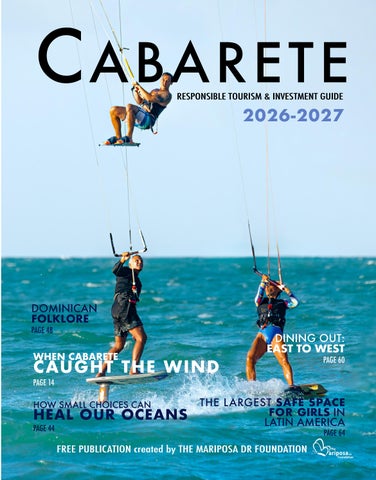
C ABARET E RESPONSIBLE TOURISM & INVESTMENT GUIDE
2026-2027
DOMINICAN FOLKLORE PAGE 48
WHEN CABARETE
CAUGHT THE WIND
DINING OUT: EAST TO WEST PAGE 60
PAGE 14
HOW SMALL CHOICES CAN
HEAL OUR OCEANS PAGE 44
THE LARGEST SAFE SPACE FOR GIRLS IN LATIN AMERICA PAGE 64
FREE PUBLICATION created by THE MARIPOSA DR FOUNDATION
1
2
3
4
5
About the Guide Our Team
CABARETE Responsible Tourism and Investment Guide is a publication created by The Mariposa DR Foundation, a US 501(c)(3) nonprofit organization working to educate and empower girls in Cabarete. All proceeds from advertising sales go directly to fund programs for local girls. It’s good for business and good for the community! 2026 marks the 15th issue of CABARETE. We are filled with gratitude for the businesses that have been with us since the very beginning. Thank you for believing in our vision, for showing up in every issue, and for helping us tell the story of this incredible community. Your continued support is a true reflection of the vibrant, creative, and connected place we all call home.
EDITOR-IN-CHIEF &
DIRECTOR OF ADVERTISING SALES Patricia Thorndike Suriel
GRAPHIC DESIGNERS Ramona Delborne Sofia Morris Giulia Pinna (map)
WRITERS & EDITORS Jessica Lawson Antarah Chopra Sofia Morris Tatianna Suriel
PHOTOGRAPHERS Fran Afonso Jianca Lazarus Amy S. Martin Sebastian Massimino
Cover shot: AP Visuals
Mission
6
Our mission is to end generational poverty by educating and empowering girls to become leaders in their families, communities, and beyond. Guided by dignity, equity, sustainability, and girl-centered design, we are building a global network that elevates girls’ voices, creates safe and inspiring spaces, and models sustainable solutions for communities facing rapid development and climate vulnerability.
The Mariposa DR Foundation, located right here in Cabarete, is the largest safe space for girls in Latin America and the Caribbean.
A special thank you to our long-term supporters. The following businesses have invested in every single issue of this guide in the past 15 years.
Thank You
Andari Spa The Beach Club Bliss Blue Moon Cabarete Beach Houses (Nanny Estates) Gorditos Fresh Mex
Millenium Resort & Spa Natura Cabana Seguros Universales/EPS Villa Taina Yamazato
15 YEARS OF RESPONSIBLE TOURISM
We extend our immense gratitude to Pamela Cuadros, the designer behind 12 of our 15 guides. As the longest running publication source in Cabarete, we are honored that many businesses, media platforms, and individuals use the information published in this guide. We ask that if you choose to redistribute or reuse any verbiage, images, etc., from this guide or any previous editions, please make sure to cite your sources! You can cite this publication as is written below or modify the date to reflect the correct edition to which you are referring: Cabarete: Responsible Tourism & Investment Guide 2026, 2027. The Mariposa DR Foundation. 7
14
60 48
Contents 64 8
10 14 20 26 28 30 34 44 48 56 60 64
Letter from the Founders When Cabarete Caught the Wind Women Trailblazers Encuentro La Boca El Choco Cabarete Coffee How Small Changes Can Heal Our Ocean Dominican Folklore Dominicanisms Dining Out: East to West The Largest Safe Space for Girls in Latin America
Your future deserves an ocean view. Contact us for a private consultation Ocean One Plaza, Suite 3315, Cabarete info@cabareterealestate.com
+1(849) 397-2602
www.cabareterealestate.com 9
10
Letter from the Founders
Fifteen years later, that dream feels more alive than ever. At Mariposa, we have always believed in the power of girls. We know that when a girl is supported—when she stays in school, receives good health care, plays sports, learns her worth, and has a safe place to grow—everything changes. She becomes a young woman who can lift herself, her family, and ultimately her entire community out of poverty. As local businesses flourish, they help fuel this cycle of hope and opportunity, investing back into the most powerful force for change we have ever witnessed: girls. We are endlessly grateful for this vibrant community made up of the friends, partners, and visionaries who have helped shape Cabarete into a place where possibility thrives. We are deeply honored to present the 15th edition as a tribute to the businesses that make Cabarete an extraordinary place to visit, work, eat, live, and play.
We created CABARETE: Responsible Tourism and Investment Guide with a dream in our hearts—to share the magic of this small town and the extraordinary people who make it feel like home. From the beginning, our goal was to celebrate the businesses and stories that shape Cabarete while also creating a With gratitude and great pride, platform to share the work of The Mariposa DR Foundation and its mission to educate Patricia & Jessica and empower girls to end generational pov- Founders, The Mariposa DR Foundation erty.
11
Welcome to
C ABARETE
12
13
WHEN CABARETE
CAUGHT THE WIND Originally a quiet fishing village, Cabarete burst onto the international scene in the late 1980s when European and Canadian windsurfers learned that this exact beach had nearly perfect conditions for watersports. In June 1989, Claude Marois and Lorenzo Sancassani organized the Professional Windsurfing Association (PWA) World Cup competition on Cabarete beach. It made a major splash, bringing some of the most iconic windsurfers, including Robby Naish, Bjorn Dunkerbeck, Anders Bringdal, and Robert Teriitehau, here to compete. This event is considered the turning point that started the windsurfing craze in this sleepy town. Over the years, the town has expanded rapidly, evolving into one of the premier wind and water sports destinations in the world. From windsurfing, kitesurfing, winging, and stand-up paddling to surfing and more, Cabarete has it all. A vibrant town with windswept beaches, bohemian cafes, lush jungles, and a paddle friendly lagoon, Cabarete has become a hotspot for adventure and ecotourism.
1987: Eric Hertsens with his windsurfing board in Cabarete
1985: Jean Laporte and Pierre Laporte Owners of Les Alizé, the first windsurfing school in Cabarete, Eric Hertsens instructor, Enero local helper, Annick Graveline world champion, Bernard Labrosse Investor in Les Alizés, Benoît Ratté Canadian instructor
14
Photo by Anthony Vogler, Cabarete 1987
PABLITO GUZMAN, Local Windsurfer Pablito learned to windsurf in the early 90’s when the sport began to take off on Cabarete beach. He then made it his life’s work to make sure that other local kids, like him, had access to windsurfing equipment and lessons so that they too, could participate in local events and be a part of their growing community. Pablito kept a small shop on the east side of town where local children could come and have free access to windsurfing equipment and lessons.
LAUREL EASTMAN, Owner of LEK Laurel joined the PKRA World Cup tour in 2002 as one of the sport’s rising female stars. A competition led her to Cabarete where she settled and founded LEK (Laurel Eastman Kiteboarding). She’s been passionate about getting others out on the water ever since. An active community leader, Laurel has provided countless hours of free kitesurfing instruction to local girls and has sponsored numerous community events including Kiteboarding 4 Kids.
MARCUS BOHM, Founder of Cabarete Kids and Master of the Ocean Marcus made his way to Cabarete in the early 90’s. With Lemont Weaver and Neil Adar, he opened Surf and Sport, the first surf shop in town. They immediately started working with local kids in the community, teaching them to windsurf, giving them jobs and access to health care, and other resources. One of those kids was world famous windsurfer, Tony Garcia. Today, Marcus owns and operates 321 Takeoff, a surf school at Encuentro Beach, and continues to give free surf lessons to local children. He is also the founder of Master of the Ocean, a unique annual watersports competition held in Cabarete that spans four disciplines and attracts enthusiasts from all over the world. 15
16
EH LIFTS A CHAMPION
17
EH Kites Design Loft
CRAFTED IN CABARETE - EH KITES “I arrived to Puerto Plata in October 1983. I worked at Playa Dorada and would occasionally visit Cabarete when I could find some transportation. When Jean Laporte opened the first windsurf school, Les Alizés (French for trade winds), in 1985, he offered me a job, and I moved to Cabarete to work for him and his brother, Pierre. It was way more fun.” - Eric Hertsens, Founder of EH Kites Eric Hertsens started kitesurfing in 1997. Wanting more from the gear, he began modifying kites himself and officially launched EH kites in 2000, with its design loft headquartered in Cabarete. EH Kites focused heavily on research and development, working on inflatable kites and boards and collaborating closely with manufacturers. As kitesurfing grew in popularity, Hertsens’ designs were adopted by leading brands. “I put thousands of images on forums in 18
the early days of the internet and promoted Cabarete… People came!” - Eric Hertsens A huge part of Eric’s business was making sure that local kids in Cabarete were being included. He mentored, sponsored, and employed a group of young Dominican kiters, many of whom went on to become world champions. It was the children of Cabarete, winning competitions all over the world, who really put this town on the map! 2007 - Ariel Corniel wins the Cabarete leg of the World Cup on a locally designed, new modern style bow kite - the EH Ripper.
19
WOMEN TRAILBLAZERS
From pioneering windsurfers to fearless kitesurfers launching sky-high tricks in Cabarete’s trade winds, these women have expanded what’s possible on the water. They’ve opened doors and inspired young women to dive into watersports with confidence.
20
Nina Corniel 21
NINA CORNIEL
Nina comes from a family that is no stranger to water sports. The youngest sister of world kiteboarding champion Ariel Corniel and Olympic medalist Adeuri Corniel, Nina grew up kiteboarding with her brothers, something uncommon for many local girls. At the age of 14, she was training for the junior Olympic kiteboarding team, and four days before the finals, she was injured in a freak kiting accident that resulted in the loss of the tips of three fingers. The accident was extremely traumatic, and her confidence suffered. Nina spent months at home, falling into a deep depression and becoming the victim of so much bullying that she eventually had to change schools. In 2019, we started the Mariposa Kite Team after realizing that this sport is incredibly intimidating and isolating for the few young women of color doing this on the entire island. Nina, no stranger to hardship, emerged as the perfect candidate to take on a leadership role coaching other local girls interested in the sport. When Nina joined the Mariposa team as the kite team leader, everything changed. Not only did Nina reclaim her power and rebuild her confidence, but she also began to play an integral role in helping other local girls in the program gain confidence and transform their lives. With Nina there to mentor and support them, the Mariposa girls have banded together and formed an impressive team of brave, fearless young women.
MICHELLE BORDEAU The Buttefly Effect hosts non-competitive boardsports events around the world to spread “aloha” and give back to local communities. Michelle Bordeau first brought the Butterfly Effect event to Cabarete in 2008. The Cabarete Butterfly Effect includes wellness and leadership events, a beach cleanup, a 4km downriver SUP, an advanced 5km wind/kitesurf downwinder, and much more. It has become a local favorite event for women and girls every summer.
AUDREY MEYER
Audrey Meyer is a longtime water-sports professional and entrepreneur in Cabarete, known for owning and operating several ocean-focused businesses. As an athlete and coach, she has helped introduce countless people to kitesurfing, surfing, and fitness on the North Coast. Her dedication to ocean life and women’s empowerment has made her a respected leader in Cabarete’s water sports community. Most recently, Meyer founded the Cabarete Wing Fest in 2025.
22
SUSI MAI
Born to parents who were passionate windsurfers, her entire family moved to the Dominican Republic when she was five to pursue their love of adventure and great beaches. When she was a teenager, she discovered her life’s passion: kiteboarding. She competed on the world tour for 10 years and along the way, her deep passion for the ocean has manifested into a number of creative, innovative, and impactful projects that combine watersports and ocean conservation, including ULTRAMARINE and the Cabarete Kite Festival event in the Dominican Republic.
SUJEIDY OXIIS JULES
Sujeidy (Suje) was an original Mariposa girl, joining at just six years old with her older sisters and cousins. She quickly took to the water and was one of the youngest girls in town who learned to become a strong swimmer. With her natural athletic ability, she became one of the first Mariposa girls to shine in watersports. Today, Suje loves to kite and is working at Mariposa DR Foundation as one of the lead swimming instructors.
23
24
SAY YES TO YOURSELF
SPA TRENDS
Healthy Skin is in
WELLNESS Its more than a moment, its a way of life.
www.andarispa.com 809.8 .9399 info@andarispa.com Located at the Millennium Resort & Spa
25
ENCUENTRO Once a secluded surf beach, Encuentro has transformed into a thriving, vibrant neighborhood.
Over the past five years, Cabarete has experienced a real estate boom, with Encuentro Beach at the center of all the action. From multimillion-dollar mansions to surf lodges and condos, this once off-the-beaten-path beach is now one of the most popular neighborhoods in town to live, work, and play. Just four kilometers west of downtown Cabarete, Encuentro is one of the best surfing beaches on the North Coast of the Dominican Republic. Wave riders of all levels flock to this spot to enjoy its fun, family-friendly atmosphere. Whether you’re a seasoned surfer, curious to try the sport, or simply want to relax in the sand with a coffee or fresh juice while taking in the view, there’s something for everyone at Encuentro Beach. 26
When is the best time to surf?
Although surfing tends to be much better in the morning, it’s a great spot for more advanced, wave riding kiters and wingfoilers in the afternoon. Waves at Encuentro beach tend to be big in the winter and smaller in the summer, making the summer months ideal for learning.
The vibe
A friendly, diverse, family-friendly neighborhood with great restaurants like Coconuts and Bonsai Poke, local artisan shops, and plenty of places to hang out and connect with the community.
Encuentro is great for kids!
If your little one isn’t quite ready to start surfing, Encuentro is great for playing on the beach, bike riding, walking, and more!
27
LA BOCA Just a few kilometers east of downtown Cabarete is La Boca, which means “mouth” in Spanish, where the Yasica river flows into the Atlantic ocean. La Boca is a popular recreational area for tourists and locals alike. Here, you can swim in the fresh waters of the river while enjoying a full view of the ocean.
place for Dominican families to gather, BBQ, and enjoy spending the day in nature. Weekends tend to be very crowded, so if you’re looking for something a little more laid back, visit early or try a weekday.
The beach is constantly changing depending on the currents, recent rainfalls, ocean swells, winds, and Surrounded by lush tropical scenery, the Yasica Riv- other environmental factors – one of the most interer is a popular spot for swimming, fishing, paddling, esting things about La Boca is that it looks different and kitesurfing. On weekends, rivers are a popular every time you visit! 28
HOW TO GET TO LA BOCA By Car
Enter at the sign for Camino del Sol and follow the sandy road all the way to the end. You can also hire a local taxi to arrange drop off and pickup in town.
By Boat
Enjoy a leisurely cruise down the river with Jungle River Tours and learn all about the local flora and fauna. Arriving to La Boca by boat is absolutely breathtaking and something the whole family will enjoy.
THINGS TO DO AT LA BOCA
Relax and Enjoy Great Food
La Boca is a great place to hang out and enjoy an authentic Dominican meal at Wilson’s Restaurant, featuring fresh caught seafood, plantains, rice and beans, piña coladas, coco frío, and icecold beer.
Stand Up Paddle and Kayak
The calm, flat waters make La Boca ideal for kayakers and SUPers of all levels. Explore the river and marvel at the entangled roots of the mangrove trees. A great activity for kids!
Kitesurfing
Best for intermediate and advanced kiters, La Boca offers shallow, flat water - perfect for practicing new tricks! The area is pretty small and can only accommodate a few kiters at a time. It’s the perfect place to enjoy a short session and then kite downwind all the way to Cabarete beach.
Where the River Meets the Sea
29
The Caves of Cabarete
At the traffic light on the west end of town, turn down the paved road towards the hills and you will find yourself in Callejón de la Loma, one of Cabarete’s most populous neighborhoods. Follow the busy street all the way to the end, and you’ll arrive at the entrance to El Choco National Park – a tropical wonder filled with majestic hiking trails, spectacular caves with deep natural pools, lush vegetation, and a wide variety of bird species. For a $20 entrance fee, you can enjoy a guided tour of the five-million-year-old cave system. The underground pools connect to underwater caves, and some are shallow and safe for a cooling freshwater swim! On the trails you will likely be greeted by the locals who call the “Loma” (or foothills) home. You may even be invited into a home for coffee!
Did You Know?
There are 18 national parks in the Dominican Republic, and about 25% of the country’s land is protected. Parque Nacional El Choco is a sprawling 48 square miles of natural reserve, making Cabarete a significant ecotourism destination.
Tips for enjoying the caves • • • • •
30
Dress in loose, comfortable clothing and swimwear. Wear comfortable, close-toed walking or hiking shoes. Wear plenty of sun protection and bug repellant. Bring a full water bottle. Hire a local taxi service, like JOJIM tours, to take you directly to the park offices at the entrance.
EL CHOCO NATIONAL PARK
31
32
The most historical Hotel in Cabarete City is Villa Taina, an exclusive oceanfront Boutique hotel with 61 rooms in the unique location right on the golden beach of Cabarete Bay. Best known for its personalized service that make clients feel as home.
The charming town is one of the most famous Wind-/Kitesurfing spots worldwide! The recently opened Water Sport Club offers the latest sport gear including Wingfoiling for Watersport fanatics, and for beginners our professional instructors are the best to teach. Restaurant & Bar Serenade offers international cuisine while enjoying the sunset over the Atlantic Ocean, where brunch is hosted once a month — dates announced on our social media.
+1 (809) 571 0722
info@villataina.com
www.villataina.com
Follow us @hotelvillataina
33
In 2009, Patricia Suriel had the idea to arete’s local population being of Haitian descent, many made plans to travel home and rescue their family open up a coffee shop. members. Cabarete Coffee Company and The Mariposa DR Foundation sprang into action. The concept was to create a place that would bring people together to drink coffee that tastes good, is good for Working together with a dedicated group of volunteers the earth, and good for the people who grow it. This and organizers from the community, we helped famisimple idea evolved into so much more. lies reach their loved ones by providing food, water, and transportation. As community members returned from 2009 was also the year the Mariposa DR Foundation Haiti with relatives affected by the earthquake, Cabarete began. While running a nonprofit and a business at Coffee Company and Mariposa worked together to prothe same time, and with Mariposa having no physical vide meals, medical care, housing, and education placespace, Suriel offered her small family business as a gathments for children. Our community was deeply affected ering place for volunteers, donors, families, and anyone as thousands of earthquake refugees found their way to wanting to learn more about how to help. In this small, Cabarete for relief. unassuming coffee shop, people from all over the world began to visit – to drink good coffee and solve hard It was during this most challenging time that it became problems. clear how much a little hole-in-the-wall coffee shop could really be a hub for transforming our community. In January 2010, a massive earthquake devastated our It wasn’t a big place. It wasn’t aesthetic. But it was filled neighbors and friends in Haiti. With nearly half of Cab34
with hope, love, good food and great coffee. People would walk into the coffee shop for a sandwich and a latte and leave as a champion for girls’ education. As both organizations grew, Suriel saw how important the coffee shop was in building awareness of Mariposa’s mission. With her family, she made the decision to donate the Cabarete Coffee Company, so it could become a social business of The Mariposa DR Foundation.
ceived job training and internships at Cabarete Coffee, equipping them with the skills to land jobs at some of the town’s most popular restaurants. As of 2017, 100% of the proceeds, totaling over $1M, from the shop have gone to support education programs for girls. Whether you’re in town, planning a visit, or live here and have not yet paid us a visit, we invite you to join us for a cup of some of the best coffee on the island and to support girls in the community.
Dozens of Mariposa program participants have re-
“Come join us in the coffee world. You can do a lot of good there.” AUTHOR & HONORARY CHAIRWOMAN, JULIA ALVAREZ
35
In 2027, we will be opening our second Cabarete Coffee Company
on site at the Mariposa Center for Girls, expanding our menu and retail selection so that more funds can be earned. We believe the true success of the Mariposa DR Foundation lies in our ability to steer our own ship. In an effort to bolster the donations and grants we receive, we work hard to generate our own sustainable funding through the coffee shop. Don’t leave town without visiting Cabarete’s first and only social business, where 100% of the proceeds support educational programs for local children.
36
Welcome to our Beach! VILLAS & CONDOS FOR RENT
Visit our websites. Here you can find out everything about our prices and open dates.
OLAS DE ORO
Make a reservation by Whatsapp or use the form on our Website. PHONE: +1 (849) 876 4533
NANNY ESTATES
Cabarete Beach Houses & Cabarete Luxury Home - Your first address for a relaxing vacation in Cabarete. Directly by the sea, in the best condominiums: Nanny Estate and Olas de Oro. Ideal for kitesurfers, wingfoilers and connoisseurs - with the highest level of living comfort in a top location, with restaurants, bars and shopping facilities in the immediate vicinity. Experience an unforgettable vacation with personal service and Caribbean flair.
CABARETE
LUXURY HOME www.cabaretebeachhouses.com www.cabareteluxuryhome.com
37 2025_Cabaretemagazin.indd 1
11.05.25 10:41
38
39
A place to belong.
Playa Encuentro, Dominican Republic
40
www.theschoolhouse.edu.do
NAME THAT FRUIT!
With year-round sunshine, fertile soil, and a warm, tropical climate, the Dominican Republic is heaven on earth for fruit lovers. Offering an abundance of year-round tropical goodies, this Caribbean paradise offers an astonishing variety of delicious fruits - many of them unknown outside of the region. Can you identify these local fruits?
1
2
3
4
5
6
7
8
9
41
1. Breadfruit BUENPAN
6. Almond ALMENDRA
Although it can be enjoyed raw when very soft and ripe, it’s recommended to cook breadfruit. Often treated like a potato, breadfruit is best roasted, boiled, or fried.
Tropical almonds in the Dominican Republic are typically harvested toward the end of the rainy season when the hard shells fall from the almendra criolla trees. The nuts are nutritious, offering protein, fiber, and natural oils. People often roast them as a snack, and the tree’s leaves and wood are also used in local crafts and remedies.
2. Mango Mangos are in season in the Dominican Republic from spring through early fall, and the island grows many unique varieties, including Banilejo and Mingolo. They’re rich in antioxidants, support digestion, and are one of the most consumed fruits in the country. Whether eaten on their own or turned into smoothies, cold drinks, or jams, mangos are a staple of Dominican food culture.
3. Cacao This tropical goody goes through so many different transformations before becoming chocolate! The soft, white, fleshy pulp can be enjoyed raw – pop the bean in your mouth and enjoy the sweet, complex, and tangy flavor. The beans are then dried and ground into raw cacao powder or roasted and crushed into nibs.
4. Achiote BIJA Vibrant in color with a mild, sweet, and nutty flavor, bija is commonly added to dishes like rice, stews, and meats for color and flavor.
5. Spanish Lime LIMONCILLO Only available for a brief period of time in the summer, limoncillos are a local favorite. Use your teeth to gently crack the skin and discard. Place the small, slippery fruit in your mouth, suck, and bite the flesh until you’re left with the pit. Spit and repeat!
42
7. Coffee Café The sweet, fruity pulp around raw coffee beans is edible and safe to consume! Coffee cherries can be eaten raw, dried into “cáscara” for tea, or processed into juices, syrups, and jams.
8. Banana Flower FLOR DE GUINEO
This striking, teardrop-shaped bloom is full of surprises from the moment you peel back its deep purple leaves! Inside are crisp, creamy blossoms that can be enjoyed raw for a gentle, floral crunch or cooked to unlock their subtle, savory sweetness.
9. Seagrape UVA DE PLAYA With a large seed and a small amount of pulp, sea grapes can be enjoyed raw, as a snack, or used to make juice and wine. Seagrapes are also integral to coastal ecosystems as their extensive root systems help prevent erosion.
43
How Small Choices Can
Heal Our Ocean
Look around – single use-plastic is everywhere. Every year, more than 400 million tonnes of plastic is produced worldwide, with only 10% properly recycled. Annually, 11 million tonnes of plastics end up in lakes, rivers, and the ocean, and it takes at least 400 years for the plastic we’ve created to break down. We’ve become accustomed to using plastic and throwing it away without a second thought–out of sight, out of mind. However, in the Dominican Republic, these single-use plastics never truly ‘disappear’. The majority end up on our beautiful beaches or in the ocean, irrevocably damaging aquatic ecosystems and the vitality of our oceans. We must act quickly to protect our oceans. Small steps, big impact. Here are three small actions you can take to drastically reduce the amount of plastic you put into our oceans: 44
1. Order your drinks, “Sin sorbete” or “No straw, please.”
Millions of plastic straws end up in the ocean, posing a huge threat to our sea turtle populations. The Dominican Republic is home to five types of sea turtles: Leatherback, Green, Hawksbill, Olive Ridley, and Loggerhead. March to November is turtle-nesting season in the Dominican Republic, and we can all do our part to protect them by asking for our drinks without a straw. Consider using paper straws or toting around your own reusable stainless-steel straw for sipping.
2. Reuse single-use plastics.
Sometimes single-use plastics are inevitable, so if you find yourself using one, make sure to use it multiple times before throwing it away. Got a straw in your drink? Say you’ll keep the same straw for the next one. Refill your plastic water bottle as many times as you can before disposing of it. Think about another possible use for a plastic container before you throw it away. Dominicans are great recyclers, finding multiple uses for disposable plastics. From coffee containers to gallon jugs to produce sacks, look around, and you will find ingenious uses of disposable products.
3. Be proactive.
Bring your own bags to the grocery store or reusable tupperware when ordering take-out. Keep reusable alternatives to single-use plastics in your car to ensure you’re always taking care of the planet. Change takes time, but when communities mobilize, amazing things can happen. Rethinking your relationship with single-use plastics and making small changes can have a big impact! 45
46
NATURA CABANA Boutique Hotel & Spa
Natura Cabana features unique bungalows, a tranquil spa, and an open-air yoga temple with daily yoga and fitness classes, all set along a secluded beach just steps from the property. The two oceanview restaurants are open to all, serving fresh meals for breakfast, lunch, and dinner—made with local and garden-grown ingredients.
+1 849 214 7010 | info@naturacabana.com www.naturacabana.com | www.attabeyraspa.com 47
Dominican Folklore
48
49
Excerpt(s) from THE SECRET FOOTPRINTS by Julia Alvarez, text copyright © 2000 by Julia Alvarez. Used by permission of Alfred A. Knopf, an imprint of Random House Children’s Books, a division of Penguin Random House LLC. All rights reserved.
50
Las Ciguapas The Secret FootprinTs
I first heard about the ciguapas when I was as little as the littler little girl in my story. My family lived in the Dominican Republic where the ciguapas come from. My mother and my aunts told me all about these beautiful creatures with golden skin and long black hair who live in caves under the water. They come out at night to hunt for food because they are very shy and do not want to be seen by human beings. Their only other protection besides hiding during the day is that their feet are on backwards, so their toes face where they have come from. That means if you follow their footprints in order to find them, you’ll end up going in the opposite direction. I always thought that was so smart of them. Now that I’m grown up and live in the United States, I’ve found that there are many different versions of the ciguapa story. These unusual and beautiful creatures originated a long time ago in the Dominican Republic. Some writers say they have golden skin, some say they have black skin. In some versions the ciguapas are very small, only about a yard tall, but in other versions they are as tall as humans beings. In fact, they look just like us, except for their strange feet and their extraordinary beauty. Some say the ciguapas live in caves under the water, some say they live in caves in the woods. All the writers agree that the ciguapas only come out at night to hunt. In most versions of the story, the ciguapas are an all-female band, but in some versions there are male and female ciguapas. In the all-female stories, the ciguapas fall in love with human males and lure them away to their caves. (I don’t think this is what Guapa is up to in my story.) Some writers think the ciguapas came from the legends of the Taino Indians who inhabited the island when Columbus and the Spaniards arrived in 1492. Others believe that the legend originated when the few Indians who were not killed by the Spaniards escaped to caves in the mountains and came out only at night to hunt for food. Since the Taino Indians also had golden skin and black hair, maybe that is where the ciguapas came from. Sometimes my mother and aunts would try to scare me at night by saying that if I didn’t go to sleep quickly or if I turned on my light after lights-out, the ciguapas would come and take me away. They thought I would be scared, but I was secretly excited by the thought of seeing a ciguapa. I admit, I never did. But I haven’t given up. Some-
times I leave my wash out on the line overnight and stick a piece of candy or an apple in the pocket of my pants or jacket, just in case. I know it’s a far way from the Dominican Republic to Vermont , especially if your feet are on backwards. But I have to tell you, sometimes that piece of candy or apple is gone from that pocket in the morning. My husband says it could be squirrels or maybe even a racoon. Now that you’ve read my story, you and I know better.
About the Author
Julia Alvarez
There is no better way to tell Dominican folklore than from the Dominican Republic’s most famous, notable, and prominent author, Julia Alvarez. Here are two excerpts from Alvarez’s books which best illustrate some of these magical tales of mythical creatures and Dominican folklore. Julia has supported and inspired the girls, volunteers, and staff at The Mariposa DR Foundation since the beginning. Julia and her husband Bill are longtime advocates for the work at the Mariposa DR Foundation and distinguished guests as the Mariposa girls beam with joy during their visits. Julia has led workshops on reading and writing, mindfulness, and even participated in yoga with the Mariposa girls. 51
La Vieja Belén The Best Gift of All
When I was a little girl growing up in the Dominican Of what? I wondered. Republic, there were three occasions for getting gifts around the Christmas season. As I researched the legend for this book I discovered that La Vieja Belén is not known in any other country Since the majority of people were Catholic, many chil- but the Dominican Republic. Curiously, though, there dren received their presents on Christmas day from is a popular Italian legend about an old witch, La Befael Niño Jesus. I always thought it was very nice of the na, who comes at Epiphany and helps the Three Kings baby Jesus to bring us presents on his birthday. Over deliver their gifts. Maybe Italians who moved to the the years, with the influence of the United States, baby Dominican Republic in the late 1800s brought her story Jesus gave way to Santa Claus, who somehow managed along? The story of La Befana inspired my own story of to get his sled to work on our warm, snow-less, tropical our Vieja Belén in the Dominican Republic. landscape. Some Dominican scholars believe that la vieja Belén The second time you could get gifts was on Epiphany, originated with immigrants from the French and Enthe feast of the Three Kings. These Magi, who long ago glish Caribbean, known as cocolos, who came to the isbrought gifts for the baby Jesus, now brought gifts for land to work in the cane fields. They brought their own us. On the night of January fifth, before we went to traditions, among these the figure of an old black wombed, we left grass for the camel and cigarettes for the an, riding a mule, remembering the poorest of the poor. Magi (something we would never do now) and water for both. Next morning, the grass and cigarettes were Whether she was Italian or Cocola or pura criolla, la gone and the water bowl drained, and there were gifts Vieja Belén was the poor people’s Santa Claus, Niño Jefor us in their place. sus, and Magi rolled into one. Old Dominicans say that she was invented by poor parents who could not afford The last chance to get gifts was a week later from an old to give their children gifts on Christmas or Epiphany. woman named la Vieja Belén. She left gifts for poor They waited until after the holiday season when stores children, who hadn’t received gifts on the other two oc- marked down what merchandise was left or rich chilcasions. We weren’t poor, but still, she always stopped dren with new toys threw out their old ones. Then, at our house and left us some simple gift, a bunch of these poor parents would recycle them--with the help pencils or some Jacks or a bag of marbles or a box of of La Vieja Belén, of course. cinnamon chiclets. Just as with the three Kings, I always asked my mami if I couldn’t leave la Vieja Belén But no one really knows for sure where the legend of a glass of water and a cigarette, too. After all, she was La Veija Belén came from. I’m just glad someone was an old woman without a camel or sled for transporta- making sure that children who had not received anytion. Not only that, she had remembered what I had thing during the first two opportunities received somecompletely forgotten with all the excitement of big thing in the end. bulky boxes that were a joy to rip open at Christmas and Epiphany, bicycles trimmed with gay streamers on Many Dominican children today do not know who la the handlebars, darling baby dolls who looked so real Vieja Belén is. She is slowly disappearing from the they left you breathless with motherlove. There were culture. Unfortunately, the poor have not disappeared children out there who would not have gotten anything along with her. at all had la Vieja Belén not remembered them! That is why I wanted to write this book: so that she will Often I would ask my mami and old tías who was this remain alive in our hearts and in our imagination. May old lady? How come she cared so much about poor she remind us all of the true spirit of gift giving. And, people? No one could tell me. Since her name means as she herself learned, may we never forget that the best Bethlehem, maybe she had come all the way from that gift of all is the time we give to those we love, talking or holy place to the Dominican Republic to remind us-- taking a walk or reading a book together. 52
Copyright © by Julia Alvarez Reprinted by permission of Susan Bergholz Literary Services, New York, NY and Lamy, NM. All rights reserved. FURTHER PRINT OR ELECTRONIC PUBLICATION, DUPLICATION OR DISTRIBUTION OF THIS COPYRIGHTED MATERIAL IS STRICTLY PROHBITED.
53
54
SURF
SURFSKATE
MOVEMENT
RECOVERY 55
Dominicanisms Local Lingo
AHORITA
In Mexico this means “right now,” here it means an undefined “later”
BOLA
Literally, “ball,” but means “a free ride” here
BOMBA
Literally “bomb.” In the Dominican Republic, it’s the gas station where you will often find the best parties in town
CHEVERE
From African roots, means “awesome” or “cool”
CONCON
The crusty layer of fried rice at the bottom of the pot. A tasty treat!
CHIN
Comes from the indigenous Taíno language, means “a little”
CUARTO
Slang for “money”
DIQUE
Pronounced “D-keh.” This means “supposedly” and is commonly used when divulging the latest gossip
GUAGUA
“Bus” or “van”
QUE LO QUE
Shortened from “que es lo que hay,” which means “what’s up?”
VAINA Pronounced “by-nuh,” means “thing” 56
The Taíno population may have been wiped out when Columbus arrived; however, part of their language still lives on today. Many of their words were adopted by Spanish and later passed into English and other languages. Here are some that you might recognize:
BARBECUE
Derived from “barbacoa,” a particular method of cooking meat on a raised platform
CANOE
Originally meaning a dugout like those used by the Taíno, it comes from the word “canoa”
HAMMOCK
Spanish colonists learned about hammocks from the Taíno, who protected themselves from critters while sleeping with nets called “hamaca”
HURRICANE
Huracán is the Taíno word for “god of the storm”
POTATO
But potatoes don’t grow in the tropics! The word comes from the Spanish “patata,” which comes from Taíno “batata,” which we call “sweet potato”
TOBACCO
Referred to by the Taíno as a pipe used for smoking, the word “tabaco” now takes on many forms
Here are some must-know “Dominicanisms” that will have you speaking like a local in no time! 57
58
59
Dining Out Sometimes you want to eat on the beach, other times you just want a quick bite. We have organized our favorite restaurants to make your travels and planning easier.
East to West
Yamazato - Caribbean Asian Fusion, Sushi Bar Mi Bodegón - Buenos Aires-Inspired
SEA HORSE RANCH The Beach Club - International Cuisine overlooking the ocean
CALLEJÓN DE LA LOMA La Chabola - Pizzeria Papon’s - Dominican food, by the caves Swai - Ceviche, Seafood, Dominican Restaurant Bayerischer Hof - German, Schnitzel, Sausage
PERLA MARINA Ceiba Cafe and Pizzeria - Pizzeria Karaya at Natura Cabana - International Cuisine on the beachfront ENCUENTRO Coconuts Restaurant - International Cuisine on the beachfront 100% Pan Bakery - Venezuelan Bonsai Poke & Tapas Encuentro Food Park - International Food Trucks (on the highway across the street) Pizzicleta - Pizzeria LA CIENEGA Bliss - Italian KITE BEACH El Cocotazo Cafe - Dominican, Breakfast, Lunch, cocktails La Mesa Taína - International cuisine Kite Beach Watersports Center - Dominican, Breakfast, Lunch Tuva - Italian HEADING INTO TOWN ON THE MAIN HIGHWAY Cabarete Coffee Company - Coffee, Breakfast, Lunch, Smoothies Gypsy Bowls - Bowls, Salads, Smoothies Vagamundo Coffee & Waffles - Coffee, Waffles, Lunch Cabarete Bakery - North American Gordito’s Fresh Mex - Fast Food Mexican 60
DOWNTOWN CABARETE Belgian Bakery - Belgian Friend’s Restaurant - Breakfast, Lunch, Dinner Fresh Fresh Cafe - Breakfast, Lunch, Smoothies Dick’s Bakery - German Pizza & Spaghetti House - Italian Le Bistro - French Viento - Seafood, Steak, Salads CABARETE BEACH Aqua at Millennium - Caribbean Spanish Tapas Serenade at Villa Taina - International, Buffets Pomodoro Pizza - Italian La Casita de Papi - Seafood Lax - Drinks, Bar Bites, Pizza Mojito Bar - Mojitos, Dominican, Bar Bites Voy Voy Bar Restaurant - Dominican, Bar Bites Drifter - Mediterranean Caribbean Fusion Sunset Grill at Velero Beach Resort - International Cuisine, Seafood Grill CABARETE EAST & BEYOND Wilson’s La Boca Restaurant - Dominican family style Ali’s Surf Camp (Pro Cab) - Churrasco Blue Moon (20 minute drive out of town, reservation only) - Caribbean Indian Fusion
61
62
p l as t i c s u r g e ry From the Heart of the Caribbean
J
ust as many people find energy, freedom, balance, and peace in Cabarete, we have the privilege of complementing that sense of well-being by supporting them in the care of their physical beauty. From a place o1f harmony, we help achieve a balanced metamorphosis of the figure—always keeping in mind what matters most: feeling good in one’s own body. We are board-certified plastic surgeons with over 24 years of experience and more than 10,000 successful procedures performed. Throughout this time, we have shared knowledge, developed new techniques, trained future generations of surgeons, and contributed to internationally recognized research. Our approach is grounded in three core pillars: safeguarding the patient’s health, employing cutting-edge technology, and pursuing natural-looking results—within an environment that adheres to the highest safety standards.
Address: HOMS - Suite 707, Austopista Duarte km. 28, Santiago RD DRESCOBARJARAMILLO
+1 (809) 543-6317
We are a multidisciplinary team led by Dr. Escobar Jaramillo, a surgeon known for combining technical expertise with a deep sense of human connection. We are members of the most prestigious plastic surgery societies in the United States and worldwide, reflecting our ongoing commitment to excellence. For all these reasons, many individuals have entrusted us with their care, knowing they are supported by a multidisciplinary, compassionate, and deeply committed team.
63
The Largest
Safe Space for Girls
64
Opened in 2013, The Mariposa Center for Girls in Cabarete is the largest safe space for girls in all of Latin America and the Caribbean. 65
Why Girls? On one side of the road in Cabarete you’ll find sandy beaches, beautiful hotels, condos, and bustling shops and restaurants. On the other side, there are thousands of people living in extreme poverty. Daily life for many children means overcrowded homes that flood when it rains, families struggling to put food on the table, and limited access to quality education and health care. Poverty is hard for everyone, but it’s hardest for girls – and they alone hold the unique power to change everything. From a young age, girls are positioned as caretakers in their homes. Often with overburdened parents, girls take on the brunt of domestic responsibilities - cooking, cleaning, and caring for younger siblings - putting them at risk of dropping out of school and missing out on extracurricular activities offered within the community. More often than not, this leads to early marriage, early childbirth, and the cycle of poverty starting all over again. But if a girl stays in school, has access to proper physical and mental health care, and has a safe space to learn and grow, she can lift her entire family out of generational poverty. The Mariposa Center for Girls is a beautiful, safe sanctuary where the girls of Cabarete come to learn, grow, and play - and it’s changing everything.
66
Why is Having a Safe Space Important? The Mariposa Center for Girls is a sprawling 5,000 square meter campus with lush gardens, a swimming pool, a teaching kitchen, and well-equipped indoor and outdoor classrooms. Girls come here daily to enjoy a safe environment where they can build support networks, access vital services and information, develop life and leadership skills, and feel emotionally and physically safe. At Mariposa, girls are given the space and freedom to grow into active, positive contributors to their communities. On campus, Mariposa serves nearly 200 girls ages 6–18, providing educational opportunities, healthy meals, sports, access to mental and physical health care, and much more.
The Results:
In a town where less than 35% of girls graduate from high school and more than 20% become mothers before the age of 18, 100% of Mariposa girls graduate from high school and celebrate their 18th birthday without falling victim to early marriage and motherhood. More than 20 Mariposa alumni are pursuing higher education across the Dominican Republic and many others are attending universities around the world—including Macalester College, Middlebury College, Whitman College, and St. Olaf College in the U.S. and the United World College in Thailand, Singapore, and Costa Rica. Dozens are working in schools, businesses, and restaurants right here in Cabarete, some are pursuing vocational training, and 10 work right here on campus! 67
One Generation, Infinite Change A single generation can rewrite the story of an entire family and transform a community. When we invest in girls, entire societies shift—families grow healthier, economies strengthen, and new leaders rise where silence once stood. The power of educating and empowering girls isn’t just about classrooms or textbooks; it’s about unlocking potential that ripples outward forever. In one generation, education can turn barriers into bridges and hope into lasting change. Rosa was an original Mariposa girl when we began the program in 2009. She was 11 years old and came from an extremely poor family. Rosa attended programs just a few days a week for about three years, and that was enough for her to become the cycle-breaker.
Rosa now owns one of the most successful beauty salons on the North Coast of the Dominican Republic, Rosa Trenza. Her daughter, Rosbelly, began her Mariposa journey in 2024. Rosbelly was absolutely thrilled to become a Mariposa, just like her mom. She actively gets involved in everything she can and quickly became one of the more advanced swimmers in her group. She absolutely loves tennis, reading, and playing with her friends. It’s incredible to see second-generation Mariposa girls entering the program, proudly following in their mothers’ footsteps. Ending poverty isn’t a distant dream. It’s happening right here, and we’re witnessing the transformation right before our eyes. Visit Rosa Trenzas: Calle 11 de Callejón de la Loma
68
“Mariposa helped my family with education, food, clothing, and shoes. We didn’t have anything before. I feel nostalgic saying this because now I have a business, and thanks to the Mariposa DR Foundation, I learned languages. I speak English, which helped me with my clients in my business...I spent a lot of time in Mariposa and feel proud that my daughter and nieces are also here, learning a lot.”
69
How can I get involved? Make a contribution
You can either make a financial contribution or donate supplies from our curated Wish List.
Volunteer or intern with us!
Participating firsthand in our work at Mariposa helps elevate the quality of our programs and raises awareness of our work around the world. Apply to become an international volunteer for our summer program and year-long stays, or reserve a Community Engaged Learning Trip. 70
Follow our social media accounts and share what you learned about us on yours.
@MariposaDRFoundation
Make a contribution by scanning this QR code!
71
72