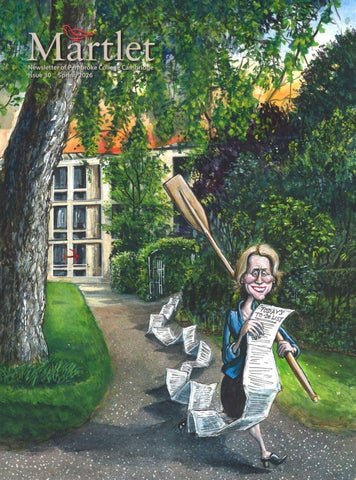
Martlet Newsletter of Pembroke College Cambridge Issue 30 Spring 2026
Hitting the Ground Running The Master, Professor Polly Blakesley
2
I
t seems inconceivable that, at the time of writing, a full seven months have passed since I was admitted as 3 Memories of Michael the fifty-fifth Master of Pembroke. Memories of that Kuczynski unexpectedly balmy 1 October are as vivid as if it was 4 Pulling Out All the just weeks ago. I woke to a video clip of the College flag being raised, sent by our thoughtful Head of HR so that Stops it would be the first thing I received that day. Briefly, I 5 Putting ‘Pembroke slipped into mum mode to take my son for his first day at Plus’ into Practice to university, our lives strangely parallel as we both embarked Support our Students on a new chapter of life. He was back soon enough, as the Fellows had extended the unprecedented honour of 6 On Migration and inviting my family to the admission ceremony in Chapel Sense of Place and the dinner afterwards, the latter orchestrated by our 7 A Refuge for the peerless catering team. I share this not to dwell on the detail of my life, but Future because that day captured much of what makes Pembroke 8 From Comic to special. The welcome extended to me and my family was Seismic both exceptional, and entirely typical of the College. And 9 Frame by Frame, the innumerable contributions of colleagues reiterated how life here is a continual and creative team effort. The Layer by Layer Praelector, noting the absence of a bound copy of our 10 Bringing Home statutes, had commissioned one specially. The Senior Belonging Fellow had practised lengthy passages of Latin, largely while waiting for luggage in airport terminals, and recited 11 Government in these phrases with aplomb. The Head Gardener had Analysis nurtured event-specific flowers to decorate the Hall, just 12 We Are Family! as she had created arrangements to reflect the Welsh and Australian roots of Julia Gillard, former Prime Minister 13 Nature Within of Australia, when we hosted her last year. Pembroke is a 14 Gossip place where excellence, thoughtfulness and collaboration 15 Poet’s Corner go hand in hand. To repeat an enduring College adage, it is a place where everyone wants everyone else to succeed. Within days, the next generation of students powered through our gates with their inimitable curiosity and drive. Quite rightly, they hold us to the highest standards and set new challenges for us all. Among the greatest privileges of my role is to spend so much time with them, learn of their Published by goals and joys at close quarters, and ensure that the College Pembroke College fuels their ambition and determination in imaginative ways. Cambridge CB2 1RF It feels invidious to choose among the many highlights Telephone 01223 338100 of student endeavour, but my experience one dark January Email: martlet@pem.cam.ac.uk evening illuminates the range of activity taking place. It Editor began with an invitation to speak at PemPapers, the Alex Houen Graduate Parlour’s showcase for research. There, I learnt Gossip Editor of one student’s work on the experiential impact of Paris on Sally March Simone de Beauvoir, and another’s on the role that jumping Illustrations genes may play in the Huntington’s disease mutation. Martin Rowson I then sprinted through the rain to the inaugural © Pembroke College 2026 Pembroke Arts Night which saw the Junior Parlour Photography and illustrations transformed into a kaleidoscope of creativity, from a copyright of the owners resounding musical line-up to poems hanging from the Design ceiling and art installations in the middle of the floor. I sat Mark Mniszko with a stalwart of our maintenance team and his daughter Print to watch our Deputy Librarian and her folk band captivate Langham Press the room. This product is made of FSC®-certified There has been equal commitment outdoors, with and other controlled material. This product is made of material from wellPembroke members gaining blues in several sports (in managed, FSC®-certified forests and the case of Hannah Major’s lightweight rowing triumph, other controlled sources. in conditions resembling the mid-Atlantic rather than the Thames). This weekend I will be yelling from the touchline as the women contest the Cuppers final in football and our men embark on the rugby semi-final. If the men win, they will play the final immediately after, hard ground having necessitated an unfortunate compression of scheduling.
© Keith Heppell
Contents
More alarmingly, I somehow found myself back in a rowing VIII for the first time since 1998, racing in our alumnae boat in the Pembroke Regatta – a sobering experience when the next oldest member of the crew was less than half my age. Possibly the first time a Master has rowed competitively for their college (though I know of one who has coxed), it was certainly the most ashen Master ever to brace for action at the start line. I survived and, thanks to invaluable support from crewmates, will be back next year. That rowing experience may have been one of the more curious ways to get to know Pembroke’s alumni. But it was entirely representative, in offering an opportunity to chat with people who feel deeply about the College and their experiences here and have gone on to make an impact in incalculable ways. I have loved meeting you and hearing stories of your escapades at Pembroke as much as the challenges you may have faced. It is equally compelling to learn of your accomplishments since, of your careful consideration of which paths to follow and what footprint to leave. I look forward to meeting many more of you in the years to come, whether in College, round the UK, or on distant shores. We will collectively share and test ideas to ensure that Pembroke continues to nurture students and scholars of exceptional merit and potential, whatever their background, and offers the right launchpad for meaningful lives. That ambition requires ceaseless hard work. We must maintain the best possible governance structures to fulfil our charitable and educational responsibilities. We must continue to find ways of reaching exciting and deserving applicants, rather than expecting them to find us. We must remain world-class in teaching, research, and the facilities we offer, supported by the expertise of professional colleagues across the College. We must work with rigour, integrity and tolerance to safeguard a culture in which everyone can thrive. My pledge is to do all in my power for Pembroke to continue to expand the boundaries of science and knowledge and raise the bar of service and human understanding. I know of no more rewarding role.
Memories of Michael Kuczynski Following the death of Michael Kuczynski on 10 October 2025, tributes and reflections poured into the College from alumni from around the world, totalling over 17,500 words. Here is just a small selection of them. He was a friend, a respected academic, an internationalist, a collector of museum quality artifacts, and a suporter of all the Pembroke sports teams. Michael played such a large role in my Pembroke and Cambridge experience. I will always remember economic discussions that veered far from the allocated topic in his college rooms during supervisions, with many an essay temporarily lost among the piles of books and papers that covered every surface. He was always cheery, always engaging, and always interested. In the nearly two decades since then, every time I saw him, he was exactly the same, and clearly thrilled to hear how his past students were getting on. I owe him my career as an economist, really – when I told him I wanted to apply for a Master’s and that I was considering Toulouse, he immediately led me to the Development Office where he picked up the phone, and within ten minutes I was speaking to a Professor he knew based there.
Foundress’ Feast. Instant recognition, perfect recall and twinkling warmth.
I was fortunate enough to have Michael Kuczynski as my Tutor. Of the many remarkable people I met at Cambridge, he was the most remarkable. His intellect was exceptional, his connections and interests extraordinary. He sparkled wherever he was. His commitment to Pembroke and his generosity, kindness, and investment in his students was unparalleled. One day, he would be away at a summit in some far-flung place, liaising with the brightest and best on the world stage, and the next day he would be undertaking a supervision with his firstyears, listening to us and communicating with us as equals. I suspect I am far from alone in being greatly influenced and inspired by Michael’s values, and these genuinely helped to shape the person I am.
Eve Jardine-Young (1991)
Dr Julia Bird (2005)
Kitty Hamilton (1998)
Supervisions required learning to read out essays without being distracted by an incredulous stare, amused but kindly smile, quizzically raised eyebrow, and by Michael breaking off to berate somebody over the telephone in animated Italian or nursing a headache by balancing a bag of frozen peas on his head. In the lecture hall, I recall being mesmerised by his rapid-fire account of informal financial flows between businesses in Latin America. Decades later, and as a teacher myself, I would often find myself recalling Michael’s use of the enigmatic phrase to kindle curiosity and scepticism, his talent for juxtaposing theory and history to open the conversation rather than to close it down, and his passionately cultivated detachment. He set the bar.
Dr James Copestake (1978)
Typical of Michael: he was my tutor in the late seventies – welcoming, worldly and always on my side. Fast forward thirty years without contact, until we bump into each other outside Fitzbillies before my first
Francis Gobey (1978)
He had an extraordinary ability to simplify concepts, often diagrammatically sketching relationships with elegance and lasting clarity. Supervisions in his rooms in College brought our small group of undergraduates into spaces quite literally filled with books, maps, prints, sculpture and items of interest, a cornucopia of cultural and intellectual riches reflecting a lifetime of curating, gathering and collecting. Miraculously, he could lay his hands on anything he was looking for within seconds, even from deep within labyrinthine piles. I knew him as a teacher, and he changed the axis of my academic path such that after graduation, I went into education, teaching Economics for 17 years before becoming a Head. It was his contribution to my pastoral care that I remember most. When I first arrived from Australia, he told me that my time at Pembroke would be as much about a social education as an academic one. He was absolutely right. It was one of the best periods of my life. He gave me confidence and a belief in myself that changed my life. He was always approachable. I once met him on the stairs to his room. He was dripping wet, having been thrown into the Cam by his students. He was grinning from ear to ear.
Dr Robert Dean (1980)
A favourite memory is of a carol service in the winter of 1983 or 1984, the chapel lit with candles, and Michael singing lustily as wax dripped relentlessly onto the shoulders of his gown. He was quite delighted to discover this had happened, stating emphatically that it added yet more character to the garment.
Alastair Merrill (1982)
Mr Kuczynski was a humane presence at Pembroke when I was an undergraduate there in the mid-1990s. I was not one of his own students, and yet he showed a kind interest in my welfare which, I realise now, went above and beyond the call of duty. I remember one occasion when I played a piece at a student concert – not at all well, I’m afraid – and later he stopped to say a few words of appreciation which touched me greatly. That he extended the same kindness to everyone at the College is extraordinary.
Dr Grace Brockington (1995)
I recall many happy games of bridge played too late and with too much alcohol, interesting and mind-broadening discussions and happy meals in various restaurants. There were courteous ‘good mornings’ as we walked back into College at breakfast time in last night’s evening dress. He was always tolerant of overexuberance and appreciated the rounded members of College, but kept us focused on delivering to our potential. It was a joy to see him – apparently ageless and always stimulating company.
Geoffrey Gestetner (1984)
His musical soirées will always be remembered as delightful. He had such a knack for bringing together interesting and talented students, providing a wonderful space for new friendships to blossom.
Cecilia Cordeiro Engels (1988)
3
Pulling Out All the Stops Luke Fitzgerald, Pembroke’s new Janeway Director of Music
F
4
riday 23rd January 2026 saw one of many excellent concerts in Pembroke’s newly-furnished Auditorium. The audience were treated by Andrew Arthur (Director of Music, Trinity Hall) and Rachel Stroud (King’s) to a musical treasure trove of ‘Dialogues’ for Violin and Harpsichord from the Georgian period including composers such as G. F. Handel, Francesco Geminiani, Elizabetta da Gambarini and, of particular interest here, one of The Cambridge Sonatas by the violinist and organist Pieter Hellendaal (1721 – 1799), which are held in manuscript at the Fitzwilliam Museum. As Mr Arthur explained from the stage, although born in the Netherlands Pieter Hellendaal was local not only to Cambridge but to Pembroke College and is buried in the churchyard of Little St Mary’s. He moved to London in 1752 to seek a more stable income as a musician and performer than was possible in the freelance scene in The Hague and Leiden. While he enjoyed some success in London as part of Handel’s circle, renowned as a virtuoso violinist, teacher and composer of catches for the city’s Glee Clubs, desire for better and more reliable wages saw him look to the Church, and to East Anglia. His first move was to Kings Lynn in 1760 where he succeeded Charles Burney as organist of St Margaret’s Church, however he reportedly found the distance from London too great for himself and his family. In 1762 he moved to Pembroke Hall where he was hired as an organist while also finding time to teach, give concerts and compose, primarily for the violin as suggested by The Cambridge Sonatas. The celebrated 1767 engraving A Concert in Cambridge by Abraham Hume, after a drawing by Thomas Orde, depicts Hellendaal on the far left in concert at Christ’s College with a cosmopolitan assortment of musicians not only from England and the Netherlands but Portugal and an oboist ‘Ranish’ or ‘Wranisch’ (according to Christopher Hogwood) most likely from Germany or central Europe. Hearing such a fabulous performance at our own ‘Concert in Cambridge’, quite possibly the first since Hellendaal’s own time here at Pembroke, of a sonata composed here by this former organist of the College gave a great opportunity for my own contemplation regarding what fantastic opportunities the College and University continue to offer for creativity and the arts, as well as the many changes that the intervening 250 or so years have seen. Certainly, Hellendaal’s balancing of regular church and chapel duties with the excitement of promoting occasional concerts and entertainments rings a most consonant note with my first six months at Pembroke. Alongside Hellendaal’s virtuosic concerti grossi and sonatas, his published works include the much humbler volume ‘A collection of Psalms and Hymns’ published by his son Peter Hellendaal Jnr. ‘printed and sold…at his music shop opposite Peterhouse College where orders for every article in the musical line are executed as cheap as in London and with the utmost punctuality and dispatch’. In a similar vein perhaps, my role as Janeway Director of Music has involved organising concert performances featuring the Pembroke College Girls Choir at the Royal Albert Hall for International Women’s Day with Anna Lapwood, a tour to Italy this coming Summer and the Chapel Choir’s showstopping performance at the Installation of Chris Smith as Chancellor of the University in March. Meanwhile, and no less importantly, I have equally enjoyed the opportunity
to work with the choir on keeping the musical offering at regular services in Pembroke’s stunning Wren Chapel fresh and of the highest quality, celebrating some of the choral gems by female composers championed by my predecessor as well as exploring little-known settings of the Evensong repertoire such as the Magnificat from Salmi Concertati a 4 voci con Strumenti by Italian composer Isabella Leonarda (1620 – 1704). In a small parallel of Hellendaal’s Psalms and Hymns, I’ve enjoyed writing a few new uplifting descants of my own for simple hymns at Sunday services (tunes such as Kingsfold and Hyfrydol). The characters depicted in A Concert in Cambridge are notable for their international backgrounds, and continuity in this aspect of Cambridge’s musical (and wider) experience is one of the great joys I have quickly come to appreciate about my post here at Pembroke. So far this academic year the choirs have sung in Swedish, Latin, Italian, German, Hebrew, and French, with a member of the choir or one of their friends or family on hand in all cases ably to coach us on our pronunciation and interpretation. Additionally, this year has been a first in seeing Semester Students from our International Programmes taking up membership of the Chapel Choir and active roles in the activities of PCMS. One recent piece of correspondence from a student visiting from Münster read: ‘I also want to thank you once again for the wonderful opportunity to be part of the Pembroke Choir during my time in Cambridge. Participating in rehearsals, services, and social events was an absolute joy, and being part of the choir was truly one of the highlights of my incredible experience. […] As a fun aside, I am one of the few professional musical saw players in the world—so if you ever happen to need one, I would be delighted to help!’ Perhaps, were a contemporary version of Hume’s engraving to be imagined, the musical saw might take its place alongside the drum kits and saxophones heard in the recent ‘Pembroke Live’ events pioneered by current students in the College Bar. The musicians’ haircuts might also need updating a little, perhaps?
Luke Fitzgerald Luke began as Director of Music at Pembroke in September 2025, working with the College’s choirs and overseeing the wider musical pursuits in College. Luke read Music at Gonville and Caius College before completing an MPhil on contemporary Chamber Opera including Birtwistle’s ‘The Corridor’ at Trinity College. His return to Cambridge follows four years as an organist and choral director at Coventry Cathedral.
A Concert in Cambridge, Christ’s College, 1767, Abraham Hume Andrew Arthur, Rachel Stroud (Dialogus1685)
Putting ‘Pembroke Plus’ into Practice to Support our Students Maria Dias, Pembroke’s new Head of Student Wellbeing
I Dr Maria Dias joined Pembroke as Head of Wellbeing in September 2025. Trained as a medical doctor, she was previously Neurodiversity Adviser at the University’s Accessibility and Disability Resource Centre, embedded at St Catharine’s College, and, before that, Student Welfare Advisor and Bye Fellow at Lucy Cavendish College.
n last year’s Martlet, the Senior Tutor wrote about his ‘Pembroke Plus’ vision for exemplary student wellbeing support in ever-changing and challenging times, starting with the appointment of a new Head of Student Wellbeing thanks to considered support from a team of donors. Since arriving in September, I have been so warmly welcomed into this role. Wellbeing engagement across College is palpable, reflecting community strength and strong pastoral and HR approaches, and it’s a pleasure to be a part of an innovative and collaborative community determined to offer outstanding holistic support for our students. By focusing on moments of need and offering responsive, targeted support we can help underpin a student’s academic and personal development and stabilise their wellbeing. In taking a longer-term view, our aim is to proactively engage and support every student to develop their personal wellbeing framework and help embed a healthy, sustainable approach to their studies and future endeavours, reducing the risk of burnout. This dual approach resonates with my experience as an NHS doctor where I saw excellent colleagues without wellbeing support suffer and leave a profession they had loved and worked so hard to be in, and others reluctantly stay because they had invested too much not to. As a Clinical Supervisor, I wondered if we could nurture enjoyment and retention by paying more attention to the ‘hidden curriculum’ and wellbeing both for medicine and other career paths. I later explored this further when establishing the wellbeing service in a rapidly changing college. In the wake of COVID, I was struck by the power of a cohesive community to nurture wellbeing, and by the profound impact on studies and mental health of unsupported neurodivergence. I gained a deeper, holistic understanding of neurodivergence in my next role, helping students to harness neurodivergent strengths rather than focus on deficit and academic impact alone. In turn, this aided research into effective models of disability support to help inform the forthcoming disability service restructure that will impact many students. The University’s five-year Mental Health Change Programme has now reached completion having transformed support services to offer greater responsiveness and stepped care without single points of failure. Balancing responsiveness and depth of service provision is a challenge and at College we need to stay aware of the strengths, challenges, and iterations of central services to ensure our students have consistently smooth access
to effective support. This may be through signposting to central support teams or offering alternative timely, tailored support or both. We can anticipate peaks in demand around exams and transitions. For example, the move from school to undergraduate studies involves managing newly independent living and social experiences whilst adjusting to University education. Entering higher study from other academic institutions can offer challenges socially and in managing increasingly self-guided learning, and post-graduation considerations now extend to securing internships from year one. Preparing for these trends and staying vigilant for evolving patterns of need will help us be proactive and effective with our support. I look forward to developing our wellbeing strategy over the coming months and in the meantime continue to support students one-to-one and complement community activities across the academic year. Collaborations have included attending regular JPC-led ‘disabled student hangouts’ plus Pembroke Chais, highlighting wellbeing at LEAP events, running a pink ribbon craft to promote breast cancer awareness, reconfiguring the Faith and Peace Room to increase its flexibility of use and supporting the introduction of sensory-friendly Chapel cards during Neurodiversity Celebration Week. Each collaboration helps increase visibility of the wellbeing service and often translates to students accessing support. New initiatives have included our first sensory-friendly welcome at the Master’s Lodge. Recognising that traditional Freshers’ events are not in every student’s comfort zone, this offered a quieter, naturally lit environment arranged into smaller spaces with a selection of puzzles, crafts, focus objects and calming items. Students shared excellent feedback on the event and the invitation, which described what students could expect including timings, social and sensory aspects. The inaugural Pembroke PowerHouseGames, held in partnership with the charity Power2inspire, saw Choir members guide mixed-age teams from local special educational need centres through inclusive sports. It was a powerful demonstration of how to ensure ‘no one is left on the bench’ whilst having fun and we greatly look forward to our 2027 Games. Our College Nurse Jan Brighting designed a brilliant Art Therapy pilot at the Fitzwilliam Museum through a grant from the College Wellbeing Stimulus Fund. Over six sessions a group of students enjoyed exploring objects and artistic responses. Feedback was excellent and we look forward to building on the success of this programme. During Easter term we are offering buddy revision sessions in response to student interest and joining forces with the Sports Centre and Student Advice Service team to offer pop up events during Mental Health Awareness Week. More change is ahead for Pembroke wellbeing as our longstanding and multi-talented Nurse Jan celebrates retirement this year. We look forward to introducing a new team member next year and together supporting our students to flourish in their studies and grow life skills and wellbeing strategies to enable sustained focus and success in their chosen paths. Our vision is that this approach primes future Pembroke alumni to meet evolving challenges globally by being supportive and inspiring colleagues, family members and friends, and future leaders who model and encourage wellbeing for others.
5
On Migration and Sense of Place Oksana Starshova on being an At-Risk Visiting Scholar in Pembroke
D
6
ecember 2022, when we arrived in Cambridge, was probably the snowiest and slipperiest winter that we have experienced here so far. The pavements were covered with snow and ice, Pembroke’s banana trees were frozen, and the city seemed wrapped in a kind of muted stillness. Did I know then that this seemingly gloomy place – with its dim streetlights and walls darkened by decades of coal burning – would come to embrace us with warmth, light, and, yes, even the charm of ancient ghosts? At that moment, it felt distant and dark as December could be. And yet, what transformed it was not only its history or architecture, but its people – the people of the Pembroke family. I remember vividly how our three-generational group – my mother, my daughter, and I – stepped off the National Express bus at Parkside. James Gardom and Nami Morris met us there, struggling to fit our large suitcases into the car. Since leaving Ukraine because of the war, we had already spent nine months in the Netherlands, suspended between places, and Cambridge marked another beginning. I remember how Loraine Gelsthorpe welcomed us into our first home on Clare Street with a pot of strong tea, which was so quintessentially British. These moments, simple in themselves, shaped a lasting impression of hospitality, of a quiet message that we were not alone. And I remember how, on one of those first days in Cambridge, as I walked through the streets, a simple thought came to me: ‘I’m finally home’. Mid-December was a good time to arrive. Just before the College went into hibernation for the Christmas break, I had a chance to be introduced to the then-Master, Chris Smith, to meet in person my mentor Alex Houen, and to get acquainted with our first Ukrainian family here. Thank you, James, for bringing us together. That very first Christmas didn’t feel lonely – we celebrated it with people who soon became close friends. The timing also allowed us a gradual transition into life in the UK. There was space to process official documents online, to navigate administrative systems, and to begin discovering the place before the intensity of the new academic term began. With the arrival of the New Year, we stepped into a new cycle of life. There was much to learn: about this unique collegiate university, about the structures and expectations of the UK educational system, about Pembroke, about the NHS and the City Council. At the same time, there was much to experience – Cambridge in different seasons and moods, new encounters, more people. Slowly, the unfamiliar became familiar. People are the most important and precious part of any community. They stand behind every achievement, every initiative, every visible success. Although I could only glimpse the tip of the iceberg, I saw the immense work carried out by individuals and committees alike: developing the Mill Lane site, raising resources, organizing events, supporting wellbeing, and maintaining an atmosphere of academic rigor, wisdom, and humanity. These efforts often remain unseen, yet they shape the experience of everyone who passes through the College. Did I call it a community? That word feels accurate, but insufficient. The word that resonates more deeply is family. This sense revealed itself in both formal and informal moments. I felt it as I watched the solemn and focused faces of the Fellows before the Admission ceremony of the new Master, Polly Blakesley – a moment that combined
tradition, responsibility, and shared purpose. I felt it again when I saw the pride in the eyes of the Valencians after performances by the Chapel Choir. These were not isolated impressions, but part of a consistent atmosphere of belonging. One of the highlights of my time at Pembroke was my involvement in organising the Migration, Identity, and Memory Symposium. Inspired by the Fellow Maria Abreu, and supported generously by Nami Morris, James Gardom, Loraine Gelsthorpe, and Liz Walsh, the Symposium became an experience that crystallised many of my impressions of Cambridge. It demonstrated that the heart of the University lies not only in its academic excellence or in the training of future scholars, but also in its freedom to create, to experiment, and to connect across disciplines. It is a space where science and art, history and the present, meet and move forward together. Over two dynamic days, the Symposium brought together a rich exchange of knowledge, ideas, and perspectives. Yet it also moved beyond conventional academic formats. The intimate dimensions of migration were expressed through poetry by Fellow Mina Gorji, through powerful musical performances by a Chinese Students’ Orchestra and Ukrainian musicians, and through an exhibition that shared Pembroke’s own migration stories. These elements created a space where intellectual inquiry and emotional experience coexisted, deepening our understanding of the subject. Looking back at the programme now, I feel both satisfaction and quiet amazement at how an initial idea evolved into something so thoughtfully and vigorously realised. I joined Pembroke with a research project on the transitional experience of migration, focusing on the sense of place in contemporary novels set in New York. Like the narrators and characters in those works, I have been trying to locate myself, to find a sense of belonging, and to renegotiate my identity within a new culture. With the wise guidance of James Gardom and the thoughtful support of Alex Houen, I have been able to re-create my own Cambridge as a place of history, home, and community. I cannot thank them enough for their precious support and advice, for the generosity, insight, and encouragement. What did Pembroke mean for me then, at the beginning? I had a lot to learn but I felt welcome right from the start. What does Pembroke mean for me now? The flying martlets, this sign of heraldry that brings connections with the past, seem a perfect expression of the College. With intellectual curiosity, integrity and ambition, they restlessly aspire for knowledge while caring for the wellbeing of all, cherishing their shared place, and contributing to the whole family.
Dr Oksana Starshova is an Associate Professor in the Department of English Philology and Translation, Petro Mohyla Black Sea National University in Mykolaiv. She left Mykolaiv in 2022. As Visiting Scholar in Pembroke from 2022-25 she was funded by the British Academy and the Council for At-risk Academics (CARA).
A Refuge for the Future Matthew Mellor, Director of Development
I Matthew Mellor
n these uncertain times, with conflicts continuing to rage around the world, one of the solaces and beauties of my line of work in a place like Pembroke is that, overwhelmingly, it is about the future. Those who contributed so generously to our ‘The Time and the Place’ Campaign knew that they were helping to build something permanent, forward-looking so that future generations would have an experience of Cambridge that is distinctive, unique even, and that would enable them to thrive in their lives in Pembroke and beyond. However, it is not just about who will live and work there, but what they will do with what they have learned. This means that for all the fanfare and celebration of a job well done, there remains so much still to do. What is gratifying for me and the rest of the Development Office team is that so many people are keen to help us. Our new facilities and programmes offer new ways in which Pembroke people can become involved. One such example is LEAP (Leadership, Enterprise and Adventure at Pembroke). It is right now deciding on who will be in its fifth cohort of students. That in recent years the applications have amounted to about 50% of the qualifying year (freshers going into second year) speaks volumes for the value of the programme in helping students with their confidence, certainty (about what it is they would like to do post-Cambridge) and overcoming constraints. It is a programme envied around the University and beyond, and we regularly receive inquiries about how it works from other colleges and institutions. It is also something that shows how powerful the alliance of committed philanthropy and thoughtful institutional planning and response can be. Our hats off to the small number of very generous donors: it’s certainly our intention to put LEAP on a firm footing over the coming years. In a previous article, I mentioned how much I was looking forward to working with a new Master and a new Bursar, and it has been just the sort of positive experience I had been hoping for: lots of ideas, new scrutiny, new challenge. It’s hard to get bored in Pembroke. While Masters and Bursars are appointments that every college would expect to make, and remake over the decades and centuries, one that would appear to be a function of ‘the times we live in’ is the new-toPembroke role of Head of Student We l l b e i n g , a position generously
created by four Pembroke donors. Dr Maria Dias joined in September 2025 and has had a hugely beneficial impact on College life. Pembroke has long felt proud of the tutorial support it has given its students but this is ‘next level’ stuff! Writing not just as Development Director but as a tutor too, I can vouch with absolute certainty for the benefit of this role and of the way that Maria is doing it. I know that there are people out there who believe that there are too many ‘snowflakes’ out there, and I have written before about this. What I will say is that, just as is the case with LEAP, the new post, with its attendant programme, focusing on both mental and physical wellbeing, highlights once again the power of the donor/institution alliance. Thus far, the contributions amount to six years worth of support and we are so grateful to the four generous benefactors for what they have enabled Pembroke to bring about. Data Protection regulations make it hard for me to identify them, but I can tell you that they are most definitely not ‘snowflakes’: they are perceptive people who have seen for themselves the genuine crisis and have wanted to do something about it. I trust that their generosity and faith in our capacity to address these issues will reap immense rewards not just for the students who benefit, but for what those students might then, in the future, be confident to do with what they have learned at Pembroke. In that wider context of wellbeing, there is a firm belief in the College that people can properly and disproportionately benefit from a healthy physical life too. It is therefore really gratifying that Pembroke’s students continue to lead and participate in intercollegiate and University sports. PCBC is doing well, and we are working on re-establishing the Club as a premier, wellorganised college Boat Club with a very solid financial platform. Among others, I am mindful that the 200th anniversary of the Club’s foundation is only five years away: we must endow the Club and give it the facilities and support it needs, for the obvious wider benefit of our students, by then. I have left myself very few words to mention two other things that I think are making of Pembroke a college of which you can be duly proud. First, our musical and cultural life – so well supported by generous donors – more generally are wonderful. Luke Fitzgerald has hit the ground running and our choirs have done us proud in such venerated venues as the Royal Albert Hall, Great St Mary’s Church (for the beautiful memorial service for Michael Kuczynski) and the Senate House (for the installation of Lord Smith as Chancellor). Please come and enjoy this aspect of Pembroke life. Second, our work towards becoming a College of Sanctuary, meaning that we can be a refuge and support for students and academics at risk among other things, gives a rare and important dimension to college life, while continuing in an honourable tradition that dates back to the 1930s. We count ourselves proud and fortunate in equal measure that so many Martlet readers responded so positively and generously to our Giving Day efforts in March, contributing more than £125,000 to ensure that this work can continue and that we can play our small but important role in these aforementioned uncertain times. It seems only right to end this article with a sincere thanks: the generosity of Pembroke members and friends is uplifting and has been paramount not only in what has been achieved, but what will be. Thank you.
7
From Comic to Seismic Emily So on assessing and managing urban risk and resilience
T
8
he 5th July 2025 came and went without incident for many, but for some in Southeast Asia it became a day of dread, all thanks to a manga comic that was originally published in the 1990s. Visitor interest in Japan plunged in June and July 2025 because of a prophecy in a 2021 reprint of a Japanese comic book entitled Watashi ga Mita Mirai, Kanzenban (which translates to ‘The Future I Saw, Complete Edition’) by artist Ryo Tatsuki. In it, a ‘disaster’ was predicted to strike Japan in July 2025. In March 2011, Japan suffered its most powerful earthquake on record, the Great Tohoku Earthquake, which caused almost 20,000 deaths and the Fukushima Daiichi nuclear disaster. The viral rumours of Tatsuki’s vision circulated widely in Hong Kong and other countries. Mainstream media, TV networks and YouTube influencers suggested that the author had ‘new prophetic dreams’ of a ‘real disaster in July 2025’ involving a massive fissure opening in the Philippine Sea and causing a tsunami ‘three times as tall as those from the Tohoku earthquake’ that would destroy Japan. In the 25 years I have worked on earthquakes, I have never had so many acquaintances, friends and family take as much interest in my field of research as I did in the summer of 2025. They wanted to know if it was true that an ‘earthquake disaster’ would indeed strike Japan on that fateful day. Much to their disappointment, my answer was always, ‘I don’t know, earthquakes cannot be predicted. And worse still, if it does not happen this year, the probability of it occurring in the following years would only increases…’ A significant drop in tourists from Hong Kong to Japan was reported, with July visitors falling by 36.9% because of Tatsuki’s baseless prophecy. This episode raises the question, in our age of exceptional connectivity and misinformation: how can we ensure that correct messages get through all the misleading noise? With situations that are not predictable, have no warning and have long return periods, maintaining clear communication about them is all the more challenging. Residents in Japan have to live with the possibility of earthquakes, and Japan is one of the countries that is most prepared for them. Yet in March 2011, the magnitude of the earthquake and ensuing tsunami in the east of Japan shook faith in the country’s belief that it would be ready for the next ‘big one’. Rather than relying on official assessments which had underestimated the potential for an earthquake in the area, people started looking to other sources for answers. In a recent paper by IKD Nascimento (2025), he presents a psychosocial cycle of misinformation that comprises five interdependent stages: exposure; judgment and sharing; feedback; dissonance regulation; and reinforcement. These stages are sustained by the interaction of overconfidence bias, social conformity, and cognitive dissonance, and their interaction is intensified by the contemporary digital environment. In cyberspace, social conformity is algorithmically calculated, overconfidence is exacerbated by followers and reposting, and cognitive dissonance is aggravated by publicity. Even when authorities address and try to dispel false information, the speed, scale, and emotional intensity of communications on digital platforms make the validation cycle more resilient and resistant to interruption. Risk communication in the field of disaster risk reduction and management can be split into different
categories: messages to inform the public of potential risks; plans of actions to be taken during an event; and communication in the form of alerts during a crisis. According to Crisis and Emergency Risk Communications (CERC), there are six principles in communicating risk: ‘be first, be right, be credible, express empathy, promote action, and show respect’. In theory, Japan’s approach follows these CERC principles and are effective. They are the first in terms of access the population. Risk awareness is integrated into school curricula and knowledge is built from an early age. There is a good relationship between academics, scientists and national agencies to ensure that the latest scientific information is incorporated in policies and alerts. Every year, the Japan Meteorological Agency issues an update to the public. These are from the central and therefore credible. There have been increasing efforts in tailoring messages to the different pockets of society and in 2023, the Japanese initiated the incorporation of disasters in the UN Women, Peace Security (WPS) resolution. Actions are advised, for example, people living in the country are well trained for tsunami-evacuation procedures, with the mindset of Tsunami, ten-den-ko’. This code means that each person should evacuate individually upon an earthquake. Sharing this rule, children and parents can escape separately from schools, houses or workplaces, without worrying about each other and there is an inbuilt trust in the system. However, in field surveys conducted over the years by our group, the Cambridge University Centre for Risk in the Built Environment (CURBE), we have found neither instinct nor training always prevail in situations of great stress. We have spoken to countless survivors who describe running into harm’s way to protect loved ones in an earthquake scenario, or running towards the coast despite the potential arrival of a tsunami. Others have relied on their own judgement when alerts have been misplaced. Those behavioural tendencies, coupled with social media’s ability to reinforce them, pose a significant challenge to our discipline, in which one must balance desire for accurate information with respect for individual autonomy and freedom of expression. Though substantial progress has been made in risk communication of natural hazards, and information has become more accurate, accessible, and actionable, there is much to be done, and we are learning all the time.
Emily So is a chartered civil engineer and Director of the Cambridge University Centre for Risk in the Built Environment (CURBE). She joined Pembroke as a Fellow in 2025 and is a Professor of Architectural Engineering in the Department of Architecture. Emily is currently in Japan as an Invited Professor of Tokyo College, University of Tokyo.
Frame by Frame, Layer by Layer Sally March on Jooney Woodward’s photographic portraits of Pembroke women Jooney Woodward is a British photographer based in London. Her work has been published and exhibited worldwide. In 2011, she was awarded the Taylor Wessing Photographic Portrait Prize. Her commissions include work for the New York Times, Vogue, Vanity Fair, TIME and the Royal Academy of Arts.
T Sally March is Pembroke’s Communications Manager
Public Service, Police, Prisons & the Military. The sitters in the photograph, from left to right, are: Loraine Gelsthorpe (1994), Ronnie Westermann (1990), Leah Griffin (2017) and Frances Ketteman (2014) © Jooney Woodward
o mark 40 years since the admission of female students to Pembroke in November 2024, the College commissioned award-winning photographer Jooney Woodward to shoot a series of themed group portraits, featuring Pembroke’s alumnae, students, Fellows and staff. ‘I relished the challenge of planning 26 group portraits and making each one look completely different’ Jooney reflects. ‘I thoroughly enjoyed the whole process from concept planning to the technical execution of the shoot to the editing of the negatives.’ Unlike typical magazine shoots, which often allow just a couple of hours in an unfamiliar venue, this project enabled Jooney to construct each photo, adding layers, like a painter. Knowing that each shot needed a distinct look, Jooney spent January and February researching locations across Pembroke. ‘I said to Becky [Coombs, College Registrar], show me every cupboard, even rooms you wouldn’t consider, just show me everything.’ This led to Jooney compiling a list of 24 shooting locations, ranging from the men’s changing room at the Boat House to the Organ Loft. She also took the opportunity to stay in Pembroke, so she could observe how the light changed throughout the day and night at different locations across the site. ‘I wanted to see it at different times of day. I’d go to the Chapel in the evening, to see the light there. You might have the sun coming in the window at a certain time of day that will transform the image.’ After noting the red carpet in the Old Library on a daytime visit, Jooney returned one evening and realised, ‘We’ve got to shoot in here at night. We’re going to be using light from the top. I wanted it to be dramatic, chiaroscuro.’ Next, she considered the theme of each photo and how it could tie into the settings. For the Maths, Computing & AI portrait, Jooney chose to place the sitters in the Ferguson Nazareth Room, noting, ‘It was the shapes of the lights, the ceiling, the spheres. That’s why I was thinking maths, that’s why I was swaying towards putting that theme in that room.’ Other settings for the sitters were inspired by paintings. Jooney explained, ‘I am influenced by the history of art and painting, rather than photography.’ So, when she saw the Recital Room, with its cool, muted tones, ‘I thought it looked like a scene from one of Vilhelm Hammershøi’s paintings. It became the setting for the Physical Sciences portrait, with sitters wearing dark colours, like the subjects in Hammershøi’s work. Attention to detail extended beyond clothing and setting. Props were also used to add additional layers to the image. The props enhanced the thematic elements, as when using
animal skulls in the biology photo, and were also used to fill empty space or create points of interest, as in the inclusion of a wooden sword found in the Organ Loft. Cambridge-based videographer and photographer Tom Stewart acted as Jooney’s lighting assistant at the shoots. In this often-challenging role, he set up and adjusted diffusers, reflectors, and artificial lighting to counter shifting weather or control sunlight as needed. During the Entrepreneurship & Business shoot in the Rosenthal Art Library, Tom had to rig lights in the Master of Peterhouse’s garden to ensure that Jooney’s wish that PhD student Sara AlMahri’s face was reflected in the glass case around the globe. All these factors come together in the Economics & Finance portrait, which was shot on the John Davison Stage in the Auditorium. With the shot Jooney had in mind, it would require a group of three sitters, which would fit with the number of arches in the shot. The highly reflective top of the grand piano added extra light as the sitters stood playing cards around it, evoking John Everett Millais’ The Card Game. Given the complexity of coordinating 88 sitters across 26 photographs, it was decided to shoot the photos between March and June. Each took around half a day to set up and shoot. Jooney shoots on medium-format film with a Mamiya RZ67, known for its large negatives and high image quality. ‘I shoot on film because I love the physicality of it. I love the way shooting on negative, it’s got much more range, dynamic range, range of tones, the colours I find more natural.’ It also forces her to slow down and really evaluate the scene before pressing the shutter, and she believes that sitters respond better to shooting on film and allows time to form a connection with them. ‘I love talking to people, meeting new people. You know, everybody has a different story. That’s what I’m interested in: people.’ To add an extra dimension to the project, Jooney and Tom also shot video of the sitters at the end of each sitting, which they combined into a ‘moving portrait’. Jooney reflected, ‘It is quite a simple thing to do once you’ve spent three hours setting up, lighting the scene, just to switch the camera and have that interaction with the sitters.’ Much consideration was given to the transitions between each portrait, with the very last footage captured at dusk on the final day of shooting. Including post-production, this was a nine-month project for Jooney, marked by very long shoot days often sustained by coffee and the occasional Percy Pig sweet. It became both the longest and most challenging project she’s undertaken, fostering a strong connection to Pembroke in the process: ‘I have an attachment to the to the College now.’The result has been a series of photographs meticulous in their composition and alive with the presence of the remarkable women featured. A fitting way to mark this anniversary and a testament to the photographer who so precisely crafted them. View the Women of Pembroke portraits: https://bit.ly/3R86qQQ. Watch the ‘moving portrait’: https://bit.ly/3Ra4OGe.
9
Bringing Home Belonging PhD student Joshua Nicholas (2024) on his Dominican identity and research
I
10
was 26 years old the first time I felt there was a community in which I belonged. For those of us with mixed ancestries, identity is rarely something we choose for ourselves. More often, it is something imposed on us by others, whether by the country that won’t claim us or the community that doesn’t recognise us. Having lived my whole life in predominantly white spaces, I have always felt identified based on my differences, not my similarities. At primary school, the other children were quick to recognise I looked different and would frequently ask if I was adopted. My mum is white, born and bred in Yorkshire, while my dad is black British with Caribbean ancestry. When I was eight, my family moved from Hertfordshire to Canada. Despite gaining citizenship, I was never considered Canadian by others; I was always dubbed ‘the British guy’. Now, back in the UK, I don’t quite have the life experiences (nor the skin colour) to be convincingly British enough for some – this theme came up in my speech for the 2025 Brian Riley Declamation competition. These experiences tell a similar story. Despite sharing some component of my identity, people are quick to categorise me based on what makes us different rather than on the characteristics and experiences that we share. At no point did anyone suggest that I was truly one of them. Not until I found myself in Dominica. Dominica is a lush, green, volcanic island in the Lesser Antilles of the Caribbean. Its nine towering volcanoes contribute to a rugged landscape that deviates greatly from the stereotypical Caribbean model of sandy beaches. My doctoral research focuses on Dominica in part because I want to contribute towards its bold goal of becoming the world’s first climate resilient nation. In 2017, Dominica experienced the devastating Category 5 Hurricane Maria, which killed 65 people and caused damages exceeding 230% of the country’s GDP. This climate resilient goal was a pledge made in the days following Maria as Dominica began a huge rebuilding endeavour. Above all, however, my research is in Dominica because that’s where my dad spent his formative years, and where my granddad still resides today. I am a geological engineer by training, specialising in natural hazard risk management. I now look at this risk through the lens of the human, social, and behavioural factors that increase vulnerability to disasters, collecting data through interviews and surveys. With generous support from Pembroke funding my travel, I spent several months conducting fieldwork across the island. I was nervous going to Dominica. I was worried I would represent the contingent of those who had left the island; worried that people would not want to engage with my work because I was not a local, and that by being halfwhite I would be seen as tainted in some way. While I fumbled through my backpack looking for my microphone, one of my earliest interviewees asked why I was researching the country. I gave a bumbling answer, explaining that my granddad lives in Dominica, that my dad was born in London but spent his childhood there, and so in a way I was sort of half-Dominican. She seemed confused. ‘You’re not half-Dominican’, she said, ‘that’s not a thing’. I was slightly deflated until she clarified, ‘You’re not half-Dominican – you are Dominican!’. Over the subsequent weeks and months, I found this not to be an exception but rather the norm. I would introduce
myself as the grandson of a Dominican and routinely this was met with the correction: ‘so, you are Dominican’. For the first time in my life, I was not having an identity bestowed upon me, nor was I being characterised by what made me different. I was being welcomed into a community and identified based on the qualities, the ancestry, and the experiences that we shared. This nation happens to have had a complicated relationship with Britain. Approximately 225 years ago, under William Pitt the Younger – then Prime Minister and a Pembroke alumnus – the British army began stationing enslaved Africans as soldiers in Dominica and the wider Caribbean. It was a cynical policy designed to sow unrest amongst enslaved communities. It created a clear hierarchy and resulted in Black people killing one another because the enslaved soldiers were drawn into the British fight against Dominican Maroons – the escaped slaves living deep in the rainforest waging continued resistance against the Empire. Dominica, now an independent nation, is charting a path forward for small island states adversely affected by the climate crisis. My research asks whether that ambition is on track; whether the homes being rebuilt, the early warning systems being installed, and the policies being written will genuinely protect the 70,000 residents who call Dominica home. My research both critiques Dominica’s progress and celebrates the remarkable achievements it has already made.
I count myself lucky. My research has been academically rich and profoundly formative in my sense of identity. Dominica has been shaped by empire, devastated by climate, and is now boldly rebuilding on its own terms. In each of these chapters in Dominica’s history identity will have shaped who got to define it as a place, who belongs to it, and who is responsible for its future. I arrived not expecting acceptance. I left with the knowledge that I am Dominican and with a sense of humble responsibility to be involved, even in just a small way, in helping the nation work towards climate resilience.
Joshua Nicholas is an ESRC-DTP Scholar doing a PhD in the Department of Geography. He was the winner of the 2025 Brian Riley Declamation Prize, and is Treasurer of Pembroke’s Graduate Parlour.
St. Patrick’s Church in Grand Bay, Dominica. The church was destroyed by the combination of Tropical Storm Erika (2015) and Hurricane Maria (2017).
Government in Analysis Evie Colbeck (2023) on being an intern in the Cabinet Office
D Evie Colbeck is reading Natural Sciences.
uring my summer internship within the Cabinet Office, I received an email offering me a tour of the adjacent building, 10 Downing Street. I was quick to accept and, as I was led through the guarded gates, with press and cameras still gathered outside following a visit from Ukrainian President Volodymyr Zelenskyy, I was struck by how much the tour felt like a scene from the tv series The Crown. In an odd way I felt rather detached from the corridors in which I was standing as we briefly spoke with the Prime Minister. As I was guided around the building so central to British politics, I realised this was the version of government usually observed from a distance, behind guarded railings. Defined by its authority and weight, it was very much the institution I had imagined when I first received the email confirming my placement on the Fast Stream Summer Internship Programme. Entering my internship, I expected a lot of ‘stiff upper lip’: slow-moving and bureaucratic work carried out by stoic officials. The reality was quite different, and instead I spent my placement within a fast-paced and reactive environment. Through exposure to a range of teams and departments within the Cabinet Office, I gained insight into crisis response, policy development, and the support of the Prime Minister. Across all of this, priorities were constantly evolving, with analysis adapting to match. Briefs shifted quickly, and no two days followed quite the same rhythm. Despite the grandeur of my visit to 10 Downing Street, it quickly became apparent that the day-to-day reality of the Civil Service differs significantly from its publicfacing image. I spent the summer working in the National Situation Centre, housed within the COBR (Cabinet Office Briefing Rooms) Directorate of the Cabinet Office. The department is responsible for coordinating the data and analysis that informs decision-making in times of crisis, and my role in supporting this was far outside my initial comfort zone. Across the eightweek placement, I constructed pipelines for data-processing workflows, developed tools that helped internal systems s h a r e
information more efficiently, and carried out a commissioned piece of analysis. I was surprised to be given these responsibilities as an intern and trusted to work through them independently; it was a relief to realise that colleagues were always willing to offer help when needed. It soon became clear that work was not allocated by seniority or status, but by making the best use of collaboration across analysts. I came to appreciate that important decisions are rarely made with perfect data and unlimited time, but instead require multiple sources of information and analysis to be brought together quickly and, importantly, collectively. For me personally, the experience was a steep learning curve. As a Natural Sciences student, I had some preliminary experience with coding and data analysis, but none in Python or cloud computing. In accord with the flexible nature of the Fast Stream, I was given the option of combining technical work with more qualitative policy roles. Given that the technical analytics of the National Situation Centre contributes directly to decision-making within COBR, I was keen to develop these quantitative skills further. Analysis sits at the forefront of crisis response, neither buried beneath multiple levels of bureaucracy nor hidden away from senior officials, and consequently it felt important to make the most of that opportunity. It felt rare to experience directly how technical work could have such immediate practical relevance. As the summer progressed, I came to see that the institution which initially appeared distant and imposing was, in many ways, shaped as much by tradition and reputation as by reality. The image of distance, hierarchy, and rigid formality contrasted sharply with the openness in which colleagues exchanged ideas, seeking one another’s advice, and teams reorganising quickly as priorities changed. It was an open and responsive environment, and one that quickly dispelled many of my earlier assumptions. Beyond the government’s austere outward image and its technical underpinnings, it was the humility within the system that left the greatest impression. From the beginning, collaboration sat at the centre of work and was clear across every meeting. Weekly catch-ups with my manager often took the form of informal walks around Whitehall, offering time away from our desks, while the coffee chats, career advice, and the generosity with which colleagues gave their time underlined that even at the heart of UK government, the job remains human, shaped by a range of opinions, judgements, and discussions. It is the collegiality and unity that shape how outcomes are reached in moments of great uncertainty. My summer internship, like so many roles across government I’m sure, highlighted the distinction between headlines and reality. My experience was not one of grand speeches or formal ceremony, but of a quiet and collective pragmatism that enables effective crisis response and the delivery of essential public services in times of instability. Meetings often involved views being tested openly, assumptions challenged, and the most practical solution taking precedence over rank or job title. As I come to the end of my final year at Pembroke College, Cambridge, I leave with a deep appreciation for the responsibility and complexity that sit behind even the most visible decisions within government, and with the knowledge that many of the barriers we imagine exist are often far less real than they appear.
11
We Are Family! Claire Pope, on two alumni’s remarkable discovery of siblinghood
I
12
n the world of transformational coaching, we often refer to the ‘story we tell ourselves’, to make sense of our lives. We build our identities on the foundations of what we ‘know to be true’: our upbringing, our education, and our family history. But what happens when a single piece of new information, a notification from a DNA database, ripples through that foundation? For two Pembroke alumni, Nigel Hadfield (1973) and Barry Clarke (1981), that question isn’t hypothetical. When Nigel took a DNA test in 2024, he never imagined it would uncover four half-siblings, including a brother who had studied at Pembroke. Barry revealed, ‘We’re flabbergasted that two boys, brought up in very different parts of the country, knowing nothing of each other, both chose Pembroke. Some might even see cosmic forces at work!’ Despite their separate upbringings, both men had been drawn to the same square footage on Trumpington Street. Each had moved through the same courtyards and sat in the same Hall, unaware that a sibling had too. This synchronicity could be dismissed as pure coincidence, but as a transformational coach I am interested in what lies beneath the surface of our choices. Is it possible that shared genetics influenced their preferences for similar environments? The field of behavioural genetics suggests that our DNA can act as a silent navigator. This leads to ‘niche-picking’, where we independently seek out environments that resonate with our internal nature. That is evident in Nigel’s description of both himself and Barry as ‘thoughtful and tolerant,’ a temperament that fits the tranquil, open-minded atmosphere of Pembroke. It suggests that while they were raised apart, they were both looking for the same kind of home: one that valued academic rigour and human connection in equal measure. This shared internal landscape created what Barry calls a ‘natural affinity’ which their membership of the College only served to augment. If their genetics calibrated the compass, perhaps it was their father’s legacy that provided the ‘True North’. Frederick ‘Doug’ Clarke was a man of the Royal Navy, an institution built on loyalty, structure, and a deep sense of belonging. Serving in the Fleet Air Arm from the late 1930s to the 1950s, Doug travelled the world on aircraft carriers, seeing action in the Battle of the River Plate (1939), the Battles of Narvik (1940), and the Fall of Singapore (1942). He had left school aged 14 and never expected a son of his to study at Cambridge. He ended up having two. Working in the Development Office, I can see how the College’s culture of collective belonging and stewardship mirrors the ethos of the Royal Navy in which Doug served. In choosing Pembroke, Nigel and Barry likely sought out a community rooted in tradition and a shared sense of purpose. They weren’t just looking for a world-class university; they were also looking for a place that felt like home. The similarities between Barry and Nigel’s lives don’t stop at their choice of College; they seem to ripple through their family histories, too. When the two men first connected over a video call with their wives, Wendy and YT, they began to uncover a series of coincidences that felt uncanny. Though they followed different paths – Nigel reading Mathematics and Barry reading Natural Sciences (Zoology) – their family timelines were strikingly aligned. Perhaps the most remarkable discovery was that Nigel’s youngest daughter and Barry’s eldest daughter were both born in
August 1996. Accounting for the time difference between the UK and Singapore, the cousins were born barely an hour apart on opposite sides of the world. It is as if their lives had been vibrating at the same frequency long before the brothers discovered one another. In September 2025, the needles on their compasses finally settled, pointing to the same spot. Nigel and Barry returned to Pembroke with their wives to celebrate their discovery. Walking through Cambridge and the College grounds together for the first time, they revisited favourite haunts: Fitzbillies, Browns, and The Mill. Nigel remembers fondly: ‘We couldn’t resist a pint in The Mill, and a sit on the wall by the river, where Wendy and I first declared our love for each other!’ For Barry, the return highlighted the College’s essential spirit: ‘The College feels compassionate in a world that too often moves in the opposite direction. It stands as a source of hope’. Nigel also noticed how the essence of the place remains, even amidst significant development. ‘So little has changed in the older parts of College’, he explained, though he was struck by the ‘absolutely stunning’ transformation of the Mill Lane site and Foundress Court: ‘a world away from the old Master’s Lodge’ he remembered from his student days.
This sense of Pembroke staying true to its roots while evolving, suggests that institutions, like people, have their own kind of DNA. The architecture may change, but the foundations remain intact. Just like the College, we are rarely finished products; our personal narratives are always in motion. We have the power to reframe our experiences to re-chart our course at any time. Ultimately, Pembroke provided the fixed point of reference Nigel and Barry needed to bridge over forty years of missing history. The College offered a shared landscape, a common ground, that made their new relationship feel like a homecoming rather than an introduction. Perhaps the Foundress’s own legacy of providing a sanctuary for scholars acted as an anchor, holding their lives in alignment and waiting patiently for them to meet. In the end, Pembroke wasn’t just a shared education; it was the tether that linked two brothers together before they even knew each other’s names.
Claire Pope is Pembroke’s Development Communications Officer. A qualified transformational coach, Claire works with individuals to reframe the stories they tell themselves, ensuring their personal narratives empower them to reach their goals.
(Left to right) Barry with his wife YT, and Nigel with his wife Wendy
Nature Within James Bashford (2004) on his path to writing a book about reconnecting to nature
I Dr James Bashford is a neurologist and scientist working at King’s College London. Nature Within is James Bashford’s first book. It was released in hardback by Pelagic Publishing on 6th January 2026.
drjamesbashford
n some sense, this whole journey began in Cambridge. Although it sure took its time to get going. The four of us, aged 19 after a busy first year as medical students, stepped off the plane in Tamil Nadu, India. It was July 2005. We had travelled over 5,000 miles from the polished theatres of Addenbrooke’s Hospital to observe South Indian medical practice. And for the next month, we were guests in the land of the Blue-bearded Bee-eater and the Chocolate Albatross. We witnessed a lot in the local doctor’s surgery, from the ravages of fever to the frailty of malnutrition. But alongside this individual suffering, as desperately sad as each case was, our young minds sought something deeper. As such, we ventured widely during our weekends off. On one trip, we took an overnight train to Kanyakumari – a town lying at the southernmost tip of mainland India. This is where the Indian Ocean and two seas (the Bay of Bengal and the Arabian Sea) blend into a single expanse of blue. It is a place of great geological wonder, given it was once nestled within the supercontinent Gondwana. It also remains a place of holy pilgrimage for Hindus. Kanyakumari is where the demon king Banasura wrought great evil through his greed. As a result, the gods dispersed, the natural order was spent, and tremendous suffering took hold. It would take divine intervention to restore the good old days. Indeed, it was the virgin incarnation of the Supreme Goddess, Kanya Kumari, who became the local population’s saviour. The town’s 3,000-year-old Kumari Amman Temple still today commemorates the Goddess’s triumph of good over evil. I love that story for many reasons. First, this is only the potted version of a more cunning and entertaining sequence of events. Second, it is an ancient tale tethered to the unique attributes of its location and people. But most of all, the good win out. And can’t we all do with a bit of faith like this as our own demon king, King Capitalism, reigns supreme?
When I think back to my time in Cambridge (20042010), I realise how privileged I was. It provided me with a world-class education in the art and science of being a doctor. It introduced me to some of my closest friends. It even played host to my most memorable sporting experience – a 2006 Cuppers football final at the Grange Road stadium. Unfortunately, we lost 3-0. But in recent years, I have felt a gnawing within. Undeniably, the arrival of twin daughters in 2017 prompted me to contemplate our changing world more deeply. As the Indigenous American proverb goes, ‘we do not inherit the Earth from our parents, we borrow it from our children’. To tackle this sense of foreboding, I churned through article after article about the health of our planet. I wanted to deconstruct the unfolding crisis, right down to its basic principles, just as my Cambridge tuition had taught me. And as a doctor, it only felt natural to better understand the long-term impacts of this shared crisis on global human health. After all, what good are the marvels of modern healthcare without a stable, healthy environment? As I probed, I kept coming across videos of heatwaves, wildfires, droughts, hurricanes and floods. I read about rising temperatures, melting glaciers, thawing permafrost and rising sea levels. And I began to appreciate these observations for what they are: drivers of an extinction rate amplified 1000 times above the norm. It turns out that the climate crisis is a biodiversity crisis, too. This planetary research took me on countless detours. I learned about jet streams and plate tectonics, ring species and birdsong mechanics. No matter where I turned, I strengthened my faith in a single idea: humans are innately connected with Nature. Although, the word ‘connected’ doesn’t really do it justice. For we are Nature. And Nature is us. And so, if the planet’s ecosystems are sick, then so are we. Was there anything I could do about it? This question plagued me, exhausted me even. That is, until I decided to write. Quickly, writing became a form of therapy for my climate anxiety. It allowed me to channel the immensity of the problem into some simpler ideas. I coupled this with a newfound love for the Nature on my doorstep, investing in a new camera and a light-box for the garden. And I began to photograph the moths that visited overnight. Even now, my mind boggles at the sheer variety of species that flutter above us as we sleep. From the impressive hawkmoths to the patterned tigers to the dainty micromoths, over 2,500 moth species make the British Isles their home. And as I steadily reconnected with my natural neighbours, I felt more positive about the wider issues at play. The writing that started as a salve turned into potential solutions. My resulting book, Nature Within, explores the wider value of our reconnection with the natural world. Ultimately, I argue that protecting human health is all about preventing the destruction of our environment and the countless species we share it with. As stark as our planetary problems remain, this journey of reckoning has been hugely liberating. Two decades on from my trip to India, I see the world in a different way. It is a world I see as one integrated whole, with humans an inseparable part of it (not apart from it) – just like those micromoths in my light-box on a warm summer’s evening. And increasingly, I feel confident that we can recover from our shared sickness. We just need to reconnect.
13
Gossip From the Gossip Editor Pembroke College takes its responsibility under the GDPR for processing your personal data safely, appropriately and with transparency. Please be aware that as the Martlet is published online any contribution to the Gossip will be publicly accessible. If you would like to know more about our data protection policy and privacy notices please go to www.pem.cam. ac.uk/dataprotection. If you have any questions or concerns please contact dpo@pem.cam.ac.uk. We have used the form of names with which letters have been signed, and have throughout omitted titles. The date above each entry is the date of matriculation. N.B. When sending in a Gossip entry (180 words maximum please!), do please indicate your matriculation date, and, if possible, that of other Old Members you mention. Deadline for contributions to the 2027 Martlet: 18 March 2027. Gossip should be sent to me, Sally March, by email: Sally.March@pem.cam.ac.uk Notification about published books should be sent to: Nick McBride The Editor Pembroke Annual Gazette Pembroke College Cambridge, CB2 IRF Or by email to him at: njm33@cam.ac.uk
1961 John Nicholas writes: ‘My 11th railway history, Main Line to The South - Part 3, coauthored by George Reeve, was recently published. During my Pembroke days, there was much discussion of the future of British Railways, culminating in the Beeching Report. Many of us realised that much of our British heritage would soon disappear, so others and I recorded the network. My first book, Lines to Torrington, appeared in 1984. My own contributions cover much of the London & South Western Railway network, the lines radiating from Waterloo. Many lines survive and prosper, but numerous rural lines have closed. A few have been reopened by preservation societies. The one to Okehampton was reinstated by the government and now prospers. Sources include archives at Record Offices, both county and national and details supplied by railwaymen, although now many have passed away. The books include full line descriptions, developments up to the present day, details of passenger and goods traffic, public and working timetables, track and signalling diagrams, maps and photographs. In other news, my grandson Jack Nicholas (2021), a rowing Blue, graduated in 2025.’
1962 Peter Taylor writes: ‘On 22 July 2025 I was invested with a CBE for Services to Journalism and Public Service Broadcasting by Anne, the Princess Royal, at Windsor Castle.’
14
1971 Jonathan Wickham writes: ‘In February 2026, I published my first book, Ten Days that Shook the World: Searching for my Father in War-torn Ethiopia (Simon & Schuster). It was inspired by an old photograph I found of my father, Sgt Bruce Wickham (1936), who fought as a gunner with British forces in WW2. He joined Ethiopian resistance fighters to drive Mussolini from Gondar, his last stronghold in Ethiopia, on 27 November 1941, making it the first country liberated from the Axis Powers. The story culminates with my own 10-day journey to Ethiopia in March 2023, looking for evidence of World War II in the mountainous heartland that is only just emerging from a vicious new struggle. Ethiopia has fought a bloody civil war, out of which has come a still fragile peace. For protection, I had to hire guards armed with AK-47s as I drove and hiked the battle sites around Gondar. Ultimately, this is a story of self-discovery, a 10-day journey that ‘shook’ and profoundly changed my sense of identity and belonging. (https:// jonathanwickham.net/)’ 1973 Simon Shepherd writes: ‘In 1974-75 I returned to College well refreshed after a boozy and/or stony evening out and discovered that I couldn’t, in fact, scale the lamp post. Scanning around, I spotted the back gates and worked out that if I pushed them, I could create a triangular opening between them and the crossbar above and get through the space by using the intermediate crossbar on the gate to get high enough. It worked. A couple of days later, I went back to the gate and saw that downward-pointing spikes had now been installed on the top crossbar… I think they’ve been removed now. I must have been slimmer then, as in 1976 I discovered that I could squeeze between the vertical bars of the gates. I certainly couldn’t do that now!’
1978 Andrew McGregor writes: ‘There is currently a strong Pembroke presence involved with music at Chelmsford Cathedral. Emma Gibbins (former Pembroke Organ Scholar) took over as Director of Music at Chelmsford Cathedral in September 2024 and is doing a tremendous job. She was previously Director of Music at Newport Cathedral. Meanwhile, Gavin Oddy (1976) and I have been singing in the Back Row of Chelmsford Cathedral Choir for a number of years.’ 1979 Aidan Wallis writes: ‘Three out of the seven economists who matriculated in 1979 (Johnny Andrews, Aidan Wallis and Steven Winram) attended Michael Kuczynski’s Memorial Service in March 2026. They arrived to pay their respects on behalf of all seven, remembering a dedicated Director of Studies who challenged, motivated and inspired us all. Condolences were sent from the others who are spread across the globe. The opportunity was taken to hold a further meeting of the Gregory King Society, founded at the suggestion of MGK to commemorate the work of the first economic statistician. The Society is in rude health and it was resolved that a future meeting would take place outside Cambridge for the first time.’ 1985 Mark Woodhams writes: ‘My middle daughter Isabel married Rory Lorimer, the eldest son of John Lorimer (1985), in our village church in Kent on 16 August 2025. Isabel’s godmother Kate Lyall Grant (1984) and Rory’s godfather Mike Gell (1983) were there. The bride and groom first met in Kenya as gap-year student volunteers at Pembroke House, a prep school founded by Harold Turner (1911??) in 1927 and named after his old College.’ Conor Farrington writes: ‘My latest novel, The Maiden Faust (Galileo), was published in June 2025 and launched
at Heffer’s. It presents a retelling of the Faust legend, set in an alternate Victorian Cambridge where alchemy holds sway. After Cambridge undergraduate Philippa Austen (Faust) encounters the unearthly Martha Stowfell (Mephistopheles), she strikes a bargain to unpick the threads of her dark history – but at what cost? The book engages closely with canonical texts by Goethe, Marlowe and Mann, inter alia, while also tackling contemporary themes of technology, gender and mental health. Praise for the novel includes words from Louis de Bérnières (“Atmospheric, strange, and addictive”) and Janice Hallett (“A stunning achievement”).’
2004 James Bashford writes: ‘In June 2025, I published my first book, Nature Within: How the Natural World Shapes our Minds, Bodies & Health (Pelagic, 2025). In it, I argue that reconnecting with Nature and protecting biodiversity are key public health interventions. Science has shown how our bodies are shaped by our environment, yet we still see ourselves as separate from the natural world. To protect human health, we need to reawaken our inner connection with Nature and prevent the destruction of our environment and the countless species we share it with.’ [Ed. see James’s article on page 13 of this Issue.]
Poet’s Corner In last year’s Martlet Mark Wormald wrote about the first year of Elemental Poetry Cambridge <https://elementalpoetrycambridge.org>. In May Elemental: Water, published by Peter and Amanda Carpenter’s Worple Press, was launched with a gala poetry reading. We’re delighted to reproduce one of its poems here. You can get your copy for £10 from Worple’s website <https://worplepress. com/product/elemental-water/>, or by contacting Mark by email at mrw1002@cam.ac.uk. Why not respond to Daryl Ogden and Tabitha Sparks’s challenge to Pembroke’s membership – they’ll increase their support by £500 if others match them – to join us in enabling 2026-27’s free workshops for anyone in Cambridge, en route to Elemental: Earth?
Adder Stone The waves hunch then strike. White spray frays down the sea stack where, last winter, water thrashed across the threshold of the stone arch. Waves roiled turquoise, white spume unreeled, and I found an adder’s stone, bored hollow by the water’s blurred churning, as if a snake’s teeth had dropped it where boats lie tethered on the beach – the stones were gathered to guard against illness and guide the lost home. For months, I’ve worn it around my neck. Smooth, weathered, it lifts and falls as I breathe. All night, I hear waves hiss and seethe.
Kate Robinson (2017) has published poetry and fiction in journals such as The London Magazine and Poetry Wales. She is working on a novel called Coracles, which is set in Shetland and explores our relationship, through time, to whales and other marine creatures. Kate is writing her PhD dissertation at Pembroke about Ted Hughes’s engagement with early Welsh literature. 15
16