THE Description and Use OF THE GLOBES, AND THE ORRERY.
To which is prefix’d,
By Way of INTRODUCTION, A brief Account
of the SOLAR S
YSTEM
.
By JOSEPH HARRIS, TEACHER of the MATHEMATICS.
THE ELEVENTH EDITION.
Printed for B. COLE, at the Orrery, near the Globe Tavern, in Fleet
street, late the Shop of Mr. THOMAS WRIGHT, Instrument-maker to his late MAJESTY; and E. CUSHEE, near St. Dunstan’s Church, Fleet Street.
MDCCLXXIII.
Advertisement.
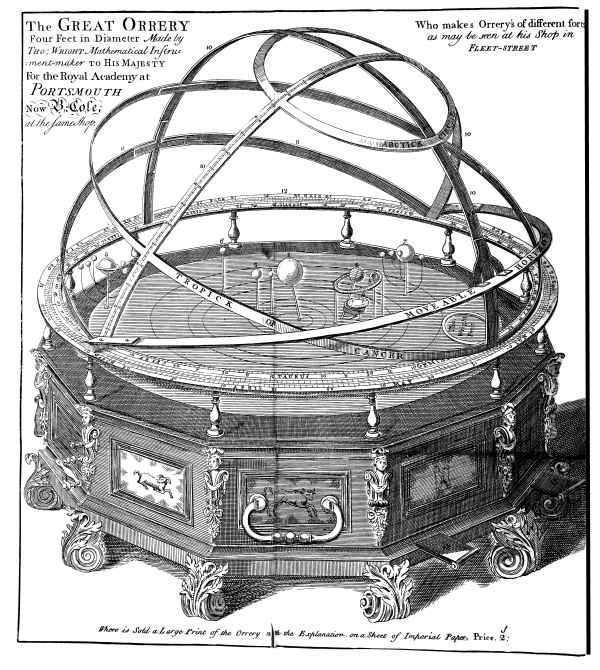
THE great encouragement Mr. WRIGHT has had for many years past in making large Orreries, with the motions of all the Planets and Satellites, and the true motion of Saturn’s Ring, has made him so ready and perfect, that Gentlemen may depend on having them made reasonable and sound, not liable to be out of Order.
As may be seen by one he made for Mr. Watt’s Academy in Tower-street.
Another for his Majesty at Kensington.
Another for the New Royal Academy at Portsmouth.
Another for his Grace the Duke of Argyle(late Lord Ila.)
And several other large ones for Noblemen and Gentlemen.
The above, and all other Mathematical, Philosophical, and Optical Instruments, are now made in the most
complete manner, by B. COLE, Servant to Mr. WRIGHT, at the time of the above being made, and successor to him in the same Trade and Business.
PROBLEM I. TofindtheLatitudeandLongitudeofanygiven placeupontheGlobe;andonthecontrary,the LatitudeandLongitudebeinggiventofindthe Place
PROB. II. TofindtheDifferenceofLatitudebetwixtany twogivenplaces
PROB. III. TofindtheDifferenceofLongitudebetwixtany twogivenplaces
PROB. IV. AnyPlacebeinggiven;tofindallthoseplaces thatareinthesameLatitudewiththesaid place
PROB. V. TheDayoftheMonthbeinggiven;tofindthe Sun’splaceintheEcliptic,andhisDeclination
PROB. VI. TorectifytheGlobefortheLatitude,Zenith, andSun’splace
PROB. VII. TofindtheDistancebetweenanytwogiven PlacesupontheGlobe,andtofindallthose placesupontheGlobethatareatthesame Distancefromagivenplace
PROB. VIII. TofindtheAngleofaPositionofPlaces;orthe angleformedbytheMeridianofoneplace,and agreatcirclepassingthroughboththeplaces
PROB. IX. TofindtheAntœci, Periœci, andAntipodes,to anygivenplace
PROB. X. TheHouroftheDayatonePlacebeinggiven; tofindthecorrespondentHour(orwhato’Clock itisatthattime)atanyotherplace
PROB. XI. TheDayoftheMonthbeinggiven;tofind thoseplacesontheGlobewheretheSunwill beVertical,orintheZenith,thatDay
PROB. XII. AplacebeinggivenintheTorrid Zone; tofind thosetwoDaysinwhichtheSunwillbeVertical tothesame
PROB. XIII. TofindwheretheSunisVerticalatanygiven timeassigned;or,theDayoftheMonthand theHouratanyplace(supposeLondon) being given,tofindinwhatplacetheSunisVertical atthatverytime
PROB. XIV. TheDay,andtheHouroftheDayatoneplace, beinggiven;tofindallthoseplacesuponthe EarthwheretheSunisthenRising,Setting, Culminating(orontheMeridian);alsowhereit isDay-light,Twilight,DarkNight,Midnight; wheretheTwilightthenbegins,andwhereit ends;theHeightoftheSuninanypartofthe illuminatedHemisphere;alsohisDepressionin theobscureHemisphere
PROB. XV. TheDayoftheMonthbeinggiven,toshow,at oneView,theLengthofDaysandNightsinall PlacesupontheEarth,atthattime;andto explainhowtheVicissitudesofDayandNight arereallymadebythemotionoftheEarth roundherAxis,in24Hours,theSunstanding still
PROB. XVI. ToExplainingeneraltheAlterationofSeasons, orLengthoftheDaysandNights,madeinall placesoftheWorld,bytheSun’s,ortheEarth’s AnnualmotionintheEcliptic
PROB. XVII. ToshewbytheGlobe,atoneView,theLength oftheDaysandNights,atanyparticularplace, atalltimesoftheYear
PROB. XVIII. TheLatitudeofanyplace,notexceeding69½ Degrees,andtheDayoftheMonthbeing given;tothetimeofSun-risingandSetting, andthelengthoftheDayandNight
PROB. XIX. Tofindthelengthofthelongestandshortest DayandNightinanygivenplace,not exceeding66½DegreesofLatitude
PROB. XX. TofindinwhatLatitudethelongestDayis,of anygivenlengthlessthan24Hours
PROB. XXI. APlacebeinggiveninoneoftheFrigid Zones (supposetheNorthern)tofindwhatnumberof Days(of24Hourseach)theSundoth constantlyshineuponthesame,howlongheis absent,andalsothefirstandlastdayofhis appearance
. XXII. TofindinwhatLatitudethelongestDayis,of anygivenlength,lessthan182naturalDays
.
TheDayoftheMonthbeinggiven;tofind whentheMorningandEveningTwilight begins andends,inanyplaceupontheGlobe
PROB. XXIV. TofindthetimewhentotalDarknessceases,or whentheTwilightcontinuesfromSun-setting toSun-rising,inanygivenplace
PROB. XXV. TheDayoftheMonthbeinggiven;tofind thoseplacesoftheFrigid Zones, wheretheSun beginstoshineconstantlywithoutsetting;and alsothoseplaceswherehebeginstobetotally absent
PROB. XXVI. TheLatitude,theSun’sPlace,andhisAltitude beinggiven;tofindtheHouroftheDay,and Sun’sAzimuthfromtheMeridian
PROB. XXVII. TheLatitude,HouroftheDay,andtheSun’s Placebeinggiven;tofindtheSun’sAltitude
PROB. XXVIII. TheLatitudeofthePlace,andtheDayofthe Monthbeinggiven;tofindthedepressionof theSunbelowtheHorizon,andhisAzimuth,at anyHouroftheNight
PROB. XXIX. TheLatitudeoftheSun’sPlace,andhis Azimuthbeinggiven;tofindhisAltitude,and theHour
PROB. XXX. TheLatitude,theSun’sAltitude,andhis Azimuthbeinggiven;tofindhisPlaceonthe ibid.
Ecliptic,andtheHour
PROB. XXXI. TheDeclination,andMeridianAltitudeofthe Sun,orofanyStarbeinggiven;tofindthe LatitudeofthePlace
PROB. XXXII. TheDayandHourofaLunarEclipsebeing known;tofindallthosePlacesupontheGlobe inwhichthesamewillbevisible
PROB. XXXIII. TheDayoftheMonth,andHouroftheDay, accordingtoourwayofreckoninginEngland, beinggiven;tofindtherebytheBabylonish, Italic, andJewish, orJudaical Hour
PROB. XXXIV. TofindtheRightAscensionandDeclinationof theSun,oranyFixedStar
PROB. XXXV. TofindtheLongitudeandLatitudeofagiven Star
PROB. XXXVI. TheLatitudeofthePlace,theDayofthe Month,andtheHourbeinggiven;tofindwhat Starsarethenrisingandsetting,whatStars areculminating,orontheMeridian,andthe AltitudeandAzimuthofanyStarabovethe Horizon;andalsohowtodistinguishtheStars intheHeavensonefromtheother,andto knowthembytheirproperNames
PROB. XXXVII. TheLatitudeofthePlacebeinggiven;tofind theAmplitude,ObliqueAscension,and Descension,AscensionalDifference,SemidiurnalArch,andthetimeofContinuance abovetheHorizon,ofanygivenPointinthe Heavens
PROB. XXXVIII.TheLatitudeandtheDayoftheMonthbeing given;tofindtheHourwhenanyknownStar willbeontheMeridian,andalsothetimeofits RisingandSetting
PROB. XXXIX. TofindatwhattimeoftheYearagivenStar willbeupontheMeridian,atagivenHourof
theNight
PROB. XL. TheDayoftheMonthandtheAzimuth,ofany knownStarbeinggiven;tofindtheHourofthe Night
PROB. XLI. TwoknownStars,havingthesameAzimuth,or thesameHeight,beinggiven;tofindtheHour oftheNight
PROB. XLII. TheLatitude,DayoftheMonth,andthe AltitudeofanyknownStarbeinggiven;tofind theHouroftheNight
PROB. XLIII. HavingtheLatitudeofthePlace,tofindthe DegreeoftheEcliptic,whichrisesorsetswith agivenStar;andfromthencetodeterminethe timeofitsCosmical andAchronical Risingand Setting
PROB. XLIV. HavingtheLatitudeofthePlace;tofindthe timewhenaStarrisesandsetsHeliacally
PROB. XLV. TofindthePlaceofanyPlanetupontheGlobe, sobythatMeanstofinditsPlaceinthe Heavens;alsotofindatwhatHouranyPlanet willriseorset,orbeontheMeridian,atany DayintheYear
PROB. XLVI. TofindallthatspaceupontheEarthwherean EclipseofoneoftheSatellitesofJupiter willbe visible
THE INTRODUCTION, CONTAINING
A Brief Account of the SOLAR SYSTEM, and of the FIXED STARS.
SECT. I.
Of the Order and Periods of the Primary Planets revolving about the Sun; and of the Secondary PlanetsroundtheirrespectivePrimaries.
HE Sun is placed in the midst of an immense space, wherein six opaque spherical bodies revolve about him as their center. These wandering globes are called the Planets, who, at different distances, and in different periods, perform their revolutions from West to East, in the following order:
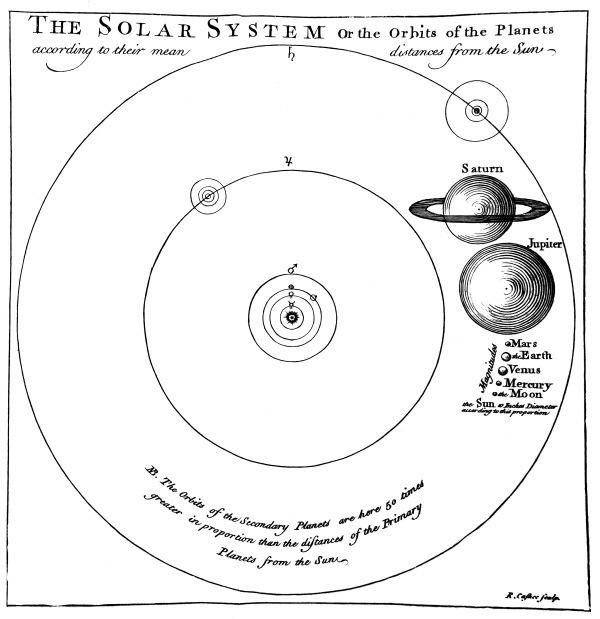
1. ☿ Mercury is nearest to the Sun of all the planets, and performs its course in about three months. 2. ♀ Venus in about seven months and a half. 3. ♁ The Earth in a year. 4. ♂ Mars in about two years. 5. ♃ Jupiter in twelve. And lastly, ♄ Saturn, whose[1] Orbit includes all the rest, spends almost 30 years in one revolution round the Sun. The distances of the Planets from the Sun are nearly in
Planets.
the same proportion as they are represented in Plate 1. viz. Supposing the distance of the Earth from the Sun to be divided into 10 equal parts; that of Mercurywill be about 4 of these parts; of Venus 7; of Mars 15; of Jupiter 52; and that of Saturn95.
The Characters placed before the names of the Planets, are for brevity’s sake commonly made use of by Astronomers, instead of the words at length, as ♀, for Venus, &c.
Plate 1.
The orbits of the Planets are not all in the same plane, but variously inclined to one another; so that supposing one of them to coincide with the above scheme, the others will have one half above, and the other half below it; intersecting one another in a line passing through the Sun. The plane of the Earth’s orbit is called the Ecliptic; and this the astronomers make the standard to which the planes of the other orbits are judged to incline. The right line passing thro’ the Sun, and the common intersection of the plane of the orbit of any planet and
Nodes.
the Ecliptic, is called the Line of the Nodes of that planet; and the points themselves, wherein the orbit cuts the Ecliptic are called the Nodes.
The inclinations of the orbits of the Planets to the plane of the ecliptic, are as follows, viz. the orbit of Mercury makes an angle with it of almost 7 degrees; that of Venus something above 3⅓ degrees; of Mars a little less than 2 degrees; of Jupiter, 1⅓ degree; and of Saturn, about 2½ degrees. The orbits of the Planets are not circles, but ellipses or ovals. What an ellipsis is, may be easily understood from the following description. Imagine two small pegs fixed upright on any plane, and suppose them tied with the ends of a thread somewhat longer than their distance from one another: Now if a pin be placed in the double of the thread and turned quite round (always stretching the thread with the same force) the curved described by this motion is an Ellipsis. The two points where the pegs stood, (about which the thread was turned) are called the fociof that ellipsis; and if, without changing the length of the thread, we alter the position of the pegs, we shall then have an ellipsis of a different kind from the former; and the nearer the focus’s are together, the nearer will the curve described be to a circle; until at last, the two focus’s coincide, and then the pin in the doubling of the thread will describe a perfect circle. The orbits of all the Planets have the Sun in one of their focus’s, and half the distance between the two focus’s is called the Excentricity of the orbits. This excentricity is different in all the planets, but in most of them so small, that in little schemes or instruments, made to represent the planetary orbits, it need not be considered.
The six Planets above-mentioned, are called Primaries, or PrimaryPlanets; but besides these, there are ten other lesser Planets, which are called Secondaries, Moons, or Satellites. These moons always accompany their respective primaries, and perform their Revolutions round them, whilst both together are also carried round the Sun. Of the six Primary Planets, there are but three, as far as
Excentric ity.
Primary Planets. Seconda ry Planets.
observation can assure us, that have these attendants, viz. the Earth, Jupiter, and Saturn.
The Earth is attended by the Moon, who performs her revolution in about 27⅓ Days, at the distance of about 30 Diameters of the Earth from it; and once a Year is carried round the Sun along with the Earth.
Jupiter has four Moons, or Satellites; the first, or innermost, performs its revolution in about one Day, and 18½ Hours, at the distance of 5⅔ Semidiameters of Jupiter, from his Center; the second revolves about Jupiter in 3 Days, 13 Hours, at the distance of 9 of his Semidiameters; the thirdin 7 Days, and 4 Hours, at the distance of 14⅓ Semidiameters; the fourth, and outermost, performs its course in the space of 16 Days, 17 Hours; and is distant from Jupiter’s center, 25⅓ of his Semidiameters.
Jupiter’s four Moons.
Saturn has no less than five Satellites; the first, or innermost, revolves about him in 1 Day, and 21 Hours, at the distance of 4⅜ Semidiameters of ♄, from his center; the second compleats his period in 2¾ Days, at the distance of 5³/₅ of his Semidiameters; the third, in about 4½ Days, at the distance of 8 Semidiameters; the fourthperforms its course in about 16 Days, at the distance of 18 Semidiameters; the fifth, and outermost, takes 79⅓ Days, to finish his course, and is 54 Semidiameters of Saturn distant from his center. The Satellites, as well as their primaries, perform their revolutions from Westto East: The planes of the Orbits of the Satellites of the same Planet are variously inclined to one another, and consequently are inclined to the plane of the Orbit of their primary.
Saturn has five Moons. Saturn’s Ring.
Besides these attendants, Saturnis encompassed with a thin plain Ring, that does no where touch his body; The diameter of this Ring is to the diameter of Saturn, as 9 to 4; and the void space between the Ring and the body of Saturn is equal to the breadth of the Ring itself; so that in some situations the Heavens may be seen between the Ring and his body. This
surprizing phænomenon of Saturn’s Ring, is a modern discovery; neither were the Satellites of Jupiter and Saturn known to the ancients. The Jovial Planets were first discovered by the famous Italianphilosopher Galilæus, by a telescope which he first invented; and the celebrated Cassini, the French king’s astronomer, was the first that saw all the Satellites of Saturn; which by reason of their great distances from the Sun, and the smallness of their own bodies, cannot be seen by us, but by the help of very good glasses.
The motion of the primary Planets round the Sun (as also of the Satellites round their respective primaries) is called their Annual Motion; because they have one Year, or alteration of Seasons compleat, in one of these revolutions. Besides this annual motion, four of the Planets, viz. Venus, the Earth, Mars, and Jupiter revolve about their own Axis, from West to East; and this is called their Diurnal Motion. For by this rotation, each point of their surfaces is carried successively towards or from the Sun, who always illuminates the hemisphere which is next to him, the other remaining obscure; and while any place is in the hemisphere, illuminated by the Sun, it is Day, but when it is carried to the obscure hemisphere, it becomes Night; and so continues, until by this rotation the said place is again enlightened by the Sun.
Annual Motion. Diurnal Motion.
Diurnal Motion of the ♁, ♀, ♂ and ♃. ☉ and ☽ likewise turn round their Axis.
The Earthperforms its revolution round its axis in 23 Hours, 56 Minutes;[2] Venus, in 24 Days, 8 Hours; Mars, in 24 Hours, and 40 Minutes; and Jupiter moves round his own axis in 9 Hours, and 56 Minutes. The Sun also is found to turn round his axis from West to East, in 27 Days: And the Moon, which is nearest to us of all the Planets, revolves about her axis in a Month, or in the same space of time that she turns round the Earth; so that the Lunarianshave but 1 Day throughout the Year.
I. The Planets are all Opaquebodies, having no light but what they borrow from the Sun; for that
The Planets are Opaque and