Explore and download more ebooks or textbooks at ebookball.com
Modern Islamic Political Thought The Response of the Shi‘i and Sunni Muslims to the Twentieth Century 1st edition by Hamid Enayat 9780857721099 0857721097
The Princeton Encyclopedia of Islamic Political Thought 1st Edition by Gerhard Bowering, Patricia Crone, Wadad Kadi, Devin J Stewart, Muhammad Qasim Zaman, Mahan Mirza ISBN 140083855X 9781400838554
The Princeton Encyclopedia of Islamic Political Thought 1st Edition by Gerhard Bowering, Patricia Crone, Wadad Kadi, Devin Stewart, Muhammad Qasim Zaman, Mahan Mirza ISBN 140083855X 9781400838554
An Efficient e Commerce Fair Exchange Protocol That Encourages Customer and Merchant to Be Honest 1st edition by Abdullah Alaraj, Malcolm Munro ISBN 3540876977 9783540876977
(Ebook PDF) Islamic Based Educational Islamic Administration and Management Challenging Expectations through Global Critical Insights 1st edition by Khalid Arar 1000838463 9781000838466 full chapters
‘Islamic Thought’is ideal for anyone who wants to understand more about Muslim beliefs and the Islamic faith.’ Oliver Leaman, University of Kentucky, USA
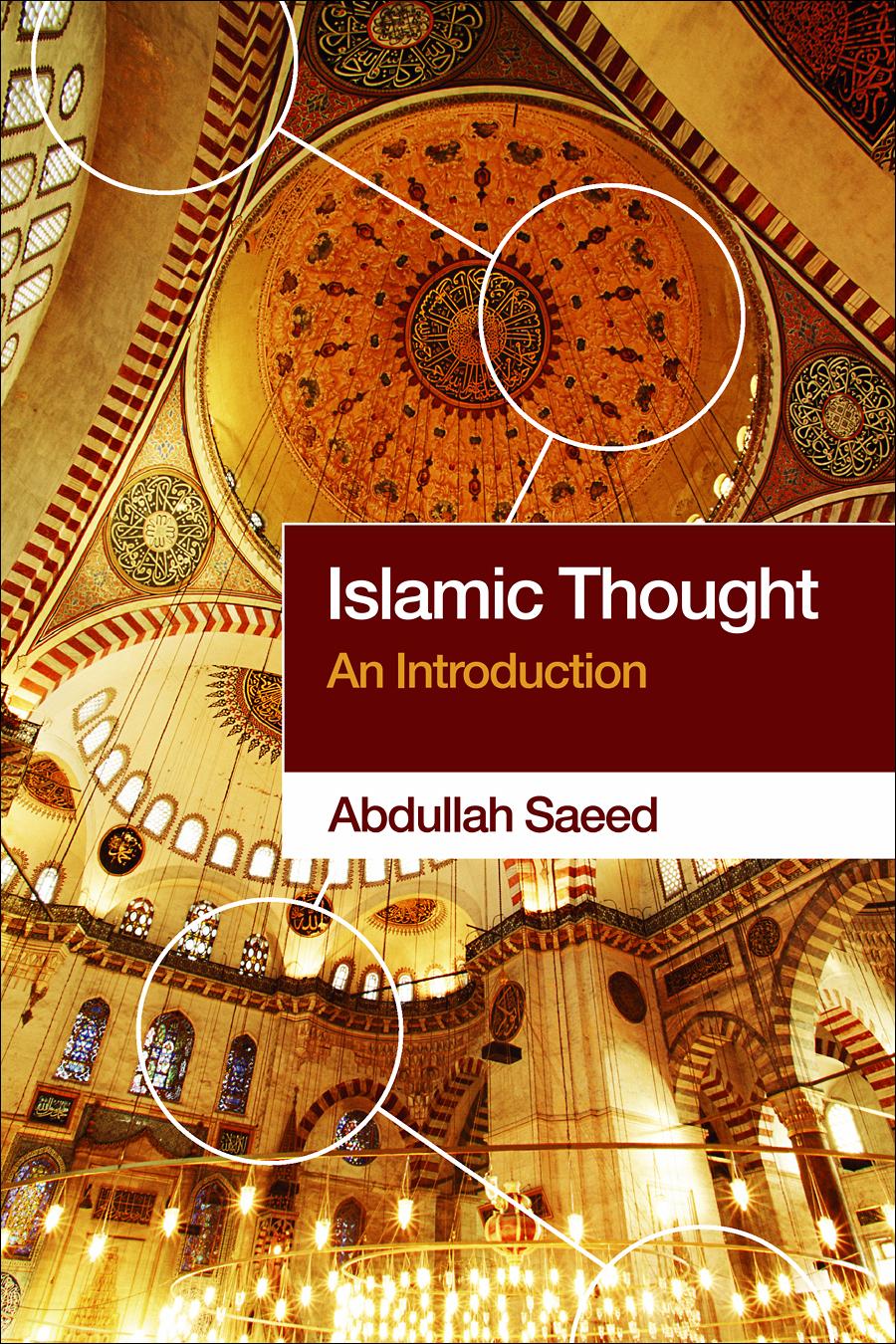
Islamic Thought is a fresh and contemporary introduction to the philosophies and doctrines of Islam. Abdullah Saeed, adistinguished Muslim scholar, traces the development of religious knowledge in Islam, from the pre-modern to the modern period. The book focuses on Muslim thought, as well as the development, production and transmission of religious knowledge, and the trends, schools and movements which have contributed to the production of this knowledge.
Key topics in Islamic culture are explored, including the development of the Islamic intellectual tradition, the two foundation texts, the Qur’an and hadith, legal thought, theological thought, mystical thought, Islamic art, philosophical thought, political thought, and renewal, reform and rethinking today. In the face of changes in Islamic law, and the influence of Western societies, as well as developments in gender rights, human rights and globalization, and in reaction to contemporary social and political events, Muslim beliefs are changing and adapting. Through this rich and varied discussion, Saeed presents a fascinating depiction of one of the world’s major living religions.
Islamic Thought is essential reading for students beginning the study of Islam but will also interest anyone seeking to learn more about one of the world’s great religions.
Abdullah Saeed is the Sultan of Oman Professor of Arab and Islamic Studies, and the Director of the Centre for the Study of Contemporary Islam at the University of Melbourne, Australia. He has written widely on Islam and contemporary Muslim issues and is the author and editor of a number of books, including Interpreting the Qur’an (2006), Approaches to the Qur’an in Contemporary Indonesia (editor, 2005), Freedom of Religion, Apostasy and Islam (co-author 2004), Islam and Political Legitimacy (co-editor 2004), Islam in Australia (2003) and Islamic Banking and Interest (1996).
Islamic Thought
An introduction
Abdullah Saeed
First published 2006 by Routledge
2Park Square, Milton Park, Abingdon, Oxon OX14 4RN
Simultaneously published in the USA and Canada by Routledge
270 Madison Ave, New York, NY 10016
Routledge is an imprint of the Taylor & Francis Group, an informa business
This edition published in the Taylor & Francis e-Library, 2006.
“To purchase your own copy of this or any of Taylor & Francis or Routledge’s collection of thousands of eBooks please go to www.eBookstore.tandf.co.uk.”
All rights reserved. No part of this book may be reprinted or reproduced or utilised in any form or by any electronic, mechanical, or other means, now known or hereafter invented, including photocopying and recording, or in any information storage or retrieval system, without permission in writing from the publishers.
British Library Cataloguing in Publication Data
Acatalogue record for this book is available from the British Library
Library of Congress Cataloging in Publication Data
Acatalog record for this book has been requested
ISBN 10: 0–415–36408–6 (hbk)
ISBN 10: 0–415–36409–4 (pbk)
ISBN 10: 0–203–01524–X (ebk)
ISBN 13: 978–0–415–36408–9 (hbk)
ISBN 13: 978–0–415–36409–6 (pbk)
ISBN 13: 978–0–203–01524–7 (ebk)
Introduction vii
1Transmission of religious knowledge and Islamic thought1
2The Qur’an: the primary foundation text15
3The Sunna of the Prophet33
4Legal thought43
5Theological thought60
6Mystical thought: Sufism74
7Artistic expression85
8Philosophical thought93
9Political thought113
10Renewal, reform and Muslim modernism129 Epilogue:
Introduction
This book is primarily aimed at undergraduate students in courses connected with Islam, Muslim societies, Islamic thought and religious studies as well as ageneral readership. It should be seen as an introduction to Islamic thought. It does not focus on one single aspect of thought; instead, it deals with a range of areas of Islamic thought from the foundation texts to law, theology, philosophy, politics, art and mysticism as well as key trends of Islamic thought in both the pre-modern and modern periods. This book is not a history of Islam, Islamic culture or Islamic civilization. Its primary focus is on Muslim doctrines, the development, production and transmission of religious knowledge, and the key trends, schools and movements that have contributed to the production of this knowledge.
Islam, like any other religion, is much more than just doctrines and religious knowledge. But understanding the doctrinal and religious knowledge background will help the reader understand other aspects, such as institutions specific to Islam, how Islam was lived in the past and how its adherents practise it in the present.
Because of the way the book is structured, it was always difficult to avoid some repetition. Instead of eliminating such minor repetitions completely, Idecided to leave them as they are. Since areas of Islamic thought are connected to each other, any attempt to draw a line between one area and another, for instance between the Qur’an and law, would ultimately fail. Similarly because for each area of Islamic thought covered in the book I have provided in each chapter an overview of the development of the area, from the earliest times of Islam to the modern period, the last two chapters might seem somewhat unnecessary. However, I believe that the last two chapters in fact help us to understand modern developments in Islamic thought in general and to contextualize many debates associated with Islamic thought today.
In dealing with the topics covered I have tried my best to remain as neutral as possible, making comments as fairly as possible in order to represent the complexities associated with the issues covered. But such neutrality is often difficult as I am bound to bring into the book how I see the world. My biases
viiiIntroduction
therefore creep into the text on a number of issues. Despite the book’s shortcomings, I do hope this book will be an accessible guide to the extremely rich and diverse tradition of Islamic thought.
Ihave tried to make the ideas presented as accessible as I could, avoiding unfamiliar language as far as possible. Where such terms are used I have tried to provide the translation or the meaning of the term. At the end, I have also provided a glossary for easy reference and a bibliography. Where relevant, timelines, brief explanation of concepts and summaries of key points and texts are provided in text boxes, particularly in the earlier chapters.
Transliteration
For transliteration of Arabic terms, given this book is primarily meant for non-specialists, I have adopted a simple system. I have avoided the use of macrons (for example u,ı or a)or dots below certain letters. I have also avoided the use of the symbol ‘ for ‘ayn at the beginning of a word but used it where that occurs in the middle (for instance shari‘a). Similarly, where the hamza occurs at the beginning of a word, I have avoided using the symbol ’ but where it occurs in the middle, I have generally used it (for instance, Qur’an). The h indicating a ta’ marbuta is also dropped throughout the book.
Dates
Where the text refers to dates, in general, I have provided two dates as follows: 1/622. The first date ‘1’ refers to the year in the Islamic calendar and the second ‘622’ refers to the year in Common Era (CE). For the twentieth century, I have given not the Islamic dates but CE only (for example, 1930). In order to make clear when a person lived, for the key people mentioned in the book, I have provided the year of death, for example: Muhammad (d. 11/632).
Chapter outline
Chapter 1 forms the basic context for the remainder of the book. It examines the fundamental teachings of the Prophet Muhammad, the development of religious knowledge and the social and political contexts that shaped the Islamic intellectual tradition. It depicts the key centres of learning with particular reference to higher education institutions and the patrons and scholars who founded them and fostered their development.
Chapter 2 explores the first primary foundation text, the Qur’an. In particular it addresses issues such as the Qur’an as revelation or text; a brief overview of the history of the text; approaches to understanding the Qur’an and its interpretation; and the centrality of the Qur’an in Muslim life and practice.
Chapter 3 examines the development of the concept of Sunna (the normativebehaviour of the Prophet Muhammad); approaches to the documentation and understanding of Sunna (in hadith); the centrality of the hadith in Muslim life and practice; and modern debates on the authenticity of hadith and Muslim responses.
Chapter 4 explores the notions of shari‘a and fiqh.It also examines how law is ‘constructed’ in the juristic schools, highlighting some of the key principles of jurisprudence (usul al-fiqh). It includes sections on Islamic law in the colonial period, on the debate on law, shari‘a and Islamization, and on the reform of law today.
Chapter 5 is devoted to Islamic theology (kalam)and its place within the Islamic intellectual tradition. It discusses theological trends and their central ideas as well as the decline of early groups such as the Mu‘tazilis and the gradual increase in the influence of the Ash‘aris, moving on to modern developments.
Chapter 6 approaches Sufism historically by tracing the origins and development of Sufism and explaining the Sufi path. It includes key Sufi orders and their characteristics, and concludes by looking at Sufism today.
Chapter 7 provides an introduction to some key aspects of Islamic artistic expression and the debates on what is considered Islamic art and what is acceptable or not islamically.
Chapter 8 traces the Muslim interest in philosophy and the lively context in which this interest arose and developed. This chapter includes some key philosophical contributions by Muslim philosophers, both classical and modern.
Chapter 9 deals with Muslim political thought. It includes the early Khariji, Sunni and Shi‘i theories of the imamate and the caliphate, and summarizes the concepts of governance and statecraft of several thinkers. Included in the chapter are also some important contemporary debates on concepts such as state and citizenship among Muslims.
Chapter 10 is about renewal and reform in Islam and Muslim modernism. The chapter describes key Islamic trends or movements that appeared from the eighteenth to the twentieth centuries.
The Epilogue summarizes several key trends in Islamic thought today. It focuses on six broad trends which seem to be the most dominant.
Acknowledgements
Iwould like to thank a number of colleagues, friends and others for contributing significantly to the development and writing of this book. In particular I would like to thank Rachel Woodlock, who assisted me in the research for the book as well as reading the draft manuscript very thoroughly and polishing it; and Andy Fuller, Redha Ameur, Imran Lum, Anisa Buckley and Eeqbal Hassim, who assisted me in the research for the book and
contributed significantly to it. Any errors, omissions and problems in the book are of course mine.
Ithank Lesley Riddle for her encouragement to write the book, Andrew Rippin for his comments on the first draft, Gemma Dunn for editorial support, Donna Williams for her critical reading of the book and John Banks for copyediting the book. I also thank my wife, Rasheeda, and my son, Isaam, for their wonderful support throughout the project.
Chapter 1 Transmission of religious knowledge and Islamic thought
This chapter introduces the basic teachings of Islam and how its body of knowledge has been transmitted from the earliest Muslims. The main topics addressed are the essential teachings of the Prophet Muhammad and the inception and growth of Islamic educational institutions.1
Muhammad’s life:key events
570:Birth of Muhammad in Mecca as an orphan
576:Muhammad’s mother dies
595:Muhammad marries Khadija
610:Muhammad receives his first revelation from God
615: Because of the persecution of his followers by Meccans, Muhammad asks his followers to flee to Abyssinia (which was ruled by a Christian king)
619:Khadija, the Prophet’s wife, dies
622:Muhammad and his followers migrate to Medina. Beginning of Islamic calendar
624:First battle between Muslims in Medina and their opponents of Mecca in which the Meccans were defeated (Battle of Badr)
632:Muhammad dies
The emergence of Islam was deeply connected to the history of its birthplace. In the early seventh century of the Common Era (CE), Mecca was a rather marginal town outside the influence of the two powerful empires of the time: the largely Christian Byzantine Empire and the predominantly Zoroastrian Sassanid Empire, both situated to the north of Arabia. The people of Mecca mostly belonged to the Quraysh tribe. As there was no ruler or formal state structures, the town was governed through a
2Islamic thought
consultative process administered by the elders and chiefs. Economically, life in Mecca and its surrounding regions was difficult. The land was generally arid and there was no agriculture. Many Meccans relied on trade and the movement of goods using transport by camel (caravans) for their livelihood. Education was limited to the basic skills necessary for survival, such as the use of armaments (swords and arrows) and the riding of camels and horses. Only a few people were literate, but that did not prevent the Meccans from having a particular love of their language, Arabic. Poetry and poets were revered, and expression in beautiful language was considered the pinnacle of intellectual activity. According to traditional accounts, several famous poems were displayed in important places like the Ka‘ba, a cube-shaped building in Mecca that served as a major point of pilgrimage for the pre-Islamic Arabs and for Muslims as well later.
Mecca
Mecca is the holiest city for Muslims. It is where the Ka‘ba (a cubical building surrounded today by the Sacred Mosque) is, and it is towards the Ka‘ba that Muslims turn every day, at least five times a day in their prayers. Muslims believe that the Ka‘ba was built by the Prophet Abraham and his son Ishmael as a place of worship of the One God and a site of pilgrimage. The beginning of Mecca, according to Muslim belief, therefore goes back to the time of Abraham. According to tradition, it is through the lineage of Ishmael that the Prophet Muhammad comes. It was because of pilgrimage by Arabs and being atrading post that Mecca became a town of significance from around the fifth century CE.
Muhammad, the Prophet of Islam, was born in Mecca in approximately 570 CE.His father Abd Allah died before he was born and his mother Amina died during his early childhood, leaving the young boy an orphan to be cared for by relatives. In his twenties, he married Khadija, a wealthy widow, with whom he had several children. He worked in his wife’s business and lived an unremarkable life until the age of forty. Unlike other Meccans, Muhammad liked to spend time apart for reflection and meditation, often in acave outside Mecca. Muslim tradition holds that during one of these retreats he experienced his first ‘revelation’ from God, in approximately 610 CE. Initially, he was not sure what to make of the experience of receiving revelation (divine messages in the Arabic language). After his initial doubts passed, however, he began to receive further divine messages. Muhammad began teaching them to his close friends and family and, after some time, to
Transmission of religious knowledge3
the wider Meccan community. His original message was that Meccans should accept that there is only one God, the creator and sustainer of everything, who had sent Muhammad as a messenger. These early revelations also emphasized that the Meccan people needed to care for the needy and disadvantaged. The Meccans believed in the existence of a higher god and anumber of lesser gods, many of which were placed in the sanctuary Ka‘ba. For them the idea of believing only in ‘one god’ which Muhammad was preaching was unacceptable.
Six pillars of faith:essential beliefs of a Muslim
•Belief in God (Allah)
•Belief in the angels
•Belief in the revealed books
•Belief in the messengers (prophets)
•Belief in the resurrection and the events of the Day of Judgement
•Belief in the predestination of all things and events (qada)and God’s decree
Five pillars of Islam:essential practices of a Muslim
•To testify that none has the right to be worshipped but God (Allah) and Muhammad is God’s messenger
•To offer the five compulsory prayers (salat)
•To pay the obligatory charity (zakat)
•To perform pilgrimage to Mecca (hajj)
•To fast during the month of Ramadan
Most Meccans were sceptical of Muhammad’s claims and refused to accept his teachings. However, a number of Muhammad’s relatives and close friends and some of the marginalized inhabitants of Mecca accepted his call and followed him. At the same time as some were coming to accept his teachings, opposition grew, and those with vested power interests in Mecca, who felt challenged by Muhammad’s social justice tied to radical monotheism, began toput obstacles in his way. They punished his followers, particularly slaves and women. Gradually, the persecution in Mecca intensified. As a result,
4Islamic thought
Muhammad instructed his small group of followers to flee the town and seek the protection of the Negus, the Christian ruler of Abyssinia (in modern-day Ethiopia). These Muslims, whose number was approximately eighty, left for Abyssinia secretly and in small groups in 615 CE.It was under the protection of the Negus that the first Muslim migrant community was able topractise its religion freely. Despite the efforts of the Meccan leaders to have the Muslims forcibly returned to Mecca, the Negus refused to comply, and gave the Muslims permission to live and practise their new religion freely under his protection.
The
Islamic calendar
The Islamic calendar is a lunar calendar. It contains 12 months (some of 29 days and others 30 days) that are based on the motion of the moon. This book and other works on Islam often give dates in the style 1/622. This means Year 1 of the Islamic calendar is equivalent to Year 622 in the Gregorian calendar (which is based on the motion of the sun). The Islamic year is therefore shorter than the Gregorian year, so that there is no exact equivalence between Islamic and Gregorian year numbering, and in successive years, Islamic months and festivals occur at different dates in the Gregorian calendar. Today, many Muslims use the Islamic calendar for religious purposes but for civil purposes they often use the Gregorian calendar. Some Western books use the style AH (Anno Hegirae) for Islamic dates.
Muhammad continued to preach to the people of Mecca and others nearby without much success. However, he managed to win over to his teachings a large number of people from Yathrib, a town to the north of Mecca. These new converts promised to protect and support the Prophet if he were to leave Mecca and migrate to Yathrib, which came to be known as Medina, from a phrase meaning ‘city of the Prophet’. In 622 CE (the date at which the Islamic calendar, also called ‘hijri calendar’, begins), Muhammad migrated to Medina, where he was joined by many of his Meccan followers. The Meccan and Medinan Muslims together formed the Muslim community, away from the persecution of Meccans. Medina thus became the base for Islam and it was from there that Islam began to spread widely throughout Arabia. By the time he died in 11/632, the Prophet had established a ‘state’ based in Medina and much of Arabia was under the control of the Muslims of Medina. At the time of the Prophet’s death, Muslim tradition holds, his followers numbered over one hundred thousand.
Transmission of religious knowledge5
The
expansion of
Muslim rule in the first century of Islam
632: Prophet Muhammad dies; a large part of Arabia is under Muslim control or allied with Muslims
633:Muslims begin conquest of Iraq
634:Muslims begin conquest of Syria
637:Fall of Sassanid (Persian) empire to Muslims
638:Fall of Jerusalem to Muslims
642:Fall of Alexandria (Egypt) to Muslims
705:Muslims control Central Asia
711:Muslims begin conquest of Spain
732: Christians (Franks) withstand the advance of Muslims into France.
Early transmission of religious knowledge
Muslim religious knowledge was first imparted via the Qur’an (the divine messages the Prophet received and which were put together in the form of a book shortly after the death of the Prophet) and its interpretations. It seems to have been common for the Prophet to expound the meaning of verses of the Qur’an to his immediate followers, who were known as ‘Companions’ (sahaba).2 His interpretation of the Qur’an was ad hoc and depended entirely on circumstances. His practice seems to have been simply to recite to those present what he had received as revelation, and to give an interpretation only when his followers did not understand.
One of the early difficulties for the Companions was to comprehend some of the terms and expressions in the Qur’an. A second difficulty for the Companions was in understanding some of the historical references in the Qur’an. Interest in such references, particularly to stories of the earlier prophets (such as Noah, Abraham and Moses) and nations of the past, increased further when younger Companions began to elaborate on the Qur’an after the death of Prophet Muhammad. Some Companions approached local Jews and Christians – known as ‘people of the Book’ ( ahl al-kitab)3 –and asked them about pre-Islamic events and stories. A number of Jewish converts to Islam, such as Abd Allah b. Sallam (d. 43/663), actively passed on biblical knowledge to the Companions. In the post-prophetic period, several Companions engaged in this on a much greater scale with converts to Islam from the ‘people of the Book’.
The growing body of hadith – traditions about the sayings and activities of Prophet Muhammad – also attracted the interest of the Companions and
6Islamic thought
the following generation of Muslims, known as the ‘Successors’ (tabi‘un).4 This interest in hadith led in the first/seventh and second/eighth centuries to the emergence of a group of ‘hadith collectors’. These people travelled from town to town in search of hadith and with them knowledge of Islam spread widely. In this process, the texts and narrators of hadith were identified and finally recorded in writing in the first three centuries after the death of the Prophet.
Political and religious tensions and the emergence of key trends
Key early Muslim trends
Kharijis:those who rebelled against the fourth caliph Ali and remained hostile to the Umayyads
Shi‘a (or Shi‘is):sided with Ali and elevated him and the family of the Prophet
Qadaris:believed in human freedom
Jabris:believed in predestination (opposite of Qadaris)
Murji’is:those who believed that it is not up to human beings to determine the fate of Muslims who commit grave sins; their judgement is left to God
Mu‘tazilis:intellectual descendants of Qadaris; believed in human freedom and adopted a particularly strict version of monotheism
Sunnis:mainstream Muslims who followed the path of Sunna and accepted a middle ground between the Qadaris and the Jabris on human freedom as well as between the Shi‘a and the Kharijis
Sufis:emphasized the spiritual dimension of Islam.
The first thirty years after the death of the Prophet (11–41/632–661) was a period of social and political tension within the body politic of the Muslim community. Problems among Muslims were not simply about political leadership but also about what and who represented religious authority. Some Muslims wanted to remain faithful to the letter and spirit of the religion and avoid debilitating disputes in the community by remaining politically neutral. Others took sides, which escalated into arguments over who was or was not a true Muslim. In fact, binaries of this nature were among the earliest questions posed in Muslim theological discourses in the first century of Islamic history, and many were to become key questions of Islamic theology.
Transmission of religious knowledge7
Community upheaval continued in the Umayyad period (41–132/661–750). Several groups with diverse theological or religio-political orientations emerged. Among these were the Kharijis ( khawarij), the Shi‘a, the Qadaris (qadariyya), the Mu‘tazilis (mu‘tazila), the Jabris (jabriyya)and the Murji’is (murji’a).
Kharijis
The Kharijis, the earliest of these groups, emerged even before the establishment of the Umayyad rule in 41/661. They began in the aftermath of the Battle of Siffin in 37/657, which had brought the fourth caliph, Ali b. AbiTalib (d. 40/661), into war with the Syrian governor Mu‘awiya b. Abi Sufyan (d. 60/680).5 The Kharijis believed that by engaging in war against one another and by committing grave sins, Muslims on both sides of this war became apostates or unbelievers. The Kharijis also believed that any Muslim, regardless of ethnic background or social status, could become the political leader of the Muslims simply on the basis of their religious virtue and refusal to compromise.6 They also believed that Muslims should rebel against any unjust ruler. They initiated heated debates on notions of ‘Muslim’, ‘believer’, ‘disbeliever’ and ‘idolater’.
Shi‘a
The Shi‘a, whose name is drawn from shi‘at Ali (partisans of Ali), believed that in political succession the family of the Prophet should be given priority over any other Muslim. They argued that Ali, the Prophet’s cousin and sonin-law, should have been his immediate political successor. All political leadership of the community should thus have remained within the Prophet’s family. From this basic position the Shi‘a developed a distinctive theological system over the first three centuries of Islam.
Murji’is
Apart from the Kharijis and the Shi‘a, other trends of thought emerged during the first and second centuries of Islam. Some of these were refinements of positions adopted by earlier groups on theological or religio-political matters. The Murji’is opposed the Khariji view that anyone who commits a major sin is an unbeliever.7 The Murji’is were not a distinct group, but rather a broad intellectual trend, which attracted a large number of Muslims. The Murji’is held that a person’s belief should be judged not on their actions but on their words. Only by committing the sin of idolatry (shirk)did a Muslim cease to be a believer. Shirk meant ‘associating other beings (or deities) with God’.8
8Islamic thought
The Murji’i position attempted to minimize division within the community. It also kept within the fold of Islam the Companions who were engaged in early military confrontations with one another. The Murji’i position also protected a range of early Muslim groups from being excluded from the fold of religion as it enabled Kharijis, Shi‘a and Umayyads all to be defined as believers; it was God alone who would determine their fate on the Day of Judgement.9
Jabris
Closely related to the Murji’is in the Umayyad period were the Jabris. According to the Jabris, human beings do not have control over their actions, as they are all predetermined by God. Some Umayyads used religion and religious ideas to justify their decisions on political matters and to legitimize their rule, and supported the views of the Jabris and the Murji’is. This is not surprising, as a number of Umayyad rulers committed heinous crimes including the wanton killing of Muslim subjects. According to the Khariji view, these rulers should have been ousted as unbelievers and unsuitable rulers of the Muslim community. However, in the Jabri view these rulers could not be labelled unbelievers as God had predetermined their actions and so their legitimacy remained relatively untarnished. Thus, in conjunction with their doctrine of predetermination, the Jabris argued that the crimes of the Umayyads were in a sense ‘sanctioned’ by God.
Qadaris
It is in this context that the Qadaris, who challenged the Jabris and the Umayyads, emerged. The Qadaris believed that God does not pre-ordain what people do: human beings are free and can choose between right and wrong. This conflicted with the interests of the Umayyad rulers. The Qadari position implied that it was possible to challenge and even change the status quo.This radical view, particularly if supported by the Khariji militancy, according to which anyone who committed a major sin was an unbeliever, posed a potentially powerful threat to the Umayyad political elite.
Mu‘tazilis
An important development was the rise of the Mu‘tazilis, who accepted some of the Qadari views on human freedom. They agreed with some Khariji views, although they modified the definition of ‘true believer’ and the status of those who commit grave sins. The Mu‘tazilis also aimed at preserving the strict monotheism of Islam by emphasizing the uniqueness of God. As part of this, they believed, for example, that the Qur’an (which is considered to be the speech of God) was ‘created’ by God. For them, if Muslims believe
that the Qur’an is the speech of God and therefore co-eternal with God, it will compromise the monotheism the Qur’an and the Prophet taught. Mu‘tazili ideas were, in a sense, an extension of earlier theological developments and quite moderate in comparison with some earlier views. However, anumber of their ideas – in particular the created status of the Qur’an – led to controversy that has left its mark on the collective psyche of Muslims to the present day.
Sunnis
It was in this theological and religio-political context that Sunnism developed between the first/seventh and the third/ninth centuries, when early debates gave way to a synthesis of sorts. Certain positions adopted by all of the groups referred to above were refined and developed into what may be called the ‘mainstream’ outlook adopted by the majority of Muslims. This mainstream came to be known as ‘people of the Sunna’ (ahl al-sunna or those who follow the path of the Prophet), or Sunni Islam, which accepted a set of theological creeds10 and schools of religious law.11 Coupled with this was the consolidation of a number of scholastic disciplines, including interpretation of the Qur’an, collection of hadith, the principles of jurisprudence and the recording of early Islamic history. Given that Sunnism reflected the position of the majority of Muslims, it came to be seen as ‘orthodoxy’.
Sufis
Sufism, or Islamic mysticism, also emerged in the second/eighth century and gradually developed into Sufiorders throughout the Muslim regions. Unlike the other groups, Sufistended to be more accommodating and inclusive:
Because Sufiscared only for the heart’s inner disposition, they were not conformists who required that true Muslims should everywhere submit to the same outward modes. They tolerated local differences, even between Christianity and Islam.12
Other Muslims wanted to differentiate themselves from non-Muslims in order to demonstrate superiority in the authenticity and truth of what they professed. Sufis accommodated diversity and drew in elements from other religious traditions. This, with their popular influence and esoteric views on religion, ensured that they remained the target of non-Sufischolars. The result was often persecution and even the execution of some leading Sufis.
In this theological fluidity, elements of intolerance among Muslims developed and grew. Sunnis and Shi‘as exchanged accusations of extremism and even heresy, and Sufis were labelled deviant by their opponents. Charges and
counter-charges of heresy, apostasy and even disbelief (kufr)continued in several guises into the modern period, with varying degrees of intensity.
Growth and dissemination of Islamic knowledge
The beginning of Islamic knowledge is rooted in the Qur’an and the traditions of the Prophet. However, Muslims came into contact with a range of civilizations as a result of the spread of Islam in the seventh century CE,and inherited forms of knowledge from philosophy to natural sciences, leading to what some scholars refer to as ‘Islamic sciences’. Muslims inherited such knowledge from Persians, Egyptians, Greeks, Indians and even Chinese. In turn Muslims added to them and enriched them and transmitted them to others, including Europeans. Although this book does not deal with all aspects of ‘Islamic sciences’, it will be useful to show how some Muslim thinkers classified various forms of knowledge. The following is an outline ofthe classification of knowledge by the Muslim philosopher al-Farabi (d. 339/950):
•Physics or Natural Science (divided into eight parts)
•Metaphysics (divided into three parts)
•Political Science, Jurisprudence and Dialectical Theology13
Another famous classification is that of the theologian al-Ghazali (d. 505/ 1111). He divided sciences into ‘religious’ and ‘intellectual’:
1.Religious sciences:
Science of fundamental principles
•Science of divine unity
•Science of prophethood
•Science of eschatology
•Science of sources of religious knowledge (such as the Qur’an, Sunna and Consensus as well as Arabic linguistic sciences)
Science of branches or derived principles
•Science of people’s obligations to God (religious rites and worship)
•Science of people’s obligations to society (transactions and contractual obligations)
•Science of obligations to one’s own soul (moral qualities)
2.Intellectual sciences:
•Mathematics
•Logic
•Physics or the natural sciences
•Sciences of beings beyond nature, or metaphysics (such as ontology, knowledge of divine essence, attributes and activities; knowledge of simple substances like angelic substances; knowledge of the subtle world; science of prophecy).14
Although these areas of knowledge were of interest to Muslim scholars throughout much of Islamic history, my interest in this book does not go beyond key areas of what al-Ghazali calls ‘religious sciences’, as these are most closely associated with the term ‘Islamic thought’.
The range of disciplines that accompanied the emergence of distinct schools of thought in the Qur’an and hadith studies, law, theology, philosophy, science and Arabic linguistics and literature saw the development of educational institutions to disseminate teaching and research. By the fifth/ eleventh century, the madrasas (seminary, college, Islamic education institution) were emerging as institutions of Islamic learning. The scholars of religion (ulama) became the transmitters of formal Islamic knowledge, and formed an international elite in all parts of the Muslim world. The ulama saw the transmission of knowledge as their foremost duty, given the dangers inherent in the change or loss of authentic teachings with the passage of time. The further each generation moved from the time of the Prophet, the greater the chance of losing the truth. The main task of the ulama was to preserve, transmit and defend religious law – the shari‘a – as well as to provide legal decisions and judgements to the populace. They also performed awide range of other functions, such as administering mosques, schools and orphanages, and serving as diplomats and courtiers.15
During the fifth/eleventh and sixth/twelfth centuries, madrasas were established in Iraq and Syria. By the end of the sixth/twelfth century, at least thirty madrasas existed in Damascus and Cairo.16 Over time, a network of such madrasas spread throughout the length and breadth of the Muslim world.17 Al-Azhar, the most famous seminary, was founded in Cairo in 361/972 by the Fatimids (297–567/909–1171), a North African Ismaili Shi‘i dynasty. It later became a Sunni institution, and the greatest traditional Islamic seminary in the Sunni world.
In the madrasas as well as in other study circles, scholars taught legal and theological subjects, in addition to medicine, literature, mathematics, natural sciences, and philosophy.18 In some madrasas, certain controversial fields such as theology, logic and philosophy were avoided but were accepted in others. The growth and development of the madrasa system continued and achieved its greatest period during the Ottoman empire. According to Rahman:
From the organizational point of view, the madrasa system reached its highest point in the Ottoman Empire where madrasas were systematically instituted, endowed and maintained... with remarkable administrative skill and efficiency. The ulama were organized in a hierarchy and became almost a caste in the Ottoman society. These traditional seats of learning are still functioning all over the Muslim world outside Turkey.19
In madrasas, common texts were often used across regions and became canons for the schools of law. For example, the ulama in Timbuktu (in modern day Mali) used the same books as their counterparts in Morocco and Egypt; the openness to rational sciences on the part of some Sunni and Shi‘i Muslims also led to commonality of texts among their ulama.20
The ulama used a system of certification called the ijaza (licence). Traditionally, licences were given by an individual scholar (as opposed to a licentia granted by a university) which enabled his or her students to pass on abody of knowledge received from that scholar.21 There were several types ofijazas, which were often verbal rather than written. ‘What was granted was as much an emblem of a bond to a shaykh [teacher] as a certificate with afixed value in social relations.’22
While the ulama flourished in cities and areas of state power, Sufis reached all parts of the Muslim world, particularly remote areas where kinship and tribal organization were paramount. From the third/ninth century, disciples gathered around certain Sufishaykhs to follow their ‘way’ (tariqa) –their method for travelling towards direct experiential knowledge of God, sometimes congregating in Sufihospices. The central ritual of the tariqa was the shaykh’s dhikr (his or her particular form of devotion for remembering God).
The disciples of Sufishaykhs were central to the transmission of mystical knowledge and became part of the shaykh’s chain of spiritual transmission (silsila). Following their initiation, disciples swore an oath of allegiance, received a special cloak, and were taught a special protective prayer. When they completed their training, they received a certificate showing the chain of transmission of spiritual knowledge, from the Prophet to their particular shaykh. From around the seventh/thirteenth century, Sufi groups began to establish specificorders, which differed in their rituals and practices for remembering God. These Sufiorders were pivotal in transmitting mystical knowledge throughout the Muslim world. The great tolerance and flexibility of Sufis has helped them build bridges between Islam and other religious traditions. Also, Sufisplayed a key role in spreading Islam to remote regions. The firm establishment of Islam in central Asia, Sind and Bengal was due to the Sufis, who also travelled to North Africa, Anatolia and the Balkans.23 12Islamic thought
Ulama in the modern period
During the pre-modern period (before the mid-nineteenth century CE), the social status and position of the ulama, as transmitters of religious knowledge, were based on their multiple roles as scholars, judges and jurists and other key functions in society. As administrators of charitable endowments, they often had substantial economic independence. The ulama controlled the training of students, basing this on a model in which religious disciplines were given priority. The influence of religion in all aspects of life in the society thus confirmed the social role of the ulama. By contrast, in the modern period, the nation state has appropriated many of the key functions that were previously the prerogative of the ulama, often curtailing their power in the process, with varying degrees of success.
Part of this marginalization of the ulama is of their own making. Today, educational curricula for Islamic disciplines in religious seminaries (and increasingly in Islamic ‘universities’) in many cases do not seem to prepare ulama to deal effectively with modernity, let alone the educational needs of amodern society. Their studies are often regarded as outdated. Consequently, formanyMuslims the degrees they confer enjoy little prestige. Those who enrol in Islamic studies in Muslim societies are often seen as people without access to, or the ability to undertake, more ‘impressive’ disciplines, such as medicine, engineering and the sciences. Those undertaking religious studies may not have had the opportunity to go to a school where they could study modern disciplines. Their only form of education may have been that of the traditional madrasa, where only ‘religious’ education was available. Such disadvantaged students accessing the free, inadequate education in a traditional madrasa often move on to another marginalized institution, the religious seminary. This prepares them to be religious functionaries who lead the prayers in mosques and teach Qur’an classes. The fortunate ones may find a job in the bureaucracy of a department of religious affairs (to become part of the ‘official ulama’). Irrespective of career prospects, many of these ulama are seen to be ill-equipped to deal with the more complex issues of modern life.
In modern nation states where Islamic law is implemented, such as Saudi Arabia and Iran, the ‘official’ ulama enjoy a relatively important role. However, in countries where the legal system has been secularized or heavily modified, that role is limited and their importance is minimal. The primary role given to ulama in the legal systems of most modern Muslim nation states is administering family law, which is still enforced (at least in part) in such states. Matters such as marriage, divorce, inheritance and, in some cases, child custody fall within the scope of family law. Some Muslim states, for instance Malaysia, have adopted a system of shari‘a courts whose jurisdiction is strictly defined as falling within the area of family law. Besides this, the ulama also administer so-called ‘Islamic affairs’. This covers mosque
14Islamic thought
management, imams, celebration of important religious festivals, some religious education in schools and the issuing of fatwas requested by the state. The gradual increase in islamization witnessed in the late twentieth and early twenty-first centuries may again increase the role and importance of the ulama.24
Chapter 2
The Qur’an
The primary foundation text
This chapter1 provides an overview of issues surrounding the Qur’an, the central text of Islam. For Muslims, the Qur’an is the literal word of God received verbatim by the Prophet Muhammad in his native Arabic tongue,2 who passed it on to his followers. It is the most sacred of religious texts for Muslims. The Qur’an is the foundation of Islam and the primary source of guidance for Muslims in all aspects of life, whether spiritual, legal, moral, political, economic or social.
It was during one of his cave retreats that Muhammad experienced his first revelation, in 610 CE.Muhammad reportedly heard a voice instructing him to ‘read’. Three times the voice repeated its command, with Muhammad replying ‘I cannot read’. Finally, the voice said:
Read, in the name of your Lord who created: created the human being of clotted blood. Read, for your Lord is most generous, the one who taught the use of the pen, taught the human being what he did not know. 3
According to Muslim tradition, these verses were the first of many revelations that Prophet Muhammad received over the twenty-two years of his prophetic mission (610–632 CE). In the Qur’an as we have it today, the verses are the first five verses of the ninety-sixth chapter, commonly known as ‘The Clot’ or ‘Read!’
The Qur’an as revelation
The Arabic term wahy means revelation or inspiration. In its more technical sense, wahy is that which God communicates to His prophets and messengers. It can also mean the scripture revealed to particular prophets, such as the Torah given to Moses, the Gospel of Jesus and the Qur’an sent to Muhammad.
Many verses in the Qur’an have a direct bearing on the concept of wahy, whether that received by Prophet Muhammad or by other prophetic figures such as Abraham. The Qur’an uses the word wahy and its variants on a
16Islamic thought
number of occasions spanning both the Meccan (610–22 CE)and Medinan (622–32 CE)periods. The terms are used often in the sense of conveying a message from God to both human beings and other creatures, indicating that wahy is not limited to a relationship between God and His prophets alone. In fact, there are several forms of wahy as inspiration mentioned in the Qur’an: to inanimate objects;4 to animals;5 to human beings in general, such as the mother of Moses;6 to prophets in particular, such as Jesus;7 and to angels.8
The Qur’an gives some explanation of the way in which revelation comes from God to human beings: ‘It is not appropriate for a human being that God should speak to him but by inspiration, or from behind a veil, or by sending a messenger to reveal, by divine permission, what is God’s will.’9 The most immediate mode of communication comes directly from God to the person intended, without voice or messenger. The person who receives it ‘understands’ the message and that it is from God. The second method, ‘from behind a veil’, means that God speaks to a person through a liminal medium such as a vision or a dream. The best example of this is when God spoke to Moses ‘from behind’ the burning bush.10 The third method, ‘by sending a messenger’ (understood to be an angel), is considered the surest and clearest form of revelation, if the least direct. Many Muslim theologians believe this was the most common form of revelatory experience the Prophet had in receiving the Qur’an. For them, the angel brought the word of God to the Prophet verbatim, without any alteration or change, in a language the Prophet understood, his native Arabic tongue.11
As to any human element in the production of the Qur’an, the text itself stresses that the Prophet was required only to receive the sacred text and that he had no authority to change it.12 The Qur’an strongly denies that it is the speech or ideas of the Prophet or, indeed, of any other person.13 It also asserts that the Arabic revelation came directly from God to protect it from human-induced errors or inaccuracies. The Qur’an declares, ‘Do they not consider the Qur’an – were it from other than God, they would have found much contradiction in it.’14 The angel was entrusted with a direct message in Arabic, not simply with meanings and ideas. It was intended to be immediately comprehensible to ordinary people. The Qur’an says: ‘This is a revelation from the Lord of all worlds: the faithful spirit [the angel] brought it down to your heart, that you may be a herald in clear Arabic speech.’15
For the Prophet, the revelations he received were undoubtedly real, even though he could explain the modality of both the revelation and the experience only in metaphorical terms. For example, a hadith records that the Prophet described receiving revelation as like the ‘ringing of a bell’.16 Despite being unable to give a precise description of the experience, the Prophet was firm in his view that the context of revelation was objective, not subjective. His experiences as reported in hadith of seeing the inter-
mediary (the angel), at times hearing the angelic voice and comprehending what was said, all indicate the objective reality of the content of the revelation for him.17
The mainstream Muslim view of revelation asserts that the language of revelation is an essential aspect of its divine content. The words of the Qur’an are equivalent to the verbal revelation the Prophet himself received. When the Qur’an says that God says, speaks or commands, these terms are to be taken literally by Muslims. Via the intermediary, the Prophet receives this Arabic communication and transmits it verbatim to his followers, who in turn do the same for the generations succeeding them. The Qur’an is thus considered a faithful transmission of a verbally revealed message in its original format.
For Muslims, the Qur’an was and is primarily an oral and aural experience. The Arabs of seventh-century CE Hijaz (in Arabia) were, on the whole, an ‘unlettered’ people who had received no previous scripture or guidance. Nevertheless, the art of poetry and its recitation was highly prized in Arabic culture. When Muhammad began communicating verses of the Qur’an, it had a compelling effect on his audience. Even today, the experience of reciting the Qur’an is pervasive in Muslim cultures:
The sound of Qur’anic recitation can move people to tears, from Umar, the powerful second Caliph of Islam, to the average farmer, villager, or townsman of today, including those who may not be particularly observant or religious in temperament.18
Despite its oral and aural nature, several verses indicate that, even during the lifetime of the Prophet, the Qur’an was envisioned as a scripture or book like earlier scriptures given to prophets before Muhammad.19 The Qur’an uses the word kitab (book) to refer to itself dozens of times in various contexts. Even though the text was compiled into book format only after the death of the Prophet, clearly the Qur’an considered itself to be scripture: ‘Recite what has been revealed to you of the Book of your Lord. No one can change the words of God’;20 and ‘We have sent down a Book to you, wherein is your reminder.’21
In the modern period, a number of Muslim scholars have attempted to rethink the commonly accepted theory of revelation in Islamic theology. The Pakistani-American scholar Fazlur Rahman (d. 1988) believed that early Muslim theologians did not have the intellectual capacity to confront the issue of the close relationship between the Prophet and the Qur’an.22 Rahman felt it was important to emphasize the role of the Prophet in the matrix of revelation, i.e. the close connection between the Qur’an as word of God, the Prophet and his mission, and the socio-historical context in which the Qur’an was revealed. However, Rahman did not argue that the Qur’an was the word of the Prophet; his concern was the lack of emphasis, in the widely accepted
view of revelation, on the close relationship between the Qur’an and the socio-historical context of the revelation.23 This relationship, if emphasized, would allow Muslim scholars to reinterpret some sections of the Qur’an in the light of contemporary realities and challenges, in his view.
The compilation of the Qur’an
The concept of the Qur’an as a book or scripture was well established before the Prophet’s death in 11/632.24 Being from an oral culture, the Prophet and a large number of his followers had retained the Qur’an by memory. Some had written down verses on various materials. However, it was not put together or compiled into a single volume at that stage. Immediately after the death of the Prophet, a number of his Companions began to think about ‘collecting’ all the parts of the Qur’an into one volume to safeguard it against corruption and distortion. According to Muslim tradition, those entrusted with the task were a committee of senior Companions who were among those most closely associated with the Qur’an during the time of the Prophet. It was completed during the reign of the third successor to the Prophet, his son-in-law Uthman b. Affan (d. 35/656).
Atradition of the Prophet records that the Qur’an was revealed to him in seven ‘modes’ (understood to be seven dialects of Arabic or ways of reading). Although the precise details of the modes are not known, there is some indication in the hadith that the Prophet permitted some flexibility in the Companions’ recitation of certain words or verses of the Qur’an. Based on this flexibility, there existed some variations to the way in which certain words of the Qur’an were recited.
At the time of the death of the Prophet, several Companions possessed personal collections of some chapters and verses that differed slightly from what was collected and authenticated under the direction of Uthman. Critics may question whether the collected material that now exists as Qur’anic text represents the totality of what was revealed to the Prophet. For Muslims, the ‘codex’ (mushaf )of Uthman is the historical, authentic codification of the Qur’anic revelation. Any material excluded by the Companions from the final codified text was not considered part of the Qur’an. As a result, Muslims do not question seriously the authenticity and reliability of the compilation.
The structure of the Qur’an
The Qur’an is roughly the length of the Christian New Testament. It is divided into 114 chapters (sura)of varying length. The first chapter, known as ‘The Opening’ (al-Fatiha), is very short. It resembles a prayer and comprises seven verses (aya), including the opening invocation. It is the most recited chapter from the Qur’an, as Muslims recite it several times a day as 18Islamic thought
part of their ritual prayers. Throughout the world, most Muslims would be able to recite that particular chapter in the original Arabic. It reads:
In the name of God, the Benevolent, the Merciful. Praise be to God, Lord of the universe, the Benevolent, the Merciful, Ruler of the Day of Requital. It is You we serve, to You we turn for help. Show us the straight path, the path of those You have favoured, not of those who are objects of anger, nor of those who wander astray.25
The second chapter, called ‘The Cow’ (al-Baqara), is the longest in the Qur’an and comprises 286 verses. The chapters that follow generally become shorter and shorter up to the last, ‘The People’ (al-Nas), which is one of the shortest in the Qur’an.
Except for the ninth chapter, every chapter begins with the invocation ‘In the name of God, the Benevolent, the Merciful’ (bismillah al-rahman alrahim). Many Muslims believe that this phrase constitutes the first verse of each chapter. Others argue that it is not really part of the text of the Qur’an (except where it occurs within the chapter rather than heading it, for example, in the thirtieth verse of the twenty-seventh chapter), but is simply an invocation used to begin a task. The reasoning is that, since Muslims are instructed to begin all praiseworthy tasks by invoking the name of God, and the recitation of the Qur’an is one of the noblest acts a Muslim can perform, it is important to say this phrase before beginning recitation.
For those beginning the study of the Qur’an, topics in the Islamic scripture can appear haphazard. Within long chapters, verses often jump from one subject to another, and often it can be difficult to see links between the topics. Furthermore, content is not chronologically ordered. Muslims believe that the Qur’anic text is arranged in the present format based on the Prophet’s instructions. While short chapters were more likely revealed as units, individual verses of many medium and longer chapters may have come at very different times during the twenty-two-year prophetic mission. It is important to note that chapters from the beginning of the Qur’an are not necessarily from early in the Prophet’s mission. The earliest revelations are actually at the end of the Qur’anic text as we have it today.
Three tools from traditional Islamic scholarship can provide clues to the timeline of the text. First there is literature describing the occasions of revelation; the events and issues in the Prophet’s life marking the reception of a Qur’anic verse or verses, such as after the Battle of Badr (2/624). Unfortunately, only a small percentage of Qur’anic verses have occasions of revelation recorded for them, and even then there are often contradictory accounts in the literature, which makes the dating of large parts of the Qur’an difficult.
Next, there are lists of verses that are referred to as ‘abrogated’ or ‘abrogating’. The ‘abrogated’ verses are legal verses whose rulings are
20Islamic thought
nullified by other verses (abrogating verses). Most Sunni authorities hold that the Qur’an and Sunna contain verses and teachings that were replaced with different instructions later in the prophetic mission. Some of the abrogated verses still appear in the Qur’an, although their rulings are no longer in force, such as the command to give charity before approaching the Prophet for aprivate audience.26 Also, there are some rulings in Islamic law that continue to exist, such as the punishment of stoning for married adulterers, despite the fact that the verses of the Qur’an once reportedly used to support such rulings are no longer extant. However, the issue of abrogation is controversial. There is no consensus on which verses are abrogating or abrogated, and Shi‘i scholars (as well as a small number of Sunni authorities) do not fully accept the classical theory of abrogation.
Last, there are lists of Meccan and Medinan chapters. Scholars of the Qur’an drew up lists to divide the chapters into those revealed before the flight of the Prophet to Medina (marking the beginning of the Islamic calendar) and called ‘Meccan’, and those given afterwards, called ‘Medinan’. Most of the chapters from the Meccan period deal with matters such as depicting God as the creator and sustainer of all that exists, how human beings should be grateful to God and how they should relate to Him. The early chapters also often address social justice issues, including the treatment of the poor and disadvantaged. They state that God has bestowed many favours on the people of Mecca and the surrounding regions. The following is an example of one of the earliest Meccan chapters, in which the Prophet is reminded of God’s goodwill towards him and which contains an exhortation to help the disadvantaged:
By the morning, bright, and the night when it is calm, your Lord has not left you [Muhammad], and is not incensed: hereafter will be better for you than what was before; your Lord will surely give to you, and you will be content. Did God not find you orphaned and give shelter? And God found you wandering and gave guidance. And God found you needy and gave sufficiency. So do not oppress the orphan, and do not rebuff the seeker. And tell of the kindness of your Lord.27
The Medinan chapters often deal with issues related to community organization, rule and judgement, war and peace and inter-religious relations. One difficulty in approaching the Qur’an lies in its grammatical structure and its use of multiple pronouns in reference to God. The speaker of the Qur’an, which Muslims believe is none other than God, uses the first person singular: ‘and I only created sprites and humans for them to serve Me’;28 but more often than not the first person plural predominates: ‘ We will surely test you with something of fear and hunger’.29 At times, God is even referred to in the second person: ‘It is You we serve, to You we turn for help’,30 as well as in the third person: ‘It is God, unique’.31
The major themes of the Qur’an
The Qur’an deals with many themes but one overarching theme stands out: the relationship of the one God to human beings. All other themes revolve around this central theme.
One God
The Qur’an affirms a monotheistic conception of God. For the polytheists of the Prophet’s era, lesser gods functioned as intermediaries between the higher god (al-ilah or allah ‘the God’) and themselves. The Qur’an, however, rejected the idea that there are many gods in addition to a higher god. There is only one God, referred to as Allah or by His attributes such as ‘the Merciful’, ‘the Compassionate’, ‘the Creator’, ‘the Sustainer’, ‘the Everlasting’, ‘the First’, ‘the Last’, ‘the Omnipotent’, ‘the Dispenser of Rewards’, ‘the Just’, ‘the Reckoner’, or ‘the Wise’. Muslim tradition holds that God possesses innumerable names, ninety-nine of which are known. These names, lists of which were compiled from the Qur’anic text, are used widely by Muslims to refer to God.
Spiritual beings
The Qur’an acknowledges there are beings belonging to the spiritual realm, beings beyond our immediate human experience, such as angels. The Qur’an often mentions angels, some of whom have specific functions, such as bringing revelation to prophets or forewarning death. In fact, one of the six ‘pillars’ of faith in Islam is the belief in angels. The Qur’an says:
The messenger [Muhammad] believes in what has been sent down to him from his Lord, and so do the believers. Every one believes in God and God’s angels, and God’s scriptures and God’s messengers.32
Below angels, who are obedient to God, are other spiritual beings called the jinn (sprites). Jinn are believed to be imperceptible beings, created of smokeless fire, which may or may not be obedient to God. There are many references to jinn in the Qur’an, and sometimes they appear paired with human beings. For example, the Qur’an says: ‘Even if humans and sprites all gathered together to produce something like this Qur’an, they could not produce anything like it, even if they helped each other.’33
Satan as the symbol of evil
The Qur’anic symbol of disobedience to God is the Satan, the archetype of which is also known by the proper name Iblis. Iblis is a creature described
22Islamic thought
in the Qur’an as jinn in origin but who somehow came to be associated with angels.34 In the story of creation, God informed the angels that He wanted to create a human being called Adam. Some of the angels protested that this being would create havoc on earth and shed blood. God rejected their protestations, created Adam and taught him the names of all things, after which He asked the angels to bow down to him. All the angels obeyed God; however, Iblis objected to God’s command and argued that he, Iblis, was superior to Adam on account of being created from fire, while Adam was a creature of clay.35 Iblis was condemned for rebelling against God, but also given a temporary reprieve until the Day of Judgement, at which time he, and those who follow his misguidance, will be punished for their rebellion. Thus, in the Qur’an, the forces of good are represented by God and the forces of evil by Satan.
Creation of human beings and God’s guidance through prophets
The creation of human beings is described in various passages: the creation of a single soul and its mate, from whom countless human beings have sprung;36 the nature of human existence and the cycle of reproduction;37 and the story of the primordial Adam and his wife (known in tradition as Hawwa or Eve). Both Adam and Eve, according to the Qur’an, were tempted by Satan, removed from the ‘Garden’, forgiven by God and sent to the mundane world in order to fulfiltheir divinely appointed destinies.38 Part of God’s promise to Adam and his wife is that their descendents would be sent prophets and messengers with guidance from God.
Names of prophets mentioned in the Qur’an
Adam
Idris (Enoch)
Nuh (Noah)
Hud (Heber)
Salih (Shelah)
Lut (Lot)
Ibrahim (Abraham)
Isma‘il (Ishmael)
Ishaq (Isaac)
Ya‘qub (Jacob)
Yusuf (Joseph)
Shu‘ayb (probably Jethro)
Musa (Moses)
Harun (Aaron)
Da’ud (David)
Sulayman (Solomon)
Zulkifl(probably Ezekiel)
Al-Yasa‘ (Elisha)
Ayyub (Job)
Yunus (Jonah)
Zakariyya (Zechariah)
Yahya (John)
Ilyas (Elijah)
Isa (Jesus)
Muhammad
According to Muslim tradition, these prophetic figures number in the hundreds of thousands. However, only twenty-five are mentioned by name in the Qur’an. They include familiar biblical figures such as Adam, Noah, Abraham, Isaac, Jacob, Joseph, Moses, Zechariah, David, Solomon and Jesus. All taught the basic message of belief in the one God, Creator and Sustainer of the universe, and that human beings should recognize this and lead an ethical and moral life.
Attitude to other religions
The Qur’an has a somewhat ambivalent attitude towards the recipients of previous revelations, whom it calls ‘people of the Book’. This term refers to those who received divine scriptures, for instance, Jews and Christians. At times it appears harshly critical of the failure of older religious communities (such as the Jews and Christians) to accept the prophethood of Muhammad, and the new guidance given by God.39 At other times, it affirms the righteous among other faiths: ‘The Muslims and the Jews, and the Sabians and the Christians, any who believe in God and the last day and do good will not be in fear and they will not grieve.’40 The Qur’an censures religious exclusion,41 but also acknowledges a purpose in the diversity of religions.42
Life after death
Those who follow God’s path will enter Paradise ( janna)and those who follow Satan’s path will enter Hell (jahannam). The life to come is not transient, but everlasting. Descriptions of both Paradise and Hell are included in many chapters, particularly the Meccan ones. The Qur’an23
The Qur’an on Paradise
And their [believers’] recompense shall be Paradise, and silken garments, because they were patient. Reclining on raised thrones, they will see there neither the excessive heat of the sun, nor the excessive cold. The shade will be close upon them, and bunches of fruit will hang low within their reach. Vessels of silver and cups of crystal will be passed around amongst them, crystal-clear, made of silver. They will determine the measure of them according to their wishes. They will be given a cup [of wine of paradise] mixed with zanjabil,and a fountain called Salsabil.And around them will [serve] youths of perpetual [freshness]. If you see them, you would think they are scattered pearls.
24Islamic thought
When you look there [in Paradise] you will see a delight [that cannot be imagined], and a great dominion. Their garments will be of fine green silk and gold embroidery. They will be adorned with bracelets of silver, and their Lord will give them a pure drink. (Qur’an 76: 12–21)
The Qur’an as a source of law
An important theme of the Qur’an is legal guidance, and related matters, about how the Muslim community should conduct itself. This includes how to worship God through prayer; fasting and pilgrimage; marriage and divorce; the restriction of polygyny; the regulation of slavery; spending money to help the poor and needy; relations between the sexes; children and custody; prohibition of gambling and alcohol; punishment for crimes such as theft, murder, adultery and slander; war and peace; commercial transactions; and inheritance. It also covers moral injunctions such as truthfulness, moderation in behaviour, justice, fairness, forgiveness, honesty, kindness to one’s parents, generosity, and the keeping of promises.
Despite their importance, legal injunctions must be placed in perspective. The number of legal verses in the Qur’an ranges from two hundred to five hundred, depending on the definition of the term ‘legal’. This is a relatively small portion of the entire text of the Qur’an, which contains approximately 6,300 verses.
Howto understand and interpret the Qur’an
Muslim scholars have developed a great number of Qur’anic exegetical (critical explanation) works over the past fourteen hundred years. Some of these rely heavily on the Qur’an and the explanations of the Prophet; others draw on additional sources to expound the meanings of the Qur’an. Some have produced mystical, linguistic, literary, philosophical, theological or legal exegetical works. In the modern period, a rich array of exegetical works has been produced.
The Qur’an is, for Muslims, the revealed word of God. Hence, the exegesis of the Qur’an (tafsir)has emerged as one of the most revered disciplines in Islam. Given that the life of the early Muslims revolved around the Qur’an, one of their earliest concerns was to understand the message of the sacred text.
The beginnings of Qur’anic exegesis ( tafsir )
Arudimentary exegetical tradition began during the Prophet Muhammad’s time. The Qur’an says that one of the functions of the Prophet was to explain the Qur’an. There is debate among Muslims as to whether the Prophet ever provided explanations for the whole Qur’an. Those who say he did rely on the Qur’anic verse ‘And We revealed to you the Reminder [the Qur’an], that you might clarify to people what had been revealed to them, and that they might reflect’.43
Little of the Prophet’s own exegesis of the Qur’an is recorded, and much of this exists only in the form of what we may call ‘practical exegesis’, which refers to the Prophet’s putting into practice Qur’anic instructions, and which is collected in the hadith. Because of his legacy of actions and deeds, we should see the time of the Prophet as the richest period of exegetical activity through practice.
Even though the Prophet had hundreds of followers (Companions) closely connected with him at the time of his death, only a few reportedly contributed directly to Qur’anic exegesis. They included the first four caliphs, Abu Bakr (d. 13/634), Umar (d. 24/644), Uthman (d. 35/656) and Ali (d. 40/661), as well as A’isha (d. 58/678), one of the Prophet’s wives. Other Companions included Abd Allah ibn Mas‘ud, who settled in Iraq, Ubay ibn Ka‘b in Medina, Abd Allah ibn Abbas in Mecca, and Zayd ibn Thabit in Medina. Of these, the most celebrated is Abd Allah ibn Abbas, who reportedly had a large number of students in Mecca and is known as the ‘Interpreter of the Qur’an’. The tafsir tradition that developed during the course of the first/ seventh and second/eighth centuries traced its material and inspiration to these teachers.
The Companions who engaged in exegesis had several sources for understanding and interpreting the Qur’an: parts of the Qur’anic text itself that explained other parts; information received from the Prophet, both oral and established practice; and their own understanding of what the Qur’anic text meant. They were also familiar with the language of the Qur’an, the context of the revelation, the Prophet’s ways of thinking, and the norms, values and customs of the Arabs, all of which gave them a unique basis for making sense of the Qur’anic text within the overall framework of the emerging ‘established practice’ of the community. The need for interpretation increased with the second generation of Muslims, known as ‘Successors’ (tabi‘un), who were a more diverse group.
Islam expands and diversifies
Diverse groups, traditions and new converts to Islam emerged as Muslims conquered lands and grew in influence. During the first/seventh century, the domain of Islam expanded dramatically to include all of Arabia and a large
26Islamic thought
part of the Middle East and North Africa, lands previously under the Sassanid and Byzantine empires. The Companions were flexible in relating the Qur’an and their experiences with the Prophet to the newly emerging conditions. In this, they appear to have relied on key objectives of the Qur’anic message, such as ‘establishing justice’. An instance of this development is the second caliph Umar’s rationale for not distributing the lands (in present-day Iraq) that were conquered during his caliphate (13–24/634–44). Unlike the Prophet, Umar refused to distribute the land as booty to warriors who conquered Iraq, arguing that the relevant Qur’anic verses on the distribution of booty in general did not favour such a division of land. In his view, the land should be retained as public property from which the whole community would benefit, not just the warriors. In his interpretation of the relevant Qur’anic texts, he was relying on the general Qur’anic principle of ‘justice’ and the need to share wealth with the wider community.
Also during the first/seventh century, influences from both the Jewish and Christian traditions (later called isra’iliyyat)began to enter the discourse of Qur’anic exegesis via converts to Islam from those traditions. These converts found an eager audience in scholars, storytellers and popular preachers who wanted to fill in details that were often only alluded to in the Qur’anic narratives, such as about Joseph, Moses and Jesus.
Qur’anic exegesis moves from oral to written transmission
There is debate in the literature on Qur’anic scholarship as to whether Qur’anic exegesis was written down in the first/seventh century. While Muslim tradition holds that some written works existed from the mid first/seventh century, the evidence of recent research indicates that they began to emerge at least by the early part of the second/eighth century.44 The earliest exegesis (going back to the time of the Prophet and the Companions) was transmitted generally orally. Ibn Khaldun (d. 808/1406) suggests that the explanations of the Qur’an ‘continued to be transmitted among the early Muslims until knowledge became organized in scholarly disciplines and systematic scholarly works began to be written. At that time, most of these explanations were committed to writing’. 45 The exegetical writings from this early period, where they exist, are not necessarily complete commentaries; rather, they should be seen as the beginning of the documentation of teachings related to Qur’anic exegesis.
It was perhaps natural for Qur’anic exegesis to begin with brief explanatory comments on specificwords or phrases of the Qur’an that appeared unclear, difficult or ambiguous. Much of the very early exegesis falls into this category. An example is by Mujahid ibn Jabr (d. 104/722), who belongs to the Meccan tradition of tafsir. Another form of early tafsir was related to the community’s interest in legal and ritual matters. Given that a number of Qur’anic verses deal with law and ritual, this must have been an important part of the
Prophet’s explanatory task. An example of this early form of exegesis is by Muqatil ibn Sulayman (d. 150/767). In his Interpretation of Five Hundred Verses (Tafsir khams mi’at aya)he dealt with several legal topics: prayer, almsgiving, fasting and pilgrimage, marriage and contracts, and punishments related to theft, adultery and alcohol.46 Towards the end of the second/eighth century exegetical works began to cover the entire Qur’an, from beginning to end. Perhaps the most important figure in this type of exegesis is al-Tabari (d. 310/923).
At this point, two different approaches to exegesis became crystallized –that which emphasized ‘tradition’ (tradition-based exegesis, tafsir bi alma’thur)and that which focused on ‘reason’ (reason-based exegesis, tafsir bi al-ra’y). In Sunni Islam, tradition-based exegesis is the most authoritative form of exegesis because it is based on one of the most important sources of religious authority: the Prophet and his Companions who were able to elaborate on the meaning of the Qur’an on the basis of the Prophet’s instructions (hadith). Even exegesis by Successors (the second generation of Muslims) is considered as deriving its authority from the Prophet himself, either directly or indirectly.
Some Muslims considered reason-based exegesis unacceptable, because, in their view, the Qur’an prohibited it.47 It is said that the Prophet Muhammad prohibited reason-based exegesis on the authority of the hadith: ‘Whoever explains the Qur’an without knowledge let him take his place in Hell.’48 There are also reports that the Companions were afraid to interpret the Qur’an on the basis of reason.
Distinct trends and schools emerge
The third/ninth century saw the maturing of distinct schools or trends within Islam, following heated debates among Muslims on religio-political, legal and theological issues. While the seed of many of these trends lay in the mid first/seventh century, it took one to two centuries for them to take form. We cannot talk about Sunni, Shi‘i or Khariji exegesis in the first/seventh century, but we can use those terms in the third/ninth century. The vast majority of Muslims (mainstream in terms of numbers) came to be known as Sunnis. The other main groups were Kharijis and Shi‘a, who were further subdivided into Zaydis, Twelvers (or Imamis) and Ismailis. There were also the Sufis (mystics), the theologians, and the jurists who usually belonged to one of the three key groups.
Sunnism developed in the course of the first/seventh to the third/ninth centuries. Early debates on religio-political and theological issues ranged from who can become an imam (caliph or ruler), freewill versus predestination, God’s attributes, the definition of ‘believer’ or ‘unbeliever’, to the status of those who commit grave sins. In the third/ninth and fourth/tenth centuries, Sunnism accepted a set of creeds and legal schools ( madhhab). With this came
the consolidation of Islamic disciplines that provided the intellectual basis for Sunnism: Qur’anic exegesis (tafsir), hadith, fiqh and early Islamic history. Given that it reflected the position of the majority of Muslims, Sunnism also came to be considered the ‘orthodoxy’.
Tabari’s exegetical work represents the most important early Sunni exegesis. He was born in Tabaristan in Persia and studied the Qur’an, hadith, jurisprudence, history, grammar, lexicography and poetry. While Tabari’s writings are vast and varied, our interest is primarily in his multi-volume exegetical work (popularly known as Tafsir of Tabari ). Tabari brought together in this massive work much of the tafsir-related material of his time. He commented on each verse of the Qur’an from beginning to end, brought together hadith and other reports attributed to early authorities in relation to each verse, provided grammatical and linguistic analyses, noted systemically the various meanings of each text attributed to early authorities and finally offered his own interpretation and the reasons for choosing that interpretation. Tabari’s Tafsir is usually identified with the exegesis based on tradition, although in some respects it can be associated with exegesis based on reason as well. From the time of Tabari, a large number of multi-volume exegetical works emerged that fall into the broad category of Sunni exegesis.
Key characteristics of Sunni exegesis include, for instance: emphasis on literal interpretation of the Qur’an wherever possible, strongly justified by linguistic evidence; reliance on tradition in explaining the text; use of reason within limits; rejection of esoteric meanings as unjustifiable speculation; respect for the Companions of the Prophet collectively as the most important source of religious authority after the Prophet; acceptance of a set of theological positions on God’s attributes, religious doctrines, prophecy and revelation, the definition of a ‘believer’ (Muslim), and sources of authority in law; and rejection of positions held by rationalist theologians known as Mu‘tazilis.
The Shi‘a, the second most important religio-political group of Muslims, are subdivided into a number of groups. An important difference between the Shi‘i and Sunni Muslims relates to the Shi‘i doctrine of the imam and their respective views of the Companions.
The Imamis (also known as Twelvers) are the largest subgroup among the Shi‘a. The early Imamis criticized the mode of compilation of the Qur’anic text during the caliphate of Uthman. They accused the compilers of omitting and adding verses. However, many later Imami scholars toned down the criticism and said that the existing Qur’anic text did not contain falsifications.49 For Imamis, the Shi‘i imams are divinely inspired and endowed with aspecial knowledge. The imam should also be nominated as heir by his predecessor.50 Thus, Ali was the first imam designated by the Prophet himself, and any who befriended him are considered friends of the Shi‘a, but any who opposed him are seen as enemies, an example of an enemy being the Prophet’s wife A’isha, because of her political opposition to Ali. Imamis were
The Qur’an29
also heavily influenced theologically by the rationalist Mu‘tazilis. Moreover, Imamis believed in differences between the ‘inner’ and ‘outer’ meanings of the Qur’an. This allowed them to read into the Qur’an a range of theological and religio-political views. Among the key Imami scholars of Qur’anic exegesis are al-Tusi (d. 460/1067), and al-Tabarsi (d. 548/1153).
Many other trends of exegesis existed and continued to develop. Despite this dynamic intellectual development, the vibrancy, creativity and innovation that existed in exegesis began to wane from around the seventh/thirteenth century.
The Spanish philosopher Ibn Rushd (d.595/1198) on allegorical interpretation of the Qur’an as a resolution of apparent contradictions
Now since this religion is true and summons to the study which leads to the knowledge of the Truth, we the Muslim community know definitively that demonstrative study [that is, philosophy] does not lead to (conclusions) conflicting with what Scripture has given us; for truth does not oppose truth but accords with it and bears witness to it. This being so whenever demonstrative study leads to any manner of knowledge about any being, that being is inevitably either unmentioned or mentioned in Scripture. If it is unmentioned, there is no contradiction, and it is the same case as an act whose category is unmentioned so that the [Muslim] lawyer has to infer it by reasoning from Scripture. If Scripture does speak about it, the apparent meaning of the words inevitably either accords or conflicts with the conclusions of (philosophical) demonstration about it. If this apparent meaning accords, there is no conflict. If it conflicts, there is a call for allegorical interpretation. The meaning of ‘allegorical interpretation’ is: the extension of the significance of an expression from real to metaphorical significance, without forsaking therein the standard metaphorical practices of Arabic, such as calling a thing by the name of something resembling it or a cause or a consequence or accompaniment of it, or other such things as are enumerated in accounts of the kinds of metaphorical speech.51
Qur’anic exegesis in the modern age
In the modern period, that is, from the mid nineteenth century, Qur’anic exegesis was rekindled and further developed. A modernist exegesis developed because many Muslims, particularly of a non-traditionalist orientation, sought to redefine their understanding of the Qur’an in the light of modernity. This was exemplified in scholars such as Sayyid Ahmad Khan (d. 1898) of India and Muhammad Abduh (d. 1905) of Egypt. Both stressed the importance of moving away from imitation of the past towards a responsive approach compatible with modern life. The Qur’an could guide Muslims towards becoming part of the modern world. Both scholars had an affinity with rationalist thinkers in early Islam, such as the Mu‘tazilis and saw the need for interpretation of the Qur’an with a scientific worldview in mind.52
An example of this new approach was Muhammad Abduh’s analysis of polygamy. The problem he confronted was whether men should continue to be allowed four wives in an era of greater gender equality and in the light of changed social, political and economic conditions. Abduh’s solution was to reinterpret relevant phrases in the Qur’an. Abduh argued that, by Qur’anic logic, a man may be married to only one woman because permission to marry more than one is conditional upon ‘justice’. According to Abduh, monogamy was the ideal and just form of marriage, as multiple wives might not receive equal access to their husband, and they (and their children) might receive less financial support. Therefore, Abduh argued, it was necessary to accept changes in interpretation in line with changed circumstances.53
Another distinctly modern approach involves examining the Qur’an in the light of modern science (called scientific exegesis). Scientific exegesis can be understood in two ways. First is the approach taken by the Egyptian Tantawi Jawhari (d. 1940), who wrote an encyclopaedic work of scientific exegesis. Although referred to as a ‘tafsir’, it is not a tafsir in the strict classical sense, but an encyclopaedia that enables Muslims to link the text of the Qur’an to a modern scientificworldview. The second use of scientificexegesis is to highlight the so-called ‘scientific miraculous nature of the Qur’an’. This method is apologetic and attempts to demonstrate that modern scientific achievements were foreseen in the Qur’an fourteen centuries ago.54
Another significant trend has been socio-political exegesis. The foremost proponent of this was Sayyid Qutb (d. 1966), who wrote his In the Shadow ofthe Qur’an (Fi Zilal al-Qur’an)essentially to provide a new perspective on the relevance of the Qur’an to today’s Muslims. He has an uncompromising commitment to his view of Islam. His portrayal of many of the institutions of modern society as akin to pre-Islamic institutions (jahiliyya), that is, un-Islamic, has ensured him an important place among those whose primary aim is to establish Islam as the dominant socio-political force in Muslim societies. Qutb’s work, an example of a tafsir of a personal reflective nature, is somewhat divorced from standard exegetical tradition in its more
free-floating ideas. It draws on the modern world and its challenges, and refuses to follow dogmatically early approaches to tafsir. This perhaps explains its wide acceptability among younger Muslims. In many ways, it is among the most inspiring and powerful tafsir in the contemporary world for young Muslims influenced by the ideas of the best-known ‘political Islamist’ movement, the Muslim Brotherhood.55
Acontroversial and challenging manner of studying the Qur’an has arisen from a literary perspective. The Egyptian literary critic Taha Husayn (d. 1973) generated a controversy in Egypt when he argued for analysing the Qur’an as a literary text and suggested that the biblical stories mentioned in the Qur’an may not necessarily be historical.
In the mid twentieth century, another popular approach emerged called thematic exegesis. This approach emphasizes the unity of the Qur’anic text over the interpretation of verses in isolation. Verse-by-verse interpretation is seen as distorting the Qur’anic message, and as not giving sufficient emphasis to related verses on a particular theme across the Qur’an. This form ofexegesis goes back to the ideas developed by Amin al-Khuli of Egypt (d. 1967), who emphasized that it is more beneficial to interpret the Qur’an by focusing on specific themes. In this way, one can explore in depth such concepts as ‘justice’ and ‘unity of God’ by looking at all aspects of the concept as dealt with in the Qur’an in different chapters. Practitioners argue that this approach can be useful today in dealing with contemporary questions such as women’s rights, human rights and ethical problems. Thematic exegesis has become very popular and influential in many parts of the Muslim world, including Egypt and Indonesia.56
Muslim feminism brings cultural politics into exegetical scholarship. Several Muslim feminist interpretations have recently argued that it is important to reread the Qur’an because the ‘male-oriented’ readings of early and modern scholars and theologians are biased against women. Historical injustices against women have therefore been perpetuated through sexist interpretations. Feminist scholars have argued that the Qur’anic rules and values concerning women must be understood in the light of the sociohistorical context of the revelation and its interpretation, and then adjusted to accord women a more central role.57
The literature on Qur’anic exegesis in the modern period shows that there is a strong desire on the part of Muslims, scholars and laity alike, to find the relevance of the Qur’an for contemporary issues without compromising its core beliefs and practices. This is seen as particularly urgent in relation to the Qur’an’s ethico-legal content. There are, broadly speaking, three trends among those who believe that the ethico-legal content of the Qur’an is relevant to Muslims in the modern period: textualists, semitextualists and contextualists.58
The textualists seek to maintain the exegesis of the Qur’an as handed down by tradition and argue for a strict following of the text (as well as the