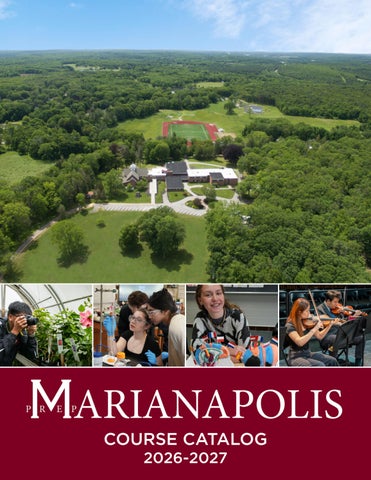
COURSE CATALOG C1
2026-2027
INTRODUCTION
T
he mission of Marianapolis Preparatory School, to educate students in the Catholic tradition of academic excellence, is reflected in the college preparatory curriculum offered to all students. The Aims and Purposes serve as the foundation for each course’s goals and objectives. Marianapolis Preparatory School cultivates and nurtures a growth mindset in our students while teaching them essential skills of creative problem solving, critical thinking, and communication in a culture that promotes the development of community and character. Within a rigorous college preparatory course of study, Marianapolis Preparatory School nurtures students to become responsible and independent learners. The classroom environment is both intimate and intensive; faculty members challenge each student to achieve their best on assessments, through projects, and in classroom discourse. Each student is supported by their advisor, who monitors progress and acts as a resource throughout the school year. Advisors serve as the central point of contact for parents and ensures that students are achieving at the highest level possible. Our academic curriculum reflects the richness and diversity of a broad spectrum of interests. The academic philosophy at Marianapolis fosters development of critical and disciplined thinking, precise communication and scientific analysis, creative problem solving, and understanding of the social, scientific, and political background of Western and non-Western civilizations. At all grade levels, the curriculum encourages students to think creatively and to articulate ideas effectively. The school maintains a strong and balanced offering of required and enrichment options. Honors and Advanced Placement sections are available in most departments and serve to challenge the capable student with more complex inquiries. Elective offerings augment traditional requirements and provide enrichment opportunities. 1
MISSION MISSION The mission of Marianapolis Preparatory School is to educate students in the Catholic tradition of academic excellence with a commitment to an active faith in God and a dedication to building character with content, compassion, and integrity.
AIMS & PURPOSES
•
To encourage scholarship and mature character
•
To develop critical and analytical thinking skills
•
To build communicating and problem-solving skills
•
To promote the love of learning and the highest standards of academic excellence
•
To foster aesthetic sensitivity and creativity
•
To encourage the classical ideal of “mens sana, in corpore sana” (sound mind and body)
•
To appreciate the value of cultural diversity
•
To nurture active and intelligent citizenship in the world and to affirm Catholic principles through ethical and moral values
2
TABLE OF CONTENTS
Academic Information & Policies........................................ 4 Academic Enrichment & Experiential Learning............... 6 Summer Term........................................................................ 11 Fall, Winter, & Spring Terms Business........................................................................... 19 Engineering..................................................................... 22 English............................................................................. 24 English Language........................................................... 30 Fine Arts......................................................................... 33 History............................................................................. 41 Informatics...................................................................... 46 Mathematics................................................................... 48 Modern Language.......................................................... 54 Religious Studies............................................................ 59 Science............................................................................. 62 Social Sciences................................................................ 68
3
ACADEMIC INFORMATION & POLICIES GRADUATION REQUIREMENTS Minimum Course Load: Minimum Graduation Credits:
6 Courses each term 24 Credits (Adjusted for students seeking reclassification)
Department Requirements: English and/or English Language:
Four Academic Years
Fine Art: Visual Art 1/2 Credit Performance Art 1/2 Credit in Ensemble or Performance Art History: Two Courses (Humanities/World History I, US History) Informatics:
Casimir: Innovation, or Computer Science I
Mathematics:
Three Courses (must include all prerequisites)
Modern Language:
Three courses in the language of choice
Science: Three courses (must include Conceptual Physics, Chemistry, Biology, or its equivalents and each must have a lab component) Religious Studies:
One Grade Level Course per Academic Year
* Transfer Students: Transfer credits are awarded based on official transcripts. Adjustments to graduation requirements are made.
ADVANCED PLACEMENT COURSES Advanced Placement (AP®) courses are college-level courses offered in almost all academic departments, in grades 10, 11, and 12. Classes are taught as the equivalent of courses taken by college freshmen, and students are expected to produce college-level work in the course; that is, work showing greater depth, more sophisticated reasoning and higher creativity than the work in regular courses. These courses will include outside reading and 4
other assignments, additional class time and significant amounts of homework each night. Because of the rigors of these classes, students are encouraged not to take more than three AP® courses in a given year. If four AP® courses are taken, an additional study period during the school day is strongly suggested. End of Term Evaluations are weighted as one-third of the term average for all AP® level courses. Students are carefully selected for AP® courses according to the following criteria: • Recommendations of the student’s prior teachers in the subject matter • Evaluation of all Habits of Mind indicators • Excellent grades in prerequisite courses • High achievement as shown on standardized test scores • Evaluation of the student’s total academic program, particularly the student’s performance (including grades on any prior AP® courses and any approval that the student has received to take other concurrent AP® courses) • Other specific departmental requirements (see appropriate section) • A mandatory commitment to the AP® examination in mid-May.* The school expects students to give serious commitment to AP® courses and to take the AP® examination in mid-May.* A sufficiently high score on an AP® examination may allow the student to earn credit in the college they eventually attend. *Students will be responsible for the fee associated with these tests.
HONORS COURSES Honors courses are offered by most departments at all grade levels. These courses are significantly more rigorous than regular courses. Students need specific departmental recommendation to take Honors courses. • The facility to produce Honors level work consistently and independently • An eagerness to take risks and embrace ambiguity when encountering the unknown • A willingness to persist with challenging questions or tasks • The desire to explore ideas deeply, not merely complete assignments • The ability to make connections to other areas of knowledge or fields of study • A readiness to embrace, process, and use feedback to improve performance • An intellectual appetite that is awake or awakening to the pleasures of the mind • A commitment to all Habits of Mind indicators
INDEPENDENT STUDY Independent Studies, in which students do considerable work on their own with periodic supervision by an assigned teacher, are sometimes available. With solid academic standing and administration and departmental chair approval, students may elect to fulfill a requirement or an elective through special independent work. Prior to the commencement of the course of study, the student must present a proposed project outline, including a statement of what the student hopes to achieve by the completion of the course. The student is free to organize their project and to decide its basic direction, seeking advice and direction from the assigned faculty member when the student feels it is necessary. However, “independent study” does not equate to “anything goes,” and the student must produce tangible evidence of scholarship (a research paper, a scientific experiment, a work of art) at the conclusion of the course of study. 5
ACADEMIC ENRICHMENT & EXPERIENTIAL LEARNING NINTH GRADE EXPERIENCE Marianapolis believes that the preparation of students for college and life after Marianapolis begins the second students step on campus their freshman year. The Ninth Grade Experience will teach freshmen the skills needed to succeed not only at Marianapolis, but also for the rest of their academic career. The Casimir Seminar and the Humanities course combined focus on building skills that students can use in their day-to-day lives such as critical thinking, communication, and cross-curricular learning. HUMANITIES OR ENGLISH LANGUAGE (See History, English, or Religious Studies course listing description) CHOICE OF LANGUAGE – FRENCH OR SPANISH (For English as first language learners) (See Modern Language course listing description) ALGEBRA I/INTEGRATED MATH/GEOMETRY (See Mathematics course listing description) CONCEPTUAL PHYSICS (See Science course listing description) FINE ART A Performance Art: Ensemble, Chorus, or Dance (See Fine Art course listing descriptions) CASIMIR SEMINAR Communication - Articulation - Social Justice - Innovation - Management - Information Fluency - Research The Casimir Seminar is a term-long course that is designed to provide a foundation of essential skills and insights that will benefit the first year students and enhance their ability to achieve success in their academic and extracurricular careers while at Marianapolis. The four main focus areas of Communication in Society, Information Fluency, Human Dynamics, and Innovation are interwoven into the introduction of all four Centers of Excellence Programs. Student will be introduced to the Mark R. Russell ‘67 Center for Business & Entrepreneurship, the Center for Health Science, the Center for Innovation, and the Center for Social Justice with specific content and skill in preparation for their formal enrollment in the sophomore year. PEER LEADERSHIP Senior leaders mentor freshmen through this peer leadership by reducing the fears and disconnectedness that many new freshmen feel when they enter a new environment. Each senior Peer Leader has a small group of freshmen they meet with weekly to help transition to life at Marianapolis. A continued mentorship will help the freshmen face their academic challenges and extracurricular lives. A broad perspective will be gained as students master thinking creatively and critically, collaborating with others, and communicating effectively.
6
LEAP LIVE. EXPERIENCE. ADVANCE. PREPARE.
Learning doesn’t stop at the classroom door. LEAP invites students to engage with the world in hands-on, meaningful ways that complement traditional academics. By stepping beyond comfort zones, students begin a lifelong journey of self-discovery and growth. Alongside teachers who model curiosity and the joy of learning, participants build lasting relationships that carry back into daily campus life. LEAP courses span a wide variety of experiences, including: -Specialized skills and the arts -Community service projects -Scientific field studies -Cultural immersion programs -Outdoor challenges There are several LEAP programs throughout the year: LEAP: Weekend & Weekday Explorations, LEAP Discovery Days, and LEAP: Global.
LEAP: WEEKEND & WEEKDAY EXPLORATIONS
Small Adventures. Lasting Impact. This program brings education beyond the classroom with dynamic weekend and weekday opportunities. Each experience is designed to spark curiosity, nurture lifelong learning, and support social-emotional growth through hands-on, real-world activities. This program is required for all new 9-PG students and the Class of 2028.
LEAP: DISCOVERY DAYS
Engage. Explore. Discover. The three-day experiential program is held each October, serving as a mini-term course requirement for all students. During this time, groups of students and faculty dive into a specific topic, project, or adventure designed to spark curiosity and expand learning beyond the classroom.
LEAP: GLOBAL
New Ideas. New Friends. New Experiences. The 5-Day Experience invites students to venture beyond New England during Thanksgiving, Christmas, or March Break. While typically five days long (ranging from 4–6 days), each trip is designed to balance fun, exploration, adn team building.The 10-Day Experience offers Marianapolis students the chance to travel nationally or abroad during Spring Break. Each year, students expand their education through enriching tours that promote cultural discovery and global awareness.
7
ACADEMIC ENRICHMENT & EXPERIENTIAL LEARNING CENTERS OF EXCELLENCE The Centers of Excellence were created with the idea of giving students the opportunity to gain more practical experience by allowing them to become globally engaged in a specific focal area while completing their traditional curricular requirements. Students enrolled in the Centers of Excellence will take a unique course of study focused on courses within the area of their chosen Center. Building off the skills obtained their freshman year, sophomores will have the option to enroll in one of four Centers—The Mark R. Russell ’67 Center for Business and Entrepreneurship, the Center for Health Science, the Center for Social Justice, and the Center for Innovation. The Center for Innovation may focus on one of two areas: Computer Science or Engineering. In their junior year, students will enroll in Practicum Seminar, which is to be completed in the form of a supervised practicum or virtual externship. Senior year, students will complete a capstone project within the English Department and will also attend a recognition ceremony before graduation.
8
CENTER FOR SOCIAL JUSTICE Grade 10 Civic Engagement Change Agents of the 20th & 21st Centuries
Grade 11 Sociology
Grade 12 COE Capstone Math Elective Behavioral Science COE Electives
MARK R. RUSSELL ’67 CENTER FOR BUSINESS & ENTREPRENEURSHIP Grade 10 Business & Entrepreneurship Introduction to Marketing
Grade 11 Introduction to Global Economics
Grade 12 COE Capstone Math Elective Behavioral Science COE Electives
CENTER FOR INNOVATION: COMPUTER SCIENCE Grade 10 Design Principles Programming I
Grade 11 AP® Computer Science A or AP® Computer Science Principles
Grade 12 COE Capstone Math Elective Physics/AP® Physics COE Electives
CENTER FOR INNOVATION: ENGINEERING Grade 10 Modeling for Problem Solving Design Principles
Grade 11 Engineering & Design
Grade 12 COE Capstone Math Elective Physics/AP® Physics COE Electives
CENTER FOR HEALTH SCIENCE Grade 10 Public Health & Culturally Informed Practices Practicum in Health Science
9
Grade 11 Practicum Seminar (Online course) COE Science Elective (Anatomy & Physiology, AP Chemistry, Science of Infectious Disease, etc.)
Grade 12 COE Capstone Behavioral Science Math Elective COE Electives
COE-SPECIFIC COURSES CASIMIR SEMINAR Communication - Articulation - Social Justice - Innovation - Management - Information Fluency - Research The Casimir Seminar is a term-long course that is designed to provide a foundation of essential skills and insights that will benefit the first year students and enhance their ability to achieve success in their academic and extracurricular careers while at Marianapolis. The four main focus areas of Communication in Society, Information Fluency, Human Dynamics, and Innovation are interwoven into the introduction of all four Centers of Excellence Programs. Student will be introduced to the Mark R. Russell ‘67 Center for Business & Entrepreneurship, the Center for Health Science, the Center for Innovation, and the Center for Social Justice with specific content and skill in preparation for their formal enrollment in the sophomore year. COURSE TITLE: GRADE LEVEL: PREREQUISITES: DURATION:
COE CAPSTONE 12 Successful Progress through the COE Program Trimester III
In this required, experiential-learning trimester course, the Centers of Excellence students will engage in problembased and project-based learning. Within their chosen center, students will begin by applying critical thinking to identify an opportunity to invent, enhance, or further any aspect of their chosen community. Students will use the educational experience they have gained throughout the COE program as they challenge their skills and work towards a unique solution. The content and skills acquired through their various courses of study will serve them well as they apply their critical thinking to examine real world challenges, solve problems, research, strategize, develop, and potentially implement a capstone project that serves to address the issue and improve a particular situation. The course culminates in a Capstone paper and presentation sharing the student’s vision within their focus area. This course will require attendance at prerequisite evening seminars throughout trimester one and two, focused on problem identification and project planning and will allow the student to immediately address their chosen community issue.
10
SUMMER TERM 11
SUMMER SESSION ONLINE 2026
O
nline learning is a vital aspect of the Marianapolis curriculum. The school is committed, without compromise, to providing students a top-tier college preparatory education through the virtual platform. By prioritizing personalized instruction and immersing students in a blended curricular approach, Marianapolis equips students with the tools essential for success in the ever-changing academic climate. Most importantly, this innovative distance-learning program gives students 1:1 access to Marianapolis faculty, curricula, and instruction. Enrolled students have an opportunity to continue their courses of study during the Summer Term. Participants take online summer classes in order to meet graduation requirements, to complete course prerequisites in advance, or to study a particular discipline at an accelerated rate. Non-native English-speaking students also make tremendous progress in our intensive English Language program throughout the summer. 12
Advancement courses offer advanced credit for term and year-long equivalent coursework through rigorous thematic study modules. Exploration courses allow students to refine and maximize targeted skills for college preparation. More information can be found on the website in early spring. Explore the Summer Term options below as you build your course schedule. The Summer Term is designed in a semester model to include two terms. Each term is equivalent to one half year. Make note of those graduation requirements that will require the successful completion of both Summer Term I and Summer Term II to earn one full credit awarded during the traditional school year. Each course meets Monday – Friday. Internet access is required throughout the duration of each course as well as ongoing video and audio connection. Courses are conducted through our platform where students and teachers are engaged visually with all members of the class through class discussions and office hours.
Term I: (equivalent to one half year of the traditional school year) June 15 - July 8 Term II: (equivalent to one half year of the traditional school year) July 9 - August 1
ADVANCEMENT COURSES BUSINESS COURSE TITLE: ECONOMICS DURATION: Summer Session Online 3 1/2 weeks EQUIVALENT: Term Microeconomics CREDIT: 0.5 This course serves as an introduction to the field of economics within the context of mathematics. Topics include fundamental economic concepts such as scarcity, opportunity, cost, and incentives. Students will examine both microeconomic and macroeconomic principles: supply and demand, markets and prices, competition, unemployment, monetary and fiscal policy, and the role of government. Technology, written and mathematical work, and daily class discussion are used to educate students on current topics, such as the costs and benefits of international trade, how wages are determined in labor markets, and why countries develop at different rates. The course allows students to apply graphical and statistical methods of analysis and create a greater understanding of economic systems. COURSE TITLE: BUSINESS & ENTREPRENEURSHIP DURATION: Summer Session Online 3 1/2 weeks EQUIVALENT: Term Business & Entrepreneurship CREDIT: 0.5
which are needed to start and own a business. Students in this class will learn to explore the characteristics and traits of an entrepreneur, to identify the characteristics of different economic systems, to recognize and assess economic resources, to understand the concept of the free market in a mixed economy, to understand the components of an effective business plan, to identify competition, to know how to develop a marketing plan, to recognize business risk, and to understand how to effectively grow a business. COURSE TITLE: INTERNATIONAL RELATIONS DURATION: Summer Session Online 3 1/2 weeks EQUIVALENT: Term International Relations CREDIT: 0.5 This course will focus on how different sovereign nations may approach situations and problems in the modern world. The concepts of balance of power and national security will be explored. Students will study international conflict and cooperation on issues of human rights, warfare and weapons of mass destruction, migration, trade, health, and the environment. The role of treaties, agreements, and cooperation in specific issues as relations among nations shift from internationalism to globalization will be analyzed through case studies and group discussion.
ENGLISH COURSE TITLE: JOURNALISM DURATION: Summer Session Online 3 1/2 weeks EQUIVALENT: Additional English Elective CREDIT: 0.5
Embark on a journey through the dynamic world of journalism in this comprehensive introductory course. From the principles of reporting to the ethics of storytelling, students will explore the landscape Entrepreneurs are individuals who utilize and combine of journalism and its pivotal role in shaping public factors of production, such as land, labor and capital, discourse and understanding. This course is designed and use their knowledge, skill, and creativity to produce to equip students with the fundamental skills and a good or service that is wanted or needed by society and knowledge necessary to thrive in the fast-paced realm which allows the entrepreneur to make a profit. This class of journalism. Through a combination of theoretical introduces students to the basic principles of business discussions, practical exercises, and real-world case 13
studies, participants will develop a deep understanding of the key concepts and practices that underpin journalistic excellence. Throughout the course, students will have the opportunity to apply their newfound skills in practical exercises and assignments, culminating in the creation of their own journalistic portfolio.
(CAD) models to solve problems brought forth in the class. Students will work in small groups to produce a satisfactory product that improves the client’s situation in some way. Groups will receive guidance in the form of lessons designed to spark inspiration and bring to light major strategies or considerations for the design process, as well as constant feedback on designs. For COURSE TITLE: CREATIVE WRITING success, students will be encouraged to have good DURATION: Summer Session Online communication with their teammates and their client, 3 1/2 weeks to perform research individually to better understand EQUIVALENT: Introductory Course to Senior problems and how to address them, to thoughtfully Elective: Creative Writing balancing between the limitations in time and resources CREDIT: 0.5 and the assortment of potential solutions, and to continually model, test, and evaluate their ideas as they Creative Writing is a course that offers students an continue to develop them towards a final application. introduction to the art of writing through creative exercises (fiction, poetry, and play) and analysis FINE ARTS (including works from more than one genre), with DIGITAL PHOTOGRAPHY special attention given to a writer’s way of reading. This COURSE TITLE: DURATION: Summer Session Online course is designed to build upon vocabulary, interpretive, and formal comprehension skills. In addition, students 3 1/2 weeks Term Digital Photography will learn to articulate constructive feedback through EQUIVALENT: workshop and peer edits. Although primarily focused CREDIT: 0.5 on the practice of generating new work, reading course texts will be regular. These texts are meant to inspire This course will immerse students into the world of and include books concerning craft, contemporary and digital art and photography. Students will learn how classical texts, and, most importantly, one another’s to use the digital darkroom to enhance their work work. Participants are expected to be actively engaged but will still be focused on the artistic principles of and prepared to share their writing. Lastly, revision photography. Upon completion, students will know the and reflection will play key roles in helping students difference between traditional print media and digital understand the process of writing, providing effective media, digital color correction, and printmaking. strategies for synthesizing feedback toward completion. Students will be expected to produce finished work and participate in real world scenarios. The course will be instructor driven for the first half of the term. By the ENGINEERING end of the term, students will be expected to produce finished pieces that are presented to the class. Students COURSE TITLE: INTRODUCTION TO are required to exhibit their work. ENGINEERING DURATION: Summer Session Online 3 1/2 weeks EQUIVALENT: Introductory Course to COE Requirement: Engineering & Design CREDIT: 0.5
This course is an experience for students interested in the Engineering field of study. Students will develop engineering design and project management skills. They will build physical and computer-aided design 14
HISTORY COURSE TITLE: CONTEMPORARY WORLD ISSUES DURATION: Summer Session Online 3 1/2 weeks EQUIVALENT: Contemporary World Issues Trimester Course CREDIT: 0.5
COURSE TITLE: PSYCHOLOGY DURATION: Summer Session Online 3 1/2 weeks EQUIVALENT: Introductory Course in Psychology CREDIT: 0.5 This course will provide a broad introduction to the field of psychology, one of the social sciences. Among the topics we will cover are: gathering data on the causes and correlations of behavior, key figures in psychology and their theories, examples of research findings from the major subareas of the field, and using psychological knowledge to improve the quality of our lives. This survey of psychology will acquaint the students with the major concepts and terminology of the discipline and give them a better understanding of self and others. It is the hope that it will encourage students to want to learn more about psychology.
This course explores the current issues and crises that exist in America and the world. The class focuses not only on understanding the historical causes and current manifestations of these issues but also the philosophical questions modern controversies engender. Topics will range from domestic issues (such as the state of the American economy, immigration policy, etc.) to international (globalization, refugee crises, and SOCIOLOGY the rise of terrorism.) Students will simultaneously COURSE TITLE: Summer Session Online study a variety of perspectives on any given issue, DURATION: 3 1/2 weeks acknowledging and accounting for bias. EQUIVALENT: Introductory Course in Sociology CREDIT: 0.5
SOCIAL STUDIES
COURSE TITLE: LEGAL STUDIES DURATION: Summer Session Online 3 1/2 weeks EQUIVALENT: Term Legal Studies CREDIT: 0.5 This class will introduce students to the nature and functions of law in a society. Law, when legitimately developed by a society, provides order, structure, and limits to those living in that society. Law takes essentially two forms: civil law, which addresses issues, disputes, and grievances between individuals in their role as private individuals, and criminal law, which addresses violations that individuals, in their role as public citizens, commit against the order of political society. Students in this class will explore a broad range of law related topics including: the nature and functions of law in a society, legal principles and fundamentals, civil law, criminal law, international law, law in a mixed market economy, and government regulation.
15
The goal of this course is to introduce students to Sociology – the study of human relationships. Students will not only learn the basic principles, concepts, and theories that constitute the core study of Sociology, but will also be given the knowledge to better understand society. Students will hopefully be encouraged to see the world through the eyes of others and draw connections between what they are studying in class and the events that are taking place today. This Sociology course will provide students with the basic concepts and tools necessary for understanding human social behavior in a complex world. The focus of this course examines the structures and functions of society from a purely sociological perspective and then examines current social issues in the world. Topics to be covered include: culture, socialization, formal organizations, deviance, as well as global, gender, race stratification, economics and politics, urbanization, and social change.
COURSE TITLE: BEHAVIORAL SCIENCE DURATION: Summer Session Online 3 1/2 weeks EQUIVALENT: Introductory course in the Behavioral Sciences CREDIT: 0.5 The goal of this course is to introduce students to the Behavioral Sciences of Psychology, Sociology, and Anthropology. Students will learn basic principles, concepts, and theories from all of these social sciences. The emphasis of this course will be to better understand human behavior from a psychological, biological, and social approach. In addition, students will gain perspective from a variety of cultural perspectives and practice cultural relativism. This course will survey a number of topics including the historical background of the social sciences, research methods and ethics, culture, learning theory, developmental psychology, social stratification, social psychology, and deviant behavior.
RELIGIOUS STUDIES COURSE TITLE: BIBLICAL STUDIES DURATION: Summer Session Online 3 1/2 weeks EQUIVALENT: Term Biblical Studies CREDIT: 0.5 Biblical Studies is an introductory course to the Scriptures of the Jewish and Christian traditions. The writings of the Old Testament and New Testament are surveyed, utilizing literary and historical criticism. Moreover, there will be a historical and thematic introduction to Christian thought and practice. Students will be exposed to major questions raised in interpreting the Bible in the 21st century. COURSE TITLE: WORLD CULTURES DURATION: Summer Session Online 3 1/2 weeks EQUIVALENT: Term World Cultures CREDIT: 0.5
fact that it has a powerful appeal and influence on many people over time. These religions have shaped and been shaped by every culture. To study the major world religions is, in truth, to study the history and culture of the human race over the centuries. The main points of emphasis in this course are to acquaint each student with the basic answers each religion gives to the fundamental questions of life; to expose students to the basic elements of all religions; to help students appreciate the areas of similarity and diversity found in world religions; to help students to examine their own religious beliefs and practices in light of other religions. COURSE TITLE: MORAL & ETHICAL DILEMMAS DURATION: Summer Session Online 3 1/2 weeks EQUIVALENT: Term Moral & Ethical Dilemmas CREDIT: 0.5 This term course explores moral theology, ethics, and the moral decision-making process. In examining how they would act in a given situation, students compare and contrast the psychological, humanistic, and philosophical decision making process with the Catholic approach leading to whether decisions are based on societal values or faith based values. Students will look at the life of Christ, Christian and non-Christian commentators on society, and the problems of the world, and then decide how good moral and ethical decision making can change the world for the better. Students will explore their position on capital punishment, war, beginning and end of life issues, medical dilemmas, and various aspects of sexual morality. COURSE TITLE: PEACE & JUSTICE DURATION: Summer Session Online 3 1/2 weeks EQUIVALENT: Term Social Justice CREDIT: 0.5
This course will explore Catholic teaching on a variety of ethical and social justice issues. As discussion of such issues has become increasingly prominent in the Church This course is offered as a part of the International during the modern period, some historical surveys of Student experience and done so through the scheduling the Church from the Renaissance to the present will process. What makes a religion a world religion is the be integrated into the course. Particular attention will 16
be paid to contemporary Church perspectives on such issues as racism, work, poverty, and the right to life.
ENRICHMENT COURSES COURSE TITLE: SAT PREPARATION DURATION: Summer Session Online 3 1/2 weeks The SAT Prep course is designed to help students prepare for the rigors of taking the SAT tests offered by the College Board. Our primary goal is to identify and implement test taking strategies using prerequisite knowledge to increase student performance. Students in this course should have passed Algebra 2 or are taking it concurrently.
17
FALL | WINTER | SPRING TERMS 18
BUSINESS
REQUIRED FOR COE STUDENTS, OPEN TO ALL STUDENTS
COURSE TITLE: BUSINESS & ENTREPRENEURSHIP GRADE LEVEL: 10 - PG PREREQUISITES: None DURATION: One term
COURSE TITLE: INTRODUCTION TO GLOBAL ECONOMICS GRADE LEVEL: 11 - PG PREREQUISITE: None DURATION: Full year
Entrepreneurship is the process of creatively combining factors of production to fulfill a want or need of society in a profitable exchange. This class introduces students to the principles of business needed to undertake this process, then presents the opportunity to move through the process itself. Students will learn the language and fundamentals of business, how to target a specific market, the means of understanding competitive landscape, and the basics of marketing a product. They will then leverage these skills to conceive and write their own comprehensive and well-researched business plan. Students will leave the class with an understanding of how businesses are started, structured, and operated, and will be conversational in the language of entrepreneurship.
In this year-long course, students will be introduced to the fundamentals of economics and the dynamics of a global economy. This class will allow students to explore how economies emerge and function and examine the socio-economic impact of globalization and how it relates directly to international relations and business opportunities. The course covers topics such as international trade, factor markets, emerging technologies, and the role culture plays in shaping the way business is done across borders and oceans. Students will understand how economics has shaped the modern world and what the future of globalization may have in store.
19
COURSE TITLE: GRADE LEVEL: PREREQUISITES: DURATION:
INTRO TO FINANCE 11 - PG None One term
to globalization will be analyzed through case studies and group discussion.
COURSE TITLE: FUNDAMENTALS OF ACCOUNTING This course will explore the principles and practices GRADE LEVEL: 11 - PG of modern financial management that are utilized by PREREQUISITES: Algebra II contemporary business enterprises. Topics that will DURATION: One term be discussed will include, but will not be limited to, cash flow, risk, financial investment strategies, money, Accounting, popularly referred to as the “language of working capital, banking, mortgage, saving and interest business,” is the foundation upon which we build our rate analysis. Students will have the opportunity to delve understanding of financial transactions and processes. into real life scenarios that involve topics that they will In the Fundamentals of Accounting class, students will explore throughout the duration of the course. explore the accounting cycle and gain experience in both the writing and interpretation of financial statements. COURSE TITLE: INTRO TO MARKETING Through the one-trimester experience, students will also GRADE LEVEL: 10 - PG build familiarity with common accounting practices, PREREQUISITES: None such as tracking inventory, payroll, and management of DURATION: One term business assets. By examining these critical operations, students will come to a fuller understanding of the This course will explore the principles of marketing in a true structures of the businesses that drive economic, business environment. During this course, students will technological, and societal progress. have the opportunity to delve into the multiple forms of communication within a business environment. COURSE TITLE: AP® MACROECONOMICS Topics that will be discussed will include, but not be GRADE LEVEL: 11 - PG limited to, identifying and satisfying customer needs PREREQUISITES: Algebra II & Department Chair and wants, analyzing consumer behavior, targeting your Approval audience, the benefits of logos and branding, product DURATION: Full year development, marketing research, and the impact of social media. Students will be provided with the AP® Macroeconomics is an introductory collegefoundation needed in marketing that will allow them to level macroeconomics course, in which students will develop a strategic marketing plan. cultivate their understanding of the principles that apply to entire economic systems. While it will place COURSE TITLE: INTERNATIONAL particular emphasis on the examination of national RELATIONS income and price-level determination, the course GRADE LEVEL: 11 - PG will also explore economic performance measures, PREREQUISITES: None the financial sector, stabilization policies, economic DURATION: One term growth, and concepts within international economics. Students will learn to utilize graphs, charts, and data to This course will focus on how different sovereign analyze, describe, and explain these concepts as they nations may approach situations and problems in the come to a better understanding of the financial and modern world. The concepts of balance of power and economic underpinnings of the broader world. The national security will be explored. Students will study Business Department will consider the following factors international conflict and cooperation on issues of in evaluating a student’s request to take AP® Business human rights, warfare and weapons of mass destruction, courses: migration, trade, health, and the environment. The role of treaties, agreements, and cooperation in specific issues • Evaluation of the student’s qualification form, as relations among nations shift from internationalism including the quantitative and qualitative merits, the 20
student’s stated reasons for enrolling in the course, and the student’s demonstrated evidence of enthusiasm for the subject matter • Strong recommendations by the student’s prior teachers • Maintenance by the student of a quarterly average of B+ or better throughout the current year, including midterm and final exam grades • Student’s projected course-load for the coming academic year, including plans for any concurrent AP® courses • Student’s projected extracurricular commitments for the coming academic year • Successful completion of the student’s present courses • Command of all Habits of Mind 2027-28 Electives Being Offered: All 2026-2027 Electives AP® Microeconomics Not Offered:
21
AP® Macroeconomics
ENGINEERING REQUIRED FOR COE STUDENTS, OPEN TO ALL STUDENTS
COURSE TITLE: MODELING FOR PROBLEM SOLVING GRADE LEVEL : 10 - PG PREREQUISITES: Algebra I DURATION: One term This term-long course introduces the various methods used for problem solving in science, technology, engineering, art, and mathematics (STEAM) disciplines. Mathematical, physical, descriptive, and computer-aided design (CAD) modeling strategies will be introduced. Students will learn how to develop, implement, and select the most appropriate models for solving problems in diverse fields of study. Group projects at the conclusion of the course will allow students to put their culmination of knowledge into practice while solving real-world problems. Students will further develop their communication, critical thinking, and reasoning skills through the collaborative nature of the course.
22
COURSE TITLE: GRADE LEVEL : PREREQUISITES: DURATION:
DESIGN PRINCIPLES 10 - PG Algebra I One term
This term-long course provides students with a foundation in the strategies and methodologies implemented in many current and developing careers. Through lecture and project-based learning, students will develop the ability to understand and analyze the iterative design process. Projects with emphasis in different focus areas (such as web design, architecture, goods and services, and technology) allow for student lead innovation and creativity. Ultimately, at the completion of the course, students will gain the ability to communicate, conceive, lead, and execute project designs across multiple disciplines.
COURSE TITLE: GRADE LEVEL : PREREQUISITES: DURATION:
ELECTRONIC SYSTEMS 10 - PG Casimir Innovation or equivalent to Computer Science I, Modeling for Problem Solving One term
Electronic Systems is a course melding computer science with design in order to demonstrate how advanced behaviors are produced through the use of electrical components, especially sensors, and thoughtful coding. We will investigate the role of various electrical components and how they can contribute to a mechanism to perform as desired. Students will also learn how to use some basic programming in order to manipulate the operation of these components. The course will culminate in a final project where groups of students will utilize what they learned to program a small bot to complete a special course. COURSE TITLE: GRADE LEVEL : PREREQUISITES: DURATION:
ENGINEERING & DESIGN 11 - PG Design Principles, Algebra II Full year
Product Engineering is a course designed to give students more insight into the design process for creating products for a community or targeted audience. This course will be primarily student driven, as teams of students will be tasked with addressing one or more struggles of various surrogate clients. The groups will iterate over designs, test models, and work with their client to produce a satisfactory product that improves the client’s situation in some way. Groups will receive guidance in the form of lessons designed to spark inspiration and bring to light major strategies or considerations for the design process, as well as constant feedback on designs. For success, students will be encouraged to have good communication with their teammates and their client, to perform research individually to better understand problems and how to address them, to thoughtfully balancing between the limitations in time and resources and the assortment of potential solutions, and to continually model, test, and evaluate their ideas as they continue to develop them towards a final application.
COURSE TITLE: ENGINEERING COMMUNICATION GRADE LEVEL : 11, 12 This course is a year-long experience for students PREREQUISITES: Any prior Engineering course interested in the Engineering field of study. Students DURATION: One term will develop engineering design, statics, and project management skills. They will build physical and This course helps students shift their mindset and computer-aided design (CAD) models to solve problems build confidence in expressing ideas during critical brought forth in the class while applying concepts such opportunities while overcoming potential anxiety. as forces, equilibrium, and structural stability. Students Through an immersive, hands-on learning environment, will work in small pairs and larger groups to gain varied students will develop effective communication skills experience. Methods and strategies from the course in across various engineering contexts, including: Design Principles will continue to be used and built • Technical Reports & Paper Presentations upon, along with concepts of sustainability and material • Engineering Project Reports science. The goal for the final portion of the class is for • Product & Technology Demonstrations small collaborative groups of students to explore, define, • Design Reviews & Defenses and tackle a real-world problem. Students will explore • Team Collaboration & Cross-Disciplinary a situation needing resolution and define a plan that, if Communication implemented, will bring forth a positive change. Students will learn how to extract key messages, design effective technical presentations enhance delivery COURSE TITLE: PRODUCT ENGINEERING skills, and engage the audience. The course emphasizes GRADE LEVEL : 12, PG practical application, requiring students to deliver PREREQUISITES: Design Principles and engineering presentations and provide peer feedback. Engineering & Design or Robotics 2027-28 Electives DURATION: One term Being Offered: All 2026-2027 electives 23
ENGLISH GRADUATION REQUIREMENT: 4 YEARS ENGLISH AND/OR ENGLISH LANGUAGE
T
he goal of the English Department is to further the reading, writing, and critical thinking skills of our students. Through the study of classic and contemporary works of literature, students not only gain an appreciation of reading, but also develop analytical thinking skills that extend beyond the classroom. We believe that studying the stories of great authors encourages students to critically examine themselves and their world. Through literature, creative writing, and non-fiction, students are exposed to a wide variety of works, all with the central goal of deep analysis and critical thinking.
of the Department, English students read frequently and critically, write analytically, and communicate effectively. COURSE TITLE: GRADE LEVEL: PREREQUISITES: DURATION:
HUMANITIES 9 None Full year
The aim of this course is to encourage students to develop and gain analytical, interpretive, and communication skills, as well as enduring understanding, while contributing to the development of the student as In order to graduate, each Marianapolis student must a whole. Humanities aims to encourage students to complete their course(s) of English study each year. understand and respect the world around them, and Core courses include the study of literary works, to provide the skills necessary to facilitate further vocabulary, and grammar. With rigorous standards, interdisciplinary study. This is achieved through the the department prepares students to excel in college- study of individuals, societies, and environments level English courses. Honors courses are offered for in a broad context: historical, geographical, social, many levels, and AP® Language & Composition and economic, religious, moral, and cultural. This course will AP® Literature & Composition are offered for the most foster intellectual curiosity, global awareness, critical accomplished English students. To fulfill the standards thinking, personal responsibility, and ethical awareness. 24
Through the study of English, history, and theology, this course will serve as an introduction into the literary, historical, theological, and cultural development of humanity to be found in specific examples of literature, historical events, and social and religious institutions of the Greeks, the Middle Ages, and the Renaissance. COURSE TITLE: LITERARATURE & COMPOSITION GRADE LEVEL: 10 PREREQUISITES: Humanities (Full-Year English) DURATION: Full year Literature and Composition endeavors to build students’ reading, writing, and analytical skills through the study of world literature, informational texts, and selected classical works. Students will closely read and discuss a range of texts while developing essential academic skills, including literary and rhetorical analysis, multigenre writing, and the effective use of grammar and academic voice. Students will practice expressing their ideas clearly and thoughtfully in both written and spoken forms. Emphasis will be placed on crafting strong thesis statements, organizing logical arguments, as well as how to support a claim with relevant textual evidence and explicating that evidence in order to prove a position. COURSE TITLE: HONORS LITERARY GENRES GRADE LEVEL: 10 PREREQUISITES: Humanities or equivalent; Department Chair approval DURATION: Full year Honors Literary Genres, like its standard counterpart, studies the five principle genres - short stories, novels, poetry, essays, and drama. Honors students distinguish themselves through the study of more complex works within these genres and increased personal responsibility. At this level, students become accountable for generating and facilitating discussion with their peers. With careful attention to the writing process, students will produce full-length analytical essays, demonstrating a command of mechanics, argumentation, and MLA citation. Entrance into the honors level will be determined by strong recommendation of the teacher, current GPA, standardized test scores, and overall aptitude as a 25
student of English. COURSE TITLE: GRADE LEVEL: PREREQUISITES: DURATION:
AMERICAN LITERATURE (A choice for the 11th grade requirement) 11 Literary Genres or equivalent Full year
During the junior year, students study a survey of American Literature. The course focuses on the theme of American identity. From the beginning, immigrants have come to this country seeking fulfillment of their personal dreams. Concerns over the reality of the American Dream form an important component of the course. Students trace how the American identity evolves and transforms through the modern era. Assessment is based primarily on writing, both critical and personal, as well as regular reading. In this upper level course, the expectation is that students will engage in thoughtful and lively roundtable discussions. COURSE TITLE: HONORS AMERICAN LITERATURE (A choice for the 11th grade requirement) GRADE LEVEL: 11 PREREQUISITES: Literary Genres or equivalent; Department Chair approval DURATION: Full year The Honors American Literature course centers around the study of the American identity and how that is captured in varying definitions throughout the American literary canon, as is done in the standard American Literature course. Honors students distinguish themselves through an accelerated pace and increased personal responsibility. In addition to learning the course material, Honors students will be challenged to master the skills of annotation and class discussion. The Honors American Literature course is designed to prepare students for placement in either AP® Literature & Composition, AP® Language & Composition, or 21st Century Literature Honors. Entrance into the honors level will be determined by strong recommendation of the teacher, current GPA, and overall aptitude as a student of English.
COURSE TITLE: ENGLISH COMPOSITION & ANALYSIS GRADE LEVEL: 9 - PG English Language Students PREREQUISITES: English III or outcome of placement test DURATION: Full year
ecology, journalism, current events, memoir, political science, and literature. Students will write in a wide variety of styles and for a wide variety of purposes, and they will work both independently and collaboratively to revise their work. Students will analyze images and films with the goal of studying how rhetorical strategies are employed in visual media. Careful and analytical reading and annotation is an important requirement of This year-long course facilitates the transition between the course. Students are required to complete the AP® English Language courses and the mainstream English test in mid-May. classes. It is an upper-level literature and writing course for non-native speakers of English. This course involves Students looking to enroll in AP® English Language & both the in-depth discussion and the written analysis Composition should have already demonstrated in an of many literary genres including: fiction, non-fiction, honors-level course: drama, and poetry. Critical-thinking strategies and an • A commitment to precision and clarity in the use of intensive review of the principles of good composition the written word. are included. Students will sharpen their grammar as • A facility to integrate reflection and deliberation in they expand their understanding of parts of speech, the formation of their responses in class. phrases and clauses, sentence analysis, and structure. • An enthusiasm for immersion in topics to achieve This is a one-credit course, which meets for one period understanding and application beyond their surface within the student’s schedule. meaning. • An ability to craft a sophisticated response with COURSE TITLE: AP® ENGLISH LANGUAGE & depth and nuance that goes beyond simply answering COMPOSITION the question. (A choice for the grade level • An eagerness to take risks with creative expression requirement) that goes beyond standard structures and forms. GRADE LEVEL: 11 - PG • A readiness to embrace, process, and use feedback PREREQUISITES: Literary Genres, American independently to improve performance Literature, or equivalent; • A command of all Habits of Mind Department Chair approval DURATION: Full year COURSE TITLE: AP® ENGLISH LITERATURE & COMPOSITION In the words of the College Board’s AP® Program, (A choice for the grade level requirement) students who complete the course in Advanced GRADE LEVEL: 12, PG Placement English Language & Composition will PREREQUISITES: American Literature or be able to do the following: analyze and interpret equivalent; Department Chair samples of good writing, apply effective strategies and approval techniques, create and sustain arguments, demonstrate DURATION: Full year understanding and mastery of standard written English and stylistic variety, analyze images as text, and evaluate AP® Literature & Composition is a college level course and incorporate reference documents into researched in literary analysis. As designated by the College Board’s papers. Toward these goals, students in this course AP® Program, students in this course must demonstrate will study both literary and non-literary texts with an exemplary writing skills and possess the ability and emphasis on examining the ways in which authors from willingness to engage in sophisticated literary analysis. a variety of time periods and perspectives have used the With each text, they will consider a work’s structure, style, tools of composition, syntax, and rhetoric to accomplish themes, societal and historical values, and such elements a wide variety of goals and appeal to multiple audiences. as figurative language, imagery, symbolism, and tone. Reading assignments may come from the fields of history, Students engage with complex reading assignments, 26
covering a variety of themes, and do so at an accelerated pace. Class discussion centers on concentrated inquiry into the text of each work considered. Additionally, the ability to craft formal essays - sometimes under rigorous time constraints - is an absolute necessity. This course is designed for students who are considering pursuing the study of literature at the collegiate level. To prepare for the exam, students will consistently practice both the analysis of literary works and the communication of that analysis through their own writing. The goal of this course is to develop students into independently motivated and skilled analytical thinkers. Students are required to complete the AP® test in mid-May. Students looking to enroll in AP® Literature and Composition should have already demonstrated: • A genuine passion for the study of literature and the examination of the writer’s craft • A resilient and persistent dedication to high performance expectations • A willingness to take risks and embrace ambiguity with difficult material • An ability to closely analyze a passage of text to formulate an argument • A command of literary devices and why authors choose to use them • An impeccable sense of grammar and essay structure • A command of all Habits of Mind COURSE TITLE: GRADE LEVELS: PREREQUISITES: DURATION:
LANGUAGE & LITERATURE 12, PG 3 years of English Full Year
Language and Literature will prepare students for college and the workplace by revisiting and mastering the skills learned in their previous English courses. Throughout the course, students will critically engage with complex literature and nonfiction, refine their approach to the writing process, and continue to develop the public speaking, analytical, and social skills necessary for success in the college classroom and beyond. The course will focus on specific skills each trimester, providing students with the opportunity to engage with the content more deeply over a longer period.
27
SENIOR/PG ENGLISH: Honors Level Students, by recommendation, may choose a combination of three of the following trimester courses to fulfill their one-credit/full-year requirement. This would replace or be in addition to an Advanced Placement course or the Language and Literature course.
ENGLISH LITERATURE TRIMESTER COURSES: COURSE TITLE: HONORS APOCOLYPTIC FICTION DURATION: One Term What does it mean for the world to end? What could life and civilization look like after a catastrophe? Students will spend the term examining these questions through fiction and real-world examples. By examining the ways the world can end for individuals, civilizations, or entire species, students will explore what our perception of the apocalypse says about us and think about the durability of the ideas, institutions, and beliefs that pervade our society. Students will work with a wide variety of texts and media. They will examine the relationships between people and societies, between individual fictions, and between humans and their environment. They will be encouraged to reconsider the lenses through which they understand existing social systems and, hopefully, the way they think about what it means for something to ‘end.’ COURSE TITLE: DURATION:
HONORS WORKS IN FOCUS One Term
Dune is Frank Herbert’s masterpiece and a deeply influential text, even outside of science fiction. It’s complicated knot of political, religious, and ecological commentary has, if anything, made the novel even more important since its publication. In this course, students will learn about the ecological, postcolonial, and philosophical ideas that inspired Herbert while working to understand and enjoy the foundational text. Students will immerse themselves in the history of postcolonial and ecological theory. They will examine
the ways these ideas can be explored through fiction and non-fiction. Students will be encouraged to recognize the ways adaptation can both expound on the ideas present in their source text and undermine them simultaneously.
COURSE TITLE: HONORS CREATIVE WRITING DURATION: One Term
Creative Writing is a trimester elective course. While the emphasis is obviously on writing, students will COURSE TITLE: HONORS SOMETHING OLD, also read and analyze published works and classmates’ SOMETHING NEW pieces. Students will be expected to write daily with a DURATION: One Term positive, creative attitude. The course focus will be on the artistic expression of oneself through writing. It Ever wonder why your teacher picks “old” books for will involve both fiction and non-fiction writing as well you to read? This course solves that dilemma, pairing as reading, intended to inspire student writing. Peer a contemporary novel with its classic predecessor of a editing will also play an important role in this class, and similar theme in order to demonstrate how the more students will be expected to be active participants in the world changes, the more things stay the same. The such exercises. Catcher in the Rye and The Perks of Being a Wallflower, Crime and Punishment and Gone Girl, Romeo and COURSE TITLE: HONORS POETRY AND Juliet and Twilight - all of these pairings include popular WRITTEN EXPRESSION modern works directly inspired by and reimagined from DURATION: One Term a beloved classic. Students in the course will read several pairs of texts and explore the ways writers borrow from This course seeks to demystify poetry composition, each other, adapt stories for a modern audience, and breaking poetry down to its most rudimentary understand why some stories are so universal they are components and bringing out the poetic voice in all told and retold over and over again. students.. We will learn how to analyze the meter, beat, rhyme scheme, and structure of a poem while building COURSE TITLE: HONORS GOTHIC our knowledge of figurative language. This course will LITERATURE review a wide variety of poems and poets from the DURATION: One Term classical age to present day contemporary poetry from Homer to Tupac. You don’t have to be a poet to write Gothic Literature offers students many avenues for poetry, but by the end of this course you will be wellexploration into the human psyche, a rich historical equipped to write poems of many different forms as context that illustrates our steps into the scientific age, well as go to live poetry readings, listen to spoken word and the literary evolution of popular fiction - which poetry, and study how music and poetry are intrinsically the once illiterate masses began to consume. The many tied to each other. works written during this period in literary history open the door for inquiry into the ethical and social problems that mattered in that moment and still matter 2027-28 Electives to us today. The course could be structured as a survey Being Offered: All 2026-2027 electives course with longer thematically connected excerpts from several great Gothic novels, or it could include 1-2 novels, but either option would include additional short stories, poems, and nonfiction.
28
ENGLISH LANGUAGE GRADUATION REQUIREMENT: 4 YEARS OF ENGLISH/ENGLISH LANGUAGE
T
he goal of the English Language Department is to develop communicative proficiency in English in students whose first language is something other than English. Since the English Language program embraces students with a wide variety of abilities and backgrounds, the program is structured to take students where they are along the continuum of competence and move them forward. Testing is done to determine the appropriate level placement for each student with the ultimate goal being to matriculate into the mainstream English classroom. The Department also seeks to strengthen and refine skill levels in all four modalities: Speaking, Listening, Reading, and Writing so that students are sufficiently prepared for entry into a U.S. college or university. The English Language Department also supports its academic goals with a unique curriculum component called the “Experiential Learning Program.” In this program, students select from a variety of off-campus excursions and educational experiences that support the students’ cultural competence. These activities are created specifically to enhance the curriculum by 29
encouraging guided risk-taking and give students a hands-on experience with a variety of cultural activities. Each year the program culminates in LEAP Week which offers the students a selection from a variety of five-day trips within the United States of America. COURSE TITLE: ENGLISH I CORE PREREQUISITES: English Language Proficiency Assessment DURATION: Full year This course is designed to provide a strong foundation in the English language for beginner-level students. Students will expand their vocabulary on everyday topics while developing essential language skills in listening, reading, speaking, and writing. The course focuses on helping students understand and respond to simple spoken and written texts, engage in basic conversations, and write short, clear sentences. Emphasis will be placed on pronunciation to ensure effective communication. By the end of the course, students should be able to confidently communicate in simple everyday situations, improving both comprehension and expression.
COURSE TITLE: FOUNDATIONS OF CREATIVE WRITING PREREQUISITES: Current enrollment in English I Core DURATION: Full year This course is designed to help beginner English learners build confidence in writing through creative expression. Students will explore key elements of storytelling, sentence structure, and vocabulary. Through a variety of guided activities, writing prompts, and collaborative exercises, they will learn to describe people, places, and events while developing their own creative voice. The course will focus on building confidence and comfort in writing, using familiar vocabulary, and clearly expressing ideas. By the end of the course, students will have created a portfolio of written works, including descriptive pieces, dialogues, and simple narratives.
comprehensive and interactive approach. By engaging in in-depth study and hands-on practice of grammar rules, sentence structure, and punctuation, students will refine their ability to write with clarity, precision, and impact. The course emphasizes the practical application of grammar concepts to strengthen both written and spoken communication, enabling students to express their ideas more effectively. COURSE TITLE: GRADE LEVEL: REQUIREMENT: DURATION:
FILM LITERATURE 9-PG Current Enrollment in English II Full year
This course offers students an in-depth exploration of storytelling through film, focusing on key literary elements such as plot, character, setting, conflict, theme, and genre. Through the analysis of diverse short films and movie clips, students will refine their ability CULTURE COURSE to identify and critically engage with these narrative COURSE TITLE: AMERICAN STUDIES components, drawing connections between visual REQUIREMENT: Current Enrollment in English I and written forms of storytelling. Guided discussions or II and creative projects will foster the development of DURATION: Full year vocabulary, listening comprehension, and both oral and written expression. Students will leave the course with This course introduces beginner English learners to life a deeper appreciation for the art of storytelling and the in the United States, developing foundational language ability to analyze and discuss narratives across both film skills through an exploration of its geography, culture, and literature. history, government, and daily traditions. Through engaging readings, visuals, and interactive activities, COURSE TITLE: ENGLISH III CORE students will discover key regions, major holidays, iconic PREREQUISITE: English II or outcome landmarks, and everyday customs that shape American of placement assessment society. They will also follow current events, analyzing DURATION: Full year news articles and videos to understand different perspectives. Lessons emphasize essential vocabulary This course is designed to help language learners and fundamental sentence structures, equipping enhance their English grammar skills in preparation students to discuss and engage with American traditions. for mainstream academic courses. With a focus on Through dynamic class discussions, collaborative mastering complex grammatical structures, students projects, and short presentations, students will develop will engage in interactive exercises aimed at improving confidence in reading, listening, and speaking. both writing and speaking accuracy. The course emphasizes practical application, preparing students COURSE TITLE: ENGLISH II CORE for real-world academic tasks such as discussions, PREREQUISITE: English I or outcome presentations, and research. By the end of the course, of placement assessment students will be equipped to communicate confidently DURATION: Full year and competently in academic settings. This course is designed to enhance students’ English grammar, writing, and language skills through a 30
COURSE TITLE: YOUNG ADULT LITERATURE REQUIREMENT: Current Enrollment in English III DURATION: Full year This course immerses students in the world of Young Adult (YA) literature, exploring a diverse range of subgenres, themes, and narrative styles. Through close examination of YA fiction, students will deepen their understanding of the literary devices that shape its themes, character development, and emotional impact. They will engage in thoughtful discussions, drawing connections between YA literature and broader social and cultural issues. Additionally, students will develop the critical vocabulary necessary for insightful analysis, strengthen their ability to craft well-structured literary arguments and refine their skills in writing compelling, evidence-based critiques. By the end of the course, students will not only have a greater appreciation for the genre but also the analytical tools to evaluate literature with depth and confidence. 2027-28 Electives Being Offered:
31
All 2026-2027 electives
FINE ARTS GRADUATION REQUIREMENT: 0.5 CREDIT IN VISUAL ART AND 0.5 IN PERFORMANCE ART, AND AN ADDITIONAL 0.5 CREDIT IN EITHER AREA
P
articipation in and study of the arts encourages us to react, record, and share our impressions of and with the world. The goal of the Fine Arts Department is to enable students to experience, understand, and enjoy the Visual and Performance Arts, including studio art, dance, and music. The program encourages individual creative expression, development of specific skills in each area, communication with the public through exhibitions and performances, working collaboratively with peers, and nurtures an appreciation of all art forms. Courses provide recognition of the role of the arts in history and in our contemporary world. All students have the opportunity to display their work in the school art shows, and/or participate in the school performances.
32
VISUAL ARTS COURSE TITLE: PEER ASSISTANT: VISUAL ART GRADE LEVEL: 11 - PG and Departmental Chair approval PREREQUISITES: Successful completion of three terms of Visual Art and/or teacher permission DURATION: One term This course is designed to provide students skilled in the visual art the opportunity to serve as an aide to teachers in preparing lessons and supporting art students throughout the term. This course may be taken for one or two terms. Participation will be reflected on transcripts but no numerical credit is given. Responsibilities will include coordinating with visual art teachers in the areas of project learning, student understanding, and peer support. Students must be willing to make a commitment to this course
during its designated period. The peer assistant will be challenged through their service to their peers. COURSE TITLE: GRADE LEVEL: PREREQUISITES: DURATION:
ART FOUNDATIONS 9 - PG None One term
Art Foundations is a one-term studio course designed to familiarize students with the fundamental concepts of two-dimensional art. Through a series of projects that are progressive in nature, students are introduced to the practice, process, and visual language of the arts while developing technical skills and cultivating their creative voice. This course serves as a prerequisite for many visual art classes and is appropriate for students of all experience levels. Emphasis is placed on working with a variety of media and exploring multiple approaches to mark-making while also introducing non-objective, abstract, and representational art. Students demonstrate their understanding of the elements of art through projects, research, and critiques. COURSE TITLE: GRADE LEVEL: PREREQUISITES: DURATION:
MIXED MEDIA DESIGN 9 - PG None One term
Mixed Media is a one-term studio course in which students explore a wide range of materials and ways of making, including collage, sculpture, printmaking, drawing, and painting. Building on the concepts introduced in Art Foundations, students work with diverse materials and experiment with various techniques to better understand how material choices influence outcomes. Emphasis is placed on recognizing and utilizing the unique characteristics of each medium to inform and guide creative decision-making. Through hands-on exploration, students learn to embrace experimentation, problem-solving, and risk-taking as essential parts of the artistic process. Class discussions, research, and critiques are integral components of this exploratory course, encouraging thoughtful reflection and constructive dialogue.
33
COURSE TITLE: GRADE LEVEL: PREREQUISITES: DURATION:
SCULPTURE 9 - PG Art Foundations One term
Sculpture is a one-term studio course that builds upon the concepts introduced in Art Foundations. This course is designed to familiarize students with the fundamental principles of three-dimensional art. Through handson experience, students develop the technical skills and creative problem-solving abilities necessary to transform their ideas into physical form. Students explore and apply basic artistic principles to all projects, thoughtfully considering both function and aesthetics. Emphasis is placed on material experimentation and creative exploration while working with a variety of traditional and non-traditional materials such as wood, clay, fiber, and cardboard. Throughout the course, students demonstrate their understanding of three-dimensional design concepts through projects, discussions, and class critiques, fostering both artistic growth and critical thinking skills. COURSE TITLE: GRADE LEVEL: PREREQUISITES: DURATION:
COLOR THEORY 9 - PG None One term
Color Theory is a one-term studio course designed to help students recognize, analyze, and accurately reproduce color for use in art and design. Through a sequence of structured projects, students investigate foundational color relationships, paint-mixing techniques, and the construction of color wheels and charts. The course emphasizes how color communicates mood, meaning, and visual impact. Students explore strategies for creating harmony, contrast, and balance, while developing greater intention and control in their color choices. As their understanding deepens, they learn to apply color thoughtfully and effectively within their own work. Understanding is demonstrated through studio projects, research, discussion, and critiques, supporting both technical skill and conceptual awareness.
COURSE TITLE: GRADE LEVEL: PREREQUISITES: DURATION:
DRAWING 10 - PG Art Foundations One term
Drawing is a one-term studio course designed to expand upon the foundational skills introduced in Art Foundations. Working with graphite, charcoal, oil pastel, and chalk pastel, students engage in a sequence of projects that strengthen observational skills while exploring the essential role of drawing in the visual arts. Through the study of artworks from both historical and contemporary contexts, students explore how drawing styles evolve over time and communicate meaning across cultures and artistic movements. Emphasis is placed on careful observation, control of value, composition, and the expressive potential of each material’s unique qualities. Discussion, research, and critiques are integral components of the course, supporting the growth of both technical ability and visual literacy. Students of all working styles, whether analytical and detail-oriented or intuitive and experimental, will find opportunities to refine their skills, expand their creative voice, and grow in confidence as artists. COURSE TITLE: GRADE LEVEL: PREREQUISITES: DURATION:
PAINTING 10 - PG Art Foundations One term
and creative growth. Students of all working styles, whether analytical and detail-oriented or intuitive and experimental, will find opportunities to deepen their skills, expand their creative voice, and strengthen their confidence as painters. COURSE TITLE: INTRODUCTION TO DIGITAL ART GRADE LEVEL: 9 - PG PREREQUISITES: Art Foundations or its equivalent DURATION: One term Introduction to Digital Art is an introductory course that explores the fundamental concepts of art through a range of digital processes. The course invites students to experiment with multiple approaches to creating art digitally, including drawing, painting, photography, and animation. The class emphasizes how the elements and principles of art translate into contemporary digital formats. Students work in mobile applications as well as software platforms in order to begin understanding how different digital tools influence color, line, form, movement, and visual communication. Through handson projects and critiques, students build foundational art concepts while developing technical proficiency and creative confidence.
COURSE TITLE: INTRODUCTION TO PHOTOGRAPHY GRADE LEVEL: 9 - PG Painting is a one-term studio course designed to PREREQUISITES: None expand upon the foundational skills introduced in REQUIRED: DSLR with manual functions Art Foundations. Students explore a range of painting DURATION: One term media, including watercolor, tempera, and acrylic, while studying both historical and contemporary artists Introduction to Photography is an introductory course who work with these materials. The course emphasizes that explores the fundamentals of photographic image color theory, paint application, and the development making through a range of creative processes and of each student’s individual visual language. Beginning techniques. The course emphasizes multiple ways with composition and color relationships, students of creating photographic imagery, including digital, progressively build greater control over perspective, pinhole, instant, image transfers, cyanotype, and other spatial depth, and detail. Through intentional exploration experimental approaches. Students examine how of mark-making and gesture, they refine both technical light, composition, timing, and subject matter shape skills and expressive capacity. Focused, color-driven visual storytelling across formats. Students work with projects challenge students to make thoughtful artistic digital cameras and editing applications, while also decisions while cultivating conceptual awareness. engaging in traditional photographic processes and Discussion, research, and critiques are integral to the hands-on methods of image production, developing learning process, fostering both analytical thinking an understanding of how different processes influence 34
the final image. Through structured projects and class critiques, students build technical skills, strengthen their visual language, and gain confidence in expressing ideas through photography. COURSE TITLE: GRADE LEVEL: PREREQUISITES: PREFERRED: DURATION:
DIGITAL PHOTOGRAPHY 10 - PG Introduction to Photography DSLR with manual functions One term
COURSE TITLE: INTRODUCTION TO ARCHITECTURE GRADE LEVEL: 9 - PG PREREQUISITES: None DURATION: One term
Introduction to Architecture is an introductory course that explores the fundamentals of architectural design and spatial thinking through hands-on projects and creative experimentation. The course emphasizes multiple ways of designing and representing buildings, This course will immerse students into the world of including floor plans, interior layouts, building digital art and photography. Students will learn how to maquettes, front elevations, and culminating in a use the “digital darkroom” to enhance their work but will complete three-dimensional model of a studentstill be focused on the artistic principles of design. Upon designed building. Students work with a variety of completion, students will know the difference between materials, such as cardboard, foam core, watercolor, traditional print media and digital media, digital paint, and other media, to explore form, scale, structure, editing, and how to expand on photography. Students and proportion. Through these projects and class wishing to take this course should have a comforable critiques, students develop technical skills, strengthen understanding of good photography and be interested their understanding of spatial relationships, and gain in thinking outside the box. Photography and digital art confidence in translating architectural ideas from are seen all around us. Curiosity and exploration is key concept to physical representation. in expanding what photography can do. COURSE TITLE: AP® STUDIO ART GRADE LEVEL: 11 - PG PREREQUISITES: Two terms of Visual Arts courses and teacher permission required DURATION: Full year The AP® Studio Art course is designed for students interested in a rigorous and focused study of art. While the course aims to develop technical skill and encourages independent thinking, individuals enrolled must have a strong background in art. The course is incredibly fast paced, largely self-driven, and requires a significant time commitment outside of class. AP® Studio Art does not culminate in a written exam; instead, students will develop a quality portfolio that demonstrates a mastery of concept, composition, and execution in either drawing or two-dimensional design. This course may be taken more than once as students have the opportunity to submit either a 2-D Design or Drawing, Painting, or Sculpture portfolio to the Collegeboard for evaluation.
35
2026-27 Electives Being Offered: All 2025-2026 electives Art History
PERFORMANCE ARTS MUSIC The music offerings allow students the opportunity to create music by performing in a variety of ensembles, both choral and instrumental, or by digital and traditional music creation. Traditional and contemporary works are studied in class and performed in school concerts as well as in performances off campus. In the choral and instrumental groups, the goal is to educate students in the rudiments of music in order to be literate and proficient in reading and performing from various historical periods and musical styles. The vast choral repertoire for male, female, and mixed voices is explored. The students sing music ranging from unison to eight parts in as many as five languages. Students are offered the opportunity to rehearse and
perform in woodwind quintets, brass trios, and other Department. Solo and small group performance chamber music settings. opportunities will be available throughout the term. Literature performed will mostly be sacred; however, COURSE TITLE: CHORUS music from other genres may be included as the need GRADE LEVEL: 9 - PG arises. Due to the musical needs for mass, students PREREQUISITE: None must be able to commit to additional rehearsals other DURATION: One term than the limited class time. Chorus is an entry-level course that provides the opportunity for all students to discover the joy of singing, as a soloist or in an ensemble. The class is open to all students regardless of experience. Students will explore tone production, pitch, blend, and note reading, all within an ensemble setting in performance in and out of class. This course may have some singing opportunities throughout the term with additional performances toward the end. Literature performed will include folk, traditional, multicultural, pop, and classical choral music. Students may also experience multiple languages throughout the term. COURSE TITLE: CHAMBER CHOIR GRADE LEVEL: 10 - PG PREREQUISITES: Chorus or Department Chair approval DURATION: Full year The Chamber Choir is intended for students of mixed voices, who wish to continue their singing experience at Marianapolis. Performing both Secular and Sacred music, the Chamber Choir will perform for schoolsponsored functions as well as end-of-term and year performances. While singing in many languages, the students will sing in three or four-part harmonies. Literature chosen will provide a very wide variety of genres and styles - which will be chosen according to the number of students and the vocal make-up of the class. Students who show an advanced interest can be involved in the Connecticut All-Regional or All-State choirs. COURSE TITLE: GRADE LEVEL: PREREQUISITES: DURATION:
SCHOLA CHOIR 9 - PG None One term
Schola Choir, an evening class, is responsible for providing “worship leadership,” during school mass, and other performances within the Performing Arts 36
COURSE TITLE: GRADE LEVEL: PREREQUISITES: REQUIRED: DURATION:
GUITAR I 9 - PG None Acoustic guitar One term
Guitar I is an entry-level class that provides the opportunity to learn the basics of the acoustic guitar. Students in Guitar I will study the practical and fundamental techniques of guitar playing including note reading, chord formation, fingerpicking, strum patterns, and chord chart reading. All students must provide their own acoustic guitar. COURSE TITLE: GRADE LEVEL: PREREQUISITES: DURATION:
PIANO I 9 - PG No previous experience One term
Piano I introduces students to the fundamentals of piano playing within a collaborative group environment. This course is designed to help students master basic playing techniques, progressing from single-hand to two-hand pieces. Key concepts such as chord and scale structures, proper playing and fingering techniques, and balancing accompaniment with melodies will be covered. While the department provides all instruments, students are required to purchase their own piano book for the course. COURSE TITLE: GRADE LEVEL: PREREQUISITES: DURATION:
PIANO II 9 - PG Piano I or equivalent One term
The Piano II course builds upon the foundation established in Piano I, offering students an opportunity to deepen their understanding and skills in piano playing. Students in Piano II will tackle more challenging musical pieces in this next stage and delve into new techniques. This includes aspects of music expression,
terminology, and forms, enabling students to broaden form. The students are required to purchase their own their musical proficiency and expressiveness at the textbook for this course to support daily coursework piano. and independent study. COURSE TITLE: ADVANCED PIANO GRADE LEVEL: 9 - PG PREREQUISITES: Department Chair Approval DURATION: One term, can be repeated The Advanced Piano course centers on performance, blending independent study with private instruction. Throughout the term(s), students will engage with a diverse repertoire written expressly for the piano. In addition to instructor-selected pieces, students can choose additional music for study, allowing for a personalized learning experience. Participants are expected to perform at least once or twice during school events such as the Morning Gathering, Parent and Family Weekend, Open House, Alumni Weekend, or Spring Musical. While all official performances will occur on Marianapolis’s grand pianos, practice sessions may be conducted on electronic pianos. This course enhances performance skills and offers valuable public performance experience. Designed for repeated enrollment, the course offers students the opportunity to deepen their skills and knowledge over time.
COURSE TITLE: GRADE LEVEL: PREREQUISITE: DURATION:
BEGINNER STRINGS 9 - PG None One term
This course, offered over a trimester, represents a unique opportunity for beginner musicians to join the Orchestra. Enrollment in the Orchestra (a morning class) in Trimesters 2 and 3 is automatic and required. It equips students with the essential skills required for basic proficiency in playing a stringed instrument, reading musical notation, and collaborating within an orchestral setting. The course can be retaken for those looking to enhance their abilities, allowing for further advancement under the instructor’s guidance. COURSE TITLE: ORCHESTRA GRADE LEVEL: 9 - PG PREREQUISITES: Prior playing experience on instrument of choice DURATION: Full year
A morning class, the Orchestra is one of the premiere performance ensembles at Marianapolis. The orchestra COURSE TITLE: MUSIC FOUNDATION is available to instrumentalists who demonstrate GRADE LEVEL: 9 - PG intermediate to advanced ability on their instruments, PREREQUISITES: None as the instruction emphasizes performance techniques DURATION: One term as soloist and full ensemble players. Through a variety of classical repertoire for both orchestra and chamber Open to students in grades 9 through PG, this one- ensembles, students gain a rich understanding of the term course offers a fundamental introduction to music orchestra through history and apply fundamental literacy with no prior experience required. Students principles of ensemble playing in community will dive into the mechanics behind composition, performances. Students have the opportunity to enrich learning how to read sheet music, interpret notation their experience through field trips and audition for and markings, and analyze musical structure. The outside ensembles such as the All-Regional Honor curriculum emphasizes developing a strong theoretical Orchestra of Connecticut and the surrounding states. framework, incorporating ear training and basic music theory to help students decode symbols on the page and COURSE TITLE: JAZZ & ROCK BAND understand how they function. GRADE LEVEL: 9 - PG PREREQUISITES: At least one year of playing In addition to theory, the course broadens musical experience horizons through guided listening exercises across DURATION: Full year different styles and by studying various instruments. This holistic approach helps students develop critical A morning ensemble class is comprised of intermediate listening skills and a deeper appreciation for the art to advanced musicians. Students will develop technical 37
accuracy and gain an understanding of jazz and rock styles by performing a wide variety of repertoire, including blues, swing, funk, and pop from both past and present. Through an introduction to improvisation, students will apply jazz idioms and create original melodies over chord progressions found in many wellknown jazz standards. The ensemble performs at spring concerts and at school events, including Open House, Revisit Day, and School Assemblies. Small combo performance opportunities may arise at regional venues, depending on personnel and instrumentation. Students must have at least one year of instrumental experience before enrolling in this course.
in preparing and teaching music for their ensembles throughout the year. This course may be taken as a term elective. Participation will be reflected on their transcripts but no numerical credit will be given. Responsibilities will include coordinating with music teachers in the areas of music preparation, distribution, and storage; acting as a teacher’s aide during rehearsals in the areas of vocal building exercises, studying music, and learning theory; and other duties that will aid in the smooth operation of the music department. Students must be willing to make a commitment to this course and may be asked to extend their duty time to after school if necessary.
COURSE TITLE: ADVANCED INDEPENDANT STUDY GRADE LEVEL: 10 - PG PREREQUISITES: Departmental Approval & Prior Coursework DURATION: One term
2026-27 Electives: Being Offered:
Students enrolled in Advanced Independent Study will work independently and through private lessons to master major works written for their specific instrument or voice part. The primary focus of the course is preparing high-level repertoire for significant performance opportunities. These engagements include key school events such as Morning Gathering, Parent and Family Weekend, Open House, Alumni Weekend, and other Admission Department events.
All 2025-2026 electives
DANCE COURSE TITLE: GRADE LEVEL: PREREQUISITES: DURATION:
BEGINNER DANCE 9 - PG None One term
This course is a beginner class for students with little to no previous dance experience. This class exposes students to a variety of dance techniques including ballet, jazz, modern, and hip hop. Emphasis of Beginner Dance is placed on body alignment. Students will learn proper placement and technique within their own abilities in the warm-up and continue to explore more fully how their bodies can move with combinations across the floor and in the center. The students will gain flexibility and strength as they train in the core elements of proper dance technique. Students will be required to take part in a performance at the end of the term.
Enrollment in this advanced course is selective and requires strict adherence to prerequisites, including obtaining permission from the instructor or department head. Additionally, candidates must have successfully completed, or be currently enrolled in, Orchestra or Jazz/Rock Band. Or complete Qualifying prior coursework classes such as Advanced Piano, Chorus, or Chamber Choir. COURSE TITLE: INTERMEDIATE DANCE GRADE LEVEL: 9 - PG COURSE TITLE: MUSIC PEER ASSISTANT PREREQUISITES: Dance teacher permission GRADE LEVEL: 11-PG and Department Chair DURATION: One term approval This course is an intermediate class expanding on the PREREQUISITE: None principles of Beginner Dance. Students will continue DURATION: One term working on proper placement and technique. The This course is designed to provide students who emphasis of this class will be to increase muscle memory are excelling in their music study and skills with or the ability to pick up and remember choreography. opportunities to serve as an aide to music teachers Techniques taught include ballet, jazz, modern, and 38
hip hop. Students will be required to take part in a performance at the end of the term. COURSE TITLE: GRADE LEVEL: PREREQUISITES: DURATION:
ADVANCED DANCE 9 - PG Dance teacher permission One term
COURSE TITLE: STRETCH, MOVEMENT, AND MOBILITY GRADE LEVEL: 10 - PG PREREQUISITES: Successful completion of one dance class DURATION: One term
This course is designed for students to explore different This course is an advanced class with an emphasis on ways to increase mobility and flexibility through yoga, furthering students’ knowledge of the elements and Pilates, and dance-based movement. Students will learn techniques of dance. This class builds on what was proper ways to stretch and increase strength through learned in Beginner Dance and Intermediate Dance, activity specific movement and will gain the physical focusing on the refinement of technical concepts and knowledge to improve their bodies for athletics and creative expression. Students will learn discipline and other activities. hard work as well as critical thinking and creative problem solving, through spatial awareness and COURSE TITLE: SENIOR INDEPENDENT improvisation. Techniques taught will include ballet, STUDY IN DANCE jazz, contemporary, and hip hop. Students will be GRADE LEVEL: 12 required to take part in a performance at the end of the PREREQUISITES: Completion of 3 terms of term. dance and Department Chair approval COURSE TITLE: BEGINNING TAP DURATION: Spring term TECHNIQUE This is a senior level course culminating in a solo GRADE LEVEL: 9 - PG performance in the spring dance show. The students will REQUIRED: Tap Shoes work one on one with the instructor on a weekly basis to DURATION: One term learn a solo of their chosen style. Outside of class time Beginning Tap Technique is a class for students with the students are expected to work on their performance little to no tap experience. This introductory class will piece independently. Students will also attend meetings expose students to the basic steps of tap technique. with other members of the class to perform their solos Students will learn coordination, rhythmic variations, and offer peer evaluations. If this class does not fit into a and performance skills through a series of tap student’s academic day, it will meet in the evening. The combinations. All students enrolled must provide their student and instructor will decide on a night and time. own tap shoes. COURSE TITLE: INTERMEDIATE/ADVANCED TAP TECHNIQUE GRADE LEVEL: 9 - PG PREREQUISITES: Dance teacher permission DURATION: One term Intermediate/Advanced Tap Technique is a class for students with previous tap experience. Students will continue to work on coordination and rhythmic variations while learning more complex steps including wings, pull-backs, and more intricate rhythms. Students will also focus on the clarity of their tap sounds. Students will be required to take part in a performance at the end of the term. 39
2026-27 Electives Being Offered:
All 2025-2026 electives
HISTORY GRADUATION REQUIREMENT: HUMANITIES/WORLD HISTORY I, UNITED STATES HISTORY
T
he Marianapolis Preparatory School History Department has developed a curriculum based on the premise that history and humankind are shaped by the past. Therefore, the examination of this past is paramount in preparing students for the future. In both its totality and its particular courses, the History Department seeks to contribute to the broadening, deepening, and enriching of students’ education by exposing the students to historical perspectives of time, space, continuity, and change. The Department, through its sequence of non-Western Civilization, Western Civilization, U.S. History, and AP® offerings, covers all aspects of history from the beginning of time to the present. The Department attempts to cultivate strengths vital to students in order for them to be successful at the college level and to become well-informed world citizens.
independent critical analysis, skill in oral and written communication, and an ability to understand and solve complex problems. Students will become familiar with essay examination, the use and interpretation of maps, the lecture method of presenting historical material, extensive note-taking from both printed material and lectures, and the writing of research papers. Geography is a critical component of each discipline as well. Skill in reading, writing, and speaking is rigorously promoted throughout the program. Elective courses prepare students for college studies as well as Advanced Placement examinations.
Opportunities for pursuing history or social sciences beyond credit courses in the classroom may include: • Forums on contemporary issues • Participation with other schools in the Model UN program At Marianapolis, students develop a core of • Debate, Amnesty International, Diplomacy Club understanding and analysis, learn how to analyze their own and others’ opinions, and participate in Advanced Placement® Requirements civic and community life as active, informed citizens. The History Department will consider the following Students are encouraged to develop a capacity for factors in evaluating a student’s request to take AP® 40
History: • Evaluation of the student’s qualification form, including the quantitative and qualitative merits, the student’s stated reasons for enrolling in the course, and the student’s demonstrated evidence of enthusiasm for the subject matter • Strong recommendations by the student’s prior history teachers • Maintenance by the student of a quarterly average of B+ or better throughout the current year, including midterm and final exam grades • Student’s projected course-load for the coming academic year, including plans for any concurrent AP® courses • Student’s projected extracurricular commitments for the coming academic year • Successful completion of the student’s present history course • Command of all Habits of Mind COURSE TITLE: GRADE LEVEL: PREREQUISITES: DURATION:
HUMANITIES 9 None Full year
COURSE TITLE: AMERICAN STUDIES REQUIREMENT: Current Enrollment in English I or II DURATION: Full year This course introduces beginner English learners to life in the United States, developing foundational language skills through an exploration of its geography, culture, history, government, and daily traditions. Through engaging readings, visuals, and interactive activities, students will discover key regions, major holidays, iconic landmarks, and everyday customs that shape American society. They will also follow current events, analyzing news articles and videos to understand different perspectives. Lessons emphasize essential vocabulary and fundamental sentence structures, equipping students to discuss and engage with American traditions. Through dynamic class discussions, collaborative projects, and short presentations, students will develop confidence in reading, listening, and speaking.
COURSE TITLE: WORLD HISTORY I GRADE LEVEL: 9, 10 PREREQUISITES: English I or II, or outcome of placement test The aim of this course is to encourage students to develop DURATION: Full year and gain analytical, interpretive, and communication skills, as well as enduring understanding, while This year-long course continues to further the contributing to the development of the student as development of communication skills in English with a whole. Humanities aims to encourage students to an emphasis on preparing students for standard and AP® understand and respect the world around them, and history classes. Students begin with the fundamentals of to provide the skills necessary to facilitate further history papers, primary sources, notes, and discussion. interdisciplinary study. This is achieved through the Throughout the year, students work to build the skills study of individuals, societies, and environments necessary for writing, analysis, and participation along in a broad context: historical, geographical, social, with a variety of other academic skills. Focus is placed economic, religious, moral, and cultural. This course will on primary source analysis and clear writing with foster intellectual curiosity, global awareness, critical an appropriate structure and a thesis supported by thinking, personal responsibility, and ethical awareness. evidence. For participation, students learn to provide Through the study of English, history, and theology, this thoughtful answers, questions, and thoughts, whether course will serve as an introduction into the literary, during a lecture, discussion, or debate. In addition to historical, theological, and cultural development of acquiring and honing these academic skills, necessary humanity to be found in specific examples of literature, for standard and AP® history classes, students learn historical events, and social and religious institutions of the basics of American History starting with the first the Greeks, the Middle Ages, and the Renaissance. American colonies and ending with the Civil War. An American history textbook serves as the foundational reading for World History I and supplemental documents and pictures may be used. 41
COURSE TITLE: GRADE LEVEL: PREREQUISITES: DURATION:
AP® WORLD HISTORY 10 Department Chair approval Full year
This AP® course will take a global view of historical processes and contacts between peoples in different societies. Students will be expected to learn selective factual knowledge in addition to certain analytical skills. Major interpretive issues will be explored, as well as the techniques used in interpreting both primary historical evidence and secondary sources. Themes will be employed throughout the course; though the basic approach will be chronological. Students will pay particular attention to change and continuity over time, to the characteristic institutions and values of societies, and to the way such institutions and values are affected as a result of cultural contacts among peoples. In assigned readings and class discussion, there will be an emphasis on critical thinking. The course will be rigorous and rewarding. Attention will also be given to preparing students with the skills necessary to engage the AP® World History examination. COURSE TITLE: UNITED STATES HISTORY GRADE LEVEL: 10 - PG PREREQUISITES: Humanities, World History I, World History II or its equivalent; English Language III (International Students) DURATION: Full year The purpose of this course is to help students acquire a deeper understanding of the main political, social, economic, and cultural developments in the story that is American History. Students will progress through a study of Western civilization topics to a comprehensive study of American history, encouraging students to think, write, and speak clearly about many of the fundamental issues in our culture. Beginning with the aforementioned primer on critical Western civilization events between 1492 and 1918, the course traces the basic ideas, institutions, and problems of the American people. Topics for study include: Colonial America, the meaning of the American Revolution, constitutional issues, causes of the Civil War, industrialization, immigration, the Gilded Age and Progressive reform, the Women’s Movement, the Great Depression, the 42
New Deal, World War II, U.S. responses to the Cold War, and the lessons of Vietnam. In order to develop skills in the use of systematic thought, research, and judgment, students acquire some knowledge of major documents, historiography, and major interpretations of U.S. History. COURSE TITLE: AP® UNITED STATES HISTORY GRADE LEVEL: 11 - PG PREREQUISITES: Department Chair approval DURATION: Full year The Advanced Placement course in American History presents a college level survey course to secondary school students. It differs from the regular U.S. History course in that students are expected to perform more independently and analytically, and to be responsible for a heavier reading load. While the basic content and skills are the same, the course develops in greater depth such areas as political philosophy, intellectual movements, foreign policy, and historiography. More time is devoted to study of interpretive articles and writing expository essays. Emphasis is placed on the development of writing and research skills necessary for the student to successfully answer the document-based questions on the AP® exam. COURSE TITLE: AP® MODERN EUROPEAN HISTORY GRADE LEVEL: 11 - PG PREREQUISITES: Department Chair approval DURATION: Full year This course is designed to set forth the modern history of Europe and to survey European civilization as a unit in an integrated/interconnected world. Emphasis falls on situations and movements of international scope or on what Europeans and their descendants have in common. National histories, historic regional differences, and differences between eastern and western Europe are brought out, and the history of the Americas and developments in Africa and Asia are woven into the story. A good deal of institutional history is included, and considerable time is spent on the history of ideas. Social and economic development, as well as the impacts of wars and revolutions, forms an integral section. Beginning with a brief geography
lesson, the course appraises the basic ideas, institutions, and problems of European civilization, including such topics as the Rise of Europe, the Scientific Revolution, the Enlightenment, the French Revolution and Napoleonic Era, the Age of Revolution and Reaction, the Age of Nationalism, La Belle Epoch, the World Wars, the Russian Revolution, Democracy and Dictatorship, and Contemporary Age. It covers political, economic, social, and intellectual developments from the Renaissance to the present. History skills include essay writing, research and analysis of primary sources, and historical interpretations. COURSE TITLE: AP® AFRICAN AMERICAN STUDIES GRADE LEVEL: 11 - PG PREREQUISITES: Department Chair approval DURATION: Full year AP® African American Studies is an exciting, interdisciplinary course that draws from a variety of fields—history, literature, the arts, geography, science, and law—to explore the vital contributions and experiences of African Americans. In AP African American Studies, students explore key topics that extend from early African kingdoms to the ongoing challenges and achievements of the contemporary moment. Given the interdisciplinary character of African American Studies, students in the course will develop skills across multiple fields, with an emphasis on developing historical, literary, visual and data analysis skills. This course foregrounds a study of the diversity of Black communities in the United States within the broader context of Africa and the African diaspora. The course provides students with a strong foundation in facts and evidence about African American history and culture.
This course will look into the lives of national and civil rights leaders like Mahatma Gandhi, Nelson Mandela, Malcolm X, César Chávez, and Martin Luther King Jr. It will also explore the lives of wartime leaders such as Winston Churchill, Golda Meir, Mao Zedong, and Ho Chi Minh. The class will take the time to explore the lives of marginalized people who helped change the world. Students will study the lives of hidden figures that made decisions that changed our world. We will be looking at the question “How can one person change the world?” COURSE TITLE: CONTEMPORARY WORLD ISSUES GRADE LEVEL: 11 - PG, and 10 by Department Chair approval PREREQUISITES: None DURATION: One term This course explores the current issues and crises that exist in America and the world. The class focuses not only on understanding the historical causes and current manifestations of these issues but also the philosophical questions modern controversies engender. Topics will range from domestic issues (such as the state of the American economy, immigration policy, etc.) to international (globalization, refugee crises, and the rise of terrorism.) Students will simultaneously study a variety of perspectives on any given issue, acknowledging and accounting for bias. COURSE TITLE: HUMAN GEOGRAPHY GRADE LEVEL: 11 - PG, and 10 by Department Chair approval PREREQUISITES: None DURATION: Full Year
During the course of the school year, students will COURSE TITLE: CHANGE AGENTS OF THE systematically study the patterns and processes that 20TH & 21ST CENTURIES have shaped human understanding, as well as the use, GRADE LEVEL: 10 - PG, 10 by Department and alteration of Earth’s surface. Students will employ Chair approval geography concepts and landscape analysis to examine PREREQUISITES: None human social organization and its environmental DURATION: One term consequences. We will learn that life is dictated by several geographical circumstances. Patterns of where This course will take a biographical approach to the and how people live are influenced by world events study of the most recent century up to the present-day. and factors of geography. Geography influences It will investigate how personality can impact the course political boundaries and causes conflict within regions. of history and change the outcome of crucial events. Agriculture, industrialization, and urbanization have 43
dramatic positive and negative consequences in every region of the world. Human Geography, the study of the spatial aspects of human existence, enables students to find answers to questions about the world around them. A geographically informed person sees, understands, and appreciates the connections among people, places, and environments. Understanding these connections requires an acute awareness of space, which can be identified in terms of location, distance, direction, pattern, shape, and arrangement. With a strong grasp of geography, students will be prepared to understand issues and solve problems in the contemporary world. COURSE TITLE: GRADE LEVEL: PREREQUISITES: DURATION:
THE AMERICAN CIVIL WAR 11 - PG US History One term
This elective course examines the origins, major events, and lasting impact of the American Civil War. Students will explore the political, economic, and social tensions that divided the nation, including slavery, states’ rights, sectionalism, and westward expansion. The course traces the conflict from the election of Abraham Lincoln through major military campaigns and turning points such as the Battle of Gettysburg, and concludes with Reconstruction and its unfinished promises. Through primary sources, historical scholarship, maps, and multimedia resources, students will analyze the experiences of soldiers, enslaved and freed African Americans, women, and political leaders. Special attention is given to the war’s long-term consequences, including the 13th, 14th, and 15th Amendments, the rise of Jim Crow, and the continuing debates over memory, monuments, and civil rights.
COURSE TITLE: A HISTORY OF PUBLIC MEDIA: SHAPING NARRATIVE, CULTURES, AND TRUTHS GRADE LEVEL: 11 - PG, and 10 by Department Chair approval PREREQUISITES: None DURATION: One Term This course explores the intertwined histories of public memory, media, film, and documentary production, analyzing how these mediums have been used to shape collective memory, inform, persuade, and reflect societal values. Students will examine key moments in media history, technological innovations, and the evolving relationship between media, audiences, and power structures. By studying films, documentaries, radio programs, and television broadcasts, the course investigates how public media has shaped political discourse, cultural identity, and historical memory. The course culminates in a critical project analyzing the impact of a specific media artifact or trend on public memory. COURSE TITLE: THE HISTORY OF MUSIC: SOUNDTRACKS OF CIVILIZATION GRADE LEVEL: 11 - PG, and 10 by Department Chair approval PREREQUISITES: None DURATION: One Term
This course explores the evolution of music across diverse cultures and historical periods, from ancient traditions to modern global influences. Students will examine how music has been shaped by societal, political, and technological developments, while also analyzing its role as a medium of cultural expression, resistance, and By the end of the course, students will develop unity. Through lectures, discussions, and multimedia critical thinking, historical writing, and evidenceresources, the course aims to provide a comprehensive based argumentation skills while gaining a deeper understanding of the dynamic relationship between understanding of how the Civil War continues to shape music and history. the United States today. 2027-28 Electives Being Offered: All 2026-2027 electives
44
INFORMATICS GRADUATION REQUIREMENT: COMPUTER SCIENCE I OR ITS EQUIVALENT
T
he goal of Informatics is to empower students to view technology as a malleable tool they can tailor to fit their needs. Students will additionally develop the logical reasoning needed to work with and understand the inner workings of a computer. All throughout, students are encouraged, and in many cases required, to practice the skills of communicating their technical understandings to others. Formalizing these simple skill sets allows our students to engage in the rest of their coursework at Marianapolis with vividly improved expertise. The Informatics Department remains current, providing relevant skills to a growing field. The computer is a tool whose capacity and application will continue to expand at enormous rates for the foreseeable future. The computer has become an indispensable tool not only for many of today’s businesses and professions, but in everyday life as well. All students at Marianapolis will graduate with, at the very least, a basic understanding of and familiarity with coding and with the workings of computers. Ideally, most of our students will become proficient in applying the power of this tool to their chosen professions, while some will become the 45
scientists and engineers who create new capabilities for the tool itself. COURSE TITLE: PROGRAMMING I GRADE LEVEL: 9 - PG PREREQUISITES: Casimir Seminar: Innovation or the equialent of Computer Science DURATION: One term The goal of this course is to welcome students into the discipline of programming. Students will gain an understanding of the fundamental principles and logic of scripting code. They will explore the logical structures that adorn the code of even the simplest programs and through this, gain a deeper understanding of how software works. Students will begin to master programming in Python, including using conditionals, loops, and functions to accomplish tasks of increasing complexity or to implement useful algorithms. No matter what discipline the student later pursues, the ability to build one’s own tools and applications will be invaluable.
COURSE TITLE: HONORS PROGRAMMING I GRADE LEVEL: 9 - PG PREREQUISITES: Casimir Seminar: Innovation or the equialent of Computer Science DURATION: One term
COURSE TITLE: AP® COMPUTER SCIENCE PRINCIPLES GRADE LEVEL: 10 - PG PREREQUISITES: Algebra II, English III, Department Chair approval, and Completion of a Summer Assignment* This course is designed for students with limited DURATION: Full year programming experience who are looking to dive into the world of programming and to gain a comfort with The AP® Computer Science Principles course is and understanding of fundamental principles and code designed to be equivalent to a first-term introductory scripting logic that will enable them to tackle advanced college computing course. In this course, students will problems and challenges. Students will build their develop computational skills vital for success across mastery of Python, manipulating conditionals, loops, all disciplines, such as using computational tools and functions to accumulate intuition and experience to analyze data and working with large data sets to for addressing difficult coding tasks, and utilizing analyze, visualize, and draw conclusions from trends. object oriented programming through the creation of T he course is unique in its focus on fostering student classes to produce complex behaviors. Through skills creativity. Students are encouraged to apply creative accumulated from this course, students will be able to processes when developing computational artifacts confidently build their own applications and approach and to think creatively while using computer software problems they would have previously found daunting. and other technology to explore questions that interest them. They will also develop effective communication COURSE TITLE: PROGRAMMING II: and collaboration skills, working individually and APPLICATION & DESIGN collaboratively to solve problems, and discussing and GRADE LEVEL: 9 - PG writing about the importance of these problems and the PREREQUISITES: Programming I impacts to their community, society, and the world. DURATION: One term The goal of this course is to reach beyond any other informatics course and develop larger working projects. Through a challenging curriculum, students will gain a deeper understanding of programming, delving into topics such as object oriented design and event driven programming. Establishing an advanced conceptual framework of the mechanics of programming, while simultaneously applying the concepts to develop a working product, requires a determined student willing and able to solve many of their own problems. Students that confront this challenge head on will emerge as accomplished programmers with highly marketable skills.
*AP® approval is given to those students who have demonstrated a commitment to mathematical and Information Science success as shown through efficient and timely homework and test preparation, class participation, mathematical ability with a minimum B average in all previous mathematics courses and an attention to the fine details of mathematics as shown through the quality and orderliness of homework assignments. A command of all Habits of Mind is essential. This is a college level course in Computer Science requiring considerable time, effort, and motivation. 2027-2028 Electives Being Offered: All 2026-27 electives AP® Computer Science A Not Offered: AP® Computer Science Principles
46
MATHEMATICS GRADUATION REQUIREMENT: 3 CREDITS
T
he goal of the Marianapolis Mathematics Department is to develop in every student a firm grounding in the basic facts and skills, to extend these skills to advanced topics, to recognize that mathematics permeates the world around us, to appreciate the usefulness, power, and beauty of mathematics, and to encourage the initiative, patience, and persistence required to enjoy and find success in the problemsolving process. Students are encouraged to think analytically and creatively about the world surrounding them. The students will develop skills in order to report answers and to explore mathematical ideas algebraically, numerically, graphically and verbally. The curriculum is flexible; a variety of courses are offered to accommodate the needs of all students, including those who are highly accelerated. In order to encourage the number sense required in everyday life and to prepare students for the no-calculator sections of future examinations, a substantial amount of mental arithmetic is involved in every course. Technology is incorporated in the classroom; for this reason, all students are required to have an approved graphing calculator that allows 47
for inclusion of real-life applications and higher order mathematical calculations. In addition, technology is used to reinforce concepts and to tackle problems that cannot be solved by other means. Students enrolled at Marianapolis are required to take three courses in mathematics, including Algebra and Geometry. Electives are highly encouraged after the completion of the core requirements. Honors Level Placement: Departmental approval is given to those students who have demonstrated a commitment to mathematical success as shown through their commitment to the development of sound Habits of Mind, mathematical ability with a minimum B+ average in both Algebra I and Geometry Honors, and an attention to the fine details of mathematics as shown through the quality and orderliness of homework assignments. Advanced Placement® Requirements: AP® approval is given to those students who have demonstrated a commitment to mathematical
success as shown through their commitment to the development of sound Habits of Mind, mathematical ability with a minimum B+ average in all previous mathematics courses, and an attention to the fine details of mathematics as shown through the quality and orderliness of homework assignments. This is a college level course in calculus requiring considerable time, effort, and motivation. All students enrolled are required to take the Collegeboard evaluation in May. COURSE TITLE: GRADE LEVEL: PREREQUISITES: DURATION:
ALGEBRA I 9 None Full year
Algebra I and Geometry and will prepare students for Algebra II at the Honors level. COURSE TITLE: HONORS INTEGRATED MATH II (ALGEBRA II & GEOMETRY II) GRADE LEVEL: 10 PREREQUISITES: Honors Integrated Math I and/or Department Chair approval DURATION: Full year
Honors Integrated Math II examines the structure of algebra as a reflection of the real and complex number systems. Emphasis is placed on the notions of relations, This course examines the structure of algebra as a functions, and their inverses. The relationship between reflection of the real number system. Students are taught the logarithmic and exponential functions is discussed to apply algebraic concepts and skills to analyze, solve, thoroughly. In this course the students review and and graph equations, inequalities, and word problems, master their skills in analyzing conditions of plane and both linear and quadratic. The student is introduced solid figures. They justify their answer by using different to the language of algebra in verbal, tabular, graphic, types of proofs. and symbolic forms. This course emphasizes problemsolving activities that encourage students to model COURSE TITLE: GEOMETRY patterns and relationships with variables and functions. GRADE LEVEL: 10 The objectives of this course are to relate and apply PREREQUISITES: Algebra I algebraic concepts to geometry, statistics, data analysis, DURATION: Full year and discrete mathematics; to develop confidence and facility in using variables and functions to model This course is an informal approach to Euclidean numerical patterns, as well as quantitative relations; and and coordinate geometry with an emphasis on active to develop as a team player as well as an independent learning. Students learn to use the tools of geometry achiever. There is limited use of the calculator in to perform investigations and discover conjectures Algebra I. A substantial amount of mental arithmetic through inductive reasoning. As the course progresses, is cultivated. TI86 or TI89 graphing calculators are not students are encouraged to support their conclusions allowed for this class. using deductive reasoning. A focus on construction helps develop a visual understanding of the geometric COURSE TITLE: HONORS INTEGRATED figures and relationships. Topics studied include the MATH (ALGEBRA I & measures and relationships within segments and GEOMETRY) angles, deductive and inductive reasoning, parallel and GRADE LEVEL: 9 perpendicular lines and planes, congruent and similar PREREQUISITES: Pre-Algebra or Algebra I Part I polygons, solid figures, and coordinate geometry. DURATION: Full year The objectives of this course are to engage students in learning through cooperative group activities that Honors Integrated Math is a study of algebra, including help students make sense of geometric ideas as they the real number system and its properties, linear and improve their reasoning skills, to show the relationship quadratic functions, equations and inequalities, systems between geometric figures in space, to illustrate logical of linear equations, and operations on polynomials. development of the geometric system, to incorporate This course integrates all topics of Geometry. Successful principles of algebra, to develop skills in visualization, completion of this course fulfills the requirements of pictorial representation and the application of geometric 48
ideas to describe and answer questions, and to develop as a team player as well as an independent achiever. COURSE TITLE: HONORS GEOMETRY GRADE LEVEL: 10 PREREQUISITES: Algebra I and Department Chair approval* DURATION: Full year The course objectives and materials are similar to the geometry course offered on the standard level. In addition, this course strives to develop a deeper analytical aptitude and ability in the student. This is a formal course in geometry, including both deductive proof and computation. Students will delve deeper into the topics discussed and will develop their logical reasoning ability. COURSE TITLE: GRADE LEVEL: PREREQUISITES: DURATION:
ALGEBRA II 10 - 11 Geometry Full year
logarithmic functions, over the domain of real numbers and subsets thereof. Technology is used to explore ideas and methods from at least three connected perspectives: graphic, numeric, and symbolic. The objectives of this course are to create a clear understanding of the real number system, in particular the properties and theorems, and to understand the visual and algebraic representation of the relationships between the variables. COURSE TITLE: AP® PRE-CALCULUS GRADE LEVEL: 10 - PG PREREQUISITES: Honors Geometry, Honors Algebra II, and Department Chair approval DURATION: Full year AP® Precalculus prepares students for other collegelevel mathematics and science courses. Through regular practice, students build deep mastery of modeling and functions, and they examine scenarios through multiple representations. Four major units of study are included, the first three of which are assessed on the end of year national AP® evaluation. 1. Polynomial and Rational Functions, 2. Exponential and Logarithmic Functions, 3. Trigonometric and Polar Functions, 4. Functions Involving Parameters, Vectors, and Matrices. The course framework delineates content and skills common to college precalculus courses that are foundational for careers in mathematics, physics, biology, health science, social science, and data science. All students enrolled are required to take the College Board AP® PreCalculus Evaluation in May.
This course includes an intensive review of algebra material, particularly linear and quadratic functions and relations. It examines the structure of algebra as a reflection of the real and complex number systems. Emphasis is placed on solving systems of equations, inequalities, and exponential and logarithmic equations. Technology is used to explore applications of real world experiences. The objectives of this course are to develop further proficiency with polynomials and factoring, to understand the word relations and functions in a mathematical content, and to create a COURSE TITLE: PRE-CALCULUS clear understanding of the real number system. GRADE LEVEL: 11 - PG PREREQUISITES: Geometry and Algebra II COURSE TITLE: HONORS ALGEBRA II WITH DURATION: Full year UNIT CIRCLE TRIGONOMETRY The study of Pre-Calculus will focus on numerical GRADE LEVEL: 10 - 11 trigonometry, which is principally concerned with PREREQUISITES: Honors Geometry and/or solving triangles and trigonometric analysis – the Department Chair approval* relations between trigonometric functions, identities, DURATION: Full year trigonometric equations, and graphical representations of trigonometric functions. Pre-Calculus will also This course briefly reviews the topics of Algebra I, with give an overview of polynomial, rational exponential, a limited amount of time spent on proof. Emphasis logarithmic, and piecewise-defined functions, their is placed on the real and complex number systems, properties and graphs. Technology is used regularly rational, polynomial, trigonometric, exponential, and to reinforce the relationships among the functions, to 49
confirm written work, to explore, discover, and assist interpreting results. COURSE TITLE: CALCULUS: DIFFERENTIAL & INTEGRAL CALCULUS GRADE LEVEL: 11 - PG PREREQUISITES: Pre-Calculus and departmental approval* DURATION: Full year
COURSE TITLE: AP® CALCULUS BC & MULTIVARIABLE CALCULUS GRADE LEVEL: 11 - PG PREREQUISITES: AP® Calculus AB, Department Chair approval, and completion of a summer assignment* DURATION: Full year This college-level course covers the required syllabus for AP® Calculus BC and additional topics in Multivariable Calculus. Continuing from the study of Differential & Integral Calculus AB, students will focus on parametric equations, polar coordinates, vector-valued functions, and infinite sequences and series. This advanced course is intended for students who thrive on mathematical challenges. The core concepts of limit, derivative, and integral are studied through a combination of discovery, lecture, and individual work. Graphing calculators will be used extensively to help visualize functions and their relationships.
This course emphasizes a multi-representational approach to differential and integral calculus, with concepts, results, and problems being expressed geometrically, numerically, analytically, and verbally. Technology is used to reinforce the relationships among the representations of functions, to confirm written work, to implement experimentation, and to assist in interpreting results. The objectives of this course are to enable students to handle ideas such as velocity, area under the curve, volume of the solids of revolution, continuity, and tangent lines. The students will gain an understanding and a working knowledge of the words COURSE TITLE: STATISTICS “derivative” and “integral”. GRADE LEVEL: 11 - PG PREREQUISITES: Algebra II and English III COURSE TITLE: AP® CALCULUS AB: DURATION: Full year DIFFERENTIAL & INTEGRAL CALCULUS This course is designed to provide the student with GRADE LEVEL: 11 - PG a comprehensive understanding of introductory PREREQUISITES: Honors Pre-Calculus, statistics and probability. Such areas as sociology, Department Chair approval, business, ecology, education, medicine, psychology, and completion of a summer and mathematics will be used to stress the importance assignment* of this field of study. A special effort is made to make DURATION: Full year the concepts elementary with a slight focus on elaborate symbolism and complex arithmetic. The objectives of Differential calculus is designed to examine the this course are to understand and apply the differences techniques of differentiation. The students will focus between probability and statistics, to draw, analyze, on finding and applying derivatives, increasing their and choose between graphs to represent data, to solve knowledge of elementary functions, and understanding problems involving permutations and combinations, to the development of theories and techniques of calculate the measures of central tendency and spread, calculus. Technology is used to help solve problems, to distinguish between independent, dependent, and experiment, interpret results, and verify conclusions. mutually exclusive events and their probabilities, to Integral Calculus emphasizes an understanding of the study probability distributions such as binomial and relationship between the derivative and definite integral geometric, and conclude with a study of Hypothesis as expressed in both parts of the Fundamental Theorem Testing utilizing x, t-test and χ2. An emphasis is placed of the Calculus. Students will focus on finding and on using technology, including the TI-83 calculator and applying integrals. Microsoft Excel.
50
COURSE TITLE: AP® STATISTICS GRADE LEVEL: 11 - PG PREREQUISITES: Honors Algebra II, English III, and/or Department Chair approval* DURATION: Full year This course is designed to provide the student with a comprehensive understanding of the application of statistical techniques. Students explore data by constructing and interpreting graphical displays and detect important characteristics. They summarize distributions of quantitative analysis using various measures of central tendency and spread. They analyze patterns observed in scatter plots, calculate and explore correlation, and regression lines. They are introduced to the methods of data collection and discover the sources of bias in sampling. They learn the techniques for designing an experiment. Students will come to understand that probability is used for anticipating how the distribution of data should behave in a given model. They are introduced to probability rules, discrete distributions (normal, binomial, geometric), and simulation. The students will estimate population parameters from samples, create confidence intervals, analyze and interpret margins of errors, and conduct hypothesis testing using the normal model, t-test and χ2. The students will demonstrate their understanding of the course content by planning and conducting a study through a detailed course project.
•
•
of functions, such as linear, quadratic, exponential, and rational functions. Emphasis will be placed on graphing techniques, interpreting functions, solving equations, and understanding transformations. Statistics: This section covers fundamental statistical concepts including data representation, measures of central tendency (mean, median, mode), standard deviation, probability, and statistical inference. Students will learn how to analyze and interpret data through visual displays, and make informed decisions based on statistical analysis. Trigonometry: Students will study the relationships between angles and sides of triangles through trigonometric functions. Topics will include the unit circle, sine, cosine, and tangent functions, as well as applications of trigonometry in real-world contexts, such as navigation and wave patterns.
COURSE TITLE: PEER ASSISTANT - MATHEMATICS GRADE LEVEL: 10 - PG and Department Chair approval PREREQUISITES: Honors Algebra II DURATION: One term
This course is designed to provide students skilled in mathematics the opportunity to serve as an aide to mathematics teachers in preparing lessons and supporting math students throughout the term. This course may be taken for one or two terms. Participation will be reflected on transcripts but no numerical credit COURSE TITLE: FUNCTIONS, STATISTICS, is given. Responsibilities will include coordinating with AND TRIGONOMETRY math teachers in the areas of project learning, student GRADE LEVEL: 11 - PG understanding, and peer support. Students must be PREREQUISITES: Honors Algebra II willing to make a commitment to this course during its DURATION: Full Year designated period. The peer assistant will be challenged through their service to their peers. To quote the Latin In this engaging and comprehensive course, students proverb, Docendo discimus, “by teaching, we learn,” will explore key mathematical concepts in three distinct this course will support the growth of both the peer areas: Functions, Statistics, and Trigonometry. The assistant as well as the math learners. course is designed to help students develop a deep understanding of how mathematical functions model real-world situations, how to collect and analyze data through statistics, and how trigonometric functions are applied in geometry and beyond. Units of Study: • Functions: Students will learn about different types 51
COURSE TITLE: ADVANCED MATHEMATICAL STUDY GRADE LEVEL: 11 - PG PREREQUISITES: AP® Calculus AB, AP® Calculus BC, Department Chair approval, and completion of a summer assignment* DURATION: Full year This rigorous course of study is for the passionate mathematics student who would like to continue their study beyond Calculus BC and Multivariable Calculus at the college level. Through the Johns Hopkins Center for Talented Youth program, Brigham Young University Pre-College Study, and the Stanford PreCollegiate University our students will engage with expert instructors and motivated fellow peers, tackling challenging course content. Through this opportunity, students will advance thJohns Hopkins Center for Talented Youtheir honors and AP® academic skills and standing. The online courses allow the student to work through the material at their own pace with the support of their instructor. Number Theory, Linear Algebra, Differential Calculus are just a few of the courses offered. The course(s) is (are) entered on the Marianapolis transcript along with the awarded grade and credit. The registration and acceptance process is completed through the Marianapolis Math Department Chair. 2026-2027 Electives Being Offered: All 2025-26 electives Discrete Mathematics
52
MODERN LANGUAGES
GRADUATION REQUIREMENT: COMPLETION OF 3 YEARS OF ONE LANGUAGE
T
he key to language is communication. A proficiency-based approach to teaching and learning languages focuses on utilizing the target language in authentic contexts and real-world situations. The structures of language are taught in ways that support communicative skills and not as an end themselves. Authentic resources are introduced through all levels to provide students with contexts for practicing and developing language skills, to present the background and context of target language cultures, and to introduce the perspectives of those who use the language. Classes are conducted using the ACTFL recommendation of 90% target language usage at all levels, recognizing the language abilities of students at each proficiency level. More information about proficiency levels is available here. In level III and beyond of each language, students are encouraged to test for the Seal of Biliteracy, which is awarded with Intermediate Mid proficiency in English and one other language. After students complete the requirement for graduation, they are encouraged 53
to pursue their language studies through more advanced courses, and students may elect to study more than one language, provided that they achieve the requirement in at least one. The Department Chair makes the final decision about the placement of students. Honors and AP® Level Placement: Students may be recommended to take courses at the Honors and AP® levels by the department chair. All Honors and AP® recommendations take into consideration student performance (including a grade of B+ or higher, Habits of Mind, and commitment to use of the target language. Generally, recommendations will be made in the preceding year but in some cases may be made at the end of the first term for the current academic year.
FRENCH COURSE TITLE: GRADE LEVEL: PREREQUISITES: DURATION:
FRENCH I 9 - PG None Full year
This is an introductory course to the language and culture of the French-speaking world, focusing not only on reading and writing skills but also on speaking and listening skills. Reading and writing formative assessments help to further expand the students’ utilization of vocabulary to support communicative tasks. Work outside of class is a key component oF continued practice. Language skills are built through interaction with authentic materials, including highly scaffolded materials with recognizable and highly contextualized language and strong visual support. Students are expected to create language at the word and sentence level, using mostly memorized elements. Participation in class, group work, and homework are essential and will also be integral to the students’ final evaluations. Assessments take varied forms and are assigned throughout the year, integrating the four skills. The proficiency goal for students at the end of French I is Novice Mid. COURSE TITLE: GRADE LEVEL: PREREQUISITES: DURATION:
FRENCH II 9 - PG French I Full year
Students in the second year of language study continue to create and take in language through thematic units that further their proficiency. The students will continue building reading and listening comprehension through authentic resources of more complex text types. Students will produce written and spoken language that strings sentences together and begins to form paragraphs responding to contexts that are familiar to them. Students will also continue to study the diverse cultures of the French-speaking world, furthering their broad understanding of who French speakers are and where they live. Participation in class, group work, and homework are essential and will also be integral to the students’ final evaluations. The proficiency goal for students at the end of French II is Novice High to Intermediate Low. 54
Students may be recommended to take French II at the Honors level by the department. Recommendations may be made in the preceding year or during the first term. COURSE TITLE: GRADE LEVEL: PREREQUISITES: DURATION:
FRENCH III 9 - PG French II Full year
Communication continues to be the focus as students build language proficiency. The emphasis is on creating language about mostly familiar contexts at paragraphlevel discourse. An important communicative context in the course will be an historical and cultural overview of the French-speaking world and the voices that arise from those places where French is spoken. The students will practice reading and listening comprehension through the use of authentic resources, including literary classics, contemporary authors, and Frenchspeaking artists. Participation in class, group work, and homework are essential, and will also be integral to the students final evaluations. The proficiency goal for students at the end of French III is Intermediate Mid. COURSE TITLE: GRADE LEVEL: PREREQUISITES: DURATION:
HONORS FRENCH III 9 - PG French II Full year
Communication continues to be the focus as students build language proficiency. The emphasis continues to be on creating language about mostly familiar contexts at paragraph-level discourse. An important communicative context in the course will be an historical and cultural overview of the French-speaking world and the voices that arise from those places where French is spoken. The students will practice reading and listening comprehension through the use of authentic resources, including literary classics, contemporary authors, and French-speaking artists. These highly contextualized and familiar resources allow students to identify the main idea and supporting details of the article and the author’s perspective. Participation in class, group work, and homework are essential, and will also be integral to the students‘ final evaluations. The proficiency goal for students at the end of Honors French III is Intermediate Mid to Intermediate High.
COURSE TITLE: GRADE LEVEL: PREREQUISITES: DURATION:
FRENCH IV 11 - PG French III Full year
SPANISH
COURSE TITLE: SPANISH I GRADE LEVEL: 9 - PG French IV continues to build communicative proficiency PREREQUISITES: None for students through thematicunits designed to further DURATION: Full year their understanding of the French language and cultures of French-speaking countries. Students will engage with This is an introductory course to the language and the diverse and varied communities of the Francophone culture of the Spanish speaking world, focusing not world using resources from target language cultures. only on reading and writing skills but also on speaking Students will continue to develop communication and listening skills. Reading and writing formative skills, to make connections between their work in this assessments help to further expand the students’ course and their other courses, and to compare their utilization of vocabulary to support communicative experiences with those of French speakers around the tasks. Work outside of class is a key component of world, while learning more about the products, practices, continued practice. Language skills are built through and perspectives that encompass the cultures of French interaction with authentic materials, including highly speakers. Students will deepen their understanding of scaffolded materials with recognizable and highly the countries, regions, and cultures where French is contextualized language and strong visual support. spoken. The proficiency goal for students at the end of Students are expected to create language at the word French IV is Intermediate Mid to Intermediate High. and sentence level, using mostly memorized elements. Participation in class, group work, and homework are COURSE TITLE: HONORS FRENCH IV essential and will also be integral to the students’ final GRADE LEVEL: 11 - PG evaluations. Assessments take varied forms and are PREREQUISITES: French III assigned throughout the year, integrating the four skills. DURATION: Full year The proficiency goal for students at the end of Spanish I is Novice Mid. Honors French IV continues to build communicative proficiency for students through thematic units COURSE TITLE: SPANISH II designed to further their understanding of the GRADE LEVEL: 9 - PG French language and cultures of French-speaking PREREQUISITES: Spanish I countries. Students will engage with the diverse and DURATION: Full year varied communities of the Francophone world using resources from target language cultures. Students will Students in the second year of language study continue continue to develop communication skills, to make to create and take in language through thematic units connections between their work in this course and that further their proficiency. The students will continue their other courses, and to compare their experiences building reading and listening comprehension through with those of French speakers around the world, while authentic resources of more complex text types. learning more about the products, practices, and Students will produce written and spoken language perspectives that encompass the cultures of French that strings sentences together and begins to form speakers. Students will deepen their understanding paragraphs responding to contexts that are familiar to of the countries, regions, and cultures where French them. Students will also continue to study the diverse is spoken. The proficiency goal at the end of Honors cultures of the Spanish-speaking world, furthering French IV is Intermediate High. their broad understanding of who Spanish speakers are and where they live. Participation in class, group work, and homework are essential and will also be integral to the students’ final evaluations. The proficiency goal for students at the end of Spanish II is Novice High to 55
Intermediate Low. COURSE TITLE: HONORS SPANISH II GRADE LEVEL: 9 - PG PREREQUISITES: Spanish I and Department Chair approval* DURATION: Full year
COURSE TITLE: HONORS SPANISH III GRADE LEVEL: 9 - PG PREREQUISITES: Spanish II and Department Chair approval* DURATION: Full year Communication continues to be the focus as students build language proficiency. The emphasis continues to be on creating language about mostly familiar contexts at paragraph-level discourse. An important communicative context in the course will be an historical and cultural overview of the Spanish-speaking world and the voices that arise from those places where Spanish is spoken. The students will practice reading and listening comprehension through the use of authentic resources, including literary classics, contemporary authors, and Spanish-speaking artists. These highly contextualized and familiar resources allow students to identify the main idea and supporting details of the article and the author’s perspective. Participation in class, group work, and homework are essential, and will also be integral to the students‘ final evaluations. The proficiency goal for students at the end of Honors Spanish III is Intermediate Mid to Intermediate High.
Students in the second year of language study continue to create and take in language through thematic units that further their proficiency. The students will continue building reading and listening comprehension through authentic resources of more complex text types. Students will produce written and spoken language that strings sentences together and begins to form paragraphs responding to contexts that are familiar to them. Students will also continue to study the diverse cultures of the Spanish-speaking world, furthering their broad understanding of who Spanish speakers are and where they live. At the Honors Level, assessments call for performance at a higher proficiency level. Students will be expected to generate target language content frequently with an emphasis on accuracy in writing and speech. The collaborative nature of language learning is emphasized as students will frequently communicate with one another in the target language across integrated COURSE TITLE: SPANISH IV authentic contexts. The proficiency goal for students at GRADE LEVEL: 9 - PG the end of Honors Spanish II is Intermediate Low. PREREQUISITES: Spanish III DURATION: Full year COURSE TITLE: SPANISH III GRADE LEVEL: 9 - PG Spanish Converstation continues to build communicative PREREQUISITES: Spanish II proficiency with an emphasis on the skill of speaking. DURATION: Full year In thematic units, students will examine current events, sociopolitical issues, and global challenges, Communication continues to be the focus as students engaging with the diverse and varied communities of build language proficiency, the emphasis is on creating the Spanish-speaking world. Using resources from the language about mostly familiar contexts at paragraph- target language communities, students will engage with level discourse. An important communicative context the same media as native language speakers. Guided by in the course will be an historical and cultural overview the ACTFL World-Readiness Standards for Language of the Spanish speaking world and the voices that arise Learning and based in the UN Sustainable Development from those places where Spanish is spoken. The students Goals, students will develop communication skills in will practice reading and listening comprehension the target language, make connections between the through the use of authentic resources, including work of the course and their other courses, compare and literary classics, contemporary authors, and Spanish contrast their own experiences with those of Spanish speaking artists. Participation in class, group work, and speakers worldwide, gain valuable insight into target homework are essential, and will also be integral to language cultures and engage with the communities the students‘ final evaluations. The proficiency goal for that speak Spanish. The proficiency goal for students at students at the end of Spanish III is Intermediate Mid. the end of Spanish Conversation is Intermediate High. 56
COURSE TITLE: AP® SPANISH LANGUAGE & CULTURE GRADE LEVEL: 11 - PG PREREQUISITES: Spanish II(H)/Spanish IV and Department Chair Approval DURATION: Full year AP® Spanish Language and Culture is an immersive, college-level course designed to develop advanced Spanish proficiency and intercultural competence across the Spanish-speaking world. Organized around the College Board’s thematic units and Enduring Understandings, students will explore topics including personal and public identities, contemporary life, global challenges, science and technology, families and communities, and beauty and aesthetics. Students will engage with authentic materials such as articles, podcasts, films, literary excerpts, music, and visual media. Instruction emphasizes interpretive, interpersonal, and presentational communication, strengthening listening, speaking, reading, and writing skills within meaningful cultural contexts. Through analysis of cultural perspectives, practices, and products, students will build critical thinking skills and global awareness. Through discussions, debates, cultural comparisons, and real-world communication tasks, students will apply language skills in collaborative projects and presentations aligned with AP expectations. Coursework includes analytical and persuasive writing, formal correspondence, multimedia presentations, and thematic projects connecting contemporary issues to Spanish-speaking communities. 2027-28 Electives Being Offered: Not Offered:
57
AP® Spanish Literature & Culture AP® Spanish Language & Culture
RELIGIOUS STUDIES GRADUATION REQUIREMENT: 1 GRADE LEVEL COURSE PER ACADEMIC YEAR
T
he Religious Studies curriculum aims to complement and enhance the spiritual and moral life of the Marianapolis community. The courses offered are designed to cultivate an understanding and knowledge of a belief system. Although the courses are taught from a Catholic/Christian perspective, the department seeks to motivate the exploration of the student’s own beliefs and principles. Each course challenges the student to explore, understand, and deepen their value system, decision-making process, and spiritual journey in the context of various individual, family, national, and international issues. Unique at Marianapolis are the faiths of an international student body. In light of this, the department encourages a global awareness of various expressions. The Religious Studies curriculum believes that faith cannot be forced but only encouraged, since faith is a personal decision. The availability of daily Mass, the Sacrament of Reconciliation, daily prayers, and the examples led by the faculty, administration, and students can help nurture a student’s faith, bringing the faith to a mature level. The Religious Studies courses integrate an interdisciplinary approach and provide insight and reflection for virtually every other course 58
offered in the curriculum. During the junior year, students will choose from a series of courses that focus on the idea of their own personal moral development. Moving to their place in society is the primary goal of the senior year as students focus on the theme of Faith in Action through a series of course choices. The school requires a course in Religious Studies each academic year. For a student transferring to Marianapolis after the tenth grade, the graduation requirements are adjusted. COURSE TITLE: GRADE LEVEL: PREREQUISITES: DURATION:
HUMANITIES 9 None Full year
The aim of this course is to encourage students to develop and gain analytical, interpretive, and communication skills, as well as enduring understanding, while contributing to the development of the student as a whole. Humanities aims to encourage students to understand and respect the world around them, and to provide the skills necessary to facilitate further interdisciplinary study. This is achieved through the
study of individuals, societies, and environments in a broad context: historical, geographical, social, economic, religious, moral, and cultural. This course will foster intellectual curiosity, global awareness, critical thinking, personal responsibility, and ethical awareness. Through the study of English, history, and theology, this course will serve as an introduction into the literary, historical, theological, and cultural development of humanity to be found in specific examples of literature, historical events, and social and religious institutions of the Greeks, the Middle Ages, and the Renaissance. COURSE TITLE: WORLD CULTURES GRADE LEVEL: 9, Department Chair approval PREREQUISITES: None DURATION: One term This course is offered as a part of the International Student experience and done so through the scheduling process. What makes a religion a world religion is the fact that it has a powerful appeal and influence on many people over time. These religions have shaped and been shaped by every culture. To study the major world religions is, in truth, to study the history and culture of the human race over the centuries. No one course could hope to accomplish so much. As such, the main points of emphasis in this course are as follows: • To acquaint each student with the basic answers each religion gives to the fundamental questions of life • To expose students to the basic elements of all religions • To help students appreciate the areas of similarity and diversity found in world religions • To help students to examine their own religious beliefs and practices in light of other religions COURSE TITLE: GRADE LEVEL: PREREQUISITE: DURATION:
BIBLICAL STUDIES 10 None One term
This is an introductory course to the Scriptures of the Jewish and Christian traditions. The writings of the Old and New Testaments are surveyed, utilizing literary and historical criticism. Moreover, there will be a historical and thematic introduction to Christian thought and practice. Students will be exposed to 59
major questions raised in interpreting the Bible in the 21st century and challenged to deepen their personal understanding of the fundamental questions of life raised by the timeless teachings of Jesus Christ. COURSE TITLE: MORAL & ETHICAL DILEMMAS GRADE LEVEL: 11 PREREQUISITE: None DURATION: One term This term course is the investigation and discussion of personal, social, and professional moral issues and the principles and thinking skills used for their resolution. Emphasis is on the development and application of reasoning skills for decision making in the moral domain. This course provides awareness, sensitivity, insights, and skills essential to the success and moral integrity of the person in today's morally complex world. In examining how they would act in a given situation, students compare and contrast the psychological, humanistic and philosophical decisionmaking process with the Catholic approach leading to whether decisions are based on societal values or faith based values. Students will explore their position on capital punishment, war, beginning and end of life issues, medical dilemmas, and various aspects of sexual morality. COURSE TITLE: GRADE LEVEL: PREREQUISITES: DURATION:
BUSINESS ETHICS 11 None One term
The Business Ethics course fulfills the Morality graduation requirement. It offers an introduction into the concepts of values and morality, as well as cultural beliefs and upbringing in all areas of business, from consumer rights to corporate social responsibility. This course is taught with the assumption that all must work toward solid business decision making where ethics is a vital component. The overall goal is to help students understand and appreciate the elements of ethics, the importance of ethical decision making, and its effects on themselves, business, and society. Case studies and scenarios illustrating ethical dilemmas in business such as bribery, sourcing, intellectual property, downsizing, corporate governance, and ethical leadership will be discussed.
COURSE TITLE: GRADE LEVEL: PREREQUISITE: DURATION:
IMPACTFUL LIVING 12, PG None One term
This senior course explores the impact of one’s values and vision to make your part of the world a better place. The course may explore many of the current political, medical, environmental, business, juridical, sexual, and technological “hot topics” in the light of the Catholic Social Teaching highlighting the heroes and heroines fighting for basic human rights for today and yesterday. The course may provide a logical basis for one’s beliefs and an effective method for ongoing development of your understanding and a realistic action plan. Some specific topics may include immigration, tariffs, climate change, genetic engineering, crime, human trafficking, consumer fraud, media manipulation, end of life issues, discrimination, and the individual effects of poverty. Enrolled students may generate other topics geared to their specific interest. By the end of the course, students should be able to understand how their values and vision can be put into practice in a specific area of their interest. Throughout this course, students will be challenged to think critically and examine issues of social justice COURSE TITLE: GRADE LEVEL: PREREQUISITE: DURATION:
PEACE & JUSTICE 12. PG None One term
Throughout this course, students will be challenged to think critically and examine issues of social justice and peacemaking on a local, national, and global level through a moral foundation grounded in the principle of Catholic social teaching. Students will apply their accumulated understanding of Christian principles and advocacy for the least of us and how to better understand how being Christian is inseparable from advocating for justice. Through healthy discussions, research, readings, open dialogue, and a “faith in action” project, students will be exposed to a wide variety of lived experiences. They will develop a thorough, sophisticated understanding of the challenges to peace and justice they will encounter in their own lives, as well as strategies of working with others to overcome those challenges. 60
2027-2028 Electives Being Offered: All 2026-27 electives
SCIENCE GRADUATION REQUIREMENT: CONCEPTUAL PHYSICS, CHEMISTRY, BIOLOGY
S
tudents at Marianapolis are required to earn three credits in science, each including a laboratory component. Electives are encouraged during the junior and senior years. The goal of the Science Department is to encourage curiosity, foster a sense of wonder, show the applicability of science in daily life, and provide the student with the background needed to make informed decisions in a world increasingly affected by science and technology. Equally, the goal of the department is to encourage students to think analytically about the world in which they live and be able to make informed decisions about science and technology and the impact these decisions have socially and environmentally. (L) (*)
61
Indicates a laboratory component to the course Indicates that an assignment will be given to be completed over the summer
COURSE TITLE: GRADE LEVEL: PREREQUISITES: DURATION:
CONCEPTUAL PHYSICS (L) 9 None Full year
This course serves as an introductory science course for first year students and is a requirement for graduation. The focus of the course is to introduce students to the basic concepts and principles used to study matter and energy. Less emphasis will be placed on the mathematical rigor of physics, (although it will not be omitted completely), and more on the conceptual ideas. Topics to be covered include: mechanics, work, power and energy. The closing unit of the course will focus on the application of physics as it relates to chemistry. The scientific method, problem solving, scientific writing and acquisition of science skills are stressed throughout the year, and assessment is drawn from labs and inquiry based activities. In the final term of the course, students will participate in a Physics Derby which will require them to apply the content and skills they have learned throughout the year in the context of a practical
application challenge. COURSE TITLE: GRADE LEVEL: PREREQUISITES: DURATION:
CHEMISTRY (L) 10 Conceptual Physics Two term
COURSE TITLE: BIOLOGY (L) GRADE LEVEL: 11 PREREQUISITES: Conceptual Physics and Chemistry DURATION: Two term
The themes of biology will serve as a central focus The main focus of this course will be to explore the throughout the course and students will gain a deeper nature of matter – both the structure and properties of understanding of the role we play as humans in the matter, as well as interactions and chemical changes. global ecosystem. Labs will emphasize the use of This science applies to us every day - it is often regarded the scientific method and concentrate on writing to as a “central science” because it explains the nature of all communicate methodology and results. matter and the changes we experience. Students will begin this course by looking extensively COURSE TITLE: ADVANCED HONORS at the basic unit of matter – the atom – and then move BIOLOGY into the periodic table, studying the trends and how GRADE LEVEL: 11 - PG structure determines behavior and bonding. In the PREREQUISITES: Conceptual Physics and second part of the course we will learn about chemical Chemistry reactions. Students will become skilled in molecular DURATION: One term geometry, stoichiometry, acid-base chemistry, oxidation-reduction chemistry, as well as chemical This course will expand on the exploration of the equilibrium and kinetics. Labs will emphasize the use themes of biology introduced in Biology and explore of the scientific method and concentrate on a mastery them deeper. Additional units on evolution, genetics, of skill and application of concepts covered in lecture. biotechnology and ecology will be covered. Labs will emphasize the use of the scientific method and COURSE TITLE: ADVANCED HONORS concentrate on writing to communicate methodology CHEMISTRY (L) and results. Students will be prepared to take AP® GRADE LEVEL: 10 - 11 Biology. PREREQUISITES: Department Chair approval and Chemistry COURSE TITLE: AP® BIOLOGY (L) (*) DURATION: One term GRADE LEVEL: 12, PG PREREQUISITES: Conceptual Physics (or its The course will focus on the conservation of matter equivalent), Chemistry, Biology, as it relates to quantum theory and the atomic model, Department Chair approval, stoichiometry, bonding, kinetics, enthalpy and entropy, and Command of all Habits of action rate and chemical equilibrium, redox and Mind acidbase reactions, electrochemistry, thermodynamics, DURATION: Full year and organic chemistry. Emphasis will be placed on quantitative analysis in the lab and on scientific AP® Biology is equivalent to a two-semester, college writing. Students will be prepared to take AP® introductory biology course. Four underlying principles, Chemistry their junior or senior year. referred to as the Big Ideas of Biology (College Board), encompass the core principles, theories, and processes present in biology. Each Big Idea is supported by concepts that are part of the required content of the AP® Biology exam. Interwoven throughout the course is also an emphasis on Seven Science Practices (College Board) that are 62
common to all areas of science. These practices allow for a course structure that supports critical thinking, inquiry based learning, and skills that prepare the student to succeed in subsequent college level science courses. COURSE TITLE: AP® CHEMISTRY (L) (*) GRADE LEVEL: 11 - PG PREREQUISITES: Conceptual Physics, Chemistry, Department Chair approval, and Command of all Habits of Mind DURATION: Full year This course is designed to be the equivalent of a college or university introductory course, usually taken by chemistry majors during their first year. The course will focus on the conservation of matter as it relates to quantum theory and the atomic model, stoichiometry, bonding, kinetics, enthalpy and entropy, reaction rate and chemical equilibrium, oxidation-reduction and acid-base reactions, electrochemistry, thermodynamics, and organic chemistry. Emphasis will be placed on quantitative analysis in the lab and on scientific writing. COURSE TITLE: AP® PHYSICS I (L) (*) GRADE LEVEL: 12, PG PREREQUISITES: Math & Science Department Chair approval Students must have completed or be enrolled in Pre-Calculus, Honors Pre-Calculus, or its equivalent Command of all Habits of Mind DURATION: Full year This course is an algebra-based, introductory physics course equivalent to a first term college or university physics course. Topics which will be explored are Newtonian mechanics (including rotational motion); work, energy and power; mechanical waves and sound; and introductory simple circuits. There is a significant lab component to this course. The College Board requires that 25 percent of the instructional time will be spent in hands-on laboratory work or demonstrations with a strong emphasis on inquiry-based investigations that provide students 63
the opportunity to apply established science practices. Through inquiry-based learning, students will develop scientific critical thinking and reasoning skills. COURSE TITLE: GRADE LEVEL: PREREQUISITES: DURATION:
PHYSICS (L) 11, 12, PG Conceptual Physics, Chemistry, Biology, and Algebra II Full year
This full-year course is designed to prepare students for a General Physics 1 course at the college or university level. The main objectives of this course are to provide students with a good understanding of the basic concepts and principles used to study matter and energy. Topics include mechanics, kinematics, force, wave motion, circuits and electricity, and light. This is a lab-based course and students should be prepared for a hands-on approach that requires critical thinking and application of theory to real-world scenarios. Students interested in pursuing this course should have a solid, foundational understanding of trigonometry and algebra, but do not need prior experience with calculus. COURSE TITLE: ANATOMY & PHYSIOLOGY (L) GRADE LEVEL: 12, PG PREREQUISITES: Conceptual Physics, Chemistry, and Biology DURATION: Full year Anatomy & Physiology is an introductory course whose purpose is to prepare students for careers in the healthcare field. Emphasis will be placed on anatomical structures and their role in the kinesthetic motions of the human body. Physiology of the body will also be emphasized with regards to homeostasis. In addition, there will be a strong focus on the many related careers, with a focus on sports medicine. This course will involve a heavy, hands-on component and commitment to completing 12 hours shadowing a professional in the field. Teaching methods will include but are not limited to lecture, class discussion, and dissection.
COURSE TITLE: PUBLIC HEALTH & CULTURALLY INFORMED PRACTICES GRADE LEVEL: 10 - PG PREREQUISITES: None DURATION: One term Public Health is a multifaceted science that focuses on the health of both the individual and the communities they live in. Students will be introduced to foundational tenets of the science of public health including how it works towards detection, prevention and continued monitoring of injuries, disease, health and wellness, environmental safety and preventing and responding to infectious disease. This introductory course will also examine global health trends and familiarize students with medical terminology, health and wellness research, and what it means to be a culturally informed practitioner. Students will be challenged to apply the knowledge they have gained to the analysis of case studies and real world data, giving them a well rounded understanding and introduction to the career possibilities that exist for them in the vast field of health and medicine. COURSE TITLE: PRACTICUM IN HEALTH SCIENCE GRADE LEVEL: 10 - PG PREREQUISITES: None DURATION: One term Practicum in Health Science will serve as an introductory course that is designed to give students first hand, practical experience in a myriad of health and medical science career pathways. This course will be modeled after a clinical rotation with the students spending a set amount of time focusing on multiple areas of the health and medical field in order to experience the diversity in the profession. Examples of focal areas could be: mental health, sports medicine, clinical nursing, health and wellness, geriatric care and neonatal care. Students will learn about the various medical fields including an overview of how to take a patient history and conduct a basic assessment.
64
COURSE TITLE: GRADE LEVEL: PREREQUISITES: DURATION:
BIOTECHNOLOGY (L) 12 - PG Chemistry and Biology Full year
This is a year-long course that will introduce students to science content and laboratory skills used by biotechnology professionals. This course will be labheavy and will cover such topics and skills as cell culturing, DNA analysis, PCR, ELISA, Western Blot, bacterial transformation, immunological applications, and CRISPR technology. Several other techniques will also be included and will cover a myriad of tests and protocols used in a variety of professional fields such as the health sciences, forensics, and environmental science. Case studies will be used to realize real-world applications, and students will also gain a greater understanding of how independent research in the biotechnology industry works. COURSE TITLE: FORENSIC SCIENCE (L) GRADE LEVEL: 11 - PG PREREQUISITES: Chemistry, Biology (may also be taken concurrently) DURATION: Full year This course will explore the methodologies and techniques used by forensic scientists to collect and analyze evidence from crime scenes. Students will then learn how evidence is used by forensic scientists to reconstruct crime scenes and how it helps crime scene investigators tell the stories the victims can no longer tell. Case studies of actual crimes, as they pertain to different types of evidence collection and evidence analysis, will serve as real life examples of forensic science in action. Labs will reinforce the techniques of evidence collection and analysis covered in lecture, and these skills will be applied by the student during an actual crime scene investigation at the close of the course.
COURSE TITLE: SCIENCE OF INFECTIOUS DISEASE: PLAGUES, PANDEMICS AND PETRI PLATES GRADE LEVEL: 11 - PG PREREQUISITES: Biology DURATION: Full year
COURSE TITLE: ETIOLOGY OF PHYSICAL AND MENTAL HEALTH CONDITIONS GRADE LEVEL: 11-PG PREREQUISITES: Biology (May also be taken concurrently) DURATION: Full Year
The Science of Infectious Disease is a course that will explore pathogens that have, and continue to, plague humanity. Students will learn how to write a scientific research paper as well as how to prepare a collegelevel presentation. This course is a heavy writing and research-based course. The course will begin with a brief history of our relationship with infectious disease in terms of our understanding of disease and how we have tried to combat the microbes that intrude upon our well being. Students will then explore the different categories of infectious agents in regards to their basic biological characteristics, pathology and epidemiology. The specific pathology and epidemiology of selected examples from each category will be highlighted in order to reinforce the basic characteristics from each class. Students will also explore the area of public health and work on a year long project that will center around a current public health topic.
Etiology of Physical and Mental Health Conditions is an elective science course designed to give students the opportunity to learn about the stages of development and the presentation, impact, and prevalence of various physical and mental health conditions. Through hands-on learning opportunities, presentations, and case studies, students will explore physiology, pathophysiology and gain a basic understanding of the considerations for interventions based on the stage of development as it relates to both physical and mental health conditions.
COURSE TITLE: GRADE LEVEL: PREREQUISITES: DURATION:
DIFFERENTIAL DIAGNOSIS 10-PG NONE One term
Differential Diagnosis is an elective course designed to give students the opportunity to learn about the thought process behind diagnosing within the medical field. Students will learn about the brief pathology, signs and symptoms, and treatment options for various illnesses. Through case studies and hands-on learning opportunities, students will apply critical thinking skills to formulate a diagnosis and discuss the thought process behind navigating their way through healthbased scenarios.
COURSE TITLE: LABORATORY PEER ASSISTANT IN SCIENCE OR ENGINEERING GRADE LEVEL: 11 - PG and Department Chair approval PREREQUISITES: None DURATION: One term This course is designed to offer students the opportunity to serve as an aide to science and Engineering teachers in preparing and teaching laboratories and project leraning for their courses throughout the year. This course can be taken as a term elective. Participation will be reflected on transcripts but no numerical credit will be given. Responsibilities will include coordinating with science teachers in the areas of project learning, lab preparation, cleanup, acting as a teacher’s aide during labs, support student learning, and other duties that may aide the smooth operation of the science department. Students must be willing to make a commitment to this course and may be asked to extend their duty time to after school if necessary. 2027-28 Electives: Being Offered:
65
All 2026-2027 electives
SOCIAL SCIENCES
T
he Marianapolis Preparatory School Social Sciences Department has developed a curriculum based on the premise that history and humankind are shaped by the past. Therefore, the examination of this past is paramount in preparing students for the future. Furthermore, study in the social sciences is critical to understanding the institutions and functioning of human society. In both its totality and its particular courses, the Social Sciences Department seeks to contribute to the broadening, deepening, and enriching of students’ education by exposing the students to historical perspectives of time, space, continuity, and change. The Department attempts to cultivate strengths vital to students in order for them to be successful at the college level and to become well-informed world citizens.
to understand and solve complex problems. Students will become familiar with essay examination, the lecture method of presenting historical material, extensive notetaking from both printed material and lectures, and the writing of research papers. Skill in reading, writing, and speaking is rigorously promoted throughout the program. Elective courses prepare students for college studies as well as Advanced Placement examinations. Opportunities for pursuing social sciences beyond credit courses in the classroom may include: • Forums on contemporary issues • Participation with other schools in the Model UN program • Debate, Amnesty International, Diplomacy Club
Advanced Placement® Requirements At Marianapolis, students develop a core of understanding The Social Sciences Department will consider the and analysis, learn how to analyze their own and others’ following factors in evaluating a student’s request to opinions, and participate in civic and community life take AP® Social Sciences courses: as active, informed citizens. Students are encouraged • Evaluation of the student’s qualification form, to develop a capacity for independent critical analysis, including the quantitative and qualitative merits, skill in oral and written communication, and an ability the student’s stated reasons for enrolling in the 66
• • • • •
course, and the student’s demonstrated evidence of enthusiasm for the subject matter Strong recommendations by the student’s prior teachers Maintenance by the student of a quarterly average of B+ or better throughout the current year, including midterm and final exam grades Student’s projected course-load for the coming academic year, including plans for any concurrent AP® courses Student’s projected extracurricular commitments for the coming academic year Successful completion of the student’s present courses Command of all Habits of Mind
public citizens, commit against the order of political society. Students in this class will explore a broad range of law related topics including: the nature and functions of law in a society, legal principles and fundamentals, civil law, criminal law, international law, law in a mixed market economy and government regulation. COURSE TITLE: INTRODUCTION TO ANTHROPOLOGY GRADE LEVEL: 10 - PG PREREQUISITES: None DURATION: One term
Anthropology as a field asks what it means to be human: • how do we know what is universal to human existence? What is natural and what is cultural? How can the COURSE TITLE: CIVIC ENGAGEMENT strange become familiar and the familiar strange? This GRADE LEVEL: 10 - PG course introduces the theory and method of cultural PREREQUISITES: None anthropology as applied to case studies from different DURATION: One term geographic and ethnographic areas. In addition, students will gain insight from a variety of cultural The purpose of this course is to examine the concept of perspectives and practice cultural relativism. Topics to citizenship within a society with liberal and republican be considered include archaeology, family and kinship, traditions. Discussion in the course will focus on inequality and hierarchy, race and ethnicity, ritual and selected theoretical traditions of citizenship, the symbolic systems, gender, globalization and social historical development of democratic communities, change. citizenship as political participation and civic responsibility, challenges to civic participation and the COURSE TITLE: GLOBAL GOVERNMENTS development of civic skills. Through active participation AND POLITICS in guided discussion activities on specific current issues GRADE LEVEL: 11 - PG and analysis of assigned readings and class materials, PREREQUISITES: None students will come to a greater understanding of DURATION: Full year the issues and unique challenges that frame the contemporary concept of democratic civic engagement. Students are introduced to fundamental concepts used by political scientists to study the processes and COURSE TITLE: LEGAL STUDIES outcomes of politics in a variety of countries. The GRADE LEVEL: 10 - PG course aims to show the rich diversity of political life PREREQUISITES: None and communicate the importance of global political DURATION: One term and economic changes. Comparison of political systems produces knowledge about the policies countries have This class will introduce students to the nature and effectively used to address problems. In addition to functions of law in a society. Law, when legitimately covering major concepts, the course will cover specific developed by a society, provides order, structure countries and their governments. The first term will and limits to those living in that society. Law takes investigate countries such as England, China, Mexico, essentially two forms: civil law, which addresses issues, Korea, and other nations of the world. The second term disputes and grievances between individuals in their will focus on the study of the American government role as private individuals and criminal law, which and will cover a wide range of institutions, actors, and addresses violations that individuals, in their role as processes, which are influenced by American history, 67
culture, and economics. Discussion of current events will be an important part of this class. By using these core countries, the course moves the discussion of concepts from abstract definitions to concrete examples. This goal will be met through readings, lectures, class discussions, in-class activities, and assignments. COURSE TITLE: GRADE LEVEL: PREREQUISITES: DURATION:
PSYCHOLOGY 11 - PG None Full year
COURSE TITLE: AP® AFRICAN AMERICAN STUDIES GRADE LEVEL: 11 - PG PREREQUISITES: Department Chair approval DURATION: Full year AP® African American Studies is an exciting, interdisciplinary course that draws from a variety of fields—history, literature, the arts, geography, science, and law—to explore the vital contributions and experiences of African Americans. In AP African American Studies, students explore key topics that extend from early African kingdoms to the ongoing challenges and achievements of the contemporary moment. Given the interdisciplinary character of African American Studies, students in the course will develop skills across multiple fields, with an emphasis on developing historical, literary, visual and data analysis skills. This course foregrounds a study of the diversity of Black communities in the United States within the broader context of Africa and the African diaspora. The course provides students with a strong foundation in facts and evidence about African American history and culture.
This course will provide a broad introduction to the field of psychology, one of the social sciences. Among the topics we will cover are: gathering data on the causes and correlations of behavior, key figures in psychology and their theories, examples of research findings from the major subareas of the field, and using psychological knowledge to improve the quality of our lives. This survey of psychology will acquaint the students with the major concepts and terminology of the discipline and give them a better understanding of self and others. The course will be a combination of lectures, video clips, and demonstrations. It is the hope that it will encourage students to want to learn more about psychology and have them asking “What’s the evidence?” each time they COURSE TITLE: SOCIOLOGY encounter statements about behavior. GRADE LEVEL: 11 - PG PREREQUISITES: None COURSE TITLE: AP® PSYCHOLOGY DURATION: Full year GRADE LEVEL: 11 - PG PREREQUISITES: Department Chair approval The goal of this course is to introduce students to DURATION: Full year Sociology – the study of human relationships. Students will not only learn the basic principles, concepts, and The AP® Psychology course is designed to introduce theories that constitute the core study of Sociology, but students to the systematic and scientific study of the will also be given the knowledge to better understand behavior and mental processes of human beings and society. Students will hopefully be encouraged to see the other animals. Students are exposed to the psychological world through the eyes of others and draw connections facts, principles, and phenomena associated with each between what they are studying in class and the events of the major subfields within psychology. They also that are taking place today. This Sociology course will learn about the ethics and methods psychologists use provide students with the basic concepts and tools in their science and practice. All students are required necessary for understanding human social behavior to take the AP® Psychology exam in May. This AP® in a complex world. The focus of this course examines Psychology course is designed to mirror an entry-level the structures and functions of society from a purely college course. Those who are willing to accept the sociological perspective, and then examines current challenge of a rigorous academic curriculum, and have social issues in the world. Topics to be covered include: command over all Habits of Mind, are encouraged to culture, socialization, formal organizations, deviance, as take this course. well as global, gender, and race stratification, economics and politics, urbanization, and social change. 68
COURSE TITLE: GRADE LEVEL: PREREQUISITE: DURATION:
MUNICIPAL GOVERNMENT 11 - PG None One term
This course will focus on the nature and function of local or municipal governments within a federal system. Specifically the structures of town, city and county governments will be analyzed. These will include forms of government such as Mayor, Council-Manager and First Selectman-Town Meeting. Issues in local services such as; education, waste-management, resource management, health, recreation, emergency services and transportation will be discussed. COURSE TITLE: GRADE LEVEL: PREREQUISITE: DURATION:
GENDER STUDIES 11 - PG None One term
The goal of this course is to introduce students to the study of gender from a global perspective. Students will explore how culture impacts gender and how gender impacts culture. Together we will investigate specific cultural practices as they pertain to gender roles. We will pay particular attention to gender relations in the American, Middle Eastern, African, and Asian cultures, as well as a variety of others. Some of the topics we will discuss include gender inequities, sexuality, family, personal identity, career and work, media influences, and the social construct of masculinity and femininity. We will pay special attention to various historical, cultural, social, political, and economical constructs and how they have influenced our lives. In addition, this course will highlight social movements that have led to key transformations. Students will discover how their study of gender can help them view the world from a new perspective and make sense of the global community in which they are members. 2027-28 Electives Being Offered: All 2026-2027 electives
69