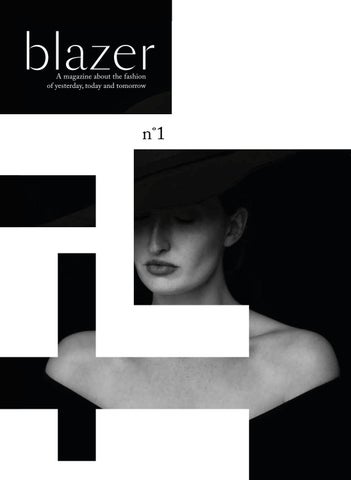
blazer A magazine about the fashion of yesterday, today and tomorrow
n˚1
Blazer, Veneziani, 1955
N1
Cultural partners
2 / Letter from the editor
CON TE N blazer
p. 4
Letter from the editor / Innovation or eternal return
p. 8
Good fashion never goes out of style An introduction to the history of fashion, the major styles in vogue in the last century and the major designers who helped to spread them.
p. 24
The relationship between fashion and art
p. 44
Throughout jeans history
p. 56
In our magazine fashion is related to a different area: in this issue we talk about art and how designers are inspired by the great masterpiece of art.
The history of denim, how it has evolved and how the trendy jeans that we wear today are the result of what happened during the last century.
The meaning of time and fashion for Roberto Capucci A conversation with the Italian designer Roberto Capucci about time, catwalk, old and new fashions.
p. 60
Trench: history and advice on a style icon
Details, curiosities and combinations of the ‘coat’ most loved: an evergreen garment that returns in the fashion show trends and streetstyle.
p. 60
14 items you can’t not have in your closet Discover women’s clothes that never go out of fashion. And how to create a personal capsule collection that will solve any look problem.
Why 7 fashion sneakers for 2020 are vintage p. 78
Come from the past but are the basis of your sneakerhead look pro: a look at the ocean of sneakers that swarm the contemporary fashion scene.
TS blazer
n°1 / 3
I n n ova t i o n
or
Fashion during the age
Fashion for communicating
Tastes change and over the decades there are always new trends. Or not?
Fashion and society
Eternal return 4 / Letter from the editor
blazer
Photo: The LIFE Picture Collection/Gett
Grace Kelly’s classic, sophisticated style was always impeccable. Her iconic feminine dresses and tailored ensembles made her one of the most influential fashion icons of her time. In fact, Hermès renamed one of their purse designs, the Kelly Bag, after the actress was spotted toting one on numerous occasions.
blazer
Photo via John Kobal Foundation/Getty Images
Lauren Bacall’s seductiveness in combination with her effortless glamour is what makes her one of fashion’s most iconic actresses. From silk blouses, to blazers, to pencil skirts, and even to pleated trousers, Lauren transformed professional attire into a simplistically glamourous style.
n°1 / 5
Vintage fashion is considered by the world’s greatest fashion designers and connoisseurs as an artistic and cultural heritage. The garments and accessories of other times considered vintage have acquired over the years a special value, because they can no longer be reproduced with modern methods and because they are symbols of particular and iconic moments in the history of fashion, design and costume. Of course, vintage fashion is not only proposed by great designers, indeed, the real vintage fashion is the one found in houses, markets and specialty shops. Vintage fashion is the one that offers long, feminine dresses, reaching up to the mid-calf typical of the 40’s, take-off in eighteenth-century style, very wide, white and red pull typical of skiers of the seventies or plaid skirts and suede under the knee, always typical of that decade, combined with leather boots. The real vintage fashion is the one that offers patterns in rhombus, punk rock look with a strong taste or chic animal. Well, fashion has undergone real changes, but without knowing the history of fashion, its path and its transformation, without knowing the fashion of the past it is very difficult to judge that of today. Fashion has its own history and it also has some reasons why it has changed and evolved over the years, because I believe that fashion is the mirror of the time in which we live and so many movements were born 6 / Letter from the editor
Photo: Getty Images
When we look at pictures of our mothers or grandmothers, we can have two kinds of reactions. The first is like: “Oh heaven! But how did they dress?” The second of the type: “Wow! What happened to this item of clothing? I want it!”
Some could argue that Audrey Hepburn is the reason for fashion’s obsession with the Little Black Dress. Her classic Holly Golightly look from Breakfast at Tiffany’s is one of the most iconic in ‘Old Hollywood’.
blazer
Photo: Sanford Roth / mptvimages.com
Victoria Beckham, proves to be a true‘lady’M style even in the days of Spice Girls. There are simple garments to compose his outfits: white T-shirt combined with over pants, structured jacket with male pants, maxi pull and maxi skirt, in most cases combined according to the rules of color blocking, or combine two opposite shades of the color wheel to create unexpected visual effects.
blazer
for social, political reasons and to better express and communicate a certain ideology, just think of the ‘70s hippies. And then there’s definitely the creativity of the designer who can change the way a generation dresses, in fact I never cease to be surprised at how much there has been in the past and how much evolution there is constantly, how the concept of beauty has changed. The magazine’s intent is to provide a tool for your personal fashion culture and methods of judgment to understand what fashion communicated in the past and how people expressed themselves in 19th century and express themselves today through fashion, what they want to communicate and how they look in different ways and depending on what they wear. This intent stems from the fact that human nature has always been to communicate, and clothing and fashion have always been one of the greatest means of communication, voluntary or involuntary who have allowed the man to communicate not only his social condition, but also his ideas and especially his personality. For these reasons, going into detail, we will analyze the most iconic fashion items, their history, how they have changed and how they have become today, starting from iconic garments such as jeans, shirts, boot, overcoat, tailleur or blazer. In this way, I hope you can open up new and unknown horizons, endless sources of inspiration and understand that not everything we see on the modern runway is new! n°1 / 7
Good fash
goes out 8 / Good fashion never goes out of style
blazer
Photo: Mario Testino
h i o n n e ve r
of style blazer
n°1 / 9
The coat in the past Photo: Bill Cunningham
Steven Meisel and Madonna in their coats in the ‘80s
Anna Wintour and her coat, 1973
Making a splash: New Yorkers wading through or leaping over puddles with their coats
10 / Good fashion never goes out of style
blazer
Bill Cunningham ready to capture a coat at one of the most sedate, oldschool fashion shows.
Fashion’s history has made a huge impact on how fashion is today. Fashion designers are showing us that no matter how old a trend is, it can never go out of style, such as top hatsboots and bomber jackets. In the 1800’s, fashion became a way to express oneself, as western style quickly emerged into the fashion field. Jumping to the “Roaring 20’s”, women started to experiment with hair introducing new styles of long, short, or bowl cuts to the rest of the world. To this day, women continue to experiment with their hair, with styles shifting back and forth. Little black dresses were a popular style for women in the 1930’s, which is still true for most women of this era, expecially thanks to the French fashion deisgner Coco Chanel. She was inspired by lines drawn from everyday life, sailors’ uniforms, men’s style and even nuns’ clothes. blazer
For this reason his feminine creations were revolutionary, devoted to simple elegance and extreme comfort. Women, on the other hand, were changing and could no longer afford unmanageable corsets and very complicated clothes to wear. Chanel’s client, on the other hand, was certainly a very wealthy lady, but also active, dynamic, who allowed herself few colors, sure that white and black were enough to make her elegant. Moreover, before the 1940s, these are the years in which a-line skirts quickly replace the pencil skirt suit, giving the legs just a bit of breathing room. A popular fashion trend from the 1940’s was the sleek long pant that was introduced by Katherine Hepburn. The sleek long pant style is still common to this day, mostly worn by business women. As time progressed and the 1950’s rolled around, pencil skirts and miniskirts were created for young women to make themselves feel more attractive. T he skirt suit is slowly evolving with the addition of a cape, an early source of style inspiration for the countless celebs who wear capes. Moreover in this decade coats get longer and bags finally get bigger, expecially since 1956. Holiday shopping has never looked so fab. 1960’s is also the debut of the miniskirt, which began to be use by lot of woman from different social classes. As well as skirts, even dresses are inspired by stylized geometric shapes or the famous polka dots. Still survive the 50’s style dresses, very wide and at knee height… but still for a short time! In these years there were other emerging designers: infact, if Coco Chanel was the first stylist capable of releasing the female body and giving it a new style suitable for the new era, Yves Saint Laurent was surely his heir. When Dior passed away in 1957, he was then chosen, very young, as artistic director of the fashion house, being immediately launched in the Olympus of the great. He was also the first to create mixtures between painting and fashion, influenced by the masters of 20th century. In these years following Woodstock, and the ongoing conflict with Vietnam, there was the hippie movement of the 1960s. To display freedom, tie-dye became very popular. During this rebellious period, 1967 was also proclaimed as the year of the turtleneck. In today’s fashion world, turtle necks would be extremely conservative. However, this moment in time was quite the opposite. Men were used to wearing neck ties and scarves, but part of the rebellion was ignoring that and wearing turtle necks instead. The 1970’s instead presented platform shoes, or wedges, which made its trademark on the fashion empire that we know. n°1 / 11
Steven Meisel and Madonna in their coats in the ‘80s
And the coat today Photo: Mario Testino
Steven Meisel and Madonna in their coats in the ‘80s
Steven Meisel and Madonna in their coats in the ‘80s
Steven Meisel and Madonna in their coats in the ‘80s Steven Meisel and Madonna in their coats in the ‘80s
Steven Meisel and Madonna in their coats in the ‘80s
Steven Meisel and Madonna in their coats in the ‘80s
n°1 / 13
14 / Good fashion never goes out of style
The hat in the past Photo: Ir vign Penn
Moreover, elephant Paw Pants have been booming for years! Women and men cannot resist this trend. Short dresses style“‘60” survive although hippie fashion privileges pants or skirts decidedly longer and softer. “Color” is certainly the watchword of fashion this decade. Furthermore, these were the years of the unconventional and such was Jean-Paul Gaultier, a French designer who immediately demonstrated his unconventional taste in fashion. As he made room for him, Gaultier began to make himself known as an innovator and a provocateur, earning in short the label of enfant terrible of French fashion. His collections, in fact, mix street influences and cheerfulness, so much so that even his most formal garments do not fail to exhibit some distinctive and original sign. Moreover, his clothes immediately showed such power as to make them, in some cases, icons of their time. This is all the more true when we go to examine the collaborations that Gaultier has made with cinema and the record industry. The Parisian designer, for example, has taken care of the look of Madonna on several occasions, also drawing the famous cone-shaped bra that played such a part in the construction of the singer’s 90’s image. He since the mid 1980s, it has also heightened provocation on the runway. After promoting, even with a certain insistence, the use of kilt among men, he has in fact paraded all the categories of people who are usually far from the environment, such as the elderly, the overweight and the hyper-tattooed. Returning to Italy, at the turn of the 1970s and 1980s, we can see the launch of Giorgio Armani’s first collection. His first collection is dated 1975 and to date the brand produces the following product lines: men’s and women’s clothing, accessories and underwear, perfumes and baby clothing, that made him one of the most important Italian designers in the world. Over time he has created his own style: from unstructured jackets, in which the padding is removed and the proportions changed, to the female suit of o the feminine suit of male cut designed for women in career, until the creation of its own color, the Blu-Armani, which together with the cold colors, have become over time its trademark. Regarding the style of these years more generally denim jeans became one of the most famous and popular fashion trends of the 1980’s, along with Calvin Klein clothing that can be worn by both women and men. Even today, Calvin Klein’s jeans continue to be a major fashion trend among men and women. They were “really weird” years for fashion.
Jean Patchett and her boater in a classical style of 1950
It’s easy to see yourself in old photos of those years and wonder why you dressed like this! Tight waist in contrast to wide shoulders (effect given by the inevitable shoulder straps positioned in each end of the top) was the must-have of the 80’s. For the colors, well, you could really give yourself crazy joy! Among the most famous Italian designer of these years is definitely Valentino Garavani, the image of the successful Italian fashion worldwide, one of the greates icon of fashion of evere and of creativity. Born in Voghera in 1932, Valentino learned all the secrets of the trade in Paris and Milan, where he collaborated over the years with celebrities, movie stars and TV stars. He was also portrayed by Andy Warhol in one of his works in 1971 and he even created a new color, never seen before anywhere, called “Rosso Valentino”,
Photo: Bill Cunningham
Beats baseball caps: Ava Cherry and David Bowie in fancy hats at a Grammy Awards party in 1975
Photo: Ir vign Penn
It comes as no surprise that fashion trends have changed throughout the ages. However, what is surprising is that fashion from the past is making a comeback
Photo: Ir vign Penn
The twelve most photographed models with differents hats in New York, 1950
Jean Patchett and her boater in a classical style of 1950
n°1 / 15
And the hat today Photo: Mario Testino
Model with leopard hat, 2019
Model with bowels hat, 2018
16 / Good fashion never goes out of style
Model with Floppy hat, 2019
Models with Floppy and Panama hats, 2019
a bright red shade, a mix of purple, carmine and cadmium red, used in his clothing collections, that will be famous also in the following decades, especially in 1990’s years. These age brought the “grunge” look also known as holes in the jeans, along with hip hop and Goth style that teens sport today. Pants (strictly jeans!) were allowed only if high waist! The jerseys were worn inside and the shirts were terrific if tied under the breasts (of course for those who were lucky enough to afford it!). Also the skirts were high-waisted (in return they were really short) and were worn with low shoes. Experts believe the reason for the return of old school fashion is because young adults are becoming more fascinated and intrigued by the past from television: movies and celebrities have a direct influence on recurring fashion
trends expecially thanks to advertising but event thanks to the influence of celebrities. They represent a new fashion that makes us, the new era, curious about life in the past. Non-familiar clothing makes young adults and teens interested and excited to attempt a new style that has never been a reality to them. According to fashion experts, fashion repeats itself every twenty years, which seems to be the case for Mercedes Silvas who stated, “Good fashion never goes out of style.” From paperboy hats of the 1940’s to the boots of the 1960’s, fashion has proved that any style can be brought back in a new exciting way. Abigail Gonzalez, who is a huge fan of the 60’s boots trend said once time, “I think it’s amazing how fashion from the past is coming back and being intercepted into the new fashion.” These old school styles have become so unique that they are being introduced to our generation in a great way”, stated Nessa Esparza. Leading designer of these years is Gianni Versace, considered one of the most famous Italian designers of all time, who died prematurely in 1997, murdered by a maniac in Miami Beach. His fashion maison, Versace in fact, over the years has become an icon of style and luxury, known all over the world. Famous is indeed its style, which takes elements of Ancient Greece, the Roman, Byzantine and Baroque world, contaminating them and translating them into a unique style. Famous is the choice of Medusa as a symbol of the brand, which represents the woman beauty. Years 2000: here is the proof of the eternal return. Elephant paw pants are back in fashion, but the high waist and tight ankle pants are a huge success. Shorts are worn in every season and, for those who like them, with low boots and Parisian style. Symbol of these years are Domenico Dolce and Stefano Gabbana, who became, in the years 2000, the designers symbol of “Italian and Made in Italy”. Their success is due, besides the talent, to the ability to reinvent themselves, but always remaining faithful to their origins. On their catwalks they paraded the real Italy, the trendy but genuine, colorful and noisy. After years of important testimonials such as Scarlett Johansson and Matthew McCounaghey, the two designers decided to entrust the image of their brand to the millenials and to bring fashion to the italian streets, starting a new era for Dolce&Gabbana. Fashion today is redefining of the 1980s and 1990s. Many fashion trends stayed popular such as alternative fashion and grunge look. Hipster culture has also dipped into the fashion world with denim blue jeans and n°1 / 17
18 / Good fashion never goes out of style
Photo: Ir ving Penn
denim jacket, cardigans, rounded glasses, and printed T-shirts. This decade is about the representation of different subcultures. Everything from hip-hop streetwear to contemporary fashion can be seen worn by everyone in the streets. 2010s fashion is including everyone. It stands as another indication of how fashion has changed over the years. The early 2010s saw many recycled fashions from the 1950s, 1970s and 1980s as designers from stores like Topshop replicated original vintage clothing. In the United States, it was popular to wear Gucci, Chanel, or Versace designer clothing, and neon colors such as pink, green, teal, black, purple, magenta and yellow. Popular tops for American, British and Australian women aged 20–50 included tunics, 1980s style baseball jackets, oversized cardigans, western shirts, 2fer and layered shirts and tees, dresses and shirts worn with belts, Abercrombie and Fitch hoodies until 2012, Perfecto motorcycle jackets customized with studs, floral camisoles worn with matching boyshorts. European women wear sparkly dresses, baggy one-size-fits-all Empire line skirts, blouses and dresses, and lace, figure-hugging white organza maxi dresses inspired by Pippa Middleton. From 2010 to 2012 many late 2000s fashion trends remained popular in Europe, the United States, East Asia, Israel, and South America, especially acid wash skinny jeans, geometric or galaxy printed crew neck sweatshirts and leggings, “trouser-dresses”, romper suits, preppy pastel colored skinny jeans, metallic dresses, and capri pants cropped at the ankle. Possibly due to the poor economy in the early years, the midi skirt and the maxi skirt were the most common skirt and dress styles, with the hemline standards being the longest they had been since The Great Depression. From late 2011 onward, 1990s inspired fashion began to make a comeback in the UK, India, and Australasia among teen girls and young women aged 15–30. Popular upper apparel included ugly sweaters, T-shirts with blazers, plaid, oversized flannel shirts worn or tied around the waist, oversized T-shirts, padded gilets, skorts, crew neck sweaters, T shirts bearing the word Nerd or Geek, destroyed acid wash Balmain jeans, and crop tops. In the UK, popular bottom apparel includes skinny jeans, leggings, parachute pants, railroad stripe pants or skirts, boyfriend jeans. High-waisted bottoms, such as pants, shorts, skirts, and bathing suits also became the standard for women’s fashion in the 2010s, as opposed to the low rise trend that was popular throughout the 2000s. Desirable footwear from 2012-15 included flat sandals, stilettos,
Model in her velvet-tie beach hat and her blues, 1958
black, white or multicolored Vans, Keds as worn in ads by Mischa Barton, Ariana Grande and Taylor Swift, TOMS Shoes, Chucks, Sperry top-siders boat shoes, flat knee high riding boots, Uggs, moccasins, Hunter boots brand rain boots, one strap sandals, furry slip-on Puma sandals, cavalier boots, gladiator sandals, wedge heel-style sneakers, flip-flops, combat boots, Doc Martens, and The Timberland Company hiking boots. Other popular trends of the early and mid 2010s included Aztec and Navajo inspired patterns featuring diamonds and triangles, especially on T shirts, socks, handbags, panties, pullovers, and other knitwear. In addition, young American women began wearing feather earrings, beaded bracelets, sneakers resembling moccasins, ponchos, vests and jackets made from striped Mexican blanket material, despite the connotations of cultural appropriation.These tribal inspired garments, made popular by Urban Outfitters and Ralph Lauren, typically came in bright colors like red, yellow, turquoise, blue, and orange. Many fashion trends from the early blazer
Photo: Bill Cunningham
Photo: Bill Cunningham
Row royalty: left to right, Carlyne Cerf de Dudzeele, Anna Wintour and Suzy Menkes in their shirts, 1980
Photo: Bill Cunningham
Myrna Sandoval, eighteenyear-old, and and her sister Claudia, fourteenyear-old wearing shirts, 1982
Shirts in 90s A subject in ruffled blouse and wide-legged trousers hails a cab, 1973
blazer
n°1 / 19
Group of models in shirt and skirt
Shirts today Photo: Mario Testino
White blues with accessories
Models with different kinds of blues and shirts
20 / Good fashion never goes out of style
blazer
Not only does the dress we wear communicate something about us, but above all the accessories make the difference: the hat, the bag, the belt, the bijoux and the shoes determine our status: bon Ton, professional, conformist and nonconformist
years of the decade, especially the 1980s influences and the 1960s inspired indie, neo-hippie and boho chic looks, remained relevant in the US and Europe as far as 2017. This included skinny jeans, tunics, floral print dresses, midi and maxi skirts, motorcycle jackets, western shirts, red and blue geometric print blouses, patterned and solid colored tights, overalls, jogger pants, flat boots, stiletto shoes, pastel and neon colored shorts, ballet flats, and combat boots. Popular colors from 2015-16 included mauve, cream, eggplant, lime green, and warm grey. In the UK, modestwear combined with elements of hip-hop fashion became popular among many young Muslim women, with long skirts decorated with lace and beaded embroidery, colourful floral hijabs, halal cosmetics free from animal products, knee length grey cardigan sweaters worn over leggings, white trenchcoats worn with baggy pants, keffiyehs worn as headscarves, black satin gowns worn with a long shawl collar overcoat, purple kaftan dresses worn with high heeled shoes, and abayas with retro 1980s inspired zigzag patterns. Continuing on from the late 2000s, fashion in India moved away from traditional clothes blazer
like the saree and glamorous Bollywood style dresses in favor of a more Westernized style that incorporated navy pants, blazers, leather jackets, and androgynous military jackets. Popular casual footwear included leather dress boots, stiletto heels, platform sandals, and open toe pumps. Cream, grey, blue and orange Kurta dresses with side slits decorated with pink or purple embroidery and synthetic jewels were worn with jeans or leggings, T shirts, tank tops and bat wing sleeve blouses were paired with traditional silk salwar pajamas or short shorts, and the large hoop earrings declined in popularity in favor of smaller minimalist gold jewelry. By the mid 2010s, neon colors were out of style in Europe, America and Australia. More subdued colors became popular such as burgundy, mustard yellow, olive green, mauve, and blush pink. Bright colors were also replaced by black, white, various shades of gray, and charcoal first on the catwalk, and later as street fashion. Black and white Polka dot dresses underwent a revival in China and North Korea. This trend had spread to Middle Eastern countries like Turkey, Iran and the United Arab Emirates by 2016, with Italian brand Dolce and Gabbana launching a range of black and white hijabs and abayas decorated with lace daisies, roses and lemons. Monochromatic clothing trends from 2013 to 2017 included black and white lace dresses, lace blouses, jackets and dresses with peter pan collars, white Adidas Superstar sneakers with black or gold stripes, houndstooth or geometric patterned blazers, black or nude slip dresses, white babydoll dresses, bodycon midi dresses, black and white striped “Beetlejuice” style slim-fit pants, long black velvet blazers decorated with silver braid, tuxedo jackets (often having contrasting black velvet or satin lapels), crop tops, oversized coats, striped culottes, loose Capri pants and palazzo pants, patent leather gladiator sandals, romper suits, sheer black tops worn over bralettes, puffer jackets and vests, knee-length skirts, pencil skirts, black and white geometric printed leggings, and cuffed boyfriend jeans. Denim declined in popularity in the US, with black or grey yoga pants, leggings, and slim-fit jogger pants replacing them. From 2013, small bucket backpacks in colorful prints such as aztec, polka dot, and floral were popular, mirroring the small backpack trend in the 1990s, but by 2015, these small backpacks were largely replaced by Herschel zip-up backpacks with brown diamond patches on the front. In the spring of 2017, the brightly colored beige, red, green, brown and orange 1970s revival fashions n°1 / 21
began to replace the grey and monochromatic 1990s inspired streetwear in Italy, Britain, USA and France. Particularly popular were the sheepskin coats, moon boots, flared double breasted trouser suits in black, applique cropped wide leg jeans, denim jackets with embroidered red roses, multicolored tie dye skirts, baby blue and China print dresses worn with black tights, pale denim shirt dresses worn unbuttoned over blouses and light wash jeans, white sneakers, leopardskin coats, distressed jeans, peacoats, brown granny boots, pale dusky pink midi-dresses, white peplum dresses reminiscent of those worn by Princess Leia, slightly flared jeans, white and blue floral print shirt dresses, loosely woven plaid blouses, pleats, ruffles, stripes, mismatched earrings popularised by Kate Moss, mandarin collar tops, purple dresses with puffball sleeves, leather or PVC miniskirts, translucent yellow or orange cold shoulder blouses, oversized paisley, denim skirts, geometric print blouses, floral Brigitte Bardot minidresses and blouses with flouncy sleeves, kimono jackets made from the same brightly colored silk as aloha shirts, leather safari blazers, slim fitting capri pants, babydoll dresses, knee boots, flat ankle boots with tights, or crew or knee socks slouched down over tights, leggings, jeggings, or skinny jeans. Also seen are snakeskin or sequinned pants, oversized hoop earrings, velvet blazers and dresses in pink, cobalt blue, red, navy, gold, and forest green, fur vests, sunflower print maxi dresses, red, black and white, salmon, lavender or orange crocheted jumpers. The pantywaist tops previously fashionable as sportswear in the late 1970s and early 1980s, started to commonly replace T-shirts in the UK, US and South Africa, especially among pop stars and models like Candice Swanepoel, Nicki Minaj, and Beyoncé, whose one-off bodysuits were modified from vintage Adidas and Chicago Bulls jerseys. By way of Alessandro Michele of Gucci’s creative direction, flat mule shoes, sandals and orange, brown or pink mule heels reminiscent of those worn by Barbie dolls started making a resurgence in Italy and Americas from early 2017 onwards, sometimes featuring tiger embroidery, florals, beadwork, or furry lining. We saw the major fashion designers of the time, their style, their peculiarities in relation to the times in which they emerged and the fact that over the years, fashion has become a way of expressing oneself, making one feel more attractive, and allowing individuals to keep up with the new trends that occur and change often. Fashion is also the prevailing mode of expression. 22 / Good fashion never goes out of style
Model wearing 19th century clothes
It is the idea that the mode will change quickly that the culture as a whole. Fashion is seen as a display of individuality; a person’s fashion gives the world around them an idea of who they are. Fashion may vary within a soceity according to age, generation, social class and geography. Infact not only does the dress we wear communicate something about us, but above all the accessories make the difference: the hat, the bag, the belt, the bijoux and the shoes determine our status. The evolution of fashion has been a response to cultural changes, but the fashion industry also has initiated its own clothing trends. Trends often start from the people who have high social status or are popular with the public start to wear new or different clothes, and people who like or respect them start wearing clothes of a similar style. The history of fashion has made a huge and very importatn impact on how fashion is today, creating a variety of styles for everyone. An article by Alessia Melzer
blazer
Fashion of today set in the past Photo: Mario Testino
Model posing with clothes ispired by 19th century, setting in a museum
Clothes ispired by 19th century
Model posing with clothes ispired by 19th century, setting in a museum
blazer
n°1 / 23
THE RELATIONSHIP BETWEEN FASHION AND ART Art and fashion have forever been entwined, infact in the 1920s, Coco Chanel collaborated with Pablo Picasso when together they worked on costumes and backdrops for the Ballet Russes; Sonia Delaunay designed clothes and textiles in tandem with her vivid artworks; Yves Saint Laurent returned to art again and again throughout this career: in 1965, he drew on the bold abstractions of the Modernist painter Piet Mondrian to create a collection of six A-line dresses; he was forever fixated by Yves Klein’s blue; and, in 1980, created a couture collection after Henri Matisse’s cut outs. The AW16 collections took inspiration from a diverse range of art. The catwalks recalled everything from the surreal works of Salvador Dalí, to the great sculptures of Richard Serra and the playful Pop Art of Andy Warhol. When looking for the cultural threads that drew the looks together, one found both bold and deeply romantic influences. Feather-light tulles and laces conjured the spirit of the Impressionists, while mind-bending patterns and dazzling monochromatics evoked Op Art. How does art go into our wardrobes? An article by Jo Ellison
24 / Fashion and art
blazer
The clothes inspired by the founder of neoplasticism were born thanks to a book given by his mother to the young Yves Saint Laurent (Piet Mondrian, Sa vie, son oeuvre). John Galliano for Dior, was inspired by the golden period of Gustav Klimt’s painting, where it is also evident the reference to the work “Medicine”.
Inspired by the mosaics of the Cathedral of Monreale, close to Palermo, Dolce&Gabbana have created queens and byzantine princesses, covered with gold.
Maison Martin Margiela has always been inspired by the world around it, particularly by nature and art, as Vincent Van Gogh’s paintings, of which uses floral images. Aquilano Rimondi, the brand created by Tommaso Aquilano and Roberto Rimondi, was inspired by Gustav Klimt for the prints and patterns in his collection of 2015. The Wren Scott, has also dedicated its latest collection, before her death, to Gustav Klimt and in particular to his passion for Adele Bloch-Bauer, inspiration of painter.
Across Miu Miu’s collection it looked like the models walked out of the artist Roy Lichtenstein painting thanks to use of signature lines and lots of dots. Hussein Chalayan is inspired by the abstraction of Jackson Pollock, transforming the typical brushstrokes of the artist into patterns for his 2014 collection. On the Iceberg runway of 2014 there is a clear reference to the psychedelic art of the 60’s and 70s, especially in the soft shapes, pattern and colors.
blazer
n°1 / 25
Photo: Guy Marineau
Yves Saint Laurent Autumn/Winter 1965 Ispired by Piet Mondrian 26 / Fashion and art
blazer
Photo: Daniele Oberrauch
Maison Dior Spring/Summer 2008 Ispired by Gustav Klimt 28 / Fashion and art
blazer
Photo: Getty Images
Dolce&Gabbana Autumn/Winter 2014 Ispired by the byzantine art 30 / Fashion and art
blazer
Photo: Kim Weston Arnold / Indigitalimages.com
Maison Martin Margiela Autumn/Winter 2014 Ispired by Vincent Van Gogh 32 / Fashion and art
blazer
Photo: Kim Weston Arnold / Indigitalimages.com
Aquilano Rimondi Spring/Summer 2011 Ispired by Gustav Kilmt 34 / Fashion and art
blazer
Photo: Getty Images
L’Wren Scott Autumn/Winter 2013 Ispired by Gustav Klimt 36 / Fashion and art
blazer
Photo: Getty Images
Miu Miu Autumn/Winter 2014 Ispired by Roy Lichtenstein 38 / Fashion and art
blazer
Photo: Getty Images
Hussein Chalayan Autumn/Winter 2014 Ispired by Jackson Pollock 40 / Fashion and art
blazer
Photo: Carmelo Poidomani
Iceberg Autumn/Winter 2014 Ispired by psychedelic art of 60s 42 / Fashion and art
blazer
Photo: Warner Bros film
GHOUT HISTORY
44 / Throughout jeans history
blazer
THROUGHOU JEANS HISTO Jeans of today and yesterday because denim is an item of clothing that never goes out of fashion. Infact, if it is true that the world of fashion changes constantly, this is not true for everything: there are some trends that stay on top for a long time. Among these obviously we find jeans, since denim is a fabric that never goes out of fashion remaining always on the crest of the wave. And yet, over the years, denim trends have faced different stages: so let’s discover the steps that, have marked the history of jeans. An article by Serena Tibaldi
blazer
n°1 / 45
They are the most famous, popular and beloved garment in the history of fashion. The jeans can be declined in thousands of different versions, from overalls to jeggings, from dark blue to the most ruined and light, from shorts to long ankle. Many designers have built part of their fortune starting from them: Calvin Klein and dsquared2 are a perfect example, but also Giorgio Armani himself. He’s secured a place in the history of jeans. But how did the legend begin?
The manufacturing of denim overalls began in the 1870s and the company created their first pair of jeans in the 1890s. It was only after the 19th century that competitors for the denim market began to appear: namely Wrangler (1905) and Lee (1911)
46 / Throughout jeans history
blazer
"I have often said that I wish I had invented blue jeans: the most spectacular, the most practical, the most relaxed and nonchalant. They have expression, modesty, sex appeal, simplicity, all I hope for in my clothes." Yves Saint Laurent
Photo: Ted Strenhinsky photo graphic archive
blazer
The denim’s origins are European: the fabric from which it all began, was born in Nîmes, in France (the etymology of the term comes from Serge de Nîmes): the turning point, however, is around 1860, when French producers elect Genoa to their port for trade with the United States. It is here, in the Ligurian capital, that the first pair of trousers made of that vestrong indigo blue cotton is made and sewn. These, together with the fabric, arrived in those years in America. In 1873 a tailor from Nevada, Jacob Davis, took those first jeans as a model, using denim to make a pair of trousers commissioned for her husband: the demand is that they be very durable because they have to be used to split wood. Davis has a brilliant intuition: he strengthens the joints with copper rivets, making them (almost) indestructible. The news spread quickly, and soon Davis is submerged by orders: he sells more than 200 pairs of his jeans in a few months, but overwhelmed by the amount of requests, he turns to a major merchant in the area, Levi Strauss, offering him a deal. Thus, modern jeans are born: it is because of these events that is always associated with the american culture of Stars & Stripes, becoming in this way one of the symbols par excellence of the living in the West World. At that time, California search, garments resistant to the worst environwas in the spotlight for a mental and atmosphe conditions; the fabric called phenomenon that would “bleu de nimes”, that was used in the past, in the go down in history: the ports, to cover the goods and the keels of the ships gold rush. The gold digleft in port. The fabric was more than suitable to be gers and miners therefore used for the realization of solid and resistant mihad the need to wear, in ning trousers, and their workmanship still speaks the course of their reof their past: jeans, in fact, are often characterized by double seams, steel stitching, rivets and buttons. Denim is made from cotton. While some types of jeans may be made from other materials, the only type of material that can be used to make true denim is all-natural cotton. This plant-based substance is made from the fibers that grow on cotton seeds. These fibers are separated from cotton seeds, and they are then packed into bales. Once these bales arrive at a production facility, they are broken open, and the fibers are carded, which results in long strands of fiber. Next, these strands are spun into yarn, and this yarn is loaded onto spools. Cotton may be dyed with the traditional indigo blue color of denim after it is spun, or denim manufacturers may wait to take this step until the fabric is woven. Denim is a twill fabric, which means it is woven with multiple weft passes for each warp pass. n°1 / 47
Photo: Getty Images
"A boutique in the New York East Village called Limbo, was the first retailer to wash a new pair of jeans to get a used, worn effect. It became new fashion hit.”
This process creates the diagonal weave that is part of the iconic appearance of denim jeans from Calvin Klein, Lee, or Wrangler. After it is dyed and woven, denim is in a form called “raw denim.” In some cases, raw denim may be sold as-is, but this fabric is usually subjected to a process called stone washing to make it easier to wear. After the fabric is washed, it is cut and sewn into jeans. In the 1920s and 1930s, jeans became popular Western wear in the United States, worn by miners, cowboys and other male workers who needed sturdy clothing that could withstand heavy wear and tear. In the wake of this success, Levi Strauss became a leader in the manufacture of garments, especially trousers, with its flagship made up of jeans today as then. Today the company, the absolute protagonist in the history of jeans, can count a dense network of stores present in more than 110 countries around the world, soon becoming a real icon of casual clothing in general, so much so that, today, claiming to be wearing a pair of Levi’s is equivalent to wearing a pair of real jeans. The jeans had a leading role also during the student revolution, becoming almost the symbol, and from that day was consecrated in the world of fashion as a clothing that cannot be missing in any wardrobe. It is in fact worn both for everyday activities as well as for
evening dates, for formal occasions or parties. The model that most of all made the story of Levi’s jeans is the famous 501 model, which was originally born of brown color, with no back pockets or belt loops. Later, the dark brown gave way to the classic, legendary and timeless New York denim, and the most fragile and subject to denim ruptures were reinforced with special metallic accessories that, still today, they are present in most models. The fame of the model 501 is extended to all the other models, giving life to a real diffusion of oil stain jeans in all social classes and in people of all ages. Levi’s are now produced by both men and women in different models. From those with low waist to those with high waist, from those with elephant paw to those with cigarette, from those long to those with three quarters, jeans are available in many models, in many colors and more or less rich in accessories, pockets, hinges, bottom, loops and so on (In addition to jeans, Levi’s also produces a whole collection of casual clothing that includes skirts and shorts of jeans, T-shirts, sweatshirts, shirts, shoes and accessories). Another peculiarity of denim jeans that has made him so different is undoubtedly his ability to have remained over all the decades a unic garment as useful as charismatic. It is chosen because it has a precise stylistic meaning, but at the same time it is still used today for the heaviest tasks because of its innate resistance. During the Second World War denim overalls were introduced, while in the 1950s they were revolutionized by James Dean, who
48 / Throughout jeans history
blazer
In the late 1800s, denim trousers, typically worn by male workers and originally referred to as “waist overalls,” were fairly commonplace as rough and tumble work wear.
“To eliminate the shrinkage, most of the denim fabric is washed in water after coloring.”
Photo: Getty Images
In the early 20th century, denim was adopted as the preferred workwear fabric choice for western cowboys, miners, farmers in the US. Not only was the fabric cheap, but denim was more durable and sturdy than the popular alternative ‘jean’ (traditionally made from cotton and wool).
"The term “jeans” gained popularity in the 50s. Before then, they were usually referred to as waist overalls."
blazer
n°1 / 49
in the movie “Burnt Youth” used them as a symbol of rebellion against social conventions. Moreover, in the 1950s, teenagers embraced blue jeans, when. Hollywood movies used jeans as a fashionable symbol of rebellion against the status quo. Pop culture “bad boys” such as James Dean and Marlon Brando popularized jeans in their films, wearing denim as they shook up the squares. This led to blue jeans being banned in some public schools in America, for being too provocative. Light washes, cuffed denim styles, and black jeans were the reigning jeans trends among men, and popular brands included Levi’s, Lee Cooper, and Wrangler jeans. Contrary to what you might think, women rarely wore denim during the 1950s, that change in women’s fashion history was still to come, in the turbulent a pair of sneakers or a 1960s. Suddenly a whole generation of teen-agers finds their ideal garment. simple winter sweater. It is not by chance that Dean is still the embodiment of the young and tormenThe jeans impress with ted rebel. The 1960s launched the beginning of the hippie age. The youthful, such force his personality free love movement that rocked American culture embraced the casual blue on a creative and revolujean, which was seen to represent freedom from more structured clothing. tionary era as the seventies In this decade of creative expression, personalizing your jeans was consideto suffer from a rejection red very groovy. Embroidery, bright colors, stone washing, and patches were crisis with the arrival of just some of the hip jean trends of the time. Double denim also made its the 80, when high schofirst real appearance as a fashion trend during the 1960s, and jean jackets ol girls buy Fendi bags became standard hippie wear, and were often decorated with sew-on decals. and boys dress garments Moreover, In 1962 Levi Strauss signed by emerging desiintroduced their own pre-shrunk gners. Luckily that wave of couturier decides to match the high jeans (Lee and Wrangler jeans had range with the first ready-to-wear collections accessible to all. already long been pre-shrunk); these And what boss, better than jeans, could get everyone on board? did not shrink further after purchase, The first designer jeans are a miracle of happiness. They buy them allowing the consumer to purchase all, giving a boost to the already established and declining brands, a correctly fitting size. Pre shrink is including Levi’s, which instead start to get the new collections signed most common in jeans nowadays. by the stars. Boys and girls wear them in San Babila with Moncler These jeans were known as the 505 and Timberland, giving life to the fashion. In these days, infact, regular fit jeans. The 505 are almost you’ll see jeans in most places you go. They are symbols of comfort, identical to the 501s with the excepand they also have the potential to be somewhat professional in tion of the button-fly. The Levi’s the right situation. In addition, they are symbols of flexibility as Corporation also introduced a slim they appeal to all walks of life. That’s part of their popularity, and it boot-cut fit known as 517 and 527. contributed to the explosion in popularity of jeans during the 1950s. The difference between the two is the All in all, denim has had a vibrant and exciting history. 517s sit at the waist line and the 527s sit below the waist line. Later, Levi’s would develop other styles and fits such as the loose, slim, comfort, relaxed, skinny, and a regular fit with a tapered leg. If in the 1960s bue denim were introduced into everyday wear, in the late 1970s everyone bring him, of all races, of all social classes, to offices, parties and weddings. They cover themselves with drawings, with flowers, with applications, their life is outrageously low. Thus, casual fashion is born: open the closet and take the first things that happen to you, easily a jeans and a t-shirt, simple coat or
“From one bale of cotton 2-15 to 225 pairs of jeans can be made.”
50 / Throughout jeans history
blazer
Photo: Getty Images
“Rivets are used on jeans to make them stronger especially on pockets. In the beginning Levi Strauss & Co. Placed rivets on all pockets, front, and back but people complained that rivets on the back pockets scratched saddles and chairs so at first they covered them and then removed them altogether from the back pockets.”
To facilitate the jeans diffusion are fashion icons but also the idols of music and cinema of the youth of that time as Elvis Pretsley and James Dean, who redefined the humble denim jean forever with their highly stylised roles in cult movies such as ‘Rebel without a Cause’. Naturally, everyone wanted to emulate these idols.
blazer
n°1 / 51
“The most common colour of stitching on jeans is Orange, which was originally done to match some copper rivets.”
Photo: Getty Images
What began life as a failed fabric grew into a firmly established part of modern fashion. The durability of denim coupled with all the colors it can be dyed means that there are styles and choices for almost everyone. The history of jeans is one that has left its mark on the world: we all have a pair of jeans or two in our wardrobes. However, you can’t help but notice the rich and varied path that denim has taken to get to where it is now; it’s pretty incredible when you think about it. Jeans now are also all color, green, white, red, yellow, pink. An ephemeral success, destined to disappear with sandwiches. At the end of the 80’s, Levi’s 501 Jeans became a must among the youngest. Meanwhile, however, there was the big change: the arrival of the elastane in denim fiber (Elastene is a synthetic fiber known for its exceptional elasticity. It is a polyether-polyurea copolymer that was invented in 1958 by chemist Joseph Shivers at DuPont’s Benger Laboratory in Waynesboro, Virginia). If in that decade one of the favorite tortures was to squeeze into tight jeans (and then walk with stiff knees), if someone came to the extreme gesture of getting into the tub full of water after wearing them, to make them tighten a little more ‘on, drying them then with the hairdryer or in the open air (and shooting colds and rheumatism) elastic denim bursts into our lives like a bombshell, a second landing on the moon. Skinny jeans are born. In the 80’s also the fashion of gyms breaks out. Today it seems strange to think that regular exercise until then was not so obvious. The results of so much fatigue are to be shown and bandage the shapes with elastic jeans is not enough, they need
Jhon Travolta in one of his film helped to popularize jeans. The dark hue and stiffness of denim made it a popular fabric for trousers. Zippers were incorporated for the first time, and the younger generation began to wear denim trousers as leisurewear.
52 / Throughout jeans history
blazer
Photo: Getty Images
at least some strategic loopholes. In the 90s, jeans get ragged, studded with holes that imitate the accidental, they are washed with pumice stones to age them. Then they rediscover the low waist, even lower in the first years of the new millennium, they discover tattoos on the sacred, on the scooters. Now we are today and the jeans are back elegant, even with a high waist, after having proposed the summer shorts. Because the secret of a perfect marriage, between the blue jeans and us, is to renew, relive the stages of love in a continuous cycle, starting from time to time from the beginning. Mr Levi Strauss would approve. As well as he would also welcome the experiments with elastic fibres such as elastane, become a symbol of glamour and sensuality, carried out in the early 1980s. In this period Calvin Klein, the first designer to use them as a luxury and sleek piece, explodes thanks to the advertising with Brooke Shields. The ‘90s with grunge mark the triumph of the models sdruciti to art. Stone wash, acid wash, and ripped jeans were some of the most desired looks of this decade, along with the new, skinnier leg cuts that were tapered at the ankle. Even men got in on the designer denim trend in this decade, and started to show up more in jeans advertising, instead, in the 2000 to assert, in the good and the bad, are the so-called models “skinny”, adherent like leggings will also arrive, still today among the most sought after models. In the early 2000s infact, pop stars like Britney Spears and Christina Aguilera popularized the ultra low-rise jean. Denim also became a fashion staple once again, becoming an appropriate item of clothing to wear for going out on a Saturday night, or even to the office. Also their point life endures in the course of the years and of the fashions several variations, passing from that leaning on the hips, introduced by the sons of the flowers, to the breathnking one that arrives to the navel. “I have often stated that I wanted to invent blue jeans. They have expression, modesty, sex appeal, simplicity: everything I would like for my clothes”. This was declared by the great Yves Saint Laurent. And today it is more than evident that the denim jeans have not lost even one of these characteristics, but on the contrary.
The 1960s launched the beginning of the hippie age. The youthful, free love movement that rocked American culture embraced the casual blue jean, which was seen to represent freedom from more structured clothing.
“In a time when the jeans were worn by factory workers, jeans for men had zippers on the front, but jeans for women had zippers on the side.” blazer
n°1 / 53
“The first label to be attached to a piece of a garment was a red flag that was sewed next to the back pocket Levi Strauss’ jeans.” Their charm has grown, and they continue to be protagonists on the catwalk season after season each years. A true record if you think that the jeans was patented in 1873 by Levi’s Strauss and that was used as a work garment. To make it an icon were Hollywood legends, rebels of youth subcultures and rock stars. Let’s find out which models are not to be missed Autumn Winter 2019/2020 and the latest trends. One of the most fashionable models today comes directly from the 1970s: the flared jeans are back. Off-White offers ‘used’ effect in combination with bright colors eco fur. As for the high-waisted jeans, it was the Hollywood divas of the fabulous fifties that turned them into real icons. The high boot of soft leather is a must. The wide jeans are back in fashion, with a single note: wide leg, straight or bell, but with a high waist and tight fit on the hips. Casual denim translation of palace pants or cropped pants. In the middle of the season they wear with dancers and pumps that show the ankle, while with the first cold they prefer ankle boot, although their origins are far more distant, mom fit jeans were the cult model of the 90s. Alberta Ferretti offers them with a dark wash in flat ankle boots and combined with a high-necked sweater and a patchwork coat in soft colours. The couture version of jeans will never leave the catwalk. If you don’t want to go unnoticed even in jeans, a look like Tommy Hilfiger could be perfect. The model proposed by the brand is in denim jacquard, to shine like a star. The jeans, because of their resistance, entered the world of fashion, until they became a garment to which no one renounces, due to its wide adaptability to the most disparate looks and for the richness in terms of models. Today everyone wears jeans and our current decade has seen the return of every denim style, cut and wash imaginable. While most people are reluctant to let go of their skinny jeans, high-waisted denim, flared jeans and straight-legged styles have all made a comeback. As we edge closer to a new decade, we ask ourselves ‘what the future of denim will look like?’ Mirroring the direction take by the fashion industry as a whole, brands are being steered by consumers’ concerns over whether or not their products are sustainable and the denim manufacturing market is responding to this. While many premium brands have honoured sustainable practices for some years, the launch of denim ranges from rapidly growing fast fashion etailers and a strong performance from those pioneering premium brands is also helping the breadth of the denim industry to thrive. Wrangler’s Icon collection is made from 20% recycled denim, Jack & Jones relaunched its low-impact denim range last year. Meanwhile, Primark has launched jeans made from 100% sustainable cotton. Sean Gormley, creative director of Wrangler, says, “We’re finding that buyers want to be able to give their customer a better, more sustainable product. Increasingly, you can’t call yourself a premium product unless your credentials are sustainable.” The denim revolution has only just begun: something is about to change, and certainly for the better. The news,
54 / Throughout jeans history
blazer
Photo: Archive of Richard Avedon
which takes an open-air applause from the world of ethical fashion, even echoes a prophecy signed by Madame Le Figaro in 2006: “Jeans will be the cause of a global ecological disaster”. Which? Today, the source fuels (again) the dose: “The overconsumption of pesticides and fertilizers, the pollution of the water during the staining, the gas emissions from transport, as well as the expensive process of washing and ironing: The price of denim trousers is too high for the environment and reaches its peak when, in domestic environments, they are wasted and thrown away after only about four years of loyal service”. So where, how and when is the environmental impact of jeans going to be solved? The (beautiful) news for denim lovers comes from ecotextile.com: “New guidelines have been published by the Ellen MacArthur Foundation, which has brought together leading brands and recycling companies around the world in a mission that will transform the way jeans are produced. The truth, let’s face it, is that today the denim garments (whether jeans, shorts, skirts, jackets and who has more than one wear) are no longer the status symbol of the working class. And if once they were worn only and exclusively for their endurance and longevity in the workplace, today jeans are a passpartout garment that comes back in season in the feminine and male wardrobes, combining comfort and fashion trends. But this has a cost, which is much higher than the one on the card for those who are hunting for must-haves: it is the price that pays for the environment, our planet Earth. This is why the Ellen MacArthur Foundation in New York has drawn up four prerequisites in the name of ethical fashion for environment-proof jeans: longevity, healthy materials, recyclability and traceability. “The way we produce jeans is causing enormous problems in terms of waste and pollution, things should no longer be like this, leader of the Make Fashion circular initiative by the Ellen MacArthur Foundation. Working together we can create jeans that last even longer, that can be transformed into a new pair once used at the maximum, and that are made in a more respectful way towards the environment and those who produce them”. The initiative has already welcomed on board many brands that have written the history of international denim: according to circularonline.co.uk, there are primarily GAP and Lee Jeans. So, it seems that the future of blue jeans will be green in spirit but classic in form. Forever in blue jeans, indeed. Brooke Shields in the Calvin Klein advertising, wearing jeans for the first time as a symbol of femininity and sensuality.
"The smaller pocket inside the front pocket of a pair of jeans was originally designed for a pocket watch. Nowadays, wrist watches are far more popular, but the watch pocket remains on most jeans as a stylistic touch and a nod to their history." blazer
n°1 / 55
T h e m e aning of time a nd fashion for Rob e r to C ap u cci: c o nve rs ation with the It al ia n de signe r ab o u t t i me c atwa l k s, old a n d new fa shi o ns An article by Marta Stella
The fact that Roberto Capucci in 1951 was interviewed by a young Fallaci, called to find out for Epoca who was the same young Roman boy who had blown up in Florence “a fashion bomb” I mean, that’s enough to describe why Capucci was never just a designer.
56 / Interview
blazer
Photo: Capucci’s foundation archive / Claudia Primangeli
Capucci’s dresses are real sculptures, architectures to wear. This is why the great designer was invited in 1995 to the Venice Biennale: amid applause and controversy, great fashion enters the empirical of art with equal dignity.
«Do you know what comes to mind when I see these young designers here in Florence? My first interview, the one with Oriana. I was so excited, so young». The fact that Roberto Capucci in 1951 was interviewed by a young Fallaci, called to find out for Epoca who was the same young Roman boy who had blown up in Florence “a fashion bomb” I mean, that’s enough to describe why Capucci was never just a designer. Meet him today and bring back what you will read in the next lines, sixty-five years after that five-piece parade in the park of the villa of Marquis Giorgini, is a further confirmation of how much transcending time is a power probably granted to: myths, superheroes, perhaps Stephen Hawking’s black holes and who in every field can challenge what is change in itself and the attached “impatient time” of Simmel. «Tonight I had a lot of fun», he tells me sitting on a chair, while a procession of people stands in line to greet him. «For me this is a breath of youth. My thoughts go to that day of 1951. The day Giorgini created fashion». Sixty-five years have passed but there is no interview in which she does not remember him. She never stopped thanking him and thanking you. Everything she sees around us tonight, as well as the parades that I no longer look at, is due to him. He was a very intelligent man. Before we went to Paris, everyone presented the collections only there. He managed to bring to Florence the greatest fashion journalists from America, but also the Germans. It was an honor for me to see the plaque for him on Via dei Serragli here in Florence. That day I looked around, I was the only one left. The others of that generation are almost all dead or have decided to do not work anymore. Can you tell us how you started ? It was thanks to Maria Foschini who was involved in high craftsmanship and had a magazine dedicated to craftsmanship, it was she who convinced me to make the first fashion creations. I was hesitant, I was young only twenty years, I wanted to do architecture, besides my mom did not want me to take care of fashion and did not even look kindly on my friendship with a lady much older than me . The foschini said to me: I bring a shearer, some workers and some customers. I was fascinated by the idea and I opened the first atelier in “Via Sistina”, it was there that I had the first clients, Isa Miranda took me, Doris Durante, Franca Rame. Later I came to the Princess Pallavicini who was my first great client and with her came all the aristocracy, I am a little ‘specialized for them’, for these kind of stuffs or these kind of committees. Are you intrigued by something of today’s fashion? Do you follow its? No, now I only follow young people. My tailoring is crowded with students. I am over seventy and come from all over the world. They come to me for advice, to read their thesis. They usually arrive to conclude it, to have an interview with me, a chat before the final draft, and maybe it’s even more fascinating to me than it is to them.
blazer
n°1 / 57
Do you think the défilés have remained static in recent decades? I recently asked Olivier saillard the same thing. He told me that the immobility in the evolution of the parades “is a problem reached its climax”. In 1965 she organized one in Paris, illuminated by a phosphorescent beads of the rosaries that decorate the clothes. The inspiration came to me one day in Rome, while I was driving. I remember I was going to visit some friends at the EUR. I saw this procession towards Divine Love, where people go to pray and to dissolve their vows. I was fascinated. I was lucky and do want to you know why? The day before in Paris, just as Dior was parading, the city remained in the dark due to the strike of light. When my models got on the catwalk, they looked like ghosts. But I was terrified by the reaction of the buyers. You know how the French are when they get angry. The next day the cover and the story of life came out. A wonderful moment. Is it singular that after the 70’s the fashion has not changed? Do you believe that ideas are missing or do you think to dare in reality not daring? Look, when I started I made my second straw collection. At the time Americans were all puzzled. That’s what happens. Today I do not believe that there is a lack of ideas, it is the times that have changed. And then, speaking of who’s actually a novice, and I’m interested in them, I have to say that if these guys tonight had money at their disposal, special fabrics and the possibility to make more elaborate workings who knows what would have been the result. And then you have to study, study and still study. Never waste time with useless things. I have never wasted time with useless things. I have devoted my life to work, one hundred percent. First there was work and then there are friends, amusements. What would you say today to those who at the time accused you of having “imprisoned the body of the woman in a dead crate”? In ‘58, of course, for the box dress. The Italian press criticized me, while America gave me the Oscar. I then answered when I returned to Italy, when they gave me an award in Milan. I remember stepping on stage, and then reminding the microphone that I was butchered. Do you regret it? Yes. Because he only loves once in his life. There are other types of loves. For me fashion has been, besides a great love, a great virus. A disease that one carries on himself. Even today I draw every day, I can’t help it. Do you think it will come back a time when a designer, if he still calls himself that, will be able to create freely? I know that today everything has become so commercial. It is difficult to distinguish what a person could do out of these logics of today, from business. evaluate him for a job that does his own thing. Do you think the first time I presented my clothes, I wasn’t even 20 and I was nobody, and Giorgini said to me: “to an artist you must never tell what to do”.
58 / Interview
Particular attention is given to one of the themes most dear to the great creative: the search for royalty. The regality is understood as the solemn surrender of the dress and for the great designer is fundamental when he creates especially for queens, stars and ladies of the great world.
blazer
Photo: Archive of Capucci’s museum
What’s vulgar for you today? When they desecrate the woman to make her sexy, is vulgar. For me, frankly, that’s not respect for the woman. How has the fashion system changed ? I still have so much enthusiasm but it is a completely finished world, everything has become too commercial, depends on the advertising you give to a newspaper. Something bothering you today? On the street sometimes I see things, look! But do you know how I solved it? I chose to see only the comic side. I always took it out on myself with my friends, commenting on what I saw around me. One day they said to me: why don’t you take it ironically? So I started doing caricatures of all the people I saw around. I have over three hundred drawings. I walk, sometimes I turn around, smile. And then, when I go back to my atelier I try to draw them.
Dress characterized by drapes, pleats and inserts in a climax that evolves from fluid shapes dictated by impalpable fabrics that slide on the body, through silhouettes underlined by geometries made of repeated and multiplied elements, up to almost sculptural stiffness.
Photo: Archive of Capucci’s museum
If you could talk to 20-year-old capucci today, what would you say? When my third collection came out they said to me: this is no capucci. It did me a lot of good, and you know why? Because it was the biggest lesson they could give me. I was inspired by the German school of 15th century painters, but it wasn’t me. I accepted the criticism, I studied it thoroughly and changed. However, you seem optimistic about what you said. Of course. You see, you have to understand that the world has changed. You have to follow this world, for better or worse. Children have the faculty of their madness. They are the oxygen of the future. And the future belongs expecially to them. Photo: Archive of Capucci’s museum
Roberto Capucci, sculpture dress in silk taffetas, Berlin 1992. The taffetas is sublimely declined by the Maestro in countless spectacular creations, of inimitable technical skill, characterized by an extraordinary taste for color.
blazer
n°1 / 59
Blazer, Zara, 2019
December 2019 UE 25€ USA 27,68$