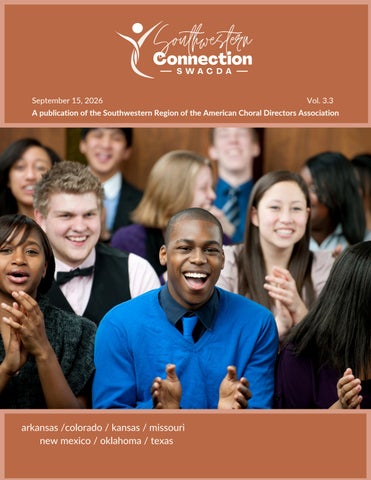
September 15, 2026
Vol. 3.3
A publication of the Southwestern Region of the American Choral Directors Association
arkansas /colorado / kansas / missouri new mexico / oklahoma / texas
Vol. 3.3 · September 15, 2026 SWACDA BOARD (2026– 2028) Joshua Oppenheim, President Erin Plisco, President-elect Jonathan Owen, Past President Ron Wallace, Treasurer
3
From the President’s Desk
Margie Camp, Conference Chair
Change is in the Air—Joshua Oppenheim
5
Voices from the Region Margie Camp, Conference Chair
8 9
13
Voices from the Region
Brandon Wade, Kansas
R&R Insights & Ideas
Christy Elsea, Missouri
Purpose in the Chaos —Christy Shinn High School R&R Chair
Emery Edwards, New Mexico
R&R Repertoire Suggestions
Eric Cooley, Texas
New Voices in SWACDA Get to know our newest members
16 17 19
Karsten Longhurst, Oklahoma
ACDA EXECUTIVE COMMITTEE (2025– 2027)
Membership Monthly
Edith Copley, President
Kansas and Colorado Membership Chairs
Pearl Shangkuan, Vice President
Deadlines at a Glance
Jessica Nápoles, President-elect
Every date worth circling, region-wide
David Fryling, Past President
In Memoriam
Tom Merrill, Treasurer/Secretary
Honoring the colleagues we’ve lost - Marilyn Ruth (Earls) Killian
22
Nick Farr, Arkansas Julia Dale, Colorado
Submit a suggestion for our next spotlight member
Nathan Wubbena - Community Choirs R&R Chair
15
STATE PRESIDENTS (2025–2027)
Robyn Hilger, Executive Director
Connect with SWACDA Find us everywhere you listen and scroll
23
Be Our Guest Share your story with SWACDA
24
College and University Youth & Student Activities - Meet and Greet Tuesday, September 22 - Online Meetup
SOUTHWESTERN CONNECTION · SEPTEMBER 2026
2
From the President’s Desk
SOUTHWESTERN CONNECTION
A NOTE FROM JOSHUA
Change is in the air Joshua Oppenheim, SWACDA President
Hello SWACDA Friends, How quickly time flies (and planes, btw... have you noticed?). I officially began on July 1st and so many things have been happening behind the scenes, and in front? (Not sure how that phrase works.) Since July, we've: Published our first two newsletters Selected and introduced all of our amazing R&R chairs Made two site visits to 2028 conference locations (more on that to come) Designed logos Selected honor choir clinicians for 2028 Built a rough schedule of the conference Held meetings with the R&R chairs And so much more... As I mentioned in my first article, there were four objectives I wanted to focus on during these two years: Engagement beyond the conference. More reasons to be a SWACDA member in the long stretch between gatherings. A sustained growth cycle. Staying with our student members as they convert to professional. Leadership beyond formal structures. You don't need a title to lead something around here. Maximizing our reach. Choral music belongs to more than just the people making it.
FROM THE PRESIDENT’S DESK
For this article, I want to talk about how we're doing engagement beyond the conference. As I wrote back in July, a biennial conference is a big, beautiful event, but also, by definition, every other year, and that's a lot of silence in between. For the next two years, we're leaning into filling that silence. One of the things we hope you'll notice is more engagement, and engagement that serves the vast variety of our membership. I've asked each of our R&R chairs to lean into this with me, and we have a calendar of content they'll be creating over the next two years. Some of it will be articles here (as you've already seen), some will be short bite-sized bits for social media, and some will be long-form content for our YouTube channel. I've also started a podcast called "What's Your Story?" We have two episodes recorded already and many more scheduled. The aperture will be wide, with a range of topics and individuals representing the breadth of our interests in SWACDA. We'll have features on our R&R chairs, composers, conductors, guest clinicians, and features about the upcoming 2028 conference. Both of these efforts are also meant to serve another one of those objectives, leadership beyond formal structures. I believe everyone has something to share, and we really do want to hear from you, our members. So if you have an
3
From the President’s Desk
SOUTHWESTERN CONNECTION
A NOTE FROM JOSHUA Joshua Oppenheim, SWACDA President
idea, a story, a piece of music, someone to nominate for our spotlight series in the newsletter, or if you'd like to be a guest on the podcast, I hope you'll reach out. You can always reach me at joshuao@swacda.org. On the podcast, episode one is with Eddie Vandewalker at North Central Texas College, our two-year college chair, talking about what makes that world its own thing and what he wants to do with the role. It's a good conversation and we hope you'll have a listen. The next episode is with Logan Caywood, choir director at Arkansas City High School in Kansas. It's a great discussion about his philosophy, his success, his approach to teaching, and the role of choral music in schools in smaller communities. Coming soon is our first webinar, with our Youth and Student Activities R&R. On Tuesday, September 22 at 7:00 PM Central, Dr. Jabarie Glass and I are hosting an online meet and greet. He's Director of Choral Activities at the
FROM THE PRESIDENT’S DESK
University of Oklahoma, he conducted our 1012 Mixed Honor Choir in 2024, and he has experience serving in this role in the Southern Region as their Student Activities Coordinator. More of these are coming, in other areas and on other nights, from all of our R&R areas. A quick note about the 2028 conference. The theme is "Every Voice Tells a Story," and I hope to have much more to share soon, including the location and a teaser of some of the great things we have planned. Dates are coming as soon as everything is finalized, so keep an eye out, because you won't want to miss this one. I wish everyone great success, especially those of you beginning another season in the inspiring work that you do. Look forward to seeing you all soon,
Joshua
4
Voices from the Region
CONFERENCE UPDATE
CONFERENCE CHAIR
Margie Camp Behind the Scenes: How SWACDA Chooses a Conference Site One of the questions I hear most often from members is some version of, "How do you decide where the conference will be?" It seems like it should be simple. Pick a nice city, book a hotel, done. I wish it were that easy. The truth is that choosing a host city for a SWACDA Regional Conference is one of the most complex decisions our leadership team makes, and I want to pull back the curtain on what actually goes into it. We start with geography SWACDA represents seven states: Texas, Oklahoma, Colorado, New Mexico, Kansas, Missouri, and Arkansas. That is a lot of ground to cover, and no single city is centrally located for everyone. Every choice involves a tradeoff. A site that is a short drive for our Texas and Oklahoma members might mean a full day of travel, and real airfare costs, for someone coming from Colorado or Missouri. Then we look at cost, because it drives everything Our biggest filter is making sure the experience we bring to our membership is worth the expense. A conference only succeeds if directors and their students feel that what they gained was worth what it cost them to be there. That means we are evaluating hotel room rates, but also the less visible costs: food and beverage minimums, service charges, taxes, and gratuities. VOICES FROM THE REGION
Selecting a conference site is much harder than you would expect. We also never lose sight of what our auditioned performing ensembles bring to this conference. Bringing a choir to perform is a significant expense for a director and their school, on top of everything else a conference already asks of our members. We know that. Without these ensembles and the meaningful performance experience they provide, our conference would be missing one of the most important parts of this professional development opportunity for our entire membership. Understanding that expense, and what a real performance opportunity means to these directors and their singers, is top of mind for us as we work through every location decision. We hear you on affordability We know that many of our members still feel that our conferences are not affordable, and we want to be honest that we understand why. Registration is only one piece of the real cost. Members are also covering transportation, hotel, and food, often paying for a substitute teacher to cover their classroom, and giving up time away 5
Voices from the Region
CONFERENCE UPDATE
CONFERENCE UPDATE, CONTINUED
Margie Camp from their students and their own families. That is a significant commitment for a teacher to make. We do not take that lightly. Leadership understands exactly how much our membership pays, in money and in time, to attend a conference, and that understanding is a big part of why we work so hard to find the very best possible location every time. We also believe, and hear from members again and again, that this conference is one of the best professional development experiences many of them will have all year. We will talk more about that professional development value in a future article. Space requirements are more demanding than people realize A choral conference has very specific physical needs. We require multiple large rehearsal spaces running at the same time, often for four or more honor choirs plus reading sessions and clinics. Sound bleed between rooms is a real problem, so we cannot simply book back-toback ballroom salons. We need non-adjacent spaces with a buffer between any two rooms in simultaneous use. Ceiling height matters too. Most of our rehearsal and session rooms require a minimum of 12 feet of clearance to allow the sound to develop properly. Every candidate venue gets mapped room by room against these requirements before we can seriously consider it.
VOICES FROM THE REGION
The performance venue is its own challenge Where our performing choirs actually perform matters just as much as where we rehearse. Many of our members have told us directly that they do not want to perform in a ballroom, and we take that feedback seriously. That means we are searching for a real performance venue, ideally a theater, in every candidate city. That search comes with its own set of restrictions. The venue needs to be close enough to large enough hotels, because our membership does not enjoy being bused back and forth between a hotel and a separate performance site. Theater rental, along with paying theater staff, whether union or nonunion, and renting the AV package the performance requires, is generally the single largest expense in our conference budget. We sometimes find a church that has the acoustics and the space we need, and that option can bring real financial savings compared to a commercial theater. The challenge is that the right church is often difficult to find close enough to everything else we require. We negotiate hard, and we take our time Our hotel sourcing partner helps us evaluate multiple properties in each candidate city, and we build out detailed comparisons, room assignments, catering commitments, and equipment needs like grand piano availability, before we ever bring a recommendation to the board. This process takes months, not weeks. It is not unusual for us to eliminate a city we were excited about because the math simply did not work for our membership.
6
Voices from the Region
CONFERENCE UPDATE
CONFERENCE UPDATE, CONTINUED
Margie Camp Where things stand right now We can tell you that the search for our 2028 conference site is actively underway, and we are getting close to being able to make a decision. We are evaluating multiple candidate cities right now, weighing all of the factors above against each other to find the best possible balance of location, cost, and space. We are not ready to name finalists yet, because these conversations are still evolving and we do not want to create expectations before we have a firm agreement
in hand. What we can promise is that every decision is being made with one goal in mind: giving our members across all seven states the best possible conference experience at a price that keeps the door open for as many directors and singers as possible. We cannot wait to share the decision with our membership once it is finalized. Thank you for trusting us with a decision that matters so much to our region. Getting the site right is one of the best ways we can show up for our members.
Stay tuned for our next conference update.
VOICES FROM THE REGION
7
Voices from the Region
NOMINATIONS OPEN
W E N E E D YO U R H E L P
Who Should We Feature Next? Every issue, Voices from the Region will spotlight a member of our SWACDA community whose story deserves to be told. And we need your help finding them. Maybe it’s the choir director who’s quietly shaped generations of singers in a small town nobody’s heard of. Maybe it’s a colleague who’s been doing extraordinary work behind the scenes for years without ever being asked to step into the spotlight. Maybe it’s someone whose passion for choral music has changed the way you think about your own.
NOMINEE REQUIREMENTS Must be a current SWACDA member Must currently reside within the SWACDA region TO NOMINATE, SEND US Their name A bio of at least one paragraph — their story background, and the impact they’ve had A photo
Whoever they are, we want to know about them. The more detail you send us, the better we can honor
Nominate someone
their story, so don’t hold back. This region is full of people
Complete the Voices from the Region
doing remarkable things. Help us make sure they get the
form →
recognition they deserve.
Every member of this region has a story worth telling.
VOICES FROM THE REGION
8
R&R Insights & Ideas
REPERTOIRE · RESOURCES REFLECTION · RENEWAL
Purpose in the Chaos Christy Shinn · High School Choirs R&R Chair · cshinn@jackson.k12.mo.us
The first weeks of a new school year can feel like controlled chaos.
1. Mindset Is Everything
Schedules change. Rosters shift. Students arrive
examine the mindset we bring into the room.
with different levels of experience, confidence, and motivation. There are concerts to plan, music
A challenging rehearsal doesn't mean the day is
to select, classrooms to organize, uniforms to coordinate, and countless details that seem to multiply by the hour. I don’t know about you, but the to-do-list keeps getting longer even though I keep marking things off. In the middle of it all, it is easy to lose sight of the reason we do what we do.
Before we can transform our choir, we have to
failing. A wrong note doesn't mean a student isn't capable. A group that isn't immediately responding doesn't mean the culture isn't developing. Instead of asking, “Why can't they get this?” try asking: “What do they need from me right now to move forward?”
But perhaps the chaos is exactly where purpose matters most.
That small shift changes everything.
As choir directors, we are not simply teaching notes, rhythms, diction, and musical technique. We are creating a place where students learn to listen, belong, persevere, take risks, and discover that their individual voice matters within something bigger than themselves.
From: “They aren't listening.”
This fall, consider anchoring your program around three simple strategies: Mindset is Everything. Transform Your Environment. Practice Positively and Consistently.
Reframe the rehearsal. To: “I need to give them a clearer reason to listen.” From: “They can't sing this passage.” To: “We haven't found the strategy that makes this passage accessible yet.” From: “This rehearsal was a disaster.” To: “What did we learn that will make tomorrow better?” Students take their cues from us. When they see us respond to challenges with curiosity instead of frustration, they learn to do the same. As Henry Ford said, “Whether you think you can, or you think you can't—you’re right.” Your mindset becomes part of your choir's culture.
R&R INSIGHTS & IDEAS
9
R&R Insights & Ideas
CHRISTY SHINN · CONTINUED
Purpose in the Chaos, continued
Start rehearsals with purpose.
Create visible purpose.
Consider giving students a 30-second reminder at the beginning of rehearsal:
Consider displaying:
“Today our goal is to become better listeners focusing on…..” “Today our goal is to build confidence in this difficult section focusing on…” “Today our goal is to sound more like an ensemble—not just individual singers focusing on…” A clear purpose helps students understand that rehearsal isn't something they have to endure. It is an opportunity to grow, to belong, to contribute, to succeed. Each student is an integral piece of the puzzle and has a purpose in making the magic of the ensemble take place.
2. Transform Your Environment Sometimes the fastest way to change the energy of a choir is to change the environment in which that energy exists. Your rehearsal room communicates before you say a word. What does your space say to your students? “Welcome.” “Belong.” “Work hard.” “Take risks.” “Your voice matters.” Transformation doesn't necessarily require a new room, expensive equipment, or a major renovation. Small changes can have a tremendous impact. R&R INSIGHTS & IDEAS
A choir mission statement created with student input Concert goals for the semester Student-written words describing what they want their choir to become Alumni letters to future members A “wins” board where students and directors recognize growth Inspirational quotes about music, perseverance, courage, and community Photos that celebrate the history and accomplishments of your program Create an environment where students can literally see what they are part of. Build rituals Students thrive on consistency. Maybe every rehearsal begins with a breath together. Perhaps the choir shares one word describing the energy they want to bring into rehearsal. Maybe you end each rehearsal by recognizing one specific moment of growth. Maybe you start with the same warm-up. I did not realize what a big deal my high-fives and elbows to EVERY kid in the room and out of the room were to all my kids until I was absent a few days in a row, and I returned to find them anxious to see me at the door telling me how much they had missed their high fives and elbows. It really is the little things that make a big difference. These rituals take very little time but can create tremendous emotional continuity. 10
R&R Insights & Ideas
CHRISTY SHINN · CONTINUED
Purpose in the Chaos, continued
One simple strategy is the “3-2-1 Close.” At the end of rehearsal, ask students to identify: 3 things they learned 2 things they improved 1 thing they will focus on next rehearsal This encourages students to recognize progress rather than simply evaluating whether they were “good” or “bad” that day. As Maya Angelou reminded us, “Do the best you can until you know better. Then when you know better, do better.”
Instead of: “Good job!” Try: “That was a much cleaner vowel because everyone matched the shape.” Or: “I heard the altos listening across the section instead of singing independently. That changed the whole chord.” Or: “Your breath support stayed consistent through the phrase. That's the kind of detail that makes this music compelling.”
A transformed environment isn't perfect. It is purposeful.
3. Continuous Practice Through Positive Feedback Great choirs are not built in one spectacular rehearsal. They are built through hundreds of small moments of intentional practice. The same is true for confidence, musical independence, leadership, and ensemble culture. The key is to make practice feel like progress, not punishment. Catch students doing something right. Positive feedback is most effective when it is specific.
R&R INSIGHTS & IDEAS
Specific feedback tells students what success sounds and feels like, giving them something they can intentionally reproduce. Use the “Feedback Loop.” A simple rehearsal cycle can be: Perform → Listen → Identify → Adjust → Repeat Give students a manageable goal. Let them perform it. Ask what they heard. Identify one specific adjustment. Then immediately try it again. The goal isn't to correct everything. The goal is to improve one thing at a time. When students experience repeated cycles of try, adjust, improve, they begin to understand that mistakes are not evidence of failure. They are part of the learning process. 11
R&R Insights & Ideas
CHRISTY SHINN · CONTINUED
Purpose in the Chaos, continued
Celebrate growth, not just achievement.
What mindset am I bringing into this room?
Recognize the student who finally sings independently.
What can I change about this environment to
Celebrate the section that improved its diction. Acknowledge the freshman who finally raises their hand. Notice the student who encouraged someone else.
help students succeed? What small steps can we practice today that will make us better tomorrow? The answers don't have to be complicated. Sometimes purpose looks like one student finding their voice. Sometimes it sounds like a chord finally locking
Celebrate the choir that recovered after a
into place.
difficult rehearsal.
Sometimes it is a student who walks into
Because what we celebrate becomes what students value. As Vince Lombardi said, “Perfection is not attainable, but if we chase perfection we can catch excellence.”
rehearsal discouraged and leaves feeling like they belong. And sometimes, it is simply a choir of young people standing together, breathing together, listening to one another, and discovering that something beautiful happens when individual
Finding Purpose in the Chaos
voices become one.
There will still be chaotic days.
That is the purpose in the chaos.
There will be rehearsals when the sound isn't what you imagined. There will be students who struggle, schedules that fall apart, concerts that arrive too quickly, and moments when you wonder whether anyone is making progress. That's normal. The goal isn't to eliminate the chaos. The goal is to have a purpose strong enough to carry you through it. When the room feels overwhelming, come back to three questions:
This fall, don't measure your success only by the concerts you produce. Measure it by the culture you create, the confidence you build, and the students who discover that their voices matter. “Music can change the world because it can change people.” — Bono Keep showing up. Keep refining. Keep encouraging. Keep practicing. And when the chaos comes—as it inevitably will— remember why you started. Your work matters. Your students matter. And the music you are building together matters.
R&R INSIGHTS & IDEAS
12
R&R Repertoire Suggestions
REPERTOIRE · RESOURCES REFLECTION · RENEWAL
Community Choirs Repertoire Nathan Wubbena, Community Choirs R&R Chair · nathan@boulderchorale.org
Title of Piece: Crossroads Composer: Timothy C. Takach Voicing: SATB Link: https://graphitepublishing.com/product/crossroads/ Publisher: Graphite Publishing Octavo Number: NA Recording Link: https://youtu.be/ZwZtPgZrHNw?si=uQWY2AXzLjoLFHPH This piece, and the text in particular, struck a chord with my singers when we performed it. During the process of rehearsing, I heard several comments of how it resonated strongly with them and they felt they could identify with the idea the text presents, as described by the composer: Sometimes we look back on events in our lives and recognize them as pivotal moments – an occasion where something significant changes. And then there are moments in life of which we’re aware at the time, they feel like a milestone as they happen…I like thinking that we could call one of these moments as a birthday, a rebirth that no one else celebrates but ourselves.
Title of Piece: They Are Mother Arranger: Jennifer Lucy Cook Voicing: SATB, SSAA Publisher: Graphite Publishing Link: https://www.jwpepper.com/sally-gardens-1292804/p Recording Link: https://youtu.be/DNmEXAq_i50?si=sbwhgagq14gSxsdf We performed this piece at our concert this last year featuring female composers, and it elicited the strongest audience reaction at its conclusion. It was a piece that the membership was initially hesitant to give it the unique grounded feeling required, but eventually became a favorite of the signers as well. I highly recommend including the string instrumentation when performing, if possible. If needed, the bass part can be eliminated and included in the cello part with slight modifications. From the composer: When I was working on the words for this piece, I consulted with my friend Reverend Alex Reegan, who is a trans man and interfaith pastor, to create a text that embodies the energy of the feminine divine that is present in any gender. I chose to use they/them pronouns, which capture both the nonbinary and the nonsingular mystery and grandeur of the divine creating force, and by doing so, welcomes everyone into the work. I wanted to explore the many aspects of the divine; pairing a grounded Mother Nature with a joyous playful being who is capable of laughter, a force that is present in the large and small moments, the noise and the silence, and most importantly, the divine creative spark in each of us. R&R INSIGHTS & IDEAS
13
R&R Repertoire Suggestions
REPERTOIRE · RESOURCES REFLECTION · RENEWAL
Community Choirs Repertoire, continued Title of Piece: Clementine Composer: Traditional Arranger: Byunghee Oh Voicing: SATB divisi Publisher: Self-Published (Contact: obh502@gmail.com) Recording Link: https://www.youtube.com/watch?v=u2CCytZtllk This piece is a masterful and unique arrangement of this familiar tune. It takes the typical treatment and turns it on its head, offering a chance to explore a more emotional and complex look at the characters in the story. From the composer: As you may know, 'Clementine' is a melody familiar to both Americans and Koreans. In this arrangement, I tried to weave in a unique Korean sentiment and contemporary choral textures. I focused on a father's deep sorrow. Korean fathers often restrain their emotions, so while maternal love is a very common theme, I wanted to explore the depth of paternal love. While arranging this song, I truly realized the weight of a father’s heart. I shed tears imagining a father's voice desperately crying out his daughter's name, and there were many nights I couldn't sleep because my heart ached. To express the extreme grief of losing a child, I captured the emotional climax by inserting the desperate cry, "I'm sorry, Clementine," in the middle of the song. Ultimately, it is this profound love that makes the song beautiful. Title of Piece: Give Me Your Tired, Your Poor Composer: Irving Berlin Arranger: Roy Ringwald Voicing: SATB, SAB, 2-part, TTBB Publisher: Shawnee Press Recording Link: https://youtu.be/sKPsrx6UCtc?si=4mCUeZRxC2w_Ay58 As part of our tradition, we perform a set of patriotic songs for an Independence Day celebration every year. I always like to include a piece that contrasts the typical patriotic and Americana songs that are often performed at these events, yet feels like it fits the moment. The text of this piece is taken from a portion of the inscription of the Statue of Liberty, and does exactly this. It offers a multitude of opportunities of musicality and text interpretation and the thick piano accompaniment supports the emotional weight of the piece.
Title of Piece: A Little Jazz Mass Composer: Bob Chilcott Voicing: SATB, SAB, SSA Publisher: Oxford University Press Link: https://www.jwpepper.com/a-little-jazz-mass-3304607/p Recording Link: https://www.youtube.com/watch?v=PWsjDqMde9o This setting of the Latin Missa brevis is a unique fusion of the classical and jazz genre, and is an accessible piece for many different levels. Each movement has an individual character, yet the flow is retained throughout the piece. It would be easy to pull any of these movements out as a standalone addition to a concert. I have personally performed this with both an intermediate and advanced middle school treble ensemble, as well as a non-auditioned adult community chorus. The music is fun to sing for the choir members, and R & R I N S I Gjazz H T Sconcepts & I D E A and S introduces harmonies in an approachable manner.
14
New Voices in SWACDA
GET TO KNOW OUR NEWEST MEMBERS
WELCOME IN
Every Beginning Matters to Us Every choral director’s journey has a beginning, and every one of those beginnings matters to us. New Voices in SWACDA is our chance to welcome the newest members
WHAT WE’RE LOOKING FOR
Name and state
of our region, whether you’re brand new to the profession and just starting to find your footing, or you’ve been leading choirs for years and are new to SWACDA
Current role or position
itself. Either way, you belong here, and we want the whole region to know it.
drew them to choral music
This feature is about more than introductions. It’s about connection. When we share a new member’s story, their background, what drew them to choral music, and what excited them about joining SWACDA, we’re building bridges across our seven states. Someone reading their story might reach out with a welcome, an invitation, or a piece of advice that makes all the difference in those
part of SWACDA
early days. That’s the kind of region we want to be: one where nobody has to figure it out alone. So if you’re new to the profession, new to SWACDA, or you know someone who is, we’d love to feature them.
A short bio — a few sentences on their background and what What excites them about being A headshot You can submit your own information, or nominate a new member you’d love to see featured.
Submit a New Voice Complete the New Voices in SWACDA form →
Every voice adds something to this region, and we can’t wait to help the rest of us hear it.
NEW VOICES IN SWACDA
15
Membership Monthly
KANSAS
Claire Clifford
MEET YOUR STATE MEMBERSHIP CHAIRS
COLORADO
Dirk Johnson
Claire Clifford has 13 years of experience as a
Dr. Dirk Johnson is the Director of Vocal
music educator, serving the students of USD 440
Ensembles at Colorado Mesa University, where
Halstead-Bentley Schools. She teaches vocal
he directs the Vocal Arts Ensemble, Vocal
music for grades 4–12, directs multiple choirs,
Chords chamber ensemble, and Tenor/Bass
and leads the district’s musical theatre and
Choir and teaches courses in conducting, choral
summer musical programs. Claire also teaches
literature, and choral methods. He also serves as
Kodály-based music to preschool students,
Artistic Director of the Western Colorado
bringing music education to students from early
Chorale and director of the Messiah Choral
childhood through high school. Her choirs and
Society of Grand Junction. He holds a DMA in
musical productions have received recognition
choral conducting from the College-
throughout the state, including invitations to
Conservatory of Music, University of Cincinnati,
perform at Carnegie Hall and other prestigious
and master’s and bachelor’s degrees in choral
music education events.
music education from Brigham Young University.
In addition to teaching, Claire serves as the Membership Chair for the Kansas Choral Directors Association (KCDA) and is a member of the Kansas State Music Educators Association (KSMEA) and the Organization of American Kodály Educators (OAKE). She is actively involved in leadership within her school, professional organizations, and community. Claire works to create meaningful performance opportunities and help students develop confidence, musicianship, and a lifelong love of music.
An active composer and arranger, Dr. Johnson has been published by Walton Music and was honored as winner of the 2015 John Ness Beck Foundation Award. As a professional choral singer, he sang with the Vocal Arts Ensemble of Cincinnati and the Tennessee Chamber Chorus. With scholarship focused on folk music and arranging, Dr. Johnson has presented at past CMEA conferences, WVACDA conferences, and NCCO and ACDA National Conferences. Gratefully, the CoACDA leadership found a place where I can help, and I have been serving as the Colorado ACDA Membership Chair for nearly two years. In this role, I maintain our membership email list and send out messages from our president to our members throughout the year. I am also part of the CoACDA Summer Conference registration team and enjoy greeting our members as they gather in July.
MEMBERSHIP MONTHLY
16
Deadlines at a Glance
MARK YOUR CALENDAR
Below is a quick-glance list of upcoming deadlines from ACDA National and each of our seven states, so you never miss an audition window, application deadline, or registration cutoff. We’ll refresh this list every issue, so bookmark this space and check back each month.
DATE
EVENT & DEADLINE
ORGANIZATION
September 19, 2026
Oklahoma OkMEA All-State Mixed and
Oklahoma MEA
Treble Chorus, second registration deadline Sept 1–24, 2026
National ACDA
Graded Honor Choirs — application deadline: September 24, 11:59pm CDT
Sept 1–24, 2026
National Show Choir Honor Choir — application deadline: September 24, 11:59pm CDT
National ACDA
Sept 1–24, 2026
National Vocal Jazz Honor Choir — application
National ACDA
deadline: September 24, 11:59pm CDT Sept 1 – Oct 15, 2026
National ACDA
Student Conducting Masterclass Auditions — deadline: October 15, 11:59pm CDT
October 1-Nov. 3 2026
National Research Poster Session Call —
October 9, 2026
NMACDA Choir Audition — registration / submission
New Mexico ACDA
November 17, 2026
Oklahoma All-OkACDA Junior High Honor
Oklahoma ACDA
National ACDA
deadline: November 3, 11:59pm CDT
Chorus, second round auditions
Know a deadline we missed? If you know of a deadline in your state that isn’t listed here, send the date, the deadline description, and the organization it’s tied to by completing this form at least one month before the event deadline, and we’ll add it to the next issue.
DEADLINES AT A GLANCE
17
HONORING OUR COLLEAGUES
In Memoriam Guidelines As a community, SWACDA publicly honors the passing of current, retired, and past choral directors who were members of SWACDA, in The Southwestern Connection. If you know of someone who has passed and should be recognized, you are asked to submit the following information to Margie Camp at MargieC@swacda.org.
GUIDELINES FOR THESE NOTICES Upon the passing of current, retired, and past choral directors who were members of SWACDA, a notice will be posted in the In Memoriam section of The Southwestern Connection. Please include: Name Employer positions held Positions held in ACDA, SWACDA and/or state chapters Date of passing Memorial link We invite anyone to share news of the passing of current, retired, and past choral directors who were members of SWACDA, so that we can honor them. Please send such information to MargieC@swacda.org.
IN MEMORIAM
18
HONORING OUR COLLEAGUES
In Memoriam
Marilyn Ruth (Earls) Killian April 27, 1936-August 6, 2026
A Life Shaped by Music, Education, and Service Marilyn Ruth (Earls) Killian, age 90, passed away on Thursday, August 6, 2026, at her Larksfield Place home in Wichita, Kansas, with her son, Steve, by her side. Marilyn was born April 27, 1936, and grew up in Ironton, Missouri, with her parents, Oran Wayne Earls and Helen Coleman Earls, and her sister Carol. Marilyn demonstrated an early affinity for music, one that would become the defining current of her life. She earned a B.S. in Music Education from the University of Missouri–Columbia and an M.S. in Music Education from the University of Illinois at Urbana–Champaign 1992, Marilyn and Barbara Bowers founded the Wichita Community Children’s Choir (WCCC), one of Marilyn’s most enduring contributions. As founding director, Marilyn built a program of remarkable artistic quality and national stature. Under her leadership, WCCC performed at regional and national music conferences, at the 2001 dedication of the Kansas Governor’s Mansion, with the Wichita Symphony Orchestra, and with Samuel Ramey at Century II. Marilyn’s students were regularly selected for national and regional honor choirs of the American Choral Directors Association (ACDA) in cities across the country. She believed deeply in disciplined preparation, expressive singing, and the responsibility of young musicians to honor both the music and their audience. Her influence also extended to music education across Kansas. As project chair for the Kansas Music Curriculum Framework, Marilyn helped lead the development of sequential pre-K–12 outcomes designed to guide music instruction throughout the state. Marilyn served the profession through state and national offices in the Kansas Music Educators Association, ACDA, and Sigma Alpha Iota. Her honors included the Citation
IN MEMORIAM
19
HONORING OUR COLLEAGUES
In Memoriam
for Outstanding Music Service from the Kansas Federation of Music Clubs and induction into the Kansas Music Educators Association Hall of Fame in 1995. She was the first woman to receive the Harry Robert Wilson Award for distinguished work in choral music. Later honors included a 2005 Kansas Governor’s Arts Award as an arts educator and the Wichita Arts Council’s Burton Pell Achievement in Music Award in 2012. Despite these accolades, Marilyn remained characteristically humble. She measured success not in awards but in rehearsal rooms, careful vowel shaping, disciplined breath, and the moment when young singers realized they were capable of something larger than they believed. At her core, Marilyn believed that music matters because people matter. She believed that discipline is an act of care, excellence is a form of respect, and children rise to the level of what is asked of them when they are truly seen. Away from classrooms and rehearsals, Marilyn brought energy, style, and determination to everyday life. Those who knew her understood that once Marilyn set her mind on something, it was going to happen. She rarely missed an opportunity to dress to the nines. She took exercise seriously, even making fitness an ongoing friendly competition with Don. She treasured family dinners, pizza Sundays, and Kansas City Chiefs games. She had a particular fondness for ice cream and enjoyed making banana splits for family and friends, drawing on a skill dating back to her days working at Dairy Queen. Marilyn’s determination was profoundly tested in 2010, when she spent 74 days at Wesley Hospital, including more than a month in intensive care, after developing serious infections following surgery. After she and Don moved to Larksfield Place later that year, she described herself as a “98-pound weakling” who walked with a cane. Following her doctors’ advice to rebuild through “baby steps,” she committed herself to the Larksfield Fitness Club and gradually regained her strength and then some. Marilyn credited its staff with helping bring her “through the valley and back”—a recovery she approached with the same discipline, patience, and resolve she brought to music.
IN MEMORIAM
20
HONORING OUR COLLEAGUES
In Memoriam
That same determination remained unmistakably Marilyn throughout her life. In her final chapter, she was ultimately able to remain in her own home at Larksfield, in familiar surroundings and among people who loved her, with comfort and dignity at the center of her care. True to form, she did things her own way to the very end, meeting life’s final passage with the strength, grace, and fierce resolve that had always defined her. Her son, Steve, offers this tribute: “With profound gratitude and love, I honor my mother for being an extraordinary mom in more ways than I could ever count. She devoted her life to creating music and to helping young people—including me—find their voices, grow in confidence, and discover what they were capable of becoming. She understood something about life that she also knew about music: harmony does not require everyone to sing the same part. Her life’s work is complete, but the music she gave to the world will never fall silent. It continues in all of us. Mom, I couldn’t be more proud of you.” Marilyn was preceded in death by her husband, Don, in March 2020, and by her parents, Oran Wayne Earls and Helen Coleman Earls. She is survived by her son, Steve Killian, and his partner, Steve McKnight; her sister, Carol Leach; her nieces, Carla Ewing and Christi Childers; and extended family. She is also remembered by generations of colleagues, students, and friends, many of whom consider her a formative presence in their lives. The Wichita Community Children’s Choir (WCCC) honored Marilyn during its December 2026 holiday concert, offering friends, former students, colleagues, and the broader community a meaningful opportunity to remember her through music and experience the choir she helped found. Those wishing to honor Marilyn’s memory are invited to make a donation to WCCC in recognition of her lifelong love of music and the many lives she touched. Concert details and a link for memorial donations will be available at www.wcccks.com. An equally meaningful tribute is simply to share a favorite story about Marilyn with someone you love, or to encourage a young person to discover and experience the joy of music.
IN MEMORIAM
21
Connect with SWACDA
BETWEEN ISSUES
FIND US EVERYWHERE
Stay in the Loop, All Month Long The Southwestern Connection lands on the 15th — but the conversation doesn’t stop between issues. Follow SWACDA wherever you spend your time online for repertoire ideas, session clips, member news, and the occasional something that makes you smile.
swacda.org Our home base — news, resources & conference info
YouTube — Southwest Region ACDA Sessions, interviews & performances
Facebook Group — Southwestern ACDA Member conversation & community
Facebook Page — ACDA: Southwestern Region Expect the exact same high-value updates, leadership insights, and community spotlights delivered right to your Facebook feed in easy-to-read, bite-sized posts.
Instagram — @swacda Look forward to quick, digestible bites of content from our leadership team, R&R leaders, and the rest of the membership.
TikTok — @swacda Prefer video? Catch those same leadership perspectives, R&R highlights, and community moments in quick, engaging, short-form videos.
More ways to stay connected between conferences — and more ways to get something useful out of your membership, every single month. CONNECT WITH SWACDA
22
Be Our Guest
A LETTER FROM SWACDA MEMBERSHIP
We Want to Hear From You The Southwestern Connection is only as good as the voices in it. Every issue, we get to share stories from directors across our seven states, and we know there are so many more out there. If you've got something to say to your fellow SWACDA members, this is your invitation to say it here. What we're looking for We're open to a wide range of submissions. A few ideas to get you thinking: A lesson you learned the hard way (or the easy way) in your own classroom or rehearsal hall A program, project, or partnership at your school or in your community worth celebrating A reflection on a piece of repertoire that changed how you think about teaching A letter on an issue facing choral education in our region A tribute to a mentor, colleague, or student who shaped your path Anything else that feels true to why you do this work There's no single format that fits every story, and we'd rather hear yours in your own words than try to fit it into a template. How to submit Send your piece as plain text, without special formatting, to MargieC@swacda.org. A headshot is welcome if you'd like one included. We ask that submissions run somewhere between 400 and 800 words, though we're happy to talk through anything longer or shorter. When We're looking for a piece for our next issue, and we'll keep this space open on an ongoing basis after that. If your story doesn't make it into the very next issue, we'll be glad to hold it for a future one. If you've been sitting on something you've wanted to share with the region, consider this your sign. We'd love to hear from you.
ARKANSAS · COLORADO · KANSAS · MISSOURI · NEW MEXICO · OKLAHOMA · TEXAS
The Southwestern Connection · Vol. 3.3 · September 15, 2026 · A publication of the Southwestern Region of the American Choral Directors Association
BE OUR GUEST
23
SOUTHWESTERN
ACDA
•
YOUTH
&
STUDENT
R&R
ONLINE MEET & GREET
COLLEGE & UNIVERSITY STUDENT CHAPTERS Meet other college singers from across the Southwestern region. Share experiences, ideas, and find your people. Come hang out, ask anything, and be part of the community!
YOUR HOSTS
DR. JABARIE GLASS
DR. JOSHUA OPPENHEIM
SOUTHWESTERN ACDA YOUTH & STUDENT ACTIVITIES R&R CHAIR
SOUTHWESTERN ACDA PRESIDENT
DATE
TIME
WHERE
TUES SEP 22
7:00 PM CST
ONLINE
24