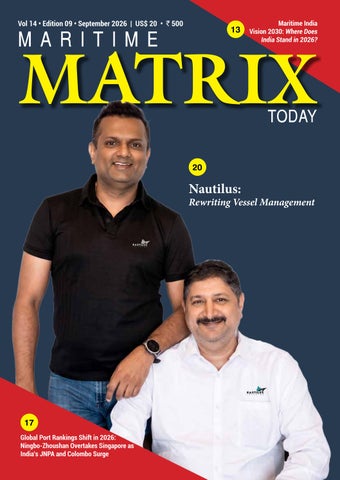
Vol 14 • Edition 09 • September 2026 | US$ 20 • ` 500
13
MA R I T I ME
Maritime India Vision 2030: Where Does India Stand in 2026?
MATRIX TODAY
20
Nautilus:
Rewriting Vessel Management
17 Global Port Rankings Shift in 2026: Ningbo-Zhoushan Overtakes Singapore as India’s JNPA and Colombo Surge
02 | Maritime Matrix Today | September 2026
Maritime Matrix Today | September 2026 | 03
Table of CONTENTS
Cover Story
07
Preparing Seafarers to Thrive in a Changing Maritime World
12
Asian Auto Export Boom Triggers Global Car-Carrier Crunch
29
MacGregor Launches Fully Automatic Twistlock System
13
Maritime India Vision 2030: Where Does India Stand in 2026?
30
Sensor‑Driven Insights Slash Ship Engine Failures
17
Global Port Rankings Shift in 2026: Ningbo-Zhoushan Overtakes Singapore...
32
Lilly Maritime Pvt. Ltd. Celebrates 30 Years of Excellence, Service and...
26
MacGregor Sees Surge in Electric Cranes
35
COSCO Shipping Signals Long-Term Vision with $3 Billion Order for...
27
ClassNK Unveils ‘Survey Compass’ AI to Streamline Maritime Surveys
36
Geopolitics, Chokepoints and the New Maritime Logistics Map
20
Nautilus: Rewriting Vessel Management
Disclaimer All advertisements in this magazine are placed with no liability accepted by the publisher for the material content therein. No responsibility is accepted by the publisher for omission or error or non-insertion of any advertisements. All advertisements and material in this magazine are subjected to approval by the publisher and are not necessary the opinion of the publisher. No liability is accepted for advertisements that are placed or any information that might be criminally connected. All information is checked to the best of our knowledge and is reliant upon the material submitted not being in contravention of all relevant laws and regulations and within the provisions of the Trade Practices Act. Reproduction Prohibited Maritime Matrix Today will not be responsible for the views expressed by contributors in their personal capacity. All rights reserved. Reproduction in part or whole without the permission of the Editor is prohibited. Readers are recommended To make appropriate enquiries before sending money, incurring expenses or entering into any commitment in relation to any advertisement published in this publication. Maritime Matrix Today does not vouch for any claims made by the Advertisers of Products and Services. The Printer, Publisher, Editor and Owner of Maritime Matrix Today shall not be held liable for any consequences, in the event such claims are not honoured by the Advertisers. RNI: MAHENG/2013/50159 Published by Marex Media Pvt Ltd C-209, Morya House, New Link Road, Andheri West, Mumbai 400058 Email: info@marexmedia.com
04 | Maritime Matrix Today | September 2026
Printed by Young Graphics Printed at Young Graphics, 208 Shankala Industrial Premises, Gogatewadi, Goregaon(E), Mumbai-400 063
• Seaspan technology continues to be a leader in the industry, setting high environmental goals
• COPES Company e-learning training platform completed from the comfort of your home
• Our fleet of Dual Fuel Vessels with Membrane & Type B Tanks sets us up for a strong future
• Gender friendly accommodation facilities
• MAN ‘ME-GI Mark 2’ Main engines, a step further than present generation of main engines • The ‘EGR (Exhaust Gas Recirculation)’ as well as ‘SCR (Selective Catalytic Reactors)” as means to bring down NOx emissions to Tier III levels
• Female Engagement Champions across offices worldwide • Quality growth • Low LTIF & High retention • Wages in top Quartile, and consistent operational excellence
ADDRESS: Seaspan Crew Management India Private Limited, 501, Kamla Executive Park, Andheri (E), Mumbai 400 059, India TEL: Chennai: +91-9884450085 Cochin: +91-9633110085 Mumbai: +91-22-40666200 | EMAIL: Jobs@Seaspancrew.com
License no MUM-014 valid till 6 Feb 2031 CIN No.: U 78100 MH 2005 PTC 152233
Maritime Matrix Today | September 2026 | 05
Editorial
People, Progress and Resilience at Sea The maritime industry stands at an important crossroads. Ships are becoming more technologically advanced, ports are becoming smarter, trade routes are being reshaped, and sustainability is moving from aspiration to necessity. Yet, amid this transformation, one truth remains unchanged: shipping ultimately depends on people. The September 2026 issue of Maritime Matrix Today brings this human element sharply into focus. The Wellness at Sea Conference highlighted a vital shift in thinking—technical competence alone is no longer enough. Seafarers must also be equipped to manage stress, isolation, fatigue, cultural differences, conflict and the pressures of an increasingly connected world. Wellbeing must be recognised not as an additional benefit, but as an essential part of safety and professional performance. At the same time, India’s maritime sector is moving from vision towards execution. Port cargo volumes and efficiency have improved, digital systems are expanding, and ambitions in shipbuilding, green shipping and inland waterways are gaining momentum. But the real test will be integration—connecting ports effectively with roads, railways, logistics networks, technology and skilled human resources.
The global operating environment adds another layer of complexity. Geopolitical disruptions can rapidly affect routes, freight rates, fuel consumption, schedules and cargo availability. Resilience, therefore, must stand alongside cost and efficiency as a measure of maritime competitiveness. The industry must also prepare for a changing workforce. Younger seafarers expect meaningful careers, better connectivity, appropriate contract structures and genuine opportunities for development. The answer to future talent shortages cannot simply be recruitment; it must be retention through dignity, welfare, training and professional growth. As shipping enters a more complex decade, the strongest maritime organisations will be those that combine technology with judgement, efficiency with resilience, and commercial success with responsibility to people. The future of maritime is not merely about building smarter ships. It is about building a stronger, safer and more sustainable industry around them. - Kamal Chadha
Team Matrix Kamal Chadha Group CEO
Radhika Vakharia CEO & Editor
Delphine Estibeiro Editorial Coordinator
Jagdamba Pandey Manager, Business and Promotion
kamal@marexmedia.com
radhika@marexmedia.com
delphine@marexmedia.com
jagdamba@marexmedia.com
Shirish Kirtane HOD Graphics
Santosh Nivalkar Sr. Graphic Designer
Manish Malve Graphic Designer
Bhavna Pimpale Coordinator
shirish@marexmedia.com
santosh@marexmedia.com
manish@marexmedia.com
bhavna@marexmedia.com
06 | Maritime Matrix Today | September 2026
Sailors’ Society Conference 2026
Preparing Seafarers to Thrive in a Changing Maritime World Sailors’ Society’s Wellness at Sea Conference held on 20th August 2026 places the human element at the heart of the future of shipping
F
or generations, the maritime industry has defined a competent seafarer primarily through technical knowledge, operational skills, discipline and the ability to respond effectively to emergencies. These qualities remain fundamental. But the demands placed on seafarers are changing rapidly, and the industry is increasingly recognising that technical competence alone cannot prepare a person for a successful and sustainable career at sea. This was the central message of the Sailors’ Society Wellness at Sea Conference 2026, which brought together more than 4,000 cadets, ratings and trainees from the Indian Subcontinent. The conference provided a platform for young maritime professionals to explore the challenges of life at sea and, importantly, to consider how they could develop the skills and awareness necessary not simply to survive shipboard life, but to thrive in it. The programme adopted a holistic approach to wellbeing, examining social, emotional, physical, intellectual and spiritual wellness. It also brought together an unusually broad range of voices—from the International Maritime Organization and senior shipping executives to master mariners, maritime educators, psychologists, medical professionals, P&I specialists, welfare experts, trainers and, most importantly, young seafarers themselves. The philosophy behind the initiative is reflected in its emphasis on creating seafarers who are safe, seen and supported in a changing maritime world. Beyond Technical Competence The modern ship is becoming greener, more automated, digitally connected and technologically sophisticated. Yet the person on board remains at the centre of safe operations.
A seafarer may be technically excellent but still face difficulty communicating across cultures, managing conflict, coping with isolation or recognising signs of stress in themselves or colleagues. The Wellness at Sea programme addresses precisely these gaps. At the leadership level, Sara Baade, CEO of Sailors’ Society, has been a prominent voice in placing seafarer welfare and wellbeing higher on the maritime agenda. Working alongside her is Johan Smith, Head of Wellness, whose contribution focuses on practical approaches to helping seafarers understand and manage the emotional challenges associated with life at sea. The conference therefore moves the discussion of wellbeing beyond the conventional idea of simply “looking after oneself ”. It presents wellness as an essential component of professional competence. Social Wellness: Learning to Live and Work Together One of the most relevant themes for shipboard life was social wellness. A vessel is a unique workplace. Crew members may spend months together in a confined environment, away from family and familiar surroundings. They may represent different nationalities, cultures, religions, languages, ranks and personalities. Under these circumstances, relationships and communication are not peripheral issues—they can directly influence teamwork, morale and safety. The conference explored communication across rank, culture and personality, along with managing conflict in close quarters, diversity, onboard culture and the pressures created by home and digital connectivity. Healthy boundaries in an increasingly connected world were also considered. Heidi Heseltine, who brings around three decades of
Maritime Matrix Today | September 2026 | 07
Sailors’ Society Conference 2026 maritime experience, addressed culture and diversity on board. As Founder and CEO of DSG, her work focuses on helping maritime organisations create more inclusive and psychologically and physically safe working environments. The subject of conflict was addressed by Julke Brandt, a Master Mariner, mediator and maritime consultant. Her experience on container ships, expedition yachts and humanitarian vessels gives her a valuable understanding of the realities of living and working in close quarters. Her contribution focused on managing conflict in close quarters, highlighting the importance of communication competence and healthier conflict cultures. For cadets and young officers, these lessons can be as valuable as any technical training. A ship is a team environment, and the ability to communicate respectfully, listen effectively and resolve disagreements constructively can determine how well that team performs. Emotional Wellness: Strength Is Also Knowing When to Ask for Help The emotional-wellness programme addressed some of the most sensitive issues facing seafarers: stress, anxiety, depression and trauma. For decades, the maritime culture of resilience has sometimes been interpreted as the ability to endure difficulties silently. The Wellness at Sea approach offers a different understanding. True resilience does not mean ignoring problems. It means recognising them early, understanding their impact and knowing when and how to seek support. Johan Smith, Head of Wellness at Sailors’ Society, contributed to the discussion on anxiety, depression and trauma. His participation reflects the organisation’s focus on providing young seafarers with practical tools to understand emotional challenges. Dr Monique Rizza R. Mendoza, a certified maritime physician specialising in lifestyle medicine, addressed stress and early warning signs. Her experience spans several maritime jurisdictions and includes providing medical and psychological assistance to seafarers and shore-based employees. The programme also explored asking for help and peer-to-peer support. This is particularly important for young people
08 | Maritime Matrix Today | September 2026
beginning their first sea-going assignments. A cadet who can recognise that a colleague is struggling—and knows how to respond appropriately—can contribute to a safer and more supportive shipboard environment. Physical Wellness: The Mind and Body Are Connected Physical wellness was another important pillar of the programme. The traditional approach to seafarer health often concentrates on fitness for duty, medical examinations and physical capability. The conference expanded that conversation by examining the connection between physical and mental wellbeing. Sleep, fatigue, nutrition, physical activity and general health can influence concentration, mood, judgement and decision-making. At the same time, prolonged stress can affect physical health. The physical-wellness session included a trainer’s perspective from Rob Mangles, together with discussion on the relationship between mental and physical health. For seafarers working long and demanding schedules, physical wellbeing is therefore not simply a personal matter. It is part of professional performance. A physically exhausted or psychologically stressed seafarer may find it more difficult to maintain concentration, communicate effectively or make sound decisions. Sara Baade, CEO of Sailors’ Society, said: “It is fantastic to see so many of the next generation of seafarers from across the Indian Subcontinent benefiting from this event that focuses on something just as important as their technical training – looking after themselves and each other. “These young people are the future of our industry, and we need to make sure they have the knowledge, confidence and support to thrive at sea. Their voices and experiences will also help shape our 2026–27 Cadet Report. “Sailors’ Society is particularly grateful to TK Foundation, whose funding made the conference possible, and to the maritime schools, colleges, training institutions and companies that made time for their cadets, ratings and trainees to attend this free event.”
MSTI Maritime Academy-Sri Lanka
Chitkara University School of Maritime Studies-Chandigarh, India
Commander Ali’s Academy of Merchant Navy-Telangana, India
AMET University-Chennai, India
Hindustan Institute of Maritime Training-Chennai, India
Familiar Faces Representing Maritime Representation from The M.U.I-Women’s Wing
Mr Venkatramana, HOD, Marine Engineering, Commander Ali’s Academy of Merchant Navy
Mona Breja
Payal Bhalla Maritime Matrix Today | September 2026 | 09
Sailors’ Society Conference 2026 Intellectual Wellness: Rights, Learning and the Future of Shipping Perhaps one of the most forward-looking elements of the programme was intellectual wellness. The session addressed learning from real-life maritime incidents and claims, seafarers’ rights and the importance of speaking up, as well as artificial intelligence and the future of shipping. The inclusion of AI is particularly significant for today’s cadets. They are entering a maritime industry in which automation, digitalisation, remote systems and artificial intelligence will increasingly influence ship operations and management. But technology does not eliminate the need for human judgement. In many ways, it makes good judgement more important. Future seafarers will need to understand technology, challenge information when necessary, recognise its limitations and know when human intervention is required. Continuous learning will therefore become an essential part of a maritime career. The session on “Know your rights”, contributed by Capt. Samos, adds another important dimension. Seafarers who understand their rights and responsibilities are better positioned to identify unacceptable situations and raise concerns appropriately. Speaking up is fundamental to a positive safety culture. Whether the concern involves an unsafe operation, fatigue, harassment, inadequate working conditions or another serious issue, silence should never become the default response. Spiritual Wellness: Finding Purpose at Sea The programme also recognised a dimension that is often overlooked in professional discussions—spiritual wellness. The theme was approached through purpose, values and staying grounded at sea. Long periods away from home can challenge a person’s sense of identity and connection. For many seafarers, personal values, purpose and a sense of belonging can provide stability during difficult periods. By including this dimension, the conference underlined an important point: wellbeing is not limited to the absence of illness. It also involves understanding who we are, what matters to us and what gives meaning to
10 | Maritime Matrix Today | September 2026
our professional and personal lives. Leadership Voices from Across the Maritime World The international character of the conference was reflected in its keynote speakers. Arsenio Dominguez, Secretary-General of the International Maritime Organization, brought the perspective of the global maritime regulatory community. A naval architect by training, he has more than three decades of maritime experience and has held senior technical and administrative positions within the IMO. From India, Capt. M.P. Bhasin, Managing Director of MSC Crewing Services Mumbai and Chairman of the Company of Master Mariners of India, brought extensive experience in seafarer training, welfare and professional development. His involvement is particularly relevant to the Indian Subcontinent, which supplies a substantial workforce to international shipping. Dr Bryan Pasigna, Dean of the College of Maritime Education, represented the South East Asian maritimeeducation perspective and was recognised as Dean of the Year at the LSDB Educational Award Program 2025 in London. From Africa and the Middle East, Sam Megwa brought experience spanning sea-going service, shipping, governance and maritime security. With more than 14 years at sea, he has served on tankers, offshore support vessels, container ships and dredgers and now serves as Director of the Gulf of Guinea Interregional Network. For the UK and Europe, John Denholm CBE, Chairman of J. & J. Denholm Limited and Denholm Energy Services, brings decades of shipping and industry leadership. His career has included senior roles within major maritime organisations, and he currently chairs the International Chamber of Shipping. The P&I and Industry Perspective An important strength of the conference was the participation of the P&I community and experienced maritime professionals. Holly Conway, P&I Claims Director at NorthStandard, contributes expertise in people claims and occupational disease, while also being involved in mental-health initiatives. Yves Vandenborn, Master Mariner and Head of Loss Prevention, Asia-Pacific at NorthStandard, combines
seagoing experience with expertise in risk assessment, loss prevention, crew and wellbeing services. Lucy Dixon, P&I Claims Director at NorthStandard, has specialised in people claims for many years and has been involved in crew-care and wellbeing initiatives. From Britannia P&I, Capt. Charles Chong, with more than 26 years of maritime experience, brings a practical operational perspective, while Muhammad Mahadhir contributes expertise in loss prevention, dry cargo, bunkers, safety and alternative fuels. The Indian industry panel includes Jacob Damgaard, who has experience as both an engineer and deck officer as well as in ship management and flag-state surveying; Capt. Anshul Rajvanshi, a Master Mariner with more than three decades of sea and shore experience and a strong focus on recruitment, HR and welfare; Dr Delna Shroff, Superintendent, Mental Health and Wellness at Bernhard Schulte Shipmanagement, whose background is in psychology and human performance; and Anand Tripathi, Resident Director at AMET Mumbai, whose career encompasses marine engineering, sailing, shipbroking, shore HR and maritime education. Together, these perspectives demonstrate that seafarer wellbeing is not the responsibility of one organisation or one department. It is a shared industry responsibility. The Cadet Voice: Speaking With, Not Just Speaking To Perhaps the most significant feature of the conference was the space given to young seafarers themselves. The programme included cadet voices from Yangchen Sherpa, Arfackzad Apala, Sajith Sjeev Bindhu, Diana Ndegwa, Precious Faith Alba, Kurt Udto, Jamie Baldovino, Tomasz Kucia and Will Price. Their inclusion is more than symbolic. It reinforces the idea that maritime welfare programmes must be developed with seafarers, not simply for them. The conference was designed as an interactive platform where cadets, trainees, ratings, experienced seafarers and industry leaders could share practical experiences while participants contributed their own views. Maritime influencers—including Capt. Samarth Sinha, Arpit Gupta, Arvin Cruz and KC Abigail Chin—also brought contemporary perspectives and helped connect traditional maritime communication with the digital environment in which today’s young seafarers increasingly engage.
From Surviving to Thriving The conference concluded with a powerful question: What do experienced seafarers wish they had known when they were cadets? The closing session, “Thriving at Sea: What We Wish We’d Known as Cadets,” brings the entire programme together. The message is clear. Preparing a person for a maritime career cannot end with teaching navigation, engineering, cargo operations, safety procedures or emergency response. A successful seafarer also needs communication skills, emotional awareness, physical wellbeing, healthy relationships, adaptability, continuous-learning ability and a sense of purpose. For India’s maritime education and training community, the message is particularly important. Thousands of young people are preparing to enter a global industry that is simultaneously becoming more digital, more environmentally conscious and more complex. The ships of tomorrow may be powered by alternative fuels, supported by artificial intelligence and operated through increasingly sophisticated digital systems. But the fundamental reality will remain unchanged: people will still make decisions, work in teams, respond to emergencies and depend on one another. That is why the Wellness at Sea Conference deserves attention beyond the boundaries of a welfare initiative. It represents a broader shift in maritime thinking—from viewing wellbeing as an additional benefit to recognising it as an essential component of safety, performance, leadership and career sustainability. The future of shipping will demand highly skilled seafarers. But it will also demand seafarers who are resilient, self-aware, adaptable and capable of supporting the people around them. The ultimate lesson of Wellness at Sea 2026 is therefore simple but profound: the future-ready seafarer is not merely trained to operate a ship. The future-ready seafarer is prepared to thrive on it. Upcoming Regional Wellness at Sea Conferences South East Asia: 5 September 2026 Africa: 17 September 2026 UK & Europe: 18 November 2026 MMT
Maritime Matrix Today | September 2026 | 11
Market
Asian Auto Export Boom Triggers Global Car-Carrier Crunch
U
nprecedented export volumes of passenger cars, electric vehicles, and heavy industrial equipment from East Asia are stretching the global ocean logistics system to its limits. Pure Car and Truck Carrier (PCTC) capacity remains severely constrained despite steady vessel deliveries, forcing daily spot charter rates upward and driving automakers into a frantic race to lock in long-term tonnage. Explosive Export Demand Meets Finite Fleet Capacity The primary catalyst behind the current supply-demand imbalance is the sharp rise in automobile shipments out of Asia, led predominantly by Chinese vehicle manufacturers expanding aggressively into European, Middle Eastern, and Latin American markets. Chinese auto exports alone are pacing toward record annual milestones, with monthly shipments crossing the 1-million-unit mark. Compounding the problem is high-and-heavy freight. Surging overseas construction and infrastructure projects have increased demand for shipping space dedicated to excavators, tractors, and heavy machinery—cargo that takes up multiple vehicle slots per unit on specialized roll-on/roll-off (Ro-Ro) decks. Despite a record wave of newbuilding deliveries entering the market, effective fleet availability has struggled to keep up.Route diversions around the Cape of Good Hope to avoid Middle Eastern maritime risks have lengthened voyages by 10 to 14 days per round trip, absorbing extra vessel capacity simply to maintain baseline schedules.
Record Charter Workarounds
Rates
and
Supply
Chain
With available ocean tonnage tight across major trade lanes, charter rates have reached historically elevated levels.Modern multi-deck PCTC spot fixtures are commanding upwards of $80,000 to $90,000 per day, leaving auto manufacturers and logistics providers competing for limited uncommitted space. 12 | Maritime Matrix Today | September 2026
To keep supply chains moving, carmakers have turned to alternative logistics solutions: •
Containerized Auto Transport: Shippers are packing millions of export vehicles into standard 40-foot multi-car rack containers on conventional container ships to bypass Ro-Ro vessel shortages.
•
Dedicated OEM Fleets: Major automakers like BYD are commissioning their own private fleets of custombuilt, high-capacity car carriers (7,000+ CEU) to secure guaranteed transport capacity and reduce dependence on commercial charter markets.
Shipyards Gear Up for the Next-Gen Ro-Ro Fleet The tight market has triggered a massive, multi-year shipbuilding wave. Global order books for car carriers are near historic highs, dominated by Chinese shipyards, which are handling nearly 80% of current building contracts. The new generation of PCTCs being delivered and ordered features significantly higher capacity—often scaling past 9,000 Car Equivalent Units (CEU)—and incorporates dualfuel engines running on LNG or methanol to meet stricter international carbon reduction mandates. While these new ships will eventually ease global supply constraints, maritime analysts expect capacity to remain tight through late 2026 as Asian vehicle exports continue to outpace fleet growth. -MMT
Development
Maritime India Vision 2030: Where Does India Stand in 2026?
I
ndia’s Maritime India Vision 2030 (MIV 2030) was conceived as a comprehensive roadmap to transform the country’s maritime sector and position India as a globally competitive maritime nation. Launched in 2021, the vision identified more than 150 initiatives across ten themes covering ports, shipping, shipbuilding, ship repair, inland waterways, maritime education, technology, sustainability and logistics. Five years into the implementation journey, the question is no longer whether India has a maritime vision, but how much of that vision has translated into measurable infrastructure, operational and commercial outcomes.
The answer is encouraging, although significant work remains before the 2030 ambitions are fully realised. India’s major ports handled a record 915.17 million tonnes of cargo in FY 2025–26, exceeding the annual target of 904 million tonnes and representing growth of 7.06 per cent over the previous year. At the same time, average vessel turnaround time at major ports has fallen from about 96 hours in 2014 to 49.5 hours in 2025. These figures demonstrate one of the clearest areas of progress under the broader maritime reform agenda: Indian ports are becoming more productive and efficient.
From Vision to Port-Led Development At the heart of MIV 2030 is the idea that India’s maritime sector should become an engine of economic growth rather than simply a facilitator of trade. The Sagarmala Programme has consequently emerged as one of the principal vehicles for implementing this objective. It seeks to reduce logistics costs, improve port connectivity, promote port-led industrialisation and strengthen coastal and inland-waterway transportation. Maritime Matrix Today | September 2026 | 13
The scale of implementation is substantial. By the end of 2025, the government reported that 272 Sagarmala projects worth approximately ₹1.41 lakh crore had been completed, while another 217 projects worth approximately ₹1.65 lakh crore were under implementation. The broader programme envisages around 840 projects with an estimated investment of ₹5.8 lakh crore through 2035. This represents an important transition from planning to execution. New terminals, road and rail connectivity, mechanisation projects and coastal infrastructure are gradually changing the relationship between India’s ports and their hinterlands. The next stage is already emerging through Sagarmala 2.0, which is intended to accelerate the maritime transformation and align it with the longer-term Maritime Amrit Kaal Vision 2047. The emphasis is increasingly moving towards advanced port infrastructure, shipbuilding, sustainability, logistics efficiency and attracting private capital.
Port Efficiency: One of the Strongest Success Stories Perhaps the most visible achievement since the launch of MIV 2030 has been improvement in port efficiency. Reduced vessel turnaround times mean that ships spend less time in port and can potentially undertake more productive voyages. For shipping lines, this can translate into better asset utilisation; for cargo owners, it can mean improved schedule reliability. The record cargo throughput of 915.17 million tonnes in FY 2025–26 is particularly significant because it demonstrates that capacity expansion is being accompanied by higher utilisation. However, port efficiency cannot be measured solely by cargo handled or vessel turnaround time. The real test is whether cargo can move efficiently through the port and beyond the port gate. A container that leaves a vessel quickly but remains stranded at the terminal because of inadequate rail or road connectivity does not represent an efficient logistics system. Consequently, the next phase of MIV implementation will increasingly depend on the integration of ports with freight corridors, logistics parks, inland terminals, highways and digital platforms.
Digitalisation of Maritime India Another important area of progress is digital transformation. The maritime industry is moving rapidly towards paperless and integrated systems, and India is developing its own digital maritime ecosystem. The Maritime Single Window–Sagarsetu has been designed as a unified platform for ship-related data exchange and to reduce duplication in clearance procedures. According to the Ministry of Ports, Shipping and Waterways, all 12 major ports and more than 60 other ports have been onboarded, with further upgrades planned for integration and security. 14 | Maritime Matrix Today | September 2026
This is more significant than simply replacing paper forms with electronic forms. The long-term objective is to create an integrated information environment in which ports, shipping companies, customs authorities, terminal operators and other stakeholders can exchange information more efficiently. India is also beginning to explore more sophisticated technologies such as artificial intelligence, Internet of Things systems and digital twins. In 2026, V.O. Chidambaranar Port became the country’s first major port to implement a Digital Twin, creating a virtual representation of the port to support berth optimisation, predictive maintenance, traffic management, energy monitoring and operational simulations. This is an important indication of where the Indian maritime sector is heading: from digitised ports to intelligent ports.
Shipbuilding: The Major Area Still Requiring Acceleration While India has made significant progress in port infrastructure, shipbuilding remains one of the areas where the country still has a considerable distance to travel if the ambitions of MIV 2030 are to be fully achieved.The vision envisaged India becoming a major shipbuilding nation, supported by stronger domestic shipyards, financing mechanisms, technology development and a larger share of global ship orders. Recent government initiatives suggest that shipbuilding is now receiving renewed strategic attention. In 2026, proposals for greenfield shipbuilding clusters in Andhra Pradesh, Gujarat and Tamil Nadu, together with brownfield expansion projects at existing shipyards, received in-principle approval under the Shipbuilding Development Scheme. The stated objective is to establish India as a global shipbuilding and maritime-sector hub. This is particularly important because shipbuilding has implications extending far beyond the shipyard itself. A stronger domestic shipbuilding industry creates demand for steel, marine equipment, electronics, engines, propulsion systems, design services, financial services and highly skilled manpower. For India, therefore, shipbuilding represents an opportunity to move from being primarily a maritime transportation nation to a complete maritime industrial power.
Ship Recycling: A Notable Milestone One of the more striking achievements associated with the MIV 2030 agenda has occurred in ship recycling. India became the world’s largest ship-recycling nation in 2025, according to data cited from UNCTAD, with approximately 2.99 million gross tonnes of vessels recycled—almost 60 per cent higher than the 1.86 million gross tonnes recorded in 2024. This means India achieved a major MIV 2030 ambition ahead of schedule. The development is particularly relevant
because ship recycling is becoming increasingly connected with sustainability, circular economy principles and responsible end-of-life vessel management. The challenge now is to ensure that increased recycling volumes are accompanied by consistently high standards of worker safety, environmental protection and compliance with international conventions.
Green Shipping Moves to the Centre The maritime transition is no longer exclusively about cargo and infrastructure. Decarbonisation has become one of the defining issues of the sector. India’s Maritime INDIA @ Net Zero programme is designed to implement the National Green Shipping Policy and focuses on green ships, green fuels, green ports, green technology, green finance, ship recycling and green skills. This aligns the country’s maritime strategy with the global transition towards lowercarbon shipping. Indian ports are already reporting measurable environmental improvements. V.O. Chidambaranar Port, for example, reported that renewable energy offsets nearly 94 per cent of its energy-consumption equivalent and that net carbon emissions had fallen by approximately 45 per cent. The challenge now is to extend the green transition from individual ports to the wider maritime logistics chain, including vessels, bunkering infrastructure, inland transport and logistics facilities.
Inland Waterways: From Potential to Performance MIV 2030 also recognised that India’s maritime future cannot be confined to seaports. Inland waterways have considerable potential to reduce pressure on roads and railways while providing an alternative mode for bulk and container transportation. The long-term policy direction is to substantially increase cargo movement on national waterways. The Maritime Amrit Kaal Vision 2047 subsequently expanded this ambition, with an objective of significantly increasing inland-waterway cargo capacity. The challenge is developing reliable cargo ecosystems around waterways. Cargo owners need predictable schedules, terminals, handling infrastructure and seamless connections with road and rail. Inland water transport will therefore become commercially successful only when it becomes part of an integrated multimodal logistics chain.
From MIV 2030 to Maritime Amrit Kaal Vision 2047
India’s maritime transformation. The Ministry describes it as a roadmap covering ports, ships and maritime infrastructure and aimed at improving India’s efficiency, infrastructure and global maritime position. This does not make MIV 2030 irrelevant. Instead, MIV 2030 can be viewed as the foundation upon which the longer-term 2047 ambition is being built. The immediate task is therefore to complete and consolidate the initiatives already underway while using the next decade to build capabilities that can support India’s emergence as a global maritime hub. As India approaches 2030, the country’s maritime transformation presents a mixed but increasingly positive picture. Port cargo volumes have reached record levels, vessel turnaround times have fallen substantially, digitalisation is advancing, Sagarmala projects are being implemented, ship recycling has achieved an important global milestone and new initiatives are emerging in shipbuilding, green shipping and maritime finance. Yet the remaining challenges are equally important. India must continue improving port-hinterland connectivity, expand coastal and inland water transport, develop a globally competitive shipbuilding ecosystem, attract private capital, strengthen maritime skills and accelerate green-fuel infrastructure. Most importantly, the country must ensure that the various components of the maritime system operate as one integrated ecosystem. The real measure of Maritime India Vision 2030 will not ultimately be the number of projects completed. It will be whether an exporter in an Indian industrial cluster can move cargo from factory to global customer efficiently, competitively and sustainably; whether an Indian shipyard can compete for international orders; whether an Indian port can match global benchmarks; and whether Indian maritime professionals possess the skills required for the next generation of shipping. India has moved considerably beyond the stage of announcing a maritime vision. The focus is now on execution, integration and scale. Maritime India Vision 2030 has evolved from a roadmap into an ongoing transformation—and the remaining four years will determine how successfully India converts that transformation into lasting global maritime competitiveness. -MMT
An important development since the launch of MIV 2030 is that India’s maritime strategy has expanded beyond the original 2030 horizon. The government is now positioning Maritime Amrit Kaal Vision 2047 as the longer-term framework for
Maritime Matrix Today | September 2026 | 15
16 | Maritime Matrix Today | September 2026
Ports of Future
Global Port Rankings Shift in 2026: Ningbo-Zhoushan Overtakes Singapore as India’s JNPA and Colombo Surge
T
he global container-port hierarchy is undergoing a notable shift in 2026, reflecting changing trade flows, expanding Asian manufacturing networks, transshipment competition and the growing importance of strategic port concessions. In the latest Alphaliner review of container-port performance for the first half of 2026, China’s Ningbo-Zhoushan has moved into second place globally, overtaking Singapore, while India’s Jawaharlal Nehru Port Authority (JNPA) has climbed
seven positions to 21st. Sri Lanka’s Port of Colombo has entered the global top 20 at 20th position. The changes are particularly significant for the Indian Ocean region, where Colombo and JNPA are increasingly competing for gateway and transshipment cargo. At the same time, questions surrounding terminal concessions and long-term leases show that port rankings are no longer simply about infrastructure and cargo volumes—they are also about who controls and operates the infrastructure.
Ningbo-Zhoushan Takes the Global No. 2 Position Shanghai remains the world’s leading container port. During Maritime Matrix Today | September 2026 | 17
the first half of 2026, Shanghai handled approximately 28.737 million TEUs, maintaining a substantial lead over its competitors. Ningbo-Zhoushan, however, recorded 22.90 million TEUs, an increase of approximately 8.8% year-on-year, moving ahead of Singapore. Singapore handled approximately 22.742 million TEUs in the same period, representing growth of around 4.7%. The margin between Ningbo-Zhoushan and Singapore was therefore only about 158,000 TEUs, making the change in ranking relatively narrow but strategically important. The shift should not be interpreted as a collapse in Singapore’s performance. Singapore itself continued to grow. Rather, Ningbo-Zhoushan expanded faster. During the first half of 2025,
Singapore had led Ningbo-Zhoushan by roughly 665,000 TEUs. Over the subsequent 12 months, Ningbo added approximately 1.85 million TEUs, compared with about 1.03 million TEUs added by Singapore. Ningbo-Zhoushan’s rise is part of a much larger Chinese port story. Its annual container throughput reached 39.3 million TEUs in 2024, and the port has continued to strengthen its shipping connectivity, logistics infrastructure and multimodal links. DNV has identified Ningbo-Zhoushan as one of the world’s fastest-growing major container ports. The port’s importance extends beyond containers. Its total
18 | Maritime Matrix Today | September 2026
cargo throughput exceeded 1.4 billion tonnes in 2025, keeping it first globally by cargo tonnage for the 17th consecutive year.
JNPA: India’s Most Significant Ranking Gain Perhaps the most strategically important development for India is the rise of Jawaharlal Nehru Port Authority (JNPA). The port, commonly known as Nhava Sheva, moved from 28th position in 2025 to 21st in H1 2026, a jump of seven places. JNPA handled approximately 4.40 million TEUs during January-June 2026, compared with 3.87 million TEUs during the corresponding period of 2025. This represents growth of approximately 13.6%. That 13.6% increase is particularly noteworthy because it
was reported as the fastest growth rate among the ports in Alphaliner’s global top 30. India’s position is not limited to JNPA. Mundra Port also appears in the global top 30, ranking 26th, although its growth rate was much lower at approximately 2.4% during the period. JNPA’s performance reflects several structural developments: India’s expanding merchandise trade, greater containerisation, improved hinterland connectivity, increased terminal capacity and the emergence of India as a manufacturing alternative within the wider China+1 supplychain strategy. The seven-place jump is therefore more than a statistical improvement. It indicates that Indian ports are beginning to
capture a larger share of the containerized trade generated by India’s expanding economy.
Colombo Enters the Global Top 20 Just ahead of JNPA is the Port of Colombo, which has climbed into the global top 20. Colombo handled approximately 4.44 million TEUs, compared with about 3.97 million TEUs in the corresponding period, representing growth of approximately 11.9%. The gap between Colombo and JNPA has consequently narrowed to only about 41,000 TEUs. This is an important development because Colombo has historically served as one of South Asia’s principal transshipment hubs. Its location near the major east-west shipping lanes gives it a natural advantage in connecting Indian subcontinent cargo with global mainline services. The opening of the Colombo West International Terminal (CWIT) has further strengthened the port’s competitive position. The terminal, developed under a 35-year BuildOperate-Transfer (BOT) agreement, has a planned annual capacity of approximately 3.2 million TEUs. It has a 1,400-metre quay and 20-metre depth and began operations in April 2025. The project involves Adani Ports, John Keells Holdings and the Sri Lanka Ports Authority. Adani Ports holds a 51% stake, John Keells 34%, and the Sri Lanka Ports Authority 15%. The significance is geopolitical as well as commercial. Colombo now contains terminals operated or backed by both Chinese and Indian-linked interests, making the port an important node in the competition for influence and connectivity across the Indian Ocean.
The Lease and Concession Question The latest rankings also highlight why terminal leases and concessions matter. At JNPA, DP World is seeking an extension of its concession for the Nhava Sheva International Container Terminal (NSICT). The 30-year concession is approaching expiry, with recent reports putting the scheduled end around 2027-28, depending on the contractual interpretation. The concession was India’s first major private container-terminal PPP and its future has become strategically important as JNPA’s throughput expands. DP World’s adjacent Nhava Sheva India Gateway Terminal (NSIGT) has a concession running until 2031. An extension of NSICT could therefore help create greater continuity in terminal operations and investment planning. Colombo offers another model. Its West Container Terminal is based on a 35-year BOT structure, allowing private-sector capital and expertise to develop and operate the terminal while ultimately providing for transfer arrangements with the state.
These arrangements demonstrate an important principle in modern port economics: a port authority does not necessarily have to operate every terminal directly to remain strategically important. Long-term concessions can attract capital, technology and global terminal expertise while allowing governments to retain ownership of the underlying port estate.
What the Rankings Mean for India The narrowing gap between Colombo and JNPA is particularly significant. JNPA’s 4.40 million TEUs versus Colombo’s 4.44 million TEUs means that the two ports are now operating at remarkably similar levels in the global ranking. India’s challenge is therefore no longer simply to increase port capacity. It must ensure that additional capacity translates into global mainline connectivity, competitive turnaround times, efficient rail and road evacuation, digitalisation and reliable terminal operations. The development of new Indian transshipment capacity, including deep-water facilities, could further change the regional competitive landscape. If India can retain more Indian-origin cargo within Indian ports instead of routing it through foreign transshipment hubs, the economic benefits could extend beyond port revenues to logistics costs, foreign exchange savings and manufacturing competitiveness.
A New Asian Port Hierarchy The latest ranking illustrates a broader transformation in global maritime trade. Shanghai remains firmly at No. 1, but NingboZhoushan’s rise shows the strength of China’s integrated manufacturing and logistics ecosystem. Singapore remains an exceptionally important global transshipment hub despite losing the No. 2 position in the latest half-year ranking. Meanwhile, Colombo’s entry into the top 20 and JNPA’s sevenplace rise demonstrate that the Indian Ocean is becoming increasingly competitive.The numbers tell the story: Shanghai at 28.737 million TEUs, Ningbo-Zhoushan at 22.90 million, Singapore at 22.742 million, Colombo at approximately 4.44 million, and JNPA at approximately 4.40 million TEUs during the relevant 2026 period. The next phase of competition will depend not only on who can handle more containers, but also on who can offer the best combination of connectivity, capacity, cost, technology, reliability and long-term access to terminal infrastructure. For India, JNPA’s rise to 21st is an encouraging signal. But the 41,000-TEU gap with Colombo also sends a clear message: India’s ports are moving up the global league table, but the race for South Asian maritime leadership is intensifying. -MMT
Maritime Matrix Today | September 2026 | 19
Cover Story
Nautilus: Rewriting Vessel Management
F
ounded in 2007 by Ajay Krishnamani and Narayan Rajan, Nautilus began as a dedicated crewing company run by a handful of former seafarers and shippingindustry veterans, and has since grown into a name that ship owners across the world now recognise for technical management, crewing, and commercial solutions. Nautilus has managed more than 250 vessels to date and works with a pool of more than 100,000 seafarers, a scale that would have been hard to imagine from the small Chennai office where it all began. What makes the Nautilus story worth telling isn’t simply the growth curve, but the management philosophy behind it. Cofounders and Managing Directors Ajay Krishnamani and Narayan Rajan arrived at ship management from almost opposite directions, and nearly twenty years on, that difference continues to shape how the company operates. Together, they have built a management model centred on asset performance, bringing together operational discipline, regulatory confidence, cost awareness, vessel performance, and people capability to protect and enhance what ultimately matters to a shipowner: a reliable, compliant, and commercially productive vessel.
From crewing roots to comprehensive ship management The company’s evolution reflects the complementary strengths of its founders. Krishnamani is, first and foremost, a seafarer. Before Nautilus existed, he spent years at sea and later worked in senior marine personnel roles with established ship management skills, the kind of background that leaves a person with an instinctive read on what actually happens on a bridge or in an engine room during a bad week. That instinct shows up in how he runs his half of the business. Operational strategy, regulatory compliance, and workforce readiness sit under his watch, and he has stayed closely involved in maritime training and recruitment rather than delegating it upward and out of sight. It’s also the reason his election to the managing committee of the ICC Shipping Association (ICCSA) adds an important institutional dimension to that experience, particularly through his involvement in coastal and river-sea trade. ICCSA has represented India’s coastal shipping industry since 1951, and Krishnamani’s seat there reflects recognition for work specifically on coastal and river-sea trade. 20 | Maritime Matrix Today | September 2026
Jagdamba Prasad Pandey
Rajan’s route into the business looks nothing like his cofounder’s. His background is entrepreneurial and digital; before Nautilus, he built and ran a digital solutions company, and that instinct for building systems rather than just running them has stayed with him. Where Krishnamani thinks in terms of compliance and crew readiness, Rajan tends to think in terms of infrastructure: how technology, policy, and incentive structures could be redesigned to make seafaring a more sustainable career choice, not just a more efficient business line.
Two perspectives, one management proposition It would be easy to frame Krishnamani and Rajan as a classic operator-and-visionary pairing, but that undersells how much their respective focuses actually overlap. Krishnamani’s compliance-first, training-heavy approach and Rajan’s push for structural reform in how the industry treats its workforce are, in practice, two ends of the same argument: that a ship management company’s real product is the reliability of its people, and that reliability has to be built deliberately rather than assumed. Nautilus describes its approach internally through what it calls the 4Ps, a framework built around profitability for ship owners that doesn’t come at the expense of crew welfare or regulatory standing, but rather because of attention paid to both. That balance gets tested constantly. Running technical and crew management across a fleet spread over multiple international hubs means Nautilus is answerable to a different regulatory regime practically every time a ship changes flag state or enters a new port authority’s jurisdiction. Keeping that compliant without slowing operations down is one of the less visible but more constant pressures on a company of this size, and it’s squarely Krishnamani’s domain, one he’s described as requiring the kind of hands-on, close-to-the-ground presence that can’t really be outsourced or automated away. Both founders, in their own ways, are also wrestling with a question that’s increasingly hard to avoid in ship management circles: what happens to crewing over the next five to ten years as the global seafarer shortage deepens and shore-based careers become more competitive with sea-going ones. Rajan has been blunt that the industry can’t out-recruit the problem by simply casting a wider net in the same source countries; the economics of those countries have shifted, and a generation that has other viable options isn’t going to choose nine months at sea out of necessity the way previous generations did. His answer leans toward better conditions, shorter contracts, and a genuine effort to modernise crew management using digital tools. Krishnamani’s version of the same worry shows up as a skills question, a concern that newer cadets are arriving with technical qualifications but without some of the practical, on-the-job judgment that used to come from longer, more traditional apprenticeship-style training. It’s part of why Nautilus has kept its training and recruitment functions close to leadership rather than treating them as a back-office function, and part of why Maritime Matrix Today | September 2026 | 21
Cover Story the company has been exploring newer training methods, including simulation-based approaches, to close gaps that classroom instruction alone doesn’t always catch. It also helps that neither founder seems particularly interested in claiming sole credit for where the company has ended up. Ask around Nautilus’s offices, and the growth tends to get described less as one person’s vision executed by the other, and more as two overlapping instincts that happened to compensate for each other’s complementary strengths at exactly the right moments. A seafarer’s read on operational risk doesn’t always translate into a scalable business system on its own. A technologist’s read on scalable systems doesn’t always account for what actually goes wrong on a vessel three weeks into a rough crossing. What ties it together, ultimately, is a fairly simple idea that both founders keep returning to in different language: that a ship management company is only as good as the people crewing its vessels, and that treating that as a genuine operating principle, not a line in a mission statement, is what separates a company that manages ships from one that’s actually trying to reshape how the industry treats the people who sail them. Nearly twenty years in, Nautilus Shipping has managed more than 250 vessels over the course of its journey and built a seafarer network well into six figures. What began as a bet on a different approach to ship management now looks less like an experiment and more like a track record.
22 | Maritime Matrix Today | September 2026
The next generation of ship management Nearly two decades after its founding, Nautilus’s story has moved well beyond its original crewing roots. The company began with people, grew through operational expertise and expanded into comprehensive ship management. Its next phase is about combining that foundation with performance discipline, technology, data and a modern approach to workforce management. For shipowners, that creates a clear proposition. The value of management is not measured by any single function in isolation. It is created when people, technical execution, regulatory confidence, technology and commercial awareness work together to protect the performance of the vessel. That is ultimately what Nautilus means by rewriting vessel management: not replacing the fundamentals of ship management, but connecting them more deliberately so that people capability strengthens compliance, compliance supports reliability, reliability supports vessel performance, and vessel performance supports profitability. Nautilus began with people, grew through operational expertise, differentiated itself through performance and is now using technology and a modern management philosophy to build the next generation of ship management.
The leadership behind the model In conversation with Ajay Krishnamani and Narayan Rajan, co-founders of Nautilus Shipping, Jagdamba Prasad Pandey of Maritime Matrix Today sits down to explore the evolution of a company that has managed more than 250 vessels over nearly two decades. Merging Krishnamani’s hands-on seafaring expertise with Rajan’s digital entrepreneurship background, they share insights into crew welfare, strict global compliance, and industry reform before the formal interview begins.
Narayan Rajan How are you using digital tech and AI to modernise traditional crew management? A lot of crew management has traditionally involved time-consuming administrative work, writing emails, preparing reports, documentation and coordinating routine communication. We’ve started using AI across Nautilus, with ChatGPT subscriptions introduced across departments, to take some of that repetitive work off our teams. The objective isn’t to replace people; it’s to give them more time to do the work that actually requires their expertise. For example, our crewing teams can use AI to help draft routine emails, prepare reports and organise information, allowing them to spend more of their time identifying the right candidates, making calls, engaging with seafarers and closing requirements. We’re seeing the same principle across departments. Whether it is drafting communications, structuring reports, summarising information or getting a first version of routine documentation prepared, AI reduces the administrative load and improves the speed at which teams can work. For us, modernising crew management is therefore not simply about introducing sophisticated technology into the process. It is about using technology intelligently to remove friction, improve productivity and allow our people to focus on decisions, relationships and responsibilities that technology cannot replace. What specific steps has Nautilus taken to tackle seafarer isolation and mental burnout?
improving connectivity on board so seafarers can actually stay in touch with their families rather than being cut off for weeks at a stretch, and we’ve pushed for contract lengths and rotation schedules that don’t push people past what’s reasonable. Naavik Sangam, the event we ran with Transworld, came from the same instinct; seafarers spend so much of their lives unseen, and simply being recognised, with their families present, matters more than people realise. How will the global crew shortage change the role of third-party managers by 2030? The next generation of managers will need to combine sourcing with welfare, training, career development and long-term seafarer engagement. The shortage means the companies that actually invest in welfare, training, and career development, not just filling a berth, are the ones who’ll have reliable access to good seafarers. Third-party managers are going to have to start behaving more like long-term employers and less like intermediaries. That’s the direction we’ve been trying to move in for a while now. Even with a shortage of 39,100 certified officers (Source: BIMCO/ ICS Seafarer Workforce Report 2026), Nautilus ensures we maintain the relationship with the seafarers, which helps us to retain confidence in placing the crew at any point in time of requirement on vessels.
It starts with treating it as a real operational issue, not just a wellness talking point. We’ve worked on
Maritime Matrix Today | September 2026 | 23
Cover Story
Ajay Krishnamani more competitive coastal shipping ecosystem where sustained collaboration lets both sides unlock the sector’s potential and establish coastal shipping as a key pillar of India’s maritime growth. What critical skills are missing in the newest generation of maritime cadets? Technically, this generation of cadets is often better prepared than the ones before them; the certifications and classroom knowledge are strong. What’s harder to teach is judgment under pressure- the instinct that comes from time spent actually on a vessel through the kind of situation a textbook can’t fully prepare you for. That’s not a criticism of the cadets; it’s a reflection of shorter, more compressed training pathways industry-wide. It’s part of why we’ve kept our own training and recruitment close to leadership rather than treating it as a back-office function.
What are some of the key challenges preventing coastal shipping from reaching its full potential in India? Let me address a long-standing perception: that coastal vessels are poorly maintained or substandard. That picture is changing; better technology, evolving norms, and focused government efforts are together driving real improvement in fleet quality and operational standards Realising coastal shipping’s full potential will take closer collaboration between industry and government, not to lower standards, but to shape regulations that are both rigorous on safety and practical to implement. Faster clearances, easier access to spares, and smoother processes for importing ship equipment would help operators maintain high standards while working more efficiently. At Nautilus, we see ourselves as a partner in that effort. We work closely with the Directorate General of Shipping on safety and business matters, and remain committed to raising industry standards through international classification, training, and seafarer development. We believe the path forward isn’t industry adapting to regulation from the outside, but industry and government building it together, a safer, stronger,
24 | Maritime Matrix Today | September 2026
How do you maintain strict regulatory compliance across so many different international hubs? It comes down to not treating compliance as a document exercise. Every flag state and port authority has its own requirements, and the only way to stay ahead of that is to have people on the ground who understand the practical reality of each jurisdiction, not just the paperwork. We’ve built our compliance function around that principle: close, hands-on oversight rather than a centralised checklist applied the same way everywhere. How do you and Narayan divide executive duties to keep daily operations smooth? Narayan and I come at this business from different backgrounds, he’s the entrepreneur and technologist, I spent my career at sea, and we’ve let that shape how we split responsibility. I focus on the operational and regulatory side: crew readiness, compliance, training. Narayan focuses on the digital infrastructure, growth, and a lot of the industry advocacy work. Neither of us stays entirely in our lane, plenty of decisions need both of us, but the division has worked for nearly two decades because it plays to what each of us actually knows best.
Naavik Sangam
Narayan Rajan
Ajay Krishnamani
Capt Milind Patankar
On August 7, Nautilus Shipping and Transworld marked a year of partnership not with a press release, but with an evening built entirely around the seafarers both companies depend on. The event, held at the Vivanta Navi Mumbai, was called Naavik Sangam, Naavik meaning seafarer, Sangam meaning a coming together. The name summed up the intent well: this was less a corporate function and more a homecoming, bringing together officers and engineers. What made the evening distinctive was the presence of seafarers’ families alongside their colleagues. The keynote address came from a military veteran, whose own career of long separations and quiet endurance drew a natural parallel to seafaring life. The comparison landed well with an audience that spends months at a time away from home, navigating conditions few outside the industry fully appreciate. At the centre of the evening was a certificate ceremony that moved through every senior shipboard rank. Masters Prateek Mishra, Arul Murgan Subramanian, and Joseph Johnson were honoured. Chief Officers Raj Sekhar Gudia, Nibu Mathew, and Satyendra Kumar were recognised for their role. Chief
Col Lalit Rai
Sridhar Gopal
Engineers Prabhakaran Murugesh, Ganapathi Vedulla, and Mayur Borkar were honoured, and Second Engineers Kamalakannan Krishnamurthy, Murli Manohar, and Subrata Halder. Electro-Technical Officers Ashwani Kumar Singh, Nayendra Vishnu Shirke, and Simson Jebakumar Ananda Pandian were recognised, and Chief Cook Meen Bahadur Dharam Singh was honoured. For Nautilus Shipping, the event reflected a philosophy the company has held since its founding: that its seafarers are its real asset. Naavik Sangam gave that philosophy a physical form, an evening that treated recognition not as a formality, but as something worth building an entire event around. Ultimately, Naavik Sangam was more than a ceremony; it was an opportunity to bring two partner companies closer to the people behind their operations, recognise the families whose sacrifices often go unseen, and celebrate seafarers not simply for the roles they perform, but for the careers and lives they have built at sea. MMT
Maritime Matrix Today | September 2026 | 25
MacGregor Sees Surge in Electric Cranes
M
acGregor has experienced a highly positive trend in the demand for its electric cranes in the first half of 2026, reinforcing its position as an innovating provider of sustainable maritime solutions.
The current portfolio, including high-performance HCE-series heavy lift cranes and MCE-series container cranes, utilises advanced Generation 2 variable frequency drive (VFD) technology. These systems offer significant operational advantages over traditional hydraulic drives, including up to 60% lower energy consumption,
26 | Maritime Matrix Today | September 2026
“I’m very happy to see that electric drive technology became a new industry standard as our customers see the significant benefits. By leveraging our long-standing expertise, we continue to deliver solutions that combine precise load control with substantial operational savings and a reduced environmental footprint for our customers,” says Magnus Sjöberg, Executive Vice President, Merchant Solutions Division, MacGregor.
Release By MacGregor Press Office
Demand for MacGregor cranes has been strong in the first half of 2026, and the electric cranes represent more than 80% of the overall cranes order intake. The majority of orders for electric cranes come from heavy-lift and multipurpose vessels. Another significant share involves container ships, which are experiencing a renaissance compared to previous years.
increased precision, and the total elimination of hydraulic oil leakage risks.
MacGregor started developing electric cranes more than 20 years ago and currently, over 800 electric-driven MacGregor cranes are in operation. In addition to the wide portfolio of electric cranes, the company also offers a wide range of other electric-driven products such as hatchcovers, deck machinery and walk-to-work gangways as well a full range of service and maintenance support, prolonging the lifecycles of equipment. MMT
ClassNK Unveils ‘Survey Compass’ AI to Streamline Maritime Surveys
C
lassNK has launched ‘Survey Compass,’ an AI assistant that supports shipowners and ship management companies in their survey-related operations.
Survey Compass is an AI assistant that responds in natural language to questions on classification survey matters faced by shipowners and ship management companies. Users can quickly confirm the information they need together with its supporting sources, thereby improving the efficiency of survey preparation and response work and reducing their workload. This initial release marks the first step toward ClassNK’s vision of a digital service platform for ships in service. ClassNK will continue to expand and enhance Survey Compass together with our customers, incorporating feedback and requests gathered through its practical use. Survey Compass is available on ‘ClassNK Customer Hub - Ship in Service -’ (hereinafter ‘CCH SiS’)*1, a web portal service for shipowners and ship management companies.
Background In the maritime industry, regulations, particularly those related to environmental compliance, are becoming increasingly complex, requiring shipowners and ship management companies to manage a growing number of requirements and an ever-expanding volume of information. Against this backdrop, personnel responsible for survey-related matters are often required to identify the applicable requirements within a limited timeframe. To provide prompt and accurate responses to the classification survey-related inquiries received daily from shipowners and ship management companies, ClassNK has developed Survey Compass, an AI assistant specialized in classification survey support. Features of Survey Compass Survey Compass accepts questions in natural language, directly searches classification survey-related documents, and presents a concise summary together with links to the underlying information sources. Because information related
Maritime Matrix Today | September 2026 | 27
to classification surveys and ship management is closely tied to the safe operation of vessels, a high level of accuracy and reliability is required.
Hub to support the digitalization and operational efficiency of shipowners and ship management companies. How to Use Customers using NK-SHIPS*2 can log in to the web service portal on the ClassNK website with their existing account and access Survey Compass via the link to ‘ClassNK web service portal.’
For this reason, Survey Compass adopts a retrieval-based approach that generates answers based on relevant source documents, reducing the risk of AI-generated inaccuracies. Through this approach, it aims to serve as a trustworthy AI assistant that users can rely on with confidence.
Future Developments Based on feedback and usage during the beta phase, ClassNK will continue to enhance Survey Compass by expanding the range of covered documents, including international conventions and flag State requirements, and by linking with vessel-specific data to provide more context-aware support. Through these enhancements, Survey Compass will evolve to better support users in their day-to-day operations. Going forward, ClassNK will continue to expand services through ClassNK Customer
28 | Maritime Matrix Today | September 2026
Release By JLA Communication
By providing links to the source documents used to generate each answer, Survey Compass enables users to review the original references directly and make informed professional judgments. In the first version, the service will start by covering Part B of the Rules for the Survey and Construction of Steel Ships, the Guidance for Undergoing Surveys, and Technical Information.
About ClassNK Customer Hub - Ship in Service A web portal service for the daily use of shipowners and ship management companies. In addition to the existing NKSHIPS functions, it is progressively expanding hub functions that enable integration with other systems, such as seamless electronic application. For details, please see the following site. http s : / / w w w. c l a s s n k . or. jp / hp / e n / a c t i v it i e s / p or t a l / customer-hub.html?utm_source=pressrelease&utm_ medium=email&utm_campaign=surveycompass About NK-SHIPS An internet information service that provides shipowners and ship management companies with online information such as the survey status of individual ships, periodical survey/audit items, and designated survey/audit dates. MMT
MacGregor Launches Fully Automatic Twistlock System
M
acGregor has experienced a highly positive trend in the demand for its cargo securing innovations in 2026, driven by strong market uptake of its ACV1 Hippo fully automatic twistlock (FAT) and patented Balanced Lashing System. Industry adoption of MacGregor’s advanced lashing technologies has accelerated rapidly across both newbuildings and vessel retrofits, highlighted by strong order volumes: • Hippo fully automatic twistlocks: Sold over 1 million units • Balanced Lashing Systems: Sold to over 110 ships As container lines increasingly prioritise operational efficiency, turnaround speed, and cargo capacity optimisation, MacGregor foresees substantial and growing demand ahead across global container shipping segments.
“I’m very happy to see our Hippo fully automatic twistlocks
Release By MacGregor Press Office
The strong market reception stems from the combined system’s ability to maximise vessel deck payload while elevating operational safety and speed. Forged from high-tensile steel, the maintenance-free Hippo twistlock features a 12mm vertical clearance that eliminates payload loss, alongside a drop-lock mechanism to prevent fall-offs during handling. When paired with the class-approved Balanced Lashing System, which evenly distributes peak stresses between upper and lower lashings, vessels can safely increase approved stack weights by up to 10% without requiring structural hull modifications.
and Balanced Lashing System so warmly welcomed by the maritime industry,” says Magnus Sjöberg, Executive Vice President, Merchant Solutions Division, MacGregor. “By pairing robust mechanical engineering with loadsharing innovation, we are helping our customers safely unlock additional container capacity, shorten port stays, and achieve significant operational savings.” MacGregor continues to lead the market in integrated container stowage solutions, offering a comprehensive cargo ecosystem that includes hatch covers, loose and fixed fittings, lashing bridges, lashing optimisation software, backed by global lifecycle support. Designed for seamless integration on both newbuilds and existing fleets, MacGregor’s securing systems enable shipowners to maximise earning potential while maintaining uncompromising safety standards. MMT
Maritime Matrix Today | September 2026 | 29
Marine Tech
Sensor‑Driven Insights Slash Ship Engine Failures
M
achinery failure is not a minor operational risk in shipping; it is one of the leading causes of maritime incidents. Between 2014 and 2023, machinery damage or failure accounted for well over ten thousand recorded incidents, several times the number
30 | Maritime Matrix Today | September 2026
caused by collisions. For an industry that has long relied on fixed-interval maintenance, running an overhaul every few thousand hours regardless of actual condition, that record points to a structural mismatch between how engines are maintained and how they actually degrade.
Predictive maintenance is the industry’s answer to that mismatch, and AI is what makes it practical at fleet scale. Condition-based monitoring has existed for years; what has changed is the ability to process continuous sensor streams into a usable early warning, rather than a chart an engineer has to interpret by hand. Why Fixed Schedules Fall Short A modern voyage profile is rarely steady. Vessels slow-steam for fuel efficiency, then run at full power to make a berth window, while fuel quality varies across bunkering ports and weather forces constant load adjustments. Maintenance schedules built around running hours assume a steady-state wear pattern that this kind of profile does not produce, so an engine that has spent months at variable load gets serviced on the same clock as one running constant conditions. The result is maintenance that is sometimes premature and sometimes too late: parts replaced before they need to be, and faults left developing quietly past the point they should have been caught. How the Monitoring Actually Works Predictive maintenance systems follow a consistent pattern across vendors and vessel types, even if the underlying models differ. Sensing – Vibration pickups, temperature probes, lube oil debris sensors, and pressure transducers are fitted to main engines, turbochargers, generators, and shaft lines, feeding a continuous stream of operating data rather than periodic snapshots. Pattern detection – Machine learning models compare current readings against historical trends for that specific engine, flagging anomalies such as a vibration spike, a slow rise in exhaust temperature, or unusual bearing wear, that a running-hours schedule would miss entirely. Early warning – Rather than a binary pass or fail, most systems assign a health score, healthy, moderately stressed, or critical, so engineers can plan an intervention on their own timeline instead of reacting to an alarm at sea.
Where the Value Shows Up, and Where It Doesn’t Yet The clearest gains are in avoiding unplanned downtime: a mid-voyage breakdown is far more costly, in both money and schedule, than a scheduled repair at the next port. There is also a fuel efficiency link easy to overlook: an engine running with early-stage wear, a fouled injector or a misaligned turbocharger, burns more fuel to do the same work, so catching that drift early carries a secondary emissions and cost benefit. The limits are just as real. These systems are only as good as the data feeding them, and legacy vessels with inconsistent sensor coverage give a model far less to work with than a newly built ship designed around continuous monitoring. Predictive models also need time on a given engine before their recommendations are trustworthy, since a system trained on fleet-wide patterns still needs calibration to the specific quirks of one machine. A Measured View Forward Predictive maintenance is not a replacement for engineering judgment, and it should not be sold as one. What it offers is a way to make that judgment more consistent across a fleet, catching the kind of gradual, easy-to-miss drift that a fixed schedule is structurally blind to. For an industry facing rising machinery-related incident counts and tightening cost pressure, that is a meaningful improvement, but it depends on the same unglamorous groundwork as most AI-driven maritime tools: reliable sensors, clean historical data, and crews and shore teams willing to act on what the model actually tells them. MMT The Author
Kashif Ahmad
Senior Manager, Sales Yodaplus Technologies
For further inquiries or to engage in a detailed discussion on the role of AI in predictive maintenance and its transformative impact on maritime operations, readers are invited to connect at kashif@yodaplus.com.
Maritime Matrix Today | September 2026 | 31
Community Service
Lilly Maritime Pvt. Ltd. Celebrates 30 Years of Excellence, Service and Commitment
T
hree decades in the maritime industry is a significant achievement—one that reflects resilience, professionalism, adaptability and an unwavering commitment to service. Lilly Maritime Pvt. Ltd. proudly marks 30 years of excellence, celebrating a remarkable journey that began in 1996 and has evolved into a story of sustained growth, trusted relationships and meaningful contribution to the maritime sector. Since its establishment, Lilly Maritime Pvt. Ltd. has steadily built a strong reputation through its dedication to professionalism, quality and reliability. Over the past three decades, the company has witnessed significant changes in the maritime industry, adapting to evolving technologies, operational requirements and global standards while remaining firmly committed to the values on which it was founded. The 30th anniversary is therefore more than a celebration of longevity. It is an opportunity to recognise the people, partnerships and principles that have contributed to the company’s journey and to look ahead towards an even more promising future. Celebrating the Spirit of Service 32 | Maritime Matrix Today | September 2026
An important highlight of the 30th anniversary celebrations was the organisation of a blood donation camp, an initiative that added a meaningful social dimension to the milestone occasion. Rather than limiting the celebrations to commemorating the company’s achievements, Lilly Maritime chose to mark the occasion by encouraging its employees, associates and well-wishers to participate in an initiative that could make a tangible difference to the community. Blood donation is one of the simplest yet most valuable forms of social contribution. A single donation can potentially help patients in critical need, accident victims, individuals undergoing major surgery and those requiring regular medical support. By organising the camp, Lilly Maritime demonstrated that corporate success and social responsibility can go hand in hand. The initiative reflected the company’s broader philosophy of service—not only to the maritime industry but also to society. It reinforced the idea that an organisation’s legacy is measured not merely by its commercial achievements, but also by the positive impact it creates beyond its immediate business interests.
Strengthened by Industry Support The anniversary celebrations were further enriched by the valuable support and coordination extended by several respected organisations and maritime stakeholders, including NMDC, Adsun Offshore, MSI, Venkatesh Marine, Ask Marine and IRCLASS. The participation and support of these organisations underline the importance of collaboration within the maritime industry. Shipping and maritime operations are inherently interconnected, relying on a wide network of companies, professionals, classification societies, service providers and industry partners. Strong relationships built on trust and mutual respect are therefore essential to long-term success. For Lilly Maritime, the support received from these organisations made the 30th anniversary celebration particularly meaningful. It was a reflection of the professional relationships and industry goodwill developed over the years. Distinguished Presence The occasion was further elevated by the presence of special guests Shri Satish D. Kamath and Capt. Ajit Topno, whose participation added prestige and significance to the celebrations. The presence of distinguished personalities from the maritime community provided an opportunity to acknowledge the company’s contribution to the industry
and to celebrate the collective efforts of those who have been part of its journey. Such occasions also serve as valuable reminders that maritime excellence is ultimately driven by people—their knowledge, dedication, leadership and commitment to maintaining high professional standards. Leadership Behind the Event The successful organisation and management of the anniversary programme were made possible through the valuable guidance and contribution of Lilly Maritime Pvt. Ltd.’s leadership team, particularly General Manager Capt. Vikas Kumar, Technical Manager Mr. Balamurugan, and Technical Manager Mr. N.C.V.R. Acharyulu. Their involvement reflects the importance of strong leadership and teamwork in translating an important milestone into a memorable and purposeful occasion. From planning and coordination to execution, successful events require attention to detail, effective communication and collective responsibility—qualities that are equally important in maritime operations. Looking Towards the Future As Lilly Maritime Pvt. Ltd. celebrates 30 years, the milestone represents both a moment of reflection and a new beginning. The company’s journey from 1996 to the present has been shaped by dedication, teamwork, professionalism and numerous achievements. Each year has contributed to the experience and foundation upon which the organisation’s future will be built.
Maritime Matrix Today | September 2026 | 33
Community Service
The maritime industry continues to evolve rapidly, presenting new opportunities as well as challenges. Technological advancement, environmental sustainability, changing regulatory requirements and the growing emphasis on safety and human performance are reshaping the maritime landscape. Organisations with a strong foundation and the ability to adapt will be best positioned to thrive in this changing environment. Lilly Maritime’s 30-year journey demonstrates the value of remaining committed to core principles while embracing change. The anniversary celebrations, particularly the blood donation camp, also demonstrate an understanding that true corporate achievement extends beyond business performance.
34 | Maritime Matrix Today | September 2026
Thirty years is a milestone worthy of pride, but it is also a platform for the future. With its established reputation, strong industry relationships, committed leadership and spirit of service, Lilly Maritime Pvt. Ltd. looks ahead with confidence towards new horizons of growth, excellence and contribution to the maritime industry. The next chapter promises to be another journey of learning, innovation, partnership and achievement. As Lilly Maritime celebrates three decades of service, it carries forward not only the experience of the past but also the ambition to reach even greater heights in the years to come. MMT
Update
COSCO Shipping Signals LongTerm Vision with $3 Billion Order for 18 Mega-Ships
I
n a major move to solidify its status as a premier global carrier, COSCO Shipping Holdings announced a multi-billion-dollar shipbuilding expansion worth nearly $3 billion. Signed through its subsidiary COSCO Shipping Assets, the deals involve building 18 container vessels split between ultra-large mega-ships and strategic regional feeder vessels. The order undverscores China’s flagship maritime giant’s push toward capacity enhancement, trade network modernization, and low-emission shipping operations. Expanding Core Trade Routes The centerpiece of the investment is a $2.688 billion deal for twelve 22,000-TEU LNG dual-fuel container vessels awarded to Shanghai Waigaoqiao Shipbuilding. Priced at $224 million per unit, these ocean giants will operate on long-haul arterial lanes connecting the Far East with Northwest Europe upon delivery between 2028 and 2030. To complement this long-haul capacity, COSCO secured six 3,200-TEU wide-beam container ships valued at over $302 million from CSSC Huangpu Wenchong Shipbuilding. Scheduled for delivery between 2028 and 2029, these smaller, agile vessels will act as regional feeder links around key hub ports. This dual approach ensures that as main haul vessels deliver massive volumes to transshipment hubs, local distribution networks can clear cargo without generating regional bottlenecks.
slot costs. •
Green Fleet Transition: Choosing LNG dual-fuel engines for all 12 mega-ships directly reflects COSCO’s commitment to energy efficiency and decarbonization. Dual-fuel technology drastically reduces sulfur oxides, nitrogen oxides, and greenhouse gas emissions, helping international supply chains meet tighter International Maritime Organization (IMO) standards.
•
Intra-Asia Hub Connectivity: The regional feeder fleet provides operational agility, feeding high-density trade corridors across Southeast Asia and regional waters.
Industry Impact & Financing Structure COSCO plans to cover up to 70% of the project’s total cost via external debt financing and bank loans, funding the remainder through cash reserves.By locking in strategic slots at top-tier domestic shipyards, COSCO guarantees its fleet renewal pipeline well into the late 2020s. As global maritime logistics balance post-pandemic supply constraints, environmental compliance, and evolving supply chain routes, COSCO’s multibillion-dollar commitment signals long-term confidence in global ocean trade resilience -MMT
Strategic & Environmental Rationale This expansion comes at a pivotal period for ocean freight, marked by fluctuating spot rates and evolving environmental regulations. •
Fleet Modernization: Integrating ultralarge container ships allows COSCO to capture maximum scale economics on Asia–Europe trade lanes. Higher container capacity per vessel substantially lowers unit Maritime Matrix Today | September 2026 | 35
Logistics
Geopolitics, Chokepoints and the New Maritime Logistics Map
F
or generations, the geography of maritime trade has been relatively predictable. Ships followed established trade routes connecting major production centres with consumer markets, while ports, shipping lines, freight forwarders and logistics providers built their networks around the assumption that the principal sea lanes would remain accessible. In 2026, that assumption is being fundamentally challenged. Geopolitical tensions, regional conflicts, attacks on commercial shipping and uncertainty around strategic waterways are forcing the maritime industry to reconsider one of its most basic questions: how should cargo move when the most efficient route is no longer necessarily the safest or most reliable?
36 | Maritime Matrix Today | September 2026
The Red Sea, Suez Canal and Strait of Hormuz have become powerful examples of this changing maritime landscape. The continuing instability around the Red Sea has encouraged many container carriers to reassess Suez services and, at various points, divert vessels around the Cape of Good Hope. Longer voyages consume additional fuel, require more vessel capacity and increase transit times, thereby affecting not only shipping lines but also ports, inland transport operators, manufacturers and consumers. Research published in 2026 examining major ports along the Red Sea–Mediterranean route has documented significant changes in port throughput and shipping-network patterns following the Red Sea crisis. The Strait of Hormuz has added another dimension to maritime logistics risk. The waterway is one of the world’s most strategically important energy corridors, and recent conflict has sharply reduced commercial vessel movements. Reuters reported in August 2026 that only five commodity vessels
transited the Strait on one day, compared with a ten-day average of 15, illustrating the extent to which geopolitical risk can immediately affect maritime traffic. The consequences extend far beyond tankers. Energy prices, bunker costs, insurance premiums, vessel availability and the operating economics of global supply chains are all influenced by the security of major maritime chokepoints. The significance of these developments is that maritime logistics is no longer simply a question of distance and freight cost. It is increasingly a question of resilience. A route that appears optimal under normal circumstances may become extremely expensive when vessels must wait for security clearance, avoid a particular waterway, pay additional war-risk insurance or undertake a much longer voyage. Consequently, shipping companies and cargo owners are increasingly developing alternative routing strategies. The objective is not necessarily to abandon established routes permanently, but to ensure that a viable alternative exists when circumstances change. This is contributing to a fundamental shift in supply-chain thinking. The traditional logistics philosophy focused heavily on efficiency and the lowest possible landed cost. The emerging model places greater emphasis on resilience. A manufacturer may therefore be prepared to maintain a second supplier in another country even if that supplier is slightly more expensive. A shipping company may retain alternative port options. A cargo owner may hold additional inventory closer to the market. A logistics provider may develop contingency arrangements for rail, road and air freight when maritime routes are disrupted. Ports are also acquiring a new strategic importance. They are no longer simply points where cargo is loaded and discharged. A modern port is an integrated node connecting ships with road, rail, pipelines, warehouses, energy infrastructure, customs systems and industrial clusters. The recent response of Gulf states to disruption around Hormuz illustrates this transformation. Governments are accelerating investment in alternative ports, pipelines and inland logistics infrastructure to reduce dependence on a single maritime chokepoint. This development has implications for port competition. Port selection in the future will increasingly depend not merely on quay length, crane productivity or tariff structures, but on resilience, hinterland connectivity, digital visibility, security and the availability of alternative transport corridors. A port that can quickly transfer cargo from vessel to rail, road or inland depot may have a significant advantage during periods of disruption. The maritime industry is also being forced to reconsider the concept of “just-in-time” logistics. For decades, reducing inventory was considered an important source of efficiency. Yet repeated disruptions—from the pandemic and Red Sea crisis to geopolitical tensions affecting energy and trade routes— have demonstrated that extremely lean supply chains can be vulnerable. The emerging philosophy is closer to “just-in-case”
logistics, in which carefully calculated buffers are maintained for strategically important commodities and components. Technology is becoming an important part of this resilience strategy. Real-time vessel tracking, predictive analytics, maritime intelligence platforms and digital supply-chain visibility allow companies to identify developing disruptions earlier. A logistics manager can monitor vessel movements, port congestion, weather, security alerts and schedule changes and make routing decisions before a disruption becomes a crisis. Artificial intelligence is increasingly being used to analyse large volumes of operational and geopolitical information, allowing companies to move from reactive crisis management towards predictive risk management. The Arctic is also receiving renewed attention as shipping companies and governments explore alternative routes between Asia and Europe. South Korea, for example, began a commercial test of the Northern Sea Route in 2026, while China has already developed seasonal Arctic services. The route can potentially shorten certain Asia–Europe voyages compared with Suez, although geopolitical, environmental, insurance and operational challenges remain substantial. For maritime professionals, the lesson is clear. Understanding ships and ports is no longer sufficient. Modern logistics requires an appreciation of international relations, energy markets, trade policy, sanctions, insurance, security and infrastructure. The master, marine superintendent, port manager, freight forwarder and supply-chain executive may all be affected by a geopolitical event occurring thousands of kilometres from their own operation. The maritime industry has always been adaptable. Ships have changed routes in response to weather, congestion and commercial conditions throughout history. What is different today is the speed and scale at which geopolitical developments can propagate through the global logistics network. A disruption at one chokepoint can affect freight rates, bunker consumption, vessel schedules, container availability, port congestion and manufacturing output across several continents. The future maritime logistics map is therefore likely to be more diversified and more complex. Companies will continue to seek efficiency, but resilience will increasingly sit alongside cost and speed as a central performance measure. The most competitive logistics networks will be those capable of changing routes, switching modes, accessing alternative ports and maintaining cargo visibility when normal operations are interrupted. The central lesson of 2026 is perhaps the simplest: maritime logistics cannot control geopolitics, but it can prepare for its consequences. In an increasingly uncertain world, the ability to adapt may become as valuable as the ability to move cargo efficiently. -MMT
Maritime Matrix Today | September 2026 | 37
38 | Maritime Matrix Today | September 2026
Take your pick Choice is a wonderful thing – and that’s what you have when you dip into GAC India’s integrated shipping, logistics and marine solutions. All served with quality, expertise, compliance as well as respect for you and the environment.
Make your selection @gac.com/india
GAC Shipping (India) Private Limited Main office GAC House, P.B. No. 515, Subramanian Road, Willingdon Island, Cochin 682 003, India E: india@gac.com | T: +91 484 266 8372 CIN: U63090KL1983PTC003733 GACshippingindiapvtltd
gac-shipping-india-pvt.-ltd
gacshippingindia
Maritime Matrix Today | September 2026 | 39