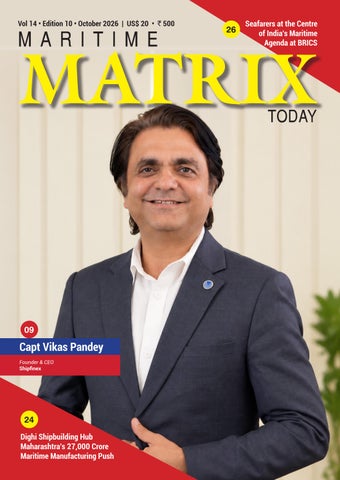
Vol 14 • Edition 10 • October 2026 | US$ 20 • ` 500
MA R I T I ME
26
Seafarers at the Centre of India’s Maritime Agenda at BRICS
MATRIX TODAY
09
Capt Vikas Pandey Founder & CEO Shipfinex
24 Dighi Shipbuilding Hub Maharashtra’s ₹27,000 Crore Maritime Manufacturing Push
02 | Maritime Matrix Today | October 2026
Maritime Matrix Today | October 2026 | 03
Table of CONTENTS
Cover Story
09 From Chain Blocks to Blockchain
32
K Shipbuilding, Sejin & ClassNK Ink MOU for Eco LPG Carrier
22
The Energy Dependence Debate
33
Berg Propulsion Strengthens India Presence Amid Shipbuilding Boom
23
How Bunker Vessels Drive Shipping’s Green Future?
34
World Maritime Day: History and Significance
24
Dighi Shipbuilding Hub Maharashtra’s `27,000 Crore Maritime Manufacturing...
36
When Politics Undermines Policy Can Maritime Excellence Endure?
26
Seafarers at the Centre of India’s Maritime Agenda at BRICS
37
Maharashtra Emerges as India’s Strategic Investment Gateway
28
Mazagon Dock’s `15,000 Crore Andhra Pradesh Shipyard: A New Chapter...
38
Reducing Risk at Sea
30
Historic Batavia Prepares for Onshore Legacy at Damen
15
Legal Frameworks for a Changing Sea
Disclaimer All advertisements in this magazine are placed with no liability accepted by the publisher for the material content therein. No responsibility is accepted by the publisher for omission or error or non-insertion of any advertisements. All advertisements and material in this magazine are subjected to approval by the publisher and are not necessary the opinion of the publisher. No liability is accepted for advertisements that are placed or any information that might be criminally connected. All information is checked to the best of our knowledge and is reliant upon the material submitted not being in contravention of all relevant laws and regulations and within the provisions of the Trade Practices Act. Reproduction Prohibited Maritime Matrix Today will not be responsible for the views expressed by contributors in their personal capacity. All rights reserved. Reproduction in part or whole without the permission of the Editor is prohibited. Readers are recommended To make appropriate enquiries before sending money, incurring expenses or entering into any commitment in relation to any advertisement published in this publication. Maritime Matrix Today does not vouch for any claims made by the Advertisers of Products and Services. The Printer, Publisher, Editor and Owner of Maritime Matrix Today shall not be held liable for any consequences, in the event such claims are not honoured by the Advertisers. RNI: MAHENG/2013/50159 Published by Marex Media Pvt Ltd C-209, Morya House, New Link Road, Andheri West, Mumbai 400058 Email: info@marexmedia.com
04 | Maritime Matrix Today | October 2026
Printed by Young Graphics Printed at Young Graphics, 208 Shankala Industrial Premises, Gogatewadi, Goregaon(E), Mumbai-400 063
• Seaspan technology continues to be a leader in the industry, setting high environmental goals
• COPES Company e-learning training platform completed from the comfort of your home
• Our fleet of Dual Fuel Vessels with Membrane & Type B Tanks sets us up for a strong future
• Gender friendly accommodation facilities
• MAN ‘ME-GI Mark 2’ Main engines, a step further than present generation of main engines • The ‘EGR (Exhaust Gas Recirculation)’ as well as ‘SCR (Selective Catalytic Reactors)” as means to bring down NOx emissions to Tier III levels
• Female Engagement Champions across offices worldwide • Quality growth • Low LTIF & High retention • Wages in top Quartile, and consistent operational excellence
ADDRESS: Seaspan Crew Management India Private Limited, 501, Kamla Executive Park, Andheri (E), Mumbai 400 059, India TEL: Chennai: +91-9884450085 Cochin: +91-9633110085 Mumbai: +91-22-40666200 | EMAIL: Jobs@Seaspancrew.com
License no MUM-014 valid till 6 Feb 2031 CIN No.: U 78100 MH 2005 PTC 152233
Maritime Matrix Today | October 2026 | 05
Editorial
Charting a Maritime Future with Purpose The October 2026 issue of Maritime Matrix Today arrives at a defining moment for shipping, when technology, geopolitics, infrastructure, finance and, above all, people are reshaping the maritime landscape. The cover, featuring Capt. Vikas Pandey, sets the tone: a mariner who moved from commanding ships to reimagining how maritime assets can be financed and owned. Our cover story, “From Chain Blocks to Blockchain,” is an entrepreneurial journey. It is a story of curiosity, reinvention and the conviction that maritime experience can become the foundation for innovation. Capt. Pandey’s vision of regulated maritime asset tokenisation, GIFT City and participation in vessel economics opens a conversation about the relationship between maritime human capital and financial capital. The issue moves from innovation to responsibility. The discussion around LNG bunkering highlights the infrastructure, safety and competence required for the energy transition, while the Energy Dependence Debate examines how disruption around the Strait of Hormuz exposes the fragility of global energy flows and reinforces the need for diversification and resilience. Maritime law receives attention through the International Maritime Legal Conference & Awards 2026. Its discussions on insurance, sanctions, war-risk exposure, digitalisation, electronic documentation, vessel tokenisation and emerging cargoes demonstrate that regulation cannot remain static while the industry transforms. The clear message is collaboration. Lawyers, regulators, insurers and maritime professionals must understand one another’s realities.
The issue also brings the human dimension into focus. India’s maritime agenda at BRICS places seafarer safety, emergency support, communication and welfare within the wider framework of maritime security. The article reminds us that secure sea lanes and resilient supply chains depend on people. India’s shipbuilding ambitions provide a thread. The proposed Dighi cluster in Maharashtra and the Dugarajapatnam project in Andhra Pradesh point towards an ecosystem involving shipyards, technology, manufacturing, skills, finance and employment. These developments underline that maritime growth is not about building ships; it is about building capability. From the history of World Maritime Day to the engineering behind the preservation of Batavia, this edition connects heritage with the future.Together, these stories tell us that maritime progress cannot be measured by technology or tonnage alone. It must be measured by resilience, competence, safety, inclusion and the ability to translate ambition into action. As the industry charts its course, one principle remains constant: innovation may change the vessel, the system and the business model, but people remain at the heart of the voyage. Kamal Chadha
Team Matrix Kamal Chadha Group CEO
Radhika Vakharia CEO & Editor
Delphine Estibeiro Editorial Coordinator
Jagdamba Pandey Manager, Business and Promotion
kamal@marexmedia.com
radhika@marexmedia.com
delphine@marexmedia.com
jagdamba@marexmedia.com
Shirish Kirtane HOD Graphics
Santosh Nivalkar Sr. Graphic Designer
Manish Malve Graphic Designer
Bhavna Pimpale Coordinator
shirish@marexmedia.com
santosh@marexmedia.com
manish@marexmedia.com
bhavna@marexmedia.com
06 | Maritime Matrix Today | October 2026
Maritime Matrix Today | October 2026 | 07
08 | Maritime Matrix Today | October 2026
Cover Story
From Chain Blocks to Blockchain How Capt. Vikas Pandey went from commanding ships to rewriting who gets to own them
- Jagdamba Prasad Pandey
W
hen a Silicon Valley technologist told Capt. Vikas Pandey in 2017 that AI, IoT and blockchain would reshape every industry, the master mariner’s honest reply was that he knew the first two — and that in shipping, “we use chain blocks.” That question set him reading, and the reading set him building. Today, as Founder & CEO of Dubai-based Shipfinex, the world’s first regulated maritime asset tokenisation platform, Capt. Pandey is constructing the missing capital market for the world’s oldest industry.
A dream of the sea Vikas Pandey was born in Chandigarh in 1983, the son of an Indian Air Force officer. Like many armed forces children, his education was a journey across India itself — Kendriya Vidyalaya schools in city after city — and his dream combined both of his worlds: he wanted to be an aircraft carrier pilot. He cleared the NDA written examination and was called for his SSB interview at Bhopal, where, on the final day, he was disqualified. But the sea does not release its claims so easily. He sat the entrance examinations of several foreign shipping companies, qualified in all of them, and chose Anglo-Eastern Ship Management, joining as a deck cadet. With a Diploma in Nautical Science from Tolani Maritime Institute and a BSc in Nautical Science from Mumbai University, he spent eleven years at sea on multiple ship types, rising to command as captain. Those years gave him an education no business school offers — and a front-row seat to a paradox. The vessels he commanded were immensely valuable, income-generating assets, yet the capital behind them was accessible only to a narrow circle of banks and owning families. The masters, engineers and crews who ran the ships could not own a fraction of the industry they powered.
Chain blocks or blockchain? The itch to build started early: from 2009 he ran ventures in parallel with sailing, and in 2013 he swallowed the anchor to become a full-time entrepreneur. One ambition kept circling back — a technology startup — but he is a mariner, not a technologist, and in his own words, without a tech co-founder
there is no point starting a tech company. That changed in 2017, when he met Kawal Arora: fifteen years in Silicon Valley, a tech lead at Tesla before turning entrepreneur. Kawal told him that a trio of technologies — AI, IoT and blockchain — would change the way industries operate. The Captain knew the first two. The third produced the exchange that gives this story its title. The more he read, the more fascinated he became; the two founded a blockchain technology company together, and Capt. Pandey exited all his other ventures.
“
In shipping we use chain blocks. So my honest question to Kawal was — what is blockchain? That one question changed my life.”
The birth of Shipfinex The two threads of his life soon braided into one idea: fractionalising ship ownership, with blockchain as the underlying technology. He developed it with Suraz Kottakki, a fellow sailor-turned-entrepreneur and technology enthusiast, today Shipfinex’s COO — and in 2018, Shipfinex.com was born. They were, he admits, too early. But the vision kept attracting the right people: at a maritime conference they met Ravi Shankar, a shipbroker of twenty-five years and Chairman of the Institute of Chartered Shipbrokers, Middle East, who joined as a co-founder. The search for a shipowner led to Tony Dagher, founder of TMC Shipping, who came aboard in 2022 as an angel investor. Shipfinex was incorporated in Dubai that year, and the journey formally began. The company holds an In-Principle Approval (broker-dealer) from VARA, Dubai’s Virtual Assets Regulatory Authority; in India, Shipfinex India at GIFT City holds the first Limited Use Authorisation issued for asset tokenisation in the IFSCA FinTech Innovation Sandbox; and in August 2026, it announced an exclusive partnership with ADI Foundation to build the first regulated tokenised maritime asset class on ADI Chain.
Maritime Matrix Today | October 2026 | 09
Cover Story
The Voyage:
ADI Foundation x Shipfinex
Marine Money New York 2026
The Maritime Standard Tanker Conference 2025
Annual Offshore Support Journal Conference 2026 Shipfinex at The Captain’s Table 2024 Event
Shipfinex at Hong Kong Maritime Week 2024
10 | Maritime Matrix Today | October 2026
RIS & IFSCA Event
Milestones
ShipTek 2025 in Singapore
Shipfinex wins the Regional Startup World Cup Pitch Competition
ShipTek 2025, Dubai
Startup World Cup Finale, San Francisco,
SPM Shipping Partnership
Maritime Matrix Today | October 2026 | 11
Cover Story In Conversation with Capt Vikas Pandey In a candid conversation with Jagdamba Prasad Pandey of Maritime Matrix Today, Capt. Pandey shares his insights on his journey from an Air Force childhood to the fintech boardroom, the birth of Shipfinex, Maritime Asset Tokens, GIFT City, the ADI Foundation partnership, and his vision of seafarers as investors. Welcome, Capt. Pandey. From an Air Force childhood to a ship’s bridge to a fintech boardroom — what carried through? Thank you — it is a pleasure to be featured. Growing up across India as a fauji kid teaches you to adapt and absorb the values of service. Command at sea then teaches you accountability without excuses: when you sign for a vessel, everything on board is yours. It also teaches decisionmaking with incomplete information, and respect for disciplined systems — ships are safe because of systems, not heroics. We have built Shipfinex the same way: regulation, legal structure and compliance first, technology in service of those. And leaving the sea in 2013 was the hardest decision of my life, but I never really left the industry — I moved from operating the asset to fixing the capital behind it.
The chain blocks story has become Shipfinex folklore. Take us back to 2017. I had always wanted to build a technology startup, but I firmly believe that without a tech co-founder there is no point in starting a tech company. Then I met Kawal Arora — fifteen years in Silicon Valley, a tech lead at Tesla before beginning his entrepreneurial journey. He gave me the confidence I had been missing. One day he told me three technologies would change how industries operate: AI, IoT and blockchain. I told him honestly — I know the first two, but in shipping we use chain blocks. What is blockchain? He explained, and I started reading everything I could find. The more I read, the more fascinated I became. Kawal and I founded a blockchain technology company together; I exited all my other ventures at the time, and as my understanding deepened, the idea arrived naturally: fractionalising ship ownership. I developed it with Suraz Kottakki, a sailorturned-entrepreneur like me, and Shipfinex.com was born in 2018. Ravi Shankar joined us as co-founder with twenty-
12 | Maritime Matrix Today | October 2026
five years of ship broking behind him, and Tony Dagher of TMC Shipping came in as our angel investor in 2022. Our first believer with capital was a man who owns ships — that told me the industry itself knew this was needed.
For readers new to the concept — what exactly is a Maritime Asset Token? A MAT is a regulated digital security representing fractional economic rights in a single vessel. Each vessel sits in its own ring-fenced special purpose vehicle — the sole registered owner on the flag registry — secured by a first-priority registered ship mortgage, the same instrument a bank would take. The token is identity-bound on the ERC-3643 standard, so compliance is enforced at the token level: only verified, eligible investors can hold or transfer it. Ownership, operation and registration of the ship remain completely conventional. Tokenisation changes the size of the door through which capital can enter.
Put the opportunity in perspective for us. How large is this asset class, really? The global merchant fleet is valued at roughly US$2.1 trillion — and yet only a small fraction of it changes hands in any given year, because the friction in sale and purchase is enormous. Every transaction is bespoke: whole-ship deals, lengthy negotiations, a narrow pool of qualified buyers. Now consider that ships carry around ninety per cent of global trade, and then count the shipowners of the world — you can count them in the thousands, in a world of eight billion people. A multi-trillion-dollar asset class, essential to every economy on earth, reachable only by institutions and ultra-high-networth individuals. I consider that a genuine injustice to the asset class itself. What Shipfinex is building goes beyond making ships tradeable through fractionalisation. We are re-imagining the entire architecture — a new capital layer for maritime finance. When a vessel’s economics can be held in regulated fractions, priced continuously and transferred without the friction of a whole-ship transaction, tradability and accessibility change together, and trading volumes follow. That is what redefining the capital markets of this industry actually means: not a new product on old rails, but new rails.
There is a great deal of noise around tokenisation. What separates a durable platform from the speculation? One word: enforceability. If an investor’s claim cannot be exercised in a court, backed by a registered mortgage, within a licensed framework, it is not an investment — it
Capt Vikas Pandey Founder & CEO Shipfinex
Maritime Matrix Today | October 2026 | 13
Cover Story
is a promise. That is why we took the harder road. We hold an In-Principle Approval as a broker-dealer from VARA in Dubai and are progressing through the full licensing process; in India, we received the first Limited Use Authorisation issued for asset tokenisation in the IFSCA FinTech Innovation Sandbox, where we conduct structured testing under the regulator’s conditions. We built inside regulatory perimeters from day one, because that is the only version of this industry that institutions, flag states and courts will take seriously.
Your partnership with ADI Foundation attracted significant attention. What does it involve? It is an exclusive partnership to build the first regulated tokenised maritime asset class on ADI Chain. Shipfinex brings maritime origination, legal structuring and the tokenisation engine; ADI brings institutional-grade chain infrastructure and settlement in a CBUAE-licensed dirham stablecoin. The programme was announced with a pipeline of approximately 35 vessels representing around US$500 million in asset value. The significance is not in the numbers — it is in the architecture: regulated settlement, institutional infrastructure, compliance enforced on-chain. That is the plumbing of a genuine capital market for maritime assets.
What does GIFT City mean for Indian maritime finance? I believe it is one of the most important developments in Indian ship finance in a generation — and the momentum is visible at the highest level. I recently attended India’s Ship Leasing and Ship Finance Conference, hosted by IFSCA at GIFT City, where the Chief Guest was the Hon’ble Union Minister of Ports, Shipping and Waterways, Sarbananda Sonowal. The regulator’s and the government’s intent are unmistakable. Now look at the gap that intent must close. India has a vast coastline and one of the world’s great maritime traditions, yet around ninety-five per cent of Indian EXIM cargo is carried on foreign-owned ships. The estimates discussed for what India requires on its journey to Amrit Kaal 2047 — to become a nation with significant strength in shipbuilding and ship owning — run to the order of US$1 trillion. I will say this plainly: capital of that magnitude cannot be raised through conventional channels alone. It becomes possible only when the asset class is democratised — opened to a far wider base of investors under full regulation and compliance. That is precisely what tokenisation delivers, and it is why our work at GIFT City matters. Our Limited Use Authorisation lets us test maritime asset tokenisation under IFSCA’s own conditions — and I want to be precise: it is a sandbox authorisation for 14 | Maritime Matrix Today | October 2026
structured testing, not an operating licence. But the direction is set. A regulated Indian framework for tokenised maritime assets gives Indian shipowners a new capital source, Indian shipyards a new financing route, and GIFT City a genuinely global asset class.
You speak of seafarers as future investors, not just operators — and of India’s special place in that vision. This is personal. I sailed for eleven years alongside the finest professionals in the world, and none of us could own a fraction of the ships we ran. The industry’s human capital is completely divorced from its financial capital. Now apply that to India: we are the second-largest supplier of seafarers in the world, with more than 320,000 active sailors and thousands more of our maritime professionals working ashore. Today, most have no practical route to meaningfully invest in the very assets they have spent their lives mastering. My long-term vision is a gated, regulated framework in which maritime professionals — alongside institutions — can hold a stake in vessel economics, with proper eligibility checks and sensible exposure limits. Open the gates of accessibility, and capital will not be the problem. India can rise rapidly as a ship-owning nation — we simply have to make ship-owning a culture, because sailing is already in our blood. Our Hon’ble Prime Minister has set the vision of a developed India by 2047, and I am convinced the maritime industry is a key to it. As a sailor and as an Indian, I can tell you — we are not merely dreaming about this. We are in the process of making it a reality.
Finally — your message to the young Indian officer standing his or her first watch tonight? Take your profession seriously — it is one of the finest educations on earth. Stay curious beyond the bridge: understand how your ship makes money, because that knowledge is rare and valuable. Remember that a closed door is not the end of the road — I was disqualified at my SSB interview on the last day, and it turned out to be the detour that gave me everything. And know that this industry is changing in your favour: I believe your generation will not merely operate the world’s fleet, but will, in a regulated and sensible way, come to own a part of it. The bridge is a better classroom than any boardroom. Use it well. MMT
MIMLCA 2026
Legal Frameworks for a Changing Sea - Pratik Bijlani
A
t a time when ships are increasingly navigating not only volatile seas but also a maze of sanctions, geopolitical tensions, cyber risks, digital contracts and rapidly changing regulations, the legal architecture supporting global shipping is being tested like never before. These challenges formed the backdrop to the 3rd Edition of the International Maritime Legal Conference & Awards 2026, hosted by Marex Media in association with Bose & Mitra & Co. on 26th August at PVM Gymkhana, Mumbai. The conference brought together maritime lawyers, shipowners, insurers, P&I clubs, regulators and industry professionals to examine how law and commercial practice must evolve alongside a rapidly transforming shipping industry. With maritime insurance, sanctions, liability, documentation, dispute resolution, digitalisation and risk management occupying centre stage, the event offered a rare opportunity for legal and industry professionals to engage in a common conversation. Opening the conference, Capt Kamal Chadha, MD, Marex Media, highlighted the profound transformation underway across shipping, driven by decarbonisation, alternative fuels, artificial intelligence, autonomous vessels, cybersecurity and increasingly complex sanctions regimes. He called for closer engagement between maritime professionals and the legal fraternity to develop practical solutions capable of supporting a safer, more sustainable and legally resilient industry. Chairman of the Board of Advisors, Mr Wilfred C Pereira, set the tone for the discussions by pointing to emerging legal and commercial challenges arising from geopolitical disruption,
insurance and regulatory change. He also drew attention to emerging subjects including nuclear cargo, vessel tokenisation and crisis preparedness, encouraging delegates to move beyond conventional thinking and focus on actionable solutions. The keynote address by Mr Shantanu Bhadkamkar, MD, ATC Global Logistics, titled “Navigating Legal Horizons – Maritime Maritime Matrix Today | October 2026 | 15
MIMLCA 2026 & Allied Transport in Transformative Times,” emphasised the need for law to keep pace with increasingly fragmented supply chains and geopolitical uncertainty. Calling for riskbased legislation, disruption-ready contracts, harmonised multimodal rules and stronger insurance frameworks, he observed, “Law is simple; understanding the industry and analysing circumstances is the real challenge. Lawyers must partner with industry experts to build a fair, proportionate and calibrated legal architecture that addresses disruptions, strengthens supply-chain resilience, embraces digitalisation and ensures harmonised multimodal rules.” Guest of Honour Mr Ash Mohomad, DDG (MSL), DGMA, outlined India’s evolving maritime legal framework and the implementation of five new maritime Acts addressing registration, education, labour, emergencies, salvage, digitalisation and transparency. “India’s maritime legal framework is undergoing significant reform, with new legislation addressing registration, education, labour, emergencies, salvage, digitalisation and transparency. These reforms aim to simplify procedures, strengthen regulation and improve ease of doing business across the maritime sector,” he said. Chief Guest Hon’ble Chief Justice Kalpathi Rajendran Shriram (Retd.) called for continued dialogue between the judiciary, maritime industry and legal professionals as new forms of maritime commerce and risk emerge. Reflecting on vessel tokenisation, piracy, marine insurance, bills of lading, multimodal transportation, arbitration, liability and insolvency, he stressed that legislation must remain practical and industryinformed. “Maritime law must evolve alongside the industry, addressing emerging challenges in vessel tokenisation, piracy, insurance, multimodal transport and insolvency. New legislation must be carefully calibrated, practical and clearly understood, while drawing on industry expertise to create a fair and effective legal framework,” he said. The first panel, “Maritime Insurance in India: Legal Challenges and Future Direction,” moderated by Mr. Wilfred Pereira, examined how India’s growing maritime footprint is being accompanied by increasingly complex insurance exposures. Mr. Harsh Buch called for stronger Indian maritime jurisprudence and a dedicated dispute-resolution mechanism; Mr. Aishwarye Dubey highlighted the need for flexible contracts and greater grassroots maritime awareness; Capt. A. Krishnan stressed rigorous sanctions due diligence across cargoes, beneficiaries and payment chains; Mr. Sanjay Mokashi highlighted
16 | Maritime Matrix Today | October 2026
geopolitical volatility, reinsurance capacity and the Bharat Maritime Insurance Pool; and Ms. Jayati Roy emphasised the need to build domestic underwriting expertise and regulatory capability, particularly in P&I insurance. An AV presentation by Mr. Simon Kaye, Global Head of Reinsurance, NorthStandard, brought an international perspective on war-risk insurance. He described the unprecedented pressure created by conflicts across the Persian Gulf, Strait of Hormuz, Red Sea and Black Sea, noting that war-risk pricing can change rapidly as insurers reassess their exposure. He also highlighted increasing interest in government-backed schemes and reinsurance support as global markets respond to widening geopolitical risks.
Maritime Matrix Today | October 2026 | 17
MIMLCA 2026 Strengthening India’s Maritime Insurance Ecosystem “At a time when maritime trade is being reshaped by regulatory change, geopolitical uncertainty, emerging risks, technological disruption and sustainability imperatives, the Marex International Maritime Legal Conference & Awards 2026 provided a timely platform to examine the forces shaping the sector’s future. Under the theme “Navigating Legal Horizons – Maritime and Allied Transport in Transformative Times,” the conference offered valuable perspectives on the priorities confronting India’s maritime insurance sector: strengthening legal and regulatory clarity; developing innovative, accessible and affordable risk solutions; advancing data and technology capabilities; expanding protection against climate and cyber risks; and building capacity to address complex and emerging exposures.
It was a privilege to contribute to these important discussions and share perspectives on strengthening India’s maritime insurance ecosystem while enhancing its competitiveness in an increasingly complex global environment. The conversations also underscored the importance of collaboration among insurers, regulators, shipowners, brokers, legal professionals and technology providers. For India, resilience will depend on anticipating global change, investing in expertise and innovation, and aligning insurance solutions with the country’s expanding maritime ambitions. The waters ahead may be uncharted, but with foresight, innovation and collaboration, we can turn uncertainty into opportunity and navigate the future with confidence.” – Ms Jayati Roy, Deputy General Manager, The New India Assurance Company Ltd
The following expert lecture by Mr Suumit Madhu examined the legal boundaries of war-risk coverage, with particular emphasis on hull war, war P&I and excess war P&I. He urged shipowners to look beyond premiums and examine geographical exposure, policy gaps, contractual obligations and claims-handling arrangements before entering volatile waters.
maritime finance. He explained how regulated maritime asset tokens could allow fractional participation in vessel economics, improve liquidity and widen access to shipping investments. Shipfinex is seeking to pilot the tokenisation of approximately 35 vessels with an estimated combined value of $500 million over the coming year.
The second panel, “Coverage in Conflict and Crisis Situations,” moderated by Capt. Naresh Kumar, focused on the operational reality of crisis decision-making. Mr. Muthu Jagannath advocated proactive contingency planning and “what-if ” exercises; Adv. Ritesh Kaushik identified sanctions enforcement as one of the most unpredictable maritime risks and called for stronger contractual protections; Mr. Pradeep Kulkarni stressed the importance of timely decisions and coordination between shore and vessel teams; Mr. Sibesh Sen highlighted the changing boundaries of war-risk cover and the importance of resilience; Ms. Radhika Sharma emphasised preparedness, mock drills and documentation; while Capt. Harinder Singh stressed timely communication, vessel tracking, regulatory coordination and empowering Masters to make informed safety decisions.
The third panel, “Future-ready Legal Frameworks for Maritime Transformation,” moderated by Mr. Shivkumar Iyer, examined the legal architecture required for a digitally enabled and internationally competitive Indian maritime sector. Dr. Sanjay Bhavnani highlighted the potential of India’s new shipping legislation to attract investment and strengthen the Indian flag; Dr. Joshua Ebenezer stressed continuous sanctions screening across owners, vessels, banks and service providers; Mr. Ruchir Goenka welcomed reforms supporting vessel registration and Indian-flag growth while calling for effective implementation; Capt. Pankaj Kapoor advocated an Electronic Bills of Lading framework under MLETR; Mr. Manas Vaid highlighted GIFT City’s growing relevance to maritime finance; and Mr. Clarence Xavier called for a clearer legal foundation for transferable electronic records and digital documentation.
The legal and commercial horizon widened further with Capt. Anand Chopra’s special session on the maritime carriage of nuclear material. He explained the stringent regulatory controls governing Class 7 cargo while highlighting opportunities arising from India’s nuclear energy ambitions, including private participation, small modular reactors and floating nuclear power plants. The session suggested that the expansion of nuclear energy could create a new specialised cargo opportunity for the shipping industry.
The conference concluded with a summary by Mr. Hari Narayan, Senior Partner, UMLC, followed by a vote of thanks from Ms. Delphine Estibeiro, Joint CEO, Marex Media, before the evening transitioned into the International Maritime Legal Awards 2026.
Capt. Vikas Pandey, Founder and CEO of Shipfinex, then explored vessel tokenisation as a potential new avenue for
18 | Maritime Matrix Today | October 2026
The awards recognised professionals and organisations across the maritime legal and insurance spectrum. Among the individual honours were Ms. Ankita Sen, Rising Star; Mr. Harsh Buch, Young Achiever of the Year; Adv. Yash Ayya, Personality with a Promising Future; Mr. Pradeep Kulkarni, Maritime Risk & Insurance Personality; and Dr. Sanjay Bhavnani, Excellence
in Maritime Legal Ethics & Seafarer Welfare. Organisational honours went to VMT Legal, Renata Partners, Rex Legalis, Bose & Mitra & Co. and New India Assurance for excellence across maritime legal aid, admiralty law, alternative dispute resolution and maritime insurance. The evening’s highest honour, the Lifetime Achievement Award, went to veteran customs and trade professional Mr. Jayyannt Lapsiaa, Managing Partner of U.M. Khona & Co., in recognition of more than four decades of contribution to the customs, trade and maritime ecosystem. Accepting the honour, Mr. Lapsiaa expressed his gratitude to Marex Media, saying, “I am deeply grateful to Marex Media for this incredible Lifetime Achievement Award. To receive such recognition from the maritime and trade community is a matter of immense pride, and I sincerely thank the entire Marex team for this honour and encouragement.” By the end of the evening, the conference had made one point unmistakably clear: maritime law can no longer operate in isolation from technology, geopolitics, insurance, finance and commercial realities. As India seeks to build a stronger and more globally competitive maritime sector, the effectiveness of its legal framework will depend increasingly on how closely lawyers, regulators and industry work together to anticipate risk, resolve disputes and create rules capable of keeping pace with the sea change underway in global shipping. MMT
Maritime Matrix Today | October 2026 | 19
20 | Maritime Matrix Today | October 2026
Maritime Matrix Today | October 2026 | 21
Energy Security
The Energy Dependence Debate
W
-Delphine Estibeiro
hen the Strait of Hormuz trembles, the shipping world feels the aftershocks. The narrow waterway, through which nearly a fifth of global oil passes, has long been a geopolitical fault line. But as the attached report underscores, the crisis is no longer confined to the strait itself—it reverberates across global energy security, reshaping the maritime industry’s future. For decades, the Strait of Hormuz has symbolised both opportunity and vulnerability. Tankers laden with crude oil and LNG have sailed its waters under the shadow of regional tensions. Yet the report highlights a critical shift: the world is diversifying energy routes and sources, reducing its singular dependence on Hormuz. This transition is not just about pipelines and alternative shipping lanes—it is about resilience in the face of uncertainty. Shipping companies, once passive carriers of energy, now find themselves at the heart of strategic debates. The report points to a growing recognition that maritime operators must adapt to new realities: fluctuating freight rates, heightened insurance premiums, and the constant spectre of disruption. For shipowners and charterers, the Strait of Hormuz is no longer just a chokepoint—it is a reminder of how fragile global supply chains can be. Humanising this crisis means looking beyond the numbers. For seafarers navigating these waters, every voyage carries the weight of geopolitical risk. For port operators in Asia and Europe, delays ripple through schedules, affecting livelihoods onshore. And for consumers worldwide, the price of energy security is felt at the pump, in electricity bills, and in the cost of goods transported across oceans. The report also stresses the importance of innovation. From digital monitoring of vessel movements to investment in alternative
22 | Maritime Matrix Today | October 2026
fuels, shipping is being asked to shoulder more responsibility in safeguarding energy flows. LNG tankers, once seen as niche, are now central to diversification strategies. Meanwhile, ports outside the Gulf are positioning themselves as hubs for rerouted cargo, signalling a broader redistribution of maritime power. Yet, the narrative is not one of doom. The crisis beyond Hormuz is also an opportunity. By embracing sustainability, diversifying routes, and strengthening international cooperation, the shipping industry can transform vulnerability into resilience. The report calls for collective action—governments, shipowners, and energy companies working together to ensure that the next tremor in Hormuz does not paralyse global trade. In the end, the Strait of Hormuz remains a symbol: of risk, of resilience, and of the interconnectedness of maritime energy security. The shipping industry, as the report makes clear, must not only navigate these waters but also chart a course for a more secure and sustainable future. MMT
Based on the McKinsey’s report: “Aftershocks: Energy Security Beyond the Strait of Hormuz Crisis”
Green Shipping
How Bunker Vessels Drive Shipping’s Green Future? Delphine Estibeiro
I
n the September 7th edition of The Marex Bulletin, I published an article titled “LNG Bunkering: Strategic Pathway to Decarbonisation”, based on the presentation of Mr Manoj H Chaudhari, CEO of Unnic LNG Solutions, who offered a timely and insightful perspective on how liquefied natural gas could reshape shipping’s future. His emphasis on LNG as a transitional fuel, infrastructure readiness, and safety standards resonated strongly with industry stakeholders. The newly released DNV White Paper Report on Gas Bunker Vessels speaks on similar lines, reinforcing LNG’s role as a bridge fuel while highlighting the critical importance of bunkering infrastructure in enabling the maritime energy transition. According to DNV’s Alternative Fuels Insight platform, nearly 900 LNG-fuelled vessels are already in operation worldwide, with hundreds more on order. This rapid expansion has driven LNG consumption up by more than 500% between 2020 and 2024, with another 167% growth forecast by 2030. To meet this demand, the LNG bunker vessel fleet must grow to between 165 and 208 units by 2030—a scale-up that underscores their strategic importance. The report notes that Europe remains the most established LNG bunkering region, with structured operations in Rotterdam, Antwerp, and Gothenburg. Asia, however, is the fastest-growing market, led by Singapore’s thriving LNG hub and China’s rapid build-out of ship-to-ship bunkering capacity. The Americas, while smaller in scale, are steadily developing along the U.S. East Coast and Gulf, driven by cruise and container operators. Gas bunker vessels, as DNV stresses, are not simply smaller versions of gas carriers. Their role as fuel suppliers requires specialized cargo handling systems, vapour return and boiloff gas management, flexible transfer arrangements, and redundant propulsion systems to ensure safety and reliability. Conversion of small-scale LNG carriers into bunker vessels offers opportunities, but also challenges in design adaptation, class compliance, and operational readiness.
Competence across the value chain—from vessel crews to port authorities—will be critical to maintaining confidence in alternative fuels. Looking ahead, DNV forecasts LNG’s role will extend well into the coming decades, supported by mature ship technology, established supply chains, and compatibility with bio-methane and synthetic methane. Importantly, today’s LNG bunkering infrastructure is laying the groundwork for tomorrow’s fuels. Investments in storage, berths, digital coordination, and emissions-reduction measures will be essential to closing the supply-demand gap. The DNV White Paper Report concludes that gas bunker vessels are “strategic enablers of the maritime energy transition.” Much like Chaudhari’s vision, the report underscores that while LNG may not be the final destination, it is the vessel carrying the industry toward a cleaner maritime future. MMT
Safety is a recurring theme in both Mr Chaudhari’s presentation and the DNV report. Cryogenic fuels demand rigorous safeguards, resilient systems, and highly trained personnel. As ammonia and hydrogen emerge as future fuels, the IMO has issued interim guidelines to address their unique risks.
Maritime Matrix Today | October 2026 | 23
Maritime Boost
Dighi Shipbuilding Hub Maharashtra’s ₹27,000 Crore Maritime Manufacturing Push
M
aharashtra is set to take a significant step in expanding its shipbuilding and maritime manufacturing capabilities with the proposed greenfield shipbuilding cluster at Dighi Port in Raigad district. On 15 September 2026, Mazagon Dock Shipbuilders Ltd. 24 | Maritime Matrix Today | October 2026
(MDL) signed a Memorandum of Understanding with the National Shipbuilding and Heavy Industries Park Maharashtra Ltd. (NSHIPML) for the project. According to the Maharashtra government and multiple reports, the proposed development involves an investment of around ₹27,000 crore and is expected to create approximately 90,000 direct and indirect employment opportunities. The project is planned to have an annual shipbuilding capacity of at least 2 million gross tonnes (GT) and is intended to support the
between MDL and NSHIPML. It is also worth distinguishing the figures being reported: the ₹27,000 crore figure relates to the proposed Dighi shipbuilding cluster, while some reports have separately discussed investment by MDL within the broader development. This distinction is important when communicating the project’s financial scale.
construction of large commercial vessels while strengthening India’s domestic maritime manufacturing base. NSHIPML is being developed jointly by the Maharashtra Maritime Board and the Mumbai Port Authority, with MDL serving as the anchor shipbuilding organisation within the proposed cluster. The project is being taken forward under the Centre’s Greenfield Shipbuilding Cluster Development Plan and is aligned with the broader objectives of Maritime Amrit Kaal Vision 2047. The scale of the proposed Dighi development is particularly significant because shipbuilding is not limited to the construction of ships. A modern shipbuilding cluster brings together shipyards, marine engineering companies, equipment manufacturers, steel and fabrication units, logistics providers, repair facilities, technology companies and specialised service providers. The proposed capacity of 2 million GT annually would provide infrastructure for large commercial vessels and could expand India’s ability to undertake ship construction domestically. Reports on the project indicate that the wider cluster is expected to create an industrial and supply-chain ecosystem around shipbuilding, with opportunities for technology, investment and skilled employment. Earlier in 2026, Maharashtra had identified Dighi as the preferred location for a major greenfield shipbuilding cluster, with MDL being considered as the anchor shipyard. The project has therefore evolved from an initial cluster proposal into a formal MoU
Perhaps the most significant social and economic dimension is employment. The project is expected to generate around 90,000 direct and indirect jobs, although the exact distribution between direct employment at the shipyard and indirect employment across suppliers and supporting industries will depend on how the cluster develops. Shipbuilding requires a diverse workforce, including naval architects, marine engineers, welders, fabricators, electricians, pipe fitters, designers, planners, quality professionals, safety specialists, logistics personnel and skilled technicians. Beyond these occupations, the growth of an industrial cluster can generate opportunities for companies supplying engines, electrical systems, pumps, valves, cables, coatings, automation systems, accommodation equipment and other marine components. This creates an opportunity for Maharashtra to develop not only a shipyard but a broader maritime manufacturing ecosystem. For young professionals and technical institutions, the expansion could also create demand for specialised training in ship design, fabrication, marine engineering, digital shipbuilding, automation and shiprepair technologies. The project could consequently have an impact extending well beyond Dighi itself, particularly if ancillary industries and service providers establish operations around the cluster. The employment figure of 90,000 should, however, be understood as a projected figure, rather than jobs already created. The Dighi project also comes against the backdrop of India’s broader effort to strengthen its position in global shipbuilding. International shipbuilding remains highly concentrated, with China, South Korea and Japan accounting for the overwhelming majority of global production by gross tonnage. India’s challenge is therefore to build scale, infrastructure, technology, financing mechanisms and skilled manpower simultaneously. The proposed Dighi cluster represents one component of that larger effort. Its location in Raigad on Maharashtra’s Konkan coast, combined with its proximity to Mumbai’s existing maritime and industrial ecosystem, provides an opportunity to connect shipbuilding with ports, logistics, engineering and manufacturing. MMT
Maritime Matrix Today | October 2026 | 25
BRICS 2026
Seafarers at the Centre of India’s Maritime Agenda at BRICS - Dr. Radhika Vakharia
A
t the BRICS Business Forum in New Delhi, Prime Minister Narendra Modi placed the safety of seafarers alongside the security of sea lanes and the continuity of global supply chains. His message was direct: “Global trade can move forward only when sea lanes are secure, supply routes remain open and seafarers are safe.” He also reaffirmed India’s position as a strong advocate of freedom of navigation and the safety of seafarers. This statement is significant because it recognises that maritime 26 | Maritime Matrix Today | October 2026
security is not only about protecting ships, cargo and trade routes; it is equally about protecting the people who operate those ships. The importance of this message has become particularly clear with the increasing number of vessels operating in areas affected by geopolitical tensions and conflict. Seafarers can find themselves onboard ships navigating high-risk waters, often thousands of kilometres away from their families and home countries. In such circumstances, information and communication become critical. Recognising this need, the Prime Minister had earlier directed the establishment of a mechanism to provide timely information, emergency assistance and counselling to seafarers and their families, specifically in the context of Indian seafarers serving on domestic and foreign-flagged vessels in conflict zones. This moves the discussion from general concern for
seafarer welfare towards a more practical system of support during emergencies. For the maritime community, the significance of these announcements lies in the possibility of creating stronger coordination between government agencies, maritime administrations, diplomatic missions, shipping companies and seafarer welfare organisations. When a crisis occurs, a seafarer may need much more than evacuation or physical protection. Families need reliable information about the vessel and the crew; seafarers may need emergency communication, counselling or assistance in dealing with fear, uncertainty and traumatic experiences. A structured support mechanism can help ensure that information reaches seafarers quickly and that families are not left without answers. It also highlights the growing importance of mental and emotional well-being as part of maritime safety. Trained onboard welfare personnel can contribute significantly by identifying distress early, providing initial support and connecting seafarers with appropriate professional or shore-based services. India’s intervention at BRICS therefore provides an opportunity to make seafarer welfare an integral part of maritime security discussions. BRICS countries include major maritime nations, trading economies and countries with large seafaring communities, making cooperation in this area particularly relevant. The real measure of such cooperation, however, will be its implementation on the ground—whether a seafarer in a crisis can receive accurate information, whether his or her family can access timely assistance, and whether psychological and welfare support is available when it is most needed. The message from India is clear: protecting maritime trade means protecting the people who make that trade possible. Safe sea lanes, open supply routes and safe seafarers are not separate priorities; they are three essential parts of the same maritime security framework.
Industry Voices on the BRICS Seafarer Initiative Capt MP Bhasin Managing Shipping:
Director,
MSC
“This initiative is an important recognition of the challenges faced by crews operating on international routes. The safety of a vessel is closely linked to the safety, preparedness and well-being of its crew. Closer coordination between governments, maritime authorities and the shipping industry can provide seafarers with greater confidence and support when they face disruption or crisis.”
Mr Milind Kandalgaonkar
General Secretary-cum-Treasurer, National Union of Seafarers of India (NUSI): “The recognition of seafarer safety at the highest level of BRICS is an important development for the global maritime community. Seafarers are the human link that keeps international trade moving, yet during war, geopolitical conflict and other maritime emergencies, they and their families can suddenly find themselves facing uncertainty, isolation and serious risks far from home. Prime Minister Shri Narendra Modi’s proposal for a Seafarers Emergency Support Network therefore has particular significance. What seafarers need during a crisis is not only concern, but a system that works on the ground—one that can connect maritime administrations, diplomatic missions, governments, shipowners and seafarers’ organisations so that distress information, medical assistance, communication with families and, where necessary, evacuation and repatriation can be coordinated without delay. From the experience of NUSI in assisting Indian seafarers and their families during maritime crises, we have seen that timely and reliable communication can itself become a lifeline. A family ashore should not have to struggle to find out whether their loved one is safe, and a seafarer in a conflict-affected area should know where to turn for immediate assistance. NUSI therefore believes that the proposed BRICS mechanism should ultimately develop into a practical, accessible and responsive support network with clearly identified contact points and coordination protocols. It should complement existing international maritime mechanisms and strengthen cooperation with seafarers’ unions and welfare organisations that are often in direct contact with affected crews and their families. India has placed an important human dimension at the centre of the maritime-security discussion: ships carry global trade, but seafarers make that trade possible. Protecting sea lanes must therefore go hand in hand with protecting the life, dignity, welfare and rights of the men and women who sail on them. NUSI stands ready to contribute its experience and work with the Government of India, maritime authorities, BRICS partners, the international maritime community and seafarers’ organisations to help translate this important proposal from policy into effective protection for seafarers and their families.” MMT Maritime Matrix Today | October 2026 | 27
Maritime Future
Mazagon Dock’s ₹15,000 Crore Andhra Pradesh Shipyard: A New Chapter for India’s Shipbuilding Ambitions
I
ndia’s shipbuilding ambitions are entering a significant new phase with Mazagon Dock Shipbuilders Ltd. (MDL)planning a ₹15,000 crore greenfield shipyard in Dugarajapatnam, Andhra Pradesh. The proposed project, being developed under an MoU with the National Shipbuilding and Heavy Industries Park–Andhra Pradesh (NSHIP-AP), is expected to be implemented over five to seven years, subject to the necessary approvals and clearances. The shipyard is planned with an initial annual capacity of approximately 1.2 million gross tonnes (GT) and is expected to build a wide range of commercial and specialised vessels, including tankers, bulk carriers, container ships and LNG carriers. The project marks an important expansion of MDL’s traditional role as a major defence shipbuilder into large-scale commercial shipbuilding. The proposed Dugarajapatnam shipbuilding and port cluster is itself estimated at around ₹38,767 crore, with the shipbuilding and ship-repair yard accounting for approximately ₹29,254 crore and the associated port around ₹9,513 crore. Spread across nearly 3,488 acres with approximately 2.1 km of waterfront, the proposed development has the potential to create a major maritime industrial cluster in Andhra Pradesh. More importantly, the project comes at a time when India is seeking to strengthen domestic shipbuilding, reduce dependence on overseas yards and develop greater capacity across the maritime manufacturing value chain. The scale of the opportunity becomes clearer when viewed against the global shipbuilding landscape. India remains a relatively small player in global ship production. According to UNCTAD data, China accounted for 54.57% of global shipbuilding output by gross tonnage in 2024, followed by South Korea at 28.02% and Japan at 12.56%, while India’s share was only around 0.06%. More recent UNCTAD data indicate that China, South Korea and Japan together accounted for approximately 91% of ships completed globally by gross tonnage in 2025, highlighting the highly concentrated nature of the industry. Against this backdrop, India’s national shipbuilding strategy has set ambitious targets, including reaching the top 10 global shipbuilding nations by 2030 and the top five by 2047. The long-term vision includes increasing annual shipbuilding capacity to approximately 4.5 million GT by 2047, compared with a target of around 0.6 million GT by 2030. The proposed MDL facility could contribute to this broader capacity-building exercise while also strengthening India’s ability to construct
28 | Maritime Matrix Today | October 2026
larger commercial vessels domestically. Shipbuilding is not simply about assembling a vessel; it requires a sophisticated ecosystem involving steel, marine engines, electrical systems, automation, navigation equipment, pumps, valves, cables, coatings, software, logistics, engineering, testing and certification. The development of a large greenfield yard could therefore encourage the establishment of ancillary industries around the facility, creating a maritime manufacturing ecosystem rather than a standalone shipyard. One of the most significant dimensions of the project is its potential employment impact. The proposed MDL shipyard is expected to generate approximately 45,000 direct and indirect jobs. The employment multiplier associated with shipbuilding extends far beyond the shipyard gates, encompassing naval architects, marine engineers, welders, fabricators, electricians, pipe fitters, quality inspectors, safety professionals, planners, designers, logistics specialists, procurement teams and numerous other technical and support functions. Ancillary companies supplying components and services could create additional employment in engineering, manufacturing, transportation, maintenance and logistics. For Andhra Pradesh, this could provide an opportunity to build a specialised maritime industrial workforce and attract new businesses into the region. It could also generate demand for specialised training and skill development. Modern shipyards increasingly rely on digital ship design, advanced production planning, automation, robotics and new propulsion technologies, creating opportunities for both traditional trades and highly specialised technical professionals. India’s maritime education and training institutions could therefore play an important role in preparing the workforce required for this expansion. The government’s policy support is also becoming more substantial. In 2026, the Government approved the Shipbuilding Financial Assistance Scheme with an outlay of ₹24,736 crore, aimed at addressing the cost disadvantages faced by Indian shipyards competing with established international shipbuilding centres. Alongside this, the ₹25,000 crore Maritime Development Fund includes a ₹20,000 crore Maritime Investment Fund and a ₹5,000 crore Interest Incentivisation Fund, intended to improve access to long-term financing and reduce financing costs for maritime projects. Such measures are important because shipbuilding is highly capital intensive, involves long production cycles and requires significant investment before revenue is realised.
The proposed Dugarajapatnam shipyard therefore needs to be viewed not merely as a ₹15,000 crore industrial project, but as part of India’s larger effort to establish a globally competitive maritime manufacturing ecosystem. The project’s proposed 1.2 million GT annual capacity, approximately 45,000 direct and indirect jobs and substantial investment in commercial shipbuilding represent significant numbers, but achieving India’s long-term ambitions will depend on execution, infrastructure connectivity, availability of skilled manpower, technology, domestic component manufacturing, competitive financing, vessel orders and the ability of Indian shipyards to deliver vessels efficiently, competitively and on schedule. International competition remains formidable, particularly from China, South Korea and Japan, which possess decades of experience, extensive supplier networks and large-scale production capabilities. India’s challenge, therefore, is not simply to construct more ships, but to develop the entire ecosystem that supports competitive shipbuilding.
If successfully implemented, the Dugarajapatnam project could strengthen Andhra Pradesh’s maritime industrial profile while contributing to India’s broader objectives in shipbuilding, ship repair, marine manufacturing, logistics and employment. The larger significance lies in the possibility of creating a stronger connection between ports, shipyards, maritime technology, manufacturing, finance, skills and human capital. India’s ambition to move from a marginal share of global shipbuilding to a leading position will require sustained investment and coordinated policy support over many years. Dugarajapatnam could become an important part of that journey, demonstrating that India’s maritime future is not only about operating ships and managing ports, but also about designing, building, repairing and supporting the ships that drive global trade. MMT
Maritime Matrix Today | October 2026 | 29
Historic Batavia Prepares for Onshore Legacy at Damen
T
he Batavia, the full-scale reconstruction of the 1628 Dutch East India Company ‘retourschip’, arrived at Damen Shiprepair Amsterdam on Saturday 19 September after a six-hour tow. The 56.6-metre wooden ship made the passage afloat on her own hull, masts standing, under tow by two tugs of Koninklijke Van der Wees. At the Damen yard she will be lowered onto a 100+ tonne steel and wood cradle in dry dock 4, the first step in moving her permanently ashore at Museum Batavialand in nearby Lelystad.
A hull that cannot be replaced The Batavia was towed rather than carried. Placing her on a pontoon for the passage would have introduced loads the hull is not built to carry, so she stayed in the water, with her full rig in place and a 30.5-metre air draught. The timber has been afloat for 31 years. In the 17th century these vessels could last between 15 to max. 25 years. Hence, the vessel must be handled with the utmost care. The hull is in fragile condition, which set strict weather limits on the operation: the ship could not 30 | Maritime Matrix Today | October 2026
be allowed to work or move excessively in a seaway. The guns and a large part of the ballast were removed in advance, and temporary steel shoring was fitted in the hold and on the decks to absorb the loads that arise once the supporting buoyancy of the water falls away.
Centimetre work in dry dock 4 The dry-docking follows a sequence engineered over the past 14 months. Crane mats are laid on a Van der Wees pontoon to distribute load, support pots are set on the mats, and the steel cradle - 39.7 metres long, 15.5 metres wide, 87.2 tonnes of steel and 14 tonnes of wood - is craned onto the pots from the quay. The pontoon is then ballasted down and submerged in dry dock 4, for which Damen Shiprepair designed a dedicated dock bed. Two small tugs manoeuvre the Batavia over the cradle, after which the dock is pumped down and the ship settles into her supports under controlled conditions. Once dry, the remaining voids between hull and cradle are
Paul van de Craats, Commercial Manager at Damen Shiprepair Amsterdam: “I followed the construction of this ship during my own training years, under Mr Vos, and what struck me was that they built her authentically and taught young people the carpentry trade while doing it. We work the same way; we train our own people on the job to master ship repair. That is why this project means something here. Dutch maritime history came into dock 4 in 1995 and it is back now. In addition, the cradle carrying her, designed by Q3 Heavy Lift, was built by our sister company Niron Staal. We are incredibly proud to be part of this project coming full-circle.”
Where a wooden ship is strong The load model behind the cradle took ten months to develop. FaraFlash established the ship’s dimensions and weight and produced the basic cradle design; Q3 Heavy Lift carried out the detailed engineering, including the support and jacking arrangement. Kuperus & Gardenier verified dimensions and weight and advised on the hull’s vulnerable areas - Jan Kuperus and Rienk Gardenier trained on the Batavia as apprentices
under shipwright Willem Vos during her construction. Niron Staal fabricated the cradle. Trans Global Projects is responsible for project management, risk analysis, permitting and public safety.
Release By The Maritime Marketeer
packed with timber, a task expected to take two days while the structure beds in. The pontoon is then deballasted, and the dockreflooded until it lifts the pontoon with the ship clear, and the Batavia is towed to the quay, where the remaining ballast is removed. She will leave Amsterdam at a hull weight of almost 650 tonnes.
Ard Suvaal, Project Manager at Trans Global Projects, says: “When we were contracted to arrange this project for Museum Batavialand, we wasted no time in bringing in the specialised subcontractors needed for this job. That is where our strength sits: making sure every link in the chain is present and delivered on time, including permits, the risk analysis, the interfaces between parties and more. We normally move transformers and offshore structures for a living. Nobody ever sees that work, except for the people who are inconvenienced by road closures and such. This project is different: it’s highly public and has enormous historical value. Both from a professional engineering point of view and from a personal perspective, it’s very special to suddenly manage the logistics of a reconstruction of a 17th-century East India vessel. And I am especially proud of the smooth collaboration between all partners; that is what brings success.” The Batavia is scheduled to return to Lelystad on the pontoon on 1 October and to be moved ashore at Museum Batavialand on 2 October. The entire operation is part of Museum Batavialand’s large-scale redevelopment. MMT
Maritime Matrix Today | October 2026 | 31
K Shipbuilding, Sejin & ClassNK Ink MOU for Eco LPG Carrier
Mr Hyeun-Chul SUNG, Vice President & CPO, K Shipbuilding; Mr Do-Hyung KIM, CTO, Sejin Heavy Industries; and Mr Hayato Suga, President & CEO, ClassNK
K
An amendment to the IGC Code, an international code for the construction and equipment of ships carrying liquefied gases in bulk, is scheduled to be adopted at MSC 112 (to be held in December this year) and to enter into force on July 1, 2028. Prior to its application, K Shipbuilding, Sejin Heavy Industries and ClassNK have agreed to the joint development of a 9,000 m³ class LPG carrier that complies with this amended code. In addition, the LPG carrier to be developed under this project will be equipped with Energy Saving Devices (ESDs) aimed at improving operational efficiency. By incorporating a Rudder
32 | Maritime Matrix Today | October 2026
Bulb and Energy Saving Fin, both of which contribute to enhanced propulsive efficiency, the vessel is expected to achieve improved fuel efficiency and reduced greenhouse gas emissions.
Release By JLA Communication
Shipbuilding Co., Ltd., Sejin Heavy Industries Co., Ltd. and ClassNK have signed an MOU (Memorandum of Understanding) regarding the joint development of a new generation Eco LPG carrier that complies with the IGC Code amendment. The signing ceremony was held at Gastech 2026 in Bangkok, Thailand.
The roles of each party are as follows: • K Shipbuilding: Development of a 9,000 m³ class LPG carrier applying the IGC Code amendment • Sejin Heavy Industries: Development of its cargo tank design applying the IGC Code amendment and wide-plate bending technology • ClassNK: Review of the design based on the IGC Code amendment Through this collaboration under the MOU, K Shipbuilding, Sejin Heavy Industries and ClassNK will ensure the smooth application of the IGC Code amendment and contribute to the safe maritime transport of liquefied gases. MMT
Berg Propulsion Strengthens India Presence Amid Shipbuilding Boom
B
erg Propulsion is set to open its own office in Mumbai, in an expansion of its global network which reflects its growing participation in shipbuilding projects across India. Scheduled to open on 1 January 2027, the new office will offer a contact hub for Berg’s activities in India as it builds on its relationships with leading yards such as Garden Reach Shipbuilders & Engineers (GRSE), Mazagon Dock Shipbuilders Limited (MDL) and Chowgule Shipyard. The new office will be led by Amrita Singh, Berg Propulsion Account Manager for New Sales, who will take up the post of General Manager. Singh will be supported by Prasenjit Roy, formerly a Commander in the Indian Navy and Programme Manager for Commercial Shipbuilding at GRSE. Roy’s equipment commissioning experience will also benefit quality assurance services.
Ms Amrita Singh and Prasenjit Roy Roy. “Proximity is critical in this market, where the next five years will see optimized efficiency transition from the market differentiator it is today into a minimum requirement.”
Singh and Roy have already worked successfully together in the supply of Berg Propulsion packages for two 33.55m electric tugs under construction at KMEW Group’s Mumbai facility.
“India’s propulsion sector is genuinely exciting right now,” said Roy. “Both the Navy and Coast Guard have significant expansion programmes, with opportunities for the type of controllable-pitch propeller [CPP] systems Berg offers at the heart of almost every platform.” India’s shipyards are also focusing on green propulsion opportunities, with particular interest shown in hybrid configurations, variable speed drives and CPP systems, added
Release By JLA Communication
“Our focus will be on identifying and supporting projects where Berg solutions add value, enhance efficiency and reduce emissions,” Singh commented. “Working closely with customers and our yard partners, we look forward to matching our systems, service and support with the opportunities available in this growing market.”
With private sector investment strong and government support available for projects prioritising sustainability, Berg would seek to increase its business footprint in India across the tug, dredger and OSV newbuild segments, said Singh. It will also create a network of trained service agents in Mumbai, Kochi and Visakhapatnam, where most of its customers’ vessels operate, she said. “We will recruit skilled local talent and put training programmes in place, building long-term expertise to better serve customers throughout India.” Scope also existed for the new Mumbai office to support customers in other South Asian countries, such as Sri Lanka, added Singh. MMT
Maritime Matrix Today | October 2026 | 33
WMD 2026
World Maritime Day: History and Significance
W
orld Maritime Day is an official United Nations international observance held every year on the last Thursday of September. It is coordinated by the International Maritime Organization (IMO) to highlight the importance of shipping, maritime safety, security, environmental protection and the people who make maritime transport possible.
34 | Maritime Matrix Today | October 2026
World Matime Day Celebration on 30th September 2026 in Mumbai.
How did World Maritime Day begin? The idea of World Maritime Day dates back to 1978. The IMO conceived the day as an opportunity for its Member Governments and the wider maritime community to understand, promote and reflect on the Organization’s work, achievements and future objectives. It was also intended to encourage maritime events around the world around a specific theme selected by the IMO Council. Initially, the principal international observance was held at IMO Headquarters in London, while individual countries organised their own maritime events. Over time, World Maritime Day developed into a truly global observance involving governments, maritime administrations, ports, shipping companies, seafarers, maritime academies, NGOs and other stakeholders. Since 2005, the IMO has also organised a formal World Maritime Day Parallel Event, hosted by an IMO Member State.
Why was it created? The purpose of World Maritime Day is broader than simply celebrating shipping. It provides an annual opportunity to draw attention to: • Safety of life at sea • Maritime security • Protection of the marine environment • Sustainable shipping • International maritime regulations • Maritime education and training • The contribution and welfare of seafarers • Technological development and innovation • The role of shipping in global trade Each year, the IMO selects a theme that brings attention to a particular issue or priority facing the maritime sector.
Evolution of the themes The themes have evolved with the challenges facing the maritime industry. For example: Year World Maritime Day Theme 2015 Maritime Education and Training 2016 Shipping: Indispensable to the World 2018 IMO 70: Our Heritage – Better Shipping for a
Better Future 2019 Empowering Women in the Maritime Community 2020 Sustainable Shipping for a Sustainable Planet 2021 Seafarers: At the Core of Shipping’s Future 2022 New Technologies for Greener Shipping 2023 MARPOL at 50 – Our Commitment Goes On 2024 Navigating the Future: Safety First! 2025 Our Ocean, Our Obligation, Our Opportunity 2026–27 From Policy to Practice: Powering Maritime Excellence The IMO has selected the 2026–2027 theme as a two-year theme for the first time, focusing on turning international maritime policies and instruments into effective implementation through technical assistance, training and capacity development.
World Maritime Day 2026 In 2026, World Maritime Day was celebrated on Thursday, 24 September. The theme -“From Policy to Practice: Powering Maritime Excellence”, emphasises that adopting international maritime rules is only part of the process. Their effective implementation and enforcement are essential to achieving safer, more secure, environmentally sound and efficient shipping.
World Maritime Day and seafarers Although World Maritime Day addresses the entire maritime sector, seafarers remain central to its purpose. Ships, regulations, technology and infrastructure ultimately depend on competent people to operate them safely.This is particularly significant because the IMO also has a separate Day of the Seafarer on 25 June, specifically dedicated to recognising the contribution of seafarers to international trade and society. In essence, World Maritime Day has evolved from an IMO awareness initiative into a global platform for reflecting on where maritime transport has come from, the challenges it faces today, and how the industry can build a safer, cleaner and more sustainable future. MMT
Maritime Matrix Today | October 2026 | 35
WMD 2026
When Politics Undermines Policy Can Maritime Excellence Endure?
W
hen politics undermines policy, can maritime excellence truly endure? That was the unspoken question echoing across this year’s World Maritime Day, observed on 24 September under the IMO’s theme “From Policy to Practice: Powering Maritime Excellence.” While the slogan emphasizes implementation and resilience, the reality at sea is far harsher. Wars in the Strait of Hormuz and the Black Sea, alongside piracy and geopolitical flashpoints, continue to threaten global trade routes, endanger seafarers, and destabilize supply chains. In such turbulent waters, the industry must ask whether policy alone can safeguard lives and commerce when political conflicts disregard international norms. The IMO’s chosen theme reflects its mission: to ensure that regulations are not just written but lived — through technical assistance, training, and support for Member States. Yet, the question remains whether these policies can withstand the relentless strain of geopolitics. For two consecutive years, the IMO has emphasized “policy to practice,” but the maritime community grapples with the reality that practice is often disrupted by forces beyond its control. IMO Secretary General Mr Arsenio Dominguez acknowledged this stark truth in his World Maritime Day message: “Regrettably, too many seafarers have lost their lives to geopolitical conflicts. Our thoughts are first and foremost with the seafarers and their families who have been affected.” Mr Dominguez’s words resonate deeply. The disruption of global supply chains for energy and food has exposed vulnerabilities that no regulation alone can mend. He reaffirmed IMO’s steadfast support for shipping and seafarers, stressing that regulations deliver results only when implemented effectively — and when they make a difference where it matters most: at sea.
36 | Maritime Matrix Today | October 2026
The IMO’s vision extends beyond immediate crises. Dominguez called on Member States to embrace digitalization, energy transition, and inclusivity, ensuring that every nation benefits from the opportunities of the next decade. He emphasized creating more opportunities for women and building a diverse maritime sector. Yet, amid these ambitions, one principle remains constant: Seafarers come first. Always. Ultimately, the maritime industry stands at a crossroads. Policies, however well intentioned, risk becoming hollow if political conflicts continue to override international norms. The IMO’s call to turn policy into practice is both urgent and aspirational, but practice must mean protection — for ships, for trade, and above all, for seafarers. As Mr Dominguez reminded us, “Seafarers come first. Always.” That principle must anchor every regulation, every negotiation, and every decision taken in the corridors of power. Without it, maritime excellence remains a slogan adrift in turbulent seas. World Maritime Day is not just a celebration; it is a reminder that the strength of global shipping lies not in policy alone, but in the courage to uphold it when politics falters. The question is no longer whether policy can power excellence — but whether the world has the will to honour it. MMT
Viksit Maharashtra
Maharashtra Emerges as India’s Strategic Investment Gateway -Delphine Estibeiro
A
t a recent Fireside Chat featuring Dr Rajesh Gawande, IFS, Secretary (Protocol, FDI, Diaspore & Outreach) & Chief of Protocol, Government of Maharashtra and moderated by Dr Prasad Pradhaan, PhD, Global banking & GCC veteran, Enterprise Risk & Resiliency Leader, ex Hon Advisory Director – PMO India the spotlight was firmly on Maharashtra’s evolving investment ecosystem and its role as a global partner in trade and technology. Dr Gawande emphasized that India’s transformation is not a sudden change but an ongoing process of becoming a reliable partner in global supply chains, technology development, and responses to challenges such as protectionism, terrorism, and environmental sustainability. Maharashtra, he noted, is uniquely positioned to lead this charge. With a GDP of $600 billion, contributing 15% of India’s national GDP and attracting up to 40% of national FDI, Maharashtra would rank as the 20th largest economy globally if it were a country. This scale, combined with its strong infrastructure and skilled workforce, makes the state a natural magnet for international investors. Dr Gawande highlighted the Production Linked Incentive scheme, identifying 14 priority sectors including semiconductors,
Dr Prasad Pradhaan (left) and Dr Rajesh Gawande, IFS, engage in an insightful Fireside Chat at the Indo‑Belgian‑Luxembourg Chamber of Commerce & Industry’s 25th Annual General Meeting held at the Royal Bombay Yacht Club, Mumbai — exploring Maharashtra’s investment landscape and global partnership opportunities
specialty chemicals, electronics, AI, and agriculture. These align with the vision of Viksit Bharat 2047 and Viksit Maharashtra, positioning the state as a hub for advanced industries. International engagement has accelerated, with visits from leaders of the UK, France, Canada, Cyprus, Vietnam, Japan, and Belgium. “The world increasingly understands that the route to engaging economically with India runs through Mumbai and Maharashtra,” Dr. Gawande remarked. The state’s focus on ease of doing business was exemplified by the John Cockerill MOU, executed in just 76 working hours. This partnership introduces green steel technology, helping Maharashtra’s exports remain competitive in Europe despite carbon adjustment taxes. Dr Gawande credited the Chief Minister’s leadership for driving expedited clearances and positioning Maharashtra as a state where speed, stability, and reliability define investment processes. The discussion also underscored the role of the diaspora and Chambers of Commerce in building resilient corridors of trade and investment. Dr. Gawande described the diaspora as an “underappreciated asset,” noting their potential to contribute not only economically but also culturally and socially to Maharashtra’s growth story. For the shipping and trade community, Maharashtra’s message is clear: it is not just an investment destination but a strategic partner. With its ports, logistics corridors, and advanced industrial ambitions, the state is charting a course that blends traditional strengths with futuristic aspirations — making it a pivotal player in India’s global trade narrative. MMT Maritime Matrix Today | October 2026 | 37
AI in Maritime
Reducing Risk at Sea
W
eather remains one of the biggest operational uncertainties at sea. A route that appears safe and efficient at departure can become challenging when vessels encounter high waves, strong winds, changing currents, or developing storms. Weather routing helps crews navigate these conditions. Artificial intelligence is making this process more responsive by analysing weather and vessel data together and helping operators identify risks earlier. How AI Improves Weather Routing Traditional weather routing relies on forecasts, vessel characteristics, and navigational expertise to determine a suitable route. The challenge is that conditions can change significantly during a voyage. AI-based systems can continuously analyse factors such as wind speed and direction, wave height, ocean currents, pressure systems, vessel speed, fuel consumption, and historical voyage performance. By processing these variables together, AI can identify how changing conditions may affect a vessel and highlight alternative routing options. For example, the shortest route may pass through an area where severe weather is expected. A slightly longer route could reduce exposure to high waves or strong winds while improving safety and maintaining acceptable voyage times. The objective is not simply to find the shortest route. It is to balance safety, efficiency, fuel consumption, and operational requirements. Identifying Weather Risks Earlier One of the main benefits of AI-assisted routing is continuous risk assessment. Weather forecasts change throughout a voyage. Storms may alter direction, wave heights may increase, or wind conditions may become more severe than initially predicted. AI systems can process updated forecasts alongside the vessel’s current position and planned route. If conditions deteriorate, crews can receive information about potential risks and possible alternatives earlier. This can help reduce exposure to excessive rolling and pitching, cargo movement, structural stress, reduced visibility, and unsafe working conditions onboard. Earlier warnings also give crews more time to respond. A small course or speed adjustment made several hours in advance may be more practical than a major deviation once the vessel is already approaching severe weather. Combining Weather and Vessel Performance Data Weather does not affect every vessel in the same way. Vessel size, type, draft, loading condition, and speed can influence how a ship responds to wind, waves, and currents. AI-based routing can combine this information with historical voyage and performance data.
limitations, company procedures, and real-time observations that an AI system may not fully capture. AI is better viewed as a decision-support tool. It can process large volumes of information, highlight changing risks, and present possible alternatives. The crew can then evaluate those recommendations using their experience and understanding of the vessel’s actual operating conditions. The Importance of Reliable Data AI does not remove uncertainty from weather forecasting. The quality of its recommendations depends on the quality of the data it receives. Inaccurate forecasts, missing sensor information, communication problems, or incorrect vessel data can affect the output. Shipping companies therefore need strong data quality controls, system validation, cybersecurity measures, and clear procedures for using AIgenerated recommendations. Crews should also understand the reasoning behind recommendations rather than automatically accepting them. Towards More Adaptive Weather Routing AI is helping weather routing become more adaptive. Instead of treating a voyage plan as fixed, operators can continuously reassess conditions as new information becomes available. By combining weather forecasts, vessel performance data, and voyage conditions, AI can help crews identify risks earlier and evaluate alternative routes faster. The goal is not to remove human judgement from navigation. It is to provide crews and shore teams with better information and more time to make informed decisions when conditions at sea change. MMT
This allows operators to evaluate not only where poor weather may occur, but also how those conditions could affect a particular vessel. The system may, for example, identify that a slightly longer route with calmer conditions could result in more stable vessel performance and lower fuel consumption than a shorter route through rough seas.
The Author
Safety and operational efficiency can therefore be considered together during route planning. AI Supports, Rather Than Replaces, Crew Decisions AI weather routing should not be treated as autonomous navigation. The master and bridge team remain responsible for navigational decisions. They must consider traffic, navigational warnings, vessel
38 | Maritime Matrix Today | October 2026
Kashif Ahmad
Senior Manager, Sales Yodaplus Technologies
For inquiries or to engage in a detailed discussion on how AI is driving the development of sustainable, adaptive weather routing navigation systems, readers are invited to connect at kashif@yodaplus.com.
Maritime Matrix Today | October 2026 | 39
You ask. We answer. Logistics is vital for your supply line – and your bottom line. Shipments must arrive at the right place at the right time, no questions asked. Whether you’re in one country or many, GAC India answers with the efficiency you need in a competitive world. Our network, technology and expertise help turn challenges into opportunities.
We empower businesses @gac.com/india
GAC Shipping (India) Private Limited - Main office GAC House, P.B. No. 515, Subramanian Road, Willingdon Island, Cochin 682 003, India E: pricing.india@gac.com | T: +91 484 266 8372 CIN: U63090KL1983PTC003733 Bengaluru Mr Gopala Krishna T: +91 96863 55008 E: gopala.krishna@gac.com Chennai Ms Ranjani Kumar T: +91 98846 62852 E: ranjani.kumar@gac.com
GACshippingindiapvtltd
Cochin Mr Swaraj Joseph T: +91 79943 33270 E: swaraj.joseph@gac.com Delhi Mr Jaya Shekar T: +91 98992 05424 E: jaya.shekar@gac.com
gac-shipping-india-pvt.-ltd
Kandla Mr Jatin Joshi T: +91 98251 58583, E: jatin.joshi@gac.com Kolkata Mr Dipayan Hore T: +91 99036 27997 E: dipayan.hore@gac.com
gacshippingindia
Mumbai Mr Sanket Chandwade T: +91 83697 44069 E: sanket.chandwade@gac.com Pune Mr Arjun Bangar T: +91 98196 69622 E: arjun.bangar@gac.com