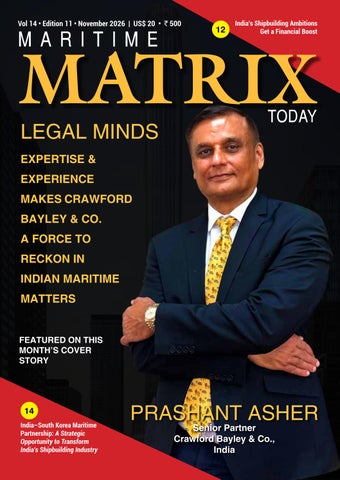
Vol 14 • Edition 11 • November 2026 | US$ 20 • ` 500
MA R I T I ME
12
India’s Shipbuilding Ambitions Get a Financial Boost
MATRIX LEGAL MINDS
TODAY
EXPERTISE & EXPERIENCE MAKES CRAWFORD BAYLEY & CO. A FORCE TO RECKON IN INDIAN MARITIME MATTERS FEATURED ON THIS MONTH’S COVER STORY
14 India–South Korea Maritime Partnership: A Strategic Opportunity to Transform India’s Shipbuilding Industry
PRASHANT ASHER Senior Partner Crawford Bayley & Co., India
02 | Maritime Matrix Today | November 2026
Maritime Matrix Today | November 2026 | 03
Table of CONTENTS 12
India’s Shipbuilding Ambitions Get a Financial Boost
08 Cover Story
THE STRATEGIST OF COMMODITY LAW How Crawford Bayley & Co. Secured a High-Stakes Perishable Cargo Against High-Seas Diversion
28
Srishti Launch Strengthens India’s Offshore Maritime Vigilance
14
India–South Korea Maritime Partnership: A Strategic Opportunity to Transform...
29
DP World Launches DFCEnabled JNPA to NCR, Gujarat Services
17
Kashti 2026 Reinforces the Bonds That Power Maritime India
30
Industry Pushes for Single Digital Standard
22
Transforming India’s Maritime Gateway Strategic Port Upgrades...
32
Charging Ahead with 5 GWh Battery Capacity
25
Dual-Fuel Container Ships A New Opportunity for India’s Maritime Industry
34
Faster Document Retrieval During Audits
26
Damen Deepens Commitment to BatteryPowered Shipping
36
Running for a Cause. Remembering Our Heroes. Saluting the Spirit of Seafarers.
Disclaimer All advertisements in this magazine are placed with no liability accepted by the publisher for the material content therein. No responsibility is accepted by the publisher for omission or error or non-insertion of any advertisements. All advertisements and material in this magazine are subjected to approval by the publisher and are not necessary the opinion of the publisher. No liability is accepted for advertisements that are placed or any information that might be criminally connected. All information is checked to the best of our knowledge and is reliant upon the material submitted not being in contravention of all relevant laws and regulations and within the provisions of the Trade Practices Act. Reproduction Prohibited Maritime Matrix Today will not be responsible for the views expressed by contributors in their personal capacity. All rights reserved. Reproduction in part or whole without the permission of the Editor is prohibited. Readers are recommended To make appropriate enquiries before sending money, incurring expenses or entering into any commitment in relation to any advertisement published in this publication. Maritime Matrix Today does not vouch for any claims made by the Advertisers of Products and Services. The Printer, Publisher, Editor and Owner of Maritime Matrix Today shall not be held liable for any consequences, in the event such claims are not honoured by the Advertisers. RNI: MAHENG/2013/50159 Published by Marex Media Pvt Ltd C-209, Morya House, New Link Road, Andheri West, Mumbai 400058 Email: info@marexmedia.com
04 | Maritime Matrix Today | November 2026
Printed by Young Graphics Printed at Young Graphics, 208 Shankala Industrial Premises, Gogatewadi, Goregaon(E), Mumbai-400 063
• Seaspan technology continues to be a leader in the industry, setting high environmental goals
• COPES Company e-learning training platform completed from the comfort of your home
• Our fleet of Dual Fuel Vessels with Membrane & Type B Tanks sets us up for a strong future
• Gender friendly accommodation facilities
• MAN ‘ME-GI Mark 2’ Main engines, a step further than present generation of main engines • The ‘EGR (Exhaust Gas Recirculation)’ as well as ‘SCR (Selective Catalytic Reactors)” as means to bring down NOx emissions to Tier III levels
• Female Engagement Champions across offices worldwide • Quality growth • Low LTIF & High retention • Wages in top Quartile, and consistent operational excellence
ADDRESS: Seaspan Crew Management India Private Limited, 501, Kamla Executive Park, Andheri (E), Mumbai 400 059, India TEL: Chennai: +91-9884450085 Cochin: +91-9633110085 Mumbai: +91-22-40666200 | EMAIL: Jobs@Seaspancrew.com
License no MUM-014 valid till 6 Feb 2031 CIN No.: U 78100 MH 2005 PTC 152233
Maritime Matrix Today | November 2026 | 05
Editorial
Navigating Change: Law, Innovation and the Human Spirit of Maritime The November 2026 issue of Maritime Matrix Today explores an industry being reshaped by legal complexity, strategic investment, technological innovation and the enduring strength of its people. Across its cover story and articles, one message emerges: maritime progress depends not only on scale and speed, but also on judgement, resilience and trust. Our cover story, “The Strategist of Commodity Law”, examines how Crawford Bayley & Co., led by Senior Partner Prashant Asher, secured a high-stakes cargo dispute involving 386 metric tonnes of raw cashew nuts diverted during transit. The case demonstrates that international trade documentation must withstand rigorous scrutiny. By exposing inconsistencies in the purported original Bill of Lading, securing interim protection and moving swiftly towards arbitration and settlement, the legal team showed how forensic attention, procedural agility and commercial thinking can protect cargo. The accompanying conversation with Mr Asher offers insight into maritime law, cross-border enforcement and the discipline of preparation. It reminds us that confidence in shipping rests as much on credible legal frameworks as on vessels and ports. India’s maritime ambitions form another strong thread. Specialised credit-risk insurance under the National Shipbuilding Mission could strengthen confidence in domestic and export shipbuilding. Articles on dual-fuel container ships and the India–South Korea VOYAGES partnership examine opportunities to expand capacity, acquire technology, develop skills and build a competitive manufacturing ecosystem. Coverage of
port modernisation—from deeper-draft capability at Paradip to improved connectivity at Visakhapatnam and environmental action at Jawahar Dweep—shows why infrastructure, logistics and sustainability must advance together. This edition also considers a changing global landscape: shifting port rankings, Asian vehicle exports and carcarrier demand, geopolitical chokepoints, and fleetmanagement developments. Reports on electric cranes, automated twistlocks, AI-enabled surveys, sensor-driven engine reliability and standardised vessel and emissions data illustrate how digitalisation is becoming practical. Its value, however, will depend on safe implementation, interoperability and skilled people who can use technology responsibly. People remain at the heart of this transformation. Kashti 2026 brought the maritime fraternity together across generations, while SEARATHON 2026 honoured seafarers who lost their lives in the Strait of Hormuz and brought public attention to their sacrifice. These stories remind us that shipping is not simply an economic system; it is a human endeavour sustained by courage, expertise and solidarity. We invite readers to engage with this edition and help shape a maritime future that is legally sound, technologically capable, commercially resilient, socially responsible and humane for generations to come. - Kamal Chadha
Team Matrix Kamal Chadha Group CEO
Radhika Vakharia CEO & Editor
Delphine Estibeiro Editorial Coordinator
Jagdamba Pandey Manager, Business and Promotion
kamal@marexmedia.com
radhika@marexmedia.com
delphine@marexmedia.com
jagdamba@marexmedia.com
Shirish Kirtane HOD Graphics
Santosh Nivalkar Sr. Graphic Designer
Manish Malve Graphic Designer
Bhavna Pimpale Coordinator
shirish@marexmedia.com
santosh@marexmedia.com
manish@marexmedia.com
bhavna@marexmedia.com
06 | Maritime Matrix Today | November 2026
Maritime Matrix Today | November 2026 | 07
Cover Story
THE STRATEGIST OF COMMODITY LAW
How Crawford Bayley & Co. Secured a High-Stakes Perishable Cargo Against High-Seas Diversion
I
n the fast-paced, high-stakes arena of international commodity trading, written word is supposed to be absolute law. For over a century, a singular rule governed global maritime freight: whoever holds the physical original Bill of Lading holds absolute title to the goods. But what happens when an original document is shrouded in anomalies, and High-Stakes cargo is actively being diverted mid-transit? In a landmark legal battle that concluded this autumn, premier law firm Crawford Bayley & Co. proved that a title document is only as strong as its credibility. Representing UAE-based buyer COAF FZE, the firm successfully navigated an intricate web of international jurisdiction, fraudulent shipping reroutes, and high-stakes claims to preserve 386 metric tonnes of raw cashew nuts sitting at New Mangalore Port. THE CASE AT A GLANCE
Jagdamba Prasad Pandey
cashews destined for Vietnam. COAF paid the invoice in full. Yet, while the vessel was mid-transit, the shipping data was surreptitiously altered, and the 15 containers were abruptly rerouted to New Mangalore Port in India. By the time the cargo touched Indian shores, three rival claimants emerged to seize the stock, including an Indian trading house claiming to hold the “original” Bill of Lading. Dismantling the “Original” Document Appearing before Justice M.G.S. Kamal at the Karnataka High Court, the legal strategy required surgical precision. While maritime presumption heavily favours the holder of an original Bill of Lading, Crawford Bayley & Co. meticulously dismantled the rival claimant’s paperwork, exposing a string of critical structural flaws: •
Temporal Impossibility: The rival firm claimed an advance payment was made in March 2026 against a commercial invoice that wasn’t even generated until June 2026.
•
The Appearance of Seals: Earlier legal iterations of the document bore no official stamps, yet a copy filed later suddenly featured six unexplained seals.
•
Mismatched Identity: The physical corporate seals on the packaging lists completely contradicted the seals stamped on the Bill of Lading.
• Dispute Value: USD 566,282.57 (Approx. ₹4.75 Crores) • Subject Matter: 386.541 MT of raw cashew nuts (15 High-Cube Containers) • Forum: High Court of Karnataka & Arbitration The Mid-Ocean Reroute The conflict ignited when COAF FZE contracted with another UAE firm, Avanikailani Commodities, for Ghana-origin
08 | Maritime Matrix Today | November 2026
The High Court agreed with the scrutiny, ruling that the self-proclaimed original documents failed to evince basic credibility. In a major win for arbitration jurisprudence, the Court held that interim safety nets under Section 9 can actively bind and restrain “strangers” to an arbitration agreement if they voluntarily step forward to claim the prize. Turning Litigation into Commercial Resolution For perishables like raw cashews, a court victory is only half the battle. With a strict nine-month shelf-life and massive port storage fees racking up at USD 300 per container every single day, time was the ultimate enemy. “A perishable commodity cannot wait indefinitely. Interim judicial protection must be rapidly weaponised into a workable commercial outcome.” Moving with lightning speed, Crawford Bayley & Co. expeditiously transitioned the battleground from High Court to an arbitration headed by former Bombay High Court Judge, Justice S.J. Kathawalla. Within mere days of the commencement of arbitration, the firm applied for an immediate public auction of the cargo to stop the financial bleeding of port demurrage. The tactical pressure of an imminent public auction forced all rival entities to the negotiating table. By September 12, 2026, just weeks after the initial High Court intervention, a comprehensive settlement was executed via formal Consent Terms. The rival claimant agreed to take the cargo on an “as-is” basis, absorbing all customs, port clearing, and heavy demurrage costs, while routing a structured settlement payment back to COAF FZE. The Core Insights The resolution of the cashew cargo dispute stands as a definitive blueprint for modern commercial litigation. It highlights the ethos Crawford Bayley & Co. has come to personify: flawless forensic documentation analysis, rapid jurisdictional adaptability, and a commercial mindset that prioritises protecting client asset value over prolonged, destructive court wars. Maritime Matrix Today | November 2026 | 09
In Conversation with Mr Prashant Asher Mr. Prashant Asher is a Senior Partner at M/s. Crawford Bayley & Co., one of India’s oldest fullservice law firms. He leads a tier-one maritime and admiralty practice that handles dry and wet shipping, vessel arrests, charterparty and cargo disputes, marine insurance, and offshore energy mandates. The firm represents a prominent portfolio of domestic and international clients—including Adani Enterprises Ltd., Monjasa A/S, and Macquarie Bank Ltd.—and notably acted for ING Bank N.V. on global trade receivables by arresting over 80 vessels across Indian ports and securing recoveries in 78 matters. In addition to his cross-border enforcement record, Mr. Asher’s practice leadership regularly addresses global industry forums and includes serving as an expert witness on Indian maritime law before the High Court of Justice (Commercial Court, QBD) in London. Jagdamba Prasad Pandey from Maritime Matrix Today recently had the opportunity to interview Mr. Prashant Asher, capturing insights into his extensive legal expertise and leadership in the maritime and admiralty sector. What was the exact moment during your forensic review of the paperwork when you spotted the flaws that dismantled the “original” Bill of Lading? Usually, in cross-border trade, when a paper trail defies basic chronology, it is clear you are looking at a fabricated shield rather than a genuine title. Although, the turning point was noticing the sheer commercial impossibility of their financial and physical timelines where they claimed they paid a hefty advance in March for a commercial invoice that magically didn’t exist until June. Surprisingly, their purported “original” Bill of Lading surfaced initially with zero seals, only to later appear suspiciously stamped with six different company seals without any logical explanation.
an order that forced the terminal to preserve the goods at the ultimate loser’s expense, we effectively halted the daily cash drain. This strategy prevented the perishable nature of the goods from being weaponized against us, preserving our leverage.
Considering the perishable nature of the cargo costing $300 a day in port fees, how critical was your strategy to expedite the court hearings and force a fast, commercial settlement through private arbitration?
How will this victory-proving that court protection orders can freeze the assets of “strangers” to an arbitration-change the landscape for international trade disputes at Indian ports?
While dealing with perishable commodities stuck in transit, the ticking clock literally eats your client’s margins. Our immediate play under Section 9 of the Arbitration Act was a commercial necessity to instantly freeze the diverted cargo and prevent an unauthorized fire sale. By securing
This ruling decisively closes a classic loophole often exploited in cross-border maritime fraud. Fraudsters frequently divert cargo and transfer it to a “stranger” or shell entity, hoping to dodge the original arbitration agreement. The court established that protective orders
10 | Maritime Matrix Today | November 2026
bind these third parties if their independent claims lack prima facie credibility, effectively widening the enforcement net. It puts the market on notice that merely possessing a manipulated maritime document will no longer guarantee automatic immunity or cargo release.
Navigating cross-border crises involves intense financial stakes and chaotic time zones. How do you personally maintain absolute mental clarity when a high-velocity case is in full swing?
How do you balance preserving the traditional values of a historic institution like Crawford Bayley & Co. with the need to stay agile in today’s aggressive corporate environment?
First step is to assess every matter based on the documents and information available to us. We then formulate a strategy and build a strong foundation through careful preparation and meticulous drafting. The objective is to address every relevant aspect of the case from the outset, so that we are prepared for the challenges that may follow. Ultimately, the focus remains on resolving the issue at hand, and a structured approach helps us navigate the pressure without losing sight of that objective.
At our firm, we place great emphasis on meticulous drafting and thorough preparation which is captured in our pleadings and they are drafted to address every minute aspect of the matter, ensuring that the foundation of our case is as strong and comprehensive as possible. With a carefully guarded and strategically articulated approach leaving narrow room for opposing parties to develop or advance a defence. Keeping in mind that the matter may progress to the higher appellate forums, including the Apex Court, and that the case must be built on a sound legal foundation from the outset. This approach has served us well in several matters, where we have successfully pursued the case through the higher courts. The nature of disputes may vary, but integrity, thorough preparation, and the trust reposed in us by our clients remains at the core of our practice.
What is one vital piece of advice you would give to a young maritime lawyer today that they will never find in a legal textbook? Be thorough and never take any document at face value. In maritime disputes, a matter can turn on the smallest detail, something that may seem insignificant at first but can ultimately make all the difference. Peruse every document and details carefully and never leave any issue unaddressed. With experience, you realise that cases are won on how well you are prepared. MMT
Maritime Matrix Today | November 2026 | 11
Shipbuilding Mission
India’s Shipbuilding Ambitions Get a Financial Boost
I
ndia’s shipbuilding industry is poised for a significant boost following the Shipping Ministry’s announcement of two specialised credit risk insurance products under the National Shipbuilding Mission. The initiative marks an important step towards strengthening domestic shipbuilding capabilities, improving access to finance, and creating a more supportive environment for shipyards, shipowners, lenders, and maritime enterprises. At a time when India is seeking to expand its maritime footprint and reduce dependence on foreign-built vessels, the introduction of targeted insurance mechanisms could help address one of the industry’s most persistent challenges: financial risk. Shipbuilding is a capital-intensive activity that requires substantial investment, long project timelines, specialised infrastructure, and close coordination between multiple stakeholders. Unlike many manufacturing industries, shipbuilding involves significant financial commitments well before a vessel is delivered and begins generating revenue. Delays in construction, changes in project costs, buyer defaults, and uncertainties surrounding payments can create substantial pressure on shipyards and financial institutions. Specialised credit risk insurance can help mitigate some of these risks, thereby improving confidence in financing shipbuilding projects.
12 | Maritime Matrix Today | November 2026
The Ministry’s announcement is therefore more than a financial measure. It reflects a broader policy effort to create the institutional and financial foundations required for India to emerge as a competitive shipbuilding nation. Two Policies, Two Distinct Areas of Protection The two insurance products have been designed to address different segments of the shipbuilding market. The Shipbuilding Project Credit Risk Insurance Policy (SbPCP), developed by ECGC Ltd., will cover export-oriented shipbuilding projects. It is intended to strengthen protection for Indian shipyards undertaking contracts in international markets, where payment delays, buyer defaults and changing commercial conditions can expose manufacturers to considerable financial uncertainty. The second product, the Business Credit Shield Policy– Shipbuilders (BCSPS), developed by The New India Assurance Company Ltd., will provide protection for domestic shipbuilding projects. This is particularly relevant as India seeks to encourage Indian shipowners and shipping companies to procure vessels from domestic shipyards, strengthening the relationship between vessel demand and indigenous manufacturing capacity.
A key feature of the initiative is the government’s commitment to subsidise insurance premiums and provide direct support to insurers when shipyards file eligible claims. This intervention is expected to make risk coverage more accessible and reduce the financial burden associated with securing insurance for large and complex shipbuilding contracts. Union Minister for Ports, Shipping and Waterways Shri Sarbananda Sonowal emphasised that a missed milestone payment can disrupt an entire shipyard’s operations. The new policies, he indicated, are intended to provide a financial safety net, allowing shipyards to concentrate on building world-class vessels without being unduly constrained by delayed payments or sudden shifts in global markets. Strengthening the National Shipbuilding Mission The insurance products have been introduced under the Shipbuilding Development Scheme (SbDS), which forms part of the government’s wider strategy to revitalise domestic shipbuilding. The objective is not merely to support individual shipyards, but to establish a more resilient industrial ecosystem capable of attracting investment, encouraging technological advancement and increasing India’s share of global shipbuilding activity. Shipbuilding generates demand across a broad industrial network, including steel production, marine engineering, propulsion systems, electrical equipment, navigation technology, electronics, design services and specialised manufacturing. Greater confidence in shipbuilding contracts can therefore stimulate growth well beyond the shipyards themselves. A stronger domestic industry could also create opportunities for small and medium-sized enterprises supplying components, machinery and technical services. Over time, improved demand visibility and more reliable payment arrangements could encourage these suppliers to invest in capacity, modernise production facilities and develop specialised capabilities. The government’s broader shipbuilding programme combines financial assistance with development measures intended to improve infrastructure and industrial capacity. The Shipbuilding Financial Assistance Scheme addresses the cost disadvantages faced by Indian shipyards, while the Shipbuilding Development Scheme supports the creation and expansion of shipbuilding facilities. Credit risk insurance adds another layer by addressing uncertainties associated with contractual payments and project financing. Together, these interventions seek to tackle several interconnected barriers to competitiveness: construction costs, access to finance, infrastructure limitations and commercial risk.
specialised ships creates opportunities for countries with the industrial capability to design and manufacture competitive vessels. India possesses established maritime institutions, engineering expertise, a substantial industrial base and a long coastline. However, converting these advantages into a larger global shipbuilding presence requires sustained investment, predictable policies, skilled personnel and the ability to deliver vessels within agreed costs and schedules. The new insurance framework could improve confidence among lenders and shipowners by reducing exposure to certain financial risks. Its actual impact, however, will depend on implementation, the scope of coverage, the efficiency of claims settlement and the accessibility of the products to eligible shipyards. Clear contractual provisions and transparent procedures will be essential to ensure that the intended protection translates into tangible benefits. The initiative also needs to be accompanied by investments in research and development, modern production technologies, workforce training and stronger domestic supply chains. Financial protection can help stabilise projects, but long-term competitiveness ultimately depends on productivity, quality, innovation and timely delivery. Building Towards Maritime Self-Reliance The announcement was made during the 21st Maritime State Development Council meeting in Mumbai, which also addressed wider priorities for integrated maritime development, port connectivity and industrial growth. The Council called for port-linked industrial clusters, improved multimodal connectivity and the implementation of the One Nation One Port Process reforms across ports by March 2027. These parallel initiatives underline an important principle: shipbuilding cannot develop in isolation. It requires efficient ports, connected industrial zones, reliable logistics, access to finance and coordination between central and state governments. For India, the introduction of specialised credit risk insurance represents a meaningful step towards creating that enabling environment. By addressing financial uncertainty in both domestic and export projects, the government is seeking to give Indian shipyards greater confidence to undertake ambitious contracts and compete in international markets. The ultimate measure of success will be whether these policies translate into more orders for Indian-built vessels, stronger domestic manufacturing networks, greater private investment and sustainable employment across the maritime sector. MMT
The timing of the announcement is significant. Global shipping is undergoing changes driven by fleet renewal, decarbonisation, technological innovation and evolving supply chains. Demand for more efficient vessels, alternative-fuel technologies and Maritime Matrix Today | November 2026 | 13
International Partnerships
India–South Korea Maritime Partnership: A Strategic Opportunity to Transform India’s Shipbuilding Industry
I
ndia is taking significant steps towards transforming its shipbuilding industry into a globally competitive manufacturing sector through strategic international partnerships, technological collaboration and infrastructure development. A major milestone in this direction was the adoption of the India–Republic of Korea (ROK) Comprehensive Framework for Partnership in Shipbuilding, Shipping and Maritime Logistics on 20 April 2026, during the state visit of South Korean President Lee Jae Myung to India. Announced by Prime Minister Narendra Modi’s office, the framework, titled VOYAGES — Shared Vision for Operation of Yard Assisted Growth with Efficiency and Scale, seeks to combine India’s expanding industrial potential with South Korea’s established expertise in advanced shipbuilding. The initiative comes at a crucial time when global shipping
14 | Maritime Matrix Today | November 2026
companies are investing in modern vessels, alternative-fuel technologies and more efficient maritime supply chains. It also presents India with an opportunity to address its shipbuilding capacity limitations and strengthen its role in the international maritime economy. Why South Korea Matters to India South Korea is among the world’s leading shipbuilding nations, with considerable expertise in constructing large container ships, liquefied natural gas carriers, tankers and technologically sophisticated commercial vessels. Its shipbuilders have developed advanced capabilities in naval architecture, production engineering, automation, quality assurance and alternative-fuel propulsion systems. India, meanwhile, offers a growing domestic market, a large industrial workforce, an expanding maritime sector and significant opportunities for new shipyard development. The VOYAGES framework seeks to bring these complementary strengths together. India has invited leading South Korean shipbuilders to participate as technical and strategic partners in the development of large greenfield shipbuilding clusters. Their involvement could extend beyond investment to include ship design, production engineering, advanced manufacturing, operational management and the establishment of international quality and safety standards. Such collaboration could accelerate the development of Indian shipyards while enabling domestic manufacturers to acquire expertise that would otherwise take years to develop independently.
The Proposed Mega Shipyard at Thoothukudi
Meeting the Demand for Modern Commercial Ships
A significant implementation step emerged through a tripartite memorandum of understanding involving HD Korea Shipbuilding & Offshore Engineering (HD KSOE), National Shipbuilding & Heavy Industries Park, Tamil Nadu Limited, and Sagarmala Finance Corporation Limited. Announced on 13 May 2026 by the Ministry of Ports, Shipping and Waterways, the agreement provides a foundation for developing a mega greenfield shipyard at Thoothukudi, Tamil Nadu, with an envisaged annual capacity of 2.5 million gross tonnes.
The global shipping industry is undergoing a major fleetrenewal cycle. Container operators and other shipowners are investing in larger, more efficient vessels while exploring alternative fuels to respond to environmental pressures and evolving regulations. However, constructing these ships requires substantial capital, specialised infrastructure and sophisticated engineering capabilities.
The project is intended to establish a modern shipbuilding ecosystem incorporating ancillary manufacturing, marine equipment production, advanced engineering and workforce development. It could also support the adoption of digital shipbuilding technologies and greener vessel designs. The planned capacity is an important ambition, but its eventual contribution will depend on project implementation, financing, infrastructure readiness, equipment availability and the development of a dependable order pipeline. Nevertheless, the initiative represents a meaningful step towards expanding India’s capacity to construct large commercial vessels.
India’s domestic demand provides a potential foundation for growth. Under the plans presented during India Maritime Week 2025, public agencies were expected to acquire more than 400 vessels over the foreseeable future, with an estimated value of ₹2.2 lakh crore. The VOYAGES framework seeks to channel this demand into partnerships between Indian and South Korean companies, helping domestic shipyards build a more predictable order pipeline. Recent commercial developments also demonstrate the potential of Indian shipyards. Cochin Shipyard Limited has secured orders from CMA CGM for six LNG-fuelled feeder container ships, while Swan Energy’s Pipavav shipyard has attracted international orders for chemical tankers and ammonia-powered bulk carriers, according
Maritime Matrix Today | November 2026 | 15
International Partnerships to the Ministry’s May 2026 announcement. These projects illustrate opportunities across different vessel categories, although the ability to deliver consistently at scale will remain critical to attracting further international business. Investment, Technology and Local Manufacturing A central objective of the partnership is to create an industrial ecosystem rather than merely construct additional dry docks. Government support for shipbuilding, combined with private investment and international technical expertise, could encourage the domestic production of marine engines, propulsion systems, electrical equipment, automation technologies and alternative-fuel components. The opening of a Mumbai branch of the Korea Marine Equipment Association (KOMEA) is another development intended to strengthen connections between Korean equipment manufacturers and Indian industry. Greater local manufacturing could reduce dependence on imported components, improve supply-chain resilience and create opportunities for Indian small and mediumsized enterprises. The framework also supports collaboration to upgrade existing Indian shipyards, including facilities for block fabrication and the construction of large, specialised vessels. Such investments could improve productivity and help shipyards manage increasingly complex construction programmes. However, local manufacturing will require consistent demand, technology transfer, competitive financing and sustained investment in research and development. Skills, Ports and Maritime Education The partnership recognises that infrastructure alone cannot create a globally competitive shipbuilding industry. India will also require skilled naval architects, marine engineers, production specialists, welders, technicians and shipyard managers. Cooperation involving the Korea International Cooperation Agency and India’s Ministry of Ports, Shipping and Waterways is intended to support shipbuilding skills development. Discussions between Indian Maritime University and Korea Maritime & Ocean University could further strengthen maritime education, research and innovation. Potential areas include naval architecture, marine engineering, port management, autonomous vessels and green shipping technologies. These collaborations could help align academic programmes with industry
16 | Maritime Matrix Today | November 2026
requirements and prepare the next generation of maritime professionals. The framework also includes cooperation in port development, with opportunities for Korean developers and terminal operators to participate in Indian infrastructure projects. The two countries have identified potential collaboration across port infrastructure, terminal mechanisation and logistics, reinforcing the connection between shipbuilding capacity and the wider maritime supply chain. Challenges and the Road Ahead Despite its promise, India’s ambition to become a major shipbuilding hub faces several challenges. Chinese, South Korean and Japanese shipyards benefit from established supplier networks, extensive infrastructure and experience in large-scale serial production. Indian shipyards must therefore improve productivity, control construction costs, secure reliable financing and meet delivery schedules to compete effectively. The VOYAGES framework offers a pathway to address these constraints through international collaboration, but its success will depend on converting agreements into operational facilities, confirmed orders, technology transfer and sustained industrial investment. Transparent project milestones, effective coordination between central and state governments, and the development of domestic component suppliers will be equally important. The India–South Korea VOYAGES framework represents a strategic opportunity to reshape India’s shipbuilding industry through investment, technology, skills and international cooperation. The proposed Thoothukudi mega shipyard and wider industrial partnerships could expand domestic capacity, strengthen local manufacturing and help Indian shipyards pursue more sophisticated commercial vessel orders. India’s objective should not simply be to build more ships, but to establish a reliable, technologically advanced and commercially competitive shipbuilding ecosystem. If the partnership delivers on its ambitions, it could contribute significantly to India’s Maritime Amrit Kaal Vision 2047 and position the country as an increasingly important participant in global shipbuilding, shipping and maritime logistics. MMT
Kashti 2026
Kashti 2026 Reinforces the Bonds That Power Maritime India Delphine Estibeiro
M
umbai’s maritime fraternity gathered in impressive numbers on 21st October at the prestigious Sri Shanmukhananda Fine Arts & Sangeetha Sabha for the Riya Marine-Marex Media 14th Edition of Kashti – The Musical 2026, an evening that once again demonstrated the power of music to bring the shipping community together. More than an entertainment programme, Kashti has evolved into a cherished maritime institution, symbolising the journeys, aspirations and shared experiences that bind the industry. This year’s edition attracted over 2,000 attendees, including shipping industry leaders, seafarers, veterans, family members, cadets and maritime stakeholders, reaffirming its status as one of the sector’s most anticipated annual gatherings. Maritime Matrix Today | November 2026 | 17
Kashti 2026
The event also underscored Kashti’s enduring commitment to nurturing future maritime talent. A total of 144 cadets and 21 faculty members from The Great Eastern Institute of Maritime Studies, Indian Maritime University - Mumbai Port Campus, Anglo-Eastern Maritime Academy and Ganpat University participated in the programme. During the inauguration ceremony, cadets joined in the traditional lamp-lighting ritual, symbolically representing the future of India’s maritime sector. A defining highlight of the evening was the return of acclaimed playback singer Hema Sardesai to the Kashti stage after an 18-year hiatus. Her electrifying performance, marked by powerful vocals and popular hits, captivated the audience and added a touch of nostalgia to the celebrations.
18 | Maritime Matrix Today | November 2026
Reflecting on the significance of the event, Mr Bharat Mehhrotra, Associate Vice President (Business Development), Riya Marine Travel, said: “The maritime industry is built on people,
partnerships and a shared understanding of the challenges that come with keeping the world connected. What makes an evening like Kashti special is the opportunity to step beyond our day-to-day roles, reconnect with peers and strengthen the relationships that sustain this community. As an industry, we have much to gain from creating more spaces for meaningful dialogue and collaboration. For us at Riya Marine, being part of this community means not just serving its needs, but actively contributing to its growth and cohesion.” The evening also recognised outstanding contributions to Indian shipping with the presentation of the Lifetime Achievement Award to Capt Sudheer S Naphade. A respected maritime veteran, former Nautical Adviser to the Government of India and former Director General of Shipping (in charge), Capt Naphade was honoured for a distinguished career spanning ship operations, maritime administration and industry leadership. In his acceptance remarks, the 84-year-young mariner shared a simple but powerful lesson from his mentor:
whatever profession one chooses, strive to be the very best at it. Addressing the many cadets present, he encouraged young professionals to pursue excellence throughout their careers, drawing warm applause from the audience. Leading support for Kashti 2026 came from Riya Travel And Tours (India) Pvt Ltd, alongside valued contributors including Anglo-Eastern Ship Management (India) Pvt Ltd, Seaspan Crew Management India Pvt Ltd, d’Amico Ship Ishima India, The Great Eastern Shipping Company Ltd, The Maritime Union of India, Elite Mariners, Ganpat University, MASSA, Patel International, Sea Bird Medicare, Seaarland Management Services, TBO and Tolani Maritime Institute. As the curtains fell on the 14th edition, the overarching message was clear: while ships connect nations, it is people, relationships and shared experiences that truly hold the maritime community together. Kashti 2026 celebrated precisely that spirit. MMT
Maritime Matrix Today | November 2026 | 19
20 | Maritime Matrix Today | November 2026
Maritime Matrix Today | November 2026 | 21
Ports
Transforming India’s Maritime Gateway Strategic Port Upgrades and Modernisation Initiatives
I
ndia’s maritime sector is undergoing a significant transformation as the government invests in port infrastructure, freight connectivity and environmentally sustainable operations. With the country’s international trade heavily dependent on maritime transport, efficient ports are essential for strengthening supply chains, reducing logistics costs and improving export competitiveness. The Ministry of Ports, Shipping and Waterways (MoPSW) is pursuing a multi-pronged modernisation strategy that combines deeper navigational channels, improved road connectivity and greener port operations. Recent developments at Paradip Port, Visakhapatnam Port and Mumbai’s Jawahar Dweep Terminal illustrate how
22 | Maritime Matrix Today | November 2026
infrastructure upgrades and environmental initiatives can address different challenges across India’s maritime network. These projects represent more than isolated improvements. Together, they demonstrate the importance of integrating port capacity, hinterland connectivity and environmental responsibility to create efficient, resilient and sustainable maritime gateways. Paradip Port: Capabilities
Expanding
Deep-Draft
Shipping
Paradip Port, located on Odisha’s eastern coast, is an important gateway for bulk commodities, including coal, iron ore and other industrial cargoes. As international trade increasingly demands efficient handling of larger vessels, ports must continually upgrade their channels and berthing infrastructure to accommodate greater draughts and higher cargo volumes. According to the project details provided, Paradip Port has commissioned major development works valued at ₹427.80 crore, including capital dredging and structural enhancements designed to support vessels with drafts of up to 18.5 metres. The ability to accommodate deeper-draft vessels can offer substantial operational advantages. Larger ships can carry more cargo per voyage, potentially reducing the freight cost per tonne and improving economies of scale. For bulk cargo importers and exporters, these efficiencies can contribute to more competitive supply chains. They may also help reduce the number of vessel movements required to transport equivalent cargo volumes.
The benefits, however, depend on more than channel depth alone. Adequate berth depth, turning basins, navigational safety, cargo-handling equipment and reliable access to the hinterland are equally important. Dredging must also be managed responsibly, with appropriate attention to sediment disposal and marine environmental impacts. By strengthening its deep-draft capabilities, Paradip can improve its readiness to handle larger vessels and support the cargo requirements of industries across eastern and central India. The investment also reinforces the broader objective of improving the efficiency of India’s eastern maritime corridor. Visakhapatnam Connectivity
Port:
Improving
Urban-Port
Port efficiency depends not only on facilities within the port boundary but also on how quickly cargo can move between terminals, highways, industrial centres and distribution networks. In busy port cities, heavy truck movements often compete with ordinary urban traffic, creating congestion, increasing journey times and raising vehicle operating costs. To address these challenges, a ₹334.89 crore flyover project has been approved for Visakhapatnam Port, according to the information provided. The proposed infrastructure is intended to improve freight movement between port facilities and the surrounding road network by reducing conflicts between port-bound vehicles and city traffic. The expected benefits include more predictable cargo transit times, fewer delays at road intersections and reduced vehicle idling. For shipping companies, transport operators and cargo owners, better connectivity can improve the reliability of the wider logistics chain. More consistent truck movements can also support terminal planning and help reduce queues at port entry points. Environmental gains are possible as well. Vehicles caught in prolonged congestion consume fuel while travelling slowly or idling, increasing emissions and local air pollution. Smoother freight movement can help reduce these impacts, although the scale of the benefit will depend on traffic management, road design and the extent to which congestion is actually reduced. The flyover should therefore be viewed as part of a wider logistics strategy. Effective port-city integration also requires coordinated traffic planning, efficient gate operations, digital cargo documentation and better
scheduling of truck arrivals. When these measures work together, port infrastructure can deliver benefits extending well beyond the immediate project site. Jawahar Dweep Terminal: Advancing Plastic-Free Marine Operations While infrastructure capacity and cargo connectivity remain essential, environmental sustainability is becoming an increasingly important measure of port performance. Marine terminals must manage waste responsibly to protect coastal ecosystems, reduce pollution and maintain safe operating environments. Jawahar Dweep, an offshore marine oil terminal serving Mumbai, has reportedly been declared India’s first plasticfree marine oil terminal, according to the supplied information. The initiative highlights the potential for targeted environmental measures to improve operational practices at specialised maritime facilities. Plastic waste entering the sea can persist for long periods, fragment into smaller particles and threaten marine organisms. Offshore terminals face particular challenges because waste handling, vessel movements and marine activities occur in close proximity to sensitive aquatic environments. Plastic-free operations typically require a combination of measures, including restrictions on single-use plastics, segregation and collection of waste, responsible procurement, appropriate disposal arrangements and awareness among employees, contractors and visiting vessels. Effective implementation also requires monitoring to ensure that waste is not simply transferred elsewhere without proper treatment. At an oil terminal, environmental management must extend beyond plastics to include oil-spill prevention, wastewater control, emergency preparedness and the safe handling of hazardous materials. A plastic-free designation can be an important operational milestone, but sustained results depend on consistent compliance, transparent monitoring and continuous improvement. If maintained effectively, the initiative at Jawahar Dweep could provide a useful example for other offshore terminals and coastal facilities seeking to strengthen environmental standards. An Integrated Approach to Maritime Modernisation The three initiatives illustrate complementary dimensions of port development. Paradip’s deep-draft improvements
Maritime Matrix Today | November 2026 | 23
Ports
focus on vessel access and cargo-handling potential. Visakhapatnam’s flyover addresses the movement of freight between port terminals and the road network. Jawahar Dweep’s plastic-free initiative places environmental responsibility at the centre of terminal operations. Their combined significance lies in the relationship between these priorities. Deeper channels cannot deliver their full economic benefits if cargo remains delayed on congested roads. Improved road access alone cannot guarantee efficient logistics without effective terminal operations. Similarly, greater cargo capacity must be accompanied by strong environmental safeguards to ensure that maritime growth remains sustainable. India’s wider port-modernisation agenda must therefore continue to emphasise infrastructure investment, digitalisation, multimodal connectivity, workforce capability and environmental management. Progress should be measured not simply by project expenditure or construction milestones, but by improvements in vessel turnaround times, cargo-handling productivity, freight reliability, logistics costs and environmental performance.
24 | Maritime Matrix Today | November 2026
The developments at Paradip Port, Visakhapatnam Port and Jawahar Dweep Terminal demonstrate how India’s maritime modernisation agenda is addressing capacity, connectivity and sustainability together. The ₹427.80 crore investment at Paradip, the approved ₹334.89 crore flyover at Visakhapatnam and the reported plastic-free status of Jawahar Dweep represent distinct but complementary approaches to improving port performance. As India seeks to strengthen its role in global trade, the success of its maritime gateways will depend on how effectively infrastructure investments translate into measurable operational improvements. By combining deeper navigational access, smoother freight connectivity and responsible marine practices, India can build ports that are not only more productive, but also more resilient and environmentally conscious. Ultimately, modern maritime gateways will be essential to improving trade competitiveness, supporting industrial growth and advancing the country’s long-term maritime ambitions. MMT
Maritime
Dual-Fuel Container Ships A New Opportunity for India’s Maritime Industry
C
hina’s shipbuilding industry faces a growing capacity challenge: demand for advanced dual-fuel container ships is outpacing the ability of major shipyards to deliver them within shorter timeframes. Leading shipbuilding groups, including China State Shipbuilding Corporation (CSSC), have secured substantial orders as shipping companies seek to modernise their fleets, improve fuel flexibility and prepare for a lower-emission maritime future. However, with production slots committed years in advance, expanding demand is translating into extended delivery schedules rather than an immediate increase in available vessels. The central issue is not a shortage of orders, but the limited capacity to convert those orders into completed ships quickly enough to meet the industry’s evolving needs. This capacity constraint has implications for the entire maritime sector. Shipowners must plan further ahead, maintain existing vessels for longer and weigh the risks of ordering ships that may not enter service when anticipated. At the same time, shipyards must balance the commercial benefits of a strong order book against the operational pressures of constructing increasingly sophisticated vessels. The challenge is therefore to expand effective production capacity while maintaining quality, controlling costs and delivering ships on schedule. India has a significant opportunity to strengthen its position in the global shipbuilding industry as major Chinese shipyards, including China State Shipbuilding Corporation (CSSC), face capacity constraints and extended delivery schedules for dual-fuel container ships. However, India currently accounts for a small share of global shipbuilding output and cannot yet match China’s scale, infrastructure, production efficiency or established supply chains. Nevertheless, the country is beginning to attract international interest in advanced commercial vessel construction. A notable development came in February 2026, when Cochin Shipyard Limited secured an order from CMA CGM for six LNG-fuelled feeder container ships, each with a capacity of 1,700 TEU. This agreement demonstrates India’s potential to participate more actively in the construction of modern, alternative-fuel vessels for international shipping companies.
The Indian government is also taking steps to strengthen domestic shipbuilding through financial assistance, maritime financing, infrastructure development and skills enhancement. In July 2026, it announced a ₹69,725 crore shipbuilding package aimed at expanding domestic capacity and improving competitiveness. These investments could help modernise existing shipyards, develop new shipbuilding clusters and strengthen the domestic marine equipment manufacturing ecosystem. India could initially focus on feeder container ships, specialised vessels, ship repair and retrofitting before progressively expanding into larger and more technologically sophisticated commercial ships. International partnerships and technology transfer will be particularly important in developing expertise in alternative-fuel propulsion, advanced ship design, automation and efficient construction methods. However, converting this opportunity into a sustainable competitive advantage will require more than government funding. India must improve shipyard productivity, ensure timely access to critical components, develop a skilled workforce, attract long-term orders and offer competitive financing and delivery schedules. The immediate objective should not be to replace China, but to establish India as a reliable alternative for selected vessel categories while progressively increasing its global market share. China’s shipbuilding capacity constraints provide India with a strategic opening, but India’s success will depend on its ability to translate investment and international interest into efficient production, technological capability and timely vessel delivery. MMT
Maritime Matrix Today | November 2026 | 25
Damen Deepens Commitment to Battery-Powered Shipping
R
ecently, Damen Shipyards Group contracted ESTFloattech to supply two battery systems, thereby renewing the framework agreement in place between the two companies since last year. The two Octopus Series battery systems are to be installed on board Damen Combi Freighter (CF) 3850 vessels.
26 | Maritime Matrix Today | November 2026
Towards zero emissions In November 2024, EST-Floattech and Damen Cargo Vessels signed an agreement, formalising their collaboration in a bid to make shipping greener. This latest order will bring the total number of EST-Floattech systems installed on CF 3850 vessels to nine. Contributing to significant emissions reduction The CF 3850 is a successful cargo vessel for short sea markets. Since releasing the next generation version of the vessel, Damen Cargo Vessels has received orders for 50 such vessels in just five years. The CF 3850 is a standard proven platform focused
but we also have the modular flexibility to scale up to meet the specific requirements of our clients.”
One of these options is an EST-Floattech Octopus battery system, ranging from 240 kWh to 1,320 kWh, based on operator requirements. Depending on its size, the battery system enables peak shaving, bow thruster support and/or zero emission port calls. Reliable solution for a proven platform Arjan de Vries, Manager Procurements at Damen Cargo Vessels, said: “The CF 3850 is a proven vessel with an extensive track record. To ensure the continued reliability of the model in the market, we aim to integrate similarly proven options. With the EST-Floattech Octopus battery system, not only do we have a solution we can depend on,
Release By The Maritime Marketeer
on the delivery of high levels of efficiency. In addition to its optimised hull form, the vessel is prepared for the integration of wide-ranging options for increased efficiency. These solutions work in concert with one another, each playing a part in the significant reduction of the vessel’s emissions.
Jelle Meindertsma, Sales Manager at EST-Floattech, said: “We were very pleased to receive this latest order from Damen Cargo Vessels. We greatly value their continued trust in EST-Floattech and the strong collaboration between our two companies. Applying our solutions in a proven vessel type such as the CF 3850 provides us with a unique opportunity to benchmark our performance, resulting in continual product evolution over successive generations. I look forward to continuing this cooperation as we, together with Damen, support vessel operators in achieving their goals for the energy transition.” MMT
Maritime Matrix Today | November 2026 | 27
Srishti Launch Strengthens India’s Offshore Maritime Vigilance
Y
These indigenously designed and built ships will augment the existing OPVs/ NOPVs for multi domain operations, such as maritime surveillance, Search and Rescue, protection of offshore assets, Humanitarian Assistance and Disaster Relief (HADR) and anti-piracy missions. The construction of NGOPVs is concurrently being undertaken at two shipyards (GSL, Goa & GRSE, Kolkata). These ships derive their names from India’s rich heritage, with this ship being named as ‘Srishti’, meaning ‘Creation’ or ‘Act of Creating’ in Sanskrit. The launch marks yet another significant milestone in Indian Navy’s pursuit towards indigenous shipbuilding and is in consonance with Government of India’s vision of Aatmanirbhar Bharat and Make in India initiatives. MMT
28 | Maritime Matrix Today | November 2026
Release By Public Relations Office (Ministry of Defence)
ard 1283 (Srishti), Next Generation Offshore Patrol Vessel (NGOPV), was launched at Goa Shipyard Limited (GSL), Goa on 27 Oct 2026 by Smt Sandeepa Sahay, in the presence of Shri Vishvajit Sahay, Secretary (Defence Finance). The event reflected the rich traditions and ethos of the Indian Navy. Senior dignitaries from the Indian Navy, Ministry of Defence and GSL attended the occasion.
DP World Launches DFC-Enabled JNPA to NCR, Gujarat Services important step towards making India’s logistics more efficient. As the economy grows, moving goods faster and more cost-effectively between ports and key markets will be critical. By connecting JNPA with major markets across NCR and Gujarat, we are helping businesses move cargo faster, reduce logistics costs and build stronger, more resilient supply chains.” Adhendru Jain, Vice President - Rail & Inland Terminals - SCO DP World, said, “India’s National Logistics Policy and PM GatiShakti are driving a more integrated, multimodal and efficient logistics ecosystem, with stronger connections between ports, rail networks and inland markets. Our expansion of DFCenabled double-stack rail services is aligned with this vision, as we continue to build greater rail capacity and strengthen the link between maritime gateways and key consumption and production centres. By connecting JNPA with our ICD network across NCR and Gujarat, we are bringing together dedicated freight infrastructure, higher-capacity rail operations and our inland network to provide customers with more efficient and predictable cargo movement. This not only gives businesses greater choice in how they move cargo but also supports the broader shift towards a more cost-efficient, resilient and sustainable freight network in India.”
D
P World has launched two new Dedicated Freight Corridor (DFC)-enabled double-stack rail services connecting Jawaharlal Nehru Port Authority (JNPA) with its inland container depot (ICD) network in the National Capital Region (NCR) and Sachana in Ahmedabad, Gujarat. The first service, effective September 2026, connects JNPA with DP World’s ICD network at Pali/Rewari, Jhattipur–Panipat and Modinagar in NCR. The second service, connects JNPA with ICD Sachana in Ahmedabad, extending JNPA’s double-stack rail connectivity into Gujarat. Together, the services leverage dedicated infrastructure, higher speeds and higher capacity to move more cargo efficiently, with the potential for improved turnaround times between the maritime gateway and key inland markets.
The new rail connectivity will support key production and consumption clusters across Gujarat and North India, including automotive, engineering, manufacturing, pharmaceutical, chemical, textile and home-furnishing sectors. By connecting these clusters more efficiently with JNPA, the services will provide exporters, importers and domestic supply chains with greater rail capacity and more reliable cargo movement.
The new services further strengthen gateway-to-hinterland connectivity by combining port and inland infrastructure within an integrated network across key consumption and production centres. They provide customers with dependable rail alternatives designed to support faster transit, predictable cargo movement and efficient supply chain planning, while strengthening connections between maritime gateways and inland markets.
Hemant Kumar Ruia, Country Manager, Subcontinent (India), DP World, said, “Expanding double-stack rail connectivity through the Dedicated Freight Corridor is an
Release By Edelman
Double-stack operations increase the amount of cargo that can be moved by rail, while greater use of rail supports a more sustainable logistics network by reducing reliance on road transportation.
MMT
Maritime Matrix Today | November 2026 | 29
Industry Pushes for Single Digital Standard
T
he Tripartite Joint Industry Working Group (JIWG) has released two new frameworks that can help improve the exchange of operations and emissions data across the maritime industry. The JIWG, chaired by BIMCO, was established under the Tripartite, a forum bringing together shipowners and operators, shipbuilders, and classification societies. As part of its work to develop a common approach for Maritime Emissions Reporting, the JIWG has released version 1.0 of the Operational Vessel Data (OVD) and Vessel Emissions Reporting (VER) frameworks. The two frameworks complement each other and can help establish a common foundation for a more efficient exchange of data. Both OVD and VER are voluntary industry frameworks. They do not create new reporting obligations but provide a common approach that organisations may adopt to support more efficient and consistent data exchange. The JIWG’s development of the OVD and VER frameworks complements and builds on earlier work by BIMCO and IACS (International Association of Classification Societies) to add emissions-reporting data elements to the IMO Compendium on Facilitation and Electronic Business. While the IMO Compendium provides common definitions and formats for maritime information, the latest work adds a practical implementation framework for exchanging operational vessel data and verified emissions-reporting results between industry systems. The initiative also forms part of a broader move towards 30 | Maritime Matrix Today | November 2026
using the IMO Compendium as a common foundation for maritime data exchange. Emerging use cases covering portcall optimisation, electronic seafarer certificates and maritime emissions reporting demonstrate how common data definitions can support interoperability across different parts of the maritime sector. The work of the group addresses the common industry challenge of stakeholders facing different reporting systems and data formats which often result in the same information being mapped, entered and checked multiple times. The OVD and VER can support a more consistent, efficient and traceable exchange of data between ships, shipping companies, software providers, verification bodies and other authorised users. The approach will also make it easier to reuse data more consistently across the industry and connected value chains. Two complementary parts of the data flow The OVD provides a structured format for exchanging operational vessel and fuel-consumption data. It defines common data elements, names, units and structures, allowing the information to be interpreted consistently by different systems and organisations. It does not prescribe how data must be collected onboard, which software must be used or where data must be stored, but instead provides a common approach for sharing such data across the maritime industry. The VER complements the OVD by providing standardised formats for emissions reporting in cases when commercial reporting practices and needs vary considerably. This could
include charter-party performance, Emission Trading Schemes (ETS) cost allocation, FuelEU pooling and other commercial arrangements. The VER provides a common way to exchange emissions information, including its verification status for reporting periods that are defined by the user.
Yasuhiro Ikeda, Director, Digital Solutions Division, ClassNK “VER is the result of a truly collaborative effort across all participating organisations, and I would like to thank everyone who contributed to this achievement. By establishing a common foundation for trusted and interoperable emissions data exchange, VER will help improve efficiency, transparency and digital collaboration across the maritime industry. Version 1.0 marks an important beginning, and we look forward to expanding its value through practical use and continued industry cooperation.”
In practical terms, the OVD provides the underlying operational data layer while the VER provides a structured output solution for emissions information. In combination, the two solutions can help support the maritime industry’s objective of capturing data only once and reusing it for all relevant reporting, verification and other purposes.
Bjarte Walaker, Head of Maritime Deliveries, Veracity by DNV
See also the illustration in the annex, which shows the exchange of operational and emissions data across the maritime industry.
“After several years of developing OVD, DNV is very pleased to see its broad adoption and grateful to the shipping companies, solution providers and other contributors who have helped turn it into a formal industry standard. This shared commitment is essential to enabling more efficient, consistent and interoperable exchange of vessel data, helping to reduce friction and support innovation across the maritime industry and connected value chains.”
Responding to a growing reporting burden
Vincent Joly, Smartship Manager - Bureau Veritas Marine & Offshore
The Tripartite JIWG has therefore worked to develop a common approach that allows data to move between different systems, regardless of the technology or service provider used. The OVD builds on a framework initially developed by DNV and subsequently considered through the wider JIWG process. The VER builds on an initial draft prepared by ClassNK and was further developed collaboratively by the participating organisations.
The need for accurate and trusted maritime emissions reporting has increased due to the IMO Data Collection System (IMO DCS) and the EU Monitoring, Reporting and Verification system (EU MRV). Although these requirements serve different purposes, the use of different datasets and system formats can create inconsistencies, repeated data mapping and manual work across the reporting chain.
“As reporting requirements continue to evolve, greater alignment in operational and emissions data is becoming increasingly important. Bureau Veritas has already adopted OVD for emissions data collection and supports this industryled effort to establish common approaches for data exchange. These frameworks provide an important foundation for greater consistency across reporting and verification activities, enabling information to be shared and used more effectively across the maritime ecosystem.”
Industry collaboration and practical implementation As voluntary industry frameworks, OVD and VER version 1.0 provides a baseline for practical use and further development. Organisations can now consider how the formats may be applied within existing systems and processes. Experience from implementation and real-world use will help identify where definitions, guidance, tools or data structures may need further refinement.
“RINA believes that common industry standards are essential to make maritime emissions reporting more efficient, consistent and interoperable. RINA is taking practical steps to adopt OVD within its emissions reporting processes, supporting a common approach to data exchange across the industry. Continued industry collaboration will be key to achieving broad adoption and ensuring that these common frameworks deliver long-lasting value across the maritime sector.” Jeppe Skovbakke Juhl, Chief Naval Architect, Regulatory Affairs, BIMCO – chair of the JIWG “The maritime industry does not need more ways of exchanging the same information. It needs a common approach that allows data to move efficiently between organisations and systems. OVD and VER are an important step in that direction, reducing duplication and creating a stronger foundation for efficient and interoperable reporting.”
Release By JLA Communication
Michela Schenone, Marine Digital and Class Solutions Operations Director - RINA
As part of the next phase, the Tripartite Joint Industry Working Group will also assess options for transitioning OVD and VER towards independent and broadly representative governance. The objective is to establish clear ownership, open participation, transparent decision-making and predictable change management, providing confidence that the frameworks can be maintained as neutral and accessible industry resources. The Joint Industry Working Group will continue to oversee the work while the governance alternatives are assessed and until an appropriate structure is ready to receive the frameworks. No final governance model has yet been selected. MMT
Maritime Matrix Today | November 2026 | 31
Charging Ahead with 5 GWh Battery Capacity
M
ecpower Solutions Limited and Navitas Solar have announced a strategic collaboration to establish a 5 GWh Battery Energy Storage System (BESS) manufacturing facility in Karjan, Gujarat. Expected to commence operations in the first quarter of FY 2027-28, the facility will strengthen domestic battery storage manufacturing capabilities while supporting the growing demand for integrated energy storage solutions across India’s renewable energy sector.
Commenting on the development, Setul Shah, Director, Mecpower Solutions Limited said, “As India continues to scale its renewable energy capacity, Battery Energy Storage Systems will be critical in addressing the intermittency of solar and wind power, improving grid flexibility, and enabling more predictable energy delivery. Our proposed 5 GWh manufacturing facility in Karjan represents a strategic step towards strengthening our capabilities across the energy storage value chain. By integrating battery storage manufacturing with our EPC and IPP businesses, we aim to develop scalable solutions that address the evolving needs of utility-scale renewable energy projects and support India’s transition towards a more flexible and reliable power ecosystem.”
The proposed facility is envisioned as a platform that combines manufacturing, project deployment, and system integration capabilities. By leveraging their respective strengths, Mecpower Solutions and Navitas Solar aim to develop scalable battery storage solutions tailored to utility-scale, commercial, and industrial renewable energy applications. Battery Energy Storage Systems are increasingly becoming a critical component of renewable energy infrastructure, helping address intermittency challenges, improve grid stability, and enable more efficient utilisation of renewable power. Through this collaboration, both companies seek to contribute to the development of indigenous energy storage capabilities that align with India’s long-term renewable energy ambitions. The facility’s output is expected to support project requirements across both organizations, including EPC deployments and utility-scale renewable energy projects, while also addressing the growing market demand for advanced energy storage solutions. 32 | Maritime Matrix Today | November 2026
Release By Passion 4 Communication Pvt Ltd
The collaboration brings together Mecpower Solutions’ strengths in renewable energy project development, engineering, and execution and Navitas Solar’s integrated manufacturing expertise. Building on a longstanding business relationship across solar and renewable energy projects, the partnership marks a significant step towards creating a robust energy storage ecosystem that supports India’s clean energy transition.
Ankit Singhania, Director, Navitas Solar said, “As India accelerates its transition towards renewable energy, Battery Energy Storage Systems are emerging as a critical component of the power sector, enabling better management of renewable intermittency, greater grid flexibility, and more efficient energy utilisation. Building domestic manufacturing capabilities in this segment will be an important step towards strengthening India’s clean-energy supply chain and supporting the evolving requirements of utility-scale storage projects. Through this collaboration, we aim to extend our manufacturing capabilities into a strategically important segment of the energy transition and contribute to the development of scalable storage solutions for India’s power sector.” MMT
Maritime Matrix Today | November 2026 | 33
Beyond the Traditional
Faster Document Retrieval During Audits
M
aritime audits are essential for maintaining safety, regulatory compliance, and operational accountability. Whether conducted internally or by external authorities, these assessments require shipping companies to demonstrate that their vessels operate according to established standards. However, audit preparedness often depends on something seemingly straightforward: how quickly the right documents can be located. Vessel certificates, maintenance records, safety procedures, crew documentation, and inspection reports may be distributed across multiple systems. Retrieving these records manually can delay audits and place unnecessary pressure on onboard and shore-based personnel. As maritime operations become increasingly dataintensive, faster document retrieval is emerging as an important component of effective compliance management.
34 | Maritime Matrix Today | November 2026
Why Document Retrieval Remains a Challenge A commercial vessel maintains extensive documentation covering operational safety, equipment maintenance, environmental compliance, and crew qualifications. These records support requirements established under frameworks such as SOLAS, MARPOL, ISM, and STCW. However, documentation is frequently stored across shared drives, onboard computers, physical archives, and specialized management systems. During an audit, locating a particular inspection record or verifying the latest version of a safety procedure may require searching through several repositories. Inconsistent file naming, duplicate documents, and outdated records further complicate retrieval. These challenges can consume valuable time and create uncertainty when auditors request immediate evidence of compliance.
Moving Beyond Traditional Document Management Traditional document management systems provide centralized storage, but locating information may still depend on knowing the correct filename, folder, or document category. Modern retrieval technologies introduce more intelligent ways to access information. Artificial intelligence, natural language processing, and semantic search enable users to locate relevant records based on their content rather than exact keywords. For example, a compliance officer searching for recent maintenance observations related to firefighting equipment could retrieve relevant inspection reports, corrective action records, and supporting documentation. This reduces dependence on manual navigation and helps teams identify information across different document formats. However, retrieval systems must also distinguish between current and outdated records to ensure that users access appropriate compliance evidence. Improving Audit Preparedness and Response Times Port State Control inspections, internal audits, and external assessments often require operators to provide supporting documents within limited timeframes. Delayed retrieval does not necessarily indicate non-compliance, but it can complicate the inspection process and reduce operational efficiency. Faster document retrieval allows teams to respond more effectively to information requests while minimizing disruption to routine activities. It also supports better coordination between vessel personnel and shore-based departments. When authorized users can access consistent, up-to-date documentation, compliance teams spend less time searching for records and more time verifying their completeness and accuracy.
help locate both the original finding and the corresponding resolution records. Maintaining these connections strengthens the reliability of compliance evidence. Human oversight remains essential, particularly when interpreting regulatory requirements or determining whether documentation adequately demonstrates compliance. Building Continuous Audit Readiness The greatest benefit of faster document retrieval extends beyond individual inspections. When compliance information is consistently organized and accessible, maritime organizations can maintain a more continuous state of audit preparedness. Teams can identify missing records, monitor documentation updates, and address information gaps before scheduled assessments. This approach shifts audit preparation from a periodic administrative exercise toward an ongoing operational discipline. Successful implementation requires standardized document practices, reliable information governance, and integration with existing maritime workflows. Technology becomes most effective when supported by clear responsibilities and established compliance procedures. Faster document retrieval is becoming an important capability for maritime organizations managing increasingly complex compliance requirements. By improving access to accurate, current, and traceable records, shipping companies can reduce administrative delays, strengthen audit preparedness, and support more efficient inspections. Ultimately, effective maritime compliance depends not only on maintaining the right documentation but also on ensuring that critical information is available when it matters most.
This improves overall audit readiness without increasing administrative workloads. Ensuring Accuracy, Traceability, and Document Control Speed alone is insufficient when managing regulatory documentation.
MMT
The Author
Retrieved records must be accurate, current, and traceable to their original sources. Effective retrieval systems should maintain document version histories, access permissions, and audit trails to support accountability. For instance, when an auditor requests evidence of corrective action following a previous inspection, the system should
Kashif Ahmad
For a deeper discussion on the application of AI in audits and inspections, reach out to Kashif at kashif@yodaplus.com.
Senior Manager, Sales Yodaplus Technologies
Maritime Matrix Today | November 2026 | 35
SEARATHON 2026
Running for a Cause. Remembering Our Heroes. Saluting the Spirit of Seafarers.
I
ndia’s First Merchant Navy Marathon celebrates the courage, sacrifice and invaluable contribution of seafarers, while honouring those who lost their lives in the Strait of Hormuz.
The oceans may separate continents, but they connect the world through trade, commerce and human endeavour. Behind the uninterrupted movement of goods, the availability of essential commodities and the smooth functioning of the global economy are thousands of seafarers who spend months away from their families, braving unpredictable weather, challenging working conditions and the uncertainties of life at sea. Their contribution often goes unnoticed, their sacrifices rarely acknowledged, and their stories seldom heard. SEARATHON 2026 sought to change that narrative. In a remarkable initiative celebrating the maritime fraternity, Mumbai witnessed India’s First Merchant Navy Marathon – SEARATHON 2026, organised at the picturesque Sanjay Gandhi National Park. Bringing together nearly 2,000 enthusiastic participants, including international runners, seafarers, maritime professionals and supporters from different 36 | Maritime Matrix Today | November 2026
walks of life, the event transformed a sporting occasion into a powerful expression of solidarity, remembrance and gratitude. At the heart of SEARATHON 2026 was a deeply emotional purpose: to pay tribute to more than 97 seafarers who lost their lives in the Strait of Hormuz amid the prevailing warlike situation. These were not merely names or numbers. They were sons, daughters, husbands, wives, fathers, mothers and colleagues whose lives were dedicated to keeping the wheels of global trade moving. Their loss was a poignant reminder of the risks that seafarers continue to face while fulfilling their professional responsibilities in some of the world’s most challenging waters. Every stride taken during the marathon carried a message. Every participant became a part of a collective tribute to the courage, resilience and selfless service of those who brave the oceans. The 3 km and 10 km running categories provided an opportunity for people across age groups and fitness levels to participate, while reinforcing a shared commitment to the safety, welfare and dignity of seafarers.
Founded by Fourth Engineer Mr Sanjay C. Tiadi, SEARATHON emerged as an initiative to bring the maritime community and the wider public together through a meaningful platform. Sharing his thoughts on the occasion, Mr Tiadi highlighted how the marathon was conceived as a tribute to seafarers and their sacrifices. The initiative reflected the need to recognise the human lives behind the shipping industry and create greater awareness about the challenges faced by those who work at sea.
The event also received valuable support from the Captain Telange Foundation, which participated for the first time as an official Associate Partner. Captain Prasad Telange, along with several other seafarers from Mumbai, joined the initiative, demonstrating the spirit of togetherness that defines the maritime fraternity. SEARATHON 2026 witnessed enthusiastic support from representatives of the shipping industry, administrators, regulators, maritime associations and other stakeholders. Their presence underscored the importance of collective responsibility in promoting seafarer welfare. It also highlighted the need for sustained efforts towards improving safety standards, mental and physical wellbeing, working conditions and support systems for seafarers and their families. What made the event particularly meaningful was its ability to take the story of seafarers beyond the boundaries of the maritime industry. While shipping professionals understand the demands of life at sea, the wider public often remains unaware of the sacrifices involved. SEARATHON offered an opportunity to bridge this gap and remind society that the comforts and conveniences of everyday life are made possible, in no small measure, by the dedication of those navigating the world’s oceans. Seafarers are truly the unsung heroes of the global economy. They endure long periods of separation from their loved ones, work in demanding environments and sometimes put their lives at risk to ensure that international trade
continues without interruption. Their contribution deserves not only appreciation but also meaningful action towards their protection and wellbeing. SEARATHON 2026 was therefore much more than a marathon. It was a movement of remembrance, a celebration of maritime solidarity and a heartfelt salute to the men and women who keep the world moving. As the participants crossed the finish line, the larger message of the event remained clear: while ships may sail across oceans and continents, the lives and sacrifices of seafarers must never be forgotten. MMT
Maritime Matrix Today | November 2026 | 37
Zip through supply chain tight spots Whatever your business, you need a robust supply chain that is the right fit with no slips, busts or disruptions. Unzip a world of possibilities with GAC India‘s logistics resources, expertise and network to close the gaps and open up your business.
Secure success @gac.com/india
GAC Shipping (India) Private Limited Main office GAC House, P.B. No. 515, Subramanian Road, Willingdon Island, Cochin 682 003, India E: pricing.india@gac.com | T: +91 484 266 8372 CIN: U63090KL1983PTC003733 Bengaluru Mr Gopala Krishna T: +91 96863 55008 E: gopala.krishna@gac.com Chennai Ms Ranjani Kumar T: +91 98846 62852 E: ranjani.kumar@gac.com Cochin Mr Swaraj Joseph T: +91 79943 33270 E: swaraj.joseph@gac.com Delhi Mr Jaya Shekar T: +91 98992 05424 E: jaya.shekar@gac.com GACshippingindiapvtltd gacshippingindia
Kandla Mr Jatin Joshi T: +91 98251 58583, E: jatin.joshi@gac.com Kolkata Mr Dipayan Hore T: +91 99036 27997 E: dipayan.hore@gac.com Mumbai Mr Sanket Chandwade T: +91 83697 44069 E: sanket.chandwade@gac.com Pune Mr Arjun Bangar T: +91 98196 69622 E: arjun.bangar@gac.com gac-shipping-india-pvt.-ltd
38 | Maritime Matrix Today | November 2026
Maritime Matrix Today | November 2026 | 39