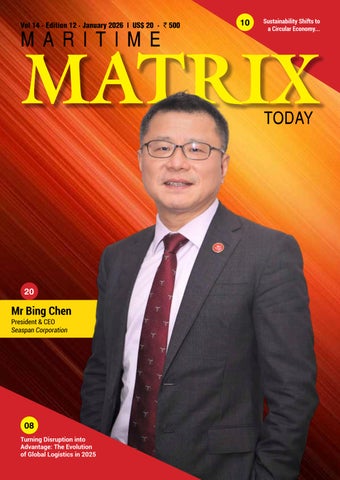
Vol 14 • Edition 12 • January 2026 | US$ 20 • ` 500
MA R I T I M E
10
Sustainability Shifts to a Circular Economy...
MATRIX TODAY
20
Mr Bing Chen President & CEO Seaspan Corporation
08 Turning Disruption into Advantage: The Evolution of Global Logistics in 2025
02 | Maritime Matrix Today | January 2026
Maritime Matrix Today | January 2026 | 03
Table of
CONTENTS 08 10 12 14 24 26 28
Turning Disruption into Advantage The Evolution of Global Logistics in 2025
20
Sustainability Shifts to a Circular Economy: ESG’s New Frontier in 2025 The Logistics Renaissance Why India is Poised to Lead the Global Supply Chain From Blame to Systems A Modern Playbook for Marine Accident Investigations Mumbai Marina Project A New Maritime Landmark for India’s Financial Capital India–Oman Maritime Relations A Shared Seafaring Legacy Across the Indian Ocean Unlocking Meaning in Maritime Data
Cover Story
30 32 34 35
Make the Impossible Possible
India–U.S. Trade and Supply Chain: Strategic Convergence in the Era of Critical Minerals, AI, and Semiconductors Reflections on 2025 Seafarer-Centric Growth and Maritime Self-Reliance New Age of Smart Logistics How Technology and Consumer Shifts Are Redefining India’s Supply Chains Isa Logistics Reinvents Its Brand to Strengthen Market Leadership
Disclaimer All advertisements in this magazine are placed with no liability accepted by the publisher for the material content therein. No responsibility is accepted by the publisher for omission or error or non-insertion of any advertisements. All advertisements and material in this magazine are subjected to approval by the publisher and are not necessary the opinion of the publisher. No liability is accepted for advertisements that are placed or any information that might be criminally connected. All information is checked to the best of our knowledge and is reliant upon the material submitted not being in contravention of all relevant laws and regulations and within the provisions of the Trade Practices Act. Reproduction Prohibited Maritime Matrix Today will not be responsible for the views expressed by contributors in their personal capacity. All rights reserved. Reproduction in part or whole without the permission of the Editor is prohibited. Readers are recommended To make appropriate enquiries before sending money, incurring expenses or entering into any commitment in relation to any advertisement published in this publication. Maritime Matrix Today does not vouch for any claims made by the Advertisers of Products and Services. The Printer, Publisher, Editor and Owner of Maritime Matrix Today shall not be held liable for any consequences, in the event such claims are not honoured by the Advertisers. RNI: MAHENG/2013/50159 Published by Marex Media Pvt Ltd C-209, Morya House, New Link Road, Andheri West, Mumbai 400058 Email: info@marexmedia.com
04 | Maritime Matrix Today | January 2026
Printed by Young Graphics Printed at Young Graphics, 208 Shankala Industrial Premises, Gogatewadi, Goregaon(E), Mumbai-400 063
• Seaspan technology continues to be a leader in the industry, setting high environmental goals
• COPES Company e-learning training platform completed from the comfort of your home
• Our fleet of Dual Fuel Vessels with Membrane & Type B Tanks sets us up for a strong future
• Gender friendly accommodation facilities
• MAN ‘ME-GI Mark 2’ Main engines, a step further than present generation of main engines • The ‘EGR (Exhaust Gas Recirculation)’ as well as ‘SCR (Selective Catalytic Reactors)” as means to bring down NOx emissions to Tier III levels
• Female Engagement Champions across offices worldwide • Quality growth • Low LTIF & High retention • Wages in top Quartile, and consistent operational excellence
ADDRESS: Seaspan Crew Management India Private Limited, 501, Kamla Executive Park, Andheri (E), Mumbai 400 059, India TEL: Chennai: +91-9884450085 Cochin: +91-9633110085 Mumbai: +91-22-40666200 | EMAIL: Jobs@Seaspancrew.com
License no RPSl-MUM-014 | Valid until February 15, 2026 (CIN No. U 78100 MH 2005 PTC 152233)
Maritime Matrix Today | January 2026 | 05
Editorial
From Disruption to Design The Great Pivot of 2025 and the Road into 2026 As 2025 drew to a close, global logistics and maritime were not merely ending a year— they were closing an era. If 2024 was about stabilization, 2025 became the Year of the Great Pivot, defined by geopolitical shockwaves and a decisive leap into intelligent, technology-driven operations. The re-emergence of tariffs as a central policy tool reshaped global trade. The United States’ “Liberation Day” tariffs in April triggered a sharp realignment of supply chains, depressing volumes on traditional East–West routes while accelerating trade diversion. New growth corridors emerged across India, Southeast Asia, the Middle East, Mexico, and Eastern Europe, confirming that near shoring and regionalization are now structural, not temporary.
supply-chain modeling, and fully automated logistics control towers. Digital twins and realtime analytics shifted the industry from reactive crisis management to proactive resilience. Maritime also crossed a sustainability threshold. The enforcement of the Hong Kong International Convention and expanding carbon costs made green compliance an economic necessity. LNG, electrification, and cleaner recycling practices accelerated as environmental risk became financial risk. Looking to 2026, legal battles over tariffs and shifting trade routes will test this new resilience. The lesson of 2025 is unmistakable: agility, data, and intelligence—not scale alone—will define success in the new era of global trade. - Kamal Chadha
At the same time, Artificial Intelligence moved from experiment to infrastructure . AI now powered voyage optimization, predictive
Team Matrix Kamal Chadha Group CEO
Radhika Vakharia CEO & Editor
Delphine Estibeiro Editorial Coordinator
Jagdamba Pandey Manager, Business and Promotion
kamal@marexmedia.com
radhika@marexmedia.com
delphine@marexmedia.com
jagdamba@marexmedia.com
Shirish Kirtane HOD Graphics
Santosh Nivalkar Sr. Graphic Designer
Manish Malve Graphic Designer
Bhavna Pimpale Coordinator
shirish@marexmedia.com
santosh@marexmedia.com
manish@marexmedia.com
bhavna@marexmedia.com
06 | Maritime Matrix Today | January 2026
Global Marine Insurance. Regional Commitment. We help shipowners, charterers, and operators navigate evolving challenges – from regulatory shifts to operational complexities – through globally informed marine insurance solutions shaped by decades of experience and trusted industry insight. north-standard.com
Maritime Matrix Today | January 2026 | 07
Logistics 2025: The Turning Point
Turning Disruption into Advantage The Evolution of Global Logistics in 2025 In the year 2025, the logistics and supply chain sectors have entered a phase of structural transformation, where adaptability and innovation are redefining operations, and the ability to manage geopolitical shifts and evolving climate mandates has become a core competitive strength rather than an occasional challenge.
The year 2025 marked a defining moment for the global logistics and supply chain industry. What began as a period of adjustment has evolved into one of purposeful reinvention, with companies rethinking networks, investing in technology, and embedding sustainability at the core of operations. Amid shifting trade dynamics and tighter regulatory frameworks, the sector demonstrated resilience and agility, laying the foundation for more intelligent, transparent, and future-ready supply chains. 1. Logistics & Supply Chain: The “Tariff Wave” The end of 2025 has been dominated by massive shifts in global trade routes due to aggressive new tariff policies. • Trade Rerouting: New U.S. tariffs (some as high as 100% on pharmaceuticals) have triggered a rapid shift toward India and Southeast Asia. India’s exports to the U.S.
08 | Maritime Matrix Today | January 2026
surged by over 22% in late 2025 as companies scrambled to restock before new duties took effect. • Nearshoring Becomes Reality: Major drugmakers like Eli Lilly and Merck have accelerated investments in U.S.based manufacturing to bypass trade friction. • The Rise of “AI Operators”: Industry leaders are moving beyond “AI dashboards” toward Autonomous DecisionMaking. Systems are now being deployed to act independently—rerouting ships or adjusting inventory levels in real-time without human intervention to mitigate port congestion. 2. Cold Chain: Sustainability & Precision The cold chain market is projected to reach over $450 billion this year, driven by the specialized needs of GLP-1 weight-
loss drugs and advanced biologics. • Natural Refrigerants: Startups like Biocold Technologies are gaining traction by replacing HFCs with natural refrigerants to meet strict 2025 emission standards. • Energy-Agnostic Trailers: Manufacturers like Thermo King have introduced trailers that can draw power from solar panels, regenerative axles, or the vehicle’s tractor, reducing energy use by 20%. • Spoilage Prevention: Enhanced IoT sensors are now “rescuing” cargo mid-transit.8 A notable 2025 case involved AI-driven monitoring saving over $210,000 worth of perishable produce by detecting a refrigeration failure and rerouting it to a closer facility before spoilage. The cold chain sector in India surged to a valuation of approximately $23.28 billion in 2025. • Deep-Freeze for Biologics: Driven by a boom in weight-loss drugs (GLP-1s) and high-value biologics, the pharmaceutical cold chain saw the fastest growth (approx. 6.7% CAGR).
• Human Rights Due Diligence: New regulations now require companies to map their supply chains down to Tier 4 (raw material level) to ensure no forced labor or environmental violations. • The EV Tipping Point: As of late 2025, India has over 27,000 public EV charging stations. For last-mile delivery, nearly 45% of new fleets commissioned by major e-commerce players (Amazon, Flipkart, Zepto) are now electric. • Decarbonization Playbook: The CII (Confederation of Indian Industry) released a dedicated “Decarbonization Playbook” for cold storage, providing a roadmap for facilities to transition to net-zero emissions through green refrigerants and rooftop solar. • Circular Logistics: “Reverse logistics” saw a 20% growth as brands like Samsung and Apple expanded their Indiabased refurbishing and recycling programs, requiring specialized logistics for “dead” electronics. Key Industry Moves in 2025
• LNG Reefer Trucks: To cut costs and emissions, companies began deploying LNG-powered refrigerated trucks,which offer ~20% fuel savings over diesel. Major LNG refueling corridors are now operational in Gujarat,Rajasthan, and Maharashtra. • Solar Micro-Cold Rooms: For rural agriculture, portable solar-powered cold rooms became a standard solution to reduce post-harvest losses, particularly in the Northeast and fruit-growing belts of Himachal and Kashmir. 3. ESG: From Reporting to “Hard Compliance” 2025 is the “year of reckoning” for ESG, as voluntary disclosures have turned into mandatory legal obligations. • CSRD & CSDDD Impact: The EU’s Corporate Sustainability Reporting Directive (CSRD) is now in full swing, requiring large firms to report their 2025 environmental impact.This has forced logistics providers to provide granular Scope 3 emissions data to their clients.
As the industry steps into 2026, the logistics and supply chain sector carries forward the momentum built over the past year. The transformations initiated in response to disruption have matured into scalable capabilities,driving greater agility, deeper sustainability integration, and more intelligent network design. With advanced automation, compliant ESG frameworks, and resilient trade corridors firmly in place, the sector is positioned not just to adapt to change, but to shape the future of global commerce. MMT
• Circular Supply Chains: Companies are moving toward “closed-loop” systems.For example, Maersk and other major players are expanding “reverse logistics” hubs specifically designed to collect, repair, and redistribute products, moving away from the “take-make-waste” model. Maritime Matrix Today | January 2026 | 09
ESG in Logistics
Sustainability Shifts to a Circular Economy: ESG’s New Frontier in 2025 In 2025, the landscape of corporate sustainability and Environmental, Social, and Governance (ESG) compliance is undergoing a profound transformation. No longer is reducing carbon emissions and publishing annual environmental reports considered sufficient; companies are now adopting comprehensive circular economy strategies that embed sustainability into product design, logistics, and business models. Central to this shift is the concept of reverse logistics, the process of bringing products and materials back into the value chain for reuse, recycling, and remanufacturing, turning waste into opportunity and longevity into core business value.
T
he traditional linear economic model, summed up as “take, make, dispose”, is increasingly giving way to a closed-loop circular system. This model seeks to eliminate waste, keep materials in use longer, and regenerate natural systems. By redefining products and processes, businesses aim to minimize resource consumption and cut the environmental impacts associated with production, transportation, and end-of-life disposal. The transition from linear to circular isn’t just environmentally imperative; it’s becoming a regulatory and competitive necessity. ESG compliance frameworks are now advancing beyond carbon metrics to include resource efficiency, material reuse, and lifecycle accountability . One of the most visible examples of this shift is IKEA , the global furniture retailer. IKEA has publicly committed to designing all products to be reused, repaired, refurbished, and recycled by 2030,a cornerstone objective of its circular economy strategy . The company has expanded initiatives that prolong product lifespans and reduce dependency on virgin materials. For instance, IKEA’s commitment includes revising product design guidelines specifically to enable reuse and recycling and advocating for global policy frameworks that promote circularity. IKEA’s strategic investments also underscore how circular economy principles are reshaping corporate behavior. The company’s investment arm, Ingka Investments, has pledged €1 billion toward recycling infrastructure, technology, and companies that can help transform end-of-life products into new resources ,from textiles and mattresses to plastics and wood. This push not only addresses environmental waste but also anticipates stricter regulations and consumer expectations around Extended Producer Responsibility (EPR), where producers are tasked with the full lifecycle impact of their products.
10 | Maritime Matrix Today | January 2026
Beyond product design, IKEA has launched IKEA Preowned, an online second-hand marketplace for furniture. This reflects a broader trend of companies capturing emerging value streams from resale and reuse markets instead of letting products languish in landfills. Such initiatives address a growing demand for sustainable consumption and expand IKEA’s business model into new revenue opportunities, while meaningfully reducing Scope 3 emissions tied to product disposal and reselling. In the logistics sector, Maersk, a global leader in shipping and freight forwarding, is also advancing circular economy practices, especially through reverse logistics systems that recover value from returned or end-of-life products. Industry trend maps from Maersk show that circular economy strategies rank among the key sustainability and supply chain trends, particularly emphasizing reverse logistics, waste reduction, and waste-to-resource transformation as pivotal elements for logistics operations. Reverse logistics, once primarily focused on handling product returns, has evolved into a systemic capability to support circular business models. By efficiently bringing goods back from consumers to processing hubs where they can be refurbished, remanufactured, or broken down for recyclable materials, companies can significantly extend product lifecycles and optimize material flows. This shift is not only environmentally beneficial, reducing landfill waste and conserving resources, but also economically strategic, enabling firms to capture secondary revenue and enhance brand trust among sustainability-conscious consumers. For logistics companies like Maersk, embedding circularity means redesigning supply chains to support multidirectional flows of goods. Circular logistics operations leverage advanced technologies, AI analytics, automated sorting, and real-time tracking, to improve visibility into reverse flows and ensure materials are efficiently reintegrated into production cycles. The
potential benefits extend beyond waste reduction to include deeper supply chain resilience, cost savings in raw material procurement, and stronger alignment with tightening ESG reporting mandates. The shift toward circularity is also accelerating global collaborative efforts. Initiatives such as industry coalitions, public-private partnerships, and regulatory frameworks are pushing companies to broaden their sustainability commitments. These include standards that require detailed reporting on supply chain emissions and material flows, as well as legislative incentives for reuse and recycling infrastructure. As regulatory environments tighten globally, from the EU’s Corporate Sustainability Reporting Directive to national obligations for comprehensive ESG disclosures, more firms find that circular economy integration is not just an advantage but a compliance imperative.
CEVA Logistics: Centralized Returns Networks CEVA Logistics, a global supply chain and freight company, has developed returns and reverse logistics operations that optimize handling returned goods ,a significant facet of circular supply chains. CEVA operates regional returns centers where returned products are quickly graded and sorted. According to industry listings, CEVA claims that a high percentage of processed items are either ready for resale or can be repurposed within 24 hours — reducing time in the reverse flow and helping clients recover value faster.
In 2025, sustainability leadership was defined not by reducing harm, but by creating regenerative systems that keep resources in circulation . Firms at the forefront of this movement, like IKEA and Maersk, are setting new benchmarks for how businesses can integrate circular thinking into core strategy. This paradigm shift, driven by stakeholders, regulators, and evolving market forces, is reshaping global industries and demonstrating that sustainable business models can be both profitable and planet-positive.
Their returns infrastructure supports lead-time optimization across Europe , allowing CEVA and its customers to manage reverse flows efficiently and at scale. While these operations are not purely environmental initiatives, they contribute directly to circular economy objectives by extending product lifecycles and maximizing resale potential.
There are real-world case studies in the shipping and logistics sector that illustrate how companies are implementing reverse logistics and circular economy practices to advance sustainability and add business value.
CEVA’s dedicated reverse logistics network illustrates how returns can be systematized to support both customer service and sustainability objectives.
DHL’s Expansion into Reverse Logistics and Circular Supply Chains One of the clearest examples in logistics is DHL’s strategic moves into reverse logistics , aimed at transforming returns into sustainable supply chain flows. In 2025, DHL Supply Chain acquired Inmar Supply Chain Solutions , a specialist in returns management. This deal underscores how major logistics providers are positioning themselves to handle the rising tide of product returns and embed circularity into operations, rather than treating returns as a cost center. Handling returns more effectively lets DHL capture value from returned goods and support clients’ circular economy goals by refurbishing, reselling, or recycling products. DHL has also promoted reverse logistics as part of its broader sustainability strategy , noting that better returns management supports circular economy commitments by enhancing reuse and reducing waste across the supply chain. By owning returns operations and reinvesting in circular processes, DHL showcases how logistics providers can turn reverse flows into strategic assets instead of liabilities.
Across these examples, a few common themes emerge: •
Reverse logistics expands revenue opportunities by enabling resale, refurbishment, and recycling rather than disposal.
•
Dedicated infrastructure (returns centres, refurbishment hubs) improves speed and sustainability of circular flows.
•
Technology integration (AI, robotics, data traceability) is central to scaling reverse logistics.
•
Strategic acquisitions and partnerships signal that logistics firms see circular services as a competitive edge.
These real-world cases show that sustainability and profitability can go hand in hand in shipping and logistics — a key lesson for companies navigating the shift toward circular economy models in 2025 and beyond. MMT
Maritime Matrix Today | January 2026 | 11
Logistics
The Logistics Renaissance Why India is Poised to Lead the Global Supply Chain
T
he global supply chain landscape is undergoing a seismic shift. As nations look to diversify their manufacturing bases and build resilience against geopolitical shocks, the spotlight has turned sharply toward India. No longer just the “office of the world,” India is rapidly transforming its physical and digital architecture to become a global logistics powerhouse. In 2025, the narrative has shifted from “potential” to “performance.” With logistics costs finally dropping toward single digits of GDP and massive infrastructure projects reaching completion, India is no longer just a participant in global trade, it is becoming its primary engine.The cornerstone of India’s logistics revolution is a radical shift in how the government plans and executes infrastructure. PM Gati Shakti National Master Plan: This digital platform integrated 39 central ministries and all states into a single
12 | Maritime Matrix Today | January 2026
GIS-based interface.By synchronizing over 1,500 data layers, the government has slashed the time for project approval and planning from months to days. National Logistics Policy (NLP): Launched to bring down logistics costs from 14% to roughly 8% of GDP (the global benchmark), the NLP has standardized processes across the country. India is moving away from its over-reliance on road transport, which traditionally handled over 70% of freight but was plagued by inefficiency.The completion of the Western and Eastern DFCs has been a game-changer. These “cargo-only” tracks allow freight trains to double their speed and carry nearly triple the load.By 2025, the transit time for a container from the manufacturing hubs of North India to the ports of Gujarat has been slashed by half, making Indian exports significantly more competitive.
Under the Sagarmala project, India has focused on port-led development. By 2025, the turnaround time at Indian ports has reached levels comparable to Singapore and Shanghai. The development of deep-water ports like Vizhinjam and the expansion of Mundra Port have enabled India to handle the world’s largest “Mega-Max” container ships, positioning the country as a vital transshipment hub in the Indian Ocean.Just as India revolutionized finance with UPI, it is now revolutionizing movement with the Unified Logistics Interface Platform (ULIP). •
•
•
ULIP & LDB 2.0: These platforms provide end-to-end visibility.A manufacturer in Ludhiana can now track a shipment in real-time across trucks, trains, and ships through a single dashboard. FASTag & E-Way Bills: These digital tools have eliminated physical checkpoints, saving millions of man-hours and reducing fuel wastage at state borders. AI and Predictive Analytics: Indian logistics startups are now using AI to optimize routes and predict demand, further driving down “empty miles”—the cost of trucks returning without cargo.
Highlights An ₹8,000 crore integrated logistics hub is being developed in Greater Noida (Uttar Pradesh) under the DelhiMumbai Industrial Corridor (DMIC) framework—aimed at boosting export competitiveness and multimodal connectivity. A 2025 CBRE survey found nearly 70% of logistics occupiers plan to expand in India, citing strong demand, evolving supply chains, and infrastructure improvements, supporting India’s emergence as a preferred logistics location in the Asia-Pacific (APAC) region. The logistics industry employs over 22 million people and is expected to generate millions more jobs with ongoing infrastructure development. The World Bank Logistics Performance Index (LPI) ranks countries on logistics quality and efficiency. India’s ranking has improved over recent years (e.g., in 2023 moving into the ~30s among ~140 nations), reflecting infrastructure and service gains, though still below top performers. Another forecast estimates India’s logistics sector could reach US $800 billion by 2030, contributing ~11% to GDP. Government data (pre-2026) showed logistics valued at US $215 billion in 2021, with an expected 10.7% CAGR through 2026.
Global corporations like Apple, Samsung, and Tesla are actively seeking to reduce their dependence on China. India’s emergence as a manufacturing alternative is creating a massive “pull factor” for logistics.The Production Linked Incentive (PLI) schemes across 14 sectors (like electronics and white goods) have created high-volume freight demand. Logistics providers are responding by building Grade-A warehouses and specialized cold-chain facilities, ensuring that India can handle high-value, sensitive cargo at scale. India is positioning itself as a leader in sustainable logistics, a key requirement for modern global brands. •
Railway Electrification: With nearly 100% of the broadgauge rail network now electrified, India offers one of the lowest carbon-footprint freight options in the world.
•
Inland Waterways: By reviving the Ganga (NW-1) and Brahmaputra (NW-2) as cargo highways, India is moving heavy bulk cargo (like coal and steel) off the roads, reducing emissions and costs simultaneously.
India’s logistics market was valued at ₹19,53,732 crore (≈ US $228.4 billion) in 2024 and is projected to grow to ₹36,73,530 crore (≈ US $428.7 billion) by 2033 at a CAGR of 6.5%. India’s path to becoming a global logistics leader is no longer a matter of “if ” but “how fast.” By 2025, the synergy between massive physical infrastructure (DFCs and Ports) and a robust digital backbone (ULIP) has created a foundation that is difficult to replicate.As the world seeks a reliable, efficient, and cost-effective partner for the next century of trade, India is standing ready—not just as a market, but as the world’s most efficient gateway. MMT
Maritime Matrix Today | January 2026 | 13
Upcoming Book
From Blame to Systems A Modern Playbook for Marine Accident Investigations
W
hen the sea teaches, it rarely does so gently. A casualty compresses physics, complexity, and human limits into a few brutal minutes. The task of the modern investigator is to turn that moment into durable learning—not a story with a villain, but a map with bearings. “Human error” may appear in the first interview; it should never be the final line of a professional report. The question is not who failed, but how normal people, working in a real system, ended up in a place where failure was likely.
This excerpt outlines the method I use in serious casualties—groundings, contacts, blackouts, fires, and cargo losses—and the disciplines that keep the work credible with ship, shore, and market. It is practical by design: everything here can be done tomorrow. Stabilize and Preserve: Credibility Begins on Day One Before any theory, fix the conditions for truth. Evidence that is not preserved is soon disputed. I start with four immediate actions: 1. Freeze the digital traces. Imagine the VDR and ECDIS exporting AIS snapshots, radar screenshots, engine and alarm logs, bridge audio, and CCTV, where available; hash every export. Keep a simple, legible chain-of-custody ledger with who, what, when, and hash values. 2. Tag the steel. The ship is your first witness. Photograph and sketch the casualty footprint before salvage or cutting begins: buckling patterns; paint transfers; scorch marks; lashing scars; hatch coaming witness marks; deformation around doors, ramps, and visors. Mark any post-incident intervention (firefighting water, hot work, towage scars) so the cure is not confused with the cause. 3. Protect timelines. Reconcile all clocks to UTC: VDR drift, ECDIS system time, AIS (GNSS-anchored), engine management, VTS, and port stamps. A single time base is the foundation for subsequent analysis.
14 | Maritime Matrix Today | January 2026
4. Set the tone. Issue a neutral 48–72 hour factual bulletin: what happened, what is preserved, immediate risks, early mitigation, knowns/unknowns, and next steps. Do not speculate. This reduces rumors, calms the bridge team, and gives underwriters and authorities confidence that the process is orderly. Chronology Before Theory: Draw the Track, Then Tell the Story A coherent timeline beats confident opinion every time. I align, to the second where possible, the following signals against UTC: helm and thruster orders; engine RPM/torque; generator load and breaker events; ECDIS user actions (safety contour, guard zones, alarm acknowledgments); radar screenshots; pilot exchanges; tug connections; and bridge audio. Only when the track is drawn do I begin to label causes and contributors. The discipline here is simple: no conclusions that cannot be located on a timestamp. If a change of speed mattered, the plot shows where and by how much. If an alarm is acknowledged without action, the audio and event logs show who and under what distraction. If a blackout precedes a contact, the power-management events are sequenced—load step, frequency dip, protective trip, and restoration. A single-page track with 30-second ticks often kills a dozen rumours. Witnesses Without Fear: How to Interview for Accuracy Testimony improves when people feel safe and respected. I interview in private rooms, in the mariner’s strongest language, with water on the table and no visible clock. I open with one truth: this is fact-finding, not disciplinary. I avoid group interviews, leading verbs, and binary questions; I anchor memory to lived markers—“before the pilot boarded,” “after the coffee break,” “ten minutes after watch change.” When fatigue is evident, I split sessions. Conflicting recollections are not problems to prune; they are bearings to triangulate with the timeline.
Two traps to avoid: translational loss and authority gradients. Use a qualified interpreter, not a colleague; ensure juniors can speak without their line manager present. Accuracy is a function of conditions, not just questions. From “Human Error” to Human Factors: The System Around the Person A modern report must distinguish between unsafe acts and the preconditions, supervision, and organizational influences that made them likely. I use HFACS (Human Factors Analysis and Classification System) and BowTie models to map barriers that should have arrested the chain but did not. •
Fatigue is chemistry, not character. Reconcile hours of rest with VDR cadence, alarm density, and workload peaks. If the paper says “rested” but the audio says otherwise, fix the roster before you fault the person.
•
Interface and alarms matter. Nuisance alerts create blindness. If the alarm storm trained crews to acknowledge without diagnosis, the design and governance of alarms are causal elements—not footnotes.
•
Culture and commercial pressure are inputs. Check BRM/ERM behaviours, challenge-and-response on the bridge, and shore-side messaging around schedule and weather limits. Many “errors” are rational responses to poorly balanced pressures.
A professional report can be both firm and fair: “The OOW missed the squat cue,” and “Alarm design and workload made that miss likely.” That is not leniency; it is actionable accuracy. Metallurgy, Machinery, and Cargo: Let Physics Arbitrate Narrative Digital traces must meet the physics of steel and fluids. In machinery spaces, I follow power through to consequence: generator load steps, frequency dips, breaker trips, and protective relays tied to steering response and blackout chronology. In fuel and cargo systems, I test rather than guess: fuel quality and contaminants; lube oil and wear metals; residue analysis in suspected fires; microstructure and fracture faces for brittle cleavage vs ductile tearing; beach marks for fatigue. For pollution or cargo contamination, paper alone is weak. I reconcile the Oil Record Book with ullages, valve positions, pump hours, and piping line-up. Sampling must be protocol-driven and time-stamped, with custody
documented, or claims will drift unchecked. When paper and physics disagree, physics wins. Deliverables That Decision-Makers Can Use Stakeholders—Masters, DPAs, superintendents, class, flag, clubs, H&M, and cargo underwriters, average adjusters— need different lenses on the same truth. A usable report is modular: •
Findings: Facts only, with timestamps.
•
Analysis: What those facts mean; conflicting evidence presented rather than suppressed.
•
Conclusions: Most probable sequence and proximate causes, with confidence levels and uncertainties labeled.
•
Recommendations: Specific, measurable, assigned actions with deadlines and verification (audit/KPI/ simulator).
•
Annexes: Chronology plot; chain-of-custody; data dictionary (what each file is and how it was processed); interview protocol.
Two further artefacts enable the report to travel: a 72hour learning brief (a one-page timeline and three “do differently” rules for crews) and a breach/coverage matrix for claims (warranties/conditions vs. evidence and causal linkage). The former prevents repeat casualties; the latter shrinks disputes. Independence and Integrity: The Compass That Must Not Bend Pressure is a fact of life: owners fear reputation, insurers fear payouts, and authorities fear politics. Integrity begins with the engagement letter—scope, access, independence of analysis, conflict disclosures. It continues with a “sunlight policy”: any attempt to steer conclusions is logged contemporaneously (who, when, wording), and where a line is crossed, I object in writing and—if necessary—withdraw. A polished career is worthless if the compass no longer points true. Transparency is how integrity is demonstrated. I share the method: clock reconciliation notes, hash values, processing steps, and the red-team review that tried to break the chronology. Uncertainty is stated plainly. A fair-minded reader should be able to follow the path from evidence to conclusion without trusting me personally. Claims Without Fog: How Clarity Saves Money and Time A clean timeline and causation map cut through the
Maritime Matrix Today | January 2026 | 15
battlefield of narratives. Underwriters can reserve on facts; adjusters can segregate GA, H&M, P&I, and cargo heads of claim without double-counting; counsel can avoid scattershot litigation. A mitigation ledger (sueand-labour actions with time, cost, and effect) defends necessary spend; subrogation notes preserve rights against pilots, ports, terminals, OEMs, or towage providers by documenting evidence early. Distinguish between technical breaches and breaches with causal linkage. Seaworthiness at commencement, ISM practicability, trading limits, manning and recency, towage and pilotage clauses—address them explicitly and fairly. Many disputes evaporate when the difference is made visible.
settings; alarm governance limits; pre-pilotage rest gates; BRM drills with graded assertiveness; and tug minima at drafts where thrusters are marginal. Claims settle faster because causation is clear; risk falls because controls are real. Closing: What Professionalism Looks Like? Professional investigation is not a performance of certainty; it is a discipline of method. Preserve first. Draw the timeline. Listen with care. Let physics arbitrate narrative. Map human factors without moralizing. Write recommendations that someone owns. Be transparent about limits. Guard your independence. If we do this consistently, we turn private tragedy into public improvement—ship by ship, port by port, claim by claim.
Beyond the Ledger: Turning Losses Into Public Lessons The industry’s best reforms were born from complex reports. Torrey Canyon led to traffic separation and modern pollution control; Herald of Free Enterprise drove the ISM Code; Exxon Valdez accelerated OPA-90 and double hulls; Estonia reshaped Ro-Ro survivability; Costa Concordia refocused passenger safety and musters; Ever Given exposed system-level risks in constrained waterways. Learning is not automatic. It must be engineered: •
Share fast: learning briefs in days, not months.
•
Train with friction: simulator vignettes built from the case (alarm storms, bank/squat, pilot authority gradients, emergency steering).
•
Add controls where the chain actually broke: phasebased ECDIS contour policy; alarm governance; pre-pilotage rest gates; tug/thruster minima; speed windows; management-of-change when routes, equipment, or commercial windows shift.
•
Verify: audit and KPI the new controls. Risk that can’t be measured can’t be managed.
A Short Worked Vignette A Panamax bulker grounds in a river bend under pilotage. Early chatter says “pilot error.” The timeline shows something else: speed held to maintain a tide window; under-keel clearance narrowing; safety contour left at ocean value; guard zones acknowledged repeatedly amid VHF exchanges; a brief frequency dip on the power grid preceding a sluggish rudder response; bank effect amplifying sheer. Witnesses reveal a junior OOW reluctant to challenge. The fix is not “be careful.” It is a package: speed windows by reach; phase-based ECDIS
16 | Maritime Matrix Today | January 2026
This article is an excerpt from Capt Gajanan Karanjikar’s forthcoming book, Marine Investigation Techniques.
About the author Capt. Gajanan Karanjikar is a Master Mariner, Marine Surveyor, and Casualty Investigator. Over decades at sea and ashore, he has commanded vessels, mentored officers, and advised owners, insurers, and regulators. His work spans shipboard command, technical surveys, flag-state and class compliance, and post-casualty investigations. A firm advocate of safety culture and professional seamanship, he blends traditional maritime instincts with modern forensic techniques so the industry can learn—quickly and honestly—from its hardest days. Feedback welcomed at captgajanan@gmail.com
In the News
Allcargo Logistics Launches ‘Extended Reach’ Network to Cover 100% of India’s PIN Codes Allcargo Logistics has launched its Allcargo Extended Reach (AER) network, a major upgrade and rebranding of its former Extra Serviceable Stations model, to cover 100% of India’s PIN codes as part of a strategic expansion of its domestic distribution footprint. With the AER rollout, the company has expanded its mapped network from about 21,000 to more than 32,000 PIN codes and has doubled direct serviceable PIN codes from around 4,900 to over 10,000 , serviced through Allcargo Distribution Centres. This expansion is supported by detailed location mapping and AI-driven planning to improve delivery speed,
reliability and last-mile reach, especially in remote and underserved regions. Allcargo said the initiative strengthens nationwide accessibility and positions
it to support India’s consumptionled growth by enabling faster, more dependable logistics for MSMEs, digital businesses and enterprises across the country.
India–Oman CEPA: Strengthening Trade and Logistics Connectivity The India–Oman Comprehensive Economic Partnership Agreement (CEPA) marks a significant step in strengthening trade and logistics ties between India and the Gulf region. Under this agreement, India receives near zero-duty access on a large majority of tariff lines, covering key export sectors such as engineering goods, textiles, chemicals, food products, and electronics. For Oman, the agreement improves access to the vast Indian market and positions the country as a strategic trade gateway to the Middle East and Africa. From a logistics perspective, CEPA is expected to increase bilateral cargo volumes, driving higher demand for sea freight, port handling, warehousing, and multimodal transport. Reduced tariffs and simplified customs procedures will shorten clearance times,
lower transaction costs, and improve supply chain predictability. Indian ports on the west coast—such as Mundra, Nhava Sheva, and Cochin—are likely to see increased traffic. Overall, the agreement strengthens regional supply
routes, supports export-led growth, and enhances India’s integration into global and regional value chains.
Maritime Matrix Today | January 2026 | 17
In the News
Supply Chain & Logistics Conclave 2026: Shaping the Future of India’s Logistics Ecosystem The Supply Chain & Logistics Conclave 2026 , announced by ETManufacturing. in (The Economic Times), is scheduled to take place in New Delhi in January 2026 and marks the 5th edition of this flagship industry event. The conclave will bring together senior leaders from logistics companies, manufacturing firms, e-commerce players, policymakers, technology providers, and infrastructure developers under one platform. The event will focus on key themes shaping India’s logistics future, including digital transformation, AI-driven supply chains, multimodal logistics, sustainability, green warehousing, and infrastructure investment. Panel discussions and keynote sessions will address challenges such as cost
optimization, resilience against global disruptions, and integration of MSMEs into modern supply chains.From an industry impact perspective, the conclave acts as a catalyst for policy dialogue, collaboration, and innovation,
helping align government initiatives like PM Gati Shakti with private-sector capabilities. It also supports knowledge sharing and strategic partnerships, strengthening India’s logistics ecosystem and competitiveness globally.
Scan Global Logistics Expands Operations in India Scan Global Logistics (SGL), a global freight forwarding and logistics company headquartered in Denmark, has expanded its operations in India by strengthening its presence across major commercial hubs such as Mumbai, Delhi NCR, Chennai, Bengaluru, and Ahmedabad. This expansion includes enhanced capabilities in air and ocean freight, project logistics, contract logistics, and end-to-end supply chain solutions , aimed at supporting India’s growing manufacturing and export sectors. The move reflects increasing foreign investment confidence in India’s logistics market , driven by rising trade volumes, infrastructure development, and policy reforms. SGL’s expansion introduces advanced global practices in customer service, digital freight 18 | Maritime Matrix Today | January 2026
management, and compliance, raising overall industry standards. Increased competition is expected to benefit Indian exporters and importers through better service quality, transparency, and cost efficiency . Strategically, the
expansion also positions India as a key node in SGL’s Asia-Pacific and global network, strengthening the country’s integration into international supply chains.
Hapag-Lloyd & NCL to Power Container Ships With E-Fuels From 2027 German shipping giant HapagLloyd and North Sea Container Line (NCL) have won a major tender to begin powering container ships with low-emission e-fuels starting in 2027, the companies said. Under the three-year agreement organised by the Zero Emission Maritime Buyers Alliance (ZEMBA), Hapag-Lloyd will operate five large container vessels using about 70,000 metric tonnes of hydrogen-derived e-methanol, while NCL will fuel a smaller ship with roughly 25,000 tonnes of e-ammonia. The initiative marks a key step toward decarbonising the shipping sector, where use of e-fuels remains minimal today. ZEMBA — whose members include Amazon, IKEA, Nike and
others willing to pay a premium for greener transport — aims to cut maritime CO₂ emissions by matching
eco-minded cargo owners with fuelready vessel operators.
Maritime Matrix Today | January 2026 | 19
Cover Story
Make the Impossible Possible
W
ith a career spanning continents and industries, Mr Bing Chen, Chairman, President & CEO, Seaspan Corporation brings a uniquely global perspective to shipping. Educated in the United States, he began his professional journey in investment banking in New York before moving to Europe, where he led restructuring initiatives across 12 countries. His career then expanded into aviation, leasing and financing, and global commodity trading, before he transitioned into shipping eight years ago.
Mr Chen’s leadership philosophy is rooted in adaptability—leveraging experiences from diverse sectors and combining them with deep industry expertise. Under his stewardship, Seaspan has cultivated a team with equally diverse backgrounds, blending cross-industry insights with shipping know-how to deliver innovative and customer-centric solutions.
Mr Bing Chen President & CEO Seaspan Corporation
Beyond business, Mr Chen finds fulfilment in working with talented colleagues and driving industry-leading initiatives that directly impact seafarers and their families. His guiding principle, “Make the impossible possible,” reflects both his competitive spirit and his commitment to exploring boundaries. In this conversation with Ms Delphine Estibeiro of Marex Media, Mr Chen shares his journey, unveils his core principles on leadership, and his forward-looking vision for Seaspan, its workforce and the transformed industry landscape.
People, Partnerships, and Progress… At Seaspan, our priorities are clear: our people and our customers. Our seafarers are on the frontlines of global trade, delivering the quality and reliability that define us, while our customers connect us to global commerce and prosperity. The industry faces real challenges—stricter emissions regulations, economic uncertainty, and geopolitical tensions. Yet, it has also grown stronger through consolidation, alliances, and infrastructure improvements, creating a more stable and efficient sector. Seaspan is uniquely positioned as the global leader in the owner-
20 | Maritime Matrix Today | January 2026
operator space. We provide a full horizontal lifecycle of services—from vessel design and construction to financing, operations, retrofits, and recycling—while also partnering vertically through joint ventures in areas such as scrubber technology, LNG and methanol retrofits, procurement, and ship management. This integrated model enables us to deliver turnkey solutions tailored to our customers’ needs. Container shipping itself has undergone significant consolidation: the top 10 carriers now control nearly 90% of global capacity, with the top five accounting for over 60%. This concentration has enhanced efficiency and stability. Against this backdrop, we believe the container segment is best positioned to navigate uncertainty. With our scale, integrated solutions, and ability to attract top talent—including in key markets such as India—we are confident in our ability to continue evolving with our customers and shaping a more resilient, sustainable future for global shipping.
Investing in a Greener Future… For Seaspan, decarbonization is not a new initiative—it has been part of our DNA for more than a decade. Long before ESG became a global standard, we pioneered our proprietary Seaspan Action on Vessel Energy Reduction (SAVER) program, focused on energy efficiency and emission reduction. Sustainability is not an add-on for us; it is central to how we create long-term value for our customers.
We focus on fleet investment and operational excellence. With a fleet of over 246 vessels averaging just five years of age, we operate one of the youngest and most efficient container fleets in the world. We are investing heavily in both newbuilds and retrofits, converting conventional vessels to dual-fuel LNG and methanol capability. Already, about one-third of our fleet is positioned to run on dual fuel, significantly reducing emissions. Equally important is how we operate. Through advanced ship management, we maximize load-ability and optimize operating profiles to cut fuel consumption and emissions per container moved. In simple terms, efficiency at sea translates directly into lower carbon intensity. Ultimately, our greatest strength lies in our people—both at sea and onshore—who ensure that every vessel operates to the highest standards of safety, efficiency, and sustainability. This combination of innovation, investment, and talent positions Seaspan to lead the industry’s transition toward a greener future.
Flexibility Is Key… This is a complex question because no single fuel has emerged as the definitive solution. Each option—methanol, LNG, ammonia, hydrogen, even nuclear—comes with its own advantages and challenges in terms of risk, economics, and supply chain readiness.
Maritime Matrix Today | January 2026 | 21
Cover Story From Seaspan’s perspective, our strength lies in flexibility. We have developed a comprehensive, integrated platform that enables us to design, construct, and retrofit vessels for a range of fuels—whether methanol, LNG, or other alternatives— based on customer needs and regulatory requirements. That adaptability is where we see tremendous value for the industry today.
Fleetwide Connectivity… Digitalization is central to our ESG strategy and operational model. At Seaspan, we are harnessing data, automation, and AI to improve efficiency, compliance, and service delivery. For example, our automated reporting systems ensure accuracy and efficiency in meeting requirements such as the EU ETS, eliminating paperwork and reducing the risk of manual errors. On the technical side, data-driven insights enable us to monitor vessel performance in real-time. This enables predictive maintenance—such as hull cleaning or performance optimization—based on actual resistance levels, much like a car’s dashboard alerting you when service is due. Connectivity is another key investment. We have rolled out Starlink and backup systems across our fleet to ensure seamless communication. This benefits both seafarer welfare—by enabling reliable video calls with families—and operational
22 | Maritime Matrix Today | January 2026
efficiency, as vessels effectively function as “moving satellite offices” fully connected to shore teams. Ultimately, digitalization strengthens every aspect of our business, enhancing seafarer wellbeing, improving ship management, and enabling us to deliver more responsive, data-driven solutions to our customers.
Global Trade Endures… Geopolitical tensions are a constant in global trade— sometimes more intense, sometimes less—but trade itself will not stop. From both theoretical and practical standpoints, global commerce will continue to flourish. At Seaspan, our strength lies in the resilience of our business model. We operate the world’s largest fleet over 2.5 million TEU across 246 vessels, backed by the world’s largest customer base. Each vessel carries an average of 11 years of firm contractual commitments from our customers. This long-term visibility provides stability regardless of any market or geopolitical uncertainties. Equally important, this stability extends to our people. By offering predictability and security, we support the personal and family development of our seafarers and shore-based teams. This is why Seaspan has become an employer of choice in the industry.
Respect, Safety, and Growth… First and foremost, it begins with respect. Seafarers are often the primary breadwinners for their families, so providing stability, welfare, and predictability is essential. Equally important is safety—ensuring that every seafarer can return home safely after their service. At Seaspan, we also focus on long-term career progression. Many of our shore-based colleagues, including those in personnel, engineering, and operations, are former captains and chief engineers. This sea-to-shore pathway allows seafarers to build sustainable careers within the company. That’s why we say our seafarers carry the identity and brand of Seaspan. By respecting them, ensuring safety, supporting their families, and regularly investing in their trainings and skills, we create loyalty and pride that define true empowerment.
Holistic Training… At Seaspan, our approach is not just to meet industry standards but to exceed them. We have recently invested in state-of-theart simulation systems—among the most advanced in the industry—supported by comprehensive training programs that cover both technical and management skills. Training is delivered both on-site and off-site, ensuring seafarers are equipped to meet the latest operational and regulatory requirements. Beyond technical skills, we emphasize holistic development. Training extends to compliance, leadership, and cultural awareness, preparing captains and officers to handle realworld challenges such as bribery, drug-related issues, and ethical decision-making. Ultimately, training at Seaspan is about building safer, more capable, and more resilient seafarers. It’s an investment in people that strengthens both our operations and the wider industry.
From Regulation to Retrofit… Shipping remains one of the world’s most critical industries, carrying nearly 90% of global goods. While it is a traditional sector, container shipping in particular has evolved rapidly over the past 10–15 years, driven by shifting customer expectations and global trade dynamics. The challenge—and opportunity—lies in adapting to this pace of change. Our customers today demand more than vessels; they require solution-oriented partners who can support their business success across technical, regulatory, operational, and financial dimensions. At Seaspan, our steady growth over the past two decades has been built on exactly this approach. We provide an integrated platform that combines technical expertise, regulatory
compliance, fuel and emissions strategies, vessel retrofits, financing, and operational excellence. Currently we are retrofitting 5 10k TEU vessels to methanol with more to come. This platform is the result of 25 years of investment—not just in capital, but in knowledge, teamwork, and innovation. That foundation positions us well to navigate uncertainty and deliver consistent value. Our focus is on providing reliable, safe, and economical services, while continuing to attract top talent and embrace excellence across every aspect of our operations.
Choosing the Right Platform… A career at sea is undoubtedly challenging, but it is also deeply meaningful and rewarding. For young professionals, it is essential to approach this path with a long-term perspective and to align their ambitions with the right platform. Choosing the right company is critical—one that not only provides opportunities for growth but also ensures welfare, safety, and professional development. At Seaspan, for example, we offer both the scale and the support system that enable seafarers to excel while contributing to the industry’s future. Just as in any profession, the foundation of a successful career begins with selecting the right platform and the right exposure. In shipping, that choice can make all the difference.
Four Pillars of a Lasting Career… The key lies in four things. First, you must have a longterm plan—clarity of direction is essential. Second, patience with open-mindedness is critical; too often, people want quick results, but real growth takes time. Third, you need to “pay your dues” by steadily building yourself, much like strengthening different muscles over time. Each stage of development equips you with the skills to seize opportunities when they arise. And finally, there is no substitute for hard work. Consistency, discipline, and effort are what sustain a career at the top. MMT
Maritime Matrix Today | January 2026 | 23
Supply Chain
Mumbai Marina Project A New Maritime Landmark for India’s Financial Capital The Union Government of India has recently given the green light to a transformative infrastructure initiative the Viksit Bharat Mumbai Marina Project with an estimated investment of ₹887 crore . Designed to upgrade Mumbai Harbour with world-class marina facilities, the project aims to strengthen coastal shipping, boost maritime tourism, generate employment and position Mumbai more prominently on the global maritime map. The Mumbai Marina project, officially named ‘Viksit Bharat Mumbai Marina’, is an ambitious maritime infrastructure plan approved by the Ministry of Ports, Shipping and Waterways. It envisages developing a state-of-the-art marina in Mumbai Harbour, transforming large portions of the waterfront into a hub for yachts, waterfront tourism, leisure, and allied activities. The marina is planned across nearly 12 hectares of water area and will be capable of accommodating 424 yachts of up to 30 metres in length, making it one of India’s largest such facilities once completed. The project is anchored in the government’s broader objectives to: •
Elevate Mumbai’s maritime profile and establish the city as a global marine tourism destination.
•
Expand coastal shipping and marine recreation, creating new avenues of economic activity.
•
Promote the Blue Economy, aligning with national visions like Maritime India Vision 2030, Maritime Amrit Kaal Vision 2047, the Sagarmala Programme and Cruise Bharat Mission.
By integrating public and private investment and connecting multiple sectors like hospitality, tourism, yacht services, and waterfront recreation, the project reflects a holistic development approach beyond conventional port infrastructure. A key feature of the Mumbai Marina project is its hybrid investment model, combining public and private capital. The Mumbai Port Authority is expected to contribute approximately ₹470 crore on an EPC (Engineering, Procurement & Construction) basis for foundational marina infrastructure. A private operator is expected to invest around ₹417 crore to develop the onshore commercial and recreational.This model allows balanced risk sharing between the government and the private sector
24 | Maritime Matrix Today | January 2026
while enabling innovation, improved service delivery and sustainability in operations. The development encompasses both marine infrastructure and onshore amenities : Marine Infrastructure -The core marina facility will include: •
Approach trestle and piled breakwaters to ensure safe vessel navigation.
•
Service platforms, pontoons, and gangways for secure yacht docking.
•
Berthing space for hundreds of yachts and marine crafts.
These components are designed to support a variety of marine activities and meet international safety and operational standards. Onshore Facilities- The private partner will develop vibrant waterfront infrastructure such as: •
A marina terminal to serve tourists and visitors.
•
A Namo Bharat International Sailing School to promote marine sports and training.
•
A maritime tourism development centre to support services and information.
•
Hospitality amenities including hotels, restaurants and leisure clubs.
•
Skill development facilities focusing on marine crafts and tourism services.
•
Yacht support infrastructure, including repair and stacking areas.
This mix of utility and leisure draws not only boat owners but also tourists and maritime enthusiasts, contributing to a lively waterfront ecosystem.
Employment and Economic Opportunities- One of the most significant impacts of the marina project will be job creation. According to official estimates, the development is expected to generate more than 2,000 direct and indirect jobs across several sectors such as: •
Marina operations and yacht services
•
Cruise tourism support
•
Hospitality and waterfront leisure services
•
Skill training and maritime education
This employment boost will help invigorate local economies around Mumbai Harbour, especially in sectors that intersect with tourism and services.Furthermore, by attracting private investment, the project enhances the business ecosystem around coastal infrastructure and encourages further commercial activity along the waterfront. Broader Urban and Social Impacts Waterfront Accessibility and Public Spaces - Beyond commercial considerations, the marina project seeks to enhance public access to Mumbai’s waterfront, an increasingly rare asset in rapidly urbanising cities. The development can provide open spaces, promenades, and recreational areas for both residents and visitors, enriching waterfront life in Mumbai. Tourism and Global Connectivity - Marinas play a vital role in cruise tourism and international yachting circuits. With capacity to berth large vessels, Mumbai could become a preferred port of call for global cruise liners and luxury yachts, potentially increasing foreign tourism inflows and boosting ancillary businesses like retail, hospitality and transport.
Skill Development and Marine Sports - Institutions like the sailing school integrated into the project will nurture local talent, build skill clusters in marine activities, and support a marine sports culture increasingly gaining popularity in India. Positioning Within National Maritime Priorities - The Mumbai Marina project does not stand alone but complements a series of national maritime and coastal infrastructure initiatives aimed at harnessing India’s long coastline for economic growth: •
Sagarmala Programme: Focused on port modernisation, coastal community development and logistics optimisation.
•
Maritime India Vision 2030: A long-term roadmap to strengthen India’s maritime sector.
•
Cruise Bharat Mission: Aims to promote cruise tourism by enhancing infrastructure and port capabilities.
By aligning with these frameworks, the marina project reinforces India’s strategic goal to become a major global maritime hub. The Viksit Bharat Mumbai Marina represents a significant step in strengthening Mumbai’s maritime infrastructure and tourism potential. With a judicious mix of public-private investment, modern facilities, and alignment with national maritime strategies, the project aims to transform the city’s waterfront into a vibrant economic and recreational hub.When implemented successfully, this ₹887 crore plan could redefine Mumbai’s coastal identity,creating jobs, enhancing tourism, boosting business opportunities and adding a new chapter to India’s growing blue economy narrative. MMT
Maritime Matrix Today | January 2026 | 25
International Relations
India–Oman Maritime Relations A Shared Seafaring Legacy Across the Indian Ocean PM Modi’s visit to Oman in December 2025, marked a renewed phase in India-Oman relations, building on longstanding historical, cultural and strategic ties.
T
he maritime relationship between India and Oman is among the oldest continuous transoceanic connections in the world. Rooted in geography, sustained by monsoon winds, and enriched by commerce, culture, and diplomacy, the India–Oman maritime bond predates modern nation-states by millennia. From ancient trade routes across the Arabian Sea to contemporary strategic and cultural cooperation, the sea has served as a bridge connecting the peoples of the Indian subcontinent and the Arabian Peninsula. The recent Memorandum of Understanding (MoU) on Maritime Heritage and Museums between India and Oman is thus not merely a diplomatic agreement, but a reaffirmation of a deep historical continuum. Geographical Foundations of a Maritime Bond
India and Oman occupy pivotal positions along the Indian Ocean littoral. Oman’s coastline stretches along the Arabian Sea and the Gulf of Oman, commanding access to the Strait of Hormuz, one of the world’s most vital maritime chokepoints. India, with its extensive western coastline, naturally looked 26 | Maritime Matrix Today | January 2026
westward for trade and cultural exchange. Seasonal monsoon winds made navigation between the western coast of India, particularly Gujarat, Konkan, and Malabar, and the Omani ports of Muscat, Sohar, and Sur relatively predictable and efficient, enabling regular maritime contact. Textual evidence suggests maritime interactions between the Indus Valley Civilization and the Oman Peninsula (ancient Magan) as early as the third millennium BCE. Omani copper was a crucial commodity for Indus Valley cities, while Indian merchants supplied beads, textiles, timber, and agricultural products. These early exchanges laid the foundations for sustained economic and cultural engagement. Omani sailors and merchants were among the most accomplished seafarers of the Indian Ocean, while Indian ports flourished as hubs of global commerce. Indian communities, particularly from Gujarat and Kerala, established long-term settlements in Oman, engaging in trade, finance, and shipbuilding. Conversely, Omani merchants
frequented Indian ports, contributing to cultural exchange in language, cuisine, architecture, and maritime technology. The dhow, symbolic of Indian Ocean navigation, embodied this shared maritime heritage.
sailors navigated its waters, guided by stars, winds, and shared experience. Their interactions fostered pluralistic port cities, resilient trade networks, and mutual respect, values that remain relevant in today’s interconnected world.
From the 16th century onward, European colonial expansion reshaped Indian Ocean geopolitics. The Portuguese, followed by the Dutch and British, sought to dominate maritime trade routes. Oman emerged as a significant regional maritime power, resisting Portuguese control and eventually establishing its own maritime empire extending to East Africa.
Joint Vision Document on Maritime Cooperation- During the visit, India and Oman adopted a Joint Vision Document on Maritime Cooperation.
India and Oman remained connected despite colonial constraints. Indian merchants continued to operate in Omani ports, often under British imperial frameworks, while Oman maintained relative autonomy compared to many regional polities. The sea remained a conduit for goods, ideas, and people, even as global power structures shifted. Modern Era: Cooperation
Diplomatic
Continuity
and
Strategic
With India’s independence in 1947 and Oman’s modern state consolidation under Sultan Qaboos Bin Said from 1970 onward, bilateral relations entered a new phase. Maritime ties evolved from primarily commercial exchanges to encompass diplomacy, security, energy, and cultural cooperation. Oman became one of India’s most important partners in the Gulf region. Its strategic location near the Strait of Hormuz aligns with India’s maritime security interests, particularly concerning energy supply routes and freedom of navigation. Defence and naval cooperation, port access arrangements, and joint exercises have strengthened mutual trust in the maritime domain. At the same time, the Indian diaspora in Oman, one of the largest expatriate communities in the country, continues to serve as a living bridge between the two societies, reflecting centuries-old patterns of mobility and maritime connectivity. The signing of the MoU on Maritime Heritage and Museums represents a significant evolution in India–Oman relations. By focusing on heritage, history, and museums, both countries are acknowledging that maritime cooperation is not solely strategic or economic but also civilizational. The planned maiden voyage of the Indian Navy’s traditional stitched ship, INSV Kaundinya, to Oman is a powerful symbol of this initiative. Inspired by ancient shipbuilding techniques, the voyage reenacts historical trade routes and underscores the continuity of maritime knowledge across centuries.
This signifies a shared commitment to: •
Regional maritime security
•
Blue economy development
•
Sustainable use of marine resources
This framework reinforces collaboration between the two as maritime neighbours in the Indian Ocean region. Maritime Security as Strategic Priority- India’s ambassador to Oman highlighted maritime security as central to bilateral defence cooperation, reflecting mutual interest in securing sea lanes, combating piracy and maintaining stability in the Arabian Sea and wider Indian Ocean — crucial for trade and energy flows. Cultural & Heritage Linkages- An MoU in the field of Maritime Heritage and Museums was signed to promote: •
Exchange of artefacts and expertise
•
Joint exhibitions and research
•
Capacity building in maritime history
This fosters cultural as well as economic cooperation linked to shared seafaring heritage. The maritime relationship between India and Oman is a testament to the enduring power of the sea to connect civilizations. From ancient copper trade and monsoon navigation to modern diplomacy and cultural cooperation, this relationship has adapted to changing historical contexts while preserving its core essence. The recent emphasis on maritime heritage signals a forward-looking approach rooted in historical consciousness, one that recognizes that understanding the past is essential for navigating the future. As India and Oman continue to deepen their partnership, their shared maritime legacy offers not only a source of pride but also a foundation for sustainable cooperation in trade, security, culture, and people-to-people ties across the Indian Ocean world. MMT
The India–Oman maritime relationship exemplifies the Indian Ocean not as a boundary but as a shared cultural space. Long before modern globalization, Indian and Omani Maritime Matrix Today | January 2026 | 27
AI Technology
Unlocking Meaning in Maritime Data
T
o understand why Generative AI is so good at finding answers, we have to look at the engine under the hood: Semantic Search.
The computer doesn’t know what a “Ship” is physically, but it knows that Ship is mathematically closer to Boat than it is to Banana.
Here is the breakdown of how it differs from traditional keyword search, focusing on the “math of meaning” (vectors) and how this revolutionizes searching through complex documents like shipping manuals.
The “Math of Meaning” In this vector space, relationships are mathematical equations. A famous example in AI is: King - Man + Woman = Queen
The Old Way: Keyword Search (Ctrl+F on Steroids) Traditional search engines look for literal string matches. If you search for “automobile,” the engine looks for the exact sequence of letters a-u-t-o-m-o-b-i-l-e. • How it works: It creates an index of words • The Limitation: It doesn’t understand that “car” and “automobile” are the same thing. If your shipping manual says “Vessel” but you search for “Ship,” a strict keyword search might return zero results.
If you take the numbers for “King,” subtract the numbers for “Man,” and add the numbers for “Woman,” the resulting coordinate is almost exactly the coordinate for “Queen.” The AI understands the concept of royalty and gender purely through these distances. Comparison: Keyword vs. Semantic
The New Way: Semantic Search (Word Vectors) Semantic search understands the intent and meaning behind the query.1 It does this by converting words into numbers, known as Vectors.2 What is a Word Vector? Imagine a massive 3D map. On this map, words that mean similar things are placed close together.3 • Ship might be at coordinate $[10, 50, 3]$ • Boat might be right next to it at $[11, 51, 4]$ • Banana is far away at $[900, 20, 15]$
28 | Maritime Matrix Today | January 2026
Applied to Shipping Safety Manuals & SOPs In a document repository full of Standard Operating Procedures (SOPs) and safety manuals, the terminology is often technical and rigid. Users, however, ask questions in natural language.
Scenario: A crew member notices a fire in the engine room and types a hurried query into the search system. The Query: “What to do for smoke in engine room” Case A: Keyword Search Fails • Search: Looks for exact words “smoke” and “engine room” • Document Reality: The official SOP is titled “Main Propulsion Space Fire Suppression Protocol.” It uses words like “combustion,” “fumes,” and “machinery space.” • Result: No results found or low relevance results because the user didn’t use the official jargon. Case B: Semantic Search Saves the Day • Vectorization: The AI converts the user’s query into a vector. • Matching: It looks for documents with vectors close to that query It knows “smoke” is semantically close to “fumes” and “fire” It knows “engine room” is semantically close to “main propulsion space” or “machinery space” • Result: It retrieves the Main Propulsion Space Fire Suppression Protocol instantly, even though the words don’t match exactly Why this improves results (RAG) When you chat with a Gen AI bot about your documents (a process often called Retrieval-Augmented Generation or RAG), semantic search is the retrieval step. 1. Context Handling: If you search “How to store it?”, a keyword search fails because “it” is too vague. Semantic
search looks at the previous conversation history (e.g., you were discussing Lithium Batteries) and finds storage SOPs for hazardous materials. 2. Polysemy (Multiple Meanings): If you search “Bow”, keyword search finds “Bow ties” and “Bow and arrows.” Semantic search looks at the context of “Shipping” and only returns results about the front of the ship. 3. Typo Tolerance: Since vectors rely on meaning, “Egnine room fire” (typo) often maps to the same vector space as “Engine room fire,” returning the correct SOP without needing exact spelling correction rules. Semantic search allows your document repository to “read between the lines.” It bridges the gap between how humans speak (messy, informal, varied) and how manuals are written (formal, technical, precise). MMT The Author
Vishrut Srivastava
For further queries or to discuss how semantic search operates and its role within Generative AI in shipping, please feel free to connect with us at vishrut@yodaplus.com
Managing Director Yodaplus Technologies Pvt Ltd
Maritime Matrix Today | January 2026 | 29
Supply Chain
India–U.S. Trade and Supply Chain: Strategic Convergence in the Era of Critical Minerals, AI, and Semiconductors India and the United States are steadily deepening their cooperation on trade and supply chains as global economic priorities shift toward resilience, technological sovereignty, and secure access to critical resources. A key development in this evolving partnership is India’s ongoing dialogue to join the U.S.-led Pax Silica supply chain partnership—an initiative focused on critical minerals essential for advanced technologies and clean energy systems.
W
hile India is not part of the initial Pax Silica grouping, the United States continues to view India as a strategic partner in securing global supply chains for artificial intelligence (AI), semiconductors, and next-generation technologies,highlighting the long-term convergence of interests between the two democracies.Pax Silica is envisioned as a multilateral framework led by the United States to ensure stable, transparent, and diversified supply chains for critical minerals such as silicon, rare earth elements, lithium, and other inputs vital to semiconductors, renewable energy, electric vehicles, and defense technologies. These materials form the backbone of the modern digital and green economy, yet their supply chains are currently concentrated in a few geographies, creating strategic vulnerabilities. Pax Silica represents an effort to reduce overdependence on single-source suppliers and to “friend-shore” supply chains among trusted partners. India’s potential entry into this framework,expected to be explored further in early 2026, signals growing recognition of India’s role as both a large consumer market and an emerging manufacturing hub with the capacity to support diversified global supply chains. Despite not being included in the initial group of Pax Silica members, India occupies a central place in U.S. strategic thinking on supply chain security. Several factors underpin this assessment. First, India’s scale and market depth are unmatched. As one of the fastest-growing major economies, India’s demand for semiconductors, electronics, renewable energy equipment, and AI-enabled systems is expanding rapidly.Integrating India into trusted supply chain networks is therefore not only about
30 | Maritime Matrix Today | January 2026
production but also about ensuring stable demand and longterm market alignment. Second, India offers geo-political reliability. In a global environment marked by rising trade restrictions, export controls, and geopolitical tensions, the U.S. sees India as a like-minded partner committed to democratic governance, rule-based trade, and strategic autonomy. This makes India an attractive partner for building resilient supply chains that are less exposed to geopolitical shocks. Third, India’s manufacturing ambitions align closely with U.S. objectives. Programs such as “Make in India,” the Production Linked Incentive (PLI) schemes, and recent investments in semiconductor fabrication and electronics manufacturing complement U.S. efforts to diversify global manufacturing away from concentrated hubs. Beyond critical minerals, India–U.S. cooperation increasingly centers on AI and semiconductor ecosystems . Semiconductors are the foundational input for AI, defense systems, consumer electronics, and industrial automation. Disruptions in chip supply during recent years have underscored the strategic importance of secure and diversified semiconductor value chains. The U.S. has acknowledged India’s growing role in this ecosystem not necessarily as a direct competitor to established fabrication hubs, but as a key player in design, assembly, testing, packaging (ATMP), and downstream manufacturing. India already accounts for a significant share of the global semiconductor design workforce, and bilateral initiatives aim to strengthen talent development, R&D collaboration, and investment flows.
AI supply chains, meanwhile, extend beyond chips to include data infrastructure, cloud computing, advanced materials, and energy systems. India’s digital public infrastructure, large talent pool, and expanding data economy position it as a natural partner for the U.S. in shaping responsible and secure AI supply chains. India recently shipped its first commercially packaged multi-chip module (MCM) to the U.S., comprising around 900 intelligent power modules (IPMs) manufactured by Kaynes Semicon at its OSAT (Outsourced Semiconductor Assembly and Test) facility in Sanand, Gujarat. These were delivered to Alpha & Omega Semiconductor (AOS), a California-based technology firm. Joining Pax Silica—or aligning closely with its objectives— could offer India multiple benefits. Access to trusted critical mineral supply chains would support India’s own clean energy transition, electric mobility goals, and electronics manufacturing ambitions. It could also attract higher-quality foreign direct investment, particularly from U.S. firms seeking to diversify production bases. Strategically, participation would elevate India’s role in global economic governance, allowing it to shape norms around sustainability, transparency, and
responsible mining. This is particularly important as critical mineral extraction raises environmental and social concerns that require coordinated international standards. India–U.S. trade and supply chain cooperation is entering a more structural and long-term phase , moving beyond transactional trade to strategic alignment in critical sectors. Whether through formal participation in Pax Silica or through parallel bilateral and multilateral frameworks, India’s integration into trusted global supply chains appears increasingly inevitable. As global competition over critical minerals, AI leadership, and semiconductor capacity intensifies, the India–U.S. partnership offers a compelling model of cooperation rooted in shared interests rather than short-term expediency. The coming years particularly around 2026 are likely to determine how deeply India becomes embedded in these emerging supply chain architectures, with significant implications for global technology, energy security, and economic resilience. -MMT
Maritime Matrix Today | January 2026 | 31
International Relations
Reflections on 2025 Seafarer-Centric Growth and Maritime Self-Reliance
A
s 2025 draws to a close, it is worth pausing not merely to recount activity, but to reflect on intent, outcomes, and the deeper structural challenges shaping India’s maritime ecosystem. Over the past year, through policy dialogue, stakeholder engagement, and sustained advocacy, one principle has remained clear: India’s maritime growth must be anchored in the welfare, employability, and long-term sustainability of its seafaring workforce. India’s ambitions, articulated through the Prime Minister’s Amrit Kaal vision and Maritime India Vision 2030 (MIV 2030), reflect a clear intent to expand the nation’s global maritime footprint. This ambition is timely and necessary. Yet, experience over the year reinforces a simple truth, these aspirations will succeed only if human capital development is integrated into policy, planning, and institutional support frameworks with the same seriousness as physical infrastructure. Ships, ports, and technology may symbolise progress, but seafarers remain its foundation.
32 | Maritime Matrix Today | January 2026
Despite India’s position as a leading supplier of maritime manpower, vulnerabilities persist in recruitment and training pathways, particularly for young and first-generation seafarers. Inadequate counselling, information asymmetry, and the continued presence of informal intermediaries often impose disproportionate financial and emotional burdens on aspirants and their families. Sustainable maritime growth cannot be built on avoidable human distress, nor can it rely solely on procedural compliance without accountability for outcomes. Structural imbalances in recruitment and training have become increasingly evident. While shore-based training capacity has expanded, employment outcomes, especially assured sea-time for cadets, have not kept pace. Intake levels misaligned with realistic absorptive capacity risk eroding confidence in the system and creating long-term disillusionment among young professionals. Restoring trust requires greater transparency, clear differentiation between responsible and non-compliant operators, and a stronger linkage between training approvals and placement outcomes.
Challenges of ethics and governance remain significant. Instances of contractual default, abandonment, and exploitation, often facilitated by touts and unethical intermediaries, continue to surface. Too often, institutional responses remain reactive, compounding harm after damage has occurred. Reform must therefore focus on preventive system design: closing procedural loopholes that enable malpractice, while ensuring that ease of doing business for compliant agencies is not undermined by excessive process friction or indiscriminate financial guarantees applied across the board. In this context, the proactive use of AI-enabled risk profiling and data analytics, drawing on national and global datasets, offers a pragmatic way forward. Such tools can help identify high-risk entities early, apply proportionate safeguards, and target oversight where it is most needed, protecting seafarers without penalising ethical operators. A governance framework that is technology-enabled, responsive, and outcome-oriented strengthens confidence in institutions and enhances India’s credibility as a maritime nation. Throughout the year, engagement with regulators and policymakers has increasingly emphasised dialogue over confrontation. This approach has enabled candid discussions on complex issues and reinforced the belief that durable reform emerges from shared ownership rather than adversarial positioning. Engagements aligned with the Maritime Anti-Corruption Network (MACN) have broadened the conversation on integrity and transparency across the maritime value chain. A key learning has been the importance of institutionalising awareness at the earliest point of a seafarer’s interaction with the system. Embedding structured awareness on rights, obligations, ethical practices, and grievance mechanisms within Maritime Administration offices, where aspiring seafarers first engage with regulatory processes, can significantly reduce vulnerability to exploitation and misinformation. An increasingly important dimension of the year’s discourse has been the “Just Transition” for seafarers. As shipping accelerates towards decarbonisation and digitalisation, future-ready seafarers will require new competencies, from energy-efficient operations and alternative fuels to digital systems, cyber awareness, and evolving ESG compliance. A Just Transition must ensure that seafarers are not displaced by change, but actively supported through accessible, modular, and industryvalidated upskilling pathways. Hybrid training models,
combining simulator-based learning with cloud-enabled delivery, offer a scalable and inclusive solution. Aligning MIV 2030’s manpower aspirations with institutional support remains one of the most consequential challenges before the sector. The objective of increasing India’s share of the global seafaring workforce from approximately 12 percent to 20 percent is ambitious but achievable. While substantial investments in ports, shipbuilding, and allied infrastructure reflect confidence in the sector’s future, parallel support for maritime manpower development is essential. Supplementary measures, such as dedicated Cadet Training Ships, structured sea-time assurance frameworks, and public–private participation models, could significantly strengthen India’s domestic training ecosystem. Beyond employment, seafarer development also has a strategic dimension. A robust and self-reliant seafaring workforce is not only an economic asset but a component of national security and resilience, aligning naturally with the vision of Atmanirbhar Bharat. As we look ahead, the emphasis must shift from diagnosis to execution. Protecting vulnerable seafarers, strengthening ethical recruitment and training frameworks, supporting responsible operators, and ensuring inclusive growth are shared responsibilities. India’s maritime success will ultimately be judged not only by the scale of its infrastructure, but by how effectively it prepares, protects, and values those who sail its ships. MMT
May the year ahead bring growth, resilience, and new opportunities across the maritime community. Happy New Year 2026! The Author
Capt (Dr) Rajesh Tandon, FNI CEO Foreign Owners Representatives and Ship Managers Association
Maritime Matrix Today | January 2026 | 33
India Economic Conclave
New Age of Smart Logistics How Technology and Consumer Shifts Are Redefining India’s Supply Chains At the India Economic Conclave (IEC) 2025 ,industry leaders gathered to discuss the future of India’s rapidly evolving economy. One of the standout conversations focused on logistics, where Akshay Ghulati, CEO – International Shipping , shared insights on how the sector is being transformed by technology, changing consumer behavior, and the rise of Tier II and Tier III markets. His address underscored how logistics is no longer a backend function, but a strategic enabler of India’s e-commerce and supply chain growth.
I
ndia’s logistics sector is undergoing a fundamental shift toward what Ghulati described as “smart logistics.” This new model is powered by digital tools such as artificial intelligence, data analytics, automation, and real-time tracking systems. These technologies are enabling logistics companies to improve visibility across supply chains, predict demand more accurately, and optimize routes and inventory. As a result, logistics operations are becoming faster, more cost-efficient, and more responsive to market changes.
A key driver of this transformation is evolving consumer expectations .With the rapid expansion of e-commerce, Indian consumers increasingly demand faster deliveries, flexible shipping options, and greater transparency. Same-day and next-day deliveries, once limited to metro cities, are now becoming standard expectations across the country. Ghulati emphasized that meeting these demands requires logistics players to invest heavily in digital infrastructure and scalable networks capable of handling high order volumes with minimal friction. Another major theme highlighted at IEC 2025 was the rapid growth of Tier II and Tier III cities. These markets are emerging as powerful engines of consumption, fueled by rising incomes, improved internet penetration, and increased adoption of online shopping. Ghulati noted that logistics strategies designed solely around metropolitan hubs are no longer sufficient. Companies must now build decentralized fulfillment centers, regional warehouses, and last-mile delivery networks tailored to smaller cities and semi-urban areas. Technology plays a crucial role in unlocking these emerging markets. Advanced analytics help companies forecast demand patterns unique to different regions, while GPS-enabled fleet management systems ensure efficient deliveries even in areas with limited infrastructure. Automation in warehouses reduces processing times, and digital payment integration supports seamless cashless transactions, which are increasingly preferred by consumers. 34 | Maritime Matrix Today | January 2026
Ghulati also addressed the growing importance of sustainability and efficiency in logistics operations. As supply chains expand, companies are under pressure to reduce costs while minimizing environmental impact. Smart logistics solutions such as route optimization, electric vehicles, and data-driven load planning are helping firms lower fuel consumption and emissions while maintaining service quality. Sustainability, he emphasized, is becoming a competitive differentiator rather than a regulatory checkbox. Looking ahead, Ghulati expressed optimism about the sector’s growth potential. India’s logistics market is poised to benefit from continued government investments in infrastructure, including highways, ports, and multimodal transport corridors. When combined with digital innovation and a consumercentric approach, these developments are expected to make India’s supply chains more resilient and globally competitive. In conclusion, the discussion at IEC 2025 made it clear that the future of Indian logistics lies in technology-led transformation, customer-driven design, and regional inclusivity . As companies embrace smart logistics models, they will not only support the next phase of e-commerce growth but also play a critical role in shaping India’s broader economic trajectory. MMT
Maritime Matrix Today | January 2026 | 35
36 | Maritime Matrix Today | January 2026
Maritime Matrix Today | January 2026 | 37
Logistics Progression
Isa Logistics Reinvents Its Brand to Strengthen Market Leadership
I
sa Logistics, a rapidly growing force in the business of moving goods, today announced a significant milestone: the launch of a dynamic new brand identity and logo. This rebranding reflects the company’s massive strategic change, moving from a company that offered just one kind of service to a complete partner providing a full range of solutions. The new logo represents Isa Logistics’ expansion into comprehensive offerings, including running large storage facilities, managing global shipping, operating local storage and transport, and organizing the entire delivery process from start to finish. This new look confirms its place as a provider of total solutions. The new logo’s design is clean, modern, and deliberately created to capture the core values of Isa Logistics: forward thinking, quick action, and continuous improvement. This powerful new look is designed to be easily recognized everywhere—online, on vehicles, and in all company locations—making it simple and effective across the entire business globally. By launching this modern and confident identity, Isa Logistics aims to strengthen its market appeal, boost its visibility, and reinforce its reputation as a trusted, forward-looking partner in a highly competitive industry. This visual change is a clear sign of the company’s dedication to fresh ideas, being environmentally conscious, achieving high performance, and always putting the customer first as it moves into a period of rapid expansion. Announcing the unveiling of the rebranded logo, Santosh Shetty, CEO of Isa Logistics, proclaimed, “Our new identity reflects who we are today and the future we are building. Over the years, Isa Logistics has grown into a multi-vertical logistics partner, and this evolution needed a visual expression that matches our ambition. The refreshed logo represents our focus on technology, expansion, and delivering value across the entire supply chain. It is a symbol of transformation, resilience, and our commitment to shaping a smarter and more connected logistics ecosystem.”
Santosh Shetty CEO, Isa Logistics
The company believes this new identity not only positions it for faster growth but also reinforces its central mission of providing outstanding, complete service to its customers. With this powerful new logo, Isa Logistics is confidently signaling its commitment to building a stronger, smarter, and more efficient way to handle the flow of goods—today and in the future. MMT
38 | Maritime Matrix Today | January 2026
You ask. We answer. Logistics is vital for your supply line – and your bottom line. Shipments must arrive at the right place at the right time, no questions asked. Whether you’re in one country or many, GAC India answers with the efficiency you need in a competitive world. Our network, technology and expertise help turn challenges into opportunities.
We empower businesses @gac.com/india
GAC Shipping (India) Private Limited - Main office GAC House, P.B. No. 515, Subramanian Road, Willingdon Island, Cochin 682 003, India E: pricing.india@gac.com | T: +91 484 266 8372 CIN: U63090KL1983PTC003733 Bengaluru Mr Gopala Krishna T: +91 96863 55008 E: gopala.krishna@gac.com Chennai Ms Ranjani Kumar T: +91 98846 62852 E: ranjani.kumar@gac.com
GACshippingindiapvtltd
Cochin Mr Swaraj Joseph T: +91 79943 33270 E: swaraj.joseph@gac.com Delhi Mr Jaya Shekar T: +91 98992 05424 E: jaya.shekar@gac.com
gac-shipping-india-pvt.-ltd
Kandla Mr Jatin Joshi T: +91 98251 58583, E: jatin.joshi@gac.com Kolkata Mr Dipayan Hore T: +91 99036 27997 E: dipayan.hore@gac.com
Mumbai Mr Sanket Chandwade T: +91 83697 44069 E: sanket.chandwade@gac.com Pune Mr Arjun Bangar T: +91 98196 69622 E: arjun.bangar@gac.com
gacshippingindia
Maritime Matrix Today | January 2026 | 39