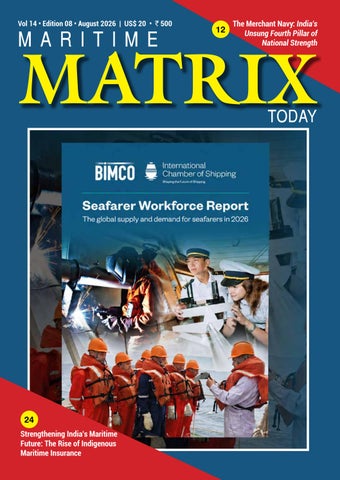
Vol 14 • Edition 08 • August 2026 | US$ 20 • ` 500
MA R I T I ME
12
The Merchant Navy: India’s Unsung Fourth Pillar of National Strength
MATRIX TODAY
24 Strengthening India’s Maritime Future: The Rise of Indigenous Maritime Insurance
02 | Maritime Matrix Today | August 2026
Maritime Matrix Today | August 2026 | 03
Table of CONTENTS
19
Nippon Paint Advances Sustainability
20
Samskip Strengthens Green Ambitions Through HyShip
21
Wärtsilä 25 Ammonia Engine Powers Two New Gas Carriers
24
Strengthening India’s Maritime Future: The Rise of Indigenous Maritime...
26
Prudence Marine Takes a Step Towards a Cleaner Coastline
08
The Invisible Casualties of War Indian Seafarers Paying the Ultimate Price
10
Future of Indian Seafarers Highlighted
27
Bypassing Hormuz: How Fujairah’s Port Expansion Reshapes Middle East...
12
The Merchant Navy: India’s Unsung Fourth Pillar of National Strength
28
Moving beyond Tokenism
14
AGA Aqua Marine Marks a Milestone Year with a Vision for the Future
30
Understanding Emotions, Building Resilience: MUI Women’s Wing Hosts...
17
India’s Maritime MegaProjects Charting the Course to Become...
32
Unlocking Operational Excellence
18
Methanol‑Fuelled Ships Get Safety Boost
34
Mooring Lines inquiry how many is enough?
Disclaimer All advertisements in this magazine are placed with no liability accepted by the publisher for the material content therein. No responsibility is accepted by the publisher for omission or error or non-insertion of any advertisements. All advertisements and material in this magazine are subjected to approval by the publisher and are not necessary the opinion of the publisher. No liability is accepted for advertisements that are placed or any information that might be criminally connected. All information is checked to the best of our knowledge and is reliant upon the material submitted not being in contravention of all relevant laws and regulations and within the provisions of the Trade Practices Act. Reproduction Prohibited Maritime Matrix Today will not be responsible for the views expressed by contributors in their personal capacity. All rights reserved. Reproduction in part or whole without the permission of the Editor is prohibited. Readers are recommended To make appropriate enquiries before sending money, incurring expenses or entering into any commitment in relation to any advertisement published in this publication. Maritime Matrix Today does not vouch for any claims made by the Advertisers of Products and Services. The Printer, Publisher, Editor and Owner of Maritime Matrix Today shall not be held liable for any consequences, in the event such claims are not honoured by the Advertisers. RNI: MAHENG/2013/50159 Published by Marex Media Pvt Ltd C-209, Morya House, New Link Road, Andheri West, Mumbai 400058 Email: info@marexmedia.com
04 | Maritime Matrix Today | August 2026
Printed by Young Graphics Printed at Young Graphics, 208 Shankala Industrial Premises, Gogatewadi, Goregaon(E), Mumbai-400 063
• Seaspan technology continues to be a leader in the industry, setting high environmental goals
• COPES Company e-learning training platform completed from the comfort of your home
• Our fleet of Dual Fuel Vessels with Membrane & Type B Tanks sets us up for a strong future
• Gender friendly accommodation facilities
• MAN ‘ME-GI Mark 2’ Main engines, a step further than present generation of main engines • The ‘EGR (Exhaust Gas Recirculation)’ as well as ‘SCR (Selective Catalytic Reactors)” as means to bring down NOx emissions to Tier III levels
• Female Engagement Champions across offices worldwide • Quality growth • Low LTIF & High retention • Wages in top Quartile, and consistent operational excellence
ADDRESS: Seaspan Crew Management India Private Limited, 501, Kamla Executive Park, Andheri (E), Mumbai 400 059, India TEL: Chennai: +91-9884450085 Cochin: +91-9633110085 Mumbai: +91-22-40666200 | EMAIL: Jobs@Seaspancrew.com
License no MUM-014 valid till 6 Feb 2031 CIN No.: U 78100 MH 2005 PTC 152233
Maritime Matrix Today | August 2026 | 05
Editorial
India’s Ascent in the Global Maritime Landscape The global shipping industry stands at a pivotal
such as Gujarat’s mega-shipbuilding clusters—are
junction, torn between heightened geopolitical
supercharging domestic port capacity and ship
vulnerabilities and an imperative push toward green
construction capabilities. Concurrently, the launch
transformation. As traditional trade corridors face
of the Bharat Maritime Insurance Pool (BMIP)
operational disruptions and rising security costs,
directly targets foreign market vulnerabilities,
India is proving that strategic policy, infrastructure
granting
investment, and human capital can turn systemic
protection, reducing war-risk premiums by up to
challenges into long-term national growth.
40%, and insulating vital supply chains.
At the heart of this shift is India’s rapid rise as a
However, staying competitive requires evolving
global maritime hub. The BIMCO-ICS Seafarer
beyond traditional infrastructure. The industry’s
Workforce Report 2026 highlights a major milestone:
future lies in alternative fuels like methanol and
India has overtaken China to become the world’s
ammonia, digital crewing, and genuine inclusion
second-largest supplier of seafarers, accounting for
that elevates diverse perspectives into core decision-
12.2% of the global seafaring workforce with over
making spaces. By marrying physical infrastructure
311,000 professionals. As global shipping navigates
with progressive workforce welfare and green
a shortage of nearly 39,100 qualified officers, Indian
technology, India is not merely adapting to modern
seafarers—serving as the “fourth pillar” of national
shipping demands—it is actively setting the course
economic strength—continue to keep essential trade
for the global maritime future.
Indian
shipowners
flowing despite escalating risks in high-conflict
- Kamal Chadha
waters like the Persian Gulf and Black Sea. To support this human foundation, India is building a robust, self-reliant ecosystem. Initiatives under the Sagarmala Programme and state-led investments—
Team Matrix Kamal Chadha Group CEO
Radhika Vakharia CEO & Editor
Delphine Estibeiro Editorial Coordinator
Jagdamba Pandey Manager, Business and Promotion
kamal@marexmedia.com
radhika@marexmedia.com
delphine@marexmedia.com
jagdamba@marexmedia.com
Shirish Kirtane HOD Graphics
Santosh Nivalkar Sr. Graphic Designer
Manish Malve Graphic Designer
Bhavna Pimpale Coordinator
shirish@marexmedia.com
santosh@marexmedia.com
manish@marexmedia.com
bhavna@marexmedia.com
06 | Maritime Matrix Today | August 2026
sovereign-backed
Maritime Matrix Today | August 2026 | 07
Uncertain Times
The Invisible Casualties of War
Indian Seafarers Paying the Ultimate Price
W
ars are often measured by military casualties and political consequences. Yet, far from the headlines, another group continues to bear the cost of conflict— the world’s merchant seafarers. Since March 2026, at least eight Indian merchant seafarers have lost their lives in conflict-related attacks on commercial vessels operating in the Persian Gulf and the Black Sea. These tragic incidents underscore the growing dangers faced by civilian seafarers who, while simply carrying out their professional duties, find themselves caught in the crossfire of geopolitical conflicts. The year 2026 has served as a stark reminder that merchant shipping remains one of the most vulnerable sectors during times of international conflict. While global attention is focused on military operations, diplomatic negotiations and shifting alliances, another tragedy continues to unfold quietly at sea. Civilian merchant vessels carrying food, fuel, medicines and other essential commodities continue to sail through conflict zones, placing thousands of seafarers at constant risk.
08 | Maritime Matrix Today | August 2026
The Indian seafarers who lost their lives were serving aboard foreign-flagged merchant vessels engaged in legitimate commercial trade. Some ships were struck by missiles in the Black Sea, while others became victims of escalating hostilities in the Persian Gulf. Unlike naval personnel, merchant seafarers are civilians. Their ships are unarmed, their mission is commercial, and their responsibility is to ensure the uninterrupted movement of global trade. Yet they are increasingly becoming unintended victims of wars in which they have no role. These deaths are far more than statistics. Behind every casualty is a family that has lost a father, son, husband or brother. These men left home to provide for their loved ones, never imagining that a commercial voyage could become a journey into a war zone. Their sacrifice highlights a harsh reality: modern conflicts are no longer confined to battlefields. Missile strikes, drone attacks and naval hostilities can instantly transform vital international shipping routes into dangerous corridors, threatening not only lives but also global supply chains. For India, these losses carry particular significance. India is
one of the world’s leading suppliers of merchant navy officers and ratings, with thousands of Indian seafarers serving on vessels across the globe. Their professionalism, competence and dedication have earned worldwide respect. Every Indian seafarer lost at sea represents not only a national tragedy but also a reminder of the immense contribution made by maritime professionals who quietly sustain global commerce. The recent attacks have also raised difficult but necessary questions for the international maritime community. Should commercial vessels continue to transit active conflict zones when credible security threats exist? Are existing voyage risk assessments sufficiently robust? Do seafarers genuinely have the freedom to refuse deployment to high-risk areas without fear of losing their employment or damaging their careers? As geopolitical tensions continue to escalate, these questions can no longer be ignored. The scale of the challenge is becoming increasingly evident. According to the International Maritime Organization (IMO), 46 attacks on commercial shipping have been confirmed since the beginning of the current conflict, demonstrating that merchant vessels are becoming increasingly exposed to the consequences of modern warfare. The disruption extends far beyond individual ships, affecting global trade, food security, energy supplies and the stability of international supply chains. Recognising the seriousness of the situation, the IMO has strongly condemned the attacks on merchant vessels and the tragic loss of civilian seafarers. IMO Secretary-General Arsenio Dominguez has emphasized that merchant seafarers are civilians performing an essential service to the global economy and should never become targets of armed conflict. Calling for immediate de-escalation, he has urged all parties to exercise maximum restraint and uphold the principles of the United Nations Charter and international maritime law. The IMO has reaffirmed the fundamental principle of freedom of navigation and stressed that commercial shipping must be allowed to operate safely without fear of attack or intimidation. The Organization continues to work with Member States, shipping companies and international stakeholders to strengthen maritime security, improve information sharing, encourage comprehensive voyage risk assessments and enhance measures to protect merchant vessels and their crews operating in highrisk waters. In India, the Directorate General of Shipping (DG Shipping) has taken several proactive measures to safeguard Indian seafarers. Following the escalation of hostilities in the Middle East and the Black Sea, DG Shipping issued advisories directing Indian shipowners, recruitment and placement service licence holders (RPSLs), ship managers and manning agencies to exercise extreme caution before deploying Indian seafarers to conflict-affected regions. The Directorate advised that Indian seafarers should not be deployed on vessels transiting the Strait of Hormuz and other high-risk waters unless absolutely
necessary, and only after obtaining their informed written consent and ensuring they fully understand the associated security risks. DG Shipping has also strengthened operational oversight by establishing a real-time monitoring mechanism for ships carrying Indian crew, regardless of the vessel’s flag. Under the guidance of the Ministry of Ports, Shipping and Waterways, the Directorate is developing a comprehensive monitoring dashboard to track vessel positions, crew strength, voyage plans, cargo, welfare conditions, security threats and emergency requirements. This enhanced monitoring system enables timely coordination between shipowners, Indian diplomatic missions abroad and government agencies whenever emergencies arise. In addition, shipping companies have been directed to maintain continuous communication with vessels operating in highrisk areas, conduct dynamic voyage risk assessments, closely monitor international security advisories and ensure adequate war-risk insurance, emergency response arrangements and welfare support for seafarers and their families. However, regulatory measures alone cannot eliminate the risks confronting merchant seafarers. Greater collaboration between governments, international organisations, shipowners, charterers, insurers and maritime associations is essential to strengthen the protection of civilian shipping. Seafarers must be provided with accurate intelligence, comprehensive security training, transparent risk communication, psychological support and the genuine right to decline assignments in conflict zones without fear of professional repercussions. The families left behind deserve far more than condolences. They deserve recognition that their loved ones died while performing one of the world’s most essential professions— keeping global trade moving. Their sacrifice should strengthen the international community’s resolve to ensure that civilian seafarers are never treated as collateral casualties of armed conflict. The sea has always demanded courage. Today, that courage is tested not only by storms and rough weather but also by missiles, drones and geopolitical instability. As merchant ships continue to transport over 90 per cent of global trade, the world must acknowledge the immense human cost borne by those who operate them. The tragic deaths of Indian seafarers since March 2026 are a solemn reminder that behind every cargo delivered safely lies the dedication of men and women who accept extraordinary risks to sustain the global economy. Protecting them is not merely an industry obligation—it is an international humanitarian responsibility. Every seafarer deserves the fundamental right to sail in safety and to return home to their family. No civilian mariner should ever become an invisible casualty of war. MMT
Maritime Matrix Today | August 2026 | 09
Maritime Dialogue
Future of Indian Seafarers Highlighted
- Jagdamba Prasad Pandey
T
he International Maritime Federation (IMF) and the Forward Seaman Union of India (FSUI), in association with Srichakra Maritime College, successfully hosted a high-level maritime dialogue on Building a Future-Ready Maritime Workforce at the Andhra Social & Cultural Association (ASCA), Chennai. The event brought together a cross-section of the maritime community, including Master Mariners, Chief Engineers, Recruiting & Placement Services License (RPSL) representatives, heads of training institutes, and key industry stakeholders. The dialogue aimed to address pressing challenges in seafarer training, welfare, and workforce preparedness in an era of rapid technological change and evolving global regulations. Dr KVR Srinivas opened the proceedings with a warm welcome that set the tone for collaboration and collective responsibility within the maritime fraternity. The inaugural session featured a ceremonial lamp lighting, stirring patriotic renditions, and a solemn moment of silence in memory of seafarers who lost their lives in recent maritime incidents. The tribute served as a poignant reminder of the human element at the heart of the shipping industry.
10 | Maritime Matrix Today | August 2026
In her address, Ms Aishwarya Gupta Pilankar, Vice Chairperson of IMF, emphasized the critical role of maritime training institutes and RPSL agencies in upholding and exceeding global standards. She noted that with shipping becoming increasingly digitalized and decarbonized, India’s maritime workforce must be equipped not just with technical skills, but also with adaptability, safety awareness, and global compliance knowledge. The keynote address was delivered by Dr Syed Asif Altaf Chowdhury, ITF Representative. He spoke on the current global challenges facing seafarers, including crew change issues, mental health, and the impact of automation. Dr Chowdhury called for stronger industry commitment to seafarers’ welfare and urged all stakeholders to align training and employment practices with international conventions to ensure dignity and security at sea. Mr Manoj Yadav, General Secretary of FSUI, further highlighted the need for robust social security and support systems for
Indian seafarers and their families. He stressed that a “futureready” workforce must also be a protected workforce, with access to healthcare, insurance, and grievance redressal mechanisms that match global benchmarks. The core of the event comprised technical sessions led by eminent maritime professionals, followed by a panel discussion moderated by Ms Gupta. The panel comprised Capt. Vinayak Gupta of Sunav Maritime, Capt. J. Manivannan of Indian Maritime University, Mr. Binesh Chandra Varma, Seaman Welfare Officer, DG Shipping, Capt. Lalith Kumar of ICS Chennai, and Mr. Narendra Rao of FSUI Chennai. The discussion covered training standards, integration of new technologies such as AI and autonomous systems, competency assessment, and the gap between academic curricula and onboard realities. Panellists agreed that collaboration between RPSLs, training institutes, regulators, and unions is essential to bridge this gap and to ensure Indian seafarers remain competitive in the global market.
A highlight of the evening was a special felicitation presented to Capt. Yashwanth Raj, recognized as one of the youngest Master Mariners. His achievement was celebrated as an inspiration for aspiring cadets and a testament to the quality of Indian maritime training. The dialogue concluded with a vote of thanks by Capt. Raman Jayaram, followed by the National Anthem and a networking dinner that allowed participants to continue discussions in an informal setting. The event was well-received by attendees and reinforced a key message: building a resilient, skilled, and future-ready maritime workforce requires sustained partnership between industry, government, unions, and academia. With India aiming to be a global hub for seafarer supply, such dialogues are vital to aligning training, policy, and welfare with the demands of tomorrow’s shipping industry. MMT
Maritime Matrix Today | August 2026 | 11
The Unsung Force
The Merchant Navy: India’s Unsung Fourth Pillar of National Strength
W
henever the nation’s security is discussed, the focus naturally turns to the three armed forces—the Army, Navy, and Air Force. Yet, there is another group of professionals who quietly safeguard India’s economic lifeline every day: the Merchant Navy. Unlike the armed forces, however, the Merchant Navy is not recognised as a military service because its primary role is commercial rather than combat-oriented. Merchant ships are civilian vessels owned and operated by private companies or public sector organisations, and their crews are governed by the Merchant Shipping Act, international maritime conventions, and labour laws rather than military legislation. They function under the Ministry of Ports, Shipping and Waterways, whereas
12 | Maritime Matrix Today | August 2026
the armed forces fall under the Ministry of Defence. International law also requires a clear distinction between merchant vessels and naval warships. This distinction protects merchant ships as civilian assets during armed conflicts and enables them to trade globally under internationally recognised legal frameworks. If merchant shipping were formally classified as a military force, merchant vessels could lose this protected status and become legitimate military targets during conflicts, affecting international trade and the safety of seafarers. Despite their civilian status, the contribution of merchant seafarers to national security is both substantial and indispensable. Nearly 95 percent of India’s trade by volume
and around 70 percent by value is carried by sea, including crude oil, liquefied natural gas, coal, food grains, fertilizers, and countless essential commodities. Without merchant ships, industries would halt, energy supplies would be disrupted, and the nation’s economy would face severe consequences. Indian merchant seafarers continue to operate through piracy-prone waters, conflict zones, geopolitical tensions, severe weather, and global crises such as the COVID-19 pandemic, ensuring that supply chains remain uninterrupted. During periods of conflict in the Red Sea and the Black Sea, merchant vessels have continued their voyages despite missile threats, drone attacks, and escalating war-risk insurance costs.
recognise it as India’s Fourth Pillar of National Security and Economic Resilience. Such recognition would acknowledge the unique role merchant seafarers play while preserving the civilian status that international maritime law requires. It could include greater public awareness, dedicated national honours, enhanced welfare measures, improved insurance and pension schemes, and broader representation during national celebrations that recognise their contribution to the nation. As India pursues its Maritime Amrit Kaal Vision 2047 and aspires to become a leading global maritime power, strengthening the status of the Merchant Navy should form an integral part of that vision.
Unlike military personnel, these seafarers undertake such risks without the recognition generally associated with national defence, yet their work directly supports India’s economic resilience, energy security, and strategic interests. Their professionalism, discipline, and commitment have earned India a reputation as one of the world’s leading suppliers of maritime talent, making them vital contributors to both the national and global economy.
A nation that depends so heavily on seaborne trade must also celebrate those who keep its commerce moving. Merchant seafarers may not carry weapons, but they carry the nation’s trade, energy, and economic future across the world’s oceans. Recognising their service is not about equating them with the armed forces—it is about acknowledging that national strength is built not only through military power but also through the uninterrupted movement of commerce, on which every modern economy depends.
Rather than seeking to designate the Merchant Navy as a fourth armed force, a more meaningful approach would be to
MMT
India Supercharges Shipbuilding Sector with Multi-Billion Financial Reforms
T
he Government of India has unveiled transformative financial reforms and institutional frameworks to establish the nation as a global shipbuilding hub, aligning with its Maritime Amrit Kaal Vision 2047. Central to these measures is the updated Shipbuilding Financial Assistance Scheme (SBFAS) featuring an outlay of ₹24,736 crore to eliminate cost disadvantages faced by domestic yards. Complementing this is the newly created ₹25,000 crore Maritime Development Fund (MDF), comprising a ₹20,000 crore equity investment pool and a ₹5,000 crore interest subvention component to significantly lower debt financing costs. To ensure unified execution, the National Shipbuilding Mission (NSbM) has been instituted as the apex body overseeing these initiatives. NSbM has already granted in-principle approvals
for new greenfield shipbuilding clusters across Andhra Pradesh, Gujarat, and Tamil Nadu, Alongside major brownfield expansion projects for existing shipyards, bolstering India’s overall maritime infrastructure. MMT
Maritime Matrix Today | August 2026 | 13
Steady Helms
AGA Aqua Marine Marks a Milestone Year with a Vision for the Future
A
GA Aqua Marine Pvt Ltd celebrated its first anniversary on 29 June at its corporate office in Boomerang Business Park, Chandivali, Mumbai, bringing together clients, business associates, industry professionals, employees and wellwishers to commemorate a year of remarkable progress and promising beginnings. Founded in 2025 by Capt Amit Joshi, a maritime professional with over three decades of sailing and shore-based leadership experience, AGA Aqua Marine was established with a clear vision—to provide reliable, compliant and technology-driven maritime solutions while building long-term partnerships based on trust, professionalism and operational excellence. In just one year, the Mumbai-based company has established itself as a dependable integrated maritime services provider, offering crew management, recruitment and placement, technical and marine support services, onboard riding squads, vessel maintenance support, as well as port agency and husbandry services. As an approved Recruitment and Placement Service Licence (RPSL) holder under the Directorate General of Shipping, the company remains committed to delivering high-quality services while ensuring the highest standards of compliance and seafarer welfare. The anniversary celebration was more than a milestone—it was an opportunity to reflect on the company’s journey and acknowledge the confidence placed in AGA Aqua Marine by shipowners, ship managers, business partners and seafarers. 14 | Maritime Matrix Today | August 2026
During its inaugural year, the company successfully expanded its client portfolio, strengthened strategic partnerships both within India and internationally, and more than doubled its workforce, reflecting the growing demand for its services and the trust it has earned across the maritime community. Addressing the gathering, Founder and Managing Director Capt Joshi reflected on the company’s journey and the philosophy that continues to drive its growth: “Our first year has never been about becoming the biggest company overnight; it has been about building trust, credibility and lasting relationships. Every client we serve, every seafarer we place and every commitment we honour strengthens the foundation of our organisation. Shipping is built on people, professionalism and performance, and these values will continue to define AGA Aqua Marine as we expand our global footprint.” Capt Joshi also acknowledged the dedication of the company’s employees, clients and business partners, noting that their unwavering support has been instrumental in transforming a vision into a growing and respected maritime enterprise. Despite global challenges affecting the shipping industry, including geopolitical uncertainties in key trading regions, he expressed confidence that the sector’s resilience would continue to create new opportunities for sustainable growth. Looking ahead, AGA Aqua Marine aims to further strengthen its integrated maritime services portfolio while expanding its presence across key international shipping markets. The company is investing in digital crewing solutions, enhanced compliance systems and value-
added maritime services to deliver greater operational efficiency and seamless support to shipowners and ship managers worldwide. As it embarks on its second year, AGA Aqua Marine remains committed to its founding principles of integrity, quality, innovation and customer-centric service. Backed by experienced leadership, a dedicated team and a growing international network, the company is well positioned to contribute meaningfully to the evolving needs of the global maritime industry while continuing to create value for clients, partners and seafarers alike. MMT
Maritime Matrix Today | August 2026 | 15
16 | Maritime Matrix Today | August 2026
Impact
India’s Maritime Mega-Projects Charting the Course to Become a Global Maritime Power
I
ndia’s maritime sector is undergoing one of the most significant transformations in its history. Driven by the Government of India’s ambitious Sagarmala Programme, strategic investments in ports, shipbuilding, coastal logistics and maritime infrastructure are positioning the country as a major global maritime hub. With record cargo volumes, new port developments and a renewed focus on indigenous shipbuilding, India is steadily translating its maritime vision into reality. At the heart of this transformation is the Sagarmala Programme, the flagship initiative of the Ministry of Ports, Shipping and Waterways. Since its launch, the programme has evolved into one of India’s largest infrastructure initiatives, encompassing 845 projects with an estimated investment of ₹6.06 lakh crore. As of March 2026, 315 projects worth ₹1.57 lakh crore have been completed, while another 210 projects are under implementation and 320 projects are in various stages of planning. The recently launched Sagarmala 2.0, supported by ₹85,482 crore, is expected to catalyse investments of nearly ₹3.6 lakh crore, further strengthening India’s maritime ecosystem. The impact of these investments is already visible. During FY 2025–26, India’s major ports handled a record 915.17 million tonnes of cargo, surpassing the annual target and registering 7.06% year-on-year growth. Operational efficiency has also improved dramatically, with the average vessel turnaround time reducing from 96 hours in 2014 to just 49.5 hours, making Indian ports faster, more competitive and globally efficient. The completion of new coastal berths has added nearly 9.84 million tonnes per annum of additional cargo handling capacity, further enhancing the country’s logistics capabilities. A significant boost to India’s maritime ambitions has come from Gujarat, which continues to lead the country in port-led industrial development. In July 2026, the Gujarat Maritime Board invited Expressions of Interest (EOIs) for the development of six new greenfield ports, three greenfield shipyards, and an Integrated Mega Shipbuilding Cluster. Spread across more than 4,500 hectares, these projects are expected to attract investments exceeding ₹35,000 crore, with the shipbuilding cluster alone estimated to draw nearly ₹25,000 crore. Planned shipyards at Mithapur (Devbhumi Dwarka), Ghogha (Bhavnagar), and Vadhera (Amreli), along with the mega shipbuilding cluster at Kuchhadi in Porbandar, are expected to significantly expand India’s shipbuilding and ship repair capacity while generating thousands of skilled jobs. These initiatives align closely with India’s broader vision of becoming a global manufacturing and maritime logistics powerhouse. By strengthening domestic shipbuilding
capabilities, India aims to reduce dependence on foreign shipyards, enhance self-reliance under the ‘Make in India’ initiative, and capture a larger share of the global shipbuilding market. The projects are also expected to stimulate ancillary industries, including marine engineering, heavy fabrication, offshore construction, marine equipment manufacturing and maritime services. India is also investing in strategic maritime assets that will redefine its position in global shipping. Greenfield projects such as Vadhavan Port in Maharashtra, expansion of container handling capacity, development of transshipment hubs, and increased emphasis on coastal shipping and inland waterways are creating a more integrated and efficient maritime transport network. Simultaneously, digitalisation, automation, green port initiatives and sustainability measures are improving operational performance while supporting India’s climate commitments. However, India’s maritime ambitions extend beyond infrastructure alone. Recent geopolitical tensions and disruptions to global shipping have highlighted the importance of resilient supply chains, strategic port capacity and domestic shipbuilding capability. Investments under Sagarmala and state-led initiatives such as Gujarat’s maritime expansion not only strengthen India’s economic competitiveness but also enhance national maritime security and reduce dependence on external logistics networks. As global trade patterns continue to evolve, India is uniquely positioned to emerge as a leading maritime nation. With worldclass ports, expanded shipbuilding capacity, improved logistics connectivity and a strong policy framework, the country is steadily building an ecosystem capable of supporting the next generation of global trade. MMT Maritime Matrix Today | August 2026 | 17
Methanol‑Fuelled Ships Get Safety Boost
T
he Maritime Technologies Forum (MTF) today announced the publication of new guidelines to support companies in developing new Safety Management Systems (SMS) and strengthening existing SMS for ships using methanol as fuel. As the maritime industry accelerates its decarbonisation efforts, low-carbon methanol has emerged as one of the most scalable alternative fuel options. Its liquid state under ambient conditions, compatibility with existing fuel infrastructure, and increasing industry adoption make methanol an attractive near-term solution. However, its toxicity, low flashpoint and invisible vapour and flame characteristics introduce new safety challenges for the maritime industry that require enhanced procedural controls and risk management measures for safe operations. Developed collaboratively by MTF members and industry stakeholders with expertise in methanol fuel technologies and the International Safety Management (ISM) Code, the guidelines provide methanol-specific recommendations across all functional areas of an SMS. Recognising that methanol as a marine fuel remains at an early stage of adoption, the guidelines place particular emphasis on risk-based decision-making, continuous improvement and organisational agility. The guidelines emphasise the importance of learning from hazardous occurrences, near-misses and accidents involving methanol fuel.
Human factors are identified as a critical element in ensuring safe methanol operations. The guidelines recommend that companies assess competency, training, familiarisation and resource requirements based on individual roles and responsibilities. By providing clear, practical recommendations aligned with the ISM Code, the new MTF guidelines aim to support the safe and effective adoption of methanol as fuel while enabling the
18 | Maritime Matrix Today | August 2026
Nick Brown, CEO of Lloyd’s Register, said, “While IMO regulatory discussions continue, many ship owners and operators are already moving ahead with alternative fuel retrofits and newbuilds. For those choosing methanol, these guidelines provide practical recommendations to ensure safety management systems appropriately reflect its characteristics as a fuel.”” Release By JLA Communication
The report also highlights the importance of developing versatile SMS frameworks capable of supporting mixed-fuel operations during the transition period, where both conventional fuels and methanol may be carried and used onboard.
maritime industry’s transition towards lower-carbon shipping.
Capt. M. Segar, Chief Marine Officer / Senior Advisor, Maritime and Port Authority of Singapore, said, “We appreciate the collective efforts of industry and MTF members to bring together practical experience and regulatory perspectives in support of the safe adoption of methanol as a marine fuel. It serves as a practical reference for companies developing or strengthening their Safety Management Systems for ships using methanol as fuel.” MMT
Nippon Paint Advances Sustainability
Mr Subash Gaijes Selvaraj
President - Industrial Coatings, Nippon Paint India
N
ippon Paint participated in SMARTCOR 2026 – 1st International Conference on Materials for Corrosion Resistance and Smart Control, held at CSIR– Institute of Minerals and Materials Technology (CSIR-IMMT), Bhubaneswar, highlighting Advanced Coil Coatings for a sustainable future.
primer systems, functional coatings and sustainable solutions, including low-VOC, lead- and chromate-free coatings, cool roof technologies, and energy-efficient coating systems designed to meet the evolving needs of modern infrastructure.
Representing the company, Subash Gaijes Selvaraj, President – Industrial Coatings, Nippon Paint India, delivered a technical presentation on ‘High-Performance Coil Coating Solutions for Pre-painted Steel’, highlighting the evolving role of advanced coating technologies in improving durability, corrosion protection, weather resistance, sustainability and lifecycle performance. Mr. Gaijes’ Presentation highlighted Nippon Paint’s global R&D capabilities, advanced exposure testing across diverse climatic conditions and an innovation-led approach to developing customised coating solutions. He also spoke about nextgeneration fluoropolymer technologies, high-performance
Release By Rigveda Consultancy & Services
The premier, global platform united researchers, academia, industry, and innovators to collaborate and advance corrosionresistant materials and smart control technologies for a sustainable future.
Speaking at the conference, Subash Gaijes Selvaraj, President – Industrial Coatings, Nippon Paint India, said: “Industrial coatings have evolved beyond surface protection to become strategic enablers of asset performance, sustainability and lifecycle value. At Nippon Paint, we continue to leverage our global innovation legacy, R&D expertise and customer-centric approach to develop future-ready coating solutions that support India’s growing infrastructure and manufacturing sectors.” Mr. Gaijes also participated in an expert panel discussion on ‘Rust, Risk and Resolution: Advanced Practices in Industrial Corrosion Management’, where industry leaders discussed emerging technologies and best practices for enhancing asset protection and lifecycle performance. SMARTCOR 2026 brought together researchers, industry experts and technology leaders to discuss advancements in corrosion prevention, materials science, and sustainable industrial technologies. MMT Maritime Matrix Today | August 2026 | 19
Samskip Strengthens Green Ambitions Through HyShip
S
amskip is taking another significant step towards the future of sustainable maritime transport by bringing its pioneering SeaShuttle project into the European HyShip initiative, strengthening collaboration to accelerate the development of liquid hydrogen infrastructure and support the commercial deployment of zero-emission shipping.
“Our SeaShuttles have always been about proving that hydrogen-powered shipping can work in everyday commercial operations, not just as a concept. By joining HyShip, we’re taking an important step beyond the vessel itself. Together with our partners, we’re helping develop the liquid hydrogen supply chain, bunkering infrastructure and operational knowledge needed to make hydrogen-powered shipping scalable across Europe.” Jeroen Hollebrands, Head of Newbuilding & Projects, Samskip
The collaboration connects Samskip’s two hydrogen-powered SeaShuttle vessels, currently under construction for operation between Rotterdam and Oslo, with a consortium of leading European maritime, energy, research and regulatory partners working to develop the technologies, infrastructure and operational standards needed to scale hydrogen-powered shipping across Europe.
20 | Maritime Matrix Today | August 2026
Release By JLA Communication
Unlike many demonstration projects, the Samskip SeaShuttles have always been designed with commercial operation in mind. Once introduced into service in 2027, the vessels will transport containerized freight between Rotterdam and Oslo using liquid hydrogen as energy source, creating one of Europe’s first green shipping corridors. Each vessel is expected to reduce CO2 emissions by approximately 25,000 tonnes annually when operating in zero-emission mode, while demonstrating that sustainable shipping can become a practical reality for customers and supply chains.
The HyShip project addresses one of the industry’s most important challenges: creating an end-to-end hydrogen ecosystem that connects fuel production, port infrastructure and vessel operations. This integrated approach is essential to making hydrogen-powered shipping commercially viable on a larger scale. The Samskip SeaShuttles form an important part of Samskip’s broader sustainability strategy, which combines one of Europe’s most energy-efficient multimodal logistics networks with continued investment in alternative fuels and zero-emission technologies. Hydrogen-powered shipping represents a key milestone in delivering Samskip’s ambitions while helping customers reduce the environmental impact of their supply chains. MMT
Wärtsilä 25 Ammonia Engine Powers Two New Gas Carriers
T
echnology group Wärtsilä will supply its Wärtsilä 25 Ammonia auxiliary engine, together with a NOx reducer (SCR) and gas valve unit (GVU), for two new 51,350 m3 capacity midsize LPG/liquid ammonia carrier vessels. The engine will support reduced emissions and improved operational efficiency, while helping the vessels meet evolving sustainability requirements. The ships are being built at Nantong CIMC Sinopacific Offshore & Engineering (SOE) shipyard in Shanghai and will be owned by a joint venture between Navigator Gas and Norway-based Amon Maritime, Navigator Amon Shipping AS. Wärtsilä will also supply the propulsion system, including a Controllable Pitch Propulsion solution designed to optimise efficiency and reliability. The order for the engines, SCR and GVU was booked by Wärtsilä in Q2 2026, whilst the order for the Controllable Pitch Propeller system was booked in Q3 2026.
“Wärtsilä has demonstrated industry-leading capabilities in enabling future low and zero-carbon fuels to become viable.
The ammonia engine aligns with the shipping industry’s accelerating shift towards decarbonised operations. When running on sustainable ammonia, total greenhouse gas emissions can be reduced by at least 90 percent compared to equivalent diesel engines. In addition, the Wärtsilä propulsion system optimises vessel operations by integrating the entire shaft line arrangement. The Controllable Pitch Propeller system is designed to deliver high efficiency, operational reliability, and reduced emissions.
Release By Cision
As the shipping industry transitions to decarbonised operations, ammonia is emerging as a promising carbon free marine fuel capable of achieving the IMO’s net-zero-emissions target for 2050. Wärtsilä has played a leading role in developing engine solutions able to operate with alternative fuels, and already in 2023 introduced the marine sector’s first commercially available 4-stroke engine-based solution for ammonia fuel. The ammonia-fuelled engine supports the industry’s transition towards lower-emission vessel operations.
By selecting the Wärtsilä 25 Ammonia engine, we expect to dramatically reduce the ships’ environmental impact, while supporting compliance with evolving regulatory requirements,” says Mr. Kaj S. Pilemand, Director of Vessel Operations, Navigator Gas.
“This project reflects the continued momentum behind carbonneutral and zero-carbon fuels, with ammonia emerging as one key pathway. It also highlights the growing demand for flexible, propulsion solutions that support new, more sustainable operating models. In short, these vessels have been designed for lower-emission operations, and Wärtsilä’s solutions will support those ambitions,” comments Stefan Nysjö, Vice President of Power Supply, Wärtsilä Marine. The Wärtsilä equipment is scheduled for delivery to the yard commencing in June 2027. MMT
Maritime Matrix Today | August 2026 | 21
BIMCO-ICS Report 2026
India’s Maritime Moment has Arrived
T
he BIMCO–ICS Seafarer Workforce Report 2026 was released on 25 June 2026 by the Baltic and International Maritime Council (BIMCO) and the International Chamber of Shipping (ICS). It is regarded as the most comprehensive global assessment of the supply and demand of seafarers.
The BIMCO–ICS Seafarer Workforce Report 2026 brings welcome news for India’s maritime sector, reaffirming the country’s emergence as a global leader in supplying maritime talent. According to the report, India has overtaken China to become the second-largest supplier of seafarers in the world, accounting for approximately 12.2% of the global seafaring workforce, with an estimated 311,900 Indian seafarers serving on merchant
22 | Maritime Matrix Today | August 2026
vessels worldwide. This achievement reflects decades of investment in maritime education, internationally recognized training standards, English-language proficiency, and the professionalism of Indian seafarers. More importantly, it underscores the confidence that global shipowners and ship management companies place in Indian officers and ratings. As international shipping continues to expand, India’s reputation as a reliable source of skilled maritime professionals strengthens its position as a key contributor to global trade and supply chains. The report also highlights a significant opportunity for India by identifying a global shortage of 39,100 qualified officers, while demand for competent maritime professionals is expected to continue rising through 2030. BIMCO projects that the industry will need to recruit nearly 22,750 additional officers every year to meet fleet growth and replace retiring personnel. This presents a strategic advantage for India, which already possesses one of the world’s largest networks of maritime training institutes and produces thousands of competent cadets annually. With focused investments in quality training,
simulator technology, alternative-fuel competencies, digital shipping, cybersecurity, and leadership development, India is well positioned to bridge this global skills gap. The shortage also translates into improved employment prospects, faster career progression, greater earning potential for Indian officers, and increased foreign exchange remittances that contribute significantly to the national economy. Simultaneously, the growing demand for experienced seafarers creates opportunities ashore in ship management, maritime education, port operations, classification societies, marine insurance, surveying, and regulatory bodies, further strengthening India’s maritime ecosystem.
India’s performance
While the report is undoubtedly encouraging, it also serves as a reminder that sustaining this momentum will require continuous investment and strategic planning. India must ensure that the rapid growth in seafarer numbers is matched by uncompromising training quality, adequate sea-time opportunities for cadets, and continuous professional development aligned with the future of shipping. The transition to green fuels such as methanol, ammonia, and hydrogen, increasing automation, digitalisation, and stricter environmental regulations will demand a workforce equipped with new technical competencies. Equally important is strengthening initiatives related to seafarer wellbeing, mental health, diversity, inclusion, and retention to ensure that experienced officers remain within the profession. I
The report identifies several issues that require urgent attention:
Key findings Global seafarer workforce: Approximately 2.57 million seafarers serve the world’s merchant fleet of 85,148 ships. Officers: 1,048,980 Ratings: 1,516,600 Officer shortage continues: The industry is facing a shortage of 39,100 STCW-certified officers in 2026, while there is a surplus of 56,890 ratings.
One of the most significant findings for India is that it has become the second-largest supplier of seafarers globally, overtaking China. •
India’s share of the global seafaring workforce: 12.2%
•
Estimated Indian seafarers: Approximately 311,936
•
Rank: 2nd globally, behind the Philippines.
Challenges highlighted
•
Persistent shortage of qualified officers.
•
Growing demand for officers with digital and alternative-fuel competencies.
•
Need to improve recruitment and retention of young people.
•
Greater investment in maritime education and training.
•
Increasing participation of women and underrepresented groups to widen the talent pool.
•
Enhanced focus on seafarer wellbeing, career progression, and retention.
If India successfully addresses these priorities, it has the potential not only to remain the world’s second-largest supplier of seafarers but also to become the preferred global hub for maritime excellence. The BIMCO–ICS Seafarer Workforce Report 2026 therefore represents more than a statistical milestone—it is a recognition of India’s growing influence in global shipping and a roadmap for transforming the country’s maritime workforce into a cornerstone of the world’s future maritime economy. MMT
Future workforce needs: To meet projected fleet growth through 2030, the industry will need to recruit each year: 22,747 additional officers 8,475 additional ratings This represents an average annual increase of 2.0% for officers and 0.5% for ratings.
Maritime Matrix Today | August 2026 | 23
Maritime Insurance
Strengthening India’s Maritime Future: The Rise of Indigenous Maritime Insurance
T
he launch of the Bharat Maritime Insurance Pool (BMIP) marks a significant milestone in India’s journey towards becoming a self-reliant maritime nation. For decades, Indian shipping companies have relied heavily on overseas insurers and London-based Protection and Indemnity (P&I) Clubs for essential marine insurance, including hull, cargo, liability, and war-risk cover. While these international arrangements have served the industry well, recent geopolitical events—including conflicts in the Red Sea, the Russia-Ukraine war, and rising tensions in the Middle East—have exposed the vulnerabilities of depending
24 | Maritime Matrix Today | August 2026
on foreign insurance markets. Warrisk premiums escalated dramatically, insurance availability became uncertain for vessels operating in conflict-prone regions, and Indian shipowners faced soaring operational costs. Recognizing these challenges, the Government of India introduced the Bharat Maritime Insurance Pool, a sovereignbacked initiative designed to provide comprehensive warrisk and marine insurance to Indian shipping interests. The initiative aligns with the Government’s broader vision of Atmanirbhar Bharat (Self-Reliant India) and supports the ambitions outlined in Maritime Amrit Kaal Vision 2047. By developing indigenous insurance capabilities, India aims to strengthen the resilience of its maritime sector, safeguard the continuity of international trade, and reduce dependence on overseas insurance providers. The BMIP is not merely an insurance mechanism; it represents
a strategic national asset that enhances maritime security while ensuring that Indian shipowners continue to receive competitive insurance cover during periods of geopolitical uncertainty. It also enables insurance premiums that would otherwise flow to international markets to remain within the Indian financial ecosystem, contributing to the growth of domestic insurers and strengthening India’s financial services sector. As India continues to expand its merchant fleet, port infrastructure, coastal shipping, and shipbuilding capabilities, a robust domestic marine insurance framework becomes an essential pillar supporting sustainable maritime growth. The benefits of the Bharat Maritime Insurance Pool extend well beyond the shipping industry. By providing dependable and competitively priced insurance cover, the initiative improves the overall competitiveness of Indian shipping companies in the international market. One of the immediate successes reported following the launch of the BMIP has been the issuance of over 1,600 warrisk cargo and hull insurance policies, accompanied by a 35–40 percent reduction in war-risk premiums for participating vessels. These savings directly lower voyage costs and improve profitability for Indian shipowners operating in high-risk waters. More importantly, they help maintain uninterrupted supply chains for India’s import and export trade, particularly for critical commodities such as crude oil, LNG, fertilizers, coal, and food grains. Insurance plays a pivotal role in facilitating maritime commerce, and any disruption in insurance availability can have cascading effects on freight rates, cargo movement, and national economic security. The BMIP therefore serves as a stabilizing mechanism during periods of international instability. The initiative also supports India’s aspiration to emerge as a global maritime hub by enhancing confidence among shipowners, financiers, charterers, and cargo interests. Domestic insurers participating in the pool will gain valuable expertise in underwriting complex marine risks, claims management, and war-risk assessment, thereby expanding India’s capabilities in specialised maritime financial services. This, in turn, can stimulate employment opportunities for marine underwriters, claims specialists, maritime lawyers, surveyors, actuaries, and risk management professionals. The establishment of a strong domestic insurance ecosystem could eventually pave the way for India to develop its own internationally recognised P&I Club, further reducing dependence on foreign institutions. Additionally, the insurance pool complements other flagship initiatives such as
the Sagarmala Programme, the proposed shipbuilding clusters, the expansion of Indian-flagged vessels, and the growth of coastal shipping, creating a comprehensive framework that strengthens every segment of the maritime value chain. The true significance of the Bharat Maritime Insurance Pool lies in its long-term strategic value rather than its immediate commercial benefits. The recent claim arising from a drone attack on a vessel insured under the BMIP provided the initiative with its first real-world operational test, demonstrating that the pool is designed not only to issue policies but also to respond effectively during crises. As geopolitical uncertainty continues to reshape global shipping routes, maritime insurance is increasingly becoming a component of national resilience rather than merely a financial product. The BMIP therefore enhances India’s ability to protect its shipping interests during periods of conflict while providing confidence to domestic shipowners to continue trading in challenging environments. Looking ahead, the initiative could evolve to include broader marine insurance products, enhanced reinsurance arrangements, digital underwriting platforms, and specialised cover for green shipping technologies and alternative-fuel vessels. As the global maritime industry transitions towards decarbonisation, autonomous shipping, and increased cyber risks, India’s insurance sector will also need to develop expertise in emerging maritime risk management. Continued collaboration between government agencies, insurers, shipowners, financial institutions, and maritime regulators will be essential to ensure the long-term sustainability of the insurance pool. Ultimately, the Bharat Maritime Insurance Pool is far more than a response to current geopolitical challenges; it is a strategic investment in India’s maritime future. It strengthens the nation’s economic resilience, supports indigenous capability development, encourages confidence among shipping stakeholders, and reinforces India’s ambition to become a leading global maritime power. In an increasingly uncertain world, the ability to insure one’s own maritime assets is as strategically important as the ability to build ships, train seafarers, or operate world-class ports, making the BMIP one of the most significant maritime policy initiatives undertaken by India in recent years. MMT
Maritime Matrix Today | August 2026 | 25
Community Service
Prudence Marine Takes a Step Towards a Cleaner Coastline - Jagdamba Prasad Pandey
P
rudence Marine Services organised a beach cleanup drive at the Juhu Koliwada section of Juhu Beach, Mumbai, bringing together employees who participated enthusiastically in the initiative.
As a company connected to the maritime industry, Prudence Marine recognises the importance of protecting our oceans and coastal environment. The cleanup drive reflected the company’s commitment to Corporate Social Responsibility (CSR) and environmental sustainability. The initiative was a collective effort to give back to the community, raise awareness about marine pollution, and take a meaningful step towards a cleaner and greener future. Together, Prudence Marine is committed to making a positive difference—one step at a time. -MMT
26 | Maritime Matrix Today | August 2026
Global Trade
Bypassing Hormuz: How Fujairah’s Port Expansion Reshapes Middle East Trade Resilience
I
n global logistics, single point-of-failure chokepoints present immense operational vulnerabilities. Chief among them is the Strait of Hormuz—a narrow maritime passage through which roughly one-fifth of the world’s petroleum and vast volumes of containerized trade must pass. Recognizing the severe economic exposure caused by recent security escalations, drone threats, and regional disruptions inside the Persian Gulf, global port operator DP World and regional authorities signed a landmark 50-year concession to aggressively expand infrastructure at Fujairah Port on the eastern coast of the United Arab Emirates.
Expanding Fujairah provides three essential operational benefits:
Located outside the Strait of Hormuz along the Gulf of Oman, Fujairah offers direct, unimpeded access to the Indian Ocean and Arabian Sea. By converting this strategically positioned hub into a full-scale, deep-water trade gateway, regional authorities are taking concrete steps to de-risk the Middle East supply chain. Strategic Infrastructure Investments
•
Elimination of War-Risk Surcharges: Vessels calling directly at Fujairah stay outside JWC-designated high-risk zones inside the Persian Gulf, bypassing severe Additional Premium (AP) surcharges.
•
Energy Export Continuity: Parallel efforts—such as expanding the Habshan–Fujairah Crude Pipeline to double overland crude transfer capacity—ensure energy exports continue flowing even during a complete naval blockade of the Strait.
•
Supply Chain Redundancy: Cargo landed at Fujairah can move overland to logistics hubs like Jebel Ali Free Zone (Jafza) via highway and rail networks, providing an immediate contingency when maritime access inside the Gulf becomes constrained.
The Broader Impact on Global Trade
The agreement between DP World and the Fujairah Ports Authority establishes two major, state-of-the-art facilities designed to complement Dubai’s flagship Jebel Ali Port via an integrated inland logistics corridor: 1. Al Rugaylat Container and Multi-Purpose Terminal: A deep-water facility engineered to accommodate Ultra Large Container Vessels (ULCVs). It is projected to handle up to 2.5 million TEUs (Twenty-foot Equivalent Units) annually, alongside 1.7 million tonnes of general cargo and 190,000 vehicles. 2. Dibba General Cargo Terminal: Dedicated to bulk and general breakbulk commodities, adding an additional 3.6 million tonnes of capacity every year. Together, these developments will expand DP World’s UAE container handling footprint from 19.4 million TEUs to nearly 22 million TEUs. Why Fujairah Matters to Global Supply Chains For decades, ocean carriers relied heavily on Gulf ports like Jebel Ali and Khalifa Port as primary transshipment hubs. However, when regional tensions spike, vessel queues inside the Gulf mount, war risk insurance premiums jump dramatically, and transit times lengthen.
The multi-billion dollar investment in Fujairah marks a permanent shift toward structural resilience over short-term efficiency. By creating an alternative gateway capable of berthing modern mega-ships on the open ocean, the UAE is insulating its trade economy from geopolitical volatility.As phase-one construction moves forward over the next 24 to 30 months, Fujairah will evolve from a traditional bunkering port into one of the world’s premier multi-modal logistics sanctuaries— offering global shippers a reliable bypass around one of history’s most contested waterways. MMT
Maritime Matrix Today | August 2026 | 27
Women in Maritime
Moving beyond Tokenism
A
s the global maritime industry pushes for greater gender diversity, highlighted in recent international forums and policy discussions, the question of women’s presence in decision-making spaces has gained renewed attention.
Are women finally “there”? Are the numbers improving? At first glance, the answer appears encouraging. More women are visible today, on panels, in leadership conversations, and across maritime institutions. But reality resists such simple conclusions. Change in representation is not a switch that can be turned on or off; it is more like navigating shifting currents, shaped by history, institutional culture, and time. This is what makes the conversation complex.
Presence Is Not the Same as Power In maritime forums such as technical panels, safety committees, policy discussions women are increasingly present. Yet presence does not automatically translate into influence. Who speaks the most? Who is deferred to on technical matters? Whose recommendations shape decisions? Counting seats is easy; measuring influence is not. A panel may appear balanced on paper, but that tells us little about how 28 | Maritime Matrix Today | August 2026
authority and attention are distributed in practice. The gap between being present and being heard remains significant.
The Optics vs Reality Gap Under growing global scrutiny, the maritime sector has made visible efforts to improve gender representation. Conferences feature more women speakers, and organisations highlight diversity in official narratives. These are important signals. But they can also create a surfacelevel shift without fundamentally altering decision-making structures. The paradox is clear: women are more visible, yet core power dynamics often remain unchanged. Progress exists, but so do persistent gaps.
The Burden of Representation In an industry where women are still underrepresented, those who are present often carry an unspoken responsibility. They are seen not just as professionals, but as representatives of women in maritime. This creates a double bind. Success is treated as exceptional; setbacks risk being generalised. The individual is rarely allowed to simply be. Even within inclusive spaces, the conditions are not entirely neutral.
The Complication: Which Women? Access within maritime is not uniform. Pathways differ based on geography, training, and whether one works at sea or ashore. So when we speak of inclusion, the question must be: which women, and in what roles? Without this, visible progress can obscure narrower patterns of access. Should Maritime Forums Actively Include Women? Yes, but not as a symbolic gesture. In a sector where opportunities often flow through networks and prior exposure, relying solely on “merit” can unintentionally reinforce existing imbalances. Visibility itself is unevenly distributed. Active inclusion is not about lowering standards. It is about ensuring that the search for expertise extends beyond familiar circles. Maritime discussions on safety, sustainability, and operations benefit from a wider range of perspectives. Diverse experiences lead to more grounded decision-making. But inclusion must go beyond tokenism. It must avoid overburdening the same voices or limiting women to specific themes. The goal is not just representation, but participation with influence.
The Pipeline Argument The sector frequently invokes the “pipeline problem”, the idea that there are not yet enough qualified women to fill senior roles. While partially true, this can also delay deeper change. It shifts focus away from structural questions: Who gets critical seatime? Who is mentored? Who is retained? In effect, the issue is framed as a shortage of candidates rather than a question of access and progression.
The Bottom Line Panels and forums must move beyond counting who is present. The real question is how individuals arrive in these spaces, what happens when they speak, and what structures shape their participation. Women may now be in the room. But the more important question remains: has the room itself changed? MMT
-Dr. Radhika Vakharia Member- Sagar Mein Samman Task Force, India
PSA Mumbai Unveils 16 New Entry Gates and Hypotenuse Road to Boost Port Efficiency PSA Mumbai has marked a major operational milestone with the inauguration of 16 new entry (IN) gates and the newly developed Hypotenuse Road at its terminal at Jawaharlal Nehru Port (JNPA). The modern infrastructure was formally inaugurated by Shri Gaurav Dayal, IAS, Chairman of JNPA, alongside senior officials from PSA Mumbai and port stakeholders. Designed to handle expanding cargo volumes, the 16 entry gates significantly streamline vehicle processing and boost truck handling capacity. Paired with the Hypotenuse Road, this expansion substantially improves internal traffic circulation, relieves congestion at access points, and drastically reduces turnaround times for export cargo. This strategic development reflects PSA Mumbai’s customer-centric commitment to delivering safer, faster, and more efficient supply chain solutions. The project further strengthens JNPA’s position as India’s premier container gateway while enhancing overall logistics competitiveness. Maritime Matrix Today | August 2026 | 29
MUI-Women’s Wing
Understanding Emotions, Building Resilience: MUI Women’s Wing Hosts Transformative Webinar on Emotional Well-being
T
he Maritime Union of India (MUI) Women’s Wing continues to champion the holistic well-being of the maritime community through meaningful learning initiatives that address the human side of life at sea. Reinforcing its commitment to mental and emotional wellness, the Women’s Wing recently organised an insightful webinar on 25th July 2026 titled, “The Emotional Blueprint: Why We React the Way We Do?” The programme brought together seafarers, maritime professionals, cadets, and family members from across the maritime fraternity to explore one of the most important yet often overlooked aspects of professional and personal success— understanding emotions.
While the maritime profession is synonymous with resilience, discipline, and technical excellence, it also demands individuals to navigate prolonged separation from loved ones, multicultural work environments, operational pressures, fatigue, and uncertainty. These
30 | Maritime Matrix Today | August 2026
challenges make emotional awareness not merely desirable but essential. The webinar sought to help participants understand why people react differently to situations, how emotions influence decisionmaking, and how greater self-awareness can improve relationships, leadership, teamwork, and overall wellbeing. Through interactive discussions and practical examples, participants gained a deeper appreciation of how emotional intelligence can become a powerful tool in managing stress and responding effectively to the demands of life both at sea and ashore. The session featured an engaging keynote address by Ms. Deepshikha Mehra, who captivated the audience with her practical insights into the science behind emotions and human behaviour. She explained how emotional triggers are formed, why individuals respond differently under pressure, and how understanding these patterns can significantly improve emotional regulation. Participants explored the connection between the brain, emotions, and physical responses to stress, gaining valuable knowledge about recognising early signs of emotional overload before they escalate into anxiety, conflict, or burnout. Equally important, the webinar focused on practical strategies for strengthening emotional resilience. Techniques for managing stress, reframing negative thought patterns, improving emotional awareness, and developing healthier coping mechanisms were discussed in a simple and relatable manner, making the concepts applicable to everyday maritime life. The session encouraged participants to move beyond simply reacting to circumstances and instead cultivate the ability to pause, reflect, and respond thoughtfully. The interactive nature of the programme enabled attendees to engage actively with the speaker, creating
an environment where learning was both meaningful and empowering. The discussions reinforced that emotional resilience is not an inherent trait possessed by a few but a skill that can be developed through awareness, practice, and continuous self-reflection. The webinar commenced with an inspiring inaugural address by Capt. Savio Ramos, General Secretary of the Maritime Union of India, who highlighted the importance of prioritising emotional wellbeing alongside professional competence within the maritime profession. He emphasised that supporting the mental and emotional health of seafarers is fundamental to creating safer ships, stronger teams, and healthier communities. Dr. Deepti Mankad, Head of the MUI Women’s Wing, reaffirmed the Women’s Wing’s commitment to creating initiatives that nurture the holistic development of the maritime fraternity, recognising that true empowerment extends beyond technical skills to include emotional strength and psychological well-being.
comprehensive session summary, and Mrs. Suchita Javadekar for delivering the vote of thanks. Gratitude is also extended to the entire organising team whose meticulous planning ensured the smooth execution of the webinar. As the maritime industry continues to recognise the importance of human factors and wellbeing, initiatives such as these reaffirm the Maritime Union of India’s vision of building a stronger, healthier, and more resilient maritime community. By encouraging individuals to understand their emotions, respond with awareness, and transform challenges into opportunities for growth, the MUI Women’s Wing continues to foster a culture where emotional wellbeing is valued as an essential foundation for personal fulfilment and professional excellence. The message of the webinar was both simple and profound— Understand. Respond. Transform. MMT
The success of the programme was made possible through the dedicated efforts of several individuals. MUI extends its sincere appreciation to Mrs. Renuka Nayar for the introduction, Mrs. Mona Breja for expertly moderating the interactive question-andanswer session, Mrs. Payal Bhalla for presenting a
Maritime Matrix Today | August 2026 | 31
Maritime Tech
Unlocking Operational Excellence
T
he maritime industry has never lacked data. Every voyage generates it. Every vessel, engine, cargo movement, inspection, and compliance activity produces another layer of information. The challenge has never been collecting data. The challenge has always been making sense of it.
Many shipping companies still operate with information spread across emails, PDFs, spreadsheets, onboard
32 | Maritime Matrix Today | August 2026
systems, and multiple software platforms. Teams spend valuable time searching for documents, reconciling reports, and manually preparing updates instead of acting on insights. As fleets grow and regulations become more demanding, this approach becomes increasingly difficult to sustain. The conversation today is no longer about digitising records. It is about turning data into better decisions. That is where analytics and reporting have become central to modern maritime operations. Every stakeholder relies on timely information. Fleet managers need operational performance. Technical teams monitor equipment health. Compliance officers track inspections and regulatory requirements. Commercial
teams analyse voyage performance and profitability. Leadership wants a clear view of risk, efficiency, and business outcomes. When these teams work from different versions of the truth, decision-making slows down. A connected data strategy changes that. Instead of collecting information simply for record keeping, organisations begin using it to improve operations. Analytics provides the context behind the numbers. It helps identify recurring maintenance issues, measure fuel efficiency, compare vessel performance, monitor emissions, and highlight trends that would otherwise remain hidden in thousands of documents and reports. Reporting then turns those insights into action. Rather than manually compiling information every week or every month, organisations can generate consistent, reliable reports that provide the right information to the right people at the right time. This becomes particularly important as regulatory expectations continue to evolve. Environmental reporting, safety audits, port state inspections, emissions monitoring, and operational compliance all depend on accurate data. Preparing these reports manually increases both effort and the likelihood of inconsistencies. Automation helps reduce that burden. Modern reporting platforms can collect information from multiple operational systems, standardise it, validate data quality, and generate reports with significantly less manual intervention. Teams spend less time preparing reports and more time analysing what the data is actually telling them.
The value of analytics also extends beyond compliance. Shipping companies are increasingly using operational data to improve fuel consumption, optimise maintenance schedules, reduce downtime, enhance fleet utilisation, and support long-term investment decisions. Better visibility often leads to better performance. The organisations seeing the greatest benefits are not necessarily those with the most data. They are the ones that have built processes that transform data into actionable insights across the business. That requires more than new technology. It requires common data standards, reliable governance, well-defined reporting processes, and systems that integrate with existing operational workflows rather than creating additional complexity. The maritime industry has always adapted to change. Today’s change is driven by information. As digital technologies continue to mature, data, analytics, and reporting will become even more important in supporting safer operations, stronger compliance, greater operational efficiency, and more informed business decisions. The future belongs to organisations that can move beyond simply storing information and start using it as a strategic asset. In maritime, better data alone is not the competitive advantage. Better decisions are. MMT
The role of artificial intelligence is also expanding. AI is not replacing maritime expertise. Instead, it is helping experienced professionals work more efficiently. Large volumes of maintenance records, safety manuals, inspection reports, regulatory documents, and operational logs can now be analysed in minutes rather than hours. AI can identify relevant information, surface potential risks, summarise lengthy documents, and help teams locate critical information almost instantly. This allows technical specialists and operations teams to focus on judgement and decision-making instead of repetitive administrative work.
The Author
Kashif Ahmad
Senior Manager, Sales Yodaplus Technologies
For further inquiries or to engage in a detailed discussion on the evolving role of analytics and reporting in modern maritime operating systems for informed decision making, readers are welcome to connect at kashif@yodaplus.com.
Maritime Matrix Today | August 2026 | 33
---
Mooring Lines inquiry how many is enough?
P
orts sometimes have requirements for the number of mooring ropes a vessel calling must have on board. John Southam and Vicky Dolka, of NorthStandard*, examine who is responsible when the requirement exceeds the number normally carried. The number of mooring lines a vessel must carry during normal operation is decided on a vessel-byvessel basis. The vessel must prove compliance with SOLAS Regulation II-1/3-8 and its associated MSC guidelines (MSC. 1/Circ. 1619, MSC. 1/Circ. 1620, and MSC. 1/Circ. 1175/Rev. 1) which entered into force on 1 January 2024. Local regulations may, however, require more ropes often based on the specific port situation or expected environmental conditions, as well as the need for redundancy in the mooring rope system. Some local or terminal requirements will state the exact number of lines required on board, in some cases even stipulating the type and length. Examples include Port Hedland and Hay Point (Australia), Dahej Port (India), Caleta Coloso (Chile), and Saudi Aramco Operated Terminals. If a vessel fails to comply with the rules, it may not be allowed to enter the port, which in turn gives rise to disputes between owners and charterers. On some occasions, where hiring or buying new ropes has been necessary to allow port entry, the quick fix has only led on to later disputes over which party is responsible for the cost of the additional mooring lines.
32 | Maritime Matrix Today | August 2026
Even if owners have complied with SOLAS, therefore, local regulations can create an issue. And in our experience, there is a risk that expenses relating to additional mooring lines can become an owners’ problem. Line of responsibility In a time charter context, owners who have fixed their vessel to trade on a worldwide basis may face port regulations that impose mooring line requirements which go beyond their vessel’s statutory standards. This can potentially result in extra costs being incurred for the purchase or hire of additional lines and may lead to disputes under the charterparty. In such circumstances, responsibility for bearing the cost will depend on the terms of the governing charterparty and the underlying facts. For example, if the vessel has been fixed on the NYPE 2015 form, owners may say that charterers should be liable for such costs because the port’s requirement for additional lines is an unusual requirement such that trading to that port is a “special trade” for the purposes of Clause 7(c). Owners may also argue that the cost of the extra lines arose from complying with charterers’ employment orders and they should therefore be indemnified. In response, charterers may argue that, by fixing for worldwide trading, owners have agreed the vessel should be properly equipped for such ports of call; or that by not having sufficient mooring lines on board, owners are in breach of their seaworthiness obligation. Charterers may also argue that owners are in breach of their maintenance obligation on the basis that this obligation includes exercising due diligence to ensure that equipment, such as mooring lines, is maintained. Arguments similar to those discussed above were considered in London Arbitration 19/01. In that arbitration, the vessel was chartered on an amended NYPE form. The charterers ordered the vessel to the port of Caleta Coloso in northern Chile which
required vessels to use 14 mooring lines, each of 220 metres length. However, the vessel was only equipped with 5 mooring lines of 197 metres in length each, which was in accordance with design specification. Accordingly, 14 mooring lines of the requisite length had to be hired at a cost to enable the vessel to be berthed. A dispute arose as to whether the owners or charterers were liable in respect of the hire of the 14 mooring lines. The charterparty provided that the vessel on delivery would be “… in every way fitted for the service” and that the owner would “provide and pay for … all necessary stores … and keep the vessel in a thoroughly efficient state in hull, machinery and equipment … for and during the service”. No specific reference was made in the charterparty to the vessel calling at Chilean ports. The tribunal held that the costs of additional mooring ropes were for owners’ account. The tribunal made the following comments in reaching its decision: (i) the provision of mooring ropes for a vessel was a matter falling within the owners’ sphere of responsibility under the time charterparty. (ii) the length requirement set by the port authorities at Caleta Coloso was not unusual. (iii) the Tribunal rejected owners’ argument that they were entitled to an implied indemnity covering the cost of hiring the mooring lines as a consequence of the master complying with charterers’ order. The Tribunal considered that the risk of the vessel being ordered to a port requiring more than the bare classification requirements for mooring was one that should have been contemplated by the owners when entering into the charterparty with its wide trading limits. (iv) the classification requirements were minimum requirements for trading and took no account of the practical needs of ports such as Caleta Coloso, and many others to which the vessel might legitimately have been ordered, where local wind, current or swell conditions called for securing arrangements of a higher level than the minimum Class requirements. The Tribunal noted that owners of commercial vessels plying their trade worldwide should reasonably anticipate such requirements.
Based on the above reasoning, the tribunal held that the risk and responsibility for providing the requisite mooring lines to enable the vessel to berth at Caleta Coloso rested with the owners. Although arbitration awards do not have a binding effect on other tribunals or courts, they can have persuasive value and may serve as guidance to other London arbitration tribunals in future disputes. Best to declare intentions From a practical perspective, owners can consider conducting a full appraisal of the intended ports of call for the vessel. Locally appointed agents should be able to assist in advising owners of any local requirements. On the contractual side, owners can consider providing information on the number of mooring ropes and their length in the charterparty “Descriptions Clause”. Whilst charterers might still argue that the number of ropes on delivery is not sufficient for “ordinary cargo service” or “the intended service”, a tribunal may be more sympathetic towards owners who have as part of the fixture negotiations declared to the charterers the number and length of available mooring ropes. This may also be of particular relevance if on delivery of the ship into their service, charterers did not issue a protest declaring that the number of mooring ropes carried by the vessel, or their length, were insufficient for “ordinary cargo service” or “the intended service”. Owners could also consider inserting a tailor-made clause in the charterparty to cater for this situation. MMT
Authors:
John Southam
Loss Prevention Director – Greece, NorthStandard
Vicky Dolka
FD&D Claims Advisor, NorthStandard
Maritime Matrix Today | August 2026 | 33
You ask. We answer. Logistics is vital for your supply line – and your bottom line. Shipments must arrive at the right place at the right time, no questions asked. Whether you’re in one country or many, GAC India answers with the efficiency you need in a competitive world. Our network, technology and expertise help turn challenges into opportunities.
We empower businesses @gac.com/india
GAC Shipping (India) Private Limited - Main office GAC House, P.B. No. 515, Subramanian Road, Willingdon Island, Cochin 682 003, India E: pricing.india@gac.com | T: +91 484 266 8372 CIN: U63090KL1983PTC003733 Bengaluru Mr Gopala Krishna T: +91 96863 55008 E: gopala.krishna@gac.com Chennai Ms Ranjani Kumar T: +91 98846 62852 E: ranjani.kumar@gac.com
GACshippingindiapvtltd
Cochin Mr Swaraj Joseph T: +91 79943 33270 E: swaraj.joseph@gac.com Delhi Mr Jaya Shekar T: +91 98992 05424 E: jaya.shekar@gac.com
gac-shipping-india-pvt.-ltd
Kandla Mr Jatin Joshi T: +91 98251 58583, E: jatin.joshi@gac.com Kolkata Mr Dipayan Hore T: +91 99036 27997 E: dipayan.hore@gac.com
gacshippingindia
Mumbai Mr Sanket Chandwade T: +91 83697 44069 E: sanket.chandwade@gac.com Pune Mr Arjun Bangar T: +91 98196 69622 E: arjun.bangar@gac.com