contents Aliens Like Us? Aveni . . . 36 Arizona Boots and Burgers Naylor . . . 20
Lone Star Fields . . . 26
Billingsley . . . 10 Mark Twain Remembered
Litrel . . . 47
Scharnhorst . . . 44
Peck . . . 11 Bugsy’s Shadow Gragg . . . 35
Foreman, Walters, Petersen and Forbes . . . 38
Lorca in Vermont
The Battle for Brazil
The Bright Edges of the World
Resilience
The Secular Care of the Self Whitmarsh . . . 49 Seventh and Central Paolinelli . . . 8
The Maze of History Martínez . . . 48 A Method of Reaching Extreme Altitudes and Other Stories Allen . . . 16
something out there in the distance Faulkner; Butensky . . . 7 Speak of It McPeek Villatoro . . . 32
Delilah Montoya Lopez . . . 30
Midsummer Count
They Kill People
Becker . . . 28
Ellis . . . 4
El Iluminado Stavans and Sheinkin . . . 18
Nuclear Family Bannerman . . . 14
Those Who Walked Before Bennett, Bustos, and Odess . . . 12
A Film Lover’s Guide to Santa Fe Strykowski . . . 23
Ore and Empire
The Ultimate Protest
Stupich . . . 24
Boomhower . . . 34
Hip to the Trip Dedek . . . 22
Perilous Beasts Neufeld . . . 46
The Woman Who Wrote the Bible Scliar, Wing . . . 17
Into the Great White Sands Varjabedian, Calhoun Mish, Ditmanson, and Eckles . . . 13
Punishment Bag Fournier . . . 29
The King of Taos
Reservation Restless
Evans . . . 37
Kristofic . . . 33
The Worst Fishing Dog Ever Dungan . . . 15
trade
They Kill People
history / film
Bonnie and Clyde, a Hollywood Revolution, and America’s Obsession with Guns and Outlaws kirk ellis “Kirk Ellis, a true connoisseur of cinema, deftly uses an iconic movie as a jumping-off point for a much larger study of America’s disturbing obsession with guns and our propensity not only for violence but for celebrating and romanticizing it. Ellis’s argument—that gun culture is central to our national identity—is hard to dismiss. They Kill People is a supple and far-ranging narrative that examines our country’s long, sordid trigger-happiness through the lens of film. You can’t read it without wondering, on multiple levels, What the hell’s wrong with us?” —Hampton Sides, New York Times bestselling author of Blood and Thunder and The Wide, Wide Sea
kirk ellis is the multiple Emmy–winning screenwriter of HBO’s John Adams, the Apple TV+ limited series Franklin, and other works of historical drama, including Anne Frank: The Whole Story and Into the West. He is the author, most recently, of Ride Lonesome, one of the inaugural volumes in UNM Press’s Reel West series. Residence: Santa Fe, NM February 3 376 pp.; 6 × 9 in. 42 halftones $29.95 cloth $19.99 ePub
978-0-8263-6937-6 978-0-8263-6938-3
Also of Interest Ride Lonesome Kirk Ellis $19.95 paper 978-0-8263-6461-6
high road books
On May 23, 1934, two borderline inept but ruthless criminals named Clyde Barrow and Bonnie Parker met their end in a hail of semiautomatic gunfire on a rural road in the Louisiana backcountry. The duo had terrorized Depression-era Middle America with a string of robberies and a brazen daylight prison escape, killing nearly a dozen police officers along the way. A legend was born. Thirty-two years later, a movie crew gathered on a Warner Bros. studio ranch to re-create the scene of Bonnie and Clyde’s violent demise. It was the end of a difficult shoot. Almost everyone involved knew they were on to something, but getting there had taken a toll on relationships both professional and personal. The result was destined to become what is arguably the landmark film of the New Hollywood era. Nothing like it had ever been attempted—anything similar had, in fact, been forbidden by censorship. When the lights finally came up after an agonizing moment of black, Hollywood would never be the same. Almost sixty years since it exploded onto American screens, Bonnie and Clyde still retains the power to shock, amaze, and provoke, as fresh and relevant today as when it was first released in 1967. The movie’s resonance goes well beyond the peerless filmmaking of director Arthur Penn, producer-star Warren Beatty, and their talented team of collaborators. Bonnie and Clyde taps into a dark wellspring in the American psyche. Produced in a time of great social upheaval, with a country divided under a deeply polarizing president, the film addresses troubling questions about our country’s founding myth and its obsession with firearms, questions that remain part of our national debate. They Kill People is the story of the making of Bonnie and Clyde. It is the story of the outlaws whose real lives were anything but glamorous. Most of all, it is the story of how violence and a predilection for firearms became a fundamental part of American identity.
4
“
Kirk Ellis has written a vibrant, astute, and vastly entertaining account of the making of one of the greatest American movies of the modern era. But They Kill People is not just an excellent movie book. It’s also the story of a country struggling to escape the death grip of the Great Depression, its myths, its mortal wounds, and its obsession with fast cars, lethal weapons, and murderous celebrity outlaws. Ellis understands that while history doesn’t repeat itself, it often rhymes, and he deftly connects the dots between the roaring ’30s, the rebellious ’60s, and our own troubled decade.” —Glenn Frankel, Pulitzer Prize–winning journalist and author of
“
Shooting Midnight Cowboy: Art, Sex, Loneliness, Liberation, and the Making of a Dark Classic
Kirk Ellis examines the disturbing roots of this country’s obsession with guns and outlaws in a book that’s as rollicking as it is alarming. A brilliant exploration of how a fascination with violence reveals the darkest reaches of our American identity.” —Betsy Gaines Quammen, author of
“
True West: Myth and Mending on the Far Side of America
In They Kill People, Kirk Ellis leads the reader through our history of gun-fueled outlawry with entertaining enlightenment.” —Bryan Cranston, producer/star of Breaking Bad
fiction / photography
something out there in the distance
grant faulkner; photographs by gail butensky
“‘You can’t take a bad photo of a highway’—my favorite quote from this beautiful little book about two lovers on the run from death. something out there in the distance reads like a song, and like a song it will echo inside you long after you’ve finished it.” —Molly Giles, author of Life Span: Impressions of a Lifetime Spent Crossing and Recrossing the Golden Gate Bridge Grant Faulkner is the cofounder of 100 Word Story, the cofounder of the Flash Fiction Institute, and the cohost of the podcast Memoir Nation. He is the author of several books, including The Art of Brevity: Crafting the Very Short Story (UNM Press) and All the Comfort Sin Can Provide. Residence: Berkeley, CA
Gail Butensky is a renowned photographer whose work has been featured on numerous record covers as well as in books and magazines. She is the author of the photography book Every Bend.
“The shape of this book is small but powerful, uncommon but familiar because it is about the unimaginable gap between breathing and dreaming that is grief. Grief literature is trending for a reason, because we are in a state of great loss and transformation. This work aims a bleary eye on the land, the sky, palm trees, and chlorinated pools and then into a single pair of bodies, restless, regretful, earnest, gorgeous, ashamed, and in love—then it waves good-bye to what will never be again.” —Venita Blackburn, author of Dead in Long Beach, California
Residence: Los Angeles, CA
January 13 98 pp.; 7 × 6 in. 27 color photographs $24.95 paper $16.99 ePub
978-0-8263-6858-4 978-0-8263-6859-1
Flash-fiction master Grant Faulkner and photographer Gail Butensky have partnered to create this unique narrative made up of stories alongside edge-of-the-world photography. The book tells of two lovers taking a reckless, searching road trip through the American West. Dawn is a photographer who captures desert landscapes. Jonny drives just to drive, running away from the end of time or running toward the end of time, looking for a home even as his restlessness overtakes him. By turns funny, poignant, and heartbreaking, something out there in the distance is big in emotions while brief in words. An extraordinary collaboration between word and image, Dawn and Jonny’s journey transports us to a place, achingly familiar, populated by love, loss, and wonder.
7
photography
Seventh and Central Lowriders
photographs by nathaniel tetsuro paolinelli
“Paolinelli’s photographs are current, raw, and deeply human, and they honor a subculture that’s unique to our particular place and time. His reverence for his subjects conveys a remarkable trust and openness.” —Suzanne Sbarge, founder and former executive director of 516 Arts
Nathaniel Tetsuro Paolinelli is an award-winning photographer whose work is in the permanent collection of the Albuquerque Museum. His photographs have been exhibited internationally. Residence: Albuquerque, NM
March 17 176 pp.; 8 × 10 in. 139 color photos $29.95 paper
978-0-8263-6924-6
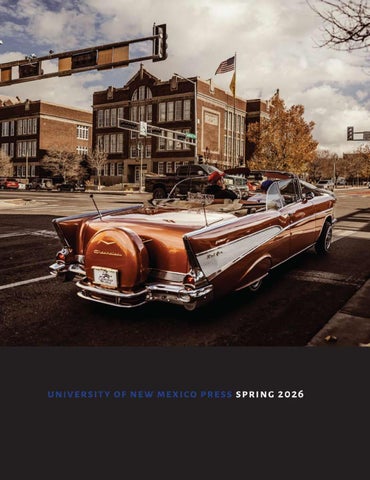
Seventh and Central is a photographic tribute to Albuquerque’s vibrant lowrider culture, a powerful reflection of lowrider traditions and communities everywhere. It is an immersive, visual affirmation of the bonds and values of a community rooted in art and family. Featuring more than 130 astonishing photographs in both full color and black and white, this collection documents an important expression of identity, creativity, and belonging. From chrome bumpers to custom paint, lowriders are more than vehicles—they are rolling works of art and symbols of pride. In Albuquerque, New Mexico, especially along the iconic stretch of Route 66 known as Central Avenue, the lowrider scene pulses with resilience, history, and love. Lowrider culture extends beyond the cars to the people who drive them, with their remarkable tattoo work and distinctive fashions, and to the multigenerational car clubs that weld communities together. This book captures it all: from the high-gloss paint jobs and hydraulics to the quiet, intimate moments behind the spectacle. Paolinelli’s humanity and heart put his subjects at ease, enabling him to authentically capture their true selves. Lift the cover and slide into the world of Seventh and Central.
8
Lorca in Vermont
biography / literature
The Spanish Poet and His American Lover patricia a. billingsley
“Patricia Billingsley’s secret history involving an unknown American and an icon of Spanish poetry represents an act of biography at its finest. The long-suppressed story of Federico García Lorca and an aspiring poet named Philip Cummings travels from Madrid to New York to, of all places, Vermont. Lorca in Vermont reveals passions and literary source material that will fascinate and surprise even seasoned readers of García Lorca’s cherished works.” —Steve Paul, author of Literary Alchemist: The Writing Life of Evan S. Connell
Patricia A. Billingsley is an independent researcher and biographer with a special interest in poets and writers of the early twentieth century. She divides her time between Delaware and western Massachusetts and maintains close ties to the Vermont region where Lorca and Cummings created their own private Eden in August 1929. Residence: Newark, DE
April 7 232 pp.; 5.5 × 8.5 in. 36 halftones $27.95 cloth $18.99 ePub
978-0-8263-6935-2 978-0-8263-6936-9
high road books
Lorca in Vermont tells the story of two young lovers with mismatched goals and expectations: Spanish poet Federico García Lorca, already well established in his career, who sought a sustained romantic relationship with another man, and Philip Cummings, a new college graduate eight years his junior with no interest in long-term commitment or in challenging social conventions. Based on over a decade of research, Lorca in Vermont explores the full course of Lorca’s relationship with Cummings, an affair that spanned three years and two continents. Combining unique access to primary sources, extensive original research, and a fresh analysis of published sources, the book describes not only the pair’s history as a couple but also the suppression of their relationship by Lorca scholars after the poet’s tragic death in 1936. Perhaps most importantly, it reveals previously unrecognized links between the disappointment and loss Lorca experienced in his relationship with Cummings and at least eight of the poems in his landmark collection Poet in New York, a work that has long intrigued and inspired other writers. The book brilliantly blends compelling new findings and an engaging narrative style in a page-turning tale that is a must read for anyone interested in Lorca and his legacy.
10
biography / history / literary criticism / southwest
The Bright Edges of the World Willa Cather and Her Archbishop garrett peck
“The Bright Edges of the World: Willa Cather and Her Archbishop is both a deep dive into one of Cather’s most beloved classics and also an exhilarating guided trek through a rugged slice of Southwestern literary history.” —Kali Fajardo-Anstine, author of Woman of Light: A Novel
Garrett Peck is an author, historian, and tour guide in Santa Fe, New Mexico. He is the author of nine books focusing on American history. He leads the Willa Cather’s Santa Fe tour and many other excursions around New Mexico. Residence: Santa Fe, NM
February 17 256 pp.; 6 × 9 in. 80 halftones $27.95 cloth $20.99 ePub
978-0-8263-6925-3 978-0-8263-6926-0
Also of Interest Death Comes for the Archbishop A Classic Novel of New Mexico Willa Cather; Introduction by Richard W. Etulain
Six months before she died, Willa Cather called her 1927 novel Death Comes for the Archbishop her “best book.” The Atlantic magazine concurred, including Archbishop on its Great American Novels list in 2024. A perennial favorite for people who love New Mexico, the novel tells an unusual story of two French priests and best friends serving on the American frontier before the arrival of the railroad. This Western work of fiction is loosely based on two historical figures, Archbishop Jean-Baptiste Lamy and Bishop Joseph Machebeuf. In The Bright Edges of the World, Garrett Peck explores how Cather’s travels to the Southwest inspired her writing. She visited the Southwest six times between 1912 and 1926, and from these journeys came three novels, the last of which was Death Comes for the Archbishop. Through Cather’s letters, postcards, articles, and interviews, Peck traces how integral travel was to Cather’s imagination while highlighting the vital contribution that Cather’s longtime partner, Edith Lewis, made to the story. The Bright Edges of the World is richly illustrated to highlight Cather and Lewis’s extensive Southwestern adventures. Though Archbishop is a work of fiction, Peck explores how Cather wove some of the most legendary people in New Mexican history into her novel, such as Archbishop Lamy, Kit Carson, and Padre Antonio José Martínez, while subtly hinting toward the complexity of Pueblo Indian and Navajo (Diné) faith. Archbishop is a multicultural novel that reflects the diversity of New Mexico’s people. Death Comes for the Archbishop remains a timeless book of friendship on the American frontier and an inspiration for people who, as Cather wrote, “have gone a-journeying in New Mexico on the trail of the Archbishop.”
$16.95 paper 978-0-8263-6572-9
11
archaeology / geology / indigenous Studies / science
Those Who Walked Before How Ice Age Footprints in New Mexico Retell the Stories of the First Americans
matthew r. bennett, david f. bustos, and daniel odess
“A gripping narrative that transports readers to the glistening white sands of an ancient lake bed, hemmed in by mountains under the dusty New Mexico sun, as they brush away the literal sands of time that have obscured the footfall of Native Americans’ ancestors—the first Americans.” —ed jolie, (Oglala Lakota / Hodulgee Muscogee), Clara Lee Tanner Professor of Anthropology at the University of Arizona
Matthew R. Bennett is a geoscience professor from the United Kingdom. He is one of the world’s leading authorities on vertebrate ichnology (the study of fossilized trackways), and he is the author of Our Dynamic Earth: A Primer. Residence: United Kingdom David f. Bustos is the integrated resource-program manager at White Sands National Park, where he has investigated ancient human and megafauna footprints throughout the park for more than a decade. Residence: Las Cruces, NM Daniel Odess is an archaeologist with extensive experience conducting research in Alaska, northern Canada, and arctic Russia. He is a coeditor of Honoring Our Elders: A History of Eastern Arctic Archaeology. Residence: Tacoma Park, MD
March 3 208 pp.; 6 × 9 in. 62 halftones $21.95 paper $14.99 ePub
978-0-8263-6941-3 978-0-8263-6942-0
On a warm winter day in 2005, while mending fences in the backcountry of White Sands National Park, David F. Bustos, the park’s biologist turned resource-program manager, spotted his first Ice Age human footprint. He initially ignored it as a print made from a modern cowboy boot, but it nagged him for years. As Bustos became adept at identifying the trackways of Ice Age megafauna, he could not shake the feeling that ancient humans had walked there too. It turns out, Bustos was right. With the expertise of archaeologist Daniel Odess, British geologist Matthew R. Bennett and a vast team of researchers worked with Bustos and his colleagues to uncover what is now considered the longest fossilized footprint trail in the world. Preserved beneath layers of alkaline gypsum sand are the unmistakable footprints of early humans, evidence that rewrites the timeline for the initial peopling of the Americas and is arguably the most important archaeological discovery of the last hundred years. Those Who Walked Before: How Ice Age Footprints in New Mexico Retell the Stories of the First Americans is the riveting, first-person account of this extraordinary scientific journey that recounts in vivid detail the excitement of an evolving and ongoing research program complete with dramatic discoveries, disheartening failures, and significant impacts that have shifted our collective knowledge of Indigenous America.
Photography • Southwest
Into the Great White Sands Photographs by Craig Varjabedian; Essays by Jeanetta Calhoun Mish, Dennis Ditmanson, and Jim Eckles
NE W IN PA P E R “Put professional equipment into the hands of a master like Craig Varjabedian and he’ll find stunning beauty, great recreation, and a few surprises. . . . The pictures truly are the thing. And they are gorgeous.” —New Mexico Magazine “If you prefer open space and simplicity, this award-winning photographer takes you there with an eye for detail, contrast, and composition. . . . Beautifully done.” —Enchantment
Craig Varjabedian is a renowned photographer and author. His most recent UNM Press book, Landscape Dreams, A New Mexico Portrait, won the prestigious New Mexico–Arizona Book Award. Based in Santa Fe, he photographs throughout the American West and teaches at Eloquent Light Photography Workshops. Residence: Santa Fe, NM
March 3 136 pp.; 12 × 9.5 in. 91 color plates, 1 map
$39.95 paper
978-0-8263-6898-0
$26.99 ePub
978-0-8263-5831-8
Winner of the 2018 New Mexico–Arizona Book Award’s Father Thomas J. Steele Award for History
Award-winning photographer Craig Varjabedian has spent decades photographing the many moods of the magnificent and ever-changing landscape of New Mexico’s White Sands National Monument. His photographs reveal snow-white dunes of gypsum, striking landforms, storms and stillness, panoramic vistas and breathtaking sunsets, intricate windblown patterns in the sand, ancient animal tracks, exquisite desert plants, and also the people who come to experience this place that is at once spectacular yet subtle. Varjabedian’s evocative color images provide the reader with an almost palpable sense of this extraordinary place. These photographs are enriched by several essays written by Jeanetta Calhoun Mish, noted poet and author; Dennis Ditmanson, retired White Sands National Monument superintendent; Jim Eckles, retired Missile Range public affairs officer; and Craig Varjabedian, the photographer who shares his insights and experiences of photographing this inspiring landscape and offers tips on making better pictures of White Sands.
13
essays • new mexico
Nuclear Family
A Memoir of the Atomic West ty bannerman
“Ty Bannerman is a gifted New Mexico journalist with deep roots in the life and times of his state. He has written a fascinating and thoroughly enthralling insider’s look at the intimate impact that both the national security establishment and radioactivity itself can have on a family associated with the operations of the Manhattan Project and its evolution into the shadow world of mutually assured destruction.” —v.b. price, author of The Orphaned Land: New Mexico’s Environment Since the Manhattan Project and Albuquerque: A City at the End of the World
Ty Bannerman is a writer, editor, and independent journalist based in Albuquerque, New Mexico. He cohosts the local history podcast City on the Edge while his YouTube channel, Meet Me in Dreamland, documents American history as reflected in its amusement parks and attractions. Residence: Albuquerque, NM February 3 168 pp.; 5.5 × 8.5 in. $19.95 paper $9.99 ePub
978-0-8263-6902-4 978-0-8263-6903-1
Ty Bannerman’s family came to Los Alamos in 1952 to build nuclear bombs. This fact has become their origin myth, threaded into the very DNA of Bannerman himself, his relatives, and his children. No one on this planet has been untouched by the nuclear industry, but the Bannermans—working-class contributors to the atomic industrial complex—are a unique embodiment of this reality. Nuclear Family is a lyrical memoir, a series of connected essays that use hard science, popular culture, and personal meditation to explore the role of nuclear weapons and the legacy of Los Alamos in the lives of one American family. Unsung heroes and victims, McCarthy-era interrogations, the Incredible Hulk, and corpses preserved for display are all linked, ultimately, to the bomb and the people who created it.
From Nuclear Family
Oppenheimer is so convenient, with his gimlet eyes and quiet, conflicted intensity. One man who encapsulates the contradictions of the bomb. The fascinating science behind it, the fear of not having it, the fear of having it, the horror and pain of power and violence. And that he knew that he was wrong, how perfect is that? The remorse of the now-sober parent, crying and asking forgiveness for the blows he rained down and the rending words he screamed out. If it were only him. Then we could forgive him and be done with it.
14
southwest / essays / environment
The Worst Fishing Dog Ever And Other Essays ron dungan
“Ron Dungan’s book is full of hard-earned, thoughtful, incisive insights. He understands and illuminates the personal, cultural, and environmental forces at play that surround our beloved sport of fly-fishing. This is a must-read book for anyone interested in why fly-fishing matters in these troubled times.” —Robert DeMott, author of Astream: American Writers on Fly Fishing
RoN dungan was a travel and outdoors writer for the Arizona Republic for many years, where he contributed to a Pulitzer Prize–winning story on the history of the border. More recently, as a reporter for public radio affiliate KJZZ, he had pieces on NPR and Here and Now. His work has appeared in the New York Times, Gray’s Sporting Journal, USA Today, Sierra, the Minneapolis Star Tribune, Southwest Fly Fishing, and the Miami Herald, among others. Residence: Phoenix, AZ
March 17 192 pp.; 5.5 × 8.5 in. $16.95 paper $9.99 ePub
Ron Dungan, like many fly-fishers, can be obsessive. Although decades of fishing trips have led him to encounter snakes, bears, and treacherous terrain, his main focus is always the fish—how to find them, how to outsmart them, and how to hook them. In twenty-seven essays, Dungan takes us on a journey down bad roads and backcountry streams. Each tells a tale about fishing but also about hunting dogs, death, public-land policy, the trap of materialism, and accelerating environmental damage. This last becomes a new obsession. Fly-fishing in the arid Southwest has always been precarious, but how has fly-fishing changed, and what further impacts will climate change and resource extraction have? With his dog curled at his feet, Dungan attempts to unravel the tangled line of these hard questions.
978-0-8263-6920-8 978-0-8263-6921-5
15
fiction / short stories
A Method of Reaching Extreme Altitudes And Other Stories nancy j. allen Lynn and Lynda Miller Southwest Fiction Series “Nancy Allen is a gorgeous writer, deft with the use of telling and power-packed poetic verbs and wise in her ability to see deep into the soul of a character and know how a single event can change them.” —Elisabeth Sharp McKetta, author of Ark
Originally from Roswell, New Mexico, Nancy J. Allen is a graduate of Vanderbilt University and the Warren Wilson College Program for Writers. Her fiction has won awards in journals including Southwest Review, StoryQuarterly, bosque, and Short Story America. A research fellow of the School of Spiritual Psychology in Santa Fe, she lives with her husband in Dallas and Taos. Residence: Taos, NM, and Dallas, TX
In Nancy J. Allen’s fierce first collection, A Method of Reaching Extreme Altitudes and Other Stories, the extraordinary emerges from the everyday. Allen’s stories are informed by the vast landscapes of New Mexico and Texas, and in them the mythic and the mundane intertwine: two neighbors burn a grandson’s letters from Vietnam in a backyard grill; a child vanishes into the maze of Albuquerque’s fabled Alvarado Hotel; a sculptor meets her younger self in the eerie stillness of a theater lobby. These are only a few of the unforgettable, mysterious moments that mark the arrival of a bold new voice in contemporary Southwest fiction.
January 13 200 pp.; 5.5 × 8.5 in. $19.95 paper $9.99 ePub
978-0-8263-6927-7 978-0-8263-6928-4
16
fiction / latin america / jewish studies
The Woman Who Wrote the Bible moacyr scliar translated by heath wing introduction by ilan stavans Jewish Latin America Series “Moacyr Scliar’s novel The Woman Who Wrote the Bible, in a rollicking English translation by Heath Wing, is hilarious, irreverent, and thought-provoking. The author’s use of language, by turns modern and archaic, ribald and refined, sets this biting satire of the rigors and absurdities of the patriarchal order apart. I don’t think I’ve ever read anything quite like it.” —Jessica Powell, translator of Reinbou: A Novel by Pedro Cabiya
Moacyr Scliar (1937–2011) was the author of numerous works of fiction, including Max and the Cats (the inspiration behind Yann Martel’s Life of Pi) and The Centaur in the Garden, named one of the 100 Greatest Works of Modern Jewish Literature by the National Yiddish Book Center. His Collected Stories (UNM Press) was awarded the National Jewish Book Award.
March 17 168 pp.; 6 × 9 in. $19.95 paper $9.99 ePub
978-0-8263-6931-4 978-0-8263-6932-1
Moacyr Scliar was the preeminent literary voice of the Jewish immigrant experience in modern Brazil. Now his most ambitiously satirical and irreverent novel is at last translated into English, offering not just a significant contribution to Latin American and Jewish literature but to world literature as well. In a past-life therapy session, a mysterious woman makes a remarkable breakthrough when she discovers that in a previous life she was one of King Solomon’s seven hundred wives. In language that hilariously mixes modern jargon and biblical diction, she sets out to tell the story of her earlier incarnation three thousand years in the past, revealing how she went from a provincial nobody to a queen. Yet being royalty isn’t all it’s cracked up to be. As the least desirable of King Solomon’s wives and concubines, she is unceremoniously discarded and forgotten in his harem. But as luck would have it, she possesses a unique gift: she is a woman who knows how to read and write. Once her talent is discovered, King Solomon charges her with writing what will become one of the most important texts in human history. Along the way our nameless narrator leverages her newfound status as royal scribe to bring about her own secret agenda. A brilliant feminist critique skewering the absurdities of patriarchy, The Woman Who Wrote the Bible is a comic masterpiece of truly biblical proportions.
latina and latino • jewish studies • new mexico
El Iluminado
A Mystery of Santa Fe ilan stavans and steve sheinkin
“El Iluminado is a revelation—a story that surprises at every turn, where the dusty histories of New Mexico’s crypto-Jews are brought to life with sharp wit and striking visuals. It’s the kind of graphic novel that stays with you well past the final page, inviting you to look deeper and think harder about our hidden histories.” —Christopher González, coauthor of Reel Latinxs: Representation in U.S. Film and TV
Internationally renowned scholar, essayist, linguist, translator, editor, and cultural commentator ilan stavans is the Lewis-Sebring Professor of Humanities, Latin American, and Latino Culture at Amherst College. He serves as the series editor for the University of New Mexico Press’s acclaimed Jewish Latin America Series. Residence: Amherst, MA steve sheinkin is the award-winning author of three graphic novels featuring Rabbi Harvey, a fictional rabbi who also functions as an Old West sheriff. His nonfiction books include Bomb: The Race to Build—and Steal—the World’s Most Dangerous Weapon and The Port Chicago 50: Disaster, Mutiny, and the Fight for Civil Rights, which were both National Book Award finalists. Residence: Saratoga Springs, NY
March 17 216 pp.; 7 × 10 in. $24.95 paper $24.95 ePub
When young Rolando Perez falls to his death from a cliff outside Santa Fe, New Mexico, the mysteries immediately begin to accumulate. Was he pushed or did he jump? What might Rolando have been so desperate to protect that he would sacrifice himself? And what does a colorful concha pastry have to do with any of this? In the midst of the investigation, Professor Ilan Stavans arrives in Santa Fe to give a lecture about the area’s long-buried Jewish history. He’s looking forward to relaxing afterward with an evening at the opera, but his presentation on “crypto-Jews” attracts unexpected attention, and soon Ilan is drawn into a desperate race to find the long-lost documents that might hold the key to Rolando’s death. His amateur sleuthing leads him to taco joints, desert ranches, soaring cathedrals, and, finally, deep into the region’s past, where he encounters Luis de Carvajal, also called “El Iluminado.” In a sixteenth-century tale of martyrdom that eerily echoes Rolando’s, Carvajal fled Spain for colonial Mexico at the height of the Spanish Inquisition, searching for his religious heritage—a hunt for which he, like Rolando, would pay the ultimate price. In El Iluminado, esteemed literary critic Ilan Stavans and author and illustrator Steve Sheinkin present a secret history of religion in the Americas, showing how thousands of European refugees have left a trail of ghostly footprints—and troves of mysteries—across the American Southwest. This paperback edition includes a new afterword recounting the amazing events that occurred after the original publication, including the real-life discovery of the long-lost memoir of Luis de Carvajal and its restoration to Mexico.
978-0-8263-6918-5 978-0-8263-6919-2
18
19
travel / recreation • food / foodways • southwest
Arizona Boots and Burgers A Guide for Hungry Hikers: New and Expanded Edition roger naylor Southwest Adventure Series “Roger’s depth of knowledge about hiking leads the reader to many spectacular and diverse places. His humor, fun facts, love of Arizona, and endless devotion to burgers will have you ready to lace up your boots and get your stomach ready for an adventure!” —Sirena Rana, author of Urban Trails Tucson
Roger Naylor is an award-winning travel writer, an avid hiker, and a road-trip junkie. He is a member of the Arizona Tourism Hall of Fame and the author of several Arizona guides, including Arizona State Parks, Awesome Arizona, Arizona National Parks and Monuments, and Arizona’s Scenic Roads and Hikes (all from UNM Press). Residence: Cottonwood, AZ
February 17 328 pp.; 5.5 × 8.5 in. 100 color photographs $23.95 paper $29.95 ePub
978-0-8263-6907-9 978-0-8263-6908-6
No matter where you are in Arizona, you’re only minutes from an amazing hiking trail—and there’s probably a locally owned eatery nearby if you know where to look. Roger Naylor, “the dean of Arizona travel writers,” knows where to look. Naylor combines two great passions—hiking and hamburgers—to create the ultimate culinary adventure for the Grand Canyon State. Arizona Boots and Burgers: A Guide for Hungry Hikers is loaded with scenic beauty and scrumptious meals. A humor and travel writer, Roger highlights his favorite hikes in Monument Valley, the Grand Canyon, Flagstaff, Sedona, Prescott, the Phoenix area, Tucson and the southern deserts, the White Mountains, and Arizona’s West Coast. Each trail is paired with a nearby restaurant serving up delicious Sonoran hot dogs, barbecue, pizza, Indian tacos, cheese crisps, and, oh yeah, dozens of mouthwatering burgers—including vegetarian options at each location. This book is a love letter to Arizona packed with more than 100 stunning photographs and featuring 70 trails and 70 eateries along with maps, fun facts, storytelling, attractions along the way, and fruit burros. These are Arizona’s best trails and best burgers.
20
21
travel•recreation / U.S. History / american studies
Hip to the Trip
Route 66 Centennial Edition peter b. dedek
Peter B. Dedek is a professor of history and the coordinator of the Public History Program at Texas State University, San Marcos. Residence: San Marcos, TX
March 3 248 pp.; 5.5 × 8.5 in. 55 halftones $16.95 paper $9.99 ePub
978-0-8263-6943-7 978-0-8263-6944-4
In 2026, Route 66 reaches a major mile marker: the celebration of its one-hundredth anniversary. Commissioned by the federal government as US Highway 66 in 1926, Route 66 has weathered many bumps in the road. The old road even survived a near-death experience in 1985 when it was bypassed by interstate highways and officially decommissioned only to rise again as a historic landmark and symbol of the independent American spirit and America’s love affair with the automobile. Although much along the historic highway has been lost over the years, Route 66 still has a lot to offer. Old motels, vacant gas stations, vintage restaurants, and decayed tourist traps have been preserved and transformed into sites of reverence and memory. In the past few decades, the highway has evolved into a linear community, a heritage corridor, an American route of pilgrimage sustained by a series of preserved landmarks visited by tourists from all over the world. More recently built museums, visitors’ centers, roadside parks, and Route 66–themed businesses offer tourists the chance to experience myriad aspects of the highway and the ideas it represents. This book examines the many meanings of Route 66 and how they relate to its past, present, and future. More an idea than a highway, Route 66 symbolizes a sense of freedom and benign rebellion against the constrained routines of modern life, a place where one can wander and live in the moment. The old road also represents community, wholesome enjoyment, and an entrepreneurial, independent spirit. Route 66 is a road of stories and legends.
22
film / travel • Recreation / new mexico / pop culture
A Film Lover’s Guide to Santa Fe A Walking Tour
jason strykowski
“The perfect guide to cinematic Santa Fe, Strykowski’s walking tours combine film history, the city’s arts and architecture, and gentle exercise for locals and visitors alike.” —Aimee Macpherson, author of A Guide to the Bars and Restaurants of Breaking Bad and Better Call Saul
Jason Strykowski has worked on more than a dozen major film and television sets as a script coordinator and an assistant to producers and actors. He also spent years as a tour guide in Northern New Mexico. His articles have appeared in the Santa Fe New Mexican, Edible New Mexico, Santa Fean, wired.com, Comic Book Resources, and New Mexico Magazine. He is the author of A Guide to New Mexico Film Locations: From Billy the Kid to Breaking Bad and Beyond. Residence: Orinda, CA
March 3 176 pp.; 5 × 7 in. 39 color photos $19.95 paper $9.99 ePub
978-0-8263-6929-1 978-0-8263-6930-7
Demons, detectives, cowboys, hippies, lawmen, and Asgardian gods have all visited Santa Fe, New Mexico. The City Different also hosts similarly colorful townsfolk, artists, culture makers, and trendsetters. A Film Lover’s Guide to Santa Fe situates all these larger-than-life characters onto a figurative map that depicts both Santa Fe’s fictional life in filmmaking and its real life as the heart of southwestern arts and culture. Follow Hollywood insider and film historian Jason Strykowski to iconic film locations walkable from the Santa Fe Plaza, including Evangelo’s Cocktail Lounge in Crazy Heart and the Bataan Memorial Building, as seen in Christopher Nolan’s Oppenheimer. Strykowski’s guide to famous film sights provides adventurers with deeper insights into Santa Fe’s social tapestry through film and filmmaking, cultural and natural history, architecture, and the arts. A Film Lover’s Guide to Santa Fe also includes short driving detours to Bonanza Creek Ranch, the Audubon Center, Bandelier National Monument, and Meow Wolf, all of which have appeared on the big screen!
23
photography / southwest / history
Ore and Empire
Conquistadors to Guggenheims on the Camino Real martin stupich; foreword by dagoberto gilb “This handsome and unusual book will fascinate general readers as well as students, historians, architects, and environmentalists. Martin Stupich spent years photographing ASARCO’s entangled complex of pipes, furnaces, hearths, and smokestacks that produced great wealth for a handful of Gilded Age families. It also deeply scarred and polluted the earth. This unique postmortem study presents the entwined histories of American capitalism and environmental destruction.” Martin Stupich is an internationally recognized photographer of industry and landscape. His photography books include Red Desert: History of a Place, with Annie Proulx, and his work is extensively covered in Through the Lens of the City: NEA Photography Surveys of the 1970s by Mark Rice and The Altered Landscape: Photographs of a Changing Environment, edited by Ann M. Wolfe, and in numerous critical essays and exhibition catalogs over his forty-year career. Residence: Albuquerque, NM
February 17 232 pp.; 10.5 × 8.5 in. 113 color plates, 38 figs., 1 map $60.00 cloth
978-0-8263-6860-7
—Annie Proulx, Pulitzer Prize–winning author
For centuries the Spanish Empire’s conscripted laborers extracted silver from hand-dug tunnels and shafts deep beneath the mountain spine of the Americas. By the late nineteenth century, mining engineers in the United States and in Mexico were refining not just silver ores but also lead, gold, and copper. Copper was especially crucial to the looming industrial century. Not since the days when Spanish treasure galleons carried off the New World’s silver had anyone seen the sort of vast mineral wealth amassed by the “copper kings” of the Gilded Age. First among them was the Guggenheim family, whose American Smelting and Refining Company (ASARCO) controlled more than 80 percent of the world’s supply of silver, copper, and lead by the early twentieth century. Like the Spanish conquistadors before them, the ASARCO empire extended over 1,500 miles, from Central Mexico to Colorado. Its epicenter straddled the Mexico–Texas borderlands where the Rio Grande and the ancient Camino Real de Tierra Adentro converge at El Paso, the home of one of America’s largest smelters—and the centerpiece of Martin Stupich’s photographic journey. The hundred-acre ASARCO site was, until its 2013 demolition, more than a gritty industrial tract. For a century the company was central to El Paso’s vitality, even as Mexican American workers’ families in Smeltertown, the company barrio, died slowly under its toxic plume. Ore and Empire documents this storied landscape in words and images. Original color photographs are complemented with essays by three renowned scholars, adding depth to an already sweeping historic panorama. Created over some fifteen years in the field, Stupich’s monumental work serves as an homage to the unnamed thousands who lived and toiled here.
24
25
film / american west
Lone Star
alison fields Reel West Series
“In this timely and engaging study, Alison Fields examines Lone Star as a landmark Western that delves deeply into the cultures, politics, and histories of the US/Mexico borderlands. A nuanced and perceptive book, Lone Star offers rich insights into debates about memory and counter-memory, the struggles for national belonging, and the meanings of local and regional places.” —Susan Kollin, author of Thelma & Louise
Alison Fields is the acting director of the School of Visual Arts at the University of Oklahoma. She is the Mary Lou Milner Carver Professor of Art of the American West, a professor of art history, and the author or coeditor of four books, including Discordant Memories: Atomic Age Narratives and Visual Culture. Residence: Norman, OK
April 7 168 pp.; 5 × 7 in. 25 halftones $19.95 paper $9.99 ePub
978-0-8263-6939-0 978-0-8263-6940-6
Filmmaker John Sayles has been a key voice in independent cinema since the 1970s, interrogating American legends by retelling stories about class, race, labor, sexuality, history, and violence. Lone Star, released in 1996, was ahead of its time in exploring the prevailing legends of the Borderlands through the intersectionality of Black, Chicano, and women’s narratives. Set in the fictional small town of Frontera on the Texas/Mexico border, the film opens with the discovery of a decades-old skeleton on a rifle range—the remains of racist and corrupt former sheriff Charlie Wade (Kris Kristofferson). It had long been presumed that Wade was driven from town by Buddy Deeds (Matthew McConaughey), who succeeded him for a long tenure as Frontera’s beloved sheriff. The discovery of Wade’s remains prompts current sheriff Sam Deeds (Chris Cooper), who had always lived in his father’s shadow, to question Buddy’s legacy and his involvement in Wade’s death and to look to the testimonies of the poor, the dispossessed, and the overlooked—the very people the late Sheriff Wade had victimized. In the first book-length examination of Lone Star, Fields situates the film firmly in the “new Western history” that has done so much to overturn the century-old Frontier Thesis.
26
AVAILABLE NOW
REEL WEST Broken Arrow
The Man Who Shot Liberty Valance
Thelma & Louise
Angela Aleiss $19.95 paper ISBN 978-0-8263-6832-4 E-ISBN 978-0-8263-6833-1
Chris Yogerst $19.95 paper ISBN 978-0-8263-6838-6 E-ISBN 978-0-8263-6839-3
Susan Kollin $19.95 paper ISBN 978-0-8263-6552-1 E-ISBN 978-08263-6553-8
Ride Lonesome
Ride the High Country
Blood on the Moon
Kirk Ellis $19.95 paper ISBN 978-0-8263-6461-6 E-ISBN 978-08263-6462-3
Robert Nott $19.95 paper ISBN 978-0-8263-6608-5 E-ISBN 978-08263-6609-2
Alan K. Rode $19.95 paper ISBN 978-0-8263-6469-2 E-ISBN 978-08263-6470-8
27
poetry
Midsummer Count New and Selected Poems robin becker Mary Burritt Christiansen Poetry Series
“For decades, and certainly since her Lambda Literary Award–winning All-American Girl, Robin Becker has inspired and instructed us on how to be the portrait of the artist as a Jewish woman, a lesbian, a sister, a daughter, a lover, a traveler, and a teacher of the craft of poetry. With grace and grit, the poems that span her career now reside together in one volume to magnify their mastery and thematic conversations over time.” —Sandra Yannone, author of The Glass Studio
Robin Becker is the author of eight previous books of poetry, including The Black Bear Inside Me and the Lambda Award winner All-American Girl, both published in the Pitt Poetry Series. A liberal arts research professor emerita in English and women’s studies at the Pennsylvania State University, she lives in central Pennsylvania and southwestern New Hampshire. Residence: Boalsburg, PA
January 13 162 pp.; 6 × 9 in. $21.95 paper $15.99 ePub
Midsummer Count collects the best work of Robin Becker, considered by many to be the foremost feminist poet of her generation. With selections from each of her previously published books and nearly thirty new poems, readers enter Becker’s lifelong exploration of childhood, animals, cherished places, complex friendships, and romantic intimacy. A life-affirming current yokes these narratives across time, even as a sister’s early suicide haunts the decades. In blank and free verse, in couplets, quatrains, and sonnets, the poet wrestles formal tensions, creating a present-day idiom for beauty, grief, and compassion. Lovers of Becker’s work and those new to it will find in Midsummer Count a master class by one of today’s most dynamic poets.
978-0-8263-6933-8 978-0-8263-6934-5
28
poetry
Punishment Bag Poems
jake fournier Mary Burritt Christiansen Poetry Series Underpass Coming over it for once, seeing it from above, coming to this spot and seeing Route 20 bend. 13'8" plus the unknown height of the train carriage, plus my own height—I had already been fighting the cabin light to see. I was close. The closed Tae Kwon Do house, the island between these three roads, the yield sign, flagpole, billboards, the landscaped embankments— it’s nameless. We’re coming to it, a turquoise trapezoid cut through the hill. I took you here, not specifically. We passed, blinking, through both of them . . . Anyway, I went countless, with you and others, to get to the lake. The lake is proof. And a train rips into sight just before we dip beneath its quarter mile of cars. Simultaneity. Simultaneity. Then the bridge erases a second of rain.
jake fournier is a firefighter in Albuquerque, New Mexico. He teaches in the graduate program at the Institute of American Indian Arts. Residence: Albuquerque, NM
January 13 96 pp.; 6 × 9 in. $18.95 paper $9.99 ePub
978-0-8263-6922-2 978-0-8263-6923-9
Jake Fournier’s Punishment Bag asserts that poetry ought to exceed its author’s intelligence. At once caustic and tender, this daring debut spans from dense, refractory lyrics to lucid narratives. As ghosts materialize at the periphery of late-night dialogues and spiritual seekers slide into hedonic disaffection, ordinary objects—creamer cups and plush koalas—accrue bizarre, sacred resonance. The collection hopscotches from the American Southwest to the exurbs of Paris and culminates in a piercing, Eliotic prose poem created from a destabilizing selection of autobiographical notes. Tracing the growth of a poet’s mind, Punishment Bag extends its readers an irresistible invitation to grow in turn, to delight in the tactile density of language, and, against a backdrop of ecocide and systemic injustice, to discover new ways to make meaning.
29
art / biography / chicana and chicano
Delilah Montoya
Activating Chicana Resistance josie lopez
Josie Lopez is the head curator and the curator of art at the Albuquerque Museum. In addition to curating temporary art exhibitions, she oversees the collection and the permanent exhibition Common Ground: Art in New Mexico.
February 3 280 pp.; 8 × 10 in. 414 color photos $29.95 paper $21.99 ePub
978-0-8263-6945-1 978-0-8263-6946-8
Delilah Montoya: Activating Chicana Resistance provides an in-depth exploration of Delilah Montoya’s decades-long engagement with printmaking, photography, and large-scale installation works, showcasing her contributions to contemporary art through the lens of her Chicana heritage. Born in Texas, raised in the Midwest, and now living in New Mexico, where she has spent much of her career, Montoya and her work are deeply rooted in the experiences of the Southwest and its communities. Her projects navigate the intersections of spirituality, gender norms, and cultural identity, challenging and redefining perceptions through a unique lens intently trained on the roots of mestizaje, the coming together of European and Indigenous cultures in the formation of Latino identities. From the very beginning, Montoya’s work has not only situated and defined Chicana and Chicano identity, it has also served as a tool rooted in activism to demand that these voices, stories, bodies, and histories be seen. This ambitious volume is the first publication to provide an art-historical examination of the broad scope and depth of Montoya’s body of work. This book cements Montoya’s status as a key artist in the discourse on Chicana and Chicano art and culture.
university of new mexico press albuquerque museum
30
31
memoir
Speak of It A Memoir marcos mcpeek villatoro
new in paper “A neat, Hitchcockian thriller. . . . Let’s hope there are real FBI agents as brilliant as Romilia Chacón.” —Washington Post [for A Venom Beneath the Skin] “Scintillating, densely plotted. . . . Villatoro creates a compelling, dramatic balance.” —Publisher’s Weekly (starred review) [for Minos] “Rich in history and myth, rich in setting, rich in character. This book reminded me of The Da Vinci Code. It is a pleasure from start to finish.” —T. Jefferson Parker, Edgar Award–winning author of A Thousand Steps [for Minos]
Marcos McPeek Villatoro is the author of six novels, two collections of poetry, and a memoir. His Romilia Chacón crime fiction books have won national acclaim (named a Best Book by the Los Angeles Times) and have been translated into German, Russian, Portuguese, and Japanese. Villatoro holds the Fletcher Jones Endowed Chair in Writing at Mount St. Mary’s University, where he lectures on poetry, fiction, nonfiction, and his Latino and Appalachian heritages. Residence: Los Angeles, CA
April 21 224 pp.; 5.5 × 8.5 in. $19.95 paper $9.99 ePub
978-0-8263-6949-9 978-0-8263-6533-0
high road books
In Speak of It, Marcos McPeek Villatoro explores how he channeled his Latino roots to come to terms with the childhood sexual abuse he suffered at the hands of a relative in his home in Appalachia, and he recounts his ensuing struggle with trauma and mental illness. The son of a Salvadoran mother and a Scotch Irish father, Marcos spent much of his life struggling to break away from the trauma he experienced in childhood by striving to get closer to his Salvadoran heritage. His journey includes steeping himself in the Spanish language and Latin American literature, especially the work of Gabriel García Marquez; a stint in Nicaragua with Witness for Peace, followed by missionary work in Guatemala; and social-justice work with Mexican migrant farmworkers in Alabama. Each experience brought him closer to understanding where he came from and to forging an identity as a whole self in the wake of trauma. Riveting, horrifying, moving, and inspiring, Speak of It is a testament to the healing power of language, books, and identity.
32
native americans / southwest / memoir
Reservation Restless jim kristofic
new in paper “A wonder of autobiography, deep introspection, and marvel at all creation. . . . With the keen eye of an outdoorsman for the sacred landscape and the grace of a gifted storyteller, Kristofic paints word pictures that bring his world to life.” —Helene Woodhams, 2021 Southwest Books of the Year panelist “Kristofic thoughtfully interweaves Diné history and folklore with meditations on the destruction of the environment, thus deepening the implications of his story of leaving home in order to return.” —Lindsay Harmon, Booklist “This is the way to write a memoir, by fixing it within the bigger scope of life. If you like the puzzles of nature’s humanity, rich in vibrant timbres, you’ll not regret adding this to your library.” —Monette Bebow-Reinhard, Roundup Magazine
Jim Kristofic grew up on the Navajo Reservation in northeastern Arizona. He has written for the Navajo Times, Arizona Highways, Native Peoples Magazine, and High Country News. He is the author of Medicine Women: The Story of the First Native American Nursing School and Navajos Wear Nikes: A Reservation Life. Residence: Taos, NM
February 17 208 pp.; 6 × 9 in. 2 halftones, 1 map $19.95 paper $9.99 ePub
978-0-8263-6951-2 978-0-8263-6114-1
2021 Southwest Books of the Year Winner of the 2020 New Mexico–Arizona Book Award for Autobiography & Memoir In the powerful and haunting lands of the Southwest, rainbows grow unexpectedly from the sky, mountain lions roam the desert, and summer storms roll over the Colorado River. As a park ranger, Jim Kristofic explores the Ganado valley, traces the paths of the Anasazi, and finds mythic experiences on sacred mountains that explain the pain and loss promised for every person who decides to love. After reconnecting with his Navajo sister and brother, Kristofic must confront his own nightmares of the Anglo society and the future it has created. When the possible deaths of his mentor and of the American future loom before him, Kristofic must find some new way to live in the world and strike some restless path that will lead back to hózhó—a beautiful harmony.
33
biography / military / journalism
The Ultimate Protest Malcolm W. Browne, Thich Quang Duc, and the News Photograph That Stunned the World ray e. boomhower
new in paper “Malcolm Browne, the first and longest-serving American correspondent in Vietnam, was long overshadowed by the better-known David Halberstam and Neil Sheehan. But Ray Boomhower’s new book finally helps redress the balance. The Ultimate Protest is an engrossing read for anyone interested in how the United States got itself involved in Indochina despite clear warnings by its best journalists who found themselves labeled as ‘enemy agents’ for reporting the truth.” —fox butterfield, Pulitzer Prize winner and author of China: Alive in the Bitter Sea “Malcolm Browne was everything a great reporter should be—intrepid, independent, insightful, and ultimately a bit wistful about the human condition. Ray Boomhower has given Malcolm the fine biography he deserved.” Ray E. Boomhower is a senior editor at the Indiana Historical Society Press. His books include The Soldier’s Friend: A Life of Ernie Pyle, Dispatches from the Pacific: The World War II Reporting of Robert L. Sherrod, and Richard Tregaskis: Reporting Under Fire from Guadalcanal to Vietnam (UNM Press). Residence: Indianapolis, IN
April 7 344 pp.; 6 × 9 in. 29 halftones $24.95 paper $17.99 ePub
978-0-8263-6948-2 978-0-8263-6571-2
high road books
—peter l. w. osnos, author of An Especially Good View: Watching History Happen
The Ultimate Protest: Malcolm W. Browne, Thich Quang Duc, and the News Photograph That Stunned the World examines how the most unlikely of war correspondents, Malcolm W. Browne, became the only Western reporter to capture Buddhist monk Thich Quang Duc’s horrific self-immolation on June 11, 1963. Quang Duc made his ultimate sacrifice to protest the perceived anti-Buddhist policies of the Catholic-dominated administration of South Vietnam’s president Ngo Dinh Diem. Biographer Ray E. Boomhower’s The Ultimate Protest explores the background of the Buddhist crisis in South Vietnam in the spring of 1963 that led to Quang Duc’s self-sacrifice as well as the worldwide reaction to Browne’s photograph, how it affected American policy toward Diem’s government, and the role the image played in the violent coup on November 1, 1963, that deposed Diem and led to his assassination. The book also delves into the dynamics involved in covering the Vietnam War in the early days of the American presence and the pressures placed on the journalists to stop raising doubts about how the war was going. Browne and his colleague David Halberstam shared the 1964 Pulitzer Prize for international reporting for their work in Vietnam.
34
biography / western history / southwest
Bugsy’s Shadow Moe Sedway, “Bugsy” Siegel, and the Birth of Organized Crime in Las Vegas larry d. gragg
new in paper
“Las Vegas aficionado Larry Gragg once again has mined the city’s history for gold and found a whopper of a nugget in the remarkable life and times of casino founding father Moe Sedway. With an obvious love for his subject, Gragg traces Sedway from his earliest days through his rise and fall in Las Vegas as an ally of a notorious crowd led by none other than Benjamin ‘Bugsy’ Siegel. There’s something in here for longtime Vegas denizens and for first-time visitors alike.” —john l. smith, author of Running Scared: The Life and Treacherous Times of Las Vegas Casino King Steve Wynn “Larry Gragg deserves a medal for tackling the long-neglected story of Moe Sedway, who has been unfairly overshadowed by his larger-than-life partner in crime, Bugsy Siegel. This is a vital and invaluable resource for anyone interested in understanding organized crime’s pivotal role in the rise of Las Vegas.”
Larry D. Gragg is a Distinguished Teaching Professor Emeritus and the University Historian at Missouri University of Science and Technology. His books include Benjamin “Bugsy” Siegel: The Gangster, the Flamingo, and the Making of Modern Las Vegas and Becoming America’s Playground: Las Vegas in the 1950s. Residence: Rolla, MO
March 17 240 pp.; 6 × 9 in. 17 halftones $19.95 paper $9.99 ePub
978-0-8263-6950-5 978-0-8263-6516-3
high road books
—geoff schumacher, author of Sun, Sin, and Suburbia: The History of Modern Las Vegas, Revised and Expanded
Early in the Prohibition era, Moe Sedway became part of the New York organized crime gang led by Meyer Lansky and Benjamin “Bugsy” Siegel. A loyal and highly effective operative for Siegel, Sedway eventually gained monopoly control of the race wire service in Las Vegas and also became an effective casino manager of the Las Vegas Club, El Cortez, and the Rex Club. A breach in their relationship led to rumors that Sedway had gained Lansky’s approval for a “hit” on Siegel. The unsolved mystery of who murdered Bugsy in 1947 has spawned numerous theories about the identity of the hitman, but regardless of who pulled the trigger, Bugsy’s death opened the way for Moe to flourish as his own man at last. Long overshadowed by Bugsy in the annals of organized crime in America, Moe Sedway is now at last brought out into the light in this riveting tale of the sensational life and times of one of Vegas’s most mysterious and little-known figures.
35
science / anthropology
Aliens Like Us? An Anthropologist’s Field Guide to Intelligent Extraterrestrial Life anthony aveni
new in paper
“This fascinating and thought-provoking volume applies insights from the social sciences and humanities to the search for life beyond Earth, from exoplanets to aliens and UFOs. Aveni brings his unique expertise in the cultures of Earth to illuminate possible cultures in the heavens. The result is an important, readable, and unusual contribution to the literature of astrobiology, illuminating not only possible extraterrestrials, but also the humans who search for and believe in them.” —steven j. dick, former NASA chief historian and author of Astrobiology, Discovery, and Societal Impact “One of today’s most exciting research efforts is focused on detecting the presence of extraterrestrial intelligence. But are we, in fact, looking for ourselves?” —seth shostak, senior astronomer and director of the Center for SETI Research at the SETI Institute and author of Confessions of an Alien Hunter: A Scientist’s Search for Extraterrestrial Intelligence Anthony Aveni is the Russell Colgate Distinguished University Professor of Astronomy, Anthropology, and Native American Studies Emeritus at Colgate University. He has written or edited more than forty books, including Conversing with the Planets: How Science and Myth Invented the Cosmos and The End of Time: The Maya Mystery of 2012. Residence: Hamilton, NY
January 3 296 pp.; 5.5 × 8.5 in. $19.95 paper $9.99 ePub
978-0-8263-6947-5 978-0-8263-6743-3
high road books
In this authoritative, accessible, and at times funny and irreverent work, distinguished astronomer/anthropologist Anthony Aveni speaks to the trained astrophysicist and the curious layperson alike about a simple but previously unexplored question: Why do we assume aliens, if they are really out there, behave just like us? Aveni’s newest work departs from the usual scientific treatment of extraterrestrial intelligence by probing the historical and widely neglected anthropological record, which offers relevant analogous incidents of contact among terrestrial cultures. Beginning with theories of the evolution of life and culture advocated by astrobiologists, Aliens Like Us? explores how the Western cultural imagination is influenced by ways of knowing that are deeply embedded in the minds of the questioners—for example, how we consider the ownership of property, the idea of progress, and even the way we classify things. The lessons of anthropology offer not only value structures from other cultures that differ profoundly from our own but also testify to the diverse ways in which “alien” cultures interact. Finally, on the question of potential first contact, Aveni closes with a fascinating exploration of the image of extraterrestrials in popular culture that is derived in part from the hugely influential realm of science fiction.
36
fiction / american west
The King of Taos A Novel
max evans
new in paper “Evans may have been born in Texas, but New Mexico—the setting of many of his twenty-five novels—captured his heart. His latest, written at ninety-five years old, is no exception. A series of sharp vignettes describe the meandering misfortunes of the drunken ne’er-do-wells who populate post–World War II Taos.” —Sarah Steers, Booklist “Evans draws on his years in 1950s Taos, New Mexico, for this wistful picaresque. . . . It’s a treat to watch Evans pull this off.” —Publishers Weekly “In my opinion, Evans was an author akin to James Joyce, John Steinbeck, and J. P. S. Brown. . . . I believe anyone who reads The King of Taos and savors Evans’s writing will not only be inspired, but have their own personal spiritual awakening through Max’s prose and the fictional-life experiences of his characters.” —Stuart Rosebrook, True West
Max Evans was the author of over thirty works of fiction and nonfiction. He is the recipient of the Spur, Wrangler, and Owen Wister awards, and he is the subject of the biography Ol’ Max Evans: The First Thousand Years and a documentary film of the same title. Evans lived in Albuquerque, New Mexico, for over fifty years.
February 17 176 pp.; 5.5 × 8.5 in. $19.95 paper $9.99 ePub
978-0-8263-6952-9 978-0-8263-6165-3
Winner of the 2021 Western Heritage Award for Outstanding Western Novel The underground world of con men, winos, prostitutes, laborers, and artists has been an abundant source of material for great writers from Dickens to Bukowski. The underground world of Taos, New Mexico, is no different. In the late 1950s this mountain town was higher, brighter, poorer, and farther removed than London, Paris, or Los Angeles, but it was every bit as rich for the explorations of a young writer. Max Evans, the beloved New Mexican writer of such enduring classics of Western fiction as The Rounders and The Hi-Lo Country, returns to form with The King of Taos. Set in the late 1950s, the novel tells the stories of sharp-witted Zacharias Chacon, aspiring artist Shaw Spencer, and a circle of characters who drink, fight, love, argue, and—mostly—talk. Readers will enjoy this witty and moving evocation of unforgettable characters as they look for work, love, comfort, dignity, and bottomless oblivion.
37
art / biography
Resilience
The Life and Grand Canyon Art of Curt Walters d damian foreman and curt walters
d Damian Foreman is Curt Walters’s grandson and follows
in the family’s artistic traditions. First published at age twelve, he won two scholarships for acting and studied theater at Northern Arizona University. Today, he is known as a musician, an author of fiction, and the co-owner of a boutique publishing business. His short fiction is collected in Portraits in Bloodlines (with Rycke Foreman in 2018), and his novel, The Circus: An American Fantasy, debuted in 2023. He lives in Arizona with his wife.
“Many consider the Grand Canyon of the Colorado River the ultimate challenge for landscape artists. They must know how to create the illusion of depth with geometric and aerial perspective and replicate the fine details and colors of the geology. Walters has accomplished all of this consistently and to the highest standard, which is why he is recognized for his unique mastery of the subject and is considered the premier Grand Canyon artist.” —Christine Mollring, author and international art consultant
Residence: Arizona
February 3 384 pp.; 12.25 × 10.25 in. 132 color plates, 203 color photographs $85.00 cloth
978-1-934491-92-8
In the arts of the American West, two names are inextricably linked: Curt Walters and Grand Canyon. Documenting Walters’s career as a master painter of one of the Seven Natural Wonders of the World, author dDamian Foreman provides intimate and honest insights into the artist’s life and five-decade career. Walters’s passion and philosophy, his challenges and triumphs, are woven into an emotional narrative related in both words and oil paintings arranged to illustrate the narrative of his life and the evolution of his matchless style and technique. From a sensitive, dyslexic childhood in rural New Mexico to his award-winning stature today, Walters found that every choice he made, every trail he took, and every canvas he painted always led back to Grand Canyon. Resilience tells a story profoundly unique yet infinitely relatable—both worldly yet deeply personal.
S F DE S IG N, L LC / F R E S COB O OK S
38
selected high road backlist
Wrecking Ball
The Mountain Knows the Mountain
Venomous River
Race, Friendship, God, and Football Rick Bass $27.95 cloth ISBN 978-0-8263-6856-0 E-ISBN 978-0-8263-6857-7
A Fire Watch Diary P h i li p Co n no rs $24.95 cloth ISBN 978-0-8263-6834-8 E-ISBN 978-0-8263-6835-5
Changing Climate, Imperiled Forests, and a Scientist’s Race to Find New Species in the Congo E li Green b au m $29.95 cloth ISBN 978-0-8263-6824-9 E-ISBN 978-0-8263-6825-6
The Believer
Patterns of Connection
Fortunate Son
Alien Encounters, Hard Science, and the Passion of John Mack Ralp h Bl u ment h al $21.95 paper ISBN 978-0-8263-6395-4 E-ISBN 978-0-8263-6232-2
Essential Essays from Five Decades F rit jof C a p ra $24.95 paper ISBN 978-0-8263-6724-2 E-ISBN 978-0-8263-6281-0
Selected Essays from the Lone Star State R ic k B a s s $19.95 paper ISBN 978-0-8263-6245-2 E-ISBN 978-0-8263-6246-9
My Book of the Dead
Requiem for America’s Best Idea
A Passing West
New Poems Ana Cast illo $18.95 paper ISBN 978-0-8263-6727-3 E-ISBN 978-0-8263-6320-6
National Parks in the Era of Climate Change M ic h a el J. Yoc h i m ; Fo r e wo r d b y W i lli a m R. Lo w ry $24.95 paper ISBN 978-0-8263-6819-5 E-ISBN 978-0-8263-6344-2
Essays from the Borderlands Dag ob erto Gi lb ; I ll u st rat io n s b y C és a r A . M a rt í n ez $19.95 paper ISBN 978-0-8263-6890-4 E-ISBN 978-0-8263-6683-2
39
Growing a Sensational Garden in the Southern Rocky Mountains
Best Plants for New Mexico Gardens and Landscapes
A Monthly Guide Nan Fischer $24.95 paper ISBN 978-0-8263-6744-0 E-ISBN 978-0-8263-6745-7
Keyed to Cities and Regions in New Mexico and Adjacent Areas Ba k er H. M o rro w $34.95 paper ISBN 978-0-8263-5636-9 E-ISBN 978-0-8263-5637-6
The Gardens of Los Poblanos J u dit h P h i lli p s $34.95 cloth ISBN 978-0-8263-6522-4 E-ISBN 978-0-8263-6523-1
The Ecology of Herbal Medicine
Women and Gardens
The Big Book of Hatch Chile
A Guide to Plants and Living Landscapes of the American Southwest Dara Saville $24.95 paper ISBN 978-0-8263-6217-9 E-ISBN 978-0-8263-6218-6
A History from the Victorian Era to Today J udit h M . Tay lor $24.95 paper ISBN 978-0-8263-6783-9 E-ISBN 978-0-8263-6784-6
180 Great Recipes Featuring the World’s Favorite Chile Pepper K elley C lea ry Co f f een $29.95 paper ISBN 978-0-8263-6543-9 E-ISBN 978-0-8263-6544-6
Red or Green
The New Mexico Magazine Centennial Cookbook
New Mexico Cuisine Clyde Casey $16.95 paper ISBN 978-0-8263-5415-0 E-ISBN 978-0-8263-5416-7
A Century of Flavors E d ite d b y M o lly B oy le a n d Ly n n C li n e $19.95 spiral ISBN 978-1-9344-8028-1
New Mexico Cuisine Recipes from the Land of Enchantment C ly de C a s ey $16.95 paper ISBN 978-0-8263-5417-4 E-ISBN 978-0-8263-5418-1
40
Wisdom Sits in Places
Landscape and Language Among the Western Apache Keit h H. Basso $24.95 paper ISBN 978-0-8263-1724-7 E-ISBN 978-0-8263-2705-5
selected trade backlist
Into the Unknown
The Last Hanging of Ángel Martinez
High Adventure and Hard Lessons Exploring the World’s Great, Lost Wilderness Rivers M ic h a el P. Gh ig li eri $24.95 paper ISBN 978-0-8263-6684-9 E-ISBN 978-0-8263-6685-6
K at e N i les $19.95 paper ISBN 978-0-8263-6704-4 E-ISBN 978-0-8263-6705-1
The Llano County Mermaid Club
Martíneztown, 1945
Waiting for Godínez
A Novel Kat hleen M. Ro d g e r s $19.95 paper ISBN 978-0-8263-6826-3 E-ISBN 978-0-8263-6827-0
Tales of Life and Loss in an Albuquerque Barrio N a s a rio G a rc í a $19.95 paper ISBN 978-0-8263-6866-9 E-ISBN 978-0-8263-6867-6
A Tragicomedy in Two Acts Da n i el A . O liva s $18.95 paper ISBN 978-0-8263-6844-7 E-ISBN 978-0-8263-6845-4
The Wounded Line
Love Letter to Ramah
The River in Winter
A Guide to Writing Poems of Trauma Jehanne Dubrow $19.95 paper ISBN 978-0-8263-6864-5 E-ISBN 978-0-8263-6865-2
Living Beside New Mexico’s Trail of the Ancients T i m A m s den $19.95 paper ISBN 978-0-8263-6658-0 E-ISBN 978-0-8263-6659-7
New and Selected Essays Sta n ley C ra w ford $19.95 paper ISBN 978-0-8263-2858-8 E-ISBN 978-0-8263-2859-5
41
scholarly
literature • biography • american studies
Mark Twain Remembered An Anecdotal Biography
edited by gary scharnhorst “With his latest contribution to the immense biographical record of Mark Twain’s life and career, Gary Scharnhorst engages in a bold new experiment: he has assembled a vast archive of personal reminiscences about the author by people who knew him during each of the key phases of his extraordinary life. The result is a collage of impressions that serves to contextualize and, in some cases, to complicate the mythological persona that Mark Twain himself promoted and that his official biographers have often perpetuated. Mark Twain Remembered: An Anecdotal Biography offers readers an intimate perspective on most of the major themes and events in the life of America’s premier literary celebrity. Samuel L. Clemens emerges through the eyes of his contemporaries as an even more interesting and complicated figure than we could have imagined.” —henry b. wonham, author of Mark Twain and the Art of the Tall Tale
Gary Scharnhorst is a Distinguished Professor of English at the University of New Mexico, the author or editor of over sixty scholarly books, the former president of the Western Literature Association, and the former chair of the American Literature Section of the Modern Language Association. Residence: Albuquerque, NM April 7 272 pp.; 6 × 9 in. 19 halftones $75.00x cloth $29.95 paper $29.95 ePub
978-0-8263-6915-4 978-0-8263-6916-1 978-0-8263-6917-8
A master storyteller, Mark Twain inspired his friends, family, fellow authors, and others to reminisce about him at every stage of his life and everywhere he lived. In Mark Twain Remembered: An Anecdotal Biography, Gary Scharnhorst transcribes and annotates over two hundred memoirs by people who knew Twain personally—boyhood friends in Hannibal; family members; mining partners and fellow journalists in Nevada and California; neighbors in Hartford and New York. Commentaries from editors, publishers, lecture managers, and politicians of all stripes—from Prime Ministers and Presidents to grassroots activists—grace these pages. Teddy Roosevelt, Winston Churchill, Charles Darwin, Thomas Edison, Jean Webster, Maxim Gorky, Ambrose Bierce, Booker T. Washington, and P. T. Barnum are all heard from. The greatness of these recollections are the breadth of experience, intimacy, and depth of understanding from Twain’s contemporaries, notable and otherwise. These anecdotes chronicle Twain’s brief service in a Missouri militia during the Civil War; his residences in Paris, Berlin, Vienna, London, and Florence; his campaigns against colonialism in Africa and Asia and US imperialism in the Philippines; his advocacy for international copyright; his opinions on issues of race and ethnicity; and his triumphant trip to England to receive an honorary doctoral degree from Oxford University in 1907. This mosaic of his life should interest general readers, teachers of Twain’s writings, and specialists in American literature.
44
“
Mark Twain, who, whenever he has been long enough sober to permit an estimate, has been uniformly found to bear a spotless character, has got married. It was not the act of a desperate man—it was not committed while laboring under temporary insanity; his insanity is not of that type, nor does he ever labor—it was the cool, methodical, cumulative accumulation of human nature, working in the breast of an orphan hankering for someone with a fortune to love—someone with a bank account to caress. For years he has felt this matrimony coming on. — Ambrose Bierce, “Town Crier,” San Francisco News-Letter, February 19, 1870
45
latin america • history • sports • cultural studies
Perilous Beasts
Mexican Necropolitics, Animal Deaths, and Blood Sports, 1870–1920 stephen b. neufeld Diálogos Series
“This is a must-read book not only for historians of post-independence Mexico but also for anyone interested in the development of modern societies and animal-human relations. From his first page Neufeld draws the reader into a world in which understanding humanity and human historical development requires reckoning with how we categorize and treat the animals with whom we share our urban, suburban, and rural spaces. Neufeld’s innovative approach, captivating stories, and wry wit will appeal to general audiences and academics alike.” —Steven B. Bunker, author of Creating Mexican Consumer Culture in the Age of Porfirio Díaz
Stephen B. Neufeld is a professor at California State University, Fullerton, where he teaches Latin American and Mexican history. His previous works include Mexico in Verse: A History of Music, Rhyme, and Power and The Blood Contingent: The Military and the Making of Modern Mexico, 1876–1911 (UNM Press) as well as numerous journal articles and anthology contributions. Residence: Fullerton, CA
January 13 304 pp.; 6 × 9 in. 28 figs. $95.00x cloth $34.95x paper $34.95 ePub
978-0-8263-6909-3 978-0-8263-6910-9 978-0-8263-6911-6
In Perilous Beasts Stephen B. Neufeld explains how and why Mexicans accepted animal death as a part of daily human life. Whether with casual indifference or with roaring cheers, the death of animals became a feature of the emerging liberal and capitalist society. This study looks at an era between 1870 and 1920 when cities became killers, sports became spectacle, and wildlife became game. Beasts died for science and entertainment all across turn-of-the-century Mexico from cities and suburbs to wildernesses, best exemplified by the proliferation of blood sports—cockfighting, bullfighting, and hunting. Neufeld explores topics including public health and the war against rabies, the emergence of the bullring as modern entertainment, and the deep contradictions between elite safari and indigenous foodways. Perilous Beasts examines how Mexicans made sense of and culture from these practices. Although some pushed back and demanded the abolition of practices like the bullfight, many supported these sports with enthusiasm and even, at times, with full-throated rioting and arson. As animals lost their status as “fellow beings” they became casualties to the genocidal impulses of a changing society. Through considerations of how the human-animal justified killing dogs, roosters, bulls, and other creatures for reasons beyond strict necessity, Perilous Beasts explains the necropolitical ecology and power of a transformed Mexico.
46
latin america • history
The Battle for Brazil Resistance, Renewal, and the War Against the Dutch, 1580–1654 suzanne m. litrel The Americas in the World
Suzanne M. Litrel is an independent historian of Brazil and the Portuguese Atlantic world. She has taught at Georgia State University and Kennesaw State University. She is a coauthor of Ten Notable Women of Colonial Latin America and Ten Notable Women of Modern Latin America. Residence: Woodstock, GA January 13 256 pp.; 6 × 9 in. 11 figs., 2 maps $95.00x cloth $34.95x paper $25.99 ePub
978-0-8263-6904-8 978-0-8263-6905-5 978-0-8263-6906-2
From a desert death march in North Africa to the war-torn beaches of Bahia, The Battle for Brazil: Resistance, Renewal, and the War Against the Dutch, 1580–1654 integrates Portuguese prophecy, myth, and tradition with on-the-ground action. A remarkable moment in an enduring global contest, the Dutch challenge for Brazil was sparked by the 1580 Spanish claim of the Portuguese throne. The Netherlanders, already locked in battle against Habsburg Spain, turned on their old trading partners, and Portuguese trading posts fell to the Dutch East India Company’s relentless assaults. Then the Dutch turned west—to Brazil. In 1624, Portuguese soldiers, priests, and their indigenous allies pinned invading Dutch West India Company troops to the town of Salvador, Bahia. The following year, a joint Luso-Spanish armada helped oust the Dutch—a short-lived interlude in the battle for Brazil (1630–1654). As town by town fell to the enemy, and as the West India Company expanded control over the Brazilian northeast, it seemed that the contested colony would go Dutch. By the end of 1640, the restoration of an independent Portugal ended sixty years of Spanish rule, but this did not end the kingdom’s trials. With Dom João IV of Braganza on the throne, the kingdom of Portugal now faced a two-front challenge—at home, from Spain, and abroad, from the Dutch. Within five years, lackluster support from Lisbon prompted a new phase of local resistance against the Dutch in Brazil. This defiance manifested in what would become known as the “Divine War of Liberation”—and with it, an emergent Luso-Brazilian identity. On the ground, cross-class and transatlantic alliance and coordination, formed in the first Dutch assault, only strengthened during the next nine years. The Battle for Brazil highlights the actions of once-marginalized men and women of European, African, Indigenous, and mixed descent who helped force final Dutch surrender by 1654. On both sides of the Atlantic, the battle for Brazil proved a spiritual venture and a reckoning, shaping a new world to come.
47
native american • anthropology • southwest
The Maze of History
Komal Hok, O’odham Teachings, and an Earth-Based Sense of Time david martínez
“David Martínez succeeds brilliantly in framing O’odham oral tradition as history and Indigenous intellectual history from the perspective of a renowned O’odham intellectual who is deeply grounded within a genealogy of O’odham intellectuals.” —Seth Schermerhorn, author of Walking to Magdalena: Personhood and Place in Tohono O’odham Songs, Sticks, and Stories
David Martínez (Akimel O’odham / Hia-Ced O’odham / Mexican) is enrolled in the Gila River Indian Community and is a professor of American Indian and transborder studies at Arizona State University. He is also the director of the Institute for Transborder Indigenous Nations. Martínez’s previous works include Life of the Indigenous Mind: Vine Deloria Jr. and the Birth of the Red Power Movement and My Heart Is Bound Up with Them: How Carlos Montezuma Became the Voice of a Generation. Residence: Tempe, AZ
April 21 224 pp.; 6 × 9 in. $95.00x cloth $29.95 paper $29.95 ePub
978-0-8263-6912-3 978-0-8263-6913-0 978-0-8263-6914-7
The Maze of History refers to the man-in-the-maze symbol that has adorned O’odham baskets for generations. According to O’odham oral tradition, the maze is the home to I’itoi, “our elder brother,” the sacred being that taught ancestral O’odham their way of doing things, their himdag. Moreover, I’itoi’s home is in the mountains everywhere that O’odham dwell, be it South Mountain, Baboquivari, or Sierra Pinacate. Komal Hok (born ca. 1827), also known as Thin Leather, was an Akimel O’odham elder and storyteller from Sacaton Village who shared his people’s origin narrative with anthropologist Frank Russell, archaeologist Jesse Walter Fewkes, and writer J. William Lloyd. With the help of translators Jose Lewis Brennan and Edward H. Wood (both O’odham), Komal Hok created an epic legacy that continues to inform the direction of O’odham studies to this day. However, his uniqueness in modern O’odham history has never been fully appreciated and honored until now. The culmination of David Martínez’s twenty-five years of studying, writing, and teaching about O’odham culture and history, The Maze of History at last captures the significance of Komal Hok’s work as an O’odham intellectual. Komal Hok’s recounting of O’odham origins forms the basis of an O’odham sense of history, which is based on their relationship with their jeved—the earth, soil, land—that was given them at the time of creation. Here is where I’itoi, along with Jeved mahkai (Earth medicine maker), Bán (Coyote), and Nuwi (Buzzard), shaped the first people into O’odham.
48
latin america / anthropology / religion
The Secular Care of the Self Discipline and Its Discontents across the Protestant Atlantic ian whitmarsh
new in paper
“Insightful, timely, and exceedingly nuanced, Ian Whitmarsh’s The Secular Care of the Self details with stunning clarity the Christian dimensions of ostensibly secular impulses to be healthy. It should find an immediate audience with those interested in health outside of Western institutional forms of care.” —Kevin Lewis O’Neill, author of Hunted: Predation and Pentecostalism in Guatemala
Ian Whitmarsh is an associate professor of medical anthropology at the University of California, San Francisco. He is the author of Biomedical Ambiguity: Race, Asthma, and the Contested Meaning of Genetic Research in the Caribbean. Residence: San Francisco, CA
April 21 184 pp.; 6 × 9 in. $29.95 paper $21.99 ePub
978-0-8263-6953-6 978-0-8263-6954-3
The modern desire to care for our health, so obvious to its proponents, has its discontents. Secular medicine denounces the work of those who claim the protective powers of spirits or the Holy Spirit. In this contestation over what it means to care for oneself, Ian Whitmarsh offers an unorthodox thesis: the modern secular desire toward health is founded in a Protestant congregationalism that shapes its refusal of spirit manifestation, revelation, and the power of deities to shape the world. This proper healthy ethics and aesthetics is then taught to those who lack choice in their continuing to live through these ontologies. Whitmarsh explores these dynamics of power and spirit as they move across the Atlantic, from northern Europe to North America to the country of Trinidad and Tobago. Trinidad offers a broken mirror to the ostensibly secular global endeavor of the desire to be healthy. This mirror shows that the threat found in the spirits and practitioners of other religions, such as Pentecostal healing and orisha manifestation, reveals racialized Protestant commitments masked within a modern global “secular” care of the self.
49
Malintzin’s Choices
Que vivan los tamales!
Driving Terror
An Indian Woman in the Conquest of Mexico Camilla Townse n d $29.95x paper ISBN 978-0-8263-3405-3 E-ISBN 978-0-8263-3406-0
Food and the Making of Mexican Identity J ef f rey M . P i lc h er $29.95x paper ISBN 978-0-8263-1873-2
Labor, Violence, and Justice in Cold War Argentina K a ren Rob ert $29.95x paper ISBN 978-0-8263-6761-7 E-ISBN 978-0-8263-6762-4
Frontier Justice
Anti-Catholicism in the Mexican Revolution, 1913-1940
State, Law, and Society in Patagonia, 1880–1940 Javier Cikota $29.95x paper ISBN 978-0-8263-6751-8 E-ISBN 978-0-8263-6752-5
E d ite d b y J ü rg en B u c h en au an d Dav i d S. Da lton $29.95x paper ISBN 978-0-8263-6691-7 E-ISBN 978-0-8263-6692-4
Andean Worlds Indigenous History, Culture, and Consciousness under Spanish Rule, 1532-1825 K en n et h A n dri en $34.95x paper ISBN 978-0-8263-2358-3
Black Mexico
Women in the Crucible of Conquest
A Woman, a Man, a Nation
Race and Society from Colonial to Modern Times Ed ited b y Mat t hew R e stal l and Ben Vinson III $29.95x paper ISBN 978-0-8263-4701-5 E-ISBN 978-0-8263-4702-2
The Gendered Genesis of Spanish American Society, 1500-1600 K a ren P ow ers $29.95x paper ISBN 978-0-8263-3519-7 E-ISBN 978-0-8263-3520-3
Mariquita Sánchez, Juan Manuel de Rosas, and the Beginnings of Argentina J ef f rey M . S h u m w ay $34.95x paper ISBN 978-0-8263-6090-8 E-ISBN 978-0-8263-6091-5
50
The Yazzie Case Building a Public Education System for Our Indigenous Future E d ited b y Wendy S. Greyeyes, L loy d L . L e e , and Glenabah Martin e z $34.95x paper ISBN 978-0-8263-6509-5 E-ISBN 978-0-8263-6510-1
Indigenous Educational Leadership Through Community-Based Knowledge and Research E d ite d b y Ro b i n Z a p e-ta h-ho l-a h M i ntho r n, S h a w n L . S ec at ero, C at h eri n e N. M o ntoya , a n d Jodi L . B u rs h i a $34.95x paper ISBN 978-0-8263-6755-6 E-ISBN 978-0-8263-6756-3
selected scholarly backlist
The Dollar How the US Dollar Became a Popular Currency in Argentina M a ri a n a L u z z i a n d A ri el W il k is $34.95x paper ISBN 978-0-8263-6539-2 E-ISBN 978-0-8263-6540-8
North American Regionalism
Embracing Autonomy
Cocaine
Stagnation, Decline, or Renewal? E d ited b y Eric Hershberg an d To m Lo ng $34.95x paper ISBN 978-0-8263-6520-0 E-ISBN 978-0-8263-6521-7
Latin American–US Relations in the Twenty-First Century Greg o ry W eek s $29.95x paper ISBN 978-0-8263-6581-1 E-ISBN 978-0-8263-6582-8
The Global Reach of the World’s Most Lucrative Illicit Drug E dit ed b y S eb a st i á n A . C u t rona a n d Jo n at h a n D. Ros en $34.95 paper ISBN 978-0-8263-6821-8 E-ISBN 978-0-8263-6822-5
Transnational Humans and Transnationalisms in the Humanities
The Uncollected Louis Zukofsky
The Black Panther Party
Poetry, Drama, Prose E d ite d b y J ef f rey T w itc h ell- W a a s an d M a rk S c ro ggi n s $34.95 paper ISBN 978-0-8263-6879-9 E-ISBN 978-0-8263-6880-5
Service to the People Programs T h e D r. H u ey P. N ew ton Fou n dat ion a n d Dav i d H i lli a rd $24.95x paper ISBN 978-0-8263-4394-9 E-ISBN 978-0-8263-4395-6
Crossing Boundaries in the Americas Ed ited b y Max Paul Fri e d m an, Ste fa n Rinke, and Núri a V il anova $45.00x paper ISBN 978-0-8263-6871-3 E-ISBN 978-0-8263-6872-0
51
selected scholarly backlist
Voces del Pueblo
Borderland Brutalities
Dictionary of Jicarilla Apache
Artists of the Levantamiento Chicano in New Mexico Ray Hernández-Du rán an d I r e n e Vásq u e z $45.00 paper ISBN 978-0-8263-6873-7 E-ISBN 978-0-8263-6874-4
Violence and Resistance along the US-Mexico Borderlands in Literature, Film, and Culture L au ra E len a B elm ont e $29.95x paper ISBN 978-0-8263-6885-0 E-ISBN 978-0-8263-6613-9
Abáachi Mizaa Ilkee’ Siijai W i lh elm i n a P hon e, M au reen Ol s on, M at i lda M a rt i n ez, M eli s s a Ax el rod, J u le Gó m ez de G a rc í a , a n d Jo r dan Lac hl er $123.00x cloth ISBN 978-0-8263-4078-8 E-ISBN 978-0-8263-4080-1
Enchantment and Exploitation
Hungry Lightning
The Life and Hard Times of a New Mexico Mountain Range, Revised and Expanded Edition William de Bu y s $24.95x paper ISBN 978-0-8263-5342-9 E-ISBN 978-0-8263-5343-6
Notes of a Woman Anthropologist in Venezuela P ei-L i n Y u $24.95x paper ISBN 978-0-8263-1807-7 E-ISBN 978-0-8263-2552-5
Portuguese Jews and New Christians in Colonial Brazil, 1500-1822 A New Geography of the Atlantic World A la n P. M a rc u s $34.95x paper ISBN 978-0-8263-6717-4 E-ISBN 978-0-8263-6718-1
Massacre of the Dreamers
Painting the Cosmos
Food Sovereignty the Navajo Way
Essays on Xicanisma 20th Anniversary Updated Edition Ana Cast i l lo $29.95x paper ISBN 978-0-8263-5358-0 E-ISBN 978-0-8263-5359-7
Art and Iconography of the Ceramics of Ancient Panama A la n Gri n n ell $84.90x cloth ISBN 978-0-8263-6714-3 E-ISBN 978-0-8263-6715-0
Cooking with Tall Woman C h a rlot t e J. F ri s b i e; w it h R ec ip es b y Tal l W o m a n & A s s i sta nc e from Au g u sta S a n doval $34.95x paper ISBN 978-0-8263-5887-5 E-ISBN 978-0-8263-5888-2
52
selected sar backlist
For Indigenous Eyes Only
For Indigenous Minds Only
The Archaeology of Chaco Canyon
A Decolonization Handbook E d ite d b y Waziyatawin Ang e l a W il so n a n d Michael Yellow Bi r d $19.95x paper ISBN 978-1-9306-1863-3 sar p ress
A Decolonization Handbook E d it ed b y W a z i yata w i n an d M ic h a el Y ellow B i rd $24.95x paper ISBN 978-1-9346-9193-9 s a r p res s
An Eleventh-Century Pueblo Regional Center E dit ed b y St ep h en H. L ek s o n $34.95x paper ISBN 978-1-9306-1848-0 s a r p res s
Cowboys and Cave Dwellers
Living the Ancient Southwest
Becoming Indian
Basketmaker Archaeology of Utah’s Grand Gulch F r ed M. Bl ackbu rn and Ray A . W il l i am so n $27.95 paper ISBN 978-0-9334-5247-3 sar p ress
E d ite d b y Dav i d Gra nt Nob le $29.95 paper ISBN 978-1-9386-4546-4 s a r p res s
The Struggle over Cherokee Identity in the Twenty-first Century C i rc e St u rm $27.95x paper ISBN 978-1-9346-9144-1 s a r p res s
The Ancient City
Senses of Place
First Coastal Californians
New Perspectives on Urbanism in the Old and New World Edit ed b y Joyce Ma rc u s and Jeremy A. Sab lo ff $34.95 paper ISBN 978-1-9346-9102-1 sar p ress
E d ite d b y Ste v en F eld a n d K eit h H. B a s s o $24.95x paper ISBN 978-0-9334-5295-4 s a r p res s
E dit ed b y Ly n n H. G a m b le $29.95 paper ISBN 978-1-9386-4519-8 s a r p res s
53
ordering information UNM Press titles are distributed exclusively to the trade in the United States and Canada by Simon & Schuster.
By Phone If you are interested in ordering any of our titles, you can do so by using the following contact information:
For Booksellers and Wholesalers United States and Canada (Simon & Schuster) Electronic (Via EDI) Different electronic ordering options are available such as PubEasy, Pubnet, and Corporate EDI. For more details, please visit our EDI page: https://www.simonandschuster. biz/c/EDI.
For US customers, please call: (800) 223-2336 For Canadian customers, please call: (800) 268-3216 Order processing business hours are Monday through Friday from 8:30 a.m. to 5:00 p.m. EST
By Email Order your titles by ISBN. To identify your account, provide your Simon and Schuster account number or zip code.
US customers, please fax: (800) 943-9831 Canadian customers, please fax: (888) 849-8151
US customers, please email orders to: Purchaseorders@ simonandschuster.com Canadian customers, please email orders to: Canadian.Orders@ simonandschuster.com
By Fax If you would prefer to fax your orders, please use the following numbers:
By Mail Simon and Schuster, LLC Order Processing Department 100 Front St. Riverside, NJ 08075 * Please make sure to send a check, money order, or credit card number along with the title of the book, author, ISBN, and desired units.
ordering information
How to Get Information on Pricing, Product Availability, Ordering Information If you already have a PubEasy account, title status, availability, and order tracking are available via PubEasy. This service is available year-round, twenty-four hours a day, and seven days a week. If you do not have a PubEasy account, please contact Simon & Schuster’s Customer Service team to obtain information about setting one up: https://www. simonandschuster.biz/c/biz-customer-service.
All Other Inquiries Don Redpath Marketing and Sales Manager University of New Mexico Press 1717 Roma Avenue NE Albuquerque, NM 87106 (505) 277-3294 dredpath1@unm.edu
If you do not have a PubEasy account but would like to learn more about services and additional electronic ordering options, please visit Simon & Schuster’s EDI Page: https://www.simonandschuster.biz/c/EDI. United Kingdom, Africa, Asia, Oceania, Mexico, and Central and South America Mare Nostrum Group 39 East Parade Harrogate North Yorkshire HG1 5LQ United Kingdom Trade Orders and Enquiries +44 (0)1243 843291 trade@wiley.com Individual Orders and Enquiries Orders should be placed through your local bookstore, an online retailer, or via email: mng.csd@wiley.com Foreign Rights Mabel Marte Taveras Subsidiary Rights Manager (212) 698-7372 mabel.marte.taveras@simonandschuster.com
photography credits pages 2–3: Courtesy of Matthew R. Bennett, David F. Bustos, and Daniel Odess page 9: Courtesy of Nathaniel Tetsuro Paolinelli page 21: Courtesy of Rick Mortensen and Roger Naylor page 25: Courtesy of Martin Stupich page 31: Courtesy of Delilah Montoya pages 42–43: Courtesy of the Library of Congress
university of new mexico press The University of New Mexico Press, founded in 1929, plays a vital role in preserving the cultures, languages, and histories of New Mexico and the Southwest. Our purpose is to advance and disseminate knowledge through the publication of books and electronic media, educate present and future generations, and further the mission of the University of New Mexico, supporting research, education, and community service.
Your financial support matters! UNM Press is an internationally known and respected publisher, and, like all nonprofit university presses, we need outside financial support from generous individuals and foundations to meet our publishing objectives. Gifts to the Press enable us to • Pursue creative initiatives that reflect the dynamic changes in today’s publishing industry • Disseminate educational content for children and for future generations • Produce important works of scholarship that may not recover their costs To discuss funding opportunities at the Press, including financial gifts to individual books, publication series, or our general endowment, please contact: Stephen P. Hull, director sphull@unm.edu
Gifts to the University of New Mexico Press are tax deductible as charitable contributions. The Internal Revenue Service Code requires nonprofit organizations to provide donors with a good faith estimate of the value of any benefits provided as a result of their gifts. Gift options include cash, bequests or memorial gifts, stocks, bonds, real property, and annuities.
Prices shown are effective January 1, 2026, and are subject to change without notice.
The University of New Mexico Press is a member of the Association of University Presses.