an d Wint er Titles 2026 27
SALES AND MARKETING
University of Minnesota Press 111 Third Ave. South, Suite 290 Minneapolis, MN 55401
Phone: 612-301-1990 ump@umn.edu www.upress.umn.edu
@UMinnPress on Bluesky, Facebook, Instagram, LinkedIn, and X. Podcast: z.umn.edu/ump_pod Available on Apple, Spotify, YouTube, and most places podcasts are published.
Assistant Director for Book Publishing Emily Hamilton eph@umn.edu
Publicity Director and Assistant Marketing Manager Heather Skinner presspr@umn.edu
Senior Sales Manager Matt Smiley mwsmiley@umn.edu
Digital Marketing Manager Margaret Sattler sattl014@umn.edu
FALL/WINTER 2026–27 BOOKS
in alphabetical order by author
p53 Philippa R. Adams, Roopa Vasudevan, Gillian Russell, Kishonna Gray,Wendy Hui Kyong Chun, and Tara McPherson Data Fluencies
p36 Jess Arnett Settler Imperialism
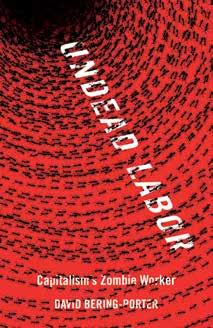
p40 David Bering-Porter Undead Labor
p19 Craig Buckley Graphic Assembly
p38 Brianne Cohen The Empathic Lens
p26 Dio Cramer, John Kim, Jeremy Meckler, and Rebecca Snedeker Mississippi River Open School for Kinship and Social Exchange
p6 Jennifer de Mooy Water, Carbon, Time
p20
Julie Landsman, Debra J Stone, and Morgan Grayce Willow Nick of Time
p22 Evan Larson and Nisogaabokwe Melonee Montano Ishkode
p47 Robin M. LeBlanc Proprietors for a Democratic City
p35 Raymond Lifchez and Barbara Winslow Design for Independent Living
p31 Johanna Malt The Contact Image
p41 Thomas Matusiak The Visual Guillotine
p32 Claudia Milian The X Catalogue
p17 Carolina A. Miranda Juan Sánchez

Marketing and Engagement Specialist Shelby Connelly schir080@umn.edu
Publicity Associate Alena Rivas rivas118@umn.edu
Digital Marketing and Exhibits Assistant Grace Holton holto051@umn.edu
For more contact information, please see the “Contact Us” section of our website at www.upress.umn.edu
p12 Gilles Deleuze On Spinoza
p29 Jennifer A. Delton Making Minnesota Liberal
p48 Danielle Drees Sleep with Spectators
p11 Eric Dregni Raising Bilingual Bambini
p9 Lizzie Ehrenhalt Romantic Sensation
p34 Daniela Fabricius Rationality Without Reason
p33 Freda L. Fair Black Visual Cultures of the Midwest
p15 Kathryn J. Gindlesparger Paper Pusher
p8 Matt Goldman The Prohibited
p25 Gary Goodman Longships and Sod Houses
p50 Robin Truth Goodman Ideology, Interrupted
p19 Boris Groys Towards a New Universalism
p14 Vincent Haddad Next Time on Dragon Ball
p28 Larry Haeg Harriman vs. Hill
p30 Catherine L. Hansen Powers of No
p44 Conor Harrison Brokers of Power

p29 Jon Hassler The Hassler Effect
p49 Sarah Hayden Voiceworks
p13 Maya Hey Singing with Invisible Worlds
p54 Eden Kinkaid Disorienting Phenomenology
p52 Davy Knittle Urbanist Desire
p5 David Mura Exit, Miss Saigon
p24 Mark Neuzil Rooted in the North
p18 Jas Obrecht Early Blues
p54 Kyle Parry Ways of Seeing After Dark
p27 Jay D. Peterson and Collette A. Morgan Sky Blue Water
p28 Dudley Riggs Flying Funny
p46 Gillian Rose Animated Urbanism
p42 R. Joshua Scannell The Carceral Surround
p43 Michel Serres Hermes IV
p39 Deborah Shamoon Text and Image
p7 Alexis Shotwell Liberation Is Other People
p45 Michael Simpson Terminal City
p4 Paul Chaat Smith Indian Enough
p18 Paul Chaat Smith Everything You Know about Indians Is Wrong
p51 David Shuang Song Multiracial Mandarin
p21 Sasha Maria Suarez An Ojibwe Home in the City
p16 Antoine Volodine Living in Fire
p37 Pauline Wakeham Indigenous Reparations and Settler Colonial Reckoning
p10
Jay Weiner A More Dangerous Game
BROWSE BY SUBJECT
NATIONAL TRADE AND LOCAL INTEREST
SCHOLARLY pp30–54
JOURNALS pp55–57
Architecture 19, 34–35
Art 4, 17, 30–33, 38–39, 48–49, 54
Children's and YA 22–23, 27
Digital Culture 14, 31, 35, 37, 39–40, 42, 46, 53–54
Disability Studies 35, 48
Education 15, 26, 51
Environment 6–7, 24, 26, 32, 38
Ethnography 13, 47, 51
Fiction 8, 16, 27, 29
Gender and Sexuality 9, 48, 52, 54
Geography 44–45
History 18–19, 21, 25, 28–30, 34–36, 49
Literary Criticism 5, 50
Media and Film 9, 14, 39–41, 49
pp4–29
Minnesota and Regional Interest 5, 8–11, 20–29, 33
Native American and Indigenous Studies 4, 18, 21–23, 36–37
Nonfiction, Memoir, Biography 4–6, 9–11, 20, 24–26, 28
Paperback Reprints 18–19, 27–29, 35
Philosophy and Theory 7, 12, 19, 43, 52–54
Politics and Public Policy 7, 15, 29, 47, 50
Race and Ethnicity 5, 32–33, 38, 41, 51
Scandinavian Studies 25
Science and Technology 13, 34, 42
Translations 12, 16, 43
Urban Studies 45–46, 52
BOOKSELLER S
University of Minnesota Press fulfillment operations are through the Chicago Distribution Center.
The address is:
University of Minnesota Press c/o Chicago Distribution Center 11030 South Langley Ave. Chicago, IL 60628
Phone: (800) 621-2736 or (773) 702-7000 Fax: (800) 621-8476 or (773) 702-7212
We provide pubnet access. Our address is: PUBNET@202-5280.
For our current discount structure, please contact our sales manager at mwsmiley@umn.edu
DISCOUNTS
We use three discount structure classes: Trade, Short, and Super Short. Short titles are marked with “x”, super short titles are marked “xx”, and trade titles are not marked.
E-BOOKS
Books in this catalog are listed with their retail e-book ISBNs. Digital editions of most University of Minnesota Press titles are available through a variety of retailers. Our list is continually updated at z.umn.edu/aboutebooks
More bookseller information is on the inside back cover.






Indian Enough Essays
PAUL CHAAT SMITH
An acerbic, candid reckoning with Indigenous identity, visibility, and the messy realities of cultural change
In Indian Enough, curator and critic Paul Chaat Smith probes the paradox of contemporary Indigeneity: enormous, hardwon cultural visibility in museum exhibits, land acknowledgments, mascot removals, and more alongside persistent erasure in everyday life. Rejecting the easy comforts of identity politics (he was, he admits, a fan of the Land O’Lakes Butter Maiden), Smith brings “honest confusion” to his inquiry, using sharp wit and wry humor to confront the gap between symbolism and lived reality.
Both memoir and cultural critique, Indian Enough follows Smith from a suburban childhood in Washington, D.C., filled with Kurt Vonnegut and Vine Deloria Jr., through teenage years steeped in Native politics leading to a thrilling and eventually disillusioning stint with the American Indian Movement, to his pivotal role in creating the inaugural exhibitions at the National Museum of the American Indian. His insider account
of NMAI exposes how well-meaning efforts to redress Native erasure can simply swap one set of stereotypes for another, and his candor shows how institutions and activists— himself included—all grapple with the tension between good intentions and political realities.
Irreverent and searching, Indian Enough tackles culture writ large—the rise of punk and the fall of AIM, pop culture as a battleground, Indigenous slaveowners and other histories we’d rather forget, MAGA Indians, and what it means to win when the ground keeps shifting. Together these essays reveal a truth that’s hard to reconcile in an era of “progress”: representation is everywhere, certainty is not.
Essays INDIAN E NOUGH
PAUL CHAAT SMITH
Paul Chaat Smith (Comanche) is author of Everything You Know about Indians Is Wrong, also published by the University of Minnesota Press, and coauthor with Robert Warrior of Like a Hurricane: The Indian Movement from Alcatraz to Wounded Knee. He was curator at the Smithsonian’s National Museum of the American Indian for twenty-four years.
ESSA YS
$24.95 Cloth/jacket ISBN: 978-1-5179-2275-7
$24.95 Retail e-book ISBN: 978-1-4529-7715-7
JANUARY
224 pages 12 b&w illustrations 5 1/2 x 8 1/2
Retail e-book files for this title are screen-reader friendly with images accompanied by short alt text and/or extended descriptions.
Exit, Miss Saigon
An American Memoir
DAVID MURA
A profound memoir of coming to terms with a lost racial identity
“In this forthright and open-hearted essay collection, David Mura deftly examines politics, psychology, assimilation, masculinity, and the transformative power of friendships and collective action, offering an essential history of Asian American literary arts and culture.” —Lisa Ko, author of Memory Piece and The Leavers
David Mura was well into his twenties before he began to explore his Asian American identity. His Japanese American parents had been incarcerated in internment camps during World War II and in response to their traumatic experience, they abandoned their Japanese roots to try to assimilate into white, middleclass America. Mura was raised to consider himself as a white person, and his journey toward understanding and accepting his Asianness was fraught. In Exit, Miss Saigon, Mura writes with frank openness about his personal experiences and the irrevocable ways they are rooted in the internalized, systemic racism that permeates American culture.
Starting out as a young poet in Minneapolis working toward a PhD, Mura avoided reading “minority literature,” yearning instead to be like famed poets in their ivory tower—Robert
Lowell, Randall Jarrell, John Berryman, artists tortured by their families and personal demons rather than by politics or race. As Mura began to read more widely, his conceptions of race and its societal construction began to broaden. When the Ordway Theater in St. Paul, Minnesota, staged Miss Saigon in 1992, Mura published “Secrets and Anger” in Mother Jones, a scathing critique of the play’s racist undertones and the arguments he’d been having with white artist friends about it. As a result, Mura was ostracized from the local, dominantly white writing community, yet in its place he found a deeper connection with other BIPOC writers and eventually started an Asian American arts organization in the Twin Cities.
Exit, Miss Saigon is a clear-eyed examination of issues affecting Asian Americans: anti-Asian hate crimes during the pandemic, affirmative action, racial and sexual stereotypes in the media, interracial relationships and raising mixed-race children, the legacy of Japanese American internment, and the shortfalls of therapy in addressing race. Mura excavates the deep-seated racist stereotypes thrust on those perceived as “other” (read: nonwhite people) and works to uncover a more authentic, liberatory path to defining personal identity.
Exit , Miss Saigon
David Mura
An
David Mura is a poet, writer of creative nonfiction and fiction, critic, and playwright. He is author of several books, including The Stories Whiteness Tells Itself: Racial Myths and Our American Narratives (Minnesota, 2022) and A Stranger’s Journey: Race, Identity, and Narrative Craft in Writing and the memoirs Turning Japanese: Memoirs of a Sansei and Where the Body Meets Memory: An Odyssey of Race, Sexuality, and Identity. He is coeditor, with Carolyn Holbrook, of We Are Meant to Rise: Voices for Justice from Minneapolis to the World (Minnesota, 2021). He lives in Minneapolis.
CREATIVE NONFICTION/CRITICISM
$28.95 Cloth/jacket ISBN: 978-1-5179-2121-7
$28.95 Retail e-book ISBN: 978-1-4529-7599-3
OCTOBER
272 pages 6 x 9
Retail e-book files for this title are screen-reader friendly.
American Memoir
Water, Carbon, Time
Exploring Peatlands in a Warming World
JENNIFER DE MOOY
Revealing the hidden worlds of peatlands and their potential to fight climate change
“Jennifer de Mooy’s book is a welcome addition to a small but growing body of literature devoted to the wonderful, restorative powers of peat. Water, Carbon, Time is an engaging travelogue that animates the underlying beauty of these spongy ecosystems.”
—Edward Struzik, author of Swamplands: Tundra Beavers, Quaking Bogs, and the Improbable World of Peat
“Water, Carbon, Time digs far into the past, and looks far into the future, to examine the unsung role that peatlands play in climate, ecology, and biodiversity. Jennifer de Mooy’s graceful writing makes this book not only illuminating but a joy to read.”
—Scott Weidensaul, author of The Return of the Oystercatcher: Saving Birds to Save the Planet
Bogs, fens, mires, moors, muskegs, and pocosins—they are found in nearly all the world’s climatic zones but are easily overlooked in our landscapes. Yet these murky ecosystems formed of decay are both full of life and crucial to our planetary wellbeing: covering only about three percent of the earth’s surface, peatlands store more carbon than all the world’s forests combined. In Water, Carbon, Time, Jennifer de Mooy
shares her personal discovery of these natural wonders in all their variety and understated beauty, bringing much-needed attention to the restorative possibilities of their spongy depths.
De Mooy first encountered peatlands on a trip to Ireland with her father, but her later work on climate change policy in the United States motivated her to investigate options for reducing greenhouse gases in the atmosphere. Her interest was practical: could peatlands combat global warming? To deepen her understanding of these unique wetlands, she embarked on a quest from bogs and fens in Minnesota and Maine to bofedales in Peru and muskegs in Canada and Alaska. A vivid account of her journey, Water, Carbon, Time describes these peatlands in all their richness and mystery: what they are and how to find them, the diversity of ecological life they support, and how their hidden systems promote climate resilience.
In parts a travelogue, an ecological history, and a call to action, Water, Carbon, Time demonstrates there is still hope for these precious ecosystems—and their potential as a natural climate solution right beneath our feet.

Jennifer de Mooy has worked in conservation, environmental protection, and climate policy for forty years. For two decades she designed and implemented projects with The Nature Conservancy to protect and restore natural habitats, and for ten years she worked with the Delaware state environmental agency, promoting climate mitigation policies that enhance the capacity of plant communities to absorb and store carbon.
ENVIRONMENT/CREATIVE NONFICTION
$19.95 Paper ISBN: 978-1-5179-2139-2
$19.95 Retail e-book ISBN: 978-1-4529-7575-7
SEPTEMBER
208 pages 12 b&w illustrations 5 1/2 x 8 1/4
Retail e-book files for this title are screen-reader friendly with images accompanied by short alt text and/or extended descriptions.
Liberation Is Other People
ALEXIS SHOTWELL
Ot her
A compelling call to transform isolation into solidarity and turn shared action into lasting change
“Rooted in a lifetime of generous, joyful, and fierce participation in collective social movement, Liberation Is Other People is a practical and inviting book. Alexis Shotwell carefully thinks with other writers, philosophers, and activists to nurture concrete practices of building individual and collective strengths for the struggles we must engage in, showing us how collective flourishing is still possible.”
—Donna Haraway, author of Staying with the Trouble: Making Oddkin in the Chthulucene
Liberation Is Other People offers a bold and timely exploration of how we confront the immense, interconnected challenges of our time. It begins with the truth that many of the crises we face—climate collapse, war, systemic inequality—are human-made and therefore humanly transformable. Yet such “wicked problems” cannot be solved by individuals alone. Every attempt to repair exposes how deeply our lives are entangled across histories of power, privilege, and vulnerability.
Rejecting the idea that personal virtue or guilt can solve the world’s problems, Alexis Shotwell offers a philosophy and practice of collective freedom through collective struggle. Drawing on thinkers such as Angela Davis and Ursula K. Le Guin, she argues that freedom is not the power to act alone but the capacity to shape the world with others. Through sustained engagement with climate politics, white settler responsibility, and the reimagining of sexuality and gender, Liberation Is Other People shows how embracing complicity and acknowledging that none of us stand outside the systems we wish to change can open new possibilities for solidarity and transformation.
Rather than a call to purity or perfection, Liberation Is Other People is a vision of politics as a shared, necessarily imperfect process of creation. Shotwell builds a compelling case that solidarity can be a source of joy, inspiration, and political power. In an age of division and isolation, Shotwell insists that our greatest possibility lies not in fixing the world by our individual selves but in remaking it—together.
Alexis Shotwell is professor of sociology and anthropology at Carleton University in Ontario. She is author of Against Purity: Living Ethically in Compromised Times (Minnesota, 2016) and Knowing Otherwise: Race, Gender, and Implicit Understanding
ETHICS/ACTIVISM
$24.95 Paper ISBN: 978-1-5179-2166-8
$100.00xx Cloth ISBN: 978-1-5179-2165-1
$24.95 Retail e-book ISBN: 978-1-4529-7603-7
NOVEMBER
264 pages 5 1/2 x 8 1/2
Retail e-book files for this title are screen-reader friendly.
Libera tion
ALEXIS SHOTWELL Is People
The Prohibited A Novel
MATT GOLDMAN
A family, their liquor store, and the clash of the Eighteenth and Nineteenth Amendments in 1920s St. Paul
“Sprawling, rambunctious . . . The Prohibited is a compelling exploration of ambition, passion, and the insatiable hunger of human desire in all its forms. Matt Goldman is a literary master, and his book is a spellbinding tour de force.”
—William Kent Krueger, author of God’s Country
“With great brio, Matt Goldman takes us back to the wild days of prohibition-era St. Paul, Minnesota, where gangsters, haberdashers, and suffragettes can be both heroes and rogues. The setting and characters are vividly brought to life in this fast-paced novel.”
—Lorna Landvik, author of Chronicles of a Radical Hag (with Recipes)
The Kaner brothers were getting by well enough running Kaner’s Fine Wine and Spirits in St. Paul, Minnesota, until Prohibition took effect in January 1920. With their liquor store shuttered, Red, Isaac, and Lewis are left to forge new livelihoods, their paths taking turns distinct as their personalities. All of the Kaners have secrets—from a clandestine lover to a joyless marriage to an entanglement with
the mob—but when it comes down to it, the family will do just about anything for each other, and they’re going to have to prove it.
The Prohibited follows the Kaner family in the wake of the Eighteenth Amendment. Isaac finds unlikely means to stay close to the family trade, becoming a rabbi (or someone the Feds believe is a rabbi) to exploit a loophole that allows men of the cloth to sell sacramental wine. Lewis takes the opportunity to pursue his dream of being a playwright. And Red is happy to work in a haberdashery, though he resents his wife’s suffragist allegiance and resulting support of Prohibition. Tangled up in the Kaners’ story is Pearl Holgersen. After a tragic event up north, she has finally found community in the Rondo neighborhood in St. Paul, but she has a score to settle with Red's son, Willie, who was recently murdered. Or was he?
Based loosely on Matt Goldman’s family history, The Prohibited brings to life 1920s St. Paul, a haven for bootleggers, gangsters, and bank robbers, but also home to many ordinary folks navigating a remarkable new social order. With his signature wry wit, Goldman presents an engrossing character study of a family testing their bonds—and irrevocably changing their lives.


Matt Goldman is the New York Times and USA Today best-selling author of the Nils Shapiro mystery series as well as the standalone novels A Good Family and Carolina Moonset, among many others. He is also a playwright and an Emmy Award–winning television writer on shows including Seinfeld and Ellen. He lives in Minneapolis.
FICTION
$28.95 Cloth/jacket ISBN: 978-1-5179-2006-7
$28.95 Retail e-book ISBN: 978-1-4529-7619-8 SEPTEMBER
320 pages 6 x 9
Retail e-book files for this title are screen-reader friendly.
Romantic Sensation
The Queer Lives of Leon A. Belmont, 1853–1927
LIZZIE EHRENHALT
Exploring gender and sexuality in the Gilded Age through one sensationalized life
Addie Liona Walker. Leon A. Belmont. Nova McClure Carr. Romantic Sensation tells the full story of this one ordinary person’s singular life. Assigned a female sex at birth, Addie was born in Massachusetts in 1853 and lived as a woman for twenty-five years. After transitioning in 1878, Addie became Leon and lived as a man for twenty-four years before making a second gender transition and living as a woman, Nova, for the rest of her life. Placing these milestones within the historical context of the late nineteenth and early twentieth centuries, Lizzie Ehrenhalt traces Belmont’s life, from child laborer to husband, from outlaw to heartthrob, and from stepfather to single mother.
Belmont was a Gilded Age celebrity: he made national news for breaking an ordinance against dressing as the “opposite” sex in Minneapolis, and he inspired a media frenzy when one of his girlfriends told police that he was a woman. While newspapers labeled Belmont a “curious and romantic sensation,” Ehrenhalt shows that he was not much of a sensation after all. Illuminating what his story can tell us about Americans’ developing
understandings of sexuality and gender in the 1850s through the 1920s, she reveals how Belmont’s run-ins with police, doctors, courts, and reporters resonate in the evolution of the LGBTQIA+ identities we recognize today.
An empathetic case study of a figure often denied respect in the telling of his story, Romantic Sensation presents Belmont’s gender transitions not as puzzles in need of solving but as acts grounded in the cultural milieu of the Gilded Age. Traversing the dramatic economic upheavals of the second industrial revolution, the Era of Good Stealings, and the Great Railroad Strike of 1922, and spanning the Cult of Domesticity, the invention of sexology, and the rise of New Womanhood, Ehrenhalt uses Belmont’s example to demonstrate how trans, queer, and intersex histories are inseparable from American history.

Lizzie Ehrenhalt is an editor and public historian who specializes in the history of gender and sexuality. Since 2013, she has edited MNopedia, the encyclopedia of Minnesota history produced by the Minnesota Historical Society. She is coeditor of Precious and Adored: The Love Letters of Rose Cleveland and Evangeline Simpson Whipple, 1890–1918
BIOGRAPHY/GENDER AND SEXUALITY
$24.95 Paper ISBN: 978-1-5179-1584-1
$100.00xx Cloth ISBN: 978-1-5179-1583-4
$24.95 Retail e-book ISBN: 978-1-4529-7609-9
OCTOBER
312 pages 10 b&w illustrations 5 1/2 x 8 1/2
Retail e-book files for this title are screen-reader friendly with images accompanied by short alt text and/or extended descriptions.
A More Dangerous Game
How a Young Sportswriter Met Patty Hearst and Landed in Federal Prison
JAY WEINER
From precocious sportswriter to Federal Prisoner #01150-134: the intersection of sports and the revolutionary 1970s, with one ambitious young man caught in the middle
“Jay Weiner has written a coming-of-age story unlike any I have ever read. With the wisdom acquired over a half-century of distance, and with the storytelling skills of a master journalist, he has revisited both the bracing idealism and the dangerous self-delusions of the New Left. Weiner may have been only a bit player in the saga of Patty Hearst and the Symbionese Liberation Army, but even that fleeting proximity endows this book with its drama and its tragedy.”
Samuel G. Freedman, author of Into the Bright Sunshine: Young Hubert Humphrey and the Fight for Civil Rights
“A surprising slice of American history with a compelling cast of characters, famous and infamous. Even though it happened decades ago, it’s a story worth retelling to this day.”
Christine Brennan, USA Today columnist and author of On Her Game: Caitlin Clark and the Revolution in Women's Sports
“A powerful and fast-moving account of gaining wisdom the hard way.”
Jack El-Hai, author of The Case of the Autographed Corpse and The Nazi and the Psychiatrist
Jay Weiner was an aspiring teenage sportswriter when he met Jack Scott, the charismatic activist journalist who would become his mentor, immersing him in the political and social issues roiling sports—and so much else—in the late 1960s and 1970s. Weiner became a zealous student of Scott, joining a new tradition of sports journalism that interrogated questions of race, power, and politics alongside the games themselves. But his blind devotion took a treacherous turn when Scott took Weiner, as a surprise for his twentieth birthday, to a secluded Pennsylvania farmhouse where heiress-turned-FBI-mostwanted Patty Hearst was hiding out with her Symbionese Liberation Army kidnappersturned-comrades.
A wild mosaic of sports, journalism, betrayal, justice, courage, and redemption, A More Dangerous Game describes the fallout after that fateful encounter with the country’s most wanted fugitives: three years of federal subpoenas, impossible decisions, and, ultimately, four months in prison for refusing to testify before a grand jury. With exhaustive background reporting, Weiner puts readers on the cutting edge of one of the most notorious stories of a generation.



Dangerous Dangerous

HOW a YOUNG SPORTSWRITER ME T PATTY HEARST and LANDED in FEDERAL PRISON
A Game


Jay Weiner is author of Stadium Games: Fifty Years of Big League Greed and Bush League Boondoggles; This Is Not Florida: How Al Franken Won the Minnesota Senate Recount; and, with Hy Berman, Professor Berman: The Last Lecture of Minnesota’s Greatest Public Historian, all published by the University of Minnesota Press. He lives and writes in St. Paul.
MEMOIR
$25.95 Cloth/jacket ISBN: 978-1-5179-2064-7
$25.95 Retail e-book ISBN: 978-1-4529-7665-5
JANUARY
232 pages 9 b&w illustrations 6 x 9
Retail e-book files for this title are screen-reader friendly with images accompanied by short alt text and/or extended descriptions.
J°y Wei˘er
Raising Bilingual Bambini
The Art of Immersing Our Family in La Dolce Vita
ERIC DREGNI
A father’s memoir of preparing a duallanguage household for a stint living abroad—and all of the ensuing challenges and rewards
After living in Modena, Italy, for three years, Eric Dregni and his wife, Katy, had a dream of returning one day—future children in tow—to give their kids the experience of living abroad. When they become parents, they decide to raise their children with a global perspective in a bilingual household: Katy speaking only English to them and Eric speaking only Italian.
Despite their extended family’s confusion about this experiment, they persist through their three kids’ childhoods, sending them to an immersion language camp and planning to prepare them for life abroad. Eventually, the family packs up and moves to Florence, where the bambini can stop to see Michelangelo’s David on the way back from school, indulge in fresh pasta and gelato, and learn how to argue like real Italians. Sooner than anyone would
like, three months of la dolce vita come to an end, and they head back to Minnesota, trying to bring a taste of Italian culture home with them.
A fast-paced memoir/travelogue, Raising Bilingual Bambini is Dregni’s passionate testament to the value of an international perspective, loving tribute to the family’s time together in Italy, and bittersweet reflection on what it meant to return to Minnesota (until their trip to Sicily several years later). Writing with his signature humor and sincerity, he offers a heartfelt story about family and finding a home together in a new place.
RaisinBi|ingual ambıni
The Art of Immersing Our Family in la Dolce Vita
Dregni B g
Eric

Eric Dregni lived in Italy for five years and worked as a travel journalist for a weekly paper. He is author of many books, including In Cod We Trust: Living the Norwegian Dream and Never Trust a Thin Cook and Other Lessons from Italy’s Culinary Capital, both published by the University of Minnesota Press. He is professor of English, journalism, and Italian at Concordia University in St. Paul, Minnesota; leads student trips to Italy every other year; and was dean of the Italian Concordia Language Village for twenty years.
MEMOIR
$22.95 Cloth/jacket ISBN: 978-1-5179-2132-3
$22.95 Retail e-book ISBN: 978-1-4529-7640-2
OCTOBER
208 pages 17 b&w illustrations 3 maps 5 3/8 x 8 1/2
Retail e-book files for this title are screen-reader friendly with images accompanied by short alt text and/or extended descriptions.
On Spinoza
Courses,
November 1980–March 1981
GILLES DELEUZE
EDITED BY DAVID LAPOUJADE
TRANSLATED BY
CHARLES J. STIVALE, WITH
THE DELEUZE
SEMINARS TRANSLATION COLLECTIVE
Through newly transcribed and translated lectures, Deleuze explores Spinoza’s philosophy concerning questions of good and evil and humanity’s potential for realizing a full life
Available for the first time in English, On Spinoza presents the annotated transcripts of Gilles Deleuze’s fifteen seminars on the seventeenth-century philosopher’s Ethics, delivered at the experimental University of Vincennes at the behest of Michel Foucault. Spinoza’s ambitious treatise was central to Deleuze’s thought, and his course provides an accessible framework for understanding the vitality of Spinoza’s philosophy.
In an informal classroom setting, Deleuze addresses fundamental aspects of Spinoza’s thought: How does one undo the negativity of harmful passions such as hate, resentment, and envy? How can a system of moral judgment based on good and evil be replaced by a more sophisticated ethics of the good and the bad? And since such questions
commit Spinoza to a new theory of signs, Deleuze also delves into his thinking on how these signs should guide human existence and the differences between concepts of eternity, experienced in the here and now, and the immortality promised by philosophy and religion.
Building gradually from session to session, Deleuze shows how Spinoza rejects a hierarchical reality dominated by an authoritarian and impenetrable God, instead proposing a world ruled by light and reason in which all beings are equal. Annotated by David Lapoujade and including recorded exchanges with Deleuze’s students, On Spinoza offers a rare window into Deleuze’s teaching, offering readers a guide for linking Spinoza to other philosophers—including Deleuze himself.
DELEUZE ON SPINOZA
Gilles Deleuze (1925–1995) was professor of philosophy at the University of Paris, Vincennes–St. Denis. He coauthored Anti-Oedipus and A Thousand Plateaus (Minnesota, 1987) with Félix Guattari and is author of many books, including On Painting: Courses, March–June 1981 (Minnesota, 2025).
David Lapoujade is professor of philosophy at Université Paris 1–Sorbonne.
Charles J. Stivale is Distinguished Professor Emeritus at Wayne State University.
PHILOSOPHY
$34.95 Paper ISBN: 978-1-5179-2017-3
$140.00xx Cloth ISBN: 978-1-5179-2016-6
$34.95 Retail e-book ISBN: 978-1-4529-7627-3
DECEMBER
464 pages 1 b&w illustration 5 1/2 x 8 1/2 Univocal Series
Retail e-book files for this title are screen-reader friendly with image accompanied by short alt text and/or extended descriptions.
Edited by David Lapoujade Translated by Charles J. Stivale with the Deleuze Seminars Translation Collective
Singing with Invisible Worlds
Fermenting Sake on Microbial Time
MAYA HEY
Rethinking life with microbes through the art of natural fermentation
Within us and around us, microbes are everywhere, constantly reshaping what it means to be human as we interact with them—sometimes knowingly, sometimes not. Singing with Invisible Worlds theorizes human–microbe relationships through a rare ethnographic account of the fermentation process at the 350-year-old Terada Honke, one of only two natural sake breweries in Japan.
Painting a vivid picture of how sake brewers collaborate with bacteria, molds, and yeasts, Maya Hey reveals that ambient microbes are not controlled but courted, cultivated, and deliberately choreographed. As the brewers adapt to shifting microbial dynamics, they engage in what Hey calls an “improvisational ethic”—a way of responding to the unknown with care and attentiveness through each phase of blooming and waning across weeks, months, and even centuries. In documenting
these remarkable practices, Singing with Invisible Worlds offers an intimate, situated understanding of how we can come to know and live with microbial life, with implications for feminist theory, science and technology studies, and multispecies ethnography.
Unsettling simplistic notions of “good” or “bad” microbes, this book presents a compelling vision for planetary coexistence— one that starts not with grand solutions but with small, rhythmic acts of microscopic attunement.

Maya Hey is a postdoctoral researcher with the Environmental Humanities Laboratory at KTH Royal Institute of Technology in Sweden and a core member of the Centre for the Social Study of Microbes at the University of Helsinki.
ETHNOGRAPHY/SCIENCE AND TECHNOLOGY STUDIES/FOOD STUDIES
$24.95 Paper ISBN: 978-1-5179-2120-0
$100.00xx Cloth ISBN: 978-1-5179-2119-4
$24.95 Retail e-book ISBN: 978-1-4529-7592-4
NOVEMBER
280 pages 40 b&w illustrations 5 1/2 x 8 1/2
Retail e-book files for this title are screen-reader friendly with images accompanied by short alt text and/or extended descriptions.
Next Time on Dragon Ball
Playing with a Manga and Anime Franchise
VINCENT HADDAD
How media production and fan play interact to shape the aesthetics of a global anime franchise
Since its debut in 1984, Dragon Ball has become one of the most popular, influential, and lucrative media franchises in the world. In Next Time on Dragon Ball, Vincent Haddad investigates how the franchise has maintained huge global demand despite its formulaic plotlines. Examining its exhaustive repetition of storytelling forms across comics, TV series, games, and merchandise, Haddad argues that the convergence of play, fandom, and narrative made Dragon Ball an unlikely success—and a harbinger of broader shifts in the media landscape of franchises from the 1980s to the present.
Haddad conceives of Dragon Ball as a “franchise toy,” a corporate media property that is constantly remixed by its fans in ways that its owners resist but also ultimately embrace: appropriation is essential to the franchise’s popularity. Over the past forty years, Haddad argues, Dragon Ball’s deployment of familiar tropes, cultural
references, and narrative forms—from classical Chinese stories and the films of Bruce Lee and Jackie Chan to American franchises like Superman and Star Wars—has invited unique transcultural play. Through diverse examples of how fans use its characters as “playthings,” Haddad shows how Dragon Ball travels across international networked fandoms, highlighting the queer, gendered, and racialized dimensions of this play.
Parsing the dynamics of “sites of conflict” between authorized media and fan content, Next Time on Dragon Ball illuminates how fan engagement across the Americas changes the parameters of what a manga and anime franchise is and can be.
Vincent Haddad is associate professor of English at Central State University. He is author of The Detroit Genre: Race, Dispossession, and Resilience in American Literature and Film, 1967–2023
FILM AND MEDIA STUDIES/DIGITAL CULTURE
$24.95 Paper ISBN: 978-1-5179-1956-6
$100.00xx Cloth ISBN: 978-1-5179-1955-9
$24.95 Retail e-book ISBN: 978-1-4529-7586-3
AUGUST
280 pages 13 b&w illustrations 6 x 8 Mass Markets: Storyworlds Across Media Series
Retail e-book files for this title are screen-reader friendly with images accompanied by short alt text and/or extended descriptions.
NEXT T I ME O N D RAGON BALL
VINCENT HADDAD
Paper Pusher
Power and Protest in Higher Education
KATHRYN J. GINDLESPARGER
Paperwork is the new protest: leveraging bureaucracy for progressive action
In contemporary higher education, power increasingly circulates through documents rather than debate, making paperwork one of the most consequential sites of protest. Yet as universities become more corporatized and subject to authoritarian influence, bureaucratic writing is often treated as passive, procedural, or politically neutral. Paper Pusher shows how paperwork is a central mechanism of governance and therefore a formidable, underused medium for democratic action and protest within bureaucracies.
Kathryn J. Gindlesparger reframes the “paper pusher” from a symbol of compliance into an agent of institutional accountability and resistance. She develops four avenues for protesting through bureaucracy—voice, filing, circulation, and stasis-seeking— showing how everyday documents such as meeting minutes, policy drafts, budgets, and accreditation reports can be used to push back against authoritarian and corporate
forces that undermine an institution’s mission. Rather than emphasizing visible confrontation, Paper Pusher demonstrates how activism can operate quietly and credibly from within systems where overt protest may carry professional risk.
Grounded in story and lived experience, this book is a love letter to office workers, staff, and middle managers whose labor sustains institutions and whose expertise is often overlooked. It foregrounds feminist, workingclass, queer, disabled, Black, and brown voices, highlighting how marginalized workers have long used bureaucratic knowledge to create access, protection, and change. Practical and people-centered, Paper Pusher calls for bureaucratic literacy to be taught wherever writing is taught, insisting that paperwork is not grunt work but power work.
Power & Protest in Higher Education

Kathryn J. Gindlesparger is professor of writing and rhetoric at Thomas Jefferson University and author of Opening Ceremony: Inviting Inclusion into University Governance (Minnesota, 2023).
ACTIVISM/HIGHER EDUCATION
$24.95 Paper ISBN: 978-1-5179-1858-3
$100.00xx Cloth ISBN: 978-1-5179-1857-6
$24.95 Retail e-book ISBN: 978-1-4529-7652-5
JANUARY
176 pages 6 b&w illustrations 5 1/2 x 8 1/2
Retail e-book files for this title are screen-reader friendly with images accompanied by short alt text and/or extended descriptions.
Kathr yn J. Gindlesparger
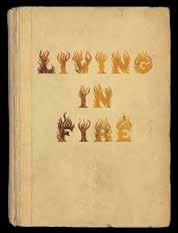
Living in Fire
A Post-Exotic Novel
ANTOINE VOLODINE
TRANSLATED BY LIA SWOPE MITCHELL
A soldier engulfed in napalm suspends his death by composing a family saga in which he learns to live within the flames
Do not remain on the fire’s edge, find your way to the heart of the fire and do not leave. . . . Death does not exist as long as you reject it. A soldier watches an airplane dropping napalm on his position. In the instant before his fiery death, he does not see his life flash before his eyes. Instead, he improvises a novel, one that screams out of him at high speed.
In his story, Sam wanders a postapocalyptic landscape of broken cities and empty steppes for days, years, centuries. Through a series of blackly comic, dreamlike, bizarre scenes, he gleans lessons imparted by the weird and violent members of his family, including sorceress Aunt Yoanna, doomed Uncle Slutov, and two sharp-shooting cousins who try to
persuade him to kill their mother. Sam’s clan teaches him how to accept his fate and live in the world of flames with no fear for the future.
The forty-ninth novel in the post-exotic series and the last to appear under the name Antoine Volodine, Living in Fire includes an interview with the writer about this book’s place in his overall project, its literary and cinematic influences, and its thematic connections with other works in the sequence. A triumphant conclusion to an epic experiment, Living in Fire cuts through a world aflame using dark humor, flights of fantasy, and radical acceptance.
A ntoine
Vo lodine
Antoine Volodine is the primary pseudonym of a French-Russian writer who has published dozens of novels under various names and identities, including Manuela Draeger. Several of his books are available in English translation, including, from the University of Minnesota Press, Solo Viola, Mevlido’s Dreams, and The Inner Harbour
Lia Swope Mitchell is translator of several books from French, including Solo Viola by Antoine Volodine, Kree by Manuela Draeger, and Survival of the Fireflies by Georges Didi-Huberman, all published by the University of Minnesota Press.
FICTION
$17.95 Paper ISBN: 978-1-5179-1977-1
$17.95 Retail e-book ISBN: 978-1-4529-7629-7
OCTOBER
152 pages 5 3/8 x 8
Univocal Series
Retail e-book files for this title are screen-reader friendly.
a Post-Exotic Novel
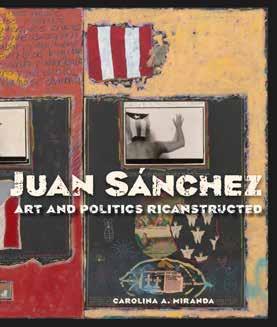
Juan Sánchez
Art and Politics Ricanstructed
CAROLINA A. MIRANDA
FOREWORD BY CHON A. NORIEGA
A comprehensive look at Juan Sánchez’s mixed-media art and its commentary on Puerto Rican life
Juan Sánchez’s vibrant mixed-media paintings offer a trenchant commentary on the Puerto Rican experience—and, more broadly, American culture. At the heart of these works are intricate collages that express the artist’s ideas about identity and place through a unique iconography. Sánchez combines photographs and newsclips, handwritten texts, found objects, and imagery that ranges from Taíno petroglyphs to the Puerto Rican flag, creating richly colorful works that are exuberant and joyful—and also darkly serious.
Carolina A. Miranda’s detailed account of Sánchez’s life and career reveals the deeply personal, political, and formalist dimensions of his photographs, prints, and paintings. Drawing on extensive interviews and visits
to the artist’s Brooklyn studio, Miranda places Sánchez’s observations about art, activism, and family within a broader cultural and historical context. Juan Sánchez: Art and Politics Ricanstructed introduces an extraordinary artist whose widely collected work is inextricably tied to the past, present, and future of Puerto Rico.
Chon A. Noriega, distinguished professor in the UCLA School of Theater, Film, and Television, is an art historian, media scholar, and independent curator.
ART
$29.95 Paper ISBN: 978-0-89551-139-3
$60.00 Cloth/jacket ISBN: 978-0-89551-138-6
JANUARY
184 pages 76 color plates 7 1/2 x 9
A Ver Series
Distributed for UCLA Chicano Studies Research Center Press
Carolina A. Miranda is an independent writer and critic whose work has been featured in The Washington Post, The New York Review of Books, Alta Journal, and Fresh Air

Everything You Know about Indians Is Wrong
PAUL CHAAT SMITH
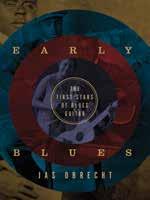
Early Blues
The First Stars of Blues Guitar
JAS OBRECHT
Forceful and eloquent essays on the American Indian in culture and history—now in paperback
“Rigorously insightful . . . addresses the myriad ironic complexities of American Indian reality.”
—Washington Post
“Amusing and enlightening.”
—Publishers Weekly
“Pushes the ‘minority experience’ past victimhood and infantilization to self-agency and determination.”
—Lowery Stokes Sims, former curator, Museum of Arts and Design, New York
In this highly entertaining yet searing critique of the deeply disputed role of American Indians in the United States, cultural critic Paul Chaat Smith illustrates with dry wit and brutal honesty the contradictions of life in “the Indian business.” Sharing his experiences from fighting activist to federal employee, Smith reveals what he has learned along the way: there is no one true representation of the American Indian, and even the best intentions sometimes result in catastrophe.
Paul Chaat Smith (Comanche) is author of Indian Enough: Essays, also published by the University of Minnesota Press, and coauthor with Robert Warrior of Like a Hurricane: The Indian Movement from Alcatraz to Wounded Knee. He was curator at the Smithsonian’s National Museum of the American Indian for twenty-four years.
ESSA YS
$14.95 Paper ISBN: 978-0-8166-5602-8
$14.95 Retail e-book ISBN: 978-0-8166-7402-2
DECEMBER
208 pages 18 b&w illustrations 6 color plates
5 3/8 x 8 1/2
Indigenous Americas Series
The complete history of early blues guitar, with portraits of its first stars—now in paperback
“Obrecht offers material that will be new even to readers who have been familiar with this music for many years.”
—Jim O’Neal, founding coeditor, Living Blues
“This book is a must for anyone serious about the blues.”
—CHOICE
Since the early 1900s, blues and the guitar have traveled side by side. This book tells the story of their pairing from the first reported sightings of blues musicians to the rise of nationally known stars such as Lonnie Johnson and Papa Charlie Jackson to the onset of the Great Depression, when blues recording virtually came to a halt. Early Blues is the most comprehensive account ever written of the early stars of blues guitar—an essential chapter in the history of American music.
Jas Obrecht is an award-winning music journalist and former editor for Guitar Player magazine. He has written for Rolling Stone, Living Blues, Blues Revue, and many other publications. His books include Rollin’ & Tumblin’: The Postwar Blues Guitarists and Blues Guitar: The Men Who Made the Music
MUSIC/HISTOR Y
$15.95 Paper ISBN: 978-0-8166-9805-9
$15.95 Retail e-book ISBN: 978-1-4529-4565-1
DECEMBER
272 pages 70 b&w illustrations 6 x 8
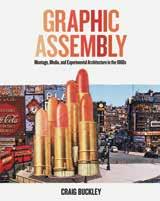
Graphic Assembly
Montage, Media, and Experimental Architecture in the 1960s
CRAIG BUCKLEY
Towards a New Universalism
BORIS GROYS
An innovative look at the contribution of montage to twentiethcentury architecture—now in paperback
“Vivid, original, precise, and archivally rich.”
—Felicity Scott, author of Outlaw Territories: Environments of Insecurity/Architectures of Counterinsurgency
“[Shifts] the ground for studies of architecture and media, prompting new research on what followed and preceded the history it narrates.”
—Claire Zimmerman, author of Photographic Architecture in the Twentieth Century
Graphic Assembly unearths the role played by montage and collage in the development of architectural culture over the past century, revealing their unexamined yet crucial significance. Richly illustrated with material from more than a dozen archives and private collections, it offers a comparative overview of the network of experimental architectural practice in Europe. Craig Buckley provides a deep historical account of the cut-and-paste techniques now prevalent with architecture’s digital turn, demonstrating the great importance of montage to architecture past, present, and future.
Craig Buckley is associate professor of art history at Yale University. He is editor or coeditor of several books, including Screen Genealogies: From Optical Device to Environmental Media
ARCHITECTURAL HISTORY/VISUAL CULTURE
$30.00 Paper ISBN: 978-1-5179-0162-2
$30.00 Retail e-book ISBN: 978-1-4529-6227-6
JANUARY
400 pages 162 b&w illustrations 66 color plates 8 x 10
A dynamic contemporary
examination of universalism
Gathering a selection of essays by influential theorist Boris Groys, Towards a New Universalism articulates his sustained engagement with the problem of universality under contemporary conditions shaped by globalization, institutional fragmentation, and digital mediation. Rather than defending classical universalism or abandoning it in favor of cultural particularism, Groys approaches universality as something produced within shared historical, institutional, and technological frameworks. These essays address topics spanning from identity politics to migration, museums, media, and artificial intelligence, examining how universal claims make their way into social and cultural contexts. Distinct from recent philosophical treatments of universalism, Towards a New Universalism situates the question within aesthetics, media theory, and institutional critique, offering an indispensable collection for anyone interested in the intersections of politics and art.
Boris Groys is a philosopher, essayist, and cultural theorist. He is Global Distinguished Professor of Russian and Slavic Studies at New York University and author of many books, including The Communist Postscript, Art Power, Going Public, On the New, In the Flow, Philosophy of Care, and Becoming an Artwork
THEOR Y
$30.00x Paper ISBN: 978-1-5179-2260-3
$120.00xx Cloth ISBN: 978-1-5179-2259-7
$30.00 Retail e-book ISBN: 978-1-4529-7704-1
OCTOBER
200 pages 20 b&w illustrations 5 1/2 x 8 1/2 Distributed for e-flux
Retail e-book files for this title are screen-reader friendly with images accompanied by short alt text and/or extended descriptions.
Nick of Time
Women Write about Art and Aging
JULIE LANDSMAN, DEBRA J STONE, AND MORGAN GRAYCE WILLOW, EDITORS
NIC K O F TI ME


A bold, collective portrait of the sustaining force of art while aging
Nick of Time celebrates the artistic community of the Twin Cities and the wisdom that comes with age. Bringing together the voices of women creatives over the age of sixty-five, this collection is as varied as the artists’ vocations, spanning from narrative prose to poetry, essay, monologue, letters, historical reflection, and more. As the contributors examine their lived experiences, hopes and regrets, joy and grief while traversing their last decades of life, they serve as a guiding beacon for others navigating the intersection of creativity and aging—as well as a ballast against its inevitable challenges. They write with refreshing honesty about feeling invisible in older age, receiving late recognition, or being dismissed as hair turns gray and wrinkles appear. Their openness provides strength and support for us all.
A beautiful collection of pieces from established and emerging writers, painters, singers, photographers, musicians, playwrights, dancers, sculptors, and beyond, Nick of Time traces the contours of both the
commonalities and the differences that can be found in the creative life of an aging artist. This generous book is a provocative meditation on finding power in age, demonstrating that creativity is an integral part of a full life as well as a lifelong pursuit.
Contributors: Shari Albers, Hend Al-Mansour, Hazel Belvo, Chris Cinque, Venus de Mars, Julia Dinsmore, Mary Moore Easter, Jan Elftmann, Georgia A. Greeley, Kathryn Haddad, Kim Hines, Carolyn Holbrook, Adar Kahin, Deborah Keenan, Amoke Kubat, Fiona McCrae, Teresa Ortiz, Rebecca Pavlenko, Marcie R. Rendon, Joyce Sutphen, Suzanne Thao, JoAnn Verburg.




Julie Landsman is a writer, retired teacher, and painter. She has edited several anthologies of fiction, nonfiction, and poetry and is author of Basic Needs, A White Teacher Talks about Race, and Growing Up White
Debra J Stone writes essays, poetry, and fiction. She is author of The House on Rondo, also published by the University of Minnesota Press.
Morgan Grayce Willow is a writer and artist. She is author of several poetry collections and chapbooks, including Dodge & Scramble, Between, Silk, Oddly Enough, and The Maps are Words
CREATIVE NONFICTION/REGIONAL
$19.95 Paper ISBN: 978-1-5179-2045-6
$19.95 Retail e-book ISBN: 978-1-4529-7642-6
OCTOBER
168 pages 5 1/2 x 8 1/4
Retail e-book files for this title are screen-reader friendly.
JULIE LANDSMAN , DEBRA J STONE , AND MORGAN GRAY CE WILLOW, E ditors
An Ojibwe Home in the City
White Earth Women and Community Organizing in Minneapolis
SASHA MARIA SUAREZ
The story of generations of Ojibwe women who built a thriving Indigenous home in the urban heart of Minneapolis
Minneapolis became home to White Earth Ojibwe people not through a centralized movement but through generations of determined, behind-the-scenes work by Ojibwe women. These women were organizing not in the streets, but in sewing clubs, churches, classrooms, and kitchens to bring people together and form interconnected communities. Rooted in care, tradition, and persistence, their labor laid the foundation for a thriving urban Indigenous population that continues to shape the city today.
An Ojibwe Home in the City tells the histories of Louise and Emily Peake, Winnie Jourdain, Ignatia Broker, and other Ojibwe women who endeavored to make space for Native families in South Minneapolis. From the 1930s through the 1970s, these women built institutions, secured services, and fought for culturally grounded education—all while working inside systems never intended for them. Their efforts
led to the creation of vital community hubs such as the Division of Indian Work and the Minneapolis American Indian Center and helped ensure that future generations would stay connected to their culture, even in an urban setting.
Far broader than a local history, this book challenges what we think we know about Native activism in the twentieth century, shifting the focus from protest to perseverance and steady commitment.
Intimate, compelling, and deeply grounded in community, An Ojibwe Home in the City is both a tribute and a revelation—an essential and personal account of how Indigenous women made a place for their people in a changing world.
An Ojibw e Home i n the Cit y
WHITE EARTH WOMEN AND COMMUNITY ORGANIZING IN MINNEAPOLIS
Sasha Maria Suare z
Sasha Maria Suarez, direct descendant of the White Earth Nation of Ojibwe, is assistant professor of history and American Indian and Indigenous studies at the University of Wisconsin–Madison.
NATIVE AND INDIGENOUS STUDIES/HISTORY/ REGIONAL
$27.95 Paper ISBN: 978-1-5179-1791-3
$112.00xx Cloth ISBN: 978-1-5179-1790-6
$27.95 Retail e-book ISBN: 978-1-4529-7569-6
OCTOBER
304 pages 7 b&w illustrations 5 maps 5 1/2 x 8 1/2
Retail e-book files for this title are screen-reader friendly with images accompanied by short alt text and/or extended descriptions.
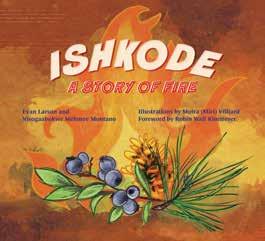
Ishkode
A Story of Fire
EVAN LARSON AND NISOGAABOKWE MELONEE MONTANO
ILLUSTRATIONS BY MOIRA (MIRI) VILLIARD
FOREWORD BY ROBIN WALL KIMMERER
Igniting connection with the forests of the Great Lakes region through Indigenous teachings
“We need the stories told by the pines, by the blueberries, by the scientists and elders. I am grateful for the gift of this lovely book, which brings their stories to light. May we listen to them closely.”
—Robin Wall Kimmerer, from the Foreword
When an invitation arrives from the forest, what will you hear? What will you learn? How will you respond? Ishkode: A Story of Fire invites readers into a beautiful stand of ancient red pines where Aanikoobijigan, a grandmother red pine, guides a young woman, Animikiimiikanikwe, toward healing and renewal through fire. Embracing the power of memory, storytelling, and restoration, this lyrical narrative is a celebration of hope, healing, and the lessons we can learn from the land.
Including an Ojibwe pronunciation guide and glossary, this book weaves Anishinaabe teachings with the science of tree rings to reveal the deep, enduring relationships between people, fire, pines, and the wider web of ecosystems in the Great Lakes region. Ishkode highlights the role of fire in the environment, bringing to light the connections between ecological restoration, cultural revival, and reciprocal stewardship.
Evan Larson is professor in the Department of Environmental Sciences and Society at the University of Wisconsin–Platteville.
Nisogaabokwe Melonee Montano is a mother, grandmother, and enrolled member of the Red Cliff Band of Lake Superior Chippewa. She is owner of Ethical Embers LLC.
Moira (Miri) Villiard, Fond du Lac Ojibwe direct descendant, is a multidisciplinary artist.
Robin Wall Kimmerer is author of several books, including Braiding Sweetgrass and The Serviceberry
CHILDREN’S PICTURE BOOK, AGES 6–10
$18.95 Cloth/jacket ISBN: 978-1-5179-2271-9
$18.95 Retail e-book ISBN: 978-1-4529-7709-6
OCTOBER
48 pages 10 x 9

Rooted in the North
The Lives and Lore of Twenty Minnesota Nature Writers
MARK NEUZIL


and Lore
IN THE ROOTED NORTH
Discover unforgettable writers who taught Minnesota how to see its wild heart
In this engaging collection, environmental journalist Mark Neuzil revives the voices that showed generations how to appreciate Minnesota’s wild places. Comprising twenty vivid biographical essays, Rooted in the North traces the lives and lore of writers who shaped our understanding of this great state, from Minnesota’s northwoods to its tallgrass prairies to the storied landscape of the Boundary Waters Canoe Area Wilderness.
Readers will encounter towering figures of conservation such as Sigurd F. Olson, whose spiritual vision of wilderness helped define the modern environmental movement, alongside beloved chroniclers like Florence Page Jaques and Helen Hoover, whose intimate portraits of wildlife still resonate decades later. Neuzil also highlights writers Charles Eastman and Maude Kegg, who share insights into their Indigenous childhoods, and once-popular authors like Charles Hallock and George Leonard Herter, restoring them to their rightful place in the
state’s literary heritage. Rooted in the North broadens our definition of “nature writer” to include novelists whose fiction grew from close observation of the land. Writers such as Martha Ostenso, Frederick Manfred, and Gary Paulsen appear here not just as storytellers but as keen interpreters of Minnesota’s natural world.
In what began as a popular series for the Minnesota Star Tribune, these essays explore the philosophy, science, adventure, faith, and everyday oddities that enlivened their subjects. The result is the only book of its kind—an illuminating portrait of the voices that helped us define and fall in love with Minnesota’s natural landscapes.






Mark Neuzil is a journalist and professor emeritus at the University of St. Thomas. He is author or coauthor of several books, including Views on the Mississippi: The Photographs of Henry Peter Bosse and Canoes: A Natural History in North America, both published by the University of Minnesota Press.
NATURE WRITING/REGIONAL
$21.95 Paper ISBN: 978-1-5179-1869-9
$21.95 Retail e-book ISBN: 978-1-4529-7756-0
DECEMBER
256 pages 30 b&w illustrations 5 1/2 x 8 1/4
Retail e-book files for this title are screen-reader friendly with images accompanied by short alt text and/or extended descriptions.
The Lives
of Twenty Minnesota Nature Writers
Mark Neuzil
Longships and Sod Houses
A Thousand-Year Journey from Viking Iceland to the Dakota Plains
GARY GOODMAN
A direct descendant of a tenth-century Viking marauder traces his lineage from medieval Iceland to the Dakota plains
Gary Goodman first heard that his 24x greatgrandfather was a tenth-century Viking pirate and mercenary at a family reunion, when a cousin told him that they were the direct descendants of an Icelandic poet and coldblooded killer named Egil Skallagrímsson. Also known as “Egil the Bastard,” Goodman’s ancestor was the subject of Egil’s Saga, one of the great Icelandic epics of the early Middle Ages. Spurred by this revelation of his family’s lineage, Goodman set out to discover the route his forefathers had traveled from medieval Iceland to the North Dakota plains in the late 1800s.
Drawing on Egil’s Saga, family records, and travels through Iceland, England, and Ireland, Goodman traces his ancestral line from Iceland—the family’s homeland for over a thousand years until a volcanic eruption forced them to migrate—to the hardscrabble plains
of the Dakota Territory. His panoramic view ranges from the Viking invasion of England in the early Middle Ages to the disappearance of a short-lived Icelandic settlement on the Mouse River in North Dakota in the late 1800s. Along the way, Goodman sketches the highlights of Egil’s Saga, making the centuriesold epic accessible to today’s readers.
With candor, dry wit, and some bemusement, Goodman shares his trip through history from the perspective of a descendant of an original Viking marauder. An innovative, time-bending family history, Longships and Sod Houses is a noteworthy saga in its own right.
LONGSHIPS AND SOD HOUSES
A THOUSAND‑YEAR JOURNEY FROM VIKING ICELAND TO THE DAKOTA PLAINS

GAR Y GOODMAN
Gary Goodman is author of The Last Bookseller: A Life in the Rare Book Trade, also published by the University of Minnesota Press, and coauthor of The Stillwater Booktown Times and The Secret History of Golf in Scotland
MEMOIR/HISTORY/SCANDINAVIAN STUDIES
$24.95 Cloth/jacket ISBN: 978-1-5179-2215-3
$24.95 Retail e-book ISBN: 978-1-4529-7667-9
NOVEMBER
200 pages 14 b&w illustrations 5 1/2 x 8 1/4
Retail e-book files for this title are screen-reader friendly with images accompanied by short alt text and/or extended descriptions.
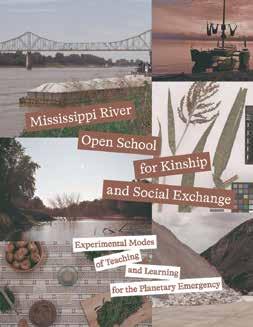
Mississippi River Open School for Kinship and Social Exchange
Experimental Modes of Teaching and Learning for the Planetary Emergency
DIO CRAMER, JOHN KIM, JEREMY MECKLER, AND REBECCA SNEDEKER, EDITORS
Revealing the Mississippi River as an interconnected ecological corridor that structures our collective past, present, and future in the Anthropocene
The Mississippi River Open School for Kinship and Social Exchange (2022–2025) is a structurally radical, community-engaged educational project that turns the university inside out to make it a home for public pedagogy, reconceiving the relationship between universities and frontline communities. This book collects, curates, and represents much of the work produced by, through, and in collaboration with the Open School. It foregrounds the central methodology of collaboratively imagining and practicing experimental modes of teaching and learning for the planetary climate emergency by drawing from a growing archive of creative writing, art, film, interviews, and activist toolkits, and it engages pressing issues of race, environment, and extraction as it connects crises experienced along the Mississippi River, from its headwaters to the gulf.
Contributors: Morgan Adamson, Jamie Allen, Kayla Anderson, Ida Aronson, Sara Black, Bruce Braun, Imani Jacqueline Brown, Nicholas Brown, Andrea Carlson, Aron Chang, Jennifer Colten, Morgan Piper Cordova, Amber Ginsburg, Tammy Greer, Shana M. griffin, Ryan Griffis, Brian Holmes, Sarah Kanouse, Amy E. Lesen, Sarah Lewison, Jacob Lindgren, Stephanie Lindquist, Jason Ludwig, Jenna Mae, Shanai Matteson, Nelson Mondale, Tahani Nadim, Ozone 504, Sara Pajunen, Lynn Peemoeller, Claire Pentecost, Roopali Phadke, Zane Piontek, Catherine Russell, Kirisitina Sailiata, Meira Smit, Joe Underhill, Monique Verdin, Jesse Vogler, Colin Waters, Mark Williams, Jan Zalasiewicz.
Dio Cramer is an artist and geographer living in the Mississippi River watershed in Minneapolis.
John Kim is associate professor of media and cultural studies at Macalester College in St. Paul.
Jeremy Meckler is a scholar, instructor, and collaborator in media and cultural studies at Macalester College.
Rebecca Snedeker is an artist, writer, curator of public programming, and bioregionalist based in Bvlbancha/ New Orleans.
ENVIRONMENT/CREATIVE NONFICTION
$29.95 Paper ISBN: 978-1-5179-2192-7
AUGUST
328 pages 193 color plates 6 1/2 x 9 1/2
Distributed for the Mississippi River Open School for Kinship and Social Exchange
Sky Blue Water
Great Stories for Young Readers
JAY D. PETERSON AND COLLETTE A. MORGAN, EDITORS
FOREWORD BY KEVIN KLING
A one-of-a-kind collection of short stories for adolescent readers that celebrates Minnesota’s vibrant storytelling tradition— now in paperback
“A high-quality anthology full of classroom potential, sure to inspire budding writers and hook casual readers, too.” School Library Journal
“The excellent writing should keep young readers riveted.” Pioneer Press
“Compelling, witty, and wise.” —Lake Superior Magazine
A collection motivated by the desire to inspire passion for reading and to foster literacy in young readers, Sky Blue Water celebrates young adult and intermediate fiction from many of Minnesota’s most beloved authors. Highlighting Minnesota’s diverse cultures and stunning landscapes, this anthology
beautifully captures the variety and essence of Minnesota adolescence in twenty short stories and poems.
Contributors: William Alexander, Swati Avasthi, Kelly Barnhill, Mary Casanova, John Coy, Kirstin Cronn-Mills, Anika Fajardo, Shannon Gibney, Pete Hautman, Lynne Jonell, Margi Preus, Marcie Rendon, Kurtis Scaletta, Julie Schumacher, Joyce Sidman, Phuoc Thi Minh Tran, Anne Ursu, Sarah Warren, Stephanie Watson, and Kao Kalia Yang.

Jay D. Peterson was store manager of Magers & Quinn Booksellers of Minneapolis for twelve years. He is an active and dedicated member of the Twin Cities literary community and served as founding board chair of 826 MSP.
Collette A. Morgan believes that sharing stories changes lives. In 1992, she and Tom Braun opened Wild Rumpus Books in Minneapolis. She has served on the board of directors of the American Booksellers Association and the Midwest Independent Booksellers Association.
Kevin Kling is a playwright, actor, author, storyteller, and cultural advocate.
SHORT STORIES/MIDDLE GRADE AND YOUNG
ADUL T
$14.95 Paper ISBN: 978-1-5179-2270-2
$14.95 Retail e-book ISBN: 978-1-4529-5194-2
DECEMBER
264 pages 5 1/2 x 8 1/2
Harriman vs. Hill
Wall Street’s Great Railroad War
LARRY HAEG
HARRIMAN
vs. HILL

Now in paperback: how the two most powerful men in the nation’s dominant industry battled for control of the Northern Pacific Railway, forever changing the landscape of American business
“Mr. Haeg conveys a vivid picture of the Gilded Age in splendor and in turmoil.”
—The Wall Street Journal
“An excellent and enlightening read.”
—Model Railroad News
“Haeg writes economic history as if it were a novel and draws readers along complicated financial twists and makes them like it.”
—Red Wing Republican Eagle
In 1901, two titans of American railroads set their sights on the Northern Pacific. The subsequent battle was unprecedented in the history of American enterprise, pitting not only James J. Hill against Edward Harriman but also Big Oil against Big Steel and J. P. Morgan against the Rockefellers, with a supporting cast of enough wealthy investors to fill the Waldorf Astoria’s ballroom. This is the account of an epic battle, with effects that echo through our economy to this day.
Larry Haeg is former executive vice president of corporate communications for Wells Fargo & Company and a former broadcast journalist.
HISTOR Y
$21.95 Paper ISBN: 978-0-8166-8365-9
$21.95 Retail e-book ISBN: 978-1-4529-3990-2
OCTOBER
392 pages 20 b&w illustrations 2 maps 6 x 9

Flying Funny
My Life without a Net
DUDLEY RIGGS
FOREWORD BY AL FRANKEN
The unusual, gravity-defying first act of improvisational theater’s founding father—now in paperback
“Dudley Riggs not only brought comedy to thousands of people, he paved and provided a safe environment for artists to stretch the boundaries beyond the norm.”
—Louie Anderson
“The great Dudley Riggs is a titan of comedy. There was no laughter west of the Mississippi before him.”
—Penn & Teller
“Like Riggs himself, his book is warm and a bit bashful in tone, avoiding the acres of melodrama and flamboyant flimflam found in many show business autobiographies. It reads like the work of a man with more good cheer than worry, making it through life’s travails without deep scars on his body or spirit.”
—Star Tribune
Dudley Riggs didn’t have to run away from home to join the circus: home was the circus. In Flying Funny, Riggs shares stories spanning from his early life in circus and vaudeville to his creation of the Brave New Workshop in Minneapolis. With wry humor and infectious warmth, he relates the exhilaration of flying—through the air or on the stage.
Dudley Riggs (1932–2020) worked as an aerialist, clown, movie actor, comedian, writer, stage director, and producer, and founded Brave New Workshop in Minneapolis.
Al Franken, a politician, writer, actor, and comedian, began his career in improvisational theater and political satire at the Brave New Workshop.
MEMOIR
$15.95 Paper ISBN: 978-1-5179-0094-6
$15.95 Retail e-book ISBN: 978-1-4529-5453-0
MARCH
200 pages 23 b&w plates 5 1/2 x 8
Larry Haeg

The Hassler Effect
The Complete Short Stories of Jon Hassler
JON HASSLER
FOREWORD BY WILL WEAVER
EDITED AND WITH AN INTRODUCTION BY
IAN GRAHAM LEASK
Bringing the powerful literary voice of Jon Hassler to a new generation of readers
“Hassler’s brilliance has always been his ability to achieve the depth of real literature through such sure-handed, no gimmicks honest language that the result appears effortless.”
—The New York Times Book Review
“Jon Hassler’s prose is flawless, his characters decent, believable people about whom you care immensely, his stories are strong. He writes about what he knows so that we may know it too and find therein a power of understanding.”
—The Cleveland Plain Dealer
The Hassler Effect gathers the short stories of beloved Minnesota writer Jon Hassler into one volume for the first time. Known for his stories and novels of boyhood and small-town life, and for evoking a keen sense of place in his work, Hassler’s stories draw from his childhood in southern Minnesota, his experiences teaching high school and college English classes, and the great variety of folks he knew throughout the years.
Jon Hassler (1933–2008) was writer in residence and Regents Professor Emeritus at St. John’s University in Collegeville, Minnesota. Will Weaver is author of Black Dirt, Bright Stars, Power & Light, Sweet Land, and Red Earth, White Earth Ian Graham Leask is publisher of Afton Press and author of The Wounded and Other Stories about Sons and Fathers
REGIONAL/FICTION
$24.95 Cloth/jacket ISBN: 978-0-9976-2963-7
OCTOBER
224 pages 5 1/2 x 8 1/2 Distributed for Afton Press

Making Minnesota Liberal
Civil Rights and the Transformation of the Democratic Party
MAKING MINNESOTA LIBERAL
JENNIFER A. DELTON
The surprising story of how Minnesota politicians in the 1950s helped redirect American politics—now in paperback
“A tremendously impressive feat of scholarship . . . Delton tells a thoroughly good story.”
—American Historical Review
“Sprightly and perceptive, Making Minnesota Liberal offers unexpected insight into the history of liberalism in the wake of the Second World War . . . rightly bringing back into sight the radicals of the era of the Great Depression.”
—Nell Irvin Painter, author of Standing at Armageddon
In Making Minnesota Liberal, Jennifer A. Delton delves into the roots of Minnesota politics and traces the change from the regional, thirdparty, class-oriented politics of the Farmer–Labor party in the early twentieth century to the national, two-party, pluralistic liberalism of the Democratic–Farmer–Labor party (DFL). Delton contributes to our understanding not only of Minnesota’s political history but also of the relationship between antiracism and American politics. Featuring a new preface by the author, this absorbing and trenchant account of a key moment in American history continues to resonate today.
Jennifer A. Delton is professor of history at Skidmore College and author of several books, including The Industrialists: How the National Association of Manufacturers Shaped American Capitalism
POLITICS/HISTOR Y
$22.95 Paper ISBN: 978-1-5179-2226-9
$22.95 Retail e-book ISBN: 978-1-4529-7634-1
OCTOBER
272 pages 14 b&w plates 5 1/2 x 8 1/2
Jennifer A. Delton
Powers of No
The Infra Noir Surrealist Group
CATHERINE L. HANSEN
How five dissident poets applied Surrealism to everyday life under totalitarian rule
A collective biography of the Surrealist group Infra Noir, Powers of No reveals an important chapter in the history of the postwar European avant-garde. Detailing the group’s innovative program for cultivating community and political resistance, Catherine L. Hansen examines how its five members reimagined Surrealism as a means to endure life under totalitarianism and war.
Encompassing the careers and friendships of Gherasim Luca, Gellu Naum, Dolfi Trost, Paul Păun, and Virgil Teodorescu, Powers of No is the first English-language book about this Francophone Romanian group active between 1941 and 1947. The members of Infra Noir created radical art and publications that attracted the attention of André Breton and other central figures in the wider Surrealist movement. Charting their course from the Bucharest avant-garde amid the rising tide of fascism through the turbulent intellectual and
political scene of postwar France and Stalinist repression, Hansen unpacks the concepts this group developed, which envisioned new possibilities for emancipatory thought and praxis.
Grounded in a wealth of archival materials and original translations, Powers of No situates the unique legacy of Infra Noir’s revolutionary project among the various intellectual currents of a tumultuous era. Establishing Infra Noir as more than an obscure clique of dissident poets and artists, this book presents their work as a repertoire of lessons for resisting authoritarian oppression and avoiding despair even under the harshest political conditions.

Catherine L. Hansen teaches in the Center for Global Education at the University of Tokyo. She is coeditor of In Search of The Third Bird: Exemplary Essays from The Proceedings of ESTAR(SER) 2001–2021.
ART HISTORY/ACTIVISM
$30.00x Paper ISBN: 978-1-5179-2015-9
$120.00xx Cloth ISBN: 978-1-5179-2014-2
$30.00 Retail e-book ISBN: 978-1-4529-7752-2
NOVEMBER
368 pages 30 b&w illustrations 6 x 8
Surrealisms: The International Society for the Study of Surrealism Book Series
Retail e-book files for this title are screen-reader friendly with images accompanied by short alt text and/or extended descriptions.
The Contact Image
Casts, Imprints, and Other Traces in Art
JOHANNA MALT
A new conceptual tool for understanding the history of art
From ancient cave paintings to contemporary sculpture, forms of indexical trace are vital to the human practice of artmaking. Through this wide-ranging exploration, Johanna Malt shows how casts, molds, and imprints (“contact images”) offer a paradigm for thinking about our relationship to objects and their surfaces as sites of meaning. Engaging and complicating philosophical dualities of absence and presence, art and non-art, original and copy, Malt introduces the contact image as an important new concept for the study of Western art.
Close reading examples from 30,000 years of art history, Malt cuts across eras and media to unite diverse forms of artistic production created through instances of contact with “the objects of the world.” From holy relics
to Napoleon’s death mask to life casts of the human body by artists such as Duane Hanson and Janine Antoni, as well as conceptual and performance work by Jasper Johns and Yves Klein, The Contact Image traces themes of selfhood, time, negation, and vestige in these tactile encounters.
Revisiting fundamental questions about representation, perception, and aesthetics, The Contact Image is a sophisticated provocation for a theory of art built on the tension and oscillations that emerge when we explore how artworks embody opposites.
THE CONTACT IMAGE

Johanna Malt is professor of French literature and visual culture at King’s College London. She is author of Obscure Objects of Desire: Surrealism, Fetishism, and Politics and coauthor of World Gone Mad and Shelf Life: Neil Gall
ART/CULTURAL STUDIES
$40.00x Paper ISBN: 978-1-5179-1538-4
$160.00xx Cloth ISBN: 978-1-5179-1537-7
$40.00 Retail e-book ISBN: 978-1-4529-7601-3
DECEMBER
272 pages 37 b&w illustrations 36 color plates 7 x 10
Retail e-book files for this title are screen-reader friendly with images accompanied by short alt text and/or extended descriptions.
JOHANNA MALT
The X Catalogue
Notes on Madrid’s LatinX Flora and Fauna
CLAUDIA MILIAN
THE
A transatlantic, more-than-human exploration of LatinX presence, memory, and empire in the heart of Madrid
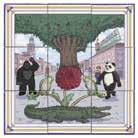
How does LatinXness begin in the Kingdom of Spain? In The X Catalogue, Claudia Milian offers a vade mecum of Madrid, exploring it as an ecological archive and former imperial metropolis. Approaching the “X” as metaphor, method, and philosophical practice, she extends inquiry beyond the human. Milian traces the “X” through transplanted life from the Americas: the roots of the ahuehuete tree (the Montezuma cypress), the engineering and renaming of the acocoxochitl (the dahlia), the “invasion” of the cotorras argentinas (Monk parakeets), and the exhibition of the caimán (the alligator) as a conquered object.
Critical theory and historical cultural studies meet to remap the Atlantic world through the “Xs” of arrival, circulation, and transformation.
By examining how LatinXness inhabits the Spanish capital, Milian breaks open LatinX
Spain and global LatinX studies. The X Catalogue resists containment, mirroring its objects of study and challenging categories such as native, foreign, or authentic. It advances a more-than-human, transatlantic understanding of LatinXness within empire studies, environmental humanities, and the critical study of tourism.
CATAL OGUE
NOTES ON MADRID’S LATINX FLORA AND FAUNA
CLAUDIA MILIAN
Claudia Milian is professor of Romance studies at Duke University. She is author of LatinX, also published by the University of Minnesota Press, and Latining America: Black-Brown Passages and the Coloring of Latino/a Studies
LATINX STUDIES/ENVIRONMENT
$28.00x Paper ISBN: 978-1-5179-2194-1
$112.00xx Cloth ISBN: 978-1-5179-2193-4
$28.00 Retail e-book ISBN: 978-1-4529-7646-4
DECEMBER
256 pages 23 b&w illustrations 5 1/2 x 8 1/2
Retail e-book files for this title are screen-reader friendly with images accompanied by short alt text and/or extended descriptions.
Black Visual Cultures of the Midwest
FREDA L. FAIR
Recentering black creativity and resistance in the history of the Midwest
African American creators have unsettled and upended racism in the Midwest region since as far back as 1787, and Black Visual Cultures of the Midwest examines the work of many such innovators, presenting an unruly, transgressive, and defiant vision of queer blackness that complicates fundamental American ideals of liberty, progress, life, and property.
Spanning the nineteenth century to the present, Freda L. Fair draws from a broad array of sources, including film, visual art, and even arrest records to examine concepts of freedom and resistance grounded in black cultural production in the Midwest. Through such subjects as Joshua Glover, who escaped slavery in Missouri and relocated to Wisconsin; sex workers in the Twin Cities; Ruth Ellis, a black lesbian elder in Detroit; and Nick Cave, who created Soundsuits in response to the
police beating of Rodney King, Fair challenges monolithic formulations of blackness and black culture. Fair also queers Midwest history, engaging an LGBTQ lens to reexamine Wisconsin’s 1854 decision to declare the Fugitive Slave Act of 1850 unconstitutional, the Springfield Race Riot of 1908, and other historic moments.
Revealing how black visual cultures in the Midwest both illuminate black gendered and sexual difference and actively resist antiblackness, Fair shows that the region is a site that can advance freedom and social change.
black vlsual cultures of the mldwest
Freda L. Fair is assistant professor of gender and women’s studies and black studies at the University of Illinois Chicago.
BLACK STUDIES/VISUAL CULTURE
$28.00x Paper ISBN: 978-1-5179-0967-3
$112.00xx Cloth ISBN: 978-1-5179-0966-6
$28.00 Retail e-book ISBN: 978-1-4529-6402-7
JANUARY
264 pages 24 b&w illustrations 5 1/2 x 8 1/2
Retail e-book files for this title are screen-reader friendly with images accompanied by short alt text and/or extended descriptions.
FREDA L. FAlR
Rationality Without Reason
Architecture and Calculation in Germany After 1968
DANIELA FABRICIUS
A critical examination of the rational turn
in postwar West German architecture
Postwar West German architecture experienced a “rational turn” characterized by a dramatic push toward ideals of optimization, economy, and accuracy based in calculation. Analyzing how architects reckoned with the political and cultural legacy of fascism and were driven by the desire to quantify and manage unpredictability in the human environment, Rationality Without Reason shows how they translated their design and production methods into numbers through protodigital technology and computational processes.
Daniela Fabricius examines architectural practices within the wider context of the shifting intellectual and cultural landscape as rationalism devolved between the student movements of 1968 and the reign of postmodernism in the 1980s. Showing how rationalism’s limitations and contradictions became increasingly apparent, she demonstrates how the intensity of these approaches ultimately led to a form
of rationalism devoid of reason. Fabricius explores how the development of increasingly autonomous systems and formalist methods strayed from important economic, social, and ethical concerns and impeded the potential for developing more liberatory forms of architecture.
Using case studies involving the Ulm School for Design and the research-based work of Frei Otto and Oswald Mathias Ungers, Rationality Without Reason traces how debates around scientific thinking evolved throughout the Cold War era and offers a critical look at the utopian promises associated with supposedly rational systems of knowledge. Through an interdisciplinary approach steeped in archival research, Fabricius highlights how the logic of quantification is bound to be unsustainable without serious ethical considerations.
RATIONALITY WITHOUT REASON

Fabricius ARCHITECTURE AND CALCULATION IN GERMANY AFTER 1968
Daniela
ARCHITECTURAL HISTORY/SCIENCE AND TECHNOLOGY STUDIES
$35.00x Paper ISBN: 978-1-5179-1866-8
$100.00xx Cloth ISBN: 978-1-5179-1865-1
$35.00 Retail e-book ISBN: 978-1-4529-7663-1
FEBRUARY
368 pages 127 b&w illustrations 21 color plates 7 x 10
Retail e-book files for this title are screen-reader friendly with images accompanied by short alt text and/or extended descriptions.
Daniela Fabricius is assistant professor in the Department of Architecture at the Stuart Weitzman School of Design at the University of Pennsylvania.
Design for Independent Living
The Environment and Physically Disabled People
RAYMOND LIFCHEZ AND BARBARA WINSLOW
FOREWORD BY IGNACIO G. GALÁN, AIMI HAMRAIE, AND BESS WILLIAMSON
Design for Independent Living
The Environment and Physically Disabled People

A new edition of the classic and innovative resource that relies on personal lived experience to guide accessible design
“The book is absorbing and revealing. . . . It challenges the notion that only perfect human specimens have a claim to be important and be granted dignity and justice.”
—Washington Post
“Lifchez and Winslow provide an unusual perspective on human use of the built environment that raises questions extending beyond the world of [disabled people] into many other social worlds.”
—The Professional Geographer
In 1979, University of California architecture professors Raymond Lifchez and Barbara Winslow published this account of ongoing collaborations with members of a robust disability community in Berkeley, California. In the first attempt by architects to know disabled people and to design from their perspective, they employed an empathetic approach that differed from typical accessible design guidelines.
Instead of presenting architectural designs to resolve existing barriers, Design for Independent Living turns to disabled people to tell their own stories through interviews and
photographs of their own homes, workplaces, and lives in public. The disabled informants of the project were members of the Independent Living movement—the activists who shaped the disability rights movement in the late twentieth century in the United States—and their contributions demonstrate the necessity of liberating design from ableist, restrictive ways of thinking about personal and public life.
Now with a new foreword by three scholars of design and disability history, Design for Independent Living is an indispensable resource for architecture and design experts who seek a socially informed practice that looks to the people most affected by design to understand its potentials and its shortcomings.
A NEW SERIES
The Critical Access Studies Series explores the meanings of “access” emerging from critical disability scholarship, activism, and design, troubling the concept of “access” and its associations with liberal rights. Foregrounding new theoretical tools, historical archives, design projects, ethnographic data, and disability culture and arts, Critical Access Studies explores the political goal of access, as well as its sometimesunexpected material outcomes.


Raymond Lifchez (1932–2023) was professor emeritus of architecture at the University of California, Berkeley, and author of Rethinking Architecture
Barbara Winslow is an architect and coauthor of Patterns of Home and The Good House
Ignacio G. Galán is assistant professor of architecture at Barnard College, Columbia University.
Aimi Hamraie is Canada Research Chair in Technology, Society, and Disability at York University.
Bess Williamson is associate professor of design studies at North Carolina State University.
ARCHITECTURE AND DESIGN HISTORY/DISABILITY
$30.00x Paper ISBN: 978-1-5179-2140-8
$30.00 Retail e-book ISBN: 978-1-4529-7705-8
JANUARY
208 pages 140 b&w illustrations 8 1/2 x 11 Critical Access Studies Series
Retail e-book files for this title are screen-reader friendly with images accompanied by short alt text and/or extended descriptions.
Raymond Lifchez & Barbara Winslow Foreword by Ignacio G. Galán, Aimi Hamraie, and Bess Williamson
Settler Imperialism
Alaska Natives and the Myth of the Last Frontier
JESS ARNETT
How Alaska redefined US colonialism through Indigenous resistance and legal innovation
Long treated as the symbolic “last frontier,” Alaska was, in fact, the United States’s first experiment in overseas empire. Settler Imperialism reveals these concepts as fictitious stories promoted by government officials and offers a sweeping history of Alaska Native legal and political struggle in the face of a colonial structure that defied the norms of US expansion. Examining Alaska as both a settler and imperial space, Jess Arnett challenges familiar narratives of American growth, sovereignty, and law.
Following the 1867 Treaty of Cession when the United States purchased Alaska from Russia, the federal government refused to sign treaties with Alaska Natives, excluded them from the Bureau of Indian Affairs, and denied the region designation as Indian Country. These departures from standard Indian policy created legal ambiguity that enabled new opportunities for land dispossession and

resource extraction by state and corporate interests. Focusing on history from the late nineteenth century through the 1971 Alaska Native Claims Settlement Act, Arnett uncovers how the Tlingit, Haida, Tsimshian, and other Indigenous nations navigated—and contested—Alaska’s peculiar legal terrain. Members of these communities forcefully petitioned for US citizenship, mobilized Indigenous legal orders, and engaged selective federal Indian law to assert land rights and political authority.
By placing Alaska at the center of US colonial history, Settler Imperialism turns a critical lens on the evolution of America. To understand US expansion, race, and legal formation, one must understand Alaska first as a proving ground for empire, not the last frontier.
JESS A R NETT
t ler
r i a lism m
NATIVE AND INDIGENOUS STUDIES/HISTORY
$28.00x Paper ISBN: 978-1-5179-1694-7
$112.00xx Cloth ISBN: 978-1-5179-1693-0
$28.00 Retail e-book ISBN: 978-1-4529-7584-9
OCTOBER
232 pages 4 b&w illustrations 1 map 5 1/2 x 8 1/2
Retail e-book files for this title are screen-reader friendly with images accompanied by short alt text and/or extended descriptions.
and the Myth of the Last Frontier
Alaska Natives
Jess Arnett is assistant professor of comparative American studies and environmental studies at Oberlin College.
Indigenous Reparations and Settler Colonial Reckoning
Re-Braiding Rights and Redress in Canada
PAULINE WAKEHAM
How Indigenous communities are transforming the idea and practice of reparations through their laws and leadership
In recent decades, a growing number of Indigenous groups across Canada have initiated movements for colonial reparations. Too often, the settler state has responded by attempting to enfold their work into a narrative of reconciliation that consigns colonialism to “sad chapters” of history. In this book, Pauline Wakeham calls attention to the ways that Indigenous reparations movements exceed state reconciliatory frameworks and prompt a deeper reckoning with the enduring structures of settler colonialism.
To expose and redress colonial injustices, Indigenous reparations movements draw on long local traditions of political organizing as well as transformations on the global stage since World War II. As international law formulated new instruments regarding gross human rights violations, atrocity crimes, and the reparative obligations of states, colonized peoples across the world have sought to mobilize these mechanisms in their struggles for decolonization and reparations. While international law has provided strategic tools
for this work, the colonial foundations of the field continue to limit how it conceptualizes and shapes access to justice. Indigenous Reparations and Settler Colonial Reckoning traces the specific implications for Indigenous nations whose land is occupied by settler states—nations whose legal orders remain subordinated to both settler “domestic” and international legal systems.
Amid this complex multijurisdictional terrain, how are Indigenous peoples carving out space to articulate their own visions of justice? To answer this question, Wakeham learns from the Inuit-led Qikiqtani Truth Commission as well as reparations movements for residential schools and the High Arctic Relocations of 1953 and 1955. These movements offer powerful lessons about the importance of centering Indigenous leadership and laws in redress processes, thereby connecting reparations to the living enactment of Indigenous rights.
INDIGENOUS REPARATIONS
RE-BRAIDING RIGHTS AND REDRESS IN CANADA & SETTLER COLONIAL RECKONING

Pauline Wakeham is associate professor in the Department of English at Western University in Ontario. She is author of Taxidermic Signs: Reconstructing Aboriginality (Minnesota, 2008).
NATIVE AND INDIGENOUS STUDIES
$30.00x Paper ISBN: 978-1-5179-2150-7
$120.00xx Cloth ISBN: 978-1-5179-2149-1
$30.00 Retail e-book ISBN: 978-1-4529-7605-1
OCTOBER
352 pages 3 b&w illustrations 1 map 5 1/2 x 8 1/2
Retail e-book files for this title are screen-reader friendly with images accompanied by short alt text and/or extended descriptions.
Pauline Wakeham
The Empathic Lens
Art, Animism, and Ecology in Contemporary Southeast Asia
BRIANNE COHEN
How lens-based art from Southeast Asia offers alternative visions for ecological sustainability
A new paradigm of ecologically minded artistic practices is taking shape in Southeast Asia— one that at once tracks ecological destruction and works specifically to cultivate deeper feelings of empathy toward the environment. Examining a range of photography and video work, The Empathic Lens explores how these lens-based projects respond to increasingly urgent concerns related to climate disaster and capitalist acceleration.
In this analysis of work produced across Cambodia, Vietnam, and Singapore, Brianne Cohen highlights artists for whom rampant urban development, resource extraction, and environmental toxicity are close at hand. As each artist takes their lens to these realities, Cohen shows, they draw on Indigenous knowledge and local traditions that have
long recognized the kinship of humans and nonhumans. Engaging often-censored discourses of Indigenous land relations and environmental justice in a region with a long history of colonial and neocolonial development, Cohen traces genealogies of empathy and animism to demonstrate how these works develop sustainable visions for the future coexistence of planetary life.
The first critical account of marginalized artworks that depict the centrality of the morethan-human in Southeast Asian Indigenous worldviews, The Empathic Lens makes a powerful case for the relevance of Southeast Asian lens-based art in contemporary media practice and the art of the Anthropocene.
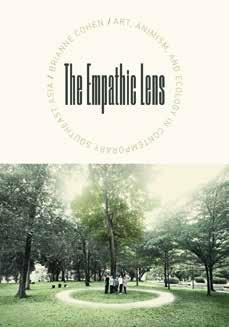
Brianne Cohen is associate professor of contemporary art history at the University of Colorado Boulder. She is author of Don’t Look Away: Art, Nonviolence, and Preventive Publics in Contemporary Europe and coeditor of Deep Horizons: A Multisensory Archive of Ecological Affects and Prospects and The Photofilmic: Entangled Images in Contemporary Art and Visual Culture
ART/ENVIRONMENT/ASIAN STUDIES
$35.00x Paper ISBN: 978-1-5179-2096-8
$140.00xx Cloth ISBN: 978-1-5179-2095-1
$35.00 Retail e-book ISBN: 978-1-4529-7613-6
NOVEMBER
240 pages 28 b&w illustrations 27 color plates 7 x 10
Retail e-book files for this title are screen-reader friendly with images accompanied by short alt text and/or extended descriptions.
Text and Image
Making Meaning in Manga and Comics
DEBORAH SHAMOON
& Image
How manga and comics reshape storytelling across cultures
Text and Image is a groundbreaking exploration of how Japanese manga and comics from the United States and United Kingdom craft meaning through the combination of words and pictures. Current scholarship often isolates manga in niche genre studies or prioritizes anime instead; in response, Deborah Shamoon proposes a unified framework for understanding paneled visual storytelling across cultures. She reframes comics not as kids’ stuff but as a sophisticated narrative art with its own grammar, rhythm, and visual poetics.
Drawing on narratology, art history, film studies, and media theory, Text and Image examines a vast array of material, from fourpanel comic strips to different manga genres, including shōjo (girls’ romance comics), shōnen (teen action), seinen (adult drama), and gekiga (mature realism). Through close visual analysis, Shamoon demonstrates how creators use panel layout, pacing, and the choreography of text and image to shape
emotional impact and narrative momentum. She reveals the shared techniques that link works as disparate as Fun Home and Spider-Man while also showing where cultural conventions diverge. Beyond the traditional print realm, Shamoon discusses digital platforms, such as webtoons and vertically scrolling comics, to show how new technologies merge manga’s cinematic sensibility with global innovation.

Making a bold case for a more expansive, inclusive theory of visual narrative that bridges long-standing divides between manga studies and Anglophone comics scholarship, Text and Image is an indispensable guide to understanding how contemporary stories work and why they resonate across borders.
Deborah Shamoon is associate professor in the Department of Japanese Studies at the National University of Singapore and author of Passionate Friendship: The Aesthetics of Girls’ Culture in Japan
VISUAL CULTURE/ASIAN STUDIES
$28.00x Paper ISBN: 978-1-5179-1958-0
$112.00xx Cloth ISBN: 978-1-5179-1957-3
$28.00 Retail e-book ISBN: 978-1-4529-7631-0
DECEMBER
256 pages 49 b&w illustrations 5 1/2 x 8 1/2
Retail e-book files for this title are screen-reader friendly with images accompanied by short alt text and/or extended descriptions.
Deborah Shamoon
Undead Labor
Capitalism’s Zombie Worker
DAVID BERING-PORTER
How the zombie represents capitalism’s fantasy of limitless labor
Much more than just an enduring figure of horror entertainment, the zombie is a uniquely modern symbol representing capitalism’s most brutal demands on human life. Examining the push to extract surplus value from human bodies in ways that exceed their natural limits, David Bering-Porter shows how this notion of the undead is both integral to and symptomatic of capitalism’s endless cycle of growth and consumption.
Bering-Porter demonstrates how the zombie has long been deeply intertwined with issues of race and exploitation, from its origins in the slave plantations of colonial Haiti to its traces in the continuing evolution of artificial intelligence systems, serving as capitalism’s ideal worker: one that never rests, never stops, and never dies. Featuring close readings of Marx alongside films such as I Walked with a Zombie, The Blob, and Night of the Living Dead, the book traces the
concept of undead labor as it manifests across various historical epochs, providing insight into the manifold ways that capitalism has sought to transform living beings into instruments of limitless production.
As he weaves together critical race studies with an analysis of popular culture and media, Bering-Porter interrogates racialized capitalism and its fantasy of labor beyond all limits. By highlighting how the zombie is borne of the same ideology that has given rise to contemporary burnout culture and environmental collapse, Undead Labor uncovers the capitalist system’s relentless death drive with the hope that it finally may be put to rest.
FILM AND MEDIA STUDIES/LABOR STUDIES
$28.00x Paper ISBN: 978-1-5179-1785-2
$112.00xx Cloth ISBN: 978-1-5179-1784-5
$28.00 Retail e-book ISBN: 978-1-4529-7636-5
NOVEMBER
240 pages 5 1/2 x 8 1/2
Retail e-book files for this title are screen-reader friendly.
David Bering-Porter is assistant professor of culture and media in the Eugene Lang College of Liberal Arts at The New School.
The Visual Guillotine
The Cinematic Cut and Politics in Latin America
THOMAS MATUSIAK
The violence of the cinematic cut in twentieth-century Latin American film
Splice, montage, close-up: by these means, modern cinema routinely presents bodies in pieces. Not unlike the guillotine itself, argues Thomas Matusiak, these techniques have served both overt and symbolic political ends as they accomplish and project the efficient production of severed bodies. In The Visual Guillotine, Matusiak traces the use of cinematic tools of dismemberment in twentieth-century Latin American film to theorize the symbolic and material violence of the cut.
A robust genealogy of Latin American cinematic politics, The Visual Guillotine encompasses national filmmaking traditions; radical and reactionary political registers; and the proliferated aesthetics of narrative, documentary, experimental, and expanded cinema through an innovative critical viewing practice. From the national cinemas of the 1930s to the decapitation videos produced
in the Mexican narco-conflict and beyond, Matusiak shows how the cinematic cut has been employed to inspire terror as well as invoke and critique a range of political programs.
A refreshing dialogue between film theory and Latin American cultural studies, The Visual Guillotine offers a new way for film to conceptualize politics. In our present political moment, with rapidly generated and circulated visual media central to a resurgent leftist-populist battle against oligarchy and authoritarianism, this book calls for readers to reassess their viewing position when confronted with violent imagery.
Thomas Matusiak is assistant professor of Latin American cultural studies in the Michelle Bowman Underwood Department of Modern Languages and Literatures at the University of Miami.
LATINX STUDIES/FILM AND MEDIA STUDIES
$30.00x Paper ISBN: 978-1-5179-1553-7
$120.00xx Cloth ISBN: 978-1-5179-1552-0
$30.00 Retail e-book ISBN: 978-1-4529-7596-2
OCTOBER
304 pages 49 b&w illustrations 5 1/2 x 8 1/2
Retail e-book files for this title are screen-reader friendly with images accompanied by short alt text and/or extended descriptions.
The Carceral Surround
R. JOSHUA SCANNELL
How digital technologies entrench state power—and a new vision for resistance
As law enforcement agencies deploy increasingly advanced technologies to suppress dissent, hunt migrants, and target marginalized communities, The Carceral Surround offers a powerful new theory of police and prison power in the digital age. Making sense of the rapid expansion of digital carceral infrastructure in a nation that claims to value freedom and individual rights, R. Joshua Scannell moves beyond familiar debates over privacy to show that understanding digital policing requires confronting the political and racial logics that sustain police power.
Drawing on digital media theory, science and technology studies, critical race and ethnic studies, and carceral theory, The Carceral Surround reveals how twenty-first-century policing is less about managing crime than about governing possibility. Carceral power now operates across every register of daily life through predictive analytics, risk modeling, and algorithmic systems that track, sort, and
preempt. From social media archives and facial recognition software to satellite mapping and radiation sensors, Scannell charts how seemingly disparate media converge into an environment of control that links technocratic governance to the maintenance of racial hierarchy and capitalist order.
Tracing today’s technoauthoritarian regime from the NYPD’s assault on Black Lives Matter protesters in 2020 to the Stop LAPD Spying Coalition’s campaign to end predictive policing contracts, The Carceral Surround is a rare hybrid of critique and refusal, illuminating the digital logic of US authoritarianism while imagining pathways for collective resistance beyond its grasp.

and Uncertain
the Urban World
DIGITAL CULTURE/AMERICAN STUDIES
$27.00x Paper ISBN: 978-1-5179-2125-5
$108.00xx Cloth ISBN: 978-1-5179-2124-8
$27.00 Retail e-book ISBN: 978-1-4529-7611-2
SEPTEMBER
276 pages 5 1/2 x 8 1/2
Retail e-book files for this title are screen-reader friendly.
The Carceral Surround
R. Joshua Scannell
R. Joshua Scannell is assistant professor of digital media theory at The New School. He is author of Cities: Unauthorized Resistance
Sovereignty in
Hermes IV
Distribution
MICHEL SERRES
TRANSLATED BY RANDOLPH BURKS
How order, meaning, and knowledge emerge from noise across science, literature, and philosophy
Hermes IV: Distribution is the fourth and penultimate volume in Michel Serres’s landmark series on knowledge and communication across disciplines. This collection of essays investigates how order emerges from noise, using thermodynamics and information theory as structural models applicable to science, literature, and culture. Moving beyond the themes of interference and translation developed in earlier volumes, Serres focuses on distribution: the processes by which systems take shape, endure, and eventually disperse.
At the core of the book is a dynamic vision of knowledge as an unstable formation. Systems arise from chance encounters or deviations that, through repetition, harden into law. They resist entropy by remaining open to external inputs, forming temporary pockets
of negentropy within a wider field of chaos. Space, time, energy, language, and meaning are all shown to emerge from such conditions of mixture and imbalance.
Serres develops his argument through a striking range of materials, including fables, myths, literary texts, philosophy, and the history of science. The result is an uncommon synthesis of hard science and the humanities that reveals shared structures across domains while affirming the irreducible plurality of their laws and methods.

Michel Serres (1930–2019) was author of more than sixty books, including Biogea, Variations on the Body, and The Parasite (all available in translation from Minnesota). He was widely known for his poetic prose and interdisciplinary form of thought.
THE FULL SERIES


Hermes I Communication
Hermes II Interference
Hermes III Translation
Hermes IV Distribution
Hermes V Northwest Passage (forthcoming)
Randolph Burks is an independent scholar who has translated many works by Michel Serres, including Biogea, Variations on the Body, Hermes II, and Hermes III, all published by the University of Minnesota Press.
PHILOSOPHY/THEOR Y
$30.00x Paper ISBN: 978-1-5179-0193-6
$120.00xx Cloth ISBN: 978-1-5179-0192-9
$30.00 Retail e-book ISBN: 978-1-4529-7648-8
DECEMBER
352 pages 6 b&w illustrations 6 x 9
Posthumanities Series, volume 82
Retail e-book files for this title are screen-reader friendly with images accompanied by short alt text and/or extended descriptions.
Brokers of Power
The Financialization of the US Electricity System
CONOR HARRISON
A detailed look at the financial interests impacting the energy transition
The twenty-first century has seen major transformations in the US electricity sector— but while the use of coal power wanes and the need for renewable energy becomes more urgent, financial actors maintain a complicating influence on the trajectory of energy transition. Brokers of Power identifies changing patterns of investment intertwined with the shift from state-regulated electricity monopolies to a market-driven price model and the embrace of wind and solar hookups to the grid.
Drawing from case studies such as catastrophic Winter Storm Uri that hit Texas in 2021 and in-depth interviews with people working in the electricity and financial sectors, Conor Harrison reveals how the various entanglements of private equity, investment banking, and financial modeling are shaping the future of this vital infrastructure. Today’s financial firms, he shows, are engaged in
the electricity industry beyond matters of investment: they own electricity generation infrastructure, trade electricity on markets, capture federal renewable energy tax credits, and advise on electricity firm operating strategy.
Looking beyond technology and policy, Harrison interrogates what it means to have powerful financial institutions as the primary agents of change in the fraught and ongoing energy transition. A timely and invaluable contribution to the fields of geography, environmental studies, and the energy social sciences, Brokers of Power is a cautionary account delving into the complexities surrounding the push for decarbonization.
Brokers of Power
Brokers of Power Conor Harrison
GEOGRAPHY/ECONOMICS
$28.00x Paper ISBN: 978-1-5179-1901-6
$112.00xx Cloth ISBN: 978-1-5179-1900-9
$28.00 Retail e-book ISBN: 978-1-4529-7577-1
AUGUST
288 pages 32 b&w illustrations 3 tables 5 1/2 x 8 1/2
Retail e-book files for this title are screen-reader friendly with images accompanied by short alt text and/or extended descriptions.
The Financialization of the US Electricity System
Conor Harrison is associate professor in the Department of Geography at the University of South Carolina.
Terminal City
Infrastructures of Racial Colonial Capitalism in Vancouver
MICHAEL SIMPSON
The entanglement of Vancouver’s infrastructure in settler colonialism and racialized exploitation
Vancouver, Canada, has long been held up as an environmentally conscious coastal refuge and model of progressive urban planning. Unpacking the troubling complexities that lie beneath the city’s otherwise tidy self-image, Terminal City reveals the long, recurring patterns of racialized violence and Indigenous dispossession crucial to its formation.
Examining the histories of Vancouver’s infrastructures, including railways, ports, the freeway system, fossil-fuel pipelines, and property, Michael Simpson details the various spatial manifestations of settler colonialism and racial capitalism that constitute the city’s urban environment—using it as a case study to reveal such tendencies around the world. Simpson exposes how the seizure of Indigenous lands and the destruction of Black communities has been foundational to the
development of the city, and he highlights its structural dependency on these violent legacies, as well as the ongoing struggles to dismantle them.
Bringing together theoretical insights from the fields of urban geography, political ecology, and Indigenous studies, Simpson provides a distinctive intervention into contemporary debates around the material basis of logistics and circulation. At a time when massive upheavals to urban infrastructure are taking place in the hopes of establishing greater sustainability, Terminal City raises important questions about how this moment of transition might be harnessed to bring about decolonial abolitionist futures that redefine what a city can become.

TERMINA L CIT Y
Michael Simpson is senior lecturer in the School of Geography and Sustainable Development at the University of St. Andrews in Scotland. He is coauthor, with Rueben George, of the award-winning book It Stops Here: Standing Up for Our Lands, Our Waters, and Our People
GEOGRAPHY/URBAN STUDIES
$30.00x Paper ISBN: 978-1-5179-2129-3
$120.00xx Cloth ISBN: 978-1-5179-2128-6
$30.00 Retail e-book ISBN: 978-1-4529-7621-1
NOVEMBER
312 pages 26 b&w illustrations 6 maps 5 1/2 x 8 1/2
Retail e-book files for this title are screen-reader friendly with images accompanied by short alt text and/or extended descriptions.
Infrastructures of Racial Colonial Capitalism in Vancouver
Michae l Simpso n
Animated Urbanism
Bringing Cities to Smart Digital Life
GILLIAN ROSE
A critical examination of the digital imagery and visualization tools that mediate urban life
Animated Urbanism explores the ways urban life is increasingly mediated by digital visualization tools, from elaborate marketing productions to specialized techniques of urban planning that rely on the collection of large datasets. By developing a critical vocabulary for these forms of digital imagery, Gillian Rose investigates the implications of using digital technology to manage the spatial and temporal organization of life in cities.
Pushing back against the so-called smartness mandate, which sees urban existence and its infrastructure as necessarily governed by big data, automation, and artificial intelligence, Animated Urbanism is a nuanced examination of the various types of media structuring urban life and their propensity to replicate highly gendered and racialized forms of human embodiment. From smartphone apps to special effects in movies to sophisticated
“fly-through” videos of cities created by urban developers, Rose analyzes the corporate imaginaries that are being created, building on the influential theories of Donna Haraway, among others, concerning the interrelation of technology, power, and human life.
While recent digital analysis often focuses on the political economy of tech platforms or the efficacy of data in smart cities, Rose emphasizes the role of human subjectivity in the shifting configurations of these new urban landscapes. With an incisive, feminist approach to the imagery enabled by software and handheld devices, Animated Urbanism invites us to question how human life emerges from these complex entanglements of technology and visual culture.
Gillian Rose is professor of human geography at the University of Oxford, author of Feminism and Geography: The Limits of Geographical Knowledge and Visual Methodologies: An Introduction to Researching with Visual Materials, and coauthor of The New Urban Aesthetic: Digital Experiences of Urban Change
URBAN STUDIES/DIGITAL CULTURE
$29.00x Paper ISBN: 978-1-5179-2206-1
$116.00xx Cloth ISBN: 978-1-5179-2205-4
$29.00 Retail e-book ISBN: 978-1-4529-7658-7
DECEMBER
304 pages 44 b&w illustrations 5 1/2 x 8 1/2
Retail e-book files for this title are screen-reader friendly with images accompanied by short alt text and/or extended descriptions.
Gillian Rose
Proprietors for a Democratic City
Space and Political Voice in Italy
ROBIN M. L E BLANC
Lessons from Bologna on how ordinary people take charge of urban spaces and make their cities more democratic
Proprietors for a Democratic City examines how nonelite individuals politically engage with urban spaces—even when they do not formally own them. Drawing on more than a decade of fieldwork throughout Bologna, Italy, Robin M. LeBlanc presents valuable models of democratic community-making through imaginative occupation, curation, and coalitionbuilding projects, with critical implications for the study of cities and democracy.
Once a standard-bearer of progressive governance, contemporary Bologna now faces globally emergent challenges to its democratic functioning, from a lack of affordable housing to the rise of an authoritarian and xenophobic Far Right. But amid this precarity, everyday citizens employ the spaces around them to influence the political life of the city. Through interviews with a wide range of Bolognese,

from urban planners and real estate developers to housing office staff, retirees in public gardening plots, and members of immigrant and youth squatter collectives, LeBlanc illuminates the humble origins of coalitional work that can meaningfully address today’s urban economic, environmental, and demographic crises.
Challenging both capitalistic and Marxist conventional wisdom, Proprietors for a Democratic City is a vivid portrait of the urban landscape and an inspiring call to empower regular people to create vibrant democratic spaces.


Robin M. LeBlanc has been studying the political life of ordinary citizens for decades. She is William Lyne Wilson Professor of Political Economy at Washington and Lee University and author of Bicycle Citizens: The Political World of the Japanese Housewife and The Art of the Gut: Manhood, Power, and Ethics in Japanese Politics
POLITICS/ETHNOGRAPHY
$28.00x Paper ISBN: 978-1-5179-2118-7
$112.00xx Cloth ISBN: 978-1-5179-2117-0
$28.00 Retail e-book ISBN: 978-1-4529-7617-4
NOVEMBER
288 pages 12 b&w illustrations 5 1/2 x 8 1/2
Retail e-book files for this title are screen-reader friendly with images accompanied by short alt text and/or extended descriptions.
Sleep with Spectators
Feminist Performance and Practice
DANIELLE DREES
A rejuvenating look at sleep’s integral role in feminist practice, critique, and imagination
Inequality is notoriously exhausting to confront, but through theater, performance art, and theory, feminist artists and thinkers have explored a radical counter to this exhaustion: sleep. Centering creative work on this restorative practice, Sleep with Spectators is a refreshing and visionary counterhistory of feminism that offers sleep as a tool for imagining new ways of living—ones that prioritize not only rest but also care and interdependence.
Taking performance as a unique means of perceiving private and unconscious aspects of daily life, Danielle Drees draws from opera, plays, and avant-garde theater to find instances of sleep and sleeplessness as novel embodiments of core feminist concerns. Among her subjects are Sarah Kane’s free verse text 4.48 Psychosis; María Irene Fornés’s queer drama of racial–sexual transformation, Enter THE NIGHT; and Regina José Galindo’s America’s Family Prison, in
which Galindo, her partner, and their baby spent twenty-four hours in a “family-sized” cell rented from a private prison outfitter. Adeptly engaging this fascinating collection of international archival material through the lenses of Marxist feminism, trans and queer studies, and disability studies, Sleep with Spectators illuminates how sleep performances reveal and critique inequalities rooted in gender, sexuality, race, class, and disability.
Idiosyncratic and interdisciplinary, Sleep with Spectators charts an original path through the feminist performance archive, presenting new ways of indexing injustice and interrogating the political conditions of rest.

Hartford, Connecticut. Her writing has been published in the Journal of Dramatic Theory and Criticism, Signs, Frontiers, Performance Research, Theatre Journal, and TDR: The Drama Review
ART AND PERFORMANCE/FEMINIST THEORY
$28.00x Paper ISBN: 978-1-5179-1850-7
$112.00xx Cloth ISBN: 978-1-5179-1849-1
$28.00 Retail e-book ISBN: 978-1-4529-7579-5
SEPTEMBER
272 pages 5 1/2 x 8 1/2
Retail e-book files for this title are screen-reader friendly.
Danielle Drees is Marsted Curatorial Fellow at the Wadsworth Atheneum Museum of Art in
Voiceworks
SARAH HAYDEN
An acute theorization of the human voice in contemporary art
Voiceworks is a perceptive exploration of contemporary artworks in which the primary medium of activation is the human voice. Engaging in close readings of video and installations primarily from the 2010s and 2020s, Sarah Hayden reveals how voiceworks intervene politically through their handling of writing and voicing.
Surveying works from eighteen established and emerging artists including Hito Steyerl, John Akomfrah, Alban Muja, Emma WolukauWanambwa, and Cally Spooner, Voiceworks attends to the sensuous potentiality of voiced language in composition and physical space. The book elucidates how these works operate relationally, conscripting embodied involvement in the service of collective critical and resistant aims.
Augmented by Hayden’s experience as a curator of exhibitions and public programs around audiovisual work, Voiceworks skillfully traverses scholarship in critical theory, sound studies, film and video theory, poetics, and feminist criticism to analyze this prominent but underexplored strand of contemporary art practice.
VOICEWORKS VOICEWORKS VOICEWORK S

Sarah Hayden is professor of experimental writing and art at the University of Southampton and has written on voice in contemporary art for academic, exhibition, and artists’ publications. She is author of Curious Disciplines: Mina Loy and Avant-Garde Artisthood, coauthor of Peter Roehr: Field Pulsations, and editor of slow emergency siren, ongoing: Accessing Handsworth Songs
ART HISTORY/MEDIA STUDIES
$35.00x Paper ISBN: 978-1-5179-1437-0
$140.00xx Cloth ISBN: 978-1-5179-1436-3
$35.00 Retail e-book ISBN: 978-1-4529-7594-8
NOVEMBER
432 pages 15 b&w illustrations 6 x 9 Proximities Series
Retail e-book files for this title are screen-reader friendly with images accompanied by short alt text and/or extended descriptions.
Sarah Hayden Sarah Hayden Sara h Hayde n
Ideology, Interrupted A Theory of Political Precarity
ROBIN TRUTH GOODMAN
A powerful argument that the failure of ideology has created political disconnection and apathy
Political institutions increasingly fail to provide representations where citizens can recognize, identify, and imagine themselves as part of the institutions’ democratic project. Robin Truth Goodman argues that this disconnection is because ideology itself has gotten interrupted. Reversing Louis Althusser’s famous formulation of ideology as “calling” to citizens who, in response, turn toward the call, she argues that citizens now feel that ideology has turned away from them and stopped calling, endangering the most basic processes of modern democracies.
Deconstructing the widespread failure of democratic institutions to connect with individuals, Goodman examines recent works by authors such as Claire Vaye Watkins, Colson Whitehead, Ling Ma, Han Kang, and Ruth Ozeki that interrogate subjective agency within three different sites of social struggle: eco-catastrophe, pandemic, and food
insecurity. She shows the themes that emerge from the novels reflecting and extending how the privatization and technologization of political decision-making have effectively cut off politicians and political institutions from the people they are supposed to serve.
Basing her study in the political philosophy of Judith Butler, Hannah Arendt, Julia Kristeva, and other prominent feminists, Goodman draws parallels with gender theory and argues that precarity in democratic societies has prevented citizens from finding points of engagement within politics. Diagnosing this widespread inability to translate private struggles into collective responses, Ideology, Interrupted is a powerful and inspiring call for new forms of societal bonds and political engagement to rejuvenate our democratic systems.
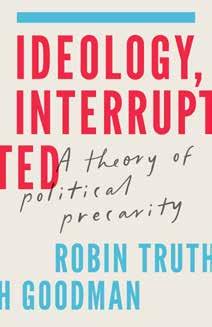
Robin Truth Goodman is Distinguished Research Professor of English at Florida State University. She is author of Milestones in Critical Feminist Theory and Cinema and the Political Imagination: Third Cinema and Its After-Image and editor of Film as World Literature and Feminism as World Literature
POLITICAL THEORY/LITERARY CRITICISM
$26.00x Paper ISBN: 978-1-5179-2181-1
$104.00xx Cloth ISBN: 978-1-5179-2180-4
$26.00 Retail e-book ISBN: 978-1-4529-7644-0 NOVEMBER
200 pages 5 1/2 x 8 1/2
Retail e-book files for this title are screen-reader friendly.
Multiracial Mandarin 多种族国语
Asian Americans and Impossible Language
DAVID SHUANG SONG 宋爽
Understanding the entanglement of language education with ethnicity and racialization
Who has the “right” to learn Mandarin Chinese? In Multiracial Mandarin, author David Shuang Song examines how matters of race and privilege shape US Mandarin language education and who has access to it. Through a two-year ethnographic study of two Bay Area high schools where diasporic and heritage speakers learn Mandarin alongside Black and Latinx students, Song advances a sociological and educational linguistic inquiry into how language interacts with our understanding of identity and equity.
Comparing classroom activities in two public schools, Song investigates teachers who seek to make Mandarin accessible while detaching it from its cultural roots. As he explores the difficulties of limited resources, racial inequality, and pedagogical practices inherent in multiracial Mandarin instruction, Song shows how language education
complicates how educators understand Asian American students and troubles conventional conversations around race and racial equity in schools.
Arguing that language practice and instruction must always be considered in relation to diaspora, ethnicity, and racialization, Multiracial Mandarin offers a frank analysis of the risks and benefits of teaching a diasporic language and asks if this practice ought to be replicated in more schools. As he applies innovative conceptual frameworks for talking about language among Asian Americans, Song’s timely and theoretically sophisticated analysis has wide-ranging implications for how students, teachers, and administrators approach essential questions around education, privilege, and language survival.
Multiracial Mandarin
Asian Americans an
d
Impossible Language
David Shuang Song
David Shuang Song is assistant professor of Asian American studies at the University of Oklahoma. His research focuses on ethnicity and race, schools, and educational linguistics. He was born in Wuhan, China.
EDUCATION/RACE AND ETHNICITY
$28.00x Paper ISBN: 978-1-5179-1879-8
$112.00xx Cloth ISBN: 978-1-5179-1878-1
$28.00 Retail e-book ISBN: 978-1-4529-7567-2
AUGUST
288 pages 5 1/2 x 8 1/2
Retail e-book files for this title are screen-reader friendly.
Urbanist Desire
Queer and Trans Survival in the City
DAVY KNITTLE
How writers and artists have used city planning strategies to push back against harm
Black queer feminist thinker Audre Lorde famously declared that “the master’s tools will never dismantle the master’s house.” This language is normally understood as a metaphor, but as author Davy Knittle argues in this provocative book, queer and trans activists have long used the tools of city planning and urban design to create written and visual art that critiques those in power and offers points of resilience to their own communities.
A close look at the ways queer and trans writers and artists resisted predatory redevelopment in New York City from 1950 to 2020, Urbanist Desire draws on the work of James Schuyler, June Jordan, David Wojnarowicz, Julian Talamantez Brolaski, and Zeyn Joukhadar, exploring how they intervened in major political flashpoints like the War on Poverty, the AIDS-era housing crisis, and gentrification in Brooklyn and Queens.
Presenting a new cultural history of New York City, Knittle explains how urban change and the more-than-human life of cities have been foundational concerns for queer and trans cultural production since the 1950s.
Ending with analysis of the 2022 speculative novel Everything for Everyone: An Oral History of the New York Commune, 2052–2072, Urbanist Desire looks to the past to imagine a better future for New York City and for all marginalized people. Knittle demonstrates how to move past a recuperative response to harm and toward one that can change the structure of society by documenting how queer and trans activists have engaged the strategies of planning and design to address spatial, social, and economic inequality.
URBANIS T DESIRE DAV Y KNITTL E QUEE

Davy Knittle is assistant professor of English at the University of Delaware.
URBAN STUDIES/QUEER THEORY
$28.00x Paper ISBN: 978-1-5179-1805-7
$112.00xx Cloth ISBN: 978-1-5179-1804-0
$28.00 Retail e-book ISBN: 978-1-4529-7638-9
NOVEMBER
288 pages 11 b&w illustrations 5 1/2 x 8 1/2
Retail e-book files for this title are screen-reader friendly with images accompanied by short alt text and/or extended descriptions.
Data Fluencies
PHILIPPA R. ADAMS, ROOPA VASUDEVAN, GILLIAN RUSSELL, KISHONNA GRAY, WENDY HUI KYONG CHUN, AND TARA M C PHERSON
Creating communities of care in the digital world
Data Fluencies offers a model for enacting theories of data justice, methods of community engagement, and practical approaches to disrupting institutions and infrastructures that have diminished the capacities of everyday digital technology users. Combining humanities-based critical thinking, computational data analyses, artsbased research cocreation, and media making, data fluencies offer creative and imaginative approaches to investigating and countering algorithmic discrimination, digital surveillance, mis- and disinformation, and deep fake versions of reality.
Not fixed or static, data fluencies move with, through, and against data streams to build the worlds we want, not the ones algorithms push on us. Presenting real-world
examples, the authors demonstrate how data fluencies transcend difference and counter the proliferation of hate and toxicity online. As they outline visions for disrupting the past to reimagine the future, the authors guide the way in devising new ways to think, act, and imagine—to influence and reshape the currents that flow through our data-driven world.

Philippa R. Adams is postdoctoral fellow at the Digital Democracies Institute at Simon Fraser University.
Roopa Vasudevan is assistant professor of art at the University of Massachusetts Amherst. Gillian Russell is assistant professor in Simon Fraser University’s School of Interactive Arts and Technology. Kishonna Gray leads the Intersectional Tech Lab and workshops in the School of Information at the University of Michigan. Wendy Hui
Kyong Chun is Simon Fraser University’s Canada 150 Research Chair in New Media. Tara McPherson is HMH
Foundation Endowed Professor of Cinema and Media Studies at the University of Southern California School of Cinematic Arts.
DIGITAL CULTURE/THEORY
$18.00 Paper ISBN: 978-1-5179-2269-6
$18.00 Retail e-book ISBN: 978-1-4529-7706-5
JANUARY
128 pages 22 b&w illustrations 5 x 7
In Search of Media Series
Retail e-book files for this title are screen-reader friendly with images accompanied by short alt text and/or extended descriptions.

Disorienting Phenomenology
Queer Space and Trans Life
EDEN KINKAID
Ways of Seeing After Dark
KYLE PARRY
Rethinking space from the ground up through trans theory, philosophy, and radical possibility
Disorienting Phenomenology takes as its point of departure the trans mundane: entering a public restroom, moving through airport security, navigating professional spaces. These ordinary yet unsettling encounters become portals into urgent philosophical questions about space, embodiment, perception, power, and violence. Attending closely to how trans people experience everyday life, Eden Kinkaid shows that space is never neutral. It is felt, negotiated, and contested at the level of the body, shaping one’s capacities, safety, and sense of self.
Weaving together philosophy, queer and trans studies, geography, and personal narrative, Kinkaid develops an intersectional theory of space grounded in lived experience. They bring the foundational spatial theories of Henri Lefebvre together with critical phenomenologies of gender, race, and disability to demonstrate how systems of oppression are built into the environments we inhabit, configuring movement and constraining possibility for minoritized people. Bold and interdisciplinary, Disorienting Phenomenology offers vital conceptual tools for understanding—and transforming—the worlds we move through.
Eden Kinkaid is a postdoctoral fellow in human geography at the University of Toronto Scarborough and affiliate assistant professor in the Department of Geography and Spatial Sciences at the University of Delaware.
THEORY/GENDER AND SEXUALITY
$10.00x Paper ISBN: 978-1-5179-2174-3
$4.95 Retail e-book ISBN: 978-1-4529-7581-8
AUGUST
112 pages 5 x 7
Forerunners: Ideas First Series
Rethinking darkness through the politics and possibilities of vision Darkness is widely misunderstood, argues Kyle Parry. We take darkness as the enemy of sight, yet we can’t see without it. We call the worst parts of our lives dark, yet we wouldn’t be here without wombs, skulls, oceans, the moon, and other shadowed places. Ways of Seeing After Dark contends that darkness is not absence but presence, shaping how worlds are sensed, inhabited, and understood. Darkness brings peril, but it is also a fundamental, if increasingly threatened, condition of living together on this planet.
Tracing links between John Berger’s influential Ways of Seeing and his more poetic later writings, Parry recasts contemporary conditions defined by light pollution, digital mediation, and racialized regimes of seeing. In dialogue with artists, critics, and astronomers, Ways of Seeing After Dark examines how fear of darkness is built rather than universal and how such training intersects with broader social structures, including racism and capitalism. Showing how “felt darkness displaces physical darkness” and “brighter nights bring darker days,” Parry reveals the dark as a multifaceted phenomenon with political and perceptual significance, calling for new ways of seeing with the night.
Kyle Parry is associate professor of history of art and visual culture at the University of California, Santa Cruz. He is author of A Theory of Assembly: From Museums to Memes (Minnesota, 2023).
THEORY/VISUAL CULTURE
$10.00x Paper ISBN: 978-1-5179-2214-6
$4.95 Retail e-book ISBN: 978-1-4529-7625-9
NOVEMBER
104 pages 5 x 7
Forerunners: Ideas First Series
Retail e-book files for this title are screen-reader friendly.
Buildings & Landscapes
Journal of the Vernacular Architecture Forum
MARGARET M. GRUBIAK AND WILLIAM MOORE, EDITORS
>> Published twice per year.
Critical Ethnic Studies
NEEL AHUJA, IYKO DAY, AND RANA JALEEL, EDITORS
>> Published twice per year.
Cultural Critique
CESARE CASARINO, FRIEDA EKOTTO, MAGGIE HENNEFELD, JOHN MOWITT, AND SIMONA SAWHNEY, EDITORS
>> Published four times per year.
Environment, Space, Place
TROY R. E. PADDOCK, EDITOR
>> Published twice per year.
Future Anterior
Journal of Historic Preservation History, Theory, and Criticism
JORGE OTERO-PAILOS, EDITOR
>> Published twice per year.
International Journal of Surrealism
KATHARINE CONLEY AND ALYCE MAHON, EDITORS
>> Published twice per year.
Journal of American Indian Education
BRYAN M C KINLEY JONES BRAYBOY AND TERESA L. M C CARTY, EDITORS
>> Published three times per year.
Markers
Annual Journal of the Association for Gravestone Studies
ELISABETH L. ROARK, EDITOR
>> Published once per year.
Mechademia: Second Arc
SANDRA ANNETT AND FRENCHY LUNNING, EDITORS

Issues available through Subscribe to Open on Project MUSE.
>> Published twice per year.
The Moving Image
The Journal of the Association of Moving Image Archivists
DEVIN ORGERON, EDITOR
>> Published twice per year.
Native American and Indigenous Studies
GINA STARBLANKET AND HEIDI KIIWETINEPINESIIK STARK, EDITORS
>> Published twice per year.

Norwegian-American Studies
The Journal of the Norwegian-American Historical Association
ANNA M. PETERSON, EDITOR
>> Published once per year.
Preservation Education & Research
Journal of the National Council for Preservation Education
EMILY BERGERON, EDITOR
>> Published once per year.
Wicazo Sa Review
A Journal of Native American Studies
LLOYD L. LEE, EDITOR
>> Published twice per year.
Swedish-American Studies
The Journal of the Swedish-American Historical Society
MARK SAFSTROM, EDITOR
>> Published once per year.
Verge
Studies in Global Asias
TINA
CHEN, EDITOR
>> Published twice per year.
JOURNALS NEWS AND NOTES
For a full list of present and past issues, visit Project MUSE (muse.jhu.edu). Our Subscribe to Open profile is at z.umn.edu/MNS20, where the next issue of Mechademia: Second Arc will be available open access.
To check the availability of back issues and to place a single copy order, please email journals@umn.edu
For more information on University of Minnesota Press journals, visit www.upress.umn. edu/journals.
Note on pricing: For print subscriptions with delivery addresses outside the US, add $8.00 to listed prices to cover postage surcharge.
Manifold Scholarship
Manifold is a free-to-install and easy-to-use platform to publish and read networked, media-rich books on the web. Manifold, funded by a grant from the Andrew W. Mellon Foundation, is a joint partnership between the University of Minnesota Press, the GC Digital Scholarship Lab at the Graduate Center of the City University of New York, and Cast Iron Coding (Portland, OR).
z.umn.edu/AboutManifold
or (773)

The University of Minnesota Press podcast
The Press podcast is a place where authors join peers, scholars, and friends in conversation. Topics include environment, humanities, cultural criticism, race, social justice, philosophy, art, literature and literary criticism, media studies, sociology, anthropology, geography, grief and loss, mental health, and more. Episodes are available on Apple, Spotify, and most places podcasts are published.
z.umn.edu/ump_pod
University of Minnesota Press c/o Chicago Distribution Center 11030 South Langley Avenue Chicago, IL 60628
Pubnet
PUBNET@202-5280
Sales Call
If you would like a visit from a sales representative, call the representative for your region (listed at right) or call sales manager Matt Smiley at (612) 301-1931.
U.S. SALES REPRESENTATIVES
Minnesota and all other states not included below:
Matt Smiley
University of Minnesota Press
111 Third Avenue South, Suite 290
Minneapolis, MN 55401-2520
Phone: (612) 301-1931
E-mail: mwsmiley@umn.edu
EAST
Parson Weems' Publisher Services
(Key national accounts, Albany Metro & Upstate New York, New Jersey, Maryland, Delaware, Connecticut, and eastern Pennsylvania)
Eileen Bertelli
1101 Tamiami Trail S, Suite 102-I Venice, FL 34285
Phone: (845) 987-7233
Cell: (845) 492-7309
Fax: (866) 761-7112
Email: eileenbertelli@parsonweems.com
(Massachusetts, Rhode Island, Maine, Vermont, New Hampshire)
Christopher R. Kerr 11 Penhallow Street
Boston, MA 02124-2307
Phone: (914) 329-4961
Fax: (866) 861-0337
Email: chriskerr@parsonweems.com
(New York City Metro, Hudson Valley, Philadelphia Metro, Washington, DC Metro)
Jason Kincade
19 Bushwick Avenue, 3R Brooklyn, NY 11211
Phone: (347) 244-2165
Fax: (866) 861-0337
Email: jasonkincade@parsonweems.com
(National Accounts, Western PA & Western NY)
Brendan Coyne
256 Ridge Ave. State College, PA 16803
Phone: (443) 854-5504
Fax: (866) 861-0337
Email: brendancoyne@parsonweems. com
MIDWEST
(Illinois, Indiana, Iowa, Kansas, Kentucky, Michigan, Missouri, Nebraska, North Dakota, Ohio, South Dakota, Wisconsin)
Abraham Associates
210 Edge Place
Minneapolis, MN 55418
Phone: (800) 701-2489
Fax: (651) 389-9299
Email: ted@abrahamassociatesinc.com
(Illinois, Wisconsin, Iowa, select Kentucky)
John Mesjak
Phone: 815-762-0598
Email: john@abrahamassociatesinc.com
(select Iowa, Kansas, Missouri, Nebraska, North Dakota, South Dakota, select Wisconsin)
Emily Johnson
Phone: 800-701-2489
Email: emily@abrahamassociatesinc.com
(northern Indiana, Michigan, northern Ohio, select Illinois)
Sandra Law
Phone: 630-352-8640
Email: sandra@abrahamassociatesinc. com
(southern Indiana, southern Ohio, Kentucky, new store openings & assistance)
Alice Mesjak
Phone: 779-777-0190
Email: alice@abrahamassociatesinc.com
SOUTH
(Alabama, Arkansas, Florida, Georgia, Louisiana, Mississippi, North Carolina, Oklahoma, South Carolina, Tennessee, Texas, Virginia)
Bill McClung & Associates 20540 State Hwy 46W, Suite 115 Spring Branch, TX 78070
Fax: (888) 311-8932
Bill McClung
Cell: (214) 505-1501
E-mail: bmcclung@ix.netcom.com
Terri McClung
Cell: (214) 676-3161
E-mail: tmcclung@ix.netcom.com
WEST
Karel/Dutton Group
(Select Northern California, Hawaii)
Howard Karel
2033 Lake Street
San Francisco, CA 94121
Phone: (415) 668-0829
Fax: (415) 668-2463
Email: hkarel@comcast.net
(Arizona, Colorado, New Mexico, Utah, Wyoming)
Dory Dutton 111 Pueblito Rd.
Corrales, NM 87048
Phone: (818) 269-4882
Fax: (480) 247-5158
Email:dory.dutton@valleyvillagemail.com
(Northern California, Oregon, Idaho, Montana, Alaska, Northern Nevada)
Ellen Towell
2033 Lake Street
San Francisco, CA 94121
Phone: (415) 298-2267
Fax: (415) 668-2463
Email: ellentowell.kdg@gmail.com
(Northern California, Washington)
Lise Solomon
1047 Stannage Ave. Albany, CA 94706
Phone: (510) 528-0579
Fax: (510) 900-1088
Email: lise.solomon@sonic.net
(Southern California)
Mark O’Neal
4941 Defiance Way
San Diego, CA 92115
Phone: (562) 587-0956
Fax: (877) 847-1619
Email: oneal.mark@gmail.com
EXPORT SALES REPRESENTATIVES
CANADA
University of Toronto Press
Distribution 5201 Dufferin Street
Toronto M3H 5T8
Phone: 1-800-565-9523 / (416) 667-7791
Fax: 1-800-221-9985 / (416) 667-7832
Email: utpbooks@utpress.utoronto.ca
By EDI through Pubnet: SAN 115 1134
ORDERS WITHIN THE UK, EUROPE, AFRICA, MIDDLE EAST, AND ASIA
(EXCLUDING JAPAN) MAY BE SENT TO:
University of Minnesota Press c/o Wiley
European Distribution Centre
New Era Estate
Oldlands Way
Bognor Regis
West Sussex PO22 9NQ, UK
Phone: +44 (0) 1243 843291
UK, Europe, Middle East, and Africa Trade Email: trade@wiley.com
Asia-Pacific Trade Email: mng.csd@wiley.com
SALES INQUIRIES
UK, EUROPE, MIDDLE EAST, AFRICA, AND ASIA (EXCLUDING JAPAN)
Mare Nostrum Group 39 East Parade
Harrogate North Yorkshire HG1 5LQ
Phone: 44 (0) 1423 526350
Email: enquiries@combinedacademic.co.uk www.combinedacademic.co.uk
CANADA
Lexa Publishers’ Representatives
Mical Moser
Phone: (718) 781-2770
Fax: (514) 843-9094
E-mail: micalmoser@me.com
AUSTRALIA, NEW ZEALAND
NewSouth Books
c/o Alliance Distribution Services (ADS) 9 Pioneer Ave, Tuggerah NSW 2259
Australia
Tel: +61 (2) 4390 1300
Email: adscs@alliancedist.com.au www.newsouthbooks.com.au
JAP AN MHM Limited 1-1-13-4F, Kanda-Jimbocho Chiyoda-ku 101-0051, Tokyo Japan
Phone: 81-3-3518-9181
Fax: 81-3-3518-9523
Email: sales@mhmlimited.co.jp
BOOKSELLER INFORMATION
University of Minnesota Press fulfillment operations are through the Chicago Distribution Center. The address is:
University of Minnesota Press c/o Chicago Distribution Center 11030 South Langley Ave. Chicago, IL 60628
Phone: (800) 621-2736 or (773) 702-7000 Fax: (800) 621-8476 or (773) 702-7212
We provide pubnet access. Our address is: PUBNET@202-5280.
For our current discount structure, please contact our sales manager at mwsmiley@umn.edu
We use three discount structure classes: Trade, Short, and Super Short. Short titles are marked with “x”, super short titles are marked “xx”, and trade titles are not marked.
RETURN POLICY
Address for returns: Returns Department University of Minnesota Press c/o Chicago Distribution Center 11030 S. Langley Ave. Chicago, IL 60628
DEFECTIVE COPIES
Accepted at any time for replacement.
CLAIMS FOR DAMAGED OR SHORT SHIPMENTS
Claims must be made within 30 days of invoice date. Indicate whether you wish replacement copies or cancellation of order.
OVERSTOCK RETURNS
Invoice number, date, and packing list with ISBN must accompany shipment. Returned copies must be clean and in saleable condition (no pricing residue, bent corners, or shelf-worn covers will be accepted). The distribution center retains the right of final decision determining the saleability of returned books. Returns deemed unsaleable will be returned to the bookseller at the bookseller’s expense.

PERIOD OF ELIGIBILITY
Eighteen months from the invoice date. Superseded editions returnable up to 90 days after publication of new edition. OSI or OP titles not returnable 60 days after declaration of status.
CREDIT ALLOWED
100% with invoice information. Returns without invoice information will be checked against most recent purchases and credited at those discounts. Books not purchased from the University of Minnesota Press distribution center will be returned to the bookseller at the bookseller’s expense.

DISCOUNT CODES

Prices marked “x” are short discount
Prices marked “xx” are super short discount
Prices unmarked are trade discount
SALES RIGHTS CODES
ANZ Not for sale in Australia and New Zealand
CAN Not for sale in Canada
COBE Not for sale in the British Commonwealth except Canada
CUSA For sale only in the United States, its dependencies, the Philippines, and Canada
EU Not for sale in Europe
IND Not for sale in India, Pakistan, Myanmar, Bhutan, Bangladesh, Nepal, and Sri Lanka
NAM For sale only in North America
NSA For sale only in North and South America
OBE World rights except for the British Commonwealth
UK & IRE Not for sale in the UK and Ireland
USA For sale only in the United States, its dependencies, and the Philippines
X World rights except for the European Continent
RIGHTS INQUIRIES
Jeff Moen
Rights and Contracts
Phone: (612) 301-1995
E-mail: moenx017@umn.edu
The University of Minnesota is an equal opportunity educator and employer.
Member of the Association of University Presses
FALL/WINTER 2026