THE BIRTH OF ENERGY Fossil Fuels,
Thermodynamics,
&
the Politics of Work
CARA NEW DAGGETT
THE BIRTH OF ENERGY
ele ments
A series edited
by Stacy Alaimo and Nicole Starosielski
THE B I RTH OF E N ER G Y FOSSIL FUELS, THERMODYNAMICS, AND THE POLITICS OF WORK
CARA NEW DAGGETT
duke university press
Durham and London
2019
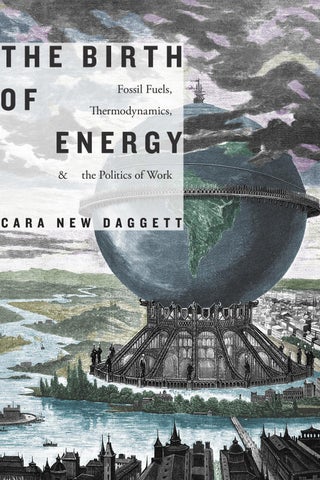
© 2019 Duke University Press All rights reserved Printed in the United States of America on acid-free paper ∞ Designed by Aimee C. Harrison Typeset in Chaparral Pro and Knockout by Westchester Publishing Services Cataloging-in-Publication is available from the Library of Congress. isbn 978-1-4780-0501-8 (hardcover : alk. paper) isbn 978-1-4780-0632-9 (pbk. : alk. paper) isbn 978-1-4780-0534-6 (ebook) Cover art: The Columbus Sphere: A Victorian New Earth. Source: Cover of Scientific American, October 25, 1890. Publication of this open monograph was the result of Virginia Tech’s participation in tome (Toward an Open Monograph Ecosystem), a collaboration of the Association of American Universities, the Association of University Presses, and the Association of Research Libraries. tome aims to expand the reach of long-form humanities and social science scholarship including digital scholarship. Additionally, the program looks to ensure the sustainability of university press monograph publishing by supporting the highest quality scholarship and promoting a new ecology of scholarly publishing in which authors’ institutions bear the publication costs. Funding from Virginia Tech made it possible to open this publication to the world. www.openmonographs.org
To my own bright stars, Henry and Gabriel. And to Matt, with love for life.
CONTENTS
Acknowledgments
ix
Introduction. Putting the World to Work
1
PART I. THE BIRTH OF ENERGY
1 2 3 4
THE NOVELTY OF ENERGY
15
A STEAMPUNK PRODUCTION
33
A G E O - T H E O L O G Y O F E N E R G Y
51
WORK BECOMES ENERGETIC
83
PA R T I I . E N E R GY, R AC E , A N D E M P I R E
5 ENERGOPOLITICS 6 THE IMPERIAL ORGANISM 7 EDUCATION FOR EMPIRE
107 AT WORK
132 162
Conclusion. A Post-Work Energy Politics
187
Notes
207
Bibliography
239
Index
255
A C K N O W LE D G M E N T S
This book began with research undertaken as a graduate student in the Department of Political Science at Johns Hopkins University. I owe my first, and greatest, debt to my teachers, friends, and fellow students at Johns Hopkins for supporting creative and interdisciplinary scholarship. I am immensely grateful to my committee members for their guidance. It was in a typically far-ranging conversation with Daniel Deudney that the topic of energy first arose, and I have him to thank for planting the first seed of this project. Because of the faith he invested in me, and his own encyclopedic knowledge of environmental studies, I had the liberty to roam far afield of disciplinary boundaries in my research. I was also fortunate to have the mentorship of Jane Bennett. She provided a model for how to think and write well, and with creativity, as a scholar of politics. If I entered her office feeling discouraged, I almost always left with new inspiration, and likely with some clever turns of phrase that would catapult me over the latest writer’s block. Thank you also to the other members of my committee, Bentley Allen, Michael Degani, and Deborah Poole, for their helpful comments. While at Johns Hopkins, I also gleaned inspiration from seminars and conversation with William Connolly, Siba Grovogui, Jennifer Culbert, and Richard Flathman. And I was equally fortunate to join a community of brilliant colleagues and alums, many of whom have offered suggestions, feedback, and advice, including Alexander Barder, Suzanne Gallant, Elizabeth Mendenhall, Daniel Levine, Jairus Victor Grove, Meghan Helsel, Hannah Son, Hitomi Koyama, Noora Lori, Kellan Anfinson, Anatoli Ignatov, Jacqui Ignatova, Stefanie Fishel, Benjamin Meiches, Adam Culver, Yehonatan Abramson, Derek Denman, and Kavi Abraham. I benefited from presenting early versions of this text at a graduate student colloquium organized by Bryan Brentus Carter and Stephanie Erev, where Elizabeth Mendenhall served as one of my most insightful discussants. Last but not least, I would like to thank the seventeen Johns Hopkins undergraduate
students who took my course, “Energy and Global Politics,” in the fall of 2015. Through teaching these concepts for the first time, I learned better ways to articulate them. The book further took shape with the time and support I received as a provost postdoctoral scholar at the University of South Florida in the School of Interdisciplinary Global Studies from 2016 to 2017. Thank you to the entire department for the warm welcome, and particularly to Cheryl Hall, Scott Solomon, Steven Tauber, Manu Samnotra, Nicolas Thompson, and Abdelwahab Hechiche. My friends and colleagues at the Department of Political Science at Virginia Tech, my home since 2017, were instrumental in helping this book through its final revisions, and in the drafting of two new chapters. I am especially indebted to François Debrix for his mentorship and sound publishing advice, and to Mauro Caraccioli for his friendship. Members of the department’s Political Economy Working Group were early readers of the final chapter: thank you to Besnik Pula, Scott Nelson, Ryan Briggs, Timothy Luke, Deborah Milly, Edward Weisband, and Benjamin Taylor for your thoughtful feedback. The Department of Science, Technology, and Society at Virginia Tech also offered me an opportunity to share research from this book in their seminar series; thanks to James Collier, Rebecca Hester, Daniel Breslau, Eileen Crist, Gary Downey, Saul Halfon, and all those who came to listen. Ideas and chapters from the book benefited from feedback along the way at many panels and workshops. Anatoli Ignatov graciously invited me to share my work at the 2016 Environmental Political Theory Workshop that he organized at the Western Political Science Association meeting. I was also electrified by the 2016 Cultures of Energy 5 symposium at Rice’s Center for Energy and Environmental Research in the H uman Sciences. Thank you to Dominic Boyer and Cymene Howe for organizing the event, and for the invitation to share my work, both at that symposium and on their delightful Cultures of Energy podcast. I would also like to thank McKenzie Wark for assistance in getting this book to the right publisher. Last but not least, thank you to my family. My parents and brother, Larry, Diane, and Ryan New, remain my most loyal and steadfast fans. They never doubted that this book would be finished, even when I did. To my c hildren, Henry and Gabriel—loving and caring for you has been my greatest honor. And to Matt, my first and best reader, who took care of me and fueled me with coffee, ideas, meals, love, and encouragement until the final page. Now that’s good energy. x • Acknowledgments
INTRODUCTION
PUTTING THE WORLD TO WORK
A house. A car. Lights at night and heat in the winter. A refrigerator to keep food fresh and a stove for cooking. A better education and a good job. Modern health care. Wireless communications. Technology and innovation. The freedom to focus one’s daily activities on something more than mere subsistence. These are among the many ecause benefits of modern energy. . . . So why energy? B energy is vital in our everyday lives. —E xxonMobil, “The Outlook for Energy: A View to 2040” (2015)
Intensive energy consumption is necessary to the good life. At least that is ExxonMobil’s outlook for energy in their “View to 2040,” quoted above. As global warming becomes more difficult to ignore, oil and gas titans increasingly want to brand themselves as energy companies that supply much-needed power to the p eople, rather than as fossil fuel extractors. Oil, gas, and coal have become the villains on a warming planet, but who could be against energy? Oil corporations are not alone in their devotion to energy. Energy seems to invite g rand thinking. A fter all, energy could be said to nourish life itself, its production and reproduction, and all activity—“everything in the universe may be described in terms of energy,” including living organisms and human civilizations, anthropologist Leslie White proclaimed in 1943.1 Energy’s meaning is capacious: it is provided by coal, oil, wind; it is a scientific entity; a metaphor; an indicator of vigor, tinged with virtue. Energy feels trans-historic and cosmic, but it is also material: it pumps through pipelines, sloshes in gas tanks, and spins wind turbines. Most importantly, energy has a foundational status in modern physics: it is the quest to understand change in the cosmos.
This also makes energy the ecological concept par excellence: a unit of equivalence through which we can compare human civilizations, from the burning of coal in the nineteenth century to the horse eating a blade of grass in ancient Greece, or the early hominid foraging for berries in the Pleistocene. Forget money; “energy is the only universal currency: one of its many forms must be transformed to get anything done,” observes Vaclav Smil, a leading figure in energy studies.2 At the same time, Smil points out that energy consumption and human well-being appear to be correlated only up to a point—about 110 gigajoules (gj) per year, per capita— and even appear to be “counterproductive” beyond about 200 gj.3 The United States has far surpassed both markers, with energy consumption at 316 gj per year, per capita in 2017.4 Nevertheless, such evidence has not pierced widespread public sentiments about energy. H umans seem to crave ever more energy, and ExxonMobil and other energy conglomerates are counting on it. The U.S. Energy Information Administration (eia) projects a 28 percent increase in world energy use by 2040.5 And while renewable energy use continues to accelerate, its effect has mostly been to add to the energy mix, rather than to herald a full-fledged, post- carbon transition.6 Indeed, the eia predicts that fossil fuel use (with the exception of coal) w ill continue to grow alongside renewables, and w ill account for three-quarters of energy consumption by 2040. Having less energy appears to be nearly incompatible with modern politics. Giving up energy sounds like sacrifice and asceticism at best, and rampant death and injustice at worst. But having ever more energy is incompatible with multispecies life on Earth. Scientists warn that “a cascade of feedbacks could push the Earth System irreversibly onto a ‘Hothouse Earth’ pathway” that could result in a planet that is highly dangerous, even uninhabitable, for humans.7 As dramatic as that sounds, it is hard to overstate the crisis in the midst of what biologists and ecologists are calling a sixth extinction event,8 nothing short of a “biological annihilation” that paints “a dismal picture of the future of life, including human life.”9 Fossil fuel burning, the main driver of global warming, is not the sole cause of the massive die-off of Earth’s flora and fauna. This is one reason why simply switching fuels, from fossil to renewable, is likely insufficient if we want to sustain a biodiverse planet fit for human life. Many scientists join social theorists and humanities scholars in insisting that preventing disastrous planetary change will require not only more efficient technology and renewable fuels, but also
2 • Introduction
“new collectively shared values, principles, and frameworks” for what it means for h umans to live well on the Earth.10 In terms of energy, this means that we need not just alternative fuels, but new ways of thinking about, valuing, and inhabiting energy systems. A shift in energy cultures and epistemologies, or ways of knowing energy, will entail a thorough transformation of habits of energy production and consumption. The nascent field of energy humanities analyzes energy in this way, as more than a set of fuels and their associated machines, but also as a socio-material apparatus that flows through political and cultural life.11 Energy humanities asks how and why communities become attached to fossil fuels, not just as a practical means to operate new technologies, but also in the formation of petro-subjectivities and petro-power.12 To date, such studies of energy have tended to focus on fuel assemblages and cultures—especially those of oil, coal, and gas, but also now of solar, wind, and other renewables. This book is in conversation with energy studies and humanities, but instead of focusing upon energy as fuel, I undertake a genealogy of energy itself, tracing the emergence of a dominant logic of energy that was first informed by thermodynamics. The Birth of Energy examines the provenance of energy—how did energy come to signify fuel as an object in need of governance? Why does energy politics refer to the acquisition and security of fuel, rather than to the politics of ensuring public vitality? A genealogy of energy helps in understanding why it is so difficult to imagine energy otherwise. Surprisingly, energy does not have an ancient pedigree akin to scientific concepts like m atter or force. Treating energy as an object of timeless human desire has obscured the historical particularity of energy as we (and ExxonMobil) know it. Energy is a thoroughly modern t hing that became the linchpin of physics only after it was “discovered” in the 1840s, at the apex of the Industrial Revolution, and then proselytized by a group of mostly northern British engineers and scientists involved in the shipbuilding industry, undersea telegraph cable building, and other imperial projects. Prior to its emergence in thermodynamics, energy did not have a strong association with fuel, nor a scientific definition, especially since, as Barri Gold points out, energy had fallen out of usage as a result of Isaac Newton’s “disdain” for the word. In the decades leading up to thermodynamics, energy is mentioned only sporadically, and was used as “a meta phor, a word to describe people, a pathetic fallacy, a word predominantly for poets.”13
Putting the World to Work • 3
In other words, until the mid-to late nineteenth c entury, energy as we now know it did not exist in the English language, such that “nobody could have conceived of the study of the flow of energy in human society, . . . calculated the energy supplied by different energy sources or distinguished between the renewable and non-renewable.”14 Within the field of politics, energy has an even more recent history. It was not u ntil the 1970s, in the wake of the so-called oil crisis, that energy (as the all- encompassing signifier of fuel) became consolidated and popularized as an object of politics. The U.S. Department of Energy was formed in 1977, and topics like “energy transitions,” “energy alternatives,” and “energy forecasting” proliferated for the first time, paving the way for “energy companies” and their energy outlooks. Recognizing energy as historical is more than an etymological quibble. Long before energy became a key concept in science and politics, of course, humans were using fuels, modifying tools to harness those fuels, and experimenting with improvements to material- machinic assemblages. Prior to the science of energy, though, these various techniques and human activities were not connected by a single scientific paradigm, nor an organized political strategy. Even when, l ater, Newtonian mechanics advanced universal theories about the operations of machines such as levers, pulleys, and waterwheels, it still failed to explain heat machines like the steam engine. The process by which burning coal produced motion remained shrouded in mystery, even as steam engines w ere already well on their way to transforming European empires and economies. Something happened to energy in the nineteenth century, when physics and fossil fuels combined to birth the energy of ExxonMobil’s business-as-usual. It was more than the advent of fossil fuel systems and an uptick in energy consumption; it was also the emergence of energy as an object of modern politics. In that birth, the expansive, multidimensional figuration of preindustrial, poetic energy was captured and yoked to a mania to put the world to work. Since the nineteenth century, the human relationship to fuel has been governed by this singular ruling logic of energy, which justifies the indexing of human well-being according to the idealization of work and an unquestioned drive to put the Earth’s materials to use for a profit. Just as energy became tightly bound by the governing logic of work, so too work increasingly came to be governed through the metaphors and physics of energy. The energy–work bindings were laced tight in the nineteenth c entury, with the purported discovery of energy and its service to 4 • Introduction
Western, fossil-fueled imperialism. The Western epistemology of energy attached fuel systems to the gospel of labor and its veneration of productivity. The energy–work nexus was so friendly to the spread of fossil capital, so conducive to concealing its violence, and so minutely sutured as to leave little trace of its contingent pairing. The intertwining of energy and the Western ethos of dynamic, productive work was produced as cosmic truth. The Birth of Energy follows the traces that remain, recording the rough patches and knots as evidence of what was done, and continues to be done, to produce energy as a political rationality that justifies extractivism and imperial capitalism. Making the traces visible involves narrating the history of the capture of energy—with all its aesthetic, theological, and material capaciousness—by the logic of fossil-fueled work. European- controlled fossil fuel systems did not extend smoothly across the globe; they were resisted, and they developed through ongoing attempts to extinguish lifeways and other potential energy epistemologies that challenged their projects. At the same time, work becomes increasingly understood through energetic metaphors, as a site of energy transformation that requires the maximization of efficiency and productivism. In many ways, Westerners remain locked within this energy epistemology. E N E R G Y A S M E T A P H O R
While energy is not a transhistorical fact of nature, neither is energy purely a concept or metaphor, an invention of the h uman mind. Energy cannot be reduced to an artifact of Victorian culture, nor merely to a set of fuels. It is a hybrid assemblage where t hese things are entangled, what Donna Haraway (and o thers)15 has called a natureculture, a term that points to the inseparability of nature and culture. To get at what nature culture means, it is helpful to consider Haraway’s reading of biology, which inspires my own reading of energy physics here. In How Like a Leaf, Haraway describes reading biology in double, understanding it “as about the way the world works biologically, but also about the way the world works metaphorically. . . . I think of the intensely physical entities of biological phenomena, and then from them I get these large narratives, t hese cosmological histories if you will.”16 A cell, for example, is the name we give to “an historical kind of interaction, not a name for a t hing in and of itself.” Again, the point is not to dismiss material reality and its cells or fuels (or energy), all of which are Putting the World to Work • 5
words that denote our engagement with things in the world. Haraway’s philosophical stance relies upon staying in the world, among things, in medias res, resisting the impulse toward abstraction and finitude. It is therefore important to Haraway that biology has this double quality, with two aspects: first, that we do “live intimately ‘as’ and ‘in’ a biological world,” but second, that “[b]iology is a discourse and not the world itself” (italics in the original).17 The result is that we live inside biology, which constitutes a natureculture, and this means “being inside history as well as being inside the wonder of natural complexity. I admit to finding the latter very important. But the final result, when we speak about biology, is that we are speaking about a specific way of engaging with the world.”18 As in Haraway’s reading of biology, energy is a way of telling “how the world works metaphorically,” and it emerges out of “an historical kind of interaction” between p eople and engines. Energy science involves discourses, theories, and experiments that are material practices, but that do not simply represent nature, or life itself. Energy is materialized in part through human experiences in the world, among t hings, in medias res. It is a figuration, a “semiotic trope” that provides “a condensed map of contestable worlds,” a map that traces “universes of knowledge, practice, and power.”19 Figurations are neither true nor false; Cynthia Weber explains that figurations “do not (mis)represent the world, for to do so implies the world as a signified preexists them. Rather, figurations . . . condense diffuse imaginaries about the world into specific form or images that bring specific worlds into being.”20 Energy is a figuration for fuel, but energy/ fuel here marks more than a given concentration of molecules, poised to proffer kinetic energy, but rather “imploded atoms or dense nodes that explode into entire worlds of practice.”21 A genealogical approach to energy means treating energy as a condensed map, a set of tropes and meta phors that help to describe a “historical kind of interaction,” one that is continually generated at the intersection of bodies, machines, and fuels. The dominant figuration of energy cannot be detached from the socio- material context in which it emerged, which was the convergence of bodies, fossil fuels, and steam engines in imperial Europe and its factories. In turn, energy “explodes into entire worlds of practice”—worlds in which thriving is indexed according to measures of productive work and indolent waste. The figuration of energy was political; it served some interests at the expense of others. Indeed, another way to understand energy is to think about it as a ruling idea, a term Karl Marx used to ground a period’s ideas 6 • Introduction
in its material context. In The German Ideology, his extended critique of German idealism, Marx writes that ruling ideas “are nothing more than the ideal expression of the dominant material relationships, the dominant material relationships grasped as ideas; hence of the relationships which make the one class the ruling one, therefore, the ideas of its dominance.”22 Just as t here w ere not “pure ideas” floating f ree from their historical material context, there also could not be “pure” science. Marx, who closely followed the scientific developments of evolution and energy, insisted that scientific thought, too, was rooted in the material context of its age. He opposes the notion that there are “secrets which are disclosed only to the eye of the physicist and chemist,” as “where would natural science be without industry and commerce? Even this ‘pure’ natural science is provided with an aim, as with its material, only through trade and industry, through the sensuous activity of men.”23 To understand energy as a ruling idea is to appreciate how energy arises in the context of the power relations of fossil-fueled industrialization, with “an aim” that is oriented toward the extension of Western trade and industry. In order to highlight the emergence of energy as a Western logic, I nar reat Britain and the United States, row my focus to the Anglo world of G and to a period that ranges from the mid-nineteenth to the early twentieth centuries, from the “discovery” of energy to the peak decades of new imperialism. Rather than accept the master narrative of energy’s discovery and diffusion as objective knowledge, I am interested in parochializing energy, troubling its claims to universality. Contesting the universality of energy requires putting energy into its specific, northern European context, and noticing that energy was first articulated as a modern object of politics in service to European industrial interests. Energy is bound up with the s imple desire to acquire, transport, and organize the geophysical capacities of fuel for the pleasure of certain groups of h umans.24 As part I describes, the Victorians interpreted energy as an important organizing knowledge for industrialization, one that explained the novel technologies and flows set off by fossil fuel consumption. Many of the scientists who proselytized energy treated it as an inherently political and geo-theological concept. The figure of energy could be used to address topics as grand as the meaning of work, as well as the relationship of humans to the Earth and to God. To discuss energy was to touch upon that fraught, industrial imbrication of h umans, nonhumans, and machines. But although physicists claimed to have discovered energy, the resulting laws of thermodynamics ultimately raised more questions about Putting the World to Work • 7
energy and the Earth than they had answered. The stubborn paradoxes of energy—the opaque weirdness of it—has remained a driving force in the development of modern physics, and energy’s meaning and dimensions only grew more complex in later investigations of quantum mechanics, relativity, cybernetics, or complexity theory. While part I narrates the birth of energy in northern Britain, part II examines how the figure of energy reinforced the imperial governance of labor, both human and more-than-human. Energy metaphors and discourses were deployed as part of the scientific spirit of new imperialism, a momentous acceleration of European empires that began in the 1870s, with the so-called scramble for Africa, and lasted until the disintegration of European empires at the end of the Second World War. The role of thermodynamics as an imperial science, one that appeared alongside and through evolution and ecology, has been underappreciated. But while evolution might sketch an overarching narrative (the progressive ranking of civilizations) as well as the plot (a struggle for survival), it was a dominant logic of energy that supplied a script: energy knowledge had made possible the specific activities by which Europeans had advanced. Europe ans had reached the top rung of the civilizational ladder by maximizing productive work and minimizing waste. Categorizations of work and waste depended on energetic judgments that assumed that empires functioned as living organisms, and that energy fueled their metabolism. Energy intake allowed for work—and growth—but only if waste could be adequately processed or expelled. In offering a scientific authorization for fossil-fueled work, a dominant logic of energy thus smoothed the way for the Victorian shift “from an industrialism based on imperial slavery to industrial imperialism based on waged labor.”25 Approached as the unit that flows through organisms, energy served the “boundary project”26 of defining the borders of living assemblages. Boundaries are inherently political. As Haraway argues, “[w]hat boundaries provisionally contain remains generative, productive of meanings and bodies. Siting (sighting) boundaries is a risky practice.”27 Moreover, boundaries also correspond to dominion, to the limits of control: that which is bounded is known, made visible, and vulnerable to governance. That which escapes the boundaries must be evacuated, policed, made invisible. A genealogy of energy, attuned to shifting boundaries, is thus as much about energy-as-work as it is about waste, a common code applied to those bodies and activities that threaten energy governance. Waste is generated 8 • Introduction
at the intersection of race, gender, class, virtue, pollution, and ecological violence. Waste is leakage, always exceeding its confinement, always lingering and threatening the bounded industrial project and markets, uman worker strikes, the stench of landfills, accidents, whether through h technological bugs, pollution, or, finally, global warming, species extinction, and melting glaciers. More broadly, waste also emphasizes how, with each indication that humans better understood the world, more of the world revealed itself to be in excess of h uman understanding. In the case of energy, the ability to more efficiently exploit fossil fuels arrived alongside the nineteenth-century awareness of the Earth as dynamic and unpredictable, as well as, at best, indifferent to the h uman quest for power and efficiency. Humans in the industrial age increasingly confronted the reality of, in Haraway’s words, the “world as witty agent and actor.” In this sense, the Victorian era was an important prelude to the Anthropocene, the proposed geological epoch in which h uman actions began to have (often disastrous) planetary consequences. It is not a prelude in a geological or atmospheric sense—the Anthropocene was already up and running—but rather an ideational one. Geologists have yet to agree upon a physical signal (which must be discrete and readily observable) to mark the start of the Anthropocene, although most agree that industrialization played a central role. Candidates for the Anthropocene starting point range from the first h uman use of fire, to the mass death of indigenous peoples following the European arrival in the New World, the patenting of the steam engine in the eighteenth century, or the nuclear fallout of the 1960s.28 However, in terms of the idea, or dawning consciousness, of the Anthropocene, while h umans have long observed their effects on the environment, it is arguably the Victorian period when humans first began to sense that these effects might be planetary and truly catastrophic for human life on Earth.29 Victorians perceived that industrialism challenged preexisting, Enlightenment frameworks. Beginning in the eighteenth and nineteenth centuries, imperial logics of domination began to contend not just with a New World, but a new Earth, an Earth of fossils and deep time that cared nothing for human well-being. An explosion of new scientific fields and academic disciplines in this period responded with cosmologies that, in many cases, were interpreted so as to buttress anthropocentrism and Western superiority. These included neoclassical economics, evolution, and thermodynamics, all of which continue to be deployed as master tropes and metaphors precisely b ecause they serve the interests of Putting the World to Work • 9
planetary industrialization, having helped to justify European imperialism by externalizing its ecological and social injustices. Thermodynamics mapped the new Earth through the figure of energy, a unit that retained its identity through time (energy conservation), even as its tendency to dissipate (entropy) imparted a tragic edge. In this sense, energy, too, is an Anthropocene knowledge, a response to glimpses of a new Earth made possible by fossil-fueled engines. This is an Earth that continues to resist being treated as a resource.30 Extending the Anthropocene into the Victorian era is useful to con temporary climate politics in that it provides evidence of the ecological culpability of a relatively small group of industrial capitalists in the Global North. That group is not the only responsible party when it comes to global warming, and the Victorian era is not the only important historical moment in terms of understanding the state of the planet t oday. Nevertheless, it would be difficult to overlook the centrality of that group of agents, and that period of time, to the story. Some have proposed changing the name of the Anthropocene to the Capitalocene to underline this point.31 While I am sympathetic to those arguments, the term Anthropocene has proven to be rather sticky. If we are to continue to speak of an Anthropocene, then Victorianizing it foregrounds the political and economic fault lines in its genesis. Moreover, to speak of a Victorian Anthropocene is to insist that we confront how historical violence persists in environmental injustices today. If we instead gesture more broadly toward the human species as the problem, with its insatiable thirst for energy and its tendency for “ecological overshoot,”32 of which industrialization is just the latest crisis, then it becomes incredibly difficult to imagine alternative energy pathways. If humans unavoidably desire ever more energy, then what could we do short of hoping for a technological miracle, changing the h uman condition, or colonizing other planets? Assigning responsibility means recognizing how fossil-fuel systems work to favor certain interests, whether in Europe and North America, or in the distinct fossil-fueled visions of new industrializing states like China, India, or Brazil. Understanding the politics of fossil fuel domination is a necessary prerequisite to developing alternative energy values and institutions that are adequately just and radical. The conclusion suggests a different vision for fuel politics, one that is opened up by a genealogy of energy. The energy–work coupling continues to inform the politics of fuel and is rarely challenged or put into context. 10 • Introduction
Indeed, the politics of energy draws heavily upon an energy logic that, in hindsight, represents an engineer’s narrow application of processes of heat exchange more than it reflects the multifaceted oddities of energy physics writ large. The dominance of the work ethic in policing the bound aries of fuel governance is manifestly evident. While the work ethic itself has dramatically shifted since the Victorian era, the notion that work is central to life still reigns in the Global North, and especially in the United States, such that “the fact that at present one must work to ‘earn a living’ is taken as part of the natural order rather than as a social convention.”33 A concern with employment, wages, and productivity, all of which feed economic growth and are held to guarantee the continuation of the comforts and pleasures of modern life, are inextricably intertwined with debates over fuel consumption. The work ethic appears continually as the bogeyman that stymies environmental politics. It informs the assumption that more renewable or sustainable energy systems w ill inevitably require sacrifice and self- denial. As a result, eco-modernists chastise environmentalists, asking how the Global North can justly deny the path of development and industrial growth to the Global South.34 One implication of this argument is that the denial of intensive fuel consumption means the denial of the higher planes of civilization and life, predicated on the availability of productive work for all citizens. A genealogy of energy suggests that there are other ways of knowing and living energy, and that energy and work can be decoupled. The maps that organize human–fuel practices do not need to be arranged along work-based coordinates. Not only can energy and work be decoupled— they should be. Without challenging dominant practices of work and leisure, and the high valuation of waged, productive work in a neoliberal economy, it will remain difficult to dislodge fossil fuel cultures. Creating space between energy and work could take a number of paths. The conclusion highlights one potential partnership: an alliance between post- carbon and feminist post-work politics. Putting t hese two movements— one against fossil fuels and the other against work—into a more enduring conversation can benefit both, especially when inflected with feminist epistemologies and an appreciation of (re)productivity. A post-work energy politics suggests one more route by which environmentalists can escape the neoliberal resonance machine,35 which obliges fossil fuels to be contested from within a work-and-waste paradigm. Meanwhile, by allying more explicitly with environmentalists, post-work movements can Putting the World to Work • 11
expand their relevance beyond anthropocentric critiques of capitalism, showing how not just h uman life, but Earthly life, are at stake in the contestation of work. F R E E E N E R G Y
That which is bound can be picked apart, untied, set f ree. In studying the bindings between work and energy, we discover the weak points, sites ripe for struggle. We begin to appreciate the possibility of decolonizing energy, of noticing other energy epistemologies, ways of knowing and living with fuel. The liberation of energy has never been more urgently required, and not just for the sake of h uman life, but for the sake of many other living bodies on Earth. The Birth of Energy joins a multitude who are thrashing at the tethers, struggling to free energy from the bindings of exploitative work. Even if energy does not name a universal knowledge, or stand for the only possible epistemology of fuel, perhaps the commonsense understanding of energy is correct in one way: energy is “vital in our everyday lives,” as ExxonMobil suggests at the opening of this book. Energy signifies that which flows through systems, through ecologies, through bodies and organisms. What we do with our energy, how we know it, count it, govern it, and use it (or not!) shapes the possibilities for life on Earth. The project of putting the world to work has led to biological annihilation; we need new energy figures and metaphors, and new ways of valuing energetic activity.
12 • Introduction
NOTES
I NTR O D U CTI O N: P U T T I N G T H E WOR L D TO WOR K 1. Leslie A. White, “Energy and the Evolution of Culture,” American Anthropologist 45, no. 3 (1943): 335. 2. Vaclav Smil, Energy and Civilization: A History (Cambridge, MA: mit Press, 2017), 1. 3. Vaclav Smil, “Science, Energy, Ethics, and Civilization,” in Visions of Discovery: New Light on Physics, Cosmology, and Consciousness, edited by R. Y. Chiao et al. (Cambridge: Cambridge University Press, 2010), 725–26. 4. Figure from the U.S. Energy Information Administration, accessed September 14, 2018, https://www.eia.gov/tools/faqs/faq.php?id=85&t=1. 5. “International Energy Outlook 2017,” U.S. Energy Information Administration, September 2017, https://www.eia.gov/outlooks/ieo/pdf/0484(2017).pdf. 6. Richard York and Shannon Elizabeth Bell, “Energy Transitions or Additions?,” paper under review. 7. Will Steffen et al., “Trajectories of the Earth System in the Anthropocene,” Proceedings of the National Academy of Sciences 115, no. 33 (2018): 8252–59, https:// doi.org/10.1073/pnas.1810141115. 8. Elizabeth Kolbert, The Sixth Extinction: An Unnatural History (New York: Henry Holt, 2014). 9. Gerardo Ceballos, Paul R. Ehrlich, and Rodolfo Dirzo, “Biological Annihilation via the Ongoing Sixth Mass Extinction Signaled by Vertebrate Population Losses and Declines,” Proceedings of the National Academy of Sciences 114, no. 30 (2017): E6089–96. 10. Steffen et al., “Trajectories of the Earth System in the Anthropocene.” 11. Timothy Mitchell, Carbon Democracy: Political Power in the Age of Oil (London: Verso, 2013); Matthew T. Huber, Lifeblood: Oil, Freedom, and the Forces of Capital (Minneapolis: University of Minnesota Press, 2013); Dominic Boyer, “Energopolitics and the Anthropology of Energy,” Anthropology News 52, no. 5 (2011): 5–7; Stephanie LeMenager, Living Oil: Petroleum Culture in the American Century (New York: Oxford University Press, 2016); Andrew Nikiforuk, The Energy of Slaves: Oil and the New Servitude (Vancouver, BC: Greystone, 2014); Dominic Boyer, Energopower: Wind and Power in the Anthropocene (Durham, NC: Duke University Press, 2019). 12. LeMenager, Living Oil; Sheena Wilson, Adam Carlson, and Imre Szeman, eds., Petrocultures: Oil, Politics, Culture (Montreal: McGill-Queen’s University Press,
2017); Andreas Malm, Fossil Capital: The Rise of Steam Power and the Roots of Global Warming (Brooklyn, NY: Verso, 2016); Imre Szeman and Dominic Boyer, eds., Energy Humanities: An Anthology (Baltimore: Johns Hopkins University Press, 2017); Cara Daggett, “Petro-Masculinity: Fossil Fuels and Authoritarian Desire,” Millennium: Journal of International Studies 47, no. 1 (2018): 25–44, https://doi.org /10.1177/0305829818775817. 13. Barri J. Gold, ThermoPoetics: Energy in Victorian Literature and Science (Cambridge, MA: mit Press, 2010), 4. 14. Joan Martinez-Alier, “Ecological Economics as H uman Ecology,” in Dimensions of Environmental and Ecological Economics, edited by Nirmal Chandra Sahu and Amita Kumari Choudhury (Hyderabad: Universities Press, 2005), 66. 15. Bruno Latour, We Have Never Been Modern, translated by Catherine Porter (Cambridge, MA: Harvard University Press, 1993). 16. Donna Haraway and Thyrza Goodeve, How Like a Leaf: An Interview with Donna Haraway (New York: Routledge, 1999), 24. 17. Haraway and Goodeve, How Like a leaf, 25. 18. Haraway and Goodeve, How Like a leaf, 26. 19. Donna Haraway, Modest_Witness@Second_Millennium.FemaleMan_Meets_ OncoMouse: Feminism and Technoscience (New York: Routledge, 1997), 11. 20. Cynthia Weber, Queer International Relations (New York: Oxford University Press, 2016), 28. 21. Haraway, Modest_Witness@Second, 11. 22. Karl Marx, “The German Ideology,” in The Marx-Engels Reader, edited by Robert C. Tucker (New York: W. W. Norton, 1978), 172–73. 23. Marx, “German Ideology,” 171. 24. In disrupting the universality of energy, The Birth of Energy also points toward the need for research that would aim to further decolonize energy, which would begin with acknowledging that modern Europe’s claims to scientific invention depended on knowledge drawn from, and through, engagements in the Global South. This book is focused on energy as a Western logic of domination, but in disrupting its claim to universality, it points to the need for a more diverse energy studies. Walter Mignolo, The Darker Side of Western Modernity: Global Futures, Decolonial Options (Durham, NC: Duke University Press, 2011); Eric R. Wolf, Europe and the People without History (Berkeley: University of California Press, 2010). 25. Anne McClintock, Imperial Leather: Race, Gender, and Sexuality in the Colonial Contest (New York: Routledge, 2013), 112. 26. Donna Haraway, Simians, Cyborgs, and Women: The Reinvention of Nature (New York: Routledge, 1991), 200. 27. Haraway, Simians, Cyborgs, and Women, 201. 28. Simon L. Lewis and Mark A. Maslin, “Defining the Anthropocene,” Nature 519, no. 7542 (2015): 171–80. 29. Timothy Morton, “Victorian Hyperobjects,” Nineteenth-Century Contexts 36, no. 5 (2014): 489–500; John Plotz, “The Victorian Anthropocene: George Marsh and
208 • notes to introduction
the Tangled Bank of Darwinian Environmentalism,” Australasian Journal of Ecocriticism and Cultural Ecology 4 (2014): 52–64. 30. Haraway, Simians, Cyborgs, and Women, 201. 31. Andreas Malm and Alf Hornborg, “The Geology of Mankind? A Critique of the Anthropocene Narrative,” Anthropocene Review 1, no. 1 (April 2014): 62–69. 32. Dipesh Chakrabarty, “The Politics of Climate Change Is More Than the Politics of Capitalism,” Theory, Culture and Society 34, no. 2–3 (2017): 25–37. 33. Kathi Weeks, The Problem with Work: Feminism, Marxism, Antiwork Politics, and Postwork Imaginaries (Durham, NC: Duke University Press, 2011), 3. 34. Mark Caine et al., “Our High Energy Planet: A Climate Pragmatism Project” (Oakland, CA: Breakthrough Institute, April 2014), http://thebreakthrough.org /images/pdfs/Our-High-Energy-Planet.pdf. 35. William Connolly, Capitalism and Christianity, American Style (Durham, NC: Duke University Press, 2008). CHA P TER 1 : THE N OV E LT Y OF E N E R GY 1. Stephen Pyne, Fire: Nature and Culture (London: Reaktion Books, 2012); Simon Dalby, “Firepower: Geopolitical Cultures in the Anthropocene,” Geopolitics 23, no. 3 (2018): 718–42. 2. Aristotle, Nicomachean Ethics, translated by Joe Sachs (Newbury, MA: Focus, 2002), viii. 3. For instance, Hans Driesch’s vitalism centers upon entelechy as a vital force, though his entelechy differs notably from Aristotle’s. Jane Bennett has excavated Driesch, as well as other vitalist thinkers like Henri Bergson, finding in them precursors to a “vital materialism.” See Jane Bennett, Vibrant Matter: A Political Ecology of Th ings (Durham, NC: Duke University Press, 2010), 62–81. 4. Bruce Clarke, Energy Forms: Allegory and Science in the Era of Classical Thermodynamics (Ann Arbor: University of Michigan Press, 2001), 21. 5. Clarke, Energy Forms, 21. 6. Arjun Appadurai, The Future as Cultural Fact: Essays on the Global Condition (New York: Verso, 2013), 223. 7. Appadurai, The Future as Cultural Fact, 225. 8. Hannah Arendt, On Violence (New York: Harcourt, 1970), 26; Pierre-Joseph Proudhon, Philosophie du progrès (Brussels: Alphonse Lebègue, 1853), 35, 39; William H. Harbold, “Progressive Humanity: In the Philosophy of P. J. Proudhon,” Review of Politics 31, no. 1 (1969): 37. 9. Clarke, Energy Forms, 2. 10. Dainian Zhang, Key Concepts in Chinese Philosophy (New Haven, CT: Yale University Press, 2002), 45. 11. Zhang, Key Concepts in Chinese Philosophy, 45. 12. Peter Barker, “Stoic Contributions to Early Modern Science,” in Atoms, Pneuma and Tranquility: Epicurean and Stoic Themes in European Thought, edited by Margaret J. Osler (New York: Cambridge University Press, 1991), 138.
notes to chapter one • 209