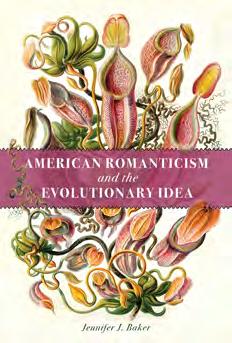
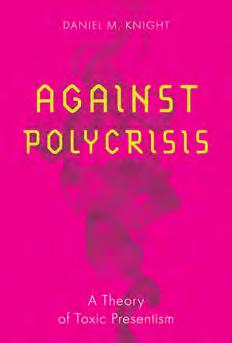
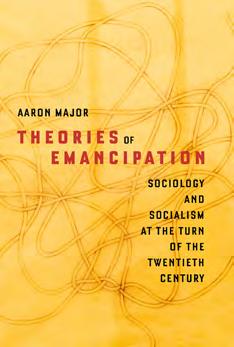
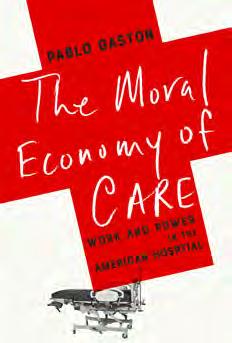
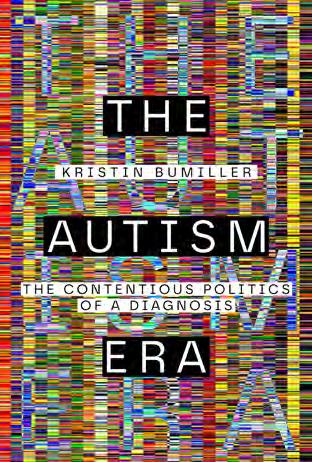
Cover art: Based on the book cover American Romanticism and the Evolutionary Idea by Jennifer J. Baker; designed by Michele Wetherbee; art by Ernst Haeckel, Nepenthaceae (Plate 62), Kunstformen der Natur (Art Forms in Nature), 1899. Wikimedia Commons.
AMERICANS WITHOUT BORDERS
The Radical Activists Who Fought for US Ideals Abroad While Facing Political Persecution at Home
JULIA HARTE
THE SURPRISING, UNTOLD STORIES OF AMERICAN ACTIVISTS WHO SOUGHT TO FIGHT FOR FREEDOM ABROAD.
One night in 1940, a group of Stalinists opened fire on Leon Trotsky’s compound in Mexico City. In the end, the victim was not Trotsky but his bodyguard: a young American named Sheldon Harte. For investigative journalist Julia Harte, the quest to uncover the truth about Sheldon—her father’s second cousin—was just the beginning of discovering a wider, hidden history of Americans who traveled abroad to join revolutionary liberation movements—and in return were labeled radicals by the US government.
From Americans who fought in the nineteenth-century Greek revolution to modern-day solidarity volunteers in Palestine, Harte chronicles two centuries of Americans whose support for international causes at odds with US geopolitical interests put them in their own government’s crosshairs. The surprising characters she profiles include African American volunteers in the Spanish Civil War who battled bigotry and McCarthyism upon returning home, a Jewish American woman who helped the Black Panthers establish an international wing in postindependence Algeria, a teenage activist who organized Filipinos against the repressive Marcos regime, the forgotten Native American contingent in Nicaragua’s Sandinista-Contra conflict, and many more. These figures held various ideologies and beliefs, yet each in their own way sought to fight oppression and saw their actions as grounded in American ideals of equality, self-government, and human rights. Through meticulous research and on-the-ground reporting, Harte brings her subjects to life in deeply personal detail, exploring not only their heroic sides but also the tensions between their actions and ideals. Interrogating how and why activists were branded as threats by an expanding security state, Harte asks what makes a “radical.” In lively narrative and rich detail, this eye-opening book reveals the long history of transnational radicalism as an irrepressibly American tradition.
“Julia Harte’s subject matter is so intriguing that it’s surprising no one has done a book like this before. The lives of these Americans are testimony to an idealism that knows no national boundaries.”
—Adam Hochschild, author of Spain in Our Hearts: Americans in the Spanish Civil War, 1936–1939
“Julia Harte’s group biography of American radicals abroad is written with lyricism, moral intelligence, and an acute awareness of the complexities of political engagement in other people’s political struggles. A book about solidarity, commitment, and the passion for justice, it could hardly feel more urgent.”
—Adam Shatz, author of The Rebel’s Clinic: The Revolutionary Lives of Frantz Fanon
Julia Harte is an investigative reporter in New York City. For the past decade, she has covered US national affairs and the Justice Department for Reuters. Her writing has also appeared in publications including Harper’s Magazine, The Nation, Slate, National Geographic, The Center for Public Integrity, and Lapham’s Quarterly
OCTOBER 2026 416 pages | 6 x 9
16 halftones, 1 map
Cloth $30.00 (£23.99) HC 9781503632837
eBook 9781503647886
History
Credit: Karly Domb Sadof
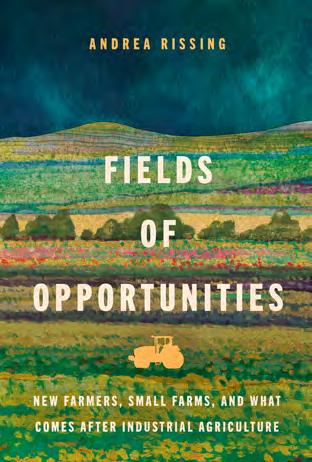
FIELDS OF OPPORTUNITIES
New Farmers, Small Farms, and What Comes after Industrial Agriculture
ANDREA RISSING
A FUNDAMENTAL RETHINKING OF WHAT CONSTITUTES PROGRESS TOWARD SUSTAINABLE AGRICULTURE IN THE UNITED STATES TODAY.
Iowa is often referred to as the “most altered” landscape in the United States—over 99.9% of its native prairie has been plowed for farming. Today, it is the country’s leading producer of corn, hogs, and eggs, and its landscape is synonymous with industrial agriculture. And yet, scattered in between the state’s massive grain monocultures, small-scale, agroecological farms are improbably emerging in the heartland of “Big Ag.” On operations as small as a single acre, a new crop of farmers seeks to feed their communities by growing food in harmony with nature.
The sudden appearance of these “alternative farms” reverses global agriculture’s modern trend of supplanting human-powered agriculture with industrial production. Tracing the complex experiences of these young farmers, this book argues that the interstices of industrial agriculture are simultaneously catalyzing and constraining a new kind of smallholder farming. In doing so, the book upends over a century of thinking on the inevitable march of food cultivation toward specialization, mechanization, and financialization.
Andrea Rissing spent a decade getting to know these improbable farms through in-depth interviews and working alongside farmers to plant, weed, and harvest food by hand at the American epicenter of industrialized agriculture. She illustrates how different elements of the industrial system, such as irregular fields unsuitable for mechanical cultivation, cast-aside equipment, and familial land inheritance norms influence nascent alternative agricultural livelihoods. Creatively applying insights from critical agrarian studies to a modern context where small-scale, diversified agriculture is born anew from an industrial landscape, Rissing shows us how the same constellation of forces stretches across centuries and continents to shape processes of agrarian transformation, and she helps us rethink how we might achieve resilient and sustainable food systems.
“This is the most creative and surprising book on the American ‘alternative’ food movement I have read. Imploding taken-for-granted binaries, Rissing illuminates a movement that is paradoxically emerging out of the fields and farmhouse dining tables of industrial agriculture itself.”
—Alex Blanchette, author of Porkopolis: American Animality, Standardized Life, and the Factory Farm
Andrea Rissing is Assistant Professor in the School of Sustainability at Arizona State University.
FEBRUARY 2027 240 pages | 6 x 9
14 halftones
Cloth $26.00 (£20.99) HC 9781503643628
eBook 9781503649040
Anthropology
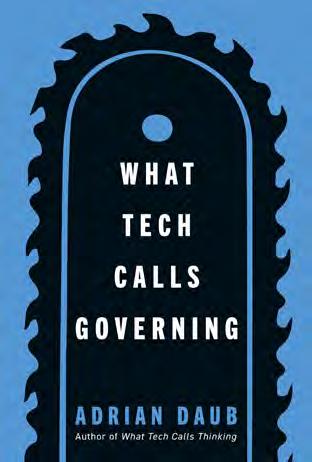
WHAT TECH CALLS GOVERNING
ADRIAN DAUB
THE TECH INDUSTRY WANTS TO RULE OUR WORLD. BUT WHAT DOES TECH MEAN BY RULING?
Tech companies increasingly determine who regulates and who governs. And the tech elite increasingly wield political power, seeking to remake your workplace, your child’s school, and the federal government in their image. But what do they mean by power? Building on his book What Tech Calls Thinking, Adrian Daub explores which ideas of politics, power, and dominance characterize the tech industry, and how those ideas came to be.
Taking readers from investor meetings to lecture halls, from science fiction to feudal imaginaries, Daub acerbically explores how tech culture approaches hierarchy and dominance, and what role a very specific form of masculinity plays in tech culture’s ethos. From billboards to social media, Daub interrogates the way the tech elite exert power in their families and offices, but also in gyms and on YouTube channels, in courtrooms and on their commutes. As What Tech Calls Governing shows, to ask “how do they exert power?” is actually to retell the history of Silicon Valley as the story of a fragile, and precisely for that reason domineering, masculinity intent on wielding all the power with none of the responsibility.
“One day, when the bubbles have burst and we are surrounded by the rusting ruins of the shiny new tech, we will look back on the clownish posturings of the Silicon Valley overlords and murmur quietly to ourselves, what a prophetic poke in the eye Adrian Daub gave them.”
—Bruce Robbins, author of Atrocity
Adrian Daub is J.E. Wallace Sterling Professor of the Humanities at Stanford University, where he serves as the faculty director of the Clayman Institute for Gender Research. He is the author of What Tech Calls Thinking (2020) and The Cancel Culture Panic (Stanford, 2024) and writes for numerous US and European newspapers and magazines.
AUGUST 2026 152 pages | 6 x 9
Paper $18.00 (£13.99) TP 9781503648333
eBook 9781503648340
Media Studies
CHEKHOV’S ANTIDOTES
Prescriptions for an Age of Unrest
YURI CORRIGAN
A ROUSING TOUR THROUGH CHEKHOV’S STORIES AND PLAYS, WITH LESSONS FOR MANAGING TROUBLED TIMES.
For all his immense literary fame, Anton Chekhov is underappreciated as a thinker. Widely regarded as a purveyor of gloom and indecision, Chekhov was in fact a reparative moral philosopher who fought back against the pathologies of a divided and dysfunctional age. In the face of emergent revolution and civil war, Chekhov wrote about the polarization, apathy, and fanaticism that were driving his society towards self-destruction. In Chekhov’s Antidotes, Yuri Corrigan offers a bold reassessment of why Chekhov’s thought matters, both for his own time and for ours.
Telling the story of Chekhov’s career in a new light, Corrigan reads the plays, letters, and short stories as puzzle pieces in larger reparative meditations. Through discussion of “House with a Mezzanine” and Uncle Vanya, the book probes Chekhov’s practical reflections on how to heal and resist culture war. New readings of “The Student” and The Cherry Orchard distill Chekhov’s thoughts on how to alleviate modern strains of sloth, loneliness, and despair. Examining “Breakdown,” “Ward Six,” and “The Wife,” Corrigan uncovers Chekhov’s monumental study of the dangers of unskilled empathy and his call for a new concept of activism in the face of what cannot be repaired. Chekhov offers no panaceas for the pathologies of modern life, only pragmatic meditations on how to salvage an irreparably broken world, and how to cultivate meaning, dignity, and integrity—lessons we can all use in our current divisive era, in the shadow of our own looming crises.
“This marvelous book is the best treatment we have of the incomparable Chekhov as a moral philosopher! There is no doubt Corrigan is one of the few great critics of Russian literature, especially of Chekhov and Dostoevsky, in our time.”
—Cornel West, author of Black Prophetic Fire
“Corrigan conducts an examination of Chekhov’s work so perspicacious, so new in its insights, and so very compelling that some things we have come to accept as foundational about Chekhov must now be reconsidered. Important and, frankly, thrilling work.”
—Cathy Popkin, Editor of Anton Chekhov’s Selected Stories, Norton Critical Edition
Yuri Corrigan is Associate Professor of Russian and Comparative Literature at Boston University. He is the author of Dostoevsky and the Riddle of the Self (2017) and the editor of Chekhov in Context (2023).
SEPTEMBER 2026
216 pages | 6 x 9
Cloth $25.00 (£19.99) HC 9781503646209
eBook 9781503647480
Literary Studies
Credit: Jackie Ricciardi
SHAKESPEARE’S TRAGEDIES
What Makes Them Great
ROBERT N. WATSON
RENOWNED TEACHER AND SCHOLAR ROBERT N. WATSON ILLUMINATES THE MAJESTIC BEAUTIES AND SUBTLE INSIGHTS OF SHAKESPEARE’S GREATEST WORKS.
Shakespeare’s Tragedies highlights the plays’ evocations of human psychology, and their astonishingly prescient anticipations of modern crises and ideas. Building from a helpful introduction of each tragedy to fresh interpretations, this book reveals what these famous plays can offer those who must confront both the world’s most tragic aspects and their own flawed but wondrous humanity.
Robert N. Watson explores, among other things, not just the dreamy romance but also the lurking anxieties about sexual violence haunting Romeo and Juliet that Juliet must heroically overcome, and how it marries comedy to tragedy, showing love and death as inextricable from each other. He explains Hamlet’s lasting worldwide fame, how that play speaks to our Information (and Disinformation) Age, and why the usual understanding of the most famous six syllables in all of literature—“To be or not to be”—is misguided and even dangerous. Tracing the intertwined roles of race, religion, and sexuality in Othello, Watson explores the deep roots of villainy, and shows how the play articulates the tragic costs of believing that love (from a deity or a fellow human) must be bought or deserved, rather than embraced as a miracle. The book then shows King Lear amplifying that last warning, and undermining our complacent certainties, with an ending so multiply shocking that it was hidden for 150 years. Finally, it demonstrates how the verbal details of Macbeth produce its psychological intensity and its relentlessly haunting aura, while also teaching environmentalist lessons and lamenting the inescapable double-bind of our ambitions, as individuals and as a species.
Nearly five hundred enrolled students regularly filled Harvard University’s biggest classroom for years to hear Watson explore Shakespeare’s plays, and his courses at UCLA remain similarly packed because he is able to reveal, in accessible and exciting ways, why people continue to treasure these works.
“Rob Watson’s exciting explorations into Shakespeare’s greatest tragedies distill a lifetime of brilliant teaching into a moving, accessible guide that helps us all—readers, audiences, students, actors—to peer deeply into the very heart of the human drama.”
—Sir Patrick Stewart
Robert N. Watson is Distinguished Professor of English at UCLA, where he has won the campus-wide Distinguished Teaching Prize. Occasional Shakespeare commentator on NPR and the BBC, he is the author of prize-winning books on Shakespeare and Renaissance culture.
Credit:
SQUARE ONE: FIRST-ORDER QUESTIONS IN THE HUMANITIES
OCTOBER 2026 368 pages | 6 x 9
22 halftones
Cloth $35.00 (£27.99) HC 9781503647572
eBook 9781503647923
Literary Studies
THE PENUMBRA PROBLEM
The Rise and Fall of the Little-Known Word that Protects Our Privacy
JARED SCHROEDER
OUR RIGHT TO PRIVACY IS BUILT ON AN UNEXPECTED WORD— PENUMBRA—YET FEW OF US KNOW WHAT IT MEANS.
The US Constitution is silent about a right to privacy, yet the Supreme Court determined, in the 1965 reproductive rights case Griswold v. Connecticut, that such a right is inferred from the Bill of Rights. The reasoning in the landmark case hinged on an unexpected word—penumbra. The Court concluded, in other words, that the unmentioned right to privacy resides in the shadows of the amendments.
But this was not the first time penumbral imagery was used in legal writings, and its broader cultural usage dates back much further. Jared Schroeder’s The Penumbra Problem provides a much-needed—and quite colorful—social and cultural history of the term. The penumbra concept, it turns out, wasn’t an accidental choice but instead a well-selected term with centuries of transnational history.
Schroeder tells its story through two intertwining narratives: first, how the word penumbra transcended its oblique scientific origins to become a distinct cultural concept; and, second, the parallel story of its evolving use in legal thought. The book tracks back and forth in time, creating an unexpected lineage of people and works who became unwitting champions of the penumbra concept, including mathematician Johannes Kepler, feminist activist Estelle Griswold, British thinker Robert Hooke, and lexicographer Noah Webster. Pairing these stories with the writings of great legal thinkers such as Willam Douglas and Oliver Wendell Holmes, Schroeder is able to construct a kind of etymological love letter to this obscure concept.
Not everyone has supported the privacy precedent, though, and it is no exaggeration to say that it is in danger today. At its core, this book is a call to redouble efforts to save the right to privacy. Schroeder argues that we must understand its ponderous, indeed uncertain, origins to fully appreciate the precarity in which it exists today.
A schematic about light and shadows from British thinker Robert Hooke’s popular picture book Micrographia, which was published in 1665 by the Royal Society. The book introduced “penumbra” to the English language after Johannes Kepler created it in his Latin-only writings.
Jared Schroeder is Associate Professor at the University of Missouri School of Journalism. He is the author of three books, most recently The Structure of Ideas (Stanford, 2024). His journalism has been published by Overby Center, Nieman Reports, and Slate
JANUARY 2027 240 pages | 6 x 9
6 halftones
Cloth $30.00 (£23.99) HC 9781503644175
eBook 9781503648753
Law
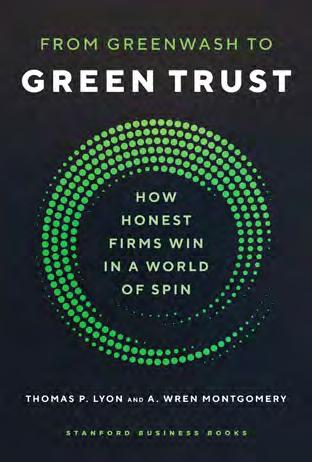
FROM GREENWASH TO GREEN TRUST
How Honest Firms Win in a World of Spin
THOMAS P. LYON and A. WREN MONTGOMERY
LEADING EXPERTS ON GREENWASHING OFFER A PLAYBOOK FOR ACHIEVING COMPETITIVE ADVANTAGE BY COMBATTING MISLEADING CLAIMS AND BUILDING TRUST.
Greenwashing has reached epidemic proportions, and consumer confidence in business sustainability commitments is falling. Those most affected by greenwashing are genuine green firms, and companies truly committed to sustainability goals can find it hard to communicate their commitments and distinguish themselves in this sea of greenwash. These companies need to confront their rivals head on to win the trust of stakeholders. From Greenwash to Green Trust offers a new paradigm for how to gain and maintain competitive advantage in a world of exaggerated green claims.
Building on more than a decade of research on greenwashing, Tom Lyon and Wren Montgomery offer a three-step approach for companies determined to rise above their greenwashing competitors:
• Understand why trust has been broken: First, learn how greenwashing works, and hurts, in today’s world.
• Build trust: Then, look in the mirror, acknowledge your own shortcomings, and substantiate your company’s commitment to sustainability goals.
• Leverage trust: Finally, create powerful relationships to outcompete greenwashers and turn integrity into lasting advantage.
In the end, the message of From Greenwash to Green Trust is a positive one. While there are plenty of businesses doing the “right” thing on sustainability, with this novel strategic approach to beating greenwashing, businesses can center transparency and trust—to restore consumer confidence and support rapid growth.
Thomas P. Lyon is the Dow Professor of Sustainable Science, Technology and Commerce at the University of Michigan. A. Wren Montgomery is the J.J. Wetlaufer Faculty Fellow at the Ivey Business School at Western University, Canada. Together, they are the leading global researchers on the topic of greenwash. They founded the Greenwash Action Lab to help companies, policymakers, citizens, activists who are working to stamp out greenwash.
JANUARY 2027
224 pages | 6 x 9
3 tables, 7 figures, 8 halftones
Cloth $30.00 (£23.99) SDT 9781503645578
eBook 9781503648623
LIVING EMPTINESS
Place, Power, and MeaningMaking from the Baltic to the Russian Far East
DACE DZENOVSKA with VOLODYMYR ARTIUKH, DOMINIC MARTIN, MARIA GUNKO, and MICHELLE CHEW
Emptiness is both temporal and spatial; it manifests in material reality, social relations, and frameworks of meaning. In this argumentdriven digital project, Dace Dzenovska and four other scholars of anthropology make use of text, drawing, photography, and film to engage with emptiness in the former socialist world. Conceived and presented as a comparative and collaborative ethnography, this multi-modal book argues that emerging spatial-temporal configurations of power come into particularly sharp focus from the perspective of places that are losing people, services, infrastructure, and value. Global cities may be becoming denser, more diverse, and multi-systemic, but it is the emptying places—and there are increasingly more of them the world over—that constitute the frontier of contemporary production of space. The authors deploy their argument dialogically through lateral comparison, presenting readers with three possible navigational pathways: thematic essays, reflections on fieldwork, and a visual-spatial landscape that spans places from the Latvian borderlands, to eastern Ukraine, the Armenian highlands, and the Russian Far East. Innovative in its theoretical and methodological contributions and aesthetic design, this ethnographic comparison frames emptying places as key places of our time.
Dace Dzenovska is Associate Professor in the Anthropology of Migration at the University of Oxford.
Volodymyr Artiukh is a Postdoctoral Researcher at the Centre on Migration, Policy and Society (COMPAS) at the University of Oxford.
Dominic Martin is a Postdoctoral Researcher at COMPAS at the University of Oxford.
Maria Gunko is a Hill Foundation Scholar and doctoral student at the University of Oxford.
Michelle Chew is project manager of the Emptiness project and member of the research team.
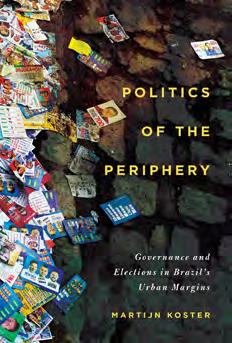
POLITICS OF THE PERIPHERY
Governance and Elections in Brazil’s Urban Margins
MARTIJN KOSTER
Based on more than two decades of ethnographic engagement with the urban margins of Brazil, this book offers unique and detailed insights into the “politics of the periphery.” Providing a long-term analysis of the residents of the periphery of the city of Recife and their interactions with state representatives and institutions, it contributes to a better understanding of the politics of marginalized populations around the world. Politics of the Periphery takes theorizing beyond state-oriented and Eurocentric approaches and offers scope to understand politics and the state from the urban margins—the places where an ever-increasing part of the world’s population lives. Critiquing approaches that see politics of marginalized populations as an expression of deficient citizenship, as informal politics, or as protest against the authorities, Martijn Koster shows how the politics of the periphery combine resistance with compliance as well as indifference, intertwining formal procedures and meetings with informal negotiations and exchanges.
This book weaves together political anthropology, urban studies, and development studies as it focuses on two central settings of resident–state relationships: government programs and electoral politics. In these settings, it shows how residents deal with urban development, citizen participation, police action, elections, and forms of clientelism. It highlights how their politics revolves around distrust, trust, betrayal, and hope as they struggle to secure their place in the city.
Martijn Koster is Associate Professor in the Sociology of Development and Change Group at Wageningen University, the Netherlands.
JULY 2026 Anthropology
OCTOBER 2026 296 pages | 6 x 9 26 halftones, 1 map Cloth $65.00 (£54.00) SDT 9781503646445 eBook 9781503648227
Anthropology
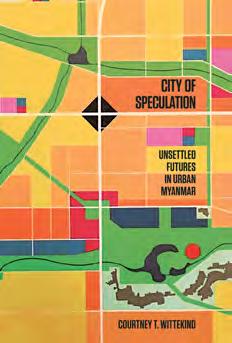
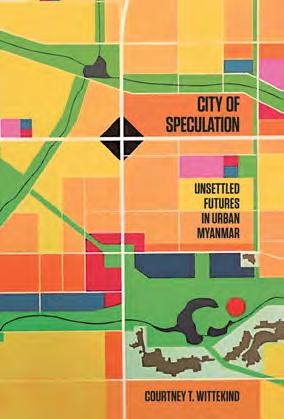
CITY OF SPECULATION
Unsettled Futures in Urban Myanmar
C OURTNEY T. WITTEKIND
In 2018, amidst a celebrated political transition, Myanmar’s first democratically elected government since 1962 proposed a builtfrom-scratch “new city” just outside Yangon, the country’s former colonial capital and current economic center. Twenty thousand acres of once-barren rice fields became the site of extraordinary developmental dreams. Farmers on Yangon’s outskirts traded cultivation for speculation on land and property, betting on uncertain futures and weighing what, exactly, was worth risking for a chance at transformation. As plans for the new city stalled amid political turmoil, economic liberalization, a pandemic, and a military coup, speculation became both a source of hope and a means of survival when urban dreams faded.
Drawing on three years of site-based fieldwork and digital ethnography, Courtney T. Wittekind shows how speculation reshapes citizens’ contemporary demands and forward-looking dreams—for themselves as well as their country—in times of crisis. Adopting the lens of “vernacular speculation,” she reveals how ordinary people create value, interpret ambiguity, and act on possible futures, even as the promises of democracy and development collapse around them. A powerful account of how hope, anticipation, and uncertainty reconfigure everyday life, City of Speculation captures what it means to imagine—and gamble on—the future in the wake of profound upheaval.
Courtney T. Wittekind is Assistant Professor of Anthropology at Purdue University.
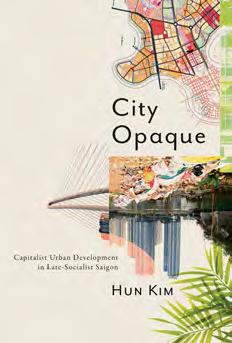
CITY OPAQUE
Capitalist
Urban Development in LateSocialist Saigon
HUN KIM
City Opaque is a book about how cities are produced—not just with plans, money, concrete, and cranes, but through gray spaces that operate through erasure, ambiguity, and the overproduction of contradictory laws and regulations. Set in Ho Chi Minh City, widely known as Saigon, it follows developers, state officials, investors, and residents as they navigate one of the fastest-growing urban economies in the world. Through years of close observation and lived encounters—from rooftop bars overlooking glittering construction sites to neighborhoods quietly erased by planning maps that have disappeared—Hun Kim reveals a city shaped as much by what is hidden, revised, or forgotten as by what is planned and recorded.
R ather than treating corruption, legal ambiguity, and disorder as failures of development, this book shows how opacity itself is a form of governmental reason and a strategy for producing space in the city. Laws multiply but rarely clarify. Archives disappear. Plans are rewritten after the fact. These practices are born out of rationalities that enable land to be reassigned, capital to move, and futures to be reimagined—often at great cost to some residents, but with enormous payoff for others. Moving beyond familiar stories of “corruption” or “failed governance,” City Opaque offers a new way of understanding urban development in Southeast Asia and beyond.
Hun Kim is Assistant Professor of Urban Planning and Public Policy at the University of California, Irvine.
NOVEMBER 2026 288 pages | 6 x 9
20 halftones, 1 map
Paper $28.00 (£21.99) SDT 9781503648531
Cloth $110.00 (£91.00) SDT 9781503647664
eBook 9781503648548
Anthropology
DECEMBER 2026 248 pages | 6 x 9
6 halftones, 2 maps
Paper
$28.00 (£21.99) SDT 9781503648609
Cloth $110.00 (£91.00) SDT 9781503648029
eBook 9781503648616
Anthropology
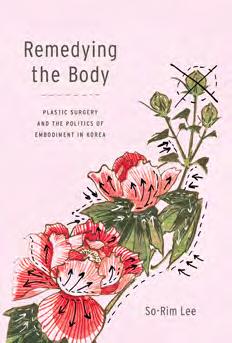
REMEDYING THE BODY
Plastic Surgery and the Politics of Embodiment in Korea
SO-RIM LEE
Plastic surgery has exploded in popularity around the world in the recent decades, with South Korea emerging as a leader of the global beauty economy. This book presents a cultural discourse of plastic surgery in Korea through the feminist politics of care, bringing together intersecting narratives of marginalization to reimagine coalitional ways of surviving a world governed by oppressive bodily norms. Pulling together a diverse array of archival and cultural materials from the 1950s to the 2020s, including newspapers, television, film, visual art, digital media, and feminist street protests, So-Rim Lee takes Korea as a paradigmatic example to show how the cultural construction of plastic surgery is entwined with the norms governing desire, upward mobility, and social belonging.
Loosely translated from the Korean term koch’ida (“to fix or mend”), Lee uses the term “remedy” to name a broad spectrum of medical interventions that are performed with the aim of changing the bodily appearance to arrive at a bodily norm. A remedy promises to alleviate, heal, or cure a broad range of conditions including disease, disability, and psychological pain. It is, however, much more than medical treatment alone. This book contends that remedy is also a critical cultural ethos, a social performance of subjectivity, and a material practice of embodiment where state biopolitics and individual desire for belonging are inextricably entangled.
So-Rim Lee is the Korea Foundation Assistant Professor of East Asian Languages and Civilizations at the University of Pennsylvania.
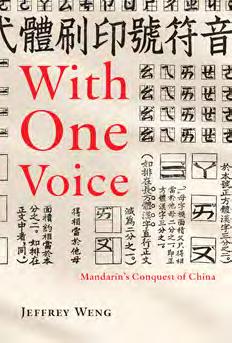
WITH ONE VOICE
Mandarin’s Conquest of
China
JEFFREY WENG
Mandarin is one of the mostspoken languages in the world. But when it was codified as the new national language in China between the 1910s and 1930s, its artificiality was such that only a handful of people could speak it with any fluency. The state-led creation and spread of China’s national language is thus arguably the largest instance of social engineering in human history. What took centuries to accomplish in Europe was compressed into a mere three decades in China. How did this national linguistic unification happen? And, more broadly, what can this process teach us about the role of language in society? Relying on research conducted in libraries and archives across the United States, Taiwan, Hong Kong, and mainland China, Jeffrey Weng examines the Chinese state’s efforts to codify and elevate a new national language during the transition from Classical Chinese to modern standard Mandarin in the early twentieth century.
The ultimate form of the language was not inevitable. It was the concatenation of a multitude of disputes and decisions made in the early years of the republic, and, as Weng argues, represents a particular vision of Chinese society: unitary and egalitarian. Weng both reconstructs and reinterprets events in early twentieth-century China to give us a fresh view of how social change take place and how nations are made through cultural reinvention.
Jeffrey Weng is Assistant Professor of Sociology at National Taiwan University.
OCTOBER 2026 304 pages | 6 x 9
13 halftones
Paper
$30.00 (£23.99) SDT 9781503648234
Cloth $120.00 (£99.00) SDT 9781503647619
eBook 9781503648241
Asian Studies
NOVEMBER 2026 176 pages | 6 x 9
3 halftones
Paper $25.00 (£19.99) SDT 9781503648517
Cloth $100.00 (£83.00) SDT 9781503647688
eBook 9781503648524
Asian Studies
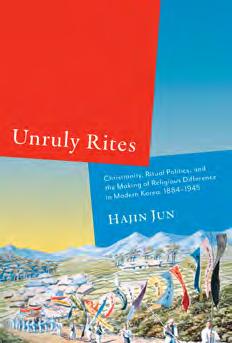
UNRULY RITES
Christianity, Ritual Politics, and the Making of Religious Difference in Modern Korea, 1884-1945
HAJIN JUN
When Western missionaries first introduced Protestant Christianity to Korea in 1884, Korean converts adopted beliefs and practices that defied prevailing Confucian norms, including distinct faithbased rituals. By the turn of the twentieth century, during the final years of the Chosŏn dynasty, competing cultural and religious viewpoints started to roil Korean society with frenzied—even lifeand-death—controversies over ritual practice. But this was just the beginning. After Japan annexed Korea in 1910, such controversies grew to command the very forefront of public attention, as Koreans and Japanese officials advanced conflicting aspirations for ritual transformation against the backdrop of colonial politics.
New Protestant rites revealed religion to be a source of perpetual division at a time when disparate groups, including Confucian intellectuals, Korean cultural nationalists, and Japanese colonial authorities, each aspired to unify rites—and the Korean people—in service of their competing cultural, social, and political agendas. Hajin Jun argues that Protestant Christianity triggered a public reckoning over the place of religious difference in Korean society. Fast-proliferating ritual reforms not only sought to restrain unruly faith-based rites but religious difference itself, efforts that turned increasingly coercive as the Japanese empire shifted toward war. By tracing this story of ritual change, Unruly Rites sheds new light on the fraught intersection of religion and political power in colonial Korea.
Hajin Jun is the James B. Palais Assistant Professor of Korean History at the University of Washington.
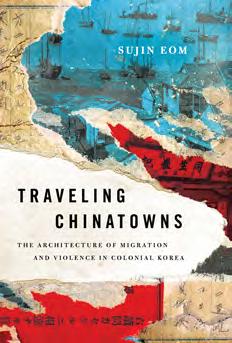
TRAVELING CHINATOWNS
The Architecture of Migration and Violence in Colonial Korea
SUJIN EOM
Drawing on an impressive array of archival sources, from colonial criminal records to historical maps and exposé journalism, this book brings to light the overlooked history of ethnic Chinese enclaves in Korea during the era of Japanese colonialism. Situated within a global circuit of Chinese migration, the Japanese empire produced a structure of anti-migrant violence that echoed discriminatory structures that created the Chinatowns of Europe and the United States. Each chapter of the book analyzes a site of Chinese migration as a constitutive part of the Japanese colonial infrastructures of racialization: ships and ports that served as conduits for Chinese migrants; shophouses that spread across Asia to accommodate new types of colonial labor; writings that circulated Chinese racial archetypes; streets and homes vulnerable to ethnic violence and destruction; and Japanese police photographs created to surveil Chinese migrants and their environments.
The title of the book, Traveling Chinatowns, indicates the transimperial infrastructures of Asian racialization that made Chinatowns both material and ideological spaces across multiple continents. Locating Korea’s Chinatowns within transnational histories of anti-migrant racism and violence, this book challenges the prevailing view that sees Chinatowns as exclusively the creation of white settler racism, and instead sheds light on the complexity inherent in Chinatowns as spaces that are reflective of histories of empire and labor migration that have linked people, goods, and ideas across continents.
Sujin Eom is Assistant Professor of Asian Studies at Dartmouth College.
FEBRUARY 2027 320 pages | 6 x 9
2 tables, 24 halftones, 1 map
Cloth $70.00 (£58.00) SDT 9781503648012
eBook 9781503648920
Asian Studies
FEBRUARY 2027 272 pages | 6 x 9
42 halftones, 2 maps
Paper $28.00 (£21.99) SDT 9781503648906
Cloth $110.00 (£91.00) SDT 9781503648050
eBook 9781503648913
Asian Studies
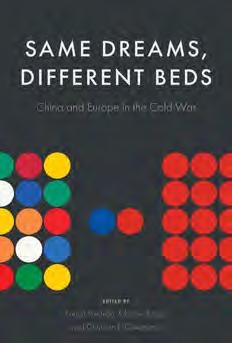
SAME DREAMS, DIFFERENT BEDS
China and Europe in the Cold War
E dited by ENRICO FARDELLA, CHARLES KRAUS, and CHRISTIAN F. OSTERMANN
Through a comprehensive analysis of relations between Europe and China during the Cold War, this volume reveals how those interactions quietly reconfigured the global balance of power, helping to forge the contemporary international order. Rooted in a rich array of multi-archival sources, the book brings together an international group of historians to explore China’s relationships with both Western European powers and European socialist countries, tracing how China systematically courted Europe to reshape the Cold War order and maneuver between the superpowers.
Beginning with China’s diplomatic opening to Western Europe from the 1950s to the 1970s, contributors highlight key turning points in rapprochement with France, Britain, West Germany, Switzerland, and Italy, marked by a shifting mix of ideology, strategic calculation, and détente-era geopolitics. The volume then moves eastward, unpacking China’s fraught but ambitious diplomacy with communist Europe, including Hungary, Poland, and Albania, as Beijing sought to contest Moscow’s dominance and present itself as an alternative pole of leadership in the socialist world. Breaking new ground by integrating Chinese and European sources and perspectives, this book shows how China and Europe, often considered secondary actors, played crucial roles in reshaping the Cold War system and turning a rigid superpower standoff into a more multipolar world.
Enrico Fardella is Associate Professor of Social and Human Sciences at the University of Naples “L’Orientale” and Associate Director of the Guarini Institute for Public Affairs at John Cabot University in Rome.
Charles Kraus is Director of Fellowships at the Wilson Center in Washington, DC.
Christian F. Ostermann is Research Professor at the University of Maryland’s School of Public Policy and Executive Director of the National Cold War Center.
SETTLING THE CALIFORNIA DELTA
Rural Japanese America Under Racial Segregation
EIICHIRO AZUMA
This book traces the forgotten history of a Japanese farm settlement in the Sacramento River delta. Before wartime removal and incarceration, most West Coast Japanese Americans, including immigrant Issei and US-born Nisei generations, resided in rural agricultural areas. Existing histories of Japanese America have often overlooked this farming aspect of their experience, focusing instead on urban narratives. Centered on the town of Walnut Grove, the “downriver” (kawashimo) settlement was home to Issei farmers, merchants, and laborers who lived alongside their Nisei children in a society characterized by strict racial segregation and landlessness. In the delta basin, a small group of white landowning settlers and corporate interests held power and wealth, shaping social relations and economic opportunities for mostly Asian immigrant settlers and fieldhands.
Combining theories of settler colonialism, racial capitalism, and immigrant transnationalism with the techniques of microhistory, Eiichiro Azuma reveals the intricate dynamics of paternalistic interdependency between white landlords and Japanese tenants, as well as the complex interethnic relations among marginalized immigrant groups in the local segregated society and agricultural economy. Through his careful analysis of heretofore overlooked immigrant vernacular sources and oral histories, Azuma sheds important light on a lesser-known aspect of rural Asian American history through the lens of multiracial entanglements on the ground.
Eiichiro Azuma is the Roy F. and Jeannette P. Nichols Professor of American History at the University of Pennsylvania. He is the author of several books, including Brokering a Race War: Japanese Americans in the Pacific War and the Occupation of Japan (2026) and In Search of Our Frontier: Japanese America and Settler Colonialism in the Construction of Japan’s Borderless Empire (2019).
DECEMBER 2026
400 pages | 6 x 9
Cloth $85.00 (£70.00) SDT 9781503647794
eBook 9781503648272
History
ASIAN AMERICA
JANUARY 2027 344 pages | 6 x 9
10 tables, 17 halftones, 3 maps
Paper $28.00 (£21.99) SDT 9781503648449
Cloth $110.00 (£91.00) SDT 9781503647336
eBook 9781503648456
History
UNDIVIDED HEAVENS
Spaceflight and the Future in Cold War Germany
COLLEEN ANDERSON
In an innovative cultural history across the Iron Curtain, this book explores how a divided nation used the cosmos—as both a technological reality and a field of imagination—to navigate the challenges of the Cold War and compete for the future. Smithsonian curator Colleen Anderson transforms the history of the Space Age by demonstrating that Germans were not just observers of the USSoviet rivalry, but active participants who used spaceflight to redefine their place in the world.
Connecting the technical and political history of space programs with space imaginations in popular culture, Anderson uncovers unexpected commonalities between two states otherwise opposed. Through vivid stories of street astronomers building telescopes from wartime rubble, the West German cult TV hit Space Patrol, and East German youth “training” for missions at the socialist equivalent of space camp, this book demonstrates how the unbounded cosmos offered a site for political and cultural maneuvering—and a canvas for imagining alternative futures—that was often impossible on Earth. From the 1978 mission of the first German in orbit to the international laboratory of Spacelab, Anderson reveals that for a divided people, technological dreams were not mere fantasies; they were essential tools for confronting a burdened past and forging a new future. Contributing to spaceflight history, Cold War scholarship, and German studies, this book speaks to the many ways technological dreams become instruments for negotiating memory, ideology, and the uncertainty of what lies ahead.
Colleen Anderson is a curator of space history at the Smithsonian’s National Air and Space Museum, where she oversees the rocketry collection.
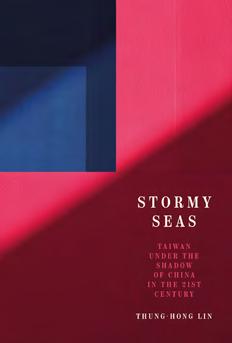
STORMY SEAS
Taiwan Under the Shadow of China in the 21st Century
THUNG-HONG LIN
How can a small democracy resist the influence of a powerful authoritarian neighbor? Taiwan is frequently praised for its successful economic development and peaceful transition to democracy, serving as a model for other developing countries. However, it faces substantial challenges, both from internal political divisions and external geopolitical pressures. Taiwan’s political landscape is shaped by several significant cleavages: national identity and ethnic disparities, economic inequality and class conflict, and generational and cultural differences. The greatest challenge to Taiwan’s democracy comes from the influence of China, which has exploited these cleavages through economic leverage, propaganda, and political interference.
Under the heavy influence of Beijing’s sharp power, Taiwan’s democracy often faces threats of regression. Whenever China escalates its tactics, Taiwan’s civil society has mobilized in response, playing a crucial role in resisting Beijing’s strategies and defending democratic institutions. Thung-Hong Lin examines case studies— such as the 2014 Sunflower Movement, the 2019 support for the Hong Kong protests, and recent social movements in 2024—to demonstrate how Taiwan’s vibrant civil society is a key source of democratic resilience. This book also situates Taiwan’s struggle within the broader context of US–China relations, showing how global geopolitics over the past half-century has shaped the island’s destiny.
Thung-Hong Lin is a Research Fellow at the Institute of Sociology, Academia Sinica. He studies inequality, political economy, disasters, and Taiwan’s democracy, and is a 2023–24 CASBS and Fulbright Fellow.
STANFORD STUDIES ON CENTRAL AND EASTERN EUROPE
FEBRUARY 2027 312 pages | 6 x 9
34 halftones
Paper $35.00 (£27.99) SDT 9781503648944
Cloth $140.00 (£116.00) SDT 9781503648937
eBook 9781503648951
History
STUDIES IN ASIAN SECURITY
SEPTEMBER 2026 360 pages | 6 x 9
2 tables, 13 halftones
Paper $35.00 (£27.99) SDT 9781503647800
Cloth $140.00 (£116.00) SDT 9781503647534
eBook 9781503647756
International Affairs
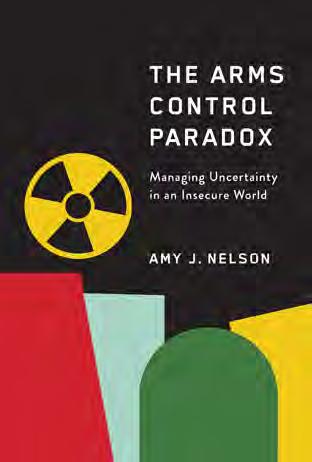
THE ARMS CONTROL PARADOX
Managing Uncertainty in an Insecure World
AMY J. NELSON
A CUTTING-EDGE ANALYSIS OF TRADITIONAL AND CONTEMPORARY ARMS CONTROL STRATEGIES THAT EXPLORES WAYS TO OVERCOME THE UNPRECEDENTED CHALLENGES OF TODAY’S SECURITY ENVIRONMENT.
Arms control is eroding amid a rapidly changing and increasingly uncertain security environment. In addition to a spate of treaty withdrawals and demises that have occurred since 2002, major powers are militarizing space and private actors are developing technologies at lightning speed. Thus, there is an urgent need for arms control agreements that incorporate multiple actors and weapons to mitigate uncertainty; yet, conditions of increasing uncertainty make reaching such agreements extremely challenging, if nearly impossible. This is what Amy J. Nelson calls the arms control paradox.
Drawing on years of research and policy experience, Nelson explores why traditional arms control strategies often fall short in today’s security environment. Most past agreements were built on assumptions of transparency, reciprocity, and predictability that no longer hold in a multipolar world shaped by advanced technologies and strategic opacity. By focusing narrowly on eliminating known dangers through rigid verification and technical controls, arms control has inadvertently neglected uncertainty management—the ability to acclimate to the unknown. This book proposes an adaptive approach: one that focuses on managing ambiguity rather than eliminating it and reflects how real-world decisions unfold under pressure. The Arms Control Paradox provides valuable insights and policy-relevant guidelines for twenty-first-century arms control.
Amy J. Nelson is a Senior Fellow and Director of the Future Security Scenarios Lab at New America.
SEPTEMBER 2026 240 pages | 6 x 9
1 table, 3 figures
Paper $26.00 (£20.99) SDT 9781503648081
Cloth $105.00 (£87.00) SDT 9781503647763
eBook 9781503648098
International Affairs
RUSSIA’S NEW IMPERIALISM
Capital and Ideology
ILYA BUDRAITSKIS AND ILYA MATVEEV
Russia’s devastating invasion of Ukraine in 2022 is a manifestation of a wider phenomenon: Russia’s new, post-Soviet imperialism. This book provides a theoretically informed, critical account of Russian imperialism that is attentive to the interplay between economy and ideology, coercion and hegemony, structure and agency. While economic developments go a long way toward explaining the reemergence of Russia’s imperialist impulses in the twenty-first century, a purely economic logic cannot account for the dramatic shift in Russian imperialism beginning with the annexation of Crimea and the instigation of a separatist insurgency in the Donbas. Nor can objective geopolitical developments, such as US and NATO military deployments, provide an adequate explanation for this shift. Instead, this book shows how the Kremlin’s reaction to the Maidan revolution was rooted in the ideological consolidation of the previous years: the emergence of a total ideology that designates the West as Russia’s eternal enemy and Ukraine as the West’s geopolitical pawn. Ilya Budraitskis and Ilya Matveev examine Russian foreign policy and the Kremlin’s project to remake the Russian people to better serve its imperialist agenda.
Ilya Budraitskis is a political theorist and researcher in Russian intellectual history. He is the author of Dissidents Among Dissidents: Ideology, Politics and the Left in Post-Soviet Russia (2022).
Ilya Matveev is a researcher in Russian and international political economy. He is a member of the Public Sociology Laboratory.
ART FOR WAR
Heritage Looting, Blood Antiquities, and the International Fight Against Terrorism Financing
COSTANZA MUSU
Understanding the world of art—particularly antiquities and archaeological artifacts—requires tracing how objects are removed from the ground, displaced by conflict or economic hardship, and ultimately reappear in the international art market. The odyssey of an artifact from its excavation site to an auction house, a private collection, or a museum display case raises a host of pressing concerns about the fragility of cultural heritage but also the global mechanisms that sustain its circulation. In recent years, growing awareness of a possible link between the illegal antiquities trade and terrorist financing has brought new scrutiny to regions marked by war and instability, particularly in the Middle East. In such places, archaeological sites are especially vulnerable to looting and illicit excavation, with the profits from these “blood antiquities” sometimes flowing back to fund further violence.
Art for War examines how this transformation in perception—from an archaeological concern to a matter of international security—reshaped the global response to antiquities trafficking. Viewing the trade through a security lens, the book offers scholars, policymakers, and students of international affairs a new way to understand how the protection of cultural heritage became entangled with the politics of counterterrorism and global security, sparking new debates over art, heritage, and security.
Costanza Musu is Associate Professor in the Graduate School of Public and International Affairs at the University of Ottawa.
SEPTEMBER 2026 232 pages | 6 x 9
2 tables, 10 figures
Paper $25.00 (£19.99) SDT 9781503647732
Cloth $100.00 (£83.00) SDT 9781503647466
eBook 9781503647749
International Affairs
SEPTEMBER 2026 232 pages | 6 x 9
4 tables, 5 halftones
Cloth $65.00 (£54.00) SDT 9781503613522
eBook 9781503648104
International Affairs
THE WORK OF WATER
Infrastructure, Bureaucratic Labor, and the Postcolonial Promise in Pakistan
MAIRA HAYAT
Pakistan’s Punjab Irrigation Department manages one of the world’s largest irrigation networks. Such bureaucracies are typically considered paradigmatic sites of corruption, inefficiency, and depoliticization, particularly in post-colonial settings. The Work of Water turns this assumption on its head, arguing that the postcolonial promise of welfare and development hinges not on elite policy or expertise but everyday bureaucratic labor.
Drawing on a decade of ethnographic and archival research, Maira Hayat offers a historical ethnography of irrigation infrastructure and its administration in the Indus basin, showing that bureaucracy is a key site where the political and ethical are navigated. Moving from irrigation offices and outlets to courtrooms, archives, village council gatherings, and international treaty arbitrations, the book traces how the materiality of water is produced through disputes, ethical conundrums, rules, calculations, files, and development projects. Attending to law, religion, gender, authority, and corruption as they are navigated every day, the book reveals how the flows and stoppages of water might enable or frustrate human designs. The Work of Water offers a powerful rethinking of environmental governance at a moment of intensifying climate strain. At stake, Hayat demonstrates, is not only the governance of nature, but the nature of governance itself.
Maira Hayat is Assistant Professor of Environment and Peace Studies in the Keough School of Global Affairs at the University of Notre Dame.
THE MAN IN THE MIDDLE
John Lehman, Naval Power, and the End of the Cold War
ANAND TOPRANI
John Lehman is a legendary figure in American naval history. He was one of the youngest people ever to serve as Secretary of the Navy and arguably the most powerful holder of that office. While the President and Secretary of Defense determine defense policy in the United States, it is up to the military services to implement it. The secretary of each service—the “man in the middle,” as one Air Force Secretary put it—represents the highest-level civilian leadership in the military. Lehman filled this role unlike anyone who came before (or after) him. He reversed the decline in the size of the Navy after the Vietnam War, oversaw the Navy’s expansion to almost 600 ships during the defense buildup of the Reagan era, and promoted an offensive maritime strategy against the Soviet Union. Drawing from recently declassified sources, private archives, and interviews with dozens of Lehman’s contemporaries, Anand Toprani offers a fresh perspective on the Navy during the last decade of the Cold War. By exploring how Lehman confronted his major challenges, from applying naval power against a continental power to reforming an inefficient system for designing and procuring new weapons that has produced a smaller and more expensive military, this book gives readers vital insights into contemporary defense policy, as national security leaders confront similar problems today.
Anand Toprani is Professor of Strategy and Policy at the U.S. Naval War College.
JANUARY 2027 224 pages | 6 x 9
23 halftones
Paper $28.00 (£21.99) SDT 9781503648296
Cloth $110.00 (£91.00) SDT 9781503641822
eBook 9781503648302
International Affairs
JANUARY 2027
360 pages | 6 x 9
Paper $32.00 (£24.99) SDT 9781503648425
Cloth $130.00 (£108.00) SDT 9781503648418
eBook 9781503648432
International Affairs
EVERYTHING BUT THE BOMB
South Korea’s Nuclear Hedging Strategy
LAMI KIM
Amid North Korea’s advancing nuclear capabilities and the declining credibility of US-extended deterrence, South Korea has a strong motive to pursue its own nuclear deterrent. With its advanced nuclear energy program, South Korea possesses the means to develop nuclear weapons indigenously. However, its opportunity to do so is constrained by the prohibitive economic, security, and reputational costs of nuclear armament. To circumvent these costs, Seoul is engaging in “nuclear hedging”—pursuing the capability to develop nuclear weapons rapidly while stopping short of actual weaponization.
Drawing on Korean- and English-language documents, archival materials, and interviews with South Korean security experts, Lami Kim offers the most comprehensive analysis to date of South Korea’s pursuit of nuclear hedging as an alternative to both nuclear restraint and outright nuclear armament. South Korea’s renunciation of its nuclear weapons program in the 1970s—and its subsequent restraint—should not be mistaken for an absence of nuclear ambition grounded in confidence in US-extended deterrence. Instead, under both conservative and progressive governments, Seoul has sought the ability to acquire nuclear weapons rapidly, if necessary, as an insurance policy. A major contribution to the literature on nuclear deterrence, nonproliferation, and Korean studies, this book delivers timely and insightful policy recommendations for both Washington and Seoul.
Lami Kim is the Korea Chair for Advanced Technologies, National Security, and Defence at the International Institute for Strategic Studies (IISS).
THE FICTION OF THE STATE
The Partitions of Poland and the Beginning of Modern Jewish Literature OFER DYNES
In a compelling new interpretation, this book locates the origins of modern Jewish literature within the turbulent events that reshaped Europe during the late eighteenth century: the partitions of Poland, the French Revolution, and the Napoleonic Wars. As Austria, Russia, and Prussia consolidated their rule over the Polish lands and banned most forms of political expression, literature became a central venue for reflecting on the new political order. Ofer Dynes argues that Jewish intellectuals turned to fiction—prose, poetry, and drama—to engage in political debates and make sense of new state structures. Through their writing, Jewish intellectuals positioned themselves as interpreters, mediators, and, at times, collaborators with the new imperial powers.
Combining meticulous archival research and nuanced textual readings, Dynes contextualizes modern Jewish literature as rooted in the awareness of major political upheaval. Rather than depicting an internal Jewish struggle between tradition and modernity, he presents Hebrew and Yiddish literature as a field of negotiation among multiple local and imperial belongings. Radically expanding the literary canon, he uncovers a diverse and often unexpected array of texts by surprising figures, including a Catholic Austrian bureaucrat who wrote poetry in Yiddish, a Prussian rabbi and French count who jointly composed a poem to the Russian Tsar; and an author whose Hebrew novel was born out of collaboration with the secret police. Connecting Jewish texts with broader trends in European history, this book presents an untold story of how Jewish writers used literature to grapple with a shifting political landscape in the age of Enlightenment and empires.
Ofer Dynes is the Leonard Kaye Assistant Professor of Hebrew and Comparative Literature at Columbia University. He has coedited a volume of Prooftexts with Naomi Seidman, The Beginnings of Modern Jewish Literature in Europe (2020).
STUDIES IN ASIAN SECURITY
JANUARY 2027
224 pages | 6 x 9
3 tables, 9 figures
Cloth $65.00 (£54.00) SDT 9781503647978
eBook 9781503648722
International Affairs
STANFORD STUDIES IN JEWISH HISTORY AND CULTURE
SEPTEMBER 2026 224 pages | 6 x 9
Paper $30.00 (£23.99) SDT 9781503647985
Cloth $120.00 (£99.00) SDT 9781503647435
eBook 9781503647992
Jewish Studies
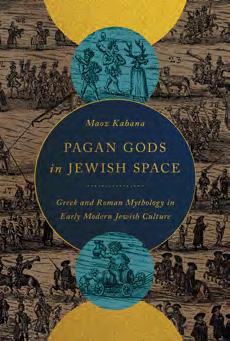
PAGAN GODS IN JEWISH SPACE
Greek and Roman Mythology in Early Modern Jewish Culture
MAOZ KAHANA
This innovative study reveals a remarkable and largely unfamiliar dimension of Jewish history: the ways in which classical mythology became part of Jewish life and erudite culture in Europe between the fifteenth and eighteenth centuries. From vibrant civic processions and rabbinic sermons to kabbalistic treatises, folk tales, and messianic heretical performances, figures such as Bacchus, Pan, the Sibyls, Amazons, and Prometheus entered the Jewish cultural landscape in surprising and illuminating ways. Tracing the Jewish encounter with classical myth through two waves, influenced by Renaissance humanism and Enlightenment critique, Maoz Kahana argues that these encounters were not superficial borrowings. Rather, classical myth served as a medium through which Jews reimagined their textual heritage and expanded the intellectual horizons of their tradition.
Kahana’s work illuminates a previously unexplained boom of classical mythological elements in Jewish literature beginning in the early modern era, providing new insight into the intersection of Jewish, Christian humanist, and pagan traditions. In this new portrait of Jewish mysticism in early modernity, Kahana argues that kabbalistic thinkers, leaders, and ritualists can and should be explored within a wider cultural and intellectual landscape. Through vivid case studies, the book shows how Greek and Roman mythological materials opened new avenues for rethinking the distant past, ongoing tradition, revelation, hidden knowledge, and the nature of the self. Putting Nachman of Breslov in conversation with Giambattista Vico, this book offers a sweeping account of the creative Jewish engagement with classical mythology from the Renaissance to the Enlightenment.
Maoz Kahana is Associate Professor and Head of the Department of Jewish History at Tel Aviv University. He is the author, in Hebrew, of A Heartless Chicken: Religion and Science in Early Modern Rabbinic Culture (2021).
LANGUAGE IN TRANSIT
Argentine Yiddish from Mass Migration to the Dirty War
AMY KERNER
In this groundbreaking history, Amy Kerner explores the critical role of the Yiddish language in defining ethnicity and belonging for Argentina’s Jewish diaspora, the largest in Latin America. Jews came to Argentina’s provinces and growing cities as immigrants and refugees from Europe beginning in the late nineteenth century. Although Jewish immigrants were multilingual, they nevertheless gave Yiddish a central place in Jewish Argentine culture for over a century. Kerner elucidates how the longstanding influence of Yiddish culture in Argentine Jewish life resulted from national migration policies, urban modernity, populism, and the alliance of Yiddish speakers with Argentine anti-fascism. In turn, Jewish Argentines used Yiddish to document, debate, and respond to events on local and global scales, including the Holocaust, Israeli Zionism, and Latin American state terror.
Drawing on extensive archival research, Kerner argues that Jewish Argentines used Yiddish to navigate changing political ideologies and ethnic boundaries across a century of Jewish Argentine history. Untangling the complex interplay of transnational and local politics in shaping the uses and meanings of Yiddish, Language in Transit offers fresh insights for the histories of Jewish culture and language in Argentina and Latin America.
Amy Kerner is Research Fellow in Latin American History at the German Historical Institute Washington DC, Pacific Office Berkeley.
STANFORD STUDIES IN JEWISH MYSTICISM
DECEMBER 2026 240 pages | 6 x 9
20 halftones
Cloth $70.00 (£58.00) SDT 9781503647398
eBook 9781503648715 Jewish Studies
STANFORD STUDIES IN JEWISH HISTORY AND CULTURE
DECEMBER 2026 248 pages | 6 x 9
22 halftones
Cloth $70.00 (£58.00) SDT 9781503645349
eBook 9781503648814
Jewish Studies
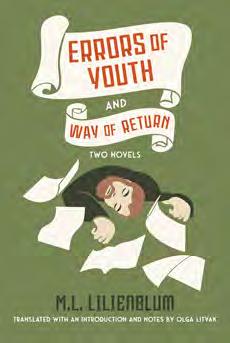
ERRORS OF YOUTH AND WAY OF RETURN
Two Novels
M .L. LILIENBLUM, TRANSLATED with an INTRODUCTION and NOTES by
OLGA LITVAK
This translation of M.L. Lilienblum’s Errors of Youth (1876) and its short sequel, Way of Return (1899), bridges a critical gap in modern Hebrew literature and Jewish intellectual history, and, for the first time, makes the entirety of these seminal texts available in English. Framed as autobiography, but written with fictionalized flair and keen irony, Errors of Youth follows the travails of its hapless, self-centered narrator from traditional Jewish upbringing to modern life in Odessa. Unconventional and absorbing, the text offers striking insight into Jewish life in Eastern Europe, and a compelling Jewish critique of modernity. It is both a transformative experiment in Hebrew novel-writing, and an essential text in the history of Jewish nationalism in Russia. Lilienblum’s contribution to modern Jewish culture has often been overlooked, but his influence resonates across the twentieth century in the work of Philip Roth and S.Y. Agnon.
This edition undertakes to restore Lilienblum’s masterwork to its proper place in the history of Jewish thought and imagination. Olga Litvak’s translation expertly maintains the poeticism and parodic intent of the originals, while her introduction and annotations elucidate how Lilienblum wrote in nuanced conversation with classical Jewish sources. Situating Lilienblum’s work in historical and literary context, Litvak also showcases its contemporary relevance. Enabling a new generation of readers to appreciate the bracing quality of Lilienblum’s prose, his powers of invention, and his consummate understanding of modern Jewish society, this edition brings a forgotten classic to life.
M.L. Lilienblum (1843–1910) was a Jewish scholar, journalist, teacher, and writer who published in Hebrew, Yiddish, and Russian.
Olga Litvak is the Laurie B. and Eric M. Roth Professor of Modern European Jewish History at Cornell University. Her books include Haskalah: The Romantic Movement in Judaism (2012).
STANFORD STUDIES IN JEWISH HISTORY AND CULTURE
JANUARY 2027 408 pages | 6 x 9
3 halftones
Paper $40.00 (£32.00) SDT 9781503648760
Cloth $160.00 (£132.00) SDT 9781503647374
eBook 9781503648777
Jewish Studies
THE LAND OF THE SKINNY COW
Beef Politics in Cuba, 1927–1963
B ONNIE A. LUCERO
Beef looms large in Cuban history. Today, it is one of the most coveted food items, and so scarce that most ordinary Cubans cannot hope to consume it without a doctor’s prescription. In this book, Bonnie A. Lucero challenges popular narratives that attribute beef scarcity to the failures of the Cuban Revolution. Analyzing Cuba’s expansive print culture and original manuscripts from archives in five countries, Lucero exposes the complex array of factors, both natural and artificial, that plagued Cuba’s cattle industry from the onset of protectionism in 1927 through the implementation of the 1959 Agrarian Reform. In doing so, she traces the political reverberations of Cuba’s cultural taste for beef, and offers a new lens on the logics of freedom, prosperity, and democracy.
Lucero reveals that Cuba’s beef and cattle industries were mired in deep conflict for decades preceding the Cuban Revolution. She shows how, beginning in the 1920s, power struggles between ranchers, industrialists, workers, retailers, and government magnified environmental limitations to provoke a series of crises in these industries, resulting in recurring beef shortages. Simultaneously, she examines how beef politics during the republican period contributed to grassroots militancy: political elites courted popular support by positioning themselves as guarantors of access to beef, but repeated failures to deliver on this promise ultimately alienated their constituencies. Revising the misconceptions surrounding beef scarcity and exposing surprising continuities before and after the Revolution, this book offers a transformative contribution to Cuban economic, political, and agricultural history, as well as wider histories of food, meat, and their politics.
Bonnie A. Lucero is the Neville G. Penrose Chair of Latin American Studies and History and Associate Professor at Texas Christian University. Her previous books include Race and Reproduction in Cuba (2022) and A Cuban City, Segregated: Race and Urbanization in the Nineteenth Century (2019).
JANUARY 2027 416 pages | 6 x 9
2 tables, 52 halftones
Paper $40.00 (£32.00) SDT 9781503648784
Cloth $160.00 (£132.00) SDT 9781503647671
eBook 9781503648791
Latin American Studies
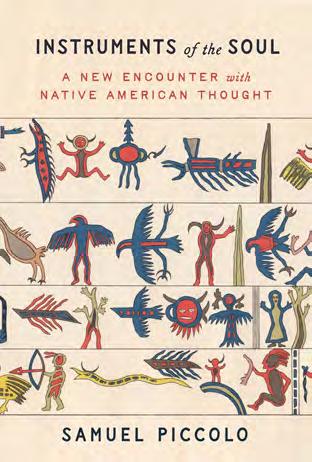
INSTRUMENTS OF THE SOUL
A New Encounter with Native American Thought
SAMUEL PICCOLO
A NEW ENCOUNTER BETWEEN NATIVE AMERICAN AND WESTERN PHILOSOPHIC TRADITIONS TO MEET THE CHALLENGES OF TODAY.
Indigenous peoples in the United States are perhaps more legally, politically, and culturally visible in the mainstream today than at any point since 1870. This shift breathes new life into old questions about Native sovereignty, philosophy, and ethics. In this book, Samuel Piccolo takes up this prompt and asks what we can learn about these as uniquely indigenous concepts, as well as sites of underappreciated overlap with North American political, legal, and philosophical traditions.
Piccolo takes seriously the intellectual traditions and perspectives of Native American peoples, arguing that their accounts of sovereignty and political legitimacy are fundamental claims about the world and not simply reactions to colonial oppression. Presenting Indigenous political philosophy as a tradition that understands itself as a continuation of precolonial thought, rich with its own positive metaphysical, ethical, and political perspectives, Piccolo establishes a dialogue between this tradition and one important pillar in Western philosophy: neo-Aristotelianism.
Exploring the implications of this link allows Piccolo to make critical interventions across several scholarly fields, particularly by locating a common understanding of morality as embedded in nature. This corrective lens rewrites contemporary defenses of Indigenous sovereignty, making the case that it must be understood in relation to the substantive philosophy that undergirds it. Moreover, Instruments of the Soul finds in Native and Aristotelian perspectives some relief from the imbricated ills by which we are afflicted, including novel understandings of our relationship with the nonhuman world, universal virtues, and alternative approaches to politics rooted in community.
The thinkers in this book urge us to be motivated, not by anxiety about power, but by wonder at the potential for meaning, beauty, and goodness around us amidst the tumult of contemporary life.
“Instruments of the Soul does an admirable job of showing the parallels between Indigenous and Neo-Aristotelian philosophy while also clearly defining their features and acknowledging the areas of less overlap. These veins of thinking have the potential to build upon each other and offer a powerful critique of the liberal theory that dominates so much of how many engage with the world today.”
—Keith Richotte, Jr., author of The Worst Trickster Story Ever Told
Samuel Piccolo is Assistant Professor of Political Science at Baruch College at CUNY.
JANUARY 2027 288 pages | 6 x 9
Paper $26.00 (£20.99) AC 9781503648258
Cloth $105.00 (£87.00) SDT 9781503647541
eBook 9781503648265
Law
HOW AMERICANS ENFORCE THE LAW
DIEGO A. ZAMBRANO
In most countries, bureaucratic agencies handle regulatory enforcement. But the United States does things differently. Embedded in statutes governing consumer protection, antitrust, employment, civil rights, and the environment are more than 10,000 “private rights of action”—legal provisions that empower ordinary citizens and their lawyers to enforce the law through lawsuits. This is how Americans regulate everything from wage theft to air pollution to corporate fraud.
How Americans Enforce the Law tells the story of this distinctively American approach to governance. Diego A. Zambrano reveals that private enforcement is not a modern innovation but an inherited tradition dating to medieval English “penal statutes” that colonial America adopted and intensified. The book traces how this system evolved through critical junctures and was boosted by twentieth-century procedural innovations like broad discovery rules and class actions that transformed scattered statutory clauses into a mass-litigation engine.
This is the first comprehensive account of private enforcement’s origins, operations, and future. Offering both celebration and critique, Zambrano shows why private enforcement works well in employment law, for instance, but has been weaponized in environmental law. He creates a framework for determining when this uniquely American form of governance serves the public interest, and when it can be used to undermine democracy.
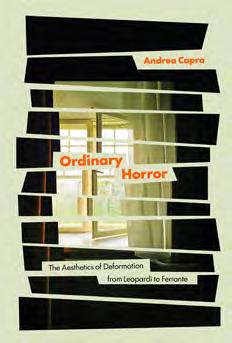
ORDINARY HORROR
The Aesthetics of Deformation from Leopardi to Ferrante ANDREA CAPRA
What is horror? The word evokes monstrous creatures and supernatural happenings, but also warfare and terminal illness. Setting aside the implausible circumstances typical of the horror genre, Capra focuses on what he terms “ordinary horror”—the horror that haunts our world, and that we may encounter firsthand. Drawing from ordinary language philosophy and phenomenology, he reframes horror as a common human experience tied to a sense of forced powerlessness—the shattering moment when our control over a given situation, and our very sense of reality, unravels. Capra reveals how ordinary horror manifests in literary texts beyond the horror genre and studies its significance for our time.
Centering on modern Italian literature, Ordinary Horror shows a tradition not typically associated with horror to be rife with it. To this end, Capra emphasizes the centrality of the experience in a host of canonical Italian authors, demonstrating the power of ordinary horror to better understand, for instance, Giacomo Leopardi’s pages on existential suffering, Primo Levi’s writings on Auschwitz, and Elena Ferrante’s descriptions of sexual violence. Literature, Capra argues, can convey horror’s experiential magnitude through what he calls the “aesthetics of deformation”—scenes when otherwise realistic texts depart from verisimilitude and embrace a more disquieting style. Weaving together aesthetics and phenomenology, Capra shows that just as horror can rupture the fabric of everyday life, so too can it rupture the fabric of a literary text.
Andrea Capra is Assistant Professor of Italian Studies at NYU.
OCTOBER 2026 352 pages | 6 x 9
2 tables, 4 figures, 1 halftone
Paper $32.00 (£24.99) SDT 9781503648395
Cloth $130.00 (£108.00) SDT 9781503647824
eBook 9781503648401
Law
SEPTEMBER 2026 304 pages | 6 x 9
Paper $30.00 (£23.99) SDT 9781503648142
Cloth $120.00 (£99.00) SDT 9781503647459
eBook 9781503647657
Literary Studies
Diego A. Zambrano is Professor of Law at Stanford Law School.
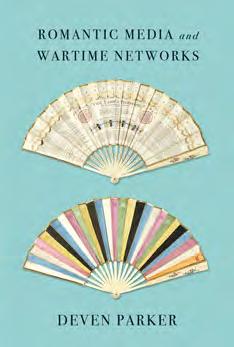
ROMANTIC MEDIA AND WARTIME NETWORKS
DEVEN PARKER
This book tells the story of how Britain revolutionized its state communication networks on an unprecedented scale during the French Revolution and the Napoleonic Wars, setting the stage for our modern infrastructure state where connectivity and surveillance go hand in hand. Deven Parker argues that Romantic literary representations of this state communications network managed to reveal—and, on occasion, to resist—its ideological functions.
In a wide-ranging study drawing upon an archive of military surveys, spy reports, trial records, and even ladies’ hand fans, Parker reveals the scope and impact of the British government’s investments in shutter telegraphs, mapping projects, and postal routes across two decades of war with France. The writers of the Romantic period, meanwhile, were cognizant of the political motivations undergirding the state’s overhauled networks, which were designed to facilitate and speed up but also to more easily control communications. Taking up familiar writers including Lord Byron, Mary Wollstonecraft, William Godwin, Charlotte Smith, Charles Lamb, William Hazlitt, and Thomas De Quincey—as well as lesser-known figures such as radical playwright John Dent, inventor Richard Lovell Edgeworth, and the proto-science fiction novelist Jane Loudon—Parker reads Romantic literature for its astute chronicling and interrogation of the material hardware of state media ecology.
Deven Parker is Leverhulme Early Career Postdoctoral Fellow at the University of Glasgow.
AMERICAN ROMANTICISM AND THE EVOLUTIONARY IDEA
JENNIFER J. BAKER
Evolutionary thought transformed nineteenth-century American intellectual life. This book details how it shaped literature in the middle decades of the century and intersected with Romantic conceptions of selfhood, society, and the history of life. Jennifer J. Baker reads the era’s Romanticism in relation to Darwin as well as naturalists, embryologists, ethnologists, anthropologists, and even Biblical creationists who used evolutionary frameworks to understand the past and future. The “evolutionary idea” encompassed much more than Darwinism, she argues, and even Darwinism in these decades was variously understood and not necessarily the secular, mechanistic, and deterministic thinking we now associate with the Gilded Age. Baker uncovers an earlier, Romantic evolutionism in writing about self-culture, social reform, racial uplift, prehistoric life and cultures, and the creation of art. Further, Baker proposes that American Romanticism was itself a way of thinking about the human condition in the terms of evolutionary process. She draws on an extensive literary archive, including works by Emerson, Thoreau, Fuller, Douglass, Delany, Dickinson, Whitman, Melville, Hawthorne, and Poe, to detail how writers understood change and innovation as the product of teleology, chance, social organization, environmental pressures, and, not least of all, the past.
Jennifer J. Baker is Associate Professor of English at NYU and the author of Securing the Commonwealth: Debt, Speculation, and Writing in the Making of Early America (2006).
SEPTEMBER 2026
13 halftones
240 pages | 6 x 9
Cloth $75.00 (£62.00) SDT 9781503645608
eBook 9781503647633
Literary Studies
SEPTEMBER 2026 392 pages | 6 x 9
15 halftones
Cloth $70.00 (£58.00) SDT 9781503647343
eBook 9781503647725
Literary Studies
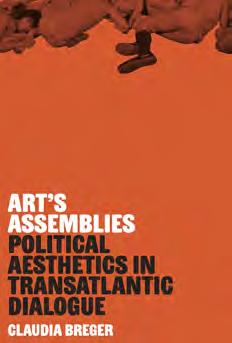
ART’S ASSEMBLIES
Political Aesthetics in Transatlantic Dialogue
CLAUDIA BREGER
Art’s Assemblies offers a new political aesthetics for the present.
Claudia Breger makes a case for art’s power to act politically in significant, manifold ways by reconnecting twenty-first-century philosophical frameworks to the more boldly political aesthetics of European modernisms, particularly as developed in response to historical fascism. Thus, the book develops dialogues between recent work in actor-network-theory, radical Black thought, neo-marxism, affect, queer studies, and the twentieth-century tradition of critical theory, with literature, film, TV, and art installation examples included. As acts of political alignment as well as imaginative prefiguration, “art’s assemblies” bring together heterogeneous elements and actions in (polyphonic) “political concert.” This includes how artworks “track” and “trace” pieces of real-world materials even in fantastic contexts; how they work through unfinished histories of violence and dehumanization by “animating” archival documents; how they “fabulate” different historical accounts without engaging in the “forging” actions of fake news; and how they counter the accumulated nightmares surrounding us through practices of “dreaming” interwoven with actions of “drafting” or “demanding.” In this challenging political moment, Breger’s work speaks across disciplines to articulate a new vision of how art can engage with the world—and imagine different futures.
Claudia Breger is Villard Professor of German and Comparative Literature at Columbia University and the author, most recently, of Making Worlds: Affect and Collectivity in Contemporary European Cinema (2020).
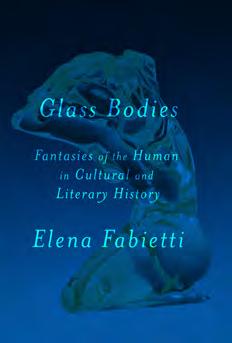
GLASS BODIES
Fantasies of the Human in Cultural and Literary History
ELENA FABIETTI
Glass Bodies tells the story of how transparent humans have appeared throughout European history—in fiction, philosophy, and science—and what they reveal about changing ideas of the human.
The book takes off in antiquity with the myth of Momus, who reproaches the gods for failing to build a window into the human heart so that humans’ thoughts and wishes would be visible. From there, it follows transparent figures into the works of Cervantes, Rousseau, Sterne, and Goethe, and into the world of science, medicine, and public exhibitions: from mechanic eighteenth-century medical models to the famous Transparent Anatomical Manikin displayed in science museums. Elena Fabietti weaves together literature, cultural history, and material culture to show how transparent humans reflected the dreams and anxieties of their own time and how they were shaped by specific material conditions, the history of glass production, and scientific and medical beliefs.
Glass bodies, Fabietti shows, have always been more than curiosities; they served as speculative, normative, or utopian figures through which cultural tensions were articulated, revealing how people thought about the body, its agency, and limitations.
Elena Fabietti is a scholar of comparative literature and Assistant Professor in the German Literature Department at the University of Regensburg.
OCTOBER 2027 272 pages | 6 x 9
8 halftones
Paper $35.00 (£27.99) SDT 9781503649170
Cloth $140.00 (£116.00) SDT 9781503649163
eBook 9781503649187
Literary Studies
CULTURAL MEMORY IN THE PRESENT NOVEMBER 2026 248 pages | 6 x 9
20 halftones
Cloth $70.00 (£58.00) SDT 9781503647473
eBook 9781503648319
Literary Studies
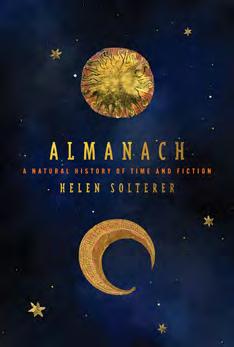
ALMANACH
A Natural History of Time and Fiction
HELEN SOLTERER
An age-old, revolutionary design for keeping time by the moon: the almanach outlines a plan for your day-to-day—commemorating notable events in human history while forecasting others in the natural world. In this novel work of criticism, Helen Solterer adopts the form of the almanach to make the case for fiction as experimental work composed in time. Each entry examines a major fictional form taking shape in French around 1400 and its ensuing transformations and interventions in other epochs and cultures: the political vision of writer-activist Edith Thomas with Christine de Pizan, the personal poetry of Langston Hughes and Pauli Murray with Villon, the theater of Samuel Beckett and BernardMarie Koltès with those devising the first mystery plays. Solterer takes us from Turkey where almanachs were assembled, across the European continent, to circumpolar Arctic zones where Inuit Thule hunters incised graphic narrative in ivory still used by Inuit artists today.
These “timely fictions,” as Solterer dubs many of them, engage generations of creators at an unpredictable tempo; at any given moment, timely fictions exist as the sum of multiple experiments in time. They are a type of compost. Over years, writers and artists mix materials to fertilize the work they make for various different circumstances. By both unearthing and recycling this model, Solterer composes a wholly inventive natural history of fiction.
Helen Solterer is Professor, French and Francophone Studies, Romance Studies at Duke University, and co-editor of Migrants Shaping Europe (2022), among other titles.
THE COLLECTIVE VOICE
Modern
Literature and the Politics of Speech
MATTHEW TAUNTON
While collective speech can seem a disparate set of practices—from prayers to protest chants, and from football songs to oaths of allegiance and national anthems—Matthew Taunton argues that we can think of these together. Speaking in unison is often considered to be in decline in an individualistic modernity and associated with earlier, more ritualistic, and even “primitive” states of being. In this incisive new book, Taunton draws on a fascinating archive of literary texts from Britain, Continental Europe, North America, Africa, and the Caribbean to demonstrate the ongoing importance of the collective voice in building group solidarity, with a variety of political meanings. Analyzing texts and performances by writers including Katharine Burdekin, T. S. Eliot, Jane Harrison, Langston Hughes, Zora Neale Hurston, Jack Lindsay, Jacques Roumain, Ousman Sembène, and Wole Soyinka, the book maps the relationship of different forms of collective vocalization to political power, with chapters that observe the collective voice in positions of refusal, protest, and hegemony. Combining historical contextualization, detailed formal analysis, and social and political theory, Taunton argues that a critical account of the functions of the collective voice is essential to understanding the contemporary rise of far-right, nationalist, and fascist politics, and shows how radical and left-wing writers have tapped the more egalitarian potentials of collective speech.
Matthew Taunton is Professor of Modern Literature at the University of East Anglia and the author, most recently, of Red Britain: The Russian Revolution in Mid-Century Culture (2019).
NOVEMBER 2026 216 pages | 6 x 9
25 black-and-white halftones, 10 color halftones
Paper $30.00 (£23.99) SDT 9781503648371
Cloth $120.00 (£99.00) SDT 9781503647565
eBook 9781503648388
Literary Studies
NOVEMBER 2026 256 pages | 6 x 9
2 figures, 3 halftones
Paper $30.00 (£23.99) SDT 9781503648494
Cloth $120.00 (£99.00) SDT 9781503642300
eBook 9781503648500
Literary Studies
WRITING ON WATER
Cold War Literary Translations and the Chinese Diaspora
L. MARIA BO
During the Cold War, the ideological struggle to win the hearts and minds of the Chinese took place on the pages of literary texts. A battle of the books between Washington DC and Beijing mobilized entire networks of US Foreign Service posts, book publishers, and higher education institutions to take sides in propagating representations of either democracy or communism to ethnic Chinese communities around the world. In Writing on Water, L. Maria Bo argues that these propagated literary texts, simply by undergoing translation, also became the means for new forms of anglophone Chinese identity and diasporic communities to emerge.
R ather than examining how translated literary texts produced strict equivalents that “worked” to spread ideology, Bo reads these texts as fluid equivocal exchanges. She attends to the various languages through which these texts traveled, including hegemonic varieties of English, numerous forms of Chinese, and other local patois. Doing so uncovers how ideology and meaning come undone in these texts-in-transit, allowing us to imagine the formation of dispersed, ideologically diverse reading publics spanning East Asia, Southeast Asia, and the US heartland.
L. Maria Bo is Assistant Professor of English at Stanford University.
NARRATIVIZED SPACE Storification and Urban Design
AARON SANTESSO
In Narrativized Space, Aaron Santesso examines a phenomenon that is at least passingly familiar to most of us: space arranged so as to create the feeling of moving through a story. This book analyzes the implementation of narrativized space, a demarcated and sequentialized area that gradually reveals an argument, claim, or story to the person passing through it. Santesso follows the history of this form from the eighteenth century to the modern day, especially as realized within four institutions: landscape gardens, zoos, museums, and amusement parks. As the book reveals, each institution shows a new step in the development of this phenomenon, and each is especially influenced by a particular literary genre. The design of twentieth-century zoo exhibits, for example, reflects the rising popularity of adventure stories, while the theme park has a special relationship with Fantasy and SciFi narratives. The implementation of narrativized space has special relevance to the modern city, and the book discusses both the past and the future of narrativized space as an urban planning strategy. An interdisciplinary work that moves between literary studies, geography, and urban studies, Narrativized Space shows how narrative theory and formalist analysis can offer insight into the operation of real-world story-structures, and makes a case for the value of literary-critical expertise to urban planning and design.
Aaron Santesso is Professor of Literature at the Georgia Institute of Technology, and the author, with David Rosen, of The Watchman in Pieces: Surveillance, Literature, and Liberal Personhood (2013).
ASIAN AMERICA
NOVEMBER 2026 288 pages | 6 x 9
6 halftones
Paper
$30.00 (£23.99) SDT 9781503648463
Cloth $120.00 (£99.00) SDT 9781503636774
eBook 9781503648470
Literary Studies
DECEMBER 2026 248 pages | 6 x 9
22 halftones
Paper $30.00 (£23.99) SDT 9781503649149
Cloth $120.00 (£99.00) SDT 9781503649132
eBook 9781503649156
Literary Studies
LAW AND MEDIA
CORNELIA VISMANN
The essays collected in Law and Media present German media theorist Cornelia Vismann investigating how law functions through the media technologies used to produce, disseminate, and preserve it—from papyrus and the codex to courtroom stenography and Stasi files. Expanding on the understanding of the cultural techniques of law advanced in her landmark first book, Files, Vismann explores topics including the history of Roman law, the development of law books and archives, the transcription and translation of laws and legal proceedings, and the techniques and technologies of bureaucratic administration.
Translated here for the first time into English and featuring an introduction situating Vismann’s thought in terms of her scholarly interlocutors, this book brings Vismann’s creative theoretical work, in the form of lively and accessible essays, to readers in cultural studies, media studies, political philosophy, and legal history. For first-time readers of Vismann, these essays will provide a valuable introduction to her key concepts and ideas, while those familiar with the pioneering media theorist will find additional insight into the theories and scholarship that shaped her unique approach.
Cornelia Vismann (1961–2010) was Professor for the History and Theory of Cultural Techniques at the Bauhaus University in Weimar. She is the author of Files: Law and Media Technology (Stanford, 2008), her only other book in English.
CULTURAL TECHNIQUES OF BIOSENSING
A History of the Body in Error
CHRISTOPHER O’NEILL
Against the emergence of “the Internet of Bodies,” Christopher O’Neill presents an incisive long history of biosensing technologies from the mid-nineteenth century to the present. As O’Neill shows, sensor technologies work by failing—if their mode of measure never quite captures the body, this is a feature and not a bug. Nobody and no body really fits into the Internet of Bodies, but the endless correction of biosensor errors works to endlessly extend the reach of the sensor society.
O’Neill’s book traces the emergence and transformation of the cultural techniques of biosensing which “work through” these errors. O’Neill shows how the early pulse-writing sensors of the sphygmograph produced a newly educated touch in the medical clinic; the way work measurement technologies not only optimized but introduced a new intimacy into the post-Fordist workplace; and how the sensors in nineteenth-century burglar alarms enabled a new choreography of servants’ movements in the American home. O’Neill demonstrates how these histories presage contemporary anxieties surrounding the Quantified Self movement, the management of affective intensities in digitally surveilled workplaces, and the integration of the gig economy within the smart home.
Just as O’Neill demonstrates that technologists’ claims to objectivity, transcendence, and omniscience remain frustrated by the messy reality of the body, the book also shows that we must go beyond the typical critical gesture of pointing out errors, biases, and false assumptions about the body, and instead show what precisely these errors do
Christopher O’Neill is a Lecturer in Media at Monash University.
SENSING MEDIA: AESTHETICS, PHILOSOPHY, AND CULTURES OF MEDIA
SEPTEMBER 2026
192 pages | 6 x 9
Paper $24.00 (£18.99) SDT 9781503647695
Cloth $95.00 (£79.00) SDT 9781503647596
eBook 9781503647701
Media Studies
SENSING MEDIA: AESTHETICS, PHILOSOPHY, AND CULTURES OF MEDIA
SEPTEMBER 2026
12 halftones
184 pages | 6 x 9
Cloth $70.00 (£58.00) SDT 9781503647503
eBook 9781503647893
Media Studies
EVERYTHING IS EVERYTHING
Tom Wilson and Pop Music in 1966
STEVEN E. JONES
AN EXPLORATION OF AMERICAN POP CULTURE THROUGH THE WORK OF RECORD PRODUCER TOM WILSON AND THE ARTISTS WITH WHOM HE COLLABORATED IN THE MIRACULOUS YEAR 1966.
1966 was a transformative year in popular culture. It’s the year when go-go dancing met the electric blues, bubblegum pop met underground rock, free jazz met psychedelia, and they all morphed into one another like fluid blobs in a liquid light show. Diversifying radio formats greeted an efflorescence of boundary-breaking artists, records, and songs, at once showcasing and encouraging fervent experimentation. At the center of these changes stood the profoundly influential, if subsequently unheralded, record producer, Tom Wilson.
It would be hard to find a figure more solidly located at the junction of the currents traversing America in 1966: a Black man working in almost exclusively white studio settings, Wilson played a vital role in an astonishing array of landmark records. After producing Bob Dylan and Simon & Garfunkel in the previous year, in 1966 alone Wilson produced albums from Frank Zappa & the Mothers of Invention, The Velvet Underground, Hugh Masekela, The Animals, Sun Ra, and more. Any one of these would be a standout on most producers’ resumes. Taken together, they testify to an influential career, and invite a new appraisal of a pivotal moment in American pop culture. As Jones reveals in this energetic account, Wilson’s radical eclecticism and his embrace of diverse musical genres was a response to the times. It was all part of making pop music in what he called “an era of complex mixed media,” and what he meant by his often-repeated catch-phrase, “everything is everything.”
Dying young in 1978, without leaving behind a significant archive of interviews or writings, Wilson has been unjustly overlooked. Everything is Everything provides a long overdue testimonial, celebrating him as an avatar of the most important trend in pop music in 1966: an exploding eclecticism, accompanied by a sometimes desperate search for authenticity.
“Two books rolled into one: an exploration of Tom Wilson, understudied maverick and industry mainstay, and of 1966 in pop music. This works because of the intricacy, thoughtfulness, intelligence, and prodigious research that animate these pages.”
—Eric Lott, author of Black Mirror: The Cultural Contradictions of American Racism
Steven E. Jones is the former DeBartolo Chair in Liberal Arts and Professor of English and Digital Humanities at the University of South Florida, and is the author of many books, including Cell Tower (2020).
SEPTEMBER 2026
248 pages | 6 x 9
Paper $30.00 (£23.99) AC 9781503647909
Cloth $120.00 (£99.00) SDT 9781503647626
eBook 9781503647916
Media Studies
Credit: Sabra Levine
MOVING PICTURES UNDER THE PALMS
Cinema in the Colonial Tropics
NADINE CHAN
How does tropicality—a concept historically rooted in colonial thought—shape colonial media and society? Thinking cinematically through a framework of tropicality—a constellation of ideas including forest, heat, humidity, miasma, microbes, logistics, labor, infrastructure, extraction, and animism—Nadine Chan demonstrates how colonial cinema created ambient spaces that enabled colonial power to take root and endure—as well as to wear away and break down. Beginning in the 1920s and continuing beyond British Malaya’s independence in 1957, colonial filmmakers sought to transform Malaya’s tropical landscape—long deemed unruly, excessive, and dangerous—into arenas of modernity and capital. In equatorial rainforests, rubber plantations, tin mines, villages, and more, colonial governments deployed open-air cinemas as ambient infrastructures of power—environ-mental surrounds that were at once elemental, atmospheric, cognitive, and affective. Weaving these cinematic environments within non-technological media landscapes that include architecture and urban design, supply chain logistics, and more-thanhuman spirit networks in local animist cosmologies, Chan demonstrates how the colonial tropics calls for expanded understandings of media worlds. Meanwhile, phenomena such as floods and fungi, mountain spirits and mechanical failure, bacterial infections and militant insurgencies emerge as possibilities for counter-colonial attrition. Drawing on multimodal methodologies including original archival research, film analysis, oral histories, on-site film screenings, and forest hikes as topographic memory-making, Chan develops an innovative theoretical and historiographical framework for thinking about media environments across multiple fields in media studies.
FACIAL RECOGNITION IN EVERYDAY LIFE
MARK ANDREJEVIC, PAT O’MALLEY, NEIL SELWYN, CHRIS O’NEILL, XIN GU, AND GAVIN SMITH
Facial recognition technology is one of the defining surveillance technologies of our time, and as the technology continues to develop it is urgently important to consider the ways in which it amplifies and reconfigures power relations.
W hile much of the critical work on facial recognition technology has focused on bias and accuracy, this book considers the social, cultural, and political implications of a surveillance technology poised to dramatically transform our experience of anonymity in shared and public space. Drawing on a series of case studies to explore how existing logics of digital surveillance are transformed when physical space is equipped with automated recognition, the book develops several defining concepts for understanding what this level of surveillance means for strategies of governance and control. Long the object of physiognomic calculations, the face, as subjected to automated forms of data collection, is now already being used to predict everything from people’s future career success to their potential for criminality. Further, the authors show, as “smart” cameras proliferate, society moves into a post-panoptic realm in which people are actually being watched all the time. This shift from surveillance scarcity to glut allows “pattern of life” analysis on a mass scale, aiding in the customization of both physical and informational environments at the level of the individual and enabling the ongoing replacement of human-to-human interactions with automated human-to-machine ones—a process the authors describe as a “social recession.”
The authors are members of a research team at Monash University and the Australian National University funded by the Australian Research Council.
SENSING MEDIA: AESTHETICS, PHILOSOPHY, AND CULTURES OF MEDIA
FEBRUARY 2027 312 pages | 6 x 9
47 halftones
Paper $32.00 (£24.99) SDT 9781503649316
Cloth $130.00 (£108.00) SDT 9781503632486
eBook 9781503648326
Media Studies
SENSING MEDIA: AESTHETICS, PHILOSOPHY, AND CULTURES OF MEDIA
JANUARY 2027 272 pages | 6 x 9
Paper $30.00 (£23.99) SDT 9781503648654
Cloth $120.00 (£99.00) SDT 9781503637160
eBook 9781503648661
Media Studies
Nadine Chan is Assistant Professor in the Cinema Studies Institute at the University of Toronto.
DEBT AND REFUGE
Syrian Farmworkers and the Politics of Displacement in Lebanon
CHINA SAJADIAN
Lebanon hosts the highest number of refugees per capita in the world, including up to 1.5 million displaced Syrians. Many are Syrian farmworkers, who for decades have sustained Lebanon’s agricultural system through their seasonal labor. Debt and Refuge traces how the lives of these farmworkers-turned-refugees were transformed by the war in Syria and Lebanon’s devastating financial collapse, revealing the slow economic violence that can push people off their land, into waged work, and into cycles of debt.
Drawing on fieldwork centered in Lebanon’s Bekaa Valley, China Sajadian documents how Syrian farmworkers’ debts—to labor brokers, landlords, and relatives—bound them to networks that exploited their labor and also sustained them in the face of profound uncertainty. In contrast to humanitarian portrayals of refugees as uprooted victims awaiting asylum or return, Sajadian locates their predicaments within a longer history of rural migration and familial division across the Lebanese–Syrian border. Linking together the politics of mass displacement, mass indebtedness, and our global food system, she makes a case for radically rethinking forced migration as an agrarian question of labor and feminist question of social reproduction. Written with both ethnographic intimacy and analytical depth, Debt and Refuge offers a deeply human portrait of the gendered politics of displacement and why they matter to the future of our agricultural systems and human mobility—in Lebanon, Syria, and beyond.
China Sajadian is Assistant Professor of Anthropology at Vassar College.
EXTRACTIVE STATES
War and Resistance in Turkey’s Kurdish Heartland
U MUT YILDIRIM
The Turkish state and the Kurdistan Workers’ Party engaged in a counterinsurgency war for nearly four decades. Over this period, Diyarbakır, the de facto capital of Greater Kurdistan, was a site of sieges and ceasefires, welfare and humanitarian relief, NGO interventions and decolonial resistance—the complementary, intertwined processes of low-intensity war. War turned urban slums into high-security frontiers and transactional hubs for policy design, and settled deep into embodied knowledges and environments.
Through committed and engaged ethnography, Umut Yıldırım reveals how destruction and displacement became structures of extraction, by which the Turkish state subjugated the Kurdish population into an object to be intervened in, traded, and contained. She also tracks Kurdish efforts to reassert their own stories of war through fact-building, welfare and compensation, women’s wellbeing, acts of solidarity, and environmental politics. What we see is a constant dance between war and peace, movement building and its containment, forced displacement and its rehabilitation, memory and its transmutations, environmental damage and its reconstruction. Extractive States offers compelling examples of how low-intensity war transforms everyday needs, embodied knowledges, and uprooted populations into securitized knowledge—and how everyday sites of perseverance can reveal such extraction, and thus help conceive of novel modes of resistance.
Umut Yıldırım is Assistant Professor of Anthropology at the Geneva Graduate Institute, Switzerland.
STANFORD STUDIES IN MIDDLE EASTERN AND ISLAMIC SOCIETIES AND CULTURES
SEPTEMBER 2026 288 pages | 6 x 9
17 halftones, 1 map
Paper $30.00 (£23.99) SDT 9781503647862
Cloth $120.00 (£99.00) SDT 9781503647602
eBook 9781503647879
Middle East Studies
STANFORD STUDIES IN MIDDLE EASTERN AND ISLAMIC SOCIETIES AND CULTURES
SEPTEMBER 2026 352 pages | 6 x 9
Paper $35.00 (£27.99) SDT 9781503647954
Cloth $140.00 (£116.00) SDT 9781503647367
eBook 9781503647961
Middle East Studies
KING ABDULLAH AND THE SAUDI ARABIAN NATIONAL GUARD
Tribes and Networks in Modern
Saudi Arabia
JOSHUA TEITELBAUM
Abdullah bin ‘Abd al-‘Aziz (1924–2015) was an unlikely contender for the Saudi throne. His kinship ties within the royal family were weak. Yet he rose to power, finally becoming king in 2005. His main instrument was the Saudi Arabian National Guard (SANG), which he took over in 1963, transforming it into a personal power base and a cornerstone of regime security. This book offers the first comprehensive history of SANG, using Abdullah’s little-studied trajectory to illuminate how power functions in Saudi Arabia.
Tracing SANG’s evolution from tribal roots to the present, Joshua Teitelbaum explores the enduring role of tribal values—especially kinship—in shaping Saudi society and the modern state. He shows how Abdullah compensated for his weak lineage through patronage and kickback schemes. Drawing on newly declassified archival documents and Arabiclanguage sources, Teitelbaum also uncovers rival royal kinship networks and an American intelligence-business network that challenged Abdullah and SANG. The narrative concludes with Crown Prince Muhammad bin Salman, whose rule continues this kinship-based network system with a new network of his own. Ultimately, this book reveals how kinship and patronage underpin Saudi governance, providing key insight into one of the world’s most opaque and strategically vital monarchies.
Joshua Teitelbaum is Professor of Middle Eastern Studies at Bar-Ilan University and the author of The Rise and Fall of the Hashimite Kingdom of the Hijaz.
PIPE ECONOMICS
Engineering the Waters of Modern Cairo
SHEHAB ISMAIL
In 1865 the Cairo Water Company secured a ninety-nineyear concession granting it exclusive control over the water supply in the Egyptian capital. What followed was a profound remaking of the city and everyday life. Historically, water had been drawn from the Nile and delivered to public facilities by manual labor. By the early twentieth century, however, mechanized pumping, underground pipes, and in-home fixtures were rapidly becoming the new norm. Pipe Economics tells the story of modern Cairo through the hidden infrastructure that made this transformation possible.
Drawing on extensive research in Egyptian and British archives, Shehab Ismail uncovers how water and sewage networks reshaped Cairo—its housing and construction patterns, urban planning practices, public health regimes, urban services and their underlying economies, and even national politics. As the old collectively managed water system gave way to private companies and expanding state bureaucracy, faucets, drains, and flushing toilets became defining features of the Egyptian home, altering how people lived, consumed, and understood what it meant to be modern. By following the engineers who designed, built, and managed water infrastructures, this book positions Cairo as a vivid example for exploring a global shift in water management, from a regime rooted in public, communal institutions to one centered on individualized, domestic use.
Shehab Ismail is Adjunct Assistant Professor in the Middle East Studies Center at the American University of Cairo.
OCTOBER 2026 376 pages | 6 x 9
1 figure, 11 halftones, 2 maps, 2 tables
Cloth $75.00 (£62.00) SDT 9781503630918
eBook 9781503648289
Middle East Studies
NOVEMBER 2026
280 pages | 6 x 9
2 tables, 32 halftones, 2 maps
Cloth $70.00 (£58.00) SDT 9781503640368
eBook 9781503648487
Middle East Studies
IN A LAND OF AID
Essays on the Palestinian Condition
SA’ED ATSHAN
AN URGENT EXAMINATION OF PALESTINE’S HUMANITARIAN CRISIS—REVEALING INTERNATIONAL AID AS BOTH A LIFELINE AND AN INSTRUMENT OF COLONIAL POWER.
For decades, the international community, Israeli occupation, and Palestinian elites have engineered the humanitarianization of the Palestinian Territories— reframing the question of Palestine as a humanitarian concern rather than a political one. Today, the West Bank and Gaza Strip have become the world’s humanitarian laboratory, and Palestinians are among the largest recipients per capita of humanitarian aid. This aid provides Palestinians with essential tools for survival and resilience, yet it has also entrenched Israeli colonial control.
Across a series of bracing essays authored by anthropologist Sa’ed Atshan, In a Land of Aid traces how humanitarianism has become the dominant lens through which Palestinian life is now governed. Drawing on over a decade of research, Atshan introduces readers to foreign aid workers, policymakers, scholars, and Palestinians as they navigate political constraints on the ground. Together, these encounters reveal an aid apparatus riddled with contradiction: simultaneously sustaining life, narrowing political imagination, and generating new forms of inequality and contestation.
Writing with principled care, Atshan amplifies Palestinian voices that express growing ambivalence toward both the prevailing humanitarian discourse and the inherited resistance narratives that no longer fully capture their embodied realities. Atshan finds that to understand contemporary global humanitarianism, we must reckon with its impact in Palestine; and to understand contemporary Palestinian society, we must confront the role of aid. Ultimately, this book insists that the most powerful response to the paradoxically dehumanizing effects of aid lies in our affirmation of shared humanity.
“While honoring the work of global and local humanitarians, Sa’ed Atshan bears vivid witness to Palestinian life under violent colonial rule. A masterful account of the Palestinian condition— immensely powerful, brilliant, and stunning—this book should be read by all.”
—Marcia C. Inhorn, author of The New Arab Man: Emergent Masculinities, Technologies, and Islam in the Middle East
Sa’ed Atshan is Associate Professor of Peace and Conflict Studies and Anthropology at Swarthmore College. He is the author of Queer Palestine and the Empire of Critique (Stanford, 2020), among other works.
NOVEMBER 2026 240 pages | 6 x 9
Paper $25.00 (£19.99) AC 9781503648968
Cloth $100.00 (£83.00) SDT 9780804798334
eBook 9781503648975
Middle East Studies
COLONIAL CONSTRUCTS
Stone, Cement, Labor, and Race in Modern Palestine/Israel
NIMROD BEN ZEEV
For over a century, construction has been at the heart of the struggle over Palestine/Israel. The ability to build on the land, the capacity to extract materials from it, and the development of economic and technological dominance in the construction industry were all central to Palestinian and Zionist ambitions to establish modern national communities. Construction also contributed to cementing a colonial social hierarchy among Jews and Palestinians, as racialized notions of skill, ability, and human needs shaped divisions of labor within the industry and the built environments.
From the vantage points of the construction site, cement factory, workers’ encampment, self-built home, and boardroom, Colonial Constructs provides a new perspective on the Zionist–Palestinian conflict. Here, the materiality of the land itself—the rocks that underlie it and the buildings and infrastructure that construct it—take center stage. Following the experiences and aspirations of those who labored to excavate, manufacture, and build, Nimrod Ben Zeev tracks the interplay between construction work, the construction industry, and metaphorical constructions of nation- and state-building, the building and rebuilding of communities, and the construction of social difference. In so doing, this book reveals the material underpinnings of a colonial structure of domination, but also the long Palestinian history of rebuilding in the shadow of ongoing catastrophe.
Nimrod Ben Zeev is Lecturer in the Department of Labor Studies at Tel Aviv University.
ACCUMULATING POWER
Capitalism, Belonging, and the Late Ottoman Order
CAMILLE LYANS COLE
Accumulating Power offers a new way of thinking about belonging, sovereignty, and empire—and how the meanings of being “Ottoman” changed with the intersection of capitalism and imperial reform. Ottoman subjecthood and loyalty transformed around the turn of the twentieth century with the emergence of an international system and intensification of commodity production. Imperial belonging was conditioned by new discourses around community, increasing material conflict, and the new tools, forms, and ideologies of the modern state. People displayed their “Ottoman-ness” in how they coped with these novel political economies and shaped them to their own ends.
With this book, Camille Lyans Cole traces Ottoman belonging through the making of a region, the Gulf of Basra— centered on the port city of Basra, extending to southern Iran and Kuwait—where people, water, commodities, ideas, and money all circulated. Here, elites’ desire to claim Ottoman-ness often arose at points of friction between regional ways of life and the transforming structures of the territorializing modern empirestate. Cole centers the lives of six individuals, tracing how each contributed to the material and political worlds of the Gulf of Basra. Through these microhistories, Cole reveals how elites used “technologies of the state”—bureaucratic instruments, discourses, and symbols—to accumulate wealth, capital, access to resources, and imperial status and to declare their own Ottoman-ness.
Camille Lyans Cole is Assistant Professor of History at Illinois State University.
STANFORD STUDIES IN MIDDLE EASTERN AND ISLAMIC SOCIETIES AND CULTURES
FEBRUARY 2027 304 pages | 6 x 9
12 halftones, 3 maps
Paper $32.00 (£24.99) SDT 9781503648678
Cloth $130.00 (£108.00) SDT 9781503647442
eBook 9781503648685
Middle East Studies
STANFORD OTTOMAN WORLD SERIES: CRITICAL STUDIES IN EMPIRE, NATURE, AND KNOWLEDGE
DECEMBER 2026 328 pages | 6 x 9
2 tables, 1 figure, 15 halftones, 5 maps
Cloth $75.00 (£62.00) SDT 9781503647428
eBook 9781503648807
Middle East Studies
SEA CHANGES
North African Encounters in the Colonial Mediterranean
CHRIS ROMINGER
At the turn of the twentieth century, confrontations between rival French, Italian, and Ottoman empires solidified national, colonial, and racial boundaries throughout the Mediterranean basin. Yet, even in the face of an emergent ethno-nationalist world order, these decades saw various North African transnational political movements thrive. Sea Changes examines how North Africans of diverse social and religious backgrounds forged new spaces and networks in which to envision bordercrossing political alternatives, such as pan-Islamism, panArabism, Zionism, and international leftism.
To unveil these alternative networks and political possibilities, Chris Rominger follows the trajectory of Jewish Tunisian photographer Albert Samama-Chikly (1872–1934) and his contacts from the 1870s to the 1920s. Not an overtly political man in any traditional sense, the highly mobile Samama nonetheless found himself an intimate witness to some of the early twentieth century’s most violent political dramas, including France’s colonization of Tunisia, Italy’s conquest of neighboring Libya, the forced conscription of North Africans during World War I, and the postwar birth of transnational and radical movements across North Africa. Emphasizing the bordercrossing experiences of those who lived on the Mediterranean’s southern shores, Sea Changes locates North Africa at the very heart of key transformations and imperial conflicts where diverse and fluid transimperial affinities clashed with emergent ethnonationalist imperatives.
Chris Rominger is Director of Undergraduate Studies with Harvard University’s Committee on Degrees in Social Studies.
ANATOMY OF EMPIRE
Sex and Medicine in the Late Ottoman World
DECEMBER 2026 280 pages | 6 x 9
34 halftones, 1 map
Paper $32.00 (£24.99) SDT 9781503648203
Cloth $130.00 (£108.00) SDT 9781503648043
eBook 9781503648210
Middle East Studies
SEÇIL YILMAZ
Syphilis had existed in Ottoman society since the sixteenth century, but it became an alarming public health problem in the nineteenth century. As the epidemic raged with population movements across provincial and imperial borders, Ottoman authorities mobilized medical staff and implemented public hygiene regulations. Seçil Yılmaz unravels how a disease long associated with shame and secrecy became a key site through which Ottomans expanded their hegemony and governance, situating medicine and sex at the center of imperial rule.
Anatomy of Empire reveals the multifaceted implications of biopolitics found in the encounters and negotiations among the diseased, sex workers, working-class men, and physicians within a complex imperial bureaucracy. Medical knowledge and practices became effective tools to govern and discipline a population, particularly as Ottoman physicians formulated vernacular forms of sexology that re-fashioned love, desire, and marriage. As syphilis persisted across the world, Ottomans joined their European counterparts in pursuit of bacteriological discoveries to understand the causes behind the resilience of this silent yet destructive disease. With this book, Yılmaz offers a history of gender, sexuality, and medicine, one set in a consequential geography—in the lands of Ottomans at the verge of their demise—and unearths how truth regimes pertaining to the body and sexuality are indispensable components of modern imperial governance.
Seçil Yılmaz is Assistant Professor of History at the University of Pennsylvania.
FEBRUARY 2027 328 pages | 6 x 9
1 table, 10 halftones, 2 maps
Paper $30.00 (£23.99) SDT 9781503648869
Cloth $120.00 (£99.00) SDT 9781503647770
eBook 9781503648876
Middle East Studies .
BEYOND ABOLITION
“Self-Lynching” and Its Afterlife
LINETTE EUNJOO PARK
In this pathbreaking work, Linette Eunjoo Park tackles a core crisis in modern thought: how to critique antiblack violence without inadvertently preserving the violence itself. Arguing that previous radical theories—from critiques of racial capitalism to discourses of abolition—have failed to capture the unique, foundational violence of antiblackness, Park develops a framework that challenges the very limits of what critical thought can achieve against the staggering evidence of antiblackness.
The book moves beyond conventional historical or legal analyses to examine how antiblack violence—specifically through the concept of “self-lynching”—is produced and enforced by the very legal and symbolic systems designed to abolish it. Focusing on contemporary arrests made under the “felony lynching” penal code in California, the book unearths a genealogy that authorizes these charges. Through an innovative analysis of case studies—including the historical elision of anti-lynching activist Delilah Beasley, Melvin Edwards’s sculptures, Torkwase Dyson’s paintings, and the judicial spectacle of Clarence Thomas’s hearing—Beyond Abolition reveals the ultimate failure of racial representation to contain or critique antiblackness. By tarrying with these aesthetic and juridical fragments, the book exposes a structural and psychical “lynching” of blackness that persists even, and especially, within our most celebrated critical frameworks. It proposes a methodological shift: the urgent need to move past the imagination of a “real abolition” and toward the confrontation with the un-settable, violent foundation of the modern world.
Linette Eunjoo Park is Assistant Professor in the Department of Women’s, Gender, and Sexuality Studies at Emory University.
VARIETIES OF AESTHETIC EXPERIENCE
On the Affective Potential of Art
TONE ROALD
Tone Roald creates a new foundation for aesthetics by taking seriously real-life experiences with works of art. Relying upon descriptions of experiences with art in the autobiographical and literary texts of St. Augustine, Diderot, Stendahl, Woolf, and Proust, as well as fifteen-years’ worth of interviews with museumgoers about their most intense experiences with visual arts, Roald explores the variety of aesthetic experiences available to us throughout history and articulates why experiences with art remain important today. The book draws upon phenomenological psychology, psychoanalysis, and cultural theory to articulate a taxonomy of basic affective experiences with art. What affect is, what affective experiences with art are like, and what meanings these experiences have for us have been limited in aesthetic theory. Beginning with pleasure, continuing with wonder and resonance, and ending with rapture and serenity, she notably reveals similarities in aesthetic experience across history. Roald’s work seeks a democratization of art; not concerned with the “correct interpretation” of the work of art or with idealized responses to art, this eye-opening new approach grants primacy to experience— historical and contemporary—and lays an experiential foundation for the development of a different kind of aesthetic theory.
Tone Roald is Associate Professor in the Department of Psychology at the University of Copenhagen and Director of Center for Phenomenological Psychology and Aesthetics at the University of Copenhagen. She is the author of The Subject of Aesthetics (2015).
INVENTIONS: BLACK PHILOSOPHY, POLITICS, AESTHETICS
OCTOBER 2026 304 pages | 6 x 9
Paper $30.00 (£23.99) SDT 9781503648357
Cloth $120.00 (£99.00) SDT 9781503630543
eBook 9781503648364
Philosophy and Critical Theory
OCTOBER 2026 192 pages | 6 x 9
12 halftones
Paper $25.00 (£19.99) SDT 9781503648739
Cloth $100.00 (£83.00) SDT 9781503647404
eBook 9781503648746
Philosophy and Critical Theory
THE ACCELERATION OF HISTORY
From the Enlightenment to the Anthropocene
CHRISTOPHE BOUTON
Like a speeding locomotive that has lost its driver, the history of Western society since the mid-nineteenth century has been characterized as an exponential, out-of-control acceleration. Simultaneously, in recent decades, the destructive impact of human activity on the planet has increased at a spectacular rate, giving rise to what has been called the Great Acceleration. But a kind of reversal seems to be taking place: nature, once seen as a realm of repetition, has become historicized and even rushed toward an end, while history, the very site of change itself, appears strangely stagnant. In the wake of Reinhart Koselleck, Bouton offers readers a history of the idea of acceleration from the Enlightenment to the Anthropocene and invites us to undertake a critical assessment of this narrative of the “acceleration of history.” Challenging the theories of Hartmut Rosa and François Hartog, he emphasizes the plurality of temporal experiences that characterize our present—the polychrony of modernity. Ultimately, the book’s aim is not to deny the relevance of the categories of acceleration and presentism for understanding modernity, but rather to show that alternative rhythms and relationships to both past and future also exist.
Christophe Bouton is Professor of Philosophy at Bordeaux Montaigne University. His research focuses on the history of German philosophy, the theory of history, and the philosophy of time.
“THE ABSENT GOD” AND OTHER CRITICAL AND PHILOSOPHICAL WRITINGS
SUSAN TAUBES, EDITED BY SARAH HAMMERSCHLAG
This essential work collects Susan Taubes’s philosophical and critical writings, establishing her as one of the most remarkable philosophical minds of the twentieth century. At the centerpiece of the volume is Taubes’s dissertation on Simone Weil, “The Absent God,” and also included are her previously published essays and reviews on Weil, Heidegger, Genet, and Camus, as well as an unpublished fragment on Kafka. Taken together, these rigorously philosophical works show Taubes to be a thinker preoccupied with seeking out a lexicon—of myth and symbol, image and narrative—by which to articulate the conundrum of how to live and die in a cosmos saturated with meaning but devoid of divinity. There has been a surge of interest in Taubes following the recent republication of her novels Divorcing and Lament for Julia. With an incisive introduction by Sarah Hammerschlag, this volume provides the necessary supplement to her fictional corpus, tracking Taubes’s transformation from philosopher to novelist, while revealing Taubes to be not only an extraordinary literary voice but a profound scholarly one as well.
Susan Taubes was a twentieth-century writer and scholar. Her literary writings include Divorcing (1969, 2020) and Lament for Julia (2023).
Sarah Hammerschlag is John Nuveen Professor of Religion, Literature and Visual Culture, Philosophy of Religions and Jewish Thought and Culture at the University of Chicago Divinity School.
CULTURAL MEMORY IN THE PRESENT FEBRUARY 2027 328 pages | 6 x 9
Paper $35.00 (£27.99) SDT 9781503648692
Cloth $140.00 (£116.00) SDT 9781503648067
eBook 9781503648708
Philosophy and Critical Theory
CULTURAL MEMORY IN THE PRESENT
JANUARY 2027 384 pages | 6 x 9
Paper $35.00 (£27.99) SDT 9781503648630
Cloth $140.00 (£116.00) SDT 9781503639959
eBook 9781503648647
Philosophy and Critical Theory
REVOLUTIONARY PESSIMISM
Simone Weil’s Antifascist Politics
SCOTT B. RITNER
Scott B. Ritner argues that the antifascist philosopher and mystic Simone Weil’s critical writings about the social crises of the mid-twentieth century, especially fascism, are particularly instructive for today. Now as then, liberal democratic capitalist states are under threat from authoritarian leaders and fascist movements. Situating Weil and her work in the tradition of pessimistic critical theory, Ritner reveals how Weil’s work can be understood as participating in an ongoing critique of capitalist and liberal, neoliberal, and fascist modes of domination. This novel interpretation of Weil’s work argues for reading her combined anarchist, Marxian, antiracist, anticolonial, and Platonic approaches to political thought holistically alongside her mystical Christianity and Judaism as a singular antifascist project in which pessimism is given political prominence. Taking up Weil’s critiques of the state, the organization of labor, the use and effects of violence, and the ideology of revolution, Ritner mobilizes Weil’s idiosyncratic antifascist politics toward a conceptual framework he calls “revolutionary pessimism”— defined as root-and-branch political action without expectation. As Ritner persuades, the revolutionary pessimism perceivable in Weil’s writing can reorient antifascism from a defensive political posture to an offensive posture of generative permanent revolt.
Scott B. Ritner teaches political theory at University of Colorado Boulder. He served as president (2022–2025) and vice president (2019–2022) of the American Weil Society.
AGAINST POLYCRISIS
A Theory of Toxic Presentism
DANIEL M. KNIGHT
We seem to be living in an unprecedented polycrisis. Multiple crises—mass forced migration, imminent climate doom, pandemics, and the rise of the far right, to name a few—intersect and amplify each other to a degree never seen before. But the fact that voices from journalists to academics can so easily label this moment unprecedented, argues anthropologist Daniel M. Knight, is a problem. With this book, Knight builds a case against the polycrisis framework as an example of toxic presentism, in which our analytical gaze is blurred by deeply engrained assumptions about historical progression and linear time.
Against Polycrisis employs diverse lines of thought from anthropology, history, philosophy, and popular culture to unpack recent fascinations with the unprecedented polycrisis trope. Knight critically examines previous historical eras of overlapping crises— from Greece’s recent economic collapse to the 1600s General Crisis to the fall of the Ottoman Empire—in conversation with philosophers, historians, and the next generation of humanistic thinkers, all enriched by reflections on science fiction and popular culture. Knight concludes that the toxic presentism perpetuated in politics, academia, and the media only serves to obscure how the world could be otherwise.
Daniel M. Knight is Professor of Philosophical Anthropology at the University of St Andrews. His most recent book is Energy Talk: Green Knowledge from Greece’s Silicon Plains (2025).
SQUARE ONE: FIRST-ORDER QUESTIONS IN THE HUMANITIES
NOVEMBER 2026
200 pages | 6 x 9
Paper $30.00 (£23.99) SDT 9781503649118
Cloth $120.00 (£99.00) SDT 9781503645592
eBook 9781503649125
Philosophy and Critical Theory
SQUARE ONE: FIRST-ORDER QUESTIONS IN THE HUMANITIES
DECEMBER 2026
216 pages | 6 x 9
Paper $35.00 (£27.99) SDT 9781503649026
eBook 9781503649033
Philosophy and Critical Theory
THEORIES OF EMANCIPATION
Sociology and Socialism at the Turn of the Twentieth Century
AARON MAJOR
Modern sociology and modern socialism were born at the same time and developed in conversation with each other—a link that is obvious in the work of Marx, but also visible in that of Durkheim, Weber, and Du Bois, among others. However, the extent of this overlap is yet to be fully realized. Theories of Emancipation: Sociology and Socialism at the Turn of the Twentieth Century uncovers this relationship to argue that the concepts, questions, and theories that are foundational to the discipline emerged in conversation with, and in reaction to, the political and intellectual movements of the turn of the twentieth-century socialist left.
A aron Major argues that paying attention to the early influence of socialism on the discipline opens a new pathway for advancing central debates around personhood and agency. This book places canonical texts within their broader political and intellectual context, and in so doing offers novel insight into some of the discipline’s most pressing concerns. A reimagining of sociology’s history also informs current conversations about its future trajectory by reasserting its aspirations to higher, moral ends. Theories of Emancipation recovers a relationship between social science and human emancipation that has largely been displaced or forgotten.
Aaron Major is Associate Professor of Sociology at SUNY at Albany. He is the author of Architects of Austerity: International Finance and the Politics of Growth (Stanford, 2014).
THE MORAL ECONOMY OF CARE
Work and Power in the American Hospital PABLO GASTÓN
American labor unions are in crisis. Unionization rates have been in decline for decades. Hospital workers’ unions, however, are growing. Today, they are among the most potent forces in the American labor movement. The Moral Economy of Care seeks to understand both the historical developments that have led to this state of affairs, and the ethical dilemmas of striking and workplace conflict in hospitals today.
The COVID pandemic laid bare the moral injury that care workers suffer due to the burden of balancing patient well-being against market incentives. Pablo Gastón argues that these longstanding ethical tensions are linked to care workers’ mass-scale mobilization, with deep roots in the history of care work in the US. The notable successes of today’s hospital workers’ unions, Gastón argues, can be explained by their ability to leverage a rhetorical framework that reconciles the tension; care workers strike because they care, whereas capital is uncaring. Following two unions working to organize California hospital workers over the course of seven decades, this book shows how moral conceptions of caring shaped collective bargaining patterns in hospitals in the twentieth century.
Pablo Gastón is Assistant Professor of Sociology at the University of Michigan.
OCTOBER 2026 224 pages | 6 x 9
Paper $28.00 (£21.99) SDT 9781503647930
Cloth $110.00 (£91.00) SDT 9781503643604
eBook 9781503647947
Sociology
CULTURE AND ECONOMIC LIFE
OCTOBER 2026 240 pages | 6 x 9
3 figures
Paper $26.00 (£20.99) SDT 9781503648173
Cloth $105.00 (£87.00) SDT 9781503647510
eBook 9781503646070
Sociology
THE AUTISM ERA
The Contentious Politics of a Diagnosis
KRISTIN BUMILLER
AUTISM AS A DIAGNOSTIC CATEGORY IS LOSING ITS VALUE; IN ITS PLACE, A NEW ERA OF JUSTICE AND INCLUSION IS EMERGING.
The invention of autism as a medical category was viewed as a crucial step toward a new era of hope for children with disabilities. However, it has come to be a hindrance to scientific knowledge and advocacy for social inclusion. The Autism Era provides an account of the diminishing value of autism, whether as a diagnostic target for drug discovery, a category of special education eligibility, or as the basis of a neurodiverse identity.
The last few decades have seen rampant investment in scientific research and technological innovation related to autism spectrum disorder, but this frenzied activity has so far failed to produce certainty about causes or remediation. Kristin Bumiller explains this failure, first, by tracing autism’s emergence amidst major changes to the medical profession, as well as to the role of parents over the twentieth century. The policy landscape that developed around autism informed changes in special education and the widespread adoption of therapeutic technologies for treatment. Bumiller exposes the interplay between these trends and the growing financial investment in autism research, which has led to a generalized disenchantment with the enterprise among those most affected—parents and caretakers.
This clear-eyed account of how we’ve gotten to this point cuts through the noise of controversy that has always shrouded autism studies, in order to make a prediction: this era of autism has come to an end. Against the backdrop of a still-growing infrastructure of this scientific project—in the form on research organizations, applied behavior analysis therapy centers, and advocacy groups— Bumiller points to a nascent reckoning with this project’s failure. The Autism Era is a call for a new movement that brings about more justice for the disabled through more equitable and expansive state support.
“The Autism Era uses ethnography, history, participant observation, and institutional analysis to show the rise and decline of a medical model. This compelling and needed reading for experts, students of sociology, and parents points to actual elements of necessary care and education.”
—Martha Minow, Harvard Law School
Kristin Bumiller is the George Daniel Olds Professor of Economic and Social Institutions in the Department of Political Science at Amherst College. She is the author of The Civil Rights Society (1988), a seminal work of legal consciousness, and In an Abusive State, (2008).
NOVEMBER 2026 312 pages | 6 x 9
2 figures, 4 halftones
Paper $30.00 (£23.99) AC 9781503648128
Cloth $120.00 (£99.00) SDT 9781503647640
eBook 9781503648135
Sociology
Credit: Bachrach Photographers
MISSION DRIVEN
The Politics of Organizational Ethics
SORCHA A. BROPHY
In recent years, the term “missiondriven” has become so ubiquitous it is difficult to determine which organizations are not mission-driven. Its ubiquitousness signals something important, however: that we expect organizations to be moral actors that hold beliefs.
In this book, Sorcha A. Brophy describes organizational politics that occur around the creation of policies on hot-button topics like gay marriage, racial diversity, and abortion, arguing that regardless of whether or not members of organizations abide by ethics standards, the creation of these standards matters a great deal. Rather than serving primarily as resources for guiding daily practice, organizational ethics standards are chiefly important because their creation (or adjustment) provides opportunities for organization members to engage with an imagined moral infrastructure. By creating and repairing ethics standards, members are able to understand their actions as guided by a systematic design and undergirded by stable principles. In practice, these moral infrastructures are not actually comprehensively designed, or truly stable. Consequently, there is ongoing work that organizations must engage in to repair perceived inconsistencies in the moral infrastructure. Brophy shines a light on this backstage work done by “custodians” at the center of organizations to maintain and repair underlying moral infrastructures.
Sorcha A. Brophy is Assistant Professor of Health Policy and Management at the Mailman School of Public Health in Columbia University.
THE INVENTION OF A NATIONAL ECONOMY
How French Economists Created New Political Possibilities
THOMAS ANGELETTI
The social world is full of collective entities. But how do collective entities emerge, and what are they made of? What supports their public existence? This book offers a theoretical and empirical response to these questions, through the case of one of these entities: the national economy in France. The national economy exists as an entity, with its own agency and sometimes even its own personality, in France as in almost every country. Journalists, politicians, trade unionists, business leaders, economists, and the general public closely follow the developments of the national economy and debate its potential for growth or decline.
This book offers a biography of the French economy, backtracking the successive events that, over the course of the twentieth century, helped establish it as an autonomous domain. Drawing on interviews, as well as institutional archives, Thomas Angeletti determines how economists and their devices invented the French economy and how, once present on the public scene, this entity developed a life of its own.
Thomas Angeletti is a Permanent Research Fellow at the French National Center for Scientific Research.
FEBRUARY 2027 192 pages | 6 x 9
6 tables
Paper $28.00 (£21.99) SDT 9781503648586
Cloth $110.00 (£91.00) SDT 9781503638020
eBook 9781503648593
Sociology
DECEMBER 2026 256 pages | 6 x 9
1 figure, 2 halftones
Paper $32.00 (£24.99) SDT 9781503648562
Cloth $130.00 (£108.00) SDT 9781503648555
eBook 9781503648579
Sociology
SORCHA A. BROPHY
MEXICAN AMERICAN EXCEPTIONALISM
Competing Ideas of Race and Identity in the American Southwest
CASANDRA
D. SALGADO
New Mexico’s long-standing Mexican American population, known as “Nuevomexicanos,” often see themselves as distinctive from other Mexican-origin people across the Southwestern United States. In this book, Casandra D. Salgado theorizes this distinction as “Mexican American exceptionalism,” and interrogates how present-day Nuevomexicanos residing in Albuquerque make sense of race and racism within this context.
Nuevomexicanos view their long history and numerical dominance in New Mexico as buffering them from racism. Yet Salgado finds they still confront anti-Mexican racism and are seen as foreign. While Nuevomexicanos’ racial frames are rooted in their colonial history to elevate their racial status, Salgado argues this strategy no longer serves contemporary Nuevomexicanos as such frames are imbued with colorblind racism—they ignore white supremacy and perpetuate intra-group discrimination.
As multigenerational Latinos are predicted to become a larger proportion of the Latino population in the United States, Salgado’s findings are suggestive of larger trends in the country’s evolving ethnoracial landscape—trends toward region-specific identities that buck against common binaries.
Casandra D. Salgado is Assistant Professor of Sociology at Arizona State University.
POSTCOLONIAL PLACEMAKING
Black Women and Township Tourism in South Africa
ANNIE HIKIDO
Since South Africa’s democratization in 1994, the urban centers have become hubs for international finance and tourism while the peripheral townships remain burdened by poverty and crime. In Cape Town, the country’s leisure capital, racial segregation has grown a township tourism market that promises an “authentic” South African experience for visitors and an economic opportunity for township residents. Black women, rejecting the notion of “slum tourism,” have spearheaded an accommodation sector by turning their township homes into bed and breakfast accommodations and guesthouses. These entrepreneurial hostesses welcome white Western tourists as well as more frequent, though less recognized, Black South African guests. By tailoring their gendered service labor for different clientele, they curate multiple narratives of township life and South Africa’s future.
Pinpointing women’s homes as sites of ideological construction, Postcolonial Placemaking considers how tourism shapes the way we understand “developing” countries. Annie Hikido critically examines how historical structures and everyday practices produce perceptions of neighborhoods and nations. Drawing from rich ethnographic fieldwork, Hikido demonstrates how township hostesses construct competing portrayals of place through race, class, gender, and nation. Poignant portraits of their homespun hospitality illuminate the promise and precarity of Black townships in the afterlife of apartheid.
Annie Hikido is Assistant Professor of Sociology at the University of Massachusetts, Amherst.
JANUARY 2027 224 pages | 6 x 9
4 halftones
Paper $28.00 (£21.99) SDT 9781503648845
Cloth $110.00 (£91.00) SDT 9781503647848
eBook 9781503648852
Sociology
GLOBALIZATION IN EVERYDAY LIFE
JANUARY 2027 240 pages | 6 x 9
1 table, 10 halftones, 1 map
Paper $30.00 (£23.99) SDT 9781503648821
Cloth $120.00 (£99.00) SDT 9781503646490
eBook 9781503648838
Sociology
GREATER SECRETS
Managing Fate Through the World of Tarot
MELISSA F. LAVIN
WHAT DOES YOUR FUTURE HOLD, AND CAN YOU CHANGE IT? IT’S ALL IN THE CARDS.
To be human is to crave prediction, especially during frightening and destabilizing times. We turn to all sorts of things to create meaning from the mayhem; from religion, to family, to therapy, to work. But, too often, these established structures are not equipped to help us with the existential uncertainties, the greater secrets of the human experience. It is this unmet need that has always fueled the world of the occult, wherein a vast array of spiritual goods and services are on offer. Tarot has become a dominant force in this space, and in this book, sociologist and card-reader Melissa F. Lavin explores its surging popularity, and the varied roles it has come to play for both its clients and its producers.
Lavin asks how we can understand something as nebulous as tarot—is it a creative practice? Amateur psychology? A centuries-old wisdom tradition? Part of the gig economy? An entertaining gimmick? It is all these things depending on the context. Lavin compares tarot to a hydra, the many-headed mythical beast, in order to argue that despite, or precisely because of, its nebulousness, tarot does something that nothing else can do: it gives us control over the chaos. Its amalgamate nature makes it uniquely suited to meet the needs of a society fractured by relentless change, and it welcomes anyone reeling from the failures of mainstream culture.
In Greater Secrets, Lavin brings readers behind the curtain, to the incenseinfused realm of the tarotists and their patrons. A world made up of card readers, deck artists, occultists, collectors, hobbyists, and seekers of answers. The work they do together is real, whether you believe in their proclamations or not. To understand tarot is not to make it ordinary; rather understanding tarot imbues sociological theories about labor, emotion, and culture with a degree of magic.
“Greater Secrets isn’t just for scholars, it’s for anyone who loves Tarot. Lavin has crafted a magical tome that provides modern insight into nearly every aspect of Tarot culture today. Artists, readers, and just plain devotees of the cards will find something new in these pages and come away with a greater appreciation for this often-underappreciated art form. There are hundreds of books on how to read Tarot, a few on Tarot history, but none that compare to Greater Secrets in scope and insights. A must for Tarot lovers.”
—Jason Mankey, coauthor of Modern Witchcraft with the Greek Gods
Melissa F. Lavin is Associate Professor of Sociology and Criminology at the State University of New York at Oneonta, as well as a practicing tarot reader.
FEBRUARY 2027 224 pages | 6 x 9
10 halftones
Paper $26.00 (£20.99) AC 9781503648883
Cloth $105.00 (£87.00) SDT 9781503642577
eBook 9781503648890
Sociology
THE POLITICS OF THE HAVE-NOTS
What South Korean Activism Teaches Us About Radical Democracy
HAE YEON CHOO
Social change requires the emergence of a collective subject that can foster solidarity within and across national boundaries. But how can such a collective come together in our current era of liberal individualism and the pursuit of maximum profit?
In The Politics of the Have-Nots, Hae Yeon Choo theorizes how this collective might cohere and mobilize, drawing on deep engagement with grassroots movements in South Korea and its diaspora over the past two decades.
Disillusionment has grown across the globe from the 2000s to the present. Wealth inequalities have consigned the marginalized to the shadows even as economies have expanded. By bridging five separate instances of mass mobilization during this period, Choo demonstrates the convergence of the collective political sensibility of the have-nots. These are people who have experienced distinct but overlapping forms of violent dispossession, whether by evictions, layoffs, sexual harassment, immigration raids, and even mass shootings. Confronting these diverse forms of violence, the politics of the have-nots challenge the cultural and material hegemony of neoliberal capitalism. They propose a critical theory of radical democracy based on expansive solidarity, taking on the struggles of others as their own.
W hile the mobilizations chronicled in this book are geographically centered in South Korea, many were transnational and linked by the collective vision of the have-nots. Together, Choo shows, they become a powerful vision of the promise of radical democracy and emancipation from the margins.
Hae Yeon Choo is Associate Professor of Sociology at the University of Toronto. She is the author of Decentering Citizenship (Stanford, 2016). She has translated works of critical social theory into Korean, including those by Audre Lorde, Patricia Hill Collins, and Judith Butler.
AADHAAR BEYOND THE NUMBERS
Enduring Inequalities
of Citizenship
in Digital India
PARUL BAXI
What can the world’s most acclaimed yet controversial stateled universal biometric identification program, Aadhaar, reveal about contemporary Indian society and citizenship? This book studies Aadhaar’s journey from its inception to its implementation and expansion, revealing the making of a new India. Drawing upon eighteen months of fieldwork among civil society organizations, political parties, elite technocrats, and migrant workers in three Indian cities, Parul Baxi offers a compelling analysis about Aadhaar’s encounter with different groups, everyday citizenship, and stratification in Indian society.
The vestiges of the paper state, she shows, greatly influenced the transition to one based on platforms and apps, with profound implications for the most vulnerable. The book’s unique methodological focus details the anxieties and aspirations of the technocratic and political elites who launched Aadhaar, the nonprofit leaders who mediate state–poor relations, and the middle class and poor internal migrants. This book provides insights and opens new spaces of inquiry that call us to urgently examine whether long-lasting change is possible when it is sought from within the very structures it seeks to reform. It offers a unique historical and sociological lens to examine digital identification programs that are driven by a heady mix of technological optimism, political ambitions, and fervent hope in various contexts.
Parul Baxi earned her doctorate in sociology at the University of California, Davis, where she has worked as a lecturer. Her work has been published in the Journal of South Asian Studies and Sociology of Work. She is currently an independent scholar.
FEBRUARY 2027 184 pages | 6 x 9
3 halftones
Paper $26.00 (£20.99) SDT 9781503648999
Cloth $105.00 (£87.00) SDT 9781503648982
eBook 9781503649002
Sociology
FEBRUARY 2027 392 pages | 6 x 9
12 halftones
Paper $35.00 (£27.99) SDT 9781503647305
Cloth $140.00 (£116.00) SDT 9781503614871
eBook 9781503647312
Sociology
BELONGING WITHOUT OTHERING
How We Save Ourselves and the World
JOHN A. POWELL and STEPHEN MENENDIAN
We all yearn for connection and community, but we live in a time when calls for further division along the well-wrought lines of religion, race, ethnicity, caste, and sexuality are pervasive. Belonging without Othering prescribes a new approach that encourages us to turn toward one another in unprecedented and radical ways. The pressures that separate us have a common root: our tendency to cast people and groups in irreconcilable terms–or the process of “othering.” To subvert it, john a. powell and Stephen Menendian make a powerful and sweeping case for adopting a paradigm of belonging that does not require the creation of an “other.” The authors argue that we must build institutions, cultivate practices, and orient ourselves toward a shared future, not only to heal ourselves, but perhaps to save our planet as well. Brimming with clear guidance, sparkling insights, and specific examples and practices, Belonging without Othering is a future-oriented exploration that ushers us in a more hopeful direction.
john a. powell is Director of the Othering and Belonging Institute at the University of California, Berkeley. He is a former legal director of the American Civil Liberties Union.
Stephen Menendian is Assistant Director at the Othering and Belonging Institute.
FIELD GUIDE TO THE PATCHY ANTHROPOCENE
The New Nature
ANNA L OWENHAUPT T SING, JENNIFER DEGER, ALDER KELEMAN SAXENA, and F EIFEI Z HOU
Field guides teach us how to notice, name, and so better appreciate more-than-human worlds. They hone our powers of observation and teach us to see the world anew. Field-based observations and place-based knowledge cultivation—getting up-close and personal with patchy dynamics—are vital to truly grapple with the ecological challenges and the historical conjunctures that are bringing us to multiple catastrophic tipping points. Field Guide to the Patchy Anthropocene takes stock of our current planetary crisis, leading readers through a series of sites, thought experiments, and genre-stretching descriptive practices to nurture a revitalized natural history. This book shifts attention away from knowledge-extractive practices of globalization to encourage skilled observers of many stripes to pursue their commitments to place, social justice, and multispecies community. It is through attention to the beings, places, ecologies, and histories of the Anthropocene that we can reignite curiosity, wonder, and care for our damaged planet.
Anna Lowenhaupt Tsing is Distinguished Professor of Anthropology at the University of California, Santa Cruz and the author of The Mushroom at the End of the World. She is also Professor at Aarhus University. Jennifer Deger is Professor of Digital Humanities and Co-Director of the Centre for Creative Futures at Charles Darwin University, Australia. Alder Keleman Saxena is Assistant Professor in the Department of Anthropology and Program in Sustainable Communities at Northern Arizona University. Feifei Zhou is Adjunct Assistant Professor in Architecture at Columbia University Graduate School of Architecture, Planning and Preservation. Together they are coeditors of Stanford’s digital publication Feral Atlas: The More-than-Human Anthropocene (2020).
SEPTEMBER 2026 448 pages | 6 x 9
1 table, 3 figures
Paper $18.00 (£13.99) TP 9781503649064
Cloth $30.00 (£23.99) HC 9781503638846
eBook 9781503640092
Law
FEBRUARY 2027 344 pages | 6 x 9
68 halftones
Paper $20.00 (£15.99) TP 9781503649095
Cloth $30.00 (£23.99) HC 9781503637320
eBook 9781503638662
Anthropology
THE PARTY’S INTERESTS COME FIRST
The Life of Xi Zhongxun, Father of Xi Jinping
JOSEPH TORIGIAN
China’s leader, Xi Jinping, is one of the most powerful individuals in the world—and one of the least understood. Much can be learned, however, about both Xi Jinping and the nature of the party he leads from the memory and legacy of his father, the revolutionary Xi Zhongxun (1913–2002). The elder Xi served the Chinese Communist Party (CCP) for more than seven decades. He worked at the right hand of prominent leaders Zhou Enlai and Hu Yaobang. He helped build the Communist base area that saved Mao Zedong in 1935, and initiated the Special Economic Zones that launched China into the reform era after Mao’s death. And though in 1989 he initially sought to avoid violence, he ultimately supported the party’s crackdown on the Tiananmen protesters.
The Party’s Interests Come First is the first biography of Xi Zhongxun written in English. It is at once a sweeping story of the Chinese revolution and the first several decades of the People’s Republic of China and a deeply personal story about making sense of one’s own identity within a larger political context. Drawing on an array of new documents, interviews, diaries, and periodicals, Joseph Torigian vividly tells the life story of Xi Zhongxun, a man who spent his entire life struggling to balance his own feelings with the party’s demands. Through the eyes of Xi Jinping’s father, Torigian reveals the extraordinary organizational, ideological, and coercive power of the CCP—and the terrible cost in human suffering that comes with it.
Joseph Torigian is Associate Professor at the School of International Service at American University and a Research Fellow at the Hoover History Lab at Stanford University.
THE ARMENIAN WOMAN, MINORITARIAN AGENCY, AND THE MAKING OF IRANIAN MODERNITY, 1860–1979
HOURI BERBERIAN AND TALINN GRIGOR
This history of a doubly marginalized minority, Armenian women in Iran, critically examines the relationships between the state, minorities, and patriarchy.
Houri Berberian is Professor of History at the University of California, Irvine, and the author of Roving Revolutionaries (2019).
Talinn Grigor is Professor of Art History at the University of California, Davis, and the author of The Persian Revival (2021).
JANUARY 2027 418 pages | 6 x 9
50 halftones
Paper $40.00 (£32.00) SDT 9781503649071
Cloth $75.00 (£62.00) SDT 9781503629417
eBook 9781503641945
Middle East Studies
KABBALAH AND THE RUPTURE OF MODERNITY
An Existential History of Chabad Hasidism
ELI RUBIN
This comprehensive history of Chabad Hasidism through the Kabbalistic concept of simsum, or cosmic rupture, shows how Kabbalistic ideas are crucially entangled in the experience of modernity.
Eli Rubin is a contributing editor at Chabad.org. He received his PhD from the Department of Hebrew and Jewish Studies at University College London.
STANFORD–HOOVER SERIES ON AUTHORITARIANISM
SEPTEMBER 2026 718 pages | 6 x 9
13 halftones, 1 map
Paper $30.00 (£23.99) AC 9781503649057
Cloth $50.00 (£39.00) SDT 9781503634756
eBook 9781503640986
History
STANFORD STUDIES IN JEWISH MYSTICISM
FEBRUARY 2027 448 pages | 6 x 9
1 halftone
Paper $40.00 (£32.00) SDT 9781503649088
Cloth $70.00 (£58.00) SDT 9781503642072
eBook 9781503642096
Jewish Studies
MANTIS
A Journal of Poetry, Criticism, and Translation vol. 23
Housed at the Division of Literatures, Cultures, and Languages at Stanford University, Mantis seeks out the work of talented poets, translators, and critics from around the world.
Founded in 2000 by Sara Hackenberg and Jenn Fishman, for twenty years Mantis has published a yearly print journal, run entirely by the graduate students of various national literature departments. While our disciplines may differ, we all bring our love for poetry and passion for translation to each and every issue.
As we bring the work of our magnificent contributors to a wider audience with this web imprint, we remain dedicated to print publishing with our annual issue, made possible by generous funding from the Division of Literatures, Cultures, and Languages.
Available Now
LIVES IN LIMBO
Refugee Place-Making and Survival in Malaysia
GERHARD HOFFSTAEDTER
Based on over seventeen years of research, including two years of ethnographic fieldwork in Malaysia, this book follows Chin and Rohingya refugees as they navigate urban spaces, build communities, and forge belonging despite legal marginalization and social discrimination. The comparative analysis of Chin and Rohingya experiences illuminates how religion, education, and international advocacy networks shape protection outcomes in complex ways, while demonstrating the conditional nature of host society acceptance.
Available Now
Paper $24.00 (£18.99) SDT
9781503646452
2026
Paper $28.00 (£21.99) SDT
9781931368766
Anderson, Colleen 13
Andrejevic, Mark 28
Angeletti, Thomas 39
Artiukh, Volodymyr 8
Atshan, Sa’ed 31
A zuma, Eiichiro 12
Baker, Jennifer J. 22
Baxi, Parul 42
Ben Zeev, Nimrod 32
Berberian, Houri 44
Bo, L. Maria 25
Bouton, Christophe 35
Breger, Claudia 23
Brophy, Sorcha A. 39
Budraitskis, Ilya 15
Bumiller, Kristin 38
Capra, Andrea 21
Chan, Nadine 28
Chew, Michelle 8
Choo, Hae Yeon 42
Cole, Camille Lyans 32
Corrigan, Yuri 4
Daub, Adrian 3
Deger, Jennifer 43
Dynes, Ofer 17
Dzenovska, Dace 8
Eom, Sujin 11
Fabietti, Elena 23
Fardella, Enrico 12
Gastón, Pablo 37
Grigor, Talinn 44
Gu, Xin 28
Gunko, Maria 8
Hammerschlag, Sarah 35
Harte, Julia 1
Hayat, Maira 16
Hikido, Annie 40
Ismail, Shehab 30
Jones, Steven E. 27
Jun, Hajin
K ahana, Maoz
Kerner, Amy
Kim, Hun 9 Kim, Lami 17 Knight, Daniel M.
Koster, Martijn 8 Kraus, Charles 12
Lavin, Melissa F. 41
L ee, So-Rim 10
Lilienblum, M.L. 19
Lin, Thung-Hong 13
Litvak, Olga 19
Lucero, Bonnie A. 19 Lyon, Thomas P. 7 Major, Aaron 37 Martin, Dominic 8
Matveev, Ilya 15
Menendian, Stephen 43 Montgomery, A. Wren 7
Musu, Costanza 15
Nelson, Amy J. 14
O’Malley, Pat 28
O’Neill, Christopher 26, 28
Ostermann, Christian F. 12 Park, Linette Eunjoo 34 Parker, Deven 22
Piccolo, Samuel 20 powell, john a. 43
R issing, Andrea 2
R itner, Scott B. 36
R oald, Tone 34
R ominger, Chris 33
R ubin, Eli 44
Sajadian, China 29
Salgado, Casandra D. 40
Santesso, Aaron 25
Saxena, Alder Keleman 43
Schroeder, Jared 6
Selwyn, Neil 28
Smith, Gavin 28
Solterer, Helen 24
Taubes, Susan 35
Taunton, Matthew 24
Teitelbaum, Joshua 30
Toprani, Anand 16
Torigian, Joseph 44
Tsing, Anna Lowenhaupt 43
Vismann, Cornelia 26
Watson, Robert N. 5
Weng, Jeffrey 10
Wittekind, Courtney T. 9
Yıldırım, Umut 29
Yılmaz, Seçil 33
Zambrano, Diego A. 21 Zhou, Feifei 43
FALL / WINTER 2026
CATALOG SALES INFORMATION
General Inquiries
Stanford University Press
485 Broadway, First Floor Redwood City, CA 94063-8460
Tel: 650.723.9434 information@sup.org www.sup.org
We invite you to subscribe to our newsletters and subject area announcements: sup.org/about/email/
Order through your local bookseller or at sup.org.
Examination/Desk Copy Requests
To request an examination or desk copy, find the title on our website and complete the electronic submission form. Examination and desk copies are subject to restriction. For detailed information on approval policies visit sup.org/requests.
Media
For review copies, submit your request online at sup.org or email us at publicity@sup.org. Allow 3–4 weeks for processing and shipping. Please call to confirm any urgent requests.
For publicity queries, please contact: Bridget Kinsella Publicist bridgetkinsella@stanford.edu
Libraries
Stanford University Press books are available through all major library wholesalers, as well as through our main distributor. Our books are printed on acid-free paper and we participate in the Cataloging in Publication (CIP) program of the Library of Congress.
Corporate and Special Sales
Special discounts for bulk purchases are available to corporations, professional associations, and other organizations. For details, please contact: sales@sup.org
Distribution
NORTH
AMERICA AND LATIN AMERICA
Stanford University Press is distributed by Ingram Academic and Professional, an Ingram brand. Customer service and fulfilment enquiries should be directed to:
Ingram Content Group LLC
One Ingram Blvd. La Vergne, TN 37086
Tel: 866-400-5351
ips@ingramcontent.com
Booksellers
Sales representation in the US and Canada is provided by the Columbia University Press Sales Consortium. Retail and wholesale orders may be sent to:
Catherine Hobbs
Sales Consortium Manager Tel: 804-690-8529
ch2714@columbia.edu
Conor Broughan
Northeast Sales Representative Tel: 917-826-7676
cb2476@columbia.edu
Kevin Kurtz
Midwest Sales Representative Tel: 773-316-1116
kk2841@columbia.edu
William Gawronski
Western Sales Representative Tel: 310-488-9059
wg2289@columbia.edu
Samuel Jaffe Goldstein
Sales Associate Tel: 212-459-0600
sj3176@columbia.edu
For your best discount, please order from your sales representative, or by selecting “publisher direct” on Ingram iPage.
In North America, prices marked HC and TP carry a trade discount; prices marked AC carry an academic trade discount; prices marked SDT carry a short discount. For a full list of in-print backlist titles, visit us at sup.org or contact sales@sup.org.
View this catalog on Edelweiss by visiting: https://tinyurl.com/S2026-SUP
UK, EUROPE, ASIA/PACIFIC, MIDDLE EAST, AFRICA, AUSTRALIA, NEW ZEALAND
Stanford University Press is distributed in these territories by Combined Academic Publishers (CAP), part of the Mare Nostrum Group
Orders and sales or marketing enquiries should be directed to: enquiries@combinedacademic.co.uk
Customer service and fulfilment enquiries should be directed to:
Wiley Distribution Services European Distribution Centre
New Era Estate
Oldlands Way Bognor Regis
West Sussex PO22 9NQ
United Kingdom
Tel: +44 (0) 1243 843291 mng.csd@wiley.com
Subsidiary Rights
For rights and permissions issues, please contact:
Kristen Spina Harrison Rights and Contracts Manager permissions@sup.org
Information in this catalog, including publication dates, page counts, and prices are subject to change without prior notice.
We the Voters
The Constitutional Choices that Shape America’s Elections
Lori A. Ringhand 2026
Cloth 26.00 (£20.99) HC 9781503645479
Thus Spoke Zarathustra Volume 7
Friedrich Nietzsche, Translated, with an Afterword, by Paul S. Loeb and David F. Tinsley
The Complete Works of Friedrich Nietzsche 2025 Paper 28.00 (£19.99) AC 9781503647282
Torikaebaya Monogatari
A Japanese Tale of GenderSwapped Siblings Translated, with an Introduction and Notes, by Rosette F. Willig; reissued with a New Introduction by Gustav Heldt 2026 Paper 28.00 (£21.99) SDT 9781503646544
The American Yawp, Second Edition A Massively Collaborative Open History of the United States, Vol. 1: To 1877
Edited by Joseph L. Locke and Ben Wright 2026 Paper 28.00 (£21.99) SDT 9781503634787
The American Yawp, Second Edition A Massively Collaborative Open History of the United States, Vol. 2: Since 1865
Edited by Joseph L. Locke and Ben Wright 2026
Paper 28.00 (£21.99) SDT 9781503634794
Security Through Cooperation Space, Nuclear Weapons, and USRussia Relations after the Cold War Rose Gottemoeller 2026 Paper 25.00 (£19.99) SDT 9781503646452
Move Over, Mona Lisa Reimagining What We Read, Look At, and Learn
Peggy Levitt 2026
Paper 30.00 (£23.99) TP 9781503647206
The AI Marketing Canvas, Second Edition
A Five-Step AI Plan for Marketers Rajkumar Venkatesan and Jim Lecinski 2026
Paper 28.00 (£21.99) TP 9781503644335
Stanford Business Books
The State of Lebanon
Popular Politics and Institution Building in the Wake of Independence Ziad Abu-Rish
Stanford Studies in Middle Eastern and Islamic Societies and Cultures 2026
Paper 35.00 (£27.99) SDT 9781503645820
485 Broadway, First Floor, Redwood City, CA 94063-8460