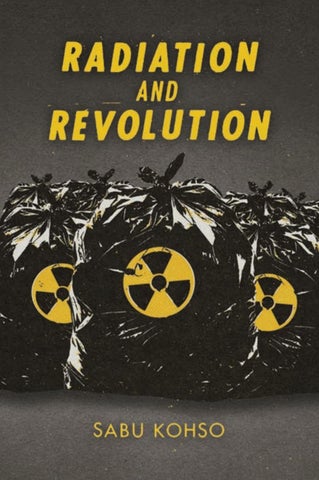
SOCIAL THE O RY /A S IA N S TU DIE S /A C TIV IS M
I
n Radiation and Revolution political theorist and anticapitalist activist Sabu Kohso uses the 2011 Fukushima nuclear disaster to illuminate the relationship between nuclear power, capitalism, and the nation-state. Combining an activist’s commitment to changing the world with a theorist’s determination to grasp the world in its complexity, Kohso outlines how the disaster is not just a pivotal event in postwar Japan; it represents the epitome of the capitalist-state mode of development that continues to devastate the planet’s environment. Throughout, he captures the lived experiences of the disaster’s victims, shows how the Japanese government’s insistence on nuclear power embodies the constitution of its regime under the influence of US global strategy, and considers the future of a radioactive planet driven by nuclearized capitalism. As Kohso demonstrates, nuclear power is not a mere source of energy—it has become the organizing principle of the global order and the most effective way to simultaneously accumulate profit and govern the populace. For those who aspire to a world free from domination by capitalist nation-states, Kohso argues, the abolition of nuclear energy and weaponry is imperative.
”Writer, political activist, and translator Sabu Kohso provides a timely intervention into discussions of the catastrophic event that overwhelmed Japan’s Fukushima Prefecture on March 11, 2011. Kohso has brilliantly captured both the sad singularity and complex generality of the event and the unyielding process of its global consequences. At the heart of Kohso’s account lies a nuclear industry now worryingly indistinguishable from global capitalism’s new lease on life.”—HARRY HAROOTUNIAN, Max Palevsky Professor of History Emeritus, University of Chicago “Turning the discussion of the Fukushima disaster and its ecological and social consequences into a reflection on the history of Japanese society and government from World War II to the present, Radiation and Revolution is a powerful, imaginative, and much-needed book.”—SILVIA FEDERICI, author of Beyond the Periphery of the Skin: Rethinking, Remaking, and Reclaiming the Body in Contemporary Capitalism SABU KOHSO is a writer, editor, translator, and activist and the author of several books in Japanese. THOUGHT IN THE ACT A series edited by Erin Manning and Brian Massumi
DUKE UNIVERSITY PRESS | www.dukeupress.edu Cover designed and illustrated by Skillet Gilmore. Back cover: Zengakuren students clash with police, October 21, 1968, Shinjuku Station, Tokyo. © Bettmann.
Kohso_pbk_cover.indd 1
8/13/2020 3:26:43 PM
R ADIATION AND REVOLUTION
THOUGHT IN THE ACT
A series edited by Brian Massumi and Erin Manning
R A DI ATION A ND R E VOLU TION
Sabu Kohso
DUKE UNIVERSITY PRESS DURHAM AND LONDON 2020
© 2020 Duke University Press All rights reserved Printed in the United States of America on acid-free paper ∞ Text designed by Amy Ruth Buchanan Cover designed and illustrated by Skillet Gilmore Typeset in Arno and Trade Gothic by Copperline Book Services Library of Congress Cataloging-i n-P ublication Data Names: Kōso, Iwasaburō, [date] author. Title: Radiation and revolution / Sabu Kohso. Other titles: Thought in the act. Description: Durham : Duke University Press, 2020. | Series: Thought in the act | Includes bibliographical references and index. Identifiers: lccn 2019055652 (print) | lccn 2019055653 (ebook) isbn 9781478009948 (hardcover) isbn 9781478011002 (paperback) isbn 9781478012535 (ebook) Subjects: lcsh: Fukushima Nuclear Disaster, Japan, 2011. | Nuclear energy—Social aspects—Japan. | Nuclear energy—Political aspects—Japan. Classification: lcc hv623 2011 .f85 k67 2020 (print) | lcc hv623 2011 .f85 (ebook) | ddc 363.17/990952117—dc23 lc record available at https://lccn.loc.gov/2019055652 lc ebook record available at https://lccn.loc.gov/2019055653
It may be that believing in this world, in this life, becomes our most difficult task, or the task of a mode of existence still to be discovered on our plane of immanence today. — G I L L E S
DELEUZE AND FÉLIX GUAT TARI,
What Is Philosophy? I’m not referring here to the microapocalypse of death: everybody dies, and even if everybody dies at the same time (I mean everybody), what’s the problem? The earth becomes a cleared tape and why should the angels grieve? — G E O R G E
CAFFENTZIS,
In Letters of Blood and Fire
Emancipate yourselves from mental slavery None but ourselves can free our minds Have no fear for atomic energy ’Cause none of them can stop the time — B O B
M A R L E Y,
“Redemption Song”
CONTENTS
/ Writing through Fukushima
ix
/ Disaster/Catastrophe/Apocalypse
1
/ Transmutation of Powers
17
/ Catastrophic Nation
55
/ Apocalyptic Capitalism
87
/ Climate Change of the Struggle
113
/ Forget Japan
161
PROLOGUE INTRODUCTION
CHAPTER 1
CHAPTER 2 CHAPTER 3 CHAPTER 4
EPILOGUE
NOTES
167
BIBLIOGRAPHY
183
INDEX
191
PROLOGUE
/ Writing through Fukushima
Nine years have passed since March 11, 2011. The subsequent period of turmoil seems to have been eclipsed in collective memory. The images circulating through the media environment gradually shifted from progressing devastation to invisible degeneration, from the catastrophe to the apocalypse: coastal towns being washed away, mushroom clouds spewing from the reactors, and men in nuclear, biological, chemical (nbc) suits undertaking lethal operations were replaced by endless piles of black plastic bags, roaming domestic animals in the deserted countryside, and medical examinations of children. This transition is concomitant with the process through which the cataclysmic event that shook the nation of Japan has been subsumed into the reconstruction of capitalist/state apparatuses while the environment with radioactive debris and soil is left to remain and even to expand with the unpredictable mutations of vital activities. In the sense of endurance and expansion, the Fukushima nuclear disaster is perceived as an epitome of the dystopian world. This book is an assemblage of thoughts on the Fukushima disaster I have conceived during these years. The disaster is grasped here both as a singular event and as a series of events, as the process that prepared it and continues to live on. The following chapters thus comprise personal narrative, empirical description, theoretical analysis, and metaphysical speculation on both the event and the process, extending from shorter to longer spans of time and nearer to farther stretches of space. The basic premise is that the disaster is not over; it continues in the unsettled disposition of powers (pronuclear regime and popular struggles in and against it) vis-à-v is the chaotic permeation of radioactivity. In confron-
tation with this developing situation, it is imperative for us to revise the idea of changing the world. A couple of months after the wake, I began translating Japanese texts on the devastating situation into English and elaborating my own accounts based on them.1 These early interventions arose from the utter shock of the unprecedented disaster and the urge to digest the thoughts and acts of Japanese friends in the midst of the conjuncture. Through these projects I came to believe that the disaster, which delivered irreversible damage to the people, must metamorphose into an irreversibility in another sense; that because it was the apparatuses of the postwar regime that caused the disaster, this should be the moment for people to give up their society and rise up for its radical change. However naive the logic linking the disaster to a revolution may be, such aspiration was manifestly conceived in common among many in Japan and elsewhere for about two years, and still is by some of us. Eventually, the worst-case scenario of Armageddon was suspended, but the disaster has endured to this day, increasingly obscured by the issue of radioactive contamination in small doses — unresolvable debates on the threshold and nonthreshold models — which has been tacitly playing the main role for the reconstitution of the pronuclear regime. Affecting economy, society, culture, and everyday life, this issue of contamination also engenders new initiatives of the people. Meanwhile, the event of the disaster itself has been buried under more spectacular affairs (i.e., the 2020 Tokyo Olympics) and imminent crises (i.e., increasing disasters and violence by the global business/military regimes), to the extent that it is almost forgotten. The same landscape of consumerist society has returned as if nothing ever happened. This general obsolescence has nurtured a fathomless pessimism in many of us. My senses have since been fluctuating between a will to radical change and a resignation to the world dying its long, slow death by irreversible degradation. In this fluctuation, it has become clear that the catastrophe itself would not necessarily create a revolutionary process. The catastrophe did disrupt the maintenance of the status quo, and it did trigger people’s rage and protest. But for the radical break of catastrophe to nurture true metamorphosis, its bifurcations should be developed in synchronicity toward innumerable dimensions and with unknown intensity. Through this awareness, my writings came to focus on the contexts that engendered the disaster, namely, what the disaster has been revealing: the role of nuclear power in the formation of Japan’s postwar regime as well as x Prologue
global capitalism, and the horizon of people’s lives and struggles against it. These writings thus sought to set flight from the fluctuation, toward another horizon.
/// This book is less about the nuclear disaster per se than it is about its revelations. It does not, as such a book may be expected to do, propose how to solve nuclear problems in and of themselves. The notion of solution is tricky vis-à-v is the nuclear problematic. In the first place, the best we can do with nuclear power is clear and simple: stop it once and for all. Nothing more, nothing less! But then the question is always raised from the standpoint of policy making: how can we sustain enough electricity without it? The answer is by replacing it with safer sources of energy or, better still, by learning to live with less energy. In either orientation, the voices commanding solutions belong exclusively to those most apparently implicated in power — policy makers, bureaucrats, and corporate executives — or to those specialists with access to scientific knowledge and technological means who participate in projects sponsored by states, corporations, or international organizations. Nuclear policy operates within the international society of authorities, wherein the voices of the majority — those who actually live with and fight against its hazards — are hardly accounted for. Authoritarianism is the essence of nuclear apparatuses, and it precludes collective engagement. In the second place, even if nuclear production is stopped, tasks will remain for decommissioning 449 reactors and containing and decontaminating the radioactive waste that has already accumulated and still continues to accumulate. There has been no answer as to how such tasks could be undertaken or by whom. So far, all decommission and decontamination treatments have been monopolized by private and public enterprises as highly specialized, costly, and secretive projects, more or less under the premise of nuclear proliferation. Sustaining and expanding already existing enterprises — regardless of consequences — is the modus operandi of capitalism and states, be they nuclear or otherwise. In the third place, therefore, nuclear power is far from a mere source of energy that could be replaced by a better one were everybody enlightened about its perils. The most demoralizing fact is that, even after Hiroshima and Nagasaki, Three Mile Island, Chernobyl, Fukushima, Prologue xi
and countless other incidents, those superpowers that have access to nuclear production hardly nurture intentions or develop techniques to give it up. This is due to the monstrosity of nuclear fission: its Janus- faced functions provide conflicting states with the maximal potency of destruction and competing capitals with the most privileged apparatus of energy. It is too good to be true for the men reigning in our world with their will to power: money and violence. Nuclear power is the most substantial means of ensuring an upper hand in the world order. It is the most guaranteed and deadly scheme to accumulate profit and to govern the populace at once. In this manner we are cornered, and thereby bump into the real question — how to decompose the network of powers (military – industrial complex) assembled around nuclear production/consumption while collectively creating new forms of life outside this network — before the idea of a solution can ever be reached. This leads us to the ultimate problematic concerning all environmental destruction: what should we do with the World as the expanding and totalizing movement of capitalist nation-states, from the vantage point of the Earth as the assemblage of the lives-as-struggle of planetary beings? The nuclear problematic thus conceives the questions of power, life, and revolution within an unending catastrophe. These questions are at the crux of what the Fukushima event is revealing to us. The core ideas here have been conceived not so much at my cubicle as by thinking and acting together with friends in Japan and elsewhere, especially in the United States, Canada, France, South Korea, Greece, and Turkey. The ways Japanese friends felt, thought, and acted in the wake of the catastrophe provide the text with its body while the passion of foreign friends to tackle the Fukushima problematic as their own gives the book its affective and intellectual extensions. Orientations to approach the problematic are inspired by the two questions most frequently raised by non-Japanese: Why did Japan dare to introduce nuclear power after the experiences of Hiroshima and Nagasaki? Why wouldn’t the Japanese people rise up to oust the nuclear state? These straightforward and honest questions touch a sore spot in the historicity of Japan’s convoluted relationship with nuclear power as well as call attention to enduring issues for Japanese oppositional movements. While the first makes us confront the substance of postwar capitalism, the second implicates the closure of the revolutionary uprisings of the 1960s xii Prologue
and the difficulties of the attempts to create popular, antiauthoritarian, and radical movements thereafter. These are now contextualized in the ongoing lives-as-struggle of people under the catastrophe. So it is that attempts to think through these questions form the basso continuo of the following narrative.
Prologue xiii
INTRODUCTION
/ Disaster/Catastrophe/Apocalypse
Around the year 2011, two series of events were set in motion that came to embody the epitomes of our planetary reality today: revolution and disaster. In December 2010, a new cycle of global uprisings began with the Arab Spring; the following March, a new type of catastrophe unfolded in the Fukushima nuclear disaster. The wave of uprisings inspired rebellions across both hemispheres, including the square phenomena in Europe, the post-Fukushima struggles in Japan, and the Occupy movements in the United States, among many other insurgencies rising in reverberation. Fukushima was the beginning of an as-yet-interminable radiation leak affecting people in Japan and the world over. From August to September, while the cosmopolitan public was dreading possible planetary contamination, Occupy Wall Street (ows) reinvigorated New Yorkers, inspiring them to act. It activated new associations among friends within the city and abroad, creating a metropolitan crowd in rebellion against finance capitalism, urban development, and police violence at once. Born in Japan and living at the time in New York, I was radically affected and deeply perplexed by the crossing of these two events — that is the main incentive of this project. Though seemingly unrelated or even antithetical, their commingling conveyed a limit experience for those of us who aspire to a planet without capitalist nation-states and who are concerned with the apocalyptic situation spreading from the Far Eastern archipelago. These instances emerged as manifestations of the intensifying interconnectivity of events on Earth and opened fissures in the world order on different ontological registers: one as an unprecedented catastrophe and the other as the new becoming of a planetary crowd. While
one was a collision between infrastructure and planetary activity that inflicted upon us a maximal disquiet, the other was a synchronic reverberation among lives and struggles in numerous locations, encouraging us by flashing prospects for revolution in a transnational space. Mirroring each other, together these epitomize the global condition in which we are living today: while the World as logos, or the ecumenical order based on nation-states, has begun to annihilate our desire and potency for creating life, relations, and the environment, the Earth as nomos, or the assemblage of all forces, has begun to express itself in its overwhelming complexity of entanglements and frictions.1 While belief in the World is collapsing, the expectation of life of permanent struggle permeates the Earth.
/// In the history of nuclear calamities, Fukushima stands out in the sense that its liquidation has so far been beyond the reach of any existing power, knowledge, and technology. It is a catastrophe without end. It manifests the irreversible tendency of man-made apparatuses to expand over the planetary body and trigger more and more accidents, the impacts of which affect all vital activities. Though slowly and minutely, the invisible flow of radionuclides is still merging into our environments. In response, a new regime has come into place that takes the populace hostage. Rather than neutralize unending contamination, this new regime manages it. By scheming programs to commodify accumulating wastes through public and private enterprise, it extends its previously underestimated prospects. In opposition, a radioactive crowd has arisen with its will to live the event by resisting the governance of the regime and creating new forms of life. This is the figure of the affirmative power of people — beyond passive victimhood — rising against the physical influence of radioactivity and the policy of nationalizing it. Their practices unfold a resistance that exceeds that of the limited frameworks of antinuclear movements by expanding the struggle to living itself. The lives- as-struggle of this radioactive crowd involve all existential territories: mind/body, social relation, and environment.2 The new cycle of global uprisings comprises waves of enraged and life-a ffirming hordes confronting multifaceted injustice, oppression, and expropriation. Following the Global South, then the Middle East and North Africa, the Global North has also seen a dramatic upsurge 2 Introduction
of popular movements corresponding to the intensifying immiseration of all-front crises (economic, political, environmental). These uprisings have nevertheless begun to conform to a pattern that involves both limit and potency. Following historical precedent, the revolt of each and every locality is either crushed immediately or quelled gradually, by measures as varied as violent crackdown and institutional tampering — that is, when it does not lead to endless civil war. At the same time, however, these impetuses continue to emerge in synchronicity, as if their impacts reverberated and traveled from place to place — what George Katsiaficas suggests in terms of the “eros effect.”3 Even if this mysterious and unexplainable phenomenon might be easily ignored, it embodies the positive aspect of the conjuncture we are now facing across the world. Impetuses of revolt today interchange along multiple flows of memes over electric signals and through vital energy via personal and local connections rather than under the unilateral command of international organizations. Speaking climatologically, heat waves do not originate by heavenly commandment but in earthly struggles; in the convergence of winds with varying temperatures, speeds, and orientations, virtual currents are created in reality. The crux of the convergence of struggle is that, no matter what oppression awaits, people will never stop revolting as an extension of their life activities. The interconnectivity of singular struggles is in this sense planetary, more concretely so than any spectacle of international politics distributed through the media. It is thanks to the mutual recognition of today’s intensifying uprisings that this interconnectivity has been gradually made visible. Thus, the climatological cartography of two planetary impetuses — environmental mutation and global uprising — is preparing the present and future of our political ontology: namely, the battleground of our lives-as-struggle.4
/// In the following pages, the Fukushima event plays dual roles: it is the subject of narration and analysis and, at the same time, a zoom lens for the revelation of powers (power over and power to) operating in varying spatial and temporal dimensions. Thereby we will have macro-and microviews of people’s life experiences and struggles in a society that has been given shape by a postwar regime — shaped in some respects since the wake of modernity or even further back. In turn, Japanese experiences are employed as filters through which to sieve experiences of the Introduction 3
wrecked world and the struggling Earth. These roles point to the singularity of Fukushima, which enfolds three conceptual strata embodying the haecceity of the event: Disaster, Catastrophe, and Apocalypse. Political reason is quick to reject the eschatology implicit in these terms because it tends to either incapacitate us with fatalism or induce a short-circuited association between end and emancipation. Such reason would warn us that eschatology nullifies the political by reducing its operative dimensions to sublimity and opportunism.5 Certainly, the incitation of the impending end for all can provide convenience to the concentrated interventions of governance and massive infrastructural reconstruction before it could empower our collective projects. The call for powerful leadership would take place as the reminder of the Hobbesian proposition of a social contract and rule by an absolute sovereign vis- à-v is Leviathan. And nuclear scares, whether by accident or war, would certainly provide such instance. However, there is something about eschatology that cannot be easily dismissed as a mere irrationality subservient to the ruling power. Historically, it has conveyed the vital perception of crises by both the ruling power and by people: while the formation and restructurings of capitalism were triggered by such moments, people’s uprisings unequivocally aspired to end their present hells and envisioned the birth of new heavens: that is, millennialist uprisings. They are two sides of a coin, as it were. In today’s global condition, wherein the interminable expansion of infrastructural development synchronizes with the catastrophic destruction of social and environmental processes, it is impossible for us not to conceive the eschatological bent to the course of capitalist civilization itself. With the Fukushima event in particular, this sense has been deeply inscribed in our affective drives, which needs to be taken not only as a vacuum for new governance to sneak in but also as an opening for our critical thinking and transformative action. In the present context, three concepts function in the following manner, with the above implication. Disaster is the real experience of people the world over. Catastrophe is the synergetic disruption of social and environmental processes, increasingly appropriated by the modus operandi of contemporary capitalism and states. Apocalypse is a metaphysical, imaginative, and affective device for us to confront the world in degeneration and to envision its radical change. These are considered as the conceptual components of what the singular name Fukushima implies for us today. 4 Introduction
The Fukushima event was a disaster that is epitomic today, as tectonic and atmospheric movements and human activities increasingly merge into one and the same planetary interconnectivity: in Fukushima, the disaster was doubly articulated by the death and destruction by earthquake and tsunami followed by nuclear calamity. One of the innumerable devastations that people all over the world experience today, its fatal aspect lies in the irreversible radiation contamination that will affect innumerable people for uncountable years to come. The outcome is really unknown to us; we would need an unparalleled patience to observe and act on it. But one thing we could say is that, although the primary cataclysm caused by tectonic movement was monumental, a relatively straightforward recovery could have been expected by mutual aid projects (i.e., the “paradise built in hell” of Rebecca Solnit) or even capitalist development (i.e. the “disaster capitalism” of Naomi Klein) — if, that is, the secondary disaster had not introduced the nanoactivity of radionuclides into the environment.6 But it did, and this worst possible merger began to generate “a land without a people and a people without a land.”7 Land and people were severed in and around radioactive zones across northeastern Japan, where residents can no longer enjoy a nature of innocence. The historic loss of that promised accord has destroyed the subsistence of farmers and fishermen and produced innumerable refugees while at the same time provoking a dramatic return of nationalism, eager to mobilize society in order to accelerate redevelopment. The catchphrase word fukko (revitalization) has been propagated by the status quo, following the many historical examples through which the nation-state forged its apparatuses of capture in response to catastrophe. This loss also means a new challenge for the “paradise built in hell,” or for any antiauthoritarian movement based on the promise of natural resources to be shared as commons. Growing counter to redevelopments are the autonomous projects of people to protect their reproduction. Extending beyond political protest, these include do-it-yourself (diy) radiation monitoring, studying the nature of radionuclides and their hazards, creating information networks, introducing medicinal diets, evacuating irradiated zones, experimenting with off-grid ways of living, and building community in new territories. Although each of these projects initiated by the radioactive crowd is inconspicuous and their coordination has not been fully established as a new impetus, they internalize a potency to open up territories of life-as-struggle and decompose the polis of the new regime. Introduction 5
The Fukushima event is a catastrophe that has triggered a few pivotal bifurcations toward conflicting orientations. It has severely damaged institutions, infrastructures, and the environment, and at the same time it has critically revealed their compositions and induced their recompositions. It has created a vacuum in the previously existing arrangement of powers — of governance, capitalism, people, and the environment — which gives people occasion to test their potency for living and struggling autonomously, even as it paves the way for inertia and the degeneration of that potency. Evidently, this has been one of the most radical junctures that the nation has ever experienced. This is the liminal situation into which the regime and the capitalist/state mode of development intervene, in order to turn the vacuum into a fulcrum for their own reinforcements. And their success so far has made us feel as if it comes from their own initiative or invention. Empirically, the disaster was experienced as pure contingency for everyone, especially for the immediate victims. However, what we discovered ex post facto was that even a calamity of this magnitude and knottiness could be taken as a mere opportunity for larger developments. As Paul Virilio points out: If, in fact, invention is just a way of seeing, of grasping accidents as signs, as opportunities, it is high time to open up our galleries to the impromptu, to that “indirect production” of science and the techno- sciences that is the disaster, the (industrial or other) catastrophe. If, according to Aristotle, “accident reveals the substance,” the invention of the substance is also the invention of the “accident.” Seen this way, the shipwreck is indeed the futuristic “invention” of the ship, the air crash the invention of the supersonic plane, and the Chernobyl meltdown, the invention of the nuclear power station.8 So too can the Fukushima event be seen as an invention. This invention should not be attributed, however, to science, technology, civilization, or humanity in general, as anthropocentrism tends to do, but to specific interests and the powers that implicate them in a specific society at a specific historical moment. It is an invention of the capitalism/ state conglomeration, which has long persisted in its mode of development wherein accident and destruction indefinitely assimilate each other, equally employed as methods for larger redevelopments. It took place as an event and continues as a process in a highly mediatized and consumerist society of control, crystallized in Japan’s postwar re6 Introduction
gime as a client state of the United States, the fountainhead of “nuclear exceptionalism.”9 The Fukushima event is apocalyptic in terms of its power to affect our feeling, thinking, and acting. Its affectivity contains both passive and active modalities, manifest in the complexity of emotions that emerged from within the bodies and minds of people: grief for losses, despair and anxiety for the future, rage against the regime that invented the disaster, and even a glimmer of exhilaration for the unknown. The Fukushima event was perceived by many as the end of the world they had known in their economically flourishing and war-free enclave after World War II. This eschatological feeling was inexorably accompanied by a vexing sense of recurrence. Why for us again? While the first instance, in Hiroshima and Nagasaki, was a tragedy inflicted by an enemy of war, the second (if not a mere farce of the original tragedy) was tragicomical, “a war of a peaceful nation against itself,” in the words of a Japanese friend.10 In this repetition, people have undergone in their bodies and minds — the collective soul — the Janus-faced function of nuclear fission: weaponry and energy. Meanwhile, the national spirit is eager to forget the revelations of both events as it quickly short-circuits them by provoking the sentiment of the national bond (kizuna) that functions as facilitator for further control and development. After Fukushima, the collective soul nurtured a critical function of Revelation — in the biblical sense of the Apocalypse — of the substance of its society: sustained under the control and protection of its original assailant, the United States, and driven by the catastrophe qua invention. Accordingly, it was this collective soul that prepared the projects of the radioactive crowd.
/// Throughout the ages, eschatology has appeared in different places and in varied forms. We find an illustrious example in the Apocalypse of John (of Patmos) in the New Testament. What stands out in this text is its maniacal programming of stages and its elaborate symbols for good/ evil, culminating in radical rupture (judgment) and messianic moment (emancipation). Today, the most trivial and unsound interpretation comes from the fanatical sects of evangelical Christians who wait for or even wish to fabricate Armageddon to settle the battle between God (Christians) and Satan (infidels). In contradistinction, our secular Introduction 7
minds have long aspired, for good reason, to create the programming of the total collapse of capitalism as the ultimate revolution. Indeed, when we plan to change our reality for its betterment, a radical discontinuity is inexorably assumed, whether as a singular event or as a long-lasting process. Meanwhile, in the East, the idea of the end appeared in the predestination of Dharma’s decline as the third stage of Buddhist universal history. In contrast with the event of the biblical Apocalypse, the cyclical process of Dharma’s decline internalizes an unthinkable temporality of suffering and degeneration for all, lasting some ten thousand years. For Buddhists, this functioned as a moral admonition against unprincipled behaviors and decadent ways of life. In China, after the idea of Dharma’s decline was introduced in the sixth century, it came to be seen in correspondence with the real historical ages, through the degeneration of dynasties, while in the case of Japan, its application was rejected by the state-backed Buddhism, around the mid-eleventh and into the twelfth centuries. It influenced newly rising schools as a way to view sociopolitical realities — as mappo (the end of Buddha’s law) — and act on them, resulting in either aristocratic pessimism or religious war (mass uprisings).11 In contradistinction to the Christian Apocalypse, the emancipatory doctrine of eschatology internalized a radically antiauthoritarian idea of salvation, prioritizing the bad people (or the social outcasts) who were destined by caste to break Buddhist precepts (for their subsistence) before the good people who were not.12 Despite their differences, both examples speak to the fact that throughout the age of “civilization,” commoners, who are unequivocally oppressed and dispossessed, have identified the present — more or less — as a time of decline or of revolutionary change. Both interpretations of the end of the world seem to be bound by sets of moral judgment, the fatalism of decline, and the programming of time. That is, people have always been expecting either the end or the rebirth of the world. Then, in capitalist civilization, the sense of time has been articulated by the recurrence of its fundamental crisis, whereby capital endlessly seeks its rebirth and expansion. Today, the material limit of the World, whose expansion is driven by capital’s critical reproduction, is exposed more catastrophically than ever. If the Fukushima event itself is interpreted as an eschatological sign, it does not seem to indicate the immediate end/rebirth of the world. It gets even nastier in a sense. Fukushima materializes the inaccessibility 8 Introduction
of a singular moment of end/rebirth, as the catastrophe of its event is absorbed into an endless process of radioactive contamination and its management. This seems to fit more, if we are to choose, with the long- lasting and all-inclusive downfall of Buddhist fatalism than the selective judgment of Judeo-Christianity. Here, apocalypse is perceived as an unending process toward the predetermined future (or return) of a radioactive planet. As a Japanese friend has voiced acutely, what this fatalism is about to take away from us is not necessarily hope or a promised future but difference, or the future as an unknown and undetermined temporality from which we can create new planetary experiences. At the same time, he has also spelled out a few points that pull us back to the political, unaffected by the sublimity of all-inclusive fatalism. First, though the apocalyptic effects of radionuclides on our bodies and minds can potentially be all-inclusive, they are also always uneven according to class, subsistence, gender, age, and locality. Second, the event nurtured two other moments: critical revelation and the will to live the event. These two pillars ground people’s initiatives beyond passive victimhood. Another friend has reflected on her will to confront and live the event as follows: during the heyday of the global justice movement, she used to single-mindedly embrace the slogan “another world is possible,” but after Fukushima she chants “staying with the trouble” because now it is the regime that seeks to avert people from confronting radioactive threats and to mobilize them with its “utopian vision” for an everlasting industrial reconstruction and security state while taking advantage of the apocalyptic power of nuclear fission — the sublimity of destruction and the imperceptibility of contamination — that incapacitates our thinking and acting.13 Because, in an ontometaphysical sense, the strongest weapon of the nuclear regime is this incapacitation of our thinking and acting, she suggests that we must dare to face events in all their trouble if we are to confront the Fukushima process and to create difference or other worlds therein. What she intends to do is to gaze at and to live the Fukushima event full-heartedly as it materializes the breach of World History and all its progressivist promises, through which full experiences of life and death on Earth are surfacing. This is dreadful, but it is necessary for action. Radionuclides travel along with the planetary becoming or heterogenesis that implicates everything — tectonic activities, atmospheric movements, human traffics, and all other forces/events on Earth — while muIntroduction 9
tating vital activities throughout the entire ecosystem. This permeation reveals an invisible, imperceptible, and unrecognizable connectivity between human activities and naturing nature (natura naturans). The dreadful turn of event is nevertheless sending us a cue: with the Fukushima event, the time has come for us to affirmatively confront the complexity of planetary becoming that has been revealed through the breaches of the endlessly expansive World by which we are existentially captured. Now the crux for the lives-as-struggle of our mass corporeality lies in the extensiveness of what we must do for reproduction and the unknownness of what we can do for happiness. In these senses, the Fukushima nuclear disaster is just beginning; it is undeterminable how long life-as-struggle continues and how far it extends. For about two years after the onset of the disaster, an anarchy of heterogeneous actions shook Japanese society. This included both the political spectacle of street demonstrations and the osmosis of autonomous projects based on everyday reproduction. Thus, the radioactive crowd arose. In fact, this rise occurred in interaction with the two epitomic planetary impetuses of radioactive contamination and global uprisings. On the one hand, the radioactive crowd’s sine qua non for survival was to develop the technopolitics of life-as-struggle to keep away from and/or live with the virtual flow of radionuclides — the unthinkable temporality of their half-lives, the invisible complexity of their traveling and accumulating patterns, their ungraspable physical effects (varied radionuclides vis-à-v is varied physical conditions). On the other hand, it was at the very moment when many of my friends were talking excitedly about the Arab Spring that the Fukushima disaster intervened and disrupted the ongoing course of their struggles. Therefore, for them, it became a crucial point of bifurcation, whether they would contextualize their subsequent struggles as part of the reverberation of the planetary crowd or isolate themselves in the national politics for economic and industrial recovery. Notwithstanding their ontological difference, the dissemination of radionuclides and the reverberation of struggles share the common attribute of belonging to an antiworld: neither of them can be properly confined to national territories, nor registered in the arenas of political and judicial institutions. They both slip not only through political rationality — institutional and geographical — but also through causal logic in the positivist sense. At the same time, they connect invisible forces and events via atomistic flows that decompose the logos of the World. 10 Introduction
In interaction with the forces of the antiworld, the radioactive crowd unveils the horizon of a new political ontology by reminding us of the situation we are thrown in, where everything in everyday life is interconnected via flows. For this reason, we who are evicted from the house of being in the World are vulnerable in uncontrollable manners, but we also have an unknown potency to live the Earth. Precisely in these ambiguous senses, the political must now follow a climatological assemblage of forces and events on Earth. Although the epochal potentiality of the radioactive crowd has been unnoticed, ignored, or marginalized by the media spectacle of national politics in Japan, it sustains itself as the premise for all thinking and acting on the Fukushima event.
/// Along the line of metaphysical investigation of the apocalypse running from D. H. Lawrence to Gilles Deleuze, we can trace a passage of transposition from fatalism to action via the critical function of revelation. Echoing Friedrich Nietzsche’s critique of Christianity, this line of thinking affirmatively confronts the messy complexity of power — involving both power over, or the power of rule based on nature as passive object (natura naturata), and power to / power with, or our potency to live, struggle, and create together in interaction with nature as active creativity (natura naturans) — in which we are implicated existentially in all respects. This treatment of power illuminates the real battleground of our lives-as-struggle in the post-Fukushima age, or the age of the antiworld. D. H. Lawrence begins his enigmatic book Apocalypse with a clarification: “Apocalypse means simply Revelation, though there is nothing simple about this one.”14 Revelation here is no longer a postponed moment of salvation but the materiality of psyche — the physical or biological psyche — that knows the forgotten connectivity that makes us, our society, and the universe as the union of spirit and body through life energy. This is the moment at which we are to discover what forces make us and what potencies we have — to accept limit and engage in survival. In an essay touching on Lawrence’s book, Deleuze pushes for an ethical reading of the Apocalypse: “The gospel is aristocratic, individual, soft, amorous, decadent, always rather cultivated. The Apocalypse is collective, popular, uncultivated, hateful, and savage . . . John of Patmos deals with cosmic terror and death, whereas the gospel and Christ dealt Introduction 11
with human and spiritual love. Christ invented a religion of love . . . whereas the Apocalypse brings a religion of Power (Pourvoir).”15 If the gospel is an apparatus that captures the individual spirit in the name of salvation by humanly love, the Apocalypse embodies desire stripped bare, as affects of body and mind. This desire drives crowds to penetrate, multiply, judge, and destroy power by and for themselves, in interaction with the cosmic forces of the antiworld. The Bible’s dark and final book functions as a radical critique of its piteous opening, by way of revealing the complexity of power in the name of a collective soul that distinguishes itself from individual spirit. The conceptual shift from individual spirit to collective soul involves a bifurcation of potential mutation: either positive with mass empowerment or negative with mass degeneration. After all, the collective soul is the drive of mass corporeality to survive in crises, and as such it persists in its will to power as counterpower. In this articulation, it is hard for us not to make an association with the trouble of political organization that is increasingly observed today, both in the twilight of compassionate leadership or vanguardist organization (Christ) and the rise of anarchic and horrifying crowds (horned lambs), which, unleashed from the logos of the World, become an uncontrollable counterpower, eager to penetrate, multiply, judge, and destroy the sovereign power. Yet the crowd’s own forces can be quickly captured by a new kind of priest — the most vulgar caricature of their desire — as we see today in the global permeation of nationalist populism or fascism. In any case, it is true that political representation — be it by government, political party, or social movement — can never contain, manage, and orient mass corporeality satisfactorily. In The Eighteenth Brumaire of Louis Napoleon, written in 1852, Karl Marx initiated the critical analysis of this essential problem of political representation, after his observations of the social unrest that followed the coup of Louis- Napoleon Bonaparte, the vulgar caricature of people’s desire, and the farcical or confusing repetition of the dramatic situation that created Napoleon the Great. The trouble of political representation is manifest more than ever in the present epoch. But it seems today that the age of tragedy has long gone and that all troubles, no matter how intense and devastating, will appear only as absurdity. In another register, Deleuze describes the distinctive sign of today’s apocalypse in its direct relation to the modus operandi of capitalist/ state development: it appears as the future that we are now being prom12 Introduction
ised “not only in science fiction, but in the military-industrial plans of an absolute worldwide state.”16 The apocalyptic project is figured in the New Jerusalem or ecumenopolis, with its system of management of life by programmed installations of ultimate judiciary/moral authority and everlasting infrastructure. This power appears to us increasingly as acephalic, hiding behind its personified face or mask — be it Louis-Napoleon, Adolf Hitler, Emperor Hirohito, or Donald Trump — as it pushes endless planetary urbanization, reinforcing the polis of business/military states and leading ecosystems to exhaustion. Thereby our lives are exposed to the uncontrollable mutations of genetic activities, engulfed in the automatic expansion of techno-industrial-metropolitan networks and domesticated throughout the vital/machinic process — through the phases of working (living), malfunctioning (illness), broken and wasted (dying and dead) — by the necropolitical management of energy, information, medicine, and security businesses. Our implication in the messy complexity of mutating power is what the promised progress of World History has ultimately delivered to us — far from its promise of dialectic sublimation in the unity of human society and original nature. Over the mutation of power from individual spirit to collective soul, Deleuze polymerizes two more conceptual shifts: from the ego to relations and from the world to flows. In ensemble, these three shifts embody the collapse of the existential protection that used to be promised to the people as the citizenry of a nation; now people are thrown out and exposed to the dreadful chaos of all forces. As such, these shifts reveal in ensemble the decomposition of the metaphysical principles holding the logos of the World together and the physical rise of planetary becoming. Relations make us confront the composition of the ego by its decomposition: to conceptualize relationality is to treat the problematic of political subjectivity from the vantage of interactivity and heterogeneity rather than individuality and identity while observing the individual body mutating in interaction with transmuting life chains. The concept of flows finally addresses the way the World expands and totalizes itself as an interaction among circulating powers — capital, labor, information, military, pollutants, epidemics, . . . — which themselves circulate within a climatological assemblage of all the Earth’s forces and events. Meanwhile, the multidimensional frictions among all powers are unilaterally intensifying. These shifts thus reveal the real battleground of our lives-as-struggle in planetary becoming. Introduction 13
In this precise manner, those Japanese friends who are developing ways to protect themselves from radionuclides and confronting the power over that seeks to control their distribution are also telling themselves: “Stop thinking of yourself as an ego in order to live a flow, a set of flows in relation to other flows, outside of oneself and within oneself . . . The soul as the life of flows is the will to live, struggle and combat.”17 This command announces the advent of life-as-struggle after Fukushima, which is the most radical break from the idea of life nurtured within the nuclear family in the postwar consumerist society. Outside Japan, as the physical limit of the World’s expansion has become manifest in the ecological and reproductive crises of our existential territories, the mutation of power has also begun to manifest itself in affirmation, that is, in the antiauthoritarian impetuses to change the world — from indigenous peoples, immigrants, feminists, and anarchists, among others — that constitute a broad horizon for projects to create “dual power” through autonomous zones of reproduction and new forms of collective living. These territorialities resist the confinement of national borders within and traverse them from community to community without, outside, or on top of political projects to take over state power — namely, those of socialist or social democratic governments operating within the expansive World toward internationalism. This is the advent of a planetary community in correspondence with the reverberation of global uprisings. Along these lines, we consider the Fukushima event to be an epitomic moment, wherein antiauthoritarian and ecological struggles could converge to embody the shift of our main battleground from the politics of the World to lives-as-struggle on Earth. Philosophically, this is an ontological shift from dialectics to immanence — from totalization by capitalism and the state to the omnipresence of singular events. In this shift lies the prospect of planetary revolution to be grasped in the decomposition of the World and the rediscovery of the Earth. However, it is imperative to acknowledge a proviso here in the introduction. This shift is neither smooth nor complete; we do not even know if it will ever end. Meanwhile, we continue to confront both the politics of historically driven territorial wars among the empires and nation-states of the World together with the politics of the climatological interactions of all the ever-mutating powers/forces on Earth.
14 Introduction
/// Before the disaster narrative begins, let us share a glimpse of the program: the arrangement of this book’s concepts and the composition of its contents. The use of concepts here is inspired by the geophilosophy of Gilles Deleuze and Félix Guattari, with the conviction that all thoughts — as much as actions — occur in relationship with the Earth: “Thinking is neither a line drawn between subject and object nor a revolving of one round the other. Rather, thinking takes place in the relationship of territory and the earth.”18 Accordingly, in this context, the Earth is the assembly of all movements and events, of which we are just a part; even the World is just a part. The Earth is the ontological index of immanence and omnipresence. In distinction, the World is the global order, or the assembly of all human societies and activities, that has been driven by the totalizing impetus of the capitalist nation-state; it is the ontological index of totalization and expansion. As a tacit premise, Marxism is considered a tendency to think and act vis-à-v is the World, while anarchism is deemed a tendency to think and act vis-à- vis the Earth.19 While the former tends to tackle structures, the latter tends to intervene in flows. We have been oscillating in between these approaches for a long time. In this project, all things happen in between the World and the Earth. Therefore, all this work’s other concepts, more or less echoing geology and climatology, will appear in relationship with both the World and the Earth, in between them, as the narrative progresses from event (chapter 1) to context (chapter 2) to mechanism (chapter 3) to struggle (chapter 4). In other words, the following four chapters are rendered in correspondence with the revelations of the Fukushima event in variable spatial and temporal extensions. In the beginning is the catastrophe. Thereafter, every word is uttered in repercussion from the epicenter of the earthquake or from ground zero of the hydrogen explosions. Chapter 1, “Transmutation of Powers,” narrates the disaster as event. Based on my own observations, stories from friends, and reports published in Japan, this chapter describes the event of the catastrophe and the social process through which the event was subsumed. These heterogeneous anecdotes concerning post – nuclear disaster lives, struggles, society, and governance provide the subsequent chapters with raw materials for their theoretical analyses. Introduction 15
Chapter 2, “Catastrophic Nation,” details the catastrophe, in response to which the nation was geohistorically constituted as an insular territory over an archipelago. The geopolitical form of the insular nation plays a pivotal role in the fabrication of Japan’s postwar regime, as it constituted a laboratory for the US global strategy to create an ideal client state. In consequence of this experimentation, the regime realized an unprecedented prosperity, which, however, lasted for only a limited moment in between two nuclear calamities: Hiroshima/Nagasaki and Fukushima. Outside US control, the regime became an economic giant thanks to Tokyo as an expansive and contractive movement, absorbing and mobilizing tremendous amounts of desire for the developments of the capitalist nation-state that ended up spreading nuclear power plants across the earthquake-prone archipelago. Chapter 3, “Apocalyptic Capitalism,” describes the apocalypse that today’s capitalism ensures by assimilating itself to the nuclear industry, which, spatially, stretches its industrial sectors — mining, transportation, energy, research, and military — across the planet and which, temporally, grants it zombie life through the endless demand for the managements of its wastes (negative commons). This analysis of the global nuclear regime illuminates the theoretical juncture where the problematics of ousting capitalism and stopping nuclear power must merge, in confrontation with the totalizing expansion of the World. Chapter 4, “Climate Change of the Struggle,” compares the struggles of 1968 to those of the post-Fukushima present via the struggles that arose in between. The difference is considered as a shift in political ontology that is provoked by increasing catastrophes: from the unification (dialectic synthesis) of the World to the reverberations (immanence) of planetary complexity. Thereby, it seeks to grasp the horizon of planetary revolution as an existential metamorphosis beyond regime change, by a dispersion of the World constituted by capitalist nation-states. The epilogue, “Forget Japan,” poses questions about the end. What does the end of Japan mean to the people in Japan? What does the end of the human world mean to us? As a final gesture, it seeks to undo the haunt of rationalist thinking whereby a big problem can only be solved by a big power, and to propose an empirical/pragmatic thinking toward reverberations among small powers.
16 Introduction