LANDSCAPES OF POWER POLITICS OF ENERGY IN THE NAVAJO NATION
DANA E. POWELL
NEW ECOLOGIES FOR THE TWENTY-F IRST C ENTURY Series Editors
Arturo Escobar University of North Carolina, Chapel Hill
Dianne Rocheleau Clark University
This series addresses two trends: critical conversations in academic fields about nature, sustainability, globalization, and culture, including constructive engagements between the natural, social, and h uman sciences; and intellectual and political conversations among social movements and other non-academic knowledge producers about alternative practices and socio-natural worlds. Its objective is to establish a synergy between these theoretical and political developments in both academic and non-academic arenas. This synergy is a sine qua non for new thinking about the real promise of emergent ecologies. The series includes works that envision more lasting and just ways of being-in-place and being-in-networks with a diversity of h umans and other living and non- living beings. New Ecologies for the Twenty-First Century aims to promote a dialogue between those who are transforming the understanding of the relationship between nature and culture. The series revisits existing fields such as environmental history, historical ecology, environmental anthropology, ecological economics, and cultural and political ecology. It addresses emerging tendencies, such as the use of complexity theory to rethink a range of questions on the nature-culture axis. It also deals with epistemological and ontological concerns, building bridges between the various forms of knowing and ways of being embedded in the multiplicity of practices of social actors worldwide. This series hopes to foster convergences among differently located actors and to provide a forum for authors and readers to widen the fields of theoretical inquiry, professional practice, and social struggles that characterize the current environmental arena.
LANDSCAPES OF POWER POLITICS OF ENERGY IN THE NAVAJO NATION
DANA E. POWELL
duke university press Durham and London 2018
© 2018 Duke University Press All rights reserved Printed in the United States of Americ a on acid-free paper ∞ Designed by Amy Buchanan Typeset in Minion Pro by Westchester Publishing Services Library of Congress Cataloging-in-Publication Data Names: Powell, Dana E., [date] author. Title: Landscapes of power : politics of energy in the Navajo nation / Dana E. Powell. Description: Durham : Duke University Press, 2017. | Series: New ecologies for the twenty-first century | Includes bibliographical references and index. Identifiers: lccn 2017032010 (print) lccn 2017043560 (ebook) isbn 9780822372295 (ebook) isbn 9780822369882 (hardcover : alk. paper) isbn 9780822369943 (pbk. : alk. paper) Subjects: lcsh: Political ecology—Navajo Nation, Arizona, New Mexico & Utah. | Energy development—Political aspects—Navajo Nation, Arizona, New Mexico & Utah. | Coal-fired power plants—Environmental aspects—Navajo Nation, Arizona, New Mexico & Utah. | Coal-fired power plants—Economic aspects—Navajo Nation, Arizona, New Mexico & Utah. | Power resources—Environmental aspects—Navajo Nation, Arizona, New Mexico & Utah. | Power resources—Economic aspects—Navajo Nation, Arizona, New Mexico & Utah. Classification: lcc ja75.8 (ebook) | lcc ja75.8.p76 2017 (print) | ddc 333.7909791/3—dc23 lc record available at https://lccn.loc.gov/2017032010
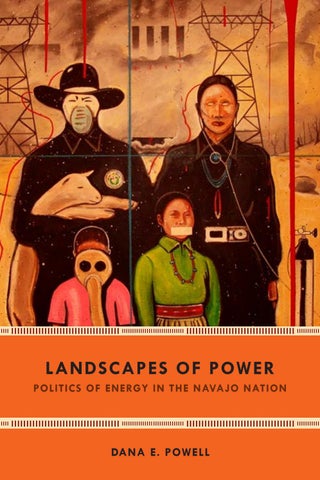
Frontispiece: Ed Singer, Diné Erosion, acrylic on canvas. Cover art: James B. Joe, Bleeding Sky (detail). Acrylic on canvas. Courtesy of the artist. Duke University Press gratefully acknowledges the support of Appalachian State University, College of Arts and Sciences, which provided funds toward the publication of this book.
FOR MY F ATHER WHOSE BRIEF LIFE SHONE BRIGHT AND FOR W ATER PROTECTORS EVERYWHERE
CANADA
Navajo Nation
UTAH
UNITED STATES
San Juan River
Lake Powell
MEXICO
ARIZONA
Kayenta
Navajo Generating Station
Colorado River / Grand Canyon
Black Mesa Mine
Kayenta Mine
Grand Canyon National Park
Colorado River
Hopi Tribe
San Francisco Peaks
Dilkon
Flagstaff Little Colorado River Cholla Power Plant
LEGEND Navajo Nation Agencies Navajo Community Navajo Government Seat Uranium Mines Coal Mines Coal Bed Methane Fields
Diné College Border Towns State Borders Sacred Mountains National Monuments Shale Oil & Gas Basins Rivers / Washes
H
Blanca Peak
C OLOR AD O Hesperus Peak
Durango San Juan Generating Station
Navajo Coal Mine Chuska Mountains
Tsaile
x Canyon de Chelly
Chinle
San Juan River
Fruitland Farmington
Shiprock
Burnham
Rio Grande
Four Corners Power Plant
Proposed Desert Rock Energy Project
(Tiis Toh Sikaad)
Wheatfields Lake
Window Rock
Mckinley Coal Mine
Gallup Church Rock
Albuquerque Mount Taylor
NEW MEXIC O 0
10
20
30
map fm.1 Navajo Nation and related sites, created by Donna Gayer.
40 MILES
CONTENTS
PREFACE
Arrivals xi ACKNOWL EDGMENTS
xvii
LIST OF ABBREVIATIONS
xxi
INTRODUCTION
Changing Climates of Colonialism 1
INTERLUDE 1
Every Navajo Has an Anthro 19 CHAPTER 1
Extractive Legacies 26 CHAPTER 2
The Rise of Energy Activism 64
INTERLUDE 2
Solar Power in Klagetoh 108 CHAPTER 3
Sovereignty’s Interdependencies 113 CHAPTER 4
Contesting Expertise 149
CHAPTER 5
Artifacts of Energy Futures 187
INTERLUDE 3
Off-Grid in the Chuskas 230 CONCLUSION
Conversions 236 EPILOGUE
Vitalities 253
NOTES
257
REFERENCES INDEX
283
301
PREFACE
Arrivals
Through the bus window, I saw a horseback rider herding a flock of sheep across the parking lot of a Taco Bell. Just beyond the sheep stood a slender windmill tower, its base attached to a corrugated metal water basin spray-painted “Livestock Only! Not for human consumption.” Our tour bus of musicians, sound techs, and environmental activists pulled into Window Rock, the capital of the Navajo Nation, following an all-night westward drive along Interstate 40. My eyes cut across the road to a dusty gas station where several stray puppies huddled against a concrete wall and a man wearing a cowboy hat fueled his pickup truck. A younger man, in a black heavy-metal T-shirt and baggy shorts, sold burritos from the trunk of a weathered sedan. Terra-cotta cliffs rose in the background, crowned with sagebrush and juniper. After a few hours of sleep at one of the two hotels in town, I took a late morning walk along the potholed pavement beneath the bluest sky. Parking lots with trailers of alfalfa for sale and a few abandoned cars eventually gave way to the surrounding arroyos and open terrain. Dozens of sheep and goats grazed silently, encircled by a team of watchful sheepdogs. Low, dry mesas r ose north of the small town; I had no idea of the verdant, high alpine forests they concealed. Past a chain-link fence stood a concrete sports center, encircled by rodeo fairgrounds and parking lots, its digital signboard announcing “Win dow Rock Sports Center: Indigo Girls Tonight.” This was the reason for my arrival. I was on tour as a political organizer and assistant manager for the folk-rock duo Indigo Girls, singer-songwriters and activists who undertook a month-long benefit concert tour in native communities e very c ouple of years as part of their collaborative work with Honor the Earth, a national native environmental organization. The event in the Navajo (Diné) Nation was part of a longer road trip of acoustic performances, media campaigns, and high school and community education events aimed at transforming dominant
energy policies. Our team partnered with native leaders—elected officials and grassroots activists—who questioned the public health, economic, and environmental effects of long-standing, and escalating, intensive extraction of fossil fuel in native territories. We had come to the Navajo Nation at the request of Diné Citizens against Ruining Our Environment (Diné care), a community-based organization working within a broader movement to transition the Navajo Nation away from its reliance on uranium and coal and toward sources of renewable power. Reporters from the tribal radio station arrived early, interviewed the musicians and activists, and set up a live broadcast of the show in the Diné language. Outside, b ehind the arena, I met local organizers Earl and Leila Tulley and their three young d aughters as we worked to unload boxes of concert T-shirts, petition cards, posters, and brochures. When the venue’s doors opened, teenagers, families, and elders rushed excitedly onto the rubber gym floor, filling the metal bleachers and muttering, “But who are the Indigo Girls, anyway?” The popular Native American rock band Indigenous was the headline act, with Jackson Browne and the Indigo Girls as relatively unknown openers. The lights dimmed, and a leading member of Diné care invited the audience to “enjoy the music and learn to organize around uranium contamination across the reservation.” Another Diné care member sold shirts and distributed pamphlets that described the group’s efforts to secure federal compensation for Navajo uranium workers sickened by radiation contamination. I circulated among the crowd of black-clad youth and elderly grandmothers adorned in turquoise jewelry and velvet skirts, collecting petition postcards addressed to the U.S. Secretary of the Interior that described the toxic legacies of uranium mining in the Navajo Nation. These acute challenges intrigued and troubled me in the years that followed. I continued direct action and fundraising work with national indigenous environmental justice movements, yet I grew increasingly skeptical of my own certainty about what was truly at stake in these matters, and in Diné territory in particular. My once secure faith in the “right” way to advance social justice as an ally began to falter. The structural violence of toxic risk was clear, yet contamination was a complex social and cultural issue; my brief encounters suggested it was also not the end of the story. There was a powerful, if understated, vitality, creativity, and resilience in the environmental movements laboring to shift federal and tribal energy policy, countering the widely circulated reports about the “wasteland” Navajo territory supposedly had become. How could these forces of ruin and renewal coexist, I wondered, xii
Preface
and what was going on beyond and between the ecstatic moments of collective political action? thers drew me back to the Navajo Nation six years These questions and o later, but in a very different role. I returned to the reservation alone, outfitted with a laptop, audio recorder, notebook, four-wheel-drive truck, and tribal research permit: equipment for ethnographic fieldwork on “the rez.” I had migrated from the world of activist musicians into a doctoral program in cultural anthropology, where I planned to continue my work with indigenous environmental movements, though from a different position. In Window Rock, I noticed that new fast food joints and a regional bank had joined the gas station and Taco Bell. Horses, cows, and sheep still ambled across the highway, and tumbleweeds tangled themselves in the axle of my car. The pavement shimmered under the sun’s heat. As I drove across the reservation, I noticed networks of electrical transmission lines, oddly invisible to me on previous visits, despite the fact that I had been engaged in solidarity work that focused on the Diné energy landscape. Heading west beyond the commercial and governmental hub of Window Rock, I noticed fewer and fewer distribution lines: while the towering transmission lines stretched as far as the eye could see, hardly any power lines distributed electricity to the wooden hogans, metal single-wide trailers, and other homes visible from the road. Some residences had small arrays of solar panels or generators, while others appeared to have no electrical power at all, even though they w ere in the shadow of transmission lines that carried Navajo coal power to distant substations and, ultimately, to urban consumers. This was the infrastructure of an export economy, transferring Navajo energy to regional utilities for off-reservation consumption—a literal and figurative transfusion of power. Although I had glimpsed this landscape years earlier—from the relative distance of the tour bus and sports center—I moved through the landscape in this l ater visit over a longer period of time, paying more careful attention to the contours of the terrain, contemplating the invisible histories and overtly embattled possible futures. I began to see the endless miles of power transmission lines as infrastructural capillaries: the lines w ere material connectors between seemingly remote Navajo places and global metropoles such as Phoenix and Las Vegas. As the power lines branched across open rangeland, sheep and goats grazing beneath, they stretched beyond Navajo homes with no electricity or running water. For nearly a c entury, as this story relays, the Navajo Nation’s economy has been dependent on intensive extraction of energy minerals, especially oil, uranium, and coal, while Preface xiii
the household energy needs of many Diné families on the reservation remain unmet. This historical contradiction has been a central critique from Diné social movements, as well as from tribal leaders and native studies scholars. Voracious energy consumption in the greater United States, paired with underconsumption and uneven production in native territories, is a foundational challenge that many native nations face in their ongoing struggles under U.S. colonial rule. Yet in that moment I was not yet attuned to this more analytical perspective. It would be a long time yet before I would come to understand t hese complex landscapes of power as fundamental arbiters of Diné experience t oday. I began my official fieldwork in the eastern Navajo town of Shiprock, New Mexico, with a deep sense of existential displacement: refracted in my newfound anthropological undertaking was my activist colabor at the Indigo Girls show in Window Rock six years earlier. Standing before the sparkling new Shiprock Performing Arts Center, the venue for yet another Indigo Girls show in Diné territory, I felt uneasy occupying the role of “participant observer,” that awkward, fraught, yet productive position unique to ethnography. Shifting from activist to researcher was a more dizzying subjective pivot than I had anticipated. Past and present seemed to collide in unsettling ways. Colonialism and knowledge extraction defined the history of North American anthropology, haunting my newfound stance. Many of my friends-turned- collaborators were acutely aware of this history, and we gingerly navigated our changing relationship in the carpeted and air-conditioned splendor of the newly constructed Shiprock Performing Arts Center. The performance venue stood as a shining monument of modernity in the twenty-first-century Navajo Nation, juxtaposing the ashen and angular Jurassic-era volcanic formation just to the south, for which the center and the town are named. Emblematic of this badlands plateau, Shiprock was named by Anglo settlers, who perceived the towering rock as a seafaring sailing vessel. Their expansionist frame of reference drew on a repertoire of global technology unfamiliar to locals. Yet for Diné people, the ancient mountain’s movement is not waterborne but airborne: it is Tsé Bit’á’í (Rock with Wings), a dimension beyond the settlers’ imagination. The sacred bird’s crumbling mile-wide wingspan marks a natural north-south border between the glowing mesas of Red Valley and the dusty Navajo settlement guarding the reservation’s northeastern edge. In 2005, after mounting significant political pressure, Diné environmental justice activists and their allies in the Navajo Nation’s leadership celebrated a hard-won victory with the passage of the Diné Natural Resources Protection Act through the Navajo Nation Council. This law secured the Navajo Nation’s xiv
Preface
official moratorium on new uranium mines on Navajo land, with tribal officials publicly designating the effects of this Cold War legacy as a twentieth-century “genocide” against the Diné people. Coal, however, remained central to official tribal economic development. That evening in Shiprock, the newest and perhaps most controversial energy project slated for Diné land in the early twenty-first century was the target of the activists’ concert: a 1,500-megawatt, coal-fired power plant known as the Desert Rock Energy Project had recently been proposed for the Northern (New Mexico) Agency of the reservation. The power plant would be a mine-to-mouth operation, using Navajo coal from an adjacent mine and following the long-established model of exporting power off the reservation to supply the urban Southwest. Activist groups had chosen Shiprock as a strategic location for the concert for political and financial reasons. The proposed site of Desert Rock was forty miles to the south, and the nearby markets of Farmington, New Mexico, and Durango, Colorado, would guarantee greater ticket sales for the concert. This, they gauged, would help build regional networks of support for the movement. Although the Navajo Nation’s government proposed the new coal plant and invited transnational energy developers to bid on the project, the Diné community was deeply, publicly divided on w hether intensification of coal exploitation should build the future of their nation. Groups like Doodá Desert Rock and Diné care had recently expanded their media and grassroots campaigns to include arresting new visuals creating associations between biohazardous emissions and regionally salient images of human life (see figure Pref.1). Backstage, local environmentalists briefed us on the latest news concerning Desert Rock, including tribal legislation, the New Mexico governor’s vehement opposition to the power plant, and a detailed description of the dynamics of the reservation-based movement against the project. Activists gave interviews on the issue to tribal and regional news reporters, while students, local organizers, and community elders exchanged information about the proposed power plant. The energetic performance by the Indigo Girls was followed by an onstage discussion among Diné and other native activists and the musicians. Members of the audience lined up at a stationary microphone to ask questions and express concern about regional air quality and their own health risks as residents of the Four Corners area. From that evening onward, I was literally, and figuratively, on the other side of the stage. Sitting quietly in a plush theater chair in the audience (rather than moving around backstage, as before) helped me hear and feel nuances of the issues that had been acoustically out of my range, so to speak. E xperiencing Preface xv
FIg. pref.1 Doodá Desert Rock activist banner. Artwork by Klee Benally. Photo by the author.
a distant closeness, a suspended intimacy, I understood for the first time that I was part of an ongoing conversation, and had been for years, but now my location within that conversation had changed. Yet far from making me more removed or “objective,” my estrangement signaled a more complex relation with the problems at hand: it was a novel location of partial connection. The acoustics were better out here than backstage; the harmonies more vibrant and clear; the audience members’ questions more vulnerable. In changing my location and perspective, I had changed myself, reinvigorating my senses. The measure of this difference was more auditory and more sensory than spatial. Now offstage myself, I was still close to our shared concerns, but I could hear and see in a way that was not possible before. Sound rushed forth, bass vibrating the floor beneath my feet, harmonized mandolin and guitar sparking adrenaline surge, the acoustic moment becoming an energetic nexus where thinking, being, and sound converged. The sensorial field of energy—its vital flows through electric guitar and amplifier, verve of performance and activism—is where this story of infrastructure and ingenuity begins. xvi
Preface
ACKNOWLE DGMENTS
It took the work of many years and many p eople to bring this book into being. I first thank the people affiliated with Honor the Earth in the late 1990s for ushering me into this work. Their perspectives transformed my sense of what was at stake and the creativity of responses required. Among those early teachers are Faye Brown, Nilak Butler, Russell Carter, Jim Enote, Tom Goldtooth, Bob Gough, Winona LaDuke, Cathy Lyons, Lori Pourier, Amy Ray, Emily Saliers, Mark Tilsen, and Anne White Hat. O thers, with whom I had brief but powerful encounters in their homelands, changed the way I saw everything: Margene Bullcreek, Mary and Carrie Dann, and Debbie White Plume. In Diné Bikéyah, I am especially thankful to Adella Begaye and her children, Che, Robyn, and Eli, for opening their home and lives to me during the most intensive period of this research, and over the years, becoming my colleagues. Other Diné friends have instructed me about their places and histories, over the past decade: Nikke Alex; Enei Begaye; Elouise Brown; Moroni Benally; Cindy, Eric, and Polly Bitsui; Angie and Jay Carroll; Andrew Curley; Anna Frazier; Alice Gilmore and Bonnie Wethington; Donna House; Lori Goodman; Dailan Jake Long; Harry Walters; Ed Singer; Kim Smith; Sarah Jane thers. White; Earl Tulley and Leila Help-Tulley and their daughters; among o Ultimately, this project would never have launched without the invitation from Earl and Diné care, with the support of the Blue Gap/Tachee Chapter and the Navajo Nation Office of Historic Preservation. Collaboration with many of these people over the years informs my thinking, while any errors in this text are, of course, completely my own. That many of t hese relationships continue to inspire and sustain my work is one of the greatest rewards I could ask for as a writer, activist, researcher, and teacher. Academically, my earliest guides in feminist theory and peace studies set me on this path of inquiry: David Landis Barnhill, Vernie Davis, Joseph Groves, Adrienne Israel, Mel and Beth Keiser, and Carol and John Stoneburner. At
the University of North Carolina, Chapel Hill, I benefited from a truly engaged doctoral committee, guided by Dorothy Holland, who taught me with the utmost dedication to how to research the problems I was already entangled in; and Arturo Escobar, who led me to think about territories and difference; Peter Redfield, who taught me to see technology as politics; Orin Starn, who introduced me to critical indigenous studies, and a new mode of ethnography, therein; and Silvia Tomášková, who revitalized my feminist perspective. Each challenged and supported my work over many years, commenting on various iterations of material that slowly morphed into this book. Also at Chapel Hill, Judith Farquhar, Valerie Lambert, Margaret Weiner, and Steve Wing offered insights that greatly s haped my approach in this project. I am deeply grateful for the thoughtful comments on drafts offered by other colleagues during various stages of more recent writing: Brian Burke, Ashley Carse, Maribel Casas-Cortés, Andrew Curley, Jean Dennison, Mike Eisenfeld, Anitra Grisales, Kristina Jacobsen, Courtney Lewis, Michal Osterweil, John Redhouse, Renee Scherlen, and Kathryn Temple. My manuscript reviewers, Andrew Needham and Jerry Jacka, were pivotal in further clarifying my argument and helping bring this story to bear on a broader audience; their careful comments in the anonymous review process, are invaluable. Thanks, as well, to my careful, committed editor at Duke University Press, Gisela Fosado, without whose enthusiasm and faith this project might have never materialized, just like the infrastructure the story describes. Funding that went into this research, spanning more than a decade, includes support from the National Science Foundation Graduate Research Fellowship and Doctoral Dissertation Improvement Grant; the Sequoyah Fellowship of the University of North Carolina, Chapel Hill, Royster Society of Fellows; the Wenner-Gren Foundation for Anthropological Research; the Jacobs Fund; the University Research Council and the Department of Anthropology at Appalachian State University. Undergraduate research assistants who assisted in various phases of the preparation of this manuscript include Ricki Draper, Christina Fasanello, Rebecca Long, and Paula Woods. On the most personal terrain, I thank my m other, Ellen Daughtry Powell, for her unwavering encouragement throughout this project. She is my original teacher, instilling in me her own lively interest in the nonhuman world and a deep commitment to its preservation. She and my father introduced my childhood imagination to the architecture, landscape, and artwork of the Southwest. I am grateful to my three sons, Isadore, Asa, and Zebulon, each born at various stages of this project, enduring the demands of its completion xviii
Acknowle dgments
and reminding me of what matters most. To JunXia Wang, for her years of helping me care for them so I could do this work. And to the neonatal doctors, nurses, and surgeons at Brenner Children’s Hospital who saved Asa’s life, this book—and many things—would never have come to be, without your expert care. Finally, I thank Eric Karchmer, medical anthropologist, doctor of Chinese medicine, partner, father, and comrade in this journey, for the many ways in which he supported me and made this book possible.
Acknowle dgments xix
ABBREVIATIONS
aim American Indian Movement bat Business Activity Tax bia Bureau of Indian Affairs bmwc Black Mesa Water Coalition bncc bhp Navajo Coal Company bo Biological Opinion coal combustion waste ccw cert Council of Energy Resources Tribes ddr Doodá Desert Rock Diné care Diné Citizens against Ruining our Environment dnrpa Diné Natural Resource Protection Act doe U.S. Department of Energy doi U.S. Department of the Interior dpa Diné Power Authority dpi Diné Policy Institute eis Environmental Impact Statement endaum Eastern Navajo Diné against Uranium Mining epa U.S. Environmental Protection Agency fcpp Four Corners Power Plant Fostering Indigenous Business and Entrepreneurship fibea in the Americas foia Freedom of Information Act icoup Intertribal Council on Utility Policy ien Indigenous Environmental Network ihs Indian Health Service imla Indian Minerals Leasing Act ipcc International Panel on Climate Change ira Indian Reorganization Act
lga nepa ngo ngs nha nigc niyc ntec ntua opec osm pe pfs pit psd ptc reca rps sev sjgs snbh sric sts tas teras ussf
xxii
Local Governance Act National Environmental Policy Act nongovernmental organization Navajo Generating Station Navajo Housing Authority National Indian Gaming Commission National Indian Youth Council Navajo Transitional Energy Corporation Navajo Tribal Utility Authority Organization of Petroleum Exporting Countries U.S. Office of Surface Mining Political Ecology Private Fuel Storage Possessory Interest Tax Permit of Significant Deterioration Production Tax Credit Radiation Exposure Compensation Act Renewable Portfolio Standard Oil and Gas Severance Tax San Juan Generating Station Sa’ah Naagháí Bik’eh Hózhóón Southwest Research and Information Center science and technology studies Treat as States Tribal Energy Resource Agreements United States Social Forum
Abbreviations
INTRODUCTION
Changing Climates of Colonialism
A 1,500-megawatt coal-fired power plant is massive. It exceeds the average annual electrical production and consumption of many countries in the Global South, such as Togo’s annual electrical output of 10.3 megawatts or Zimbabwe’s 959 megawatts of usage.1 In 2003, the Navajo Nation in the American Southwest signed an agreement with a German corporation, Steag Power, to develop a project of this scale on tribal land in Burnham, New Mexico, a small hamlet in the northeastern badlands of the reservation. Anglo mapping named the place Burnham, so it can be located—with some difficulty—on maps of the Navajo reservation and the state of New Mexico.2 Yet many local Navajo (Diné) residents know this place as T’ÍÍs TsÓh SÍkáád (Place of Large Spreading Cottonwood Trees).3 They can see life that others cannot. Energy industry executives, whose interests in this landscape are purely subterranean, have eyes untrained to see trees, tucked as they are into dry arroyos, hidden just beyond outcrops or b ehind crumbling stone homes and makeshift sheep corrals. Lacking this perspective, developers named the site and the proposed coal plant Desert Rock. omen. They deployed Those most vocally opposing the plant were Diné w their authority in the Diné matrilineal descent system as land managers and owners of livestock grazing permits, customarily responsible for land-use decisions. As elders, they w ere deeply respected cultural and moral authorities. Alice Gilmore, Lucy Willie, Pauline Gilmore, Elouise Brown, and o thers, along with their families, held steadfast through many cold winter months, keeping vigil around a campfire; blockading the only road to the site; facing off with tribal police; and enlisting the help of young journalists, activists, and bloggers in transmitting their resistance to the New York Times and beyond. Environmental journalists quickly picked up the event, repackaging it as a classic “David and Goliath” story (see, e.g., Binkly 2007; Rahimi 2008), further fueling an online media campaign that brought solidarity activists from as far away
as Los Angeles and Japan. Despite high-desert dust and windstorms, Burnham stood as a global hub for early twenty-first-century struggles in indigenous rights, climate justice, and transition politics. The story drew me in, too, and once I learned how to navigate the high-desert terrain and its lack of pavement and street signs, I started to see the cottonwoods—or their traces—and began to sense that the biblical metaphor was a vulgar misnomer for what was truly at stake in this struggle. The Desert Rock Energy Project was a joint venture between the Navajo Nation and Sithe Global Power (formerly Steag). The plan was to harvest coal from the nearby Navajo Mine to feed a new power plant. The electricity produced would then be transported to a substation in Nevada via the Navajo Transmission Project, a high-voltage power line proposed to stretch 470 miles, delivering power to urban consumers in Nevada, California, and southern Arizona. Desert Rock soon became the central energy development conflict in the Navajo Nation and in the greater Four Corners area in the early twenty-first century, articulating many enduring concerns. It came to life in debates in the Navajo Nation Council Chambers, direct actions, vigil encampments, social media, pages of newspaper stories, and environmental and American Indian law journals (see, e.g., Bryan 2006a, 2006b, 2007; Rosser 2005, 2006).4 Although advocates claimed that Desert Rock would be a state- of-the-art “clean coal” project in balance with Navajo ethics, opponents of the plant decried the uncertain health and social effects on Navajo people, especially the increase in air and water contamination in a region already edging t oward irreversible environmental degradation. Many tribal members called for their government to leave fossil fuels in the ground.5 Desert Rock further embodied long-standing concerns among Diné p eople over land use, human and environmental health, economic development, sovereignty, identity, and the future of the Navajo landscape. Desert Rock was not the first. Since the 1960s, three other large-scale coal plants have churned carbon dioxide, mercury, and nitrous oxide into the atmosphere on or near the Navajo reservation. But Desert Rock purported to make a break with the past: it promised to bring short-term construction jobs and a few longer-term operations jobs to Diné people, millions of dollars in tribal revenue, cutting-edge technology, and a business model in which the Navajo Nation would, for the first time in its long energy-development history, be majority owner. Desert Rock claims a central place in this story not because it was the only controversial infrastructure project facing Diné territory in recent memory. To be sure, Diné p eople have become experts in the ef2
Introduction
fects of risky economic development ventures on their homeland; recent years have seen new conflicts emerge regarding the Navajo Nation’s first high-stakes casinos, w ater rights settlements, and Grand Canyon tourism. In 2003, many championed Desert Rock as the answer to a depressed tribal economy and an insatiable national hunger for electricity at a moment when there was still great optimism about coal being the cornerstone of the global energy f uture. So for several tense years, it seemed that Desert Rock would claim its place in the intensive energy complex defining the greater Four Corners region, where strip-mining for coal had been g oing on for four decades, 80 percent of public land was already leased for oil and gas, and shale gas fracturing was moving forward in the eastern area of the Navajo reservation. Yet opponents argued that t hese promises w ere hollow: the end of coal was in plain view and the plant’s environmental and cultural damage would be irreversible. Such history-making claims shaped the impassioned drama that unfolded around this infrastructural possibility. Desert Rock failed. The power plant was never built. Now a decade on, it remains difficult to pinpoint precisely what killed Desert Rock. Indeed, it withered in part due to political, financial, and regulatory hurdles. It also came under attack by environmental justice organizations, which generated widespread concern via vigils, direct actions from Window Rock to Manhattan, online campaigns, lawsuits filed under the National Environmental Protection Act and Clean Air Act, exposés of weak and flawed environmental assessments, engagements with the U.S. Fish and Wildlife Service over concern for the effects of mercury on fish in the San Juan River, and meetings with global finance executives. Changes in the U.S. administration in 2008 helped bolster this re sistance, as public concern over global climate change intensified and growth in domestic coal production became increasingly uncertain. Ultimately, the Diné Power Authority (the tribal entity of the joint venture) was never able to secure the mandatory federal air-quality permit, so the project reached an impasse. Yet this story of failure is actually a story of what Desert Rock created. The proposed plant had the power to produce politics: it articulated abiding concerns and generated shifts in contemporary debates over tribal sovereignty, development, expertise, and environmentalism itself. Through its demise, Desert Rock spurred public spheres of debate over the moral dimensions of built environments and the values embedded in technological design.6 These discursive spaces of critique and creativity involved acts of speech and mobilization, works of art and technology, creating a Navajo public sphere in which questions of “development” organized differing agendas of concern. Introduction
3
Many people embroiled in the struggle felt the global significance of Desert Rock. One leading opponent described it “a microcosm of global energy debates” and “a case study for climate change.”7 This sense of the project’s trans-local meaning rapidly intensified in the early 2000s, as environmental groups nationwide worked to decommission existing coal power plants and prevent the construction of new ones, just as the Navajo Nation deepened its commitment to fossil fuels. This contradiction urges us to consider carefully the complicated positions of the Navajo and other native nations (e.g., the Crow Nation and the Mandan Hidatsa and Arikara Nation, among o thers), whose formal economies are deeply entangled with intensive fossil fuel extraction. Other native nations (e.g., Lummi and other Northwestern Nations) worked to block the expansion of extraction, transport, and export of fossil fuels through their territories, as with the Gateway Pacific Coal Export Terminal, a deepwater marine terminal proposed to send coal and other commodities from the coast of Washington State to markets in Asia (see Coats 2015). To be sure, Desert Rock’s full meaning is still unfolding, transforming contemporary environmental politics in the Navajo Nation and greater Southwest, especially as water surfaces as the most acute regional concern. Desert Rock’s legacy is more urgent now than ever, as the Navajo Nation develops its own regime of “transition” toward new energy futures through high-stakes endeavors such as the purchase of the Navajo Mine in 2013 from Australian transnational bhp Billiton and the creation of the Navajo Transitional Energy Corporation (NTEC). Tracing Desert Rock’s sociocultural effects reveals what is at stake for communities dwelling at the nexus of energy development, political marginality, and ecological risk. In the Navajo Nation, as in many other resource-rich territories, energy development is a forum for politics, including negotiations over indigeneity, sovereignty, and the place of social movements in affecting tribal and federal environmental policy and public culture within and beyond the nation. Critically approaching the cultural politics of energy development thus advances a conversation about living a good life, and by what material means. It recognizes that attending to politics and ecology demands attention to infrastructure (see Carse 2014; Larkin 2013). Finally, this book might serve as a warning: as a lead attorney on the Desert Rock case reflected, nearly a decade after the project’s inception, “Nothing really dies. . . . The can is kicked down the road, where it’s more politically feasible, when there’s less opposition, better political climate and administration.”8 Desert Rock’s demise may prove to be a temporary settlement, just yet. 4
Introduction
Desert Rock galvanized long-standing Navajo energy-justice activism and reconfigured critiques of colonialism in twenty-first-century discourses of climate change and tribal sovereignty. Though immaterial, it created a present absence, becoming vital through its contested nature. Though unbuilt and ultimately defeated, it acted on p eoples’ imaginations, desires, hopes, and worst fears in a manner that gave it the moral weight to shape the politics of energy at a time that the future of Navajo landscapes seemed to hang in the balance. Thus, the proposed plant produced transformed subjects of energy activism, new visions of development, fresh interpretations of sovereignty, alternative values surrounding expertise, and novel objects of cultural production. As an object of extreme concern, Desert Rock became the fulcrum through which I would come to understand how landscapes of power in the Navajo Nation are, and have been, shaped through energy technologies. This is a story of how it came to be and what it left b ehind. Colonialism, Energy, and Climate Change in the Navajo Nation
Tracing the controversy surrounding Desert Rock provided insight into the friction between local, sociocultural histories and transnational energy regimes within the colonial conditions that shape indigenous experience today.9 To be sure, these conditions continue to structure both the nation-building possibilities and everyday lives of native peoples, though they are resisted and contested in many forms, as this story w ill show. European colonization in Asia, Africa, and the Americas—while historically specific and different processes—held in common the modernist desire to discover, dominate, and extract natural resources to empower imperial regimes. Indeed, colonial power depended on the acquisition of foreign land and raw materials (timber for shipbuilding, quinine to c ounter malaria, and human bodies as forced labor, among others), resulting in the interpolation of local ecologies into increasingly global relations of power. In the Navajo Nation, negotiations over energy development are intimately entwined with enduring contests over colonial rule in the United States. The primary tension has to do with native nations’ geographic locations within the United States. This is the “nested sovereignty” Audra Simpson (2014) describes, in which indigenous sovereignty is always contained within settler sovereignty. Yet at the same time, indigenous polities predate the modern state. As a twentieth-century political body, the Navajo Nation literally has been built on its bedrock of energy minerals, making modern Navajo governance an energy story: the Navajo Nation Council Introduction
5
was organized in the early 1920s through federal intervention to enable mineral leases with the new energy corporations of the United States. The rest of the twentieth century was shaped by the Navajo Nation’s financial dependence on a fossil fuel economy: first oil, then uranium and coal. No longer strictly processes of global foreign relations, today’s colonial situations involve the state’s colonization of internal populations and territories for national power and urban development. These various processes of colonialism have created the political marginalization of p eoples who often occupy resource-rich territories.10 In the early 1980s, growing transnational awareness of this perverse irony launched a United Nations working group tasked with ensuring indigenous human rights and control over natural resources, resulting in a draft United Nations Declaration in 1993 and the ratification of the Declaration on the Rights of Indigenous Peoples in 2007. Although global projects such as the declaration have attempted to shift t hese uneven power relations, their traction and implementation in national policies remains vague and contested. However, in situated struggles, indigenous rights are negotiated through litigation, governance, and direct action, with increasing pressure on high-risk energy development.11 This is particularly true in the United States and Canada, where American Indian and First Nations peoples can leverage nineteenth-century treaty rights and dual citizenship to become powerful brokers in decisions concerning land and mineral use. Yet I argue that conventional models of cultural adaptation or resistance eoples’ posiare inadequate for critical theories of Navajo energy politics: p tions are more complex, change over time, and are in conversation with a deeper history of energy activism. Moreover, developers are not always outsiders, nor are environmentalists, and acts and arts of resistance to decolonize and build power are enacted in modes of social practice that may not, at first glance, appear to be political. This story of Desert Rock, one of many stories in the energy repertoire of recent Diné memory, articulates long-standing critiques of colonialism with emerging concerns over sustainability. There are, of course, different historical and theoretical approaches to understanding the ongoing conditions of colonialism facing the Diné. As a settlement (rather than strictly extractive) project of the Spanish Empire and, later, of Anglo settlers, the American Southwest is heterogeneously populated. Settlers have come to stay, generating distinct political orders and Effectively producing “natives” through their encounter.12 Many scholars in critical Native American/indigenous studies anchor an understanding of settler colonialism in Patrick Wolfe’s formulation of the double move of settlement: a 6
Introduction
“logic of elimination” in which material erasure of the native is followed by the settler state’s symbolic reincorporation of the native repressed, evidenced by mundane technologies such as native place-names or visual motifs, as well as more extraordinary and violent appropriations of indigeneity (Wolfe 2006). Through this logic of erasure, coupled with intimate recuperation, a distinctive settler identity is produced. Costumed Boston Tea Party colonists enacted resistance by “playing Indian” as they tossed British tea overboard;13 two hundred years later, counterculture movements embraced native culture as the emblem of an anarchist bohemian lifestyle, adorned in feathers and moccasins, playing Indian once again for a largely non-native audience.14 Because settler colonialism is, at its core, a project to appropriate indigenous lands, Wolfe’s approach illuminates historical and conceptual commonalities across diverse land-claims struggles in early twenty-first-century nation building. Indigeneity—understood as political rather than ethnic/ cultural difference—retains the potential to threaten settler states’ power.15 Yet there is a profound hopefulness and creativity that is not always evident in Wolfe’s framework. Ethnographies of t hese interstices and modes of resistance have exposed settler colonialism as an unfinished and open-ended project, allowing for practices of “interruption,” to borrow from Audra Simpson (2014). In the Navajo Nation, the framework of settler colonialism resonates as the “ongoing process and structure” Wolfe describes, creating the conditions of possibility for decades of exploitation of Diné subterranean mineral reserves. However, expropriation, erasure, and elimination have not been enacted by the settler state alone: intensive extraction on Navajo lands has involved collusion among federal power, private industry, and indigenous elites. Attending to this entanglement of colonialism and capitalism highlights how modernity requires coloniality (see Mignolo 2000). As the chapters that follow show, Diné bodies and communities have been materially affected by logics of violence and lack associated with de ese logics accept sacrifice zones as collateral damage velopment regimes. Th for U.S. Cold War imperialism (through nuclear weapons production) and twentieth-century industrial capitalism (through fossil fuel extraction). I follow Diné scholars who take up Wolfe’s emphasis on the slow, largely masked nature of structural violence in Native Americ a, where indigenous elimination is part of a “broader design and intent . . . shaping life on all fronts” (Lee 2014: 88). But I also want to help enunciate the particularity of colonialism in Navajo landscapes and communities, both on the reservation and in the wider Diné diaspora (Curley 2016; Denetdale 2007; Lee 2014).16 In the Diné homeland Introduction
7
(or Dinétah), Anglo-American settlement is not the same kind of territorial incursion as in many other indigenous spaces. The vast land base and large population of native p eoples on that land base keeps settlers at the margins. Colonialism continues to be experienced through various kinds of technologies in Diné life, but not solely territorial occupation. Nonetheless, settler colonialism undergirds the logic of capital in tribal communities today: land claims played out among native peoples—such as the long-standing boundary disagreement between the Navajo and Hopi (fomented by extractive interests) or emerging b attles over reopening uranium mines—are evidence of a po litical economy of resource extraction shaped by settler society.17 For these reasons, I deploy the framework of settler colonialism cautiously, emphasizing instead the ways that modern colonialism unfolds through political economics of resource extraction, as we see in Desert Rock. The core problem facing the Navajo Nation is not land loss or eviction through encroachment by settlers. Nor is it the pressing need to redefine membership or belonging away from the racialized criteria of nineteenth-century federal policies (policies written to assimilate natives as individuals, disintegrate collective holdings, and eradicate the possibility for claims of native dominion). Rather, the core problem facing the Navajo Nation today is how development is being theorized, envisioned, enacted, or altogether recast, within the ongoing conditions of colonialism in the early twentieth century. There is an urgent need to situate such struggles and consider prevailing moral certainties about social and environmental justice. Even as existing coal-fired power plants have come under fire by federal mandates to reduce carbon dioxide emissions and coal dependence in general,18 the Navajo Nation intensifies and expands coal production, deploying the future-oriented, increasingly global discourse of “transition,” but with often ambiguous meaning (Powell 2017a). More is at stake in contemporary Navajo energy and environmental politics than a question of what constitutes appropriate technology for the Navajo Nation. This intensification of energy production by tribal leadership in the name of self-determination has been met with an equally intense movement t oward energy alternatives among grassroots organizations, challenging naive assumptions about the contours of global justice under climate change. This book complicates some of t hese assumptions, bringing historical, ethnographic, and collaborative research to bear on one of the most urgent questions of our shared moment: what do “energy justice” and “climate justice” look like for historically marginalized communities, situated in ecologies rich in energy minerals? On the Colorado Plateau, where the Navajo reservation is 8
Introduction
located atop a wealth of coal, oil, gas, and uranium, the environmental health effects of decades of intensive extraction are compounded by the ecological and cultural impacts of a changing climate: increasing aridity from drought and higher temperatures; decreasing annual snowpack; intensive w ater use; and out-of-season flood events that lead to sedimentation, sand dunes, and more frequent dust storms, negatively affecting an already exceptionally vulnerable population (see Redsteer 2013; Redsteer, Bogle, and Vogel 2011). Assessments often flag social insecurity; what is less clear is how vulnerability ought to be understood and transformed and what role development, if any and of what kind, should have in solutions to the effects of global climate change on indigenous peoples.19 Thus, environmental commitments of global climate justice movements become complicated when indigenous sovereignty, in all its complexity, is taken seriously. In effect, (settler) colonialism’s logic of elimination must be reckoned within capitalism and climate change, as they shape differing logics of development. Native peoples inhabit and struggle to control some of the greatest acreage of energy mineral-rich lands in North Americ a, even as their populations remain relatively small (at less than 1 percent of the total U.S. population) and economically marginalized.20 Such marginalization is exacerbated on the Navajo reservation, where many rural h ouseholds lack electricity and potable water, producing a genuine “energy crisis” from substandard infrastructure and minimal access (see Alexander, Chan, and Gregory 2011). But this is not the kind of energy crisis that defined U.S. political life of the 1970s or 2000s, where Americans’ insatiable consumption met a decline in global oil supply. This is a crisis in which basic needs are unmet: refrigeration for medicines, indoor plumbing, and power for the comforts of everyday domestic life are often absent. Thus, the Navajo experience with energy is an important antidote to dominant projects in energy humanities and social sciences, which often rely on universal motifs that elide the complexities of reckoning indigenous sovereignty with development in places where practicing energy justice is both long-standing and contested.21 Indeed, in the Navajo Nation, the meaning and practice of transition and sustainability is far from self-evident or settled.22 Thus, the “age of oil,” as some characterize the recent past, is perhaps not so uniform or settled when we consider that 14 percent of h ouseholds on Native American reservations have no access to electricity, ten times the U.S. average. On both the Pine Ridge (Lakota) reservation in South Dakota and in the Navajo Nation, 40 percent of tribal citizens lack electricity, and other rural reservations are not far b ehind (U.S. Department of Energy 2000). For many Introduction
9
Navajos, inequality in consumption is compounded by living in dangerously close proximity to major coal mines and power plants, with their noxious effects realized locally, as well as on a regional scale. In some areas of the reservation, the toxic embodiment of the radioactive by-products of midcentury uranium mining intensifies this inequity. Representing postindustrial society as an “oil society through and through” or a global “petroculture” misses core questions about political agency, environment, and modernity that are specific to Navajo experiences as a fossil fuel-and uranium-producing, politically incarcerated population agitating for native sovereignty within the grip of U.S. colonialism. Similarly, there has been an epistemic erasure: in stark contrast to claims that indigenous movements “may not articulate this [energy] story; they simply live it” (Petrocultures Research Group 2016: 32), Diné p eople have spoken, written, and visualized their energy stories—and continue to do so— in ways that complicate dominant universals that threaten to gloss over the unevenness of their experience and assumptions around precisely what constitutes justice in transition projects. Indeed, the ever-expanding frontiers of energy extraction have transformed the ways native landscapes are perceived and theorized, by both Diné and non-Diné intellectuals. Despite some disagreement in numbers, the real significance of native energy resources is their high value and accessibility. For nearly three decades, we have understood that the problem “does not lie so much in absolute size but rather in quality and location.”23 This geologic and geographic distinction makes Navajo coal relatively easy to access and convert into electricity. It burns with less emission than high-sulfur coal and is positioned close to the power grid, exported off the reservation for electrical consumption in metropoles such as Phoenix and Las Vegas. Yet because of these colonial legacies, Navajo communities are often underrepresented in these discussions, even though Navajo labor and live near the mines and thus contend with the health and environmental effects of air and water contamination. Given the energy-rich nature of many Native American territories, what might seem to be a political advantage is stymied by ambiguities surrounding native sovereignty, as well as minimal financial and infrastructural resources, crippling most nations’ control over how energy minerals are used, if they are used at all. In other words, while native nations may seem to be in a position to deploy political and economic power due to their vast energy minerals, restrictions on native lands complicate this deployment. Lands of federally recognized nations are held in trust by the United States, based on nineteenth- 10
Introduction
century treaties. The United States holds legal title to the land, while the nations may benefit from its use. Because of this federal trust responsibility, all major development projects on reservation lands require land leases and oversight by agencies such as the U.S. Environmental Protection Agency and the Department of the Interior (which oversees the Bureau of Indian Affairs). This colonial configuration means that, although sovereign, native nations cannot spearhead energy projects fully independently or execute contracts with an outside developer or financier.24 This structural dependence of native nations on the federal government is increasingly tested through finance. Native entrepreneurs in some locations are increasingly creative and lucrative in their endeavors, building capital in unconventional ways to increase tribal economic independence, thus accelerating the challenges being levied to these structural dependencies that hamper economic development on reservations. In the case of Desert Rock, leaders of the Navajo Nation traveled to Beijing in 2013 seeking Chinese investment to build the power plant. Yet even if economic autonomy w ere achieved, without radical legislative changes, native nations remain by law “domestic dependents” of the United States, as established in the early nineteenth-century Marshall Trilogy cases. L egal complexities of federal trust responsibility for native lands complicate these conditions of jurisdiction, constituting a situation in which the dominant settler state continues to be deeply ambivalent about native self-determination.25 In response, acts of resistance are not “simply inside nor outside the American political system but rather exist on these very boundaries, exposing both the practices and contingencies of American colonial rule” (Bruyneel 2007: xvii). We are not accustomed to considering fossil fuel development as resistance; nor are we attuned to inquire about colonial contingencies in everyday encounters. Desert Rock poses such disquieting questions. Landscapes of Power
My heuristic for engaging struggles over energy infrastructure, sustainability, and sovereignty in the Navajo Nation is landscapes of power. The concept offers theoretical compass and empirical terrain, holding in tension the polyvalence of power and complex materiality of landscapes. While what appear at first glance to be infrastructural problems are indeed that, they often are also vivid instantiations of ethical impasses. Development projects are often imposed on communities in the name of modernization or poverty r eduction, Introduction
11
f ashioning local subjects as technically and morally deficient and thus to blame for their own misery and lack.26 However, local desires for development must be taken seriously, and as subsequent chapters illustrate, t hese desires are often molded by divergent interpretations of the past and future and by increasingly complex entanglements among indigenous elites, industry, layered governance, and capital. The concept takes shape around four intertwined modalities of power: material-subterranean, cultural-political, knowledge-practices, and ethical-cosmological. As a schema of four, landscapes of power purposely echoes Diné logics of quadrants and cardinal directions. In practice, these four arenas are utterly indistinct, intertwined, and inseparable. Material-subterranean power concerns the tangible mineral resources that can be converted into energy through a series of infrastructural extractions, conversions, and circulations that process t hese “natural resources” into electricity or other forms of fuel. Coal, uranium, oil, and gas have been key agents in Navajo energy history, with the consumer markets of the greater Southwest; financiers on Wall Street; and the transnational networks with Pueblo, Apache, and other southwestern native nations being the wider relations through which these substances accrue meaning and value. This conversion from the material power of “nature” (e.g., naturally occurring energy minerals) into the cultural-political power of “culture” (e.g., the technology, capital, markets, and government agencies required to transform those minerals into consumables) frequently generates conflict, often reorganizing territorial boundaries and challenging indigenous claims to specific territories. But these central conduits are not the only ways through which cultural-political power is deployed in energy politics. There are also vibrant social movements directed at energy policy and at everyday life, redefining the terms for what could be possible in (re)constructing environments and economies. Knowledge-practices constitute the third modality of power, cultivated and channeled in public discourse and in intersubjective reflection, as well as through lived experiences of sacred and relational places. As things that p eople do to generate know-how, these practices are sometimes textual but often non-or trans-textual. They sometimes occur through sanctioned institutions or domains of truth making, but often in the work of collective action, public speech, and encounters held to generate new ways of thinking and acting in the world. Knowledge-practices always emerge within networks of power relations, since they reinforce, challenge, or undermine status quo ways of knowing (and, by extension, ways of being), and often through “ecologies of comparison” in environmental conflict (Choy 2011).27 12
Introduction
Finally, the Diné system of thinking, being, and acting understood as Sa’ah Naagháí Bik’eh Hózhóón (snbh) grounds ethical-cosmological power, the fourth modality. Sometimes translated as Diné Fundamental Law, snbh is the paradigm that informs Diné philosophy and metaphysics and is ultimately grounded in Diné territory itself through the sacred mountains and each mountain’s associated colors, stones, and stories. The philosophy is further organized through associations with the four cardinal directions, beginning with the east, in four seasons, and in four parts of the day. It emphasizes harmonious living as an “intangible idea” and “ontological aspiration” that materializes in ceremonial and everyday life (Werito 2014). The ideas contained in the snbh paradigm are understood to “constitute in linguistic form the ideal world of the Navajo, and they contain the most important ideas and concepts of the Navajo world” (Witherspoon 1977: 18). It serves as a guiding princi ple, touchstone for ethical action, and program for well-being and learning through a four-phase methodology of thinking, planning, living, and reflecting (Nitsáhákees, Nahat’a, Iiná, and Siihasin). Diné Fundamental Law was recently translated and codified by the Navajo Nation Council, against much opposition to the act of translation (into English) and bureaucratic adoption (to the Navajo Nation Code), as the official ethics to be applied in policy decisions, bolstering the legal power of customary teachings centered in the core principle of k’é (relations) and hózhó (harmony, balance, peace).28 The Navajo Nation, as a political entity, enshrines this ethical-cosmological power in its tribal seal, depicting the four sacred mountains that define the customary boundaries of Navajo land, the rainbow on which deities travel, and the cornstalk through which the five-fingered beings (humans) traveled into our present, the Fifth or Glittering World. However, divergent perceptions of the land as sacred, textual, and storied are legible in less formal, everyday practices of tribal members, especially those who maintain livestock, haul their own water from nearby springs, collect medicinal plants, make ceremonial offerings, and see the imprints of ancestors’ and deities’ actions inscribed in specific land formations and in the h uman body itself (see Farella 1984; Kelley and Francis 1994). Power in human relations can manifest as a process of social differentiation, and in the Navajo Nation this often has been mediated by material (mineral) power. As a kind of sociotechnical, political-ecological practice, extraction becomes the realm of politics. The proposed power plant revealed competing desires among Diné citizens: a fossil fuel–free future with clean water or a robust, coal-centered economy u nder tribal control. Th ose who opposed Desert Rock Introduction
13
wanted to mitigate decades of extraction on Diné lands by advancing large-scale solar and wind power on the reservation, building regional food systems, and growing a more diverse and “green” tribal economy, while t hose who promoted the project wanted increased extraction, which they hoped would translate into increased political power regionally and globally through rapid economic growth. However, the struggle also illuminated a core commitment to Diné sovereignty, a value that opponents and advocates of Desert Rock shared. In this era of climate crisis, a new power plant proposal forced Diné citizens to confront the complexity of reckoning tribal sovereignty with sustainability in the twenty-first century. Desert Rock helped crystallize how Diné self- determination troubles simplistic environmentalism, placing energy production and consumption in a political context in which land matters not only as “nature” to be conserved but also as the material basis of political power. Thus, while metropolitan energy consumption (Phoenix, among o thers) drove mineral extraction, residents of the Navajo Nation—many lacking electricity and reliable water themselves—were left to grapple with the answer. If energy and electricity are indeed central questions defining the Anthropocene,29 we must seek answers with the particularities of cultural, political, geographic, and ecological difference at the forefront: intensive extraction, though a global phenomenon, happens in particular places and communities. These commitments to land and w ater as natural and cultural resources—expressed in textual, oral, and visual media—were largely illegible to those who could not read the complex layers of Diné relationships to territory. The result was a dynamic politics of nature that exceeded the logics and allegories of global environmentalism.30 Landscapes are not mere planer surfaces for human drama. They are, rather, the vibrant, material interface of human and nonhuman interaction, across time and space. They are sites and processes of struggle over material infrastructure, as well as meaning and memory.31 Colonial perceptions initially found Navajo landscapes marginal for settlement, but industrial capitalism later found them crucial for resource development. For many Diné people, traces of the human, botanical, animal, and metaphysical are legible in the land, beneath its surface, and in the atmosphere and weather, shaping how places are experienced—as is evident in naming practices such as the Place of Large Spreading Cottonwood Trees.32 Considering landscapes below and beyond the land’s surface is a productive reorientation, where m inerals, terrain, and atmosphere are understood in a dynamic relationship with one
14
Introduction
another. In Diné epistemology, patterns of weather and of wind, in particu lar, affect understandings of personhood, limits of energy expenditures, risk of airborne contamination, and potentialities for wind power. A sacred landscape grounds Dinétah as a place of distinction and point of reference for both inhabitants and travelers. Notably, Diné customary geospatial perceptions of the land do not precisely align with the contemporary l egal borders of the Navajo reservation, a distinction that is evident in the differ ent terminology in the Navajo language for these overlapping geographies.33 Checkerboard regions of privately held land further confuse land tenure, opening up possibilities for contemporary extraction on privately held lands that is not possible on reservation trust lands subject to federal oversight. Sacred mountains on the boundaries and in the interior of Dinétah orient inhabitants to this biophysical, cultural, and moral topography, each mountain figuring in Diné creation stories. Diné widely orient themselves in relation to these mountains—whether they are “on the rez” or part of the now global Diné diaspora—negotiating different kinds of lives, becoming skillful translators across domains they inhabit.34 Diné poet Esther Belin writes of the Navajo reservation as reference point for her life in Los Angeles, where routes home are both physical and m ental.35 Indeed, spatial unfixity through traveling and translation are central to understanding these landscapes.36 Earl Tulley, one of my most longtime friends, tells a gripping story of returning to his mother’s modest home in the central reservation community of Blue Gap, following more than a decade of being raised off the reservation by an English- speaking Mormon family. When he was twenty-one, he returned home for a visit to find that his mother had arranged a dinner place setting for him at a wooden table with a single chair, while the rest of his large f amily gathered to sit and eat on the floor, as they usually did. She wanted her son to “feel at home,” he explained. “You are our translator now,” she told Earl, speaking in Navajo, which, remarkably, he still understood. “I sent you away so you could learn how to move between worlds.”37 Currents of Practice
In late July several years ago, while we hiked the forested mesa behind her summer camp, elder Angie Carroll explained, “I guess we could drive the truck up here, but we prefer to walk. It takes a few hours to come up, and eventually we find the cows—gotta check on them to see if the calves have
Introduction
15
arrived. They know where the springs are, the good grasses and the shade. Sometimes, they die. Takes us all day to go down, and I like it. Guess I’ll keep going this way for as long as I can.”38 Later that summer, just a few miles down the highway at the tribal college in Tsaile, policy activists, elected leaders, and philosophers met at a two-day conference on “sustainability” to think about similar issues in terms of the human-environment interface, echoing Carroll’s concern for her livestock. These intellectuals discussed the difficulties of translation from English to Diné in m atters of nature, development, and causality. In a session on energy development, the director of the Diné Policy Institute urged the audience to contemplate Diné Fundamental Law and its central concept of k’é (relations) as a policy for development: “We cannot taste k’é in English, like mutton stew or fry bread, or get at the core of its meaning. We say it is a ‘principle’; it is interconnection with everything. . . . In ceremony, you remake the image of the being acting upon you, making you ill through revenge, to send it back to its family. Some beings have more power than o thers to come back at you.”39 If a concept cannot be tasted or an enemy cannot be reproached, there is an environmental politics at work h ere, that “sustainability” cannot contain. Sovereignty, too, is beyond the purely juridical domain: hiking to tend livestock is not a conscious act of cultural preservation for Carroll but an emergent practice within a certain landscape of power, enacting an environmental politics premised on movement through a specific landscape and cultivating a good life within particular networks of relation. These kinds of remarks, and the wider debates they are part of, are redefining the very politics of nature in the Navajo Nation. Across diverse speakers and events, they are motived by ethical commitments that reach beyond the purview of environmentalism itself.40 Throughout the public debate over Desert Rock, Diné p eople interrogated their own interpretations of “balance” as a central principle, considering whether or not environmental and social harm could be mitigated by appropriate offerings. P eople moved t oward new articulations of responsibility, spurred by the possibility of another coal-fired power plant, and all its connected actions and facilities, on their intimate ho ill see how technology produces new rizon. In the chapters that follow, we w subjects and politics of nature, rendered in the Navajo Nation through debates over sovereignty, expertise, and development. In this story, we will see how the material world (of coal production) generates interior and collective worlds, memories of the past and desires for alternative futures. These longings, and their attending social practices, hinge on the social fact of techno- scientific objects being profoundly political.41 16
Introduction
The Desert Rock struggle illuminated a deep caring for the land and w ater, as well as an equally profound investment in Navajo self-determination and decolonization. Those for and against Desert Rock expressed these common values in different modes of social practice, echoing the labor of other, earlier energy activists (for and against coal) in Navajo territory (examined in chapters 3 and 4).42 In this context, landscapes of power as a concept offers a framework for thinking about places and populations as sites of action, creativity, and possibility—not only as landscapes of waste, toxicity, and ruin, as prevailing frameworks have long defined Navajo land. The story also urges us to reconsider objects generally understood as “natural resources” as primarily cultural. Each modality of power attends to the significance of materiality—not only energy minerals and the technologies built to convert them into electricity, but also the many cultural artifacts and works of art that envision the effects of energy development on Diné lands and bodies, as well as the ecological terrain itself that is perceived as simultaneously sacred and ripe for transformation into capital. Landscapes of power draws attention to how practices in, of, and on the land itself work to articulate nonjuridical meanings of sovereignty and mobilize emergent conduits and corollaries of power, such as the postenvironmentalist politics that the Desert Rock story ultimately reveals. The book commences with a primary focus on the material-subterranean modality of power, with chapter 1 describing the complex legacies of energy extraction that quite literally have s haped tribal governance and nation-to- nation relations between the Navajo Nation and the United States. This is a particular environmental history vis-à-vis governance and such nonhuman actors such as oil, sheep, and uranium, showing how the material- subterranean power of Diné territory, with its wealth of energy minerals, has been the bedrock for twenty-first-century environmental governance and nation building. Chapter 2 engages the cultural-political modality, showing how resource conflicts emerged in the late twentieth century as the cauldron for different expressive practices of what I call energy activism. Yet, as I will show, the terrain of the cultural-political is often uneven and contradictory, with community-based social movements converging at times and diverging at other times, with industry, elected officials, and trans-local co alitions. Knowledge-practices and cultural-political modalities of power flow through chapter 3, an exploration of how environmental and energy politics shape contested interpretations of Diné sovereignty. The chapter challenges prevailing, strictly juridical-legal discourses of tribal sovereignty, amplifying Introduction
17
counterperspectives on indigenous autonomy generated through environmental practice and lived territoriality. Chapter 4 puts knowledge-practices on display through a critical analysis of the public hearings on the Draft Environmental Impact Statement on Desert Rock, showing how contestations over expert authority served to galvanize the opposition to the power plant, even as the mandated process itself was determined a failure. There is a strong current of the ethical-cosmological modality of power in these final chapters, as well, inasmuch as what it means to know, and how knowledge is legitimated and expressively rendered, exceeds energy’s standard domain of technical know- how. Chapter 5 brings all four modalities of power into circulation, focusing on the situated, performative aspects of Diné energy politics that works at the level of affect, invoking fear, humor, and collective memories to make moral, normative arguments about how the world ought to be. I index these moral claims through several specific works of art and public signs, allowing the aesthetic techniques in Diné landscapes of power to illuminate the worlds being contested and re-created. The book’s conclusion serves as a conversion rather than a denouement. It transforms the previous chapters—by way of a scene that takes place in New York City—into one permutation of the four modalities: the ethical- cosmological. The broad assertion is that the present absence of Desert Rock fundamentally shifted landscapes of power in the Navajo Nation, despite the fact that it remains a shadow to this day. That is, although Desert Rock failed to materialize as the much heralded infrastructure marked by its original promise, the proposal generated several important sociocultural transformations, the effects of which are still unfolding well beyond the pages of this book. And most important, Desert Rock helped produce a genre of politics that challenges our well-trodden notions of what constitutes environmental action and energy justice in as yet unrealized ways. My modest hope is that the analysis offered herein contributes to furthering and deepening the space of conversation among tribal leaders, social movements, regional allies, scholars, and community members who labor together to advance vital sovereignty and healthy livelihoods for Diné p eople.
18
Introduction
NOTES
Introduction
1 Figures for Togo and Zimbabwe are from 1998, cited in Smil 1999. For additional comparison, to draw 1 megawatt of electrical generation capacity, ten thousand 100-watt light bulbs, or five thousand computer systems would be needed. In other strata, the peak power output of a blue whale is 2.5 megawatts, and one jet engine on a Boeing 777 aircraft outputs seventy-five megawatts (Smil 1999). In the United States, coal plants provide 60 percent of all electricity and release one ton of carbon dioxide for each megawatt-hour of energy; it is now well established that we face a massive infrastructure problem that requires novel practices and policies if we are to transition toward new technologies (see Reitze 2010). 2 The Navajo Nation’s total land base is composed of one large reservation that covers more than twenty-seven thousand square miles, overlapping the U.S. states of Arizona, New Mexico, and Utah, as well as the three noncontiguous, very small reservations of Ramah, To’hajilee, and Alamo, which lie to the south. The Ramah Navajo Reservation is 231 square miles, located southeast of the nearby Zuni Pueblo. The To’hajilee Navajo Reservation is 122 square miles and consists of the Cañoncito Band of Navajo (who are disparagingly referred to as the “Lost” or “Enemy” Navajo). Alamo Navajo Reservation is adjacent to the Acoma Pueblo and is 257 square miles. All of t hese satellite reservation territories, while quite distant from the “big rez,” are governed by the Navajo Nation Council in Window Rock. Most of the discussion throughout this book pertains to the largest reservation. 3 There is an important analytic distinction to be made here: Navajo is the official name of the tribal government and political body, while Diné refers to “the people.” In practice, people speaking in the Navajo language (Diné Bizaad) will always refer to themselves as Diné, while p eople speaking English may use Diné or Navajo when discussing themselves, others, or the broader population. Following this everyday parlance, I use Navajo and Diné interchangeably when referring to the community of people who identify this way but use only Navajo when discussing the nation as a political body.
4 See also Jason Begay, “Desert Rock Gets Green Light—Opposing Sides Agree on One Thing: Process Is Not Over Yet,” Navajo Times, March 5, 2009, A-8; Marley Shebala, “epa Board: Desert Rock Project Needs More Study,” Navajo Times, October 1, 2009, A-1; Noel Lyn Smith, “Desert Rock Not Dead, Power Authority,” Navajo Times Online, April 15, 2010, http://www.navajotimes.com /news/2010/0410/040810desertrock.php. 5 The tired stereotype of the “ecological Indian” should be addressed only briefly here: as a colonial motif suggesting that native p eoples are “naturally” earth- and nature-loving, intrinsically endowed with knowledge of the environment, this stereotype has generated hyperreal images of natives rather than complex, textured understandings of humanity. On the indigenous hyperreal and the post-Indian response, see Vizenor and Lee 1999. I support recent moves in environmental anthropology to “reject the [ecological Indian] debate as a starting point for thinking about environmental issues in Indian Country” (Carroll 2015: xv), not only for its essentialism, but because Diné people with whom I have worked do not engage this worn-out debate. Rather, they are interested in emergent practices and technologies through which different f utures and natures are imagined and built. People are actively laboring to revitalize and reinvent Diné foodways and agriculture; modalities of local governance and leadership; genres of m usic and performance; aquifers and irrigation for human and livestock sustenance; knowledge of healing and self-cultivation that combats diabetes, depression, and despair; and everyday land-management practices— from rodeo riding to backyard gardens and piñon collecting to outdoor spiritual gatherings—that engender meaningful relationships with the nonhuman world. 6 Wendy Espeland’s (1998) study of a failed public works dam in central Arizona and its effects on the Yavapai Nation shows the ways in which struggles over infrastructure can transform values and transform subjectivities. The failure of the Orme Dam displayed the different kinds of rationalities at play in the conflict, challenging the presumed universality of rationality while also demonstrating how an empirical study of failure (the failed dam, in Espeland’s case) in fact generates insights into how politics is enacted by differently located and self-identified political actors. Bruno Latour’s critical retrospective of Aramis, a Parisian transport system that failed after nearly three decades of planning, demonstrates how desire for technology results in demise when t here is insufficient commitment and “force” within particular networks to sustain it (Latour 1996). My project resonates with theirs inasmuch as it addresses the sociocultural worlds produced by failed infrastructure. Yet my study departs significantly in my focus on the critical role of political difference in the context of colonialism and climate change, where legacies of extraction and indigenous self-determination complicate what “ought” to be done in questions of economic development. 7 Mike Eisenfeld, San Juan Citizens Alliance, personal communication, January 13, 2016. 258
Notes to Introduction
8 Interview with Brad Bartlett, formerly of Energy Minerals Law Center, Boone, NC, March 13, 2014. Throughout the book, unless otherwise noted, all interviews were conducted in person by the author. Interviewees who requested anonymity have been given pseudonyms. 9 As early as 1981, cultural anthropologists such as Laura Nader began to articulate this sociocultural approach to energy issues. While most anthropologists have researched nuclear energy and its effects (see Brooks 2002), there is a more recent turn toward understanding the social lives of fossil fuels and alternative energy systems (see Strauss, Rupp, and Love 2013; Wilhite 2005). 10 However, traction for this (legally nonbinding) attempt to shift uneven landscapes of power remained stymied, with eleven countries abstaining from the United Nations General Assembly vote and, perhaps most notable, four leading settler societies rich in energy minerals voting against the declaration (Australia, New Zealand, Canada, and the United States). Facing considerable criticism from domestic and international indigenous groups, the four opposing countries have since moved to endorse the declaration: Australia and New Zealand in 2009; Canada and the United States in 2010. Other bodies of the United Nations address indigenous rights through conventions such as the International Labour Organization’s Convention 169 and Article 8J of the Convention on Biological Diversity (see the Declaration on the Rights of Indigenous P eoples, United Nations Permanent Forum on Indigenous Issues, https://www.u n.org /development/desa/indigenouspeoples). 11 For different disciplinary perspectives on specific native nations’ contemporary engagements with energy extraction, see Dove 2006; Gedicks 2001; Lambert 2007; Willow 2014. Events in 2016 on the Standing Rock Sioux Nation to block the expansion of the Dakota Access Pipeline index this growing visibility and political leverage, demanding the intervention of the U.S. Department of Justice on behalf of the Sioux Nation. 12 On the coproduction of settlers and natives, see Mbembe 2001. 13 For a social history of “playing Indian,” see P. Deloria 1998. 14 The analysis in Smith 2009 is particularly illustrative. 15 Outstanding among these are studies that now define the field: Audra Simpson’s analysis of the Mohawks’ “refusal” of the “gift” of Canadian citizenship and of other expected performances of Mohawk belonging, thus “interrupting” settler power (Simpson 2014); Jean Dennison’s examination of Osage membership reform and her critique of the decision to locate recognition through lineal descent, resulting in a racialized formulation of kinship and a “new Osage biology” and thereby distancing political identity from the (diminishing) land base itself (Dennison 2014); and Clint Carroll’s rich political ecology of ethnobotanical research on the Cherokee Nation, wherein the nineteenth-century Cherokee Removal under the settler state created the current conditions for an elders’ council to struggle to rebuild a relationship-based modality of environmental governance in entirely new ecological terrain (Carroll 2015). Notes to Introduction
259
16 Melanie Yazzie, personal communication, Flagstaff, Arizona, June 1, 2015. 17 I am grateful to Andrew Curley in particular for our many years of conversations on this topic. Our work together on environmental governance and nongovernmental politics (Powell and Curley 2009), and in particular his more recent work on coal (Curley 2016), helps me see these refractions of settler logic in the Navajo Nation, even as the fossil fuel–based economy is advanced by tribal leaders. His readings of many drafts of what became this book have helped clarify these ideas, in addition to other critical histories of land tenure, colonialism, and social justice in New Mexico (Dunbar-Ortiz 2007). 18 Such as President Barack Obama’s Clean Power Plan of 2014, which aims to slash emissions by 32 percent below 2005 levels by 2030. 19 There is an emerging anthropological literature that considers the effects of and responses to climate change in indigenous communities (see, e.g., Maldonado, Colombi, and Pandya 2014; Marino 2015. 20 In the 2010 U.S. Census, American Indians and Alaska Natives (self- represented) account for 2.9 million, or 0.9 percent, of the total population of the United States. Their poverty rate in 2011 was the highest of all groups in the United States, at 27 percent, thirteen points higher than the national poverty rate of 14.3 percent. 21 For instance, Timothy Mitchell’s (2011) conception of the recent past as “the age of oil” and the United States as exclusively a space of energy (over)consumption cannot account for the uniquely “colonial entanglements” (Dennison 2012) involved in many native nations’ rich mineral estates vis-à-vis federal regulations and land rights, enmeshed in long-standing fossil fuel–based tribal economies. 22 I discuss the Navajo Transitional Energy Corporation and contested meanings and practices of “transition” in Navajo energy politics in detail elsewhere (Powell 2017). 23 As Lorraine Ruffing (1980: 51) noted, “Most Indian coal is strippable at low mining cost and has low sulfur content. It is strategically located near western and southern markets.” There is no consensus on the extent of Indian minerals. In the United States, it is estimated that 8 percent of all coal and 21 percent of strippable coal, 11 percent of uranium, and 3 percent of oil comes from American Indian reservation and trust lands; other estimates cite 33 percent of western low-sulfur coal and 25 percent of uranium production. The Council of Energy Resource Tribes has different estimates, including 15 percent of all coal reserves and 50 percent of uranium. 24 However, efforts are u nder way for the federal government to buy an unprece dented amount of land from private landowners across the country to return that land to trust status for native reservations, expanding tribal land bases significantly. This would be a $2 billion purchase of more than 10 million acres for 150 tribes. At least part of the impetus in this buyback is to enable native nations to control more acreage of land rich in energy minerals (oil, specifically). However, some of these private landowners are tribal members who 260
Notes to Introduction
may or may not want to sell their parcels, thus representing some of the more complicated dynamics of ownership and identity in contemporary Indian land issues (see Hotakainen 2013). 25 Here I draw from the analysis of the “third space of sovereignty” occupied by native nations in Bruyneel 2007. 26 Pieter de Vries’s (2007) corrective to James Ferguson’s (1994) “anti-politics machine” analysis, in which development projects are always disastrous, served a crucial warning against dismissing peoples’ everyday “desire for development.” It also emerged as an important counterpart to Escobar’s seminal work that critiques the development apparatus as a discursive field that produces subjects and nations as deficient populations in need of Western intervention (Escobar 1995, 2010), urging forward an approach we now understand as “post- development” (Escobar 2005, 2007, 2012). This book contributes to the field of critical postdevelopment ethnography. 27 For other ethnographies of environmental conflict that address the complexities of local and trans-local indigenous politics, see Fortun 2001; Gow 2008; Satterfield 2002; Sawyer 2004; Shah 2010; Tsing 2005. 28 Translations of these Navajo concepts follow what I learned as common-use understandings among Diné speakers and what is most recently published by scholar Lloyd L. Lee (2014, 2017). 29 Here I follow Akhil Gupta (2015: 562) in his discussion of the need for anthropology to attend to electricity, especially in the Global South. Foundational in the ethnography of electricity is Tanja Winther’s study of the electrification of the Zanzibar Archipelago and the ways in which this infrastructural connection to the mainland, and Tanzanian control, transformed the most intimate spaces of domestic and everyday life for rural residents (Winther 2008). I would include the Navajo Nation and other indigenous nations of the United States and Canada in this “Global South” geography. 30 On the “allegorical packages” of environmental action and traveling repertoires of global environmentalism, see Tsing 2005. Anna Tsing’s ethnography of Indonesian deforestation and indigenous politics offers a rich point of comparison for thinking through the contours of environmental subjectivity, politics, and practice in native North America. 31 Phenomenological and political-ecological approaches are instructive for an anthropology of energy landscapes, urging us away from our primary roles as “observers” and t oward our other, less emphasized role as “participants,” wherein our participation in a “world-in-formation” is the very condition for observation (Ingold 2011: 129). Tim Ingold (1993) approaches landscapes archaeologically, as histories of practices seen through artifacts and, in his more recent work, as dynamic interchanges of atmosphere, bodies, and other materialities. This approach informs mine, along with Hugh Raffles’s notion of the “co-production of p eople and landscapes,” drawing our attention to how “nature” (in all of its multiplicities) inhabits and shapes humans as much as the Notes to Introduction
261
other way around (Raffles 2002: 38). This, in the end, is a concern with ontology, asking how h umans and environments produce one another and how h uman experience of particular landscapes depends on histories that are often unseen. On another register, both Ingold and Raffles offer ways to situate indigeneity in landscapes of power that take seriously the historical difference of native p eoples while pushing beyond essentialist notions of identity (see Ingold 2000). See, e.g., Cruikshank 2005; Kosek 2006; Kuletz 1998; Li 2015; McNeil 2011; Willow 2012. 32 This aspect of Diné experiences of landscapes poses an interesting conversation with political ecological turns toward other materialities, such as Ingold’s (2011) argument for “weather-worlds” to attune anthropological perception toward atmospheric elements. 33 For a discussion of Diné language and specific landscape terminologies, see Young and Morgan 1987. 34 Here I refer in particular to the recent projects of Marisol de la Cadena (2015) and Mario Blaser (2010) and express my gratitude to them for many years of conversation that has helped me see the similarities, and important differences, between the South American indigenous communities in which they work and the Navajo Nation. 35 See the analysis of Esther Belin’s writing in Goeman 2009. 36 Elsewhere I have discussed how translation offers a mode for ethnographic practice, as well as a politics of navigating encounters along the entangled cir cuits of indigenous and settler worlds. I am indebted to my colleagues Michal Osterweil and Maribel Casas-Cortés for our many years of discussions that sharpened my interest in knowledge-practices and translational ethnography. We articulate these thoughts in Casas-Cortés, Osterweil, and Powell 2008, 2013. 37 Earl Tulley, personal communication, 2007. 38 Interview with Angie Carroll (Diné), Wheatfields/Tsaile, AZ, July 1, 2007. 39 Robert Yazzie (Diné), director, Diné Policy Institute, public comments at the Navajo Sustainability Conference, Tsaile, AZ, August 22, 2007. 40 On “ethical commitments” among activists, see Escobar 2008. 41 Work in political ecology (pe) and science and technology studies (sts) offers theoretical and methodological guidance for this project, especially ethnographic projects considering the role of social movements in environmental and techno-scientific debates (see, e.g., Biersack and Greenberg 2006; Escobar 1999, 2008, 2010; Johnston 2007, 2011; Rocheleau, Thomas-Slayter, and Wangari 1996; West 2006; Wolford 2010). Others in pe and sts (e.g., Bennett 2010; Fischer 2003; Fortun and Fortun 2009) have laid the groundwork for approaching indeterminate materiality (such as Desert Rock), theorizing the unpredictable and the not yet, especially when t hese emergent objects are entangled in social mobilization. Seeing Desert Rock as a present absence transforming Diné landscapes of power follows another focus among sts scholars studying “material-semiotic objects” as productive sites that generate new biophysical, cognitive, subjective, and ethical relations (see, e.g., Haraway 1997; TallBear 2013). 262
Notes to Introduction
42 Social practice theory emphasizes the role of enduring, historical struggles (such as energy development in the Navajo Nation) in forging people through practice, or what Dorothy Holland and Jean Lave describe as “history in person” (see Holland 2003; Holland and Lave 2001). Interlude 1. Every Navajo Has an Anthro
1 Diné College was founded as Navajo Community College. 2 Notably, in his conclusion to the Biolsi and Zimmerman volume, Vine Deloria Jr. calls on the transformation of anthropologists’ identities from that of “scholars” to “concerned human beings” with anthropology, as a discipline, assuming a more radical, “new task” as a leading force for social change (V. Deloria 1997: 219–21). 3 John Redhouse, “Desert Rock: 1953–2003,” unpublished Diné care internal report, March 2007. 4 See Mary Louise Pratt’s critical discussion of the persistence of this “arrival trope” in conventional ethnographic writing, and more recent subversions and remoldings that “rehumanizes” encounters across difference (Pratt 1986: 42–43). Like Pratt, I critique the silencing effect of these earlier conventions and emphasize my various arrivals to the Navajo Nation to play with this classic trope while questioning its performance in the text as a kind of singular and complete moment in time. Chapter 1. Extractive Legacies
1 My summary of the Diné Fourth World is based on Paul Zolbrod’s work, as well as on interpretations of the creation stories taught to me by Wilson Aronilth Jr., Avery Denny, and Harry Walters at Diné College’s Center for Diné Studies. I acknowledge the debate over the reasons for the conflict between women and men in the Fourth World, the contested number of Diné clans, and more broadly, the diverse—even controversial—interpretations of these teachings. 2 I find Hugh Raffles’s theory of locality helpful in directing us t oward Navajo stories and the ways in which they illuminate landscapes of power among humans and nonhumans. Locality as “a set of relations, an ongoing politics, a density, in which places are discursively and imaginatively materialized and enacted through the practices of variously positioned people and political economies” (Raffles 1999: 324) thus has everything to do with histories of human relations with this particular (political) ecology, ranging from the monsters of creation stories to the monsters of twentieth-century extractive industry. 3 As Keith Basso shows in his work among Western Apache (Basso and Feld 1996), to the south of the Navajo, these are some of the ways in which knowledge is located in storied ecologies, often through place-names and recollections Notes to Chapter one
263