GRAND FIRST PRIZE
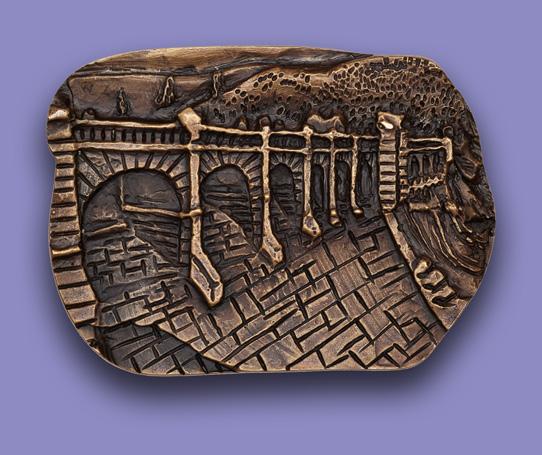
Drowned Lands (obverse) Leeds Arts University. Winner of the Grand First Prize, awarded annually by the Worshipful Company of Founders. See page 56
SIENNA WILLIAMS
GRAND SECOND PRIZE
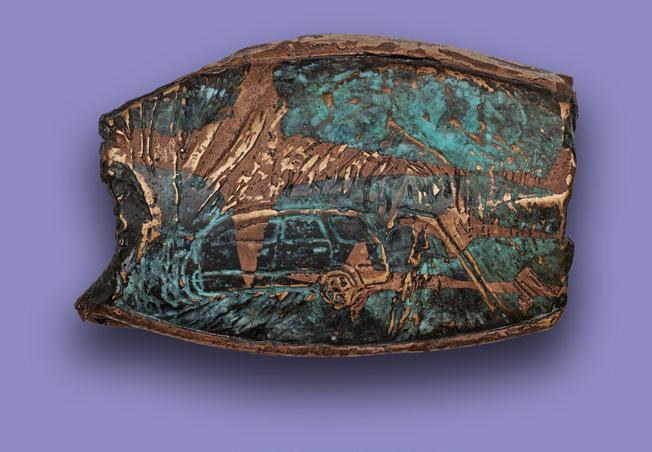
Just had to carry on (obverse) West Dean College. Winner of the Grand Second Prize, awarded annually by Thomas Fattorini Limited.
See page 58
HENRY PLUMB
BAMS STUDENT MEDAL PROJECT XXXIII 2026
CONTENTS
FIRST WORDS MARCY LEAVITT BOURNE
The British Art Medal Society, founded in 1982, has grown in membership and outreach: collectors, makers, curators, writers and lovers of the art medal can be very proud of creating together a Society that has commissioned new medals every year, organised talks and conferences and brought to wider public attention this wonderful, surprising and powerful art form.
The Student Medal Project was conceived by the British Art Medal Society as a means of re-introducing the art of the modern medal into art colleges within Great Britain – through bronze casting – and it has grown to include a considerable number of UK institutions and at least one invited foreign academy each year, making it an international Project. A new generation of medal makers is created. It has become part of the curriculum in many colleges, in sculpture, jewellery and metalwork. Teachers are encouraged to make medals too. Loyal sponsors provide ten prizes. For teaching the art of bronze casting, it creates a perfect module whether a college has its own foundry or sends work out to be cast. There are few experiences in the art world to match a bronze pour, and the skills learned – wax carving and modelling, mould making, ceramic shell or plaster cast making – can forever form part of an artist’s working life.
In terms of the focus or the subject of a modern art medal, the themes are without horizons. A student may choose to examine their own feelings about a personal matter, or select a place of great significance; they may want to speak out in anger at political wrongdoing or celebrate poetry; abstract design and attention to the form and function of making a modern medal also feature as potential ideas. The parameters of two sides and an edge – a work of art held in the hand – far from being restraints, create possibilities. The prizes are based on engagement with the medallic medium, with several specific areas, such as lettering, or current affairs, also portraiture. To encourage
promising students, ‘Merits’ are also awarded. No theme was set for this year’s Project. Nevertheless, student work often tackles the large themes of dangers to the environment, biodiversity, inequality – social and political – and health. However small it may be, the appeal of the modern art medal is its enormity of impact, its potential to state a case.
Marcy Leavitt Bourne Director, Student Medal Project
‘The medal is a medium that feels unbreakable and infinite.’
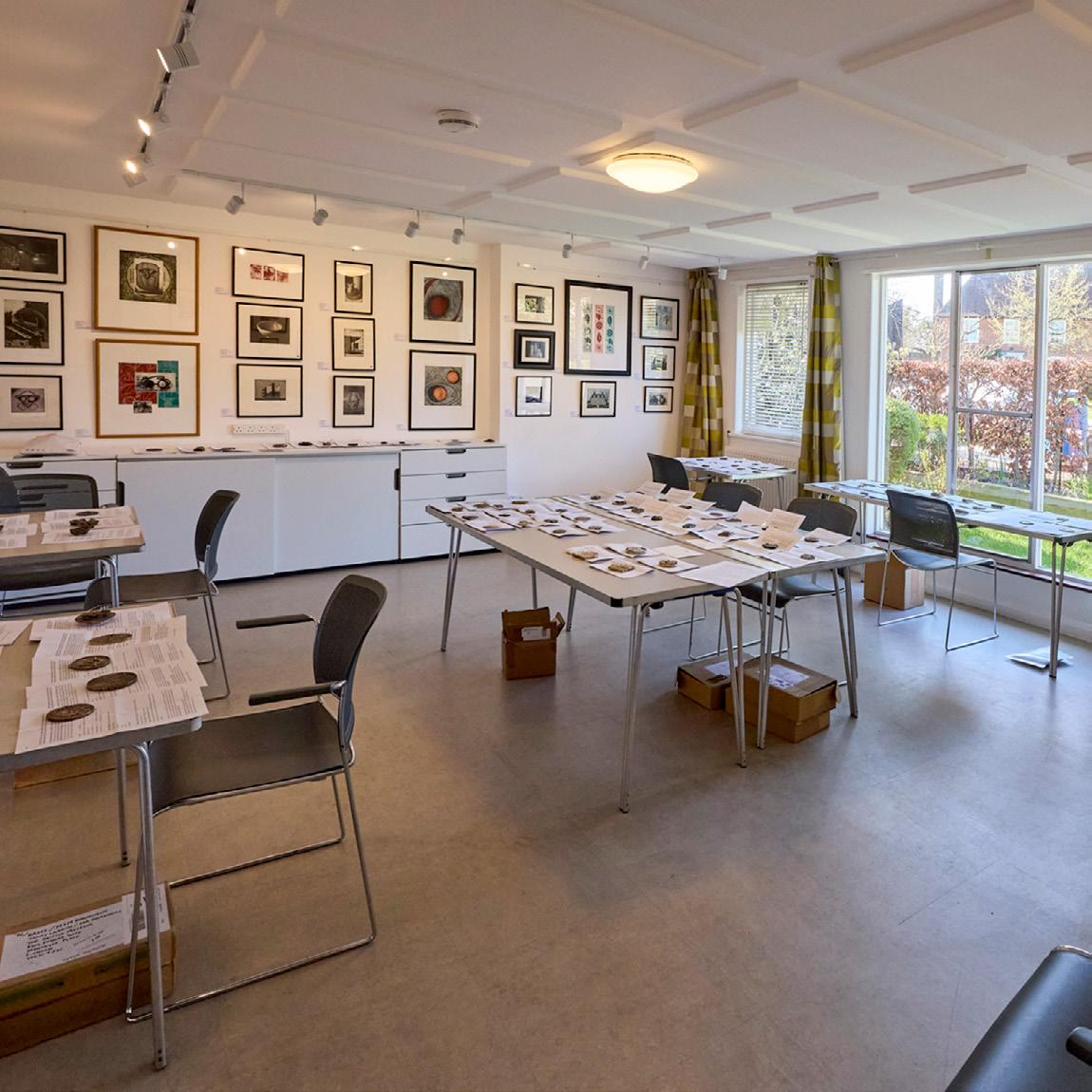
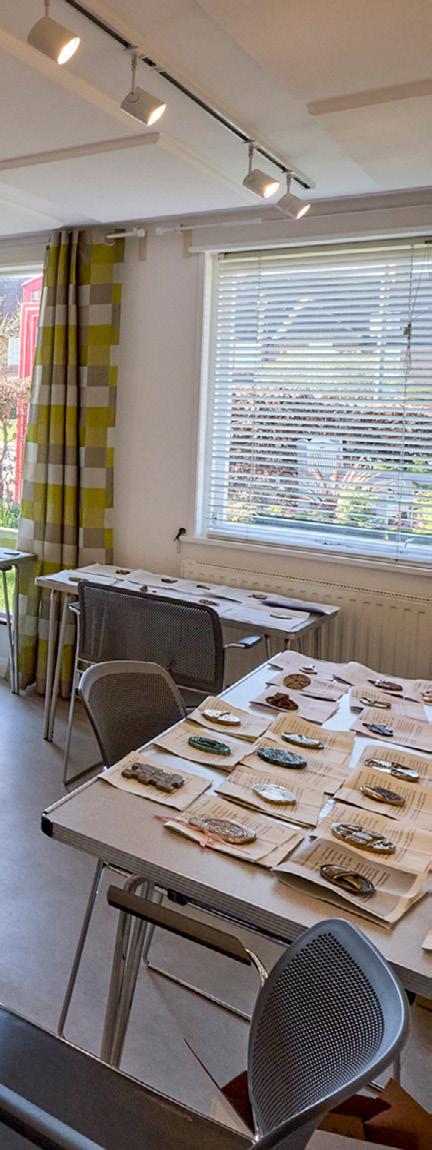
The medals for 2026 are set out by college, from 13 UK colleges and one college from abroad, for the five judges to decide on 10 prizes and one award, plus merits. Photo: Stephen Dodd.
SOFIA BRAND WHITEHEAD, FALMOUTH
INTRODUCTION: INSPIRATION & RESOLUTION PATRICK DAVISON
I trained as a goldsmith and silversmith and I currently work using these disciplines to explore and realise ideas and themes that interest me. I was fortunate to receive a training that presented gold and silversmithing as a profoundly artistic and expansive practice. It is one that can be used to investigate the inspiration we draw from the world around us and resolve this in carefully considered and executed work. In my experience this has fostered an attraction to working within a particular scale: objects that are handheld, or made to be used with the hands – whether fastening a brooch, engaging with a finely made clasp on a necklace, or drinking from a silver beaker or pouring from a jug.
The holding of a medal is central to its charm and perhaps one of its defining characteristics. Viewing medals in museums is always engaging and reading about them can be endlessly fascinating; however, it is when one can hold a medal and examine it at a steady, personal pace that the medium truly begins to reveal itself.
Judging the Student Medal Project is an example of this. It offers the opportunity to examine and handle works within the medallic tradition that present an extraordinary range of expression. It is a great pleasure to encounter the diversity on display: the breadth of artistic influences, the range of aesthetic approaches, and the variety of techniques used to bring ideas into being. I have particularly enjoyed seeing the themes the artists have chosen to address, the visual languages they have drawn upon, and the ways in which these have been resolved in relief on the medal.
In my own work, aesthetic decisions often emerge through the exploration of process and technique. The resulting forms tend to remain relatively direct and accessible while also reflecting a sparse visual language that I am drawn to. The medal offers an opportunity to work more graphically – engaging with imagery and lettering – and to consider how recurring themes in my practice might be translated in this way. There is a deep satisfaction
in resolving a piece at this scale, and in exploring a new, more pictorial direction, while continuing to develop ideas that are already embedded in my work. My experience of reviewing the medals in this Project suggests that many of the artists have undergone a similar process. The works are ambitious and yet thoughtfully resolved. The care and optimal technical execution honours the themes the artists choose to address. I hope this experience provides an opportunity for the artists involved to further develop their practice, using this distinctive and compelling medium as a means of artistic expression.
Patrick Davison Silversmith
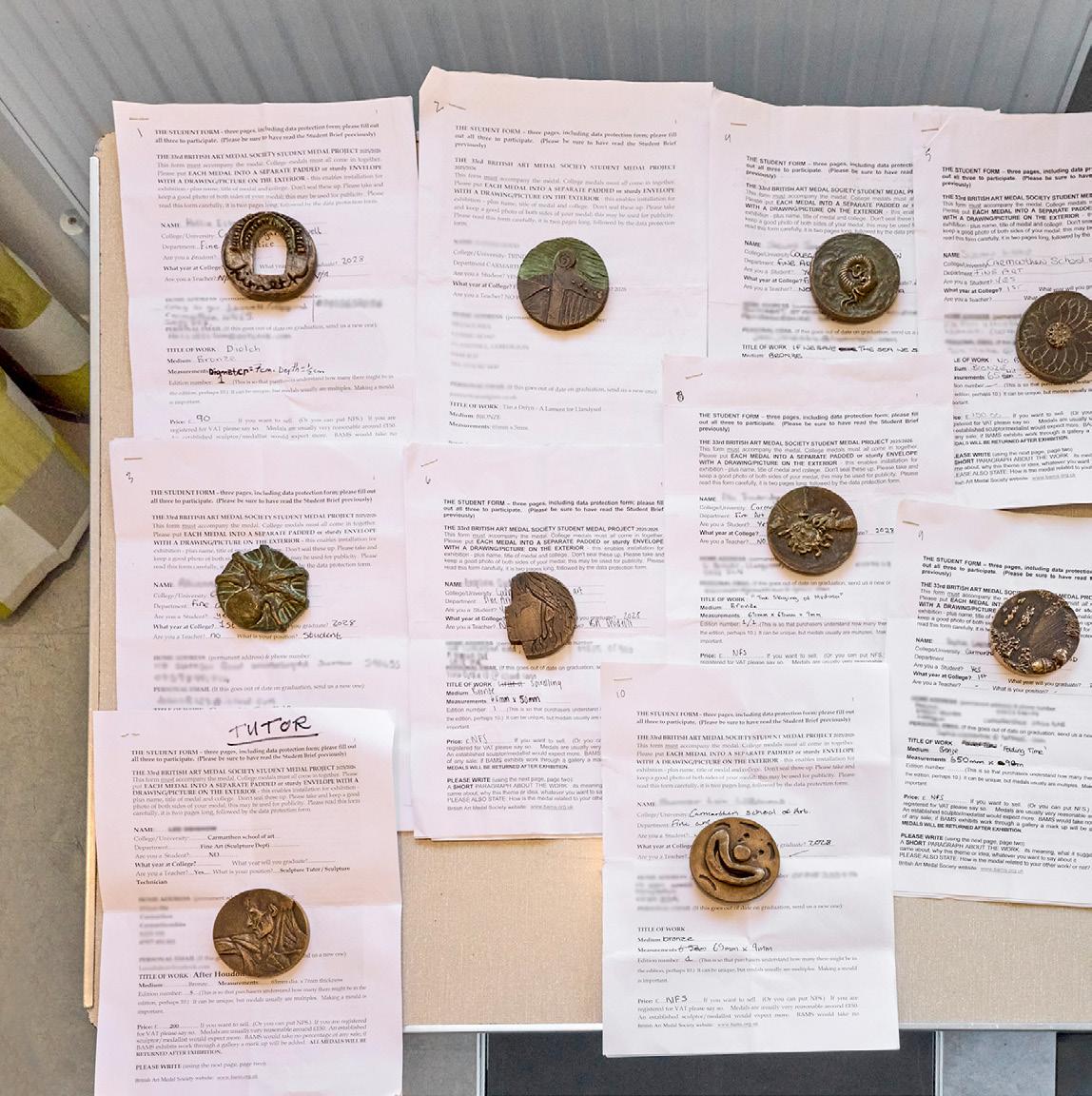
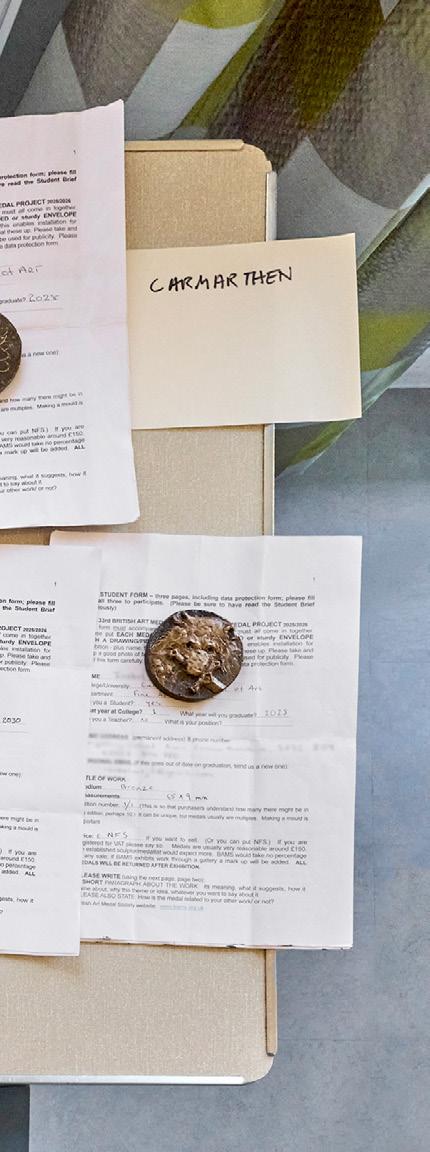
Medals at the judging from Carmarthen School of Art, Coleg Sir Gar, winner of the Annual Project Award (see page 22). Photo: Stephen Dodd.
THE STUDENT WORK
ARTISTS’ STATEMENTS & PRIZE-WINNING MEDALS
ALL MEDALS ARE CAST IN BRONZE UNLESS OTHERWISE STATED
BIRMINGHAM CITY UNIVERSITY; CARMARTHEN SCHOOL OF ART; CITY & GUILDS OF LONDON ART SCHOOL; DUNCAN OF JORDANSTONE COLLEGE OF ART & DESIGN;
EDINBURGH COLLEGE OF ART; FALMOUTH UNIVERSITY; UNIVERSITY FOR THE CREATIVE ARTS, FARNHAM;
FIFE COLLEGE; CITY OF GLASGOW COLLEGE; GLASGOW KELVIN COLLEGE;
HEREFORD COLLEGE OF ARTS; LEEDS ARTS UNIVERSITY; WEST DEAN COLLEGE; PFORZHEIM UNIVERSITY SCHOOL OF DESIGN.
BIRMINGHAM CITY UNIVERSITY
SCHOOL OF JEWELLERY
HND JEWELLERY & SILVERSMITHING
BA JEWELLERY & OBJECT HEAD OF SCHOOL (ACTING)
MIRANDA WELLS
STAFF TEAM DELIVERING PROJECT DAUVIT ALEXANDER (HND), KATY TROMANS (JEWELLERY AND SILVERSMITHING), REBECCA SKEELS (JEWELLERY AND OBJECT)
CASTING
G W LUNT
GAYNOR ALEXANDER
Two Sides of the Same Coin
‘I wanted this medal to reflect my life as a New Age traveller and how perceptions can change based on appearance. On one side is the lorry I lived in and the other the wagon. The two sides are brought together by the flames of the fire, a symbol of family, connection and community. Both were homes to us; it was not the vehicle that defined us, but the way others chose to see it.’ This medal received a Merit.
ELIZABETH BROWN
Two Swans
‘This medal is a symbol of balance, union and eternity. The two swans represent the balance of opposing forces, symbolising harmony. The Yin Yang shows how light and dark come together. Swans are known for their lifelong bonds, which is what this medal is all about.’
FIONA CHAMBERLAIN
In the Balance
‘My medal design is inspired by concerns about the parallels between the approach of Adolf Hitler in 1930’s Germany and Donald Trump in the United States, currently, regarding immigration. Trump is using similar language, in looking for someone to blame for economic and political discontent. A seesaw symbolises the questionable balance: liberty/freedom vs Trump’s policies. We all need to do our part to take a stand against injustices.’
ALICJA DERDZINSKA
The Polluted
‘My medal is a criticism of air pollution, showing the damage to lungs caused by
pollutants. According to The Lancet, air pollution is the largest environmental threat to human health worldwide. The obverse of the medal depicts a healthy lung, with imagery of a leafy tree, its branches leading up to a tree canopy; the reverse shows the lung, damaged and chaotic. A chimney billows smoke. More measures should be taken to minimise air pollution in major cities.’
ALEX FRADLEY
Under the Surface
‘The medal explores the powerful contrast between appearance and reality. On one side, a lone boat drifts across a calm ocean, representing peace, stillness and the illusion of safety. A Kraken-like creature emerges from the depths on the reverse, symbolising hidden dangers that we cannot see, rising chaos and emotions below the surface.’
be misleading: “Never judge a dragon by its hoard”, is inscribed around the edge.’
SOPHIE LEIGH Uneasy Tranquillity
‘Herons signify transformation, resilience, patience and tranquillity. On the obverse the heron sits with a fish in its beak; on the reverse, a snake has wound around the clamped beak. The message is that you can be wise and patient but still find yourself stumbling into an unpredictable situation. It mimics the real-life physical struggles I have faced, despite countless vigour; I am the heron.’
ABIGAIL MITCHELL Fiver’s Warning
Sobriety
‘My medal was based on my own personal experience with alcoholism and sobriety. It is intended to reflect the idea of turning your life around using support networks like Alcoholics Anonymous, as I did in the past. The imagery symbolises that the change is one day at a time, from a gaunt face on one side, and a 24-hour sobriety chip on the reverse.’
EVIE GREGORY
The Dragon’s Hoard
‘On the obverse, a little dragon is sitting on his humble hoard of just one coin. However, this coin is unexpectedly valuable, as it is an Edward VIII coin, produced in very limited numbers. I wanted the medal to show how value can
‘This medal was inspired by the novel Watership Down, by Richard Adams, with its themes of environmental destruction, urban expansion and abuse of power, all of which grow in relevance today. The climate crisis is being ignored in favour of poisoning our planet for profit. Fiver’s warning of a field covered with blood seems ever closer to becoming a reality.’ This medal received a Merit.
JOSEPH MORRIS What we let Grow
‘The widespread use of pesticides systematically destroys wildflowers and the habitats they support, all to make crop fields marginally larger. Yet these small gains come at a significant ecological cost. By rewilding part of our landscape we can restore biodiversity, support pollinators, and create a more sustainable agricultural system.’
JOSHUA GAWAD
ISLA PENDREIGH
A True Companion
‘This medal is an ode to dog companions and the underrated support and wellbeing they provide daily. I truly believe that the unconditional love and support they provide can change your life. I have experienced this with my own dog companion.’
ANNIE QUINN
Let the Living Be
‘Fox hunting has inspired my medal, a practice still widely performed globally, both legally and illegally. I want to raise awareness of this, as I and others strongly believe that this practice is pointless, providing no outcome besides a few hours of pointless, entertainment, harmful to foxes and hounds alike. The paw – fox or hound – on the reverse resembles a raised fist, symbolising unity, freedom and solidarity.’
TAMARA NICOLE REINHARD Two Sides of Humankind
‘With this medal, I seek to empower the beholder by showing them two contrasting realities of our mortal life. My wish is that the person who holds the medal feels empowered in times of despair, by showing them you can zoom in or zoom out of the medal, depending on which side is seen: on one, our planet is a small dot in the galaxy, of which you are a part; on the other you see yourself reflected. The medal has an inside and an outside quality.’
attention to the animals that are often harmed or sacrificed in the process of such progress. By placing animal protection within the symbolic language of the medal, the work highlights the tension between honour and responsibility. The medal becomes a reflective object, rather than a celebratory one. The work proposes that true progress should include ethical awareness and care for non-human life.’
This medal received a Merit.
Prize Winner TOBY WILLIAMS A Ship at Sea
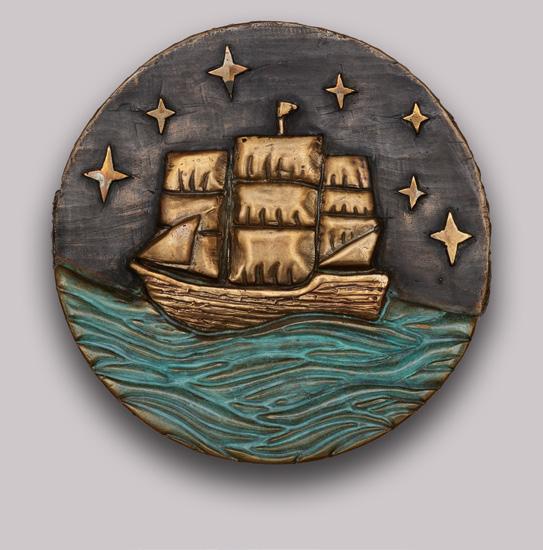
‘The medal is about taking risks and living a full life. I never planned to go into jewellery, but took a risk at doing something I loved. I like nautical themes and space. The narrative between the two sides shows the consequence of risk. Sometimes it works, sometimes it doesn’t, but it’s better than spending your whole life docked at harbour.’ Awarded the Ditchling Prize for lettering.
‘The medal uses irony to question the narratives of progress commonly associated with awards and commemoration. This work draws
YIYAO WANG Hidden
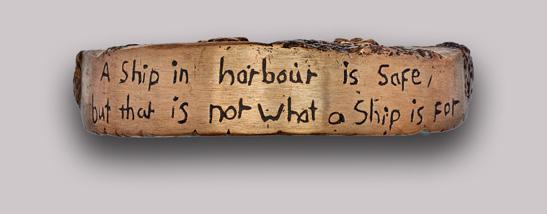
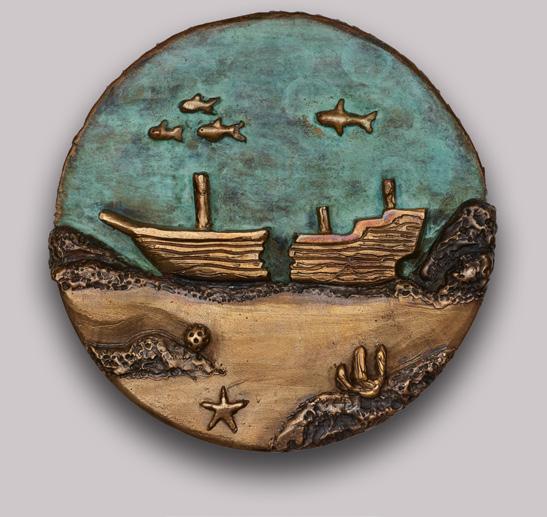
Prize Winner TOBY WILLIAMS
A Ship at Sea, 78mm Awarded the Ditchling Prize for Lettering, where lettering in an integral part of the medal and its meaning, to create an inseparable whole.
CARMARTHEN SCHOOL OF ART, COLEG SIR GAR
FINE ART PRACTICE AND JEWELLERY DESIGN
DEPARTMENT HEAD
LISA PHILLIPS
PROJECT TUTORS
LEE ODISHOW (SCULPTURE TUTOR)
KATY OWEN (PROGRAMME DIRECTOR)
FOUNDRY
LEE ODISHOW
This year the British Art Medal Society commends Carmarthen School of Art, Coleg sir Gar for the overall standard of their student medals. They exhibited an excellent understanding of the art of medal making, and the students have engaged with the medium showing skill and enthusiasm, which their written statements exemplify.
HOLLIE ELSOM
Diolch
‘The intention of this medal is to frame the land I love, the land I am so grateful to call home: Wales. After exploring one of the many castles in my area, I found myself inspired by the spectacular views of the valleys and rivers, and how the castle doors and windows framed them. I thought it would be nice if the medal could be used in a similar way.’
JUSTINE DODD
Tân a Delyn – A Lament for Llandysul
‘My medal shows an example of the beautiful harps that were created in Llandysul, and my distress at the harp centre closing, then being used as a cannabis farm, then finally destroyed in an act of arson. It traces the loss and lingering echoes of a place that shaped me.’
RHIANNON
JOHNS Down With the Ship
‘My medal is an octopus bringing down a pirate ship, inspired by folk lore, and also the idea of taking other people’s burden. In the end the ship still goes down. Sea life is always a theme in my work and I love creating almost surreal art with that.’
JACLYN JONES
If we Save the Sea we Save our World
‘The quote, on the medal, is by David Attenborough, in my opinion, my hero, someone I have admired since childhood. He would be my one guest I’d like to have a meal with. I enjoyed putting all the detail on the medal, and used a fossil to make a mould of the nautilus shell.’
SUSAN LAKE
No Bees – No Food
‘My medal is of a bee on the obverse and a sunflower on the reverse. I want to highlight nature. A lot of habitat has been lost, also farmers not thinking of the environment, as they use pesticides. There needs to be more regeneration within the farming community to help with biodiversity in our country.’
ANGELINA OJEDA-HILL
Spiralling
‘This medal was heavily inspired by medieval sketches and the grooves on fossils. I used a circular base to begin with, carving the side profile, and carving a spiral on one side, ensuring that my fingerprint was making a dent within the wax to represent humanity and human creativity.’
ISABEL TRIGWELL-JONES
The Bear
‘The medal being a two-sided form, made me think of opposites. I made a list, and the theme of “tame vs wild” inspired me. The design that developed was of this wild animal holding a man-made object between its teeth: a sword. The sword represents duty and tradition, and how out of place you can feel when struggling with the feeling of having to conform. It’s ironic, because a bear is powerful enough not to need a sword. I wanted the medal to feel like currency, the bear a royal portrait.’
ELLA TROWBRIDGE-MATTHEWS
The Slaying of Medusa
‘Since I was young, I have always been interested in Greek mythology, Medusa in particular. She
has become a symbol of female empowerment in recent years, one that confronts assault against women.’
This medal received a Merit.
SOPHIE WESTBROOK Folding Time
‘Returning to the house and field where I grew up, so many elements remained unchanged. Entering the field, as usual, I was caught by an experience of time folding and the present and past meeting. This gave a sense of nostalgia, alongside the current autumnal features, leaves falling, acorns on the ground. A design decision was to retain a vintage feel, keeping the surface as it came from the pour, and to use black patination.’
This medal received a Merit.
SUMMER LEIA WILLIAMS
Two Faces of Laughter
‘I decided to explore the duality of clowns in everyday media. Clowns are expected to make people laugh even if they may not be happy themselves. The two faces of the medal represent how people often hide their emotions behind a smile. I aimed to create juxtaposition and a feeling of yin and yang with both emotions. Each emotion goes hand in hand with the other. You cannot experience happiness without knowing true sadness.’
CITY & GUILDS OF LONDON ART SCHOOL
CARVING DEPARTMENT
DEPARTMENT HEAD
HEATHER NEWTON
PROJECT TEACHERS
RICHARD BARNES, SARAH DAVIS
CASTING AT CITY & GUILDS
ALISTAIR BLAKE, JOSH VAUGHAN
CHARLOTTE ELLERY
A Welsh Day Dream
‘I see a great value in seals and a sense of identity that is communicated through small and portable images. I designed a face with various parts of my family, as I feel I am not just one person but an amalgamation of many relationships: my mother’s nose, the curls I see in a photograph of my grandmother and the wave of hair on my own forehead. On the other side is a representation of one of the many stories I heard growing up, how Welsh fairies’ preferred mode of transport was riding on the backs of Corgis. I would enjoy the idea of other people interacting with it, perhaps thinking of their own personal stories with loved ones.’ This medal received the Kate Harrison Award, which is to visit a working artist’s studio, where the artist provides a ‘teaching’ session about working as a professional, with funding for the teaching and travel expenses for the student.
Prize Winner JOCELYN TREVENA
Many a Mus Makes a Mickle
‘This medal aims to be a delight to turn over in the hand, telling a story with no words. The title is a play on the phrase “many a little makes a mickle”, mus being the Latin name for the animal genus of mice. The medal was inspired in part by the Russian lubki motif “the cat’s funeral”, where a multitude of mice, representing peasants, have hauled away the cat, representing a wicked Tsar. I have an interest in playful, narrative based sculpture, with themes of predator/prey, wildness/ domesticity. There is more of a political note to this piece, and it felt a very relevant image.’ Prize presented by the foundry G W Lunt.
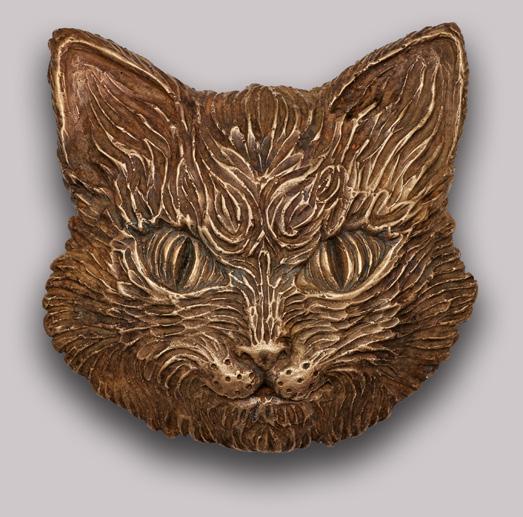
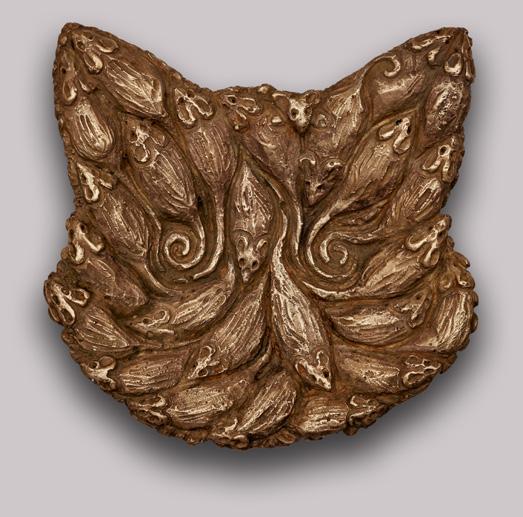
Prize Winner JOCELYN TREVENA
Many a Mus Makes a Mickle, 75mm Prize awarded for humour and detail, liveliness and contrasting scale, presented by G W Lunt.
DUNCAN OF JORDANSTONE
COLLEGE OF ART & DESIGN UNIVERSITY OF DUNDEE
DJCAD FOUNDRY
DEPARTMENT HEAD
SCHOOL SUPPORT SPECIALIST, FOUNDRY & 3D MAKING
RODDY MATHIESON
TEACHERS; CASTING
RODDY MATHIESON, JANE BULLIVANT
Prize Winner JEMIMA
BENBOW
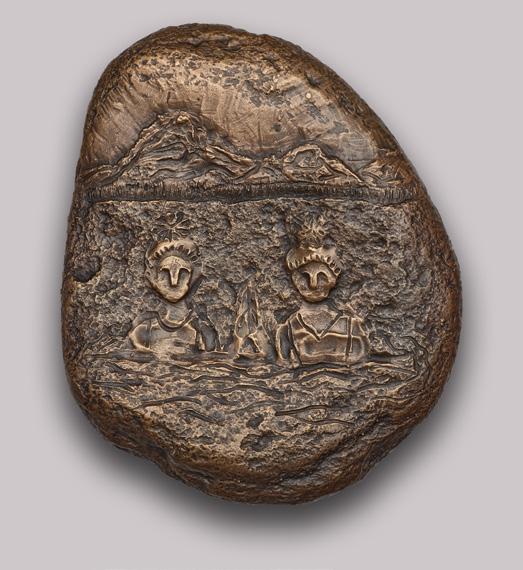
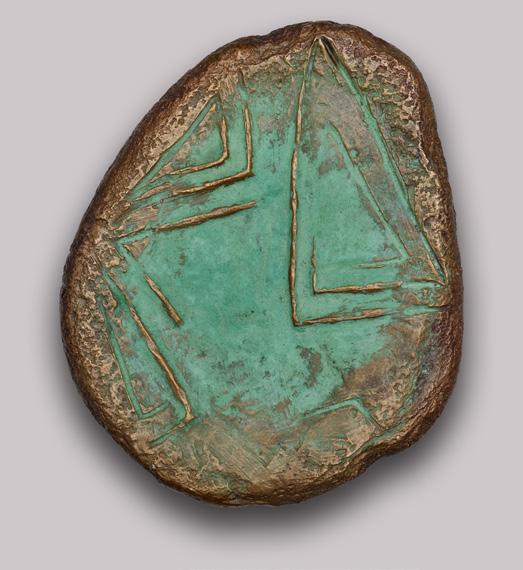
An Icy Dip
‘My medal was inspired by my experience growing up in a small village, in the Badenoch & Strathspey area, in the Highlands. My mum and I often swim in the surrounding lochs and rivers (all year round!), and it has become a key part of my love for where I live. I wanted to capture the beautiful scenery and abstract patterns that the ice makes as it forms round the shallow edges of the lochs. In my work I like the connection between person and nature, and I feel that wild swimming in the winter snow and ice blurs those boundaries. A rock from a river is the base for the medal, letting some of the natural textures show through the scene of the two of us taking a dip in the loch.’
Awarded Honourable Mention by the Bigbury Mint.
LAURA BEVERIDGE
Nothing Remotely Civil
‘This medal commemorates all the incredibly brave women of the Special Operations Executive, the SOE, who, during the Second World War, were among the agents tasked with top secret missions. They risked their lives, but they were ineligible to win military awards because of their sex. A civilian equivalent was refused by one of them, Pearl Witherington, who said, “there was nothing remotely civil about what I did”.’
PRIMROSE BOYES
PIE medal
‘Through my research, I discovered the British Pie Awards, a subject that naturally aligns with my interest in food. The medal honours the skill behind pie-making. The obverse bears the word “pie”, while the reverse features “made in Britain”, paying tribute to British producers.’
STUDENT
Prize Winner
JEMIMA BENBOW
An Icy Dip, 85x70mm Prize awarded for the imaginative use of a river rock, creating a sense of nature’s cold, with its swimmers in woolly hats on the obverse, and glacial patination with chunks of ice on the reverse. Winner of Honourable Mention from the Bigbury Mint.
MARIE HENDERSON
Right and Wrong – To the Good of Mankind
‘Carnegie and Trump, both built America in very different ways and both are opposites. Both are from Scotland (Trump’s mother was). Carnegie is from Dunfermline. He gave his money away to help less fortunate, built thousands of libraries, and believed in the power of knowledge. If only the people who voted for Trump read books instead of believing what they read online.’
CASSANDRA MANSUETO Stronger Together
‘As a first generation South African, I have a memory of walking down the road and seeing an elderly black gentleman walking in the same direction, carrying a big, heavy bag towards a taxi rank. I offered him help, and together we each carried a handle, and chatted while walking. I used this image, of a young, white female and an older black male, seen from behind, sharing a load, enjoying each other’s company, post-apartheid. It could be a healing image for a South Africa that still has racial tensions. The bag is shaped like South Africa, and on the obverse is South Africa’s national flower, a king protea, a symbol of resilience.’
JUDITH MARR
The Children are Always Ours
‘My medal is inspired by being a mother looking after children at home, but conscious of the way children are being treated across the world, and feeling powerless to do anything about it. In particular, I have been thinking about the mothers in Palestine, unable to keep their children safe. I never expected to see such things in modern times, while sitting in my own living room.’
ROMANA MCLAREN
They Will Come for You
‘This medal is a medal of dishonour. It is for those taking part or staying silent to the rise of fascism in the west; it comments on the bystanderism of today’s public in the face of evil and the apathy to the crimes of the powers above us. Around the rim of the medal is the last line of the famous poem by pastor Martin Niemöller, “First They Came”. It is a weighty medal because the subject matter is heavy.’
KATIE MUIR
Do not be Afraid
‘This medal is part of a larger project I have been working on for the last year. Growing up a Catholic, I have always felt distanced from some of the teachings, especially those involving women’s place in society. My project imagines a new religion, one which worships the female body. It has its roots in paganism and shares scriptures with Christianity. The obverse references the Christian origin of sin, which led to the patriarchy. In my edited version, both Adam and Eve take accountability, and are not ashamed. On the reverse a symbolic apple is halved to signify equality.’
HELEN RATTRAY
For Those Who go Down to the Sea in Ships
‘My medal is a tribute to the bravery of the RNLI, who saved my grandfather’s life and his crew from a violent storm with snow blizzards just off the coast of Peterhead in January 1942, a rescue that ran for 3 days, with the Lifeboat crew only taking 7 hours’ rest for the entire rescue. The quotation on the medal is the RNLI motto, “let not the deep swallow me up”.’
PAULA ROLDAN VILLAR
‘The medal follows the theme of my earlier project that asks how much artwork is worth and how an artwork achieves prestige. The cockroach resembles an artist: untouchable, lasting, multiplies and usually gross, but also a symbol of friction. Conversely, the diamond is proxy for the inflated and artificial value placed on artworks in institutions and markets. Collectively, these images work as complaint and satire, a criticism of the mythology of the art world.’
Dead Artist
UNIVERSITY OF EDINBURGH
EDINBURGH
COLLEGE OF ART
JEWELLERY AND SILVERSMITHING HEAD OF DEPARTMENT
JENNIFER GRAY
TEACHER MIRKA JANECKOVA
CASTING ECA FOUNDRY, SCULPTURE DEPARTMENT
KAYLA EWENS Greed
‘I have created a bronze medal that explores the dual nature of greed, through opposing gestures. On one side there is a possessive hand grabbing on to coins and gems, while on the reverse is a relief carving of begging hands that suggests appeal and need. This creates a concave/convex medal, which symbolises moral and physical weight of wealth and the imbalance of power worldwide’
IONA HUBBARD
Never Again/Never Forget
‘The medal uses symbolism to emphasise the title phrase, when talking about the persecution and treatment of millions of Jewish people during the holocaust. One side includes, among other symbols, a dove (bird of Judaism), a star of David, and a keyhole; on the other side is a songbird (national bird), an olive branch and a key which represents the oppression of the Palestinians, a group of people forced from their home, also victims, which many people are choosing to forget.’
ANDREA YUET TUNG LEE
Home Kong
‘Home is where the heart is, and as someone who has moved from one country to another, I always wonder, what if I were a bird, so I could fly home whenever I wanted. The Eurasian tree sparrow is a common bird in Hong Kong, depicted here holding a heart beneath its wing. The reverse shows the flower of Hong Kong, with its coordinates. It feels like a sparrow in my hands.’
MEDBH MACKLIN
Treasures
‘I was initially inspired by my own experiences of the transition from girlhood to womanhood, and the expectations that seemed to exist alongside this change. My design explores the contrast between these two states of being: innocence, playfulness and responsibility, freedom and expectation. I was interested in how these identities overlap rather than exist separately, and how the inner child continues to live within the adult self.’
ANDREA MANNING
Dying of Thirst
‘My chosen theme for the project was to highlight the increased pollution, specifically single use and micro plastics, in waterways and the threat this poses to marine wildlife. The obverse shows a seemingly innocuous four pack of ring can drinks in a plastic can carrier; on the reverse, the packaging has become a death trap for a fish, a seal and a turtle, their heads trapped in the empty spaces.’
Prize Winner
LEILA OMEROVA
Evge (Homeward)
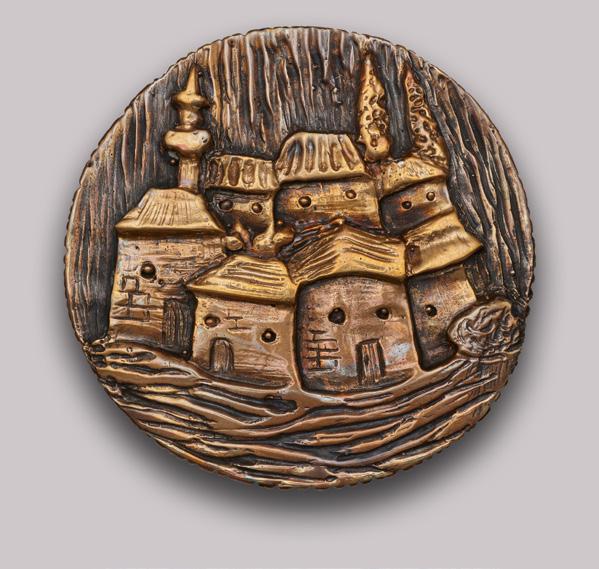
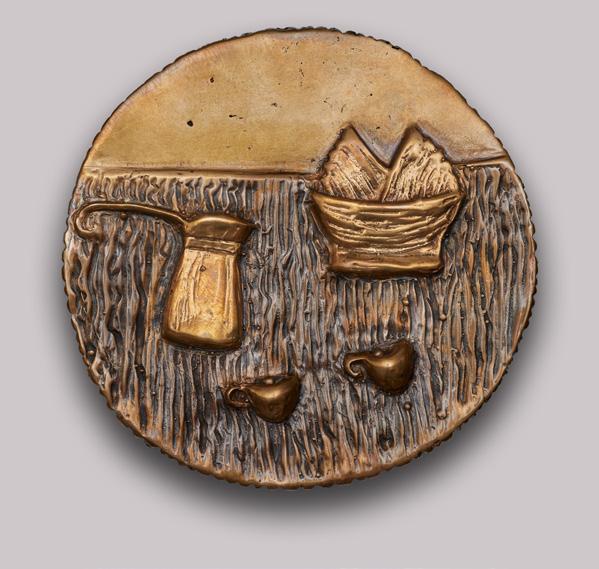
‘The medal is dedicated to my homeland, Crimea (Ukraine), a place where architecture, tradition and everyday rituals are inseparable from memory. On one side, I chose to depict Bakhchysarai, with its small old houses, mosque and tall cypress trees rising into the sky. These images reflect the layered history of the town and the quiet dignity that defines its atmosphere. On the reverse, I turned to the details of daily life: chebureks (crispy turnovers), a traditional Crimean tatar jezve (pot for coffee), and two small cups of coffee. These objects speak of warmth and hospitality, of conversations shared across generations, of family
gatherings of the aroma that fills a home in the early morning. If the first side represents place, the reverse represents feeling.’
Presented with the Michael Roberts Memorial Prize. The medal is shown on page 32.
RUBY ROBSON
Can your inner child come out to play?
‘My medal is inspired by listening to the playfulness of the inner child, and I wanted to express this through the childlike activity of listening to the sea in a shell, but hearing your inner child voice. One side depicts a shell and the other the inner ear; an earring of a child on a swing is attached.’
GEMMA SMITH
Odds over Ends
‘My medal aims to address a real issue of animal welfare in the horse racing industry. There is a large focus on money, and many race goers are more focused on their bets, and not why their horse never crossed the finish line. The horse is reduced to a financial instrument; a common occurrence is the death of a horse, seen as a “waste of money”, acknowledged only when death affects profit. This is a shocking attitude towards the welfare of horses.’
OLIWIA WILK
Who Will Bite First?
‘My medal came around due to the unnecessary fox hunting problems, with the way people treat animals and how they suffer because of us. The wide-open mouth, ready to bite, represents two different sides of fox hunting: how the dogs are manipulated, lack of obedience can cause them to be shot. Who is the victim in this scenario: fox or dog?’
Prize Winner
LEILA OMEROVA
Evge (Homeward), 81mm
Prize for modelling and narrative, drawing on history of place and remembrance of tradition, presented with the Michael Roberts Memorial Prize.
FALMOUTH UNIVERSITY FALMOUTH SCHOOL OF ART
HEAD OF ART
DUNCAN CAMERON
COURSE LEADER BA(HONS) FINE ART JONTY LEES
SENIOR TECHNICIAN, MOULD MAKING AND CASTING
TOM HARRINGTON
SOFIA BRAND WHITEHEAD I Breathe, We Breathe
‘This medal captures elements from my environment, from flora found on walks, the walls of a train station, patterns within a carpet or wallpaper. It collages mundane material, and experiments with how these textures perform in bronze, in a medium that feels unbreakable and infinite. I wanted to comment on the relationship of natural and industrial material, and the idea of patience in society today, not instant satisfaction. Things take time, including bronze casting.’
JAKE CHRISTIE Eye and Mouth
‘In my work I’ve been using isolated facial features and surreal movements to create videos with disturbing feelings, putting parts where they are not usually seen. With the medal I wanted to play with sculpture, to see how people feel when confronted with a part of the face that carries what some might consider the most weight: the eyes, gateway to the soul, and the lips, believed to be intimate. Do they carry this weight in cold medal?.’
ROWAN CHURCHILL Death Reflections
‘During the summer I had grown quite fond of the young gulls at the docks, trying to draw them, but they never stayed still. One morning I stepped out of my front door to see a seagull squashed on the road. I drew this seagull, and then made a medal, a reflective meditative process, in which the repetition of touch and material became its own form of mourning, a way of sitting with the gull a little longer, of translating fragility into weight and giving it permanence. There is a quiet beauty
in memorialising a creature widely scorned, mourning that which is not normally mourned, and how little it really matters in the end; the earth reclaims, and life begins anew.’ This medal received a Merit.
POPPY LAZENBURY
Peering Through the Rabbit Hole
‘My work has, in recent years, focused on the energy of the woodland. Designing a two-sided, tactile object allowed me to harness the concept of the portal. The medal pulls the eye from the gnarled tree stump to the intriguing hollow of the burrow, and eventually through to the hidden home of the rabbit, on the other side. This medal draws on my love of nature, whimsy and childhood storytelling.’ This medal received a Merit.
JAMES LUMLEY-WOOD
And if She Does, Will it not End?
‘The game of “she loves me” relies on the expendable nature of a flower. The medal is intended to subvert the idea that petals are discarded so wistfully, and the idea that a medal should be precious and unchanged. I hesitate to pull them, but the petals on this medal have been designed specifically to be broken off, so please go ahead, but pick carefully which phrase you begin with.’
personalising the medal to whoever is holding it. On the other side I used a contrasting decorative relief, of a face with emanating patterns. This contrasts with the shiny more fluid mirror, while also representing a face in a more iconic manner.’
‘My piece was inspired by the Chinese Shang and Zhou dynasty bronze-ware I had seen at the British Museum, and ancient bronze mirrors. I was interested in the way a mirrored surface can be created by polishing the bronze, and that one’s face can be reflected in the surface,
SAM MERRITT Face
UNIVERSITY FOR THE CREATIVE ARTS, FARNHAM
JEWELLERY & SILVERSMITHING
SENIOR LECTURER
GRANT MCCAIG
TECHNICAL TUTOR/CASTING
REBECCA ERRAT
NIKOLAOS XENOFON DRETTAS
Hydra Trail
‘This medal is inspired by my personal passion for downhill mountain biking, an extreme sport that has influenced both my life and this project. The design imagines a downhill race taking place on the Greek island of Hydra, known for its dramatic mountainous landscape and paths overlooking the sea. The obverse focuses on movement and speed, with linear marks and imprints across the surface. The reverse represents the natural terrain of the downhill track, its textured surface evoking the rough landscape of the descent.’
SUE LOCKYER
The Invisible Women
‘The medal is an evocative tribute to the dignity and resilience of women who often feel unseen as they grow older. This idea honours women whose quiet strength and beauty persist even when overlooked. On the obverse, a calm, dignified woman gazes forward, her expression self-assured. Around her, delicate flowers bloom. An inscription is in an arc above: “To The Women We Stop Seeing”. The reverse mirrors her profile, but with a mesh covering her features, unseen. The medal carries a quiet message: that invisibility does not mean absence. It becomes a tribute and a promise.’
This medal received a Merit.
Flora and Fawna
‘This medal celebrates the local nature of Surrey. It was inspired by a forest walk that I often take, depicted on the reverse of the medal, with a small stoney forest path. This leads to the obverse of the medal, which features a deer, surrounded by trees, staring at you directly in the eye.’
NINA MAGEE
PATRIZIA PINNA
Polarity: Fire & Water
‘Everything that exists and everything we can imagine is regulated by the universal law of polarity. As a lover of esotericism and mysticism, I took the theme of the balanced union between the masculine (fire) and feminine (water) energy in each of us. This amulet medal wants to recall and preserve this creative energy, through the symbolism of the two elements and through the power of the Celestian Letters on the surface.’
SISAN RASAILI
Light of Change
‘My medal represents a personal journey from darkness into light, growing up in my hometown. We once studied under oil lamps, before electricity arrived. When this happened, it changed, and nights became brighter; this memory inspired my design. My medal is divided diagonally, into two parts on each side: one symbolises the past and simplicity, the other represents progress and modern life. It indicates the power of light to change life.’
ZOË RIPLEY
She Held Me Well
‘This piece is inspired by, and is for my Granny Edwina, who was a huge part of my life. She was the most gentle, thoughtful and wise woman. When I was 16, she gave me a “purple stone”, with spiritual properties, which I have under my pillow every night. For the medal, I started by making a mould of that stone to cast and work from. I carved the labyrinth to represent a ring she wore. The quote, “all shall be well and all shall be well, and all manner of things shall be well”, is something which gave her solace, and myself also.’
FIFE COLLEGE
JEWELLERY DEPARTMENT
HEAD, ACADEMIC QUALITY MANAGER
KAREN COLVILLE
LECTURERS
KATHERINE WILLIAMSON, MICHELLE OVENS
TECHNICIAN 2
SHIRLEY WARNOCK-LOWE
CASTING
RODDY MATHIESON, THE MOBILE FOUNDRY
ALISON DORWARD
Loves Me
‘The medal represents both the eternal optimism of human nature and the beauty of flowers, and their ability to raise one’s spirits. It depicts a 7-petalled daisy on the obverse, and a naively carved heart with the words “Loves Me” on the reverse.’
KATELYN MACDONALD
A Missing Piece
‘I decided to design and dedicate my medal to spread awareness about Parkinsons Disease, which my granny has struggled with for years. I don’t feel that enough people know and understand it properly, how it makes simple, daily tasks more difficult, and how it takes a toll on so many people’s lives. The puzzle piece is “missing”, representing the lack of a chemical in the brain called dopamine. I hope that people like my granny get the help they deserve.’
JENNIFER MCGEE
ADHD – The Deconstructed Brain
‘The meaning of my medal is to show how my ADHD brain is like a deconstructed architectural building. After studying deconstructivism for a design project, I thought it represented me well, in comparison to how a “normal” brain, or building, is viewed. I incorporated an image of the brain alongside a concept deconstructed design of a building.’
spiral staircases I saw inside some of Edinburgh’s old buildings. One of them was a square spiral staircase at New College Library, an unusual shape, and made me want to make a square medal. The other was a spiral one. The medal project led me to join them together. To me a staircase symbolises a journey: a journey in life, of spiritual growth, personal evaluation. The stairs on the obverse move clockwise, and on the reverse, anticlockwise, which creates a feeling of positive and negative. A handrail is a protective barrier.’
‘The medal is very personal, and tells about some of the happiest moments in my life on one side and sad ones on the other. I was inspired by
VOLHA YATSKOVA Journey
NEW SKILLS, SMALL SCALE
SIENNA WILLIAMS
LEEDS ARTS UNIVERSITY, WINNER OF THE GRAND FIRST PRIZE
I have enjoyed the development, different processes and the challenge of working in detail on a small scale, and I was thrilled to win the Grand First Prize, especially as the medal tells the story of a small Welsh village local to me being drowned to create a reservoir of water to supply the city of Liverpool. Making a medal suits my work practice as I enjoy intricate work. I’ve enjoyed learning new skills whilst participating in the BAMS Project. Starting from a sketch to the finished bronze medal, it’s a relief to see the medal come out successfully from the mould. Refining the medal, chasing it and adding a patina brings it to life. I particularly liked
the sculpting of the clay, although I did find it challenging working on both sides as it’s fragile. It was nice to work in a different medium than I usually do, which is drawing, printmaking etc. It has given me a chance to meet different artists, connections for the future and to gain public recognition for my work. The support from the workshops and staff at university has enabled me to acquire the skill and knowledge to be able to enter the competition, working to size constraints and deadlines, and to try new forms of art. Entering the Project and winning the first prize has given me a confidence boost, and I’ve enjoyed telling a story through the art of medal making. It is a lengthy process and has taught me that not everything can be made quickly. Through this I have developed new skills that could be applied in the creative industry.
The medal and description are presented on pages 56 and 57.
HENRY PLUMB
WEST DEAN COLLEGE, WINNER OF THE GRAND SECOND PRIZE
When it came to making the medal, I took a good deal of time deciding what my subject would be. The idea of using my relatively recent car accident as the core of it came to me, but I was hesitant to use it as the experience was very personal and still emotionally quite raw in my mind. I knew instinctively this would not be an easy medal to make from all manner of perspectives. However, even as I tried to think of other ideas, my mind continued developing a medal relating to the crash, and the concept took on a life of its own. Thoughts seemed to slip into place, such as using the badge shape with the sides broken off to signify the impact of the crash on both the car and myself. Mentally,
the production process was very demanding and after the second failed casting I began to joke that all the salvaged parts of my car that littered my workbench as inspiration had gathered together to conspire against me
Although I started this project with little detailed knowledge on medals or casting, by the time I had produced my finished piece I had not only learned the practical skills required to make a medal but also how use my experiences in a positive way and not be afraid to tackle something that might seem overwhelming. I was pleased to take something so negative in my life and turn that memory into something so much more positive. I felt that there was a real symmetry with the casting process and, in winning the Grand Second Prize, I found the perfect way to, in some sense, come to terms with my accident.
The medal and description are presented on pages 58 and 59.
CITY OF GLASGOW
COLLEGE
CRAFT & DESIGN DEPARTMENT
CURRICULUM HEAD
LISA MCGOVERN
LECTURER
DAVID FINLAY
CASTING
RODDY MATHIESON, THE MOBILE FOUNDRY
ANSEEL ALSHAIKHLI
Nature and the Sun
‘This medal explores the connection between the sun, nature, and the hidden systems that sustain life. One side shows the sun radiating energy to nourish small trees, symbolising growth and renewal. The reverse reveals an underground network of roots, extending into water, highlighting the unseen processes that support life above the surface. The circular form reflects the continuous cycle and balance of nature.’
MICHAELA BAKU
Bee the Change you Want to see
‘Winnie the Pooh holds emotional weight for many people because he is tied to childhood, innocence and simplicity. By using his honeypot, I tap into that softness and nostalgia to make the message of the medal feel more personal: to save the bees, and a quiet call to action, turning nostalgia into a message of responsibility.’
ESTHER BEE
Synaesthesia, a new way to see things
‘The meaning of this work is the different outlook of how different individuals see the world, in this case, synaesthesia. This idea was developed through the research of diversity, in which I thought that neurodivergence is part of it, and is not often spoken about as being a diverse view of things. Using it as a topic is demonstrating it is a genetic outcome, and might help others.’
‘My design focused on the loss of biodiversity in sea life, especially the turtle’s loss of life as a biproduct of the fishery trade: ghost nets. These
SAIRA BEGUM Ocean’s Ghosts
nets trap turtles leading to death by injury or suffocation. The beauty of ocean life is captured on the medal with the cross-texture of the nets on the turtle’s shell; the flippers are made of fish, showing danger to all sea life. Unless humans change industry practices, the seabed will continue to be riddled with the “ocean’s ghosts”.’
SONJA BIANCHET
Guardians of the River
‘The world is in a climate crisis, and it can be difficult to choose how to help. The Riverfly Partnership gathers volunteers to survey riverfly populations across the UK. This surveying has successfully caught pollution events, such as chemical spills. Attending once a month to count the tiniest insect larvae may seem small, but it is important. On one side of the medal we see the riverfly larvae, in a tray during surveying; on the other the healthy adult completing their turn in the ecosystem that sustains our planet.’
CHLOE BOYLE
Pond Life
‘The inspiration for this medal is biodiversity, specifically the decline in amphibian population across Scotland. Habitat loss and fragmentation lead to biodiversity loss with frogs. The obverse of the medal portrays a frog’s body being crushed by jagged edges, carved from wax, reminiscent of dirt, symbolising the destruction of ponds and urbanisation. On the reverse, the frog’s fingers of its hand reach a lily pad as though the frog is hanging on to its habitat.’
GEORGINA KEANE
The Once-ler Won?
‘My design draws inspiration from the film, The Lorax, which teaches the importance of
trees. The Once-ler, a character in the film, used all the trees, thereby ruining his own business. It was a great loss and he faced the consequences. I used a juvenile art style for the medal, to convey a childlike perspective to convey an important message. It suggests that wanting to protect and aid biodiversity is such a simple idea that even a child can comprehend it. Also how important it is to educate a newer generation, and learn from the mistakes of previous generations.’ This medal received a Merit.
STEVEN MCGILVARY
We are Gonna Need a Bigger Bowl
‘Commercial fisheries work to strict quotas, this in turn means the catch contains other species outside the remit. Once hauled, many are thrown back to the sea, disrupting a delicate ecosystem, this is known as bycatch. Sharks are definned and thrown back in a cruel act. These acts are to be deplored.’
HANNAH MCNICOL Final Resting Place
‘My medal focuses on biodiversity, specifically hunting/culling and habitat loss. On the obverse, a Scottish wildcat sleeps on a bed of lichen, that covers the trees of his home. On the reverse, the skeleton of the wildcat is sunken into this same bed where he once rested his head.’
LUCY RENWICK
The Ripple Effect
‘The medal represents the devastating effects of plastic pollution on sea-life and the natural habitat. The obverse surface shows circular ripples, extending outwards, to represent a natural, unaffected ocean. The ripples also represent the evolving effect from pollution,
through human careless actions. The reverse is darker, and contains a skeletal fish, revealing the inevitable outcome of plastic pollution if we don’t clean up our act.’
JENNIFER ROACHE
A Quick Bite to Eat
‘This piece represents the food chain and its continuing cycle. It was heavily inspired by my Leopard Gecko Stevie, as I witnessed her catch food. Watching her speed and skill, as well as the grasshoppers blending into the background as she hunted, gave me the images for the medal.’
MANNIE ROSIE
Eat it
‘This is a piece tying together our human desire for progress and our innate connection to nature. One side depicts our plastification of the world, told through Alphabet Spaghetti, being told what to eat like children. The other reflects the organic and raw nature, with wavelike movement, as though swept away by the sea. The pink ribbon is a sign of rebellion. My work intends to juxtapose opposites, colliding them to create new forms.’
IONA SAMSON
A Branch of Time
‘When researching the topic of biodiversity, I was really drawn to the issues surrounding the decline in the health of the environment such as deforestation and habitat destruction, and also to the “climate clock”, and the idea of how long do we have before it is too late to fix.’
XANDER SHIELDS
Beauty of Nature
‘Nature should be appreciated, and we should cherish it, not allow pollution to damage plants and wildlife. I chose this theme because I adore nature and animals. The key part of the medal is the fish, which can be seen on both sides. On one side, the fish emerges from the water, and on the other the entire fish is on a wave, going round the medal.’
JACK STENSKIE Shared World
‘The medal celebrates biodiversity while reflecting on our shared responsibility to protect the natural world. Its irregular shape and angled corners acknowledge the world’s imperfections. One side evokes a cave wall. A minimalist butterfly is a quiet symbol of the butterfly effect: even small actions can have profound environmental effects. The other side is a brick wall, a metaphor for humanity: many individuals forming one structure. We remain connected by our shared world.’
GLASGOW KELVIN
COLLEGE
DEPARTMENT OF JEWELLERY
LECTURER
KATHLEEN DUNCAN
TECHNICIAN
IAIN BAIRD
SÍOFRA COLLINS O’REGAN
Mo Thinteán Féin
‘The title of my medal means “my own fireplace”, and it references the old Irish seanfhocal, or proverb, which in English is “there is no fireplace/hearth like your own fireplace/ hearth”. Or, “there’s no place like home”. The obverse of the medal depicts a microscopic view of sphagnum moss at the edge of a bog pool, showing just five of the many species of sphagnum moss that can be found on Irish bogs or peatlands. They are crucial as ecosystem engineers, in the formation and composition of bogs. This microscopic view gives a small insight into the wealth of biodiversity that exists in intact bogs in Ireland. While turf cutting (the reverse) has revealed histories and cultural heritage, it also degrades boglands, and becomes a highly politicised discourse.’
This medal received a Merit.
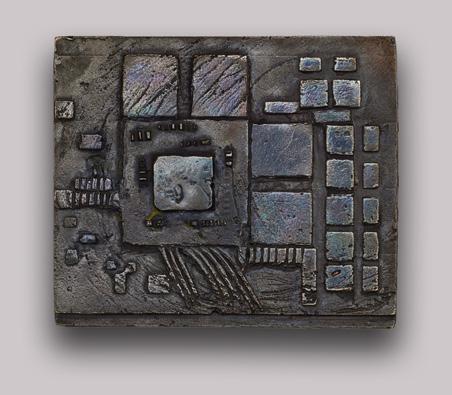
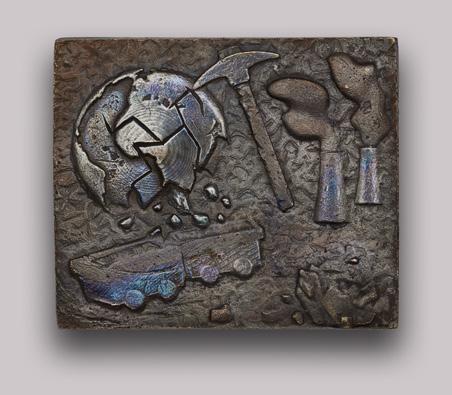
Prize Winner LENA LATIFA Mined Minds
‘Every passing year I find myself and everyone around me surrounded by technology more and more. A recent AI boom means that manual tasks are achieved with LLMs. I wanted to investigate what happens behind the scenes of the technology industry. My medal explores the stark duality of technological advancement. One side presents a sleek GPU-inspired circuit board, symbolising innovation in computing, and the training of new AI models. The reverse portrays a fractured globe being shattered by a pickaxe, belching factory chimneys and mine carts laden with rubble, evoking the environmental devastation wrought by relentless resource extraction.
While silicon chips power global progress, they rely on rare earth minerals mined in places where child labour and toxic dust contaminate soil and
water, leading to health crises. Where radioactive waste seeps into rivers it renders land barren and threatens millions. Data centres consume vast energy and pollute the air. The inherent duality of the medal was inspiring and helped me to come up with the design ideas.’
Winner of the ‘Herbie’ Prize.
STEPHANIE A. M. MCQUILLAN
Misericordia Concess
‘The title of the medal means “mercy granted”, and comes from my experience as a young student nurse in Glasgow, but due to issues following the Covid pandemic, I dropped out and redirected myself towards artistic expression and metalworking. In hindsight, a blessing. It inspired the medal’s form: double sided, one face a right eye, the other a left, uniting as a pair to gaze backward and forward in time. The portraits are of Fleming and Lister, scientists who granted mercy through scientific discoveries.’
RYAN MCQUILLAN
Midas Touch
‘I wanted to retell the myth of King Midas through a modern, political lens. I chose the shape of the apple because, in many versions of the story, he reached for it to find it turning into cold, hard metal in his hand. To me, this is the perfect metaphor for the world we live in today. We are a society that has become obsessed with material wealth and the “gold” of profit, often at the expense of our own humanity.’
Prize Winner
LENA LATIFA Mined Minds, 60x51mm
The ‘Herbie’ prize, from the estate of John Herbert, presented for the best political/social comment medal, in this instance the subject of technology is of the moment, with comments on AI and the destruction of the globe. Contrasting sides combine comment on “technological advancement”.
HEREFORD COLLEGE OF ARTS
CONTEMPORARY DESIGN CRAFTS BA (HONS) JEWELLERY DESIGN BA (HONS)
COURSE LEADER
ELLA SIBLEY SPARLING
TEACHERS ON THE MEDAL PROJECT
ELLA SIBLEY SPARLING, RICH MAKIN (DIGITAL DESIGN LEAD), NICOLA LILLIE (JEWELLERY DESIGN LECTURER)
CASTING RODDY MATHIESON, THE MOBILE FOUNDRY
SOPHIE BAYLEY
Parallels in Life
‘In nature, tree rings are like nature’s fingerprints. Each ring shows a year of growth, and, like our fingerprints, no two tree ring patterns are the same. This reminds us that uniqueness is a part of nature’s beauty. This idea links the life between humans and nature and the parallels between them.’
DIANA CALOMFIR
Untitled
‘Opposites attract. This medal is about friendship, but not just any two people becoming friends. It’s about two people that would never in millions of universes like or hang out with each other, out of all odds being inseparable. The moon doesn’t orbit the sun so how do they become one? An eclipse brings the two into one. Light and dark contrast the other to be the best version of one another.’
MARION DEVONSHIRE Fantasy vs Reality
‘My medal is about how what you are shown might not be what is actually true, with one side being pristine and polished and the other side being damaged and destroyed. I wanted to experiment with working on the surfaces. I was thinking about how what you see is not always what is happening, and how people always have secrets.’
EBONY DYAS-ELDON
Coral Morphologies
‘By highlighting both the importance and the decline of these ecosystems of corals within our planet, I wanted to produce beauty in the tragedy that is our current climate within the ocean.’
BRENNAN ESWORTHY
When Cross and Knot Became One: The Rise of the Celtic Christian Tradition
‘This medal is about how the Christians used Celtic pre-existing symbols and combined them into their own mythology to create a more secure society. An example is the Celtic knot pattern on the Celtic cross, and how the triquetra went from representing sea/sky/land or mind/body/spirit to representing father/ son/holy spirit. This could have begun with St Patrick, and is present today in churches across Ireland, Scotland and Wales.’
SARAH HUGHES
Remembrance
‘The poppy, a widely recognised symbol of remembrance on the obverse, is combined, on the reverse, with the combat stress logo, and barbed wire, representing the battlefields and trench warfare, indicative of the nightmares that surviving soldiers have to live with.’
JEAN JARVIS
Leading Others to Scale Greater Heights
‘My career in leading others to scale greater heights has left me intrigued by positivity and how we determine out own happiness. My medal explores shape and form as an expression of positivity and strength. The mountain represents life’s challenges. On one side, a
climber reaches down to help another. On the other side, both stand at the summit, arms raised. Their triumph is not individual achievement, but shared victory.’ This medal received a Merit.
S. ALEC LAWTON
Vergissmeinnicht
‘Why? To highlight the reality and reach of the Holocaust perpetrated by collaborators at the direction of the Nazis. This is a development of the ASOCIAL Concentration Camp Badge, to include specific masonic imagery of a master mason. The flowers represent the forget-meknot (the title of the medal) drawn in chalk on the walls of gas chambers. The skulls within the flames represent numbers to rule, hold and make a lodge perfect.’
MADELINE MACHARG
God’s Grandeur
‘This medal is inspired by the poem “God’s Grandeur” by Gerard Manley Hopkins, and serves as a commentary on the impacts of the industrial revolution on the environment. The obverse, a faraway perspective, highlights the disconnect between humans and nature that rapid industrialisation brings. The reverse is close-up and intimate, a quiet reminder of nature’s resilience and beauty, which will outlive mankind.’
JADE OWEN
Unmasking the Stigma
‘This work explores my experience of going through an ADHD diagnosis at the age of 42. As a woman, my symptoms presented in ways that diverged from the historically male-centred diagnostic model, resulting in decades of being
overlooked. The piece reflects the cumulative impact of masking, misinterpretation and late recognition, and considers the tension between internal experience and external perception in its design.’
JESSICA PERRIN
I Can’t Remember
‘I have no memories from my childhood due to my ADHD. This has always caused fear for me; time goes by so fast and I will have nothing to prove that it wasn’t wasted. The young girl on the medal’s obverse represents me as a youth, but she is slipping. On the reverse, I wanted to show the distortion of time and Salvador Dali’s famous melting clock sprung to mind. I wanted to make it my own, and here it melts into the shape of the skeletal structure of dopamine, the chemical which, when lacking, causes poor memory for those with ADHD.’
DANIELLA POMROY
Light in the Dark
‘This project delves into themes of grief, but in a way that looks for the happiness/joy. I’ve always related this to the presence of robins, as I’ve always associated them with my own experiences surrounding grief and found them to be a source of comfort.’
PENELOPE SHEPPARD
Less Pressure Next Time
‘The title is borne out of the realisation that excessive personal pressure in the pursuit of perfection is counter-productive. The medal has been created as a cathartic exploration of the emotional and physical consequences and is a gentle reminder that balance in all things is vital.’
AMELIE UNDERHILL GUNNER The Fates
‘I decided to play on the idea of flipping a coin to decide something, mixing that with fortune telling and luck. I drew for inspiration on the quote “one for sorrow, two for joy, three for a girl, four for a boy” and how magpies play a role in superstition when it comes to luck defending the number you see. I wanted the medal to be something you could interact with, a tool for decision making. One bird is on one side, and two on another, a total of three (for a girl).’
LEEDS ARTS
UNIVERSITY
DEPARTMENT BA (HONS) FINE ART
COURSE LEADER
JO NEIL
SENIOR LECTURER, PROJECT LEADER
GABI BOIANGIU
TECHNICIANS
JOANNE HALL, FINE ART INSTRUCTOR; THOMAS BOLLAND, 3D CASTING INSTRUCTOR;
JAMES BRIGGS, 3D METAL INSTRUCTOR; CHRIS DAVIS, 3D WORKSHOPS MANAGER
CASTING
ALL MEDALS WERE CAST AT LEEDS ARTS UNIVERSITY
JAI’LA ANDERSON
Meditative Touch
‘Through my studies I have been exploring how creating and interacting with art can create calm. While designing this medal, I was specifically interested in sculpture, finding meditation through sensory aspects, such as touch. The shape and variety of textures create a sensory experience when interacting with the medal. The experience of creating it was also meditative, interacting with the clay to map out the most used touch point.’
JORJA AINSCOUGH Lepus
‘My medal shows a design representative of the Lepus constellation, featuring a detailed hare on one side and indentations of the constellation on the reverse. I wanted to derive a focus into the links between the natural world and the cosmos, celebrating their cultural and symbolic meanings. Polishing and patination gave a contrast to the sides.’
Prize winner EVIE BLACK
Penny for Your Thoughts
‘This bronze medal is an ode to the joys of journeying. When we travel, a sense of the self is suspended, identity takes a backseat while we navigate the unspoken rules and awkward politeness of public transport. These secular pilgrimages that we adopt into everyday routines have a way of unifying the most unpredictable set of people.
On the medal, the puzzle-like assemblages of people and animals highlight the importance of respect, tolerance and quiet understanding. The shape of the rolled “penny” acts as a
Prize Winner
EVIE BLACK
Penny for Your Thoughts, 72x65mm Winner of the prize for portraiture, here with multiple portraits, including the use of the edge. Each has an individuality, suited to the subject matter, modelled to create a sense of people together. Awarded by the South London Foundry.
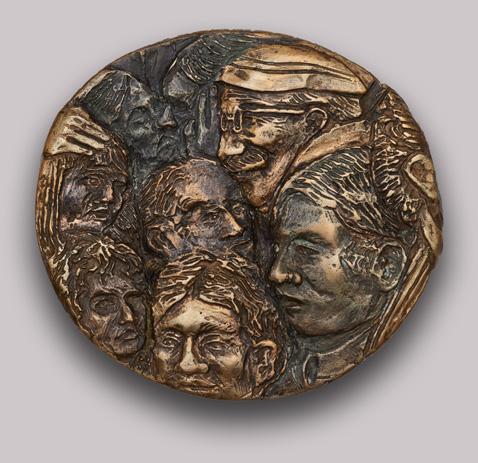
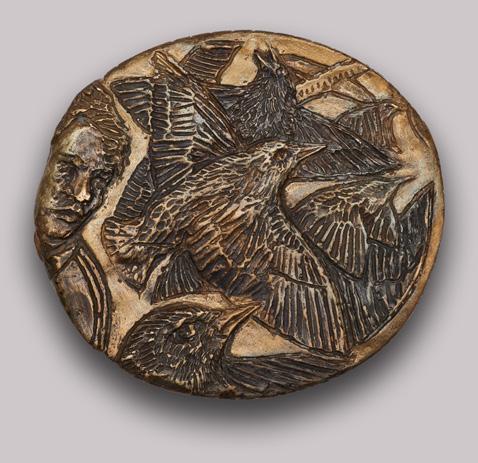
souvenir and a way-marker for the everyday traveller. It is a reminder to take moments of contemplation alongside the creatures we share the world with.’
Prize awarded by the South London Foundry for a portrait medal.
Prize winner SCARLET BROWN Escapism
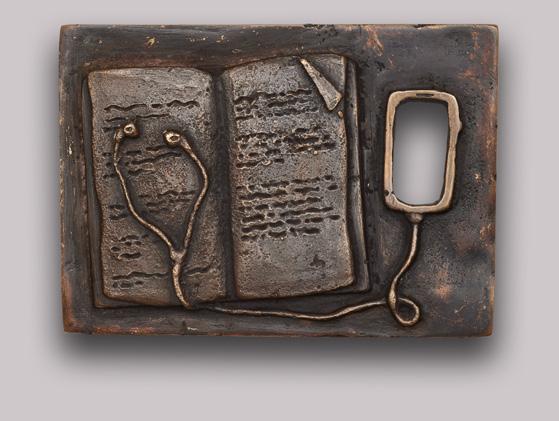
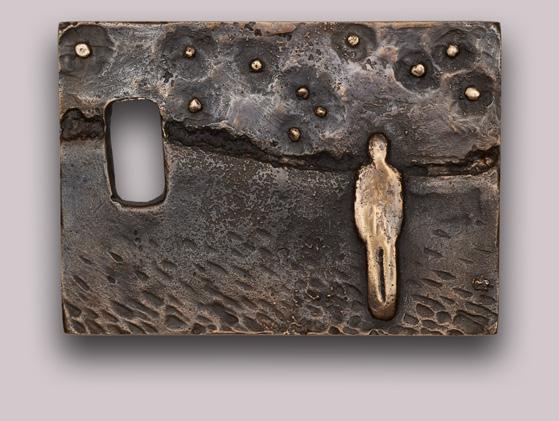
‘The medal focuses on escapism and the methods and mediums we use to achieve escape from daily life and its stresses. The obverse of the medal depicts a book, earphones and phone, mediums personally used for escapism. Escapism bases itself on a personal side of how reading and music can act as ways to ease and transport us. The hole through the piece acts as a phone screen, which transforms into a portal on the reverse that leads in to a tranquil, starry nightscape, suggesting different worlds we become engrossed in to relax from our reality.’
Prize awarded by the Worshipful Company of Tinplate Workers alias Wire Workers, who also purchase the medal to add to their collection of winning medals. The medal is shown on page 54.
EMILY BUNCE-BURKE Together
‘This medal was inspired by community and connection, the contrasting side a reference to overpowering loneliness we all relate to at certain points of our lives. On the “connection” side of the medal, the central figure shines and glows in the company of others, where feeling love and as if you matter is a powerful message.’
MICHAEL CAMPBELL Catch of the Day
‘The medal is inspired by growing up and watching boats return from the sea to the mouth of the Tyne. The title is from the fresh seafood brought to market (with a playful narrative twist), and the design came about from the rather merciless reputation seagulls have acquired through their scavenging methods. Sitting by Fish Quay sands, the view of fishing boats returning, whilst chaperoned by a squabble of seagulls tells a story of different species living and working in the same space, a shared narrative.’
FREYA CONNOLLY Thank God 4 Immigrants
‘My medal explores the hate of immigrants and migrants that has been active in the UK’s media, and the tension surrounding false patriotism. It responds to the political news, where debates around borders, asylum policy and false “British values” dominate headlines, which break apart communities. This work insists on a different narrative, that Britain has always been shaped and built by migrant workers, asylum seekers and refugees.’
LOLA COX Home
‘For me, home is not a place, but the relationships closest to me. The medal depicts the politics of home through separation, taking my 14-year-old golden retriever as a subject, who remains at home while I am away at university.
Prize Winner
SCARLET BROWN
Escapism, 76x54mm Prize awarded for the way in which the shape contributes visually to the topic of books and mobiles, with a ‘window’ through the medal, both phone shaped and at the same time a door to another world, presented by the Worshipful Company of Tin Plate Workers alias Wire Workers.
The sleeping dog, in a curled-up position, is a symbol of stability.’
RACHEL DUNSMORE
Life’s Fate
‘Life’s fate can be decided by a tiny, almost imperceptible difference, such as the split-second choice between two paths, as suggested by the quotation from The Rubáiyát of Omar Khayyám, written on the medal: “A hair perhaps divides the False and True – And upon what, prithee, may life depend?”. I no longer see everything in black and white, right or wrong, truth or falsehood, but the numerous shades of grey, like thin lines, on the reverse of the medal.’
FATEMEH GHANE
Rooted in Infinity
‘The creation of this medal is rooted in the ancient Persian archetypes, where nature, myth and spirituality are inseparable from human existence. They are cross-cultural forms resonating across many cultures and different societies. The design draws from a world view in which every creature and element is a manifestation of cosmic order, and man’s role is to preserve balance between the earthly and the divine. The goat as a sacred being appears on one side and the cypress tree on the reverse.’
LUCY LINLEY
Divine Providence
‘As part of my recent works investigating into my own relationship with religion and spirituality, specifically regarding an inherent longing for “God” without
holding any faith, this medal draws inspiration from biblical imagery and symbolism. It stages a visual dialogue about power and vulnerability, contrasting the lamb at rest, with an eye on the reverse, concentrating awareness into a single, unblinking form. It creates a tension between being seen and being offered.’
LENA MAASSEN Growing Pains/Becoming
‘In this medal I wanted to embody mindset and change, by the challenges posed by struggles, which aren’t accomplished by one task but filled with small victories and setbacks. I created a medal that captured the unsteady and long journey of growth and change that affected me while struggling with an Anorexia Nervosa diagnosis, a journey to find myself again. Using an apple - core, tree and roots - the medal is symbolic of growing, learning and finding your place, seeing a healed version of yourself.’
KIAN NUTBROWN Memory Bank
‘This medal was inspired by the environmentally harmful use of AI, specifically the extremely high water consumption required to cool the data centres. The use of AI to create art has become an issue also. On one side the dried up river bay shows where water had been before, the memory of where it once was; on the reverse the cut-out represents the mindlessness of AI, with no creativity put into the work.’
KERENSA TERESZCZUK
Take me; Tender, Sweet and Juicy; Eat me; Putris, Amarus, Malum
‘This medal is based on the idea of deception: being lured into something that appears great, only to see its darker, more grotesque side lurking beneath. The symbolism on the medal is based on the Original Sin in the Garden of Eden, the delicious, tempting apple, that had dark consequences hidden in its core. Deception is all around us, broadcast in the media, social media, spoken by politicians. Upon picking and indulging in the apple, one may find inside that it is rotten to the core.’
Prize winner
SIENNA WILLIAMS Drowned Lands
Prize Winner
SIENNA WILLIAMS
Drowned Lands, 79x57mm
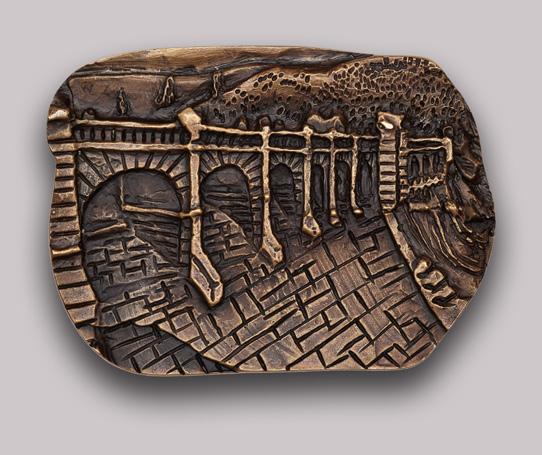
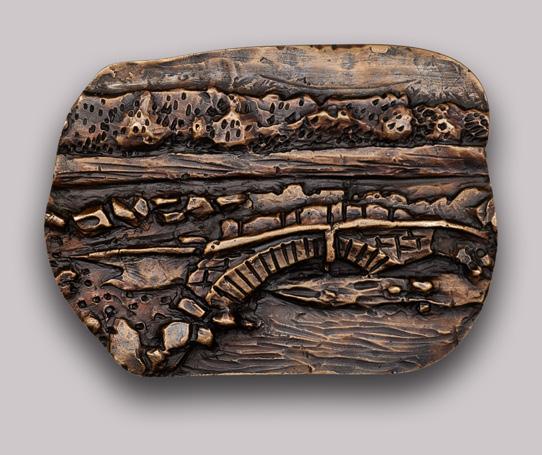
Winner of the Grand First Prize for overall excellence in the medallic medium, especially in its use of patination, perspective and detail in architecture and landscape, on both sides of the medal, awarded by the Worshipful Company of Founders.
‘The idea for this medal was inspired by Llyn Efyrnwy/Lake Vyrnwy, a reservoir near my home in Mid Wales. It was built in the late 18th century to supply water to Liverpool. In order for it to be built, though, it required the drowning of the village of Llanwddyn. The village, school, church and homes were demolished, and the occupants were moved to a replacement village, which was built by the Liverpool Corporation just below the newly built dam. When the water level drops you can still see the remains of the old village. I made the medal to highlight Welsh displacement for an English water supply. The obverse shows the dam itself, whilst the reverse depicts the remains of the bridge that ran through the old village of Llanwddyn, and can sometimes be seen in hot summers when the water level is low.’ Winner of the Grand First Prize for overall excellence, presented annually by the Worshipful Company of Founders, who also purchase the winning medal (or sponsor the making of a cast) to add to the Founders’ Collection of Grand First Prize medals. STUDENT
WEST DEAN COLLEGE
METALS PATHWAY
METALS SUBJECT LEADER KATE JENNINGS
PROJECT TEACHER
STEPHEN COLES
CASTING
STEPHEN COLES
SAMUEL KIMBER BINMORE
Hallow Void
‘This medal is themed around a prosperous society and the evils committed to preserve it. There are two sides anchored together by only the pale king, in the same position on both sides. The pale king “tamed the savage souls” of the citizens of hallownest; the civilisation was believed eternal, but succumbed to a disease, during which the king even sacrificed his children. The medal depicts an event in this time, called the abyss climb, where the children failed to save themselves.’
Prize winner HENRY PLUMB
Just had to carry on
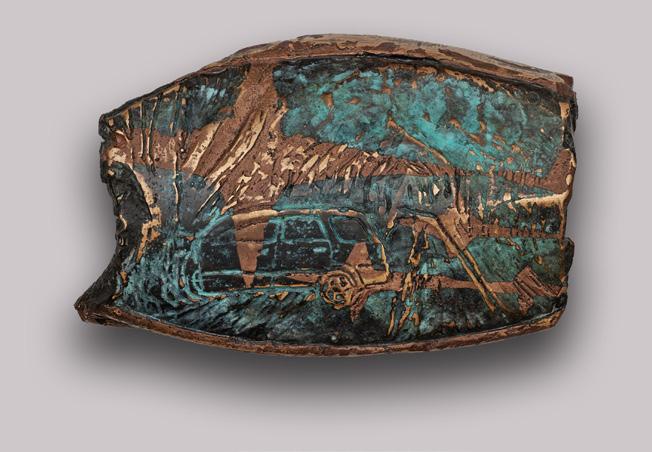
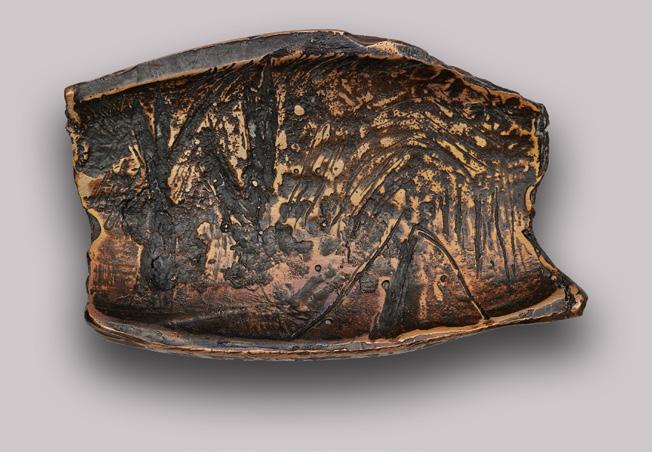
‘This medal was made to help me process the trauma from my first car crash. Its shape comes from the actual wreckage of the car, such as the grill and pieces of the wheels, for the broken edges. The medal depicts a simplified image on the obverse of the accident itself, and on the back is the exact same stretch of road a month later, devoid of the car. It suggests how trauma leaves you hollow, unless you take it with you and make something out of feelings you can’t put into words.’
Winner of the Grand Second Prize for overall excellence in the medallic medium, presented annually by Thomas Fattorini Ltd.
CAROL WALKER Get Lost
‘The medal is inspired by my love of Venice. Often people are looking at their map with a specific destination in mind and not really looking at their surroundings. It’s the notion of serendipity, connecting to your surroundings, and wandering without a specific destination. Being lost, being inquisitive and veering off the beaten path reveals unexpected gems, and even connections to Venetians, who then share their stories with you.’
Prize Winner
HENRY PLUMB
Just had to carry on, 90x50mm Winner of the Grand Second Prize for overall excellence in the medallic medium, a medal where shape and substance are combined in a narrative of personal experience in contrasting sides. Awarded by Thomas Fattorini Ltd.
THE GUEST
ACADEMY
Each year one art college outside the British Isles is invited to participate in the Student Medal Project, both students and teachers. This year BAMS has included the students from Pforzheim University, School of Design, Germany. The university is known for its interdisciplinary studies in a creative curriculum, especially jewellery, industrial design and fashion. It has a long and historic tradition of excellence in metal work.
PFORZHEIM UNIVERSITY
SCHOOL OF DESIGN
DESIGN PF, JEWELLERY PROFESSOR
ANDREAS GUT
TEACHERS ON THE PROJECT ANDREAS GUT, GABRIELE MAIER
CASTING
KALMAN-HAFNER CASTERS, PFORZHEIM
CHIARA CENICCOLA
Echoes of the Ocean
‘The bronze captures the hidden underwater world, reflecting its contrasts and harmonies: sand, shells, corals and flowing currents. One side features organic, winding forms symbolising coral reefs, and the ever-changing ocean. The other, marked by a shell, represents nature’s perfection, growth and transience, with small zircona to symbolise true treasures on the ocean floor.’
ZORA GENSEL
Respect my Right to Live
‘Cephalopods, such as octopuses, squids and cuttlefish, possess highly complex nervous systems and remarkable intelligence. They have a distributed brain structure, with a significant portion of their neurons located in their arms, allowing for advanced problem solving, even tool use. Studies have shown that they can exhibit emotions, recognise humans and demonstrate self-awareness, even suffering. This raises serious ethical concerns about consuming them. They should be treated with the respect they deserve.’ This medal received a Merit.
MILLA KOCH
Tired of Trying to fit in? F*ck it – Break Free
‘I often find myself feeling restricted, whether by circumstances, expectations or even my own thoughts. That frustration inspired me to create a medal that embodies this struggle. It depicts a figure, compressed and confined, desperately pushing against the boundaries of the medal, trying to break free.’
JEONG YEON LEE
Root to Fruit
‘The medal symbolises transformation and personal growth. It appears as a tree, but when you turn it upside down, it reveals a fruit. The obverse represents the future, while the reverse symbolises the past, a reflection of my journey. Moving to Germany from Korea was a stark contrast, full of challenges and new experiences. My past felt like the growth rings of a tree, and I hope my path smooths out, leading to something meaningful in the future.’
ZOË LEONHARD
Trapped in Reflection
‘This medal takes the form of a hand mirror, a symbol of self-perception and identity. One side is shattered, representing the fractured way I see myself, an image shaped by my own insecurities. It reflects the limits of my reality. On the reverse, an eye emerges from the mirror, embodying the desire to break free from this limited view. It represents the longing to see myself through different eyes, to gain a new perspective, a universal wish to understand oneself, beyond the mirror’s constraints.’
distinguishing fake and legitimate email, not to click on a fake one.’
ELLA SCHMEDING
How Many Lives are Your Diamonds Worth?
‘Blood diamonds are mined under brutal conditions, often funding violence and exploitation. Many miners, including children, risk their lives for little or no pay. The front of the medal features a radiant red gemstone as a symbolic ring, representing the diamond industry. The view of the gem is restricted, illustrating the miners’ struggle to find diamonds. The medal honours the workers and challenges the viewer to reflect on the hidden cost of luxury.’
Prize winner LEONIE STEINHAUER
Wings and Blossoms – A Symbiosis
Beware of the Web
‘The World Wide Web is integrated into almost all aspects of our life. But with its rising influence the danger rises. Malware. Intrusive software developed by cybercriminals/ hackers, to steal data and damage computer systems. They hide well and most times it is too late when you notice. Just like a spider and its web. This medal was made with the thought to raise awareness about the dangers of one mistaken click. The idea was inspired by my grandmother, who has problems
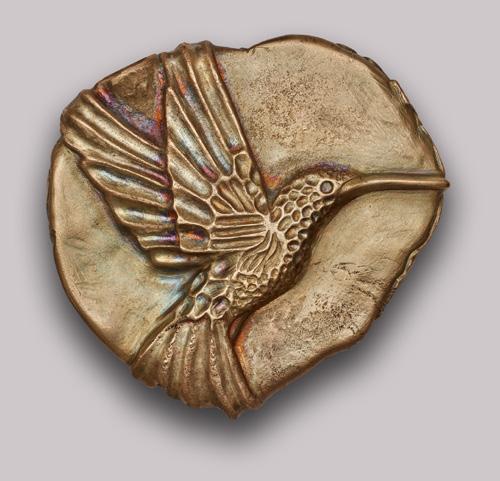
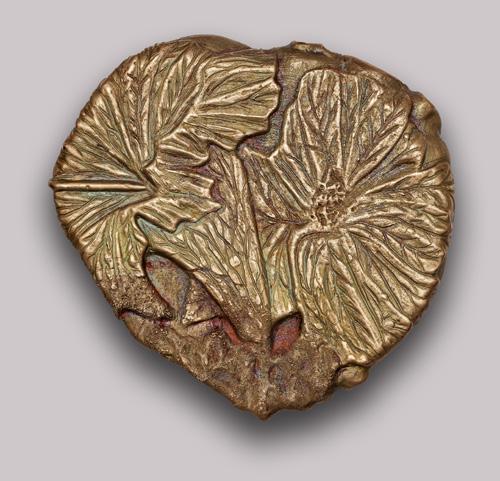
‘Nature is our origin, with fauna and flora forming the foundation of life: a masterpiece of harmony, where every being plays a vital role. The Sword-billed hummingbird, with its extraordinary beak, is a perfect example of this interconnectedness, feeding on nectar like a bee, while ensuring pollination. It is a living example of nature’s perfect symbiosis, where animal and plant life depend on each other in a delicate balance.
I wanted to capture the uniqueness of hummingbirds and emphasise their remarkable adaptation. Our responsibility is to live in harmony with nature, to listen, to understand and to act with care. We share this planet with countless other beings, all of which play a vital role.’
The ‘Best Guest’ Prize for medallic excellence, presented by Pangolin Editions. The medal is shown on page 62.
LEONA LINDEMANN
Prize Winner
LEONIE STEINHAUER
Wings and Blossoms –
A Symbiosis, 70mm
The ‘Best Guest’ prize for overall excellence in the medallic medium, with particular attention to detail on contrasting sides, presented by Pangolin Editions.
LUCA ZIMMERMANN Nonduality
‘I created this medal inspired by a Möbius strip and driven by a universal concept. These days humanity gets more and more separated and artificially divided. Fear, hate and distrust creep their way into many minds. That’s why it gets more important every day to remember that we are all one. We are all humanity and we all share the same world. My medal, like the Möbius strip, has only one side. Wrapped up and tangled it appears different, but don’t be fooled.’
MEDALS BY MEMBERS OF STAFF
GABI BOIANGIU LEEDS ARTS UNIVERSITY
Growing
‘In our urban environments, we have tried our best to annihilate any trace of natural growth and continue to punish plants that find their ways through the tiny cracks of pavement. This medal is a reflection on the amazing resilience some plants show, self-seeding, finding the tiniest bit of soil in which they can bring a spot of green. Adaptability is the key. Plants we see as undesirable often have important uses.’
STEPHEN COLES WEST DEAN COLLEGE
How do you Like Your Eggs in the Morning?
‘A stoic front, an optimism for the future. Boldly marching towards our collective bright dystopia! Adorned with many medals and with a healthy power: self-portrait of the artist.’
RODDY MATHIESON DUNCAN OF JORDANSTONE COLLEGE OF ART & DESIGN
Billionaires’ Lives Matter
‘A medal made up of seventeen casts which have been altered to make an ideological word puzzle, a game of chess and hangman, a kind of mirror held up to our times. The two sides of the medal are related through opposing ideologies of life, unity and division, which have become political weapons in the culture wars: might is right, wealth is worshipped and hate is clickbait. We are non-players in the billionaires’ game.’
LEE ODISHOW
CARMARTHEN SCHOOL OF ART, COLEG SIR GAR
After Houdon
‘As a sculptor, I have an interest in anatomy. This stems from being a child and looking at my mother’s medical notes from her time as a nurse, which included technical drawings akin to Grey’s Anatomy. Since then, I have always been drawn to musculature and skeletal anatomy. Houdon’s écorché figure stands out as one of the most revered examples of anatomy, but, for me, it is also a fascinating piece of sculptural work that I find inspiration in. The medal is just a little nod to those that were at the forefront of anatomy, and in this case Jean Antoine Houdon.’
NECOLE SCHMITZ WEST DEAN COLLEGE
Is it Still Monday?
‘This work explores the power of a gesture to capture a precise emotional state. It is an amalgam of what is at hand and what weighs on the mind. Part collage, part spontaneous mark, I wanted to see if the energy of a quick sketch could truly hold the fullness of a moment. As the parent of young children, my practice is often carved out of the present; there is rarely a “perfect” time to create. There is simply the time you have. This piece reflects that necessity by capturing a fleeting moment within the brief, borrowed windows of the everyday.’
AFTERWORD
Thirteen colleges within Great Britain produced 113 medals for this year’s Project, where they were joined by our ‘guest academy’, Pforzheim University School of Design, who produced 9 medals. This year’s judges were: guest judge, Patrick Davison; Greg Fattorini; Linda Crook; Janet Larkin; Marcy Leavitt Bourne. As each college continues to use the medal to learn the skills of lost wax bronze-casting, a tradition springs up, so that students look forward to their time of making medals at college. What with rising expenses and cost of materials for casting in bronze, it is wonderful to see such an excellent response to the Project. Keeping alive these skills, and the art and craft of the foundry – at colleges or wherever the medals are cast –is also the aim of the Project.
The Worshipful Company of Tin Plate Workers alias Wire Workers sponsor two prize-winning students to attend the BAMS Annual Conference, and purchase the medal to whom they give a prize. The Worshipful Company of Founders sponsor the casting of their prize-winning medal to add to the Founders’ First Prize Winners Collection.
The Student Medal Project is by invitation, to college departments of sculpture, metalwork or jewellery, in particular, but also from other disciplines. BAMS will often be able to have an introductory talk arranged at the college the first year, either in person or over Zoom/Teams, and there is an instructive PowerPoint on the BAMS website. Such talks will often be able to include an artist as well, speaking about the making process.
The Exhibition for the Project XXXIII, which includes all works selected by the judges to comply with the definition of the modern art medal – two sided, easily held in the hand, not too large, weighty or 3D – takes place at the New Ashgate Gallery, in Farnham, Surrey, for the month of May 2026.
ABOUT THE BRITISH ART MEDAL SOCIETY
The Society commissions medals which are available to its members to buy. Since its formation in 1982, the British Art Medal Society not only has commissioned medals but also holds seminars and workshops, plans exhibitions, and continues to encourage artists everywhere to take a fresh approach to the medal. For the past nineteen years (with one break) it has selected a recent art school graduate to join the New Medallist scheme, and awarded a travel and study bursary for them to continue their work with medals, sponsored by the Belvedere Trust. BAMS also publishes the twice-yearly journal The Medal, to which writers and medallists from all parts of the world contribute. On the Society’s 30th anniversary in 2012, it published a book, ‘The New Medallists’, which includes essays about its work and contains a list of its commissioned medals. A book celebrating the 40th anniversary of BAMS was produced
during the anniversary: ‘Encounters with Medals, 40 Years of BAMS’, by Philip Attwood, Janet Larkin and Marcy Leavitt Bourne, available from the website. The book, Making Modern Art Medals: A Rough Guide for Artistic Journeys (2024), full of professional artists’ personal tips on all aspects of making, is published in hard copy and is also online from Issuu. These and other publications are available from the BAMS website.
The Society offers an advisory service to potential patrons, institutions and individuals on how to go about commissioning a medal.
BAMS is also associated with the Fédération
Internationale de la Médaille d’Art (FIDEM), which holds an international exhibition and conference every two years, and in 2027 this will be held in Prague.
The British Art Medal Society welcomes new members. Further information can be obtained from:
Janet Larkin, General Secretary of BAMS
Email: generalsecretary@bams.org.uk
Or consult the Society’s website: www.bams.org.uk
Follow us:
ACKNOWLEDGEMENTS
The Goldsmiths’ Centre supports the Student Medal Project with its administrative costs, including those for exhibitions and symposiums held at universities around the UK, and the online Student Medal Catalogue, which is free to all participants. It contains photographs of the winners, and a statement from every student, edited for clarity and space. The Goldsmiths’ Company also supports public educational lectures organised by BAMS.
Sponsors of the prizes have continued to be very supportive and we cannot thank them enough. The Worshipful Company of Founders awards the Grand First Prize for the medal that most successfully makes use of the medallic medium, and continues the tradition of paying for a cast of the winning medal for the Founders’ collection. Thus their prize is a validation and celebration of the student’s work. The Worshipful Company of Tin Plate Workers alias Wire Workers has set aside a fund each year to purchase the winner of their prize to add to their collection, and supports the educational aspect of the British Art Medal Trust, through student sponsorship. The Grand Second Prize is presented by Thomas Fattorini Ltd. This year other prizes were awarded by: the John Herbert bequest; Philip Roberts, the Michael Roberts Memorial Prize; the Ditchling Prize, Joe Cribb; the South London Foundry; Pangolin Editions; G W Lunt; The Bigbury Mint. Kate Harrison has created an award for a student to increase their knowledge of medal making.
THANK YOU TO OUR SPONSORS
Thank you to our sponsors, those who have presented prizes, and whose generosity makes this Project and its catalogue possible:
The Bigbury Mint (See page 26)
Thomas Fattorini Ltd (See page 58)
The Ditchling Prize, Joe Cribb (See page 20)
The Goldsmiths’ Centre (Catalogue and administration)
Kate Harrison (See page 24)
The John Herbert Bequest (See page 45)
G W Lunt (See page 24)
The Michael Roberts Memorial Prize (See page 31)
Pangolin Editions (See page 61)
South London Foundry (See page 51)
The Worshipful Company of Founders (See page 56)
The Worshipful Company of Tin Plate Workers alias Wire Workers (See page 53)
COLOPHON
Published by the British Art Medal Trust, London 2026
BAMS c/o Department of Money and Medals, British Museum, King Edward Gate, Montague Place, London WC1E 7JW
Design by Two www.twodesign.co.uk
Typeset in Bureau Grotesque
Condensed and Signifier
Photography by Stephen Dodd
© the publisher, artists and designers
All rights reserved. No part of this publication may be reproduced, stored in a retrieval system, or transmitted, in any form or by any means, electronic, mechanical, photocopying, recording, or otherwise, without prior permission of the publishers.
BIRMINGHAM CITY UNIVERSITY; CARMARTHEN SCHOOL OF ART; CITY & GUILDS OF LONDON ART SCHOOL; DUNCAN OF JORDANSTONE COLLEGE OF ART & DESIGN; EDINBURGH COLLEGE OF ART; FALMOUTH UNIVERSITY; UNIVERSITY FOR THE CREATIVE ARTS, FARNHAM; FIFE COLLEGE; CITY OF GLASGOW COLLEGE; GLASGOW KELVIN COLLEGE; HEREFORD COLLEGE OF ARTS; LEEDS ARTS UNIVERSITY; WEST DEAN COLLEGE; PFORZHEIM UNIVERSITY SCHOOL OF DESIGN.