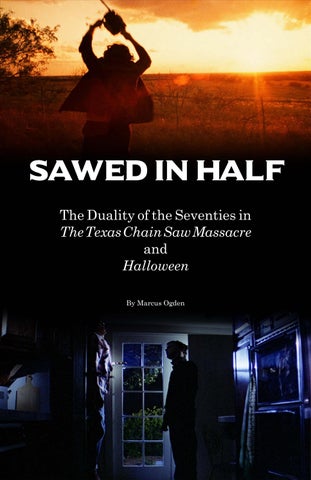
Sawed in Half The Duality of the Seventies in The Texas Chain Saw Massacre and Halloween By Marcus Ogden
A rather raw and unglamorous death scene. Peter Kramer wrote that the blockbusting release of Jaws (Spielberg, USA, 1975) began a significant shift in Hollywood cinema.1 He claimed that the early seventies were a rare period where films that diverged from classical Hollywood’s style and politics found unprecedented success, but that the rise of the blockbuster post-1975 reinvested classicism into the American cinema, with then an added tinge of post-modernism.2 Thus, a new and radical cinema was stopped short by not only a return to classical traditions and values but by a fondness for looking back at and re-situating them. If this were the case, this dynamic would certainly be observable in the particularly emboldened and successful horror films of the decade. Building on Kramer’s observation, I will argue that The Texas Chain Saw Massacre (Hooper, USA, 1974) and Halloween (Carpenter, USA, 1978) illustrate the divide found in the stylistic and political divergence of American cinema before and after 1975. I will first analyze Massacre’s abrasive stylistic elements, as well as the film’s political messaging. 1
Then I will turn to inspect both the nostalgic manipulative style and the lack of politics found in Halloween. Massacre follows Sally and Franklin Hardesty, as they and their friends (Jerry, Kirk, and Pam) drive through rural Texas. After they inspect a desecrated graveyard and have an upsetting run-in with an erratic hitchhiker, the group runs out of gas and falls victim to the hitchhiker’s brother Leatherface and their cannibal family. A particularly rich scene for analysis is one wherein Kirk and Pam intrude on the cannibal family’s home in search of gas and first encounter Leatherface. Upon Kirk entering the house, a squealing noise is heard from an adjacent room with a red wall adorned with animal skulls. As Kirk approaches the source of the noise, he stumbles. There is a medium close-up that tilts upward from Leatherface’s feet to the hammer raised above his head, emphasizing his size and stature. The shot then cuts to a long shot where Kirk is struck by the hammer. This is followed by three quick shots, two medium close-ups and a close-up, of
Kirk on the ground before another long shot shows Leatherface delivering a fatal blow. The brief, spectacle-devoid murder scenes in Massacre, such as this one, contrast with an example like Psycho (Hitchcock, USA, 1960), where Marion Crane’s murder is drawn out with a high degree of spectacle. Marion’s slow and aesthetically rich sinking into the tub is countered with the unglamorous and dim-lit shots of Kirk’s trembling and bloodied body. Pam then enters the house upon realizing Kirk has been gone for a while. She trips and falls into the family room, which is riddled with furniture and décor made of both animal and human remains. Though first matched with Pam’s eyeline, the shots are then divorced from her perspective as they go into angles and positions that she cannot possibly see. The camera breaks from continuity principles as it frantically pans, tilts, zooms, and tracks around the room, examining the macabre setting in a montage which likens Pam to a caged chicken. The penultimate scene where Sally is forced to sit at a table with the dis-
Massacre uses montage to liken the film’s protagonists to livestock and unsettle the viewer. turbed family similarly breaks from classical style with its use of jumpcuts, extreme close-ups, and drastic shifts in camera angles and positions. Kramer noted the consensus that this period exhibited a melding of the styles of the European art cinema, exploitation, and classical Hollywood.3 The influence of exploitation cinema is clear in Massacre’s rough aesthetic and graphic violence, and the classical element arises from the film’s adherence to continuity and narrative outside of its horror scenes. Although seemingly a stretch, one could compare the film’s subject matter, blasé handling of violence, and divergent form to French New Wave works ranging from Eyes Without a Face (Franju, France, 1960) to Weekend (Godard, France, 1967). One could also recall Strike (Eisenstein, USSR, 1925) in the film’s more frantic episodes, especially in moments where foreboding scenes are interjected with shots of livestock. What makes Massacre especially relevant to discuss concerning the progressiveness of early seventies’ American cinema is that the film is
fueled by a potent political message about class and capitalism. Robin Wood assessed that Sally, and her friends, represent a more privileged youth while Leatherface and his family are lower class victims of the capitalist system and its contemporary state of crisis.4 This is first apparent in the scene where Sally and her friends first encounter the erratic hitchhiker, as he rants that the introduction of new and efficient technology in the slaughterhouse cost his family their jobs. Notably, the family home and the gas station are quite dilapidated, and no one else seems to live nearby as the only adjacent house is abandoned. The father of the family is unable to keep his gas station stocked with gasoline despite residing in one of the most oil-rich states, which Naomi Merritt claimed was an allusion to the seventies’ oil crisis.5 Even amid kidnapping Sally, the penny-pinching father is careful to turn off the lights in his shop. As voiced by the father, murder itself is not the draw to what the family does, but rather is the only work they know to do to survive in a system that has other-
wise left them behind. This is supported by Merritt’s claim that the family had turned to murder and cannibalism because they had lost their appropriate and productive outlet for violence, the slaughterhouse, which had initially connected this violent urge to the family being able to eat and make a living.6 Wood noted that the family of Massacre maintain an innately human element; in their banter, their behaviour, and their continued compulsion to decorate.7 After Leatherface murders Jerry, the scene lingers with him and opens a brief window of identification. In this sequence, Leatherface paces around, clearly in a panic that someone else could be in his home or running to the authorities, before taking a seat and holding his head in his hands. There is a close-up in which the viewer is given a glimpse of the human being behind the ‘leather.’ In this brief window, Leatherface conveys a sense of insecurity, a sense that he could have lost everything, a feeling that was surely familiar and relevant during the contemporary economic hardships. This glim2
Halloween overtly borrows from its inspirations. mer of relatability furthers a sense that the family, though undeniably perverse, shares space with actual members of the working class and are preyed upon by the same system. Halloween takes place in a small Illinois town wherein a murderer, Michael Myers, has escaped an asylum and is out to strike again on Halloween night. Babysitter Laurie Strode becomes his target as he stalks her and cuts his way through her friends. Thomas Schatz’s finding that Jaws began a move towards more stylistically manipulative and entertainment-focused film-making is especially relevant when discussing Halloween.8 The film does not notably diverge from any then established film tradition as the editing stays strictly within the guidelines of continuity, and its content had been well treated in America’s less reputable film venues by examples such as the then-popular Giallo cycle.9 Halloween avoids making its form blatant or challenging, and instead maintains its verisimilitude to immerse and thrill the viewer. Though critical of the film, Wood’s 3
single concession was that Halloween demonstrated a high level of technical prowess which lent to its successful play of suspense.10 David Burnand and Miguel Mera add that even the score of the film is quite manipulative with its rare rhythmic structure.11 Kramer noted a critique of the move towards this kind of audience verisimilitude in the later seventies was that it represented a return to the stylistics of classical Hollywood.12 Equally important to the discussion of Halloween is Kramer’s finding that American films of the later seventies integrated a certain degree of intertextuality which was less concerned with commenting and building upon the methods of Hollywood and international cinemas, and more concerned with drawing from them directly.13 Stylistically, Halloween is a film that wears its inspirations on its sleeve. The opening sequence, wherein the camera is aligned with Michael’s point-of-view as he murders his older sister, is reminiscent of the opening of Peeping Tom (Powell, UK, 1960) even down to the detail of the view being
obstructed by an overlay (a mask in Halloween and frame markers in Peeping Tom). In a scene where Myers has a man pinned against the wall, Myers raises his knife with his face hidden in shadow, a shot which mirrors the shot of Norma Bates after she tears open the shower curtain n Psycho. The casting of Jamie Lee Curtis can also be thought of as an allusion to Psycho as she is the daughter of Janet Leigh. Even the soundtrack can be considered derivative as Carpenter cited Ennio Morricone and Bernard Herrmann as his inspirations for the film’s score.14 Contemporaneous reviewers found Halloween to be particularly void of substance.1516 Though there are hints in the film of contemporary issues concerning the state of suburban life and America’s youth, there is not any instance that incites a specific political reading. One root of this issue relates to the film’s intertextuality. Wood’s criticism of Carpenter is that the director is so reliant on technically perfecting handed-down techniques and traditions, that he eschews any consideration of meaning or politics.17 This
the family of Massacre bear more humanity than Myers does. relates to an issue that Schatz wrote about concerning the later seventies’ cinema, as he attributed the success of Star Wars (Lucas, USA, 1977) as the cause of a return to narrative centric film-making and a dive into genre melding, all of which left less room for concise political expression.18 This is apt in describing Halloween as the film displays peak formal techniques in its efforts to blend the techniques of splatter, suspense, and giallo films, but thus lacks the room for the political depth of an early seventies example like Massacre. Another root of Halloween’s lacking substance is in the rather blank figure of its killer. As Wood describes, Myers had the potential of representing a variety of societal issues, in the way that the family of Massacre represents capitalism, but instead Myers enforces societal taboos against sex and lacks any human characteristic.19 Death at the hands of Myers in the film seems to be a punishment for sexual expression, which is furthered by the fact that he is only defeated by the more sexually repressed and maternal
Strode, and by Dr. Loomis who does not exhibit any hint of sexuality in the film. Myers himself lacks humanity, not just because of his fantastic pain tolerance and strength, but because any opportunity to relate with him is dismissed. Dr. Loomis, throughout the film, denies that there is any humanity in Myers or that he faces any issues that the viewer can identify with. The closest Halloween comes to humanizing Myers is a brief shot wherein Strode has unmasked him. Though this unmasking may reveal that he is indeed human, it reveals little else about his circumstances or his reasoning. The blank-faced mask is removed to reveal yet another blank face underneath. This moment is abruptly interrupted by Dr. Loomis shooting Myers several times, and the scene ends with Strode and Dr. Loomis both concluding that Myers was indeed the ‘bogeyman.’ In these analyses of Massacre and Halloween, one can see the differences in approach between the American cinemas of the early and later seventies. Massacre is a film which melded various cinematic sensibil-
ities in a matter so typical to the early seventies that Kramer wrote about.20 Additionally, Massacre exemplifies the American cinema’s reverence for its contemporary circumstances during that era. Meanwhile, Halloween is a film very clearly aligned with Schatz’s conception of New Hollywood in the later seventies.21 Rather than utilizing film history and world cinema as a basis for experimenting in style, Halloween engaged in the viewer manipulation of the prior Hollywood’s suspense films and relied heavily on its intertextuality. Furthermore, The film’s focus on pastiche over substance and its summation of its killer as innately sinister, rather than as a product of contemporary society, makes it a prime example of how films lost their political ire in favour of making clean-cut entertainment in the wake of Jaws and Star Wars.
4
ENDNOTES 1 Peter Kramer, “Post-Classical Hollywood” in The Oxford Guide to Film Studies ed. John Hill and Pamela Church Gibson (New York: Oxford University Press, 1998), 301. 2
Kramer, 301, 303.
3
Kramer, 297, 304.
4 Robin Wood, “An Introduction to the American Horror Film” in Robin Wood on the Horror Film: Collected Essays and Reviews ed. Barry Keith Grant (Detroit: Wayne State University Press, 2018), 98. 5 Naomi Merritt, “Cannibalistic Capitalism and other American Delicacies: A Bataillean Taste of The Texas Chain Saw Massacre,” Film-Philosophy 14.1 (2010), 204.
BIBLIOGRAPHY Burnand, David and Miguel Mera, “Fast and Cheap? The Film Music of John Carpenter.” The Cinema of John Carpenter: The Technique of Terror edited by Ian Conrich & David Woods. London: Wallflower Press, 2004, 49-65. Carpenter, John. “Halloween Soundtrack.” John Carpenter, Accessed December 13th, 2020, https://theofficialjohncarpenter.com/halloweensoundtrack/ Kael, Pauline. “Halloween (1978).” New Yorker, February 19th, 1979. Accessed December 13th, 2020, https://scrapsfromtheloft.com/2017/10/17/ halloween-1979-review-by-pauline-kael/ Kramer, Peter. “Post-Classical Hollywood.” The Oxford Guide to Film Studies edited by John Hill and Pamela Church Gibson. New York: Oxford University Press, 1998, 289-307.
7 Wood, “An Introduction to the American Horror Film,” 99-101.
The Los Angeles Times. “Movies,” Los Angeles Times, November 5th, 1978. Accessed December 13th, 2020, https://www.newspapers.com/ clip/23557468/the-los-angeles-times/
8 Thomas Schatz, “The New Hollywood” in Movie Blockbusters ed. Julian Stringer (London: Taylor & Francis Group, 2003), 26.
Merritt, Naomi. “Cannibalistic Capitalism and other American Delicacies: A Bataillean Taste of The Texas Chain Saw Massacre.” FilmPhilosophy 14.1 (2010), 202-231.
9 Ian Olney, Euro Horror: Classic European Horror Cinema in Contemporary American Culture (Bloomington: Indiana University Press, 2013), 104.
Olney, Ian. Euro Horror: Classic European Horror Cinema in Contemporary American Culture. Bloomington: Indiana University Press, 2013.
10 Wood, “An Introduction to the American Horror Film,” 106.
Schatz, Thomas. “The New Hollywood.” Movie Blockbusters edited by Julian Stringer. London: Taylor & Francis Group, 2003, 15-44.
6
Merritt, 214-215.
11 David Burnand and Miguel Mera, “Fast and Cheap? The Film Music of John Carpenter” in The Cinema of John Carpenter: the Technique of Terror ed. Ian Conrich & David Woods (London: Wallflower Press, 2004), 59-60. 12
Kramer, 304.
13
Kramer, 304-305.
14 John Carpenter, “Halloween Soundtrack” in John Carpenter, Accessed December 13th, 2020. 15 The Los Angeles Times, “Movies,” Los Angeles Times, November 5th, 1978. Accessed December 13th, 2020. 16 Pauline Kael, “Halloween (1978)” New Yorker, February 19th, 1979. Accessed December 13th, 2020. 17 Robin Wood, “John Carpenter” in Robin Wood on the Horror Film: Collected Essays and Reviews ed. Barry Keith Grant (Detroit: Wayne State University Press, 2018), 259. 18
Schatz, 29-30.
19 Wood, “An Introduction to the American Horror Film,” 106-107. 20
Kramer, 297, 301, 304.
21
Schatz, 26-27.
Wood, Robin. “An Introduction to the American Horror Film.” Robin Wood on the Horror Film: Collected Essays and Reviews edited by Barry Keith Grant. Detroit: Wayne State University Press, 2018, 73-110. Wood, Robin. “John Carpenter.” Robin Wood on the Horror Film: Collected Essays and Reviews edited by Barry Keith Grant. Detroit: Wayne State University Press, 2018, 259-260.