The films of the Japanese Ju-on series have a particular stylistic and thematic interest in time. Starting with the direct-to-video film Ju-on: The Curse (Shimizu, Japan, 2000) and popularized by Ju-on: The Grudge (Shimizu, Japan, 2002), the films each center upon a haunted home in the Nerima district of Tokyo where a man, Takeo Saeki, murdered his wife Kayako and their son Toshio in a fit of rage. Due to the violent nature of the tragedy, a curse called the ju-on curse has befallen the home wherein the vengeful spirits of Kayako and Toshio terrorize all who enter, thus renewing and spreading the curse. In this paper I will use Gilles Deleuze’s concept of peaks of present and sheets of past to argue that the Ju-on films manipulate temporality to portray the ju-on curse’s omnipresence through time, thus generating a sense of dread in the viewer. I will look at the initial three films directed by Takashi Shimizu: Ju-on: The Curse, Ju-on: The Curse 2 (Shimizu, Japan, 2000), and Ju-on: The Grudge. When writing about cinematic time, Gilles Deleuze used the term peaks of present to refer to the states of past, present, and future which exist simultaneously concerning a given event.1 An event, at its conception, exists in three different peaks of present as it ‘will happen,’ ‘is happening,’ and ‘has happened.’2 The present of each state of time presupposes the present of the other two, and thus they exist simultaneously until the event concludes and another
1
occurs. The Curse unfolds in six chapters and presents three stories involving the Nerima home in non-chronological order. The first story supplies the backstory, thus the past, of the house and the curse. It follows Toshio’s teacher, Shunsuke, as he visits the home to inquire about Toshio’s absence from school. Arriving to find a seemingly abandoned home and a neglected (and unbeknownst to him, undead) Toshio, Shunsuke uncovers in Kayako’s journal that she held a long-time obsession for him. He is then called by Takeo who admits that he killed Kayako and Toshio upon discovering the journal and stored their bodies in the attic. He also reveals that he has killed Shunsuke’s wife, Manami, while Shunsuke has been searching the home. Kayako’s bloodied spirit awakens and climbs down the stairs to kill Shunsuke, then later appears to Takeo in an empty street and kills him as well. The second story follows a family who resides in the house sometime later and is claimed by the curse one by one. The third story follows a realtor, Tatsuya, who sells the home despite his spiritually attuned sister, Kyoko, warning him of its curse. In relation to each other, these stories each represent a past, present, and future. Each storyline is perceived by the viewer as a simultaneous present because they each lack an internal closure, an indication that one timeline has ended in a place where the next can logically begin. The past timeline is interrupted by
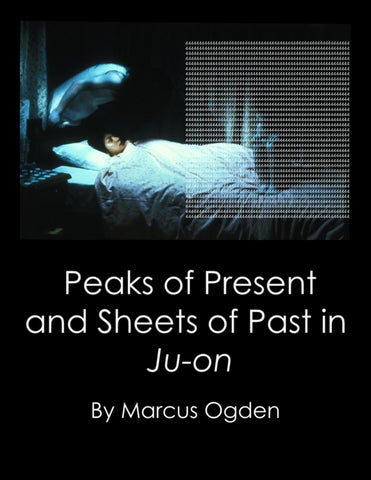
the present timeline before concluding and is thus ‘still occurring’ in the viewer’s mind while the present timeline plays out. Later in the film, the present timeline is interrupted and left unfinished when the film returns to the past timeline. The third story, the future timeline, is also brought to a sudden end. Because each timeline lacks a complete set of peaks of present, as each is abruptly cut-off before a conclusion, they cannot be considered individual events. The curse, the inescapable presence of Toshio and Kayako’s malevolence, is the ‘event’ that spans these peaks of present. Across these stories the curse simultaneously ‘has occurred,’ ‘is occurring,’ and ‘will occur.’ This is best visualized in the “Mizuho” chapter where Mizuho, a girlfriend of the eldest son who resides in the Nerima house, receives a phone call moments before she is killed by Toshio’s spirit. The caller ID displayed on the phone reads “4444444444.” Among East Asian languages, the word for ‘four’ is often spelled or pronounced closely to the word for ‘death,’ which colours the number as an ill omen in many Asian cultures.3 Therefore, the phone display can be read as “death, death, death…” The numbers, peaked themselves, can be interpreted by the viewer as peaks of present: “death has happened, death is happening, death will happen.” This visual encapsulates the dread that the film’s use of timelines creates in the viewer, a sense that the curse is a constant throughout the past, present, and future. The Curse 2 continues the stories of Tatsuya and Kyoko as they investigate the curse and as it begins to affect their own family. Unlike its predecessor, the chapters of The Curse 2 are arranged chronologically and thus the film does not exploit its peaks of present in the same fash-
ion. The horror of the film instead resides within its exploration of sheets of past. Deleuze’s concept of sheets of past arises from an understanding of time as a sequence of concentric sheets, where each sheet denotes a certain period and the present is represented by the outermost end of the sequence of sheets.4 This does not assume a strictly linear understanding of time, however, as by their concentric nature they overlap and exist as an interconnected whole whereupon illuminating fragments of one sheet may illuminate fragments of another.5 Tatsuya and Kyoko attempt to understand the house’s curse by examining the fragments of history available to them in the form of newspaper clippings and scattered belongings from the Saeki family left in the home. In Deleuze’s terms, they are each jumping into sheets of past, placing themselves within the perspective of these periods in search of pertinent details.6 However, the cursed spirits of Kayako and Toshio are projected forward from the past to terrorize Tatsuya and Kyoko.
2
As the protagonists go into the past, the past comes for them. Just as in Deleuze’s analysis of Orson Welles’ films, sheets of past become intertwined with depth field in The Curse 2 to visualize this temporal dynamic.7 In one scene, Kyoko realizes her nephew, Nobuyuki, coincidentally lives in the apartment where Takeo had murdered Manami. Kyoko finds her nephew in a trance staring at a door in the apartment. facing the shot in medium close-up, Kyoko opens the door and stumbles backward into a medium shot range. The shot reverses and in the foreground the top of Kyoko’s head as well as some items on the floor are in full colour, while in the background the image is grainy and desaturated. The two see Takeo knelt over the mutilated body of Manami in this grainy desaturated layer of space. They are quite literally looking into the past. In subsequent shots, Takeo turns to look at Kyoko while rising to his feet and, in a reverse shot, 3
the camera tracks forward towards her as she continues to back away, retreating away from the past as the curse advances through sheets of time towards her. Sheets of past cease being delineated periods parsed and investigated and become a terrain for pursuit. The penultimate sequence shows Nobuyuki fleeing from Kayako through the halls of his school. At this point, the curse has full control of space and thus the past has full control of the present. The lighting of the school darkens within a single cut, all other students in the building vanish and, during the chase, Kayako suddenly appears in Nobuyuki’s path to cut him off despite being behind him in the same shot. The sequence closes with a shot of fourteen Kayakos clawing at a classroom’s windows and a shot of ten Kayakos standing at varying depths of field in the schoolyard. The curse now exists throughout space and thus has fully saturated across sheets of time. Now it claws at the ever-expanding barrier of the present. No place, no time, is left safe. The Grudge returns to a focus on peaks of present while maintaining an interest in sheets of past, using both to generate dread once more. the film is told in six chapters, which are arranged in non-chronological order. The chapters are, however, directly connected, unlike the chapters in The Curse. Katsuya, his wife Kazumi, and his sister Hitomi are all affected by the curse after Katsuya moves into the home with his wife, and his mother Sachie. The curse then moves on to affect a social worker, named Rika,
and a retired police detective, Toyama, who is called to investigate the home. Rika and Toyama escape the curse, but years later the curse claims the detective’s daughter Izumi and lures Rika back to the home. The interconnected nature of the storylines in The Grudge becomes a source of dread, as within each chapter there is a resolution that is prefixed by another. For example, the initial chapter of the film, “Rika,” shows Rika entering the cursed home to find it abandoned and trashed, as well as to find Sachie in a dire state of neglect. The following chapter, “Katsuya,” shows the house tidied and shows Sachie as cared for by her son and daughterin-law. As the viewer experiences the presently unfolding events of this chapter, they are aware of where it must end up for the previous chapter to occur. The viewer is made weary because of their knowledge of the story’s peaks of present: something bad has happened (as the viewer looks back to the past from the perspective of the present), something bad is happening (as the viewer experiences the present of the past), and something bad will happen (as the viewer looks towards the present from the perspective of the past). In the chapter “Izumi,” Izumi arrives home to find her mother watching a news report detailing that Rika has been found dead in the Nerima house. In the following chapter, “Kayako,” the viewer is shown Rika struggling to move on with her life. The viewer knows that Rika will end up facing the curse again because, in terms of the film, it has already happened. The Grudge ensures that the viewer is aware of the peaks of past and future, and as they experience the present unfolding in any given time-
line, they are left with the fear of finding out how each of the other peaks of present came to be. The Grudge bends the bounds of time as it shows the curse bringing fragments of disparate sheets together. This is shown in the film’s restaging of the events of The Curse. The chapters “Katsuya” and “Hitomi” consist of the curse reiterating certain events from the original tragedy using the new cast of characters. After Toshio incapacitates Kazumi, Katsuya arrives home to find her catatonic in bed. Before he can call for help, he is compelled by the curse to take Kazumi’s body to the attic as he utters phrases once said by Takeo. The curse then uses Katsuya’s body as a vessel to gain access to his sister Hitomi’s apartment, where Kayako then kills Hitomi. This scene imitates Manami’s murder, which also occurred in an apartment. Finally, in the chapter “Kayako” Rika has a conversation with her friend Mariko about a student who has been absent from Mariko’s class which mirrors a conversation that occurs between Shunsuke and Manami in The Curse. This missing student turns out to be Toshio, who lures Mariko into the home and forces Rika to return. In these instances, events that occurred in one sheet of past overlap and influence events in another sheet of past. Viewers are clued to a certain sense of dread by these repetitions. much like the spirits of Toshio and Kayako, viewers are made to keep re-enacting this trauma knowing how it always concludes. The final scene solidifies this sense of dread. A bloodied Kayako reaches Rika at the foot of the house’s stairs, in a sequence that resembles 4
the lead-up to Shunsuke’s death in The Curse. Rather than appearing frightening, however, Kayako’s eyes well with tears as she reaches out to Rika and collapses. Rika experiences a series of flashbacks, Kayako’s flashbacks, to prior moments in the film where Kayako killed someone and moments where Kayako haunted Rika. Then Rika is placed into the perspective of Kayako at the moments before her death, as Kayako watched a menacing Takeo walk down the stairs and loom over her while Toshio hid in the background. These are the sheets of past that Kayako, characters affected by the curse, and the viewer are doomed to keep reliving, moments of terror before certain death blending together as their sheets of past merge. A key scene in The Grudge blatantly overlaps sheets of past to convey the curse’s persistence through time. It occurs when Toyama takes it upon himself one night to try and burn down the house. As he douses the kitchen with gasoline, he notices that the entryway has suddenly flooded with daylight. he hears a group of teenage girls talking upstairs, but most importantly he catches that one is named Izumi. His daughter Izumi is only twelve years old during this chapter, but the Izumi that races down the stairway and into the entryway is the teenaged Izumi whose story follows in the “Izumi” chapter. Toyama locks eyes with this older Izumi, who looks at him with the same shock. Much like the apartment scene in The Curse 2, the space that divides the two characters is temporal as well as spatial. At this moment Toyama is looking into the future, and Izumi is looking into the past. She flees from the house and as he approaches her, his sheet of past travels with him and darkens the entryway to align with his temporal position. He wanders up the stairs and continues to see into the future as he spots Izumi’s friends in a sunlit room down the hall. He witnesses Kayako kill the girls, who then crosses from their sheet of past into Toyama’s to pursue him. While the characters are trapped in their sheets of past, Kayako moves 5
freely between sheets, which shows the curse’s dominance of temporal space. Not only is this terrifying on its own, as the curse controls temporality in a manner no character or viewer can contend with, but it also reveals the hopelessness of Toyama’s efforts to stop the curse. The future is already set as both Toyama and the viewer see the curse’s continued existence as a terrifying inevitability. The films of the Ju-on series each emphasize that the ju-on curse reigns over temporality. The Curse situates three peaks of present, within each of which the curse is central. The Curse 2 portrays the curse’s dominance by turning the space its spirits navigate into temporal space wherein it can cross through sheets of time and gaps of space at will. The Grudge combines these two aspects, using the viewer’s foreknowledge of each peak of present to spark curiosity and fear over the moments which separate them, while overlapping sheets of time which only the curse can jump between and synthesize. Through these uses of Deleuze’s temporal principles, the films leave little room for safety for either the characters or the viewers and thus generate an overwhelming sense of dread.
Endnotes 1 Gilles Deleuze, Cinema 2: The Time-Image, trans. Hugh Tomlinson and Robert Galeta (Minneapolis: University of Minnesota Press, 1989), 100. 2
Deleuze, 100-101
3 Nicole M. Fortin, Andrew J. Hill, and Jeff Huang, “Superstition in the Housing Market,” Economic Inquiry 52:3 (2014): 975. 4
Deleuze, 98-99.
5
Deleuze, 99, 117.
6
Deleuze, 99.
7
Deleuze, 109-110.
Bibliography Deleuze, Gilles. Cinema 2: The Time-Image. Translated by Hugh Tomlinson and Robert Galeta. Minneapolis: University of Minnesota Press, 1989. Fortin, Nicole M., Andrew¬¬ J. Hill, and Jeff Huang. “Superstition in the Housing Market,” Economic Inquiry 52:3 (2014): 974-993.