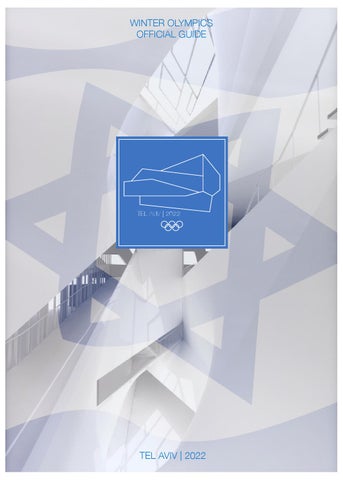
WINTER OLYMPICS OFFICIAL GUIDE
TEL AVIV | 2022
TEL AVIV | 2022
Welcome to the 2022 Winter Olympics at Tel Aviv Yafo
1
2
TEL AVIV | 2022
3
INDEX Introduction to Tel Aviv
06
The Welcome Wagon
07
About Tel Aviv Yafo
09
Culture of Acceptance
13
Transportation
15
Must See Sights
17
Past Winter Games
19
Research and Development
23
Concepts
24
Branding Options
25
Applied to the Real World
29
4
WELCOME TO
TEL AVIV HOME OF THE 2022 WINTER OLYMPICS
5
INTRODUCTION TO TEL AVIV
Ahuzat Bayit, later known as Tel Aviv. As the families could not decide how to allocate the land, they held a lottery to ensure a fair division. Akiva Arieh Weiss, chairman of the lottery committee and one of the prominent figures in the city’s founding, gathered 66 grey seashells and 66 white seashells. Weiss wrote the names of the participants on the white shells and the plot numbers on the grey shells. He paired a white and grey shell, assigning each family a plot, and thus Tel Aviv’s founding families began building the first modern, Hebrew city. The time was at a peak wave of Jewish immigration called the Second Alyia.
Tel Aviv, a city on Israel’s Mediterranean coast, is marked by its stark 1930s Bauhaus buildings, thousands of which are clustered in the White City architectural area. The city is also known for its accessible beaches and vibrant nightlife ranging from Lilienblum Street’s lounges to Dizengoff Street’s open-air cafes. Tel Aviv Port’s waterfront promenade is lined with shops and restaurants. Tel Aviv was founded on April 11, 1909. On that day, several dozen families gathered on the sand dunes on the beach outside Yafo to allocate plots of land for a new neighborhood they called
6
THE
WELC 7
COME
WAGON
Tel Aviv, Israel’s evergrowing metropolis, would be unrecognizable to its founders, a small group of Jewish immigrant families in what was then Ottoman-ruled Palestine. A skyline of shimmering skyscrapers has replaced the towering sand dunes of just over a century ago. The city is now known for its boxy Bauhaus apartment buildings, theaters, and concert halls, as well as its legions of sidewalk cafÊs that host overflowing crowds every night of the week. ENJOY YOUR STAY!!
In the city that never sleeps!!
8
ABOUT TEL AVIV YAFO 9
A N BIT A OF BIT HIS OF TORY HIS
eighborhoods in the ancient port city of Jaffa were becoming overpopulated and crowded. Many of the newcomers were Europeans of middle-class origin who sought to build surroundings that would give them a sense of what they had left behind. They wanted to build a modern suburb of Jaffa. The true development of Tel Aviv took off with the arrival of Scottish urban planner, Sir Patrick Geddes. In response to the unplanned expansion of the city, Geddes was invited by the municipality in 1925 to present a comprehensive master plan for Tel Aviv. In his vision, Tel Aviv was to be a garden city, as foreseen by its founders. His plan called for a clear distinction between main streets, residential streets and vegetation filled pedestrian boulevards. An important element of his plan, reflecting the social climate of the time, was the creation of shared public spaces – in the form of parks and squares, as well as within residential blocks. The city was again transformed starting in 1932 by a massive wave of immigration of Jews fleeing persecution in Europe whose arrival rapidly expanded a small town of 42,000 people into a flourishing city of 130,000 by 1936. In 1934, in the midst of this wave (the Fifth Aliya), Tel Aviv was declared a city, and Meir Dizengoff, the president of its council, as its first mayor.
TORY
10
thE WHITE CITY THE
T
he housing needs of this wave of immigration brought the rise of the Bauhaus, or Modern Movement, style of architecture. Many architects trained in the Modern style were among the refugees from Europe who began rapidly building to accommodate the population growth, resulting in what today is known as the White City.
I
nfluenced by the clean, functional lines of the Bauhaus School of Art and Design in Germany, they adapted the Modern style to suit Tel Aviv’s culture and climate, giving the city its special look. The White City of Tel Aviv, declared a UNESCO World Heritage Site in 2004, includes over 4,000 buildings in the Modern style. In the 1930’s, Tel Aviv became the country’s largest economic center and had the highest concentration of social and cultural institutions. Tel Aviv was the center of the emergence of Hebrew culture and
culture in Hebrew – and remains so to this very day. Tel Aviv became known for its modern cafes, hotels, concert halls and nightclubs. The city enjoyed a sense of international chic, which was rare for the region, especially at the time. At the start of the 1948 War of Independence, the city and its periphery became the focal point of the conflict between Jews and Arabs. The fight over Jaffa’s future started immediately after the UN decision for partition. As in other areas where Jewish and Arab forces clashed in close quarters, civilian populations both in Tel Aviv 11
and Jaffa suffered and ultimately many fled. In April 1950, Jaffa was formally merged with the Tel Aviv municipality and a unified city was established – Tel Aviv-Yafo. The next several of decades maintainted the city’s status as Israel’s cultural and economic center, yet Tel AvivYafo was losing its vibrancy and its population was growing older. This trend changed in the 1980s as a gradual migration from all over the country back to Tel Aviv began. Over the next decades, there was massive renovation and development throughout Tel Aviv-Yafo, giving the city a makeover whose finishing touches are still being improved upon. Tel Aviv-Yafo of today has developed a unique style combining the best of both a relaxed Mediterranean seaside town with an edgy urban vibe. Tel Avivis are passionate about their city and are proud to live in a center of commerce, culture, style and entertainment. With leafy boulevards filled with people at all hours, a thriving business sector, countless charming cafes and restaurants, a beautiful beachfront and rich cultural offerings, the vision of the city’s founders has come alive.‣ ‣ ‣ ‣ ‣ 12
Culture of Acceptance 13
Tel Aviv Pride is an annual, week-long series of events in Tel Aviv that celebrate Israel’s LGBT community life, scheduled during the second week of June, as part of the international observance of Gay Pride Month. The most-attended event is Pride Parade which is the largest in Asia.
14
transport The Tel Aviv transportation system is seen as the hub of the Israeli transport network in terms of road, rail, and air transport. The Israeli road network partly centers on the city, with some of the country’s largest highways passing through or running to the city. The city forms a major part of the country’s rail network, whilst Ben Gurion International Airport located near the city is the country’s largest airport. There is also a strong public transport system within the city, based primarily on bus transportation. FREE map pg. 16 15
16
Sights & Of s o u n d s Tel Av Check out these must see sights between our Olympic Games. • Tel Aviv’s Beaches • Old Jaffa Port • The Musuem of Art • The White City • Yemenite Quarter •Dizengoff Circle •Neve Tzedeck Quarter • Bialik Street • Ben Gurion House • Eretz Israel Museum • Lod
17
viv
18
WINTER OLYMPICS
19
On January 25, 1924, the first Winter Olympics take off in style at Chamonix in the French Alps. Spectators were thrilled by the ski jump and bobsled as well as 12 other events involving a total of six sports. The “International Winter Sports Week,� as it was known, was a great success, and in 1928 the International Olympic Committee (IOC) officially designated the Winter Games, staged in St. Moritz, Switzerland, as the second Winter Olympics.
20
Five years after the birth of the modern Olympics in 1896, the first organized international competition involving winter sports was staged in Sweden. Called the Nordic Games, only Scandinavian countries competed.
Like the Olympics, it was staged thereon every four years but always in Sweden. In 1908, figure skating made its way into the Summer Olympics in London, though it was not actually held until October, some three months after the other events were over.
It was so popular among the 16 participating nations that, in 1925, the IOC formally created the Winter Olympics, retroactively making Chamonix the first. In Chamonix, Scandinavians dominated the speed rinks and slopes, and Norway won the unofficial team competition with 17 medals. The United States came in third, winning its only gold medal with Charles Jewtraw’s victory in the 500-meter speed-skating event. Canada won another hockey gold, scoring 110 goals and allowing just three goals in five games. Of the nearly 300 athletes, only 13 were women, and they only competed in the figure-skating events.
In 1911, the IOC proposed the staging of a separate winter competition for the 1912 Stockholm Games, but Sweden, wanting to protect the popularity of the Nordic Games, declined. Germany planned a Winter Olympics to precede the 1916 Berlin Summer Games, but World War I forced the cancellation of both. At the 1920 Olympics in Antwerp, Belgium, ice hockey joined figure skating as an official Olympic event, and Canada took home the first of many hockey gold medals. Soon after, an agreement was reached with Scandinavians to stage the IOC-sanctioned International Winter Sports Week.
Austrian Helene Engelmann won the pairs competition with Alfred Berger, and Austrian Herma Planck Szabo won the women’s singles. The Olympics offered a particular boost to skiing, a sport that would make enormous strides within the next decade.
21
PAST WINTER OLYMPICS CITIES AND THEIR BRANDING
22
RESEARCH & BRAND DEVELOPMENT While Tel Aviv ins’t the coldest location to host the Winter 2022 Olympic games. It is still very unique. The pattern exhibited by past olympic logos is in the order of a five color brand, with the city name and year underneath and this is what comprised the logo for each olympic games. I decided to take a different approach and change up the orientation in which the logos are currently presented while still maintaining the traditional colors of the olympic rings. Tel Aviv is a cultural epicenter that takes most of it’s architecutal influence styles from the Bauhaus Movement that originated in Germany in the early 20th century with the foundation of the Bauhaus Design school in Weimar.
23
CONCEPTS
For my developemnet sketches I just looked at famous archtecture around Tel Aviv and created slightly sbstract shapes out of the architecture. I was thinking of doing at least five seperate shapes to stand in for the olympic rings and introduce color to each element accordingly. 24
Branding Options
Choice 1.................... Option one is a logo modeled after Tel Aviv’s imfamous Museum of Art. Tel Avivian Architecture has strong Bauhaus influence and is a trademark of “The Nonstop City”. Tel Aviv is known for it’s equal rights movement so I decided to incooperate that element into this design
TEL AVIV | 2022
Choice 2.................... Option two is another brand modeled after the Tel Aviv’s beautiful architecture. This is another famous destination called the Holon Design Museum.
TEL AVIV YAFO 2022
Choice 3.................... Option three is based around Dizengoff Square Fountain. This is a must see while in Tel Aviv and is certainly one of many unique elements present in Tel Aviv Yafo.
TEL AVIV 2022
25
TEL AVIV | 2022
TEL AVIV YAFO 2022
TEL AVIV 2022
26
AND THE WIN TEL AVIV | 2022
27
NNER IS...
28
brand merchandising
29
30
31
32
Coming 2022
33
34
35
36
37
38
ENJOY YOUR STAY