Equip p ing an ic E cr E am op E ration IN T h IS ISSUE:
h OW A 5 T h GENERATION DAIRY IS EXPANDING
→ STARTING A TOOL LIBRARY
→ PLANTING IN UNPREDICTABLE TIMES
→ f RUIT PAC k S h ED DESIGNS
WH o WE ar E
Marbleseed is a nonprofit committed to supporting the Midwest’s organic and sustainable farmers through farmer-led events and educational resources that help your farm grow.
our mi SS ion
Marbleseed educates, inspires, and empowers farmers to thrive in a sustainable, organic system of agriculture.
B
President: Clare Hintz Elsewhere Farm
Vice President: Dan Cornelius Yowela Farms
Secretary: Eliana Pinilla-Rhyal Chicago Food Policy Action Council
The Organic Broadcaster is a quarterly magazine published by Marbleseed. Opinions expressed by the authors do not necessarily reflect those of the publisher. Inclusion of an advertisement does not imply endorsement of a product. Content may be reprinted with permission.
While the digital version of this publication remains free, there is now a $30 subscription fee for the print edition. You can subscribe at: Manage your subscription by emailing us at the address below:
info@marbleseed.org
marbleseed.org/news/ organic-broadcaster
F rom our EXE cuti VE D ir E ctor
LORI STERN
H E llo r E a DE r S !
Summer is in full swing! At the time of this writing, it seemed as though the pace of organizational life was mirroring the frantic pace of farmers working fields, transplanting starts, tending flocks, herds, and litters.
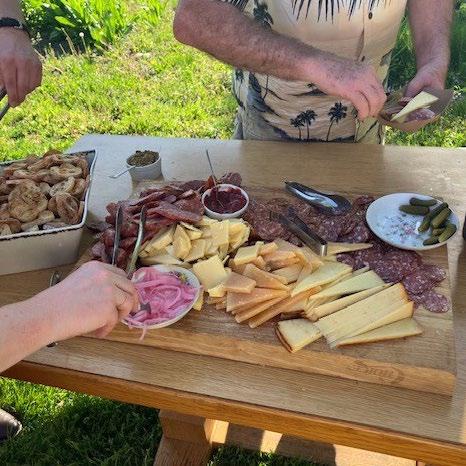
But May was all spring and warmer days. Foraged crops, early greens and herbs, and the last of fall’s harvest of root vegetables. We had the opportunity to gather at Seven Acre Dairy in Paoli, WI, for a Marbleseed fundraiser that included an evening of amazing foods al fresco brought to us by collaborations between regional chefs and farmers. From Vietnamese to Italian, and from local cured meats to ice cream made from the fruit of a nearby orchard, we ate very well! (Learn more about the event through pictures on pages 4-5.)
I opened our gathering with a poem that I wrote for the occasion, an acknowledgement of our shared journeys and food stories.
As this poem suggests, how we grow these ingredients in a way that gives back to the soil, invites pollinators – from bees, to butterflies, birds, wasps, and microbes – to the feast through managing our farms and gardens organically matters deeply. Food pulls us into a larger circle of care and concern. It honors all our roles at the community table. With intention and attention, food can bring us together.
As we come into the height of sun-warmed harvests and our own gatherings with friends and families, I hope that we can stop long enough to recognize what we literally ‘bring to the table’ as farmers. We are uniquely connected to soil and natural ecosystems.
Much of this will be on display over the summer at the field days Marbleseed is organizing. Our team looks forward to hosting you, while flexing our schedules to manage our own farm tasks. We also continue to track the progress of the longstalled farm bill. Many representatives will be in the district in August. Especially as we prepare for this fall’s elections, Marbleseed is committed to sharing farmer stories with elected officials. Please reach out if you have interest in attending a virtual meeting with your members of Congress, would like to host them on your farm, or want guidance on telling effective storytelling.
I hope to see you at field days and other summer events. In September, we will gather at Gwenyn Hill Farm in Eastern Wisconsin. There will be content for farmers in field day fashion, but also plenty for eaters to enjoy. A full schedule is on our website.
For now, enjoy juicy melons, ripe heirloom tomatoes, and smoking grills laden with shared meals!
Lori Stern, M.A. Ed
tHE Dia S pora
A sense of the collective carrying its culture with them. Enriching the places they arrive to for the myriad of reasons that compel a people to leave home; from force and violence, climate catastrophe, to finding a better life or supporting families back in the homeland.
They often carry seeds, agricultural knowledge, or recipes. Food is our connection to home and new communities. Through our food we become visible, represented, and even beloved.
Food: growing it and preparing it, bringing love and ourselves to our recipes, flowing from us as we plant, weed, harvest, stir, fold, press, toss, bake, and even wait. The carrying or search for the ingredients that taste like home in a new place is what enables us to stay grounded in our histories and draw people into our present.
— Lori Stern
EVE r Y ingr ED i E nt matt E r S f UNDRAISING DINNER & SUMMER CAMPAIGN
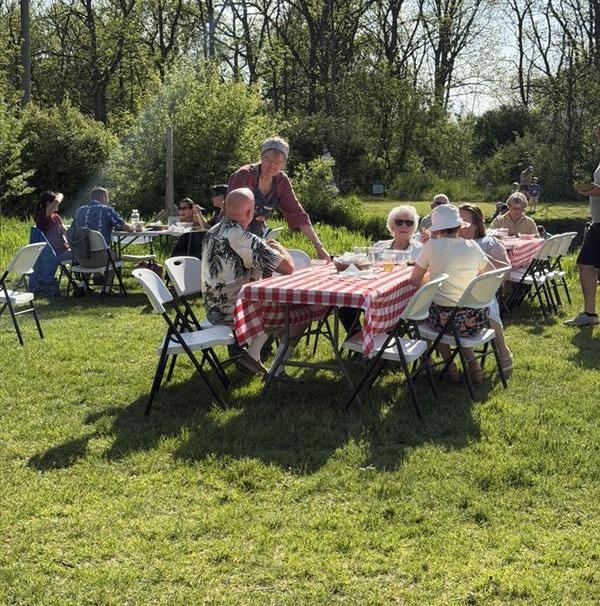
It doesn’t get much better than eating innovatively prepared food from fresh, local farm ingredients, while listening to great live music next to a burbling stream on a perfectly sun-kissed spring evening!
Marbleseed’s second farm-to-table fundraiser dinner was blessed with all the above elements. We are so grateful to each of you who came out and made the event special
Held at Seven Acre Dairy in Paoli, WI, the meal was the collaborative effort of nine farmers, seven chefs, and four beverage makers. The menu items were made possible by the unique contributions of farmers and chefs.
We and many of our guests were excited to have Odessa Piper at the event. Odessa was the original chef-owner of L’Etoile in Madison, and one of the most important figures in bringing ingredients from Midwestern small and organic farms into the restaurant kitchen.
She collaborated with Selena Warsaw-Lane of Fresh Fruit Farm and The Frozen Local on dessert. Selena provided fruit to L’Etoile back in the day, and the two women came together for a cross-generation collaboration.
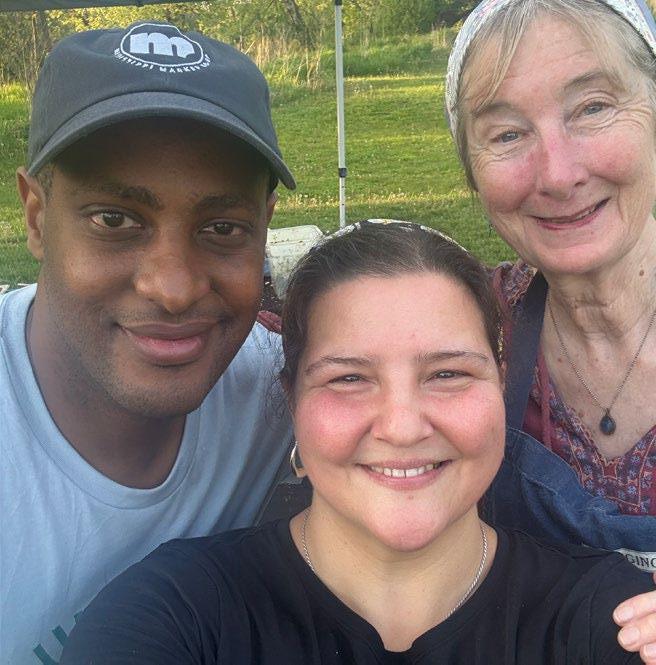
Odessa and Selena kindly shared their jointly created cookie recipe (below) that accompanied a wild plum ripple and chevre ice cream. Odessa was also thrilled to “make a new restaurant friend” in rising culinary talent Abraham Gessesse of Hyacinth in St. Paul, MN. The three of them are pictured to the right.
A Cookie Collaboration From Odessa Piper and Selena Warsaw-Lane
Speculoos or speculaas are biscuit cookies that originate from modern-day Belgium and the Netherlands. Recipe adapted by Odessa Piper for OrganicArts.com with Selena Warsaw Lane and The Frozen Local.
ingr ED i E nt S
Yield: 18–24 cookies
For cookies:
70 g butter, ( 5 T ) unsalted room temp.
100 g brown sugar, ( ½ C packed )
40 g sorghum, ( 2 T ) or substitute half corn syrup/half molasses
2 egg yolks
140 g whole rye flour, ( 1 C packed )
½ tsp baking soda
2 pinches salt
10 g ginger cinnamon mix, ( 4 tsp )
For topping:
4 tsp turbinado sugar
1 tsp dried flower petals, optional
r E cip E not ES
m E t H o D
Cream room temp butter with brown sugar. Add sorghum and yolks, then cream again. In a separate bowl, whisk together rye flour with baking soda, salt, and spices. Add dry to wet. Mix till combined. Rest dough for at least 1 hour – longer is better. Dough may be refrigerated, well wrapped, or frozen at this point
Preheat oven to 350°. Restore dough to cool-room temp. Generously dust a sheet-tray sized piece of parchment paper with rye or wheat flour. Lightly dust top of dough with more flour and roll into a rectangle on the parchment.* Roll to your desire thickness 2/8” for crisper; 3/8” for more chew. Scatter the turbinado sugar and optional crushed flower spice over the surface and lightly roll into dough to stick. Cut dough into 1.5 to 3” strips or other shapes. Place pieces on lined sheet.
Bake for 10-13 min for desired texture. Dough will puff up and then settle.
*TIP before next step: test a couple scraps in the oven at different thickness, cool, then see what you prefer.
Measurements - My conversion from weight in grams to cups and teaspoon measures is not exact; this is a very amenable recipe and a little more, or less, of this or that will not hurt. Bottom line, if you like to bake get a gram/ounce scale!
Rye flour- We recommend whole grain rye flour from Meadowlark Organics in Ridgeway, WI.
Sorghum- a.k.a. broom corn, is a climate friendly cereal plant originally from Africa. It tastes lighter than molasses! It can be produced in Wisconsin but is more commonly grown in the central Midwest and Southeast U.S.
Spice notes - This cookie invites creative spicing. Make your own variation from what’s in your cupboard, or try the wonderful Antica Spice Blend from Deliciouser https://thedeliciouser.com
Growing Our Table Collaboration Tastes Great!
H E lp u S continu E to gro W our ta B l E
The event kicked off Marbleseed’s spring and summer season of fundraising and awareness building. All money raised at the May dinner and in the campaign go to support our work of educating and empowering farmers to thrive in a sustainable, organic system of agriculture.
As with the dishes prepared for the recent dinner, Marbleseed works in collaboration with many people and organizations in the food system — farmers, agriculture professionals, conservationists, policymakers, and champions of small and rural communities across the Upper Midwest.
E VE r Y partn E r & EVE r Y ingr ED i E nt matt E r S
What Marbleseed brings to the table is:
→ Farmer-developed educational resources
→ Farmer-to-farmer led workshops and mentoring
→ Organizational commitment to our core values –equality, abundance mindset, integrity, collective care, interconnectedness, and transformation
→ Programming to advance conservation practices
→ Deep and well-tended roots in the Upper Midwest’s organic and sustainable farming system.
Your V ot E o F con F i DE nc E
Our small but mighty team — we’re currently a baker dozen in staffing — has spent the last year responding to rapid changes in funding. Building what we’d like to see rather than responding to emergencies is how we want to move forward.
Your contribution at any level is a vote of confidence in the work we’ve done, as well as in a mutually created future that places collaboration in the middle of the table. Thank you for valuing and furthering our organic movement!
→ Vist marbleseed.org/support/donate to give. m S
S can HE r E
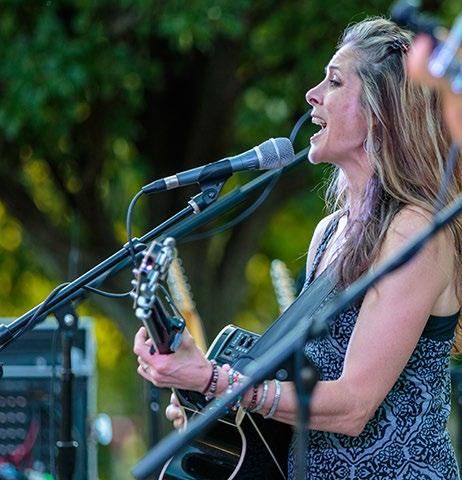
↑ Beth Kille Band of Verona, WI provided a perfect musical backdrop for the evening.
↑ Chefs Abraham Gessesse (left), Selena Warsaw-Lane (middle), and Odessa Piper (right)
↑ Attendees enjoyed a curated tasting menu featuring nine chefs, seven local farms, and four beverage makers.We have so much gratitude for every producer and maker who contributed!
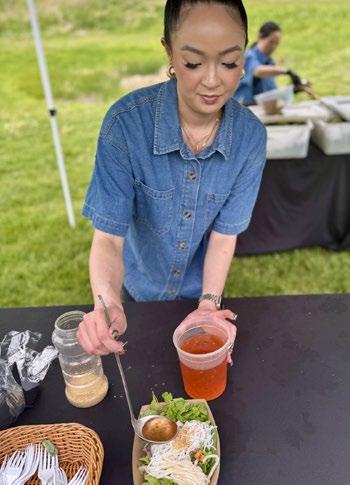
← Pork belly from Seven Seeds Farm, microgreens from Winterfell Acres, and herbs from Squashington Farm combined in Stephanie and Jacqueline Le’s freshtasting bún thịt nướng.
n EWS & up D at ES
W h AT’S GROWING AT MARBLESEED
Welcome Ben
Our Newest Team Member
Ben Wojahn joins Marbleseed as Organic & Small Farm Conservation Specialist.
Ben has served in local conservation positions for over 20 years. He enjoys helping farmers and landowners to navigate through funding and programs that best serve their production and conservation goals. He enjoys harvesting wild rice up north and tending to his hobby farm in the Driftless region.
Adding Ben to our team increases our capacity to provide conservation planning support and technical assistance directly to small, diversified, and organic producers. If you would like to learn more about potential resource concerns on your operation and practices that you might implement to address them, please reach out and connect with him below:
→ ben.wojahn@marbleseed.org
AMP Underway Incentives for Grain Producers
A federal grant is supporting a cohort of up to 120 grain producers.
Marbleseed, and its partners Michael Fields Agricultural Institute (MFAI), Ohio Ecological Food & Farm Association (OEFFA), and OFARM, have been awarded grant funding through the Advancing Markets for Producers (AMP) to implement a multistate project that will engage organic grain producers and producers looking to transition to organic production.
The project team will provide grain growers with individualized assistance to help each enrolled farmer reach production goals, establish a crop rotation that meets their own farm needs, and grow grains that fit into scalable and financially viable organic markets.
Outreach and engagement efforts are underway to build a strong cohort of participating producers and ensure they have the tools needed to improve economic returns. Marbleseed aims to enroll 120 producers by 2027. We have enrolled approximately 20 producers to date.
Each participating producer receives an enrollment incentive for the project’s duration that will cost-share the expenses associated with maintaining organic certification and continuous improvement associated with organic certification.
Producers will be supported by field service coordinators who will provide technical assistance, education, and collect farm and market data.
If you are interested in learning more about AMP, contact Mercedes Talvitie, who is overseeing Marbleseed’s involvement in this program.
→ mercedes.talvitie@marbleseed.org
Thank you, Kathleen Kathleen Delate Retires
Kathleen recently stepped down from Marbleseed’s Board of Directors. The move coincides with her retirement from Iowa State University (ISU) where she was on faculty for 27 years.
a la S ting l E gac Y F or t HE organic mo VE m E nt
Delate was the first professor focused on organic agriculture at a land-grant university. Over the course of her career, she secured more than $14 million in funding and conducted research on organic nutrient management, pest management, no-till systems, soil health, and integrated livestock.
She published widely, with much of her work demonstrating the connection between organic agriculture and soil and water quality. She also showed that organic farming can be financially viable. “Through our research,” she wrote in her retirement announcement, “we have shown that you can achieve excellent organic yields while also building soil quality and reducing nitrates in our water supply!”
Marbleseed believes research is an important leg of the organic movement. Through the publication of researcher-written articles in this publication, presentations by student researchers at the Organic Farming Conference, and advocacy for increased funding at the federal level, we know that our movement needs scientists like Delate. They provide clear and tested data that proves the multiple benefits of organic production.
In the coming months, Marbleseed will name a new researcher to our board. For now, we are grateful to Kathleen for her work on behalf of our organization. As of this writing in early June, ISU has no plans to continue the Organic Ag Program Delate built; however, a group of organic farmers, led by Paul Mugge and Ron Rosmann, are organizing to keep an organic specialist faculty on staff. m S
gro W Y our SK ill S
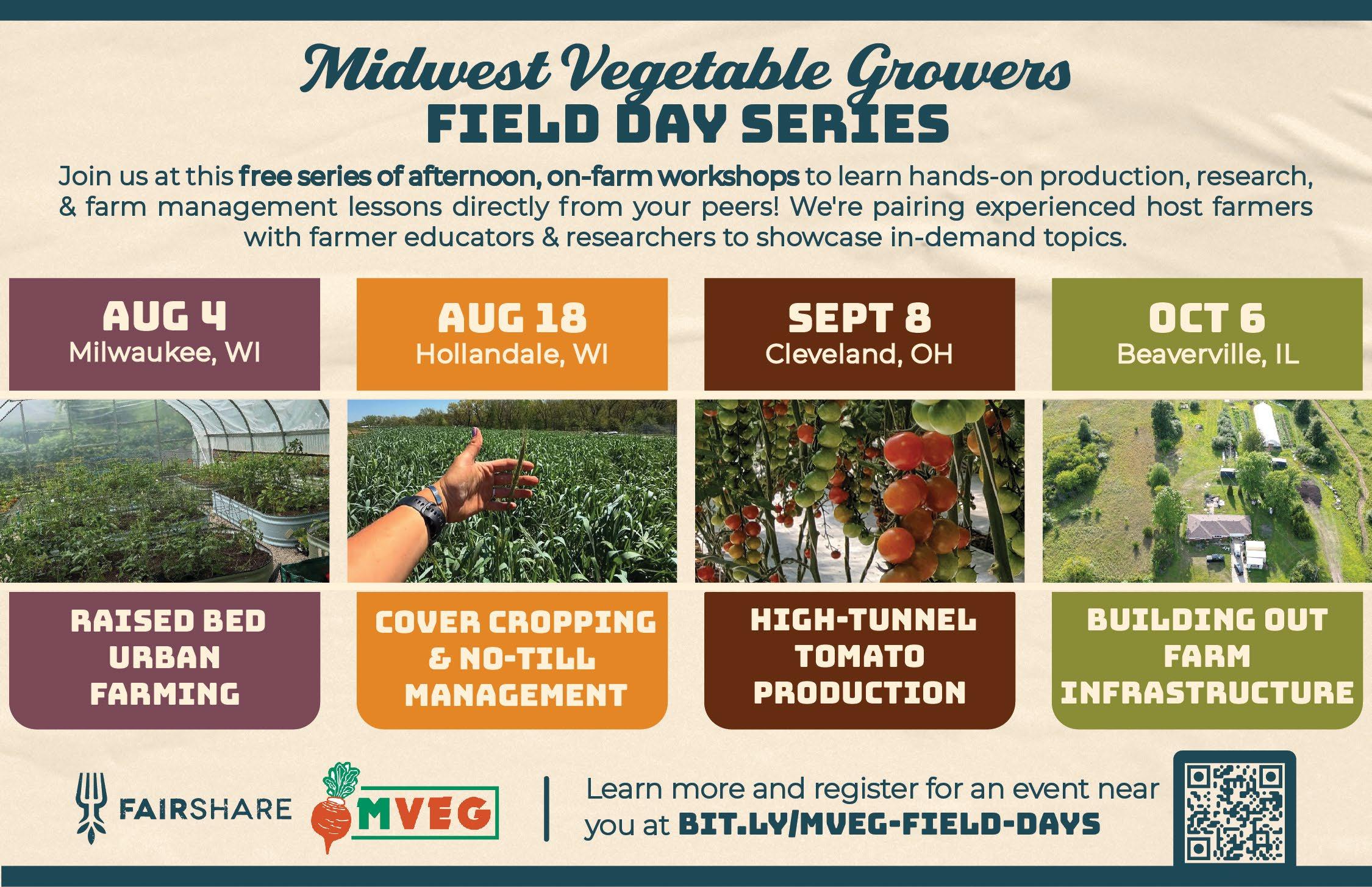
Join Marbleseed for hands-on field days hosted by farmers across the Upper Midwest.
organic p otato F i E l D D aY
Explore practical organic potato production, from soil health to pest and weed management.
c H ang E ma KE r F i E l D D aY
Join Marbleseed at Sharing Our Roots, our 2026 Changemaker of the Year, for a field day exploring how farming, culture, and land stewardship come together to strengthen communities.
S o B r E m ES a Farm E r a DV anc E m E nt training
Designed for beginning farmers, and aspiring farm entrepreneurs, this training will help you make informed decisions that support a resilient and profitable farm.
S oil HE alt H training
Join Marbleseed and Sobremesa for a two-day, hands-on training with internationally recognized regenerative agriculture educator, Jairo Restrepo Rivera.
mar B l ESEED in t HE F i E l D
Join us at Gwenyn Hill Farm on September 19, for an abundant day of hands-on education showcasing successful organic farming practices.
E quipping an ic E cr E am op E ration
h OW A 5 T h GENERATION DAIRY IS EXPANDING
Q & A with Dixie Klemish, Klemish Farm & Creamery
WE a ll S cr E am F or V alu E- a DDED D air Y pro D uct S!
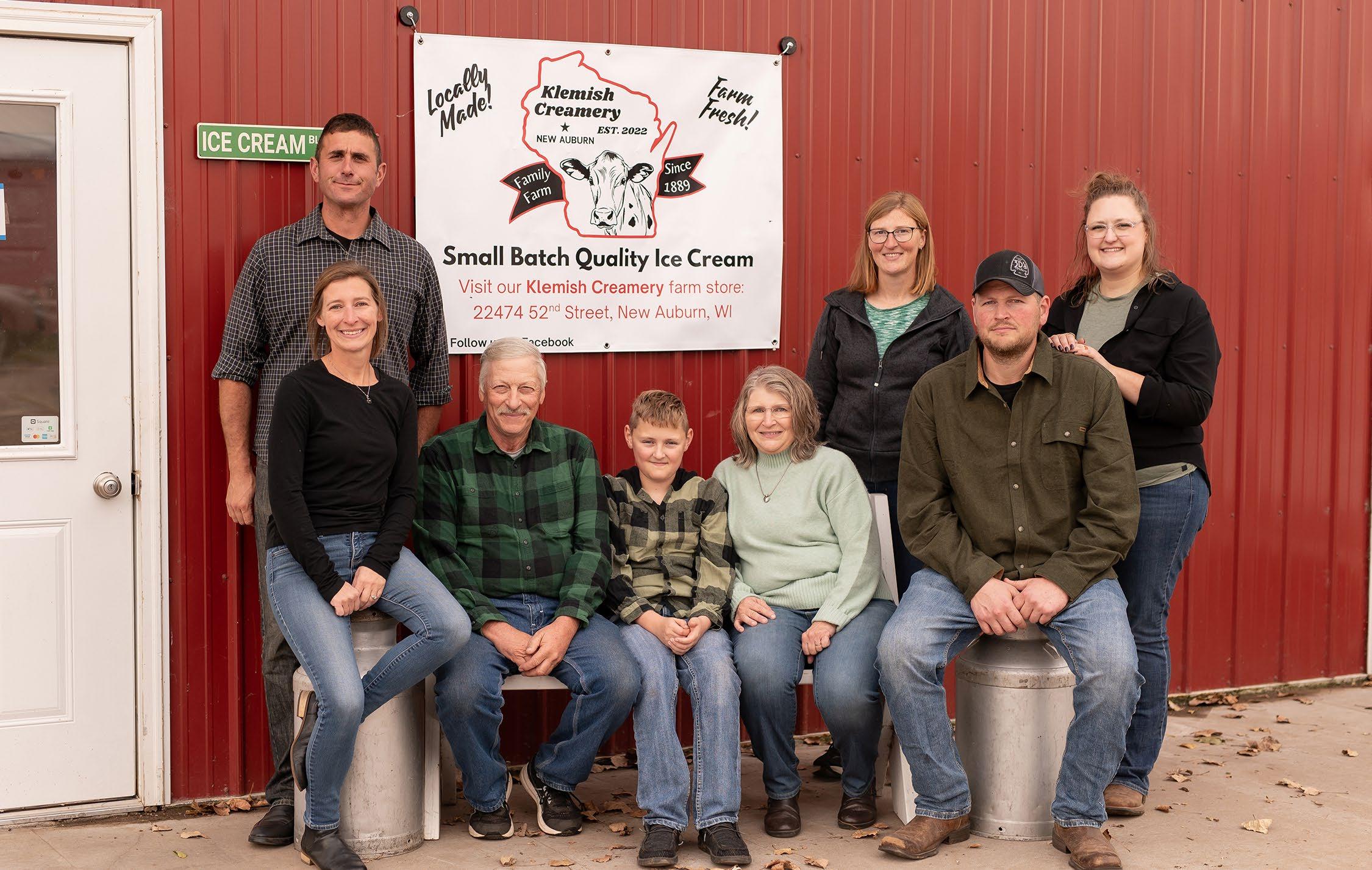
Klemish Farm in New Auburn, WI, has been family-owned since 1889. It’s now run by the fourth and fifth generations – Randy and Dixie Klemish and their son and daughter-in-law, Joe and Trista Klemish.
They are forging a new path for their operation, adding ice cream and cheese, along with the milk they continue to sell to a local cooperative.
During the Covid-19 pandemic, milk joined flour and toilet paper as a staple item that disappeared from grocery shelves. Simultaneously, largescale purchasers, such as school districts, canceled orders. Many dairies were forced to dump their milk and reduce production. Six years later, production rates are still reduced.
It was this reality that led the Klemish family to invest in facilities and equipment to add ice cream production to their business. Dixie Klemish says the family had considered value-added products before, but it was the forced 7% decrease in production during the pandemic that led them to get serious about what that would involve.
Unlike many neighbors, they didn’t dump their milk but pasteurized it and began making ice cream on a very small-scale for friends and family. But what would it look like to scale up and sell to the public?
We talked with Dixie about this “leap of faith,” the additions they’ve made to their farm, which now includes Klemish Creamery, and plans for the future.
a l E ap o F Fait H
Marbleseed (MS): Tell us how you began with adding ice cream to your business? What was involved in terms of infrastructure?
Dixie Klemish (DK): Building and opening Klemish Creamery seemed like a leap of faith in the beginning. When the whole goal of the new venture was to help keep more profit on our small farm, it felt contradictory to spend money on infrastructure. With the help of family and neighbors, we spent the winter of 2021 and the following spring constructing interior walls. It was hard to know how much money to invest with limited information on how much customer demand there would be for the product.
MS: What funding sources have you accessed to help with building and equipment costs?
DK: We’ve received two grants from the Dairy Business Innovation Alliance (DBIA). The first helped with the initial construction and equipment. In 2024, we got a second DBIA grant to help purchase a cream separator and a larger pasteurizer/cheese vat, which allows us to utilize more of our milk for ice cream. That same year, we received a Resilient Food Systems Infrastructure Grant (RFSI) to collaborate with small farmers and processors to distribute value-added farm products in Northwest Wisconsin.
MS: What has been the learning curve in ice cream making?
DK: We are such a small-scale artisan operation that it hasn’t been too bad. It took some trial and error to develop our base ice cream formulas, but we’ve found helpful websites and social media groups of homemade ice cream makers who are generous with sharing information. We also visited other dairy plants on farms producing small, value-added products. Getting their advice was very helpful, and we now give tours and provide advice to farmers considering processing dairy products on their farms.
na V igating c H all E ng ES
MS: What regulations were involved in scaling from homemade ice cream to selling to the public?
DK: It’s overwhelming – the FDA’s Grade “A” Pasteurized Milk Ordinance is over 400 pages! Thankfully, the Wisconsin code is only around 75 pages. We got help from a retired state dairy inspector to meet the FDA
Pasteurized Milk Ordinance (PMO) and Wisconsin DATCP regulations. Our dairy plant was officially inspected and licensed in August 2022, and we opened for business in November 2022 – not the most ideal month for ice cream, but it was good to have time to get up to speed before the warmer months.
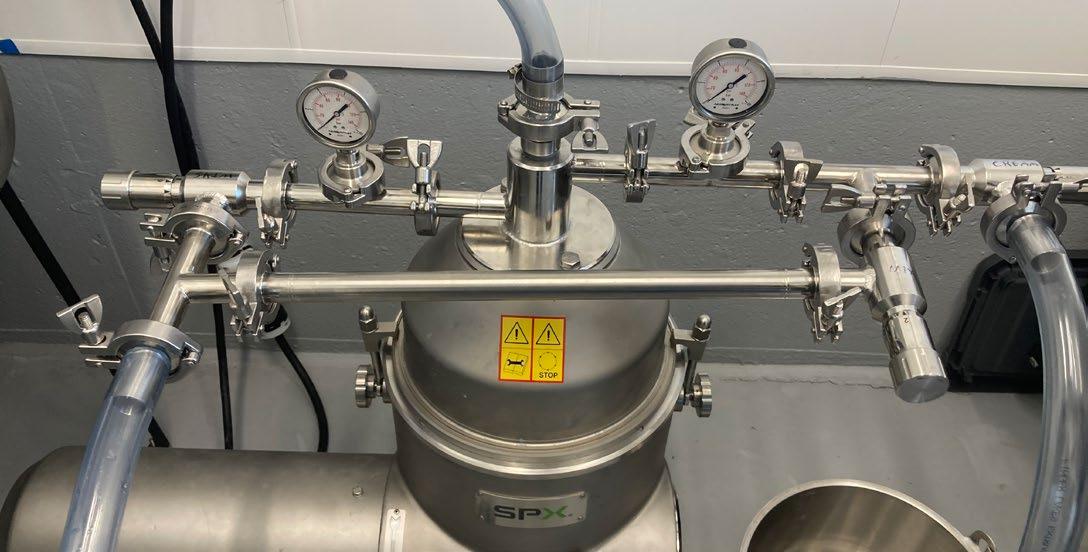
Some of the biggest challenges have been finding small-scale equipment that meets the 3A standards required for dairy processing in Wisconsin [see side bar] and finding equipment that runs on single phase electric. Much of the available USA-made small-scale dairy processing equipment is larger than what we need. It takes up too much space and is designed for a larger capacity. The cream separator is a good example. The one we purchased, which was manufactured in Italy, is still larger than what an operation of our size would require, but it is the smallest 3A certified separator we could find.
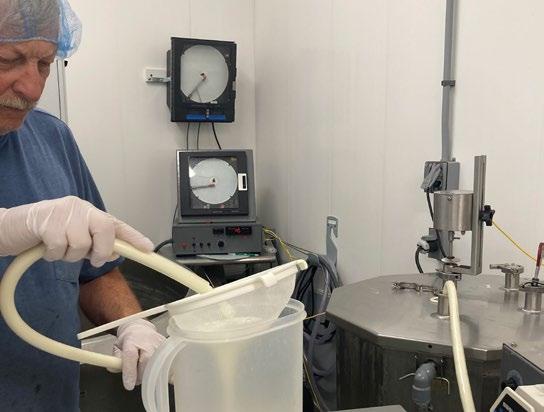
Our son Joe also got a bulk milk weigher and sampler license. We received a waiver to allow us to move milk to our creamery in modified stainless steel milk cans via a small wagon to do this. Despite this very small-scale operation of moving milk, Joe needed the same license that someone driving a large milk truck needs so that he can legally sample and test the milk quality.
MS: What is single phase electric, for those not up to speed on electrical language!
DK: Don’t worry, I’m still very much learning this stuff! Single-phase power provides a single alternating current (AC) wave, while three-phase power simultaneously delivers three overlapping AC waves, providing a constant, uninterrupted flow of electricity.
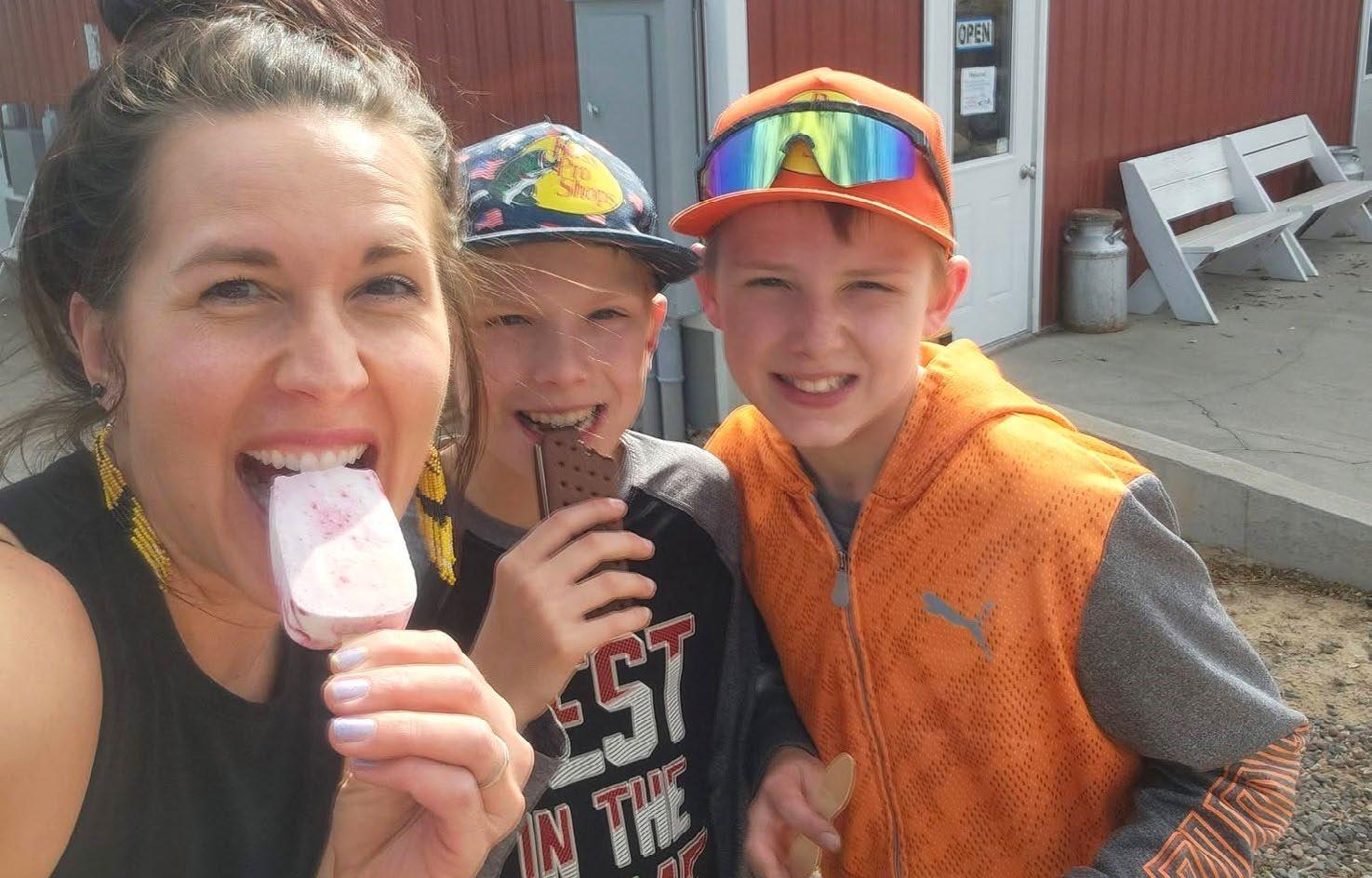
↑ Neighbors enjoying ice cream treats at Klemish Creamery.
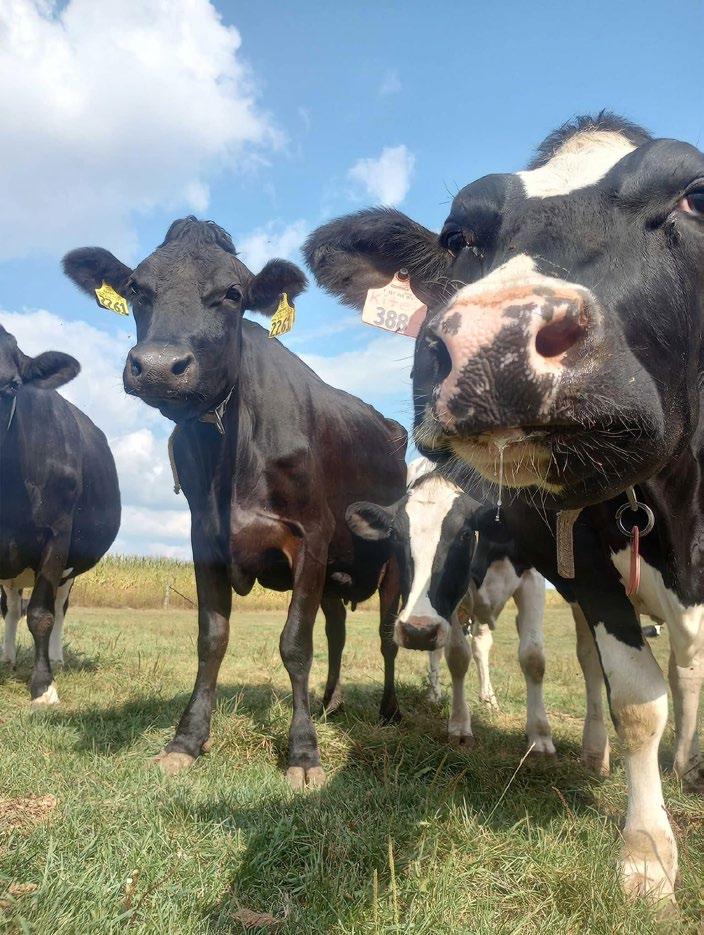
↑ The Klemish Creamery herd grazing on pasture.
Eq UIPPING AN ICE CREAM OPERATION ...
While the latter is widely used in industrial settings to run heavy machinery and large motors, single phase is what is typically available for rural homes and farms. The infrastructure for three-phase power is not cost effective with the vast distances covered in rural areas. I would call the size of our operation a micro-dairy processing plant.
MS: Tell us about the role of the cream separator. Where did you get yours and what are the costs?
DK: The second DBIA grant allowed us to purchase a separator. This equipment allows you to isolate the rich cream and control the exact fat-to-milk ratio. Ice cream really needs to have the milkfat percentage dialed in; fat content in milk changes with time of year and what the cows are eating. Since we strive for a minimum of 15% butterfat in our high-quality ice cream, there was no way in the beginning to make ice cream without relying on store-bought heavy cream to add to our milk.
With this equipment, we can now use more milk from our dairy herd as it takes four times the quantity of milk to get the amount of butterfat needed for our ice cream formula. However, that leaves us with skim milk left over, which is the reason we are working to expand into cheesemaking, especially lower fat cheese products.
We can also eliminate some of the additives from our ice cream that came in the purchased cream. We’re especially excited to be able to eliminate the carrageenan added to most heavy cream, allowing us to make ice cream with a more consumer desirable clean label.
MS: A homogenizer is another piece of equipment we know some producers invest in. Do you have one?
DK: No, we don’t have a homogenizer. We like that the fat globules in our milk remain closer to their natural state instead of being broken down during homogenization. This does cause some challenges in ice cream making; there’s an increased tendency to
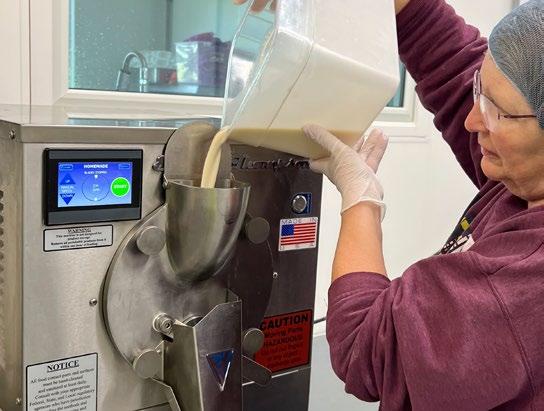
create butter balls while churning and freezing the ice cream with non-homogenized milk, but we’ve been able to develop a formula and process for making our base ice cream mixes to prevent that.
MS: What other equipment have you purchased and how did you learn about it?
DK: We spent a lot of time on the internet researching equipment, reading blogs, articles, and websites about other operations. For instance, hand wash sinks that can be operated hands free are a requirement. New sinks with hands free features are expensive. Used hand wash sinks on auctions are inexpensive, but the ones I found were not hands free. I found an automatic motion sensing adapter on Amazon for less than $40 that attaches to the faucet making the sink hands free. With three hand wash sinks in our processing areas, this saved us hundreds of dollars.
The RSFI grant allowed us to purchase walk-in cooler and freezer units. I’ll add that navigating purchase decisions with the uncertainty of tariffs has been difficult. Much of the small-scale processing equipment approved for use in Wisconsin is made in foreign countries. We have equipment that was manufactured in Greece, Italy, and the Netherlands.
colla B oration & gro W t H
MS: The RFSI grant enables collaboration with other small farmers and processors. Can you describe how that network actually works day-to-day? How many farms or producers are involved? Do you imagine collaboration with infrastructure in the future?
DK: This project is in the very beginning stages. We are collaborating with small farmers and processors in Northwest Wisconsin to distribute value-added farm products. Our goal is to build up to a collaboration with 15 farmers. This collaborative distribution plan will benefit small enterprises, especially those who lack frozen and refrigerated delivery methods for their products.
We have the delivery vehicle and freezer and cooler space installed. Now we need to focus on the rest of it, which includes seeking more farmers who could benefit from the delivery and product cooling resources we now have available. The Glass Orchard in Eau Claire, WI, is one processor we are working with. We use their cider in our caramel apple crisp ice cream each fall. We sold their cider in our store last year, and they plan to sell our ice cream at their orchard this year. We’ll also be setting up an ordering system for retailers and delivery routes schedules.
↑ The cream separator is a key piece of equipment for making ice cream.
MS: Now that you’re a few years in, what have you discovered about scaling this business?
DK: In terms of space, we could definitely use more. When we built the facility, it was so hard to estimate what our growth might be and we only had so much money, so we opted to go small. We quickly filled the space. We’ve been able to make space to fit the required cheesemaking equipment but will likely need at least a small addition for more storage in the near future.
We currently have five part-time employees. Our ice cream is made in small batches and is labor intensive, especially given that we make many of the additional ingredients like sauces and cookies that go in it. This limits the amount of ice cream we can make relying solely on immediate family labor. Our growth – mainly word-of-mouth advertising from loyal customers and increased retail locations – forces decisions about hiring more people and time management between all the normal work of a dairy farm and the added work in the creamery.
MS: Where are you with starting cheese sales?
DK: I am nearing the end of the process of becoming a cheesemaker, which includes 240 apprenticeship hours and five cheesemaking and dairy processing education courses. I did my apprenticeship hours with Rama Hoffpauir at Cosmic Wheel Creamery in Clear Lake, WI.
We could have made cheese with the equipment we already had, but we purchased a larger combination pasteurizer/cheese vat. It has a bottom drain for removing whey that our smaller 30-gallon pasteurizer did not. I will need smaller equipment such as cheese molds and a draining table for sure. A cheese press, curd mill, and cheese aging cabinet or room are future purchases depending on the types of cheese we make.
MS: What advice do you have for any farm considering adding ice cream to its farm offerings?
DK: We are glad that we chose ice cream as our first product to make in our dairy processing plant. Ice cream seems to make people happy, and it’s brought many people to our farm. It’s gratifying to see them enjoy a glimpse of farm life and the beautiful scenery we are surrounded by.
It does change life on the farm though. My advice for anyone wanting to begin making value-added dairy products, whether ice cream or another dairy product, would be to think carefully about what you are willing to change about your farm and your life. If you don’t want visitors to your farm daily, where will you sell your product? If you are already struggling to find enough hours in a day for basic farm tasks, adding dairy processing to the workload is an additional burden.
I was a full-time mail carrier when we opened the creamery. The family pitched in and we managed our first few years, although my husband Randy ended up making more ice cream than we anticipated in the beginning. I’m now retired from my job and have more hours to dedicate to Klemish Creamery and am looking forward to more new ice cream flavors and dairy products to offer in the future! m S
c or E 3 a p rincipl ES F or i c E c r E am Equipm E nt
Specific standards apply to batch and continuous freezers, piping, and packaging equipment used for ice cream:
→ Material Safety: All productcontact surfaces must be constructed of corrosionresistant, non-toxic materials like 300-series stainless steel or FDA-approved plastics.
→ Cleanability: Surfaces must be substantially smooth and flush. Equipment must be designed so that cleaning solutions can reach every nook (mechanical clean-inplace) or be easily disassembled for manual cleaning.
→ No Crevices: Welds must be polished smooth, and there can be no dead ends, hidden threads, or sharp internal angles where bacteria could hide and grow.
Source: Wisconsin Department of Agriculture, Trade and Consumer Protection (DATCP)
rnationalYEar
Currently, 56 % of the world population lives in cities, a percentage estimated to increase to 70 % by 2050. In the U.S., the numbers are even starker with 80% of the population residing in areas deemed urban.
Supply chain interruptions, whether due to political, climate, or medical events, are also expected to grow. One of the best responses is to narrow the geographic gap between where food is produced and consumed.
For this reason and others – expanded access to green space, the psychological benefits of working with the natural world, and reducing heat islands – urban agriculture is on the rise. Tech-heavy vertical farms and aquaponics get a lot of attention, but those working at the crossroads of food systems, public health, and community resilience point to the benefits of small-scale vegetable and fruit farms that range in size from a portion of a city block to a few acres.
These spaces cannot be directly compared to their rural counterparts.
As Nevin Cohen, the coauthor of an article about urban farming’s carbon impact, says, “Urban agriculture is not just the urban, smaller-scale version of conventional agriculture. It provides different benefits and operates… with a completely different infrastructure.”
As we continue our exploration of issues facing women in agriculture (read about women landowners’ role in conservation on p. 15) and women who are making unique contributions, we wanted to focus on an urban farmer.
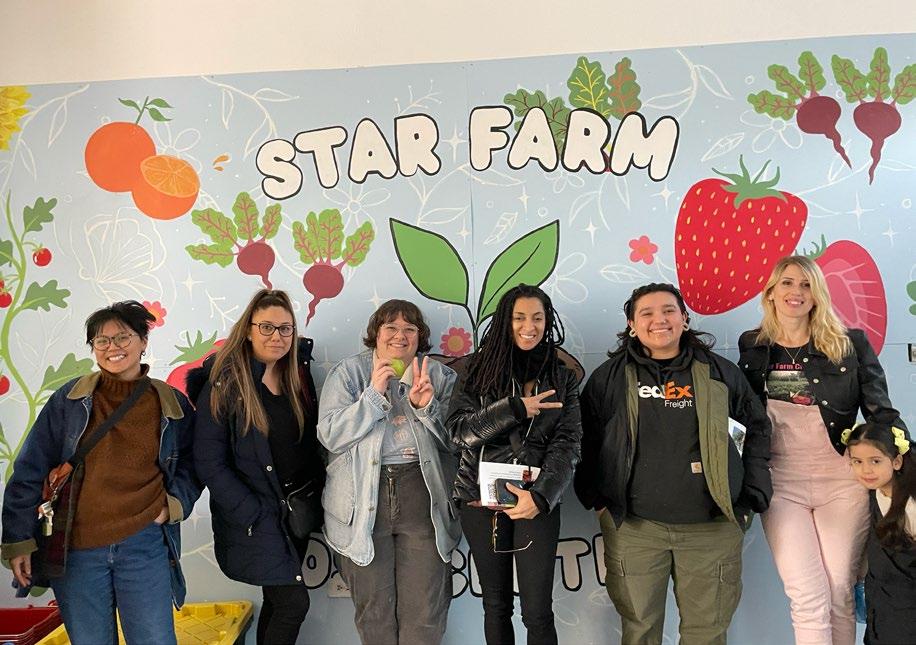
Marbleseed has had the pleasure of partnering with Star Farm on several projects, a non-profit urban farm and local food market in Chicago’s Back of the Yards neighborhood led by Stephanie Dunn. In addition to growing fresh produce, Stephanie is determined to empower women, improve mental health, and engage people with disabilities. Her work is just one example of the way people who “don’t look like a farmer” are bringing agriculture to less likely places.
↑ “Summer” is the second of a series of seasonal prints by Frances Whitfield we’ll share throughout the year in honor of the International Year of the Woman Farmer.. Whitfield is a freelance illustrator and printmaker, and muralist in rural Herefordshire. Follow her Instagram @pan.makes.
S t E p H ani E Dunn • S tar F arm
URBAN f ARM INNOVATOR
tHE act o F D oing t H i S i S a F orm o F r ES i S tanc E.”
— Stephanie Dunn, Star Farm “
By Sofia Carraci, Marbleseed
When people picture a farmer, Stephanie Dunn knows she is probably not who comes to mind. As the founder and executive director of Star Farm Chicago, Dunn is often told she doesn’t “look like a farmer.”
If the central casting version of a farmer is an older white man wearing a feed cap and overalls, Dunn is anything but. A tall woman whose long nails are often polished to match her brightly colored clothes, she challenges our collective, deeply rooted assumptions about agriculture – and reminds us how urgently those assumptions need to change.
“What does a farmer look like?” Dunn asks. To her, the answer is simple: farmers look like the people doing the work. They are women, immigrants, urban residents, people with cognitive and physical disabilities, youth, community organizers, educators, and entrepreneurs. They are people who grow food, build relationships, and strengthen their communities.
on E B ig mi SS ion
Through Star Farm, Dunn has spent more than a decade creating opportunities for those often overlooked by traditional agricultural systems. Her journey into agriculture was anything but conventional. After college, Dunn explored careers in medicine and law, working alongside both a physician and a disability rights attorney. While she valued the impact of both professions, neither felt like the right fit.
One message came up repeatedly with the patients she was seeing; “We were always telling people they needed to eat more fruits and vegetables, but we had no pathway to say where to get them from.” On Chicago’s Southwest Side, an area with low access to fresh food, following this healthful advice was challenging.
At the same time, Dunn was an avid gardener, volunteering in community gardens, participating in urban gardening projects, and completing Master Gardener and Master Urban Farmer programs. The more she thought about food access, public health, and community wellbeing, the more she realized agriculture sat at the center of all three.
“I just saw it checking all the boxes for me,” she said. “Giving people access to healthy fruits and vegetables, workforce development, community building, environmental stewardship – it all felt like one big mission.”
That mission eventually became Star Farm. Located on Chicago’s South Side, Star Farm combines urban agriculture, workforce development, community education, and farmer incubation. Its programs reflect Dunn’s own lived experience growing up in poverty with a single mother. She understands the challenges of economic insecurity and creating opportunities where few exist. Those experiences continue to shape Star Farm’s approach and its commitment to expanding opportunities.
in VES ting in W om E n
That perspective is particularly evident in Star Farm’s work with women. Through incubator farming programs, workforce development initiatives, and community-based entrepreneurship opportunities, the organization has intentionally invested in women – especially Spanishspeaking women – and recent arrivals seeking to build skills, confidence, and economic stability.
Dunn also points to a gap she has observed throughout her career: while many programs focus on “at-risk male youth,” far fewer are designed specifically for girls and young women. “There’s so much more room to support young women in sustainability,” she said. “Globally, women grow our food, prepare our food, and feed our children. That population is a super important priority.”
As conversations around equity in agriculture continue to evolve, Dunn believes women are already leading the future of farming, particularly in organic and community-centered agriculture.
“The act of doing this is a form of resistance,” she said. Many women-led operations prioritize collaboration, education, environmental stewardship, and community impact, yet remain underrecognized and underfunded despite their contributions. “They’re so busy doing the work that they don’t care about taking the credit for it,” she says. “So they don’t have the visibility that other operations might receive.”
URBAN f ARM INNOVATOR
S om E on E to BE li EVE in Y ou
tHEY H a D BEE n Farming in t HE ir min DS F or S o lon G , W HE n t HEY got acc ES S , t HEY J u S t F louri SHED .”
— Stephanie Dunn, Star Farm
One of the most important lessons Dunn has learned is that talent and ambition are rarely the limiting factors – access is. For urban growers especially, access to land and water can determine whether a dream remains hypothetical or becomes reality.
When Star Farm launched its incubator farm program six years ago, eager growers quickly filled the available plots. Only two had previous farming experience. The others had little more than backyard gardening experience. But all had long imagined themselves farming.
“They farmed the hell out of that year,” Dunn recalls with a laugh. Some sold at farmers markets while others developed farm stands and community programs. Given access to land and resources, they transformed their ideas into thriving projects almost immediately.
“They had been farming in their minds for so long,” Dunn reflected. “When they got access, they just flourished.” Looking toward the future, Dunn remains hopeful.
She points to growing awareness of local food systems following the COVID-19 pandemic, increased investment in community-based agriculture, and a broader recognition of the importance of equitable food access. While challenges remain, she believes momentum is building.
“There are people out there doing incredible work,” she said. “Sometimes they just need someone to believe in them enough to invest.” For women considering their own journey into farming, her message is clear: The future needs them. m S
Sofia Caracci is Marbleseed’s Farmer Education Specialist.
a cc E l E rating Su S taina B l E a gricultur E
Th E LONGTIME E ff ORT
By Jennifer New, Marbleseed
TO ENGAGE WOMEN LANDOWNERS
“The opportunity is so big you could drive a Mack Truck through it,” says Jodi Enos-Berlage, a microbiologist, educator, and landowner in northeast Iowa.
If soil fertility is at the center of the equation for improving water quality, providing healthy food, and strengthening rural communities, then the people ultimately responsible for soil health must be part of the solution. Whether they farm or not, it is landowners, Enos-Berlage believes, who need to show up as stewards.
In Iowa today, nearly half of landowners are women – a percentage on par with the national average. Many of them own but do not operate on their land. They lease it to farmers, the majority of whom are male.
These women are the opportunity Enos-Berlage and others have come to see as a vital part of any agricultural and climate solution. Studies show that women have different priorities when it comes to land than their male counterparts. As a group, they are more concerned with conservation and community, while less devoted to the bottom economic line. Reach women landowners and there’s a real possibility of creating authentic and scalable on-the-ground change.
n o mor E S pac E on t HE map
Enos-Berlage experienced an obstacle to this line of thinking when in 2014 she was approached by a group of concerned farmers who were interested in cleaning up a local creek that ran through the campground in Decorah, IA. It was frequently accessed by families with children as a place for water play.
The stream had high levels of bacteria, and they hoped the professor at Luther College with expertise in microbiology could help. It was an easy sell. She and her husband own and operate a small local farm, the runoff from which flows
↑ Jodi Enos-Berlage (bottom left) with members of the Regenerating Soil and Community cohort. Photo courtesy RSC.
ACCELERATING SUSTAINABLE AGRICULTURE PRACTICES
into the stream. Enos-Berlage was also familiar with farming, having grown up on a purebred cow/calf/conventional crop farm in Illinois.
“We were a year into water monitoring,” she recalls of the project, “and we had evidence of when and where bacteria was showing up. Our data helped us get a state cost-sharing grant to do outreach to farmers in the watershed.”
The group created a flyer aimed at farmers that announced potential conservation funding. To figure out who to send it to, they used a plat map to identify farm locations and names of owners. While helping address envelopes, Enos-Berlage had an aha moment: “I live in the watershed, but I realized I wasn’t going to get one.” It would go to her husband, whose name was on the map.
“There were hardly any women’s names on the map,” she says, “and the few that were there were often widows.” This irritated her because she equally owns the land and assumed this is the case with many other families.
Not one to shy away from a problem, Enos-Berlage drove the length of the watershed knocking on doors, not only to get the names of women landowners but to meet them. She also contacted the company that makes the maps to see if their names could be added. She made her way to the CEO who told her there wasn’t space on the map for more words. The name that comes first on the deed is what’s on the map. End of story.
“There’s no awareness of the downstream effects on something as seemingly simple as the ordering of names,” she says. The experience caused her to wonder more intentionally about who is being missed in conservation efforts: “It might be that we are missing the most important person to reach.”
A decade later, Enos-Berlage’s research is largely focused on the issues raised by that farmer-led project. Her passion is driven by her belief in the potential for change. “Whether it be at the local, state, or federal level,” she says, “not having focused attention on landowners, including and especially women, might be the biggest missed opportunity in conservation work.”
“Har D lY t HE D ar K ag ES !”
Dr. Angie Carter, a rural sociologist and professor at Michigan Technological University, wrote her dissertation about women farmland owners’ conservation actions in relation to water quality. “My research found that even if a woman had inherited her family’s land, her husband is often viewed as the default decision-maker or she’s expected to cede her power to her brother or nephew – always a man,” says Carter. “It’s patriarchy and it’s misogyny, and it persists because this is how land becomes concentrated in the hands of white men through the continuance of the ‘family farm.’”
Carter and Enos-Berlage both credit Dr. Jean Eells for bringing issues of women’s land ownership and conservation to the fore. As a co-founder of Women, Food and Agriculture Network (WFAN), Eells has led and encouraged programming that gives women confidence to get more involved in conservation.
When Eells began working on research about women and conservation outreach in the early 2000s, the work was considered radical. “Especially in relation to the transfer of land from one generation to the next, researchers in the area of agricultural conservation were not paying attention to gender much at all,” says Carter. “Isn’t that wild? The early 2000s and 2010 – that’s hardly the dark ages! At the time, gender was often treated as a demographic variable rather than a power system.”
In addition to Eells’ work, other peer-review studies have found that female respondents are more concerned with conservation and environmental factors than male respondents. In particular, a 2014 paper by Caroline Gottschalk Druschke and Silvia Secchi, “The Impact of Gender on Agricultural Conservation Knowledge and Attitudes in an Iowa Watershed,” is frequently cited. In it, the authors report that while female landowners often possessed less knowledge about specific best management practices (likely due to historical exclusion from agricultural networks), they exhibited more positive attitudes toward conservation.
a cc ESS to r ES ourc ES
Such findings hold true globally and contributed to the United Nation’s naming of 2026 as the Year of the Woman Farmer. The global intergovernmental organization highlighted women’s ability to positively impact the environment as a reason to celebrate and support their work and capacity for change.
“As farmers, women have learned how to cope with and adapt to climate change, for example, by practicing sustainable agriculture in harmony with nature, switching to drought-resistant seeds, employing low-impact or organic soil management techniques, or leading community-based reforestation and restoration efforts,” reports the UN, which
↑ As the numer of female landowners trends up, Enos-Berlage sees an opportunity for change. Photo courtesy RSC.
continues by saying that women “have less access to a range of resources, from land rights and credit to education and technology. If women had the same access to productive resources as men, farm yields could increase by 20 to 30%, feeding an additional 100 to 150 million people.”
Emboldening women landowners to practice conservation is a goal of many more recently developed programs. In Wisconsin, for instance, Wisconsin Women in Conservation (WiWiC) was formed to coalesce women landowners around conservation management practices and improve access to resources, including funding. It has launched sister networks in Minnesota and Illinois. (Along with Marbleseed, WiWiC recently hosted a popular two-part training for women who wanted to learn how to use chainsaws to manage wooded areas.)
t r E n D ing up
Who operates a farm and who owns it are not always the same thing. And where responsibility for the health of the land falls can become a gray area. Is it the person applying inputs and making day-to-day decisions, or is it the landowner? Many believe it’s the latter.
The number of female landowners is trending up, partly because as farmers age, female family members outlive their male parents, spouses, and siblings. The land they inherit is often debt-free.
However, many large-scale and long-running surveys focus on operators and not owners. The Iowa Nutrient Reduction Strategy and the Iowa Farm and Rural Life Poll, for example, collect data that inform outreach and engagement strategies and funding. Because both focus on operators, responses come overwhelmingly from men. In 2025, the Farm and Rural Life Poll’s respondents were 94% male.
“These are two of the state’s largest surveys that are trying to get a sense of what’s happening around nutrient reduction and water improvement,” says Enos-Berlage, “but they’re missing women stakeholders.” These women are the Mack Truck she believes can drive change.
In 2024, Enos-Berlage, in partnership with several Luther College faculty and multiple external partners, launched the Regenerating Soil and Community (RSC). With funding from the Iowa Department of Natural Resources and the U.S. Environmental Protection Agency, the program aims to build partnerships between local landowners, co-owners, and operators who wish to expand their knowledge of soil health and regenerative farming practices.
RSC is built around a cohort model that includes faculty and students, county conservation specialists, landowners, and farmers. Applicants must meet the federal definition of historically underserved landowners and farmers. To date, all participants have been women.
From outr E ac H to r E ciprocit Y
Engagement with each cohort member starts with an indepth, confidential interview conversation, most often at their kitchen table. Then, over the course of a year, the landowners and farmers receive free soil and water testing, meet for workshops and co-learning, and access technical expertise and financial support. Students, faculty, and external conservation workers get quantitative and qualitative data. And in this rural corner of Iowa, new networks are being built that enhance community resiliency.
Outcomes so far have surpassed every expectation. Cohort members are attending workshops, conferences, joining organizations, and inviting on-farm visits from conservation professionals. Further, they are having crucial conversations with family members and tenants and developing new lease agreements that reflect conservation practices. In several cases, they’ve identified new tenants more interested in regenerative agriculture.
Carter points out that some agriculture outreach programs have taken a deficit approach that assume “we just need to educate up women to be able to be competitive in the mainstream or comply with the status quo.” She credits WFAN’s Women Caring for the Land program and WiWiC for honoring women landowners’ knowledge of and history to the land.
“They may not speak the language of conservation or agricultural agencies,” she says, “and their interests may not align with the mainstream commodity agenda, but they have ideas that are worth hearing and are not starting from zero. … They have something to teach the conservation service providers, imagine that! Reciprocal learning for ecological management – now that is healing, and that is radical.” m S
Jennifer New is Marbleseed’s Communications & Policy Manager. She is completing a graduate-level training in eco-chaplaincy and is passionate about soil and water health.
↑ Members of the RSC cohort and Luther College students engage in soil testing.
Photo by Aryn Henning Nichols.
planting in unpr ED icta B l E tim ES
TOO WET, TOO COLD, W h AT ELSE IS NEW?
By Dave Campbell, Lily Lake Organic Farm
This spring saw another undesirable weather pattern in the Upper Midwest. March had some well above normal temperature days. April was also mild, although will be remembered more so as very wet. Rainfall totals for April in my area near DeKalb, IL, ended up in the seven to nine inches range – more than double the monthly precipitation average.
Then came May, pretty much a complete reversal of April, with very little rain, much cooler temperatures, and many frosty mornings. I am writing this on Memorial Day, and we’ve only had one rainfall event this month that totaled more than .2”.
Weather variability has always been a constant here in the Midwest. While technological advances in weather forecasting are certainly welcome, we are still at the mercy of whatever the rain gauge reveals. Spring of 2026 presented a decisionmaking scenario in many areas of the Great Lakes region that involved the decision of whether to sow a small grain crop versus forgoing small grains in place of planting corn or soybeans.
tH oug H t F ul S oil D i S tur B anc E
The Upper Midwest is dominated by heavier deep silt loam and silt clay loam soils. I try to hold off as much as possible on tilling soil earlier in spring when the ground is cold and still somewhat wet. The exception, of course, would be tilling the previous year’s soybean ground in front of an early spring small grain crop, since typically only shallow and minimal tillage would be needed.
One of my favorite quotes comes from Gary Zimmer, who I first met in our dairy barn in 1986: “What is tillage?
THOUGHTFUL disturbance of the soil.” To that end, I usually find that it’s better to wait rather than to proceed with tillage when the soil is unfit to work. One option may be to flail mow weeds when the ground is a bit too wet to till. My preference has always been to “lift” the soil versus “packing” the soil, much more so in the spring, which for me means using a field cultivator rather than a tandem disk or a high-speed disk for spring tillage.
When addressing weed seed predation issues — a natural ecosystem service where predators consume or destroy weed seeds before they can germinate — you may want to take a pass on fall tillage. Consider whether or not to chisel plow or deep rip a cornfield after fall harvest, especially if the weed pressure was not to your liking. I suggest letting the mice and birds harvest those weed seeds for you, given the weed seeds
will be on top of the ground if no fall tillage is done. Mice will eat weed seeds under a snowpack, and you’d be surprised at how many weed seeds a single mouse or even a cricket can consume in just one day!
As organic grain farmers we need to hold off on planting row crops, such as corn and soybeans, when compared to planting dates of our conventional row crop neighbors. That said, we should remember that spring planted small grain crops, such as oats, barley, wheat, triticale, etc., should be sown as soon as possible, assuming field conditions and weather forecasts are favorable, or at least not detrimental.
H o W E arlY i S too E arlY?
How early is too early for these spring planted grains? Should we plant if there is a warm and dry spell in late February or March making field conditions fit to sow? This past February, Dr. Margaret Smith, an agronomist with Albert Lea Seed, gave an in-depth presentation on this topic. Sowing these spring planted crops too early, she said, can result in poor germination and uneven stands.
Fall sown winter wheat should be sown as soon as possible after the “Hessian fly-free date.” (Check with your crop insurance agent on planting cut-off dates for your location.) Sowing winter small grain crops is very much a timing issue. Should you decide to sow winter rye, you will have a much later planting window, given the hardiness of winter cereal rye. Winter rye can usually be sown until Thanksgiving in the Illinois/Wisconsin state line area. There is one major exception and that would be when sowing rye for the purpose of rollercrimping that rye stand the following spring prior to soybean planting. Dr Erin Silva, a specialist in organic and sustainable cropping systems with the University of Wisconsin, has presented some well-tested research showing that earlier planted cereal rye greatly increases the success of weed control in soybeans the following year.
In my region of Illinois, there are thousands of acres sown to oats each year. Unfortunately, this spring most of the oats that were sown were not planted until the last couple of days of April and the first week of May before field conditions were suitable.
lESS on S F rom 1993
More seasoned farmers may remember the Great Flood of 1993 that impacted the Mississippi and Missouri river basins along with their tributaries. My oats sowing date that year was the first week of May. At harvest time, oats were tall, had a nice color, and looked great. But looks can be deceiving.
The test weight on oats on my farm that year ended up at 27 pounds per bushel which meant no Food-Grade Market that year given Food-Grade oats need to be in the 38 pound test weight range. It goes without saying that a very low test weight will result in a low yield.
Normally, winter wheat will head out two to three weeks before oats. This year’s conditions have brought on earlier winter wheat maturation. Driving around in late spring, I noticed winter wheat that was headed out, while in a nearby field oats were only about ankle high.
c rop rotation an D c E rti F ication
Maybe you were one of those farmers who decided to make a change in your crop rotation this spring given your inability or preference to forgo sowing a small grain crop, given very wet soil conditions. USDA-NOP allows for a change in crop rotation for circumstances like extended wet weather, so long as the new rotation complies with the organic crop rotation standard.
As always, check with your certifier sooner rather than later before making any adjustments to your planting intentions. Certification agencies may differ in what practices are allowed when delayed planting scenarios present themselves. A core principle requires that a certified USDA organic crop rotation must avoid so-called monocropping. In organic production monocropping implies the planting of row crops year after year without a small grain crop or perennial crop like hay being grown within the rotation cycle.
A common grain rotation in the Upper Midwest consists of sowing a small crop like oats followed by corn and soybeans over a three-year cycle. The oats crop can be underseeded with a cover crop of red clover or a multispecies cover crop mix can be sown after the small grain crop is harvested in mid-to-late summer.
PLANTING IN UNPREDICTABLE TIMES...
— Dave Campbell, Lily Lake Organic Farm, has been USDA certified for 35 years. “
S om E tim ES Y ou J u S t n EED to B it E t HE B ull E t t H i S crop YE ar S o t H at Y ou W on’t n EED to DE al W it H rotation i SS u ES in F ollo W ing YE ar S .”
While it is difficult to accept the financial results of an oats crop that yields poorly due to very late planting, keep in mind that switching acres over to a row crop will require some long-term sacrifices. Even if your certifier allows you to plant all or most of your intended spring small grain crop acres to corn and soybeans, you need to consider whether you have enough storage to hold those extra row crop bushels of grain, or sufficient labor at harvest time. Also keep in mind that your rotation will be “off” for next year and probably for another year or two beyond. My point is that sometimes you just need to bite the bullet this crop year so that you won’t need to deal with rotation issues in following years.
o ption S an D c H all E ng ES
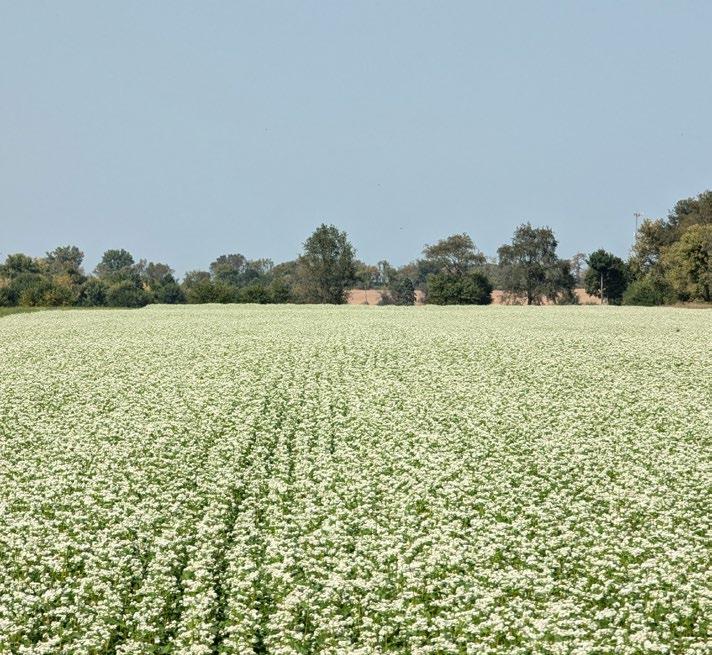
You’re reading this long after your crop rotation decisions for this year have been made. But this won’t be the first spring with challenging weather and hard decisions to ponder. In the future, rather than resorting to corn or soybeans, consider a new crop such as buckwheat. Buckwheat is typically sown in late June further north but can be sown as late as July or early August further south as a cash crop and later as a cover crop for soil health purposes.
Along with the weather, another disappointment in farming news this spring and early summer has been fertilizer prices – namely for synthetic fertilizer. Poultry and turkey manure (litter) is the most frequently used fertility product for Midwestern organic grain farmers. For now, litter prices have not increased too much across the Midwest. That will change if the situation in the Middle East doesn’t get resolved soon. And we’ll have competition; conventional grain producers are already booking allotments of litter for this fall. Bird flu has already contributed to price changes. The culling of flocks has led to a decrease in available litter; we saw a 20% price increase in litter in my area last year.
Naturally mined products like gypsum, soft rock phosphate, and sulfate of potash, (0-0-50), have seen only modest price increases. However, the soaring price of diesel fuel is impacting all off-farm fertilizer purchases. There will most likely be a price increase of soil amendment products this year.
The variables of weather, world events, bird flu, and other factors are making our already challenging decision-making more complicated. Whether you’re currently trying to right your course after decisions you made during the wet spring, or you’re looking ahead to next year as fuel costs fluctuate, know that there are always adjustments you can make. Changing crops, playing the waiting game, and switching inputs are all options you have control over. m S
Upon graduating from Western Illinois University with a teaching degree, Dave joined his father in their organic dairy cow operation located in northern Illinois. Later he operated an organic dairy in southern Wisconsin. In 1988, he began to transition the entire acreage of a conventional row crop farm near DeKalb, IL to certified organic production. Lily Lake Organic Farm has been USDA certified organic for the past 35 years, along with Real Organic Certified for the past 4 years.
I DENTI f YING ACTIONABLE SOLUTIONS S ummit on F arm E r ri SK
By Lori Stern, Marbleseed Executive Director
Summit on Farmer Risk: Investing in a Comprehensive Farm Safety Net for Human Scale Organic Farms
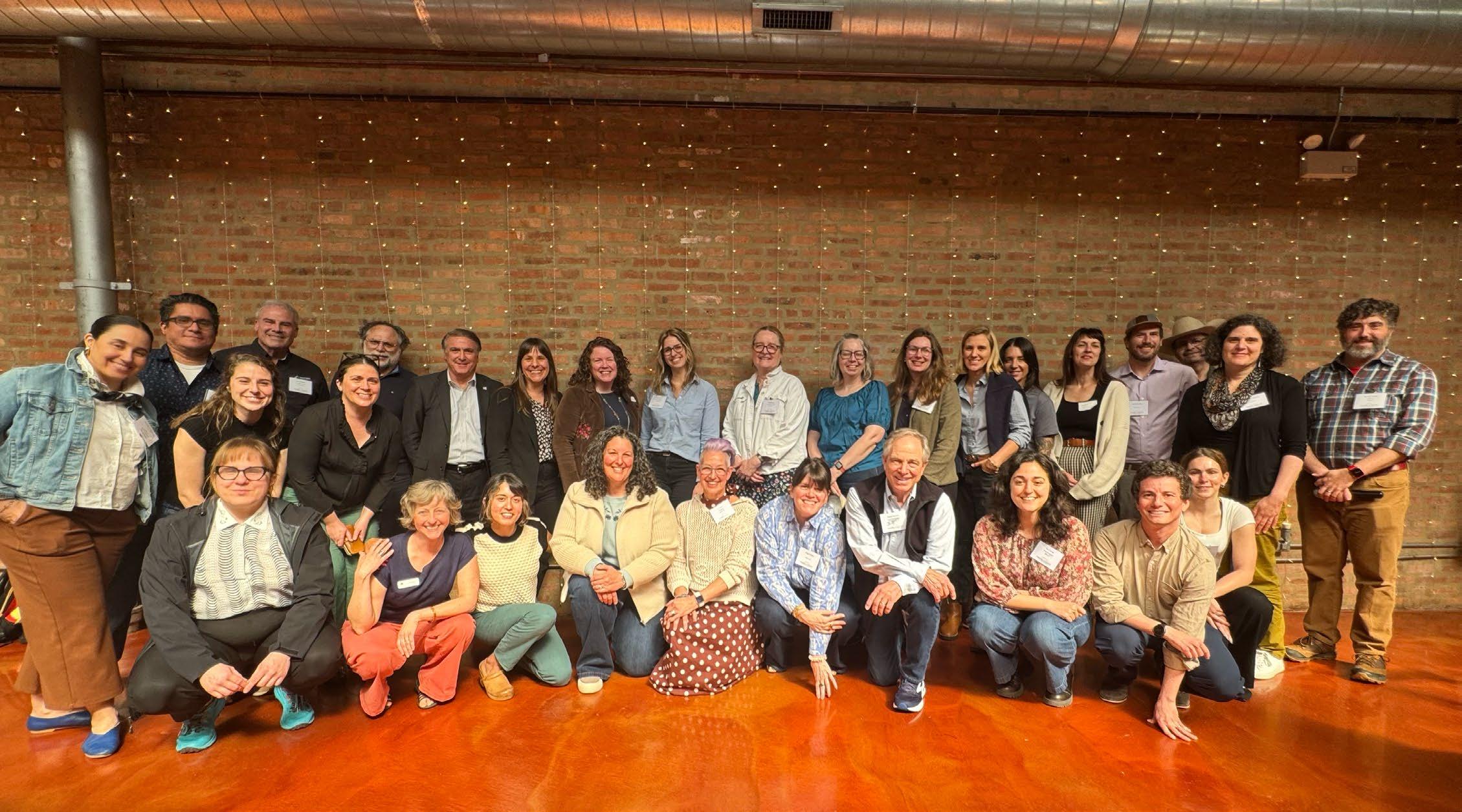
This spring, Marbleseed convened an eclectic group of folks to discuss farmer risk. The Summit on Farmer Risk occurred in Chicago, Illinois, on April 16, after more than six months of planning.
We began with a slide that stated the problem for which we were there to solve: “Without human scale, organically managed, diversified farms, we lose our access to healthy food. This is true both locally and across many values-based supply chains. Access to healthcare and farm business insurance are critical to these farms being viable and thriving.”
a ctiona B l E S olution S
The summit brought together invited leaders from sectors that do not often work closely together, including insurance, healthcare, philanthropy, and investment. Policy organizations were intentionally excluded because the planners agreed that policy solutions usually move too slowly. For people with the least financial resources and access to power, that pace is often far too slow – if change happens at all.
The day was focused on actionable solutions that were not dependent on a more friendly administration or the whims of political affiliation. Instead, we explored innovative solutions toward a farming system that works for the human-scale farms that feed us.
We heard from four speaker panels that responded to questions, such as:
→ Who are the farmers and what do we know about them?
→ What healthcare access solutions could meet their needs?
→ How ‘risky’ are organically managed farms that are diverse and mitigate climate change?
→ What finance and access to capital solutions exist to bridge the gap between conventional financing’s approach to risk and their actual risk?
It was empowering to center our creativity and solutions on small and midsize farms and farmers who have been historically underserved or disadvantaged by the current systems that support most of U.S. agriculture. So often this work happens at the margins of our current system.
After hearing from many amazing thinkers and doers, the wisdom in the room had an opportunity to come forward via smaller tabletop conversations capturing ideas that had merit for further exploration. The facilitators for the day, Shannon Sullivan with The Groundswell Alliance, and Brandon Hayes and Natalie Citro from Bold Bison, guided us through conversations on five different areas that have the potential to reduce farmer risk – including affordable healthcare, better markets for regenerative agriculture, and a climate mitigation farm safety net.
↑ Marbleseed invited leaders from insurance, healthcare, philanthropy, and investments to consider actionable solutions.
PROBLEM: Without human scale, organically managed, diversified farms, we lose our access to healthy food. This is true both locally and across many values-based supply chains. Access to healthcare and farm business insurance are critical to these farms being viable and thriving.
n EW primar Y car E mo DE l S
The healthcare panel generated the most interest and enthusiasm for continued work. One presenter, Dr. Natasha Diaz who runs a primary care practice in the greater Chicago area, shared a model that sidelines insurance and allows patients and doctors to make decisions together. As proven through Dr. Diaz’s practice, the model is improving continuation of care and saving money on individual procedures.
tHE S ur VEY S aYS
Ahead of the Risk Summit, Marbleseed distributed a survey in which we asked farmers to share information about insurance and their farms. 32% of respondents agreed with the statement, “I would be able to grow my farm business if I was not relying on an off-farm job for health insurance.”
The survey was relaunched in the weeks following the Summit in hopes of gathering more data and asking some new questions raised by the conversations in April. See the QR code below to add your thoughts and data to this effort!
W H o SE ri SK ?
One of the organizers, Zach Ducheneaux, formerly head of the federal Farm Services Agency and now principal at 5th C Capital, which works with Transformational Investing in Food Systems (TIFS), summed up the day’s approach: “Farming is risky, ag lending is not risky.”
We have an agricultural system based on large mono-cropped acreage and subsidies provided for commodities, regardless of supply or demand. Farms dependent on inputs controlled by large corporate interests are also supported by our tax dollars. The farms that truly feed us and our local economies are not served by these systems.
As a result of the gathering, everyone in attendance wanted to stay connected and continue to consider the complex issues raised.
tHE D i S tanc E BE t WEE n t HE W orl D a S it i S an D t HE W orl D a S it coul D BE i S t HE S pac E WHE r E mo VE m E nt S ma KE H i S tor Y .”
— Stephanie Luce, author of Practical Radicals
For our part, Marbleseed will be doing the following:
→ Dedicate staff to develop and coordinate Farmer Risk Summit ideas and continue attendee and farmer engagement in solutions.
→ Explore the feasibility of health and farm insurance risk pool approaches for the farmers in our community.
→ Explore multi-faceted healthcare access options for farmers.
→ Convene farmers who have indicated interest in working on these issues to further shape the solutions to make them relevant and accessible.
→ Continue to utilize our mission and capacity to reduce farmer risk and climate impact through farmer education and our programs.
This event would not have been possible without speakers attending on their own dime and our financial sponsors, the Regenerative Ag Foundation and Total Administrative Service Corporation (TASC) of Madison. Our panelists represented the following organizations: AgriCap Group, Food Finance Institute, Food System 6, Organic Association of Kentucky, Organic Farmers Association, Roots Health, Stepwell Strategies, and Transformational Investing in Food Systems. m S
If you are interested in learning more about the event and/or next steps, contact Lori at lori.stern@marbleseed. org. And please take the survey! It is short and will use just 10-15 minutes of your time.
→ https://www.surveymonkey.com/r/J8NRJ5K?
S h ARE YOUR
EXPERIENCE
ta KE our Farm in S uranc E S ur VEY!
int E grating a D apti VE approac HES
PEST & NUTRIENT MANAGEMENT IN ORGANIC SYSTEMS
i nt E grat ED an D a D apti VE manag E m E nt r E quir ES u S to loo K F or patt E rn S rat HE r t H an J u S t i S olat ED SY mptom S .”
By Tom Manley, Marbleseed
Organic farming depends on managing pests, weeds, and nutrients as elements of the same living system.
Instead of using reductionist thinking and viewing insect, disease, and fertility problems as separate challenges, long-term success requires we consider the whole farm: soil health, crop diversity, nutrient cycling, beneficial organisms, weather, equipment, labor, and markets.
The goal is not an input substitution model where we simply replace synthetic pesticides and fertilizers with organic-approved products, but rather to build a production system that prevents problems, responds early when risks appear, and supports resilience over many growing seasons.
F E rtilit Y manag E m E nt
Soil health is the foundation of organic production. Healthy soil is a living resource. It must do more than just support roots. It provides habitat for the biology that cycles nutrients and makes them available to our crop, and it stores and filters water. In organic systems, those functions are especially important because nutrients do not come from highly soluble fertilizers. Instead, they are supplied by manure, compost, legumes, cover crops, and crop residues, as well as any necessary mineral amendments. These sources release nutrients more gradually and are influenced by physical forces like temperature and moisture but also by what the biology is eating in the form of crop residues and organic matter.
Good fertility management in organic systems will never be prescriptive. It relies on soil and source material testing and our observations. It avoids the assumption that more fertility is always better and seeks to avoid over-application. Too much of anything is pollution (including money, but that is maybe a topic for another time). Too much nitrogen can create lush, tender growth that is more attractive or vulnerable to some insects and diseases, as well as leading to toxic accumulations in some forages. Too little fertility can leave crops too weak to compete with weeds. As in any system, balance is the key.
Our crop rotations cannot be detached from how we intend to manage nutrients or pests. These aspects of our production must all inform each other. Long, diverse rotations can break pest and disease cycles by shifting planting and harvest windows and alternating crop families to reduce buildup and disrupt the life cycles of specialized pathogens and insects. Weeds can be controlled by fast-growing smother crops. Soil tilth, nutrient scavenging, and water infiltration can all be improved through well-designed rotations.
c on S i DE r o BJE cti VES , a D apt accor D inglY
Cover crops can perform many functions as well as protect the soil from erosion, and in the case of legumes, fix nitrogen for future crops. However, it is sometimes difficult to tell when it is a cover crop and when it is simply part of the rotation. When designing rotations and choosing covers, we want to consider our objectives. The rotations we develop need to capture and cycle nutrients, provide food and habitat for beneficials, suppress weeds, relieve compaction, and control erosion. They may also need to feed livestock,
“
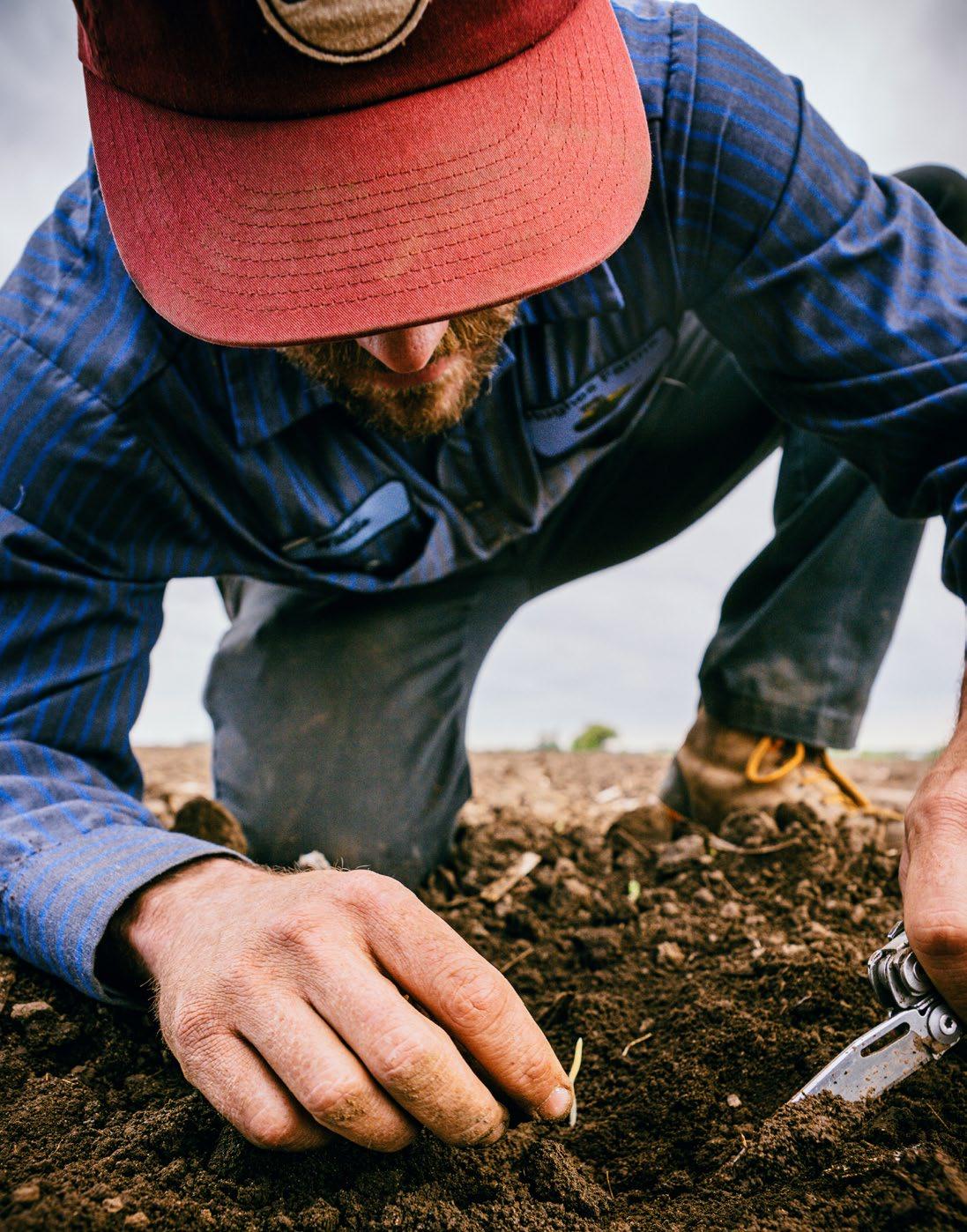
↑ Hughes Farm, Janesville, WI. Photo Credit: Full Spectrum Photography
and integrating livestock into our cropping strategy can create even more opportunities to balance fertility and control pests and weeds.
Compost and manure are indispensable fertility sources for organic operations, but they require careful management. Nutrient content varies widely; it is important to test these sources, test the soil over time, and adapt accordingly. Timing is also critical as we seek to adequately feed the system while minimizing losses from leaching and runoff. Good planning helps prevent phosphorus buildup — a common problem even on farms that are otherwise improving soil health.
Pest management in organic systems is all about prevention, avoidance, monitoring, and when necessary, suppression (PAMS). Crops that are thriving and vigorous are better able to tolerate some pressure from disease or insect feeding. We can further reduce pest risk through cultural practices like selecting resistant or adapted varieties, choosing appropriate planting dates, and managing crop residues and ground covers to be less hospitable places for pests and disease. We can reduce weed pressures by decreasing the seedbank over time, avoiding the spread of perennial weeds, using competitive crop stands, and timing cultivation when weeds are most vulnerable. These practices are often less immediately impactful than spraying a product, but they are usually more dependable over the long haul with fewer downsides.
Fri E n D o r F o E ?
Not every insect in a field is a pest, and not every pest requires immediate control. Regular scouting helps growers identify pests correctly, track crop stage, notice nutrient deficiencies, and decide whether and when action is needed.
Beneficial organisms are an often-overlooked part of integrated management. Lady beetles, lacewings, predatory bugs, ground beetles, spiders, parasitic wasps, pollinators, earthworms, fungi, bacteria, and many other organisms contribute to farm productivity. They help suppress pests, decompose residues, cycle nutrients, improve soil aggregation, and support pollination.
Farms can encourage these organisms by maintaining habitat diversity, using flowering plants, reducing unnecessary disturbance, protecting soil cover, and choosing pest-control products carefully when treatment is needed. The more a farm supports biological activity, the more management options it has and the greater likelihood the natural system will find balance and not require a suppression intervention.
Organic-approved inputs may still have a role in our pest or nutrient management. There are times when a pest outbreak, nutrient deficiency, or weather-related
problem requires a timely response. We may find the need to use an approved product to protect yield or correct an imbalance, but these should not be used as a substitute for planning. Integrated and adaptive management requires us to look for patterns rather than just isolated symptoms.
A pest problem may be partly a fertility problem (both too much or too little), a compaction problem, a rotation problem, or a timing problem. Recordkeeping helps us identify these patterns and spotlight the underlying causes. A simple record that is actually used is always better than a complicated system and the most useful records will help us connect observations with the actions and outcomes that followed.
a min DSE t a S muc H a S a practic E
What makes all of this complicated is that no two farms are the same, despite the desire of the larger industry to standardize and make farming prescriptive. What draws many of us to organic in the first place is the recognition that natural systems are complex and differ across locations, and that truly resilient farming systems will embrace the uniqueness of their place, conditions, and situation. Vegetable farms, grain farms, and livestock operations may differ in the specific techniques they apply, but the principles will be the same. Every farm will have a different set of metrics beyond just yield to measure success. It is this intended holistic nature of organic production that makes this all “hard,” but it is also why it works.
In the end, the ability to successfully integrate pest and nutrient management is a mindset as much as a set of practices. It starts with the recognition that fertility, pests, soil biology, rotations, habitat, and management timing are connected. By building healthy soils, diversifying crops, using cover crops strategically, monitoring fields carefully, supporting beneficial organisms, and applying approved inputs only when they fit the larger plan, organic growers can reduce risk and improve long-term performance. The most resilient organic farms are not those that avoid every problem, but those that learn from each season and keep improving the system. m S
Tom Manley is the Climate and Conservation Director at Marbleseed and a farmer committed to continual improvement of natural resources. Contact Tom if you are interested in learning how to utilize NRCS programs for organic and transition-to-organic:
→ thomas.manley@marbleseed.org
This material is based upon work supported by the U.S. Department of Agriculture. Any opinions, findings, conclusions, or recommendations expressed in this publication are those of the author(s) and do not necessarily reflect the views of the U.S. Department of Agriculture.
F ruit pac K SHED DES ign S SETTING YOURSEL f UP f OR SUCCESS
By Tay Fatke, Marbleseed
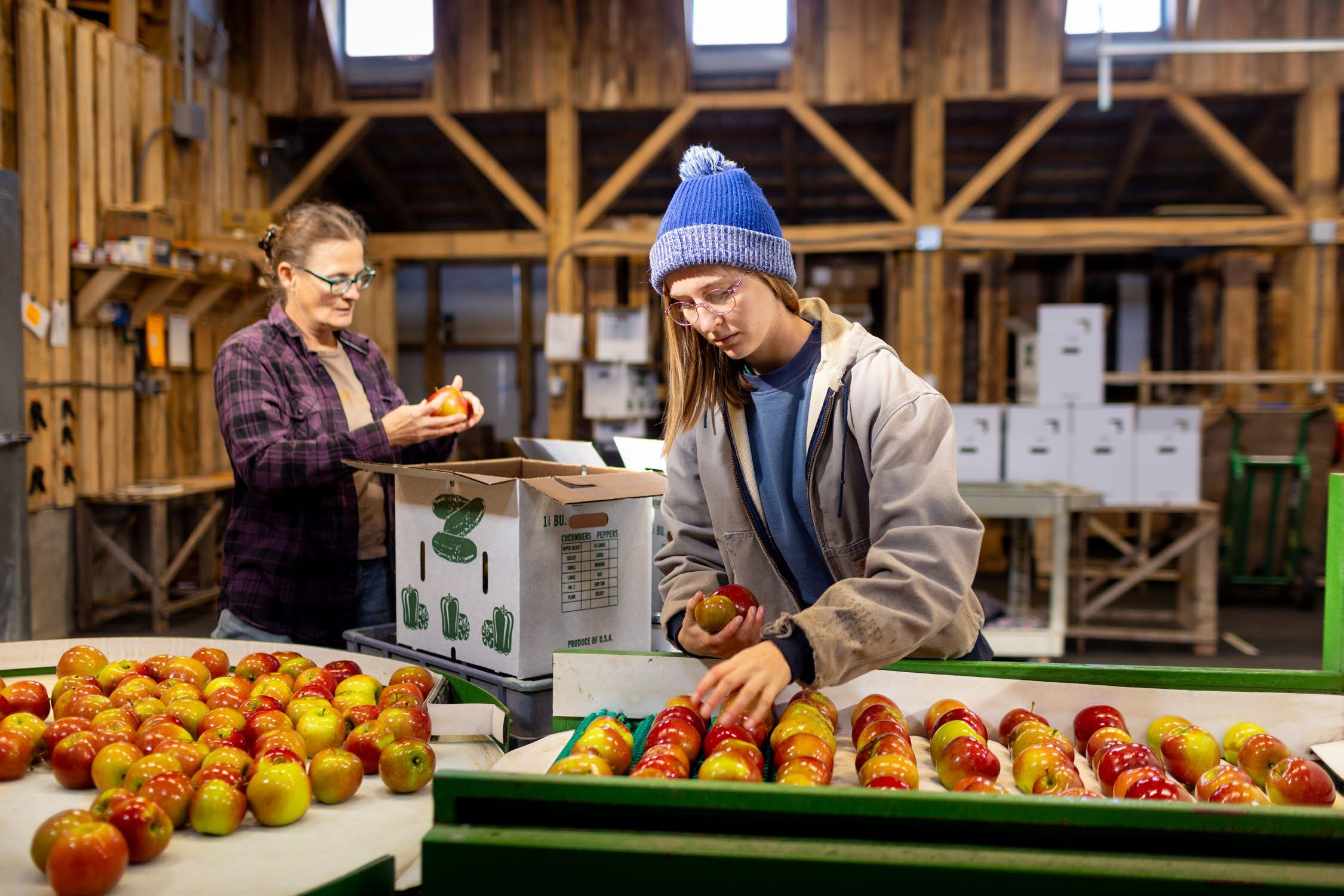
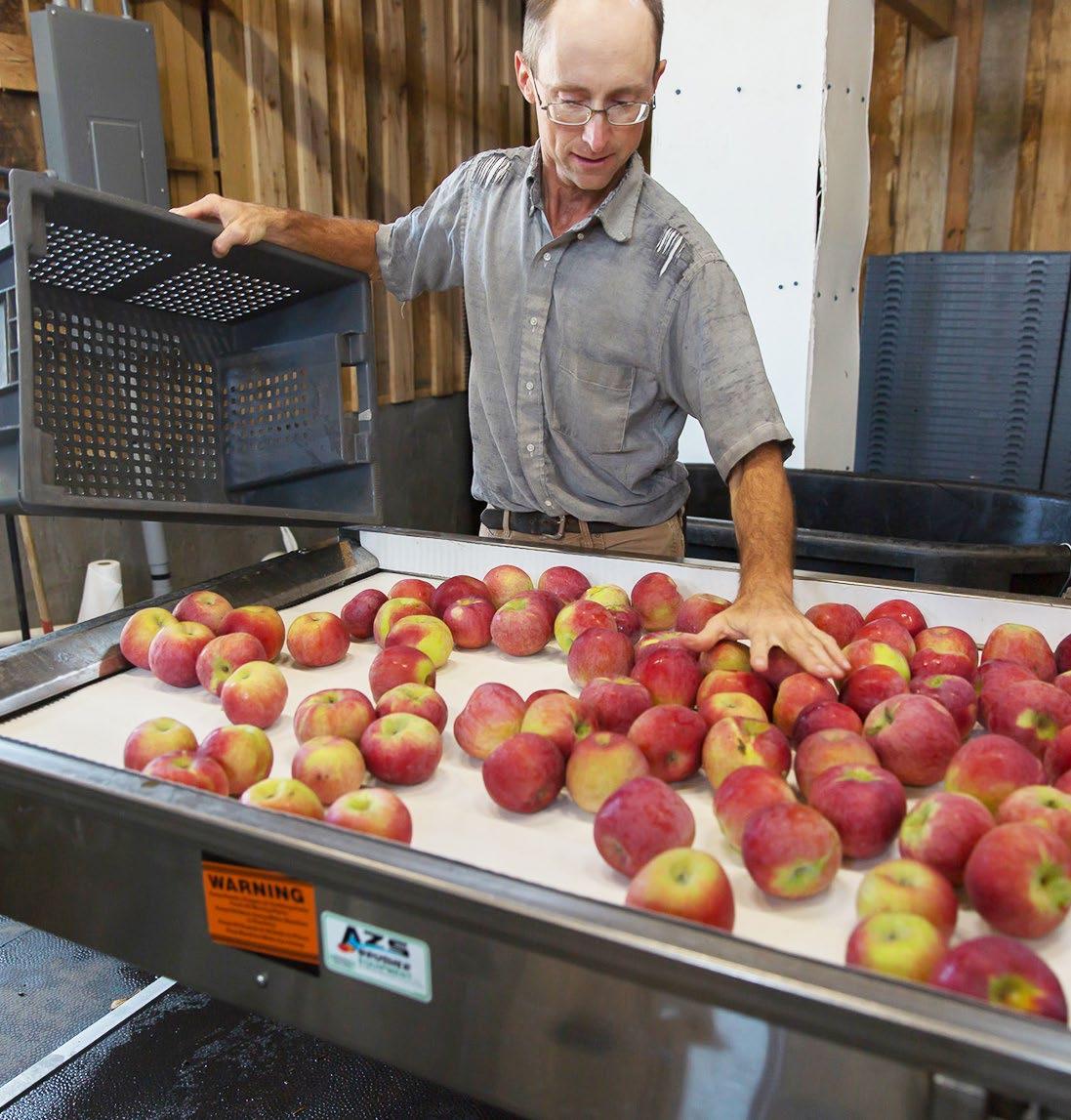
The process of growing apples looks pretty similar across orchards. Trees are set up in blocks, either free-standing or on a trellis. There is a strict spray and management schedule to counter pests and diseases. In late summer and autumn, the apples are hand harvested.
There is much more variability when it comes to the post-harvest handling of apples. I have had the opportunity to both work at an orchard as well as visit orchards, and I’m always as intrigued by what’s inside the pack shed as the apple trees themselves.
This is partly due to my previous work in food safety auditing and consulting. I usually worked with smallerscale growers, whose pack sheds ranged from old barns to open air set ups. Occasionally, there would be a brand-new building with the ideal layout.
Now, as I expand my orchardist skills, I wanted to take a deeper dive into understanding what works best for the post-harvest handling aspect for successful apple operations.
c ol D S torag E F ir S t
The first step in putting a pack shed together is figuring out cold storage. Chris McGuire of Blue Roof Orchard in Belmont, WI, said, “As far as design of the packing shed, we knew we needed a large walk-in cooler to start with and that was determined by calculating how many apples we were going to grow and how long they were going to stay in there and how many we would have at one time.”
Chris, who also coordinates the Organic Fruit Growers Association (OFGA), and his wife Juli began their farming careers growing vegetables in a CSA model prior to switching to exclusively growing apples in 2018. That move came with the need to tweak their pack shed for handling the crop efficiently. They built a new pack shed and spent a great deal of time and consideration setting it up for success.
When growing vegetables, they had multiple coolers set at different temperatures. Now, with a single crop (albeit of many varieties – they grow more than 20 kinds of apples) and one temperature requirement, it was difficult to manage multiple coolers. Chris says that when they opted for a new cooler, they “made sure it was sized to have an alley to walk in and see everything in there and pull it out based on what we need.” The larger cooler is also more energy efficient.
F ra S tructur E
Rachel Henderson of Mary Dirty Face Farm in Menomonie, WI, shared a similar sentiment of planning cold storage first. Rachel and her husband Anton worked with existing infrastructure before designing a new pack shed on the farm. “We started with an allpurpose building which was a barn on the property and had some advantages in that it had a concrete floor and was big enough to build an insulated room inside for our first pack shed,” she says.
At that time, Mary Dirty Face Farm was using a CoolBot – a technology that turns a standard window air conditioner into efficient cold storage and is more cost effective than a walk-in cooler with a compressor. The CoolBot and air conditioner were set up in a 10-12- feet insulated room they built. This amount of cold storage sufficed for about six years before they needed more storage space and more consistent cooling. Some apple varieties are stored for months at a time to sell later in Fall and Winter, while others are chilling sensitive and need a slightly warmer storage temperature.
In planning their new pack shed, Rachel and Anton went with a larger walk-in cooler with a compressor. Rachel notes that having a refrigerator in the pack shed is key. Mary Dirty Face Farm grows berries, which come before the apples and don’t take up the space that apples do. Having a refrigerator for the smaller crops means they do not have to turn on the walk-in cooler until it is necessary, saving a lot of energy and money.
tHE V alu E o F F loor S pac E
Outside of cold storage needs, both farms also aimed to understand their respective pack sheds’ floor space and what activities and objects would need to fit there. It can be easy to overlook floor space if you’re focused on equipment. However, when it’s time to grade and pack fruit, you’ll need space for washing containers and storage for boxes, which may take up more space than you anticipate.
Chris and Rachel highlighted the importance of open space in the pack shed for these various tasks. Mary Dirty Face Farm uses a modular system for their diverse farm. “Having modifiable table space has been huge because we start in the summer with the berries, and we’re often putting those in clamshell or pulp containers. Then we move into tree fruit with plums that are messy and then apples. We ended up with multiple table sizes that make modifying the space much easier.”
At Blue Roof Orchard their floor space changes, too, depending on if they are washing/grading apples or if they are packing for their apple CSA. This efficient use of space helps with flow and efficiency. This was a good reminder for me that it’s important to leave space and grow into it or take the time to foresee those efficiencies, especially as a new farmer.
Space for harvest containers, packaging materials and other supplies was factored into the design as well. Both farmers said that having enough space means buying more items in bulk, getting a better price, and saving on shipping costs. At Blue Roof Orchard, one side of the pack shed is dedicated for harvest and postharvest containers, while the other side is dedicated for reuseable CSA boxes.
Foo D S a FE t Y an D W at E r
Managing space is also important for food safety and product quality concerns, as is water placement and usage. An apple pack shed uses water much differently than a vegetable pack shed. The latter requires more water and, therefore, a different design.
↑ After years of vegetable farming, Chris McGuire and his wife Juli switched to focusing on apples.
↑ Create space for harvest containers and packaging supplies that can be moved depending on the season.
Chris knew this when designing his apple pack shed. He purchased a new brush washer to account for pushing more apples through at a time. He also intentionally located a floor drain underneath where they wash out harvest and post-harvest containers. Keeping the water in one location in a pack shed is ideal. Not only will your footwear stay dry(er), but it will help to limit potential cross contamination issues.
Equipment for post-harvest handling varies significantly across orchards. As noted above, Chris uses a brush washer that was purchased last year through a Resilient Food Systems Infrastructure (RFSI) grant. Before that they used a smaller one they had from their vegetable production days.
The new washer lets them move more apples through; even though they are a relatively smaller orchard, it has greatly improved efficiency. As Chris says, “If we are in here, we would like to get the washing and grading done relatively quickly and move on to more enjoyable things!”
p o S t- H ar VES t H an D ling
Other orchards choose to hand grade apples from one container to another. I have done this work by pulling a stack of ungraded apple boxes in front of me, putting on a podcast or pump-up music depending on my energy level, and grading into boxes for large #1 apples, small #1 apples, minus grade apples for baking/ processing, minus grade for cider apples, and finally a 5 gallon bucket for apples for the sheep.
At the orchard where I work, we use wooden apple boxes that have been in operation for decades. They have done the trick for years while this
multigenerational orchard has hummed along. Obviously, there are other options available today, but these still work just fine.
At Blue Roof Orchard, Chris has some harvest and post-harvest containers that are carried over from vegetable days. He’s developed a system that works well for moving them around, which is admittedly easier with plastic than with wood. Crates that nest into each other or stack, depending on how you place them, are put onto a small plastic pallet and moved with a dolly. Collapsable totes are also useful for grading and packing. They are easy to move and can ultimately go on a cart and into the cooler. This helps not only with efficiency but can save one’s back!
Whether you are starting an apple operation from scratch, transitioning from vegetables, or looking to improve your operation, you’ll thank yourself later if you do some planning now.
Consider how the space will be used, how many people will work in it at once, and what tasks and movements they will need to make. Think through the workflow from start to finish. What types of coolers do you have, or what would you like to add? If your operation grows, what will you need next, and where will it go? Are water, electricity, and other utilities located in the most convenient places?
With this in mind, I encourage you to put on your headphones, listen to some music, and start sketching your dream pack shed! m S
Tay Fatke is Marbleseed’s Farmer Education Manager and an apprentice apple orchardist. All photos by T. Fatke.
a n EW tool K it F or organic gro WE r S
O RGANIC IS REGENERATIVE
When it comes to organic and regenerative food, there are many competing voices in the marketplace. Understanding what these terms mean and the history behind them is imperative to anyone in agricultural spaces who uses them.
A central part of Marbleseed’s mission is to empower farmers to thrive in a sustainable, organic system of agriculture. We developed a toolkit to help farmers clearly explain “organic” to their customer base. Better informed consumers, we believe, can translate into larger markets for organic farmers.
We are currently in the midst of CSA and farmer’s market season. This is a great time to interact with customers who may be questioning just what “organic” means. For farmers who have put in the effort to gain organic certification or are working toward it, we hope the language and images in this toolkit will help you explain the differences to customers.
As a grower, we encourage you to:
→ Understand what “organic” really means
→ Know the history of “organic”
→ Share this information with your customers and collaborators
→ Work to defend and strengthen the “organic” name.
W H at’ S i nclu DED ?
In the online toolkit, you’ll find a background and history of organic certification; language that you can copy and paste into newsletters or other communications; and ready made social medial graphics that can also be used on your website or other communications. m S
→ Organic is Regenerative Overview (https://marbleseed.org/programs/ organic-is-regenerative)
→ Organic is Regenerative Toolkit (https://marbleseed.org/files/ Organic-is-Regenerative-Toolkit.zip)
l E arn mor E
→ Farmers Advocating for Organic Grant Program (organicvalley.coop/why-organic-valley/power-of-we/ farmers-advocating-organics/)
This “Organic Is Regenerative” campaign was developed by Marbleseed, a nonprofit that supports the organic farming movement, and adapted from Organic Farming Research Foundation’s Organic is Regenerative Toolkit. Marbleseed’s toolkit was funded by the Farmer’s Advocating for Organic grant program through Organic Valley.
D o W nloa D t HE tool K it
F oo D S a FE t Y con S i DE ration S
By Annalisa Hultberg, University of Minnesota Extension
Packing and wash sheds come in all shapes and sizes, as does the equipment that comprise them. Many beginning and small farmers find this aspect of building an operation intimidating as it means understanding food safety.
It’s common for small-scale fruit and vegetable growers to repurpose used equipment for their washing and packing areas or build their own. Both retrofitting and DIY are good ways to save money and customize equipment that suits your needs and space.
In this article I will outline some low-cost equipment options for spray tables, wash tanks, barrel washers, and handwashing stations. Before we dive into specific equipment, it is important to consider the core principles of food safety that apply to all equipment that comes in contact with food.
H Y gi E nic DES ign principl ES
All postharvest equipment should be cleanable so that you can fully remove biofilms. This slimy layer is a complex community of microorganisms, such as bacteria, fungi, and algae, that builds up where water is regularly present. According to the National Institutes of Health, “Biofilms are a critical food safety hazard because they harbor foodborne pathogens, accelerate cross-contamination, and are highly resistant to standard cleaning routines and sanitizers.”
If you are using equipment for postharvest that wasn’t intended to be food contact surfaces, it’s even more crucial to choose wisely. For example, we have seen hub caps, 50-gallon steel drums cut in half, bicycle rims, old bathtubs, and door frames put together into washing equipment. These materials are not ideal for a food contact environment, since they can rust, leach chemicals, and can be hard to clean. While it can be tempting to save money by reusing materials you have on hand when building postharvest equipment, it is important to consider the food safety implications.
Here are some key principles to keep in mind when building, buying, or repurposing equipment that will be in contact with fruits and vegetables.*
→ Smooth and cleanable surfaces — Walls, floors, and all equipment pieces should be smooth, non-porous, and easy to clean, such as stainless steel, plastic, or concrete with epoxy coating. Think about the smooth surfaces in a kitchen or bathroom. If surfaces are bumpy or porous, like wood, it will be difficult to remove accumulated plant debris and mud.
→ No collection points — Avoid cracks, crevices, and bumpy welds. These points allow water and debris to gather and can be difficult or impossible to fully clean. You might not be able to see the bacteria that is breeding in the small crevices, but trust that it’s there!
→ Visible and reachable surfaces — If you can’t see it or reach it, you can’t clean it. It can be difficult to reach all parts of some equipment, such as long barrel washers. You might need to buy a long-handled scrub brush for this use. Try to purchase or build equipment where you can access the parts so that you can clean it.
→ Material compatibility — The material and surfaces should be non-toxic and non-rusty. They should be non-reactive to cleaners and sanitizers that can corrode or leach chemicals from the materials.
→ Proper drainage and water management — Do your best to avoid standing water. This might mean properly graded floors and water diversion pipes or hosing so that water doesn’t pool on the ground. After cleaning your produce and the pack/ wash area, squeegee or sweep away water so that it’s not left standing. If you are washing on grass, pipe water away so that it is not pooling at your feet.
→ Preventing cross-contamination — It is important to maintain separate dirty and clean areas in the packing area. This means having a good workflow that allows dirty produce to enter in one area and leave clean from another.
W H il E it can BE t E mpting to S a VE mon EY BY r E u S ing mat E rial S Y ou H a VE on H an D WHE n B uil D ing po S t H ar VES t E quipm E nt , it i S important to con S i DE r t HE F oo D S a FE t Y implication S .
l o W -co S t E quipm E nt
Here are some low-cost post-harvest equipment ideas that are effective and food safe.
→ Spray tables — Spray tables are very helpful for cleaning off bunched or heavily soiled crops. Often, they are made from a frame (built from wood or metal), and a top that allows dirty water to run off and through the table as the produce is sprayed. Build them near a hose and water source. Attach a hook on the side to hang the hose nozzle so that it is not on the ground.
Remember that the materials should be food safe. Do not use a rusted screen or anything that will rust if consistently wet, including galvanized metal. It is okay if the frames are made of wood since the frame itself will not touch the produce, though the wood will rot relatively soon due to the wet conditions.
→ Greenhouse bench tops — Plastic greenhouse bench tops such as “Dura-Bench” with one-inch diameter holes, are excellent options as they are washable and durable. There are also plastic grid top tables that are easy to assemble and available from online retailers such as Greehousemegastore. com and WebstaurantStore.com.
→ Wash tanks — Wash tanks are used to dunk produce like salad mix. They are also used for hydrocooling crops like bunched greens that benefit greatly from removal of field heat. You can find good prices on stainless steel tanks or sinks from restaurant auctions or online resale sites like Facebook Marketplace.
→ Livestock tanks — New, heavy-duty livestock water tanks made of structural foam are another cost-effective option. For example, the Rubbermaid 100-gallon structural foam tank currently sells for about $130 at Tractor Supply and will last for many years. It has a larger diameter opening, which allows for water to drain much more quickly than a traditional 5/8-inch valve.
↑ Photo credit: University of Minnesota Extension.
f OOD SA f ETY CONSIDERATIONS...
Avoid galvanized metal or other non-stainless metal tanks, old bathtubs, or other vessels that were not made for food contact. These materials can leach out chemicals and are often chipped or worn, making them difficult to fully clean.
Barrel or root washers — Washing root vegetables can be a time-consuming and dirty task. A barrel washer can make the process much more efficient, gently spinning the produce while water and dirt fall through the cracks.
You can purchase a new or used barrel washer from many sources, including other farms. One of the first small-scale barrel washers was designed by Dick de Graff, who owns and operates an organic farm in New York state. He sells fully built washers and kits from his farm site: https://www. grindstonefarm.com/root-crop-washers. There are similar, open source plans online, such this one from Farm Hack: https://farmhack.org/tools/root-washer.
Another DIY route is made using a new concrete mixer, available from Harbor Freight for under $350. The concrete mixer becomes the washing vessel, with a nozzle spraying water over them while they turn. You will need to drill holes
↑Grindstone Farm Root Crop Washer. Produce suitable for washing: carrots, parsnips, beets, turnips, herbs, herb roots, daikon radish, potatoes, sweet potatoes, and even spinach. Other crops that can be washed, though not root crops, include apples, green beans and peppers. → grindstonefarm.com/root-crop-washers
for water to escape, and PVC or other ways to lift the produce as the barrel turns.
All root washer drums need to be sanitized after use. Also remember to shield the motor from water spray.
Handwashing station — Just as you would when working in a restaurant kitchen, it’s important to wash your hands anytime you’ll be in contact with food. Having a clean and convenient handwashing station makes it easier to adhere to this rule.
Stock the area with potable (drinkable) water, soap, paper towels, and a garbage can. The sink can be plumbed, or you can use a simple seven-gallon tank on a table with a continuous flow valve and a five-gallon bucket to catch the wastewater.
Another option is a fish washing table, available from retailers like Home Depot. They are often not stocked in stores but can be purchased for delivery to the store or your home. These can easily be fashioned into handwashing stations. Just plumb it with a hose and place a bucket below the drain to catch the water.
Finally, don’t forget to sanitize all surfaces that come into contact with food before and after use. This is even more crucial if your pack/wash shed is open to the elements — as many are — allowing critters to come in and potentially contaminate surfaces. Keeping your tools and equipment clean also minimizes the risk of the spread of plant pathogens that can cause disease on your farm. m S
*Based on materials developed by UVM Extension Agricultural Engineering program
Annalisa Hultberg is a statewide Extension Educator with the University of Minnesota, focusing on on-farm food safety. Annalisa works with fruit and vegetable growers of all sizes on common sense postharvest handling and food safety measures that improve the safety and efficiency of their operation and helps them to enter new markets. For more information, read a longer article Annalisa coauthored about post-harvest equipment:
Q & A with Sam Oschwald Tilton, Glacial Drift Enterprises
tool li B rari ES ar E ESSE ntial
“We farm at Mequon Nature Preserve and rent about two acres of land where we grow annual and perennial plants. My mom is my boss; she runs the farm and is very passionate about farming.
My relationship with the tool library is an essential component to my work here on the farm. It provides me with the necessary tools to combat the problems we face as farmers, from weeding, irrigation, planting, and harvesting.
The tool library is used by me every day throughout the growing season. It’s the first stop before I head out to the main field. I check out the necessary tools to help me accomplish my goals, including tillers, seed planters, shovels, and wheel barrels. Sometimes I make suggestions on what tools to get. If you are on a tight budget, the library is very helpful.”
– Vang Lee, Fondy Farm
Two thousand dollars. That’s how much farmer Vang Lee figures he has saved by belonging to a tool library. He is part of a group of farmers, many of whom are Hmong Americans, who farm at Fondy Farm north of Milwaukee.
Last year, the Fondy Food Center, which oversees the farm as part of its work to provide local, healthy, and culturally relevant good the greater Milwaukee area, started the tool library to help farmers access more equipment and expand their farming capacities.
They worked with Sam Oschwald Tilton, who was then working for University of Wisconsin Extension, to create the tool library. Sam now has his own business, Glacial Drift Enterprises. We spoke with him to learn more about how any organization or group of farmers might go about starting a tool and equipment sharing system.
g E tting S tart ED W it H tool li B rari ES
Marbleseed (MS): How did you get involved with tool libraries? In other words, what are your bona fides on this topic?
Sam Oschwald Tilton (SOT): I’ve been involved in sustainable and organic agriculture for 15 years. I worked on a CSA farm during the time it was being started from scratch, and we borrowed a lot of tools, including from the farmer who mentored us. As a graduate student at Michigan State University, the professor I worked with was focused on weeding tools, which continues to be one of my areas of expertise. We’d take tools to an event and ask farmers to borrow them, use them, and report back to us in a month with feedback and data. I’ve continued this kind of relationship to tool sharing as a way of learning through my work at the University of Wisconsin Extension and now as a consultant.
mY r E lation SH ip W it H
t HE tool li B rar Y i S an ESSE ntial compon E nt to
m Y W or K HE r E on t HE Farm.
i t pro V i DES m E W it H t HE
n E c ESS ar Y tool S to com B at
t HE pro B l E m S WE Fac E a S Farm E r S , F rom WEED ing , irrigation , planting , an D H ar VES ting.”
— Vang Lee, Fondy Farm
tool li B rar Y mo DE l S
approac HES to F un D ing
MS: What kinds of organizations typically start and run tool libraries? What examples have you seen?
SOT: When I was writing the grant with Fondy Farm, I found as many tool libraries as I could to use as models. I don’t think I found any that are organized by a group of farmers. Instead, most are run by nonprofits, partly because they have the capacity to go after grants. I also found a few that are run through community colleges or conservation districts.
Some are based around just one or two large tools, like a no-till drill that a conservation district purchases to address a resource issue they’ve identified, or something outside of most farmers’ budgets, like a tractor-pull flamethrower.
Some tools lend themselves more toward sharing. People tend to need weeding tools all at the same time, so they’re less effective for sharing. But it’s great to have different weeding tools available for farmers to try for a short period, and then they can find what’s right for them and purchase it. This helps prevent buying a tool that you’ll end up never using because it wasn’t a good fit. So much depends on your soil, the crop, even the personality of the person using it.
MS: Have you seen tool libraries more often in other parts of the world?
SOT: Definitely in poorer countries, farmers are more accustomed to sharing equipment. I’ve seen a lot of this during visits to Vietnam, Guatemala, and Jamacia. Oftentimes, farms are smaller and closer together, which helps. In Europe, governments provide much more money to farmers to purchase machinery, so the farms I visit there usually have newer and better machinery as compared to the U.S.
MS: What do you suggest in terms of funding a tool library?
SOT: Nonprofits tend to either fund it from their operating budgets or write a grant. When I wrote the grant for Fondy, I was able to reach out to companies that I have relationships with and ask for a discount to stretch the grant. I always want to add value to the company when I do this, so I suggest being explicit about what they’ll receive in return. They could be listed on an info sheet that accompanies the equipment, or you can offer for them to give a workshop or presentation.
MS: What are the very first things you recommend doing if a group is considering starting a tool or equipment sharing system?
SOT: The very first question is: Who is your audience? What are their needs? What is their access to transportation? You might purchase a big no-till drill – which is cool – but if you don’t have access to a vehicle to pull it, then it’s going to sit around and go unused.
Develop a brain trust of people who will develop and fine tune a vision. Once you have the vision solidified, you can write a grant or figure out funding. This should include the initial amount needed to procure a starting collection, as well as money for storage, maintenance, and paying someone to oversee the lending system.
Figure out how it’s going to work on a day-to-day basis. Will people need to be trained on the equipment to check it out? Holding workshops and training days is a good way to make sure people know how it works and can ask questions. These events also build community.
SE tting cl E ar EX p E ctation S
Be realistic when you’re setting things up. We tend to be very idealistic in the organic farming community. The reality is that people won’t bring things back. It’s not necessarily a bad intention – just people get busy, they forget. You really need a point person who will manage the library. Make sure it’s clear whose job this is and allot time for checking items in, doing maintenance, and educating people. Don’t underestimate how important this role is to the library’s success.
MS: What system works best for tracking tools?
SOT: On one hand, it would be way easier if it was all online. But it comes back to your audience. What’s best for them – not for you as an administrator. At Fondy, most of the audience are Hmong and/or are older. They don’t speak English or their digital skills are limited. So Stephen Petro, the director of farming operations, uses a clipboard checkout system – pen and paper.
MS: Do people pay to be part of a library? After all, most of us are familiar with public libraries that operate without any cost to the user.
SOT: Most tool libraries I’ve seen have some membership payment. I don’t think people value things as much when they’re free; people take better care of things when they have skin in the game. Also, consider what happens when you need a new air filter or a tool gives out. There needs to be some income to support purchases.
MS: Is it necessary to have insurance?
SOT: The organization that oversees the library either needs to amend its insurance or have clear language about liability. Having a clearly stated policy that the organization is not liable for any damage or harm – preferably language developed with assistance from a legal expert – is the easier way to go. I also recommend having anyone who wants to rent equipment be required to take a class that includes safety. Document their attendance as part of the liability paperwork.
MS: Let’s return to that brain trust you suggested. Who is part of that?
SOT: We all know that most farmers don’t have time. There are maybe 5% of farmers who actually call you back when
they say they will – me included! Diamonds in the rough, let’s call them. Find one of these as a representative from the farmer community. And if you can’t find them, then you take the temperature during a winter conference – ask about what kinds of tools people need.
Then think of anyone with the 10,000-foot view of your audience. They’re not in the field every day, but they understand the bigger picture. It might be someone from extension, or a seed company rep. They understand the farmer mindset and will help keep the project realistic.
Obviously, there needs to be someone involved from the organization that’s backing the project. It’s great to have someone who knows machinery. And then a person who is fantastic at writing grants is invaluable.
MS: How many people do you recommend inviting into the library as users?
SOT: Don’t be too nice and say everyone can be involved right away. Start with a small group of farmers who either showed up during the planning or are already connected to the organization. You want people who are dedicated. It can expand but start small. Learn what works and what doesn’t as you develop a system. I also recommend starting with farmers who have some experience. Beginning farmers are more apt to break things just out of lack of experience.
MS: What happens when something breaks?
SOT: When the library manager checks tools in, they need to look for damage or any problems. People won’t always tell you if something went wrong. I also recommend investing in really robust tools or modifying them so they’re less likely to have something go wrong. For example, I have two-wheel tractors with the engine mounted on the front, and it’s very easy to damage, so I’m building guards that go around the engine.
MS: Are there any final pieces of advice you’d give?
SOT: Yes – storage! I’m passionate about protecting tools. Everything needs to be under cover, and it can’t just be a tarp. It also needs to be accessible. Will there be specific hours when the library is open, or will members have access 24/7? If the organization behind the library doesn’t have a physical space to house it, consider renting part of a farmer’s machine shed. m S
This article is supported through the United States Department of Agriculture (USDA) Transition to Organic Partnership Program (TOPP). TOPP is a program of the USDA Organic Transition Initiative and is administered by the USDA Agricultural Marketing Service (AMS) National Organic Program (NOP).
→ www.glacialdrift.net
→ www.fondymke.org/projects-7
RESOURCES
Farm tool li B rari ES
Following are examples of several farm-related tool libraries and related resources. We’ve highlighted exemplary aspects of their work, though there are a lot of ideas to inspire anyone who is considering a sharing system.
→ The Underwood Conservation District in Washington state has a large amount of information available via PDF on its site, as well as agreement documents and videos that show how to use larger pieces of equipment.
→ https://www.ucdwa.org/farmtool-library
→ The Farm Connect Tool Library in Montana is an example of a library that is built around a few larger and most costly pieces of equipment. → https:// farmconnectmontana.org/farmersupport/farmer-tool-library
→ The KC Farm School has multiple lending libraries, including books, seeds, and event equipment. We appreciate the clear language of its lending agreement. → https://www. kcfarmschool.org/lending-libraries
→ Clarity must be in the water in Kansas City because another urban ag organization in that city, Cultivate KC, also has excellent Terms and Conditions language, as well as great organization by kinds of tools.
→ The Farmers Toolshed in eastern Iowa has a unique owner member LLC business model. Purchase of a $500 ownership share or transfer of ownership of a piece of equipment for that value or more gets one membership. → https:// farmerstoolshed.org/
→ LendEngine provides free or lowcost software for tool sharing.
→ Shareable offers a comprehensive guide to starting and growing all kinds of sharing libraries. It includes many of the topics covered above, as well as communications and marketing, environmental impact tracking, and a bevy of videos and templates.
uSD a rip S $300 m illion a W a Y
f ROM T h E N EXT G ENERATION O f fARMERS
By Amanda Koehler, Amanda Koehler Consulting LLC
Editor’s Note: As of July 3, 2026 a federal judge ordered the USDA to restore 24 of the canceled grants, which comprise $127 million in funding.
In 2021, I turned every inch of my property into food production and pollinator habitat. It’s a small lot in Saint Paul, MN, but we are able to produce organic eggs and produce for our family and neighbors at a sliding scale cost. Our dream is to grow it into a robust, profitable operation.
I own my home and two successful small businesses. I’m a Master Gardener and graduate of Land Stewardship Project’s Farm Beginnings Program. I have relationships with farmers and farmland owners across the Midwest. But I cannot afford farmland.
Secure access to farmland is the greatest barrier facing new farmers and the number one reason producers leave agriculture entirely, according to the National Young Farmers Coalition’s (NYFC) 2022 Young Farmer Survey. Land ownership matters because it enables farmers to leverage equity to access capital and credit and provides the security needed to make long-term investments. Farming is also capital-intensive – new producers need resources not just for land, but for equipment, infrastructure, and housing.
aDD r ESS ing Barri E r S an D Di S pariti ES
These barriers are higher for farmers who are Black, Indigenous, and people of color. In the Young Farmer Survey, 59% of all respondents said finding affordable land is very or extremely challenging, but for farmers of color, that number climbs to 65-68%. For accessing capital, 41% of all respondents reported serious challenges; for Black farmers, that rises to 59%.
This disparity is rooted in our nation’s history of stolen land and labor and documented federal discrimination. In Pigford v. Glickman (1999), 400 Black farmers sued the USDA for racial discrimination and won a $1 billion settlement. The court found that officials had systematically ignored applications, delayed paperwork past planting season, and denied loans based on race. In Keepseagle v. Vilsack (2018), Native American farmers and ranchers proved similar discrimination had been ongoing since 1981 and won a $760 million settlement. These were not isolated incidents, they were
intentional systemic failures, which means the solution must also be intentional and systemic.
The Increasing Land, Capital, and Market Access program (ILCMA) was the result of years of farmer advocacy, championed by the NYFC. The groundwork was laid in the NYFC’s 2020 Land Policy Report, which farmers and advocates brought directly into conversations with congressional offices and USDA policymakers. That sustained engagement resulted in securing the funding and legislative language needed to create ILCMA through the American Rescue Plan and Inflation Reduction Act.
a n i n VES tm E nt in c ommunit Y - B a SED a gricultur E
ILCMA was a $300 million investment into 50 communitybased, locally led projects, awarded in 2023. It was our nation’s most ambitious effort to address the compounding barriers that young and underserved producers face. Its design mattered: while the challenges are similar nationwide, they materialize differently from place to place.
I have spent nearly a decade organizing and advocating for those solutions, specifically for young and underserved farmers and ranchers, while trying to realize my own farm dreams. For more than a year, I’ve managed a network of grantees of the USDA’s Increasing Land, Capital, and Market Access (ILCMA) Program. So it hit me hard when in March 2026, the USDA terminated 49 of 50 ILCMA awards with just two business days’ notice – after more than a year of systematically undermining the program by freezing funds, withholding required pre-approvals for core project activities, and directing program staff withhold communication from grantees.
A number of those projects were right here in the Upper Midwest, totaling nearly $43 million: Latino Economic Development Center, Sustainable Iowa Land Trust, Iowa Valley RC&D, Menominee Indian Tribe of Wisconsin, University of Wisconsin System, Four Bands Community Fund, Lower Brule Sioux Tribe, and Piikani Lodge Health Institute.
Termination letters were template-based and vague, including unsubstantiated claims of “illegal DEI,” misalignment with Congressional intent, and “waste, fraud, and abuse.” They cited a “lack of progress,” even though funds didn’t reach farmers at the scale they should have because USDA created a bottleneck, actively blocking grantees from delivering critical resources to the next generation of farmers and ranchers.
Wa
S t ED Wor K , i mmin E nt
nEEDS
The terminations abandon years of public investment. Awardees spent the program’s early phase building partnerships, hiring staff, and laying the groundwork these projects required, work that will now go unrealized just before many grantees expected final clearance to begin their core activities.
As part of Iowa Valley RC&D’s grant, the organization spent nearly a year building out their New Century Farm Fellowship, a two-year paid training program for beginning farmers at the Johnson County Historic Poor Farm in Iowa City, IA. Their planned 2025 launch was delayed when the federal funding freeze took effect in early 2025. The first two fellows finally started work this spring but had to be laid off less than three weeks later due to the grant termination.
This is just one of 49 examples of time, resources, and hope that have been squandered. The loss plays out in communities across the nation – and the stakes couldn’t be higher. The average age of a U.S. farmer is 58 and rising, according to the USDA’s 2020 Census of Agriculture. Over the next two decades, more than a third of all U.S. farmland will change hands, according to the American Farmland Trust. Whether that land goes to the next generation of farmers or to developers and investors will determine the future of American agriculture, rural communities, and our domestic food supply.
With skyrocketing land prices and limited access to capital and credit, young and underserved producers cannot compete with developers or well-established farmland owners. These terminations will almost certainly exacerbate farmland consolidation and loss. And while the producers who depended on this program are paying the heaviest price, everyone in this country depends on a diversified, resilient farm and food system.
Losing a $300 million investment in the next generation puts the future of our farm and food system, economy, and national security at risk. There are so many people who want to farm, but the barriers to entry are almost insurmountable. We need to be building on programs like ILCMA, not canceling them.
W H at’ S nEX t?
Last summer, six organizations filed suit against the USDA (USDN v. USDA), challenging the unlawful termination of their grants, represented by Farmers Justice Center, FarmSTAND, and Earthjustice. The U.S. District Court for the District of Columbia granted a preliminary injunction restoring those six grants and suggested many more could be eligible for the same relief. It ordered DOGE and USDA to produce the administrative record, which revealed that the administration’s “process” for flagging grants amounted to a keyword search for terms like “equity,” “underserved,” and “climate change.” No individualized review or evidence of wrongdoing, just words the administration doesn’t like.
One of the original plaintiffs is ILCMA grantee Agroecology Commons. Because of the preliminary injunction, their ILCMA grant was the only one not terminated by USDA in March.
In May, 24 ILCMA grantees joined the USDN v. USDA lawsuit as plaintiffs, filing a motion for a preliminary injunction to reverse their terminations and compel the USDA to honor its agreements. If successful, $127 million will be restored.
While the legal battle plays out, we cannot sit on the sidelines. We need Congress to pass the bipartisan New Producer Economic Security Act as part of the next Farm Bill. This would codify a pilot version of the ILCMA program into law –championed by Midwesterners including Senator Tina Smith (D-MN), Rep. Nikki Budzinski (D-IL-13), and Rep. Zach Nunn (R-IA-03). If you want to get involved, urge your members of Congress to be a champion for the New Producer Economic Security Act, follow the litigation through FarmSTAND, and support the organizations in your region doing this work. The land access crisis isn’t going away, and neither are those of us fighting for young and underserved farmers. m S
Amanda Koehler is the owner/principal consultant of Amanda Koehler Consulting LLC, where she partners with national and MN-based nonprofits and labor unions on land access, immigrant rights, and defending democracy. Previously, she served as Policy Manager at the Land Stewardship Project before joining the National Young Farmers Coalition as Land Policy Associate Director, where she founded the Land, Capital, and Market Access Network. She left due to layoffs, and secured grant funding to continue managing the Network independently. She and her spouse own and operate Maple Urban Farm in Saint Paul, MN, working toward their dream of accessing farmland.
↑ Lawrencia Rogers was only a few weeks into a two-year fellowship supporting beginning farmers in Iowa when federal funding for the program was canceled.
Photo credit: PJ Pasturcazk
F un D ing F arm in F ra S tructur E
f OCUS ON f INANCES
By Anna Thomas, Food Finance Institute
When I talk to farmers about their businesses, debt is a common topic. And the context is usually that the farmer wants nothing to do with it.
It’s understandable: Farming is a low-margin operation, highly dependent on volatile forces like weather. There are also lingering historical trauma from the 1980s farm crisis when land values fell, interest rates soared, and foreclosures were rampant.
But debt, used thoughtfully at the right time, is a powerful tool that provides the cash runway to scale a business. Having a strategy to evaluate your current business financials and project future scenarios will help determine if taking on debt is a positive step toward your future goals.
D EB t VS . BE n EF it S
For any investment decision, whether it’s a tractor or a pack shed, lay out the numbers and consider what it will mean for your costs and revenue. Think about the expenses, and ask yourself: What will it cost to buy or build? Will there be regular maintenance and repair costs?
Then, think about how it will change the way you operate. Will it allow you to make more of your product? Will it increase your efficiency and save you time? Will it improve ergonomics for you or your employees? Will it allow you to reduce employee hours? Will it allow you to decrease your hours (if you’re keeping track) and spend time on something else that’s more profitable? Will it extend your season?
If you are clear on why you’re investing in a tool or project, how much it is going to cost, and what gains you will be realizing, you can determine if it’s a smart decision –potentially one worth taking on some debt.
c a SHF lo W pro JE ction an D S caling
When deciding to take out a loan, I recommend clients put together a monthly cashflow projection to see what the next year will feel like. (Look for templates online or email me). This projection will include your monthly business income, plus all your cash costs, including loan payments. This will help you decide if you have the bandwidth to make the payments and identify any months where things may feel tight.
Here’s what to expect if you’re applying for a loan: the bank will likely ask for three years of tax returns and a current balance sheet. Bonus points if you provide a future cashflow projection.
When thinking about a real estate improvement – that is, a structure permanently affixed to the ground, like a pole barn or pack shed – it can be complex to justify the expense, but these exact investments often allow a business to scale. Just remember scaling up will require cash to build the structure, but also enough liquidity to grow or make more of your product. The building may give you the capacity to scale a profitable business, but it doesn’t equal profitability itself. Generating more revenue by selling your product is what creates tangible worth.
A common issue that comes up when financing this type of project is that the final structure may be appraised at a lower value than what it cost to build. For example, a full wash and pack shed with multiple rooms may cost $100,000 to build but may be appraised at $60,000. This means that you will need additional collateral or lendable equity in your farm to get a loan to build it. In this case, a bank will look closely at your balance sheet to identify equity and assets to support making the loan.
Farm E r Fa V ora B l E loan S
You will also need cash on hand for the down payment on the loan; bankers want to make sure you have a personal stake in the project. A typical real estate improvement loan would require 20-30% down, but there are some programs, such as the Farm Service Agency’s (FSA) Beginning Farmers Loan, that may require much less.
There are other programs that can help provide more favorable terms to farmers, including the FSA’s Farm Storage Facility Loans. These loans are made to build or upgrade permanent or portable storage facilities and equipment. Terms are typically between three to twelve years, with microloans that only require 5% down available for up to $50,000.
When it comes to high tunnels, the Natural Resources Conservation Service Environmental Quality Incentives Program (NRCS EQIP) is a great option. The best strategy is to talk to your local NRCS agent to identify resource concerns and draft a conservation plan. Determine which practices are likely to get you into the priority funding pool for that year. For example, if you need a pollinator strip along with your high tunnel to get funded, include it in your plan.
If you can’t get an EQIP grant, you may need a loan for the materials to build it yourself, and all the same suggestions and requirements apply. Your finances should be accurate, and you should create projections to show how this investment will increase your revenue. High tunnels are an easily justifiable investment, as you will be extending your growing season and reducing crop loss. Still, you’ll need collateral or lendable equity to be approved.
tE lling Y our Farm’ S S tor Y
Laying out a solid project justification that includes revenue projections and a realistic monthly cashflow will give both you and a lender the confidence to move forward with financing a new farm investment. Use your numbers to tell the story of your farm business – where it is now, and where it is heading.
While clear and accurate numbers are the first step to setting yourself up for success when financing farm infrastructure projects, a good relationship with a banker who understands agriculture is also vital. This person can help usher you through a complex system. They can help you seek out farm-friendly loans for the most favorable terms. Meanwhile, search for
grants and cost shares that may help a project, but don’t depend on them to always be there. [Note: See the article about how Klemish Creamery received a dairy-specific grant for a building project on p. 8-11.]
Finally, check out foodfinanceinstitute.org for upcoming opportunities. Our newest class, Funding Your Farms Future, helps you identify different strategies to access capital, including loans, grants, and equity investments. If you are actively seeking capital and need help getting your financial materials together, apply for our Unlocking Capital for Beginning Farmers program. m S
Anna Thomas is the Farm Finance Specialist at the University of Wisconsin’s Food Finance Institute, an organization that helps food and farm businesses thrive through finance forward training and coaching. Reach out Anna with questions you’d like her to address in upcoming columns: anna.thomas@business.wisconsin.edu.
→ ffi.pub/BroadcasterUnlocking
Soil Biology Sea-90 Bio-Wave Max.
Sea-90 Lightning Rescue
Organic-certified fungal rescue treatment. Apply at the first sign of mold, fungus, or disease.
Lab tested to kill > 99.9% of:
▪ Alfatoxin
▪ White Mold
▪ Greening Disease
▪ Yellow Leaf / Blight Plus effective on dozens of others!
Spore-based biostimulant to rejuvenate and jumpstart your soil microbiome for more productive and fertile soil. Two-step, organic-friendly soil health program:
Restore soil health and fertility with Sea-90’s minerals and trace elements. Feed soil bacteria, enzymes, and fungi to unlock nutrients for your pastures so you can grow healthier, more nutrient-dense grass and hay
Scapegoat by Clare Follmann, AK
Press 2026
Reviewed
by
Kenna Bell
Clare Follmann’s Scapegoat opens with the Judas goats of the Galápagos. The goats, first introduced by fishermen in 1959, multiplied from just three to more than 400 thousand .
In the late 1990s, conservationists set out to exterminate more than 100 thousand feral goats, devastating native vegetation on the islands in the process. When the goats caught on and went into hiding, conservationists sterilized female goats, injected them with hormones, gave them radio collars, and released them to lead snipers to their hidden herds. The project was declared successful until researchers discovered the steep population decline of the Galápagos hawk, which relied on goat carcasses for food. Conservationists launched a new campaign against the invasive rats the hawks had shifted to eating.
“Do you see where this story is headed?” Follmann asks.
I did. I thought of the Japanese knotweed in my yard, a plant called “hydra” in my frantic online
i t’ S t HE alt E rnati VE in F ra S tructur E – lan D tru S t S , mutual ai D n E t W or KS , SEED li B rari ES , m ESSY gar DE n S – t H at W ill H ol D u S a S t HE curr E nt SYS t E m continu ES to Fail.
searches, which almost brought me to herbicide if it weren’t surrounded by native prairie and a creek I couldn’t risk poisoning. I thought of the rising cancer rates in Iowa, where I live. When did war against nature become the only imaginable pathway?
The answer begins with language. Follmann, who adapted this book from her master’s thesis (hence some of its wonkiness), draws on linguist Uwe Poerksen’s concept of “plastic words” – terms like resource, development, management, invasive – which flow from everyday speech into scientific discourse and back, losing specific meaning while demanding compliance. “Plastic words serve as industrial capitalism’s armor,” Follmann writes, “used to justify almost any action, even as this results in the abuse of people and the planet.”
Its us-versus-them binary sorts the world into “native” (pure, deserving protection) and “invasive” (foreign threatening, deserving eradication) – a story Follmann traces back to an actual Nazi campaign to cleanse the German landscape of “foreign” plant species. Colonial land policies codified agricultural knowledge into “proper” and “improper” ways to farm and exist, deliberately destroying Indigenous knowledge systems in the name of “civilization.” The scapegoat, in each case, absorbs accountability from a system fundamentally dependent on destruction. (Are you counting the plastic words?)
This is not to say I should let the knotweed proliferate until it tears up my foundation. But it does mean
asking what brought it here, and what its eradication would actually serve. “We can assess prominent yet outdated narratives in favor of more holistic and thoughtful analyses,” she writes. “These paradigm shifts offer us a chance to build a more collaborative science.”
At the end, Follmann turns to prefiguration – building the world you want inside the cracks of the collapsing one. Green capitalism, she makes clear, cannot fix what capitalism breaks. It’s the alternative infrastructure – land trusts, mutual aid networks, seed libraries, messy gardens – that will hold us as the current system continues to fail. These networks have always been here, constantly adapting and nurturing despite being systematically delegitimized or otherwise rendered invisible.
“The world is changing despite capital’s attempt to maintain, control, and preserve, so let us let it change for the better,” she writes. “The choice is simple: we can have capital, or we can have life. Let us work toward a human-earth relationship that is not a war.”
Note: The first section of this book is admittedly dense; however, Follman’s introduction to the field of semiotics is necessary to prove her point: Invasive species management will remain ineffective so long as it is tied to profit and framed as war.
Kenna Bell has built her career around local food systems, from Midwest summers on vegetable farms to nonprofit work in farmer education and advocacy. She lives in Iowa City, where she serves locally sourced food and tends her messy garden.
Dirt Work
By Pete Johnson & Laura Williams
Reviewed By Marbleseed
Zine (zeen) – a self-published, non-commercial booklet, typically made by a single person or a small group. Zines cover niche, personal, or unconventional subjects and are known for their DIY, independent spirit rather than profit.
Dirt Work is a new zine produced by Pete Johnson and Laura Williams. The couple gave up their apartment lease in Chicago last summer and moved into an RV. Along with their two cats, they spent the winter traveling. Williams, a ceramicist, taught classes at different studios along their route, while Johnson, who had worked in distilleries for a decade, visited vineyards, cideries, and orchards.
“We wanted to find ways to keep conversations going with people we met along the way,” says Johnson of the project’s birth. “We talked about
a blog, but I’m really into collage, and she’s a doodler. This seemed more hands-on.”
While many zines are lilliputian, Dirt Work is a full-color, 40page publication “dedicated to Midwestern, earth-based practice, regenerative farming, sustainable food and beverage production, and local crafts people.” Or, as Johnson puts it, “all things soil.”
The second issue, which came out in March 2026, has articles about Forsu, an organic winery in Michigan; a community orchard in Chicago; and part two of a feature about Las Mujeres Farm and Winery in Viroqua, WI.
Johnson, who left a graduate program in philosophy, became interested in wines and spirits after working on a farm in Portugal that produced Medronho, a traditional fruit brandy. Back in Chicago, he started Communion Wines with friends, sourcing apples from Michigan and Indiana. For the current growing season, he is working at Vitruvian Farms, gathering stories, and mapping out the winter RV season with Williams.
You can buy copies of Dirt Work online at → https://dirtworkzine. myshopify.com/.
Reviewed By Rachel Wood, Marbleseed
The Xerces Society, named for the Xerces blue butterfly that went extinct in the 1940s and inspired the organization’s creation in the 1970s, has long been a trusted voice for invertebrate conservation.
Their podcast, Bug Banter, which launched in October 2023, carries that same passion into an accessible, thoughtful format.
Many episodes focus on bees, butterflies, and the habitats they depend on, but Xerces goes deeper than the usual warm fuzzies here. Much like my favorite honey, these conversations are raw, diving into the reality of how our social, economic, and environmental systems either harm or support the invertebrates we rely on.
Bug Bant E r S cratc HES t H at itc H
F or curio S it Y an D r E min DS u S WHY in VE rt EB rat ES matt E r.
Across episodes, Bug Banter challenges the idea that honeybees reign supreme, recognizing the essential role native pollinators play and how non-native honeybees can sometimes impede their progress. It also illuminates the complexity of pesticide regulation, including how products are often tested on non-native honeybees without fully accounting for their impact on native bees, many of which hibernate underground and are exposed to toxins in different ways.
That same attention to habitat and species-specific needs comes through in episodes like the one on the Karner blue butterfly. An endangered species of small blue butterfly that is found around the Great Lakes and in narrow swaths of the Northeast, the Karner blue butterfly depends on wild lupine as the sole food source for its caterpillars.
Mixed in are moments that left me in absolute awe: dung beetles that come in rainbow colors and
use the Milky Way to navigate; chironomid explorers found from deserts to lake bottoms, including one species that can sleep for 13 years when times are tough; and a much-deserved shoutout to flies, multipurpose allies in pollination, waste disposal, pest control, and the food web.
Throughout the podcast, listeners also learn practical ways to support invertebrates at home, in the field, and across their communities. Bug Banter scratches that itch for curiosity and reminds us why invertebrates matter. Hosted by Xerces staff Rachel Dunham and Matthew Shepherd, episodes run 30 to 45 minutes and are released every few weeks.
Rachel Wood is Marbleseed’s Conference & Partnerships Manager.
Bug Banter Podcast, Xerces Society
CLASSI f IEDS
F orag ES
For Sale: Organic Large Hay Bales — OCIA certified organic large round bales of alfalfa/ grass hay. Call (641) 751-8382.
For Sale: Alfalfa and Alfalfa/Grass Bales — Alfalfa and alfalfa/grass large square bales. Organic certified. Quality tested. Shipping available throughout country. Price varies on cutting. Located in Linton, ND. Dave Silbernagel 208-867-9939.
lan D F or S al E
Organic Farm for Sale — A USDA certified organic MN farm (since 2001). 166 acres (130 tillable, tiled). Unique 4-bedroom, 2-bath farm home, remodeled. Call 320-260-4084 for more info.
40 Acre Organic Farm for Sale in North Carolina – 40-acre organic farm in N. Wilkesboro, NC for sale. 100 years in family. House, barn, pastures, timber, small springs. City water, land percs. www.ncfarm. freshandalive.com, 386-888-2342, ken@ rohla.org www.ncfarm.freshandalive.com
lan D F or l E a SE
For Rent: 170 Irrigated Acres Certified –Harrison County, IA. 170 Acre organic certified acres under two center pivots for rent. Hybrid 3-year alfalfa lease with landlord paying 100% seed year one. Land is flat and well drained. Email sampfirm@ radiks.net or call 402-689-5130.
30 acres for lease in Eleva, WI –Approximately 30 acres for lease near Eleva, WI with new land owner. Last year planted conventional soybeans. Interested in leasing out to someone using sustainable and/or organic farming practices. 608-213-5681, Jleavitt@uwalumni.com
28 Acres for Lease – Approximately 28 acres for lease in West Bend, WI. Interested in leasing to someone following organic farming practices - no pesticides or herbicides. Email jgreichard1@gmail.com or call 262-853-9046.
Black Locust Fence Posts and Lumber — Black locust fence posts and lumber for sale. Naturally rot-resistant, chemical-free, and ideal for organic farms, gardens, trellises, and raised beds. Sustainably harvested in WI. Call for pricing. 715-538-3392.
For Rent: Fontana WI-Farmhouse Rental
6 Bed, 3 Ba-In Law Arrangement
$2800+util or 3bed 2ba Kit FamRm DnRm SunRm Laun; 2bed 1ba Kit LivRm Laun. 2 sep units but prefer one fam or in-law arr. On 40 ac but access only to 2 acre. Seller lic realtor. Email: metro7185@aol.com or call 847-997-3356
t HE ultimat E F i E l D D a Y
MEET US AT GWENYN h ILL, SEPT 19
Marbleseed in the Field: A Diversified Organic Showcase at Gwenyn Hill Farm
This September, we are offering a new kind of gathering. Marbleseed in the Field is a chance to gather with farm friends and participate in production-based field visits, shared meals, and self-care workshops.
The day will be topped off by live music, a great dinner provided by local food trucks, interactive demos from community partners, and field tours for the public.
Join us at Gwenyn Hill Farm on September 19, for an abundant day of hands-on education and peer-to-peer connection with organic farmers! Select between eight field experiences – four in the morning and four in the afternoon. Sessions focused on grazing, extended vegetable production, grape and strawberry cultivation, pest and disease management, and more, will be led by Gwenyn Hill’s team and other tried and true professionals.
Gwenyn Hill Farm, located in Waukesha, WI, just west of Milwaukee, is the perfect spot for this event. The 430acre diversified farm grows certified organic produce while maintaining the biodiversity of their fields and woodlands. The land has been in production since the 1840s, settled by Welsh immigrants – “gwenyn” is Welsh for honeybee.
In 2016, the farm came under new management and ownership, although a fifth-generation member of the original farm family is still involved. They began their transition to organic at that time. Located in the Kettle Moraine, they have covered steep slopes with deep-rooted perennial plants and graze heritage-breed chickens, Red Devon cattle, and Cotswold sheep.
The farm has broad public connections, selling produce at its on-site farmstand, hosting a CSA, and attending a nearby farmers market. Its mission includes not only providing healthy food to the larger community, but also partnering with educational institutions to research and demonstrate its various farming and conservation methods.
“Farmers have so much knowledge and experience to share with each other,” says Liz Lyon, the vegetable production manager at Gwenyn Hill. “I’m excited to host this event not only to share what we’re doing here, but also to learn from other farmers face to face. This exchange of ideas and practices when farmers gather in person is so valuable to our farm team.”
Lyons is just one of Gwenyn Hill’s staff who will lead field sessions. Others include Brian Randall, farm general manager; Ben Kraus, perennials manager; Kitt Garmisch, land and livestock manager; and Kerem Sengun, field manager. They’ll be joined by farm educators Ariana Abbrescia, Steffen Mirsky, Emilee Gaulke, and Josie Dillon of UW-Extension; consultants Altfrid Krusenbaum, Sam Oschwald Tilton, and Ryan Erisman; and farming wellness expert Laura Fredrickson-Gosewisch.
While Marbleseed remains dedicated to hosting a winter gathering, we are also excited to build out a late summer event. “One of the things Marbleseed does best is gathering people together, which is especially crucial in times like these,” says Rachel Wood, our conference and partnerships manager. “This event gives us and our partners an opportunity for hands-on and interactive learning that is impossible to do in a conference setting in February. I hope folks enjoy the in-season pause to learn, connect, and keep growing this awesome community of farmers and the public supporting us.” m S Learn more and register. Scholarships are available!
REGISTER h ERE
l E arn mor E: Scholarships are available! → marbleseed.org/diversified-organic-showcase
S c HED ul E at a glanc E
tim E W or KSH op
9:00 – 10:00 a.m. Check-in and Welcome; Coffee available
pr ESE nt E r (S)
Ongoing Mini wellness sessions will occur throughout the day.
Considerations for On-Farm Sales
10:00 a.m. – 12:30 p.m. (choose one)
Managing Pests & Diseases in Organic Vegetable Production
Managing the Organic Orchard
Managed Grazing for Beginners
Liz Lyon, Vegetable Production Manager, Gwenyn Hill Farm (GHF)
Kerem Sengun, Field Manager, GHF; Ari Abbrescia, Organic Transition Outreach Specialist, University of Wisconsin Extension
Ben Kraus, Perennials Manager, GHF; Josie Dillon, UW-Extension