Organic Broadcaster | Spring 2026 | Volume 34, Issue 2
YEAR OF THE WOMAN FARMER
WHO WE ARE
Marbleseed is a nonprofit committed to supporting the Midwest’s organic and sustainable farmers through farmer-led events and educational resources that help your farm grow.
OUR MISSION
Marbleseed educates, inspires, and empowers farmers to thrive in a sustainable, organic system of agriculture.
The Organic Broadcaster is a quarterly magazine published by Marbleseed. Opinions expressed by the authors do not necessarily reflect those of the publisher. Inclusion of an advertisement does not imply endorsement of a product. Content may be reprinted with permission.
Subscription: Manage your subscription by emailing info@marbleseed.org
moved the print edition of the magazine to a paid subscription.Don’t worry — the digital edition remains free. Subscribe via the QR code above or mail the form on the back page. SUBSCRIBE
S UBSCRIBE TO THE BROADCASTER
FROM OUR EXECUTIVE DIRECTOR
lo RI ste RN
B
Hello readers!
As I write this column, I am still basking in the glow of our annual gathering in La Crosse. It was not only educational and inspirational, but it created a respite from the fear, anger, and sorrow so many of us have been carrying in the face of attacks on our communities, neighbors, family members, and selves.
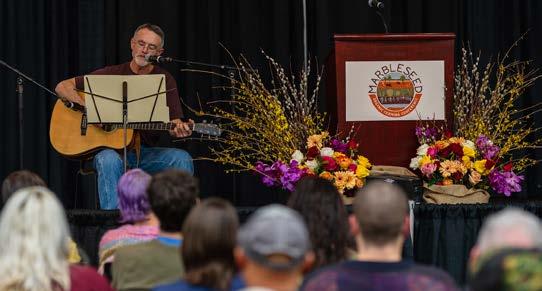
There were opportunities to connect as farmers, learn from our peers, and dream of the next growing season. We celebrated our Farmers of the Year, Beth and Steve Albert, who shared their winding farm journey and serenaded us with song. We uplifted the work of Sharing Our Roots, this year’s Changemaker, and heard from some of their farmers, who overcame very real concerns for safety to join us.
Several of our featured speakers directly called for revolution and the need for substantial change. A thread was woven through several featured speakers about transforming a system that is only working for a very few. Since leaving La Crosse, I keep mulling over Dr. Stephanie Luce’s talk on coalition building and the seven strategies for change highlighted in her book Practical Radicals. Stephanie talked about the coalitions of the “no,” people coming together from different sectors and interests to stop what we see our current government doing to our immigrants and voting rights (for example). We have clarity about what we don’t want. We know what we are against.
It is the next step that has haunted me since we were together, and that is the coalition of the “yes.” This requires introspection, time for dialogue, and engaging with others that are not in our usual circles. What is the world that we want to see? In this time of “rupture,” current systems are either failing, serving a select few, or being intentionally dismantled.
For years we’ve all said that the current food and farming system is not broken but functions as it was intended. Consolidation, extraction, and farmers losing land, markets, and in some cases, their lives, are all a result of longstanding policies and programs. If we consider a coalition of yes, what is the food and farming system we want to build together? What would it mean to truly center people, planet, and animals in policies and actions that create a culture of care and mutualism?
In the arc of movements, certified organic began with this vision. And somewhere along the way we became a successful, sought-after market premium. We became a target; petro-ag chemical companies have weaponized organic management and demonized tillage. We are losing organic farms through attrition (see Mallory Kreiger’s analysis on p. 38), but also this next generation of farmers are more interested in the original vision of organic. We need to fight for so much in this moment; and we must dream together.
Lori Stern, M.A. Ed
CHANGEMAKERS OF THE YEAR
s H a RING ou R R oots
Sharing Our Roots
ABOUT THE CHANGEMAKER OF THE YEAR RECOGNITION
The Changemaker recognition celebrates emerging leaders in the organic farming and food movement who creatively overcome systemic challenges to nurture a thriving agricultural future for all. Marbleseed seeks to recognize communities of regenerative agriculture, food sovereignty, and/or local food systems that have been historically discriminated against. An honoree organization or community does not have to be a producer but needs to directly support farmers through their work.
Learn more about Sharing Our Roots here:
www.sharing-our-roots.org
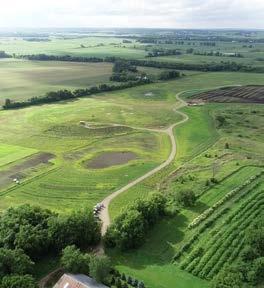
Located outside of Northfield, Minn., Sharing Our Roots (SOR) provides long-term land access for immigrant, BIPOC, LGBTQ+, and emerging farmers. Marbleseed recognizes the organization – which is a farm, a model for biodiversity, and a community of autonomous growers – as its 2026 Changemaker of the Year.
CARING FOR l AND AND COMMUNITY
Now in its ninth year, SOR is a land-based organization, rooted in 163-acres of previously depleted, monocropped farmland. It was created thanks to the generosity of two neighboring farm families who worked with SOR toward a vision for common ownership and sustainable agricultural practices. Today, 10 farms lease the land, including growers from Kenya, Sudan, and Mexico. Additionally, SOR offers growing space to more than 125 gardeners via its seven community gardens.
Unlike incubator farms that usually have a three-to five-year agreement, SOR leases land indefinitely to farmers who agree to farming within guidelines of soil health, animal biosecurity, and organic certification. Outside these community norms, farmers can make their own decisions about their land while benefiting from shared resources.
“Land Access is hard,” says farm manager Alissa Jacobsen. “We’re on the precipice of one of the most important land transfers in our history. Will land get bought by large scale corporations, data centers, foreign investors, or by families and small farmers? Our model is a shared vision of caring for the land and community.”
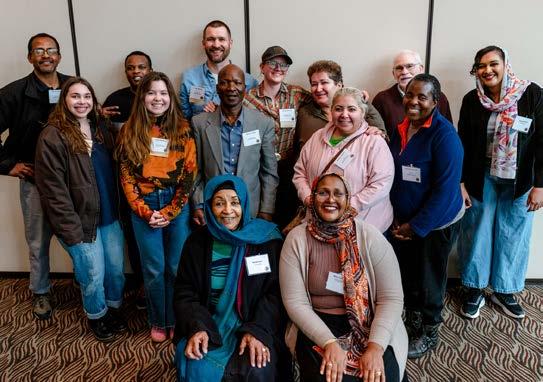
The organization brought a group of farmers to Marbleseed’s Organic Farming Conference in La Crosse, WI, in February. Two farmers, Khalid from Sudan and Moffat from Kenya, accepted the award. Khalid spoke of the need for people to eat and grow food with which they’re familiar, while Moffat noted how good it was to be in a room where the common factor was love for the land and appreciation for the work of farming. MS
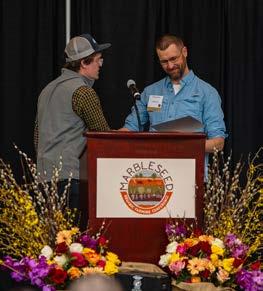
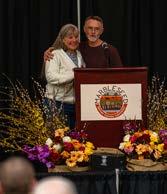
↑ Top left: Marbleseed Board member Dylan Bruce presents the Changemaker of the Year Recognition to Executive Director, Derek Meyers of Sharing Our Roots.
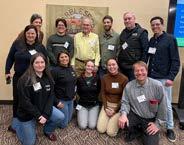
Top right: Aerial view of Sharing Our Roots. Bottom: The Sharing Our Roots crew posing at the Organic Farming Conference. Conference photos by Ben Tierney-Morrison.
T HE GOOD FIGHT
By Rufus Haucke,
As I am writing this, it has been a week since Marbleseed wrapped up its annual Organic Farming Conference, and not a day has passed without some thought of the experience bouncing around in my head. This was my first time attending the conference as a new member of the Marbleseed Board of Directors; I came to La Crosse with a different set of eyes. It wasn’t just about attending workshops and catching up with my fellow farmers. This conference was about helping the Marbleseed staff and greeting attendees. It was about engaging with the students presenting their research projects, sitting in on the keynote speakers, and picking up extra duties as needed. So much goes on behind the scenes to put on a successful conference, and as a board member, I got to peek behind the curtain.
It was also a chance to get to know some of the wonderful staff at Marbleseed – good people doing an incredible amount of work to support something beautiful, not only at the conference, but for the organic movement as a whole. This organization has grown so much from its founding days as MOSES, and the staff work year-round on behalf of us farmers. We need this partnership and we’re lucky to have folks so dedicated to helping us succeed.
One of the main themes running through my head during the conference was the flurry of memories of all the powerhouse farmers that came before me – those farmers who I timidly approached in my first years of attending with questions or just a hope of acknowledgement. They felt like titans to me,
strong-willed people fighting the good fight to farm with ecology in mind, not just a blind commitment to production. They had a vision of stewardship for this beautiful planet, and I’ve always admired that. When so many of their fellow farming peers cast them out as backwards or ridiculous, they forged ahead and built the very network and infrastructure we now benefit from.
At a time when “Get big or get out” was the only way, and buying out your neighbor’s farm meant you were succeeding, the farmers in the organic movement chose cooperation and boldly embraced the sharing of knowledge. I’m not saying it’s always been sunshine and flowers, but it was certainly a different approach. Now most of those farmers have moved on; they’ve had their 40 seasons and they’re gone. I missed them at the conference. It’s because of them that I jumped at the opportunity to serve as a board member. It’s my turn to do what I can to support organic farmers, new and old, to encourage the young people coming up who are so ripe with energy and desire to make the world a better place. The work we all did at the conference makes me more committed than ever to continue to build, maintain, and strengthen our networks and movement.
Happy farming, my friends! Hopefully, we’ll cross paths at a field day or conference. If we do, please stop me and say hi. I love meeting new friends and hearing all about your farms, whether they are in this world or still just in your head. MS
Along with his wife Joy Miller, Rufus Haucke is co-owner and farmer of Keewaydin Farms in Viola, WI.
Marbleseed Board Member
37tHaNNual
FARM RESEARCH SPOT l IGHT
ORGANIC RESEARCH FORUM
The Organic Research Forum reminded us that innovation in organic agriculture doesn’t just happen in labs — it happens in fields, in conversations, and in community.
This year’s juried poster session showcased rigorous, data-driven research conducted on certified organic land, led by farmerresearchers, students, faculty, and extension partners.
Congratulations to this year’s poster award winners — 1st, 2nd, 3rd, and our People’s Choice Award recipients! Your work is helping move organic agriculture forward in tangible, measurable ways.
1st Place: Cheyanne Mattie, University of Wisconsin-Madison
2nd Place: Isabela Arias, University of Minnesota Extension
3rd Place: Kristina Harms, South Dakota State University
People’s Choice: Dakson Sanon, University of Minnesota
We were also honored to partner with the Organic Farming Research Foundation (OFRF) for a special Researcher & Extension Meetup and two interactive listening sessions during the conference.
A big thanks to the OFRF for being an integral part of this conference, and thanks to all of the researchers, farmers, students, faculty, and extension agents who are continuing to ask practical questions and generatie real-world solutions for organic systems.
↑ Featured Speaker Reginaldo Haslett-Marroquin and Executive Director Lori Stern celebrate a growing movement.
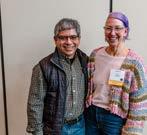
↓ Our Program Director, Alpa Goswami poses for a selfie with program cover star, farmer Malik Salsberry.
↑ Attendees observe livestock fencing techniques in a hands-on workshop with Randy Cutler of Cutler Fence.
↑ Beth and Steve Albert of Prairie Bluff Farm accept the Farmer of the Year award.
↑ Conference photos by Ben Tierney-Morrison of Morrison Media, LLC, and Alan Murdock of Murdock Media Production
T HE F ARMER -C HEF lOVE A FFAIR
By Jennifer New, Marbleseed
Farmers will be hard pressed to find others who care as much as they do about the quality, nutrients, and abundance of varieties of food than chefs. The two professions have great mutual respect and admiration for one another. Ever since Alice Waters began celebrating specific farms on her menus at Chez Panisse in the late 1970s, these relationships have become even more important to both businesses.
However, is it worth the effort it takes to build such a relationship for a farmer who only has so much time? After all, a single restaurant can only use so many carrots or eggs.
The answer lies in looking at the multiple kinds of value such partnerships offer. Restaurants are a direct line to consumers who can taste a farm’s products and see them featured in creative ways. Diners build a better understanding of their local foods ecosystem. Many restaurants that value fresh, local ingredients have a strong marketing game and are eager to share their sources with potential diners. In talking with farmers and chefs, it’s clear there is a circular and mutually beneficial nature to these relationships.
F ROM SEED TO BOTT l E
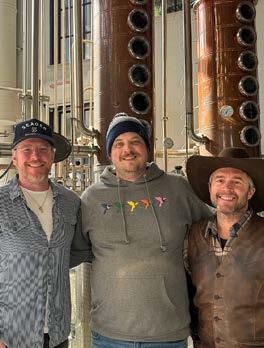
This is literally the case with McHugh Farms and La Crosse Distilling, two businesses that have created a full-circle production process. “Farmer forward. Driftless pure.” is the distillery-restaurant’s tagline. Knowing that the role of farmers was central to its business plan, owners Nick and Angela Weber and their Head Distiller Mitch Parr began partnering with Patrick McHugh before they’d sold a single bottle of spirits.
Sustainability was a central pillar to the Webers’ vision. The building that houses both the distillery and restaurant is powered with geothermal energy; they use upcycled barrels; and local produce features heavily on their food menu. But it’s their relationship with McHugh that is at the heart of their commitment to organic products and giving back to the land.
McHugh delivers about 4,000 pounds of corn and some rye a week to the distillery – yellow dent and a red varietal that is a distillery secret. “Before we opened,” says Angela, “Nick and Mitch tested more than 70 corn varietals. They worked with Seed Savers to source organic corn and then made really small batches over a Bunson burner before landing on ones that have the flavor profile they were looking for.” The varietals also needed to be able to produce the yield they would need to meet their projections.
Prior to reaching out to the Webers about the possibility of providing grains, McHugh had already transitioned his family’s farm to a diversified organic operation that includes livestock and produce as well as grains. Today, he grows the distillery’s single most important ingredient, corn, and removes its largest waste product – stillage, the watery residue that remains after fermentation and distillation of grain alcohol.
Three times a week, McHugh drives the 16 miles from his farm to the distillery to load stillage into a tanker truck. The bulk of it goes into the extensive compost piles that he tends, selling the final product to other farms. He is scaling his compost business to include smaller bags suitable for home gardeners and small farms. Angela says these will be available for sale at the distillery.
← Nick Weber, Mitch Parr, and Patrick McHugh have created a closed loop system that benefits both businesses.
In addition to stillage, food scraps from the restaurant also go into McHugh’s compost operation – about 2,000 pounds a week. Some stillage is fed to his hogs (they love it, he reports). He is expanding this part of his operation and is already selling bacon and chops to the restaurant.
Angela notes that the close proximity of the two businesses is central to their mutual success. “It has allowed us to have a very collaborative relationship,” she says. Also key has been McHugh’s ingenuity and generosity. For instance, an old barn on his property houses barrels of whisky that are ageing. The results are award-winning spirits that can be tracked from seed to bottle, a healthier local economy, and richer soil.
D O O NE ( OR T HREE ) T HINGS R EA llY W E ll
Vitruvian Farm lists more than 50 partnering restaurants and grocery stores on its website. Most of those businesses buy three products: salad greens, microgreens, and mushrooms. Tommy Stauffer cofounded the farm in 2011 with two friends from the University of Wisconsin-Madison. He says they had no grand plan at the time, just a desire to play around on a plot of land they were leasing and learn about farming.
“The one thing that really worked that first season,” he says, “was a lettuce mix.” They took it to a grocery store on campus that liked to support students. “They told
us that if we could keep up that quality, they’d put it on their salad bar.”
Inspired by the sale, the trio (one of whom, Shawn Kuhn, remains a partner involved with Vitruvian’s daily operations) spent the winter researching and refining the elements of a great salad mix. They personally reached out to any restaurants in the Madison area that bought local ingredients. “We’d ask to talk with the chef or buyer,” says Stauffer, who sometimes knocked on a restaurant’s backdoor, made a quick introduction, and left behind a bag of salad with his contact information.
As they got their product into more kitchens, the chefs themselves were a great point of contact since many of them move around and bring favorite ingredients and providers with them. While Vitruvian continues to seek out largescale wholesale partners, most area chefs now know their name and come to them.
At peak season, the farm sells about 1,400 pounds of salad greens per week. They have invested land, labor, and equipment into this crop, which Stauffer calls the “fuel” that’s behind the farm’s growth. An automated harvester and an efficient wash system that can clean up to 800 pounds in six hours ensure they can maintain a high-quality product even as the volume has expanded.
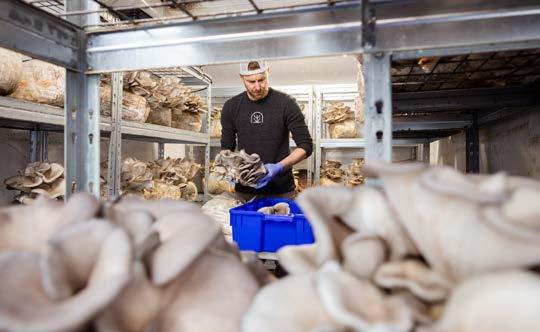
↑ Tommy Stauffer packs mushrooms, one of Vitruvian Farm’s three main wholesale products.
While Vitruvian grows a wide range of products, its team has chosen to focus on three products for restaurants and grocery stores: salad greens, micro greens, and mushrooms. The fact that the latter two crops are grown indoors and offered year-round is a bonus. This not only provides year-round income (they sell about 900 pounds of mushrooms per week) but also keeps them top-of-mind for chefs; “We don’t disappear for 14 weeks every winter.”
Stauffer says they can be more flexible with their CSA members. If a crop has a smaller than expected output or is slower to produce, they can find ways to make substitutions in weekly shares. This doesn’t work with restaurants, which value consistency.
G ROWING TOGETHER
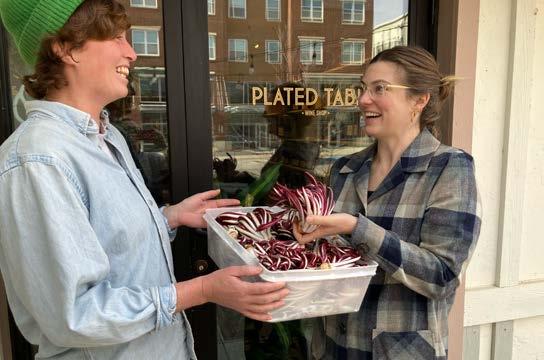
Plated Table in Iowa City, IA, just celebrated its second birthday. Prior to opening the brick-and-mortar restaurant that has become known for its communal seating, weekly-changing menu, and local ingredients, chef-owner Alex Smith had a catering and meal delivery business.
“I really fell in love with food from going to the farmer’s market in Bloomington,” says Smith, who attended the University of Indiana where she studied nutrition. She was reading books like Michael Pollan’s The Omnivore’s Dilemma when she became interested in the intersection of politics, agriculture, and nutrition.
Her restaurant captures all of these. The shared tables of the narrow room lead to impromptu conversations between strangers, a much-needed ingredient to improved civility in our current moment. And every menu highlights a wide range of nutrient-rich local products, including vegetables, fruits, herbs, eggs, and, increasingly, meats.
Among the farmers she works most closely with is Carly McAndrews. After completing a farm internship at an organic farm in Iowa, she got a Master’s in Sustainable Agriculture at Iowa State University and started her own farm. Now in its seventh year, Trowel & Error Farm identifies as “dedicated to growing organically (although we aren’t certified) and using regenerative agricultural practices.”
McAndrews’ enthusiasm for harder-to-find vegetables and can-do attitude appealed to Smith when they were introduced by a fellow chef. Smith recalls McAndrews telling her, “Give me a list. I’ll grow anything!’”
They’ve dialed in a sense of each other’s capacities and tastes. McAndrews has a better sense of how much Plated Table will use on a weekly or seasonal basis. Smith has gained trust in McAndrews’ dependability, especially regarding quality. The farmer concedes that providing produce for fine dining restaurants (she now
↑ Farmer Carly McAndrews and chef Alex Smith are growing their businesses in tandem, each benefitting from the other’s success.
THE FARMER-CHEF l OVE AFFAIR...
works with several others in the area) was intimidating at first. Would her produce be perfect enough? She adds that seeing her farm’s name on a menu is “pretty dope.”
Smith shouts out her producers not only on the menu but on daily social media posts. McAndrews says she’s gotten many CSA customers through Plated Table, as well as visitors to her farmers’ market stand. Now that she’s selling her greens at a local food coop, there is also name recognition.
Each winter, the two meet for a planning session to which McAndrews comes armed with seed catalogues and a calendar. “I ask Alex for feedback about the delivery schedule, the quality of produce, and what we need to adjust,” says McAndrews.
One of the vegetables Smith has encouraged her to explore are chicories. “Her enthusiasm is contagious!” says McAndrews, who admits to now following numerous chicory accounts on social media. It has an unusual growing process that has taken the farmer a few seasons to master — seeding in the field in July, harvesting after a hard frost, and then removing the leaves to store and force the root. Smith appreciates the effort, saying, “It allow us to have fresh greens into February.”
McAndrew’s welcomes having her produce selection be chef-directed rather than what CSA members want or expect. “My customers discover new tastes at restaurants like Plated Table,” she notes, “and they’re excited to see it in their weekly shares.”
It’s clear the two women have immense mutual appreciation for each other’s work. It echoes something Stauffer described of how he didn’t fully value the food he was growing in his early farming days until he ate at restaurants. “Experiencing what chefs were doing with our produce helped me appreciate it,” he says. He even admits that he didn’t like mushrooms very much until he had them prepared by a Vitruvian partnering restaurant. He points to another perk of eating at one of these restaurants: “They treat farmers like royalty. They really recognize what we do.” MS
In additiion to being Marbleseed’s Communications & Policy Manager, Jen is the proud mama of a chef and occasional substitute server for Plated Table.
→ Restaurants, like farms, have tight schedules and tighter budgets. They appreciate dependable quality products. Be clear about what you can offer and be sure to stick to it. Create a delivery schedule that works for both of you.
→ Ask about marketing opportunities up front. Can your farm be mentioned on the menu and/or in social media posts? Would there be possibilities for future special event collaborations?
→ Do you want to offer one or two things to a lot of restaurants, or a few to one restaurant? The former involves honing a niche and growing larger quantities for as much of the year as possible. The latter may mean a greater diversity of products and a willingness to be chef driven.
→ Keep innovating – be curious about how to make the partnership more efficient and what other services or products can be born from it.
→ Visit each other’s businesses. It is easy to get sucked into your own world of farming (or cooking), but it really makes a difference when you have firsthand experience of each other’s worlds and see the product through its entire cycle.
Marbleseed is excited to celebrate farmer-chef relationships at its annual fundraising dinner that will feature Vitruvian Farms and La Crosse Distilling among the lineup of farms, beverage partners, and chefs. Learn more about this event on p. 47 and at our website below:
N T ERNATIONAl YEAR O F THE WOMAN FAR M E R
ICE l EBRATING WOMEN IN AGRICU lTURE
It’s the International Year of the Woman Farmer. Since literally every day, month, and year is earmarked for some celebration (this is being written on National Meatloaf Day amid National Nutrition Month, go figure), you might shrug it off as a marketing gimmick. We’re choosing to take the United Nations at its word; it created the yearlong dedication to raise awareness of the role of women in the agricultural sector and the many barriers against them. For example, women make up more than 40% of the global agriculture workforce, but they only own 15% of agricultural land
Underscoring the urgency for shining a spotlight on women farmers, the chief economist of the UN’s Food and Agriculture Organization said, “The cost of inaction is enormous. We know from recent estimates that closing the gaps between men and women in agriculture could raise global GDP by one trillion dollars and reduce food insecurity for 45 million people.” Research consistently shows that increasing women’s economic power – no matter the country or sector – drives overall economic growth and improves well-being.
Women reinvest up to 90% of their income into their families and communities, specifically in health, education, and nutrition.
Throughout this year, the Organic Broadcaster will share profiles of women working in the organic movement of the Upper Midwest. We’ll talk to a researcher who knocked on every door of her Iowa county to figure out who owns the land after she realized women farmers often aren’t named on land plats. We’ll consider why the Midwest has one of the lowest rates of women farmers by region. And we’ll talk to young women who are entering farming at a fast rate and often have different goals and plans than their male counterparts. Our first profile is of Ying Lo, a Wisconsin-based organic vegetable producer.
↑ “Spring” is the first of a series of seasonal prints by Frances Whitfield we’ll share throughout the year. Whitfield is a freelance illustrator and printmaker, and muralist in rural Herefordshire. Follow her on Instagram @pan.makes.
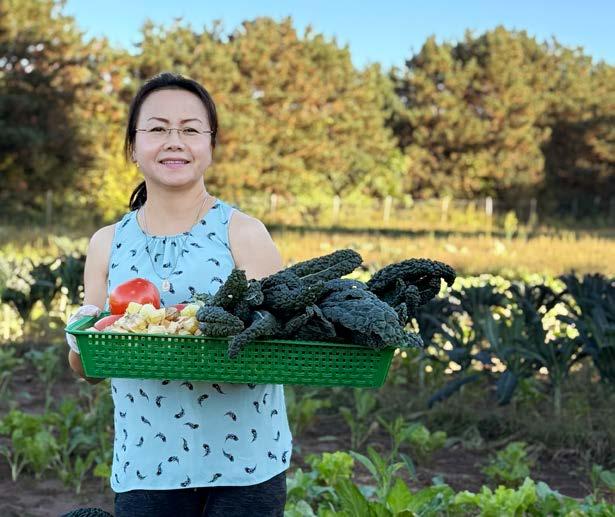
YING l O
f R om N e V e R fa R m to J o Y ful fo RC e
By Maya Deutchman, Marbleseed
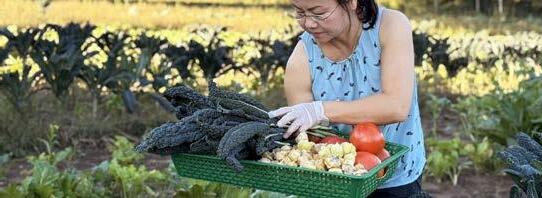
Ying Lo comes from a family of farmers. Her grandparents and many relatives farmed. Her parents farmed, first in Laos, then in California’s San Joaquin Valley, and now in Wisconsin. As a young woman, Ying was certain of one thing – she did not want to farm.
If it weren’t for Covid, she might have stuck with that conviction. The virus hit her hard. She never seemed to heal entirely, moving through waves of respiratory problems, brain fog, and exhaustion that made it difficult to do her regular job. Grudgingly, she joined her husband, Xiong Lo, on the small plot where he was growing garlic near their home in Wausau, WI.
Initially, she went just a few times a week, but she warmed to the work, and when Wisconsin announced its LFPA (Local Food Purchase Assistance) program, Ying applied. Getting funding seemed like a long shot, and she was so green that she didn’t realize all seeds aren’t planted at the same time and same depth. She planted more than 30 varieties that first summer. Some failed. Many produced at unexpected times, due to her naïve propagation skills.
Thanks to receiving the grant, she felt she had moved from being a gardener to a farmer. She spent most of her days in the field, improving not only her farming skills but her health. “By the end of the summer,” she recalls, “I realized I hadn’t been sick in a long time.”
Donating produce was part of Ying’s early motivation for farming. “I felt so abundant,” she says of the drop-offs she made three times a week at food pantries. “I loved the idea that I could harvest on Monday and do it again on Wednesday and Friday.”
Ying, who has eight children, two of whom are still at home, is now lead farmer of GreenGold Gardens. Though her husband is still involved, Ying decides each year’s plantings, sets the schedule, and oversees finances.
Sara Mooney, Marbleseed’s Conservation Outreach Specialist, has worked with Ying on several projects and calls her a “joyful force” who is always learning and working to better herself and her farm.
That drive to improve can be seen in her ever-changing produce list. At the farmers market where she had a booth (the Los now have a farmstand on their land), she asked people what produce they wanted to ensure her list reflected local tastes. She’s found ways to extend her growing season. And she’s expanded her markets, developing wholesale relationships with groceries and restaurants. All in less than five years!
Something that has not changed is her dedication to organic growing practices. While a healthy environment has always been important, her father’s journey with liver cancer made Ying a staunch believer. He saw both Western and herbal medicine doctors; the latter recommended that he start eating organic produce.
“We moved him directly to organic foods, and he did really well with his treatment process, and he got better,” Ying shared. “When he went back to the conventional produce because he said it was too expensive, guess what? Within a few months, his cancer came back.” She moved him back on an organic diet, and eight years later, he’s recovered and doing well.
Ying encourages beginning farmers to seek advice and support. She and Xiong spent a lot of time reaching out to established farmers, visiting farms, and learning about which systems would work well for their situation and goals. “The farming industry is one of the most generous industries, and they’re always willing to help,” Ying says.
Her siblings think she’s crazy to be farming, especially at this point in life. But she’s certain she’s in it for the long haul. “I find joy in it,” she says with a wide smile. MS
Rachel Maya Detchman has a background in education, farming, advcoacy, and communications. She was a Marbleseed intern in 2025 and now works at a food pantry in Minneapolis, MN.
CU lTIVATING & NURTURING MENTORS
Best PR a C t IC es fo R t H e me N to R -me N tee R elat I o N s HIP
Q & A led
by Tay Fatke, Marbleseed’s Farmer Education Manager
For hundreds of years, farming was a profession that one was born into. It was learned through daily chores and seasonal work from a network of family and neighbors. This is much less true now – the children of farmers often choose to leave rural areas, or the generational transition is not financially viable. Today, many new farmers have no family ties to agriculture.
Whether they’re college-aged or changing careers, these newcomers seek out learning that goes beyond Youtube (and you can learn a lot there – one farmer told us she learned to castrate goats through videos). High schools and colleges offer ag programs. Many farms have seasonal jobs that serve as apprenticeships. But once someone is actively farming their own operation, it’s invaluable to be able to access the knowledge of someone with more experience.
A good mentor provides perspective and practical knowledge. They can also instill confidence, be empathetic when rookie mistakes happen, and ask the kinds of tough questions that lead to reality checks. As Marbleseed continues to expand its farmer-tofarmer mentorship offerings through a new dairy coaching program, we wanted to speak with a few people who have been on both sides of the mentoring equation – the newbie and the more seasoned
practitioner. What makes for a good mentoring relationship, we wondered. When should you seek out this kind of relationship?
Melissa Weyland (Weyland Family Farm, Green Bay, WI), Caleb Trainor (Winterspring Farm, West Bend, WI), and Rami Aburomia (Atoms to Apples, Mt. Horeb, WI) shared their learning and teaching paths with us. Listen in to their conversation with Tay Fatke, Marbleseed’s Farmer Education Manager — who is currently receiving mentorship himself from Chris McGuire, another organic apple orchardist.
GOT INTO MY B l OODSTREAM
TF: How did you begin farming, and what was your initial experience with mentoring?
MW: I grew up in a farming family and learned alongside my parents as they transitioned to organics in the early 2000s. As early as kindergarten, I remember them teaching me about soil health. I didn’t have a chance to take over the family farm, but I began working at Organic Valley on their organic hotline. It was a very boots-on-the-ground experience with transitioning farmers.
CT: I fell in love with organic farming after taking a WOOFing trip around the country in 2011. When I got back to Wisconsin, I did an internship on an organic farm. I went through Marbleseed’s mentoring program in 2019 and started my own farm the next year.
↑ Caleb Trainor with his crew at Winterspring Farm.
RA: I started farming in California at a small, diversified farm with veggies and fruit trees using Biodynamic practices. This is where agriculture got into my bloodstream and my first mentor was the owner of this farm. Six years later, I started working at Eplegaarden Apple Orchard in Fitchburg, WI, and was mentored by Laverne Forest.
TF: Have you sought out mentors, and how have you found them?
CT: You don’t even know what to ask at first. I got a lot out of spending several seasons working for someone else. By doing this, I saw which farms I trusted and felt good about. So when it came time to reach out for help, I knew who I could trust. Which is much better than seeing a flashy farm on Instagram. Fair Share has been a tremendous resource for me as a vegetable grower. And Tay and Marbleseed have helped me continue to network.
MW: When I started farming in 2022, despite my experience, I sought out a mentor. I intentionally wanted someone who didn’t know me. I went through Food Animal Concerns Trust, mentorship program They matched me with a retired dairyman in Missouri who gave me some pretty straight truths that first year, especially about finances. He really set me up for success.
My cash flow was bad. I was struggling with mental health. Not even knowing me or my situation, he said, “Can I be really honest with you? Are you on a farm that you think you can succeed on?” It helped me understand that the farm I was renting on was going to need a lot of work to the facilities for Grade A license. He talked me through it to see this wasn’t going to be profitable.
RA: I am a huge proponent of working for another orchard first for a couple of years. That’s the best idea to learn, make money while doing so, and to see the full season. The great thing about having a mentor and working on their farm is seeing what you want to do and what you don’t want to do. Don’t make the same mistakes they made or at least have on your radar possible mistakes to avoid.
ADVICE TAI l ORED TO YOUR FARM
TF: What have been effective and less effective mentoring techniques you’ve experienced?
CT: Farming is such a spectrum, and, honestly, the land has a lot say about it. I made dozens of mistakes trying to do what worked for someone else. Eventually, I had a mentor whose trick to farming is to try something, and if it doesn’t work then stop and try something else. It was really freeing.
Honestly, I’ve had experiences where it felt like a waste of time. Sometimes that was on me for not putting enough energy into the relationship. But other times, the mentor’s interests or goals were just too different from mine.
MW: Especially in dairy, there can be strong opinions about how to do certain things. In the long run, I figured out the way I enjoy farming wasn’t what most people advised — feeding low grain instead of kicking that up. Now, as a mentor or coach, I try to put aside my opinions and figure out what kind of lifestyle the person I’m advising wants to lead, find the type of farming that lets them do that.
CT: It’s not always about answers. One year we had tomato blight, and I was beat up pretty bad. It was a total failure. Just being able to call one mentor who just said, that sucks so bad. I’ve been through that.
RA: What’s useful is having advice written down instead of just talking on the phone — details that you can refer to as it is easy to forget after conversations. Pictures are helpful and going to visit the mentee’s orchard has to happen to help them along. Also, setting up a timeline is important with the mentee, e.g.,“Here’s how long it takes to prune a tree times the number of trees you have.” As a mentor I can check in on this timeline now with the mentee. Just checking in on the phenology things with apples is helpful too. “I just sprayed for coddling moth, where are you at with this?”
TF: Why is it important for farmers to become mentors? Are there benefits to doing it?
RA: I like understanding what’s important to them and helping them put the vision to the farm. Helping mentees understand questions like how much do they want to spray their apples? How deep do you want to go to manage pests naturally? So, I enjoy being a mentor and figuring out what the mentee wants to do. Those first conversations like “Where do you see it going? Do you want/need it to make money?” I enjoy all aspects of mentorship, but that first step is fun.
CT: Troubleshooting problems when you don’t have skin in the game in the same way is fun! I learn things along the way. Our farm crew has a lot of returning members – giving people ownership of certain tasks. So, we have one person who has managed our kale the whole time she’s been here.
Everyone who was a mentor to me is still stepping up and helping me – picking up the phone. That’s gone a long way to helping me feel less alone and part of a community; I’ve never felt that the people asking me for help were a burden; I am renewed by the relationships.
AS A MENTOR OR COACH , I TRY TO PUT ASIDE MY OPINIONS AND FIGURE OUT WHAT KIND OF l IFESTY l E THE PERSON I’ M ADVISING WANTS TO l EAD , FIND THE TYPE OF FARMING THAT l ETS THEM DO THAT .”
— Melissa Weyland
BEST MENTOR -M ENTEE PRACTICES ...
NO ONE WI ll DO IT AS FAST AS YOU
TF: Yeah, one thing Rami shared with me earlier is that farmers need to get used to the fact that no one will be able to do a task as fast as you can. If you don’t accept that, you’ll be fighting an uphill battle. When you’re mentoring others, how do you balance encouragement with honest, constructive feedback? How have you learned to be a good mentor?
CT: I usually have a pretty gentle approach to it. I mean, I might be the one who’s not doing it right. As I try to assess what others are doing — whether it’s someone working for me or a mentee — I try not to be a hardliner but to offer suggestions.
When I went through Fairshare CSA’s Employer of Choice program I learned a lot about my management styles. I learned to pay attention to the crew and their needs, to coach them to figure out what was needed by the job. I’d been doing this whole authoritative thing when people were late; “You need to be on time!” It wrecked both our experiences. Once I understood my stye, personality, and preference everything got better, so I really want to call out that program.
RA: This was a great program, and I have no problem keeping seasonal employees from year to year. Being a mentor to these yearly employees is a reason to spend more energy and time with them. You can see the employees’ thoughts when they are assigned a task. Spend that time and energy to focus on what they enjoy doing and what their strengths are and that goes a long way.
MW: As a coach, I have eight farmers that are reaching out to me a few times a month with very specific questions. I can really focus on those individual needs. I have one person who is hardcore into numbers, and we’re always looking at spreadsheets. I have another family that wants to be able to buy a farm but feels they can’t if they’re an organic dairy. There are so many periods and phases to farming; everyone is in a different place.
l EARNING A l ONGSIDE
TF: There are young farmers and then second career people who are less likely to go work on a CSA farm. How do we support those growers? Who is the right mentorship pair for them?
MW: Just because we’re called mentors or coaches, we don’t know it all. One of my absolute favorite things is learning from them, and those second career people are coming with more lived experience and other skills. It’s a journey that goes both ways. I’ll see how someone is calculating something and I’ll think: That’s so interesting. Were’ learning with you!
TF: How can farming communities build a culture where asking for help is encouraged?
CT: Through the Fair Share listserv I get three or four messages a day. People are asking about things I often haven’t dealt with before, so I archive them for later. If I’m stumped, I can ask there. It’s so easy to be in the grind, you forget to look up and find people who have done it and to keep learning. I encourage people to get out, even if you’ve been in it for a decade or more.
MW: Other farmers really enjoy helping. Don’t be afraid to reach out if you have technical questions. People find me through a podcast or an article. It’s completely normal to ask questions, especially if you see people who are farming the way you want to.
RA: Seems like more and more land is being held by fewer and fewer people. Older farmers are looking for farm managers which is a possibility for people to learn that way. In terms of buying land establishing an orchard you need a big fat bankroll which might not be relevant to most people. Again, I am a huge proponent of working on an orchard first and building connection that way. MS
l IVING AIS l ES
IN V e G eta B le s Y stems
T HEY MAY SEEM l IKE A l OT OF WASTED SPACE OR ADDED MAINTENANCE , BUT WE GET SO MUCH OUT OF THEM . A l OT OF THE BENEFITS YOU CAN ’ T q UANTIFY EITHER . T HEY ’ RE j UST REA llY P l EASANT TO WORK IN AND KEEP MY CREW HAPPIER .”
— Tom Bryan, Gorman Farm
By Steffen Mirsky and Paulina Jenney University of Wisconsin-Madison Extension
In this article, the authors feature three Wisconsin farms that plant cover crops in the aisles between cash crops. Gorman Farms has the advantage of being a nonprofit farm that can take more risks. Red Door Family Farm has witnessed considerable benefits to soil health and plant production during its ten years of practicing with living aisles. And Dylan Bruce has a lower tolerance for pests and disease since transitioning from fresh market to seed production at Driftless Seed Supply. All three farms have something to offer anyone interested in experimenting with living aisles. This is an abbreviated version of the article, which be viewed in full at → marbleseed.org/news/ organic-broadcaster
Most farmers are familiar with the benefits of cover crops; they reduce erosion, improve soil health, and help suppress weeds. They are often incorporated into fields as part of crop rotations but can also be planted in the aisles between cash crop beds, providing cover during a time of year when the soil is typically bare.
These “living aisles” add additional advantages, such as reducing mud during rainy periods, allowing farmers to access beds when the ground is wet, and keeping harvest bins cleaner. Depending on the species used, living aisles may also be allowed to grow into beds after harvest to provide winter cover.
At the same time, living aisles introduce new management challenges, including competition with cash crops that may require more precise planting schedules, increased mowing frequency, and adjustments to fertility and irrigation management. Still, for certain production systems, many farmers report that the benefits outweigh the costs and that the added effort is well worth it.
The Climate Resilient Organic Vegetable Production (CROVP) community of practice, funded by a recent Sustainable Agriculture Research and Education (SARE) grant, brings together farmers to explore methods to reduce tillage and increase system resilience. Farmers in the CROVP group meet regularly via Zoom to share experiences, troubleshoot challenges, and exchange tips for implementing new practices. Several are experimenting with living aisles – testing different rotations, cover crop mixes, and strategies to manage interactions between aisles and beds. In this article, we highlight four case studies from farms of varying sizes and production goals to showcase the opportunities and challenges of adopting living aisle systems.
Living aisle systems represent an exciting frontier of research and on-farm experimentation. While they offer numerous benefits, their design and management introduce a layer of complexity that can feel daunting.
For many growers, incorporating living aisles is an iterative journey, starting with simple systems and gradually evolving toward greater species diversity, perenniality, and soil coverage. This shift requires a fundamental change in management philosophy, one that balances the evolving needs of both cash crops and cover crops.
The farmers highlighted here are pioneering complex systems to maximize on-farm benefits. They are constantly asking questions, experimenting, and taking risks, all while engaging with a broader community to share insights and lessons learned. Their motivations go beyond practicality; they are driven by a commitment to land stewardship, biodiversity, human health, reduced reliance on off-farm inputs, and creating better working environments for their crew.
Gorman Farm
For many working farms, experimentation can feel like a huge risk – failure may mean the difference between profit and loss in a single season. That’s why farms like Gorman Farm in Fitchburg, WI, just 10 miles south of Madison, are invaluable for generating knowledge that benefits communities of practice such as The Climate Resilient Organic Vegetable Production (CROVP). Privately owned and supported by an endowment, Gorman Farm operates as a 501(c)(3) nonprofit, donating the food it produces to residents of affordable housing in the Madison area.
Since 2021, Tom Bryan has managed Gorman Farm’s two cultivated acres, making cropping decisions primarily based on the preferences of apartment residents and the overall fit within the farm system. Serving a sizable West African community, the farm grows culturally significant crops like Scotch bonnet and habanero peppers, bitter eggplant, roselle, hibiscus, okra, collard greens, molokhia, and watermelon, alongside fruits and vegetables more common in the Upper Midwest. Tom also prioritizes transplanting larger crops such as broccoli, cauliflower, and cabbage, rather than smaller, direct-seeded crops like radishes or bok choy.
S YSTEM #1: P ERENNIA l l IVING AIS l ES
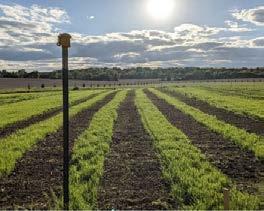
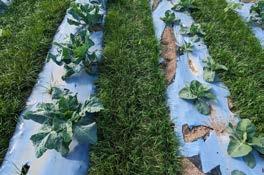
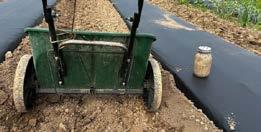
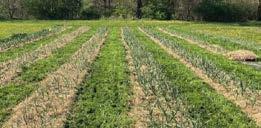
Tom manages the perennial living aisle system on about one acre of Gorman Farm. In spring 2022, he tilled the entire field before laying out the aisles and beds using stakes and string lines. He chose 30-inch aisles and 30-inch beds to match the width of his equipment, including the mower and tiller. This symmetrical design also allows for the flexibility to switch beds and aisles if desired, although he has not yet done so.
“30-inch aisles are absurdly wide,” said Tom. “Most growers are doing 18-inch or even 12-inch, but we have the luxury of being land-rich and not having to be profitable on a per acre or per square foot basis.”
After marking out the aisles and beds, Tom seeded the aisles with a mix of annual ryegrass and low-growing, bunch-type fescues using a 30-inch drop seeder. He then incorporated the seeds with his BCS rototiller set to a depth of half an inch. A few weeks later, when the cash crops were ready for transplanting, he tilled the beds using a 30-inch power harrow attached to his BCS (Figure 2). Following his first cropping season, he frostseeded Dutch White clover into the aisles during the winter, and it has since become a dominant species.
Tom employs living aisles in two distinct systems on the farm. The first features perennial living aisles with vegetable beds that are tilled annually. The second involves living aisles seeded each spring between rows of bioplastic, which are then allowed to persist through a fallow year. Both systems are described in more detail in the following pages.
Tom continues to maintain the perennial living aisles he established in 2022 and 2023. Each year, he strip-tills the beds using a BCS power harrow and plants crops such as brassicas, peppers, and tomatoes. He mows the aisles several times a month with a 30-inch rotary walk-behind push mower, using the side discharge to mulch the crops with clippings once they’ve grown larger – except for leafy greens like kale. If the aisles become overgrown, he switches to a flail mower. Mowing is so popular with his farm crew that they often line up for it on Friday afternoons.
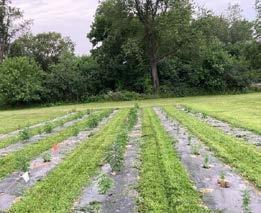
↑ Brassicas growing in biodegradable black plastic mulch between spring-seeded living aisles.
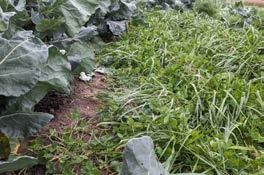
↑ Annual ryegrass establishes quickly in the first year of the perennial aisle system.
l IVING AIS l ES...
S YSTEM #2: S PRING - SEEDED l IVING AIS l ES
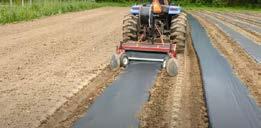
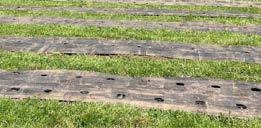
Tom’s second system features living aisles seeded annually with a mix of clover and grass, planted between rows of bioplastic mulch. Each spring, he chisel plows and tills a one-acre field before laying down four-foot-wide Bio360 biodegradable plastic mulch using a bedder layer.
He does not recommend growing carrots, lettuce, or other small, less competitive crops in this system. Additionally, crops typically planted in six rows per bed are not well suited, as a buffer zone between the clover and the outer rows is necessary to control clover encroachment using hand hoes and scuffle hoes.
At the end of the season, Tom flail mows the cash crops and sometimes sows a winter-kill cover crop in the beds, such as oats, peas, and tillage radish.
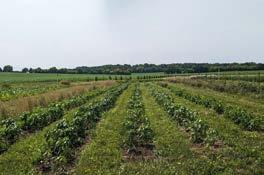
Tom appreciates the simplicity and ergonomic design of the system. The 30-inch aisles are wide enough for his crew to kneel comfortably facing the beds without stepping on the adjacent beds, making harvesting easier and less tiring. Additionally, harvest bins fit lengthwise in the pathways, reducing the need for reaching and improving workflow.
Given the chance to establish the system again, Tom says he would have taken measures to eliminate perennial weeds before seeding the aisles. Canada thistle and quackgrass have become the biggest nuisances, while plantain and dandelion have also moved in. He also wishes he had used a broadcast seeder instead of a drop seeder for the pathways to save time. Tom predicts the living aisles will last another two years before needing to be reseeded.
It’s important to note that while biodegradable plastic mulches are allowed under the USDA National Organic Program (NOP), no commercially available biodegradable plastic mulch currently meets NOP standards for certified organic production. The Gorman Farm is not certified organic.
After laying the bioplastic mulch, Tom seeds the aisles with a mix of Dutch White clover and annual ryegrass using a chest-mounted broadcast spreader or drop spreader. He applies clover at a rate of 10–15 pounds per acre, with annual ryegrass seeded at about half that rate. The rye germinates quickly, acting as a nurse crop to support the slower-establishing clover. In 2024, Tom tried seeding some aisles with Dutch White clover alone; however, these areas established too slowly and experienced significant soil erosion during May and June, which coincided with one of the wettest periods on record for the county.
Tom recommends seeding the aisles before transplanting cash crops to prevent seeds from falling into transplant holes and becoming weedy – a lesson he learned the hard way. After seeding, he sometimes uses a leaf blower to gently blow any seeds that land on the plastic mulch into the rows.
This year, Tom added Japanese millet and sweet alyssum to the mix in some aisles. So far, he really likes the early blooms and extended flowering period of the sweet alyssum, but finds that the thick, fibrous stalks of the millet grow too tall and are difficult to mow.
↑ A winter killed pea-oat-radish cover crop in December.
↑ Laying bioplastic mulch over drip tape with a bedder layer.
↑ Rows of peppers growing between freshly mowed walkways.
After seeding the aisles, Tom uses a waterwheel transplanter to plant a variety of crops into the bioplastic mulch, including peppers, eggplants, determinate tomatoes, okra, tomatillos, melons, summer and winter squash, as well as flowers. He also direct-seeds bush beans into the bioplastic using a Polyplanter Jr.
Tom and his crew manage the aisles using a flail mower, which they prefer over the rotary push mower because it can be set higher – around 6 inches – to better navigate the uneven ground created by the bedderlayer and to protect the clover’s flowers. By midsummer, the bioplastic mulch begins to break down, allowing the clover to creep into the beds. However, by this stage, the cash crops are well established and seem unaffected by competition from the clover.
A KEY ADVANTAGE OF OATS OVER ANNUA l RYEGRASS IS THAT THEY TERMINATE AFTER A SING l E MOWING ONCE F l OWERING BEGINS , CREATING MORE SPACE FOR THE C l OVER TO THRIVE .”
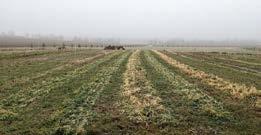
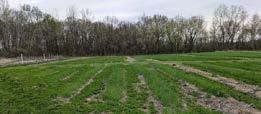
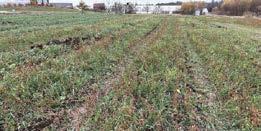
↑ Alternating rows of over-wintered rye (former bio-plastic pepper beds) and white clover dominant walkways in early spring.
At the end of the season, Tom flail mows the cash crop and tills in what’s left of the bioplastic mulch. Occasionally, he seeds winter rye in the beds to provide cover throughout the winter. The following year, the field is left fallow, with the clover and winter rye filling in the beds from the previous year. After this rest year, the field is tilled again and put back into the vegetable rotation with bioplastic mulch.
While Tom is generally pleased with the system, he hopes to extend the lifespan of the clover stand beyond just two years. To that end, he is experimenting with perennial Dutch White clover and has begun collaborative trials with Lincoln Fishman. Tom is also exploring the addition of other grasses, such as oats, to the clover mix. A key advantage of oats over annual ryegrass is that they terminate after a single mowing once flowering begins, creating more space for the clover to thrive.
Tom cites many reasons for using living aisles. They help reduce mud, keeping harvest bins cleaner and making it possible to work even after rain. Weeds from the beds can be dropped onto the aisles without the risk of re-rooting. The aisles also provide habitat for pollinators and beneficial insects. Their living roots support soil microbes, reduce erosion, and help prevent soil compaction. Beyond these practical benefits, Tom values the aesthetics and atmosphere they create – he finds the system beautiful, enjoyable to work in, and it also keeps the farm owner happy.
“They may seem like a lot of wasted space or added maintenance, but we get so much out of them. A lot of the benefits you can’t quantify either. They’re just really pleasant to work in and keep my crew happier.”
↑ Bioplastic grey-black mulch with fall broccoli. Tom welcomes the rips in the mulch after transplants are established, as they allow clover to reestablish roots in the bare soil of the beds.
↑ Clover creeps back into the fall broccoli bed as the bioplastic mulch breaks down.
l IVING AIS l ES...
Red Door Family Farm
Tenzin and Stacey Botsford are first-generation farmers at Red Door Family Farm, a certified organic farm in Athens, Wisconsin. After years of traveling the world as professional river guides, they purchased the land and began farming in 2014. Inspired by their experiences and a desire to reconnect with the land, they decided to grow healthy food for their family and community. Today, they cultivate 10 acres of diverse fruits and vegetables, which they sell through their CSA, farmers markets, wholesale distributors, and online store.
Tenzin and Stacey began experimenting with living aisles to reduce soil erosion, improve soil health, and boost water infiltration and traction. They also wanted to feed the soil microbes for as much of the year as possible. “Unfortunately, we don’t have much animal input,” he says. “So we kind of treat the soil organisms as our livestock and think about plants as food for them.”
FIE l D PREP
Tenzin uses living aisles between rows of plastic mulch. He follows a five-field crop rotation, resting each field with a cover crop every five years. Starting next year, he plans to add a sixth field to the rotation, reducing the rest period for each field to every third year instead of every fifth.
Tenzin cultivates 36” raised beds with 32” aisles, a width he achieves by driving the tractor just outside the wheel track on the last pass while laying the plastic.
This setup is less intensive than many other farms, with nearly half of the field dedicated to living aisles. After laying the plastic, he uses a cultivating tractor to level the aisles and create a fine seedbed.
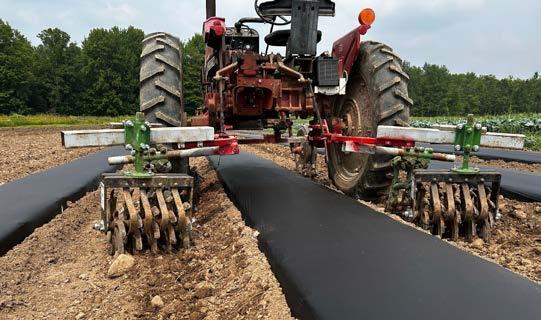
This step is crucial for ensuring the system functions well. The tractor is equipped with belly-mounted spider hoes to smooth the bed edges and rolling basket cultivators to flatten out the compacted ridge in the middle of the aisles caused by the bedder-layer. (The result is a flatter, looser surface that enhances seed-tosoil contact, promoting better germination. Once the living aisles are established, the flatter surface makes it easier to mow.
S EEDING THE A IS l ES
Tenzin then seeds the aisles using a drop spreader, using a base mix of oats, millet, and Dutch White clover. Before seeding, he mixes the oats with compost extract to slightly moisten them, with the goal of introducing beneficial microbes. Next, he adds millet and a portion of the Dutch White clover. He also incorporates a bit of clay – either soft rock phosphate or azomite – into the mixture. The clay helps the clover seeds stick to the oats, ensuring more even distribution. Without this step, the tiny clover seeds tend to sift through the mixture and drop out of the seeder too quickly. To further refine the process, Tenzin also makes a shaker from a ball jar with holes poked in the lid.
↑ A tractor equipped with belly-mounted spider hoes smooths the bed edges and rolling basket cultivators flatten the compacted ridge in the middle of the aisles. The resulting flatter, looser surface enhances seed-to-soil contact, promoting better germination and is easier to mow.
He fills it with Dutch White clover seed and shakes it into the drop seeder while walking, ensuring more uniform coverage throughout the aisles.
The combination of oats and millet in the mix serves as a sort of “insurance policy” for Tenzin – if the weather is cool and wet, the oats thrive, while in hot and dry conditions, the millet will do better. Typically, both crops will grow, though one often outperforms the other. The oats also germinate quickly and serve as a nurse crop for the clover.
In the field that will rotate into a fallow year, which he usually plants to Brassicas, Tenzin adds annual ryegrass to the mix. He values the ryegrass for its ability to overwinter, as it sets up the field for a full season of cover cropping the following year.
E ND - OF - SEASON MANAGEMENT AND FA ll COVER CROP ESTAB l ISHMENT
At the end of the year, after the crops are out, he uses an undercutter to remove the plastic, followed by discing the entire field to terminate the clover and level the soil in preparation for fall cover crops. While he has experimented with recycling the beds to avoid reworking the field each year, his attempts have had limited success. As a result, he typically resorts to discing and chisel plowing the field, remaking the beds for the following season’s crops—whether they’re grown with plastic mulch or in open beds.
In fields that will be planted late to a summer crop or left fallow the following year, he discs lightly to preserve the clover. Late planted summer crops, such as squash, allow him to take advantage of the vigorous clover regrowth in spring and do the deep tillage necessary to terminate it before making the beds and planting in early June.
In the field going into a fallow year, Tenzin plants a whole kitchen sink of cover crops in the fall on top of the existing clover and annual ryegrass. Depending on the time of year, this mix can include winter rye, oats, peas, phacelia, lentils, sunflowers and buckwheat.
O UR SOI l HAS IMPROVED REMARKAB lY OVER THE 10 YEARS WE ’ VE BEEN HERE . I T ’ S WAY MORE PRODUCTIVE , HAS FAR FEWER DISEASE AND PEST PROB l EMS ... HAS BETTER WATER RETENTION ...”
— Tenzin Botsford, Red Door Family Farm
Recently, he’s added hairy vetch to the mix. While much of it will frost kill, the Dutch White clover, rye, and vetch will persist through the winter, providing some continuity for the soil microbes as well as protecting the soil and providing vigorous early spring growth.
“The clover handles the disturbance beautifully.” says Tenzin, “So, I’ll have these strips of established Dutch White clover all through the field with whatever fall cover crop I decide, depending on whether I want it to winter kill or not.”
CONC l USION
Asked whether all this effort has made a noticeable difference on his farm, Tenzin said, “Our soil has improved remarkably over the 10 years we’ve been here. It’s way, way more productive, has far fewer disease and pest problems, has a lot less spottiness in the field, has better water retention, is easier to work, and, if it rains, we can go out there two days later instead of having to wait a week. It doesn’t stick to the tractor tires and all that. There’s been a lot of improvement over 10 years.”
“Since switching to this system, I’d say it’s just easier farming. This is the first year I’m actually growing in the field that’s had the full treatment, and it happens to be our best field, so it’s a little hard to say. But yeah, so far so good.”
↑ Seeding the aisles with a drop seeder. Tenzin sprinkles clover seed from the mason jar into the drop seeder as he goes along for more uniform coverage.
↑ An early fall planting of winter rye, oats, peas, buckwheat, and vetch going into winter, with compost spread on top.
Circadian Organics & Driftless Seed Supply
Dylan Bruce started Circadian Organics in 2018 with his wife Skye and several friends in the Driftless area of southwest Wisconsin. At the time, he was a researcher at the University of Wisconsin-Madison studying no-till organic grain systems. By 2022, Circadian Organics was a 110 member CSA. While wholesale seed production was always a part of their farm business, in the past several years, Dylan has transitioned the farm away from the fresh market and joined business partner Cody Egan to focus entirely on seed production, rebranding for retail seed as Driftless Seed Supply. Today, their business has grown to include over 30 growers in their network, all producing seeds adapted to the Midwest region.
EXPERIMENTATION WITH DIFFERENT CROPS
In the early years, when the farm was still focused on fresh market production, Dylan says they planted living aisles in every crop rotation except cucurbits. The aisles were established in a three year rotation: In the first year, the aisles would be seeded between rows of plastic mulch. In the second year, they switched from plastic mulch to landscape fabric in the beds, doing only minimal tillage with a BCS tractor to incorporate soil amendments. The third year would be a hemp or garlic crop grown in organic mulch. Depending on rotation needs, they might do the second year in mulch and the third year in landscape fabric.
To establish their living aisles, they used a seed mix called “DNR Trail Mix,” named after its use in trail restoration and available from the local hardware store. The mix consists of creeping red fescue, Dutch White clover, annual ryegrass, perennial ryegrass, and crimson clover. Dylan liked this mix because the crimson clover and ryegrass establish quickly to compete with weeds and serve as a nurse crop for the slower growing clovers and perennial grasses. The red fescue stood out for its ability to compete with quack grass.
“It’s really similar in a lot of ways and terminates much easier than quack grass because the rhizomes are more shallow and can be flipped better with a moldboard,” he explained.
Still, they struggled with controlling the bed shoulders, especially in the later stages of the three year rotation. Dutch White clover tends to do well in annual cropping studies, Dylan said, because it takes multiple years to establish and become weedy. But, by the second and third years, the clover may creep into the beds up to a foot or more, which can be a problem, especially in dry years when there is more competition for water.
Recently, they’ve gone back to using simple, bunchtype species like annual ryegrass and crimson clover. Dylan prefers crimson clover to Dutch White clover because it grows more vigorously in the first year, and some of it winterkills, making it easier to terminate the following spring. However, crimson clover doesn’t stand up as well to foot and tractor traffic, which is an important consideration in the establishment timeline.
↑ Year two of the three year rotation. Plastic mulch is exchanged for landscape fabric.
↑ Year three. Garlic grows through a layer of organic mulch.
↑ Year one of the three year rotation. Living aisles are established between rows of plastic mulch.
Dylan says it is important to establish the aisle early enough that walking on the seedlings, for transplanting, early weeding, or trellising, won’t kill them. On the other hand, establishing too early may introduce too much competition with the cash crop.
It is important, Dylan said, to adjust the height and frequency of mowing based on the species in the living aisles. Dutch White clover and rhizomatous species like Chewings fescue or red fescue can tolerate a low mowing, while annual ryegrass and crimson clover should be mowed closer to six inches. Mowing frequently will help keep the crop vegetative and thus more competitive with weeds.
“If it gets too tall, you have to get out there with a weed whacker or a walk-behind brush hog, and it’s a little more of a chore. Do it often enough and you can just zip down there with a lawn mower, and it’s really a cruise,” he said.
lIVING AIS l ES AND SEED PRODUCTION
Managing disease has become a central focus for Dylan as the farm transitions out of the fresh market and into seed production. To sell seed, growers must adhere to strict phytosanitary regulations to prevent the spread of plant pests and pathogens. In general, minimizing crop residue and controlling ambient humidity are important strategies for controlling seedborne diseases. This means that in their current system, he tills much more often and is less willing to risk experimenting with perennial living aisles.
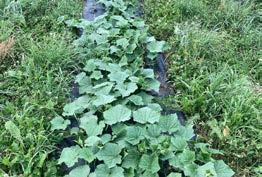
A lot of their largest contracts for wholesale seed production are for cucurbits and solanaceous crops. Dylan avoids using living aisles in cucurbits, whether for seed or fresh market, because it’s impossible to mow once the plants start vining, and he finds that annual weeds grow up through the canopy or set seed underneath it (Figure 7). Instead, he uses plastic or landscape fabric in the aisles.
For solanaceous crops like tomatoes, he noticed that the increased ambient humidity from the transpiration of the living cover seemed to exacerbate disease when compared to tomatoes grown with aisles covered in landscape fabric (Figure 8). The increase in humidity could even pose problems for dry seeded crops like brassicas if the seeds are not able to dry down sufficiently before harvest and processing.
The timing of seed production also presents challenges for perennial systems, as most contracts for wholesale seed arrive in March and April. This makes it difficult to establish a reliable, multi-year rotation.
Finally, because he is still relatively new to the economics of seed production, Dylan says he is sensitive to potential yield loss that may occur from living aisles.
“A lot of the yield loss that happens from the competition is not by count but by size. And nobody wants a huge mondo cabbage in their CSA box anyway. So it was okay if it was a little smaller. And with seed, I don’t even know how to predict yield of all the new varieties we’re growing, so I feel more sensitive to that potential for yield loss,” he said.
CONC l USION
Despite these challenges, Dylan still sees numerous benefits to establishing living aisles.
“It’s probably cheaper labor-wise to put down landscape fabric at the start of the season than to mow all the time. But when it’s July or August and I have to pick cherry tomatoes, it’s miserable to sit out there on landscape fabric next to black plastic and just roast in the tomato vines. Living aisles are beautiful green fields instead of a bunch of brown space. It doesn’t erode as much, especially in plasticulture with that impermeable area that’s exacerbating or concentrating runoff.
He adds that even a mediocre stand of a cover crop can reduce weed load; “It’s amazing. I really hope more people adopt it.” MS
Paulina Jenney is an Outreach Specialist in the Division of Extension at the University of Wisconsin-Madison, where she studies market dynamics in the seed industry and develops educational materials for growers, plant breeders, and researchers.
Steffen Mirsky is the Emerging Crops Program Outreach Coordinator with UW-Madison Extension where he supports the development of emerging crops throughout Wisconsin by providing educational programming and support for growers and other stakeholders.
↑ Living aisles in cucurbits getting weedy.
A BRIGHT YE ll OW WARNING
t H e INV as IV e H a R m of G ol D e N o Y ste R mus HR ooms
By Aishwarya Veerabahu, PhD Student at University of Wisconsin
This article originally appeared in The Conversation , July 16, 2025
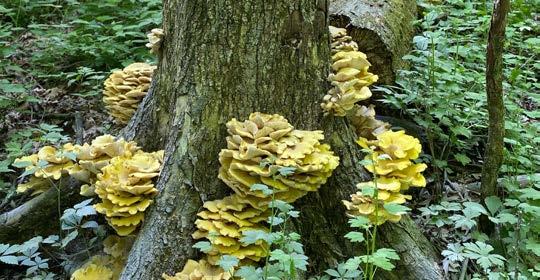
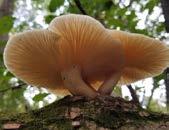
Golden oyster mushrooms, with their sunny yellow caps and nutty flavor, have become wildly popular for being healthy, delicious, and easy to grow at home from mushroom kits. But this food craze has also unleashed an invasive species into the wild, and new research shows it’s pushing out native fungi.
In a 2025 study we believe is the first of its kind, fellow mycologists and I demonstrate that an invasive fungus can cause environmental harm, just as invasive plants and animals can when they take over ecosystems.
Native mushrooms and other fungi are important for the health of many ecosystems. They break down dead wood and other plant material, helping it decay. They cycle nutrients such as carbon and nitrogen from the dead tissues of plants and animals, turning it into usable forms that enter the soil, atmosphere, or their own bodies. Fungi also play a role in managing climate change by sequestering carbon in soil and mediating carbon emissions from soil and wood.
Other organisms thrive because of their symbiotic relationships with fungi. Mycorrhizal fungi on roots, for example, help plants absorb water and nutrients. And wood decay fungi help create wooded habitats for birds, mammals, and plant seedlings.
However, we found that invasive golden oyster mushrooms, a wood decay fungus, can threaten forests’ fungal biodiversity and harm the health of ecosystems that are already vulnerable to climate change and habitat destruction.
– Madison
T HE DARK SIDE OF THE MUSHROOM TRADE
Golden oyster mushrooms, native to Asia, were brought to North America around the early 2000s. They’re part of an international mushroom culinary craze that has been feeding into one of the world’s leading drivers of biodiversity loss: invasive species.
As fungi are moved around the world in global trade, either intentionally as products, such as kits people buy for growing mushrooms at home, or unintentionally as microbial stowaways along with soil, plants, timber, and even shipping pallets, they can establish themselves in new environments. Many mushroom species have been cultivated in North America for decades without becoming invasive species threats. However, golden oyster mushrooms have been different.
No one knows exactly how they escaped into the wild, though evidence from a pioneering study by Andrea Reisdorf suggests golden oyster mushrooms were introduced into the wild in multiple U.S. states around the early 2010s, likely from increasingly popular grow kits. Whether they were grown outdoors on logs or in an indoor kit that was later composted outside, the spores could easily have traveled into nearby forests.
S PECIES THE GO l DEN OYSTERS PUSHED OUT
In our study, designed by U.S. Forest Service research scientists Michelle Jusino and Mark Banik, our team went into forests around Madison, WI, and drilled into dead trees to collect wood shavings containing the natural fungal community within each tree. Some of the trees had golden oyster mushrooms on them, and some did not.
— Aishwarya Veerabahu
We then extracted DNA to identify and compare which fungi, and how many fungi, were in trees that had been invaded by golden oyster mushrooms compared with those that had not been. We were startled to find that trees with golden oyster mushrooms housed only half as many fungal species as trees without golden oyster mushrooms, sometimes even less. We also found that the composition of fungi in trees with golden oyster mushrooms was different from trees without golden oyster mushrooms.
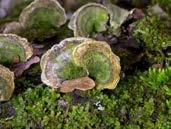
For example, the gentle green mossy maze polypore and the elm oyster mushroom were pushed out of trees invaded by golden oyster mushrooms. Another ousted fungus, Nemania serpens, is known for producing diverse arrays of chemicals that differ even between individuals of the same species.
Fungi are sources of revolutionary medicines, including antibiotics like penicillin, cholesterol medication, and organ transplant stabilizers. The value of undiscovered, potentially useful chemicals can be lost when invasive species push others out.
T HE INVASIVE SPECIES PROB l EM INC l UDES FUNGI
Given what my colleagues and I discovered, we believe it is time to include invasive fungi in the global conversation about invasive species and examine their role as a cause of biodiversity loss. That conversation includes the idea of fungal “endemism” – that each place has a native fungal community that can be thrown out of balance.
Native fungal communities tend to be diverse, having evolved together over thousands of years to coexist. Our research shows how invasive species can change the makeup of fungal communities by outcompeting native species, thus changing the fungal processes that have shaped native ecosystems.
There are many other invasive fungi. For example, the deadly poisonous death cap, Amanita phalloides, and the orange ping-pong bat, Favolaschia calocera, are invasive in North America. The classic red and white fly agaric, Amanita muscaria, is native to North America but invasive elsewhere.
The golden oyster mushrooms’ invasion of North America should serve as a bright yellow warning that nonnative fungi are capable of rapid invasion and should be cultivated with caution, if at all.
Golden oyster mushrooms are now recognized as invasive in Switzerland and can be found in forests in Italy, Hungary, Serbia, and Germany. It’s possible that golden oyster mushrooms may not be able to establish invasive populations in some regions. Continued research will help us understand the full scope of impacts invasive fungi can have.
W HAT YOU CAN DO TO HE l P
Mushroom growers, businesses, and foragers around the world may be asking themselves, “What can we do about it?” For the time being, I recommend that people consider refraining from using golden oyster mushroom grow kits to prevent any new introductions.
For people who make a living selling these mushrooms, consider adding a note that this species is invasive and should only be cultivated indoors and not composted. If you enjoy growing mushrooms at home, try cultivating a local edible species that you have collected in your region.
There is no single right answer. In some places, golden oyster mushrooms are being cultivated as a food source for impoverished communities, for income, or to process agricultural waste and produce food at the same time. Positives like these will have to be considered alongside the mushrooms’ negative impacts when developing management plans or legislation.
In the future, some ideas for solutions could involve sporeless strains of golden oysters for home kits that can’t spread, or a targeted mycovirus that could control the population. Increased awareness about responsible cultivation practices is important, because when invasive species move in and disrupt the native biodiversity, we all stand to lose the beautiful, colorful, weird fungi we see on walks in the forest. MS
Aishwarya Veerabahu is a third year PhD student in Botany at the University of Wisconsin – Madison. She studies the ecological impacts, evolutionary history, and human dimensions of invasive golden oyster mushrooms (Pleurotus citrinopileatus), a project that mixes fieldwork, genomics, and a lot of unexpected surprises. She can be reached at → veerabahu@wisc.edu
↑ Some species that have been pushed out by golden oyster mushrooms include the green mossy maze polypore and elm oyster mushrooms. Photos from www.mushroom-appreciation.com and Mushroom Observer.
l OW-TECH CO l D STORAGE SO l UTIONS
By Clare Hintz, Elsewhere Farm and Marbleseed Board President
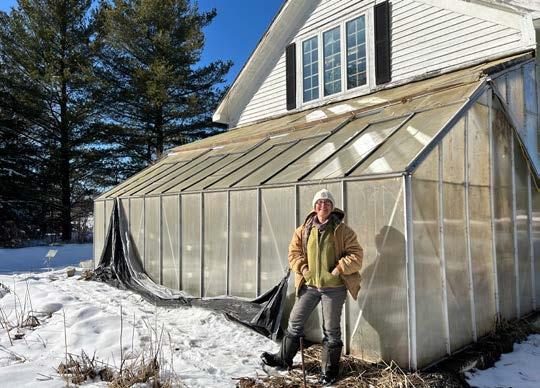
Years ago, I attended a workshop on deep winter greenhouse growing hosted by Carol Ford and Chuck Waibel in Minnesota. It was a turning point in my farming career, leading me to be able to farm year-round in Zone 4 northern Wisconsin and go full-time as a farmer.
Weekly greens are the “hook” that sell my winter CSA shares, but it’s the produce that I can store for the winter that provides heft.
I’ve developed key strategies and skills that allow me to have produce in the winter, including cold storage techniques, familiarity with winter species and varieties, soil health, and whole farm synergies. My overall design goals for my farm include farming solo, having “crop insurance” from diverse production, internalizing inputs, and optimizing infrastructure and technology. It’s important to state these up front because every farm is different, and the choices I make for financial success may not lead to success on your farm! These design goals have led me to intensify my small farm rather than scale it more extensively.
O PTIMUM l OW - TECH CO l D STORAGE CONDITIONS
The peace of mind I have sending out CSA shares through the winter is only as good as the quality of my storage. I don’t want to open a box of carrots in the root cellar and find mush! I also don’t want to have sleepless nights if the power goes down and my cold storage depends on mechanical systems. While we have excellent electrical service thanks to our rural co-op, we are increasingly getting heavy, wet snows throughout the winter that can take down power lines. For this reason, I’ve gone fully low-tech.
My root cellar is in the basement of my house, heavily insulated from the house, and vented to the outside through windows. For my market of 15 full shares plus assorted weekender boxes, I still have not maxed out the cellar’s roughly 20-by-10-foot footprint. I use rigid foam insulation panels for the walls, filling in around structural supports and creating four succinct zones.
Using the detailed information about the storage temperature, humidity, and storage life of vegetables from Knott’s Handbook for Vegetable Growers, I’ve developed these quadrants:
FOUR CO l D STORAGE q UADRANTS
→ Very cold and humid for veggies. This is where I store beets, carrots, potatoes, kohlrabi, cabbage, celeriac, parsnips, turnips, and radishes. Ideally, this would be about 33 degrees Fahrenheit and 95% humidity. In practice, I maintain about 40 degrees Fahrenheit and 50-60% humidity. These conditions allow me to offer excellent quality produce while minimizing infrastructure costs. I manage humidity with periodic water sprays on the floor of the cellar as well as produce storage in food grade plastic bags inside stackable waxed produce boxes that can be opened and shut to alter the humidity. Temperature is controlled simply by opening and closing the outside window, especially in the fall when I want to cool the concrete mass of the cellar as quickly as possible. In the spring, I extend the coolness by storing blocks of ice – which I make in five-gallon buckets – in sawdust. This area also holds the crops I am overwintering for my own seed-saving practice: potatoes, carrots for replant, etc.
→ Very cold and humid for fruit. The second storage area I maintain has the same temperature and humidity goals as the first, but I store apples and pears in it, separate from the rest of the produce so that the off-gassing ethylene of the fruit does not cause the rest of the produce to over-ripen or sprout. I keep my seeds here in metal toolboxes with desiccant to reduce humidity, taking advantage of the cold temperature in this room and its minimal use in the calendar year.
→ Moderate cold and humidity. This third area is for winter squash, tomatillos, and onions. It stays between 55 and 60 degrees, with about 50% humidity, though it would be nice if this were closer to 80%. This is in a bay in my basement open to the rest of the basement for air flow and humidity.
→ Moderate warmth and low humidity for garlic. Finally, I maintain an area at around 65 degrees and 30% humidity. All the literature I’ve read suggests that garlic prefers very cold temperatures with about 65% humidity, but in practice, I’ve found that warm and dry has worked far better for me for the 16 varieties I’ve maintained for about two decades. I don’t have molding problems with the bulbs, and the heads keep long enough for my winter delivery season. I also use this area for bulk herb storage; plants hang in bunches from clotheslines until I am ready to make batches of herbal tea.
W INTER CROPS AND VARIETIES
The produce I feature in my winter CSA comes down to crops that can fit in my summer rotations, provide variety, and keep well in my low-tech environment. The species I prioritize are beets, carrots, potatoes, kohlrabi, cabbage, celeriac, parsnips, turnips, and radishes. As my farm has matured, I’ve also leaned into more of the nutrition-packed, easy-to-grow crops to feed my chickens and pigs, rather than adding on additional CSA shares, including apples, squash, potatoes, beets, and turnips.
T HE PEACE OF MIND I HAVE SENDING OUT CSA SHARES THROUGH THE WINTER IS ON lY AS GOOD AS THE q UA l ITY OF MY STORAGE .”
— Clare Hintz, Elsewhere Farm
Instead of choosing vegetable varieties that are marketed as storage crops, I choose ones that do well with my farm’s clay soils and short growing season. Most are open-pollinated so that I can save seed, including Early Wonder Tall Top Beets, Danvers Carrots, and Purple Top White Globe Turnips. Over the years, I’ve maintained nearly a dozen varieties of potatoes and make sure to have a rainbow of colors for CSA shares, including Red Gold, Purple Viking, All-Blue, Santina, and Nicola. These are all short- to mid-season varieties, which I don’t plant until the beginning of July, thereby missing any potato beetle cycle.
The apples start to get wrinkly by mid-February, and I am still testing heirlooms known for their storage. So far, Black Oxford, a couple of Russets, and Caville Blanc D’Hiver failed to beat out the newer Suncrisp and Enterprise. Pear storage is a whole new direction for me; I’ve included Patton and Luscious for the first one or two December shares.
S OI l HEA lTH
Over nearly 15 years of running a winter CSA, the most critical factor I’ve found for storability is my soil health. Some years ago, I internalized all my fertility needs with the help of chickens and pigs. Optimal soil nutrient profiles are an important part of the picture, but I am convinced there are two other often overlooked factors to quality storage veggies: soil biology and water.
Because of my farm scale, I practice very minimal tillage in my market garden. Organic matter in my growing beds is 10%, and I have an intact fungal network. This enables my annual produce to be very efficient in foraging for nutrients in the soil. The fungal network also helps me balance plant stress in droughts. Last year was my fifth season of drought, but between irrigation, a thick mulch layer, healthy transplants, plant varieties adapted to my farm through seed saving, and functional soil biology, my plants thrived, and I have not seen a decline in produce longevity through the winter.
FA R MER SUSTAINABI l ITY
My choice to farm solo and partner with other small business owners rather than to hire workers or interns means that as much as I can spread out my labor over the year and reign in the workload in the summer, the more mentally and physically sustainable I am as a farmer.
T HERE IS
SOMETHING
— Clare Hintz, Elsewhere Farm “
VERY SATISFYING ABOUT HO l DING A MOUNTAIN OF FOOD AND DO l ING IT OUT TO THE COMMUNITY OVER MY 17- WEEK WINTER SEASON !”
YEAR-ROUND FARMING...
Having a set winter season also means I commit to two periods of “vacation” a year: two weeks at the end of November, and two weeks in April. In both periods, I am still doing daily farm chores and nursing plants in a greenhouse, but all the big projects are on pause, and I am not in full production mode.
Even though I could keep growing my winter CSA indefinitely, I have chosen to keep it small. It provides enough income for me for the winter, while still allowing a slower and more restful pace. There is something very satisfying about holding a mountain of food and doling it out to the community over my 17-week winter season!
My primary goal is to offer a reliable source of food to my customers, no matter what. I’ve designed my farm to give me the peace of mind that my infrastructure will not break and cost me thousands of dollars in lost produce. The temperaturehumidity gauge that can be purchased at farm stores is about as high tech as it gets. I am happy to trade my attention to the details of manual ventilation and temperature monitoring for the costs that come with automation. MS
Dr. Clare Hintz runs Elsewhere Farm, a production permaculture farm near the south shore of Lake Superior in Herbster, WI. The solar-powered farm features perennial fruits and nuts interplanted on five acres, intensive market gardens, and rare-breed pigs and chickens. Clare has a Ph.D. in sustainability education with a focus on regenerative agriculture. She currently serves as Marbleseed’s Board President.
C l ARE’S TOP PICKS FOR YEAR-ROUND FARMING
The Ice Crop: How To Harvest Store, Ship, And Use Ice by Theron Hiles
The Northlands Winter Greenhouse Manual by Carol Ford and Chuck Waibel
Preserving Food without Freezing and Canning by the Gardeners and Farmers of Terre Vivante
Root Cellaring: Natural Cold Storage of Fruits And Vegetables by Mike Bubel and Nancy Bubel
The Winter Harvest Handbook by Eliot Coleman
The Winter Market Gardener: A Successful Grower’s Handbook For Year-Round Harvests by Jean-Martin Forgier and Catherine Sylvestre
Recordings of past Marbleseed workshops led by Janaki Fisher-Merritt of Food Farm in Wrenshall, MN are an excellent resource for large-scale cold storage.
D EMENTIA , F ARM S AFETY
a ND t H e Qu I et l a B o R of Ru R al Ca R e
By Sofia Caracci, Marbleseed
In rural communities, aging is often inseparable from land, labor, and identity. Farmers rarely “retire” in the conventional sense of the word. Work evolves, seasons change, and responsibilities shift across generations, but the relationship to land remains constant.
When cognitive decline enters the equation through conditions such as Alzheimer’s disease or other forms of dementia, the challenges extend far beyond a medical diagnosis. They reach into the daily rhythms of farm life, the safety of agricultural work, and the emotional fabric of rural families.
A growing body of research suggests that agricultural communities face unique vulnerabilities when it comes to dementia. Long-term agricultural workers have a 46% higher likelihood of developing dementia. Risk factors for dementia include hearing impairment, depression, social isolation, brain injury, and exposure to pesticides, all of which are higher among rural and farming communities. Given that rural residents are older than their urban counterparts, this places greater burden on the former to care for family, friends, and neighbors with dementia.
U NI q UE REA l ITIES OF FARM l IFE
Recognizing this gap, researchers at the University of Iowa and the University of Illinois-Chicago are developing training programs specifically designed for farm families navigating dementia. Their work highlights a reality that many rural caregivers already understand: dementia care on a farm is not just about memory loss, it is about identity and dignity.
Likelihood of Dementia lONG - TERM A G W ORKERS
FARM WORK AND DEMENTIA
RISK
Source: The Journal of Gerontology (Vol. 78, Issue 8)
The research initiative began when two scholars working in public health and agricultural safety began comparing notes about their respective fields. Julie Bobitt, assistant professor of Medicine at the University of Illinois Chicago, spent years working in long-term dementia care facilities. Kanika Arora, associate professor of Health Management and Policy at the University of Iowa, studied occupational risks among agricultural workers.
Agriculture presents conditions that are rarely considered in standard dementia care education. Family members and other non-medical staff seeking to learn how to provide care for someone with dementia can access online and in-person training that focuses on issues such as effective communication, recognizing behavioral changes, simplifying daily tasks, and other issues that are largely related to the home environment.
How to manage operating heavy machinery, handling chemicals, interacting with livestock, and being alone outdoors in inclement weather are not part of these trainings.
And yet, these are daily events for many farmers and their families. Unlike most professions, farming lacks clear boundaries between workplace and home. Work unfolds from sunrise to sunset and is woven into daily life. A farmer can’t leave their workplace when they live on it.
A DDRESSING COGNITIVE IMPAIRMENT IN FARM SAFETY
Parallel to dementia education are the farm safety trainings offered by extension services and other organizations. These cover topics like livestock handling, tool and machinery safety, and chemical exposure. They do not, as a rule, take cognitive impairment into account. In other words, farm safety doesn’t consider dementia, and dementia education doesn’t account for the realities of farming.
This gap motivated the research team to develop a training toolkit specifically designed for farm families and rural caregivers. The program integrates dementia education with agricultural safety strategies, offering guidance on how to anticipate risks and adjust farm environments as cognitive abilities change.
One of the most difficult aspects of dementia in farmers is that early symptoms can be easily overlooked or misinterpreted. Gradual changes in decision-making or problem-solving may blend into the normal stresses of farm management. Forgetting to pay bills, for example, might initially seem like a small oversight during a busy planting or harvesting season.
The research team collected stories from farm families that illustrate how subtle those shifts can be. One caregiver described noticing that her mother, who had always taken time to cook for the family, suddenly shifted to frozen meals. Another story involved a trusted bookkeeper who began making serious accounting errors and ultimately owed significant sums.
In rural communities, long-standing relationships can sometimes soften the immediate consequences of these changes. Neighbors or local businesses may extend patience when mistakes happen, quietly helping resolve issues that might otherwise lead to financial or legal trouble. As the researchers note, this kind of grace is not guaranteed can even have serious repercussions.
F RAMING ( AND FARMING ) MATTERS
Farm Families Coping with Dementia, as Bobitt and Arora titled their program, emphasizes recognizing early warning signs and understanding how cognitive changes may appear in everyday farm tasks. Difficulty tracking routines, misjudging equipment safety, or mishandling chemicals can all signal shifts in memory or decision-making. By learning to identify these patterns early, families have more time to plan and adapt their environments, and begin difficult conversations about safety before a crisis occurs.
O NE OF THE MOST DIFFICU lT ASPECTS OF DEMENTIA CAREGIVING IS THE TENSION BETWEEN SAFETY AND DIGNITY .”
One of the central insights from the research is that farming is not simply an occupation; it is a deeply embedded identity. For caregivers, this creates an emotional dilemma: How do you begin to renegotiate roles with someone whose sense of purpose, identity, and daily rhythm has been shaped by a lifetime of farming?
Bobitt and Arora partnered with the University of Illinois Extension to help translate their work into programs that could reach farm families and rural communities. Through workshops and educational modules, the collaboration aims to help caregivers and agricultural communities recognize how cognitive changes may intersect with farm safety.
Extension educators delivering the curriculum emphasize the importance of how choices are framed. Rather than focusing on restrictions – what someone can’t do – they advise offering positive options. This might be a relatively simple adaptation of a routine, or brainstorming ideas together to find tasks the person is excited to do. This maintains a sense of autonomy.
A CAREGIVER ’ S EXPERIENCE
For one extension educator who now teaches the Farm Families Coping with Dementia curriculum, the work is deeply personal – she is caring for her spouse, who is experiencing cognitive decline. As his symptoms progressed, Tina (a pseudonym) grew increasingly aware of the risks.
“The changes are not always visible to outsiders,” she says. “Someone visiting might not immediately recognize that anything has changed.” And yet, she’s no longer comfortable with her husband doing once-familiar tasks, such as operating machinery, without supervision. “I’ve had to become very alert,” she adds.
One of the most difficult aspects of dementia caregiving is the tension between safety and dignity. Removing responsibilities too quickly can feel like stripping away independence, but waiting too long can create serious risks. Tina says that an area the couple is now negotiating is her husband’s time outdoors. She can’t be with him whenever he’s outside, nor does he want her to be; but she also can’t take away that pleasure and independence.
For now, they’ve developed informal safety practices. Before leaving the house, he tells her where he’s going and what he intends to do. “I don’t know who started it”, she says, showing how organically adjustments like this often emerge, “but it became a way for him to create his own safety net.”
DEMENTI a , FARM SAFETY...
lONG PERIODS OF UNCERTAINTY
D EMENTIA VS . Alz HEIMER ’ S
Dementia is an umbrella term that describes a collection of symptoms (cognitive, functional and behavioral) that are caused by specific diseases. Alzheimer’s disease is the most common disease that causes dementia, but Frontotemporal degeneration, Lewy Body disease, Vascular disease can all cause symptoms of dementia. Not all cognitive decline is considered dementia, dementia must be driven by an underlying progressive neurodegenerative disease.
→ Source: Alzheimer’s Association
Global Dementia Rates
A GROWING REA l ITY
There are over 10 million new cases of dementia each year worldwide, implying one new case every 3.2 seconds.
Aging Statistics in America
AGING HAPPENS FASTER IN RURA l AMERICA
Rural America is aging faster than urban areas, with 20 – 24% of its residents aged 65 or older compared to 16% in urban areas.
Tina recalls the difficulty in first bringing up the subject of cognitive decline with her husband. Asking him whether he thought they should discuss his memory with their physician “was one of the most difficult questions I’ve ever had to ask in our marriage.”
M ANY CAREGIVERS NEGOTIATE l ONG PERIODS OF UNCERTAINTY BY q UIET lY AD j USTING ROUTINES ”
Even after that conversation, progress was slow. Appointments with specialists aren’t easy to come by, and the first doctor they saw ultimately was not the right fit. Experiences like this are common for families seeking clarity about cognitive changes, particularly in places with limited medical resources and where distances to healthcare facilities can make travel costly on multiple levels.
Many caregivers like Tina negotiate long periods of uncertainty by quietly adjusting routines, watching for safety concerns, and navigating emotional changes long before a clear diagnosis is ever given. These adjustments often entail isolating themselves and their loved one from potentially difficult situations. While this isolation is a reality for many caregivers, it is magnified for those in rural areas who are already geographically separated from family and friends.
In farming families where various members – usually women – shoulder tasks that could come under the umbrella of “caregiving,” many are reticent to identify this way. “I almost feel like an imposter calling myself a caregiver,” Tina admits, noting that most other people are unaware of her husband’s limitations.
But the emotional labor is constant and exhausting. Caregivers take on the work of tracking medications, anticipating safety concerns, managing finances, and thinking ahead about difficult conversations, all while continuing to do their daily work, be it farm-related, childcare, or paid work off the farm.
T RANS l ATING RESEARCH FOR RURA l COMMUNITIES
Bobitt and Arora knew they needed a bridge between themselves and the families they sought to reach. They partnered with extension programs as a familiar and respected source in rural communities. The curriculum, which was developed with input from extension educators, medical professionals, families, and others, adapts complex medical and safety concepts into accessible training modules tailored to rural audiences.
For example, training modules might explain how changes in judgement or problem-solving could affect everyday farm decisions, such as forgetting to disengage machinery, misjudging when equipment should be repaired, or mishandling chemicals used for spraying. By connecting cognitive symptoms directly to familiar farm tasks, educators help families recognize potential risks earlier and think through ways to modify routines, simplify processes, or introduce safety measures before a crisis occurs.
C ONNECTING CAREGIVERS
For Tina, storytelling has proven to be one of the most effective tools in connecting with the caregivers taking the training. “Caregivers don’t have a lot of shared space with other caregivers,” she says, “especially in rural areas where the home is such a central part of life.”
These conversations often reveal concerns that extend beyond the safety of individual households. Firearm storage, equipment access, and transportation safety frequently emerge as topics of discussion. In some cases, multiple generations live together, which can both complicate and strengthen caregiving dynamics.
The researchers recommend incorporating a “hierarchy of control” approach to safety, encouraging families first to eliminate hazards where possible, then modify environments, and finally rely on personal behavior changes when necessary.
D EMENTIA COMP l ICATES FARM SUCCESSION
The rise of dementia among aging rural farm populations raises broader questions about how agricultural systems support farmers across their lifespan. Across the country, the farming population is steadily ageing. Many producers continue working well into their 70s and 80s. For many families, stepping away from the land is neither financially feasible nor emotionally desirable.
This demographic shift means that conversations about aging can no longer be separated from conversations about farm safety, succession planning, and rural health. Many farm transitions already involve difficult decisions about landownership, finances, and the transfer of responsibilities across generations. When dementia enters the picture, those decisions can become even more complex.
In the best scenarios, farm succession planning depends on years of shared decision-making and mutual trust. When cognitive decline interrupts that process, families may find themselves navigating sensitive questions about legal authority, financial oversight, and the timing of leadership transitions. They may realize only gradually that a loved one’s ability to make major decisions about land or business operations has been affected.
Mortality Rates in America
Life Expectancy in America
A SHORTER , HARDER ROAD
Rural residents have a 20% higher all-cause mortality rate and a life expectancy more than 3 years lower than urban counterparts.
R EPOSITIONING DEMENTIA AS A COMMUNITY ISSUE
Arora and Bobitt see this gap as an opportunity for agricultural institutions to evolve. Integrating dementia awareness into extension programming, farm safety education, and rural healthcare partnerships would help communities respond earlier and more compassionately to the challenges of aging. Recognizing dementia not only as a medical condition but as a community issue may be an important step toward supporting farmers across the lifespan.
The initial four-part virtual training, which includes videos, farmers’ stories, and discussion prompts, was offered last summer to families in Iowa and Illinois. Bobitt and Arora are evaluating the results of that training and hope to expand it to other states. Tina hopes the program will expand into an ongoing series, providing caregivers with ongoing ways to talk openly. Caregiving, she says, isn’t something anyone should face alone. “You don’t have to tell everybody everything,” she says, “but you do need someone who understands. Having that community makes all the difference.” MS
The next workshop will be offered beginning the week of June 22nd. If you are interested in learning more, or to register, please visit → https://gpcah.public-health.uiowa. edu/dementia-educational/ . Readers interested in learning more or participating in upcoming trainings should reach out to kanika-arora@uiowa.edu
Sofia Caracci is Marbleseed’s Farmer Education Specialist. This article is a part of Marbleseed’s broader work in Honoring Our Elders, funded by NCRS SARE.
DAY-NEUTRA l STRAWBERRIES
Q& a WI t H aa R o N WI lls & Be N K R aus
By Ariana Abbrescia, University of Wisconsin-Madison Extension
When most Midwesterners picture strawberry season, they might think of a trip to the pick-your-own patch or a market stand with delicious pints available — but only for a short window. That’s because most strawberries grown in the Midwest are “June-bearing” varieties, fruiting from about mid-June through early July. June-bearing strawberries are sensitive to day length; their buds develop in the fall, and they produce fruit in one big flush at the beginning of the following summer.
In the Upper Midwest, there’s a relatively new type of strawberry that’s getting some well-deserved attention. “Dayneutral” strawberries are not sensitive to day length; instead, they produce fruit consistently from July until the first killing frost (often well into October here in southern Wisconsin).
Day-neutral strawberries require a bit more love and labor than their June-bearing cousins, which are commonly grown perennially for three to four years in matted rows. By contrast, day-neutral strawberries are usually grown as annuals with a new bare-root crop planted every May. Instead of matted rows, day-neutral strawberries grow well on plastic or paper mulch and do well in protected environments like low or high tunnels. Runners are clipped to encourage better establishment and fruiting from the parent plant.
In return for the extra attention, day-neutral strawberry plants have a longer harvest season and higher yields. They grow well in organic systems; annual crop rotation and protected environments can support organic pest and disease management, while paper or plastic mulches can save hours spent weeding. For these reasons and more, they fit nicely into the rotation of a diversified vegetable farm, adding a pop of color to any market stall, farm stand, or CSA share, and adding an additional revenue stream during the “off season” for strawberries. Plus, they’re absolutely delicious!
U NIVERSITY -l ED TRIA l S FOR ORGANIC PRODUCTION
Over the past decade, the University of Minnesota has led a great deal of research into growing day-neutral strawberries in the Upper Midwest. Research topics have included biodegradable mulches, growing in protected environments vs. open field production, between-row cover crops and living mulches, table-top production, and pollinator attraction. Most recently, researchers at UMN and the University of WisconsinMadison wrapped up a project funded by the USDA-NIFA organic transition program that dug into the economics of day-neutral strawberry production and the efficacy of plastic and biodegradable mulches to manage insect pests, weeds, and diseases. Their findings, along with a suite of tools and tutorials for growing day-neutral strawberries, can be found on page 37.
Today, with collaborative efforts from university researchers, the Organic Fruit Growers Association, and farmers trialing, growing, and innovating, day-neutral strawberries are becoming a more frequent sight across the Upper Midwest. To learn more about this emerging market, Ariana Abbrescia, outreach specialist with University of Wisconsin-Madison Extension, spoke with Aaron Wills and Ben Kraus.
Aaron was one of the first farmers to partner with UMN in growing day-neutral strawberries. He and his wife farm Little Hill Berry Farm, an organic berry farm in Northfield, MN, that they started in 2011. They raise certified organic strawberries, blueberries, and other fruits and market their fruit through U-pick and their farm store.
Ben Kraus is the perennial manager at Gwenyn Hill Farm. Ben has been orcharding his whole life, starting with childhood visits to his grandmother’s orchard in Oconomowoc, WI. Along the way, he picked up experience as a landscaper, irrigation specialist, organic vegetable producer, and conventional orchard manager.
AA: How did you get started growing day-neutral strawberries?
AW: For our first seven years at Little Hill Berry Farm, we were just growing blueberries for pick-your-own and selling at our farm store. By 2018, we were interested in starting to diversify, and we were really fortunate that the University of Minnesota approached us around that time. They were doing some research on day-neutral strawberries and how well they would grow in Minnesota. Year-by-year, we’ve grown towards a size that works well for us, and now we grow seven caterpillar tunnels and two high tunnels of day-neutral strawberries. We sell them through our farm store and freeze the few seconds we get and make that into jam.
BK: I visited Aaron’s farm in 2023 for an Organic Fruit Grower’s Association field day and learned about his day-neutral strawberry system. The following season, I planted a 50-foot trial plot with four different varieties. This upcoming season will be my third one growing them, and we’ll have just over 1,700 row feet in a high tunnel. We sell our berries through our farm stand, and this year we’ll trial a pick-your-own portion of our CSA shares for overwintered berries. We work with a co-packer to turn our seconds into jam, and we’re thinking of doing a strawberry syrup this year as well.
AA: When folks think about growing strawberries, they might see a labor-intensive crop. What has you (and your customers) sold on day-neutral strawberries?
AW: Day-neutral strawberries are certainly a labor-intensive crop. You’re planting them by hand, you’re weeding, you’re clipping runners, you have to harvest regularly. But we’ve
found ways to minimize labor. We burn holes into white-onblack landscape fabric in our tunnels, which takes care of most of the weeds. When compared to something like blueberries, you can harvest them much faster; you’re harvesting more value for each hour of picking. We try to optimize yields, aiming for a pound a plant.
At the end of the day, we’ve seen that demand is just so high for these strawberries – we spend no effort trying to sell them. In fact, if you have other crops to go along with them, they’re going to help you sell those crops, too. People will drive to get them. So, while these strawberries are labor intensive, I think if you can get a good yield, they definitely pull their weight and then some.
BK: It’s a similar story here, they just fly off the shelf. I can put twelve quarts out on our farm stand, and they’re gone by the end of the day. When it comes to labor, our day-neutral strawberries are much easier to weed than the June-bearing strawberries we used to grow on the farm, since we grow them on plastic mulch. And I’ve actually had customers say that our day-neutral strawberries tasted better than our Junebearing ones!
AA: Let’s talk varieties. Which varieties will you be growing this season? Are there certain qualities that you’re looking for?
BK: We typically grow four varieties: Albion, Monterey, Seascape, and San Andreas. Albion and Monterey grow consistently well on our farm. Seascape has great flavor, but the berries can be so small and hard to pick – this might be our last year growing them. We weren’t able to access San Andreas this year, so we’ll just be growing those three. San Andreas grows huge fruit, but they’ve been spotty from plant to plant in terms of production.
AW: This year we’re growing almost all Albion and a little bit of Monterey. Albion has been super consistent for us in terms of flavor, size, and yields, and we know how to grow it well. And we like Monterey because it seems to do better toward the end of the season; it comes on when our Albion yields might be dipping. So those two varieties complement each other nicely. In our experience, Seascape has great flavor but doesn’t hold its size, and the smaller berries can be very laborious to pick. Portola had great yields but mediocre flavor. San Andreas didn’t consistently thrive on our farm, and Cabrillo has been hard to source.
AA: We’ll be growing Cabrillo this year, and I had such a hard time finding the quantity of bare root plants we were looking for, especially organic plants. How do you manage sourcing with your organic certification?
BK: When I first started growing day-neutral strawberries, there weren’t any certified organic plants available in the quantity and quality we were looking for. We had sourced our
DAY-NEUTRA l STRAWBERRIES...
other berry plants from Indiana Berry Company (IBC) in the past, and they had day-neutral strawberries available, so we went through our certifier’s exemption process and ordered from there. We have tried ordering from other suppliers since then but have had quality issues, so we’re sourcing from IBC again this year.
AA: Both of you will be growing your strawberries in caterpillar and/or high tunnels this upcoming season. What influenced that decision? If you grew outside or in low tunnels, what was your experience there?
AW: We started growing our day-neutral strawberries in low tunnels, then grew them outside in raised beds; neither of those systems worked well for us. We had a ton of disease pressure when we grew outside, especially Anthracnose (Colletotrichum fragariae), which was challenging to manage. We also struggled with berry quality when it rained. In a matted row system, water percolates away from the plants, but because we were growing on plastic we would get little pools of water every time it rained. The berries would sit in it and get soft, so we would lose a lot. We watched the weather like hawks and harvested every time it might rain, which was very stressful. After that, we moved into caterpillar tunnels,
primarily because they were lower cost, and have added high tunnels since then.
BK: We started out with our berries under a low, four-foottall caterpillar tunnel using bent conduit and lined with greenhouse plastic. We would typically have the sides rolled up in the summer but would roll them up and down on either end of the season or for big rainstorms. That ended up being way too much work, so this season we’re moving to an Eliot Coleman-style moveable high tunnel with some modifications.
Eq UIPMENT AND SETUP
AA: What does your day-neutral strawberry system looks like throughout the season beginning with equipment?
AW: We have a 35-horsepower tractor that we’ve used in the past, but that’s hard to work with in our caterpillar tunnels, so we recently got a BCS to use in the tunnels. We use a rototiller attachment on that to incorporate our fall cover crop or break up the soil, which can get hardpan throughout the season. If we’re doing a cover crop in the fall, we’ll hook up a rudimentary
overhead irrigation system to water the whole tunnel. Next, we’ll roll out our drip tape, then our white-on-black landscape fabric, which we plant into. We have our irrigation set up with a fertigation injector that we’ll use throughout the season. And then we have a backpack sprayer, which we’ll use for foliar fertilizer applications and sometimes organic pesticide or fungicide applications.
BK: We use the same equipment that the veggie side of the farm uses, which is a five- foot wide rotovator. They make a couple passes at the deepest setting, then I put our white-onblack landscape fabric down and staple it into place. We make holes in that and plant into that, then we run our drip tube on top of that.
AW: Did you say you lay your drip irrigation over your mulch? I haven’t seen that before.
BK: Yup. Instead of using drip tape underneath, I use the orchard solid half-inch drip tube with one-foot hole spacing, so it lines up with the plants and drips right in. That way I can use that same drip year after year instead of throwing it away, and I don’t have issues with rodents or anything.
F ERTI l ITY
AA: What about fertility?
BK: I’m not doing much for fertility, really. I’ve got a fertigation system that I can put in with the drip, but I haven’t used it yet. With the rotation of crops that we use, I’ve been trying to see if we need to fertilize. In my first-year trial, I didn’t fertilize and got about three quarters of a pound per plant, which felt adequate. Last year I had fungal and insect issues, so I only got maybe half a pound per plant. I’m hoping that the new tunnel will help with that - we’ll see.
AW: In general, we’ll do a compost application in our tunnels every five years or so. For year-by-year fertility, we work with a company to design nutrient programs for our different crops. They monitor nutrient levels a handful of times throughout the year to adapt our fertigation mix, which changes throughout the season, from encouraging establishment growth to flowering to fruit production. Sometimes we’ll fertilize through our fertigation system, sometimes we’ll do foliar fertilizer applications with our backpack sprayer. Of course, we have to run any product by our certifier to make sure everything is approved for use, and we have to document nutrient deficiencies as well.
DAY-NEUTRA l STRAWBERRIES...
W EED MANAGEMENT
AA: What is your weed management system?
AW: Our landscape fabric really does most of the work for weed management. We weed once early on, then a second light weeding, and that’s pretty much it. We cut runners throughout the season to focus all the energy into the parent plant.
BK: Same here. We weed right after planting, then it’s just maintenance from there with the landscape fabric. You’ll see a weed as you’re moving along and pull it, along with cutting runners.
I RRIGATION TIMING
AA: You’ve mentioned irrigation — say more.
AW: I use a few Watermark tensiometers in the tunnels; they measure soil water tension and help give me an idea of when and how long we need to water. We usually fall into a rhythm,
though, watering roughly once a week earlier in the season and twice a week during fruit production.
BK: When it gets into the heat of the season, I probably water once a week, if not twice, depending on how things are feeling.
P EST AND DISEASE MANAGEMENT
AA: Ben, slugs?
BK: Yeah, slugs. The last couple of years have been bad. I use Sluggo (active ingredient is iron phosphate) as best I can around the base of the plant, though I’ve noticed that if the fruit comes into contact with the Sluggo, they will rot more quickly. So that’s something to watch out for. Last year, Botrytis fruit rot/gray mold (Botrytis cinerea) was also an issue. The low tunnels we were using didn’t provide as much protection as I was hoping for. We’ve had a handful of other issues here and there, including thrips, Japanese beetles, and Tarnished plant bugs, but nothing notable enough to spray.
AW: Four years ago, we had a bunch of problems with slugs and snails, and we did the same thing, going plant-by-plant and putting Sluggo around the base. We haven’t seen much in the last few years, and I’m not sure why. For us, Tarnished plant bug (TPB) is probably our biggest issue, though it’s not super bad, just something we have to watch for. It causes the fruit to grow crumpled and seedy, which is called ‘catfacing.’ We’ve had a couple instances where they have multiplied quickly and we’ve had damage, but we typically only spray Pyganic (active ingredient is Pyrethrin) for them once a year. A little tip: I learned that Pyganic is more effective in more acidic water, so we use vinegar or Oxidate to lower the pH of the water in our tank mix (Note: You can find recommendations for buffering your final spray mix to the ideal pH on the product instructions).
G OING FORWARD ADVICE FOR NEW GROWERS
AA: What advice do you have for folks just starting out with day-neutral strawberries?
AW: Strawberries are a high-labor, high-reward crop. In my mind, day-neutral strawberries aren’t a plant-it-and-forget-it sort of crop. Take a good look at your situation and available labor before deciding if it’s a good fit for you. Consider if customers will stop by your market stand in late summer and buy your other produce if they see some beautiful strawberries.
BK: I agree with Aaron about the labor piece. My advice is to start small and find a scale that works for you. We started with 50 feet and grew year-by-year to a size that felt right for us. MS
Ariana Abbrescia is an Organic Transition Outreach Specialist with the UW-Madison Extension. In this role, she specializes in organic transition and organic pest and disease management. Contact Ariana at ariana.abbrescia@wisc.edu.
This article is supported through the United States Department of Agriculture (USDA) Transition to Organic Partnership Program (TOPP). TOPP is a program of the USDA Organic Transition Initiative and is administered by the USDA Agricultural Marketing Service (AMS) National Organic Program (NOP).
R esou RC es fo R GR o WING
DAY-NEUTRA l STRAWBERRIES
University of Wisconsin Extension Day-Neutral Strawberry Crop Profile → https:// cropsandsoils.extension.wisc.edu/day-neutralstrawberries/
University of Minnesota Extension Day-Neutral Strawberry Webpage → https://extension.umn.edu/ strawberry-farming/day-neutral-strawberries
University of Wisconsin Extension 2026 Day-Neutral Strawberry Webina → https://www.youtube.com/watch? v=rj4BIu4ElzQ&t=3807s
University of Minnesota Extension Day-Neutral Strawberry Production Basic → https://www.youtube. com/watch?v=vQrz6ZA6ddk
Join our family of growers who share our passion for cultivating goodness. We’d like you to grow with us.
Beans | Pulses | Grains | Flax
Let’s cultivate goodness, together. Call 844-275-3443 or visit HFIfamily.com
UNDERSTANDING ORGANIC FARM EXITS
IN s IGH ts f R om D ata & R e sea RCH
By Mallory Krieger, Organic Agronomy Training Service (OATS)
The organic sector has seen remarkable growth over the past two decades, but while new operations continue entering organic certification at encouraging rates, a significant number are also leaving.
To better understand why and the scope of the farm exits, I undertook an analysis of the USDA Organic Integrity Database (OID). This database is maintained by the National Organic Program (NOP) and functions as an administrative snapshot, showing certification status of all operations in the organic program at the present time. A preliminary analysis of this data reveals insights into the characteristics of who is entering and leaving certification.
Organic Farm Changes By State
STATE NET CHANGE IN OPERATIONS NET CHANGE IN ACRES
Wisconsin (36) 3,691
Iowa (35) (1,530)
Washington (24) 4,591
Minnesota (19) (12,239)
South Dakota (14) (4,601)
Colorado (12) 2,136
Montana (11) 13,642
Ohio (11) 6,444
North Dakota (9) 215
Maine (6) (3,475)
D IVING INTO THE DATA
As of December 20, 2025, 28,881 operations are certified organic in the United States. Over the duration of 2025, 3,539 operations newly entered certification, while 2,825 operations voluntarily surrendered their certificates. Accounting for all changes (including suspensions and reinstatements), the organic sector saw a net gain of 792 operations overall across all certification scopes (crops, livestock, and handling).
The following analysis was presented at a webinar hosted by the National Organic Coalition on January 16, 2026.
W HI l E A NET GAIN APPEARS
FAVORAB l E , THE OVERA ll NUMBER MASKS IMPORTANT VARIATIONS BY SECTOR AND GEOGRAPHY .” “
While a net gain appears favorable, the overall number masks important variations by sector and geography. The crop sector experienced a net loss of 153 operations, 1,758 exits by voluntary surrender, with only 1,605 new certifications. In contrast, livestock operations saw a net gain of 271, and handling operations increased by 916. The handling growth reflects, at least in part, the Strengthening Organic Enforcement rule (SOE), which required many previously uncertified handlers to become certified.
W HERE FARMS ARE l EAVING
The states with the largest net gains in operations were California with a net gain of 138 operations, followed by New York with 119, Florida with 101, and Missouri with 95. The states that saw the greatest net loss of operations due to voluntary surrender were Wisconsin with 36 farms leaving certification (9% of the state’s certified operations), followed by Iowa with 35 operations (10%), and Washington with 24 operations (11%). South Dakota saw the greatest per capita loss with 14 operations leaving certification, 17% of their total certified operations.
Mapping the location of these changes shows a clear pattern: gains cluster tightly around major metropolitan areas such as Los Angeles, New York, Houston, and Seattle, while losses are concentrated in rural agricultural regions, such as California’s Central Valley, much of the Midwest and Great Plains, rural Wisconsin, and rural Pennsylvania. This urban-rural divide raises questions about market access, consumer demand, and the infrastructure available to support organic farmers in different regions.
T HE ACREAGE STORY
Changes in certified organic acres show a more concerning trend. 7.7 million acres are currently certified. New certifications in 2025 reported 326,017 acres (4% of total), while newly surrendered operations reported 366,603 acres (5% of total), resulting in a net loss of 40,585 acres. (Acreage data excludes acres certified under the Wild Crop scope.)
The distribution of farm size reveals something important about organic agriculture’s changing structure. Newly certified operations were on average 203 acres with a median of 51 acres, while surrendered operations were on average larger at 355 acres with a median of 59 acres. The organic sector appears to be gaining smaller operations, particularly near urban areas, while losing somewhat larger operations, particularly in rural regions.
State-level acreage data reveals significant losses in certain areas. The state with the largest loss of certified acres was Idaho with a net loss of 91,791 acres, or 32% of the state’s certified organic acreage. Texas lost 15,352 acres (12%), Minnesota lost 12,239 acres (11%), and Oklahoma lost 6,550 acres (24%).
Interestingly, some states with high operation net losses showed acreage gains. Wisconsin lost 36 operations but gained 3,691 acres. Montana lost 11 operations yet gained 13,642 acres. These patterns suggest certified operations may be adding additional acres to their operations, though there are a number of other possible explanations and further analysis of the OID is required to more fully reveal the cause.
W HY FARMERS CHOOSE ORGANIC – AND WHY THEY l EAVE
Dr. Carolyn Dimitri, a professor at New York University and former USDA researcher, provided crucial context for interpreting these numbers. Her research consistently identifies two categories of motivations for transitioning to organic: values-based reasons including farm sustainability, human health, and environmental stewardship, and economic reasons including increased profit potential and market opportunities.
For farmers who achieve certification but later surrender, market access emerges as the dominant factor. Farmers who cannot find buyers willing to pay fair organic prices find the additional labor, management attention, and certification costs unsustainable.
Access to processing infrastructure poses particular challenges for livestock producers. Many organic farmers with split operations have given up their livestock certification because they cannot find organic processors. Without access to slaughter and processing facilities willing to handle organic animals, these farmers face difficult choices.
Research consistently shows that exits most commonly occur within the first five years of certification, with the third year being particularly critical. “It’s three years for transition and then three years of farming organically,” Dimitri explained. “And that is the key moment when most farms are going to give up their certification.”
Aggregated data from three accredited certifiers shows that approximately 40-50% of farmers who surrender report they are no longer producing organic but are staying in farming.
T HE ORGANIC SECTOR APPEARS TO BE GAINING SMA ll ER OPERATIONS NEAR URBAN AREAS
, WHI l E l OSING l ARGER OPERATIONS
IN RURA l REGIONS
Another 30% go out of business entirely. Only about 8% cite certification costs, and approximately 3% mention paperwork or certification difficulty. Between 20 - 25% don’t provide a reason.
These findings counter a common narrative that recordkeeping and regulatory burden is a leading reason for operations surrendering certification. The data indicates that market and business opportunity is far more important to retaining operations.
Dimitri’s research echoes this: “Most farmers actually said, ‘If we’re having a good business, then we’re going to keep records and that will make us more profitable.’” Farmers who are successful economically view recordkeeping as simply part of doing business.
D EFYING SIMP l E NARRATIVES
The analysis of the 2025 OID data reveals a complex landscape that defies simple narratives. While the organic sector grows overall, rural agricultural regions are losing crop farms while urban areas gain operations. Understanding the patterns and motivations for operations leaving organic certification is essential for developing effective support strategies. Continued investment in organic infrastructure, technical assistance during the critical first five years, and policies that address market access and farm economics will all play important roles in the continued growth of the organic industry.
For advocates and stakeholders, this analysis points to clear action items: improve data collection and research, strengthen market infrastructure, and provide targeted technical assistance to farmers during their most vulnerable years in organic production.
The organic movement has always been about more than just a label. It represents a commitment to farming practices that build soil health, protect biodiversity, safeguard water quality, and produce food without synthetic pesticides and fertilizers. Understanding why farmers leave organic certification — and developing effective strategies to support retention — is essential to realizing that broader vision of a more sustainable and resilient food system. MS
Mallory Kreiger is the National Program Director at the Organic Agronomy Training Service (OATS) and the principle consultant at Terra Elossa LLC . She owns and manages an 85-acre farm in western Illinois.
FOCUS ON FINANCES
By Anna Thomas, Food Finance Institute
If you’ve never heard of the Food Finance Institute (FFI), let me introduce us. We will be a regular feature in future Organic Broadcasters, exploring the financial side of farming.
We are part of the Universities of Wisconsin’s Office of Business and Entrepreneurship, which connects businesses to resources, information, and services that improve performance and increase capabilities for success. FFI lives here along with the Small Business Development Center, the Center for Technology Commercialization, and YourEconomy.
At the FFI, we envision a world where resilient food and farm businesses anchor vibrant communities and a thriving planet. We help food and farm businesses thrive at every stage through finance-forward training, coaching, and consulting. Your numbers may not be the sexiest part of your business, but a solid business model and accurate financials allow you to make the best decisions and avoid burn out.
E VO lVING l ANDSCAPE
FFI was founded by Tera Johnson in 2014 to meet the need for financial technical assistance among growing food and
agriculture businesses, to help them become profitable and raise the capital required to expand. Twelve years later, this need is more critical than ever. After a year of rapidly shifting grant availability, the funding landscape continues to evolve. We are navigating higher costs of capital, tighter equity investment, and increased pressure on private foundations to fill the void.
Even before the current administration’s change in priorities, we at FFI believed that grants should be used thoughtfully. Additional assistance is ideal for new projects that need some gap financing to cover start-up costs or to boost equity to get a loan. But grants can become problematic if funding is used as a band-aid for an unsound business model – because that grant funding eventually runs out.
And here’s where FFI can help. We know that you didn’t become a farmer because you loved spreadsheets or generating income statements. You wanted to grow carrots, raise heritage hogs, and improve the soil while nourishing people. You wanted to be out in the sun and rain, with dirt under your nails, not figuring out how to transition from QuickBooks desktop to online (by the way, you should really do that).
I NCREASING FINANCIA l ACUMEN
We help farms in several different ways. We offer training programs meant to increase a farmer’s comfort level with their financial acumen and the stories their numbers tell: Are you profitable? How are you profitable? Do you need financing to expand? What’s the right kind of financing?
We also meet with farmers one-on-one to address specific questions and apply sound financial strategies to their unique business model. We look at historical profit and loss statements, current balance sheets, and working capital to help identify specific areas where a farmer might be able to improve their profitability or cashflow. We might suggest a line of credit or a new sales channel, or work with a farmer to divide their overall numbers into an enterprise budget to help determine what areas of their business is making money (or not).
While we would love to see you all in an FFI program, until we do, the intent of this new column is to address questions that many of you are facing. How much money do I have to make to quit my off-farm job? To what scale should I grow my farm? What should I think about before I add a new enterprise? What factors should I consider when pricing my products? Should I make improvements on rented land? Can I afford to hire an employee? How do I plan for the succession of my business? How do I maximize the use of my point-of-sale system?
REACH OUT WITH YOUR q UESTIONS
What questions would you like us to explore? If you have any queries you’d like us to answer in future columns, please email me at anna.thomas@business.wisconsin.edu with your ideas. I’d love to hear from you.
In the meantime, we’ve launched a new program, Unlocking Capital for Beginning Farmers for those who have been actively farming for 10 years or less. Funded by the Beginning Farmer and Rancher Development grant, this program helps you get the financial training you need and develop a proforma and financial package that you can use to seek debt financing or equity investment. If you’re a farmer who’s growing and needs help preparing to seek capital, please go to our website and fill out the intake form at → ffi.pub/ BroadcasterUnlocking.
Here’s to a bountiful 2026! MS
Anna Thomas is a farm finance specialist with the Food Finance Institute of the Universities of Wisconsin. She earned firsthand experience with business plan creation, branding, marketing, accounting, pricing structures, distribution, and logistics by running an artisan cheese company for more than a decade. She is an ardent supporter of local food systems and farming.
C lass I f I e D s
E q UIPMENT
Retirement Sale — Agromatica 42” Greens Harvester, IH 274 Offset Tractor, cultivation tools, 5 row Planet Junior seeder, 2 row Lilliston cultivator, 4 Lannen transplanters, irrigation pipe & more. Email bluemoonfarmurbana@gmail. com
FORAGES
For Sale: Alfalfa and Alfalfa/ Grass Bales — Alfalfa and alfalfa/grass large square bales. Organic certified. Quality tested. Shipping available throughout country. Price varies on cutting. Located in Linton, ND. Dave Silbernagel 208-867-9939.
MISCE ll ANEOUS
Onion, leek, shallot plants for spring planting — Onion, leek, and shallot plants. Paterson, redwing, candy, and many others. Print our order form from our website (www. gitsfresh.com/onion-orderform) or call Glen at 563-3793951 or email gitsfresh@gmail. com.
Black Locust Fence Posts and Lumber — Black locust fence posts and lumber for sale. Naturally rot-resistant, chemical-free, and ideal for organic farms, gardens, trellises, and raised beds. Sustainably harvested in WI. Call for pricing. 715-538-3392.
l AND
For Rent: 170 Irrigated Acres – Certified Harrison County, IA. 170 Acre organic certified acres under two center pivots for rent. Hybrid 3-year alfalfa lease with landlord paying 100% seed year one. Land is flat and well drained. Email sampfirm@radiks.net or call 402-689-5130.
New Idea for Farmette — Approximately 24 acres near Stevens Point, WI. Looking for that person that will take the farmette to the next level of organic farming. Perhaps you want to try farming organic. Email marymschoe@ gmailcom
40 Acre Organic Farm for Sale in North Carolina — 40-acre organic farm in N. Wilkesboro, NC for sale. 100 years in family. House, barn, pastures, timber, small springs. City water, land percs. www.ncfarm.freshandalive. com, 386-888-2342, ken@ rohla.org www.ncfarm. freshandalive.com
30 acres for lease in Eleva, WI — Approximately 30 acres for lease near Eleva, WI with new land owner. Last year planted conventional soybeans. Interested in leasing out to someone using sustainable and/or organic farming practices. 608-2135681, Jleavitt@uwalumni.com
28 Acres for Lease — Approximately 28 acres for lease in West Bend, WI. Interested in leasing to someone following organic farming practices — no pesticides or herbicides. Email jgreichard1@gmail.com or call 262-853-9046.
WOOD l AND MANAGEMENT
CH a IN sa W t R a INING fo R W ome N
By Sara Mooney, Marbleseed
On farmland throughout the Midwest, woodlots are common features. They’re also commonly overlooked. According to the USDA National Woodland Owner Survey, about 30% of farms in Iowa, Minnesota, and Wisconsin contain forested land.
The bulk of those parcels are less than nine acres. While left largely untended, they provide windbreaks and house wildlife, serve as children’s play spaces and as sources of timber, and operate as hunting grounds and recreational areas – all while helping to maintain soil and water health.
With today’s interest in regenerative practices, the humble woodlot is being utilized as silvopasture, forest farmland, and pollinator habitat, as well as timber sources. The Natural Resources Conservation Service (NRCS) supports numerous conservation practices through the Environmental Quality Incentives Program (EQIP), Conservation Security Program (CSP), and the newly launched Regenerative Pilot Program. Landowners can have a significant impact on soil and water quality by enrolling in these programs, most of which offer cost sharing, or taking on projects to improve and restore environmental health on their wooded land.
One serious impediment to the adoption of conservation practices on wooded land, especially for women, is the intimidating nature of the power tools behind much of the work. To address this confidence gap and to get more women landowners involved in managing the health of their wooded acres, The Midwest Agriculture Network along with Wisconsin Women in Conservation and The Michael Fields Agricultural Institute is hosting a two-part series on power tool safety and use for women.
Arborist Rebecca Seibel, owner of Tree Spirit Consulting, and Olivia Kovacs, natural resources educator, will lead the trainings, beginning with an online workshop on May 7 and an in-person event on May 21.
FREE WEBINAR
Sq UASHINGTON FARM M OUNT H OREB , WI
The first is free and open to all; it is a pre-requisite to the second, paid event. The goal is to introduce women to the tools, skills, and equipment integral to woodland management. Participants will learn how to assess woodland health, identify invasive non-native species, and receive direct instruction on the safe and effective use of power tools, especially chainsaws.
By breaking the intimidating and gender-based barrier to handling these tools, Siebel guides women to confidently tend their woodland. “It’s like a lot of things,” she says, “when you get more competent, the work gets more fun!” This event is designed to be completely intimidation-free for first-time chainsaw operators! MS
Learn more and register for the series → marbleseed. salsalabs.org/mac_wiwic_inperson/index.html
Sara Mooney is Marbleseed’s Conservation Outreach Specialist.
This program is part of Marbleseed’s Midwest Agriculture Conservation Network (MACN) efforts — made possible through an innovative public-private partnership with support from philanthropy and the United States Department of Agriculture (USDA) Natural Resource Conservation Service (NRCS).. 7 MAY 21
↑ Arborist Rebecca Seibel demonstrates safe and effective chainsaw use.
Living Roots: The Promise Of Perennial Foods, Edited by Liz Carlisle and Aubrey Streit Krug, Island Press, 2026
Reviewed By Rachel Wood
There are only certain times when we close our eyes in public and collectively hold space for what is sacred.
It had been a while since something moved me to close my eyes in a room full of strangers. I was lucky enough to find that moment again while listening to Gwen Nell Westerman read her poem “Prairie Sonnet” at a book launch for Living Roots: The Promise of Perennial Foods
MEDIA FROM THE FIE l D
The book, edited by Liz Carlisle, a professor of environmental studies, and Aubrey Streit Krug, director of the Perennial Cultures Lab at the Land Institute, is a moving compilation of 30+ first-person essays and poems reflecting on the power of perennial plants and their lessons. Many farmers who have spoken at Marbleseed’s annual conference, including Reginaldo Haslett-Marroquin, Leah Penniman, and Wendy Johnson, are featured. Together, the writings encourage us to heed perennial plants’ teachings as a model for our possible future world.
The collection moves across stories of Kernza, hazelnut, and elderberry; Black Americans honoring Afro-Indigenous farming techniques to regenerate land and power; and what it looks like to shift from fearing floods to appreciating their role in soil renewal. It holds stories of raising children, building community, and reconnecting with the land.
STRONG SEED FOR STRONGER FARMS.
At the book launch, contributor Colin Cureton brought up Ashby’s Law of Requisite Variety – the idea that for a system to remain stable, its internal diversity must match the complexity of what it’s up against. The diversity of stories in Living Roots feels like a response to that truth. If anything, this book is a quiet but steady plea to make the choice to slow down, make friends of strangers, and use our diverse collective knowledge to build a better system. As the editors note in their introduction, our species knows how to do many seemingly incongruent things – to scroll social media and pick serviceberries, wage wars and make peace. “Perhaps,” they write, “we must now discern which of these activities can endure.”
Rachel Wood is Marbleseed’s Conference & Partnerships Manager
MEDIA FROM THE FIE l D ...
The
Painful Truth About Hunger: And Why We Need To Rethink Everything About It, By
Mariana Chilton, MIT Press 2024
Reviewed By Jennifer New
Pick up a copy of Mariana Chilton’s book The Painful Truth About Hunger and flip to the index. You’ll find food insecurity, wages, discrimination, human rights, violence, abolition, and love. But you won’t find farming or agriculture.
In an interview with Chilton, a faculty member in the School of Public Health and Health Sciences at the University of Massachusetts Amherst, she said, “Addressing hunger has little to do with food and everything to do with power.” Her book forces a reckoning with hard questions about why we allow hunger to persist in the U.S.
Through thousands of interviews with Black and Brown women experiencing food insecurity over 25 years, Chilton concluded that hunger is rooted in trauma and inequities that go back to the colonization of what is now the United States.
Although she has long studied food security, she was surprised by what women shared during the intimate interviews. “I was unprepared for the level of violence the women I
C HI lTON IDENTIFIED THREE INTERDEPENDENT DOMAINS THAT NEED TENDING AND MUST U lTIMATE lY OPERATE IN UNISON IF EVERYONE IS TO BE NOURISHED – THE PERSONA l , PO l ITICA l , AND SPIRITUA l.”
was hearing from described,” she says. “It led me to learn about trauma and how it leads a person into survival mode, erasing a possible future.”
A WOR l D WHERE EVERYONE IS NOURISHED
Chilton identified three interdependent domains that need tending and must ultimately operate in unison if everyone is to be nourished – the personal, political, and spiritual. (For those who attended the Organic Farming Conference this February, Regi Haslett-Marroquin’s opening meditation drew a similar conclusion.)
“A world where everyone is nourished requires work in three interdependent domains,” she writes. “Engage in deeply personal and interpersonal work. Address political challenges in the realm of public policy and programming. Allow the spiritual force of love within us to heal our relations with self, others, and natural world.”
As anyone familiar with the surplus produced by U.S. agriculture knows, a lack of food is not the problem. Our farming system provides more than one-third of the calories needed per adult. And as much as 40% of food is lost as waste; food accounts for up to 22% of landfill waste. Yet in 2024, 18.3 million U.S. households experienced food insecurity. (Source: USDA)
So why are we so stalled on ending hunger? Why have we come to accept this problem as unfixable? “We don’t have good systems in place,” Chilton says. “We have to shift our whole ethos.”
S HIFTING TO A RIGHTS - BASED FRAMEWORK
In her triad of personal-politicalspiritual, Chilton views organic and sustainable farming as part of the third leg. “People who are working the land in ways that have reverence for soil, animals, and plants and who have understanding of cycles like changes in weather, are in a spiritual relationship with the natural world,” she says. “They are paying attention. Their work to grow food is an act of generosity and compassion.”
Chilton believes a rights-based framework is key to shifting our approach to hunger. She points to the food sovereignty movement, especially the grassroots, transnational La Via Campesina. Their model has all parts of the food system, e.g., farmers, government, consumers, working in tandem to ensure no one goes hungry.
“Right to Food holds politicians accountable,” ‘she says. “It prevents large corporations, like Bayer, from not being sued. It allows people to watch hunger rates and have tools for holding the government accountable.”
S O WHY ARE WE SO STA ll ED ON ENDING HUNGER ? W HY HAVE WE COME TO ACCEPT THIS PROB l EM AS UNFIXAB l E ?”
Food sovereignty has more traction in other parts of the world than in the U.S., especially in Central and South America and Europe. Chilton hopes more U.S. farmers key into this network, which elevates and celebrates agricultural work while resisting corporatization. She cites Maine and Massachusetts as two states that are writing aspects of Right to Food into their laws.
While there is much grief and anger in Chilton’s book, she is also inviting a transformation rooted in
imagination. “We have to imagine ourselves as more powerful than the politicians and big corporations,” she says. “We can resist through solidarity economy and our shared humanity.”
The Only Thing That Lasts Podcast Offrange, 2025
Reviewed By Kate Cowie-Haskell
Farmland affects us all. This is the hypothesis of The Only Thing That Lasts , a 2025 podcast from Offrange that illustrates how land and policy support and inhibit our humanity. The nine-episode series begins with Bill Gates. When news that the Microsoft founder had become the largest private owner of farmland in the U.S. captured the general public’s attention, journalist Sarah Mock saw a story. Billionaires buying up farmland threatened something deep in the American psyche. What was it?
Gates’ land ventures are the jumping off point for an investigation into the way farmland has shaped American identity, wealth disparity, and meaning making. As Mock tell us, “We are running out of farmland because so many farmers can’t afford to buy it. And so many farmers can’t afford to buy it because of the cumulative impact of 300 years of farm, land, and economic policy.” -She proceeds to take us on a loose chronological journey from pre-colonial land use to our current farmland access crisis (which, spoiler alert, we can’t 100% blame on Gates).
Across two particularly artful episodes Mock outlines the narratives behind the Homestead Act and the way this free land ballooned into generational wealth for white Americans. Then,
↑ Print by Rosanna Morris with permission from La Via Campesina.
MEDIA FROM THE FIE l D
S O MANY FARMERS CAN
’ T
AFFORD TO BUY
IT BECAUSE
OF
THE CUMU l ATIVE IMPACT OF 300 YEARS OF FARM , l AND , AND ECONOMIC PO l ICY .”
she connects the English Enclosure Movement to systems like private property, prisons and reservations that emptied land for these Homesteaders.
The results are circuitous and repetitious. As one interviewee, Rebecca Clarren, author of The Cost of Free Land, describes, her family escaped from a Jewish pogrom in Russia to a homestead in South Dakota, where they displaced Lakota people: “I know I sound like a broken record, but the record is broken…in every generation, the Department of Interior comes up with a new justification for land taking. But it’s the same plot, it’s the same idea – we want your land, we’re just not giving you a reason why.”
We all know history repeats itself. But it is particularly dizzying to see it happen again and again across three centuries
of land policy, condensed into nine episodes. The Only Thing That Lasts shares stories of land being dangled in front of people as a way to find belonging, sustenance, and meaning, and then consistently being moved just beyond reach.
The podcast ends where we began: with farmland inaccessible to all but the richest. But the listener has been transformed. Mock has armed us with a new awareness of the strategies that enclose land and harm people, and with stories of the people who’ve resisted these strategies through time. Hopefully, we will see and stop a pattern about to repeat itself.
Kate Cowie-Haskell is a food systems organizer and podcast producer based in northern Minnesota.
16 MAY
G ROWN H ERE
FARM
UNDRAISER
SEVEN ACRE DAIRY CO. P aol I, WI s Co N s IN
A C URATED C U l INARY E XPERIENCE
At the heart of the evening is a thoughtfully designed tasting experience featuring six acclaimed chef partners, each presenting dishes inspired by peak-season, organically grown ingredients sourced directly from Midwest farms. Proceeds directly support Marbleseed’s programs.
54767
EN j OYING THE ORGANIC BROADCASTER?
SUBSCRIBE TO GET THIS MAGA z INE IN YOUR MAI l BOX
We hope you enjoyed this issue of the Organic Broadcaster as much as we enjoyed making it.
We’ve moved the print edition of the magazine to a paid subscription. The online version remains free, but printing and postage costs have made it necessary for us to go to a paid model for paper copies. If you like to hold a magazine, read it in bed, tear pages out to pin on the wall, or pass a copy off to members of your farm crew, then please use the QR code to subscribe and pay via credit card. OR tear off this form and mail it to us with a check.
SUBSCRIBE HERE
YES , I WANT TO SUBSCRIBE TO THE BROADCASTER PRINT EDITION!
Yes, I’d like to receive four print issues of the Organic Broadcaster. Choose your payment level:
$30 for 4 issues — This amount helps us meet our printing and mailing costs.
$50 for 4 issues — This amount represents the true cost of creating, printing, and mailing the magazine and helps Marbleseed share the Organic Broadcaster and its information with larger audiences.