O RG A NIC B ROA DCA S TER V olume 34 • I ssue 4
I N TH I S I S S UE :
R e ne w ing IN TERGENER AT I O N A L LE A RNING L ea Z eise’s journe y with Oneida white corn → H I G HE R E D AND AG — ODD BE DFE LLOW S → WHO AR E OUR FUTURE FARME R S? → PE R E NN I AL BUF FER POWER
Fall 2026
The Education Issue
O RG A NIC B ROAD CAS T E R VOL. 34 • I S S U E 4 • FALL 2026 CO NT R IB UTORS
IN THIS IS S UE
Editor:
3 Letter From our Executive Director
Graphic Designer:
4 News & Updates What’s Growing at Marbleseed
Advertising Coordinators:
5 Seeding Our Collective Future 2027 Organic Farming Conference Embraces Cozy
Jennifer New
A BOUT US W H O WE A R E Marbleseed is a nonprofit committed to supporting the Midwest’s organic and sustainable farmers through farmer-led events and educational resources that help your farm grow.
O UR M I S SI O N Marbleseed educates, inspires, and empowers farmers to thrive in a sustainable, organic system of agriculture.
BOARD O F D I R ECTOR S President:
Clare Hintz Elsewhere Farm
Vice President: Dan Cornelius Yowela Farms
Secretary:
Eliana Pinilla-Rhyal Chicago Food Policy Action Council
Treasurer:
Dylan Bruce Circadian Organics Driftless Seed Supply Rufus Hauke Keewaydin Farms Charlie Johnson Johnson Farms Tom Moos Moos Farms Maria Vakulskas Rosmann Farm Sweet Farm
Executive Director: Lori Stern
Emily Beaton
Rachel Wood Sophia Cleveland
The Organic Broadcaster is a quarterly magazine published by Marbleseed. Opinions expressed by the authors do not necessarily reflect those of the publisher. Inclusion of an advertisement does not imply endorsement of a product. Content may be reprinted with permission.
6 Summer Field Days An Abundance of Hands-on Learning 8 A Gentleman Farmer Takes His Leave Remembering Wendell Berry 9 This Issue’s Theme Education
10 Can Farming Be Taught?
The 250+ Year Complicated Relationship Between Farming and Higher Education
Content Submissions:
16 “Go, Farm!”
Display Advertising:
20 International Year of the Woman Farmer
Classified Advertising:
21 Caring for Corn and Community
Subscription:
24 The Sudanese Farming Group Growing Community, Deepening Cultural Roots
organicbroadcaster@marbleseed.org advertising@marbleseed.org classifieds@marbleseed.org While the digital version of this publication remains free, there is now a $30 subscription fee for the print edition. You can subscribe at: Manage your subscription by emailing us at the address below: → info@marbleseed.org → marbleseed.org/news/ organic-broadcaster
subscri be to the broadcaster:
Educating the Next Generation of Growers The Culture Bearer
Lea Zeise’s Journey With Oneida White Corn
27 A Tale of Two Programs
Vocation vs. Bottom Line
30 Perennial Buffer Power
Creating Small, Wild, and Humming Landscapes
34 Be Cognizant of Your Cation
Our Favorite Divalent Cation in Wisconsin — Calcium!
38 Growing Food Education in Schools
Chicago-Based Program Established Food Standards
42 Focus On Finances
Understanding Credit
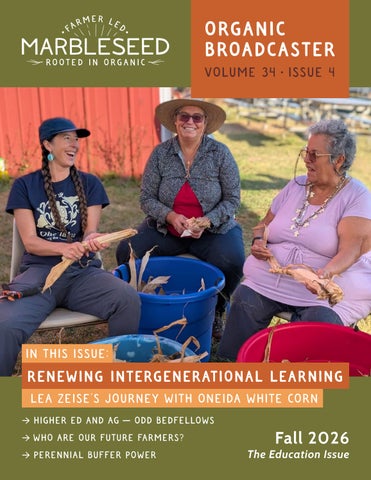
44 Media From The Field 45 Classifieds 46 Marbleseed Community Reading List On our cover → Zeise, left, with her mother and grandmother husking Oneida white corn.
F ROM O U R E X ECU T I V E D I R ECTO R LOR I S T E R N Ci rcular ity of Commu ni ty, L i f e , a nd Bage ls Late summer at our place saw the arrival of a modular wood-fired oven – to further feed my sourdough obsession and love of good pizza with all-organic ingredients. After scanning the multitude of online videos and internet wisdom, I decided on an oven that arrived on a pallet and included a steel stand that needed to be assembled. The oven weighed 650 pounds! We live deep in rural south-central Wisconsin on a bit of a hill. In the eight years of living in this place, we’ve gotten to know our neighbors. We may lack the evident people-diversity of a more urban landscape, but the range of experience, ages, and dare I say, on the surface, politics, are well represented. And we all help each other out. When a neighbor’s cows got out, we brought our four-wheeler to herd them back in. When we needed folks to slide a 650-pound wood-fired oven off the tines of the skid, from the pallet to the waiting stand, four neighbors showed up. And when we offered to pay them in pizza in three weeks, they all arrived – on ATVs, hungry and ready to hang out on the patio. We ranged in age from 17 to 73. There was a gun shop owner and a federal employees’ union representative. Conversation flowed from the weather, to conservation, to predictions of the fall hunting season. We talked about growing food and sharing it. We complained about roadwork and the politics of potholes and the township decision-making on meting out those resources. Our newest neighbor and I, who I’d met at a county meeting on housing, managed to reference her work at the bank and my work on collective farmland access. Collectively, this group so clearly shared similar observations and concerns. Yet the story we hear is about divide. The shared late summer evening, eating pizza, and enjoying guest contributions of beer and dessert, is the alternative reality. This could be another example of the power of food to gather. It could also be an opportunity to recognize what defines us as a neighborhood, and folks who help each other out. We head into fall feeling the loss of two people who were leaders by example in both gathering diverse perspectives and holding our rural values of shared resources. It felt so heavy to mourn Dolly Parton and Wendell Berry so close together. If you haven’t listened to the podcast Dolly Parton’s America, it absolutely speaks to these moments of divide and how Dolly still manages to bring us together. Wendell Berry is similarly grounded in belonging to a place and speaks to our agrarian sensibilities and value of care of the land, animals, and people. Both humans of personal spirituality, we feel their loss more deeply because they lived their beliefs through inviting us all in through their writing and poetry. “If you can find your own peace, you can do good for other people” was Dolly’s spirituality. While Wendell Berry famously wrote, “There are no sacred and unsacred places; there are only sacred and desecrated places” – an idea that speaks to caring for the land and the community of nature. Both provide guidance on how to be in the world. With pizza mostly conquered, I am turning to the real reason I got this oven – bagels. Working the dough, maintaining circularity, tending the fire, and boiling then baking are my own mindfulness practices. The ingredients are just flour and water with a bit of salt and sweetness. With a little more practice, you can bet I will be feeding our little hollow!
Lori Stern, M.A. Ed
NEWS & U P DATE S W H AT’ S G ROWING AT MA R B LE S E E D Staff Milestones Tom Manley
Tay Fatke
Work With Us Intern with our team to learn about the food system During the spring 2026 semester, Marbleseed’s communications team benefited from having an intern who helped research some of the schools and K-12 educational programs featured in this issue. As part of a class in sustainable agriculture, Maya S. identified schools in the Midwest with active farming, agriculture, and gardening programs. We have many opportunities for undergraduate and graduate students who want to learn more about sustainable and organic agriculture and nonprofits in general. Work areas include archiving and organizing digital materials, events planning, writing and research, and fundraising. Please reach out if you are a student or faculty interested in working with us.
Tom Manley – A decade on behalf of small, organic farmers On a team as small as Marbleseed’s, we all have a role to play. Tom Manley’s is officially that of Climate and Conservation Director. Just as importantly, he is a straight shooter who is passionate about the environment, well-versed in the issues facing organic farmers, and not afraid of speaking truth to power. We are celebrating Tom’s 10th year with us – work he does in conjunction with running his Mean Acres farm near Spring Valley, WI. Look for Tom at a Marbleseed event – he’s hard to miss in his sasquatch sweater – and thank him for all he does on behalf of the land!
We are so grateful for the work Tay Fatke has done on behalf of Marbleseed and our community. After four years in the role of Farmer Education Manager, Tay is stepping down from Marbleseed to concentrate on farming. Tay has been instrumental in developing content for the Organic Farming Conference and Marbleseed’s Field Days. Tay is the co-owner/operator of Mighty Wind Farms in Sister Bay, WI. Previously, he worked in quality assurance for Organic Valley. He has served on various boards, including Outpost Natural Foods. He was in the first graduating class of the Northeast Wisconsin Technical College’s Sustainable Food and Agriculture program (see p. 27). It’s been a pleasure to work with Tay and we wish him all best!
→ communications@marbleseed.org
New Resource Local Food Policy Resource Hub launched The Center for Agriculture and Food Systems (CAFS) at Vermont Law and Graduate School has launched the Local Food Policy Resource Hub, a new online resource designed to help a wide-ranging audience – including policymakers, practitioners, government officials, researchers, educators, and community leaders – understand and explore how states and municipalities across the United States are shaping laws and policies to support locally grown food. The Hub covers food access, agricultural production, urban agriculture, procurement, markets and distribution, land access, food waste, and other topics within local and regional food systems. It brings together a resource library, a policy database, and a policy technical assistance lab.
→ localfoodpolicy.org Organic Broadcaster | 4
SEED ING O U R CO L L ECT I V E F U T U R E 2027 O RG ANIC FARMING CON FE R E N C E E MB R AC E S COZ Y TH
ANNUA L
38
3
TH
8
AnnUA
L
lective Future, ↑ Seeding Our Colmin g Conference theme 2027 Organic Far
Lookin g to ward our coll ective futur e
F eb
26- 27
NEW LOC AT I ON ! L A K E L AWN RE SO RT DE L AVA N , W I
Meet us at Lake Lawn Resort in Delavan, WI, on February 26 – 27, 2027, for the 38th Marbleseed Organic Farming Conference! For nearly four decades, this annual gathering has been a cornerstone of the Midwest’s organic movement, uniting farmers, educators, and advocates for hands-on learning, shared wisdom, and community rooted in farmer-led, organic principles.
W i sco ns i n’ s olde st re sort The new location was chosen for the facility’s strong dedication to sustainability and more intimate size that better fits the conference’s current scope. “We wanted an opportunity to be in a more residential setting with a smaller number of attendees,” says Lori Stern, Marbleseed’s executive director. “Lake Lawn also aligns with our intention of hosting an event with a low carbon footprint.”
This year’s smaller and cozier space reflects our current attendance. We believe in rightsizing, and this moment calls for intimacy. Marbleseed’s staff and board wanted a gathering space that recalled our earliest conferences when it was possible to meet a sizable number of attendees and make connections that will extend beyond February. We wanted a lower carbon footprint than what a largescale convention center necessitates. And, frankly, we wanted to try something new! This year’s theme, “Seeding Our Collective Future,” was chosen to reflect Marbleseed’s dedication to hosting an event that meets its community’s current needs while preparing for a resilient future. “The farmers that provided us with the legacy of the conference came together around a specific need – learning about organic certification, both the process and production requirements, that they fought to create,” said Stern. “Today, consolidation and commodification of farmland are among the most pressing issues. We need to work together on this. The conference provides the opportunity to have a unified voice in seeking just, equitable, and durable solutions for access to land to grow healthy food and slowing climate change through organic stewardship,” said Stern. Registration opens in early December. Allied organizations will host pre-conference meetings on February 25. Visit the conference website below for more information.
→ conference.marbleseed.org
The oldest resort in Wisconsin, Lake Lawn Resort has a sustainability policy that includes recycling services, real meal-ware instead of plastics, and low- to no-paper events. It sits on a large, wooded property and has more than two miles of lakefront. Marbleseed weighed many factors in moving the conference location, after years of being in La Crosse – a community to which we are so thankful for their longtime support. Since the pandemic, many conferences have experienced lower numbers, ours among them. Simultaneously, there are more farming conferences to choose from, many of which focus on a specific production type. We are genuinely happy to be part of a richer, more complex network of farming organizations.
Program Cover Photo Contest
subm it your photos!
Submit your best farm photos for a chance to win FREE conference admission!
5 | Marbleseed.org
S U M MER FIELD DAYS A N abundance of hands -on learning
From cranberries to soil management, Marbleseed had a lively field day season! It takes many hands to make a field day happen – from planning months in advance to getting the word out and from ordering food to being prepared for poor weather. We are so grateful to the many partners and sponsors who made this summer’s events a success – especially to all the farms that hosted us on their land and the farmers who graciously shared their knowledge.
Organic Broadcaster | 6
J U NE
J ULY
25
30
O RG ANIC CRANBERRY F IEL D DAY
O RGANI C P OTATO FIE LD DAY
June — Organic Cranberry Field Day
J uly — Organic Potato Field Day
This was our biggest field day of the summer with 48 attendees; we think that’s because a lot of people had never experienced a cranberry bog firsthand. We learned about Wisconsin’s cranberry culture, production strategies, and organic certification. The cranberry coconut pecan bars were hit, too! One participant summed up their experience: “As younger cranberry growers, we like to try new things or push the limits. It’s refreshing to meet others who do as well!”
Igl Farms sits in an outwash plain in north central Wisconsin known as the Antigo Flats. Family-owned and operated since the 1930s, Igl Farm was one of the first commercial potato growers in the area. We learned about the biological farming principles the Igls follow, with a focus on balancing soil minerals, increasing soil biology, and improving soil tilth and structure.
at James Lake Farms, Three Lakes, WI
at Igl Farms, Antigo, WI
Fall f i e ld day au g
aug
06
23
C HANGEM A K E R F IE L D DAY
farmer advancement tra i ni ng
Au g ust – Changemaker of the Year
Farmer Advancement Training AND Foundations of Soil Health and Biological Fertility at Sobremesa Farm, Bloomington, IN
at Sharing Our Roots, Northfield, MN
It was great to reconnect with Sharing Our Roots (SOR), Marbleseed’s 2026 Changemaker of the Year. Khalid Elhassan of the Sudanese Farming Group discussed cultural grazing practices, while Erika Gomez, owner of La Tía Farm, shared her experience participating in local markets as an immigrant woman. Lunch, provided by the farmers, was the highlight of an already spectacular day!
au g
These back-to-back events were held in Bloomington, IN. The first brought together 15 beginning and aspiring farmers who were hungry for practical skills. The other was a chance to hear from internationally recognized regenerative agriculture educator, scientist, and engineer Jairo Restrepo Rivera. We explored the biological, mineral, and ecological processes that contribute to healthy and productive soils.
18 au g
24-25
Ryan Erisman of Odyssey Collaborative led 22 ag professionals in a day-long exploration of models for managing uncertainty and understanding behavioral drivers and resistance to change within the agricultural system. We heard lots of “ah-ha’s” about how change occurs, including one participant’s comment: “We can’t expect change if we don’t change ourselves, and let go of some things. And we can’t expect change if we make people feel defensive.”
Farmer of the Year Field Day Prairie Bluff Farm, Mt. Horeb, WI October 8, 2026 More than 40 people signed up for our final field day of the season. Our Farmers of the Year, Beth and Steve Albert shared their organically managed egg layer operation with us. We also learned how they’ve partnered with a neighboring county park to improve bird habitat.
LEARN MORE
→ www.prairieblufffarm.com
W OR K ING HA R D G RO U N D
Working Hard Ground in Madison, WI
FARMER OF THE YE A R field day REC A P
FO UNDAT IO NS O F SO IL HEALT H and Biologic al F ertilit y
A Gentl e ma n Farm e r Tak e s H is L e av e Remembering Wendell B erry
By Thomas Manley August was a cruel mistress indeed. A month with virtually no rain will keep a farmer up at night, regardless of production type, but to lose two folks who both personified real “American Exceptionalism” in a six-day period to close out the month brought dark clouds in a symbolic sense. As much as I would love to wax poetic about all the reasons we should adore Dolly, I am reserving these few inches of page for a man who is a big part of why I was drawn to farming in the first place. Wendell Berry was a novelist, a poet, a prophet, and a farmer. A Gentleman Farmer. I have long shared with folks my desire to someday be a gentleman farmer, half-jokingly, but I have never meant it in the way that phrase is most often understood. I am not a man of means who can farm solely for pleasure with no concern for the economic realities that are reflected in most of our experiences, nor do I really aspire to be. I do hope to be a gentle man who farms, and one who finds the beauty in doing it in a way that is consistent with the biological dance that defines our planet. I want to hear the song. These pursuits are at least partly rooted in Wendell’s work. I have a Wendell quote embedded in nearly every presentation I have ever delivered, and I know I am not alone. With his prolific output there is always a perfect poetic nugget to sum up a theme. Organic Broadcaster | 8
I will not recommend any particular work for those who are not familiar. It is safe to say you can start just about anywhere and find something of value, and there are lists all over the Googler now. I will be circling back and revisiting some soon as a reminder of why I do what I do. If you are reading this, I can say confidently it will not be a waste of your time and something will resonate. We have all heard the sentiment that a culture thrives when old men plant trees under who’s shade they may never sit, paraphrased a hundred different ways, but the idea is always the same. Leave it better than you found it. Trust in the natural world to provide, to cradle us in life and in death, to nurture. Know that there are generations to follow who will also rely on the gifts of the Creator, whoever you believe that to be. That sustenance is a long path, measured in lifetimes and rooted in gratitude, grace, and love. Wendell planted a lot of trees, real and figurative. Rest easy, Gentleman Farmer. MS
Tom is Marbleseed’s Climate and Conservation Director and Organic Conservation Specialist. Tom and his wife own a 40-acre homestead farm near Spring Valley, Wisconsin. They are working to develop a permanent, woody perennial-based system with alley cropping and grazing. He hopes to someday earn the title of “Gentleman Farmer.” He enjoys running, winemaking, and woodworking.
This Issue’s Theme Education
A N OT E F ROM O UR EDITO R It’s back to school time, and in this issue of the Organic Broadcaster you’ll find multiple articles that address the question: What is the role of education in ensuring there are well-trained farmers and agriculture professionals who can do the work of producing healthy food that sustains the natural environment and supports healthy rural communities? Wrapped up in farm, food systems, and agricultural education is the fact that we are on the cusp of a large number of farmers ageing out of the profession. Are we preparing a new generation to take their place? And are we teaching. young eaters where their food comes from and why the people who grow it matter? Since the earliest days of the U.S. education system, there has been a tension between institutionalized learning and farmer-to-farmer education. Freelance writer and farm worker Kenna Bell provides a history of that tension, while editor Jennifer New looks at one program in sustainable ag that is closing and another that is thriving and wonders why. A group of K-12 educators sat down with us for a Q & A about the role of school farms and gardens in the curriculum. And for our third installment of profiles of women farmers, we learn about Lea Zeise’s intergenerational project to rejuvenate a culturally significant food of the Oneida Nation. Finally, we offer you one of our favorite ways to learn: A great big book list! Thank you for helping us grow this via an open-access document. Go ahead and add other titles you think should be here, then look for a final list at the Organic Farming Conference in February! Jennifer New
9 | Marbleseed.org
CA N FARM ING BE TAU G H T ? TH E 250+ Year COMPLIC AT E D relationship between farming and higher educ ation
By Kenna Bell
↑ Class in greenhouse. Plant Sciences. University of Idaho.
I was finishing my master’s degree in Sustainable Development when I got a job at a local food nonprofit. My first project was to create a six-month farm business coaching program. What I initially envisioned as an educational program became something closer to a peer support and resource-sharing group, and my own role shifted from instructor to facilitator.
That first cohort ended up shaping something even bigger. Together, we solidified the curriculum structure for a much larger program my organization had already spent years building — a two-year farmer incubator program in which beginning and underserved farmers would be paid to attend. With funding through the USDA’s Increasing Land, Capital, and Market Access (LCMA) grant, we started in February 2025. But just three weeks in, the USDA cut most of the LCMA programs nationwide, and we came to a screeching halt.
I began my first coaching session with a disclaimer — I had resources to offer from the couple of seasons I’d worked on vegetable farms, conversations with farmer friends about their business and crop plans, and technical training in sustainable systems science. But I was a generalist, not a topdown educator. My job was to facilitate a farmer-to-farmer resource-sharing group and connect them to people who knew more than I did. At our first meeting — which included people whose first language was not English and for whom the United States’ agricultural system and Midwest climate were unfamiliar — I admitted to feeling insecure. I learned quickly, however, that everyone in the program shared some version of imposter’s syndrome. We all wanted to farm, and we were doing our best to figure out what that entailed. Organic Broadcaster | 10
While the immediate loss was a program, the longer-term effects are immeasurable — relationships that were never formed, knowledge that didn’t get passed on, farmers who didn’t find the land or support that could have helped them grow food for their communities.
“What exactly do you mean by ‘h i g h e r education’? ” I still haven’t resolved the tension I feel around this experience. Because of my educational background — that master’s degree and a bachelor’s in environmental studies — I got to work in a position of power over what beginning farmers learn and how they’re funded. The closest thing I had to field experience was a garden and a couple seasons on other people’s vegetable farms.
↑ Circa 1920s. The College of Agriculture’s flock of sheep grazed on the grassy
↑ 1908 Animal Short Course at UC Davis.
It’s a tension threaded through the relationship between higher education and agriculture. What is valued? Who holds power?
new farmers come from farming families, which means the question of who teaches the next generation carries a different kind of weight. Someone has to intentionally build the infrastructure that used to happen organically.
hillside southwest of Agricultural Hall. ©UW-Madison University Communications.
“What exactly do you mean by ‘higher education’?” was the question Corbin Scholtz leveled at me when I reached out to her for this piece. Currently, Scholtz is the farm manager at Seed Savers Exchange in Decorah, IA. After getting bitten by the farming bug, she left a pre-med program and has since owned and managed organic vegetable farms and food hubs, while serving in a range of leadership positions on nonprofit and governmental boards. I responded with the obvious — “Graduate-level training.” But I took her drift. The label is too narrow. Is farming a science handed down through a credential? A trade, earned through vocational school and apprenticeship? A form of community knowledge that predates the university system entirely? Depending on the era, American institutions have answered that question differently, and every answer has come with its own funding stream, its own idea of who counts as a legitimate teacher, and its own list of who gets left out. Farming has been taught in many spaces at once — in landgrant university lecture halls, rural high schools, farmer-led institutes, and on intergenerational family farms.
Th e curre nt conve rge nce While the tension over what counts as “real” agricultural knowledge and who gets paid for it is as old as American agriculture, two convergences are currently heightening the stakes. The first is generational. According to American Farmland Trust, as a generation of farmers age out, more than 40% of U.S. farmland is expected to change hands in the next 15 to 20 years. For most of American history, the transfer of land came with a transfer of knowledge; children learned from their parents over years of working together in the field and prior to taking over the stewardship of a farm. Today, fewer
The second thing is money. Over the past two years, federal and state funding for agricultural research and farmer education has absorbed one catastrophic hit after another. The current administration’s proposed budget for the 2027 fiscal year would cut $4.9 billion — nearly 20% — from the Department of Agriculture’s annual budget. This is on top of what’s already been lost: the Office of Management and Budget moved to cancel a wave of congressionally approved institutional research grants, leaving regional crop and climate research programs with funding gaps they haven’t recovered from, and a 2025 funding freeze that forced university labs to shut down mid-project. Some of those cuts, like the LCMA program I was involved with, have since been forcibly reinstated by the courts, though the uncertainty itself does lasting damage as people leave jobs to avoid it happening again, or organizations become much more conservative with their work. Extension offices have cut positions, stalling soil health and climate adaptation research. This is more than a crisis for farmer training, it’s a crisis for the research itself. As extreme weather becomes commonplace and farmers face uncharted territory, the need for research into soil health and water management is more urgent than ever. It’s also some of the least commercially profitable, which means it depends disproportionately on public funding in order to exist.
How did we get here? Formalized structures for teaching and researching agriculture date back to an idea the country’s founders held close – that a nation’s survival is tied to the health of its land.
11 | Marbleseed.org
C A N FARM ING BE TAUGHT ? ...
Most of the oldest universities in the U.S. were founded to replicate the kind of elite European models of education that did not include agriculture. However, the country’s founding generation were farmers themselves. George Washington and Thomas Jefferson both ran working farms and were interested in crop rotation and soil health. As early as 1796, Washington called on Congress to establish a national board of agriculture. It took nearly 70 years, and a civil war, for that to become policy. When Congress finally created the USDA in 1862, Lincoln called it “The People’s Department.” That name obscured the truth that the agricultural expertise the country was built on hadn’t come from a department or a college. It had been developed and carried, largely uncredited and uncompensated, by enslaved people on stolen land. Knowledge, resources, and capital were extracted the same way the land under the first agricultural colleges would be — from people the system refused to recognize as experts, even while depending on their expertise. The Morrill Act was also passed in 1862, granting each state 30,000 acres of federally owned land to fund colleges focused on agriculture and the “mechanic arts” — engineering in today’s terms. It was radical on paper. For the first time, public higher education was built explicitly for the working and farming classes, not just the elite. The Hatch Act of 1887 followed, funding agricultural experiment stations attached to those colleges and establishing an ongoing federal role in producing agricultural research. The Smith-Lever Act of 1914 created the Cooperative Extension Service, which put university research into the hands of county agents who carried it directly to farms — the first formal system for moving new practices in soil conservation, crop rotation, and home economics out of the lab and into the field. Organic Broadcaster | 12
↑ A student working on a college-operated farm. Image source: USDA. Together, these three laws built an ambitious public infrastructure for producing agricultural knowledge and moving it beyond the ivory tower. The system was never as simple or as democratic as that mission suggests. In 2020, High Country News documented how nearly 10.7 million acres were stolen from almost 250 tribal nations, through more than 160 treaties and outright seizures, to endow 52 landgrant institutions. Black Americans were largely excluded from those schools; the Second Morrill Act of 1890 created a parallel, and chronically underfunded, system of historically Black land-grant universities.
S pecial iz at ion an d the corporate un iversity The earliest land-grant curricula reflected a desire for rigorous, applied science, producing a new class of “agricultural experts.” Perhaps in reaction to this, farmers organized through groups like the Grange — a coalition founded in 1867 to educate rural families in modern farming techniques. Operating more like a trade school, these offered practical, accessible instruction, not elite institutions applying theory to rural life from afar. Over the twentieth century, American universities as a whole became bigger, more specialized, and more entangled with corporate money. Engineering, medicine, and the sciences all saw a similar pattern. As research and the technology needed to do it became more expensive, corporate and federal funding was necessary to keep labs running. Success increasingly meant staying siloed within a narrow discipline rather than working across several. Agricultural research followed the same arc, shaped by the postwar “get big or get out” era that pushed farming toward specialization, mechanization, and dependence on expensive inputs.
“ Over the twentieth century, A merica n universities as a whole became bigger, mor e specializ ed, and more entangled with corporate money... Succ ess incr easingly meant stay ing silo ed withi n a narrow disc ipline rather than work ing across seve ral.” — Kenna Bell
In 1980, Congress passed the Bayh-Dole Act — not an agricultural law, but a change to federal patent policy that let universities license inventions developed with federal research dollars to private companies. It’s part of why so much university-developed crop genetics and seed technology ended up licensed to a small number of seed and chemical companies rather than staying in the public domain. Today, Bayer and Corteva alone control 72% of the U.S. corn seed market and 66% of the soybean seed market.
Who s e ts the curri cular and re se arch ag en das? All of this affects what gets taught. Carly McAndrews experienced this firsthand. She started working on farms as an undergraduate at the University of Vermont but couldn’t see a clear path from farmhand to farm owner. As someone who had no family connection to agriculture, she felt she needed more education. This is the approach many U.S. students are taught to think about knowledge and work — the next job, the new skill, the societally recognized “title” are just a degree away. She enrolled in a master’s degree in sustainable agriculture at a Midwest land-grant university in hopes that the credential would provide external confirmation of her skills. Instead, she often found herself disconnected from the kind of farming she wanted to do. Frustrated by the lack of “fit” between her interests and the curriculum, she began noticing a pattern in the biographies of guest lecturers. Rather than doing research that might be most helpful to sustainable, organic agriculture, most of them were funded by industry. “You’re going to this talk that’s being presented as purely research and empirical data, only to find out that it’s literally funded by corporations,” McAndrews told me. She walked out of many sessions feeling like she had watched an advertisement.
Farmers teachin g farmers In a system built to reward specialists, organic and regenerative farmers are generalists by necessity. Soil chemistry, mechanics, marketing, labor management, and more are all part of the job. The farmers who didn’t fit the land-grant model, including smaller operations, diversified farms, and farmers without inherited land or capital, kept building their own knowledge systems. They learned from neighbors, formed co-ops and associations, and carried practical wisdom across seasons in ways formal institutions could not. Regional organizations formalized that work starting in the 1970s – the Maine Organic Farmers and Gardeners Association in 1971, the Ohio Ecological Food and Farm Association in 1979, and what’s now Marbleseed in the 1980s. Each built from the ground up in partnership with the farmers they serve. Seed Savers Exchange took on protecting culturally diverse crop seeds, and the Rodale Institute anchored organic research nationally. Scholtz got her farming education this way. Just as she was about to enter medical school, she pivoted. Her interests in human health and ecology led her to enroll at The Organic Farm School, a vocational program in Washington state that teaches all aspects of small-scale organic vegetable farming. Returning to Iowa, she started Rainbow Roots Farm. By her third year, she had 100 CSA members; “pretty unheard of,” she said, crediting her training in Washington with helping her understand the entire scope of farming. But she is clear that even the strongest training program can’t make up for the systemic issues farmers face. Scholtz says that while farmer-to-farmer education is great, helping one jump start or improve their business, it’s not enough: “I really don’t think that in the long term it’s going to help out. There’s no safety net, no matter the education level, to keep farmers farming.” 13 | Marbleseed.org
C A N FARMING BE TAUGH T ? ... S UC C ES S FUL MODELS There are inspiring and successful examples that already exist outside federal or corporate funding. To name a few:
→ Soul Fire Farms trains Black, Indigenous, and Latine growers through immersion programs funded largely by its own Reparations Map, connecting farmers directly with people willing to give with no strings attached. → The Northeast Farmers of Color Land Trust runs a formal
reparations program on the same premise, moving land and capital directly from those who hold it to farmers who need it. Agrarian Trust holds farmland in community ownership so access doesn’t depend on any single owner, lender, or federal program surviving intact.
↑ Image source: USDA.
→ Indigenous communities are creating legally recognized food and farming cooperatives built on ancient community practices. (Read about the Ohe-láku cooperative on p. 21.)
B u i ld ing br id g e s, cr e at i ng ne ts
Our surv ival depen ds on it
Scholz is alluding to the structural barriers inherent in farming, especially small- and mid-scale, that keep so many people from entering the profession or push them out. Land access, capital, equipment, healthcare, viable markets, and the economics of building a life from a farm without burning out are not taught in most ag programs at the college and university level.
Whatever comes next, much is riding on this shift. Washington and Jefferson understood, in their own way, that a nation’s survival was tied to what happened in its fields. As we collectively navigate the changing climate and a local food system under fire, a version of that same idea still points toward what the future could look like.
The strongest systems don’t ask farmers to choose between research-based knowledge and hands-on experience; they build pathways for those systems to work together. Extension offices have long partnered with nonprofits to provide technical assistance and in-the-field education; land-grant researchers work with farmer networks to test practices. The USDA’s Beginning Farmer and Rancher Development program, established in the 2008 Farm Bill, has funded community-based training. Successful education also does not extract knowledge from farmers without payment or recognition. It does not place them below PhDs in terms of their worth. Rather, it accords them funding that can withstand the fickleness of the federal funding cycle and grants them decision-making powers. As the cracks in the current system become ever larger and more apparent, many are wondering what’s next. Mutual aid, collectivism, cooperatives, and intergenerational knowledgesharing all seem to be part of the answer. We need to acknowledge that there’s no one-size-fits-all solution. Rather, we need to appreciate and respect — through funding and other forms of legitimization — that farming communities possess great knowledge and expertise. Organic Broadcaster | 14
A public agricultural education system requires public investment. We need fewer corporate partners setting the teaching and research agenda. While corporate money can lead to certain advancements, the tail cannot wag the dog. We need to fund work that may not be inherently wealthenhancing but may be very health-enhancing. I built a small piece of farmer-education infrastructure with a master’s degree and not nearly enough field experience. And then I watched it nearly disappear over a federal funding decision that had nothing to do with whether it was effective. That’s not a reason to abandon hope. It’s a reason to turn more attention and support toward what is and always has been most resilient — one farm coalition, one land trust, one shared crop plan at a time. MS
Kenna Bell has built her career around local food systems, from Midwest summers on vegetable farms to nonprofit work in farmer education and advocacy. She recently moved to Oregon where she is working on an organic farm.
“ The strongest systems don’t ask farm ers to choose betwee n research- based knowledge an d hands- on experience; the y bu i ld pathways for those syste ms to work to gether.”
↑ Image source: USDA.
COWSMO COMPOST & POTTING SOIL BULK BAGS TOTES We equip students with professional expertise, create broadly accessible resources, and provide legal support in food and agricultural law and policy.
Resource Library Browse 100+ reports, guides, issue briefs, fact sheets, and other resources.
CAFS Projects We develop tools and resources in partnership with community organizations, research institutions, and stakeholders across the country.
Study with Us Set within a top-ranked environmental law program, we offer degrees and courses with a systems-based focus.
COWSMO COMPOST S 1843 COUNTY RD U COCHRANE , WI 54622
Visit us at
cafs.vermontlaw.edu
JOHN
608-626-2571 CELL 715-495-5462 15 | Marbleseed.org
“ GO, FARM! ” educating the nex t generation of growers
↑ Highschoolers working at their school district’s garden in Columbia Heights, MN.
“ I try to plant th e seed that th e r e ar e all sorts of ways
to be involv ed with agricultur e .” — Zac har y Haselho r st, Gue rin Cath ol ic Sch ool Many of us know the looming problem: new and beginning farmers are entering the industry at a far lower rate than older farmers are retiring. What are we doing to prepare the next generation of farmers? Are young people even being introduced to agriculture — especially small-scale, sustainable agriculture — as a possible career path?
Brian Merkel is a professor at University of Wisconsin-Green Bay who leads a STEM research program for area high school students focused on soil health. And Zachary Haselhorst is a high school social studies teacher at Guerin Catholic School in Noblesville, IN, who founded and directs the school’s organic farm.
For many schools, the answer is no. Farming may be introduced at the lower grade levels as part of a social studies unit about food. Some rural schools have ag programs that tend to echo the what’s taught at many land grant universities — a focus on largescale production.
Mark Quee (MQ): Scattergood was founded in 1890 and has always had a farm component. It’s looked different ways through the years. In the 1960s through the 80s, every sophomore had a sow. The alumni always talk about their sows!
We spoke to four educators who are actively introducing today’s K12 students, the people who will be of work age when this great transition occurs, to the practice of sustainable farming. Mark Quee manages the organic school farm at Scattergood Friends School in West Branch, IA, as well as teaching humanities. Melissa Trent is the agriculture specialist for the Columbia Heights School District near Minneapolis.
In 2003, we decided to start raising as much food as possible for the school. We’re feeding around 75 people a day with lunch as our largest meal — though since we’re a residential school, there are three meals served a day. At the end of every meal, the cooks announce what came from the farm, and everyone shouts: “Go, Farm!” We really see meals and eating as part of our curriculum.
Organic Broadcaster | 16
Marbl eseed (MS): Tell us about your program an d its history.
↑ Bringing in the harvest at Scattergood, CSA share boxes line the hallway at Guerin Catholic School, and elementary students in Columbia Heights, MN sell their produce. We’ve added beef, sheep, and broilers. Since then, all the meat eaten by the school is grown here — it’s all grassfinished. Vegetable production is more complicated because of the school calendar, though I’ve gotten better at adjusting our planting schedule. From August to December, all our vegetables come from the farm, which is entirely certified. We have a high tunnel, so we have greens in the spring, usually by March. Melissa Trent (MT): Blooming Heights is our garden. We use it to engage all the senses and build skills and knowledge. Our district has five schools, an early childhood program, and an adult learning program, all of which access the garden. The curriculum is very seasonal. In the summer we have a camp for elementary school kids that includes the garden. I hire six to eight high school students to apprentice with me. We harvest a lot of perennial fruits, such as gooseberries and serviceberries. Our lessons follow the seasons. A big aim of the program is to understand the rhythms of growing food. I include kids in the planting as much as possible. I really want them to see that it’s part of the community. Brian Merkel (BM): I’m coming to this conversation from the university level, where 60% of students who intend to major in STEM switch because they’re underprepared. We’re trying to cure that. Jo Handelsman is a leader in research on soil microbial communities. She’s also very involved with efforts to improve science education for women and minorities. She started Tiny Earth at the University of Wisconsin-Madison to address the diminishing supply of effective antibiotics, the rapid decline in soil health, and the need for more research scientists. My wife teaches science in Green Bay public schools. We wondered how we could deliver this college-level curriculum to high schoolers. We began in 2021 with a summer skill camp model, in which students research antibacterials that the soil is producing. We’ve been so successful that all students in Green Bay high schools can now take this as a course and get college credits. They present their research at a huge annual event at the University of Wisconsin. We’re now reaching out to rural high schools and looking for ways to collaborate with local farmers.
Zach Haselhorst (ZH): Guerin is a Catholic high school with 800 kids, grades 9 to 12. Three-fifths of my teaching workload is social studies; the rest is the farm and teaching a food justice elective. I had been teaching for about eight years and was feeling burnt out. I was getting more into farming and told my principal that I might leave teaching to go into market gardening. I attended a sustainable agriculture conference and went to a workshop on how to get into market farming. There was a slide about the realities of income that made me realize I couldn’t do it on my own, but I could do it at the school. I was lucky that I had a principal who supported me. He put the word out to our parent guild to get a grant. They gave me $3,000 to start it up. The farm is two-thirds of an acre and is right on campus. We have 54 50-by-3-foot beds. There’s one high tunnel with seven growing beds in it. We have about 18 young fruit trees, a row of blackberries, and an asparagus patch. We intermix flowers and crops — brassicas, potatoes, tomatoes, peppers, squash. Our first year was 2020, and we did a nine-week CSA with eight customers — just to see how it would work. Now, we fill 30 boxes a week for a 20-week season. We also have a 12week flower CSA (which the kids and parents love), and we do a plant sale in May. We give ten percent of what we grow to target local food insecurity.
MS : How is the farm built in to the curriculum? MQ: Scattergood calls the farm a living laboratory; it’s incorporated into the school in numerous ways. Middle school starts each morning doing farm chores. It’s about a half mile walk, so that helps them release some energy. We have a Crew Period during the day when students and staff keep the school facilities up to date. Farm Crew gathers eggs, feeds livestock, and harvests produce. Our high school students can design independent study courses around sustainable agriculture issues; one was about researching and implementing pig socialization methods, and another was on developing rootstocks for our fruit trees. The first month of every school year is called Farm Term. It’s where 17 | Marbleseed.org
educating the nex t generation of growers... “ Bruss e ls sprouts blo w th eir m i n ds! It ’ s n ot a can n e d curri culum — it ’ s r e al w orld. Th i ng s ar e always chan g in g. Th i ng s ar e always g o in g to g o w ro n g . ” — Mark Qu ee, S c at t e rgo o d
we set the tone for the year and develop relationships. There was a class centered around Annie Dillard’s Pilgrim at Tinker Creek and another about manure and soil management. MT: About 50% of the garden program is K5 classroom curriculum that enhances their biology lessons. It’s a combination of planting, harvesting, and tasting adjusted to the grade level. In addition to science, I try to bring in social emotional learning. For instance, at every taste test, we thank the trees and pollinators for helping to produce what we’re eating. At the high school-level, there’s a global food class. We learn where foods come from, and we learn about cultural production. High school students also have volunteer opportunities in the fall and spring, which go toward their college preparatory applications. BM: The magic of Tiny Earth is that you’re setting students loose. The message I got when I was a student was “look but don’t touch,” which is a really negative message. After doing the Tiny Earth class, students tell me they feel like they’re a valued member of the community for the first time. They’re part of a network that is addressing a worldwide problem. The kids choose the site for their soil sample. They must provide a hypothesis about why they’ve chosen the site, and I’m always surprised by their innovation. The students find that the research techniques are well in their capacity. And then they teach others about their research at the annual conference. It’s a real confidence booster. ZH: There’s not much cross-curricular involvement with the farm right now, though I’ve been talking to science teachers about soil testing. So right now, teaching related to the farm is all me. There is a farming elective offered during fall and spring trimesters. And there’s a summer internship that’s unpaid. Kids fill out a contract to commit at least 50 hours and sign up for time slots.
Organic Broadcaster | 18
↑ Students at Scattergood digging into the hands-on curriculum. The Farming and Food Justice elective meets on the farm at least three days a week in work teams. When we’re meeting in the classroom, we look at these issues through a Christian world view of caring for God’s creation. I try to expose students to the realities of the ecological crisis we’re in, and ask, “Ok, fellow Christians, how are we to respond?” We cover food systems thinking, no till, soil biology, food access, and more.
MS : What ar e the reaction s you’ v e s e e n from studen ts to this kin d of ha nds-i nthe dirt lear n in g? MT: The younger kids have a lesson about soil during Earth Week. We dig for worms and learn how earthworms are invasive but useful. We study their anatomy. They’d do it all day if you let them! At third through fifth grades, we focus on sifting compost and study decomposing animals and insects. They develop curiosity for insects they had been afraid of. Overall, their interest in decomposition is really strong; they ask great questions, and it solidifies that they’re gaining an understanding of natural systems. In high school, we do a lot with soil. We test for soil composition and do the ribbon test. At some point, there’s always a spark of understanding as to why it’s important. Students are very impressed by how much is in soil, and how it is alive and dirt is dead; that opens a lot of questions. MQ: I’m always amazed by how many students don’t like getting their hands dirty. I hear a lot of surprise about what seems kind of basic — “I didn’t know beets grew underground!” Brussels sprouts blow their minds! It’s not a canned curriculum — it’s real world. Things are always changing. Things are always going to go wrong. It’s built into the whole school culture. We have a really complex composting system on campus. They’re always confronting composting decisions and thinking back to what they’ve seen on the farm. It makes it much more real.
BM: This isn’t about dirt, but a positive thing I’ve seen with Tiny Earth is that it normalizes failure for kids. Failure is core to scientific research, but it’s not something we teach very well. A lot of people are uncomfortable with it. ZH: At first, I was worried about getting students to sign up. This school is very suburban and affluent. It’s rare for a student to come into the class with any experience of working with their hands or having their hands in the dirt. They’ve probably never thought about where their food came from. Most of them are, frankly, pretty indifferent to ecology. My class is always at the end of the day, and students tend to sign up because it’s outside and they can work with their hands — that’s the buy in. The ones who get hooked often sign up for the summer internship. It’s great watching them problem solve. Last year our tomatoes had aphids. I told them that if they saw a ladybug on the thistles, they should move it over to the worst-looking tomatoes. They did it, and after two weeks, we saw more ladybugs. By the third week, the aphids were gone. They got to see non-chemical pest management firsthand.
M S : A r e local farme rs i nvolve d with your pro g ram? ZH: One of my mentors is Teeter Organic Farm, which is just down the road. I get a big truck of our soil potting mix and share the cost with them. They’ve come over and helped with the hoop house. There’s a flower farm in the area, and I’ve gone to her to get plugs when my seeds weren’t germinating. I find a lot of purpose in introducing them to where their food comes from. We have guest speakers, including farmers, and go on field trips. We visit urban farms, so they can see you don’t need to live in a small town to farm. BT: As we work with more rural schools, we’re hoping to develop relationships with farmers. Obviously, there’s a shared interest in improving soil health.
M S : D o you talk about the curre nt stat e of ag r i cultur e and th e future of farm i ng at all? Do you se e stude nts wa n t i ng to g o i nto th i s are a? MQ: I’m pretty clear with them that contemporary agriculture is a mess. What we’re doing here [at Scattergood] is on a 1950s scale, and no one can make a living in it. MT: I went to college to become an organic farmer. I learned how much of a lifestyle it is, and how challenging it is to make it viable. Based on that, I turned my work choices toward education and food justice. It’s important to connect people to farms and food. At a baseline, food is political. I want to get students to think about how they interact with food at all different levels. I want to introduce them to unique farmers who are leading conversations about systems change.
↑ A student planting seeds with a Jang seeder at Guerin Catholic School. ZH: I’ve had one student who went to college for engineering but remained interested in farming. She came back to this area after college, and I hired her as my farm assistant. Now she’s the farm manager at a nearby nonprofit. Another student studied sustainable agriculture at Purdue. I try to plant the seed that there are all sorts of ways to be involved with agriculture.
MS : Fin ally, ho w do you w ish ag r i culture an d farmin g were wov en in to the majority of K12 education? BM: I would like to see schools help raise awareness of these issues and expose students to opportunities. If there are great model examples, if there’s discussion about what’s possible, then it’s our responsibility to each other to be involved. Whether it’s soil health or something else, it can’t be someone else’s problem to solve. MQ: I wish there were more opportunities for people to raise high-quality food for people they know and love and to get health insurance doing it! Every school district should have a farmer on staff who brings food to the cafeteria and involves students and teachers. Why not?! MT: There’s so much opportunity for our STEM curriculum to be focused on food and ag — it’s all science-based. Connections can be made to math, history, and English. I’d love to see a garden or farm in every school district — with paid positions linked to them, not volunteer-run gardens. ZH: It makes so much sense for schools to be part of regional food hubs. At a minimum, with farm-to-school, we can have pictures and labels in the cafeteria of exactly where the food came from — a kind of passive education. School-based farms should be more common; the business model works. Starting my own farm wasn’t viable, but at a school, there’s already a water supply, walk-in coolers, free labor, tools and maintenance, electricity, and a customer base for the CSA. Schools have so many advantages over a startup market farm. It’s not as big of a leap as people think. MS 19 | Marbleseed.org
ER
—
th
cu
YE
M A N FA R M
e
bearer
I N T E R N AT
re
ION
u lt
AL
AR
OF
WO E H T
Colonialism has cut all of us off from our ancestral seeds. The powerful stories that many cultures shared via seed keeping, planting, and harvesting, have been forgotten. But around the globe, Indigenous communities are actively renewing their relationships with seeds. This work takes not only agricultural skills but detective work to locate seeds and, sometimes, diplomacy to access them.
In its International Year of the Woman Farmer, the United Nations highlighted areas in which women have been disadvantaged, including low pay and unequal land access. The campaign has also uplifted some of the practices and gifts women bring to agriculture – care for the natural environment, attention to intergenerational knowledge, and collaboration building. In many cultures, women have served as seed keepers. Before we bought our seeds, it was frequently women who collected, traded, and tended them, ensuring the knowledge possessed by each one was carried forward. In what is now North America, many Indigenous people hold that seeds are living relatives. Rowen White, an activist for Indigenous seeds, says, “Each one of us descends from people who have been in an intimate and reciprocal relationship with plants and seeds since the dawning of time.”
This month, we feature Lea Zeise, an Oneida Seed Keeper. Along with other women from her Tribe, Zeise has brought back one of the most fundamental foods of her people – Oneida white corn. Not only have the women learned and created the right growing conditions for the corn to flourish, but they continue to fight to get the seeds they view as rightfully theirs from institutions like the Missouri Botanical Garden. (Bayer, which patents its GMO seeds, is a major donor to the Garden.) Zeise’s story is one of farmer as culture bearer – a role we too often overlook.
↑ “Autumn” is the third of a series of seasonal prints by Frances Whitfield we’ll share throughout the year in honor of the International Year of the Woman Farmer. Whitfield is a freelance illustrator and printmaker, and muralist in rural Herefordshire. Follow her Instagram @pan.makes. Organic Broadcaster | 20
CA RING FO R CO RN & commu n it y L ea Z eise ’s journey with Oneida white corn
“ Cor n always had a pla n for us . W e w e r e just o n a n e e dto- k no w bas is ” — Le a Zei s e, Oh e · l á ku
When Lea Zeise started growing corn more than a decade ago, she didn’t know very much about soil health or organic fertilizers. She had graduated with an engineering degree, and though she was working for the Intertribal Agriculture Council, her farming chops were far from anything to brag about. Nor was it the path her family thought she would choose. “As a first-generation college student, my nana was really excited for me,” Zeise says, then laughs and shrugs adding, “Then I told her I wanted to go into agriculture!” But corn had a plan for her. She’s been following it ever since. Zeise grew up on the Oneida Nation Reservation, just west of Green Bay, WI. She thought her career would be in renewable energy. But then, she says, she “realized that we have all the technology we need to live in balance with the earth. What we need is to remember our role in our ecosystems, to give thanks to them and to take only what we need.”
↑ Zeise, center, with other. members of Ohe·láku Bein g in relation sh ip with corn On a work trip, she visited the ancestral homeland of the Oneida and other Haudenosaunee people. Also referred to as the Iroquois, the Haudenosaunee Confederacy is an alliance of six sovereign nations with historic homelands in present-day New York State and parts of Canada: the Mohawk, Oneida, Onondaga, Cayuga, Seneca, and Tuscarora. On a work trip to New York state, she hoped to buy some Haudenosaunee corn products but was disappointed when she was sent to a white farmer who was growing their ancestral corn. Returning home, Zeise shared this experience with her mother, a longtime community organizer. Her mother was angry but also noted that they couldn’t point fingers. There was a shortage of white corn on the Oneida Nation Reservation, and their family wasn’t taking care of their responsibilities to grow it. So, they planted a few acres of corn as a family. With no farming experience to speak of, they were soon outpaced by weeds that took over the field. That fall, they were grateful for their small harvest, and the lesson corn had taught them – growing corn is hard work that needs community. “Our cosmological world view is that corn is alive,” Zeise explains. “She’s agreed to stay here and take care of us. We have to take care of her in return. We are in relationship with these seeds.” 21 | Marbleseed.org
H ISTO RY O F ONEIDA CO RN
C ARI N G FOR COR N & COMMU N I T Y. . . Growin g commu n ity, sharin g struggles That first year of growing corn was a lesson in the need to reestablish community. For this, Laura Manthe, Lea’s mother, was integral. She had already played a big role in her daughter’s interest in the intersection of the environment and Indigenous foodways. During Zeise’s growing-up years, Manthe was a community organizer who brought her to meetings opposing Exxon’s planned zinc-copper mine in Forest County, WI. Zeise was out of class so often that school authorities worried about truancy, but Manthe was confident her daughter was gaining crucial knowledge. “I learned a lot about how to organize a group of people toward a common cause,” says Zeise. “My mom really ingrained in me personal power and confidence. She taught me how to facilitate and foster a shared group purpose.”
A LONG-st ewarded relationship The Oneida are one of the original five nations of the Haudenosaunee (Iroquois) Confederacy. From their original homeland in what is now central and upstate New York, the Oneida allied themselves with the colonists during the American Revolution. In the harsh winter of 1777-78, an Oneida group led by Polly Cooper brought white corn to George Washington’s camp at Valley Forge. Cooper taught the troops, who were near starvation, how to correctly prepare the corn. Despite the Oneida’s service, the colonists broke their promises and allowed millions of acres of Oneida homelands to be sold. By the 1820s, with only 32 acres remaining, some Oneida relocated to an area just west of what is now Green Bay, WI. The Oneida Nation Reservation was formally established in 1838. They brought their seeds with them on the journey. Oneida white corn is also known as Iroquois or Tuscarora white corn. It has pale yellow kernels, long ears, and stalks that grow as much as 18’ high. Its indigestible hull requires processing, traditionally using wood ash or culinary lye. Often prepared in stews and soups or as corn flour, it is high in protein and fiber with a low glycemic index.
LEARN MORE → https://ohelaku.org
The Oneida are matrilineal. Especially in the areas of land and foodways, women take the lead. Together, mother and daughter decided to explore their community’s relationship to corn. Hoping to gain insights and mentorship, they called for a meeting at the 2015 Food Sovereignty Summit to interview other Haudenosaunee farmers. These annual gatherings are a space for intertribal exchange of knowledge and foods. Not unlike the annual Organic Farming Conference, they’re an opportunity for people to share what is working and get help with challenges. What they learned was that they were not alone in their uphill battle against weeds and depleted soils. And if they did produce corn, the small plots typically grown at that time were easily ravaged by animals overnight. “At that meeting,” Zeise recalls, “we learned how many shared struggles we had.”
SAR E gra n t jumpstarts project Undaunted, they applied for and received a SARE grant. In 2016, with Manthe as the project coordinator, they secured land from the Oneida Land Commission, and adopted the name Ohe·láku (Oh-hey-LAH-goo), which means Among the Cornstalks. The goal of the SARE grant project was to test if modern fish emulsion sprayers could successfully serve as a sustainable substitute for the traditional practice of burying fish guts beneath corn mounds. Via the grant, they hosted Val Dantoin, then an instructor at the Northeast Wisconsin Tech College, to give a public talk about soil sampling, organic fertilizers, and ways to build soil health. While many people attended to improve their gardening skills, Zeise and Manthe used the meeting as an opportunity to build a cohort of families who wanted to grow corn together. “We had to decolonize our thinking about land, seeds, and food,” Zeise wrote later of that moment. “At first, we thought we would divide up the parcel into individual family lots and grow apart . . . [but an elder reminded] us that our ancestors never grew that way. They grew together, planting one row for each clan until the seeds were all in the ground.” In May 2016, Ohe·láku put its first seeds in the earth. Following a tobacco ceremony, they planted about 16 pounds of seed. For the sake of scientific comparison, some people continued to plant in backyard gardens, while others grew the corn communally on the tribal property plot. They met weekly to hand-weed the rows and sing to the corn; eventually, they recorded the songs and shared them on a CD.
“ W e harv e st all by han D, W e husk it a nd bra id it. It tak e s about o ne thousan d hours p e r acr e .” — Le a Ze ise , Oh e·l ák u
↑ Zeise, left, with her mother and grandmother. H arv e st ing corn and re lati onsh i ps In their 2018 SARE grant report, the group summarized the results of their first three years: “One-hundred ninety braids of corn were hung from the rafters in the rented barn in 2016, 250 in 2017, and 439 in 2018. The hanging weight of the corn braids on Monday, January, 2, 2017, was 1,520 pounds. The hanging weight of the corn braids on Saturday, February 10, 2018, was 2,030 pounds.” In those first years, they estimated that each participant received 60 pounds of shelled soup grade corn, and five pounds of seed grade corn to replant. As impressive as that yield was, Zeise says their greatest success was in reestablishing their relationship with the plant and with each other – relationships built through time. “We harvest all by hand,” Zeise explains. “We husk it and braid it. It takes about one thousand hours per acre.” The corn has about six times the moisture content as conventional corn. The tough outer husk is removed before cobs are braided and hung to dry for six to eight weeks.
M a n y k i nds of succ e ss Members learn patience, not just with the growing process but with each other. In spending hundreds of hours together, Zeise says that it’s inevitable you’ll become annoyed with others. The group doesn’t allow swearing or showing up under any substance and maintains commitment to positive communication. “If you can’t do that, you need to leave,” Zeise explains. “It’s really good practice.” In its first year together, the group identified what success would look like: reestablishing their relationship to the corn, learning new skills, trusting each other, learning the language (each meeting begins with introductions in the Oneida language), participating in ceremony, and building relationships with their relatives in New York and Canada – and beyond. They’ve traveled to learn about other Indigenous communities’ relationship to corn, including to Ecuador, Mexico, and New Zealand.
Ohe·láku operates as a non-profit cooperative. In only the rarest circumstances do they accept money for the corn, notably through the Tribal Elder Food Box program. Instead, Zeise says, they’ve focused on reestablishing bartering relationships with other Tribes. Strengthening their food sovereignty, they use value-added corn products, such as flour and soups, to trade with other tribal producers for wild rice, maple syrup, fish, venison, and other traditional foods. All of these provide a much higher nutritional benefit than storebought, processed foods. Notably, Oneida white corn has no sugar and a high protein content. In reflecting on the group’s successes, Zeise wrote in an article that their project convinced the Oneida Land Commission to develop a new policy for Oneida cooperatives wishing to grow traditional foods: “We think of this as our first achievement because we opened the door for other cooperatives to request land. We also learned that while we may have planted seeds, what we were growing was farmers equipped with ancestral knowledge and children with a deeply rooted sense of place.”
Deepen in g her comm itm en t Zeise recently left her job with United South and Eastern Tribes to focus full time on Ohe·láku. She is overseeing construction and initial programming for a 3,3600-squarefoot cooperative processing and teaching facility, one of five tribal infrastructure projects in Wisconsin as partners of the Great Lakes Intertribal Food Coalition. The building was named Kwà Tsiʔnikanahsto:tʌ (All Kinds of Corn) by Oneida elder Bob Brown. It will serve as a place for Oneida people to learn, connect, and grow the future of our relationship with corn. As Ohe·láku’s new building comes into being, Zeise is motivated to use the space to connect Oneida language studies with hands-on corn activities. Only a few firstlanguage speakers remain across the Oneida territories, like the scarcity of white corn ten years ago. But Zeise is hopeful that by working together, they can weave a future of Oneida language speakers just as they created an abundance of white corn. “Corn always had a plan for us. We were just on a need-toknow basis,” says Zeise. MS 23 | Marbleseed.org
T h e Suda n e s e Farm in g Group G rowing Community, D eepening Cultural Roots
Intergenerational learning. Collaborating across continents. Cross-global sharing. Cultural pride. These are all central tenets of the Sudanese Farming Group. The group (SFG for short) was formed in 2022 by a small group of Sudanese immigrants, all of whom were non-farmers. They saw farming as a chance to preserve and recover cultural practices through food. Today, working on two different farms, up to 40 families are involved in planting, harvesting, and sharing food together. One of the group’s founders, Khalid Elhassan, a retired engineer, says of the project. “It’s very important to us — the ethnic culture and the traditions. When people migrate to a different culture, we found there’s a lot of things that get lost.”
Com ing hom e to th e so i l Most members of the group are one to two generations removed from farming. Traditionally, many Sudanese have relied on subsistence farming for a large amount of their food. When a civil war broke out in the late 1980s, many Sudanese were pushed into refugee camps. They later resettled in other countries, including across the U.S. In Minnesota; according to the U.S. Census Bureau, there are roughly 3,500 to 3,600 residents of Sudanese ancestry, the majority in urban areas that are cut off from their agrarian roots. Organic Broadcaster | 24
“ Essentially , we’ve been doi n g this [farm ing] for thousan ds of y ears – lo ng befor e ‘organic’ and all of that.” — Khalid Elhassan, SFG
The chance to grow food and have their hands in the soil is more a homecoming for members of SFG than learning new skills. During a recent Marbleseed field day at Sharing Our Roots — a farm in Northfield, MN, that provides land access, tools, and skill building for emerging and immigrant farmers — Elhassan gave an overview of their farming operation. He emphasized the rich agrarian culture and advanced technology practiced by the civilizations that emerged from the area now called Sudan. Located directly south of today’s Egypt, the Blue Nile and White Nile rivers meet in Sudan’s capital city, Khartoum, to form the main Nile River. It was home to some of the most advanced early human architecture and metallurgy. “We are the descendants of Kush, Kerma, and Nubian civilizations,” Elhassan said. “Essentially, we’ve been doing this [farming] for thousands of years — long before ‘organic’ and all of that.”
Group o w ne rshi p of succ e sse s and fa ilures The food the SFG is growing is familiar to the families who are involved. They have two farm locations. At a half-acre plot in New Hope, MN, that is part of The Food Group’s incubator farm, they grow molokhia (sometimes called Egyptian spinach), okra, tomatoes, and Armenian cucumbers. At Sharing Our Roots, they have a flock of sheep and a flock of chickens. “It’s not just what the crops are that is culturally significant,” Elhassan told the group assembled at the field day, “but how they’re grown, processed, and cooked.” A collective system is key to the SFG’s goals, ensuring that members share time together and mutually expand their understanding and respect for the farming process. He says they operate with a very horizontal organizational model. For example, no matter the amount of work they do, or how many times they show up, SFG families equally receive produce and meat. Standing in front of a small flock of sheep, Elhassan said, “The flock that you see here is owned by many, many families. The idea is to make accessible the idea of farm ownership.” Although Sharing Our Roots in Northfield is nearly an hour away from where many SFG members live in the Twin Cities, at least one person is there every day to care for the animals. Because the work is divided between families, each family only must take a turn once every few weeks. They are practicing rotational grazing with the sheep, which were joined this growing season by a small experimental flock of about a half a dozen chickens or so. Elhassan says the two animal groups have a symbiotic relationship; the chickens eat the fly larvae and parasites in the sheep’s dung, significantly reducing the populations of such pests which are detrimental to the sheep. He admits that they are learning as they go, but even failures bring them closer together. This year, they lost a couple of sheep for the first time due to a worm infection. However, they turned it into a learning opportunity by taking one of the sick animals for a necropsy at the University of Minnesota’s College of Veterinary Medicine and connecting with the university’s extension services for community education.
Embrac i ng l if e cycle s Core to the SFG’s goals is the inclusion of women, the elderly, and youth. Older people too often suffer from loneliness, and the intergenerational planting, harvesting, and shared meals keep them involved in community life. Younger people are more apt to be unfamiliar with or disinterested in their cultural heritage. Bringing them all together over a shared activity — one that is about life cycles — strengthens community bonds. He described an activity that is of special importance to cultural learning and respect that’s at the heart of SFG. “One of the things that we’re focusing on is butchering. A lot of kids are growing up in the city, and they see this and think, ‘Oh, this is brutal. I can’t deal with this.’ And what we say is if you want to eat meat, then you need to know where it’s coming from.” They have butchered sheep together several times in what Elhassan calls “a very controlled manner.” Since all members of the current group are Muslim, they use halal practices. Fundamental to this is that an animal should experience minimal suffering, be well-fed and watered just prior to its death, and not be butchered in sight of other animals to avoid causing distress. A specific prayer accompanies the slaughter. The whole process, he said, “instills in young people a lot of values and a lot of responsibility.”
↑ SFG’s collectively-owned flock grazing on pasture.
M OR E CONTEX T C RIS IS IN S UDA N Since April 2023, Sudan has been consumed by an armed conflict between two internal factions — the Sudanese Armed Forces and the powerful paramilitary Rapid Support Forces. The United Nations reports that as of mid-2026, about 14 million people have had to flee their homes. The International Rescue Committee deems it “the largest humanitarian crisis in the world in terms of the number of people who need humanitarian aid.” Many families have traditionally relied on subsistence farming for fresh produce and protein. The war, coupled with climateinduced drought, has made it incredibly difficult for people to feed themselves. Today, more people are living in famine conditions in Sudan than the rest of the world combined. Few Sudanese have immigrated to the U.S. in recent years as the U.S. State Department has suspended immigrant and nonimmigrant visas for residents of both Sudan and South Sudan.
25 | Marbleseed.org
G rowing Community, Deepening Cultural Roots In volv in g kids throu gh tech Another way the SFG has engaged youth is by encouraging them to apply skills beyond agriculture to the farm. Many of the younger members of SFG have interest in technology, which they’ve used to problem solve issues that arise, such as lazy chickens that don’t come into the coop at the end of the day. They took an off-the-shelf chicken coop door that can be programmed to open at specific times each day and hooked it to a Wi-Fi camera that faces the coop. They are working on hacking the original system so that they can remotely open and close the door to let a late chicken come into the coop after sunset. They are also working on developing a small farm rover that would have a Wi-Fi camera attached to it. It would be remotely driven around the farm to check on the sheep and the chicken and alert the group if someone needs to come down to the farm to attend to any urgent matter.
In still in g resilien ce ↑ Young members of SFG designed a teched out chicken coop.
Join our family of growers who share our passion for cultivating goodness. We’d like you to grow with us. Beans | Pulses | Grains | Flax
Let’s cultivate goodness, together. Call 844-275-3443 or visit HFIfamily.com
Elhassan and other SFG elders insisted the students work on the rover project collaboratively with students in Africa. The younger Minnesotans set up a weekly design meeting with students from three universities in Africa. Due to the time difference, the U.S. group would log in to discover that the African part of the team had solved a big part of a design problem overnight. The experience knocked some hubris out of the kids who have become Americanized, as they learned about the tenacity that many of their collaborators have in the face of seemingly insurmountable obstacles. Elhassan described a girl on the African design team who walked two hours to the nearest village to source power from a generator that runs for two hours at a hospital. “She sits there to charge her laptop, so that she can return home and log into the Zoom meeting with the design team.” The Minnesota group was incredulous that she’d gone to such lengths, but she only laughed and told them it was quite normal. This kind of determination and resilience, Elhassan hopes, is contagious. Eventually, the founders of SFG want today’s youth to take the reins of the organization. As they develop more connections to the land and animals, the rhythm of farming, and the growing SFG community, Elhassan believes they’ll gladly accept this responsibility. “Once they build that emotion and attachment,” Elhassan says, “this is something that they will not forget for years and years.” MS
© 2025 Healthy Food Ingredients.
Organic Broadcaster | 26
a tale of t w o pro g rams V O C ATIO N VE RS US BOTTOM LI N E
By Jennifer New, Marbleseed
↑ Students posing in front of the high tunnel at NWTC.
“ To sign up for th i s pro g ram i s to gain access to a n en t i r e l i f esty l e . It is more than a job , i t i s a vocat i o n , an d a commitm en t to th e i d ea that an yone should b e abl e to g ro w th e i r ow n food or mak e a l i v i n g supply i n g it to their nei g hbor . S tuden ts ca n n ot ge t this anywh er e. ”
setting, especially if most faculty are expected to have a PhD or other graduate degree? When one of my Marbleseed co-workers shared that the program he’d attended for his AA degree in Sustainable Food and Agriculture Systems was closing, I was curious. I had spent two decades working in higher education, and this seemed like the kind of program that should be prospering.
↑ A web page created last spring in support of a sustainable agriculture program There are about as many uncertainties in education these days as there are in farming. In higher education, especially, many people are voicing doubt as to whether a degree is worth the time and expenditure. According to a 2023 Gallup poll, only 36% of Americans have “a great deal” or “quite a lot” of confidence in higher education, down from 57% in 2015. This is coupled with a decline in prospective students both from within and without — the overall number of college-aged U.S. citizens is decreasing, and the Trump administration has made it difficult for foreign students to attend U.S. colleges and universities. The administration’s attack on scientific research is also damaging our universities’ international reputation as the proving grounds for cutting edge discovery. Against all this, are the ongoing questions of the role of higher education in agriculture. Can farming be taught in an academic
“He didn’t wan t the P hD guy.” The program in question was started in 2008 at Northeast Wisconsin Technical College (NWTC). The school, which is in Green Bay, WI, received a NIFA (National Institute of Food and Agriculture) grant to develop a new farming program designed to train students in modern eco-friendly farming, local food production, and ag-business. The dean gathered Wisconsin farmers and ag professionals to discuss what should be included in the curriculum. Among them was Val Dantoin. (Dantoin, along with family and co-owners of Full Circle Farm, was Marbleseed’s 2024 Farmer of the Year.) Eventually, she was brought on to run the program. “I was hired because I’m a working farmer,” Val told me in an interview. “That was important to [the dean]. He didn’t want the PhD guy.” The goal was to offer a two-year undergraduate technical associate degree concentrated on core practical skills and a minimal amount of general education. Get people on to farms sooner, not prepare them for more education. 27 | Marbleseed.org
a tale of two programs ... Dantoin says the students who were attracted to the program fit a few demographics: young people right out of school who wanted to farm but didn’t see a clear pathway, mid-career people who were dissatisfied with their work, and veterans with educational funds to spend. Another commonality was that many students had health issues that piqued their interest in food and the environment.
K eep i ng b e e s a nd books Many of the program’s courses lean heavily on experiential learning — from beekeeping and cheesemaking to farm finance and equipment use and maintenance. Most students are nearby residents, many of whom take a single skillbuilding class. One recent graduate of the program, Brittany Arnold, began this way, but as her interest in the food system grew, she decided to enroll full-time. “A lot of people can’t go to a four-year school,” says Arnold, who had worked in high-level retail in Boston before returning to the Midwest. “This offers an experience you won’t get in a four-year program where it’s more about theory.” She credited Dantoin with bringing in teachers who had real life experience: “Our farm finance class was taught by a farm accountant.” As the vice president of the student organic gardening club, Arnold co-created a program to teach kids about food production. She partnered with the Green Bay Boys & Girls Club to distribute buckets, soil, and seeds so more than 100 kids could grow container gardens.
Additionally, she sees how the local food system — including food security programs, community gardens, the resurgence of foodways on the nearby Oneida Nation Reservation, and youth programs — have benefitted from the program and its alumni, many of whom are better connected to each other and actively moving ahead with collaborative projects. “The loss is beyond the concrete,” says a recent alumnus of the program’s closure. “It’s greater than dollars and cents.” The exact future of the program’s offerings is murky. I contacted the college to learn more but didn’t receive a response. For her part, Dantoin is philosophical. “These things run in cycles,” she told me. “We’re coming up on 19 years, and we trained a lot of new young farmers.”
Recon n ectin g studen ts w ith food a nd farms Travel across Lake Michigan and head to East Lansing, MI, and there is a different story unfolding. “Sustainability is thriving at Michigan State University,” says Katherine Alaimo, director of the university’s Sustainable Agriculture and Food Systems (SAFS) Minor and Specialization. Julie Cotton, a longtime faculty member in the program and former chair of the national Sustainable Agriculture Education Association, agrees there is a lot of interest in sustainability on campus, especially among students, but is concerned that the funding to support related programs has been deprioritized when it’s less federally popular. Since 2015, she’s taught one of SAFS’ most popular and foundational classes, Sustainable Farm and Food System Field Course.
Since graduating in May 2025, she’s only upped her participation in local foods, maintaining a summer gardening program for youth, subbing in at local farms in need of extra hands, and working at the local food cooperative. She points to other former classmates who are involved with farming and conservation in the area.
Field trips to a wide variety of farms of different sizes, production types, and locations are the backbone of the course which Cotton developed. The class visits large-scale operations, tiny urban gardens, high-earning farmers’ markets, and everything in between. The experience is pivotal; as one student told Cotton, “There’s only so much you can learn about milking cows from a basement classroom.”
“ Th e loss i s b eyond th e co ncr e te . ”
Cotton wants students to come out of the class appreciating just how complex the food system is and that there are no easy fixes. “These experiences prove that reconnecting students with our food and farms, the land and the water that sustain them, and the labor and care offered along the food chain helps move perspectives towards a nuanced and rich understanding of food in our lives.”
After Dantoin retired in 2025, Autum Gomez-Tagle became director of the program. Not soon after, college administrators let her know that the program would close at the end of this (2026-2027) academic year. Gomez-Tagle was disappointed. For herself, of course, but more so told me that she’s upset by the loss to individual students and the larger community. “The power of this program is that it cracks open that door for people who didn’t grow up driving a tractor with their grandpa.” She adds that it’s also made a degree more possible for people who might not thrive in a traditional college setting. Organic Broadcaster | 28
The visits increase students’ compassion for every kind of worker along the food chain. She notes that many of them come in “with a tendency to villainize commercial farmers,” but after visiting a big conventional farm and meeting the farmer whose family has been on that land for four or five generations, their stance softens.
“ S eein g th is really helps
students understand ho w difficult it w ould be to backtrack someth ing th is big and co nsolidat ed.” — Juli e Cotto n , Mi c h i g a n St at e Un i ve r s i t y
When I spoke with Cotton, she was planning an upcoming trip to a large-scale potato production operation in Mecosta, MI. “It includes an enormous climate-controlled facility — I think nearly $10 million in infrastructure — that ensures you get the same Lay’s potato chip year-round. Seeing this really helps students understand how difficult it would be to backtrack something this big and consolidated. What would it take to systemically change this?”
C ert i f icat e program wi th four si tes While the courses taught by Cotton, Alaimo, and others in the program are focused on systems-level questions, research, and policy, Michigan State also offers a certificate in organic farming that attracts a demographic closer to that of the NWTC program. The nine-month intensive includes handson learning in Detroit, Flint, East Lansing, and Grand Rapids, along field trips to more than 20 farms, and online learning. Katie Brandt, the program’s director, says it’s “an honor” to work with visionary farmers who are crating positive community change through urban farms, educational gardens, farm businesses, farm job-training, and more. An example of the work being done by students in the program is a woman from Detroit’s homeschooling community who is creating a food forest that is accessible to low-income urban families. “I am excited to call all our participants farmers,” says Brandt. “It’s a term that really deserves to be broadened.” While there is only a very small overlap between SAFS and the certificate program, Brandt believes that is likely a matter of economics more than anything. The undergrads and graduate students often have their eyes set on higher-paid careers. “To be real,” she says, “there are economic reasons not to go into farming.”
↑ MSU Potato Field Day However, if the bottom line is the amount on a paycheck, success is more questionable. When asked about reasons for the closure of the program, Dantoin cites the annual statistics NWTC puts out regarding how many of its graduates are employed and how much they are making. “We got people employed,” she says. “But when [college administrators] saw that you’re lucky to make $20 an hour as a farmer versus $45 an hour as a welder, they questioned it.” This sentiment was shared in many of the interviews for this special issue of the Organic Broadcaster. There’s not a lack of interest in farming, especially in small-scale sustainable farming; rather, there’s a lack of financial safety. Those with four-year degrees might try farming but often end up working in extension or research. Alaimo says their students are finding jobs: “There’s definitely a market for students with a sustainability focus.” For those who don’t want or cannot afford a four-year degree, they may choose other trades. Either way, educational programs that promise a more dependable income source are winning. Ironically, the pay discrepancy is true at universities, too. Someone with a PhD is almost always going to make more money — and have greater job security — than someone without. Brandt believes that universities have a role to play in issues plaguing our farming system, including the need for land access and paid mentorships for beginning farmers. She also wants to level the playing field: “I’d love for the learning that happens on farms to be valued equally to the learning that happens at universities. I can work for Michigan State Extension because I have a master’s degree. But I use my farmer and farm worker experience every single day and my master’s hardly at all.”
Th e bottom l ine This may also explain the closure of NWTC’s sustainable agriculture program. Students want to take the classes. The community is supportive. They can’t keep up with the demand from area farms that are seeking apprentices. Which seems like success, right?
Jennifer New is Marbleseed’s communications and policy manager. Previously, she spent many years working in community engagement and graduate student education at a major university. 29 | Marbleseed.org
Pe renni al Buff er P o w e r Creating small, wild, and humming landscapes
By Ben Wojahn, Marbleseed In the early morning as dew beads on the leaves, a stand of wild bergamot – Monarda – is just catching the first light. Its shaggy lavender blooms tremble under the weight of visiting pollinators. A hummingbird moth hovers over one blossom after another, wings a blur, its long proboscis unfurling like an extended party favor into each flower. Nearby, a rough-and-tumble bumble bee muscles its way headfirst into a spike of dotted mint, dusted yellow with pollen before it even notices. This is what a well-built buffer looks like when nobody’s watching — not a conservation practice number on a contract, but a small, working piece of wild, humming land. If your land has a field edge, an area with too much erosion, or a stretch of stream that mostly just grows invasives and regret, you are sitting on an opportunity. That strip could become a perennial buffer — a planted band of trees, shrubs, prairie species, and other woody plants that stabilize soil, filter run off, and feed pollinators. If you plan it right, it will provide a harvest of hazelnuts, elderberries, or timber for decades to come. Best of all, you may not have to pay for it alone. Organic Broadcaster | 30
What exactly is a “buffer, ” an d w h y w ould I wan t on e? A buffer, in conservation-speak, is a planted strip of perennial vegetation positioned to intercept something — usually water, wind, sediment, or nutrients — before it becomes a problem somewhere else. The USDA Natural Resources Conservation Service (NRCS) has several practice standards, and it’s worth knowing the names and their accompanying code numbers because they’ll come up when you apply for assistance:
→ Riparian Forest Buffer (Code 391): Trees and shrubs along a stream, river, or lake to shade the water, trap sediment and nutrients, and stabilize banks.
→ Windbreak/Shelterbelt Establishment (Code
380): Rows of trees and shrubs to block wind, protect livestock, buildings, or crops, and reduce snow drift across your driveway (a genuinely underrated benefit in Wisconsin in January).
→ Filter Strip (Code 393): Herbaceous or mixed
vegetation that filters runoff from a field before it reaches a waterway; it’s often paired with a forested buffer.
→ Tree/Shrub Establishment (Code 612): The umbrella
standard governing how any of these plantings are designed, spaced, and installed, from site prep through survival criteria.
→ Tree/Shrub Site Preparation (Code 490): The most
and native forbs into late season — and you’ve built something that functions almost like a pollinator relay race, with blooms handing off to each other from April through September.
→ Upland Wildlife Habitat Management (Code 645):
Continuous blooms matter enormously for native bees. It will also boost pollination on adjacent crops like apples, cranberries, or squash, so the “habitat” line item on your conservation plan is quietly also an “agricultural input” line item. This is true for your pollination, as well as creating your own insectary for natural pest predators on an organic farm.
common practice to assist in buffer and tree planting establishment — getting rid of the sod, weeds, and turf competition before anything goes in the ground. Often layered onto a buffer to specifically boost pollinator and wildlife value.
Don’t worry — no need to memorize the numbers. Your local NRCS or county Land & Water Conservation Department staff can help guide the process. Marbleseed also offers this service! Not only do these specialists stay on top of changing funding or the priority of practices, but they can also help you identify your conservation and production goals and locate the right programs to meet them.
C a n a buff e r pay me back? Yes — with patience. The trick is choosing species that do double duty — conservation function plus a harvestable product. This is sometimes called an “agroforestry buffer” or “multifunctional buffer,” and it’s exactly the kind of thing a lot of producers are doing well. Instead of planting a monoculture, you plant a mix that includes food, forage, floral, or wood products for you (or a future buyer) alongside the erosion control and habitat value the cost-share program is paying for. In Wisconsin, the NRCS Forestry Technical Note and the state’s Tree/Shrub Establishment guidance (Code 612) exist precisely to guide you with a multitude of native species. NRCS has identified several types of buffers, including riparian forest, herbaceous/grass, contour strips, and saturated. Which is right for your land? Think of a riparian buffer as having rings, working outward from the water — a streamside zone that tolerates wet feet, a middle zone of taller trees and shrubs, and an outer filter zone of grasses or forbs. Using Soils Maps, such as the free GIS tool Web Soil Survey, will help you identify the plant suitability for your site. Is your sight wet, or high and dry? Some species have more adaptability than others. Is your goal marketability for floriculture, or to produce pies, jams, and jelly? Do you have the goal of long-term timber, syrup, or nuts? Your production goals, along with your site’s suitability, should all go into the planning process for a harvestable buffer. A buffer planted purely for erosion control is a missed opportunity. Add a diverse bloom sequence – willow and serviceberry in early spring; dogwood, aronia, and viburnum in early summer; elderberry, St. John’s wort, Monarda, and dotted mint through midsummer;
Where to begin? Programs can be challenging, and their timelines do not always match up with your expectations. No matter who you’re working with, try to remember the three Ps: patience, politeness, and persistence. After all, you win more pollinators with honey! Contact your county’s NRCS field office or County Land and Water Conservation Department (Soil and Water Conservation Districts outside of Wisconsin). Marbleseed may be able to assist you with planning and navigating through these programs. Tell the conservationist what you’re picturing, e.g, a stream buffer, a windbreak, a pollinator-friendly hedgerow, and they’ll tell you which programs and practice standards fit. These professionals know their stuff – heed their advice! The next step is a site visit and assessment. A conservationist (possibly someone very much like the person writing this article) will walk the site with you, check soils via the Web Soil Survey, note drainage class, slope, and existing vegetation, and talk through your goals. Do you want nut production? Timber in 40 years? Maximum pollinator value? A mix? They will develop a conservation plan that translates your goals into an actual design — buffer width, species mix, spacing, and which NRCS practice codes apply. This plan is also what makes your project eligible for cost-share funding.
Cost-sharin g application You’re now ready to apply for cost sharing. EQIP and CSP applications are typically ranked and funded in batches, so timing matters. Ask about your state’s application cutoff or ranking dates; these are often in the fall or winter for the following growing season. Don’t assume funding is automatic. Competitive ranking rewards plans that address clear resource concerns, such as water quality, erosion, and wildlife habitat. A well-articulated plan will greatly benefit your odds. Also ask about “stacking” multiple practices. 31 | Marbleseed.org
P E R ENNIAl buffer po w e r ... Never chase the money, but stacking complimentary practices, each of which helps you meet your goals, can increase your chances of being funded. When do you see money? Cost-share programs typically reimburse a portion of your expenses once they are installed and certified by NRCS. Ask the funder what documentation they will expect for full reimbursement.
S uppr e ss , pla nt, mai ntai n! Following approval, you begin the unsexy but critical phase of suppressing existing sod and weeds. Sometimes this occurs a full growing season before planting, so your seedlings aren’t fighting established grass roots for water. Skipping this step is the single most common reason novice buffer plantings fail. For organic producers, this is more challenging and critical. You may want to use a combination of “smother” cover crops or organic mulch. Sometimes a sod cutter is your best tool. Regardless of your organic site prep method, you will likely need more time than
HON E Y BE E
someone using herbicide on a conventional field. Since this might take more than one growing season, be sure you understand the site prep timing before you order plants. When you’re ready to plant stock, be aware that bareroot seedlings are typically ordered months ahead through state nursery programs or NRCS-approved vendors. Wisconsin DNR’s nursery program is a common and economical source. Order early — popular species often sell out. Most Wisconsin plantings go in as bare-root stock in April or May, while the ground is workable and before leaf-out stresses the seedlings. Bring patience, a dibble bar or planting shovel, and reasonable expectations about your own back the next morning. Be ready to protect and maintain your plants. Tree “tube” shelters or fencing to deter deer, rabbits, and other critters is generally non-negotiable if you want your buffer to thrive. Plantskydd, an organic approved OMRI listed spray, has demonstrated great effectiveness in deterring herbivory. Many buffers, especially riparian ones, come with a maintenance
WELTER SEED & HONEY CO.
®
Finest Quality Seeds
Drammatic Liquid Fish Fertilizers for Organic & Sustainable Crop Production
Let Your Soil Live A Little
™
YOUR TRUSTED SOURCE FOR ORGANIC SEED 800.470.3325 welterseed.com 17724 Hwy 136 Onslow, IA 52321-7549 Organic Broadcaster | 32
Produced by Dramm Corporation • Manitowoc, WI
920.684.0227 fish@dramm.com FishFertilizer.com
R ES O U RC ES expectation (often a decade or longer) to keep them functioning. This includes replacing dead stock, controlling invasive competition, and harvesting when and where possible.
P lan t ing a l eg ac y Buffers are a slow-food version of land management. Nobody is getting rich off a row of bur oak in year two. But give it a few seasons and walk out to that diverse buffer again on a dewy morning in July. The mist is just lifting off the grass. A hummingbird moth is working its way down a stand of Monarda… The rewards of this buffer go beyond erosion protection, water retention, and providing a cushion between you and a neighbor. The beauty, joy, and extra life on your farm works the best way conservation always does — as a legacy to the production goals, quality of life, and ethos that brought you to organic farming in the first place. MS
Ben Wojahn, Marbleseed’s organic and small farm conservation specialist, is available to assist organic, transitioning, and regenerative farmers with conservation and nutrient management planning. He can also assist you in working through NRCS and other cost-share programs.
→ ben.wojahn@marbleseed.org → 888.906.6737, ext. 722
The 9 S teps of Con servation Planni ng A conservation plan is a collaboration between a planner and a landowner. It includes tools and resources that are specific to each client’s goals and needs, such as land use maps, soils information, and economic costs and benefits. Here is an abbreviated version of NRCS’ nine-step process. 1. Identify Problems and Opportunities. Planning can start with a problem, an opportunity, shared concerns, or a perceived threat. 2. Determine Objectives. With a conservationist’s guidance, stakeholders identify their needs and values, resource use, and on-site and off-site ecological protection. Objectives may need to be revised and modified as new information is gathered later in the process. 3. Inventory Resources. Data and details are gathered pertaining to the area’s natural resources and economic and social status. This information will be used throughout the process to define alternatives and to evaluate the plan. 4. Analyze Resource Data. This step entails a deeper understanding of the information gathered in Step 3 toward understanding the limitations and potential for the desired outcome. It helps to assess how effective a project is after it has been put into place. 5. Formulate Alternatives. To achieve the goals for the land, the planning team solves all identified problems, taking advantage of opportunities, including financial assistance. 6. Evaluate Alternatives. Determine the effectiveness of these alternatives toward addressing the previously identified problems and objectives. 7. Make Decisions. The landowner chooses which project or plan will work best for their situation, and the planner prepares the documentation. 8. Implement the Plan. This can be done with the assistance of NRCS staff and other conservationists — they can provide help with securing permits, land rights, surveys, final designs, and inspections for structural practices. 9. Evaluate the Plan. By evaluating the effectiveness of a conservation plan or a practice within a plan, stakeholders can decide whether to continue with other aspects of an overall area-wide plan.
your source for quality seed potatoes
Wide selection of certified organic products: Certified seed potatoes, garlic, shallots, cover crop seed, fertilizers, inoculants, sweet potato slips, heritage grains, and flowers. Reasonable prices and volume discounts!
Source: USDA Natural Resources Conservation Service. A full version of this document is available below.
→ https://www.nrcs.usda.gov/getting-assistance/
conservation-technical-assistance/conservationplanning
207-717-5451 info@mainepotatolady.com www.mainepotatolady.com 33 | Marbleseed.org
“ calcium ( C a 2 + ) a nd potass i um ( K + ). Both ar e hug e ly important in d e t e rmining th e h e alth of hort icultural pla nts a nd , ult imat e ly , fru i t y ie ld a nd q ual it y.” — Dr. Nicole Tautges, Michae l Fie lds In stitu te
B e Cogni za nt of Your Catio n O ur favorite divalent c ation in W is consin — Calc ium ! By Dr. Nicole Tautges, Michael Fields Agricultural Institute It happens at some point to everyone who has grown a tomato or squash – the icky black bottom. It looks perfect from the top, but then you turn it over and it is black right where the fruit meets the shriveled-up blossom, rendering the fruit unmarketable or unpresentable.
C alcium deficien cy
Blossom end rot is due to a calcium deficiency, where calcium availability or transport is lacking in the developing fruits (Joy and Hudelson 2024). As a young plant sciences student, I noticed this for the first time on a squash plant of mine. I did some light research to identify the problem and rescued it by applying leftover spoiled milk to the base of the plant.
In this article we are focusing on calcium, in honor of the full-full-full boxes of tomatoes coming off the fields as I write this. A future article will look at potassium.
While the milk worked (surprisingly!), it’s always better to consider calcium management in your soil fertility plan before planting. Organic Broadcaster | 34
Most growers are aware of plant nitrogen requirements. There is less familiarity and discussion taking place around the cationic plant nutrients — calcium (Ca2+) and potassium (K+). Both are hugely important in determining the health of horticultural plants and, ultimately, fruit yield and quality.
Most calcium deficiency problems in horticultural plants occur in the areas of new growth on the plant and usually manifest as cell wall failure. This causes the flesh to break down and blacken. Blossom end rot occurs when new fruit growing from the fertilized blossom is not getting enough calcium from the mother plant.
Ca lcium Opt ima l Upt a ke Rates At Early Bloom Stage in Vegetables
↑ Cell wall failure causes the flesh to break down and blacken. Calcium deficiency can affect not just fruits but also leafy greens, producing blackened tips of otherwise beautiful leaves, and celery, where a lack of calcium can cause “blackheart,” or black necrotic areas in the middle of the celery bunch where the youngest growth is located. Another reason to pay attention to the calcium levels in your soil and compost or other fertilizer amendments is that low levels of calcium can cause “cracking” in tomatoes, apples, and cherries. Cracking often occurs after heavy rainfall or water application, causing cells to swell. Without enough calcium to maintain cell wall integrity, the fruit cracks and rots (White and Broadley 2003).
CRO P
CALCIUM REQUIREM ENT S
CALCIU M CO NCENTRATION
Tomatoes
200-300 lb/acre
1.3-3.2 %
Peppers
150-200 lb/acre
1.0-2.5 %
Sunflower
100-150 lb/acre
0.3-1.9 %
Tubers
75-125 lb/acre
0.8-1.1 %
Corn
75-100 lb/acre
0.3-0.7 %
Small Grains
< 50 lb/acre
0.5-2.0 %
Lettuce
30-60 lb/acre
1.5-2.3 %
Celery
100-150 lb/acre
1.3-2.0 %
↑Table 1. Calcium optimal uptake rates (expressed as uptake by whole plants in a field crop — lb calcium/acre ) at early bloom stage in various vegetables. Concentration indicates sufficient leaf calcium concentration at early bloom stage. Data supported by Westerfield et al. 2022 and Dutton 2025. C ellular memory Calcium, which is part of the neurotransmitter release system in animal nervous systems, acts somewhat similarly in plants as a signal inducer, helping them respond to abiotic and biotic triggers in their environments. Some scholars have even likened calcium signaling systems in plants to a sort of “cellular memory” (Trewavas 1999), allowing them to alter their physiology and growth to adapt to their environments. This ability to alter growth and morphology in response to environmental factors is called “plasticity” (White and Broadley 2003). Amazingly, calcium’s ability to bind or be chelated by six to eight oxygen atoms allows it to bind to proteins and change their conformation, or shape. Protein shape changes from chemical binding is a key biological process in signal transmission within plants that could only evolve (Sanders et al. 1999) because of calcium! To provide just one example, plants change their growth in response to red and blue light shifts. These responses in plants occur because of rapid calcium signaling. White and Broadley (2003) have an amazing list of plant functions that occur from calcium signaling (see their Table 2). Have I convinced you how incredible calcium is?!
↑ Low calcium levels can cause cracking. 35 | Marbleseed.org
B e Cognizant of Your Cation ... H o w to apply calci um Back to practical matters! Regarding fertility management, calcium is not transported significantly in the phloem — the plant’s vasculature, or “bloodstream” — so foliar applications of calcium products are not as effective as applications to the roots. Calcium fertilizer application to the soil and root systems is the only reliable means of fertilization. Plant roots take it up and transport it in water in the xylem structure. Excessive nitrogen and potassium fertility during the bloom and early fruit set stages can interfere with calcium going where it needs to go in the plant, namely to the new developing fruits. If excess nitrogen and potassium result in too much vegetative growth, then calcium is diverted to new leaf and stem structures rather than to the fruit, resulting in blossom end rot and fruit quality degradation (read more about this in Westerfield et al. 2022). It is best to keep nitrogen fertilization pre-plant or during the vegetative stages of growth, before blossoming and fruit set.
PROFESSIONAL FARM MANAGEMENT INCLUDING ORGANIC FARMING
320 South Crossing Road - PO Box 169 Sherman, Illinois, 62684-0169
Organic Broadcaster | 36
Additionally, calcium can only move to and through the plant in water, so if a soil tests sufficient for calcium content but a plant is showing deficiencies, it may be due to a lack of watering. Watering properly during blossom and early fruit set can alleviate blossom end rot and other calcium-related conditions. Leaf curling in pepper and tomato is a response to low calcium, but also an indicator that more water is needed. Watering in this case will likely alleviate the leaf curling and calcium deficiency.
Kn ow your so il pH! Lime, bone meal, and compost high in eggshell feedstocks are all great fertility sources and amendments for ensuring proper calcium availability to vegetables. There are many ground limestone, calcitic lime, and dolomitic lime-based products that are OMRI approved. Be aware that there are a few lime-based products that are not OMRI-approved, so be sure to read labels and discuss with your certifying agency.
Dig deeper Soil pH is almost always a regulator of nutrient availability, so be sure to test and know your soil pH. Calcium deficiency is a common problem in highly acidic soils with pH under 5.5. In soils with pH greater than 7.5, calcium gets adsorbed by carbonates to form calcium carbonates and other precipitate deposits in soils; these carbonates are not readily available for uptake by plant roots. Soil tests for calcium will typically report in ppm but most analytical labs have sufficiency ranges on their results reports. Compare your category (e.g., “very low” or “low”) with the above uptake amounts listed in Table 1 for the crop in question to estimate fertilizer application rates. Bottom line: know your soil pH. Apply corrections to get it between 6.5 and 7.5. Your plants will almost certainly improve across the board! MS
Dr. Nicole Tautges is an Agroecologist at the Michael Fields Agricultural Institute in southeast Wisconsin. Nicole’s research program focuses on sustainable cropping system design, including soil fertility management with organic inputs, nutrient cycling, integrated crop-livestock systems, and perennial crops.
referen ces cit e d Dutton, A. 2025. Beyond pH: Calcium’s True Role in Crop Production. Joy, A. and Hudelson, B. 2024. Blossom End Rot. Sanders, D., Brownlee, C., Harper, J.F.1999. Communicating with calcium. Trewavas, A.1999. Le calcium, c’est la vie: calcium makes waves. Westerfield, B., Mayfield, J., and Kelley, W.T. 2022. Blossom-End Rot and Calcium Nutrition of Pepper and Tomato. White, P.J. and Broadley, M.R. 2003. Calcium in plants.
→ www.michaelfields.org
Sea-90 Video Webinar:
Animals thrive on Sea-90
Build your Autumn Mineral Program with Sea-90: NEW!
Sea-90 provides up to 5x more minerals than other mineral salts. Improve hydration, reproductive health, and overall vitality with Sea-90!
NOW AVAILABLE AT 2,000+ TRACTOR SUPPLY LOCATIONS!
Activate Soil Biology
Fuel Soil Microbiome
Sea-90 Bio-Wave Max. OMRI-Listed, Spore-based biostimulant to rejuvenate and jumpstart your soil microbiome for more productive and fertile soil.
Restore soil health and fertility with Sea-90’s minerals and trace elements. Feed soil bacteria, enzymes, and fungi to unlock nutrients for your gardens, pastures, and fields so you can grow healthier, more nutrient-dense vegetables, fruits, and grass.
ASK FOR SKU
1531373
ASK FOR SKU
2346827
37 | Marbleseed.org
Growi ng Food Educat io n in U. S . S chools Chi cago - based program establishes food standards “ M ost U. S . publi c school stude nts r ec e i v e approx i mat e ly ei g ht hours of n utr i t i o n e ducati on p e r y e ar.”
By Taylor Meredith, Pilot Light
PILOT LIG HT LE A R N M O R E Pilot Light is currently in 200+ schools in 28 states. On their website you can find free lesson plans, teaching resources for school and home, and more:
→ pilotlightchefs.org If you are an educator or parent who is interested in learning more about Pilot Light, contact:
→ info@pilotlightchefs.org
Imagine if your science classroom wasn’t confined to a building, but you were able to move from classroom to greenhouse to kitchen to garden. In Mr. Brian Greene’s science classroom, middle schoolers in Northern Illinois do just that. Last December, in science class, students made chicken lettuce wraps. These weren’t just any lettuce wraps; students had grown the lettuce, peppers, and herbs in their classroom greenhouse. After preparing and tasting the lettuce wraps, they calculated the “food miles” that each ingredient took to get to their plates, learning about the sources and origins of each item that wasn’t grown in their classrooms. Greene’s teaching is not driven by a textbook, but by a collection of handson stations and tools that engage all parts of his students, including aquaponic growing systems, hydroponic herb towers, an outdoor garden, and even sets of cutting knives and hotplates. He is one of many teachers across the U.S. proving that food is an effective and valuable way to teach academic content. Through food, students’ learning becomes rooted in the environment, communities, health, and identities.
Che fs saw a n eed Most U.S. public school students receive approximately eight hours of nutrition education per year. The way food is usually incorporated into the curriculum does not allow for the time needed to grow food, or prepare it, much less understand its role in so many parts of our lives. What if food was threaded through a school’s core curriculum, allowing students to participate in and experience all aspects of it — from the science behind soil health and nutrition, to the historical and cultural significance of food? Organic Broadcaster | 38
“ What i f food was thr e ad e d throug h a school’ s core curr i culum , allo w in g stude nts to part ic ipat e in and e xp e r i e n c e all asp ects of i t — from th e scie n c e b e h ind so i l h e alth a n d n utr it io n , to th e h i stor ical a n d cultural s i g ni f i ca n c e of food? ”
This was a question that four Chicago chefs were asking in 2010. Jason Hammel, Paul Kahan, Matthias Merges, and Justin Large have been associated with some of the city’s most storied restaurants, including Lula Cafe, avec, and Charlie Trotter’s. As people passionate about the intersection of food and community, they were concerned by the growing number of people who seemed disconnected from the food system — not knowing where their food came from, how it got to them, or how to prepare it. They decided to create a hands-on, resource-rich program that teachers at all grade levels could use to connect food to the core curriculum. They called it Pilot Light, not only evoking the spark that ignites the flame needed to cook but also the work they were doing of shedding light on the food system. They started with one school but with the lofty goal of getting the program into the entire Chicago Public School system. In the beginning, the chefs themselves stepped up to the challenge of tying food to topics that teachers identified. In a 2014 radio interview, Hammel described some of the topics they’d connected to food, including poetry and plate tectonics. He fondly recalled a lesson about the Civil Rights Movement in which sixth graders debated whether food is a civil right and then mapped out the city’s food deserts and points of access.
I n corporat i ng food syst e ms i nto the K12 curriculum Today, the nonprofit partners with educators to integrate comprehensive food-based education into core content areas from PreK through high school. The lessons — developed by teachers/for teachers — intentionally align to Common Core Standards, Next Generation Science Standards, and Pilot Light’s own Food Education Standards. First written in 2018, and since expanded, each of the seven standards defines a different aspect of food literacy. They stress seasonality, cultural, and historical connections through food, and the food worlds that
↑ Pilot Light’s founding chefs: Justin Large, Jason Hammel, Paul Kahan, and Matthias Merges.
surround the students and their communities, including farming, supply chains, retail, food banks, and more. During the COVID-19 pandemic many of us got a crash course in how the food system works — and doesn’t work. Now, in the age of trying to make America healthier, many adults are realizing that we need to fill the critical lack of resources and education around wellness for our bodies, our planet, and our food systems. At its core, Pilot Light is built around questions intended to improve this system via a more informed public. We ask:
→ What would the world look like if we learned about food throughout our educational experiences? → How would our food systems change if more people became informed and engaged with food at an early age? → If young people are connected with food through education, where will they lead us? As any farmer knows but most kids do not, the food system is a complex network of people, places, and parts that rely on one another to succeed. Despite its central role in our well-being, there are no standards or requirements for teaching about food systems in any state. (Educational standards are largely set at the state level.) Pilot Light helps students see how we are all daily participants in our local and global food systems. Whether we live in urban, rural, or suburban communities, there are farmers and ranchers sustaining us by growing produce and raising livestock; grocers getting that food on the shelf; cooks bringing it to the tables of schools, hospitals, and restaurants — and a long list of others. With Food Education, students build bridges between these food system partners and their classroom and school communities. 39 | Marbleseed.org
Gro wing Food Educati o n i n U.S. Schools... Th e Food Sta ndards i n act i on Curious about how this might work in schools? Here are Pilot Light’s seven standards and examples of how they’ve been applied.
→ Standard 1: Food connects us to each other. Food is something that is a part of our lives — every day. Food is a way to connect and build cross-cultural bridges. Ex: High school students visited a farmer’s market to interview growers. They learned about why farmers markets are important to local food systems, discussed how the farms are affected by climate change, and learned about changing farming practices.
→ Standard 2: Foods have sources and origins. When we equip students with knowledge and make space for students to explore the food system, they make discoveries about themselves and the world around them. We have a role in our food system and a responsibility to understand how food is grown, harvested, and used around the world.
Organic Broadcaster | 40
Ex: In a biology lesson, first graders explored different types of potatoes, then mapped the parts of a potato plant. After learning that new potatoes can be grown from old ones, they planted and cared for their own potatoes.
→ Standard 3: Food and the environment are interconnected. A healthy environment is critical for a healthy food system, and teaching students the ways in which our food system is connected to the environment is an important first step. Ex: A Pre-K class watched time lapse videos of vegetables and plants growing to understand the connection between food and the environment. They applied all their senses to investigating different vegetables.
→ Standard 4: Food behaviors are influenced by external and internal factors. There are environmental, social, and emotional factors that have influenced how we learn, develop, and practice our food behaviors. People can be influenced
“ Pilot Light made me thin k more deeply about where food comes from and who has access to it. . . I de finitely have gained more empath y a nd awar en e ss of food becaus e of this class.” to try or avoid certain foods. Some of these factors might be out of our control, e.g., a food allergy, while others are within our control; we can recognize and reflect on them. Ex: In an elementary special education classroom, students studied local grocery circulars and compared what was similar and different in the produce sections. This sparked a conversation about how the same vegetable can be prepared differently in various cultures.
→ Standard 5: Food impacts health. This standard supports an exploration of the complex relationship between food and how our bodies function in the short and long term. Students learn that food is integral to the support of our physical and mental health, recognizing that health is a state of complete physical, mental, and social wellbeing. Ex: During a lesson on nutrition, high school science students were tasked with taking a recipe and developing a healthier alternative using what they’d just learned.
→ Standard 6: We can make informed food choices. Food choices involve many factors, including financial security/insecurity, physical and mental health, seasonal and regional availability, food access, and cooking knowledge and ability. Through Food Education, we empower students to consider all factors and make informed choices for themselves. Ex: Middle school students developed a stir fry dish largely using produce grown and harvested from their hydro/aquaponic gardens. In addition to planting and growing the produce, they honed their culinary skills chopping, slicing, and dicing the ingredients for the dish.
→ Standard 7: We can advocate for food choices and
changes that impact ourselves, our communities and our world.
↑ Students working together in Brian Greene’s Classroom Deep and authentic learning provides opportunities for students of all ages to ask questions, identify issues, find solutions, take action steps, and make personal connections. Ex: Following a lesson about food waste and its contribution to climate change, middle school science students collected discarded whole apples from cafeteria trays. They washed, sliced, and dehydrated them. They were so enthusiastic about the project that they self-organized to keep it going.
Thin kin g more deeply about w h e r e food comes from Food Education provides the knowledge, skills, and attitudes necessary to the development of a comprehensive relationship with food and encourages students to be active participants in a stronger, healthier food system. When we teach students about all aspects of the food system, we give them the tools they need to lead a better future. One high school student, reflecting on what she gained from the program, said, “Pilot Light made me think more deeply about where food comes from and who has access to it. I realize that health is actually important but not everyone has the same choices on eating healthy food. I definitely have gained more empathy and awareness of food because of this class.” Her words sum up so well what the four founding chefs intended when they created Pilot Light 16 years ago. Food is political and personal; it affects us at every level, from our wallets to our hearts. It’s simply too important to be left to just eight hours each year! MS
As Pilot Light’s education policy advisor, Taylor Meredith oversees policy work on the local, state, and federal levels. 41 | Marbleseed.org
FOCUS on finANCES u nderstandi ng cred i t By Anna Thomas, Food Finance Institute It’s easy to find out what your credit score is — your latest credit card statement probably included your exact score, and whether it recently changed. What does it mean to potential lenders? If your farm is seeking debt financing, here is how your lender may consider your score, along with some strategies to improve and work with a low score. Scores range from 300-850 and are a numerical representation of how likely you are to pay back a loan — the lower the score, the riskier a lender will see you.
H o w to mov e from poor to e xc e pt i on al Under 579 is considered poor, 580-669 is fair, 670739 is good, 740-799 is very good, and above 800 is exceptional. If your score is lower than you’d like, the first step is to examine your credit report and look for any errors or issues that can be fixed easily, like an identity error or an incorrect account status. By federal law, you can access your credit report from the three major credit reporting agencies — Equifax, Experian, and TransUnion — for free on a weekly basis at annualcreditreport.com. If the report is error-free, the most effective strategies to improve your score are:
Hot tip: When banks process applications, they do a hard
pull on your credit report, which results in a temporary drop in your credit score. If you are shopping for a bank, it’s better to apply at several in a shorter period rather than spacing out your applications; this will help your credit score to bounce back more quickly.
Paul Dietmann, vice president of new markets at Compeer, says they have a “soft floor” of 670. If a potential borrower is below this (but still in the 600’s), Compeer will look for other strengths to offset the lower credit score. These can include solid cashflow, off-farm income, a strong balance sheet, a co-borrower, or a loan guarantee. For some programs, like Compeer’s Emerging Markets microloan, credit score is not part of the underwriting criteria. However, they still pull a credit report. If there are issues such as a collection, bankruptcy, foreclosure, or a charge-off, it will result in an immediate decline. (A charge-off is when a creditor has written off your unpaid debt as a loss after payments have been missed for a substantial period.) Activities like this fall off your credit report after seven years.
The len der’s perspective Generally, a lender will look at your overall financial situation and ask these questions:
→ Have you declared bankruptcy? → Have you consistently paid your obligations on time? → Are there patterns of slow payment? → Have you defaulted on previous debts?
→ Pay all bills on time.
→ Do you have the cash flow to support repayment?
→ Reduce outstanding debt balances.
→ Is there collateral available to secure the loan?
→ Keep credit utilization below 30%, and better yet, below 10%.
For farm businesses, repayment capacity, management ability, business performance, and collateral usually matter more than your credit score.
You may already have the tools to monitor your score through an existing credit card or a resource like Credit Karma to keep tabs on your progress and get additional resources and advice. Great! Pay attention to them.
Get help raising money today.
S tren gths may offse t a lo w score While personal loans are tricky to get with a low credit score, for commercial loans, the lender’s perspective is more nuanced. Some institutions have a credit score floor — the lowest score they’ll consider. These are different from institution to institution and come with their own unique requirements. If you have a low credit rating and get turned down, it’s worth applying at additional institutions. Organic Broadcaster | 42
You grow amazing food. We help you make it profitable.
ffi.pub/ Broadcaster
If you don’t have time to improve your credit score, it still may be possible to get financing with the following strategies: Including a co-borrower or co-signer or seeking a loan guarantee. A co-borrower will share ownership of any purchased asset, and their credit history, income, and assets will also be considered during the loan approval process. A co-signer does not have an ownership stake in any asset acquired by the loan, but if the primary borrower misses payments or defaults, the co-signer’s credit score will be impacted, and they will be held responsible for the loan. A borrower can obtain a loan guarantee from another institution, which can lower the risk for the primary lender. For example, the Small Business Administration (SBA) or Farm Service Agency (FSA) can provide loan guarantees in certain situations. There are also alternative lending institutions, like Community Development Financial Institutions (CDFI’s), that can make loans to people with lower credit scores, although interest rates will be higher. If seeking a smaller loan, under $15K, farmers can also consider a lending program like Kiva that is fee-free, 0% interest, and has no credit score check.
The Bottom Lin e A credit score is an important financial tool, but it is not the whole picture. In commercial lending, lenders often look beyond the number to understand your payment habits, cash flow, business performance, and overall ability to repay. The best strategy is to pay obligations on time, manage debt responsibly, monitor your credit regularly, and build a track record of financial reliability. But if your credit score has already suffered a hit, talk to multiple lenders, strive for open communication about why your loan may have been declined, and know that while your options may be limited by a lower credit score, getting the financing you need may still be possible. MS Anna Thomas is the Farms Finance Specialist at University of Wisconsin’s Food Finance Institute. The FFI helps food and farm businesses thrive at every stage through financeforward training, coaching, and consulting. Learn how FFI supports farms at:
→ https://foodfinanceinstitute.org/who-we-serve/farms/. Reach out to Anna with suggestions for future columns:
→ anna.thomas@business.wisconsin.edu.
STRONG SEED FOR STRONGER FARMS. We’re committed to providing strong solutions to make it a little easier to reach your goals. Blue River provides organic corn, soybean, and alfalfa seed. Albert Lea Seed also offers a quality lineup of forages, cover crops, and small grains. For more information or to find a dealer near you, visit alseed.com or call 800.352.5247.
INDEPENDENT SEED. INDEPENDENT FARMERS.
MED I A from th e f i e ld...
Inescapable: Facing Up to
Forever Chemicals
By F. Marina Schauffler John Hopkins University Press 2026 Reviewed by Sue Futrell I’ve followed news, research, and policy on PFAS/PFOS closely for the past decade, concerned especially for farmers who want to do the right thing to protect their families, livelihoods, and communities. Until now, I had convinced myself that they were an issue mainly in areas where sewage sludge, firefighting foam, and non-stick cookware manufacturing had occurred. Dang it, now I know better! F. Marina Schauffler is a freelance journalist who covers PFAS and other environmental issues. Her new book, Inescapable: Facing Up to Forever Chemicals, includes not only clearly explained science but also first-person stories that show the impact of “forever chemicals.” It is an accessible and compelling read — deeply researched, blunt, and sobering. It leaves readers with an undeniable recognition that this is a problem without boundaries, easy fixes, or simple enemies. Organic Broadcaster | 44
Each chapter lays out evidence of risk, along with the work of scientists, farmers, landowners, policy makers, tribal communities, local and state governments, advocacy and conservation groups, industry, and individuals who are — as persistently as the chemicals themselves — searching for solutions.
Air bubbles rising from the water ‘scavenge’ PFAS, the researchers found, so sea spray can hold over 100,000 times more PFAS than the ocean water from which it originated,” she writes. She adds that researchers “estimate that the atmospheric contribution of PFAS thrown back by the sea could rival existing known global sources.”
Maine, a focus of the book, is among a few early states (including Minnesota) to recognize PFAS contamination, and to develop programs to support farmers and communities affected by high levels. Though she focuses on this New England state, Schauffler makes clear these substances are a concern everywhere – including on organic farms. Last spring, for instance, University of Maryland researchers published a study confirming PFAS in groundwater and irrigation water at two organic farms in that state, despite no known industrial PFAS sources in the area.
A generous portion of the book is comprised of appendices, including an action guide, discussion questions for book groups, a history of PFAS, and an overview of litigation. Along with comprehensive footnotes, Schauffler is providing us with practical ways to both individually and structurally minimize harm and implement policies to reduce the introduction of PFAS into the environment.
Hundreds of PFAS/PFOS compounds are in use around the world. They show up in food, water, soil, and our bodies. Exposure can contribute to cancer, decreased fertility, impaired immune function, and more. In 2024, Schauffler reports, the EPA concluded there were no safe levels of exposure to PFOA and PFOS in drinking water. And yet, here they are — utterly inescapable. In the book’s epilogue, she quotes Rachel Carson: “We are being asked to take senseless and frightening risks…” The book provides many examples of the extent of the problem. In one sobering section, she describes how PFAS compounds concentrate in the surface waters of our oceans. “Through what Scandinavian researchers have termed a ‘boomerang effect,’ marine PFAS … surf back to land on ocean breezes.
Maine Organic Farmers and Gardeners Association (MOFGA) has taken a leading role in educating and advocating and has developed model policies to support farmers and communities impacted by PFAS. For background and updates, visit: https://www.mofga.org/ advocacy/pfas/ I’ve lived in Maine part-time for the past 15 years. Although we have our well water tested regularly for various elements, we have never tested for PFAS and their related compounds. After reading this book, I’m sending in a test sample this week. Inescapable is a call to action, and a reminder of what we have known for centuries: as Carson also said, “In nature everything is connected.”
Susan Futrell is a writer, mostly retired from 40+ years working in organic marketing and development. She is the author of “Good Apples: Behind Every Bite” (University of Iowa Press, 2017) and lives in Maine and Iowa.
“ T h e way w e g e t food is so p e rv e rs e r ig ht n o w , I th in k it ’ s w orth talk in g about. ” — Zach Galif ianakis
C L A S S I F I EDS FORAGES
LAND FOR SA LE
For Sale: Alfalfa and Alfalfa/ Grass Bales — Alfalfa and alfalfa/grass large square bales. Organic certified. Quality tested. Shipping available throughout country. Price varies on cutting. Located in Linton, ND. Dave Silbernagel 208-867-9939.
For Sale: 110 acre driftless farm — Coulee area of the Driftless Region 110 acre farm for sale. Renovated house, historic restored barn. 31 tillable acres being organically rented by organic farmer nearby. Proof of funds for viewing. Email juneburch@ hotmail.com or call 608-630-1377.
LIVES TOC K Jersey Herd for Sale — We are transitioning to beef. We prefer to sell as a herd but will consider selling individually. 2 cow/calf pairs, 1 bull, 1 heifer, 1 cow. All cows freshened, exposed to Jersey bull this fall. Email howdy@ goodtroublegrove.com or visit https://goodtroublegrove. com/2026/09/23/our-jerseyherd-is-for-sale/
LAND FOR LEAS E
This is a Gardening Show, Netflix Reviewed By Marbleseed If you have a small human in your household, Zach Galifianakis has a series for food-curious kids. You might know Galifianakis from his irreverent talk show Between Two Ferns. You may not know that he has a small farm in North Carolina, or that he’s kind of freaked out about the state of our food system. Marrying these two interests, the comedian recently produced a short docuseries called This Is a Gardening Show. On the first episode, he gives a sort of explanation as to what’s driving the show: “The way we get food is so perverse right now, I think it’s worth talking about.” Bite-sized segments — they run under 20 minutes each — focus on different foods and ways of getting them. Tomatoes, foraging, corn, and compost all take star turns. Each episode features kids themselves, who engage with the host in meandering, silly food-based conversation. It’s a quirky watch but one made with total heart for its subject. MS
28 Acres for Lease — Approximately 28 acres for lease in West Bend, WI. Interested in leasing to someone following organic farming practices — no pesticides or herbicides. Email jgreichard1@gmail.com or call 262-853-9046.
Help wanted, farm for sale — Sassafras Farm in Athens Co Ohio seeks a farm assistant with a pathway to buying the farm in a few years. We are a small organic farm selling produce at the Athens Farmers Mkt. We are in our 80’s and want a dedicated person to train, buy the farm and continue the business as their life’s career. If you think you fit the bill send us your resume. Ed Perkins and Amy Abercrombie. sassafras2233@ earthlink.net 40 Acre Organic Farm for Sale in North Carolina — 40-acre organic farm in N. Wilkesboro, NC for sale. 100 years in family. House, barn, pastures, timber, small springs. City water, land percs. www.ncfarm.freshandalive. com, 386-888-2342, ken@ rohla.org www.ncfarm. freshandalive.com.
ADVE RT I S E IN T H E O RG A NIC BROA D CA ST E R! G RO W YO U R B U S INE S S & S U P P O RT the O RG A NI C farm in g mov e m e n t
LEA RN MO R E: → marbleseed.org/support/advertising 45 | Marbleseed.org
MA RB LE S EE D’ s CO M M U NIT Y r e ad in g list great big organic & sustainable farming book list Books to read
When you’re just starting out
HE L P U S G RO W O U R L I S T farm books to help you gro w ! Marbleseed has crowd-sourced this book list from our community. The list is still growing, so if you’re inspired to add to it, go to:
→ https://bit.ly/farmingbooks
A Very Small Farm By William Paul Winchester Animal, Vegetable, Miracle By Barbara Kingsolver The Backyard Homestead By Carleen Madigan Braiding Sweetgrass By Robin Wall Kimmerer The Dirty Life: On Farming, Food, and Love By Kristin Kimball
Books to Dig Into When making the switch to organic
Deep Dives
By production type Animals Make Us Human By Temple Grandin
Freedom Farmers By Monica M. White
The Apple Grower By Michael Phillips
Gaining Ground By Forrest Pritchard
Butchering: Poultry, Rabbit, Lamb, Goat and Pork By Adam Danforth
The Greenhorns: 50 Dispatches from the New Farmers’ Movement By Zoe Ida Bradbury, Severine von Tscharner Fleming & Paula Manalo Hope’s Edge By Frances Moore Lappé & Anna Lappé
Family Homesteading By Teri Page The Back to Basics Handbook By Abigail R. Gehring Dirt to Soil By Gabe Brown
Malabar Farm By Louis Bromfield
For the Love of Soil By Nicole Masters
The Omnivore’s Dilemma By Michael Pollan
The New Organic Grower By Eliot Coleman
The One-Straw Revolution By Masanobu Fukuoka
The Soul of Soil By Grace Gershuny
Wilding: The Return of Nature to a British Farm By Isabella Tree
You Can Farm By Joel Salatin
Organic Broadcaster | 46
The Holistic Orchard By Michael Phillips The Market Gardener By Jean-Martin Fortier Microgreens: A Guide to Growing Nutrient-Packed Greens By Jasmine Richardson & Eric Franks Mycorrhizal Planet By Michael Phillips Mud Season By Ellen Stimson Regenerative Agriculture By Dietmar Nasser
Reference Books
The books you’ll want to bring out to the field
Favorite Fiction When you need a little escape
Books to Gift
And recommend
All Creatures Great and Small By James Herriot A Thousand Acres By Jane Smiley Charlotte’s Web By E.B. White Finding Turtle Farm By Angela Tedesco The Memory of Old Jack By Wendell Berry My Ántonia By Willa Cather The Tale of Peter Rabbit By Beatrix Potter
Other Notables A Grower’s Guide to Garden Amendments By Nigel Palmer
Memoirs, policy books, and more
The Art and Science of Grazing By Sarah Flack
Epitaph for a Peach By David Mas Masumoto
The Community-Scale Permaculture Farm By Josh Trought
Broken Heartland: The Rise of Rural America’s Ghetto By Osha Gray Davidson
Eat the Weeds By Deane Jordan
Debt and Dispossession: Farm Loss in America’s Heartland By Kathryn Marie Dudley
How to Grow More Vegetables By John Jeavons The Living Soil Handbook By Jesse Frost Managing Cover Crops Profitably By Sustainable Agriculture Research and Education (SARE) The Market Gardener By Jean-Martin Fortier No-Till Growers Handbook By Jesse Frost Shit à la Carte: A New ABC of Organic Agriculture By Jairo Restrepo Rivera When Weeds Talk By Jay McCaman
All God’s Dangers: The Life of Nate Shaw By Theodore Rosengarten A World Without Soil By Jo Handelsman Braiding Sweetgrass By Robin Wall Kimmerer Crop Planning for Organic Vegetable Growers By Frédéric Thériault and Daniel Brisebois The Farm By Wendell Berry The Farm as Ecosystem By Jerry Brunetti Farming While Black By Leah Penniman The Good Food Revolution By Will Allen The Lean Farm By Ben Hartman
Eating Animals By Jonathan Safran Foer
The One-Straw Revolution By Masanobu Fukuoka
The Farmer’s Lawyer By Sarah Vogel
Pastoral Song By James Rebanks
Good Husbandry: Growing Food, Love and Family on Essex Farm By Kristin Kimball
The Salt Stones By Helen Whybrow
The Orchard: A Memoir By Adele Crockett Robertson
The Serviceberry: Abundance and Reciprocity in the Natural World By Robin Wall Kimmerer
Perennial Ceremony By Teresa Peterson The Resilient Farm and Homestead By Ben Falk
A Sand County Almanac By Aldo Leopold
The Shepherd’s Life By James RebanksI The Unsettling of America: Culture and Agriculture By Wendell Berry 47 | Marbleseed.org
NON-PROFIT ORG U.S. POSTAGE PAID TWIN CITIES MN PERMIT NO. 131
PO Box 339 Spring Valley, WI 54767
share your input Complete our Survey and take 20% OFF Marbleseed Merch!
rbl a M
eseed mer ch
HELP SH A PE OUR F UTURE CO NT EN T & PROG RA M M ING!
20 % off all m e rch Marbleseed educates, inspires, and empowers farmers to thrive in a sustainable, organic system of agriculture.
tak e the surv e y we’ll sen d you a coupon code! →https://www.surveymonkey.com/r/S56VB5L