Next Chapter Media's editorial team strives to provide accurate and reliable information. However, we recommend that readers independently verify the claims and information presented in our publications. Next Chapter Media is not responsible for the accuracy of the content and encourages readers to use their own judgment when evaluating the information.
Editorial Team
EDITOR
Zahidah Zahidi zahidah@maps-globe.com
CREATIVE DESIGNER
Muhammad Faireez artwork@mapsglobe.com
DIRECTOR Emily Yu
PUBLICATION
Maps & Globe Specialist
Distributor Sdn. Bhd (625396-A)
No 3-1 Jalan Perdana 10/6, Pandan Perdana, 55300 Kuala Lumpur, Malaysia.
PRINTING
Fong Wah Printing Sdn. Bhd. (1406717K)
No. 17, JaIan Tembaga SD 5/2G Perindustrian Bandar Sri Damansara, Pekan Kepong, 52200 Kuala Lumpur, Malaysia.
Sustainability Innovation Growth
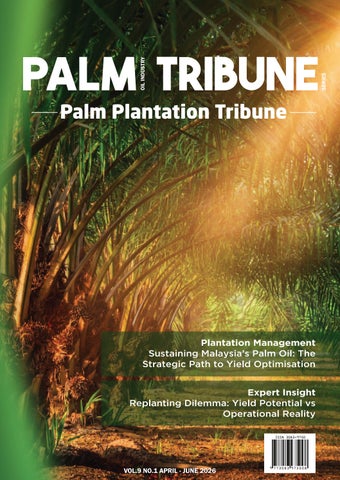
Sustaining Malaysia’s Palm Oil: The Strategic Path to Yield Optimisation
MPOGCF - Oil Palm Plantation and Biodiversity Conservation Can Go Hand in Hand
4 February 2026
e narrative around oil palm plantations and wildlife in Malaysia may be shi ing.
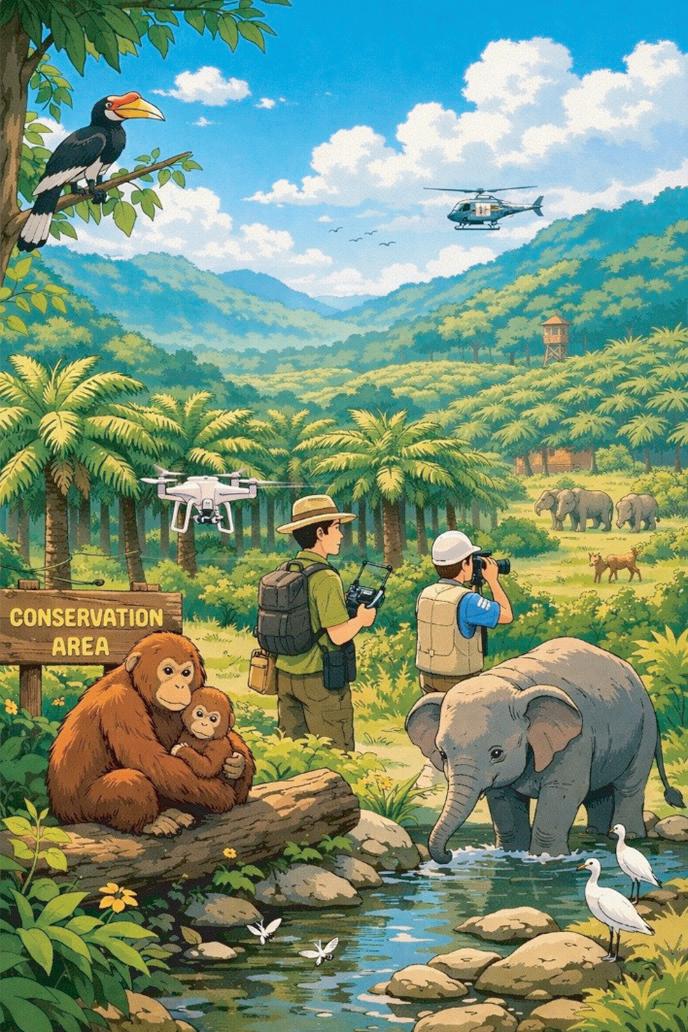
According to Hairulazim Mahmud, general manager of the Malaysian Palm Oil Green Conservation Foundation (MPOGCF), oil palm landscapes do not necessarily threaten wildlife such as the orangutan - a claim o en highlighted by international critics. Scienti c observations suggest that orangutans are adapting to plantation environments, using them as movement corridors, building nests and foraging within them, particularly in Sabah, where drone and helicopter surveys have documented their presence. ese ndings challenge broad assertions that palm oil development automatically spells habitat destruction.
Similar patterns emerge with elephants, which enter plantations during replanting seasons to feed on young shoots. Plantation operators now work closely with authorities to manage wildlife interactions ethically. MPOGCF also collaborates with organisations like the Earthworm Foundation to equip smallholders with technologies such as drones to predict and mitigate human-wildlife con ict.
Driving oil palm smallholders to adopt regenerative agriculture
22 January 2026
As global demand for sustainable palm oil grows, independent smallholders in Malaysia are being encouraged to go beyond conventional certi cation and embrace regenerative agriculture to boost pro tability, protect biodiversity and enhance carbon sequestration, says Wild Asia founder Reza Azmi. While many smallholders already comply with sustainability standards like the Roundtable on Sustainable Palm Oil (RSPO), buyers today demand detailed traceability and responsible production practices that certi cation alone can’t fully guarantee.
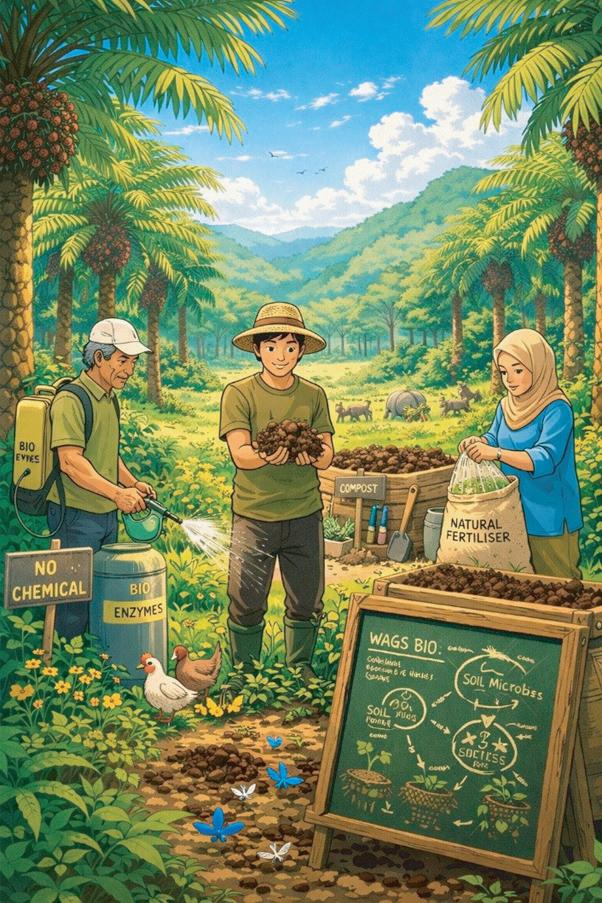
Wild Asia’s Wild Asia Group Scheme (WAGS) supports smallholders with technical assistance and training to meet international standards and improve farming practices. Its WAGS Bio programme emphasises soil health, natural pest resistance and reduced reliance on chemical inputs - strengthening palms while cutting costs and greenhouse gas emissions. Some participating farms under these regenerative systems have recorded signi cantly higher pro ts than conventional plots.
Highlighting conservation e orts, Hairulazim pointed to initiatives like the Lower Kawag Orangutan Habitat Restoration Project in Sabah and forest-connecting work under the Central Forest Spine programme in Kelantan. Malaysia’s oil palm sector, now regulated by over 60 laws and mandatory sustainability standards like MSPO - aligned with the EU’s deforestation rules.
e article highlights that regenerative methods, which include making bio enzymes, aerated compost and natural fertilisers on-farm, can lower costs and enhance sustainability. Traceable palm oil produced under WAGS can meet global market expectations and align with emerging policies on “no deforestation, no peat and no exploitation (NDPE)”.
Malaysia’s 2026 CPO output to moderate a er record-breaking 2025
- MPOB
13 January 2026
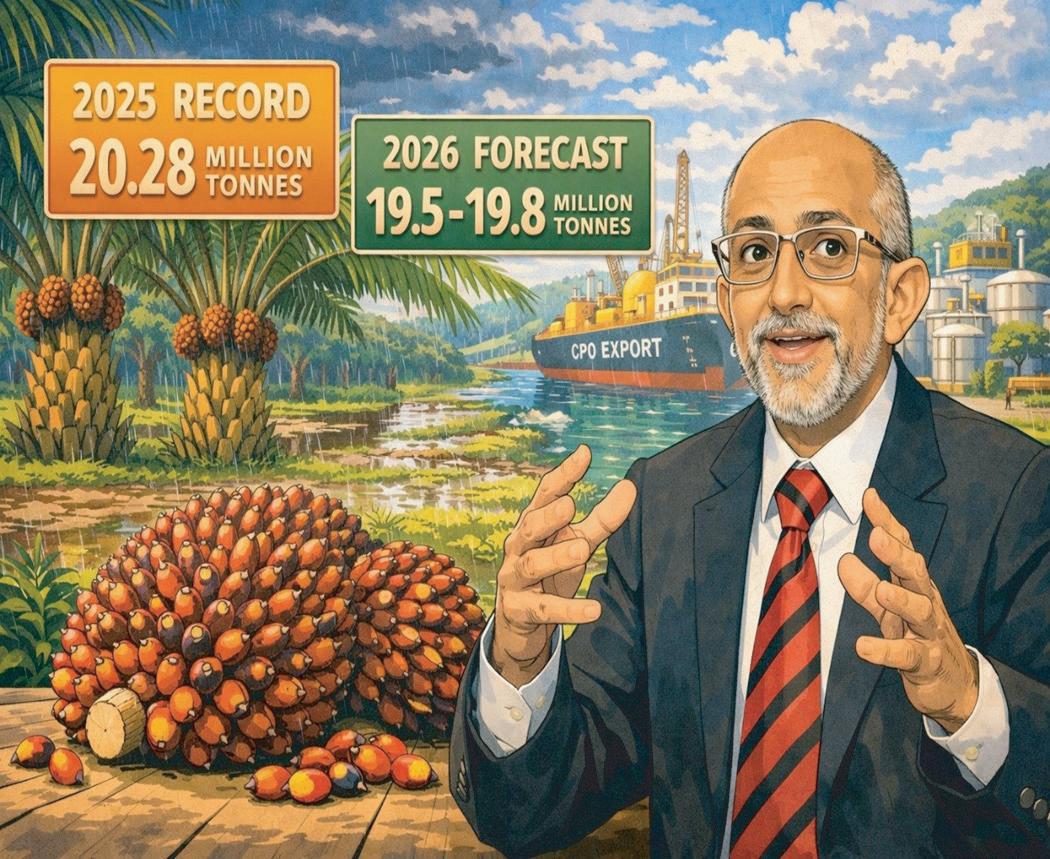
Malaysia’s palm oil sector - long a pillar of the rural economy and a key global supplier — is set for a slight production moderation in 2026 a er a record output in 2025. According to the Malaysian Palm Oil Board (MPOB), crude palm oil (CPO) production is forecast to dip below the 20 million-tonne mark this year, with estimates ranging between 19.5 million and 19.8 million tonnes, re ecting a natural “tree-resting” cycle following strong yields late last year. is moderation marks a return toward normalcy rather than a structural decline.
e output adjustment is also in uenced by ageing palms, ongoing replanting and persistent labour constraints, which temporarily reduce e ective harvesting areas. Additionally, weather risks such as monsoon-related waterlogging could disrupt eld operations and delay fresh fruit bunch deliveries.
Despite the slightly lower domestic production forecast, Malaysia’s CPO exports are expected to rebound in 2026, with shipments projected between 15.8 million and 16.8 million tonnes. Indonesia’s expanding biodiesel mandates (B35–B40) are likely to reduce its exportable supply, creating opportunities for Malaysia to ll market gaps - particularly in India, China, the EU and other regions.
e overall outlook paints a balanced picture: a modest production adjustment as part of plantation cycles, complemented by resilient export demand and strategic positioning in global markets.
Govt combats palm oil discrimination with tailored approach - Minister
20 January 2026
e Malaysian government is stepping up its e orts to tackle discrimination against its palm oil industry abroad with a proactive and tailored trade diplomacy strategy. Datuk Seri Dr Noraini Ahmad, Minister of Plantation and Commodities, outlined a multifaceted plan in Parliament that centres on aligning Malaysian palm oil products with global market expectations, strengthening standards compliance, and boosting export performance.
Key to this approach is compliance with international norms, especially through the enhanced MSPO 2.0 certi cation, which ensures sustainable palm oil meets rigorous environmental and social criteria. By pushing for value-added products and premium markets, the ministry aims to elevate Malaysia’s palm oil pro le beyond bulk commodity exports.
Market diversi cation is another cornerstone, reducing over-reliance on traditional buyers like India, China, and the European Union. In 2025, emerging regions such as Sub-Saharan Africa, the Middle East, North Africa, and ASEAN accounted for half of Malaysia’s palm oil exports, a notable increase from previous years.
Malaysia is also strengthening industry links abroad. e launch of the Palm Oil Research and Technical Service Institute (PORTSIM) in Shanghai supports innovation, technology transfer and broader use of palm derivatives.
Youth and palm oil: From Sembang Sawit to sparks
5 October 2026
In a spirited celebration of youth engagement and the future of Malaysia’s oil palm industry, the
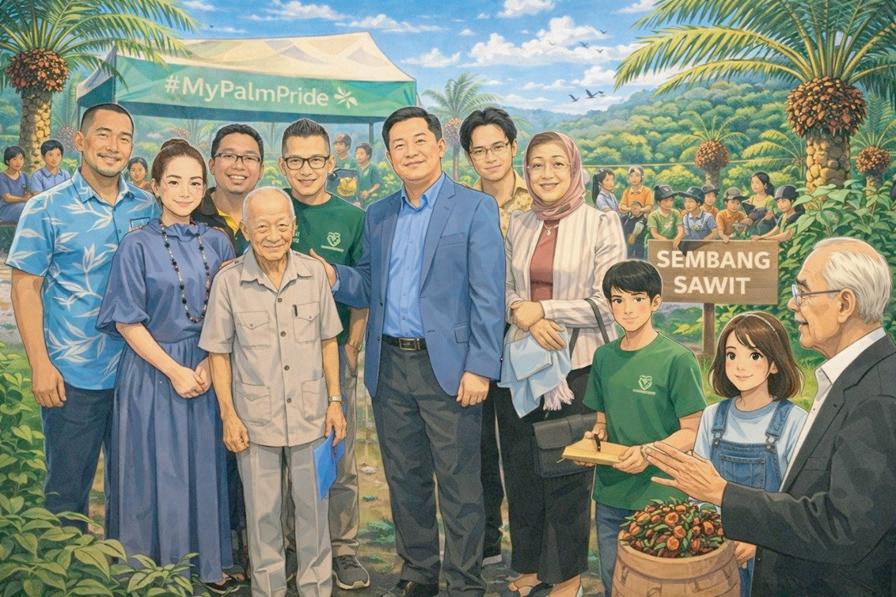
#MyPalmPride initiative brought together young advocates, industry leaders and educators at the Sembang Sawit forum to ignite fresh ideas and passion around sustainable palm oil. e event - a rare convergence of youthful energy and agricultural heritage - showcased how young voices can energise traditional sectors with innovation, dialogue and purpose.
Speakers included YB Dato’ Prof. Dr Ahmad bin Ibrahim,,Dr Sean Labansing, Dr Gideon Tan and Joseph Tek challenged young participants to rethink palm oil beyond commodity stereotypes and explore its multi-faceted roles in the economy, sustainability and global food systems. eir talks emphasised that the sector’s future depends not just on plantations and mills, but on the next generation’s creativity and commitment to sustainable practice.
Veteran voices like Tan Sri Emeritus Professor Datuk Dr Augustine S.H. Ong - regarded as a father gure in Malaysian palm oil - and MR Chandran shared context and wisdom that linked the industry’s evolution to broader societal goals.
e gathering also spotlighted youth leaders showing that mentorship and empowerment can turn “sembang sawit” (palm oil chatter) into sparks that light the way forward.
Malaysia’s Palm Oil Sector Resilient Amid Global Fertiliser Crisis
3 April 2026
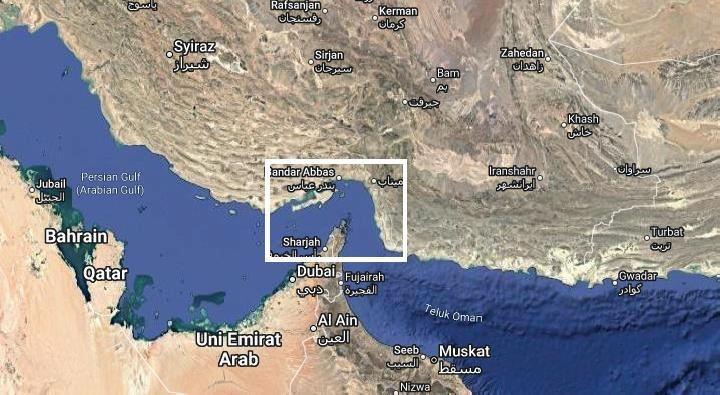
e current geopolitical instability in West Asia, speci cally the closure of the Strait of Hormuz, has positioned Malaysia’s palm oil sector as a structurally resilient cornerstone of the global edible oils market. While global agriculture grapples with severe nitrogen-based fertiliser shortages, the oil palm’s unique physiological requirements o er a strategic bu er. Unlike short-term food crops sensitive to nitrogen uctuations, oil palm is predominantly reliant on potash, thereby insulating production from the volatility seen in nitrogen pricing.
e sector’s robustness is further reinforced by established procurement strategies, as large-scale producers typically secure up to 70% of fertiliser requirements through forward contracts. is pre-emptive acquisition mitigates the impact of sudden price spikes, ensuring operational continuity despite intensifying dynamics in supply chain logistics. Furthermore, the inherent biological lag means that current fertiliser reductions would take two years to manifest in yield declines, preventing an immediate collapse in output.
Consequently, Malaysia is poised to leverage this stability to capture a larger share of the global trade, boosting export revenue. Amidst market fragmentation, palm oil serves as a critical stabilising force and a strategic diesel substitute.
When Sustainability Speaks in Tongues, Wears Costumes and Forgets the Mud
By Joseph Tek Choon Yee
A Crop Turned Confessional
Palm oil is no longer debated like a crop. It is debated like a sin.
Somewhere along the global supply chain, a quiet, e cient tropical tree has been dragged into a moral courtroom it never asked to enter. In this courtroom, guilt is allocated with surprising con dence, absolution is packaged in neat logos, and the loudest voices o en belong to those who have never set foot in a ooded harvesting path or listened to a mill boiler groan past midnight.
I am not here to argue that sustainability does not matter. It does - deeply. e planet is not a political slogan; it is our shared home. e forest is not a marketing prop; it is a living system. Human rights are not a brand strategy; they are human dignity.
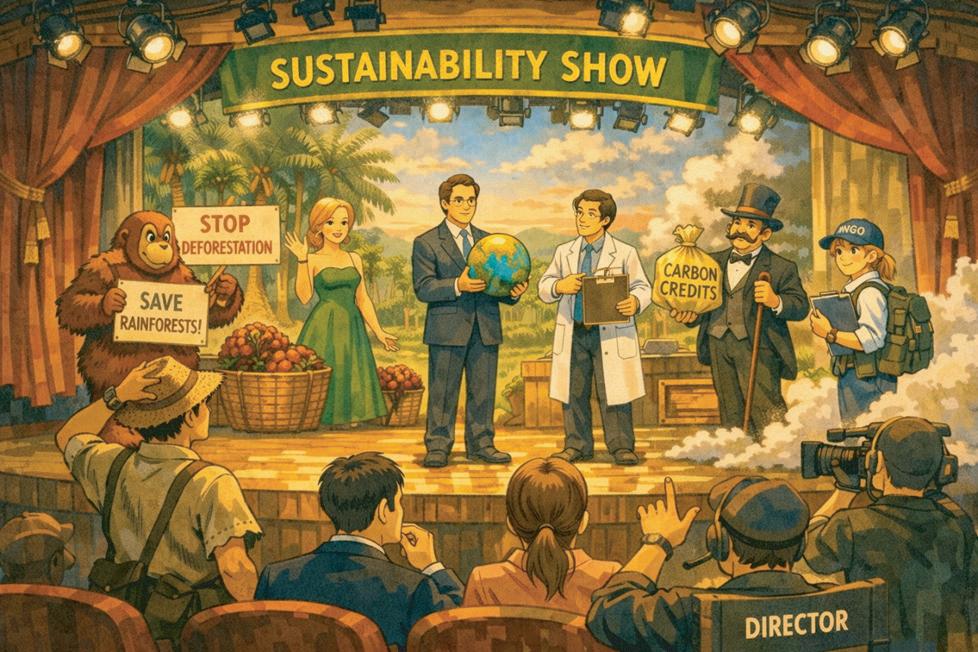
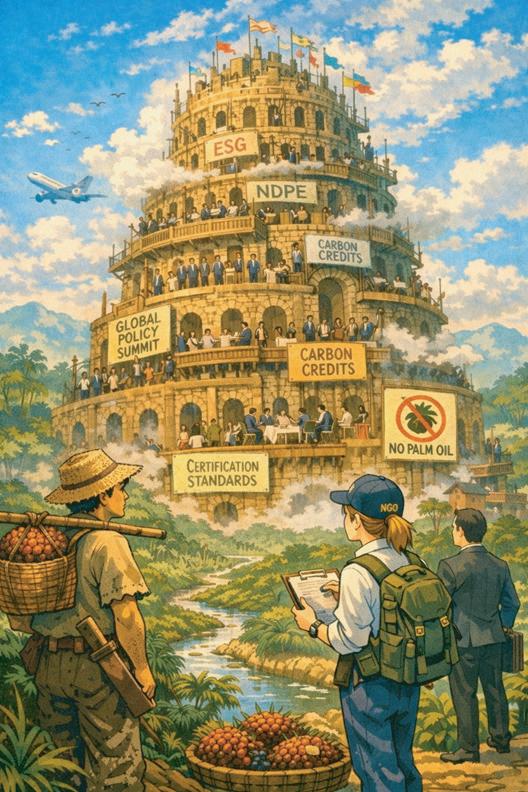
But the palm oil sustainability debate has become more than a struggle for better practices. It has become an arena of contradictions, competing agendas, unequal burdens, and - too o en - a theatre where performance replaces progress. It is also a Babel, where stakeholders speak in di erent tongues, nod politely, and then leave the room convinced the other side is either naïve or manipulative.
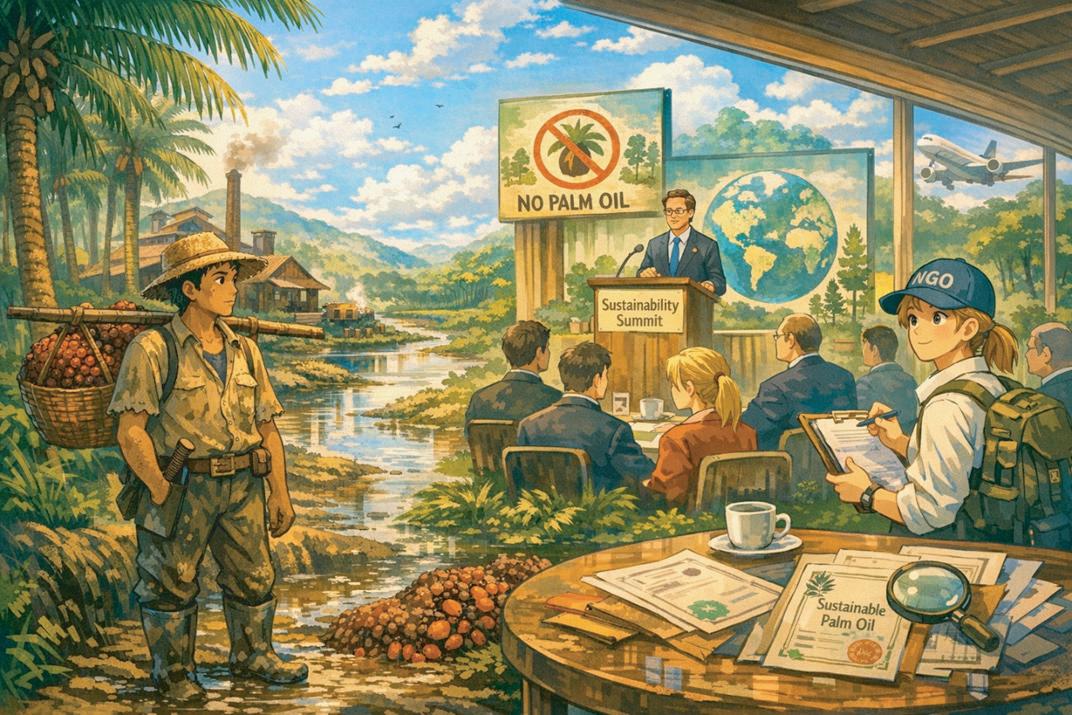
And then there is the paradox - the most corrosive one of all - when the same brands that sit at the table of certi ed sustainable palm oil quietly sell products screaming “No Palm Oil,” as if virtue can be achieved by exclusion rather than improvement.
is is a story about that debate. Not as a neat academic paper, but as a lived experience. A story of mud and metrics, of cra beer and cold peanuts, of certi cates and cynicism, of genuine reform and opportunistic green theatre. It is the story of how sustainability, when done without fairness and empathy, can turn from green to grey.
Palm Oil, Penance and Paradox (Part 1)
e Gospel According to the Green North
In the palm oil debate, contradictions sprout like weeds a er rain, and the most stubborn of these is the West–East divide. e irony is pungent. e Global North, which cleared its forests long ago in the march of empire, industrialisation and comfort, now steps forward as high priest of ecological morality, wagging ngers at the Global South for using what little land it still has.
It is like the guest who emptied the bu et at lunch and then lectures the host at dinner about portion control. Or the neighbour who felled his orchard to build a mansion and pool, then scolds you for planting durians in your yard. Once, a Western NGO member admitted - almost guiltily - “Who are we in the West to lecture the East for eking a living from deforestation, when we stripped our own lands bare long before ‘sustainability’ was even a word?” It was a rare icker of honesty, too o en drowned out by polished presentations and pious hashtags.
e truth is that the North and South o en stand on di erent rungs of Maslow’s ladder. e North, perched higher, debates ideals, identities, and philosophical purity. Much of the South still grapples with job security, survival, and dignity. When you stand on di erent steps of the ladder, it is no surprise you see di erent horizons.
is is why the UN principle of “common but di erentiated responsibility” matters. In plain English, everyone should help clean the house, but those who made the biggest mess should not scold the rest for holding the broom wrongly. e poor, who only dirtied a corner of the rug, cannot be expected to scrub the entire oor while the rich polish their silverware.
e eatre of the Green
Sustainability standards, traceability requirements, and new regulations are o en presented as moral progress, and in many ways they are. Yet for much of the producing world, they also feel like protectionism wrapped in green robes. e frustration is not that standards exist. e frustration is that burdens are uneven, goalposts keep shi ing, and the rewards rarely match the costs.
In this grand stage play, every actor performs. Some perform out of conviction. Others perform for careers, fees, reputation, and funding cycles. Scripts di er, costumes vary, but at day’s end, many still queue at the same canteen for supper.
Plantation folklore captures the absurdities best. e VIP’s pristine white sneakers are ruined within minutes of a walkabout. e mechanisation guru proposes a massive harvester for muddy paths that would swallow it whole. e academic demands tablets in areas with no internet. e donor funds a “biodiversity corridor” that becomes a rubbish dump. e bureaucrat insists estate drains be covered, only to hear the estate manager reply, dry as old fronds: “Sir, they are for water, not pedestrians.”
When sustainability becomes a performance, the danger is that it rewards optics over outcomes, paperwork over practice, and eloquence over insight.
When Eloquence Outshouts Insight
One uncomfortable truth in global debates is that those who speak con dently are o en treated as those who understand most. Eloquence becomes a substitute for expertise. Fluency becomes a proxy for wisdom. Cultures that value re ection over rhetoric appear hesitant beside those uent in persuasion. Yet silence is not ignorance, and con dence is not correctness.
In many Asian settings, politeness adds another twist. Planters and managers will sit through jargon-laden sermons, nodding graciously even as acronyms whirl overhead like low- ying aircra . Better to look agreeable than to interrupt. But too many nods can turn into lopsided deals, where one party leaves with thicker les and the other leaves with thinner wallets.
is is why the sustainability debate cannot be merely about speaking louder. It must be about listening harder - especially to voices that are less polished but more rooted.
Not Saints, Not Villains
In this saga, growers are too o en cast as pantomime villains. Yes, some have cut corners. Like any industry, there are wrongdoers who deserve scrutiny and consequences. But do not tar the entire sector.
Most growers are not saints, but neither are they the cartoon villains splashed across NGO brochures. ey are ordinary people managing extraordinary complexity: crop biology, labour realities, pests and diseases, oods and droughts, market swings, and an expanding universe of compliance demands.
Scrutiny is fair. Recognition must follow. Otherwise, we punish the very hands that harvest fruit, keep the industry alive, and help feed the world.
Sustainability must have the courage to be balanced: tough on wrongdoing, but honest about progress.
e Business of Being Green
Opportunists appear in every corner of the sustainability arena. In boardrooms, some nod through meetings rather than exercise stewardship. In NGOs, some chase grants faster than impact. In trading houses, some perfect dashboards while neglecting the supply chains behind them. On conference stages, some speak with volume that substitutes for depth.
Sustainability is too vital to become performance art. e planet does not care about slogans. Communities do not eat acronyms. Forests do not regrow because a report was published.
A touch of humour and humility may serve the planet better than posturing ever could. Perhaps the real test of “green” lies not in banners and spotlights, but in the quiet work done a er the applause fades.
e Green Double Standard and the Soy Blind Spot
e contradictions deepen when you compare scrutiny across crops.
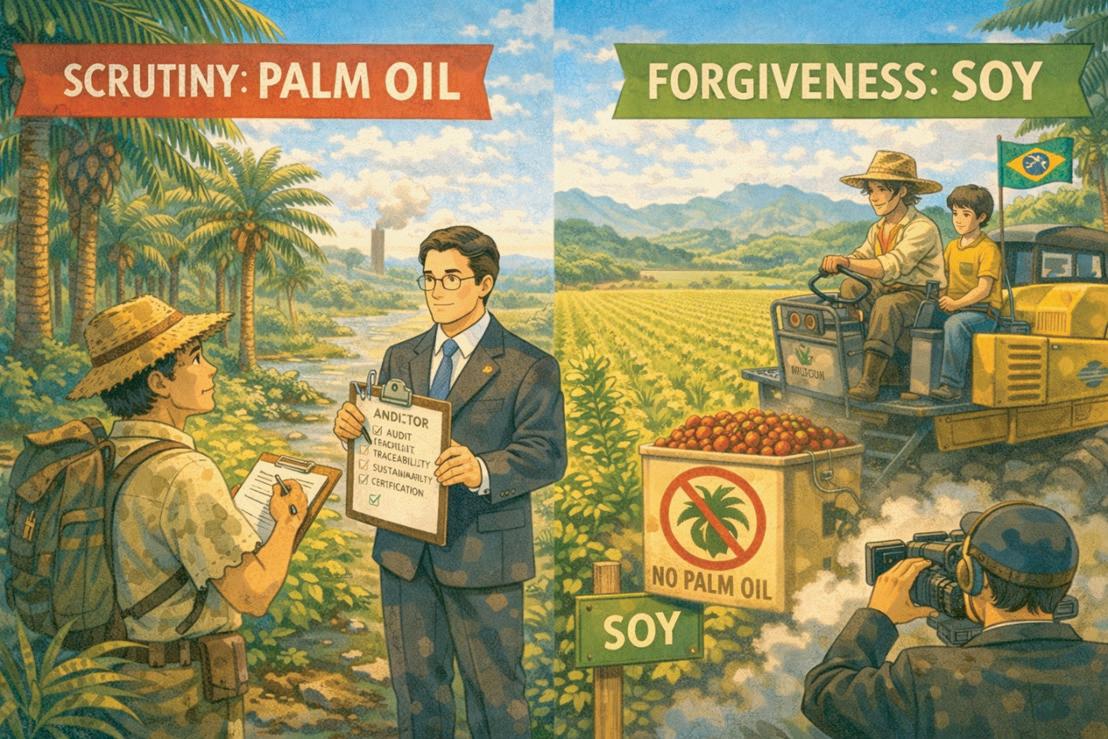
As Brazil gears up for yet another record soy harvest, bulldozers continue their slow march through the Amazon and Cerrado. Yet global outrage remains muted. Soy glides under the banner of “feeding the world,” reinforced by powerful lobbies and political goodwill. Unlike palm, much soy production still operates with minimal traceability or mandatory sustainability commitments.
e spotlight on palm is forensic; the spotlight on soy is forgiving.
is imbalance is not merely unfair. It is counterproductive. Palm oil is the world’s most land-e cient major vegetable oil. Producing more oil on less land should be a sustainability virtue, not a stigma. As a perennial crop, oil palm protects soil structure and reduces carbon loss associated with repeated tillage. If the world replaced palm oil with less e cient oils, global land demand would balloon, pushing deforestation elsewhere and multiplying emissions - the very outcome sustainability claims to prevent.
PALM OIL EVENT 2026
e Replanting Dilemma: Yield Potential vs. Operational Reality
Edited by Zahidah Zahidi
Replanting is a critical component of long-term estate management in the palm oil industry. Dr. Julian McGill, Managing Director of Glenauk Economics, challenged the conventional wisdom that replanting is merely an agronomic necessity. Instead, he framed it as a high-stakes economic calculation where the “break-even” point is higher than many realise.
Height, Not Just Yield
e primary problem with ageing palms is not necessarily a sudden collapse in yield, but rather their physical stature. Once palms exceed 13 meters, harvesting becomes exponentially more di cult and dangerous. is height barrier, combined with poor palm stands, due to damage or death over a 25-year cycle, reduces the e ective density of the eld.
e Economic Model
However, replanting also temporarily reduces production. While newer varieties reach their rst economic yield approximately 24 months a er planting, estates must absorb years of maintenance costs without peak output. Economic modelling by Glenauk Economics examined potential returns based on projected pro ts from replanted areas. eir analysis assumed a conservative cost of MYR 22,500 per hectare to cover replanting and maintenance until maturity, along with a modest annual cost in ation of 2%. e model also assumed crude palm oil (CPO) prices of MYR 4,000 per tonne and palm kernel (PK) prices of MYR 2,000 per tonne in real terms, with export taxes, corporate taxes and the windfall pro t levy remaining unchanged.
Malaysian growers need to be con dent they can achieve an average Fresh Fruit Bunch (FFB) yield of at least 20 tonnes per hectare to ensure an economic return on
How Do Growers Decide to Replant
e Window for Strategic Redesign
Replanting o ers a rare opportunity to "future-proof" the estate. Beyond simply introducing higher-yielding seeds, it allows companies to use satellite technology for optimal spacing and, crucially, to lay out elds in a way that accommodates future mechanisation.
Labour Availability and Management
In 2025, Malaysia saw a surge in replanting rates, particularly in Sabah, where roughly 4% of the planted area was turned over. Data from the Malaysian Palm Oil Board (MPOB) suggests that estates tend to postpone replanting during both price "peaks" (to capture immediate cash ow) and "troughs" (to preserve capital). Estates are catching up on backlogs as prices stabilise o their recent highs.
However, McGill argued that low replanting rates are o en a symptom rather than a cause of the industry’s woes. Structural issues with labour supply need to be solved before low-yielding growers will be con dent to invest in replanting. Without a stable workforce to ensure high-quality harvesting,the high capital outlay of RM22,500/ha becomes a risk many boardrooms are hesitant to take.
Source from: Julian McGill, Managing Director of Glenauk Economics at the MPOB Palm Oil Economic Review & Outlook (R&O) Seminar 2026
When Sustainability Speaks in Tongues, Wears Costumes and Forgets the Mud
Palm Oil, Penance and Paradox (Part 2)
One Tree, Many Lives
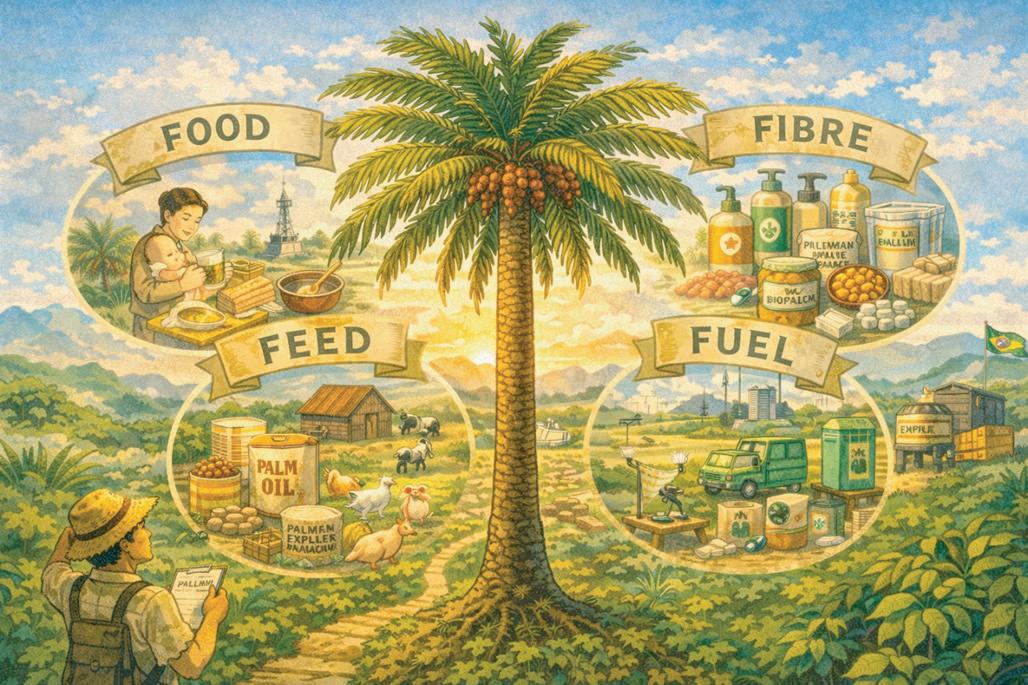
Few crops serve humanity as broadly as the oil palm. O en described through the “4Fs” - food, feed, bre and fuel - this single tree sustains kitchens, industries and communities across the world. Its derivatives show up in infant formula and frying pans, soaps and shampoos, oleochemicals and bioenergy, bioplastics and pharmaceuticals.
Per hectare, it is unmatched in productivity. Its best estates already achieve yields that other oil crops can only envy, and science continues to push the ceiling higher. More yield from less land is the simplest equation in sustainability: it reduces pressure on forests while strengthening livelihoods.
And yet, the palm remains trapped under a villain’s mask. e tragedy is not only reputational. It is strategic. When the world demonises its most e cient oil crop, it risks replacing real solutions with symbolic gestures. It is di cult to build a sustainable future on the foundation of selective outrage.
By Joseph Tek Choon Yee
e Rise of the Translators
Babel: Two Languages, One Industry
If the global hypocrisy is one fault line, the internal language gap is another.
Put an old oil palm planter in muddy boots at the same table as other stakeholders in shiny shoes, and you have more comedy than conversation. e planter speaks in rainfall, yields, fertiliser rates, harvest rounds and pests. e other side speaks in Scope 3, ESG metrics, blended nance, pro t guidance and dividend payout. Both smile politely over kopi, quietly wondering, “What on earth did he just say?”
is is the sustainability Babel. It has existed for decades, but today it feels wider than ever because the world of sustainability has become an empire of acronyms.
Planters live in a world where the weather can ruin best-laid plans. Non-planters live in a world where a disclosure template can determine capital ows. Analysts measure health by earnings per share. Planters measure health by bunch weight per hectare and whether the harvesters turned up.
Both talk about “yield,” but one means per hectare, the other means per share.
In the middle of this Babel stands an overlooked group: internal sustainability teams - the translators.
eir job is thankless and essential. ey turn PowerPoint ESG sermons into planter-speak and planter wisdom into boardroom logic. ey decode Brussels into Bahasa Ladang. ey sit through a session on Scope 3 disclosures and later explain to an estate manager: “Boss, it means we must reduce emissions and prove it, or the EU won’t buy.”
is translator class has quietly reshaped the sector. It is one reason palm oil has moved faster than many other commodities in implementing sustainability systems. Over the years, palm sustainability professionals have even spilled into other sectors - banking, insurance, FMCG, aviation - bringing with them the tough, eld-tested discipline of turning ideals into operational action.
In that sense, palm oil’s sustainability talent has become one of its biggest exports.
When Green Turns Grey:
e “No Palm Oil” Paradox
If the rst hypocrisy is global, and the second is linguistic, the third is the one that insults intelligence.
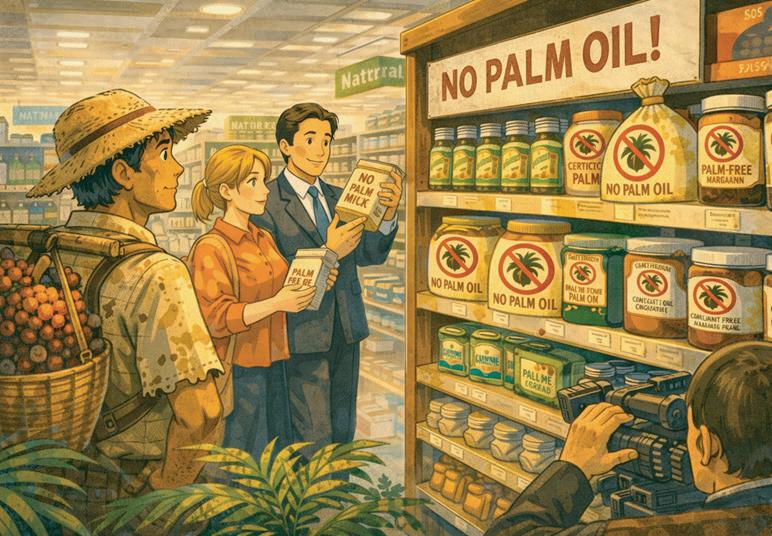
Some brands sit at the same table as certi ed sustainable palm oil stakeholders, endorse the principles, enjoy the association, and then proudly sell products labelled “No Palm Oil.” It is green theatre with double scripts: one for the conference, one for the supermarket shelf.
When a shampoo bottle boasts “No Palm Oil,” it is not making a scienti c statement. It is making a marketing statement. It is selling moral panic in a jar.
e e ect is corrosive. It turns sustainability from a shared improvement journey into exclusion and fear. It signals to consumers that palm oil, even when certi ed, is still something to be ashamed of.
And it triggers the obvious question: if certi ed palm oil earns no market reward, why should producers bear the cost of doing better?
Sustainability cannot be a producer’s penance alone. It must be a shared responsibility from plantation to product shelf. If certi ed oil is never defended, only demanded, then the whole model becomes a moral performance rather than a practical solution.
Even worse, “No Palm Oil” can expand the global footprint. Substitute oils require more land per litre. Replacing palm globally would likely mean clearing millions more hectares - precisely the outcome sustainability claims to prevent.
e label may sell soap. It cleans no conscience.
When Dialects Collide: Comedy with Consequences
e dialect clashes are o en funny, until you see the costs.
A consultant announces the need for carbon removal projects in the supply chain. e planter hears another gimmick and wonders if it will solve labour shortages. A fund manager declares the need to unlock value through ecosystem collaboration. e planter imagines sharing fertiliser with a neighbour. An analyst asks whether dividends will rise in line with crude palm oil prices, and the planter thinks: it depends on whether workers show up, whether elds ood, whether the mill survives another mechanical breakdown.
And when someone says “stakeholder engagement,” the planter imagines a long a ernoon of lukewarm co ee and another workshop, while the fruit is still ripening, unharvested, and unforgiving.
Frameworks do not harvest fruit bunches. Harvesters do. A slide deck cannot cut a ripe bunch. A compliance report cannot repair a washed-out bridge.
e plantation lives and dies by mud, not models.
e Missing Mud and the One-Way Mirror
Here lies one of the biggest unspoken resentments. Much of sustainability compliance feels like a one-way mirror.
Growers are asked for disclosures, audits, traceability and transparency. ey pay compliance costs. ey adopt NDPE policies. ey map supply bases. ey improve grievance systems. ey invest in training and data.
But the same level of transparency is rarely reciprocated downstream. If sustainability is truly shared responsibility, then openness must be mutual. Otherwise, producers feel that they are “sleeping in the same bed” with stakeholders who are dreaming of squeezing more value out of the same fruit, while leaving producers to absorb the costs.
And here is another irony. A er years of costly compliance, many growers discover that premiums are modest and demand is inconsistent. Yet non-certi ed oil still nds buyers. e system becomes di cult to exit. e reputational rewards accumulate downstream - where brands wear sustainability like a marketing badgewhile growers are told to be grateful for being allowed to sell.
is is not partnership. It is hierarchy disguised as collaboration.
From Defensive Diplomacy to Producer Solidarity
At some point, producers must ask a hard question: if critics are united, why are we fragmented?
Malaysia, Indonesia, ailand, Papua New Guinea and other producers share more than geography. ey share a destiny. ey feed the world, yet are too o en fed to the wolves of perception.
Despite progress, the palm oil story remains fractured, lost in translation and tone. What the moment demands is cohesion: shared research, harmonised certi cation recognition, and a more con dent collective voice through platforms like the CPOPC and beyond.
Imagine MSPO, ISPO, and other regional standards aligned under mutual recognition, grounded in science and fairness - a One Tropic Standard that speaks clearly, consistently, and credibly. at would not be propaganda. at would be narrative discipline.
Because the sustainability debate is not only about oil. It is about identity. It is about the Global South’s right to progress with purpose, to grow responsibly rather than apologetically. True sustainability is not submission to imported virtue. It is stewardship of what we hold in trust: land, labour, and legacy.
Stubborn Hope and the Quiet Covenant
Friends may call me naïve. I call it stubborn hope.
It is the conviction that beneath the noise of boardrooms and campaigns, there are still people who truly care - not for quarterly applause, not for the theatre of pseudo advocacy, but for the real future of an industry that feeds millions and sustains livelihoods.
Without such conviction, sustainability becomes a costume change: impressive on stage, forgotten backstage. Real sustainability cannot be staged; it must be lived and led.
What the world needs is not another sermon of slogans but a renewed covenant - one that unites growth with stewardship, inclusivity with innovation, and objectivity with honesty. Palm oil, done right, remains among the most e cient and scalable tropical edible oils to nourish a growing world.
But it will take courage: the courage to balance ideals with pragmatism, and the courage to ensure that sustainability is not merely a moral claim, but a measurable legacy.
When the Spotlight Fades
In the end, sustainability is not a slogan. It is a mirror re ecting who we are when the campaigns end and the cameras stop rolling.
e real test begins when no one is watching.
When the spotlight fades and applause dies down, what remains is character. Were we building systems that protect forests and dignity, or were we performing for audiences who reward the neatest story?
Sustainability is not a role to be acted. It is a responsibility to be lived - quietly, steadfastly, and with courage.
Because integrity, unlike applause, must echo long a er the curtain falls.
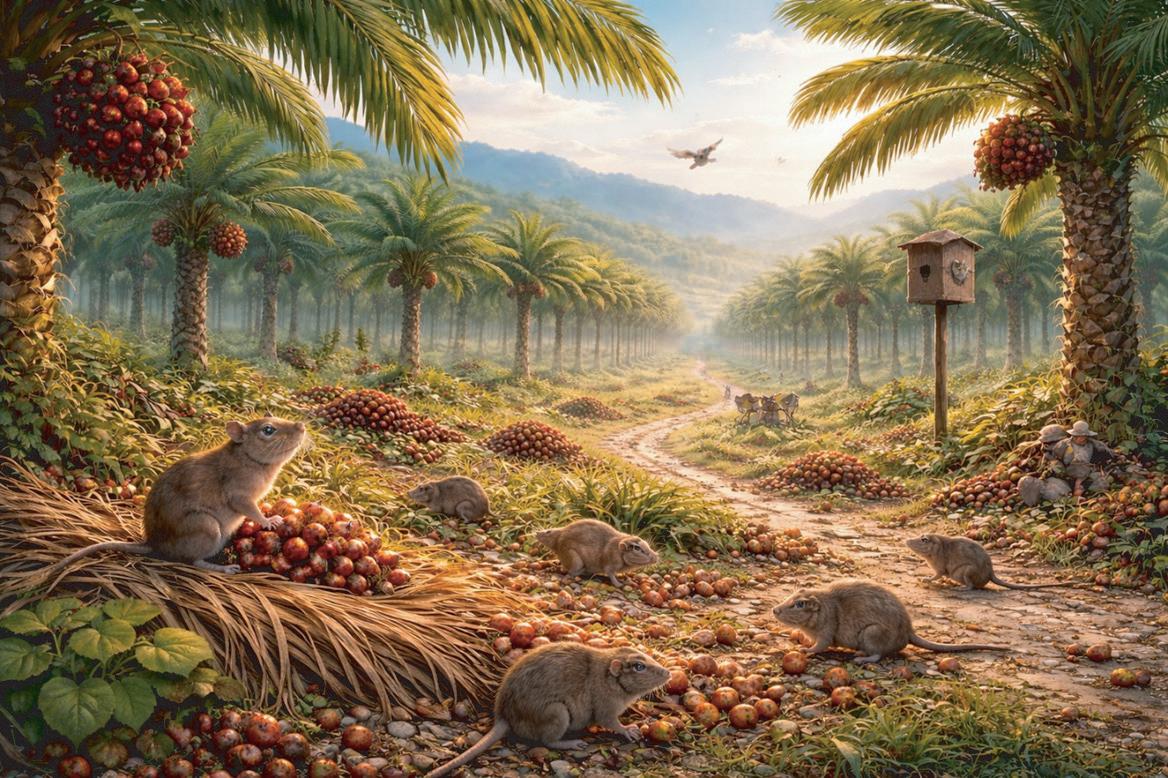
If I Were a Rat, I’d ank the Estate
By Joseph Tek Choon Yee
If I were a rat in an oil palm estate, I would wake before dawn - earlier than the eld bell, earlier than the muster, earlier even than the estate manager checking WhatsApp as if yield can be improved by scrolling.
By the time the kopi is poured, I would already be at work.
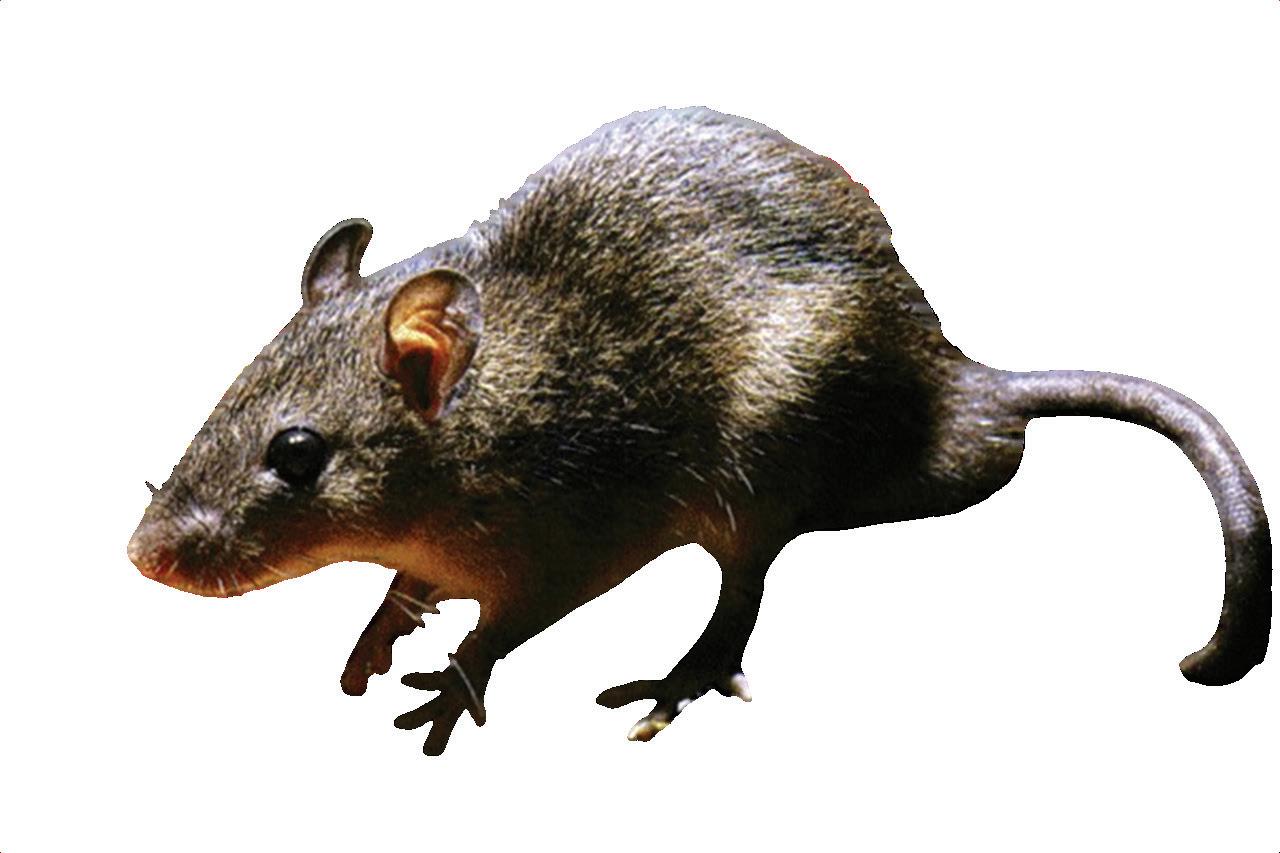
I am Rattus tiomanicus - the Malayan wood rat. Arboreal, adaptable and, frankly, much misunderstood. You call me a pest. I prefer “an uno cial harvester with poor ethics”.
From the o ce, the estate looks orderly: palm trees in rows, roads in lines, yields in tables, budgets in les. From the ground, however, it looks like something else entirely - food, cover and opportunity arranged with impressive human e ciency.
Loose fruits are breakfast. Frond piles are playgrounds. Unpruned palms are living condominiums. Neglected line-sides are not untidy to me. ey are prime property.
You count me by hectare. I count you by habit. And when I quietly remove 5% to 10% of your crop, let us not pretend this is a minor snack. at is my own little windfall tax - imposed without approval, collected without mercy.
You study me with admirable seriousness. Population cycles. Feeding damage. Habitat preferences. Palm age e ects. Undergrowth. Road proximity. Rainfall. You produce papers. I produce losses.
I do not read your journals. I simply live inside your footnotes.
Dinner, Delayed
Humans do not merely dislike rats. ey research us rst, then prepare dinner.
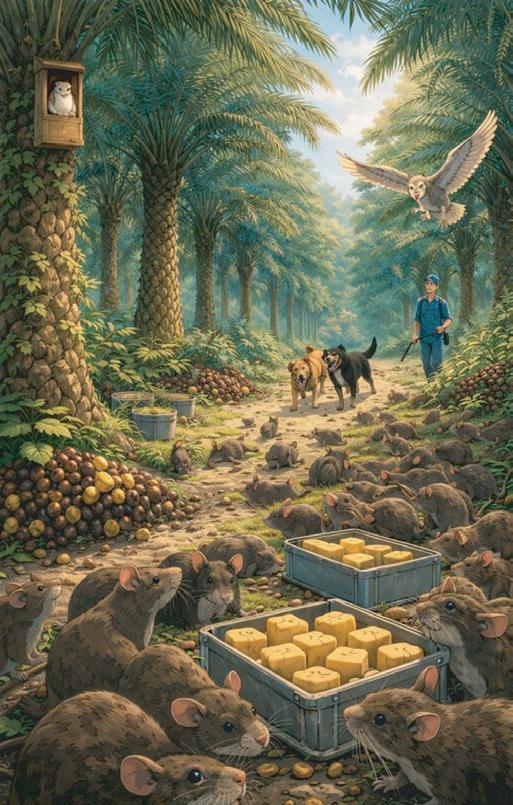
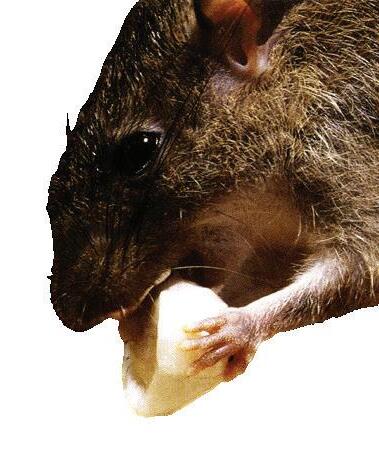
e cleverest weapons are not traps or teeth but anticoagulant baits - wax blocks dressed up like kindness, scented with palm oil and sh meal or prawn dust, placed along our runways with the false generosity of a host who already knows the ending.
e trick is delay. Eat tonight, feel ne tomorrow, suspect nothing. Meanwhile, the poison quietly prevents the blood from clotting. Small internal leaks become larger ones. No immediate pain, no instant lesson, no useful warning to the rest of us. at is why it works.
No drama. Just delayed liquidation. Some compounds, like bromadiolone, can turn one night of con dence into a fatal miscalculation. Warfarin, the old uncle in the toxic family, prefers repeat business. Either way, the principle is the same: quiet death, poor feedback.
e humans, of course, do not stop at placement. ey campaign. Two or three blocks near nests or runways, inspect, top up, record, repeat. Continue until bait acceptance drops below threshold. Very e cient. Very systematic. Very rude.
I eat, I leave, I return to my nest in the canopy or the frond heap. Nothing happens - until later, somewhere away from the bait point, out of sight and out of lesson.
From your side, that is good management. From mine, it is assassination by administration.
Rattus tiomanicusthe Malayan wood rat
Silent Wings, Loud Message
en come the barn owls - Tyto javanica - gliding above the estate like a sustainability report that has suddenly grown talons.
Humans love owls because they make pest control sound poetic. Owl boxes among the palms suggest ecology, conscience and cleverness all at once. Auditors approve. Visitors nod. ESG slides practically write themselves.
And yes, owls matter. A settled pair can remove rats steadily and e ciently. No fuel, no batteries, no overtime, no union claims. Just silence, patience and accuracy. For planters, this is biological control at its most elegant.
For rats, it is death with feathers. But even elegance has limits. Owls are complements, not commandments. ey help suppress populations; they do not perform miracles. eir success depends on prey density, habitat structure, proper box placement and estate conditions. An owl box installed merely to look impressive is not IPM. It is decorative optimism.
Worse, the owl lives inside a di cult contradiction. Use too much poison and the owl may pay through secondary poisoning. Use poison carelessly, and the predator becomes collateral damage. Use too little control in badly managed elds, and the problem outruns the owl.
Integrated Pest Management, then, is not a hymn. It is a balancing act - part science, part restraint, part eld honesty.
Dogs Bark, Rats Adjust
en, from the ground, come the dogs. Unlike owls, dogs do not arrive with poetry. ey arrive panting, noisy and enthusiastic, accompanied by handlers and the unmistakable mood that something visible is about to happen.
In certain blocks, they do make an impression. Rats are ushed, chased and caught. Damage falls. Spirits rise. Reports brighten. ere is something undeniably satisfying about seeing control in action.
But let us not mistake drama for permanence. Dogs hunt where they are taken. ey hunt when they are deployed. ey catch what they can reach. When they leave, and nearby blocks remain untouched, and undergrowth thickens again, we do what rats do best: relocate, recolonise and resume.
Useful? Yes. Final answer? Hardly. Dogs add pressure. ey also add noise, disruption and one more variable to a system already crowded with variables.
e Loudest Punctuation Mark
en comes the gun. Particularly against larger species such as the swamp giant rat, Sundamys muelleri, shooting appears attractive because it is immediate, visible and emotionally satisfying. Something has been done - and loudly too.
But a gunshot is punctuation, not policy. It removes bold individuals. It may quieten a hotspot. It may buy time. But it does not remove food, improve sanitation, change habitat or correct managerial complacency. It startles the estate, not transforms it. We adapt. We move lower, later, quieter. Shooting reshu es the sentence. It does not rewrite the paragraph.
e Real Lesson
A Rat’s ank-You Note
If I were a rat in your estate, I would not rst thank the owls, the dogs, the gunmen or even the bait chemists. I would thank you.
ank you for loose fruits le a er harvest. ank you for sanitation rounds postponed because “next week also can”. ank you for messy line-sides, overdue pruning and frond heaps that become nurseries, corridors and hiding places all in one.
ank you for eld discipline diluted by labour shortage, weak supervision or that most dangerous estate disease of all: tolerance.
You call me resilient. I call you generous.
Where sanitation slips, I breed. Where order weakens, I multiply. Where the eld becomes permissive, I prosper. at is the awkward truth. e rat’s best ally is o en not biology, but untidiness.
For all the science of baits, owl boxes, dogs, guns, GIS maps and damage thresholds, none can outwork a sloppy estate forever. A messy block is not merely vulnerable to rats. It is an invitation written in loose fruit.
So when rat numbers rise, do not always look rst to the owl box or the bait station.
Sometimes, the real problem is under your boots.
is is why the industry is right to push Integrated Pest Management. IPM is not romance with one method. It is not baits versus owls, dogs versus discipline, or gunshots versus eldcra . It is about timing, thresholds, balance and judgement.
Monitor rst. Act when numbers justify it. Combine sanitation, habitat management, biological control and targeted chemical use with discipline rather than panic. Rotate, review and recalibrate.
Below threshold, good eld practice and ecological checks should do much of the work. Above threshold, intervention becomes necessary - but measured, deliberate and reviewed. Dogs and shooting have a place, yes, but they are supplementary and situational, not substitutes for estate order.
Zero rats is fantasy. Low rat pressure is management.
And perhaps that is the deeper lesson. Plantations are living systems, not laboratories. e rat survives not because planters are foolish, but because the eld is dynamic, imperfect and full of unintended generosity.
In trying to outsmart the rat, the estate is really being asked a more uncomfortable question: how well do you know your own eld?
Good management is not the total absence of rats. It is the presence of vigilance, sanitation, ecological sense and humility.
For in the end, the estate does not reward those who dream of absolute control. It rewards those who notice the loose fruit, respect the threshold, keep the eld clean and never mistake neglect for a small matter.
And tonight, while the owl glides, the bait waits, the dogs rest and the reports are led, I will still be here - listening, adjusting, surviving.
As rats do. But whether I merely survive or truly ourish, dear planter, depends less on my cunning than on your discipline. All the best.
Sustaining Malaysia’s Palm Oil: e Strategic Path to Yield Optimisation
Edited
Malaysia’s palm oil sector remains a strategic economic pillar. e industry supports hundreds of thousands of jobs and contributes substantially to export earnings and rural livelihoods.
However, future growth will not come from land expansion. Oil palm is already the most land-e cient oil crop globally. Incremental gains must now be driven by yield optimisation and operational e ciency. In this context, two structural risks stand out: labour constraints and climate variability. Sustaining the current yield recovery depends on how e ectively estates manage both.
e Labour-Yield Equation: A Domino E ect
Malaysia’s palm oil sector remains a strategic economic pillar. e industry supports hundreds of thousands of jobs and contributes substantially to export earnings and rural livelihoods.
However, future growth will not come from land expansion. Oil palm is already the most land-e cient oil crop globally. Incremental gains must now be driven by yield optimisation and operational e ciency. In this context, two structural risks stand out: labour constraints and climate variability. Sustaining the current yield recovery depends on how e ectively estates manage both.
Low-labour estates produce approximately 3.472 t/ha less FFB compared to high-labour estates. Yield penalties widen progressively as labour availability declines. e mechanics of this loss are a "domino e ect." Insu cient labour leads to extended harvesting intervals, pushing cycles beyond the optimal 7–10 days. is delay results in increased rotten and loose fruits, lowered total FFB tonnage, and ultimately reduces the Oil Extraction Rate (OER).
In contrast, maintaining optimal harvesting intervals through adequate manning can boost yields by 5% to 20%.
by Zahidah Zahidi
Source from: Nur Nadia Kamil, Techno Economics Research Unit, MPOB, at the MPOB Palm Oil Economic Review & Outlook (R&O) Seminar 2026
Climate Variability: A Delayed but Lasting
While labour is a manageable internal variable, the El Niño-Southern Oscillation (ENSO) represents an external risk that is becoming more frequent and intense. Critically, oil palm yield responds with a lag. Current production re ects weather conditions from 10 to 24 months earlier. Elevated soil temperatures up to two years ago can depress today’s harvest.
Strong El Niño (MEI +2.0)
• FFB yield loss: –2.30 t/ha (7.05% below mean)
• Oil yield loss: –0.38 t/ha (6.09% below mean)
e Bu er: Investment as Insurance
Nutrient management plays a measurable bu ering role. During strong El Niño episodes, estates with no fertiliser investment recorded cumulative losses of 2.98 t/ha over 24 months. Even minimal fertiliser application signi cantly mitigated yield decline compared to zero input.
In volatile climate conditions, cutting fertiliser expenditure to manage short-term cash ow may deepen medium-term production losses.
Moderate La Niña (MEI –1.0)
• FFB yield loss: –1.83 t/ha (5.61% below mean)
• Oil yield loss: –0.30 t/ha (4.81% below mean)
Moving Forward: A Resilient
Strategy
To navigate the coming years, Malaysian plantations must adopt a proactive, data-driven stance. Reducing the "harvester-to-hectare" ratio through technology is no longer optional; it is a requirement to mitigate labour volatility. Estate management must treat climate data as a leading indicator for harvest forecasts two years out. Maintaining optimal application even during lean years ensures the palms have the nutrient reserves to withstand environmental stress.
By shi ing our focus toward resource optimisation and climate adaptation, Malaysia can ensure its palm oil industry remains not just a legacy of the past, but a resilient leader of the future.
OIL PALM MINISTRIES, ITS AGENCIES AND RELATED ASSOCIATIONS
Ministry of Plantation and Commodities (KPK) www.kpk.gov.my
Malaysian Palm Oil Association (MPOA) www.mpoa.org.my