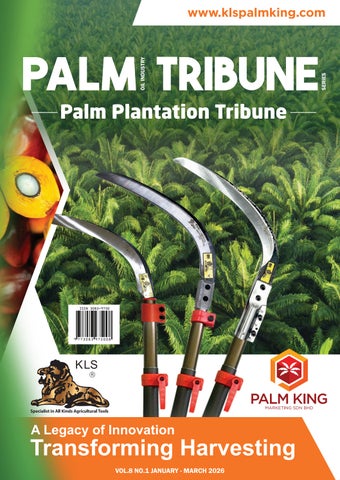
VOL.8 NO.1 JANUARY - MARCH 2026
SERIES
OIL INDUSTRY
Palm Plantation Tribune
3
Editorial
Palm Plantation Tribune
FRONT COVER BY
Editorial Team
PALM KING
EDITOR Zahidah Zahidi zahidah@maps-globe.com CREATIVE DESIGNER Muhammad Faireez artwork@mapsglobe.com Quarterly Publication Palm Oil Industry Tribune Series: Palm Plantation Tribune
Volume 8 | No 1 Other Series: Palm Oil Tribune Palm Downstream Tribune What’s in it News Roundup Expert Insights Regional Policies Technologies Event Summary Follow us on: Next Chapter Media Next Chapter Media
DIRECTOR Emily Yu PUBLICATION Maps & Globe Specialist Distributor Sdn. Bhd (625396-A) No 3-1 Jalan Perdana 10/6, Pandan Perdana, 55300 Kuala Lumpur, Malaysia. PRINTING Fong Wah Printing Sdn. Bhd. (1406717K) No. 17, JaIan Tembaga SD 5/2G Perindustrian Bandar Sri Damansara, Pekan Kepong, 52200 Kuala Lumpur, Malaysia.
Disclaimer: Next Chapter Media's editorial team strives to provide accurate and reliable information. However, we recommend that readers independently verify the claims and information presented in our publications. Next Chapter Media is not responsible for the accuracy of the content and encourages readers to use their own judgment when evaluating the information.
Sustainability
Innovation
Growth
Contents
Palm Plantation Tribune
CONTENTS 5-9
Latest News Roundup A quick digest of the latest policies and market trends.
17
Regional Policy
Sri Lanka Weighs Lifting Oil Palm Ban as Economic Losses Mount
10
18-20, 23-28
When Palm Oil Meets Silicon: Estates Turning Into Data-Centre Gold
-
Technology
11-12
Industry & Smallholders
From Sustainability to Inclusivity: Bringing Smallholders into Malaysia’s Palm Oil Transition
13
Knowledge Nuggets -
Agronomy and Oil Palm: Science, Sweat and the Long Game The Frond Line of Knowledge: What Every Planter Should Read
29
Oil Palm Ministries, Its Agencies And Related Associations in Malaysia and Indonesia
National Policy & Carbon Markets
30
14
ADVERTISERS INDEX
Biomass Hub to Unlock New Income Stream for Planters
1, 2, & 22
From Plantations to Climate Assets: Building Malaysia’s Palm Oil Carbon Framework
Unlocking Revenue
15-16 IPM Insights
Strengthening Malaysia’s Defences Against Plantation Pests and Diseases
Event List 2026
Muar Ban Lee Group Berhad
21
Maps & Globe Specialist Distributor
4
5
News Roundup
Palm Plantation Tribune
Malaysia Tightens MSPO Enforcement on Land Rights Compliance
Indonesia Issues $2.3 Billion in Fines for Illegal Operations in Forest Areas
8 December 2025
8 December 2025
Malaysia is tightening MSPO enforcement, particularly on land disputes and Native Customary Rights (NCR). Deputy Plantation and Commodities Minister Datuk Chan Foong Hin confirmed that certification bodies may suspend or revoke MSPO certificates if companies are found to have encroached or violated land rights, reflecting core MSPO 2022 requirements for lawful, dispute-free ownership.
Indonesia has intensified its crackdown on illegal land use, with a government task force ordering palm oil and mining companies to pay 38.62 trillion rupiah (USD 2.31 billion) in fines for operating in forest areas without proper authorisation. The enforcement drive, led by President Prabowo Subianto’s forestry task force, represents one of the country’s largest coordinated actions against unlicensed plantations and mines.
During an active dispute, auditors cannot fully verify compliance, especially indicators tied to legal ownership and community rights. Chan added that certifying disputed land also exposes MSPO to significant reputational risks.
This year alone, the task force has seized 3.7 million hectares of plantations and more than 5,300 hectares of mining land, with plans to reach 4 million hectares by year-end. Of the fines issued, 9.42 trillion rupiah was levied on 49 plantation firms, while 29.2 trillion rupiah targeted 22 mining companies. Officials did not disclose the companies involved.
With MSPO 2.0 in force from 1 January 2025, operators must present clear evidence of land ownership, including NCR land recognised by state law. Specific Guidance Document on MS2530:2022 Compliance of New Oil Palm Planting for NCR areas offers clearer pathways for documentation, community verification, and compliance. MSPO 2.0 further emphasises community consent, social and HCV assessments, and accessible dispute-resolution channels through the e-MSPO system. The government continues to support wider certification through training, technical guidance, smallholder incentives, and closer collaboration with state authorities.
Some operators have paid the penalties, while others are contesting them. Authorities said they are open to dialogue but remain firm that legal action will follow non-compliance. In a major structural shift, 1.5 million hectares of seized plantations have been transferred to state-owned Agrinas Palma Nusantara, positioning it as the world’s largest palm oil company by land area. Analysts predicted the sweeping seizures, together with Indonesia’s biodiesel plan, could tighten global palm oil supply and exert upward pressure on prices.
News Roundup
Palm Plantation Tribune
Sabah Leads Nation in Smallholder Replanting
RSPO, NASH and ASB Unite to Empower Smallholders
5 November 2025
4 November 2025
The state of Sabah leads Malaysia in smallholder oil-palm replanting support, securing RM 61.56 million under the RM 100 million TSPKS 2.0 financing scheme this year.
A strategic collaboration has been launched to empower Malaysia’s palm oil smallholders and enhance the country’s sustainability credentials. Under a Memorandum of Understanding, Roundtable on Sustainable Palm Oil (RSPO), National Association of Smallholders Malaysia (NASH) and Asia School of Business (ASB) have joined forces to bolster smallholder resilience through training, digital readiness and access to sustainable financing.
According to Deputy Plantation and Commodities Minister Chan Foong Hin, the approved 796 applications cover 3,420 hectares, including 34 in Sandakan (155.76 hectares) with RM 2.8 million allocated. Meanwhile, more than 30,768 smallholders in Sabah spanning 191,518 hectares - have achieved certification under the MSPO standard, which is credited with improving global market access, good agricultural practice compliance and product quality. The allocations reflect a broader push under the Budget 2026 plan, which earmarks RM 120 million to support smallholders across the commodity sectors including oil palm, rubber, cocoa, pepper and kenaf.
With more than half of Malaysia’s smallholder plantations now over 25 years old and producer incomes under pressure, the initiative seeks to strengthen productivity, traceability and certification readiness. The partnership will focus on bridging national certification (through the Malaysian Sustainable Palm Oil standard) and global standards (RSPO), enabling smallholders to meet both frameworks. NASH President, Adzmi Hassan emphasised that the endeavour is “not about one standard replacing another,” but about equipping farmers with capability, confidence and continuity. “Malaysia’s smallholders are not the problem - they are the solution,” he said. From the RSPO’s side, the move reinforces the advocacy that sustainability should never become a barrier, but rather an inclusive opportunity. Implementation begins immediately, aiming to deliver leadership training, good-agricultural-practice modules, record-keeping improvements and data-driven traceability over a phased rollout.
6
7
News Roundup
Palm Plantation Tribune
Ghana Unveils US$500 Million Plan to Accelerate Oil Palm Sector Growth
Indonesia’s Palm Oil Giants Ready for EU Rules, but Smallholders Struggle to Keep Up
24 November 2025
3 November 2025
Ghana has announced a US$500 million investment framework to strengthen its oil palm sector and reduce its continued reliance on imports. Although the country meets about 70% of domestic demand, it still spends nearly US$200 million annually on imported palm oil.
According to Indonesian Palm Oil Association (GAPKI), large palm-oil firms are largely ready to comply with the European Union Deforestation Regulation (EUDR) - but small-scale farmers face mounting difficulties. Chairman Eddy Martono acknowledged that major exporters are equipped for compliance, citing traceability systems and audit protocols already in place. However, he warned that “the real challenge lies with smallholders who are yet to access the tools and finance required for EUDR.”
The funding forms part of the National Integrated Palm Oil Development Policy (2026–2032), developed with partners including the World Bank and Ghana Development Bank. A central feature is a long-term concessional financing scheme with a five-year repayment moratorium, an essential fit for oil palm’s long maturation cycle. The government plans to attract new investors, expand plantation areas and develop 100,000 hectares of new estates to support processors with a more consistent raw material supply. Recent collaboration with Onesta Ghana Ltd. under the US$50 million Redgold Oil Palm Plantation Project reflects early momentum toward this goal. Smallholders remain a priority. The policy provides access to improved seedlings, subsidised fertilisers, guaranteed off-take, credit support, and technical training. A dedicated Smallholder Support Fund aims to widen participation, particularly among women and young farmers.
GAPKI pinpointed three main hurdles for small-scale farmers: the cost of mapping and geolocating their fields, upgrading land legality documentation, and adapting to complex supply-chain audits. Without support, many risk being excluded from lucrative export channels. The association urged the Indonesian government and trading partners to help bridge this gap recommending subsidised technical assistance, fast-track legalisation of smallholder lands, and inclusion of national certification schemes such as the Indonesian Sustainable Palm Oil (ISPO) to ease compliance. The message is clear: while corporate players are ready for new global standards, without structural aid for smallholders, Indonesia’s palm-oil sector risks a two-speed future - one compliant and competitive, the other sidelined and vulnerable.
News Roundup
Palm Plantation Tribune
India Expands Oil Palm by 52,113 ha Under NMEO-OP
Regenerative Agriculture: Beyond Slogans, Back to Soil and Science
24 October 2025
7 October 2025
India has added 52,113 hectares of new oil palm plantations in the 2025/26 fiscal year, driven mainly by Telangana and Andhra Pradesh, according to the Ministry of Agriculture.
In his opinion piece, industry veteran Joseph Tek Choon Yee provides a critical lens on the growing enthusiasm around regenerative agriculture (RA) within the plantation sector.
The expansion forms part of the National Mission on Edible Oils – Oil Palm (NMEO-OP), bringing total new plantings under the scheme to 241,000 hectares since 2021. India’s nationwide oil palm coverage now stands at roughly 600,000 hectares.
Tek explains that RA - once a set of solid agronomic practices like cover-cropping, mulching and rotational farming - has morphed into a broad, often vague ideology: “RA has become less about agronomy and more about allegory - a story people want to believe.”
The government targets 1 million hectares by 2030 to reduce dependence on imported edible oils. Current measures include improved seed supply, faster nursery development, farmer incentives, and price assurances for FFB. Advanced agricultural technologies are also being deployed to boost yields.
He likens the movement to a psychological inkblot: everyone sees a different version depending on their agenda - policymakers see climate salvation, NGOs see nature-based solutions, brands see marketing halos. Specifically for oil palm in Malaysia, Tek argues that while estates have long practised many regenerative-aligned routines, the critical challenge remains bridging yield-gaps and halting deforestation. He writes: “For oil palm, the most regenerative act is … more oil from the same soil.”
The ministry has set an ambitious target to cover 200,000 hectares with the oil palm in the 2025-26 fiscal year. Telangana, Andhra Pradesh, Assam, Arunachal Pradesh, Tripura and Mizoram are leading states in cultivation. India has identified 2.8 million hectares of suitable land for oil palm. Environmental concerns persist, particularly around biodiversity impacts. In response, authorities reaffirmed that oil palm expansion will be limited to identified, non-forest areas and guided by sustainable practices.
He emphasises yield for oil palm sustainability: stagnant output triggers land-expansion risk, which fuels deforestation and undermines ecological goals. Tek’s key message: RA must move beyond slogans and auditing into site-specific, science‐based agronomy. Without profitability and productivity, he warns, stewardship fails. “Soil sermons may soothe but site-specific science sustains,” he concludes.
8
9
News Roundup
Palm Plantation Tribune
MPOB warns smallholders about cheap fertilisers with low nutrient content 13 December 2025
Oil palm smallholders are reminded not to be deceived by the sale of cheap fertilisers with low nutrient content levels, which affect yields and waste resources. Malaysian Palm Oil Board (MPOB) Director-General Datuk Dr Ahmad Parveez Ghu¬lam Kadir said the number of such cases is increasingly worrying, with some suppliers selling fertilisers with nutrient content far lower than advertised. “Smallholders have been cheated by suppliers selling cheap fertilisers with incorrect nutrient content. Their yields are not as expected despite them having spent the money,” he said on Bernama TV’s “Apa Khabar Malaysia”. Ahmad Parveez said MPOB will assist smallholders via the Oil Palm Agronomy Centre (OPAC) in Lahad Datu, Kluang, and Hulu Paka, in addition to another laboratory being completed in Sessang, Sarawak, to test fertiliser authenticity. “Fertilisation issues are important. However, there may be a need for stricter measures to ensure that the fertilisers supplied comply with and match what is advertised,” he said. He said fertiliser suppliers also need to be monitored to prevent repeated fraud, which could eventually affect national palm oil production.
Two Asian Agri Partner Cooperatives in Riau Sign Agreement on Smallholder Oil-Palm Replanting Programme 27 November 2025
Two Asian Agri partner cooperatives in Riau have formalised their participation in Indonesia’s Smallholder Oil-Palm Replanting Programme (PSR), marking another step forward in accelerating smallholder productivity upgrades. Officials emphasised that PSR funding must be responsibly managed to strengthen farmer welfare and long-term business sustainability. Replanting, they noted, is not simply replacing old palms but a strategic intervention to restore yields, optimise land use, and support agricultural intensification. Financial support and technical guidance are key factors behind the success of the replanting program. The smallholders will be supported through financing, planting, and post-repayment phases to ensure the newly replanted areas reach optimal productivity. Leaders of both cooperatives expressed optimism, noting that the support provides a critical lifeline as farmers navigate the transition period before young palms reach maturity. The initiative aligns closely with Asian Agri’s 2030 sustainability commitments, particularly in strengthening smallholder partnerships and enhancing long-term plantation resilience.
Technology
Palm Plantation Tribune
When Palm Oil Meets Silicon: Estates Turning Into Data-Centre Gold Source: AI boom is turning Malaysia’s palm oil estates into data centres, Anuradha Raghu and Ram Anand, Bloomberg Edited by: Zahidah Zahidi
In Malaysia, the vast estates of the palm-oil industry are being reimagined. Major plantation firms are now eyeing their large land holdings as real estate for the booming AI era. Data centres devour vast tracts of land and enormous amounts of power - and Malaysia’s palm-oil companies already own both. SD Guthrie, for instance, plans to convert 10,000 ha of older rubber or low-yielding oil-palm land into solar-powered industrial parks. Its goal: to deliver up to one gigawatt of renewable power within three years, sufficient to support multiple hyperscale data-centre deployments dedicated to AI computing. Rival plantation giants are pursuing similar paths. Kuala Lumpur Kepong Berhad (KLK) has launched KLK TechPark, a 600-hectare development already anchored by industrial tenants such as BYD, while IOI Corporation has identified Johor land for at least 300 MW of solar development. Collectively, these firms control some of the country’s largest contiguous land areas, giving them an early advantage in shaping Malaysia’s industrial expansion. Their timing is strategic. Malaysia is currently the fastest-growing data-centre market in Asia Pacific, accounting for about 40% of all planned capacity in Southeast Asia. Over US$34 billion in data-centre investments has flowed into the country in recent years, driven by global cloud players expanding beyond Singapore. By 2035, data centres in Malaysia may require as much as five gigawatts of electricity, nearly one-fifth of today’s national generation capacity.
However, the pivot is not without hurdles. Data centres are highly location-sensitive: proximity to grid power, fibre networks, and water sources can make or break a site. Tropical heat also raises cooling energy requirements, increasing operational costs for tenants. Meanwhile, core hubs like Johor’s Sedenak Tech Park are already experiencing delays in power and water connections, underscoring the strain on existing infrastructure. Environmental groups add another layer of scrutiny. While converting ageing estates into solar farms may improve ESG optics, they argue such efforts do not directly address deforestation, peatland protection, labour issues, or supply-chain transparency within palm-oil operations. Without deeper structural reforms, they caution that the shift risks being perceived as surface-level green positioning. Still, the shift signals a surprising transformation - palm-oil landowners aiming to cash in on the AI infrastructure wave, while hoping to cast themselves as green-energy players rather than just plantation giants.
10
11
Palm Plantation Tribune
Industry & Smallholders
From Sustainability to Inclusivity: Strengthening Smallholders in Malaysia’s Palm Oil Transition By Dato’ Sri Ahmad Shabery Cheek, FELDA Chairman during his keynote address at the 2nd Unlocking Revenue & Sustainability: Exploring Carbon Credit Opportunities in the Palm Oil Industry 2025
This year, Malaysia served as Chair of ASEAN and successfully hosted the 47th ASEAN Summit. The theme, “Inclusivity and Sustainability,” perfectly reflects the spirit of our time: a future where economic progress goes hand in hand with social equity and environmental stewardship. As a nation, Malaysia has long been at the forefront of sustainability initiatives, and we are now moving decisively to ensure that no one is left behind in the transition toward a low-carbon economy.
From Sustainability to Inclusivity While Malaysia has achieved remarkable milestones in sustainability through various blueprints and ministries, it is now time to strengthen the second pillar of ASEAN’s theme: inclusivity. True inclusivity means empowering every participant in the value chain. In the context of the palm oil industry, this means ensuring that the transition to a low-carbon economy delivers tangible benefits across the entire value chain, particularly for smallholders who form its foundation. To bring further value to our smallholders, we must now unlock a new dimension of opportunity - carbon credit generation from oil palm plantations. (Read more at page 14)
Industry & Smallholders
Palm Plantation Tribune
Driving Inclusivity in Practice Inclusivity has increasingly become a key focus within Malaysia’s palm oil ecosystem. Initiatives such as the establishment of fresh fruit bunch (FFB) collection centres help reduce supply-chain leakages while improving payment transparency and market access for smallholders. These efforts contribute to fairer trading practices and greater income stability at the grassroots level. In parallel, the palm oil sector continues to make progress in supporting the national energy transition. The development of biogas and biomass power facilities has played a role in reducing greenhouse gas emissions by capturing methane and converting agricultural waste into renewable energy. Beyond environmental benefits, these projects support rural electrification and create employment opportunities in surrounding communities, translating sustainability goals into tangible socio-economic outcomes. Looking ahead, further expansion of collection infrastructure and continued investment in methane-capture and renewable energy projects are expected to strengthen supply-chain resilience, enhance environmental performance, and extend economic benefits to more rural communities across Malaysia, supporting a more inclusive and sustainable agricultural landscape.
Launching of Pusat Pengumpulan Sawit (PMS) to tackle missing link in the supply chain while offering fairer and more transparent payments for smallholders
12
13
Palm Plantation Tribune
Unlocking Revenue
Biomass Hub to Unlock New Income Stream for Planters Source: Noorshamsiana Abdul Wahab, Head of the Biomass Technology Unit, MPOB, presentation titled “Processing Palm Biomass Towards a Chemical Platform: Focus on Cellulose and Its Derivatives” at the International Palm Oil Congress and Exhibition (PIPOC) 2025.
A new palm biomass processing hub focusing on oil palm fronds is set to be developed soon and is expected to become an additional income source for planters and smallholders. The proposed hub, to be located at MPOB’s Keratong Estate in Pahang, is currently in the proposal stage for funding under the Thirteenth Malaysia Plan (RMK-13). Previously, MPOB was allocated RM9 million under the Twelfth Malaysia Plan (RMK-12) for 2023 to 2025 to develop a pilot plant producing cellulose and its derivatives from palm biomass. According to Noorshamsiana Abdul Wahab, Head of the Biomass Technology Unit at the Malaysian Palm Oil Board (MPOB), the hub will process palm biomass, primarily oil palm fronds, to produce intermediate products that can subsequently be converted into high-value products such as lignocellulosic chemicals, biocomposites, pellets, pulp and paper. She noted that frond availability is estimated at between 60 and 65 million tonnes annually and remains largely underutilised for value-added production, making it one of the key drivers behind the proposed development of the hub. Oil palm fronds contain high levels of cellulose, comparable to empty fruit bunches (EFB), making them a suitable raw material for the production of cellulose-based derivatives such as nanocellulose, microcrystalline cellulose (MCC) and carboxymethyl cellulose (CMC), all of which command strong market value.
Biomass from plantations mainly comprises fronds and trunks. Fronds are available continuously, whereas trunks can only be obtained during replanting activities involving tree felling, typically when trees reach around 25 years of age, resulting in an inconsistent supply throughout the year. From the mills, we also obtain additional biomass such as empty fruit bunches, mesocarp fibre, palm kernel shell and palm oil mill effluent as supplementary feedstock sources. This biomass will be transformed into high-value products capable of generating greater economic returns. Most fronds and trunks are generally left in the field as organic material to improve soil health. Some nutrients will continue to be retained in the field because not all biomass will be removed. Only selected portions will be targeted as raw material for processing. Malaysia’s palm oil industry generates an estimated 80 to 100 million tonnes of biomass annually, with fronds contributing the largest share. This underscores the significant potential of the palm biomass sector to be harnessed more comprehensively, sustainably and with meaningful impact on the rural economy.
National Policy & Carbon Markets
Palm Plantation Tribune
From Plantations to Climate Assets: Building Malaysia’s Palm Oil Carbon Framework Across ASEAN, governments are formalising carbon registries. Market mechanisms for voluntary and compliance offsets are expanding. International buyers are actively seeking credible, high-integrity carbon credits. Malaysia’s oil palm plantations are no longer viewed solely as commodity producers, but as strategic climate assets. Malaysia has both the institutional capacity and market opportunity to lead the region in oil palm-based carbon value creation.
A National Framework Envisioned by FELDA FELDA envisions a system akin to a Malaysia Emission Reduction Unit (MERU), a national framework designed to recognise and trade nature-based carbon credits generated from sustainable oil palm cultivation. MERU is envisioned as a bridge between high-emitting sectors and the plantation economy, allowing emitters to offset emissions through certified credits while providing plantations and smallholders with financial incentives to adopt sustainable practices. This approach supports Malaysia’s decarbonisation agenda while uplifting rural communities. To advance this vision, FELDA Chairman, Dato’ Sri Ahmad Shabery Cheek, proposed the establishment of a national task force to oversee the development and governance of the framework. Under the proposal, the task force would be led by the Ministry of Natural Resources, Environment and Sustainability (NRES), with either Malaysian Green Technology and Climate Change Corporation (MGTC) or Bursa Malaysia serving as the operator of the national carbon registry. MPOB would act as the technical authority and methodology developer for oil palm-based carbon standards. SIRIM, through SIRIM QAS International, would serve as the accredited certification and verification body. FELDA Group, with its extensive footprint and smallholder ecosystem, can serve as the national pilot project to operationalise and validate this framework before wider industry adoption. A structured working committee, he emphasised, would be critical to ensure the system is transparent, credible, and aligned with international standards.
For Malaysia’s carbon credit journey, the first step is to recognise and register our own oil palm-based carbon credits under a national carbon registry. FELDA Chairman, Dato’ Sri Ahmad Shabery Cheek, proposed a national task force during his keynote address at the 2nd Unlocking Revenue & Sustainability: Exploring Carbon Credit Opportunities in the Palm Oil Industry 2025
14
15
IPM Insights
Palm Plantation Tribune
Strengthening Malaysia’s Defences Against Plantation Pests and Diseases Malaysia’s oil palm sector continues to face a combination of long-standing and emerging pest and disease threats due to climate variability, land-use changes, and shifting ecological balances. Recent discussions within the plant-protection community have highlighted the need for stronger surveillance, consistent field practices, and a more disciplined application of integrated pest management (IPM). Insights shared during the International Conference on Oil Palm Protection (ICOPP) in late 2025 underscored these pressures, while reaffirming the central role of IPM as a sustainable defence strategy.
Ganoderma: A Disease Bagworm: Fast, that Continues to Visible and Costly Accelerate Ganoderma basal stem rot (BSR) remains Malaysia’s most damaging oil palm disease, with its spread accelerating in recent decades. “A recent survey conducted by MPOB reported that the nationwide BSR incidence has reached 13.7%. This is alarming as from the census taken over the span of 30 years, the spread of the disease has been on an exponential scale in more recent years.” MPOB Director-General Datuk Dr Ahmad Parveez Ghulam Kadir The disease’s latent nature, persistence in soil, and difficulty of early detection mean that management must rely on a combination of sanitation, cultural practices, and targeted biocontrol measures. Over the last 30 years, more than 40 technologies have been developed, yet the emphasis remains on disciplined implementation rather than isolated interventions.
Bagworm continues to be one of the most disruptive pests affecting Malaysian estates. Recent assessments point to nearly 30,000 hectares of affected areas, with severity varying by region. Outbreaks remain concentrated in Perak, Selangor, Pahang, and Johor. The pest’s designation as a dangerous organism under the Plant Quarantine Act 1976 highlights its economic significance. Yet, repeated outbreak cycles indicate gaps in monitoring frequency, threshold-based response, and the consistency of control strategies among growers.
IPM as a Balanced and Sustainable Framework Across the discussions, one principle remained constant: IPM must be applied as a continuous system rather than an emergency solution. According to MPOB Chairman Datuk Mohamad Helmy Othman Basha, “IPM offers a balanced and sustainable approach that integrates chemical, biological, and agronomic measures to ensure effective and sustainable crop protection.” Current IPM direction emphasises: Systematic scouting and census routines Use of biological tools such as Bacillus thuringiensis (Bt), parasitoids, and beneficial insects Selective chemical interventions guided by thresholds and rotation strategies Enhanced diagnostic and sanitation protocols These approaches reflect a shift toward precision-based crop protection, where decisions are informed by data and surveillance rather than reactive treatment.
IPM Insights
Palm Plantation Tribune
Biosecurity and Emerging Threats
Ensuring Research Reaches the Field
Discipline, Surveillance, Consistency
Malaysia’s first line of defence lies in robust biosecurity and quarantine measures.
A recurring concern is the translation of scientific knowledge into practical estate routines. CPOPC Secretary-General Izzana Salleh noted that technological solutions must be made accessible beyond large estates:
Malaysia’s pest and disease landscape is evolving, but the fundamentals remain unchanged: consistent monitoring, early detection, and disciplined IPM practices. Planters benefit most when field routines align with science-based principles and when interventions are applied systematically rather than reactively.
“Biosecurity and quarantine measures act as the first line of defence in preventing the introduction and spread of exotic pests and diseases.” - Datuk Mohamad Helmy Beyond the well-known threats, researchers are monitoring emerging issues, such as algae leaf spot, which appears to be linked to changing microclimates in certain regions. While not yet widespread, such pathogens highlight the need for adaptable surveillance systems.
“We not only need to present research but translate findings into practical field applications, especially for smallholder farmers who often lack access to the latest crop protection technology.” This remains a priority as Malaysia strengthens its crop protection ecosystem. Greater consistency in monitoring, reporting, and intervention — across both estates and smallholders — will be essential in curbing pest cycles and safeguarding production.
As pressures continue to rise, the industry’s resilience will depend on maintaining a strong, integrated approach supported by surveillance, research translation, and collaboration across estates and smallholder communities.
16
17
Regional Policy
Palm Plantation Tribune
Sri Lanka may soon lift its ban on oil palm cultivation. A Cabinet-appointed committee, comprising representatives from the Ministry of Plantation, the Central Environmental Authority (CEA), the Ministry of Environment, and academic experts, has submitted recommendations allowing oil palm cultivation under specific conditions. Gazette No. 2222/13, issued in April 2021, which imposed a complete ban on new plantings and ordered the phased uprooting of existing estates, may be revoked.
Call for Policy Reversal At a recent expert panel discussion in Colombo, smallholders argue that oil palm offers higher income, lower costs, reduced labour needs, and greater resilience than other crops. The chairman of the Haritha Derana Smallholder Association, Nimal Wijesinghe, said the ban on oil palm cultivation lacked scientific justification. Small-scale oil palm cultivation could stabilise livelihoods as heavy rainfall and labour shortages hurt traditional crops.
Sri Lanka Weighs Lifting Oil Palm Ban
Source: Dharma Sri Abeyratne, Daily News Bandula Sirimanna, Sunday Times (Sri Lanka)
Regional Perspectives Experts note that resuming oil palm cultivation could generate foreign exchange and reduce edible oil import dependency. Sri Lanka’s stance remains an outlier as neighbouring producers such as Malaysia, Indonesia, India, and Pakistan continue to benefit economically from the sector. Sri Lanka’s Ambassador to Indonesia, Dewi Gustina Tobing, said Indonesia faced similar ideological resistance during its early stage. She emphasised the oil palm’s strategic role in food security, biofuel production, and rural economic growth across Asia and Africa. Solidaridad Network Asia Managing Director, Dr. Shatadra Chattopadhyay, added that, with proper environmental safeguards, oil palm remains the most efficient response to rising global edible oil demand.
Heavy Economic Cost of the Ban Industry bodies estimate that Sri Lanka has incurred over US$175 million in edible oil imports between 2021 and 2025 due to the cultivation and crude palm oil (CPO) import ban. The policy also led to the destruction of seedlings valued at Rs. 550 million, and placed Rs. 23 billion in investments at risk. The sector previously supported around 5,000 direct jobs and 21,000 supplementary income sources, many of which have since shifted to lower-paying industries.
Environmental Concerns and Conditional Path Forward While the ban was driven by concerns over soil erosion, water depletion, and biodiversity risks, industry stakeholders are now urging a balanced policy approach that aligns economic recovery with environmental management. The Cabinet’s upcoming decision is expected to be a key turning point for Sri Lanka’s plantation sector and the future role of oil palm in the country.
Knowledge Nuggets
Palm Plantation Tribune
Agronomy and Oil Palm: Science, Sweat and the Long Game
By Joseph Tek Choon Yee
Agronomy is science with mud between its toes — and a healthy tan to prove it. Ask planters what it means and you’ll get different answers, or a thoughtful shrug. The truth is, agronomy isn’t just farming. It’s farming turbocharged by science, sharpened by experience, and stretched by the eternal tug-of-war between nature and human ambition. It’s where biology quarrels with statistics, chemistry flirts with ecology, and economics quietly wonders whether it’s all worth the fertiliser bill. Real agronomic wisdom doesn’t come from seminars or spreadsheets — it’s forged over years of sweat, setbacks, and experiments that demand more patience than papayas.
The Mud and the Mind Nowhere is agronomy’s paradox — brilliance and backache — more evident than in oil palm. It’s equal parts science and stubbornness. The agronomist must grasp the palm’s biology while wrestling with soils, rainfall, pests, climate, labour, and management — each one capable of making or breaking yields. Their job isn’t just to grow palms; it’s to orchestrate a living, breathing ecosystem into profitability without breaking the soil or the spirit. Every trial is a mini epic. A proper experiment sprawls across 8 to 20 hectares. Every palm in the plot is measured yearly, every bunch harvested every 10 days, weighed, dissected, and judged like contestants in a rather sticky beauty pageant. Leaves and soils are sampled. Data is logged and rechecked. And because palms behave differently across regions, trials are replicated — again and again — until conclusions hold water and confidence. It’s tedious, yes. But it’s also art — the slow art of translating chaos into clarity. Oil palm takes two and a half years just to turn a floral bud into a ripe bunch. Proper trials take 5 to 8 years, sometimes more. Agronomy is not a sprint. It’s a long game — a marathon through mud, mosquitoes and management meetings.
Patience, Persistence, and Pesticides An agronomist’s kit isn’t just lab tools; it’s patience, persistence and the nerve to keep asking “What if?” They design trials, test hypotheses in unpredictable weather, negotiate with bosses for budgets, and with Mother Nature for mercy. Agronomy is not glamorous. You don’t see agronomists posing for selfies beside leaf samples or soil augers. But they are the quiet architects of productivity — the ones who turn scientific theory into fruit bunches that keep refineries, economies, and livelihoods running.
18
19
Palm Plantation Tribune
Knowledge Nuggets
From Fronds to Frontiers: The Legacy of the OGs Every field has its pioneers — the ones who trudged through unknown terrain so others could walk straighter lines. In oil palm, they were the OGs of agronomy long before hashtags or high-speed Wi-Fi. They carried parangs, not tablets; notebooks, not dashboards. Their “cloud storage” was the sky over the nursery. These early agronomists weren’t content with observation — they experimented, documented, and failed forward. They built the empirical backbone of the industry, from soils and breeding to pests and fertilisation. Their grit gave birth to today’s oil palm juggernaut — an industry that feeds millions and fuels global supply chains. If today’s agronomists can Google answers in seconds, it’s because the old guards spent decades writing them. They are the invisible engineers of our success — the ones who transformed field observation into enduring science.
Science, Sweat and the Future of the Frond Fast-forward to today, and the challenges are familiar but sharper. Yields have plateaued, replanting lags, labour is scarce, and sustainability now commands both policy and conscience. The yield gap between potential and actual output still yawns wide, while the long-promised harvesting robot remains more prototype than plantation-ready. Yet, all is not gloom. Agronomy’s future is being rewritten with lighter harvesting poles, sharper sickles, drones for canopy monitoring, remote sensing, and digital mapping. Precision agriculture — once futuristic jargon — is becoming an everyday reality. The science is catching up with the soil. Even sustainability, once dismissed as “environmental PR,” is now serious business. Palm biomass — once seen as waste — is now repurposed for energy, construction materials, and animal feed. The very fronds and fibres of the palm could yet become the foundation of a carbon-neutral industry. The next leap forward will come not from one invention but from integration — of smarter breeding, AI-driven analytics, real mechanisation, and, most importantly, grounded agronomy that ties them all together.
Knowledge Nuggets
Palm Plantation Tribune
Boots, Brains and Balance Sheets The agronomist of the future will need both science and sense — able to interpret data without losing touch with dirt. The best ones will be bilingual: fluent in both spreadsheets and soils. They’ll know how to translate graphs into ground truth, and how to turn criticism into curiosity. So when a young agronomist today Googles an answer, let them remember: the OGs didn’t Google — they grew the answers. Their experiments didn’t auto-save; they were written in sweat, field notes, and annual reports stained with the smell of fertiliser. We don’t need to copy them, but we desperately need their spirit — the hunger to learn, the humility to observe, and the tenacity to persist through failure. Because oil palm’s destiny will not be shaped in boardrooms or social media debates. It will be decided where it always has been — under the sun, in the soil, and among the fronds.
Closing Frond: The Heart of the Field Agronomists are the tacticians of the plantation world. They are scientists with spreadsheets in one hand and sickles in the other, blending biology, chemistry, ecology, and economics into the daily symphony of field life. Their decisions shape not only yields, but also livelihoods, landscapes, and legacies. But agronomy is more than numbers and nutrient charts — it’s stewardship. It’s the moral compass of cultivation. The best agronomists know that good yields come and go, but good soil endures. They see success not as a single harvest, but as continuity — the trust between people, palms and the planet. So, here’s to the unsung ones — the agronomists in muddy boots, the managers who still walk the blocks, the lab technicians who turn samples into stories, and the planters who read the leaves like ledgers. Because at the end of the day, oil palms don’t grow from chairs — and neither does wisdom. It grows from curiosity, discipline, and the daily grind of those who still believe that progress, like palms, takes root slowly — but stands tall when it does. And to them — the old guards, the new generation, and the dreamers in between — I say: keep the fronds waving, keep the science honest, and keep the mud on your boots. That’s the real hallmark of greatness in this long, green game called agronomy.
20
21
Palm Plantation Tribune
Market Outlook
Market Outlook
Palm Plantation Tribune
PALM OIL EVENT 2026
22
23
Palm Plantation Tribune
Knowledge Nuggets
The Frond Line of Knowledge: What Every Planter Should Read
By Joseph Tek Choon Yee
Knowledge Nuggets
Palm Plantation Tribune
There’s something quietly reassuring about seeing a young planter holding a book instead of a phone. In a world obsessed with dashboards and data analytics, few things still smell as good as knowledge printed on paper — or as important. Throughout my decades in oil palm, I’ve met many who wanted to enter the plantation world — dreamers, doers, and some who just loved the idea of open skies and steady dividends. The question always came: “Where can I find the references?” I wasn’t about to offer free consultation like free fertiliser samples, so my answer was simple: “Read the books.” Then came the follow-up: “Alright, which books?” So here’s my long-overdue reply — a curated bookshelf for planters and agronomists who want more than slogans and PowerPoint slides. These are the books that built our understanding of oil palm — the manuals, the field bibles, the quiet mentors that still whisper truth from behind mud-smudged covers.
Hartley’s Oil Palm: The Encyclopaedic Cornerstone Long before the age of drones and sustainability hashtags, there was C.W. Hartley’s The Oil Palm — first published in 1967 and later in 1977 and 1988. If agronomy ever had a Bible, this was it. Dense, uncompromising and monumental, it explained everything from the genetic code of the palm to how to manage soil, bunch yields, and milling efficiencies. Hartley wasn’t just a writer — he was a builder of bridges between lab benches and field boots. Starting with Malaya’s Department of Agriculture before leading WAIFOR in Nigeria, he translated science into plantation sense. His fingerprints can still be traced through the early Sabah Breeding Programme at Ulu Dusun, where he set standards that endure to this day. Reading Hartley once gives knowledge; twice, understanding; thrice, revelation. He wrote not for fame, but for function. His work remains the grand old oak in oil palm literature — every agronomist since has lived in its shade.
Corley & Tinker: Science Refined for a New Era If Hartley built the foundation, R.H.V. Corley and P.B.H. Tinker polished the pillars. Their 2003 and 2016 editions of The Oil Palm refined Hartley’s encyclopaedic legacy into a modern, sharper narrative that embraced sustainability, physiology, and precision science. Corley, a master physiologist from the old Oil Palm Genetics Laboratory (OPGL), brought rigour and readability. Tinker, a scholar of soils and systems, lent depth and perspective — having himself walked the fields of WAIFOR and later guided AAR in Malaysia. Together, they turned Hartley’s grand tome into a living, breathing text that spoke to the 21st-century planter. Between Hartley’s stern fatherly tone and Corley & Tinker’s updated clarity lies the story of the oil palm itself: a crop that evolved with its custodians. Owning both volumes is not about collecting books — it’s about inheriting wisdom.
24
25
Palm Plantation Tribune
Knowledge Nuggets
Turner & Gillbanks: The Planter’s Swiss Army Knife If Hartley was a cathedral, Oil Palm Cultivation and Management by P.D. Turner and R.A. Gillbanks (published by the Incorporated Society of Planters) is the field manual you can toss into your Hilux. It’s practical, no-nonsense, and dog-eared by every serious estate manager who’s ever balanced yield targets against weevil infestations. The book walks you through the full plantation cycle — from nursery to mill, from soil to sustainability. It blends science with pragmatism and explains management with the clarity of seasoned practitioners. Quoting Turner & Gillbanks in estate meetings carries weight — the kind that can silence a boardroom full of spreadsheets. If Hartley gave us knowledge, and Corley & Tinker refined it, Turner & Gillbanks made it work on the ground. They reminded us that agronomy is not an abstract pursuit — it’s a living equation of fronds, fertiliser, and field labour, all set to the rhythm of the tropics.
TCCL Oil Palm Field Handbooks: Practical Wisdom in a Box Every planter’s truck should carry one thing besides a parang — the Tropical Crop Consultants Ltd (TCCL) Oil Palm Field Handbooks. Written by Thomas Fairhurst, William Griffiths and Ian Rankine, these pocket-sized volumes, first published in 1998 and revised in 2019, are the Michelin-star recipes of plantation management. Five books — Nursery, Immature, Mature, Agronomy and General — come packed neatly in a sturdy box. Their charm lies in their “step-by-step” clarity. No grand theories, no jargon, just precise instructions, tables, and photos. They turn field chaos into field confidence. Translated into English, Indonesian, Spanish, Portuguese and French, these books have travelled farther than most agronomists. Their dog-eared pages, coffee stains, and fertiliser smudges tell you one thing: they’ve been used — really used. For the young planter, they’re a shortcut to understanding. For the veteran, they’re a faithful friend. In short: colourful, sturdy, waterproof, and straight-talking. Agronomy made accessible, minus the academic migraine.
Knowledge Nuggets
Palm Plantation Tribune
MPOA’s Sustainable Palm Oil: The Malaysian Blueprint Before sustainability became a global chorus, Malaysia was already composing its own melody. In 2000, the Malaysian Palm Oil Association (MPOA) published Sustainable Production of Palm Oil: A Malaysian Perspective, authored by Gurmit Singh, Lim Kim Huan, Teo Leng and Chan Kook Weng — four formidable agronomists who bridged research with responsible practice. This was no PR exercise. It was a statement of fact — that good agronomy is, by its nature, sustainable. Long before RSPO audits and ESG dashboards, this team laid out practical blueprints for soil management, nutrient efficiency, integrated pest control, yield intensification, and labour optimisation. The book argued something profoundly simple: sustainability isn’t a slogan — it’s science done right, consistently. Few copies were printed, making it a collector’s item today. Yet its message is evergreen: Malaysia didn’t just join the sustainability conversation; we started it, in the fields, through agronomy. A book written by agronomists for agronomists — but with a message for the world: palm oil can be both abundant and sustainable. A reissue, updated with modern insights, is not only overdue — it’s essential.
26
27
Palm Plantation Tribune
The Lost Volumes of ACT: When Agronomy Had a Common Voice Somewhere in a few quiet estate libraries sits one of the most valuable books ever written for the oil palm industry: Agronomic Principles and Practices of Oil Palm Cultivation (2011), published by the Agricultural Crop Trust (ACT) and edited by Goh Kah Joo, Chiu Sheng Bin and S. Paramananthan. A 700-page colossus — and only 1,000 copies printed. For agronomists, it’s the holy grail — part science, part scripture. It distils decades of Malaysian and regional field trials into one cohesive guide, spanning soils, nutrition, pest control, and management. Finding a copy today is like spotting a wild pangolin — possible, but rare. ACT’s legacy didn’t stop there. It gave us a series of gems: Mucuna bracteata (2007) — the cover-crop classic; Pictorial Guide to Common Weeds (2013); Pictorial Guide to Cultivation & Mammalian Pests (2016); and Paramananthan’s Problem Soils (2014) and Malaysian Soil Taxonomy (2020). Together, they formed the most complete body of homegrown tropical agronomy literature. And yet, ACT itself has since faded from the scene — its collective spirit of collaboration gone quiet. The fraternity that once united Malaysia’s brightest agronomists has scattered, its torch dimmed but not extinguished. It deserves revival. Imagine a new edition — digital, interactive, open-source — combining historical depth with current science. Imagine it handed to every young agronomist as both toolkit and time capsule. As I once said at a seminar, “Seminars are fleeting; books endure.” So here’s a plea to MOSTA, ISOPA, MPOB and others: reclaim this lost ground. Republish, reprint, revive. Because agronomy’s strength lies not in PowerPoint slides, but in permanent ink.
Knowledge Nuggets
Knowledge Nuggets
Palm Plantation Tribune
Back to Basics: Rediscovering Our Roots Many older references still carry gold beneath their faded covers. Works like Oil Palm Cultivation in Malaya (Williams & Hsu, 1970), The Agronomy of the Major Tropical Crops (Williams, 1975), and Climate, Soil and Crop Production in the Humid Tropics (Williams, 1970) continue to echo with relevance. For estate management, The Organisation and Control of Field Practice (Bevan & Gray, 1969) remains a model of clarity. These books, though printed in simpler times, uphold timeless principles — structure, discipline, and the beauty of clear agronomic reasoning. Research too lives beyond textbooks. Decades of work from PORIM (now MPOB), ISP, universities and professional societies have filled journals and conference proceedings with breakthroughs in soils, breeding, and sustainability. Pre-1970s, you’d find oil palm papers in WAIFOR Journal, Oleagineux (France), Tropical Agriculture (Trinidad), and The Planter. Today, The Journal of Oil Palm Research carries that torch, alongside Indonesia’s Buletin Perkebunan. Together, they form a chronicle — proof that tropical agronomy didn’t just follow Western science; it built its own school of thought, rooted in humid realities and field-tested truth.
Reclaiming Our Reading Culture Here’s the uncomfortable question: do we still read? Really read — with pencil in hand, margins scribbled, pages dog-eared, coffee stains marking our progress? Reading was once the hallmark of every good planter. Estate offices had small libraries. Field assistants were expected to read The Planter and ISP Bulletins. Knowledge wasn’t optional — it was your professional fertiliser. Today, with AI summaries, YouTube explainers, and WhatsApp groups, we’re drowning in information but starving for wisdom. Technology is a blessing — but only when anchored in fundamentals. Without grounding in soil science, crop physiology, and field trials, digital tools risk becoming crutches for the uninformed. Books remind us why we do things — not just how. They teach us to ask the right questions before chasing quick fixes. They slow us down enough to see the whole plantation as a living ecosystem, not just a spreadsheet of yield trends. So let’s revive the old habit. Let’s build estate reading lists again. Let’s encourage agronomists to read deeply — not just scroll. Let’s bring back the joy of discovering insights buried in books older than the interns reading them. Because plantations may thrive on fertiliser, but planters thrive on ideas.
The Frond Line of Knowledge Agronomy is, at heart, the marriage of science and sweat. It’s where theory meets thunderstorm — and wisdom often arrives in muddy boots. The books and research mentioned here aren’t relics; they’re roadmaps. They remind us that while technology can accelerate learning, it cannot replace the curiosity, discipline and humility that make great agronomists. The best of them still know: every leaf tells a story, every soil sample a truth, every dataset a whisper from the field. They read, they observe, they connect the dots. And when they speak, it’s not in hashtags but in hectares. To the old guards who wrote and researched, and the young ones who still believe in learning — the frond line is yours now. Keep it green, keep it growing, and most of all, keep reading. Because palm oil’s future, like its past, will always depend on those who dare to learn deeply, think critically, and walk the fields with both knowledge and heart.
28
29
Directory
Palm Plantation Tribune
OIL PALM MINISTRIES, ITS AGENCIES AND RELATED ASSOCIATIONS MALAYSIA
Ministry of Plantation and Commodities (KPK) www.kpk.gov.my
Malaysian Palm Oil Board (MPOB) www.mpob.org.my
Malaysian Palm Oil Council (MPOC) www.mpoc.org.my
Malaysian Sustainable Palm Oil (MSPO) www.mspo.org.my
Malaysian Palm Oil Green Conservation Foundation (MPOGCF) www.mpogcf.org
Malaysian Palm Oil Association (MPOA) www.mpoa.org.my
Malaysian Estate Owners' Association (MEOA) www.meoa.org.my
Sarawak Oil Palm Plantation Owners Association (SOPPOA) www.soppoa.org.my
The East Malaysia Planters' Association (EMPA) www.theempa1889.wixsite.com/empa
The Incorporated Society of Planters (ISP) isp.org.my
Sarawak Dayak Oil Palm Planters Association (DOPPA) www.doppa.org
National Organisation of Smallholders (NASH) www.pkpkm.org.my
Malaysian Agricultural Producers Association (MAPA) www.mapa.net.my
INDONESIA
Badan Pengelola Dana Perkebunan Kelapa Sawit (BPDPKS) Indonesian Palm Oil Plantation Fund Management Agency https://www.bpdp.or.id/
Asosiasi Petani Kelapa Sawit Mandiri (APKSM) Independent Palm Oil Farmers Association
Gabungan Pengusaha Kelapa Sawit Indonesia (GAPKI) Indonesian Palm Oil Association https://gapki.id/en/
Indonesian Oil Palm Research Institute (IOPRI) Pusat Penelitian Kelapa Sawit (PPKS) https://iopri.co.id/
Palm Oil Agribusiness Strategic Policy Institute (PASPI) https://palmoilina.asia/
Asosiasi Petani Kelapa Sawit Indonesia (APKASINDO) Indonesian Palm Oil Farmers Association https://dpp-apkasindo.com/
Forum Pemuda Sawit Indonesia (FPSI) Indonesian Palm Oil Youth Forum https://www.forumpemudasa wit.or.id/
Gabungan Pengusaha Perkebunan Indonesia (GPPI) Indonesian Plantation Entrepreneurs Association https://www.gppindonesia.com/
Indonesian Planter Society (IPS) Masyarakat Planter Indonesia https://www.ips-planter.o r.id/
Serikat Petani Kelapa Sawit (SPKS) Indonesian Oil Palm Smallholders Union https://spks.or.id/
Directory
Palm Plantation Tribune
12 - 13 JAN
9 - 11 FEB
10 - 12 FEB
17 - 19 APR
Palm Oil Economic Review and Outlook Seminar (R&O) 2026
37th Palm & Lauric Oils Price Outlook Conference & Exhibition (POC2026)
3rd International Simposium Ganoderma (ISGANO) 2026
Pakar Pertanian Expo (PPE)
TBC, Kuala Lumpur, MY
Adimulia Hotel Medan, Sumatera Utara, INA
22 - 23 APR
23 - 24 APR
6 - 7 MAY
14 - 16 MAY
2nd HaiSawit Symposium (HASI) 2026
International Palm Oil Millers Conference (IPOMC) 2026
16th PALMEX Indonesia 2026
4th AgTech International Agro Expo
Berjaya Times Square Hotel, Kuala Lumpur, MY
Royale Chulan KL, MY
Hall A1 & A2, Jakarta International Expo (JIEXPO), Kemayoran, INA
25 - 27 JUN
7 - 9 JUL
13 - 15 JUL
4th AgTech International Agro Expo
4th Technology & Talent Palm Oil Mill Indonesia (T-POMI)
11th International Conference (IPC)
Hotel Bidakarta Jakarta, INA
Setia City Convention Centre, Selangor, MY
Holiday Inn Bandung Pasteur, West Java, INA
MAEPS Serdang, Selangor, MY
Perda Convention Centre, Penang, MY
28 - 30 JUL Planters
Royale Chulan Kuala Lumpur, MY
12th Indonesia International Palm Oil Machinery & Processing Technology Exhibition (INAPALM Asia)
Jakarta International Expo (JIEXPO) Kemayoran, INA
6 - 7 AUG
6 - 8 AUG
10 - 12 SEP
6 - 8 OCT
Asia Palm Oil Conference (APOC) 2026 | 15th PALMEX Thailand
9th Malaysia International Agriculture Technology Exhibition (Agri Malaysia)
16th PALMEX Medan 2026
CO-OP Exhibition Centre, Suratthani, THA
4th Sawit Indonesia Expo (SIEXPO) 2026 Pekanbaru Convention & Exhibition, Riau, INA
Santika Premiere Dyandra Hotel & Convention, Medan, INA
13 - 14 OCT
16 - 17 OCT
7 - 8 NOV
17 - 18 NOV
Oils & Fats International Congress 2026 (OFIC 2026)
3rd Unlocking Revenue & Sustainability: Palm Carbon Emission Reduction | POMA Dinner
4th AgTech International Agro Expo
5th World Palm Conference 2026 | 13th PALMEX Malaysia
Kuala Lumpur Convention Center, KL, MY
Genting Highlands, MY
Malaysia International Trade Exhibition Centre (MITEC), KL, MY
&
Sabah International Convention Centre, Sabah, MY
Hall 4 & 5, Kuala Lumpur Convention Centre, MY
30
Next Chapter Media Gateway to Global Markets
LET’S PARTNER Share Your News Feature product launches, milestones, and updates in the Latest News section.
Digital Distribution with Every Edition EDM to 10,000+ verified contacts and dedicated LinkedIn posts of your messages or visuals.
Brand Exclusivity We ensure your identified competitors are not featured throughout the contract period.
Tailored Editorial Opportunities Feature articles that align with your solution, innovation, and market strategy.
Custom Advertorials Showcase case studies, data insights, CSR initiatives, or your brand journey.
Expert Insight Interviews Enhance thought leadership through an interview, supported by a video snippet on LinkedIn.
Speak to us to explore tailored advertising packages.
zahidah@maps-globe.com emily@mapsglobe.com