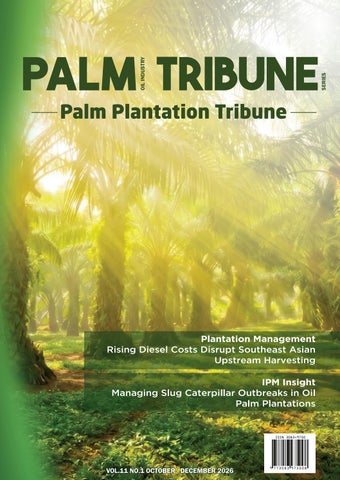
Plantation Management Rising Diesel Costs Disrupt Southeast Asian Upstream Harvesting IPM Insight Managing Slug Caterpillar Outbreaks in Oil Palm Plantations
VOL.11 NO.1 OCTOBER - DECEMBER 2026
SERIES
OIL INDUSTRY
Palm Plantation Tribune
3
Editorial
Palm Plantation Tribune
Editorial Team EDITOR Hani Aqilah hani@maps-globe.com CREATIVE DESIGNER Muhammad Faireez artwork@mapsglobe.com Quarterly Publication Palm Oil Industry Tribune Series: Palm Plantation Tribune
Volume 11 | No 1 Other Series: Palm Oil Tribune Palm Downstream Tribune What’s in it News Roundup Expert Insights Regional Policies Technologies Event Summary Follow us on: Next Chapter Media Next Chapter Media Disclaimer: Next Chapter Media's editorial team strives to provide accurate and reliable information. However, we recommend that readers independently verify the claims and information presented in our publications. Next Chapter Media is not responsible for the accuracy of the content and encourages readers to use their own judgment when evaluating the information.
Sustainability
DIRECTOR Emily Yu PUBLICATION Maps & Globe Specialist Distributor Sdn. Bhd (625396-A) No 3-1 Jalan Perdana 10/6, Pandan Perdana, 55300 Kuala Lumpur, Malaysia. PRINTING Fong Wah Printing Sdn. Bhd. (1406717K) No. 17, JaIan Tembaga SD 5/2G Perindustrian Bandar Sri Damansara, Pekan Kepong, 52200 Kuala Lumpur, Malaysia. Permit No.
PP19822/12/2024 (035507)
Innovation
Growth
Contents
Palm Plantation Tribune
CONTENTS 5-9
Latest News Roundup A quick digest of the latest policies and market trends.
11-12
Plantation Management Rising Diesel Costs Disrupt Southeast Asian Upstream Harvesting
25
Oil Palm Ministries, Its Agencies And Related Associations in Malaysia and Indonesia
26
Event List 2026
13-14
ADVERTISERS INDEX
Managing Slug Caterpillar Outbreaks in Oil Palm Plantations
1, 2, & 19
15-18
Muar Ban Lee Group Berhad
Decoding Malaysia’s Palm Oil Alphabet Soup (Part 1)
10
21-24
Back Cover
IPM Insight
Knowledge Nugget
Knowledge Nugget
Decoding Malaysia’s Palm Oil Alphabet Soup (Part 2)
Next Chapter Media
Palm Carbon Conference
4
5
News Roundup
Palm Plantation Tribune
Beyond Production: Winning Trust for Palm Oil
Indonesian govt offers free seeds for 870,000 hectares of plantations
10 July 2026
31 July 2026
Malaysia’s palm oil sector must learn to communicate as well as it produces, argues the columnist.
The Indonesian government is launching a free high-yield seed distribution initiative covering 870,000 hectares of plantations nationwide to boost agricultural productivity under President Prabowo Subianto’s priority development framework.
The sector is rich in data, standards, certification, science and acronyms, yet remains poorly understood beyond plantation circles. Technical accuracy alone is insufficient if messages do not reach policymakers, consumers, young people and critics in language they can understand. Communication should therefore be treated as strategic infrastructure, not public-relations decoration. The columnist advocates greater use of storytelling, allegory, humour, field visits and plain language to translate complex subjects such as sustainability, mechanisation, labour, biodiversity and certification into human terms. But storytelling must remain honest: the industry should avoid both greenwashing and excessive negative portrayal, acknowledging achievements alongside unresolved challenges. He also introduces the acronym PLANT as a communication framework: Pause and listen, Link facts to meaning, Anchor claims in evidence, Name the human story, and Tell it again consistently. His central message is simple: the industry need not shout louder. It must speak more clearly, honestly and humanely. If it plants understanding well, the next harvest may be lasting trust.
Agriculture Minister Andi Amran Sulaiman stated during an inspection of a 15-hectare state-run nursery in Batang, Central Java, that free seed allocations will directly target strategic commodities, including coconut, sugarcane, cocoa, coffee, cashew, nutmeg, and pepper. Distribution protocols will align directly with local agro-climates and existing farming clusters, focusing on established growing communities and areas adjacent to processing infrastructure, such as sugar mills. Backed by state funding to expand public access to quality planting materials, state nurseries are scaling up propagation to maintain long-term availability. The Batang facility currently maintains a six-hectare mother plantation for seed production alongside a three-hectare nursery zone holding over 25,000 superior dwarf coconut saplings—including Kebumen Entog Dwarf, Pandan Wangi Dwarf, and Bido Dwarf varieties. The nursery is also preparing 25,196 additional coconut plants in polybags—encompassing Bali Dwarf, Bojong Bulat Dwarf, and Kopyor variants—for immediate regional deployment.
News Roundup
Palm Plantation Tribune
The Smallholder Yield Gap Is Really a Confidence Gap
Monsoon May Soften El Niño Blow to Palm Oil
14 August 2026
25 August 2026
For independent oil palm smallholders, low yields are often the result of a deeper gap between knowing what should be done and having the means and confidence to do it.
Malaysia’s coming monsoon season could help soften the impact of a possible “Super El Niño” on palm oil production, according to Malaysian Palm Oil Council (MPOC) chief executive Belvinder Sron.
Drawing on years of field experience and research, the columnist argues that fertiliser, better planting materials and improved harvesting practices matter, but they work only when farmers can afford inputs, obtain trusted advice, secure labour and transport, access fair markets and manage household risks.
She noted that El Niño’s effect on oil palm usually appears only after a nine-to-12-month lag. During the previous Super El Niño in 2015, Malaysia’s palm oil production fell by 13%, or about 2.6 million tonnes, the following year. This time, however, dry conditions have developed later, making rainfall between September and November crucial in determining the eventual impact on 2027 production.
Studies cited in the article show that some Indonesian smallholders harvested only about 42% of attainable yield, while consistent good agronomy could raise yields substantially. In Malaysia, organised support programmes have also delivered meaningful improvements by combining technical guidance with certification, traceability, record-keeping and farmer organisation. The central argument is that technology alone is not enough. Governance, finance and institutions must make good decisions affordable and sustainable. Replanting, certification and digital tools succeed only when farmers trust the systems around them. The real yield gap may be less about what the palm can produce than whether institutions give ordinary farmers the confidence to unlock that potential.
Malaysia has so far avoided the severe dryness seen in parts of Indonesia, although temperatures have risen. In the short term, drier weather can actually aid harvesting and fresh fruit bunch transport by improving field access. The danger comes when dryness persists for more than three months, stressing palms and reducing subsequent yields. Meanwhile, palm oil prices remain supported not only by El Niño concerns but also by geopolitical tensions, elevated crude oil prices, India’s festive-season demand and Indonesia’s stronger B50 biodiesel requirement. MPOC expects CPO prices to remain above RM4,600 per tonne in September, with the possibility of staying firm through year-end.
6
7
News Roundup
Palm Plantation Tribune
Indonesia Leads Global Push for Palm Oil Smallholders
KPK Outlines Five Key Priorities for Budget 2027
31 August 2026
1 September 2026
Indonesia has assumed the presidency of the World Coalition of Oil Palm Smallholders (WCOPS), giving the world’s largest palm oil producer a leading role in strengthening the voice of smallholders internationally. Gulat ME Manurung, chairman of Indonesia’s Oil Palm Smallholders Association (Apkasindo), was elected WCOPS president during the International Oil Palm Smallholders Forum 2026 in Nusantara on August 27. The coalition brings together 12 smallholder associations from seven producing countries: Indonesia, Malaysia, Thailand, Nigeria, Ghana, Honduras and Côte d’Ivoire.
The Plantation and Commodities Ministry (KPK) has identified five key areas for Budget 2027 aimed at strengthening the agribased-commodities sector, boosting smallholder incomes, and elevating industry competitiveness. Minister Datuk Seri Dr Noraini Ahmad confirmed that central to the ministry's proposals is the empowerment of smallholders through high-quality inputs, good agricultural practices (GAP), and structured replanting support to drive long-term yield productivity. In conjunction with MAHA 2026, KPK launched the Smallholder Oil Palm Replanting Financing Incentive Scheme to accelerate crop turnover.
WCOPS aims to address smallholders challenges, including sustainability, traceability, fair trade, FFB prices, productivity and relationships with plantation companies. Manurung said smallholders and corporations should work on the basis of equality and mutual support rather than confrontation, while responding collectively to negative campaigns against palm oil.
KPK’s proposal heavily prioritises accelerated estate mechanisation, processing automation, AI, and smart agricultural technologies across upstream plantations and downstream processing mills. Furthermore, the ministry is driving downstream commercialisation by expanding targeted research and development to bring high-value, high-technology derivative products to commercial scale.
Indonesia’s five-year leadership is welcomed, with hopes for greater price equity and stronger international advocacy for farmers. The broader challenge for WCOPS will be turning this new global platform into practical gains, thus ensuring sustainability requirements, market access and industry growth also translate into better livelihoods for smallholders and their families.
This strategy ensures higher domestic value retention while strictly enforcing international market compliance, supply chain traceability, and sustainability standards. Crucially, KPK is also advocating for the modernisation of TVET modules to build a highly skilled, tech-driven local workforce capable of operating and maintaining advanced automated field machinery, securing long-term economic resilience and sustainable operational performance across the industry.
News Roundup
Palm Plantation Tribune
Oil Palm Industry Allocates RM200,000 to Boost Orangutan Habitats
MPOB’s PALMS 2030
6 September 2026
6 September 2026
The Malaysian palm oil sector has allocated nearly RM200,000 via the Malaysian Palm Oil Green Conservation Foundation (MPOGCF) to enhance orangutan habitat protection and raise public conservation awareness.
Malaysia’s oil palm industry is set for a more market-driven future as the Malaysian Palm Oil Board (MPOB) rolls out PALMS 2030, a framework designed to strengthen competitiveness, accelerate technology adoption and expand Malaysia’s global presence.
At World Orangutan Day 2026 in Putrajaya Botanical Garden, Plantation and Commodities Minister Datuk Seri Dr Noraini Ahmad said these industry funds support practical field interventions, including building arboreal wildlife bridges across fragmented habitats and funding a patrol boat for monitoring and enforcement.
MPOB director-general Datuk Badrul Hisham Mohd said the agency must move beyond reacting to issues and become more proactive in shaping industry development. PALMS 2030 is anchored on five priorities: productivity, automation, low carbon, marketability and sustainability.
Central to these initiatives is the Orangutan Diplomacy Programme (OUDip) being implemented at the Sungai Pin Conservation Area in Kinabatangan, Sabah. Within this framework, state-owned Sawit Kinabalu Group has set aside 2,632 hectares of its Sungai Pin Conservation Area (SPnCA) as a High Conservation Value zone, securing a critical habitat for an estimated 55 orangutans. Highlighting that registration proceeds from the event's 1,500-runner awareness drive were channelled directly to the MPOGCF Conservation Fund, Noraini noted that future habitat protection projects will expand beyond Sabah locations to encompass additional biodiversity hotspots, while seeking supplementary government allocations under upcoming national Budgets.
The plan includes strengthening MPOB’s international footprint through possible regional offices in strategic markets, while using its technical expertise to respond to trade challenges such as the European Union Deforestation Regulation (EUDR) and US trade measures. Greater emphasis will also be placed on downstream industries, including oleochemicals, nutraceuticals and sustainable aviation fuel, to reduce dependence on commodity exports. Smallholders will receive stronger support through expanded roles for Tunas officers in technology transfer, productivity, innovation, market access and sustainability. MPOB also aims to digitise at least 90% of its management and administrative processes by 2030.
8
9
News Roundup
Palm Plantation Tribune
Forest Fires Lift Palm Oil Prices on Supply Fears
Haze Today, Yield Loss Tomorrow?
7 September 2026
11 September 2026
Palm oil prices strengthened as worsening forest fires in Indonesia raised concerns over possible supply disruptions from the world’s largest producer.
Haze is usually discussed in terms of air pollution, health and cross-border blame. But for oil palm, the more difficult question is biological: what happens when smoke reduces the sunlight reaching the crop?
Harvesting has been affected in some areas, with plantation workers diverted to firefighting, while prolonged smoke can also reduce sunlight and potentially affect oil palm growth. The fires come amid an intensifying El Niño, which has created drier conditions and increased the risk and duration of wildfires. The ASEAN Specialised Meteorological Centre said prevailing winds were helping to spread haze across borders, affecting countries including Malaysia, Singapore and the Philippines. More than 200,000 hectares have reportedly burned in parts of Borneo and Sumatra. Palm oil prices have also received support from stronger crude oil and competing vegetable oil markets. Higher petroleum prices tend to improve the economics of biofuels, potentially boosting demand for palm-based biodiesel. The market will now watch the weather closely. More rainfall is expected around October, ahead of the wet season, which could help ease fires, haze and concerns over production.
Oil palm depends heavily on photosynthesis, and earlier research has shown that reduced light can affect growth and eventually yield. The complication is timing. A palm’s reproductive cycle stretches over many months, meaning environmental stress today may only become visible much later in flowering, fruit set and bunch production. The article also highlights the crucial role of Elaeidobius kamerunicus, the pollinating weevil introduced into Malaysia in 1981. This tiny insect transformed oil palm pollination by carrying pollen from male to female flowers, improving fruit set while reducing the need for labour-intensive assisted pollination. Yet one important scientific question remains unanswered: does severe haze affect weevil activity, floral scents, pollen transfer or fruit set? The evidence is still insufficient to establish that link. The article therefore calls for field research that measures haze, sunlight, rainfall, soil moisture, weevil activity, pollination, fruit set, OER and KER over time.
IndustryOutlook Market Insight
Next Chapter Media Palm Plantation Palm Oil Tribune
Gateway to Global Markets
PALM OIL TRIBUNE ADVERTISING RATE CARD 2026 Position
Size
Rate (RM)
USD
Back Cover
Full Page
8,000
2,000
Inside Front Cover
Full Page
7,000
1,710
Inside Back Cover
Full Page
6,500
1,600
Center Spread
Double Page
12,000
3,000
Full Page Colour
A4
5,000
1,230
Half Page Colour
A5
3,000
750
Advertorial
2 Pages
7,000
1,710
E -Newsletter Banner
Monthly
1,500
400
Website Banner
Monthly
2,000
500
BUNDLE PROMOTION Package
Price (RM)
USD
Benefit
Bronze
5,000
1,225
1 Full Page Ad
Silver
8,000
2,000
2 Full Page Ads + Website Banner
Gold
12,000
3,000
3 Full Page Ads + Advertorial
Platinum
18,000
4,410
4 Full Page Ads + Website Banner + Newsletter
Diamond
25,000
6,124
Cover Position + Advertorial + Digital Promotion
Next Chapter Media Gateway to Global Markets
https://issuu.com/mapsglobe
www.linkedin.com/in/nextchaptermedia
Speak to us to explore tailored advertising packages.
nadia@maps-globe.com emily@mapsglobe.com
Media Kit
www.nextchapter-media.com
10 10
11
Plantation Management
Palm Plantation Tribune
Rising Diesel Costs Disrupt Southeast Asian Upstream Harvesting Source: Reuters
Palm oil harvesting across Southeast Asia’s primary producing regions is encountering growing operational pressure as higher fuel prices and supply shortages force smallholders to reduce fruit collection, raising concerns over yield output across Malaysia and Indonesia. The disruption is particularly pronounced in East Malaysia. Sabah and Sarawak together generated 43.9% of Malaysia’s 20.28 million tonnes of crude palm oil in 2025. In the two states, unsubsidised diesel prices have surged by nearly 120%, significantly increasing the cost of transporting fresh fruit bunches (FFB) from remote plantations.
Subsidies Fall Short of Field Requirements In Sarawak, higher fuel prices are prompting some planters to reduce harvesting frequency. Harvesting rounds that would typically occur about 2.5 times a month have been reduced to two, 1.5 or even just once a month. Napolean R. Ningkos, President of the Sarawak Dayak Oil Palm Planters Association, warned that continued financial pressure could make harvesting uneconomical for smallholders, potentially resulting in abandoned fields and lower state productivity A key concern is the gap between subsidised diesel allocations and the operating requirements of plantations in East Malaysia. While Malaysia’s subsidized diesel scheme caps allocations at 200 litres per month per user, smallholders in East Malaysia require at least 500 litres monthly to navigate sprawling estates and rugged terrain. The association has argued that the existing quota does not adequately reflect the geographical and logistical conditions faced by planters in Sabah and Sarawak. If harvesting disruptions persist, Sarawak’s yields could decline by an estimated 15% to 20% according to industry perspectives.
REGIONAL FUEL & YIELD DISRUPTIONS Unsubsidised Diesel
Nearly +120% (Sabah & Sarawak)
Subsidised Quota vs. Field Needs
200L allocation / 500L required
Harvesting Frequency
From 2.5 rounds to 1–1.5 / month
Projected Yield Reduction
15% – 20% (Sarawak estates)
Plantation Management
Palm Plantation Tribune
Machinery and Logistics Add to the Pressure The fuel shortage is also affecting other parts of upstream operations. Raphael Golout, President of the United Sabah Smallholders Association, noted that financial burdens affect not only fresh fruit bunch transportation but also the operation of generators and other plantation machinery. In Indonesia, diesel supply constraints have similarly disrupted harvesting in Sumatra, which accounts for about 55% of national production. Scarce diesel supplies since mid-July have affected FFB transportation and the operation of diesel-powered vehicles and equipment. As a result, harvesting intervals have lengthened from 8–10 days to 8–12 days. The fuel-related disruption comes alongside the potential impact of an El Niño weather pattern expected in the second half of the year, which could further reduce rainfall and place additional pressure on palm yields. With fuel costs affecting harvesting, transportation and field machinery, industry leaders in Malaysia are calling for diesel subsidy arrangements to better reflect the geographical and operational conditions faced by planters in Sabah and Sarawak.
12
13
Palm Plantation Tribune
IPM Insight
Managing Slug Caterpillar Outbreaks in Oil Palm Plantations Slug caterpillars, Darna catenatus Snellen (family Limacodidae), are defoliating pests that have been reported as a significant problem in oil palm plantations in both Malaysia and Indonesia, where large areas have experienced severe defoliation. In India, the pest was first reported on oil palm in 2002, with sporadic and localised infestations recorded in plantations in the West Godavari and Krishna districts of Andhra Pradesh. The pest has also been observed feeding on coconut, as well as cocoa and maize grown within or near oil palm plantations.
Egg production: Each female lays approximately 250–350 eggs. Egg placement: Eggs are laid in rows on the underside (abaxial surface) of mature fronds, often near the edges of leaflets. Larval appearance: Caterpillars are green and have stinging/urticating spines that can cause skin irritation. Early feeding: Young larvae scrape the leaf epidermis, creating translucent, “window-like” patches. Later-stage feeding: Mature larvae feed from the leaflet margins towards the centre, often leaving only the midrib. Larval duration: The larval stage lasts approximately 3–7 weeks. Pupation: Mature caterpillars move towards the base of the trunk or surrounding vegetation to spin cocoons and pupate. Pupal duration: The pupal stage lasts approximately 2–4 weeks. Severity indicators: Faecal droppings, extensive leaf damage and the audible sound of feeding can indicate a severe infestation. Identification: A bluish tinge on the dorsal surface is a prominent identification characteristic.
IPM Insight
Palm Plantation Tribune
Impact on Oil Palm Plantations The caterpillars feed directly on the leaf lamina, with younger larvae initially scraping the leaf surface and older larvae consuming the tissue from the leaflet margins inwards. Under heavy infestation, feeding can leave only the midribs, resulting in severe defoliation. Lower fronds may dry out completely when pest populations are high. The extent of leaf loss can reduce the palm's photosynthetic capacity and, if severe or prolonged, potentially affect palm growth and yield. Slug caterpillars can be identified by their green body, bluish dorsal tinge and characteristic stinging spines. Contact with the larvae may cause skin irritation, making appropriate protection important during field inspection and control operations.
Integrated Management Approach Management should begin with early detection and the removal of infested lower fronds where practical. Pruned material containing pest stages should be properly destroyed to reduce sources of reinfestation. Biological control can play an important role in suppressing populations. Naturally occurring parasitoids from families including Eulophidae, Chalcididae, Braconidae, Tachinidae and Bombyliidae, together with predatory insects, have been reported to regulate slug caterpillar populations. Viral infections and the entomopathogenic fungus Beauveria bassiana have also shown potential for biological suppression. Where infestations reach damaging levels, chemical control may be considered as part of an integrated programme. Treatment should be guided by field monitoring and local regulatory recommendations, with attention given to protecting beneficial organisms and avoiding unnecessary broad-spectrum applications.
14
15
Palm Plantation Tribune
Knowledge Nugget
Decoding Malaysia’s Palm Oil Alphabet Soup (Part 1) By Joseph Tek Choon Yee
Knowledge Nugget
One question follows me around the Malaysian oil palm industry with remarkable persistence: who is who, who does what, and, most importantly, who on earth should I call? I usually try to help. After spending most of my working life in and around the sector, I ought still to be able to point someone towards the right ministry, agency, association or organisation without first conducting a Google search worthy of a PhD. Still, I confess to a small irritation. Most of the answers are already sitting quite comfortably on the internet. Websites exist. Search engines exist. Contact details exist. Organisational charts exist. Yet somehow the preferred research method remains a WhatsApp message: “Joe, who handles this-ah?” Perhaps that is simply human efficiency at work. Why spend ten minutes searching when you can spend ten seconds asking someone who probably already knows? And if that someone happens to be retired, then surely he must have nothing better to do. That last assumption, I have discovered, is both widespread and dangerous. But the repeated questions do reveal something important. The real difficulty is not a lack of information. It is the sheer breadth of Malaysia’s oil palm ecosystem - ministries, statutory bodies, associations, professional institutions, representative groups and commercial organisations - all doing different things, sometimes related things, occasionally overlapping things, and almost always answering to acronyms that seem designed to test memory. The information is there. The map is there. The challenge is seeing how all the pieces fit together without first needing a bowl, a spoon and a glossary. Palm oil begins with a fairly simple fruit bunch. Somewhere along the journey from soil to shelf, it acquires an alphabet: MPOB. MPOC. MSPO. MPOA. MEOA. EMPA. SOPPOA. NASH. ISP. MAPA. NUPW. MOSTA. POMA. PORAM. MEOMA. MOMG. MBA. MBIC - and assorted relatives. Welcome to Malaysian palm oil’s ABC soup. The soup is thick enough that newcomers may need a spoon before they need a glossary. I should also confess that this “guide” did not begin yesterday. I started parts of it a few years ago, when being surrounded by acronyms was something of an occupational hazard. It never quite crossed the finishing line, so I have now dusted it off, cleared away a few institutional cobwebs and brought the cast of characters up to date.
Palm Plantation Tribune
What began as a simple who-is-who guide has somehow grown into three parts. Consider it, tongue partly in cheek, Tek’s Guide to the Malaysian Oil Palm Industry - FOC. Perhaps it is my small contribution to helping the next person navigate the alphabet soup without learning every acronym the hard way. If I have omitted an organisation deserving mention, my apologies. Attribute it partly to space and perhaps partly to the ageing process. The memory may occasionally misplace an acronym. Hopefully, it has not yet misplaced the industry.
16
17
Palm Plantation Tribune
Knowledge Nugget
So where does one begin? As with many Malaysian palm oil matters, perhaps with three familiar letters: KPK. At the centre of federal palm oil policy sits the Ministry of Plantation and Commodities, around which are agencies with distinct roles. The Malaysian Palm Oil Board, MPOB, covers research, development, licensing, regulation and technical advancement - from planting materials and agronomy to milling, processing and downstream applications. MPOB is not an industry association; it is a statutory body, funded in part through cess paid by growers. That distinction matters. The Malaysian Palm Oil Council, MPOC, also supported by grower cess, has a more outward-facing role, particularly in market development, promotion and communicating Malaysian palm oil internationally. MPOB and MPOC therefore do very different jobs despite being separated by only one letter. Indeed, one of the first examinations for anybody entering the industry could be: MPOB is not MPOC. MPOC is not MPOA. And MPOA is definitely not MEOA. Discuss. Twenty marks. Sustainability adds another layer. Malaysia has the Malaysian Sustainable Palm Oil, MSPO, its national mandatory certification framework, while the Roundtable on Sustainable Palm Oil, RSPO, operates as an international voluntary system driven largely by business-to-business and market requirements. Particular customers and markets may demand still other assurances. At the international level, there is also the Council of Palm Oil Producing Countries, CPOPC, based in Jakarta, through which producer countries cooperate on common palm oil interests. A plantation can occasionally feel that it is growing not only oil palms but certificates as well. Certification serves an important purpose, but the challenge is to improve alignment and interoperability where possible so that sustainability produces better practices on the ground rather than simply more audits, paperwork and cost. The true measure should be what changes in the field, mill and supply chain - not the thickness of the certification file. There are also bodies such as the Malaysian Palm Oil Green Conservation Foundation, MPOGCF, likewise supported by grower cess, bringing conservation and biodiversity into the institutional landscape. Already the family photograph is getting crowded. And we have not even met the industry associations yet.
Knowledge Nugget
Palm Plantation Tribune
The Growers Have Several Voices At the plantation end sits the Malaysian Palm Oil Association, MPOA, one of the main national voices for commercial plantation interests. MPOA is itself an interesting chapter in our industry's ABC soup. It was formed in 1999 following a rationalisation that brought together three long-established plantation organisations: the Rubber Growers Association (RGA), the United Planting Association of Malaysia (UPAM) and the Malaysian Oil Palm Growers Council (MOPGC). The idea was straightforward: instead of several organisations representing overlapping plantation interests, create a stronger umbrella body capable of speaking more effectively for growers and the plantation industry. Alongside it is the Malaysian Estate Owners’ Association, MEOA, another established plantation voice, including many medium-sized interests. We often begin the palm oil story with a mature plantation. Yet every productive palm began rather less impressively as a seedling in somebody’s nursery. That brings in the Malaysian Oil Palm Nurseries Association, MOPNA. The employees and staff have their respective unions in National Union of Plantation Workers, NUPW and All Malayan Estate Staff Union, AMESU. There is also the Malaysian Agricultural Producers Association, MAPA, with its broader agricultural employer and producer constituency and longstanding links to plantation agriculture. The upstream also include the millers which have their own representative organisations. There are integrated and independent mills with the latter having its Palm Oil Millers Association, POMA. Their concerns may differ in emphasis, constituency and geography, but they also overlap considerably. That should surprise nobody. Yet once the arguments are unpacked, the common ground is often larger than the differences. One association may frame the issue through cost, another through competitiveness and another through implementation, but the underlying problem can be much the same. Different voices are useful. Common concerns are powerful. Unnecessary duplication is less so.
Cross the South China Sea Any map of Malaysian palm oil that stops in Peninsular Malaysia is incomplete. Sabah and Sarawak are fundamental parts of the national production landscape and bring their own geographic, operational and policy realities. The East Malaysia Planters’ Association, EMPA, formed in 1889 is among the region’s long-established plantation organisations. In Sarawak, the Sarawak Oil Palm Plantation Owners Association, SOPPOA, represents plantation-owner interests, while the Dayak Oil Palm Planters Association, DOPPA, adds an important indigenous grower perspective. These voices matter because one national industry operates across very different conditions. A policy conceived in Putrajaya may look beautifully symmetrical on a PowerPoint slide. By the time it reaches an estate several hours upriver in Sarawak or a remote property in Sabah, the symmetry may have encountered several potholes. Infrastructure differs, labour realities differ, land matters differ, distances differ, logistics differ and connectivity differs. That is not an argument against national policy. It is an argument for national policy informed by local reality.
18
19
Palm Plantation Tribune
Knowledge Nugget
Knowledge Nugget
Palm Plantation Tribune
Decoding Malaysia’s Palm Oil Alphabet Soup (Part 2) By Joseph Tek Choon Yee
20
21
Palm Plantation Tribune
Knowledge Nugget
Smallholders Are Not Miniature Estates Then come the smallholders, another essential constituency. They are not simply scaled-down plantation companies. Their economics, resources and ability to absorb costs can be very different. A listed plantation group may discuss five-year capital allocation, digitalisation, mechanisation strategy and return on invested capital. A smallholder may be asking whether this month’s FFB cheque will cover fertiliser, household expenses and the motorcycle instalment. Same palm. Different spreadsheet. Smallholder organisations like National Association of Smallholders Malaysia, NASH or PKPKM therefore matter, while FELDA, FELCRA, RISDA, SALCRA and others occupy important positions within Malaysia’s broader smallholder landscape. Smallholder inclusion should not mean inviting them after a policy is finished and asking whether they can comply. It means understanding their circumstances while the system is still being designed.
The Profession and Academia Matter Too The Incorporated Society of Planters, ISP, occupies another place in the ecosystem. Its role is professional rather than primarily commercial - developing knowledge, competence, continuing learning and professionalism among planters and agricultural practitioners. And for the science behind the oil, there is the Malaysian Oil Scientists’ and Technologists’ Association, MOSTA - an organisation whose name, refreshingly in our acronym-rich industry, tells you almost exactly who most of its members are. That matters because an industry cannot rely indefinitely on institutional knowledge stored inside the heads of people approaching retirement. Some of us are already discovering that those heads occasionally misplace acronyms. Professional institutions help transfer experience before the previous generation begins asking where it left its spectacles. Then there is academia. Public and private universities, colleges and research institutions are included. Industry gives academia real problems. Academia should help return knowledge, talent and possible solutions. The danger comes when one side speaks only in papers and the other only in tonnes per hectare. Innovation requires translation between both languages.
Knowledge Nugget
Palm Plantation Tribune
From Fruit to Oil
Growers, millers, refiners, traders and downstream manufacturers occupy different points along the same chain, with interests that may not always align - yet each can be The grower, incidentally, does not actually produce palm entirely rational from where they stand. oil. The grower produces fresh fruit bunches, FFB. Once harvested, those bunches begin a race against time to the mill. Millers therefore form another important constituency, whether within integrated plantation groups or independent operations purchasing crop from estates, dealers and smallholders. Their world revolves around crop supply, utilisation, oil extraction rate, quality, maintenance, energy, effluent, methane, biomass and keeping expensive machinery productively occupied. Growers naturally want the best possible FFB price. Millers naturally want good-quality fruit at a workable margin. Thus begins one of agriculture’s oldest traditions: each side explaining politely why the other fellow’s expectations are unreasonable. Yet neither survives without the other. That is the supply chain in one sentence. Once crude palm oil leaves the mill, the vocabulary changes. Rainfall becomes refining margin, loose fruits become inventory, harvesting rounds become freight schedules and somebody begins discussing futures before breakfast. Moving downstream, the Palm Oil Refiners Association of Malaysia, PORAM, represents an important part of the refining industry. PORAM specifications have become standard for palm oil trade globally. For the cooking-oil end of the chain and related packers, there is the Malayan Edible Oil Manufacturers’ Association, MEOMA - reminding us that after all the plantations, mills, laboratories and trading screens, much of the journey still ends rather simply in somebody’s kitchen. Further downstream sits the oleochemical and biodiesel stakeholders which are represented by the Malaysian Oleochemical Manufacturers Group, MOMG and the Malaysian Biodiesel Association, MBA. By this stage the original bunch has become refined oils, fractions, fatty acids, fatty alcohols, glycerine and ingredients entering food, soap, detergents, cosmetics, personal-care products and industrial applications. vvvv The harvester who cut the bunch might be surprised at just how sophisticated its journey eventually becomes. That is also why the seemingly simple phrases “oil palm industry” or “palm oil industry” can conceal a much more complex reality: there is no single commercial perspective running seamlessly from soil to shelf.
Biomass and the Wider The value chain does not stop with food and oleochemicals. Then there is the wider biomass economy, with organisations such as the Malaysia Biomass Industries Confederation, MBIC. Oil palm produces much more than oil. Empty fruit bunches, fibres, shells, trunks, fronds and other streams offer routes into renewable energy, materials and bio-based products. The phrase “waste to wealth” sounds wonderful on a conference banner. The hard part begins when the waste is wet, bulky, dispersed and somebody asks who is paying for the waste and truck. Eventually, the banker’s calculator gets a vote.
22
23
Palm Plantation Tribune
Knowledge Nugget
One Tonne, Many Perspectives The same tonne of palm oil therefore looks different depending on where one sits. The grower sees production cost, the miller sees throughput and extraction, the refiner sees feedstock and margin, the trader sees market position, the biodiesel producer sees energy feedstock and the smallholder sees household income. The sustainability manager sees compliance, the researcher sees yield potential, the academic sees questions worth investigating, and the policymaker sees exports, employment and economic value. Everyone is looking at the same elephant from a different angle. In our case, the elephant happens to have bunches.
And Who Discovers the Price? Another important player is Bursa Malaysia Derivatives, BMD - or what some older hands may still instinctively call MDEX. Its Crude Palm Oil Futures contract, FCPO, plays an important role in price discovery and risk management. The price flashing across a screen is more than a number for plantation people to celebrate when it rises and suddenly become experts in macroeconomics when it falls. It is the market continuously trying to answer one deceptively simple question: what is palm oil worth? Producers, refiners, traders, investors and other market participants bring expectations about supply, demand, competing oils, weather, currencies, policy and uncertainty into the marketplace. Their views meet and a price emerges. Palm oil may grow on trees. Its price does not.
Knowledge Nugget
More Than an Alphabet Exercise A palm may begin in a nursery, move into a smallholding or plantation, pass through a mill and refinery, enter domestic or export markets and eventually reappear as food, oleochemicals, biodiesel or other products. Around that journey and across the supply chain sit researchers, universities, unions, professional bodies, certification systems, regulators, traders, dealers, inputs and technology providers – and more. That explains why no single association, agency or company can represent every dimension of “the palm oil industry”. The ABC soup exists for a reason. Different constituencies need different voices. Regional realities matter. Smallholders matter. Upstream and downstream interests differ. Professional knowledge and academia matter. New value chains bring different economics. Government carries responsibilities beyond those of any commercial player. The challenge is not to eliminate the alphabet. It is to make the alphabet work together when the problem is common. Malaysia’s palm oil sector does not lack associations, agencies, technical expertise or institutional history. What it increasingly confronts are cross-cutting challenges - labour, ageing palms, replanting, mechanisation, rising costs, taxation, market access, sustainability, competitiveness, innovation and smallholder inclusion - that refuse to stay neatly within any one organisation’s boundary. No single acronym owns these problems. And no single acronym can solve them. That is where the real test begins: not whether Malaysian palm oil has enough voices, but whether those voices can work together when the issue is common.
Palm Plantation Tribune
24
25
Directory
Palm Plantation Tribune
OIL PALM MINISTRIES, THEIR AGENCIES AND RELATED ASSOCIATIONS MALAYSIA
Ministry of Plantation and Commodities (KPK) www.kpk.gov.my
Malaysian Palm Oil Board (MPOB) www.mpob.org.my
Malaysian Palm Oil Council (MPOC) www.mpoc.org.my
Malaysian Sustainable Palm Oil (MSPO) www.mspo.org.my
Malaysian Palm Oil Green Conservation Foundation (MPOGCF) www.mpogcf.org
Malaysian Palm Oil Association (MPOA) www.mpoa.org.my
Malaysian Estate Owners' Association (MEOA) www.meoa.org.my
Sarawak Oil Palm Plantation Owners Association (SOPPOA) www.soppoa.org.my
The East Malaysia Planters' Association (EMPA) www.theempa1889.wixsite.com/empa
The Incorporated Society of Planters (ISP) isp.org.my
Sarawak Dayak Oil Palm Planters Association (DOPPA) www.doppa.org
National Organisation of Smallholders (NASH) www.pkpkm.org.my
Malaysian Agricultural Producers Association (MAPA) www.mapa.net.my
INDONESIA
Badan Pengelola Dana Perkebunan Kelapa Sawit (BPDPKS) Indonesian Palm Oil Plantation Fund Management Agency https://www.bpdp.or.id/
Asosiasi Petani Kelapa Sawit Mandiri (APKSM) Independent Palm Oil Farmers Association
Gabungan Pengusaha Kelapa Sawit Indonesia (GAPKI) Indonesian Palm Oil Association https://gapki.id/en/
Indonesian Oil Palm Research Institute (IOPRI) Pusat Penelitian Kelapa Sawit (PPKS) https://iopri.co.id/
Palm Oil Agribusiness Strategic Policy Institute (PASPI) https://palmoilina.asia/
Asosiasi Petani Kelapa Sawit Indonesia (APKASINDO) Indonesian Palm Oil Farmers Association https://dpp-apkasindo.com/
Forum Pemuda Sawit Indonesia (FPSI) Indonesian Palm Oil Youth Forum https://www.forumpemudasa wit.or.id/
Gabungan Pengusaha Perkebunan Indonesia (GPPI) Indonesian Plantation Entrepreneurs Association https://www.gppindonesia.com/
Indonesian Planter Society (IPS) Masyarakat Planter Indonesia https://www.ips-planter.o r.id/
Serikat Petani Kelapa Sawit (SPKS) Indonesian Oil Palm Smallholders Union https://spks.or.id/
Event List
Palm Plantation Tribune
12 - 13 JAN
9 - 11 FEB
10 - 12 FEB
17 - 19 APR
Palm Oil Economic Review and Outlook Seminar (R&O) 2026
37th Palm & Lauric Oils Price Outlook Conference & Exhibition (POC2026)
3rd International Symposium Ganoderma (ISGANO) 2026
Pakar Pertanian Expo (PPE)
TBC, Kuala Lumpur, MY
Adimulia Hotel Medan, Sumatera Utara, INA
22 - 23 APR
23 - 24 APR
6 - 7 MAY
14 - 16 MAY
2nd HaiSawit Symposium (HASI) 2026
International Palm Oil Millers Conference (IPOMC) 2026
16th PALMEX Indonesia 2026
4th AgTech International Agro Expo
Berjaya Times Square Hotel, Kuala Lumpur, MY
Royale Chulan KL, MY
Hall A1 & A2, Jakarta International Expo (JIEXPO), Kemayoran, INA
25 - 27 JUN
7 - 9 JUL
13 - 15 JUL
4th AgTech International Agro Expo
4th Technology & Talent Palm Oil Mill Indonesia (T-POMI)
11th International Conference (IPC)
Hotel Bidakarta Jakarta, INA
Setia City Convention Centre, Selangor, MY
Holiday Inn Bandung Pasteur, West Java, INA
MAEPS Serdang, Selangor, MY
Perda Convention Centre, Penang, MY
28 - 30 JUL Planters
Royale Chulan Kuala Lumpur, MY
12th Indonesia International Palm Oil Machinery & Processing Technology Exhibition (INAPALM Asia)
Jakarta International Expo (JIEXPO) Kemayoran, INA
6 - 7 AUG
6 - 8 AUG
10 - 12 SEP
6 - 8 OCT
Asia Palm Oil Conference (APOC) 2026 | 15th PALMEX Thailand
9th Malaysia International Agriculture Technology Exhibition (Agri Malaysia)
16th PALMEX Medan 2026
CO-OP Exhibition Centre, Surat Thani, THA
4th Sawit Indonesia Expo (SIEXPO) 2026 Pekanbaru Convention & Exhibition, Riau, INA
Santika Premiere Dyandra Hotel & Convention, Medan, INA
13 - 14 OCT
16 - 17 OCT
7 - 8 NOV
17 - 18 NOV
Oils & Fats International Congress 2026 (OFIC 2026)
3rd Unlocking Revenue & Sustainability: Palm Carbon Emission Reduction | POMA Dinner
4th AgTech International Agro Expo
5th World Palm Conference 2026 | 13th PALMEX Malaysia
Kuala Lumpur Convention Centre, KL, MY
Genting Highlands, MY
Malaysia International Trade Exhibition Centre (MITEC), KL, MY
&
Sabah International Convention Centre, Sabah, MY
Hall 4 & 5, Kuala Lumpur Convention Centre, MY
26
PALM CARBON
CONFERENCE RENCE 2026 Harnessing Carbon Opportunities for Malaysia’s Oil Palm Stakeholders
16 JUNE 2026 MALAYSIA PALM CARBON K U A L A L U M P U R 2026
MENARA FELDA, KUALA LUMPUR www.malaysiapalmcarbon.com
Unlocking the Palm Bioeconomy Through Biofuels, Biochar, Sustainable Products, CO2 Removal Certificate
16-17 OCTOBER 2026 ASEAN PALM CARBON M A L A Y S I A 2026
RESORTS WORLD AWANA, GENTING HIGHLANDS www.aseanpalmcarbon.com
Reducing Indonesia’s Emissions Through High-Impact Palm Carbon Offset Initiatives INDONESIA PALM CARBON T B C 2027
To Be Confirmed To Be Announced www.malaysiapalmcarbon.com
MALAYSIA PALM CARBON S A B A H 2027
Organised By: