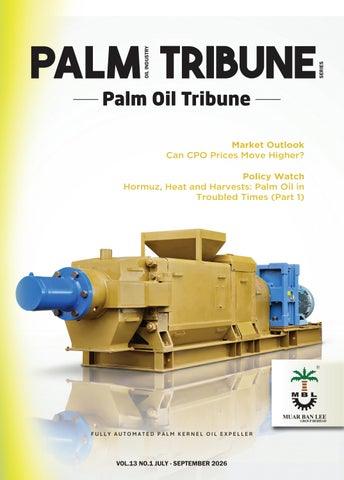
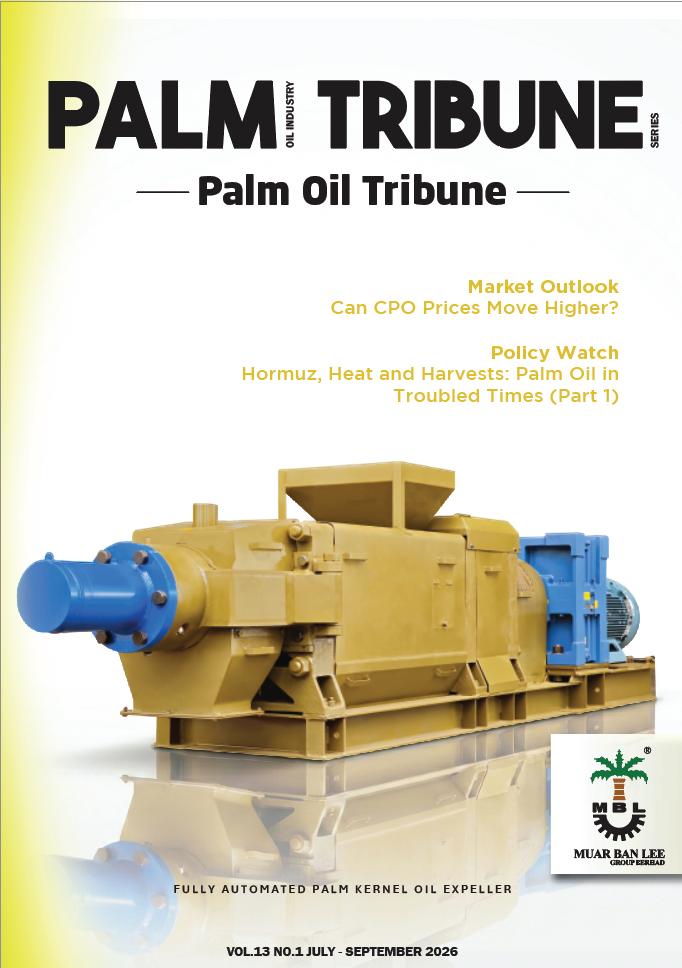
Hormuz, Heat and Harvests: Palm Oil in Troubled Times (Part 1)
Volume 13 | No 1
O ther Series: What’s in it
Palm Plantation Tribune Palm Downstream Tribune
News Roundup Exper t Insights Regional Policies Technologies Event Summar y
Follow us on: y ibune Series: Palm Oil Tribune
Nex t Chapter Media
Next Chapter Media
Disclaimer:
Nex t Chapter Media's editorial team strives to provide accurate and reliable information. However, we recommend that readers independently verify the claims and information presented in our publications Nex t Chapter Media is not responsible for the accurac y of the content and encourages readers to use their own judgment
Editorial Team
EDITOR
Hani Aqilah hani@maps-globe.com
CREATIVE DESIGNER
Muhammad Faireez ar twork@mapsglobe com
DIREC TOR Emily Yu
PUBLICATION
Maps & Globe Specialist
Distributor Sdn. Bhd (625396-A)
No 3-1 Jalan Perdana 10/6, Pandan Perdana, 55300 Kuala Lumpur, Malaysia.
PRINTING
Fong Wah Printing Sdn. Bhd (1406717K )
No. 17, JaIan Tembaga SD 5/2G Perindustrian Bandar Sri Damansara, Pek an Kepong, 52200 Kuala Lumpur, Malaysia.
Sustainability Innovation Growth
RM3.5 Million Boost for Sustainable Palm Oil Traders
11 April 2026
e Ministry of Plantation and Commodities has launched a RM3.5 million incentive to help oil palm fresh fruit bunch (FFB) traders obtain Malaysian Sustainable Palm Oil (MSPO) certi cation.
Minister Datuk Seri Noraini Ahmad said the initiative is intended to assist traders in meeting current compliance requirements while strengthening the resilience of Malaysia’s palm oil supply chain. More than 3,000 eligible FFB traders nationwide are expected to bene t, subject to set terms and conditions.
Applications were open on April 15, 2026, through the e-MSPO system managed by the MSPO Council. e programme supports the wider implementation of MSPO 2.0, Malaysia’s upgraded sustainability certi cation framework.
e ministry said the incentive also re ects the government’s commitment to protecting industry stakeholders, improving market con dence and ensuring that Malaysian palm oil continues to develop in a sustainable, responsible and resilient manner, particularly as global markets demand stronger proof of compliance.
Malaysia’s Biodiesel Moment Arrives
8 May 2026
Malaysia’s move towards B15 biodiesel marks a timely opportunity to rethink palm oil’s role in national energy security.
With B15 production scheduled to begin on June 1 through 19 licensed plants, the country is being pushed to ask whether biodiesel should remain a cautious blending policy or become a stronger strategic tool. Malaysia produces about 20 million tonnes of palm oil annually, yet only around 1.3 million tonnes is currently used for biodiesel, suggesting room for higher domestic utilisation.
e article argues that higher blends such as B15, and eventually B20 or B30, could reduce fossil-fuel dependence, support local palm oil demand and provide some bu er against global energy shocks.
MSPO May Include Carbon Credit Mechanism
26 April 2026
e Plantation and Commodities Ministry is studying the phased introduction of carbon-related mechanisms within the Malaysian Sustainable Palm Oil certi cation framework.
Minister Datuk Seri Dr Noraini Ahmad said the study will examine institutional governance, monitoring, reporting and veri cation, data ownership, and value creation for industry players. e aim is to ensure any carbon credit model is credible, market-trusted and practical on the ground, especially for smallholders.
e ministry said strengthening MSPO remains the priority, including better greenhouse gas calculation, transparent data, stronger reporting and improved supply-chain traceability.
Carbon credit elements could add value to Malaysian palm oil as global markets demand stronger sustainability proof. However, implementation will require careful evaluation, industry engagement and cooperation with relevant ministries, agencies, experts and international partners.
e proposal follows earlier calls to develop MSPO 3.0 with carbon accounting and crediting features.
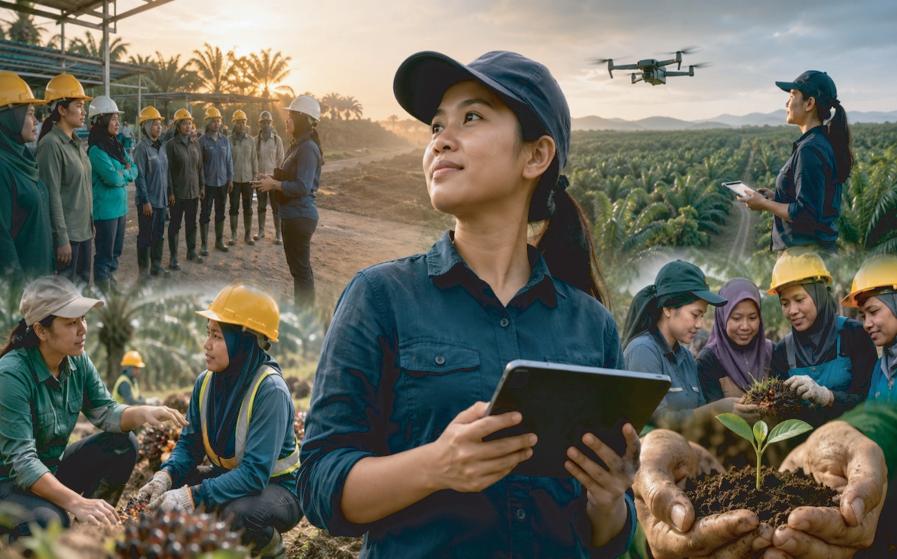
Women Planters Take Root in Oil Palm Estates
8 March 2026
Women are steadily gaining ground in Malaysia’s oil palm estates, challenging old assumptions that plantation leadership is mainly a man’s domain.
Writing in conjunction with International Women’s Day 2026, columnist Joseph Tek Choon Yee said the industry’s “Give to Gain” message is clear: when companies invest in women through training, trust, safety and career progression, they gain stronger teams and better decisions.
e article highlights women executives in SD Guthrie estates, including Assistant Manager Shirley Goh Chin Lon and Senior Assistant Nur Syahirah Che Ismail, as examples of eld-earned competence. It notes that more than 40 female executives are now serving across SD Guthrie estates.
Tek also points to wider research showing women planters carry the same workload, face safety concerns and o en must prove authority repeatedly. His message: fair opportunity turns quiet resilience into plantation leadership.
Ministry Pushes Smarter,
Greener Palm Oil Mills
23 April 2026
e Plantation and Commodities Ministry plan to modernise Malaysia’s palm oil milling sector through wider use of technology and sustainable practices.
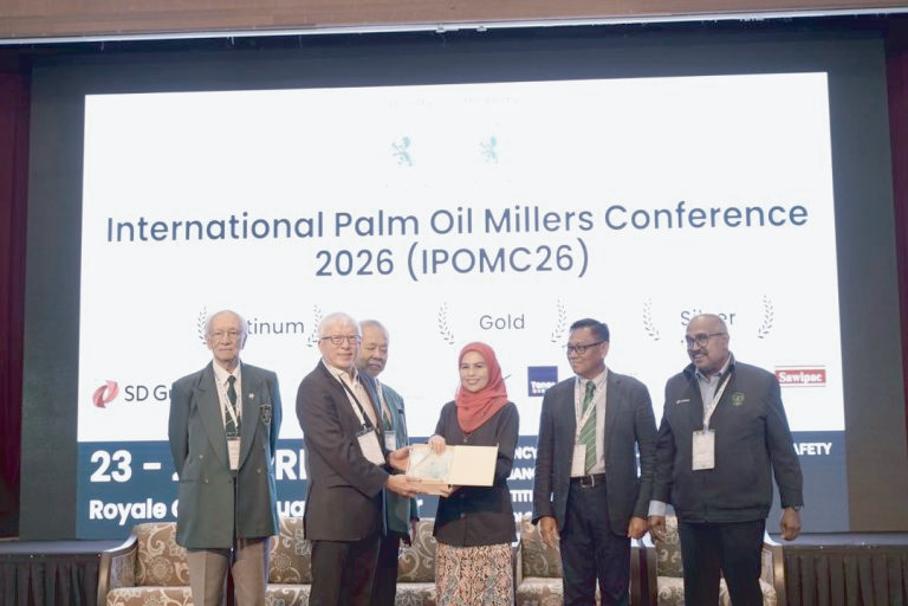
Minister Datuk Seri Dr Noraini Ahmad said automation, data analytics and arti cial intelligence can improve operational e ciency, strengthen quality control, reduce disruptions and support proactive maintenance. e commitment was highlighted during the International Palm Oil Millers Conference 2026, organised by the Incorporated Society of Planters from April 23 to 25.
Sustainability remains central to the agenda, with emphasis on responsible resource management, energy e ciency, waste reduction and compliance with Malaysian Sustainable Palm Oil standards. Food safety concerns, including 3-MCPD and glycidyl esters, must also be managed to protect reputation and market access.
e ministry will continue investing in education, training, leadership and collaboration to build a more skilled, resilient and innovative milling ecosystem.
How RSPO Took Root
21 February 2026
e Roundtable on Sustainable Palm Oil (RSPO) was born from crisis, pressure and negotiation, not corporate fashion. Writing in e Edge Malaysia, Teoh Cheng Hai recalls that the 1997 regional forest res and rising NGO campaigns pushed palm oil into the global sustainability spotlight.
WWF’s early campaigns linked palm oil expansion to deforestation, while Unilever and other market players recognised that confrontation alone could not solve supply-chain challenges. A preparatory meeting in London in 2002 led to the rst roundtable in Kuala Lumpur in August 2003, attended by 193 participants from 16 countries.
e RSPO was formally established in Zurich on April 8, 2004, by founding members including MPOA, Unilever and WWF. Today, it has over 6,000 members in 150 countries, with 5.1 million hectares certi ed, covering about 20% of global palm oil production.
PALM OIL TRIBU
BUNDLE PROMOTION
Speak
emily@mapsglobe.com
Can CPO Prices Move Higher? Supply Risks Return to the Spotlight
Source: Time to ‘overweight’ plantation stocks now as El Niño arrives, says RHB Research, Hannah Chan, e Edge Malaysia, El Niño impact on Malaysian and Indonesian palm oil production, Marex Financial
Edited by: Hani Aqilah
Crude palm oil (CPO) prices are expected to remain well supported in the second half of 2026, underpinned by tightening supply conditions, resilient export demand and expanding biodiesel consumption. While these factors are expected to support prices, elevated inventories in key importing countries and challenging biodiesel economics may temper further gains.
One of the most signi cant developments in the palm oil market is Indonesia's implementation of its B50 biodiesel mandate on 1 July 2026. Following successful trials, the programme is expected to increase domestic palm oil consumption signi cantly, thereby reducing export availability from the world's largest palm oil producer. As more palm oil is channelled towards biodiesel production, global supply
Meanwhile, production growth is expected to remain modest. Palm oil output has expanded only modestly in recent years due to biological yield cycles, labour shortages and productivity constraints. ese structural challenges continue to limit supply growth despite rm demand.
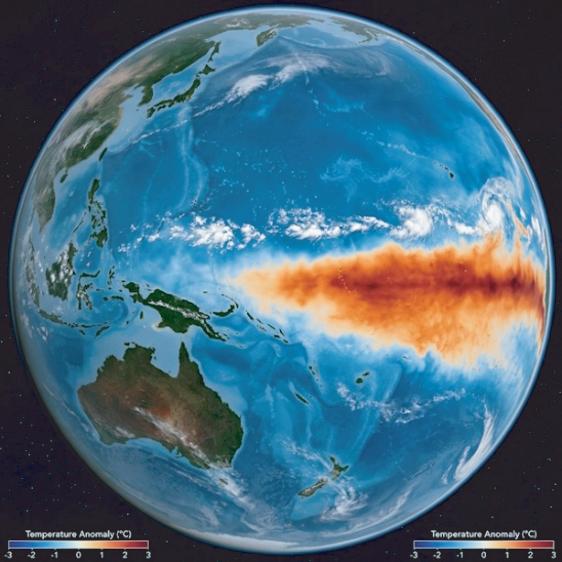
Weather remains another key risk. Market participants are closely monitoring the possibility of El Niño conditions developing between July and August, which could bring drier weather to major producing areas. Should dry conditions intensify, palm oil yields may be a ected, further tightening supply and supporting prices.
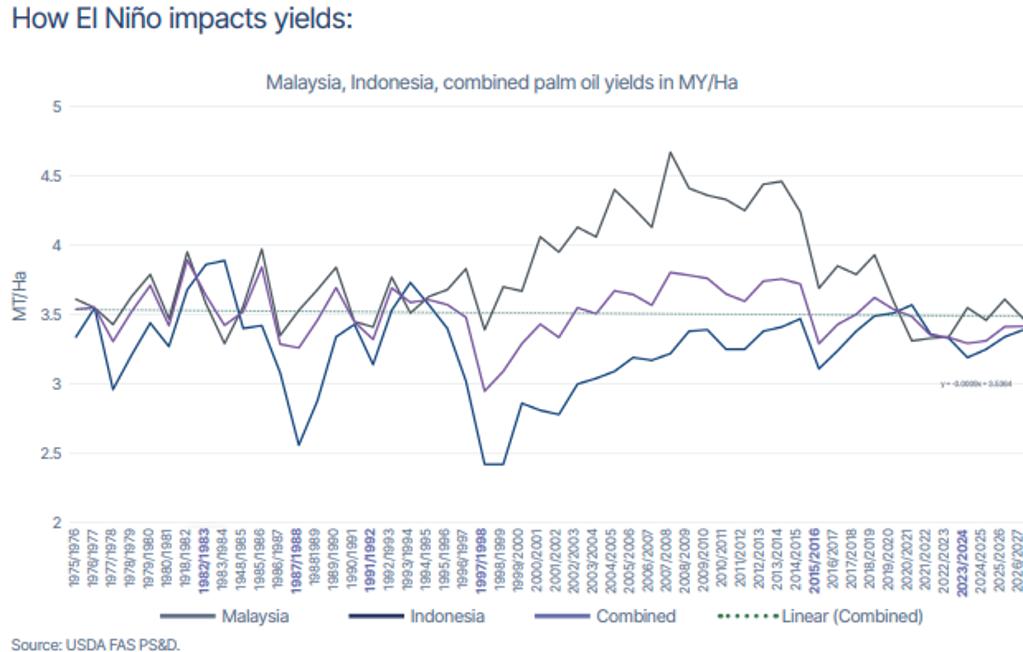
Recent analysis by commodity broker Marex highlights the potential implications of a strong El Niño event for the global palm oil market. e report noted that Malaysia and Indonesia account for approximately 88% of global palm oil production, making the market particularly vulnerable to weather-related disruptions.
Historical data show that strong El Niño episodes have generally reduced yields across both countries.
According to the analysis, a strong El Niño episode based on historical yield performance could reduce global palm oil production by more than 4 million tonnes from current projections. Marex estimates that global stocks-to-use ratios could fall from around 12% currently to approximately 8% under a strong El Niño scenario, increasing the risk of supply shortages and highlighting the market's sensitivity to production disruptions. Due to the biological characteristics of oil palm trees, moisture stress can a ect fruit development and yields for up to two years a er a severe weather event, prolonging the e ects on production.
Nevertheless, the extent of any production losses will depend on the intensity and duration of the weather event. Improved water management and current inventory levels may help cushion short-term supply disruptions.
Demand-side developments may also in uence the market outlook. China's palm oil imports have remained relatively subdued in recent months amid weak biodiesel activity and competition from soybean oil. While higher soybean oil premiums continue to support palm oil's relative competitiveness, slower import demand from major consuming markets could moderate price gains.
Overall, the market appears increasingly balanced towards upside price risks. While comfortable inventories and subdued Chinese demand may cap gains in the near term, expanding biodiesel consumption, constrained production growth and potential weather-related disruptions could tighten global supply and keep CPO prices well supported over the medium term.
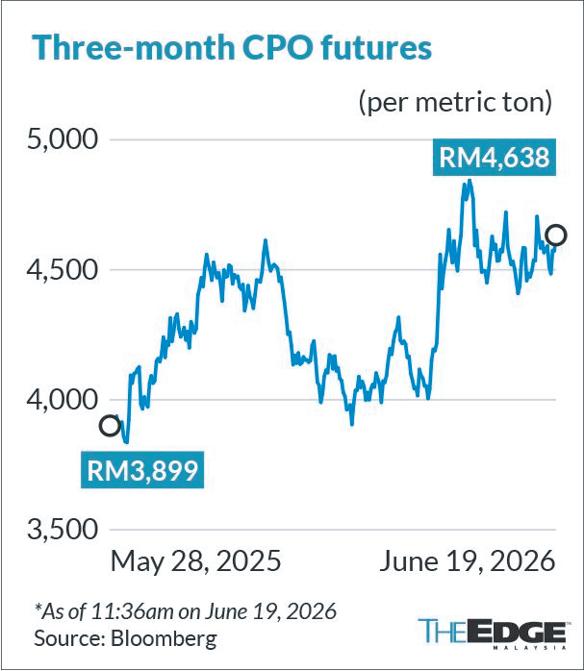
Re ecting these conditions, some analysts forecast CPO prices to average around RM4,300 per tonne in 2027, compared with an estimated RM4,400 per tonne in 2026.
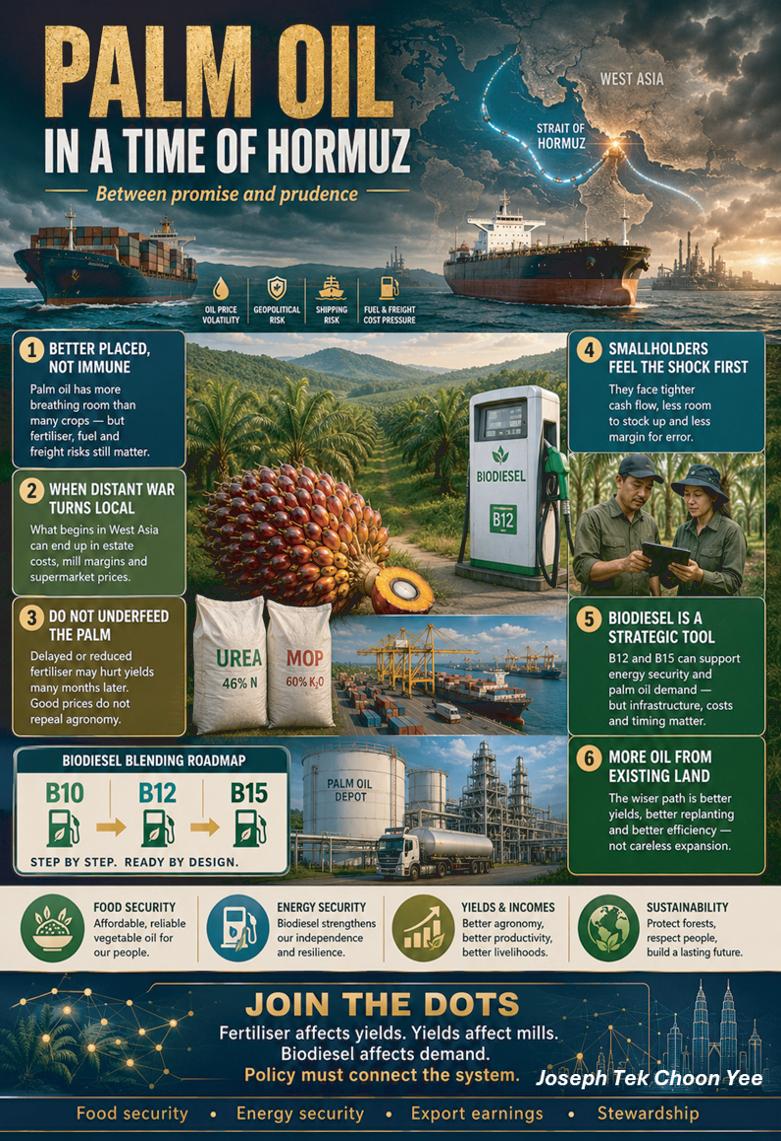
Hormuz, Heat and Harvests: Palm Oil in Troubled Times (Part
By Joseph Tek Choon Yee
1)
Wars are usually narrated through maps, missiles, war rooms and men in dark suits trying to look calm. Agriculture encounters them di erently.
It meets war through delayed vessels, nervous procurement meetings, rmer fertiliser quotations, diesel bills that suddenly look indecent, and the slow realisation that what begins in West Asia may eventually appear in a plantation ledger, a mill margin, a fuel subsidy bill and eventually, a supermarket receipt.
In that sense, the Strait of Hormuz is not merely a geopolitical chokepoint. It is one of those distant places capable of quietly rearranging the economics of Malaysian agriculture without ever sending us a postcard.
at is why the present conversation around palm oil deserves something better than cheerleading or panic. It deserves sober con dence, practical caution and joined-up thinking.
A Crop with Breathing Room, Not Immunity
ere is a reasonable argument that Malaysia’s palm oil sector is better placed than many crops in the present turbulence. Oil palm is certainly fertiliser-hungry, but it is not as immediately tied to nitrogen-based fertilisers as some annual food crops. Its nutrient dependence leans heavily on potash, which is less directly exposed to some Gulf-linked disruption.
Large plantation groups may also have already secured much of their fertiliser requirements ahead of time. In perennial crops, the e ect of fertiliser cuts may take many months, sometimes even up to two years, before appearing fully in production. at gives oil palm some breathing room.
But breathing room is not immunity.
To say palm oil is better placed is not to say palm oil is safe. A cushion is useful, but it is not a mattress for sleeping through the crisis. Fertiliser, fuel, freight, shipping risk, currency movement and procurement uncertainty still matter. If the world sneezes through Hormuz, the estate store may still catch a cold.
When the Fertiliser Shock Reaches the Estate
Malaysia remains heavily dependent on imported fertiliser inputs. at dependence sounds technical in a seminar, but it becomes very practical when quotations rise, shipments delay and estate managers must decide whether to maintain, reduce or defer applications.
For oil palm, this is not a small matter. Fertiliser is not merely a cost. It is deferred yield. It is tomorrow’s bunch weight, oil recovery and crop pro le. Missed or diluted rounds are o en not savings; they are quiet borrowing from future yields.
Large estates may have more room to negotiate, stock, schedule and optimise. Smaller growers and smallholders have less luxury. ey buy nearer to need, absorb price shocks more directly and have less margin for error. When input prices rise, the temptation is familiar: cut the dose, delay the round, hope the palm understands geopolitics.
Unfortunately, palms are ‘patient’, but not ‘stupid’.
e damage may not appear immediately. e eld may look respectable. e crop may still come in. en, months later, the bill arrives through weaker bunch formation,
Squeezed at the Roots, Li ed at the Barrel
Commodity stories enjoy irony. e same geopolitical tension that raises fertiliser and fuel concerns can also support palm oil prices.
When crude oil strengthens, biodiesel becomes more attractive. When edible oil supply tightens, palm oil may bene t. When geopolitical tension shakes energy markets, a crop that can serve both food and fuel suddenly looks more strategic.
So palm oil may nd itself in a familiar Malaysian position: squeezed at the roots, but li ed at the barrel. Helpful? Yes. Decisive? No.
Better crude palm oil prices can cushion margins, but they do not repeal agronomy. Good prices do not feed palms. ey only make it easier, if growers and policymakers are disciplined enough, to keep feeding them properly.
Between the Plate and the Tank
is brings us to biodiesel, where the conversation has moved quickly from theory to policy.
Malaysia’s move from B10 towards B15 re ects more than green signaling. It is about energy security, reducing dependence on fossil diesel, supporting domestic palm oil demand and giving the country another lever in a less predictable world.
e logic is understandable. If imported fuel becomes expensive or uncertain, palm-based biodiesel becomes more than an environmental slogan. It becomes part of national resilience.
But biodiesel must be handled with care. It is not a magic potion. It cannot abolish diesel imports, solve subsidy pressures, make ageing palms young again or turn infrastructure into fairy dust.
e move towards higher blending must obey three realities: infrastructure, economics and feedstock discipline.
Blending depots do not upgrade themselves on ministerial optimism. Storage, logistics, quality control, transport systems, engine compatibility, maintenance costs and operating discipline matter. A mandate announced in a speech still has to survive the depot, the tanker, the pump and the balance sheet.
Malaysia’s measured approach therefore makes sense. Start with what existing infrastructure can bear. Move in stages. Learn from implementation. Avoid turning policy ambition into scal drama.
e Awkward Arithmetic of Biodiesel
e central challenge is the spread between crude palm oil and fossil diesel.
When palm oil prices are favourable relative to fossil fuel, biodiesel becomes more attractive. When crude palm oil trades at too high a premium to gasoil, higher mandates become harder to sustain without subsidy, cross-subsidy or some other support mechanism.
at is the awkward arithmetic beneath all biodiesel speeches.
Palm oil may be strategic, but it is not free. Biodiesel may strengthen energy security, but it carries costs. Higher mandates may support demand, but they must not be designed in a way that creates new burdens elsewhere.
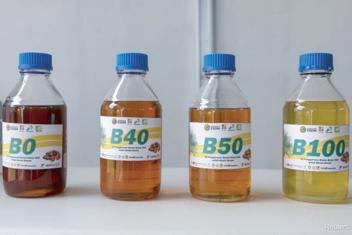
is is why Malaysia’s biodiesel path should be strategic, phased and honest. B15 is a useful step. B20 and B30 may have a future in selected sectors or regions. B100 may be suitable in controlled ecosystems such as plantation machinery, eet vehicles or settlement-based trials.
But each step must be guided by infrastructure readiness, cost transparency, technical evidence and feedstock availability.
Policy must be brave enough to move, but humble enough to count.
B100: Interesting, But Still a Pilot Frontier
e discussion on B100 is worth watching.
Palm-based B100 could have practical use in controlled environments where fuel supply, vehicles, machinery, maintenance and monitoring are managed within a de ned system. Plantation eets, settlement vehicles and machinery near mill sites are logical places to test such possibilities.
Pilot programmes are important because they reveal what speeches cannot: performance, maintenance behaviour, fuel quality, user acceptance, cost, emissions and reliability. But B100 remains pilot territory, not nationwide commercial reality. It should be treated as an experiment with promise, not a parade oat of certainty.
e right approach is to test, measure, improve and scale only where the economics and engineering make sense.
More Oil from Existing Land
If palm oil is to serve both plate and tank more convincingly, the answer cannot be careless expansion.
e wiser frontier is productivity. More oil should come from better yields, better replanting, better planting material, stronger agronomy, better harvesting discipline, improved mill recovery and reduced losses - not from pushing into sensitive landscapes.
is matters greatly. Food security, energy security, exports and environmental stewardship must be considered together. e old habit of admiring each dot separately will no longer do.
Palm oil’s future strength lies not merely in planted area, but in biological discipline, technological improvement and responsible intensi cation.
In plain language: produce more from land already planted, while keeping high-conservation-value areas rmly out of bounds.
Smallholders Must Not Be Le Behind
Any Hormuz-related fertiliser or fuel shock will expose structural di erences within the industry.
Large companies have planning capacity. Smallholders o en have anxiety.
If prices rise and smallholders reduce fertiliser applications, the consequences may appear later in national production. If diesel costs rise, evacuation and eld operations become more di cult. If biodiesel demand strengthens but productivity weakens, the country may enjoy the policy headline while struggling with the crop reality.
is is why smallholder support must be practical: group procurement, fertiliser advisory services, credit tied to good agronomy, replanting support, mechanisation access, better extension and transparent market information.
Smallholders should not be asked to carry a national strategy with household-level uncertainty.
Treat Palm Oil as Strategic, Not Convenient
Hormuz reminds Malaysia of something it should already know: palm oil is not merely another commodity line.
It is food, fuel, export income, rural employment, smallholder livelihood, industrial feedstock, downstream opportunity and national resilience. During di cult economic periods, palm oil has o en provided ballast. Not miracle. Not rescue fantasy. But ballast.
at distinction matters.
A sector that contributes resilience should not be treated only as a tax handle or policy a erthought. It requires reinvestment, replanting discipline, research and development, labour reform, better logistics, credible sustainability, stronger market development and more coherent policy.
A strategic crop deserves strategic stewardship.
Recommendations for a Less Easy World
Malaysia should respond to the Hormuz moment with practical seriousness.
First, strengthen fertiliser security through better procurement intelligence, strategic stockholding, transparent pricing and targeted smallholder support.
Second, phase biodiesel expansion carefully, matching mandates with infrastructure, cost clarity and supply readiness.
ird, accelerate replanting and productivity improvement so biodiesel ambition does not outrun agronomic reality.
Fourth, test higher blends and B100 in controlled ecosystems before wider scaling.
Fi h, use good CPO price periods to reinvest in yield, mechanisation, milling e ciency and research, not merely to celebrate margins.
Sixth, build policy coherence across fertiliser, labour, replanting, biodiesel, taxation, logistics and sustainability. Seventh, communicate honestly. e public must understand that palm oil sits at the intersection of food, fuel, climate, trade, livelihoods and national resilience.
Between Promise and Prudence
So where does Hormuz leave Malaysia? Between promise and prudence.
Palm oil is relatively better placed than many crops, but not invulnerable. Biodiesel is a strategic option, but not a miracle cure. Higher prices may help, but they do not remove biological discipline. Fertiliser shocks may arrive quietly, but their e ects can echo for years.
e lesson is not to panic. Nor is it to boast. e lesson is to connect the dots.
What happens in Hormuz can a ect fertiliser. Fertiliser a ects future yields. Yields a ect mill utilisation. Mill e ciency a ects export earnings. Biodiesel a ects domestic demand. Diesel prices a ect logistics. Policy a ects reinvestment. Smallholders a ect national production. Sustainability a ects market access.
In other words, the system is connected. Policy must be connected too. e fruit bunch now has one foot in the kitchen and another in the tank. at is both opportunity and responsibility.
If Malaysia handles this moment wisely, palm oil can again prove itself as more than a commodity. It can be a strategic crop for a less easy world - feeding people, supporting livelihoods, strengthening energy options and reminding the nation that resilience is not built during calm weather alone.
It is built before the storm, tested during the storm, and remembered a er the storm has passed.
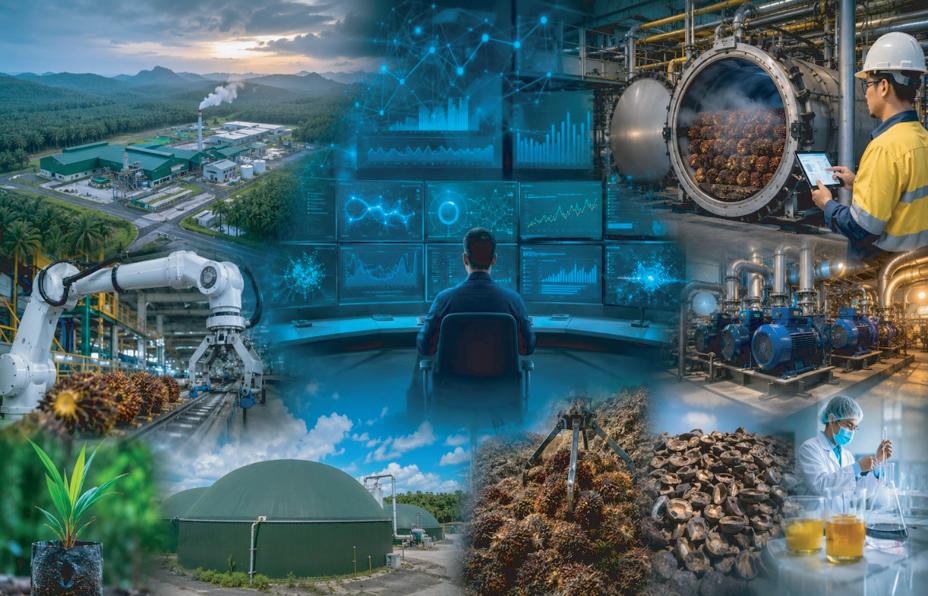
e Second Harvest: Every Drop Counts for Innovation
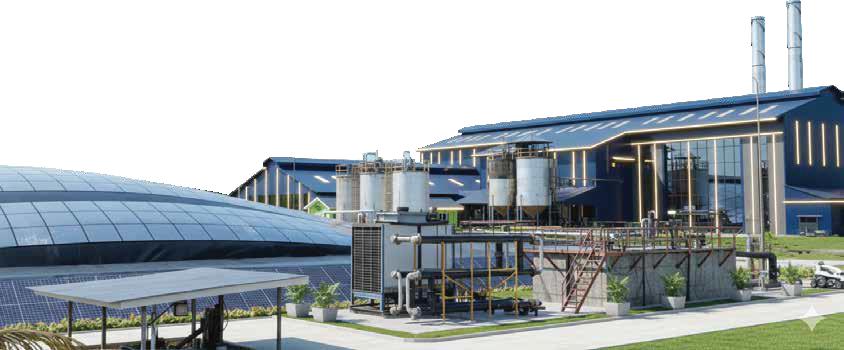
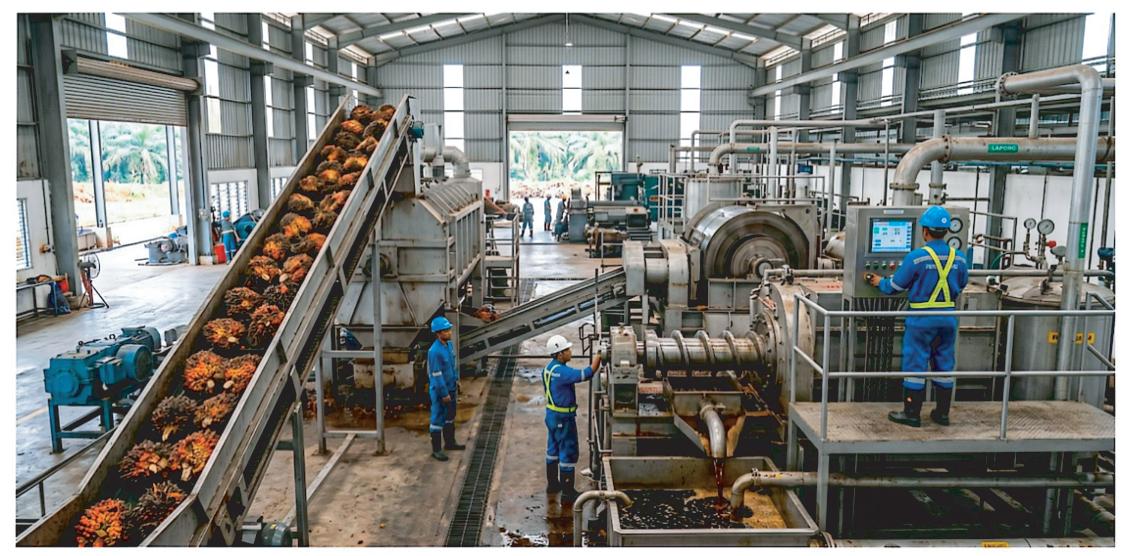
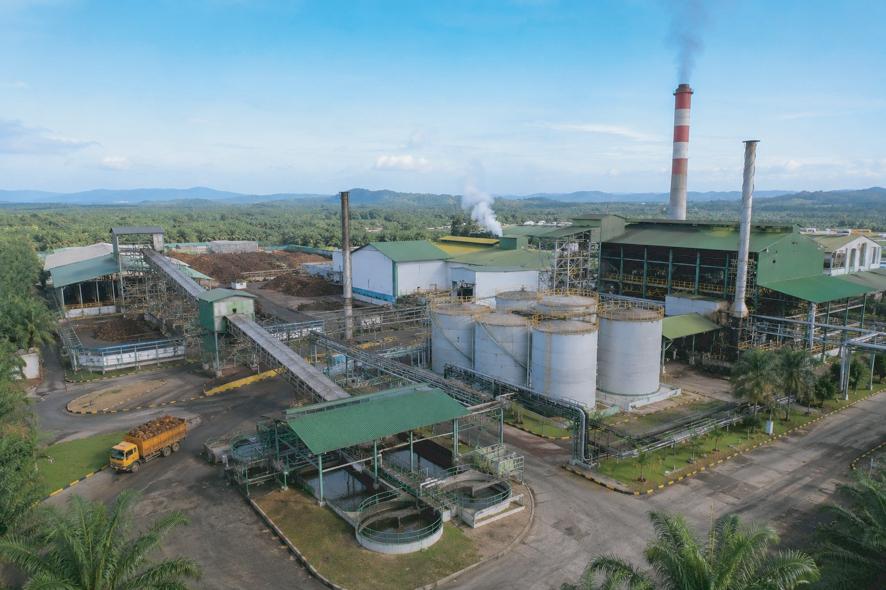
Today's palm oil mills produce far more than crude palm oil. ey are evolving into innovation hubs where advanced processing, digital technologies, renewable energy, and circular economy practices converge to maximise the value of every harvested fruit. is re ects the essence of ' e Second Harvest', creating new value from every resource throughout the milling process.
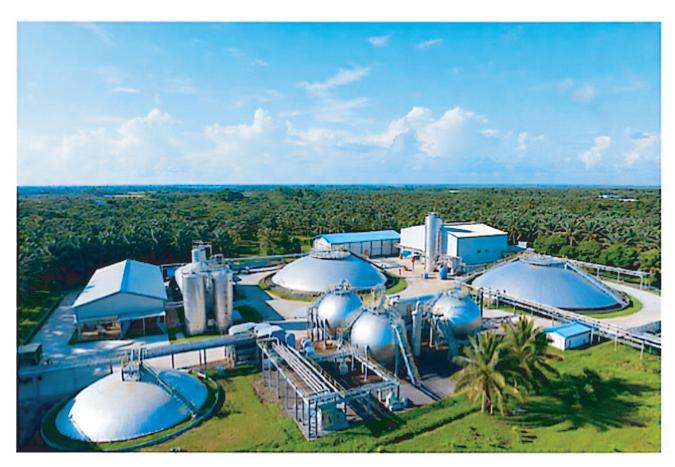
At the same time, the industry's approach to waste is undergoing a signi cant transformation. In Indonesia, palm oil mill e uent, or POME, is no longer viewed simply as a waste stream but as a valuable resource for renewable energy. rough methane capture and biogas technologies, mills are converting POME into electricity that powers mill operations and nearby communities while reducing greenhouse gas emissions and dependence on fossil fuels.
Beyond its environmental bene ts, this approach creates economic value by improving resource e ciency and waste management, whilst supporting transition towards a circular economy where valuable materials remain in productive use. As carbon pricing gains momentum, reducing emissions has become a business advantage rather than simply a regulatory requirement.
Early adoption of decarbonisation will position palm oil mills to enhance sustainability performance, increase resilience against evolving market expectations, and secure a stronger advantage in the global palm oil industry.
Investments in renewable energy, energy-e cient technologies, methane recovery, and carbon management help palm oil mills lower operating costs, generate carbon credit opportunities, and strengthen competitiveness in sustainability-driven markets.
Thermal & Corrosion Protection Built for Palm Oil Mills. Tailored refractory, insulation, and corrosion solutions for long-lasting mill performance.
REFRALINE DELIVERS:
1
2
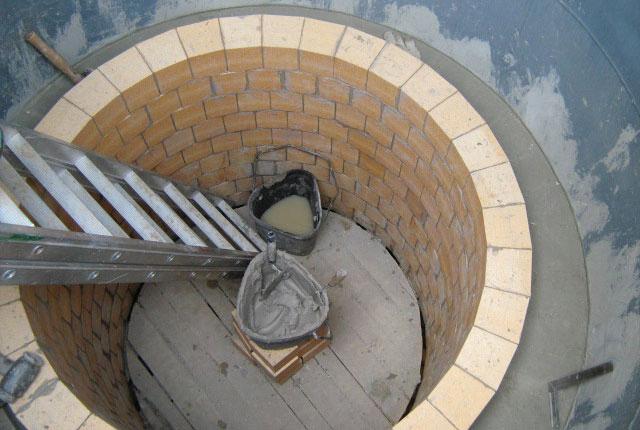
Engineered refractory linings that reduce heat loss and withstand repeated thermal cycling
3
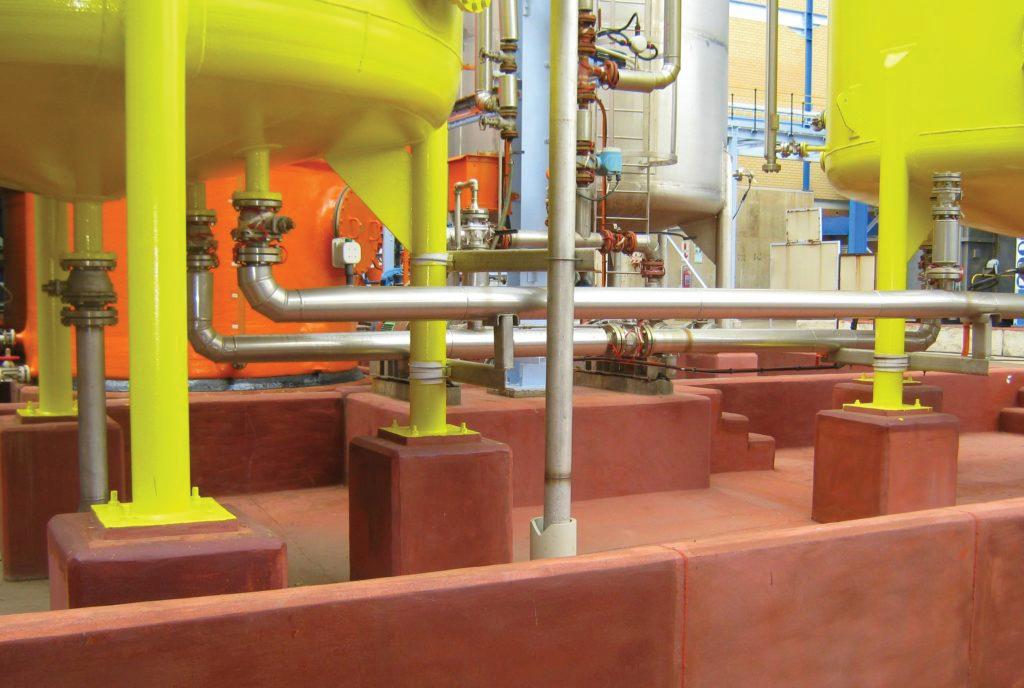
Corrosion-proof linings for digesters, flue systems, and tanks
4
Custom insulation & cladding systems to maintain energy efficiency
5
Remote demolition & installation services to minimise downtime
Full inspection, repair, and maintenance programmes
Refraline Malaysia's pioneering technological advancements in refractory materials and products have demonstrably revolutionised the operational landscape of palm oil mill boilers. By engineering superior refractory solutions, Refraline Malaysia has significantly enhanced the efficiency of these critical industrial systems, leading to optimised heat transfer and reduced energy consumption. Furthermore, their innovations have profoundly improved boiler availability, minimising downtime for repairs and maintenance through extended material lifespan and enhanced resistance to extreme operating conditions. Crucially, these advancements have also bolstered the stability of palm oil mill boilers, ensuring more consistent and reliable performance, which in turn contributes to uninterrupted production and greater overall plant reliability.
Plot 88, Lot 15, Block 20, Kemena Land District, 97000 Bintulu Sarawak, Malaysia
Office tel: (+60) 86 255 576
Email: info.malaysia@refralineinternational.com
Mobile: (+60) 19 877 9155 – Mr Andy Janse van Rensburg
Mobile: (+60) 10 408 5794 – Mr Andre van Staden
Leaders in refractory and corrosion engineering solutions, saving our clients’ money and energy.
We offer solutions to our customers in the development, manufacture, demolition, installation, and supply of refractory and corrosion materials.
Every Dollar Counts: Managing Costs in a Volatile Market
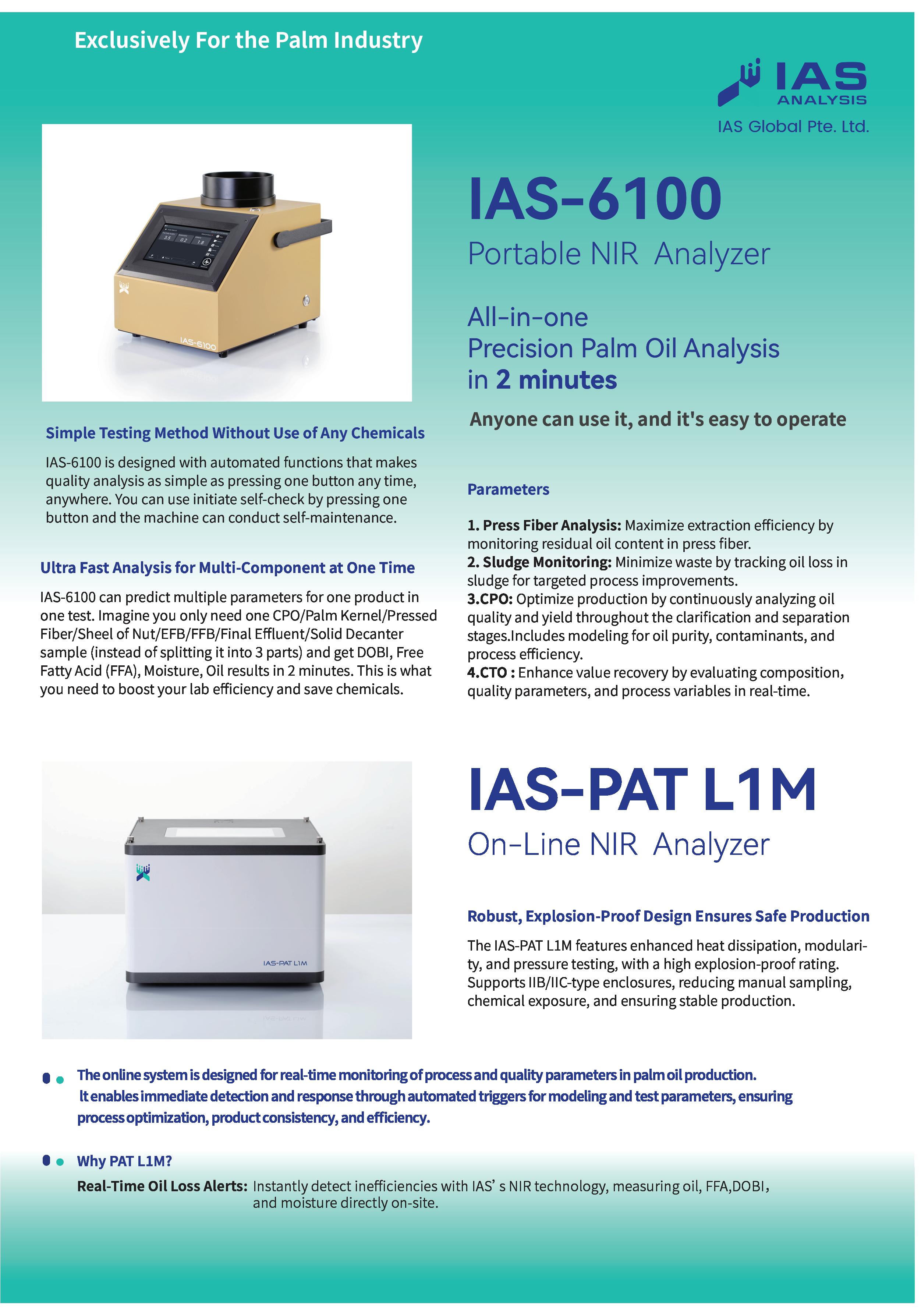
Across the milling sector, companies are adopting automation, arti cial intelligence, predictive maintenance, and digital traceability to improve operational performance, optimise costs, strengthen quality control, and support compliance with evolving
Volatile commodity prices, rising production costs, and increasingly stringent sustainability requirements are reshaping the economics of the palm oil industry. Today, pro tability is no longer determined solely by crude palm oil output or oil extraction rates, but by how e ciently companies manage energy, water, fertiliser, biomass, labour, and other critical resources. In a highly competitive market, operational e ciency has become a key strategy for protecting margins and strengthening long-term resilience.
Rather than relying on land expansion, the industry is increasingly focused on improving productivity through better governance, modern technologies, integrated data systems, accelerated smallholder replanting, and downstream development, as highlighted in Outlook Sawit Indonesia 2026. Meanwhile, rising domestic biodiesel demand is expected to tighten palm oil export supply, while compliance with the European Union Deforestation Regulation (EUDR) requires stronger traceability, legal compliance, and supply chain transparency to maintain international market access and long-term competitiveness.
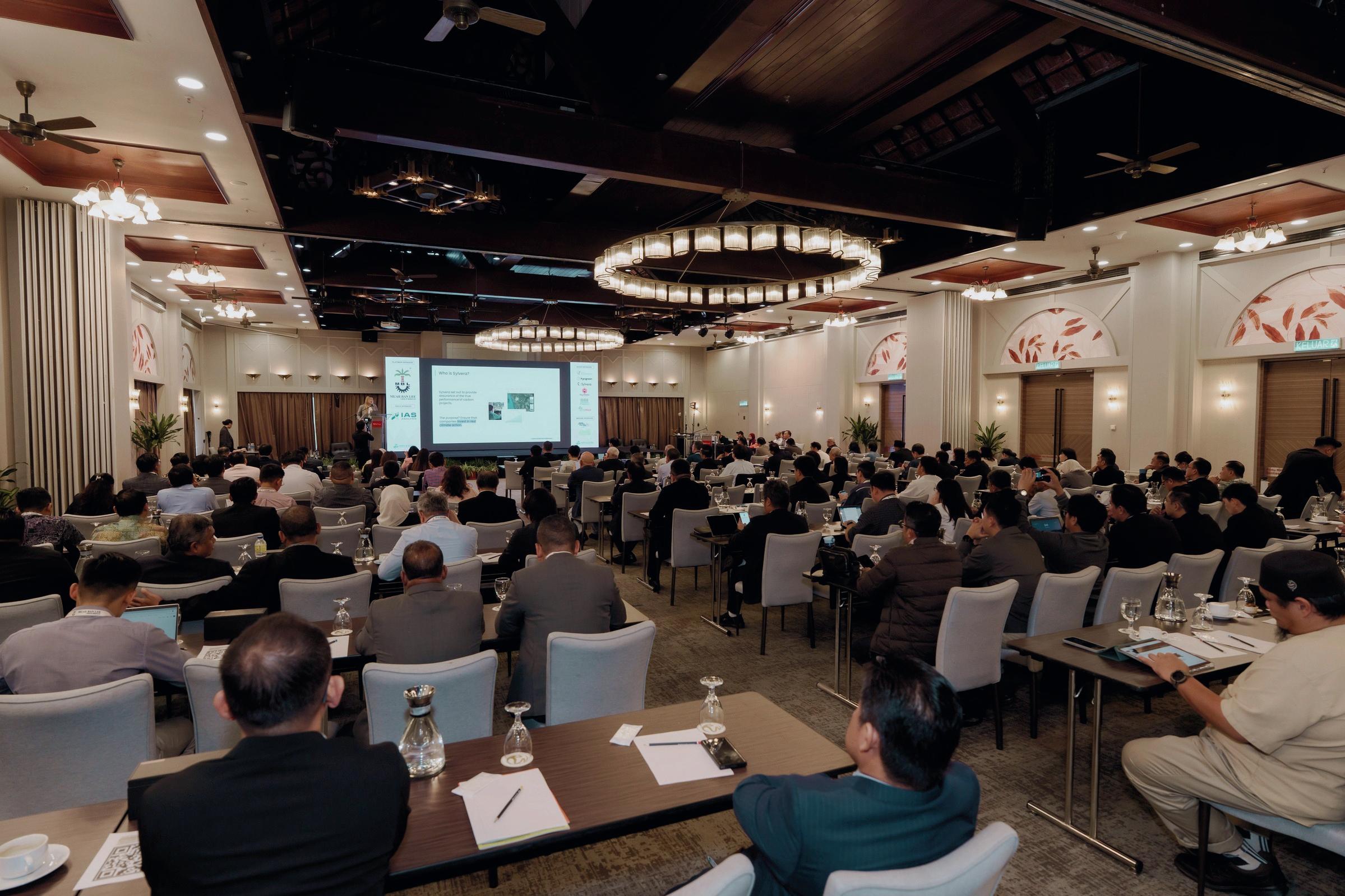
Malaysia Palm Carbon Conference 2026: Unlocking New Value for the Palm Oil Sector
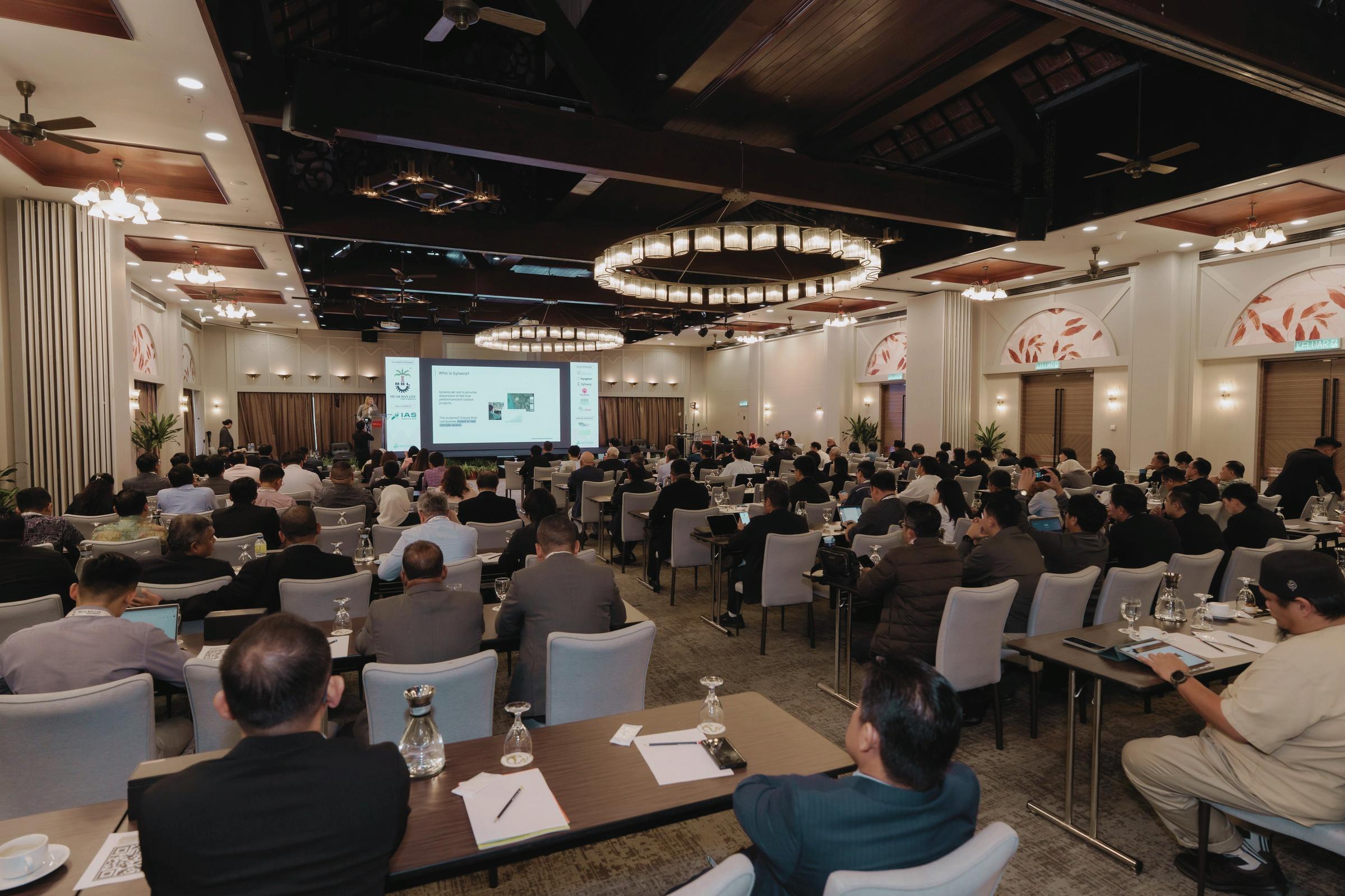
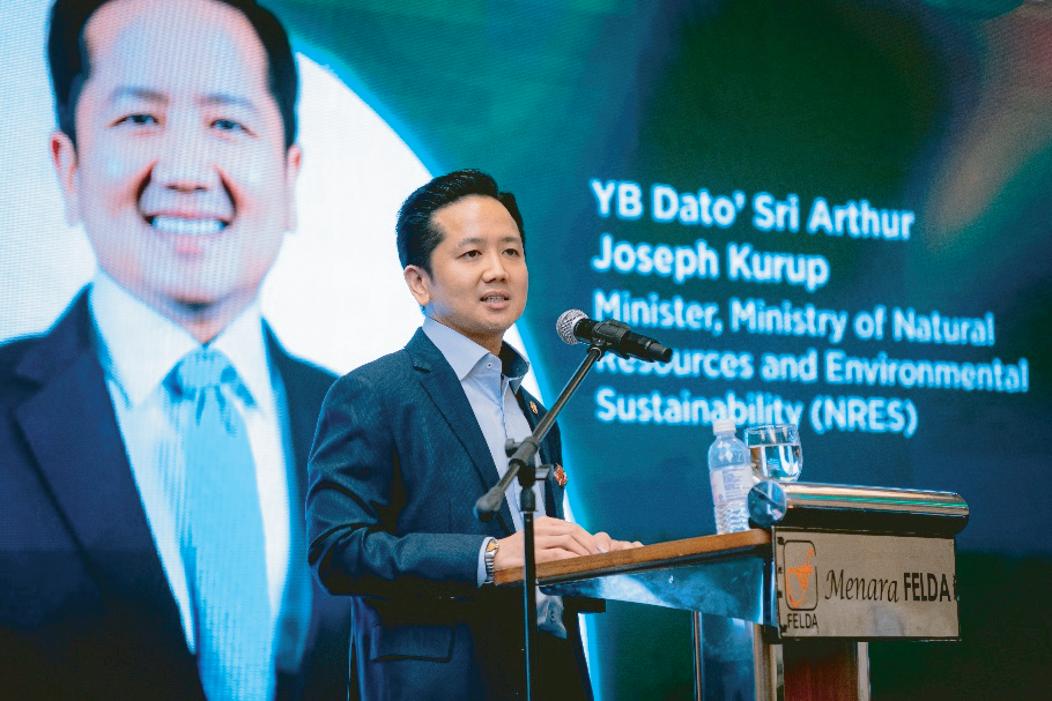
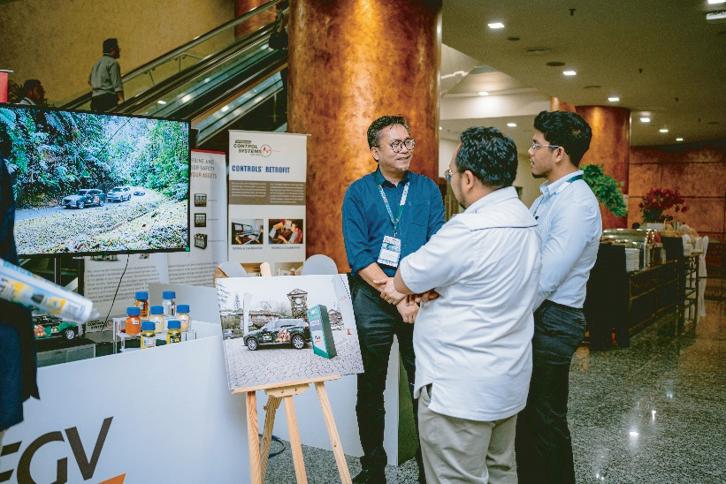
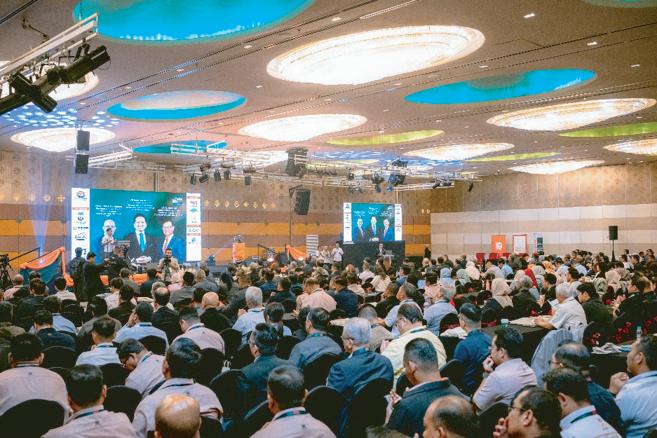
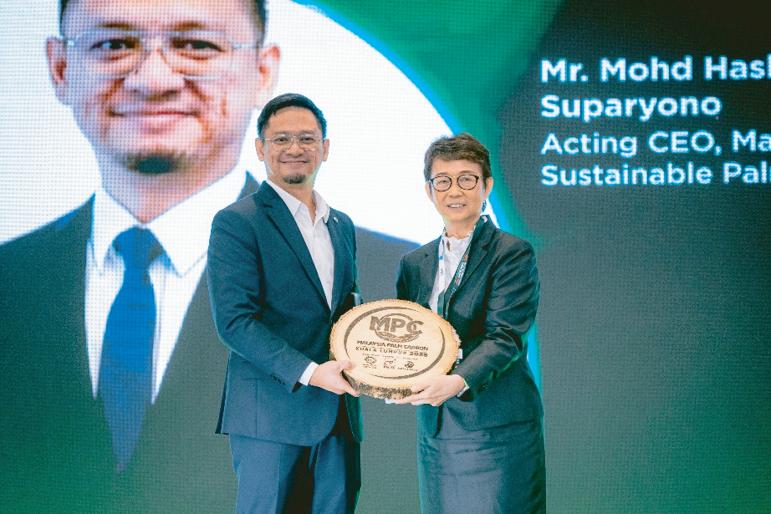
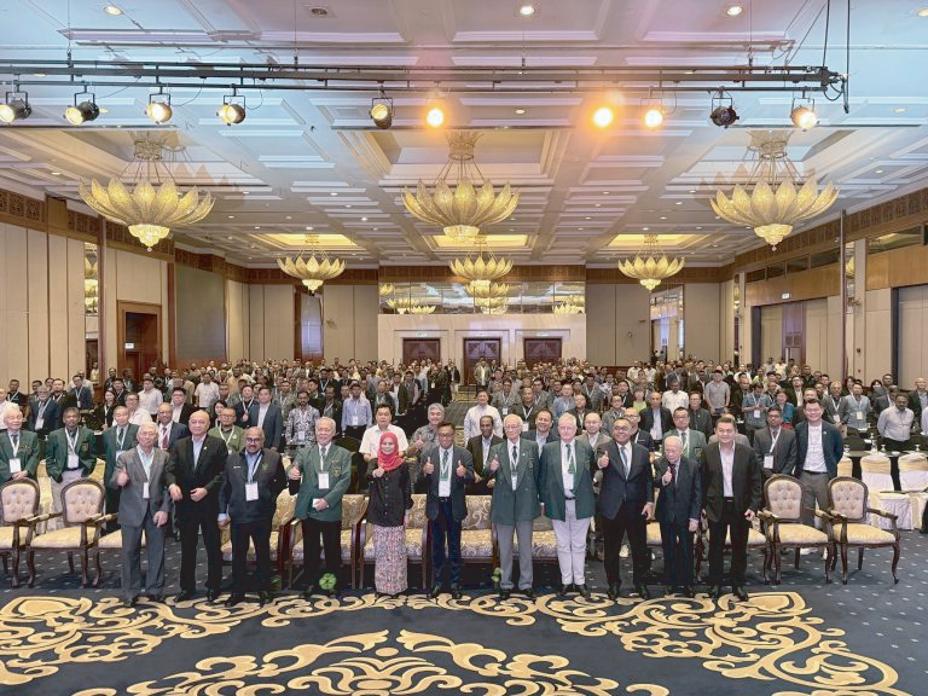
On 16 June, the Malaysia Palm Carbon Conference (MPC) 2026 brought together industry leaders, policymakers, plantation companies, nancial institutions, researchers and sustainability experts at Menara FELDA, Kuala Lumpur to explore the growing role of carbon initiatives in shaping the future of Malaysia's palm oil industry.
Organised by Maps & Globe Specialist Distributor, the conference served as a platform for strategic dialogue and knowledge exchange. Held under the theme "Harnessing Carbon Opportunities for Malaysian Palm Oil Sustainability", the conference highlighted the potential of carbon initiatives, biomass utilisation and emissions reduction in supporting both environmental goals and long-term industry competitiveness. Discussions centred on how carbon initiatives can move beyond regulatory compliance to become new sources of value creation for the palm oil industry.
MPC was o ciated by YB Dato' Sri Arthur Joseph Kurup, Minister of Natural Resources and Environmental Sustainability (NRES), and received strong support from YBhg. Datuk Seri Ahmad Shabery Cheek, Chairman of FELDA, and YBrs. Dr. Mohd Hefni Rusli, Acting Deputy Director General (R&D) of the Malaysian Palm Oil Board (MPOB). eir participation re ected the collaborative e orts of government agencies, industry and research institutions towards advancing sustainable transition in the palm oil
roughout the conference, delegates also explored the untapped potential of oil palm biomass as a strategic resource. Rather than being treated as waste, materials such as oil palm trunks and other biomass residues can be converted into bioenergy, biochar, biomaterials, compost and other value-added products. ese initiatives not only reduce greenhouse gas emissions but also create new commercial opportunities while supporting Malaysia's transition towards a low-carbon economy.
As the palm oil industry continues its transition towards a more sustainable future, the Malaysia Palm Carbon Conference 2026 demonstrated the value of bringing together key stakeholders to exchange ideas, share best practices and identify innovative solutions. e organiser also expressed its appreciation to the conference speakers, sponsors, exhibitors, supporting partners and delegates. e conference concluded with a shared commitment to advancing practical carbon initiatives that will support the industry's resilience, competitiveness and sustainable growth in the years ahead.
Scan/Click F or Mo r e Informatio n ww w.aseanpalmcarbon.co m HRD Corp Claimable Programme
REGISTER NOW 16 - 17 October 2026
Resor ts World Awana, Genting Highlands
Connecting policy, innovation and business oppor tunities accelerating ASEAN’s low carbon bioeconomy Co-Host:
Reinventing Palm Oil Milling rough Innovation, Sustainability and Talent
By M. R. Chandran KMN, FISP, FBIM, FMOSTA, FMIM during his keynote address at the ISP International Palm Oil Millers Conference 2026 (IPOMC26)
Total Mill at a Crossroads
Over the past two decades, the palm oil industry has undergone a signi cant transformation. However, the most profound change is not technological; it is market expectation.
Palm oil remains a cornerstone of global food security, contributing approximately 40% of the global vegetable oil trade. is importance elevated the industry’s responsibilities to meet increasingly stringent standards.
Today, the mill has become a sustainability checkpoint, a data and traceability node, and a determinant of industry credibility
is year, IPOMC26 was organised by e Incorporated Society of Planters (ISP) and managed by ISP Management (M) Sdn Bhd (ISPM). is event highlighted the importance of advancing e ciency, sustainability, and innovation in the palm oil milling industry, while addressing evolving challenges such as regulatory requirements, cost pressures, and rapid technological transformation.
e palm oil milling sector stands at a critical in ection point. Historically driven by metrics such as oil extraction rate (OER), throughput, and cost e ciency, the industry is now facing a fundamental shi in expectations. Mills are no longer evaluated solely as processing facilities. ey have evolved into strategic control points that determine pro tability, sustainability performance, regulatory compliance, and global market access.
From Extraction Rate to Total Mill Optimisation
e mill that survives the next decade will not be the one with the lowest cost per tonne today. It will be the one that has reinvented itself as an integrated, intelligent and indispensable bio-re nery.
Traditional performance indicators such as OER are no longer su cient in de ning excellence. Total Mill Optimisation requires an integration across operational silos, maximisation of resource e ciency and conversion of waste streams into value streams.
Key areas of transformation include:
Energy: Biogas systems must transition from compliance tools to pro t-generating assets through heat and power optimisation.
Water: Water management must evolve into closed-loop systems, reducing freshwater consumption and operational costs.
By-Products: Residual materials such as empty fruit bunches (EFB) must be repositioned as feedstock for high-value products.
is aims to shi from isolated optimisation to interconnected system performance.
Sustainability: From Compliance to Market Access
Sustainability is no longer a reputational consideration; it is a commercial requirement. Regulatory frameworks such as the EU Deforestation Regulation (EUDR) require full supply chain traceability, geolocation data and veri able compliance documentation. erefore, this transforms mills into a traceability within the value chain. However, if we fail to meet these requirements, the risks of market exclusion and loss of buyer con dence await.
Digitalisation and the Rise of Smart Mills
“ e transformation of palm oil milling is no longer a distant prospect. It is an urgent necessity.”
Sensors, automation systems and real-time data platforms o er mills the opportunity to evolve from reactive operations, where problems are addressed a er the fact, to predictive intelligence, where issues are anticipated and prevented before they occur.
Innovation today means integrating AI-driven sensors that monitor key quality parameters and thermal conditions in real time, providing instant visibility throughout the extraction process.
Human Capital: e Critical Enabler
e mill of the future requires talent that understands not just machinery, but data systems, environmental compliance and sustainability frameworks. Skills gaps, weak succession planning and a failure to attract younger workers are critical vulnerabilities. Automation without human capital development creates new risks rather than solutions.
“Perception compounds the problem. Younger, digitally uent generations rarely see palm oil as a career of choice. Field work is stigmatised; the industry’s technological transformation remains invisible to those who could lead it. is must change.”
e role of a mill technician is evolving into a blend of mechatronics—the integration of mechanical engineering, electronics and computer control—alongside data science and process optimisation. Companies like SD Guthrie are already preparing for this shi , anticipating the need for robotics technicians and remote operators who control equipment from centralised operation centres.
A Call to Reinvention
Reinventing milling excellence is not about choosing between pro t, planet or people. It is about fusing them into a single, unstoppable strategy. “Reinventing milling excellence is a well-chosen theme because reinvention is not renovation. It is not patching what is old. It is a fundamental rethinking of what a palm oil mill is, what it produces, what it proves and what it owes to the planet it serves.
KEY PALM OIL MID & DOWNSTREAM STAKEHOLDERS: MINISTRIES, ITS AGENCIES AND RELATED ASSOCIATIONS
Ministry of Plantation and Commodities (KPK) www.kpk.gov.my
Malaysia Biomass Industries Confederation (MBIC) http://www.biomass.org.my
Malaysian Oleochemical Manufacturers' Group (MOMG) www.momg.org.my
Badan Pengelola Dana Perkebunan Kelapa Sawit (BPDPKS) Indonesian Palm Oil Plantation Fund Management Agency https://www.bpdp.or.id/
Asosiasi Produsen Oleochemical Indonesia (APOLIN) Indonesian Oleochemical Producers Association https://apolin.org/
MALAYSIA
Malaysian Palm Oil Board (MPOB) www.mpob.org.my
Malaysian Palm Oil Association (MPOA) www.mpoa.org.my
5th World Palm Conference 2026 | 13th PALMEX Malaysia
Hall 4 & 5, Kuala Lumpur Convention Centre, MY
MALAYSIA PALM CARBON 20 26 KUALA LUMPUR
ASEAN PALM CARBON 20 26 MALAYSIA
INDONESIA PALM CARBON 20 27 TBC
MALAYSIA PALM CARBON 20 27 SABAH
Unlocking the Palm Bioeconomy Through Biofuels, Biochar, Sustainable Products, CO Removal Certificate 16-17 OCTOBER 2026
RESORTS WORLD AWANA, GENTING HIGHLANDS www.aseanpalmcarbon.com
Harnessing Carbon Opportunities for Malaysia’s Oil Palm Stakeholders 16 JUNE 2026 MENARA FELDA, KUALA LUMPUR www.malaysiapalmcarbon.com Reducing Indonesia’s Emissions Through High-Impact Palm Carbon Offset Initiatives To Be