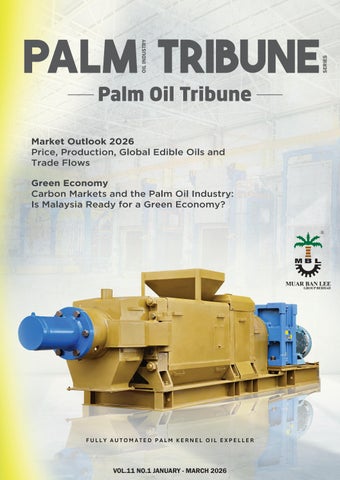
Market Outlook 2026 Price, Production, Global Edible Oils and Trade Flows Green Economy Carbon Markets and the Palm Oil Industry: Is Malaysia Ready for a Green Economy?
FULLY AUTOMATED PALM KERNEL OIL EXPELLER
VOL.11 NO.1 JANUARY - MARCH 2026
SERIES
OIL INDUSTRY
Palm Oil Tribune
3
Editorial
Palm Oil Tribune
FRONT COVER BY
Editorial Team
MUAR BAN LEE GROUP BERHAD
EDITOR Zahidah Zahidi zahidah@maps-globe.com CREATIVE DESIGNER Muhammad Faireez artwork@mapsglobe.com Quarterly Publication Palm Oil Industry Tribune Series: Palm Oil Tribune
Volume 11 | No 1 Other Series: Palm Plantation Tribune Palm Downstream Tribune What’s in it News Roundup Expert Insights Regional Policies Technologies Event Summary Follow us on: Next Chapter Media Next Chapter Media
DIRECTOR Emily Yu PUBLICATION Maps & Globe Specialist Distributor Sdn. Bhd (625396-A) No 3-1 Jalan Perdana 10/6, Pandan Perdana, 55300 Kuala Lumpur, Malaysia. PRINTING Fong Wah Printing Sdn. Bhd. (1406717K) No. 17, JaIan Tembaga SD 5/2G Perindustrian Bandar Sri Damansara, Pekan Kepong, 52200 Kuala Lumpur, Malaysia.
Disclaimer: Next Chapter Media's editorial team strives to provide accurate and reliable information. However, we recommend that readers independently verify the claims and information presented in our publications. Next Chapter Media is not responsible for the accuracy of the content and encourages readers to use their own judgment when evaluating the information.
Sustainability
Innovation
Growth
Contents
Palm Oil Tribune
CONTENTS 5-6
Latest News Roundup
A quick digest of the latest policies and market trends.
7-11
Market Outlook -
Price Outlook 2026 Palm Oil Production 2026 Global Edible Oils Palm Oil Trade Flows
13-14
Mills and Performance
OER Accuracy in Palm Oil Mills
17-18
Green Economy
Carbon Markets and the Palm Oil Industry: Is Malaysia Ready for a Green Economy?
21-28
Industry Reflections -
Solidarity in Soil: The Power of One Voice in Palm Oil Palm Oil: The Unsung Hero of Global Unity
29
Key Palm Oil Mid & Downstream Stakeholders: Ministries, Its Agencies And Related Associations in Malaysia and Indonesia
Back Cover Event List 2026
ADVERTISERS INDEX
1, 2, & 24
Muar Ban Lee Group Berhad
12
Next Chapter Media
15-16
IAS Global Pte Ltd
19-20
Refraline Malaysia Sdn Bhd
30
Maps & Globe Specialist Distributor
4
5
News Roundup
Palm Oil Tribune
Cameroon Targets 20,500 Tons of Additional Palm Oil Output in 2026
Indonesia Pushes Back Against EU in WTO Dispute Over Palm Oil and Nickel
3 December 2025
2 December 2025
Cameroon’s government is ramping up agricultural production in strategic sectors, with a focus on palm oil, aiming to add 20,500 tons of output in 2026. The initiative forms part of the national Economic and Financial Program, designed to strengthen self-sufficiency and reduce imports.
Indonesia is resisting a European Union push to resolve long-running World Trade Organisation (WTO) disputes through an interim appeal mechanism, a standoff that experts say reflects a broader power struggle over strategic commodities such as palm oil and nickel. The disputes involve EU import duties on Indonesian biodiesel and stainless steel, which WTO panels have ruled inconsistent with global trade rules, but which remain unenforceable due to the EU’s appeal amid the WTO’s paralysed dispute settlement system.
Two loans totalling CFA51.7 billion (~$91.86 million) with Standard Chartered Bank London will fund the construction of a palm oil plant and a rubber-processing facility for the Cameroon Development Corporation (CDC), enhancing processing capacity and value creation across the sector. Despite a strong first quarter in 2025, when crude palm oil production reached 77,630 tons, almost triple the previous quarter, the sector remains structurally undersupplied. Cameroon’s 2024 production of 446,984 tons still falls short of domestic demand, with an estimated annual deficit of over 500,000 tons. Between 2017 and 2023, the country imported 409,000 tons of palm oil at a cumulative cost of CFA280.4 billion.
Indonesian officials said Jakarta is not inclined to join the Multi-Party Interim Appeal Arbitration Arrangement (MPIA), preferring to adhere to the WTO’s formal mechanisms. With the WTO appellate body non-functional since 2019, the EU’s appeal has effectively stalled enforcement of rulings that favour Indonesia, a practice commonly referred to as “appealing into the void”. Palm oil is a central element of the dispute. The EU has imposed countervailing duties of 8% to 18% on Indonesian biodiesel since 2019, protecting European rapeseed-based producers from lower-cost palm oil-based fuel. Despite these tensions, both sides maintain that the dispute is separate from the recently signed Indonesia-EU Comprehensive Economic Partnership Agreement (IEU-CEPA), under which Indonesia aims to expand palm oil and biodiesel exports to its third-largest market.
News Roundup
Palm Oil Tribune
Ecoscience Secures RM55.8 Million Palm Oil Mill Project in Sabah
Dr Noraini Ahmad To Lead Plantation And Commodities Portfolio
20 November 2025
16 December 2025
Ecoscience International Bhd has secured a RM55.85 million contract for the design-build and turnkey replacement of plant and machinery for a 30-tonne-per-hour palm oil mill in Sabah. In a filing with Bursa Malaysia, the group said its wholly owned unit, Ecoscience Manufacturing & Engineering Sdn Bhd, received the letter of award from Genting Oil Mills (Sabah) Sdn Bhd on Thursday.
The appointment of Datuk Seri Dr Noraini Ahmad to lead the Ministry of Plantation and Commodities is expected to sustain efforts to steer Malaysia’s agribusiness sector towards more sustainable growth.
Design work is scheduled to start on 1 December 2025, with full project execution set to begin on 31 January 2026 and completion expected by 31 December 2027. Despite being loss-making since its ACE Market listing in July 2022, Ecoscience reported a narrower net loss of RM1.38 million for Q2FY2025, down from RM2.36 million a year earlier. Quarterly revenue rose 17.8% to RM34.54 million, supported by a higher number of construction projects that enabled increased progressive claims. Shares last traded at 11.5 sen, giving the company a market capitalisation of RM43.01 million.
Noraini brings prior experience in the sector, having served as Rubber Industry Smallholders Development Authority (RISDA) chair from March 2023 to January 2024. Noraini, 58, was previously Deputy Minister of Women, Family and Community Development. She replaces Datuk Seri Johari Abdul Ghani, who has been appointed Minister of Investment, Trade and Industry. She has also held several senior portfolios, including Minister of Higher Education from March 2020 to October 2022 and Deputy Minister of Human Resources from March 2008 to April 2009. Noraini holds a Bachelor of Commerce in Quantitative Analysis and Finance from the University of Saskatchewan, Canada, and a Master of Business Administration from Universiti Tun Abdul Razak. She later earned a doctorate in Development Management from Universiti Utara Malaysia in 2016.
6
7
Market Outlook: Price
Palm Oil Tribune
Price Outlook 2026 Crude palm oil (CPO) prices are expected to remain range-bound but firm into 2026, with potential short-term upside in the early months. While 2025 saw elevated prices averaging RM4,300/tonne, analysts and experts highlight a cautious outlook, with a combination of supportive and constraining factors shaping the market.
Institutional Forecasts
Kenanga Research expects supply tightness in edible oils to persist into 2026. While supply growth is anticipated, it is expected to merely match trendline demand growth of 3-4%. The research house project CPO prices at RM4,000 per tonne in 2026. The recent news about controversies in China and Indonesia involving PPB’s associate company looked to be already priced in.
MARC Ratings forecasts CPO in the RM3,850-4,250 per tonne range, supported by favourable weather, recovering yields, and a gradual normalisation of global edible oil supply. Biodiesel demand, notably Indonesia’s B40 mandate, and a weaker US dollar, underpinned average CPO prices of RM4,300 in 2025.
(The Star, 9 Dec 25)
(The Star, 5 Dec 25)
HLIB Research maintains a cautiously constructive view, expecting prices to average RM4,200 per tonne in 2026, citing plantation confiscations in Indonesia and slow replanting progress in Malaysia as factors underpinning prices. It noted that the recent pullback to around RM4,000 per tonne was driven by delayed production and China’s resumption of soybean oil imports from the US.
CIMB Securities expects output to be slow in the first quarter of 2026 due to seasonal factors and short-term trade flows, with prices remaining supported above RM4,000 per tonne. The firm maintains its average CPO price forecast of RM4,200 per tonne for 2026. It highlights that long-term competitiveness depends on accelerated replanting and improved smallholder support.
(The Star, 5 Dec 25)
(BERNAMA, 10 Dec 25)
Market Outlook 2026 - Compiled by Zahidah Zahidi
Market Outlook: Price
Palm Oil Tribune
Expert Perspectives Dr Sathia Varqa anticipates a seasonal rebound to RM4,500-4,600 per tonne in 1Q26, supported by low production, fewer harvesting days, and festive demand. He noted that prices could move higher upside if Indonesia formalises progress on B50. Varqa flagged 2026 as a year of major policy disruption, driven by tighter EU regulations: EUDR, Renewable Energy Directive (RED) III, and antidumping actions; US-China trade manoeuvres; and Indonesia's domestic policies. This includes land seizures, a replanting push, domestic market obligations, and the flagship biodiesel mandate. He warned that up to 3.5 million tonnes of
Dr Sathia Varqa Fastmarkets Dr Julian McGill forecasts a gradual recovery to RM4,300-4,400 per tonne by 1Q26, primarily if export demand improves once palm oil regains price competitiveness against soybean oil. He emphasises that recent price weakness reflects high production and a lack of a bullish policy signal rather than fundamental supply-demand imbalances. McGill cautions that the market is temporarily directionless, waiting on two major policy signals: Indonesia’s biodiesel mandate (B50) and the U.S. Environmental Protection Agency (EPA) in implementing the Renewable Fuel Standard (RFS).
Dr Julian McGill Glenauk Economics
Nik Ihsan Raja Abdullah expects a short-term price increase of up to 10% in early 2026, with CPO prices fluctuating between RM4,100 and RM4,500 per tonne in 1H26. He cited an asset rotation trend, marked by global capital outflows from equities into commodities, alongside a weaker US dollar, as key supporting factors. He cautioned that a stronger ringgit could weigh on Malaysia’s export competitiveness.
Nik Ihsan Raja Abdullah MSTA Berjaya Mutual Berhad
Market Signal Snapshot Upside Triggers:
Downside Risks:
Clear B50 implementation Seasonal production slowdown Festive demand Improved export competitiveness Softer US dollar trend
Persistently high inventories Slow replanting rates Strong competing oil supplies Continued policy delays Ringgit strength
Extracted from presentations during International Palm Oil Congress and Exhibition (PIPOC 2025)
8
9
Palm Oil Tribune
Market Outlook: Production
Palm Oil Production Outlook 2026 Global palm oil production in 2026 is expected to expand only modestly, shaped by biological yield cycles, ageing estates, labour constraints and rising policy intervention. While Indonesia and Malaysia remain the dominant suppliers, their production trajectories are diverging, with Indonesia facing rising governance risks and Malaysia constrained by structural limits. The Indonesian Palm Oil Association (GAPKI) reported an 11% year-on-year increase in crude palm oil (CPO) output in the first nine months of 2025, lifting production by nearly 4 million tonnes to around 39.6 million tonnes. This performance reflects favourable weather, improved harvesting conditions and the maturation of plantings from earlier years. GAPKI expects Indonesia’s palm oil output in 2026 to grow 3-4% annually, slowing from the estimated 4-7% increase in 2025. Fastmarkets cautions that between 2 and 5 million tonnes of CPO production capacity could be at risk due to uncertainty over land titles. The Indonesian government has intensified enforcement against plantations operating on disputed or forested land. To date, around 1.5 million hectares of oil palm estates have been seized and transferred to state-owned PT Agrinas, with a further 1.8 million hectares under verification. How efficiently these estates are managed will be critical. Following heavy yields in late 2025, palms are expected to enter a biological resting phase, particularly in early 2026. Current estimates by Fastmarkets place Malaysia’s 2026 CPO production at around 19.6 million tonnes, roughly 400,000 tonnes lower than the 2025 level. Malaysia’s planted area has plateaued at around 5.6 million hectares, leaving limited room for expansion. At the same time, a growing share of palms are beyond their prime productive age. National replanting rates average only 1.5-2% annually, far below the 4% required to sustain yields, resulting in a backlog of more than 600,000 hectares of palms over 25 years old. Labour constraints continue to bind, with heavy reliance on foreign workers limiting harvesting efficiency, especially for ageing palms requiring more intensive management. Uneven mechanisation adoption further restricts productivity gains. The upcoming enforcement of the EU Deforestation Regulation in 2026 adds compliance demands that may influence estate operations and production planning. At the global level, palm oil production growth in 2026 is expected to be measured rather than expansive. TA Research estimates that global palm oil output could rise by around 1-1.5 million tonnes across 2025 and 2026, contributing to a gradual recovery rather than a surplus-driven
Market Outlook: Global Oils
Palm Oil Tribune
Global Edible Oils The global edible oils complex enters 2026 in a phase of gradual supply recovery rather than surplus expansion. After several years of weather disruptions, geopolitical shocks and policy-driven demand shifts, production across major oils is improving, but only enough to keep pace with trend consumption growth. According to the US Department of Agriculture (USDA), global vegetable oil output in 2026 is projected to rise by around 1.6% year-on-year to approximately 233 million tonnes, led by palm oil and supported by resilient soybean oil production. However, this growth broadly matches expected demand growth of 3–4%, implying that overall inventories are likely to remain flat rather than rebuild meaningfully. Palm oil remains the dominant contributor to incremental supply due to its yield advantage, accounting for more than 40% of global edible oil output growth. Soybean oil follows, driven by expansion in South America, while sunflower and rapeseed oil supplies are recovering unevenly due to regional weather and geopolitical constraints.
Soybean oil production is expected to strengthen in 2026, anchored by Brazil’s expanding soybean area and improving yields. Brazil is projected to offset potential output shortfalls in Argentina or the United States, reinforcing South America’s role as the swing supplier in the edible oils complex.
Sunflower oil supply is recovering but remains exposed to Black Sea risks. While production in Ukraine has stabilised, infrastructure constraints and ongoing geopolitical uncertainty continue to limit export reliability. As a result, sunflower oil is unlikely to return to pre-war abundance levels in the near term.
Rapeseed oil output faces mixed conditions. Drier weather in parts of Canada and Europe may cap yield recovery, even as acreage remains relatively stable. This limits the scope for a sharp increase in rapeseed oil availability in 2026.
Overall, although competing oils are contributing incremental supply, none appear capable of generating a supply shock that would meaningfully ease global edible oil balances.
10
11
Market Outlook: Trade Trends
Palm Oil Tribune
Palm Oil Trade Flows Global palm oil exports rebounded strongly in 2025 after an eight-year low in 2024. According to Oil World, Indonesia, Malaysia and Thailand shipped a combined 36.4 million tonnes in the first ten months of 2025, up 1.4 million tonnes compared to the same period in 2024. Momentum improved markedly from May to August, signalling that trade flows are responding quickly once price competitiveness returns. This recovery provides a constructive base for 2026, but export performance is increasingly shaped by policy, destination concentration and competition from other oils, rather than pure supply availability.
Indonesia Leads Export
Malaysia Maintains Stable Volumes
Thailand’s Record Performance
Indonesia remains the dominant exporter, with January – October 2025 shipments of 22.47 million tonnes. However, 2026 brings uncertainty. Intensified land enforcement could disrupt export-oriented estates. Domestic policy priorities, including biodiesel mandates and domestic market obligations, may increasingly divert supply inward, tightening export availability even if production remains stable.
Malaysia performance in 2025 was broadly stable, with October shipments at 1.69 million tonnes, keeping year-to-date exports near 12.7 million tonnes. Malaysia’s trade is less exposed to abrupt policy intervention but constrained by structural production limits. Malaysia is expected to maintain its role as a reliable exporter, particularly of refined palm products, but with limited scope for volume expansion.
Thailand achieved a record-high export volume of 1.04 million tonnes in the 2024/25 marketing year, marking the country's highest-ever shipment levels. Over 90% of shipments were destined for India. This followed the lifting of government export restrictions in March 2025, which allowed producers to capitalise on carry-over stocks.
India as a Major Importer
China Buying Patterns
Other Minor Importers
India experienced a sharp reduction in palm oil imports in the first ten months of 2025, importing only 6.18 million tonnes, down from previous years. However, Reuters reports that imports could rebound nearly 20% to 9.3 million tonnes in the 2025/26 marketing year due to competitive pricing.
Strong buying from China helped offset weaker demand from India. China has increased its imports by 4.08 million tonnes between January – October 2025. In October, imports surged to 577,000 tonnes. Year-to-date, volumes reflect opportunistic restocking rather than structural growth.
Incremental import growth is expected from Africa, Pakistan and parts of the Middle East, although volumes remain sensitive to freight costs, currency movements and competing oil availability.
Trade flows in 2026 are unlikely to collapse, but they will be less predictable and more policy-driven. For palm oil, the ability to remain competitive will hinge not just on supply, but on route diversification, compliance readiness and product flexibility.
Next Chapter Media Gateway to Global Markets
LET’S PARTNER Share Your News Feature product launches, milestones, and updates in the Latest News section.
Digital Distribution with Every Edition EDM to 10,000+ verified contacts and dedicated LinkedIn posts of your messages or visuals.
Brand Exclusivity We ensure your identified competitors are not featured throughout the contract period.
Tailored Editorial Opportunities Feature articles that align with your solution, innovation, and market strategy.
Custom Advertorials Showcase case studies, data insights, CSR initiatives, or your brand journey.
Expert Insight Interviews Enhance thought leadership through an interview, supported by a video snippet on LinkedIn.
Speak to us to explore tailored advertising packages.
zahidah@maps-globe.com emily@mapsglobe.com
13
Mills and Performance
Palm Oil Tribune
OER Accuracy in Palm Oil Mills Expressed as the percentage of oil extracted from fresh fruit bunches (FFB), OER is used to benchmark performance, assess processing efficiency, and guide operational decisions. A seemingly minor discrepancy of just 0.1% can translate into tens of thousands of ringgits in annual revenue for a medium-to-large mill. Beyond financial impact, OER accuracy informs sustainability reporting, carbon accounting, and regulatory compliance under MSPO and RSPO.
The Chain of Estimations Yet, despite its importance, OER is rarely measured directly. In most mills, it is still derived from layers of estimation.
FFB processed
Tank measurements
Most mills calculate total FFB processed up to a cut-off time rather than measuring each batch precisely.
Oil in storage tanks is estimated through level readings, often with additional assumptions for oil trapped in VCT/POT.
Temperature corrections Since oil volume changes with temperature, mills estimate tank temperatures for final calculations.
Batch oil yield The estimated oil extracted is divided by the estimated FFB processed to produce the OER figure.
This chain of approximations means that the so-called “actual OER” is, in reality, an estimated approximation of an estimate.
Mills and Performance
Palm Oil Tribune
Sampling Uncertainty The uncertainty does not end there. When new FFB arrives, most mills rely on colour-based grading and small sample sizes to estimate the expected OER for the batch. A sample of 100 bunches represents thousands, introducing variability and potential bias into the system. Ultimately, mills compare: Expected estimated OER (based on sampling and batch estimation)
Actual estimated OER (based on tank and processing estimates)
A system full of uncertainty can significantly impact decision-making and profitability, with millions of ringgits at stake annually. Despite decades of operation, we’ve done little to improve accuracy. In fact, some have even leveraged these gaps to their advantage.
Bridging the Gap with Data-Driven Measurement While traditional methods rely on approximations, data-driven, measurement-based systems allow mills to measure OER more accurately. Tools and approaches include: Automated tank gauging measurement errors.
to
reduce
manual
Real-time temperature logging for precise volume corrections. Inline oil-loss analysers for continuous monitoring of extraction efficiency. Digital grading and machine-vision analysis for more accurate fruit quality assessment. Robust sampling protocols with statistical controls to reduce uncertainty in batch evaluation. Adoption of these tools transforms OER from a rough estimate into a reliable, actionable metric, allowing mills to optimise extraction, improve profitability, and enhance sustainability reporting. By embracing technology and rigorous data protocols, the industry can finally close the gap between perceived and actual OER, unlocking both financial and operational value.
14
Palm Oil Tribune
2
17
Green Economy
Palm Oil Tribune
Carbon Markets and the Palm Oil Industry: Is Malaysia Ready for a Green Economy? Malaysia’s palm oil sector is well positioned to enter the carbon market, with sustainability and circular-economy practices already embedded across the entire value chain, said the Minister of Investment, Trade and Industry, Datuk Seri Johari Abdul Ghani. He has also reiterated Malaysia’s firm no-deforestation stance, emphasising that palm oil exports must be fully sustainable if the industry is to retain market access and investor confidence. However, the carbon market landscape remains in a state of transition. Malaysia does not yet have a standalone carbon credit system for palm oil, and the government has not made a final decision on implementing a carbon tax. That decision will depend on the passage of the Climate Change Bill (RUUPIN), expected to be tabled for first reading in Parliament next year. Once enacted, RUUPIN will establish the legal framework for companies to record, reduce, and trade emissions, laying the foundation for a more structured and credible carbon economy. This sequencing matters. Carbon markets function on trust, governance, and clarity. Premature or fragmented participation risks undervaluation, weak methodologies, and reputational exposure. “The primary danger is not just a lack of knowledge, but a fragmented, reactive approach. Individual estates might rush into poorly structured deals with opportunistic buyers, locking in low prices for credits that could appreciate significantly. Others might be sold methodologies that fail, leaving them with costs and no saleable credits. The reputational risk of “greenwashing” if claims are not rock-solid is profound.” Professor Dato Dr Ahmad Ibrahim, Tan Sri Omar Centre for STI Policy, IISDS, UCSI University
Panel Discussion Session during Palm Oil Industry Networking Dinner 2025 at Malaysia Petroleum Club (MPC)
Green Economy
Palm Oil Tribune
Yet the opportunity itself is substantial. Malaysia has committed to achieving net-zero emissions by 2050, and the oil palm sector is uniquely positioned to be a contributor rather than a liability. Mature plantations already sequester meaningful amounts of carbon, while improved practices can further enhance carbon stocks without compromising productivity. As Malaysian Palm Oil Board (MPOB) Director General, Datuk Dr Ahmad Parveez Ghulam Khadir highlighted, studies indicate that mature oil palm plantations can store an estimated 30-40 tonnes of carbon per hectare in standing biomass alone. Beyond sequestration, the industry’s circular economy initiatives offer immediate, scalable carbon market relevance. Malaysia generates more than 100 million tonnes of oil palm biomass annually, from trunks and fronds to empty fruit bunches and mill effluent. When unmanaged, these materials emit greenhouse gases through decomposition or open anaerobic treatment. When captured and utilised, they represent avoided emissions that can be quantified and monetised under recognised carbon standards. The sector has already begun this transition. Palm oil mill effluent is increasingly captured and converted into biogas. Used cooking oil is being channelled into sustainable aviation fuel feedstock. Oil palm trunks from replanting are used in furniture production, while empty fruit bunches are processed into pellets for green energy. These are not experimental concepts; they are operational realities that, when properly governed, can underpin high-integrity carbon credits. Crucially, carbon credits transform sustainability from a compliance cost into an economic instrument. Avoided emissions and sequestration projects offer the industry a potential multi-billion-ringgit revenue stream, one that can help finance decarbonisation, support reinvestment, and buffer cyclical commodity downturns. This reframes the carbon conversation from obligation to opportunity. Still, inclusivity will determine long-term success. Smallholders manage more than a quarter of Malaysia’s oil palm area and face the greatest barriers to participation. Simplified methodologies, clear guidelines, and digital monitoring, reporting, and verification systems will be essential to ensure carbon markets do not become the preserve of large corporates alone. At the macro level, Malaysia is signalling serious intent. As ASEAN Chair in 2025, the country is positioning sustainability and inclusivity at the centre of its regional agenda. Estimates suggest the ASEAN carbon market could generate between US$946 billion and US$3 trillion between 2025 and 2050. Current voluntary carbon prices may be modest, but the policy trajectory points toward higher-value, better-regulated markets aligned with global expectations. For the palm oil industry, the question is no longer whether carbon markets matter, but whether participation will be coordinated, credible, and value accretive. As discussions at platforms such as the Unlocking Revenue and Sustainability: Exploring Carbon Credit Opportunities in the Palm Oil Industry conference have underscored, the technology exists, demand is growing, and policy frameworks are taking shape.
Malaysian Palm Oil Board (MPOB) Director General, Datuk Dr Ahmad Parveez Ghulam Khadir, during his opening address at the 2nd Unlocking Revenue and Sustainability: Exploring Carbon Credit Opportunities in the Palm Oil Industry 2025
18
1
Palm Oil Tribune Sustainability
Market Outlook
Thermal & Corrosion Protection Built for Palm Oil Mills. Tailored refractory, insulation, and corrosion solutions for long-lasting mill performance.
REFRALINE DELIVERS:
1 2 3 4 5
Engineered refractory linings that reduce heat loss and withstand repeated thermal cycling
Corrosion-proof linings for digesters, flue systems, and tanks
Custom insulation & cladding systems to maintain energy efficiency
Remote demolition & installation services to minimise downtime
Full inspection, repair, and maintenance programmes
Refraline Malaysia's pioneering technological advancements in refractory materials and products have demonstrably revolutionised the operational landscape of palm oil mill boilers. By engineering superior refractory solutions, Refraline Malaysia has significantly enhanced the efficiency of these critical industrial systems, leading to optimised heat transfer and reduced energy consumption. Furthermore, their innovations have profoundly improved boiler availability, minimising downtime for repairs and maintenance through extended material lifespan and enhanced resistance to extreme operating conditions. Crucially, these advancements have also bolstered the stability of palm oil mill boilers, ensuring more consistent and reliable performance, which in turn contributes to uninterrupted production and greater overall plant reliability.
Plot 88, Lot 15, Block 20, Kemena Land District, 97000 Bintulu Sarawak, Malaysia Office tel: (+60) 86 255 576 Email: info.malaysia@refralineinternational.com Mobile: (+60) 19 877 9155 – Mr Andy Janse van Rensburg Mobile: (+60) 10 408 5794 – Mr Andre van Staden 15
2
Market Outlook
Palm Oil Tribune Sustainability
VISION Leaders in refractory and corrosion engineering solutions, saving our clients’ money and energy.
MISSION We offer solutions to our customers in the development, manufacture, demolition, installation, and supply of refractory and corrosion materials.
44 Refraline
16
21
Palm Oil Tribune
Industry Reflections
Solidarity in Soil: The Power of One Voice in Palm Oil
By Joseph Tek Choon Yee
The 0.5% That Feeds the World
The story of global agriculture begins with a simple truth - we are living on borrowed land. Yes, we farm. Yes, we plough. Yes, we reap the profits and harvest the seasons. But beneath all our agricultural achievements sits one timeless reminder: this land is not ours to own outright. It is ours to steward. We do not inherit the Earth from our ancestors; we borrow it from our children - and they will one day demand accountability for how wisely or wastefully we spent their inheritance. From the vantage point of space, Earth’s 51 billion hectares glisten like a fragile, floating marble. But the illusion of plenty evaporates quickly. Most of it is ocean - 71 percent blue, swaying and restless while the remaining land must serve all our needs and ambitions. Strip that further and you will find that less than 15 billion hectares are actually habitable. Out of this, barely 5 billion hectares support global agriculture. The rest supports arguments, anxiety, and the occasional academic symposium. And within that working fraction, only a slender 1.5 billion hectares feed us through crops. Nearly 3.4 billion hectares go to livestock - an empire of chickens, cattle, goats, and the haystacks that sustain them. In a sense, humanity is fed by feathers, fat, and fodder - and quietly, but powerfully, by the palms that keep the world’s frying pans warm.
This is where the oil palm enters the grand narrative of global agriculture - a crop so efficient it confounds mathematicians, irritates critics, and saves smallholders all at once. Covering just 26 million hectares, or 0.5 percent of global agricultural land, the oil palm produces more than a third of the world’s vegetable oils. No other oil crop even jogs in the same stadium. If there were an edible oil Olympics, palm would be Usain Bolt - fast, economical, and regularly misunderstood by spectators who only catch half the race. Malaysia holds a surprisingly large role in this global picture. With just 5.6 million hectares under oil palm - a minuscule 0.1 percent of the world’s farmland - the nation contributes a fifth of all global edible oil exports. Those numbers are driven by some 700 million palms standing across the land, quietly sequestering carbon while producing food, fuel, and livelihood. Each Malaysian - whether aware or not - is accompanied by the shade of twenty palms, a far more environmentally amiable statistic than the methane-belching 4.6 sheep that statistically accompany every New Zealander. If sustainability had a scoreboard, this would be the moment the crowd leans forward. Yet palm oil, despite its astonishing efficiency and productivity, carries heavy scrutiny. It is the world’s most misunderstood crop - celebrated by agronomists, condemned by certain lobbies, dissected by the media, and debated endlessly by people who have never stepped foot in a plantation. Its success invites suspicion; its efficiency invites controversy; its complexity invites oversimplification. This, more than anything else, is why unity among producing nations is not merely beneficial - it is vital.
Industry Reflections
When Crisis Forged Cooperation Few moments revealed the strength of this unity more than the Covid-19 pandemic. As nations staggered under the weight of uncertainty, Malaysia’s oil palm sector steadied itself with discipline and determination. Estates locked down, mills tightened operations, and workers -the backbone of the industry - became communities under collective protection. What unfolded in those months could have been chaos. Instead, it became camaraderie. Competitors became collaborators. Associations that normally sparred over market share began speaking the same language of survival and solidarity. From this rare moment emerged the Malaysian Oil Palm Solidarity (MOPS) - a cross-industry coalition bringing together associations from Peninsular Malaysia, Sabah, Sarawak, refiners, millers, and traders. Never before had the entire industry stood shoulder-to-shoulder with such clarity of purpose. Their collective effort produced pioneering Covid-19 SOPs - flexible, pragmatic frameworks designed to honour worker safety without crippling operations. These were not merely sterile standard operating procedures; they were living documents shaped by real-time realities. Their effectiveness resonated far beyond Malaysia’s borders. Through the Council of Palm Oil Producing Countries (CPOPC), these SOPs travelled to Indonesia, Costa Rica, and other nations, offering guidance during crises that did not respect borders. This was one of the industry’s finest hours - proof that solidarity is not a slogan but a survival tool. Yet unity forged in crisis must not be allowed to dissolve in comfort.
Palm Oil Tribune
From Pandemic to Paradigm The question now is simple: if we stood united against a global pandemic, can we not stand together for the far larger and longer-term challenges ahead? Climate volatility, trade restrictions, sustainability standards, labour dynamics, mechanisation, and the politics of carbon markets are all reshaping the agricultural landscape. The world is shifting - and so must we. Trade barriers are rising. Narratives are twisting. Standards are multiplying faster than smallholders can read them. Markets welcome with one hand and weaponise with the other. In such a world, no single nation, company, or farmer can navigate alone. Only collective strength, shared technology, harmonised policies, and joint advocacy can define the next chapter. What is needed is a fraternity of the fronds - an alliance of palm oil-producing nations that speaks not in fragmented sentences but in one clear, credible, confident voice. Unity does not mean uniformity; it means alignment. It means recognising that Malaysia brings precision and deep R&D experience, Indonesia commands unmatched scale, Thailand offers entrepreneurial resilience, and Papua New Guinea presents promising growth. Together, these strengths can shape a future where replanting is responsible, mechanisation is wise, taxation is sensible, and the story of palm oil is told truthfully - instead of being twisted by those who seek advantage in our disunity.
22
23
Palm Oil Tribune
Industry Reflections
One Planet, One Crop, One Voice
The Call of the Crop
If the pandemic taught us anything, it is the power of unity. Now, the challenge is to transform that unity from a temporary response into a long-term roadmap. Together, palm oil-producing nations can define what sustainable agriculture should look like, rather than accepting definitions drafted in distant capitals. Together, they can invest in technology, workforce development, soil science, mechanisation, and carbon innovation - ensuring that the next decade of palm oil is smarter, cleaner, and more resilient than the last.
The oil palm was never just a tree. It is a community - a living ecosystem of farmers, smallholders, scientists, millers, traders, technicians, and families whose lives are intertwined with its red-gold fruit. To cultivate palm oil is not merely to farm; it is to participate in a global tapestry of livelihoods and hopes. This crop has fed billions, lifted rural communities, energised industries, and anchored economies. But its future depends on solidarity that is not sentimental, but strategic.
Solidarity is not a luxury; it is a strategy. It is a compass pointing us toward a shared future where palm oil is not merely a tropical commodity but a symbol of global collaboration, environmental responsibility, and socioeconomic upliftment. Because when we stand together - from the rolling estates of Sabah to the sweeping plantations of Sumatra, from Southern Thailand’s valleys to Papua New Guinea’s highlands - we do more than cultivate palms. We cultivate peace. We cultivate prosperity. We cultivate purpose. And in a world living on borrowed land, that may be the legacy our children need most.
That solidarity must challenge misconceptions with facts, confront hypocrisy with fairness, and balance environmental stewardship with economic survival. We are not asking for special treatment. We are asking for balanced treatment. We are not competing against other oils; we are competing against misinformation. And we are not environmental antagonists; we are environmental partners. The world cannot be fed, much less fed sustainably, without high-yield crops - and palm oil stands at the top of that list.
Market Outlook
Palm Oil Tribune
2
25
Palm Oil Tribune
Industry Reflections
Palm Oil: The Unsung Hero of Global Unity
By Joseph Tek Choon Yee
If the world of edible oils were a Premier League, palm oil would be the all-round midfielder - fast, consistent, unbelievably productive, and yet forever at risk of being unfairly booked by referees who didn’t watch the full match. It is the one crop that feeds billions, fuels economies, empowers smallholders, smooths your skin, crisps your keropok, and keeps half the world’s pantry running - and still somehow ends up red-carded in the global narrative. But let’s be honest: palm oil isn’t the problem. The real challenge lies in how we grow it, how we govern it, and perhaps most importantly, how we tell its story. The oil palm has never asked for pity; all it asks is that we stop blaming the player when it’s the rulebook, the coaching, and the commentary that need adjusting. So, what’s the fix? Not isolation. Not imitation. Certainly not the annual ritual of defensive press statements. The answer lies in collaboration - that rare ingredient that turns competitors into comrades and planters into partners. When growers stand together, knowledge stops being a guarded secret and becomes a shared asset. When we think like a championship team rather than 11 lone strikers, we not only change how the world sees us - we change how we see ourselves.
A Superstar Crop with a Humble Heart Let’s start with the scoreboard - the numbers that never lie. Palm oil yields five to ten times more oil per hectare than soy, sunflower, or rapeseed. Its land footprint is tiny, barely half a percent of global farmland. Yet its output is gigantic, contributing more than a third of the world’s edible oils. You’ll find it everywhere: on supermarket shelves, in the ingredients list of your favourite biscuits, in shampoos, lipsticks, instant noodles, and even in biofuels that power your daily commute. And despite being agriculture’s Most Valuable Player by every measurable metric, palm oil has been cast as the villain in a story written by people who rarely step into a plantation. We’re blamed for deforestation even as we replant responsibly. We’re criticised for labour issues even as we uplift communities. We’re judged on our history while others get away with present-day excesses. Yet behind every litre of palm oil lies a tapestry of humanity - smallholders in Sabah and Sumatra balancing school fees with fertiliser bills; scientists in Kuala Lumpur and Bogor tinkering with genetics; millers in Papua New Guinea ensuring every fruit bunch is processed at peak freshness. Palm oil feeds, funds, and fuels. It pays wages, finances schools, builds clinics, and drives rural economies across the tropics. The world may not realise it, but it owes the oil palm a thank-you note - or at least, the courtesy of a fair headline.
Industry Reflections
From Villain to Visionary The road to redemption won’t be paved by rebuttals alone; it requires rebuilding trust through transparency, shared learning, and genuine teamwork. Every grower - whether from Malaysia, Indonesia, Colombia, Guatemala, India, or Nigeria - dreams of the same thing: to grow better, to yield more, and to do it sustainably. During my years with MPOA and MEOA, and through countless exchanges with planters from Brazil to Cameroon, one truth became obvious: we are all students of the same tree. The oil palm humbles everyone. It rewards discipline, punishes shortcuts, and teaches lessons with the consistency of an unforgiving but honest teacher. When I was with IJM Plantations, visitors would fly halfway across the world just to walk our fields - notebook in hand, boots caked in mud, and machete tucked under the arm like a badge of intent. In India, during our joint venture with Godrej, local farmers came eagerly to learn from Malaysian agronomists. Their enthusiasm was contagious. They did not see us as competitors. They saw us as collaborators in the same long, sweaty, rewarding journey. Today, the flow of learning is even more dynamic. Costa Rica, Guatemala, Brazil, and Colombia - once considered distant juniors - are now pushing boundaries in productivity and sustainability. Guatemala’s growers, for instance, consistently deliver yields above 30 tonnes of fresh fruit bunches per hectare - world class by any measure. And when asked their “secret,” an agronomist simply smiled and said: “We bought the textbooks… and actually followed them.” That humility, that willingness to learn, is what will carry this industry forward. No planter -no matter how seasoned - is ever too old to learn something new from the next estate, the next country, or the next crisis.
Palm Oil Tribune
26
27
Palm Oil Tribune
Industry Reflections
The Golden Rule of the Planter’s Creed If the oil palm had a motto carved at the foot of every trunk, it would read: “Never stop learning, because life never stops teaching.” Every soil type contains a whisper of wisdom. Every rainfall pattern carries a clue. Every pest outbreak becomes a classroom. The most successful planters are never the ones who hoard knowledge; they are the ones who walk their fields, listen to their workers, ask questions, observe deeply, share freely, and uplift those around them. In the fraternity of the fronds, knowledge has always been the best fertiliser - far more potent than potassium and infinitely more renewable. And the truth is, growers across the world already share more common ground than they realise. We all want fair trade - not shadow tariffs hidden behind sustainability clauses. We all strive to support smallholders - the soul of this industry. We all deserve recognition for genuine progress - not selective reporting or biased benchmarks. If we want the world to see us as one, then perhaps we must first start acting like one.
CPOPC: The League of Oil Palm Growers If the oil palm had a motto carved at the foot of every trunk, it would read: “Never stop learning, because life never stops teaching.” Every soil type contains a whisper of wisdom. Every rainfall pattern carries a clue. Every pest outbreak becomes a classroom. The most successful planters are never the ones who hoard knowledge; they are the ones who walk their fields, listen to their workers, ask questions, observe deeply, share freely, and uplift those around them. In the fraternity of the fronds, knowledge has always been the best fertiliser - far more potent than potassium and infinitely more renewable. And the truth is, growers across the world already share more common ground than they realise. We all want fair trade not shadow tariffs hidden behind sustainability clauses. We all strive to support smallholders - the soul of this industry. We all deserve recognition for genuine progress - not selective reporting or biased benchmarks. If we want the world to see us as one, then perhaps we must first start acting like one.
Industry Reflections
Palm Oil Tribune
One Planet, One Crop, One Destiny Imagine, for a moment, a world without palm oil. Prices of soap, biscuits, and cooking oil would skyrocket. Millions of jobs would vanish. Countries would scramble to replace palm oil with crops requiring ten times more land, water, and fertiliser. The environmental footprint would balloon - and the world’s poorest would pay the highest price. Yet the loudest critics of palm oil often live far from plantations, far from poverty, and far from the realities of feeding humanity. So here is the pledge the industry must make: to collaborate instead of compete, to share wisdom instead of suspicion, and to grow together rather than apart. Because every hectare saved through higher yield, every tonne gained through better agronomy, every smallholder empowered through shared knowledge - is not just a win for one country. It is a victory for all. Benjamin Franklin, who never farmed oil palm but understood human nature perfectly, once said: “We must all hang together, or most assuredly, we shall all hang separately.” For the oil palm fraternity, that means this: If we stand alone, we will be misunderstood. If we stand together, we will be unstoppable.
The Road Ahead The future of palm oil will not be written by critics in distant capitals. It will be written by growers - through solidarity, science, and shared purpose. Let us build a culture where excellence is celebrated, where sustainability becomes second nature, where learning flows in every direction, and where storytelling replaces silence. Because we are not just growing oil. We are growing trust. We are growing livelihoods. We are growing a better tomorrow. The world may not sing our praises yet. But the day will come when the unsung heroes of global agriculture finally have their chorus. And when that happens - it will be because we chose to grow, not alone, but together.
28
29
Directory
Palm Oil Tribune
KEY PALM OIL MID & DOWNSTREAM STAKEHOLDERS: MINISTRIES, ITS AGENCIES AND RELATED ASSOCIATIONS MALAYSIA
News Roundup
Ministry of Plantation and Commodities (KPK) www.kpk.gov.my
Malaysian Palm Oil Board (MPOB) www.mpob.org.my
Malaysian Palm Oil Council (MPOC) www.mpoc.org.my
Malaysian Sustainable Palm Oil (MSPO) www.mspo.org.my
Malaysia Biomass Industries Confederation (MBIC) http://www.biomass.org.my
Malaysian Palm Oil Association (MPOA) www.mpoa.org.my
The Federation of Palm Oil Millers Association of Malaysia (POMA)
Palm Oil Refiners Association of Malaysia www.poram.org.my
Malaysian Oleochemical Manufaturers' Group (MOMG) www.momg.org.my
Malaysian Biodiesel Association (MBA) www.mybiodiesel.org.my
Malayan Edible Oil Manufacturers' Association (MEOMA) meoma.org.my/v1
Malaysian Oil Scientists' and Technologists' Association (MOSTA) mosta.org.my
INDONESIA
Badan Pengelola Dana Perkebunan Kelapa Sawit (BPDPKS) Indonesian Palm Oil Plantation Fund Management Agency https://www.bpdp.or.id/
Gabungan Pengusaha Kelapa Sawit Indonesia (GAPKI) Indonesian Palm Oil Association https://gapki.id/en/
Indonesian Oil Palm Research Institute (IOPRI) Pusat Penelitian Kelapa Sawit (PPKS) https://iopri.co.id/
Palm Oil Agribusiness Strategic Policy Institute (PASPI) https://palmoilina.asia/
Asosiasi Produsen Oleochemical Indonesia (APOLIN) Indonesian Oleochemical Producers Association https://apolin.org/
Asosiasi Produsen Biofuel Indonesia (APROBI) Indonesian Biofuel Producers Association https://www.aprobi.or.id/
Gabungan Industri Minyak Nabati Indonesia (GIMNI) Indonesian Vegetable Oil Industry Association https://gimni.org/
Indonesian Biomass Energy Masyarakat Energi Biomassa Indonesia (MEBI) https://mebi.or.id/
Market Outlook
Palm Oil Tribune
30 2
12 - 13 JAN
9 - 11 FEB
10 - 12 FEB
17 - 19 APR
Palm Oil Economic Review and Outlook Seminar (R&O) 2026
37th Palm & Lauric Oils Price Outlook Conference & Exhibition (POC2026)
3rd International Simposium Ganoderma (ISGANO) 2026
Pakar Pertanian Expo (PPE)
TBC, Kuala Lumpur, MY
Adimulia Hotel Medan, Sumatera Utara, INA
22 - 23 APR
23 - 24 APR
6 - 7 MAY
14 - 16 MAY
2nd HaiSawit Symposium (HASI) 2026
International Palm Oil Millers Conference (IPOMC) 2026
16th PALMEX Indonesia 2026
4th AgTech International Agro Expo
Berjaya Times Square Hotel, Kuala Lumpur, MY
Royale Chulan KL, MY
Hall A1 & A2, Jakarta International Expo (JIEXPO), Kemayoran, INA
25 - 27 JUN
7 - 9 JUL
13 - 15 JUL
4th AgTech International Agro Expo
4th Technology & Talent Palm Oil Mill Indonesia (T-POMI)
11th International Conference (IPC)
Hotel Bidakarta Jakarta, INA
Setia City Convention Centre, Selangor, MY
Holiday Inn Bandung Pasteur, West Java, INA
MAEPS Serdang, Selangor, MY
Perda Convention Centre, Penang, MY
28 - 30 JUL Planters
Royale Chulan Kuala Lumpur, MY
12th Indonesia International Palm Oil Machinery & Processing Technology Exhibition (INAPALM Asia)
Jakarta International Expo (JIEXPO) Kemayoran, INA
6 - 7 AUG
6 - 8 AUG
10 - 12 SEP
6 - 8 OCT
Asia Palm Oil Conference (APOC) 2026 | 15th PALMEX Thailand
9th Malaysia International Agriculture Technology Exhibition (Agri Malaysia)
16th PALMEX Medan 2026
CO-OP Exhibition Centre, Suratthani, THA
4th Sawit Indonesia Expo (SIEXPO) 2026 Pekanbaru Convention & Exhibition, Riau, INA
Santika Premiere Dyandra Hotel & Convention, Medan, INA
13 - 14 OCT
16 - 17 OCT
7 - 8 NOV
17 - 18 NOV
Oils & Fats International Congress 2026 (OFIC 2026)
3rd Unlocking Revenue & Sustainability: Palm Carbon Emission Reduction | POMA Dinner
4th AgTech International Agro Expo
5th World Palm Conference 2026 | 13th PALMEX Malaysia
Kuala Lumpur Convention Center, KL, MY
Genting Highlands, MY
Malaysia International Trade Exhibition Centre (MITEC), KL, MY
&
Sabah International Convention Centre, Sabah, MY
Hall 4 & 5, Kuala Lumpur Convention Centre, MY