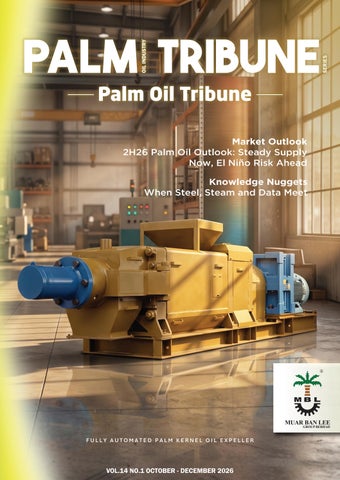
Market Outlook 2H26 Palm Oil Outlook: Steady Supply Now, El Niño Risk Ahead Knowledge Nuggets When Steel, Steam and Data Meet
FULLY AUTOMATED PALM KERNEL OIL EXPELLER
VOL.14 NO.1 OCTOBER - DECEMBER 2026
SERIES
OIL INDUSTRY
Palm Oil Tribune
3
Editorial
Palm Oil Tribune
Editorial Team EDITOR Hani Aqilah hani@maps-globe.com CREATIVE DESIGNER Muhammad Faireez artwork@mapsglobe.com Quarterly Publication Palm Oil Industry Tribune Series: Palm Oil Tribune
Volume 14 | No 1 Other Series: Palm Plantation Tribune Palm Downstream Tribune What’s in it News Roundup Expert Insights Regional Policies Technologies Event Summary Follow us on: Next Chapter Media Next Chapter Media
DIRECTOR Emily Yu PUBLICATION Maps & Globe Specialist Distributor Sdn. Bhd (625396-A) No 3-1 Jalan Perdana 10/6, Pandan Perdana, 55300 Kuala Lumpur, Malaysia. PRINTING Fong Wah Printing Sdn. Bhd. (1406717K) No. 17, JaIan Tembaga SD 5/2G Perindustrian Bandar Sri Damansara, Pekan Kepong, 52200 Kuala Lumpur, Malaysia.
Disclaimer: Next Chapter Media's editorial team strives to provide accurate and reliable information. However, we recommend that readers independently verify the claims and information presented in our publications. Next Chapter Media is not responsible for the accuracy of the content and encourages readers to use their own judgment
Sustainability
Innovation
Growth
Contents
Palm Oil Tribune
CONTENTS 5-9
24-28
A quick digest of the latest policies and market trends.
When Steel, Steam and Data Meet (Part 2)
Latest News Roundup
11
Market Outlook
2H26 Palm Oil Outlook: Steady Supply Now, El Niño Risk Ahead
12-13
Mills Performance
The EFB Bottleneck: Bridging the Gap Between Marketing Claims and Mill Reality
Knowledge Nuggets
29
Oil Palm Ministries, Its Agencies And Related Associations in Malaysia and Indonesia
30
Event List 2026
14-15
ADVERTISERS INDEX
MPOB adapts palm oil into a water-efficient cooling technology for data centres
1, 2, & 22
Innovation
16-21
Knowledge Nuggets
When Steel, Steam and Data Meet (Part 1)
Muar Ban Lee Group Berhad
10
Next Chapter Media
Back Cover
Palm Carbon Conference
4
5
News Roundup
Palm Oil Tribune
KPK steps up automation, AI and low-carbon solutions in palm oil milling
Europe-Plus: Malaysia’s Palm Oil Compass
25 July 2026
27 July 2026
The Plantation and Commodities Ministry (KPK) is accelerating the deployment of digital technology, automation, AI and low-carbon solutions across Malaysia’s palm oil milling sector. Speaking on behalf of Minister Datuk Seri Dr Noraini Ahmad at SPPOMA’s 42nd Anniversary, Datuk Razali Mohamad said this digital implementation aims to enhance operational efficiency while reducing long-term reliance on manual labour. It is being rolled out through closer collaboration with MPOB, regulatory agencies and industry associations, including SPPOMA.
Columnist Joseph Tek viewed that Malaysia should not frame its palm oil future as a choice between Europe and emerging markets. The stronger strategy is a portfolio approach: retain valuable European relationships while expanding more purposefully into Africa, India, the Middle East and other growth markets.
He said the sector must meet increasingly stringent sustainability, environmental protection, occupational safety, end-to-end supply chain traceability, and the European Union Deforestation Regulation (EUDR). To ensure regulatory frameworks remain balanced and operationally practical, KPK is encouraging millers to channel technical proposals through SPPOMA’s annual industry dialogue sessions with high-priority issues escalated to the Finance Ministry during national Budget preparations. Razali also welcomed mill-level circular bioeconomy progress, expanding methane capture, biogas power generation and BioCNG production to support national energy security, alongside gains in oil extraction recovery, process automation and high-value product development from palm oil biomass, without compromising industry competitiveness.
Malaysia exported 7.67 million tonnes of palm oil in the first half of 2026, up 10.3% year-on-year, although export earnings rose only 1.9%. India recorded strong growth, while Kenya overtook both the European Union and China as a destination. With nearly 90% of Malaysian palm oil exported, diversification is therefore a necessity, not a luxury. Africa presents more than a sales opportunity. Countries are increasingly interested in refining, downstream processing, plantation expertise, logistics, training and investment. Malaysia should approach the continent as a partner rather than merely an alternative market when Europe becomes difficult. Europe, meanwhile, remains important for higher-value products, technical partnerships, investment and sustainability standards. Malaysia should challenge discriminatory or impractical rules while strengthening genuine weaknesses in traceability and governance.
News Roundup
Palm Oil Tribune
Palm Oil Biomass Must Pass the Bankability Test
Ghana targets 100,00Ha for oil palm expansion
7 August 2026
19 August 2026
Malaysia has abundant oil palm biomass, but abundance alone does not make a viable industry. The real challenge is whether feedstock can be secured, aggregated, transported, processed and sold at prices that justify investment.
Ghana is moving forward with a plan to bring 100,000 hectares of new land into oil palm cultivation, aiming to lift domestic output, generate employment and reduce the country’s dependence on imported palm oil, said Minister of Food and Agriculture, Eric Opoku at a National Oil Palm Multistakeholder Roundtable Forum in Africa.
Oil palm produces empty fruit bunches, mesocarp fibre, palm kernel shells, fronds, trunks and palm oil mill effluent, all of which have potential uses in renewable energy, biogas, biochar, fertilisers, biofuels and higher-value materials. But each stream has different costs, logistics and existing uses. The next stage should focus on bankable business models, not just pilot projects. Investors need reliable feedstock, fair long-term contracts, workable logistics, proven technology and credible buyers. Location matters too: bulky, wet biomass is expensive to move, making estate-mill-biomass clusters potentially more practical than one national template. Government can support the sector through financing, incentives, research and carbon mechanisms, but long-term success must rest on sound economics. There is also an agronomic limit. Some residues should remain in the field to maintain nutrients, moisture and soil health. Biomass can become Malaysia’s “second harvest”, but only when it is organised, financed and scaled commercially without weakening the soil that produced it.
Opoku described oil palm as a cornerstone crop linking farming and industry, sustaining nurseries, transport firms, processors, traders, and manufacturers, while also opening income opportunities for women and youth. Nevertheless, Ghana relies on imported palm oil because it falls short of meeting its own palm oil needs, resulting in lost jobs, lower farmer income, neglected processing capacity, and exploitation. The government tasked the Tree Crops Development Authority (TCDA) with spearheading reform: registering farmers and businesses, issuing licences, coordinating production planning, gathering industry data, and enforcing traceability and quality benchmarks. He then argued that formal registration should be seen as a route to credibility investment and premium markets. Hitting 100,000-hectare goal means little without parallel gains in planting material quality, yields, and farmer incomes, with smallholders, not just large estates, at the center of the effort.
6
7
News Roundup
Palm Oil Tribune
Palm Oil May Help Cool Malaysia’s Data Centres
Indonesia could produce 3.6 billion cubic metres of biogas from palm oil waste
19 August 2026
19 August 2026
Malaysia is exploring an unusual new role for palm oil: cooling the servers that power the country’s fast-growing data-centre industry.
Indonesia could generate up to 3.6 billion cubic metres of biogas annually from palm oil waste, but currently uses less than 15% of that potential, according to the Palm Oil Agribusiness Strategic Policy Institute (PASPI).
The Malaysian Palm Oil Board (MPOB) is developing Sawit EcoTherm, a palm-based cooling fluid designed to replace water in data-centre cooling systems. The technology has already been tested in an operational environment and is moving closer to commercialisation, with MPOB finalising a licensing agreement with a local manufacturer. The potential savings are significant. MPOB estimates that a 100MW data centre can consume about 1.7 to 4.2 million litres of water a day, while Sawit EcoTherm could virtually eliminate that requirement. The palm-based coolant could also be cheaper than synthetic or petroleum-based alternatives and, by reducing reliance on server fans and mechanical air-conditioning, may cut energy consumption by up to 40% and operating costs by 30% to 50%. If commercialised successfully, the technology could create a new downstream market for palm oil while supporting Malaysia’s expanding digital economy. The caution, however, is equally important: new demand should come from greater value creation, not fresh pressure for plantation expansion or deforestation.
Palm oil mills produce around 125 million tonnes of palm oil mill effluent (POME) each year and PASPI estimates each tonne of POME could yield around 28.8 cubic metres of biogas through methane capture. The potential is tied to the scale of Indonesia's palm oil sector, with plantations covering about 16.8 million hectares and producing around 250 million tonnes of fresh fruit bunches annually. Biogas from POME can power mills directly or generate electricity, and after processing can be converted into biomethane or Bio-CNG for transport and industrial use—an application Indonesia is already piloting. To scale up utilisation, PASPI has proposed making methane capture mandatory at palm oil mills, enabling carbon credits for such projects, and requiring biogas blending with fossil fuels. These measures, PASPI argues, could cut reliance on conventional fuels while unlocking added value from palm oil waste.
News Roundup
Palm Oil Tribune
El Niño Threat to Palm Oil May Take Months to Surface
Palm Oil’s Green Transition Must Make Economic Sense
22 August 2026
1 September 2026
The impact of El Niño on Malaysia’s palm oil production is unlikely to be immediate, even as the risk of a very strong event increases.
A gathering of corporate, sustainability, biomass and smallholder leaders has broadly agreed that Malaysia’s green transition must be driven by practical economics, not technology for technology’s sake.
Plantation and Commodities Minister Datuk Seri Dr Noraini Ahmad said prolonged heat and reduced rainfall can eventually affect commodity crops, but the effects on oil palm yields normally emerge only several months later. The ministry and related agencies are therefore monitoring field conditions and production trends closely. MetMalaysia has estimated that the probability of El Niño reaching the “Super El Niño” category between October and December exceeds 90%, underscoring the need for early preparation. The government’s immediate priority is helping smallholders protect both crops and incomes through technical guidance, assistance and stronger ground-level outreach. The message extends beyond climate resilience. She also called for greater downstream processing, packaging, branding and distribution so that more value remains locally. Cluster farming, mechanisation and wider technology adoption were highlighted as ways to reduce costs, increase productivity and lessen dependence on manual labour. The broader lesson is that climate risk must be managed before yield losses appear. By the time the palm shows the damage, the weather event itself may already be over.
At an MPOC-The Edge roundtable, industry leaders agreed that opportunities exist in biogas, biomass power, solar, biochar, carbon credits and sustainable aviation fuel, but each must be commercially viable and must not undermine soil fertility or plantation productivity. Participants including Dato’ Carl Bek-Nielsen of MPOC and United Plantations, Rashyid Redza Anwarudin of SD Guthrie, Gideon Tan of FGV, Datuk Leong Kin Mun of the Malaysia Biomass Industries Confederation and Adzmi Hassan of the National Association of Smallholders. Biogas was seen as a practical near-term opportunity, although weak rural grids remain a constraint. Solar could provide income for ageing smallholders on marginal land, while shared biochar facilities may create new revenue and carbon-removal opportunities. SAF has promise, but feedstock and cost remain major obstacles. The strongest conclusion was simple: Malaysia should pursue green innovation pragmatically, while remembering that better planting material, timely replanting and improved agronomy may still deliver the greatest economic gain.
8
9
News Roundup
Palm Oil Tribune
Indonesia Eyes Wider EU Access for Palm Oil
ESG: Palm Oil’s Compliance Test Is Becoming Malaysia’s Trade Test
8 September 2026
4 September 2026
Indonesia expects broader access to the European Union market once the Indonesia-EU Comprehensive Economic Partnership Agreement (IEU-CEPA) comes into force, potentially strengthening trade prospects for palm oil and other agricultural products.
Malaysia’s palm oil industry faces a new ESG challenge: certification alone may no longer be enough to satisfy overseas regulators.
Negotiations were concluded in September 2025, with implementation expected in 2027. Under the agreement, 90.4% of Indonesian tariff lines are expected to receive immediate zero tariffs, while another 8.37% will benefit from gradual tariff reductions and tariff-rate quotas. Indonesia, the world’s largest producer and exporter of palm oil, stands to benefit if lower trade barriers improve competitiveness in the European market. Trade Minister Budi Santoso expects the agreement to be signed by the end of October 2026, after which it must proceed through European ratification. The agreement is significant because it shows that despite years of friction over sustainability rules and market access, Europe remains an important destination for Indonesian commodities. For palm oil, the opportunity is therefore not simply lower tariffs, but a chance to deepen commercial ties while continuing to meet Europe’s increasingly demanding sustainability and traceability requirements.
Writing in The Edge, former Sime Darby chief sustainability officer Dr Puvan J Selvanathan argues that the standard of proof in international trade is changing. US authorities increasingly expect companies to demonstrate what lies behind audits and certifications, particularly when allegations of forced labour arise. Past enforcement involving Sime Darby Plantation and Top Glove showed that third-party audits did not automatically shield companies from trade restrictions. The concern extends beyond the US. The EU Forced Labour Regulation, which becomes applicable from December 2027, is expected to scrutinise sectors including agri-food and palm oil. This comes on top of Europe’s longstanding sustainability focus on the commodity. Selvanathan’s wider warning is national. Because trade enforcement increasingly assesses countries as well as individual products, shortcomings in one highly visible sector could influence perceptions of Malaysia’s overall regulatory credibility. The lesson for palm oil is therefore clear: MSPO, RSPO and audits remain important, but companies increasingly need traceable, verifiable evidence showing that standards are genuinely implemented on the ground.
Market Outlook
Next Chapter Media Palm Oil Tribune
Gateway to Global Markets
PALM OIL TRIBUNE ADVERTISING RATE CARD 2026 Position
Size
Rate (RM)
USD
Back Cover
Full Page
8,000
2,000
Inside Front Cover
Full Page
7,000
1,710
Inside Back Cover
Full Page
6,500
1,600
Center Spread
Double Page
12,000
3,000
Full Page Colour
A4
5,000
1,230
Half Page Colour
A5
3,000
750
Advertorial
2 Pages
7,000
1,710
E -Newsletter Banner
Monthly
1,500
400
Website Banner
Monthly
2,000
500
BUNDLE PROMOTION Package
Price (RM)
USD
Benefit
Bronze
5,000
1,225
1 Full Page Ad
Silver
8,000
2,000
2 Full Page Ads + Website Banner
Gold
12,000
3,000
3 Full Page Ads + Advertorial
Platinum
18,000
4,410
4 Full Page Ads + Website Banner + Newsletter
Diamond
25,000
6,124
Cover Position + Advertorial + Digital Promotion
Next Chapter Media Gateway to Global Markets
https://issuu.com/mapsglobe
www.linkedin.com/in/nextchaptermedia
Speak to us to explore tailored advertising packages.
nadia@maps-globe.com emily@mapsglobe.com
Media Kit
www.nextchapter-media.com
10
11
Palm Oil Tribune
Market Outlook
2H26 Palm Oil Outlook: Steady Supply Now, El Niño Risk Ahead Source: The Star
Malaysia’s crude palm oil (CPO) production looks durable over the next two to three months as the industry enters its peak-crop season despite early signs of drier weather emerging across the region. According to research by BIMB Securities Research, emerging dry conditions are unlikely to impact crop yields in the immediate 2H26 window. This resilience is primarily due to the lag between a drop in rainfall and any resulting hit to palm oil yields; therefore, near-term supply should stay largely insulated from the current dry spell.
Consistent Supply, Firm Prices Data from the Malaysian Palm Oil Board (MPOB) highlights strong operational momentum: July 2026 Production: CPO output surged 9.4% month-on-month to 1.79 million tonnes. Inventories: Malaysian palm oil inventories climbed to 2.63 million tonnes. CPO Pricing: The average CPO price for January – July 2026 stood firm at RM4,388 per tonne. BIMB Research expects prices to hold near current elevated levels over the next few months. Seasonally stronger production and ample Malaysian stocks could cap how far prices climb in the near term. Still, firmer biodiesel demand and mounting concern over a strengthening El Niño will prevent sharp downward pullbacks. BIMB Research has left its price forecast unchanged, projecting RM4,400 per tonne for 2026 and RM4,500 per tonne for 2027.
2027: Where the Risk Sits The bigger concern is next year. BIMB Research flags a rising risk of lower regional output in 2027, particularly if the current strong El Niño pattern and below-normal rainfall persist through the end of 2026. Because dry-weather effects on yields take time to surface on plantations, a prolonged dry spell now could feed through into tighter regional supply and firmer prices in 2027.
Mills Performance
Palm Oil Tribune
The EFB Bottleneck: Bridging the Gap Between Marketing Claims and Mill Reality
Edited by: Hani Aqilah
Across the palm oil milling sector, Empty Fruit Bunch (EFB) utilization remains one of the most persistent operational hurdles. As pressure mounts to decarbonize, reduce waste, and build secondary revenue streams through biochar, co-digestion, and biomass pellets, technology vendors are pitching an increasing number of commercial-scale solutions. Yet, mill operators and technical teams routinely encounter a frustrating disconnect: solutions marketed as "commercially proven" frequently stall, break down, or fall short when exposed to the harsh operational realities of a full-scale palm oil mill. If the industry is to successfully transition EFB from a high-maintenance waste stream into a high-value asset, engineering teams must look beyond polished pitch decks and scrutinize both the physical mechanical challenges and the commercial narratives surrounding EFB processing.
EFB-to-Biochar Several technology providers point to carbon credit registrations, such as Puro and Verra, as evidence of commercial maturity. But a closer look at project audit trails often tells a different story: the feedstock being processed is usually Oil Palm trunk (OPT), Palm Kernel Shell (PKS), or a mixed biomass stream, rather than pure EFB. In other words, a project may be “proven” on paper under a voluntary carbon registry while having little or no demonstrated track record running on raw, unblended EFB under real mill conditions.
EFB Co-digestion The picture is similar for anaerobic co-digestion pathways. Most available performance data for EFB co-digestion remains confined to lab- or pilot-scale studies, with a notable absence of clear, verifiable industrial-scale references (a full mill running solid EFB co-digestion continuously, at commercial loading, over sustained operating hours). This raises an obvious question: why are these solutions so often positioned as commercially mature when the evidence doesn't yet support that claim?
12
13
Palm Oil Tribune
Mills Performance
A Structural, Not Just Technical, Problem The answer isn't purely technical — it's structural. Adoption decisions in this sector are heavily shaped by peer validation. That dynamic creates an opening that strong marketing can easily fill, since careful phrasing can imply operational success without ever demonstrating it under genuine field conditions. At the same time, the industry needs to look inward. In Malaysia, mill operations have long prioritised maximising Fresh Fruit Bunch (FFB) intake and pushing short-term throughput, often while squeezing processing budgets to make room for marketing spend. That environment doesn't leave much room for deep technical scrutiny or sustained investment in R&D — in effect, mills have started to operate more like FFB dealers than processors.
Volume-Driven Operations vs. Process Engineering Mindset For decades, the palm oil milling sector across Malaysia has operated under a simple commercial paradigm: maximize Fresh Fruit Bunch (FFB) throughput, keep processing costs low, and leave innovation to external technology providers. While this volume-driven approach generated strong margins during periods of high crude palm oil (CPO) prices, it has created a structural vulnerability when adopting advanced biomass utilization technologies. When evaluating Empty Fruit Bunch (EFB) conversion pathways—whether for biochar or biogas co-digestion—mills routinely encounter operational breakdowns. The root cause is rarely the core technology itself; rather, it stems from treating complex biochemical processing facilities like high-volume fruit collection centres. The challenges facing modern palm oil milling—carbon accounting, regulatory compliance, labour shortages, and changing yield dynamics—cannot be solved purely by increasing daily processing tonnage. Unlocking the real value of palm biomass will take a genuine cultural and technical shift: fewer FFB dealers, more precision process operators. That starts with a harder question than "who else is using it" — namely, how many palm oil companies in Malaysia today actually maintain a dedicated R&D budget and are willing to commit to developing solutions rather than simply following what their peers are doing. By dedicating resources to R&D, enforcing strict feedstock specifications, and rigorously auditing technology claims, palm oil mills can evolve into highly efficient, high-value biorefineries.
Innovation
Palm Oil Tribune
MPOB adapts palm oil into a water-efficient cooling technology for data centres Source: Bernama
The Malaysian Palm Oil Board (MPOB) has formulated Sawit EcoTherm, a palm-derived dielectric fluid formulated for single-phase immersion cooling in high-density data centres. Developed by the Process Engineering and Design Unit within MPOB’s Advanced Oleochemical Technology Division, the bio-based fluid transforms server thermal management from a water-cooling system into a closed-loop, water-free cooling system. By leveraging Malaysia’s oleochemical capabilities, MPOB has positioned palm oil not merely as an agricultural commodity or food ingredient, but as a critical technical enabler for next-generation digital infrastructure.
Mitigating Malaysia’s Data Centre Water Footprint
Thermal Efficiency for High-Density AI Workloads
Malaysia’s data centre sector is on track to consume as much as 876 million litres of water each day through conventional cooling methods alone—a volume equivalent to what nearly four million people need daily. Between 2025 and 2030, state-level data hub expansions are expected to consume 445.04 million litres per day in evaporative cooling towers alone. Sawit EcoTherm directly mitigates this pressure by eliminating the operational need for evaporative water towers altogether, safeguarding regional water security while supporting digital economic expansion.
Addressing the engineering parameters, MPOB Senior Research Officer Dr. Noor Khairin Mohd emphasized that next-generation artificial intelligence (AI) and hyperscale servers generate 3 to 5 times more heat than conventional servers. Air cooling and standard water loops struggle to manage these thermal densities without excessive energy draw. Direct immersion in Sawit EcoTherm delivers superior thermal capacity over conventional media, facilitating higher computing rack density, eliminating server-level cooling fans, and improving long-term hardware reliability. "Sawit EcoTherm stands out because it combines high-performance cooling with sustainability and local resource advantages, using a palm oil-based, non-conductive immersion cooling fluid produced from locally sourced Malaysian palm oil." — Dr. Noor Khairin Mohd, Senior Research Officer, MPOB
Credit: MPOB
Credit: MPOB
14
15
Innovation
Palm Oil Tribune
Unlocking ESG Value for Operators Data centre developers and operators face stringent global compliance frameworks. Sawit EcoTherm provides a direct pathway toward meeting corporate Environmental, Social, and Governance (ESG) targets across four primary operational pillars:
Water Conservation: Enables 100% water-free thermal management, shielding operators from local water usage effectiveness (WUE) penalties and supply risks.
Energy Efficiency: Because the fluid makes direct contact with server components, internal cooling fans are unnecessary altogether, as it can lower energy use by 30-50% and push Power Usage Effectiveness (PUE) figures in a more favourable direction.
Carbon Reduction: Reduced electrical power demand directly translates into lower indirect (Scope 2) greenhouse gas emissions across the facility lifecycle.
Environmental Safety: Up to 95% of the fluid’s composition comes from renewable, palm-based feedstocks. It contains no PFAS (“forever chemicals”), breaks down readily in the environment and poses minimal ecological risk if discarded.
Traditional Cooling System
Sawit EcoTherm Immersion
High water evaporation loss
Zero water consumption
High server fan energy draw
30-50% energy reduction
High Scope 2 emissions
Lower Scope 2 carbon footprint
Petroleum/PFAS synthetic oil
95% bio-based & PFAS-free
Accelerating Ecosystem Commercialization To scale Sawit EcoTherm across Southeast Asia’s data infrastructure, MPOB is actively engaging key stakeholders across the tech value chain. Commercial execution relies on strategic alignment between government agencies, technology integrators, data centre operators, and server OEMs. The immediate priority centres on running commercial pilot projects and technical validation trials to demonstrate long-term cost benefits, dielectric stability, and material compatibility to hyperscale operators. Through this downstream innovation, Malaysia continues to demonstrate how palm oil derivatives can power green technology for the digital age. Credit: MPOB
Knowledge Nugget
Palm Oil Tribune
When Steel, Steam and Data Meet (Part 1) By Joseph Tek Choon Yee
M
alaysia has about 446 palm oil mills, while Indonesia has well over 1,000, with its milling footprint continuing to grow alongside the scale and complexity of its plantation sector. This is no small corner of industry. The conversation around plantation and milling technology is shifting. Not always loudly, and certainly not evenly, but unmistakably. It is moving beyond processing and paperwork towards value-driven modernisation: better efficiency, stronger ESG discipline, regulatory readiness, business resilience, talent renewal and technological innovation. The mill is no longer simply where fruit becomes oil. Increasingly, it is also where efficiency, credibility, sustainability and future competitiveness may be won - or quietly lost. The industry is being asked to measure better, prove more, waste less, respond faster, trace further and train differently while continuing to run on that familiar mixture of palms, people, steel and steam. Increasingly, we can add one more ingredient: data.
16
17
Palm Oil Tribune
Knowledge Nugget
When everything wants to be smart It must be said, with a small smile, that “smart” has become one of the hardest-working words in modern industry. We now have smart cities, smart homes, smart farms, smart dashboards, smart sensors and smart phones. Naturally, we must also have smart mills. The word is used so freely that even a kettle with a blinking light may begin to feel technologically underqualified. In palm oil, however, the underlying idea is serious. A “smart” estate or mill generally involves some combination of digitalisation, automation, sensors, the Internet of Things, data analytics and increasingly artificial intelligence. IoT is especially important because it allows machines, instruments, cameras and control systems to communicate continuously, sending information from the estate or mill floor to operators and decision-makers. But smartness should ultimately be judged by outcomes. A smart estate should improve field execution. A smart mill should reduce losses, improve efficiency, strengthen reliability or allow people to intervene sooner when something begins to go wrong. Otherwise, “smart” risks becoming another attractive adjective searching for a business case.
The old mill gets a new brain Palm oil milling has been digitalising for years. Many engineers will remember the arrival of SCADA - Supervisory Control and Data Acquisition - which allowed equipment and processes to be monitored and controlled from central systems instead of relying entirely on manual readings and operators carrying clipboards around the mill. I first encountered SCADA decades ago in an aeroponic farm and later in a biomass plant. It already represented an important step forward. But SCADA largely helped people see what was happening and respond according to predefined operating limits. The newer generation of digital tools attempts to go further: analysing patterns, identifying anomalies, predicting faults and sometimes recommending or initiating adjustments. Put simply, SCADA made the plant more visible. Artificial intelligence now aspires to make it more predictive. Common sense, fortunately, remains a human responsibility. Several technology providers and mill groups are now exploring this frontier. One Malaysian example is the AI-enabled mill project at Kuala Kangsar, Perak, involving AIREI, or Artificial Intelligence Robotics Engineering Industries. What makes the project interesting is not simply the name attached to it, but the fact that an existing palm oil mill has been used as a working platform for integrating conventional mill engineering with sensors, cameras, automation, data systems and AI-based analytics. Rather than building an entirely new mill around digital technology, the project illustrates another possibility: teaching an old mill some new tricks.
Knowledge Nugget
Palm Oil Tribune
What has actually been done? The work-to-date appears to have concentrated on building a more connected operating environment across several key sections of the mill. According to material shared for the project, digital monitoring and analytics have been applied across areas including the FFB ramp and weighbridge, sterilisation, digestion and pressing, clarification, kernel recovery, boilers, storage and the mill data room. The system combines conventional process instrumentation with newer tools such as AI-enabled cameras, real-time monitoring, automated process settings and data integration. Examples shared include assessing incoming fruit, adjusting steriliser settings according to fruit characteristics, monitoring oil losses, controlling boiler fuel more closely and calculating extraction performance using online measurements. Operational, maintenance, procurement, stores, finance, human-resource and weighbridge information are also being brought together more systematically. The technology provider is additionally exploring conversational AI tools intended to help production and maintenance teams retrieve operational information and troubleshoot problems. That does not mean an AI assistant has suddenly become a veteran mill engineer. One can still imagine the old hand asking: “GPT also knows about choked conveyors, kah?” Perhaps one day. For now, the more important development is the gradual accumulation of structured operational knowledge that can help engineers diagnose problems earlier and make decisions with better information.
18
19
Palm Oil Tribune
Knowledge Nugget
AI must earn its keep Technology becomes interesting to millers only when it moves beyond demonstration. A palm oil mill is not a technology exhibition. It is a production plant. Any investment ultimately has to justify itself through some combination of lower losses, higher extraction, less downtime, improved reliability, reduced labour dependency, better safety or lower operating cost. This is where the Kuala Kangsar project becomes worth watching. The AI-enabled system has reportedly been operating since around August 2024. Performance information shared by the technology provider indicates improvements across several operating measures following implementation. Reported mesocarp oil losses declined, while OER became stronger and more stable. Manpower requirements were also reported to have fallen substantially, together with a significant reduction in breakdown hours. The figures shared indicate oil losses moving from approximately 4.8%–5.2% previously towards about 3.4%–3.6%, while OER reportedly increased from around 17.85% to 19.02%. Manpower was reported to have fallen from 66 to 31 workers, while average breakdown hours declined from about 12.21 hours to 3.08 hours. These numbers are certainly interesting. They should also be treated for what they presently are: reported results from an early operating case rather than proof that every mill installing AI will achieve the same outcome. Mill configuration, crop quality, maintenance history, operator competence, throughput, equipment condition and many other factors influence performance. What matters now is longer-term verification. Do the improvements persist? How much comes from AI itself, how much from better instrumentation and process discipline, and how much from management focus accompanying the project? Those are precisely the questions the industry should be asking.
Technology cannot repair neglect There is another danger in discussions about AI. Software can make engineering look deceptively easy. Before AI performs any digital magic, very traditional things must still work properly: instruments must be reliable, machines maintained, steam systems healthy, boilers operated correctly, calibration disciplined and operators properly trained. AI cannot rescue poor engineering. It may simply report the chaos faster - perhaps with nicer graphics. A genuinely smart mill is therefore not necessarily a workerless mill. It may operate with fewer people, but those people will probably require stronger technical capability. Sensors can detect. Cameras can observe. Algorithms can analyse and recommend. People must still interpret, maintain, repair, verify and ultimately accept responsibility when steel, steam, oil and fruit refuse to behave according to the algorithm.
Knowledge Nugget
Palm Oil Tribune
The crop supply test There is another important qualification. The Kuala Kangsar mill reportedly obtains a large proportion of its FFB from outside suppliers. That introduces variables extending well beyond the mill gate. Third-party fruit can fluctuate in quality, ripeness, timing, availability and consistency. No amount of AI inside the mill can completely control what arrives at the ramp. That is why the next useful stage would be to evaluate similar systems in more integrated estate-mill environments where harvesting intervals, crop supply, bunch quality and traceability can be monitored more consistently. Such comparisons would help answer an important question. How much improvement comes from smarter milling, and how much greater value might arise when the estate and mill begin learning together? That is where the frontier becomes especially interesting. Harvesting schedules, field conditions, crop forecasts, transport movements, bunch quality, mill throughput and maintenance demand could eventually form one connected operating system. Instead of the estate sending fruit and the mill receiving it, the two could increasingly share information before the fruit even moves.
20
21
Palm Oil Tribune
Knowledge Nugget
Let someone else go first Of course, plantations have their own philosophy of technological adoption. It can sometimes be summarised rather elegantly: Let someone else try it first. Let another mill bear the first cost, survive the teething problems, face the first uncomfortable board meeting and discover whether the “smart system” is genuinely smart - or merely expensive with impressive lighting. That caution is understandable. Millers are practical people. Steel, steam, fruit and workers have a habit of humbling PowerPoint presentations. Technology adoption also raises questions about ownership succession, skills and management capability. Machines may sometimes be modernised faster than organisations. But somebody still has to provide the learning ground. Early projects matter not because every early adopter will eventually prove correct, but because somebody has to discover what works, what fails and what needs changing. That is the real value of current projects such as Kuala Kangsar. They provide evidence. They expose limitations. They generate operating experience. And, importantly, they begin preparing engineers, technicians and operators who will increasingly need to understand both the machinery and the data describing it.
The bigger frontier The most important story therefore may not be one company, one technology provider or even one AI mill. It is the gradual transformation of plantation and milling management itself. Palm oil has always been a combination of biology and engineering. Its next chapter adds another layer: intelligence derived from data. The technology remains young. Claims should be tested. Returns should be independently examined. Failures should be discussed as openly as successes. But neither should the industry dismiss these developments simply because the first versions are imperfect. The future workforce cannot be trained only on yesterday’s tools. Tomorrow's planter, mill engineer and technician will probably need to combine field sense, process discipline, engineering knowledge and data intelligence. The question is therefore becoming less about whether artificial intelligence will enter plantations and mills. It already has. The more useful question is whether we shall learn to use it wisely - allowing technology to strengthen human judgement rather than substitute for it, measuring genuine outcomes rather than fashionable claims, and making sure that when the mill learns to think, the people running it continue thinking too. That, perhaps, is when a smart mill finally becomes a wise mill.
Event Recap
Palm Oil Tribune
22
23
Palm Oil Tribune
Knowledge Nugget
When Steel, Steam and Data Meet (Part 2) By Joseph Tek Choon Yee
I
f the mill is beginning to think, the estate must not remain trapped in yesterday’s notebook.
For many years, the plantation estate has remained the most romantic and stubbornly practical end of the palm oil supply chain. It is where sunrise still matters, rain still interrupts good intentions, roads still decide efficiency, and fresh fruit bunches still have to be cut, collected and evacuated before anyone in head office can admire a dashboard. Now comes another promise from the age of smart everything: the digital plantation. There are plantation digital platforms presenting themselves as end-to-end management systems designed to optimise productivity, control costs and support sustainability by integrating operations, finance, analytics and compliance into one intelligent platform. These systems use AI, business intelligence, cloud computing and IoT, infused with agronomics and plantation management best practices.
Knowledge Nugget
Palm Oil Tribune
The Estate Gets Its Digital Boots A plantation estate is not short of data. It has always produced data: harvesting records, manuring records, spraying rounds, weeding progress, pruning, road repairs, vehicle movements, crop evacuation, labour attendance, field inspections, rainfall, FFB production, cost statements, budget variances and audit records. The problem is not that estates lack information. The problem is that too much of it arrives late, sits in silos, depends on manual entry, or becomes useful only after the mistake has already gone for its weekend holiday. These platforms propose modules covering finance and accounting, labour and resource management, vehicle and equipment tracking, transportation, productivity monitoring, budget planning, work planning through calendars, Gantt charts and alerts, planting monitoring, field inspection and advisory. In plain estate language, they try to bring the loose pages of plantation management into one living system. That matters because estate management is ultimately a business game of discipline repeated daily. The harvest must be on round. The crop must be evacuated. The fertiliser must reach the palm, not merely the store ledger. The sprayer must cover the correct field. The road must be passable. The tractor must be where it claims to be. The supervisor must know, not guess. Digital tools will not replace supervision. But they can make supervision less blind.
The Map Is No Longer Just a Map One of the most useful aspects of estate digitalisation is the map-based view. A plantation is geography before it is finance. Blocks, terraces, roads, drains, rivers, collection points, steep slopes, replants, poor patches and access constraints all shape productivity. A good map is therefore not decoration. It is management. Map-based plantation views, IoT-enabled data collection, vehicle tracking, mobile field applications, geolocation, image capture and time-stamped proof of work can help managers monitor estate activity more clearly. They can also support FFB identification, counting and activity monitoring anytime, anywhere. When a field inspection comes with a photograph, timestamp and location, the old phrase “sudah buat, boss” becomes easier to verify. When a vehicle route is tracked, transport efficiency is no longer dependent on memory, charm or the driver’s storytelling ability. When harvesting output is linked to blocks and dates, crop patterns become clearer. When field work is visible on a map, leakages become harder to hide. Of course, technology will not abolish human creativity in avoiding responsibility. Plantation people are resourceful. Some are resourceful in the wrong direction. But digital proof raises the cost of casual excuses. That alone is progress.
24
25
Palm Oil Tribune
Knowledge Nugget
Knowledge Nugget
Palm Oil Tribune
AI Can Count Fruit, But Discipline Beyond Crop: ESG, Wildlife and Must Count Too Tree Health Plantation digital platforms also promote automated fruit count and grading using AI tools for better quality and productivity monitoring, including palm fruit detection and dashboard-style image analysis. This is promising. Crop estimation has long been part science, part art, part experience and occasionally part hope. If AI-assisted image recognition can improve FFB counting, bunch grading, crop estimation and harvest monitoring, it can support better planning. Labour allocation, transport scheduling, mill intake coordination and revenue forecasting may all improve. There is also ongoing work to develop fruit identification for harvesting alerts, where the system can eventually alert the harvester or supervisor when bunches are ready, especially when linked with hardware integration. This is where digitalisation moves from passive reporting into active operational nudging. The estate no longer merely records what has happened. It begins to suggest what should happen next. But AI can count only what it sees. Poor lighting, variable bunch positions, tall palms, difficult terrain, camera quality, network gaps and inconsistent image capture can all affect accuracy. AI also needs training data that reflects real plantation diversity, not merely neat demonstration conditions. In other words, AI can assist crop intelligence. It should not become crop superstition with a logo.
The next layer of digital estate management will not stop at harvesting, vehicles and productivity. Additional functionality is being incorporated or developed, including an ESG calculator, environmental and wildlife monitoring and tree health assessment. This is important because the estate of the future will not only be judged by tonnes per hectare or cost per tonne. It will also be judged by how well it records, manages and proves its environmental and social responsibilities. For larger planters, sustainability reporting is no longer an annual decorative chapter in a glossy report. It is becoming operational, auditable and increasingly linked to market access. Tree health is another important frontier. Yield is not created at the weighing bridge. It begins much earlier, in palm vigour, nutrition, drainage, disease pressure, water stress, terrain and field condition. If mapping data and tree-health observations can be incorporated into the platform, the estate can move closer to predictive management rather than historical explanation. In selective pilots, data from mapping and tree health are being brought into the platform. Vehicle tracking is already being tested, while human tracking, fruit identification and harvesting alerts are in the works with hardware integration. This is how such technology should mature: not as a dramatic magic show, but as a careful layering of practical functions tested against real plantation conditions.
Connectivity: The Quiet Game Changer For years, one of the biggest excuses against estate digitalisation was connectivity. Many estates, especially in remote areas, struggled with weak signals, patchy internet and the familiar ritual of walking around with a phone held up like a divining rod, searching for one bar of mercy. That is changing. With better WiFi options, improving rural connectivity and satellite internet services such as Starlink becoming more available and increasingly affordable, connectivity is becoming less of a wall and more of a bridge. This could be a genuine game changer for plantations. Once connectivity improves, mobile field apps, geo-tagged inspections, vehicle tracking, real-time reporting, cloud dashboards and remote management become far more practical. The estate manager can see more. Headquarters can respond faster. Technical teams can support remotely. Audits can be better prepared. Younger staff, who grew up in a connected world, may find plantation life less like exile and more like a modern profession with trees. This does not mean every estate will become a remote-control plantation. Boots are still needed. Field presence still matters. But better connectivity allows the boots to be supported by bandwidth.
26
27
Palm Oil Tribune
Knowledge Nugget
Robots Can Wait; Integration Cannot There is excitement around LIDAR, drones, robotics and below-canopy technologies. They will come, especially as labour shortage becomes more serious. But for many estates, broad practical adoption is still some years ahead. That is fine. The first frontier is not to fill the plantation with robots. The first frontier is to connect the existing operation intelligently: good maps, reliable crop data, vehicle tracking, work verification, fruit identification, harvesting alerts, tree-health monitoring, mill process data, oil-loss monitoring, boiler control, finance integration and ESG proof. Do this properly, and the industry will have built the platform on which future robotics can stand. Otherwise, we may one day have a drone flying above an estate that still cannot explain why the crop was late. That would be very modern, and very silly.
Smart Estates and Mills For years, the palm oil industry has spoken of integration. Field to mill. Mill to refinery. Plantation to market. Farm to fork. Soil to shelf, if one wishes to make it sound suitably poetic after lunch. But much of this integration has remained more organisational than operational. The estate produces the crop. The lorry carries it. The weighbridge records it. The mill processes it. The accounts department later tries to explain the numbers. By then, the fruit has become oil, the oil has entered the tank, the report has become history, and the argument has begun. Now, digitalisation and AI offer something more ambitious: not merely a smart estate, and not merely a smart mill, but an integrated AI estate-mill operation. That, to me, is where the real frontier lies. A smart estate tells us what is coming. A smart mill tells us what is happening to it. But an integrated AI estate-mill system begins to tell us why performance is improving or slipping - and where intervention is needed before the losses become month-end explanations. As more operating outcomes and performance results emerge, the investment case is becoming harder to ignore. Improvements in extraction, loss control, labour productivity, downtime reduction and process stability are no longer merely attractive talking points for technology brochures. They are beginning to translate into numbers that owners, planters, millers, engineers and accountants can all recognise. In that sense, the return on investment is becoming increasingly compelling for the plantation sector to study seriously not as a fashionable leap into AI, but as a phased and practical step towards a more efficient, accountable and future-ready industry. Traditionally, plantation management has too often worked backwards. At month-end, the crop statement appears. OER is reviewed. Cost per tonne is discussed. Labour productivity is examined. Transport cost is questioned. The estate may blame weather, terrain, labour, roads or crop pattern. The mill may blame fruit quality, bunch condition, poor crop flow or sterilisation challenges. Finance may blame everyone, but with tables. This ritual is familiar. It is also costly. An integrated AI estate–mill operation should help move the industry from hindsight to foresight - from explaining yesterday’s losses to anticipating tomorrow’s problems before they become today’s excuses. When tree health, crop forecasting, harvesting alerts, vehicle tracking and FFB evacuation data are connected to weighbridge intake, steriliser performance, oil losses, boiler efficiency and OER, managers - or those entrusted with watching the pulse of the operation - can begin to see relationships much earlier and more clearly. Late harvesting may no longer appear merely as a field issue. It may show up as a milling performance issue. Poor evacuation may quietly affect fruit quality. Erratic crop supply may disturb steriliser planning. Weak road conditions may slow transport turnaround. Bunch quality at the ramp can be traced back to the block, the harvester, the harvesting interval, the field condition - and, where the numbers begin to misbehave, even raise early suspicion of theft or pilferage. Suddenly, “field to mill” is no longer a pleasant slogan for conference slides. It becomes a live operating system - one where the estate speaks to the mill, the mill answers with data, and management has fewer places to hide behind the old phrase: “We only knew after the month-end report.”
Knowledge Nugget
Palm Oil Tribune
The New Workforce Will Ask New Questions This matters even more because the next generation will not enter the industry with the same assumptions as their seniors. Gen Z is already asking different questions, and Gen Alpha will ask them even more boldly. Can I work from home? Are weekends protected? Is there decent internet? Can Starlink reach the estate? Is the mill connected, or must I still chase information by walking from station to station with a clipboard and a prayer? Some older hands may smile, sigh or grumble into their coffee. Yet these questions are not entirely unreasonable. A modern industry that wants modern talent must offer modern tools. Smart estates, smart mills, digital dashboards, remote monitoring, IoT and AI will not make plantation and milling work soft. Nor will they remove the discipline required on the ground. But they can make the workplace more attractive, more professional and more aligned with the expectations of younger engineers, technicians and executives. If palm oil wants the next generation to come in, it cannot invite them into the future using only yesterday’s wiring.
The Frontier Is Integration The real promise of AI in palm oil is not isolated smartness. A smart estate alone is useful. A smart mill alone is useful. But an integrated AI estate-mill operation is potentially transformational. It closes the gap between crop and extraction. It links field discipline to mill performance. It allows management to see causes, not just outcomes. It strengthens compliance and traceability. It supports better labour planning. It makes maintenance and operations more predictive. It gives finance better context. It gives younger talent a more modern workplace. It gives leadership a clearer view of what is truly happening. The palm oil industry has often been accused of being old-fashioned. Sometimes unfairly. Sometimes with uncomfortable accuracy. But this may be one of the moments where the industry can show that it is not merely defending the past. It is wiring the past into the future. The old planter had boots, instinct and a notebook. The old miller had steam, sound and experience. The new AI estate-mill operation will still need all of that. But it will add maps, sensors, cameras, IoT, dashboards, algorithms, real-time intelligence and control-rooms. That is not the end of human judgement. It is the upgrading of it. And if done properly, the future of palm oil may not be found only in higher-yielding planting materials, better refineries or new downstream products. It may also be found in the invisible conversation between the palm in the field and the press in the mill - where data travels faster than excuses, where discipline becomes visible, and where the industry learns, at last, to manage itself as one connected chain. In the end, AI should not make palm oil less human. It should make human judgement better informed, better timed and, one hopes, less dependent on heroic guesswork after the damage is done. The old plantation walked. The old mill steamed. The new frontier will still walk, still steam, still smell of fruit, oil, mud and machinery. But now, perhaps, it will also think - or at least help us think earlier, clearer and a little less expensively. I shall therefore look forward to living long enough to see a truly integrated and transformative AI estate–mill operation in action, learning, improving and proving its worth.
28
29
Directory
Palm Oil Tribune
KEY PALM OIL MID & DOWNSTREAM STAKEHOLDERS: MINISTRIES, THEIR AGENCIES AND RELATED ASSOCIATIONS MALAYSIA
Ministry of Plantation and Commodities (KPK) www.kpk.gov.my
Malaysian Palm Oil Board (MPOB) www.mpob.org.my
Malaysian Palm Oil Council (MPOC) www.mpoc.org.my
Malaysian Sustainable Palm Oil (MSPO) www.mspo.org.my
Malaysia Biomass Industries Confederation (MBIC) http://www.biomass.org.my
Malaysian Palm Oil Association (MPOA) www.mpoa.org.my
The Federation of Palm Oil Millers Association of Malaysia (POMA)
Palm Oil Refiners Association of Malaysia www.poram.org.my
Malaysian Oleochemical Manufacturers' Group (MOMG) www.momg.org.my
Malaysian Biodiesel Association (MBA) www.mybiodiesel.org.my
Malayan Edible Oil Manufacturers' Association (MEOMA) meoma.org.my/v1
Malaysian Oil Scientists' and Technologists' Association (MOSTA) mosta.org.my
INDONESIA
Badan Pengelola Dana Perkebunan Kelapa Sawit (BPDPKS) Indonesian Palm Oil Plantation Fund Management Agency https://www.bpdp.or.id/
Gabungan Pengusaha Kelapa Sawit Indonesia (GAPKI) Indonesian Palm Oil Association https://gapki.id/en/
Indonesian Oil Palm Research Institute (IOPRI) Pusat Penelitian Kelapa Sawit (PPKS) https://iopri.co.id/
Palm Oil Agribusiness Strategic Policy Institute (PASPI) https://palmoilina.asia/
Asosiasi Produsen Oleochemical Indonesia (APOLIN) Indonesian Oleochemical Producers Association https://apolin.org/
Asosiasi Produsen Biofuel Indonesia (APROBI) Indonesian Biofuel Producers Association https://www.aprobi.or.id/
Gabungan Industri Minyak Nabati Indonesia (GIMNI) Indonesian Vegetable Oil Industry Association https://gimni.org/
Indonesian Biomass Energy Masyarakat Energi Biomassa Indonesia (MEBI) https://mebi.or.id/
Market Event List Outlook
Palm Oil Tribune
12 - 13 JAN
9 - 11 FEB
10 - 12 FEB
17 - 19 APR
Palm Oil Economic Review and Outlook Seminar (R&O) 2026
37th Palm & Lauric Oils Price Outlook Conference & Exhibition (POC2026)
3rd International Symposium Ganoderma (ISGANO) 2026
Pakar Pertanian Expo (PPE)
TBC, Kuala Lumpur, MY
Adimulia Hotel Medan, Sumatera Utara, INA
22 - 23 APR
23 - 24 APR
6 - 7 MAY
14 - 16 MAY
2nd HaiSawit Symposium (HASI) 2026
International Palm Oil Millers Conference (IPOMC) 2026
16th PALMEX Indonesia 2026
4th AgTech International Agro Expo
Berjaya Times Square Hotel, Kuala Lumpur, MY
Royale Chulan KL, MY
Hall A1 & A2, Jakarta International Expo (JIEXPO), Kemayoran, INA
25 - 27 JUN
7 - 9 JUL
13 - 15 JUL
4th AgTech International Agro Expo
4th Technology & Talent Palm Oil Mill Indonesia (T-POMI)
11th International Conference (IPC)
Hotel Bidakarta Jakarta, INA
Setia City Convention Centre, Selangor, MY
Holiday Inn Bandung Pasteur, West Java, INA
MAEPS Serdang, Selangor, MY
Perda Convention Centre, Penang, MY
28 - 30 JUL Planters
Royale Chulan Kuala Lumpur, MY
12th Indonesia International Palm Oil Machinery & Processing Technology Exhibition (INAPALM Asia)
Jakarta International Expo (JIEXPO) Kemayoran, INA
6 - 7 AUG
6 - 8 AUG
4th Sawit Indonesia Expo (SIEXPO) 2026 CO-OP Exhibition Centre, Surat Thani, Pekanbaru Convention & THA Exhibition, Riau, INA Asia Palm Oil Conference (APOC) 2026 | 15th PALMEX Thailand
10 - 12 SEP
6 - 8 OCT
9th Malaysia International Agriculture Technology Exhibition (Agri Malaysia)
Santika Premiere Dyandra Hotel & Convention, Medan, INA
Malaysia International Trade Exhibition Centre (MITEC), KL, MY
&
13 - 14 OCT
16 - 17 OCT
7 - 8 NOV
17 - 18 NOV
Oils & Fats International Congress 2026 (OFIC 2026)
3rd Unlocking Revenue & Sustainability: Palm Carbon Emission Reduction | POMA Dinner
4th AgTech International Agro Expo
5th World Palm Conference 2026 | 13th PALMEX Malaysia
Kuala Lumpur Convention Centre, KL, MY
Genting Highlands, MY
Sabah International Convention Centre, Sabah, MY
Hall 4 & 5, Kuala Lumpur Convention Centre, MY
30 2
PALM CARBON
CONFERENCE RENCE 2026 Harnessing Carbon Opportunities for Malaysia’s Oil Palm Stakeholders
16 JUNE 2026 MALAYSIA PALM CARBON K U A L A L U M P U R 2026
MENARA FELDA, KUALA LUMPUR www.malaysiapalmcarbon.com
Unlocking the Palm Bioeconomy Through Biofuels, Biochar, Sustainable Products, CO2 Removal Certificate
16-17 OCTOBER 2026 ASEAN PALM CARBON M A L A Y S I A 2026
RESORTS WORLD AWANA, GENTING HIGHLANDS www.aseanpalmcarbon.com
Reducing Indonesia’s Emissions Through High-Impact Palm Carbon Offset Initiatives INDONESIA PALM CARBON T B C 2027
To Be Confirmed To Be Announced www.malaysiapalmcarbon.com
MALAYSIA PALM CARBON S A B A H 2027
Organised By: