Next Chapter Media's editorial team strives to provide accurate and reliable information. However, we recommend that readers independently verify the claims and information presented in our publications. Next Chapter Media is not responsible for the accuracy of the content and encourages readers to use their own judgment when evaluating the information.
Editorial Team
EDITOR
Zahidah Zahidi zahidah@maps-globe.com
CREATIVE DESIGNER
Muhammad Faireez artwork@mapsglobe.com
DIRECTOR
Emily Yu
PUBLICATION
Maps & Globe Specialist
Distributor Sdn. Bhd (625396-A)
No 3-1 Jalan Perdana 10/6, Pandan Perdana, 55300 Kuala Lumpur, Malaysia.
PRINTING
Fong Wah Printing Sdn. Bhd. (1406717K)
No. 17, JaIan Tembaga SD 5/2G Perindustrian Bandar Sri Damansara, Pekan Kepong, 52200 Kuala Lumpur, Malaysia.
Sustainability Innovation Growth
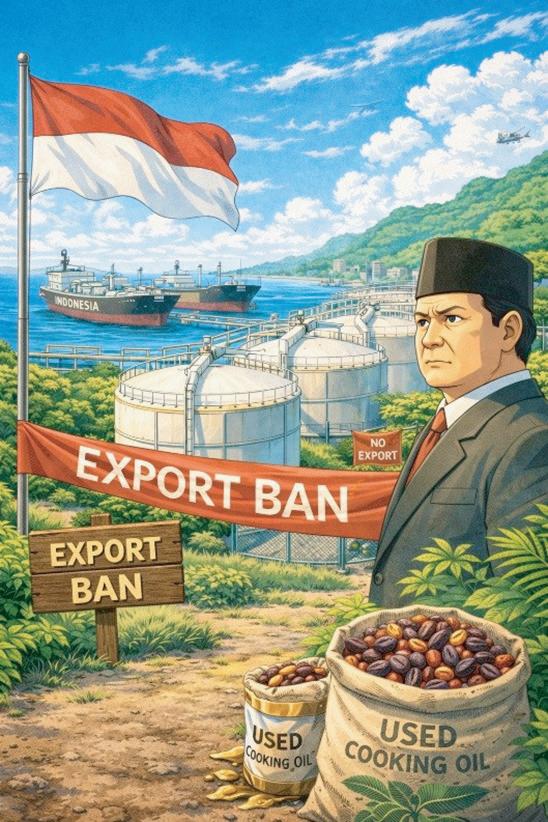
Indonesia bans on exporting palm oil waste
2 February 2026
In a bold move to strengthen national energy self-su ciency, Indonesia has unveiled a ban on exporting palm oil waste, including used cooking oil - a key feedstock for biofuel production. e announcement by President Prabowo Subianto at the 2026 National Coordination Meeting in Bogor underlines the government’s commitment to prioritising domestic energy needs over external markets.
Prabowo described palm oil as a “strategic commodity,” highlighting its versatility across food, industrial and energy applications. By retaining palm oil waste within the country, Indonesia aims to boost its biodiesel and aviation fuel industries, reduce reliance on imported fossil fuels and stimulate innovation in renewable energy sectors.
Used cooking oil, o en exported for processing abroad, will now be redirected to support local biofuel value chains. O cials say this aligns with broader national ambitions for energy independence and strengthens Indonesia’s position in global renewable fuel markets.
While global interest in Indonesian palm products remains strong, the export ban signals a shi in policy focus: national bene t rst. By capturing value within its borders, Indonesia hopes to grow domestic biofuel capacity, create new energy pathways and carve out a future where palm-based fuels play a central role in its renewable energy landscape.
Indonesia prioritises palm oil for domestic biofuel to boost energy security, jobs
3 February 2026
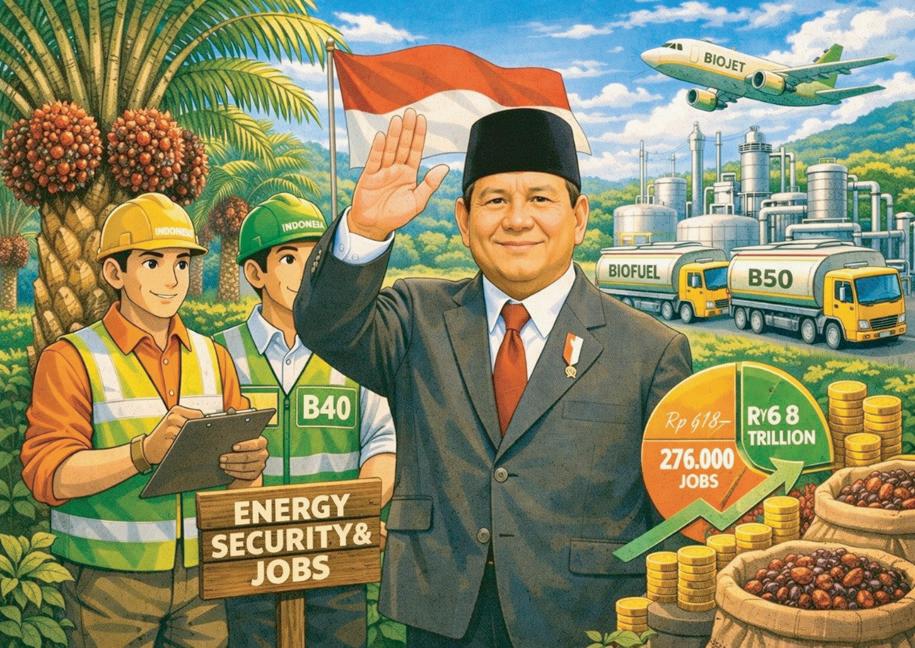
Indonesia, the world’s largest palm oil producer, is doubling down on using its abundant palm oil resources to fuel national energy security and economic growth, rather than solely for export markets. At the heart of this shi is President Prabowo Subianto’s Asta Cita national transformation agenda, which positions palm oil as a strategic commodity for bolstering biodiesel and sustainable aviation fuel production at home.
In a policy move announced at the 2026 National Coordination Meeting in Bogor, the government declared that crude palm oil (CPO) and derivatives — including used cooking oil and other waste feedstocks — will be prioritised for domestic energy consumption, with exports curtailed to ensure local supply rst. Bio-aviation fuel and oleochemical projects form part of 18 priority downstream initiatives, with a combined investment target of Rp618 trillion (about US$37 billion) expected to generate around 276,000 jobs.
Indonesia currently mandates a B40 biodiesel blend (40 % palm biofuel), and o cials are exploring raising this to B50 later in the year to deepen renewable energy use. Energy o cials say expanding domestic biofuel production will help bu er the country against global price volatility and rising fuel demand, while industry leaders caution that intensifying palm oil productivity is key to meeting both domestic fuel needs and export commitments.
Investing in Malaysian oil palm stocks
5 February 2026
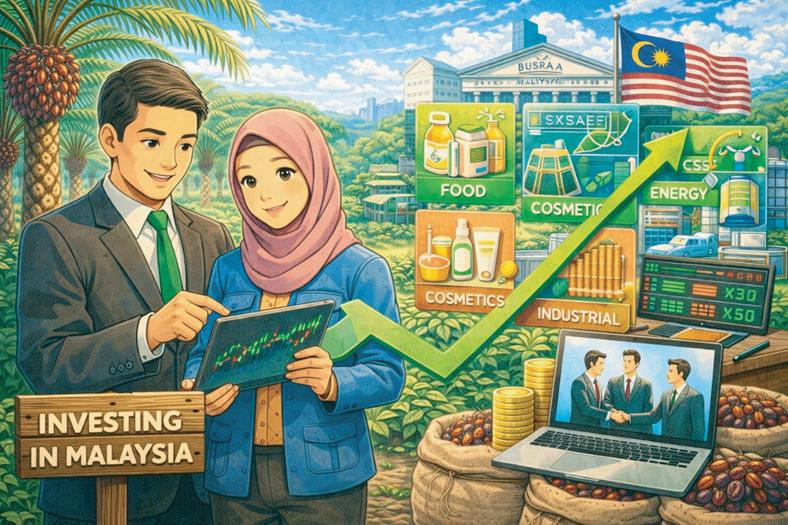
Malaysia’s position as the second-largest producer of palm oil in the world gives investors unique exposure to a global staple commodity through shares listed on Bursa Malaysia, and there’s renewed interest in plantation stocks as part of diversi ed portfolios.
According to industry watchers, palm oil equities o er long-term appeal thanks to the enduring demand for crude palm oil (CPO) across food, cosmetics, energy and industrial sectors - a structural driver that underpins revenue potential for major planters.
However, investing in this sector is far from straightforward. Plantation stocks are inherently cyclical, closely tied to uctuations in CPO prices, which are in uenced by global supply-demand balances, weather patterns, export trends and biodiesel policies in Indonesia and Malaysia. Elevated domestic stockpiles and shi ing biodiesel mandate timelines have tempered near-term price optimism and injected volatility into share valuations.
Analysts recommend selective company choice and risk awareness. While broad index exposure may dilute risk, individual counters can vary markedly in operational performance, yield growth, cost structures and sustainability credentials - the latter increasingly relevant as Environmental, Social and Governance (ESG) criteria in uence institutional capital ows.
New Chapter for the Malaysian Palm Oil Industry
2 February 2026
is piece was written by Hong Wai Onn in Business Today.
Malaysia’s palm oil sector - responsible for nearly a quarter of global supply - appears to be entering a new era of transformation, moving beyond longstanding controversies around environmental impact, labour rights and transparency. e industry’s evolution re ects pressure from global markets and internal reforms that are reshaping how palm oil is produced, traded and perceived.
A signi cant milestone came in January 2026 when U.S. Customs and Border Protection li ed its import ban on products from FGV Holdings Berhad, recognising substantive improvements in labour practices a er earlier forced-labour concerns. is shi underlines wider progress in workers’ rights across Malaysia’s plantations, including repayments and compliance enhancements totalling millions of dollars.
Technology and transparency are also driving change. Digital platforms like FGV’s sustainability data hub and SD Guthrie’s traceability tool are helping the sector map supply chains down to individual plantations, meeting growing expectations for veri ed deforestation-free sourcing.
Regulatory shi s are advancing environmental accountability. New reporting standards aligned with global sustainability frameworks have accelerated biogas capture at mills - cutting greenhouse gas
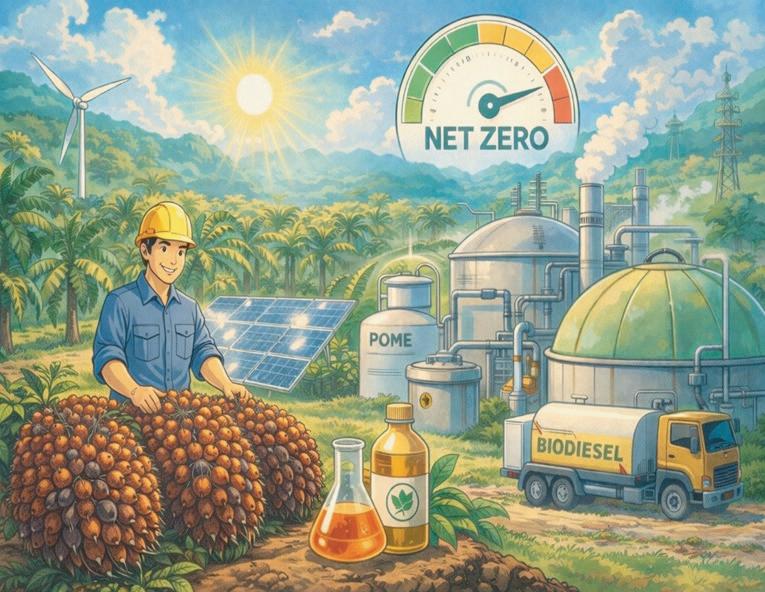
Malaysian palm oil industry plays crucial role in achieving net zero targets
17 November 2025
Malaysia’s palm oil industry is emerging as a surprising climate champion, turning what was once agricultural waste into valuable resources that help curb greenhouse gas emissions and support the country’s long-term net-zero by 2050 ambitions. From empty fruit bunches and brous residues to palm oil mill e uent (POME), virtually every by-product from oil palm cultivation and processing is being repurposed into fertiliser, biogas and renewable energy, reducing both waste and emissions. is zero-waste model re ects true circular-economy principles while aligning with multiple United Nations Sustainable Development Goals, including clean energy and responsible production.
A major push behind this e ort is the Malaysian Sustainable Palm Oil (MSPO) certi cation, a mandatory national standard that now includes stricter environmental and social requirements, elevated transparency, and new tools such as a greenhouse gas (GHG) calculator to help producers track and cut emissions.
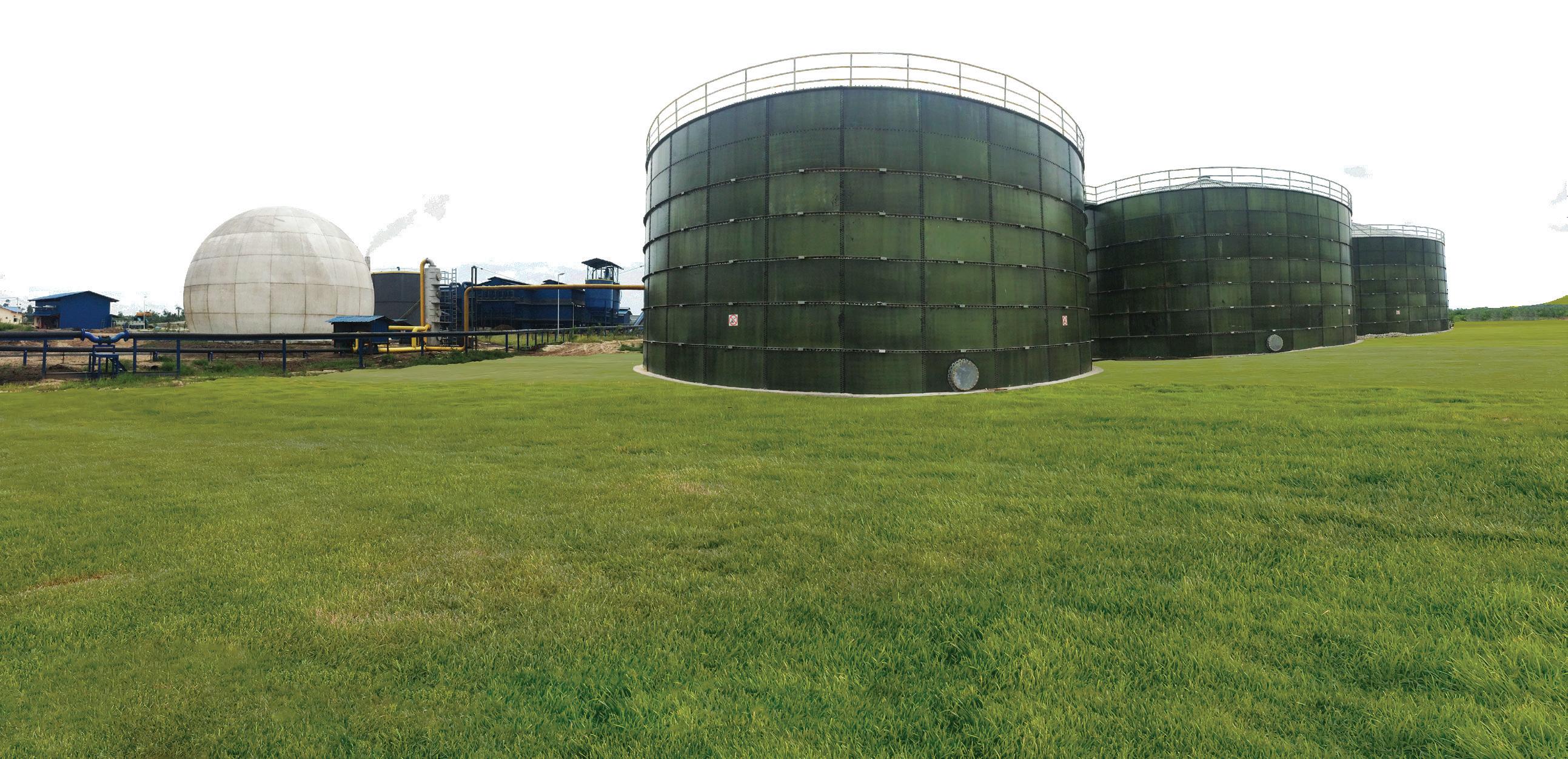
Industry players have embraced innovation across the value chain: capturing methane from POME to generate power, using biodiesel blends
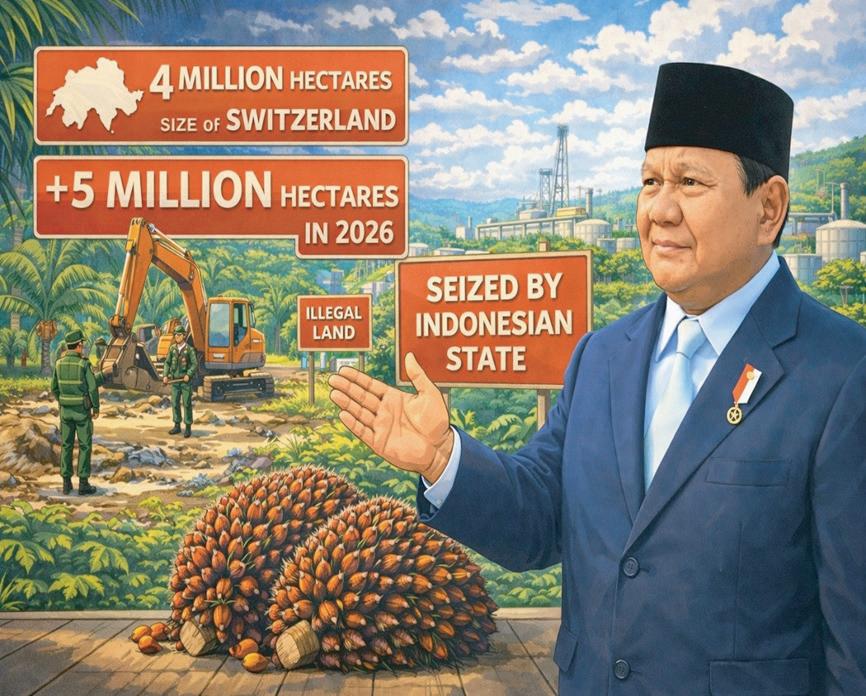
Indonesia may seize ve million hectares of illegal land this year
7 January 2026
In a sweeping move to tighten oversight of its vast natural-resource sectors, Indonesia has signalled plans to seize up to ve million hectares of land deemed illegally held - including oil palm plantations - as part of a broader crackdown on malfeasance in the commodities and mining industries. e announcement by President Prabowo Subianto comes amid an ongoing e ort to enforce the rule of law across plantations, mining concessions and processing facilities that authorities say have skirted legal land-use and licensing requirements.
So far, around four million hectares of land have already been reclaimed by the state, roughly equivalent to the size of Switzerland, with plans to at least double that footprint in 2026. A signi cant portion of these reclaimed areas includes palm oil estates, raising questions about how future production and investor con dence will be a ected in the world’s largest palm oil producing nation.
While government o cials emphasise that reclaiming illegal land is necessary to curb corruption and revenue leakage, traders and industry observers warn that such largescale action may dampen investment and cloud supply forecasts, particularly if smallholder-owned plantations are caught up in enforcement measures.
e unfolding land-seizure agenda re ects Indonesia’s broader challenge: balancing stronger governance with sustaining robust commodity sectors that feed global markets.
ailand’s Ministry of Commerce has implemented restrictions on palm oil exports to prioritise domestic supply amid a surge in biodiesel consumption. is policy shi is a direct response to West Asian geopolitical volatility, which has destabilised global energy markets and forced Bangkok to rely more heavily on palm-based fuels within its national energy mix.
e government aims to shield local re ners and consumers from supply shortages and price spikes by maintaining higher domestic reserves. O cials emphasised that energy security currently outweighs international trade commitments during this period of global uncertainty. While these restrictions secure ailand’s renewable energy strategy, industry analysts warn the move may further tighten regional palm oil markets, especially as neighbouring producers face similar pressures to balance domestic needs against global demand.
Export fall, weighed by lower shipments to the Middle East: cargo surveyor
20 April 2026
Malaysia’s palm oil exports fell sharply in the rst half of April, pressured by weaker demand from the Middle East and higher freight costs linked to the ongoing regional con ict.
According to cargo surveyor Intertek Testing Services (ITS), exports during 1-15 April totalled 580,018 tonnes, down 35.9% from 904,742 tonnes in the corresponding March period. e decline covered crude palm oil, processed palm products, palm kernel oil and oleochemicals.
e steepest fall was recorded in the Middle East, where shipments dropped by 114,650 tonnes to 11,550 tonnes. Exports to Egypt and Iran fell to zero, while volumes to the UAE declined signi cantly. Shipments to India and the subcontinent also weakened, falling to 107,500 tonnes from 177,600 tonnes.
Exports to Africa, China, Asia Oceania and the Americas also declined, although EU shipments were broadly stable, supported by stronger palm oil mill e uent exports.
Market sources said elevated palm oil prices and rising freight rates may continue to weigh on export demand, even as Malaysian production recovers seasonally in April.
MPOB Strengthens R&D To Shore Up Palm Oil Competitiveness Amid Geopolitical Uncertainty
15 April 2025
e Malaysian Palm Oil Board (MPOB) is intensifying its research and development (R&D) e orts to strengthen the competitiveness of the palm oil sector amid rising geopolitical uncertainty, particularly in West Asia.
MPOB director-general Datuk Dr Ahmad Parveez Ghulam said ongoing tensions have disrupted the global oils and fats market, reinforcing the need for a more strategic and science-driven industry approach. He noted that the MPOB Programme Advisory Committee (PAC) plays a critical role in aligning R&D priorities with evolving market conditions and industry requirements.
Speaking during the four-day MPOB PAC 2026 meeting in Kuala Lumpur, Ahmad Parveez said the board’s strategy spans the full palm oil value chain, with a focus on innovation, technology adoption and socio-economic impact.
Discussions also centred on strengthening Malaysia’s palm oil industry under the National Agricommodity Policy 2021-2030 (DAKN2030). Key initiatives include mandatory Malaysian Sustainable Palm Oil (MSPO 2.0) certi cation, RM171 million allocated for smallholder replanting programmes, development of sustainable aviation fuel, and wider deployment of automation technologies such as arti cial intelligence and drones.
Malaysia plans phased expansion of biodiesel programme, minister says
7 April 2025
Malaysia plans to expand its palm-based biodiesel programme nationwide in phases as higher crude oil prices revive interest in alternative fuels and stronger domestic palm oil consumption.
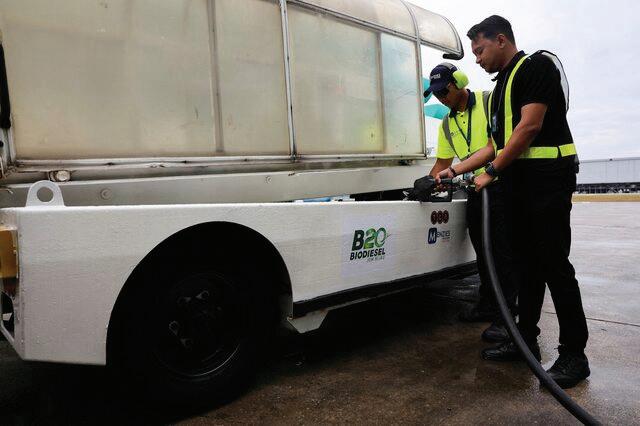
Plantation and Commodities Minister Noraini Ahmad said the government remains committed to gradually increasing biodiesel blending rates beyond the current nationwide B10 mandate for the transport sector. Malaysia has already implemented B20 biodiesel in Labuan, Langkawi and most parts of Sarawak.
“ ere is still signi cant room to support an increase in the national biodiesel blend from B10 to B20 and B30,” Noraini told Reuters.
e renewed push follows surging crude oil prices linked to the Iran con ict and disruptions to shipping through the Strait of Hormuz. Higher energy prices have strengthened the economic case for biodiesel adoption, although o cials remain mindful of palm oil’s price competitiveness against petroleum-based fuels.
Malaysia produced 975,207 tonnes of biodiesel in 2025, well below installed capacity of 2.36 million tonnes. e government is prioritising upgrades to blending depot infrastructure, with phased projects planned in Sandakan, Tawau, Sepanggar and Bintulu to support future B20 and B30 implementation.
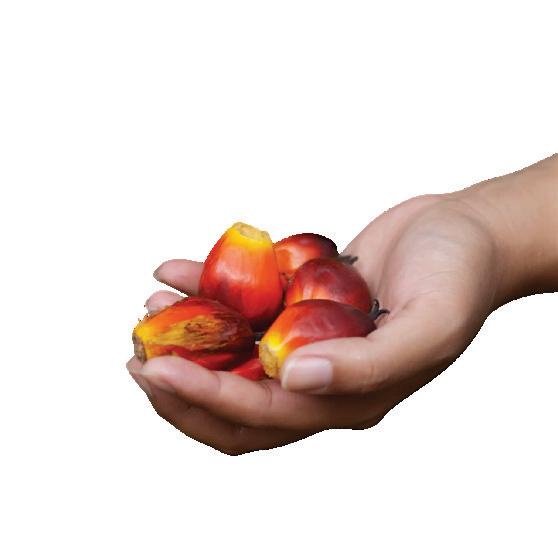
From Nutrient-Rich Oil to Beauty Active: Red Palm Oil in Skincare
and Hair
Care
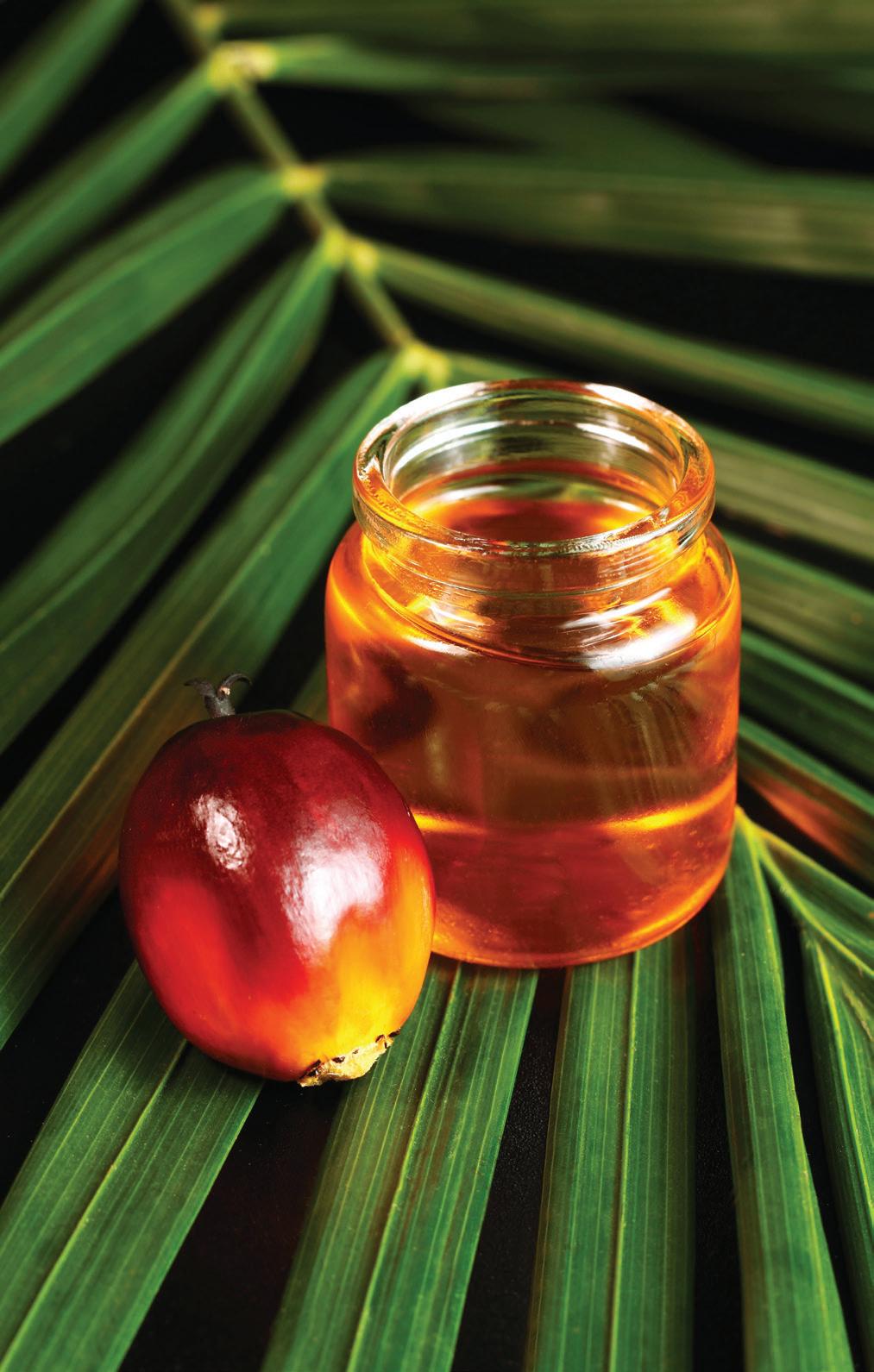
As the global beauty industry pivots toward "clean label" and bio-based ingredients, RPO is emerging as a powerhouse raw material for the personal care sector.
For downstream players and re ners, the shi from food-grade to cosmeceutical-grade RPO represents a high-value diversi cation opportunity.
e "Superfood" for Skin: Why RPO?
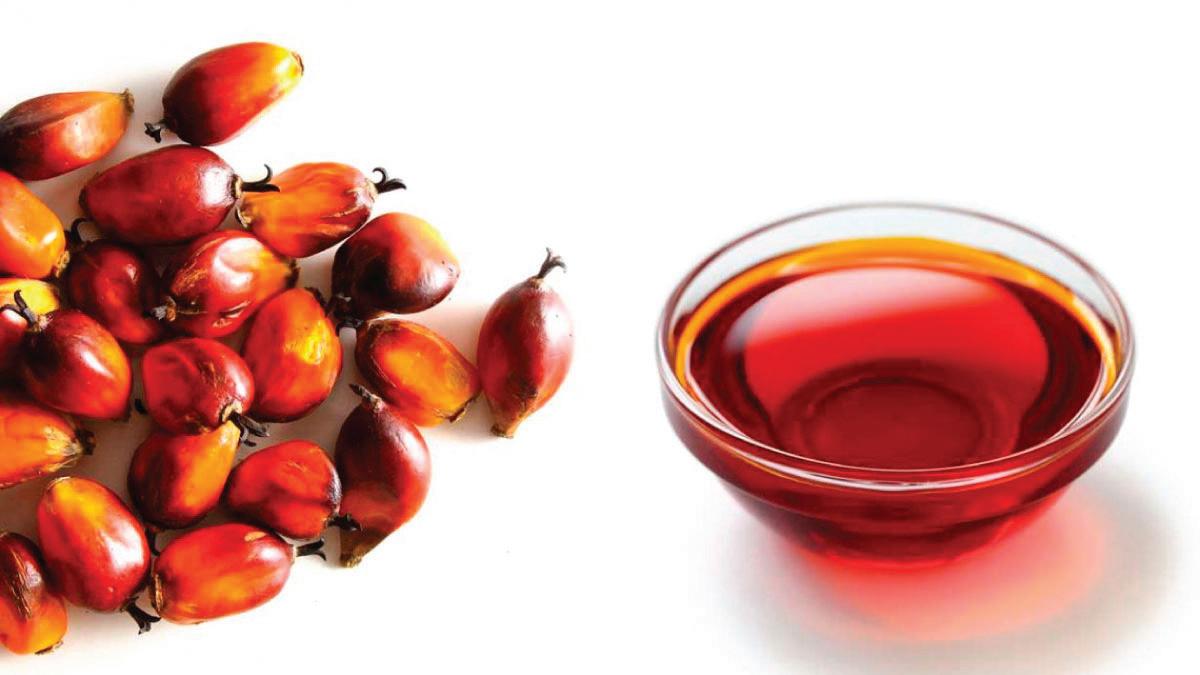
e secret to RPO’s e cacy in skincare lies in its unre ned bioactive pro le. Unlike RBD palm oil, RPO retains its high concentration of phytonutrients that o er functional performance beyond simple moisturisation.
e Antioxidant "Gold Standard"
RPO is nature's richest source of Carotenoids (Beta-carotene and Lycopene) and Tocotrienols (a potent form of Vitamin E). In skincare, these compounds act as a biological shield, neutralising free radicals caused by UV exposure and pollution.
Revitalising Hair Care
Anti-Ageing & Collagen Support
RPO contains Coenzyme Q10 (CoQ10), a natural enzyme that declines with age. When applied topically, CoQ10 helps maintain skin elasticity and supports collagen integrity, making RPO an ideal base for anti-ageing serums.
Barrier Repair
With a balanced fatty acid pro le including Oleic and Myristic acids, RPO mimics the skin’s natural lipid barrier. is helps reduce Transepidermal Water Loss (TEWL), providing relief for dry or sensitive skin conditions like eczema.
e downstream application of RPO extends signi cantly into hair and scalp treatments. e industry is seeing a rise in "scalp- rst" beauty routines where RPO serves as a key functional ingredient:
• Follicle Forti cation: e high Vitamin A (via Carotenoids) content supports sebum production, the body’s natural hair conditioner, which prevents brittleness and breakage.
• UV Protection for Hair: Just as it protects the skin, the pigment-rich oil provides a natural layer of protection for hair strands against environmental stressors and oxidative damage.
• Refatting Agent: In shampoos, RPO acts as a "refatting agent," restoring the natural oils that chemical surfactants o en strip away, leaving hair so and manageable.
e global sustainable palm oil market is projected to reach $1.14 billion in 2026. For re ners, producing high-quality RPO for the cosmetics industry requires precise control over degumming and acid removal to maintain the oil's signature red hue and nutrient density without the "earthy" odour o en associated with crude oil.
As consumers demand transparency and plant-based alternatives to synthetic petrolatum, Red Palm Oil stands ready to move from the kitchen pantry to the premium vanity, o ering the industry a sustainable, high-margin pathway for downstream expansion.
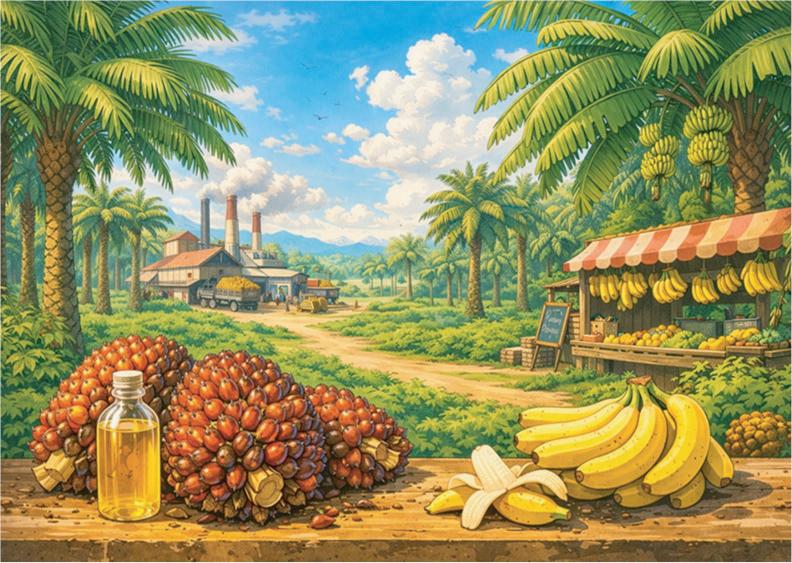
e Banana Test: Why Palm Oil Quality Is Really Common Sense
By Joseph Tek Choon Yee
If we judged palm oil the way we judge bananas, many of our arguments about quality would collapse instantly. ere would be fewer spreadsheets, fewer acronyms, and far fewer excuses. We would simply ask what every shopper already knows how to ask: Is this damaged? Is this fresh? Would I eat it?
Instead, we o en do the opposite. We hide behind technical terms, contract clauses and laboratory numbers, and then wonder why the buyers and sellers remains unconvinced. Perhaps the problem is not the science. Perhaps it is how we choose to explain it.
I have long believed that if we cannot explain palm oil quality without intimidating people, then perhaps we do not understand it well enough ourselves. For years, I have wanted to unpack this subject in a way that does not require a chemistry degree, an engineering background, or a tolerance for alphabet soup.
is essay is my attempt to do just that - by abandoning the laboratory bench and heading somewhere far more familiar. e fruit stall.
e inspiration comes from a quietly brilliant booklet written nearly two decades ago by respected chemical engineer Ir. Ng Say Bock, published by the Malaysian Palm Oil Council (MPOC). Its genius lay not in technical bravado, but in restraint. It dared to explain palm oil quality using bananas - an everyday fruit with no patience for spin. Bananas do not negotiate. ey simply tell the truth, sometimes rudely.
e timing of that work mattered. In 2004, Malaysia introduced a new quality parameter into crude palm oil contracts: the Deterioration of Bleachability Index, or DOBI. No, not a detergent - though many reacted as if it were. e addition was technically sound and commercially necessary.
Yet something curious happened. As quality standards improved, public understanding did not keep pace. e language of quality dri ed further away from common sense, even as its importance grew.
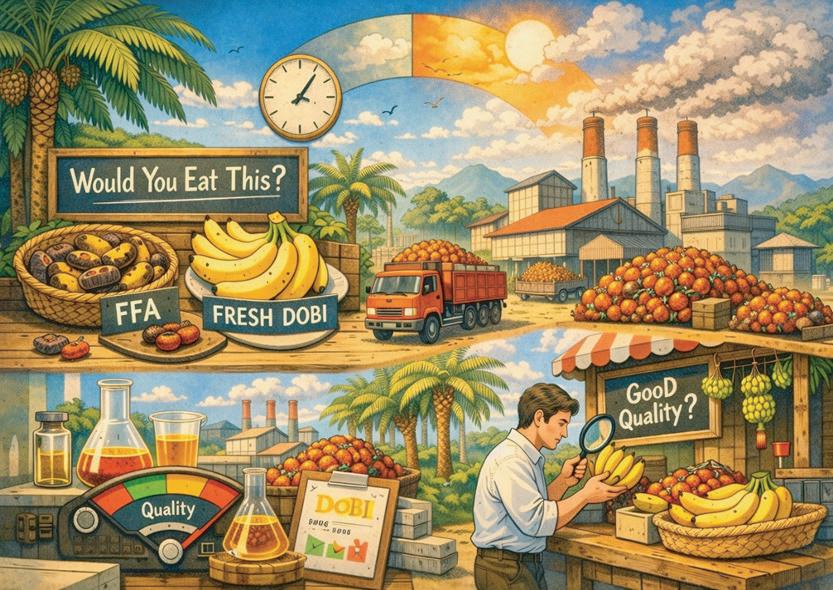
Alongside DOBI came familiar companions: free fatty acids (FFA) and the famously elastic phrase good merchantable quality. ree ideas, endlessly discussed, rarely understood, o en nodded at politely.
e result was a widening gap between those who harvest the fruit bunches, those who process into oil and those who debate it, and between those who know quality instinctively and those who manage it contractually.
at gap matters.
Knowledge, like fruit, does not keep well when le unattended. Each year brings a new generation - Gen Y, Gen Z now the Alphas - curious, sceptical, digitally uent, and impatient with explanations that sound like evasion. If we do not explain palm oil quality clearly, others will explain it poorly on our behalf. And they will not be kind.
So let us simplify - without dumbing down.
Each fruitlet is a banana. Each bruise counts. Each hour matters.
Suddenly, palm oil quality stops being abstract. It becomes visual. Instinctive. Almost edible.
Most of us are accidental experts on bananas. We may not know their scienti c names, but put us in front of a fruit stall and we transform into quality inspectors. We squeeze gently. We tilt our heads. We reject fruit that looks like it has lived a little too hard. A bruised banana? No thanks. A tired one? Maybe - but only if it is heading for fritters.
Quality, for bananas, is obvious.
Palm oil, however, has no peel to betray its past. Once extracted, it looks innocent whether it came from carefully handled fruit or from fruit that endured one insult too many. No freckles. No smell that whispers, I was delayed. Just golden silence. Palm oil is polite that way—it never tells on itself.
at is why the industry invented measurements.
Start with damage.
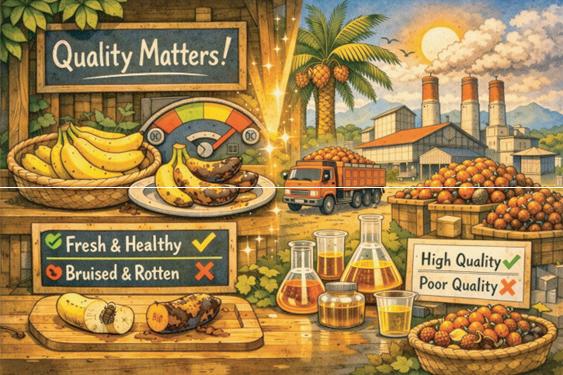
A banana bruises easily. Drop it. Spike it. row it. Stack it too high. Leave it too long under the sun. You can almost hear its internal clock accelerate. e esh so ens, sugars break down, and decay sets in quietly. Palm fruit behaves in exactly the same way. Damage and delay trigger chemical reactions long before the fruit reaches the mill.
Imagine an oil-palm fruit bunch as a bunch of bananas.
In palm oil, this deterioration shows up as free fatty acids.
Perfection, of course, is unrealistic. No harvest is gentle from start to nish. So the industry draws a pragmatic line. In contracts, the acceptable upper limit is FFA below ve per cent. Translate that back to bananas: out of one hundred, no more than ve may be damaged. Not ideal - but acceptable. Beyond that, quality slips, prices adjust, and complaints begin to ripen. Quite literally.
Here is the rst hard truth bananas teach without mercy: damage is irreversible. You can mix bruised bananas with pristine ones to improve appearances, but the bruised bananas remain bruised. No amount of blending, optimism or creative accounting can turn bad fruit good. Quality, once lost, does not come back. ere are no refunds from chemistry. en comes freshness - the quieter sibling of damage.
A banana can be intact yet tired. No bruises, no visible aws, just a sense that it has lingered too long. Freshness is not about injury; it is about time. Palm fruit, once cut, enters a silent race against the clock. Delays in collection, transport, queuing or storage all age the fruit invisibly. e oil remembers, even if we pretend not to.
is is where DOBI enters the story.
In banana terms, DOBI is simply a freshness score. ink of a scale from one to four. At one end sits the banana that has overstayed its welcome. At the other, the bright, just-right fruit that belongs proudly on the breakfast table. Somewhere in between lies the industry’s comfort zone - fresh enough to be respectable, not so fresh as to be mythical.
DOBI captures how quickly and carefully fruit moves from harvest to processing. And bananas, once again, deliver the lesson cleanly: waiting never improves freshness. No one has ever walked past a fruit stall and said, I’ll come back in three days - it should be better then.
Most freshness loss does not come from dramatic mishaps, but from ordinary routines. Fruit bunches falls. Some are nicked. Some are le behind in elds. Loose fruit is scraped up with debris. Tractors rumble. Lorries queue. Mills get busy. Concrete platforms do their quiet but unforgiving work. Every extra handling step ages the fruit bunches. Every extra hour adds another wrinkle to the banana’s skin.
is is why quality is born - or broken - long before the laboratory ever sees a sample.
And then there is taste.
Anyone who eats bananas knows that not all bananas taste alike. Pisang Emas has its charm. Pisang Berangan has its loyal following. You cannot argue one into becoming the other by slicing it more carefully. Variety matters.
Palm oil, too, carries the ngerprint of its planting material. Some qualities are genetic. Once planted, they are largely xed. Processing can preserve quality, but it cannot rewrite the fruit’s nature. When buyers complain that the “banana doesn’t taste right”, they are o en reacting to expectations buried in ne print - what the trade politely calls good merchantable quality. It is less about defects and more about t for purpose.
Markets, of course, are practical creatures. Not every banana is meant for the fruit bowl. Some are eaten fresh, others are sliced into fritters, baked into cakes, or dried into chips. Each use has its own tolerance for ripeness, texture and appearance. A slightly speckled banana may be useless to a picky shopper but perfect for baking. e key is honesty about what it is best suited for.
Palm oil works in exactly the same way. Oil produced from very fresh fruit, with low free fatty acids and good bleachability, is prized for food applications that demand stability, taste and appearance - cooking oils, margarine and re ned food products. Oil that has aged a little, while still safe and functional, may be better suited for uses where avour and colour are less critical, such as oleochemicals, soaps, detergents, candles, lubricants or bio-based industrial products. Each quality has a place; each place has its standards.
Problems arise only when this natural sorting is ignored. When bruised bananas are polished and sold as premium fruit, trust is broken. When tired fruit is quietly recycled into applications that demand freshness, problems surface downstream - higher re ning losses, higher costs, and reputational damage that travels faster than any supply chain.
Palm oil quality is not mysterious. It is bruises and freshness. Time and care. Honesty and restraint. And perhaps the simplest rule of all - one that needs no contract or laboratory to understand:
If you would not eat that banana, do not expect the market to swallow that oil.
Sometimes, the clearest truths about the most complicated industries are revealed by the simplest fruit.
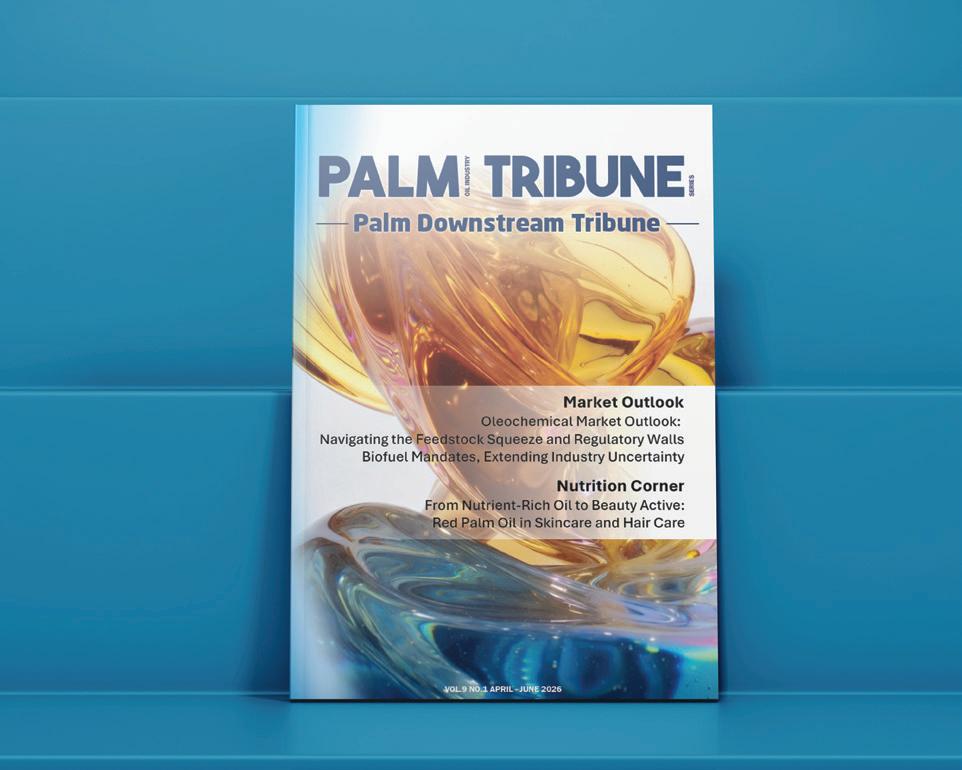
Oleochemical Market Outlook: Navigating the Feedstock Squeeze and Regulatory Walls
As global oleochemical capacity grows faster than market access, a critical question emerges: Where does the value go? e 2025–2026 horizon shows a sector under pressure. New capacity, combined with tightening global trade, is pushing volumes back into Asia. is is intensifying competition among producers and eroding margins, all while feedstock remains structurally tight and expensive.
Feedstock
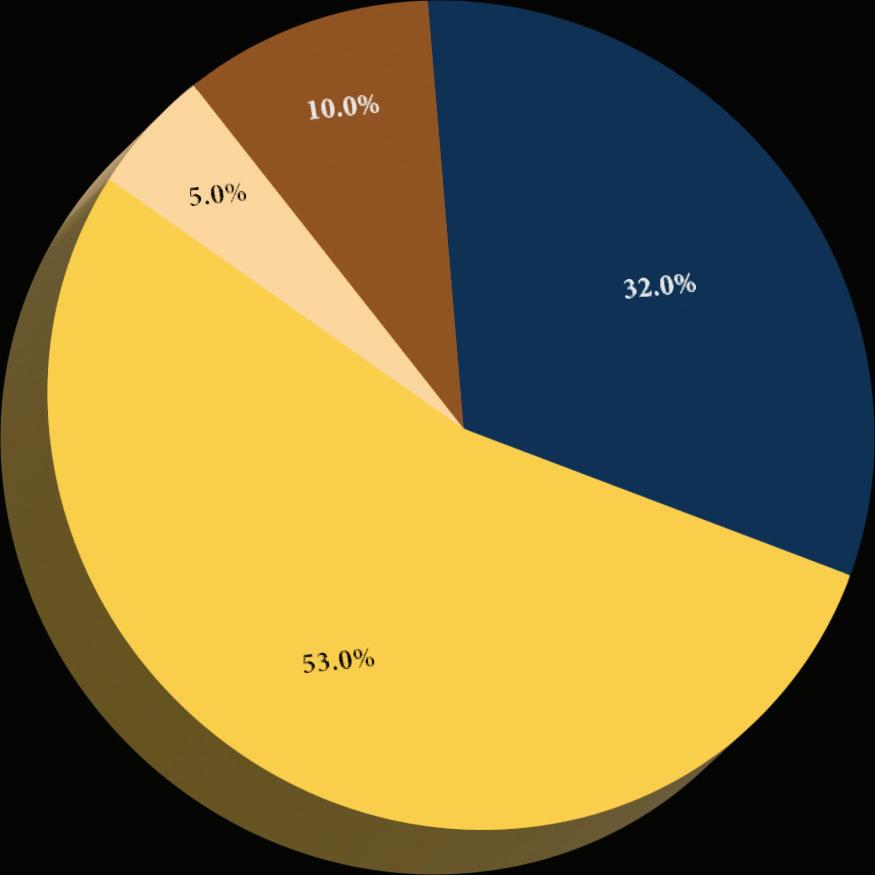
Despite being a "niche" compared to total vegetable oil production, the 14–15 million mT of triglycerides owing into fatty acids and alcohols represents a $26 billion global powerhouse in 2025.
While palm oil dominates the total vegetable oil pool (31%), the oleochemical sector is precariously dependent on Lauric Oils (PKO/CNO), which make up only 4.5% of total oils but drive 53% of fatty acid and alcohol production.
Access to animal fats (10% of feedstock) is being "cannibalised" by the skyrocketing demand for Sustainable Aviation Fuel (SAF).
Historically a substitute, Coconut Oil (CNO) is no longer cost-e ective compared to PKO. Its role has shi ed from a price-reliever to a compliance tool for EU-DR.
Capacity and Production - e Indonesia Power Play
Indonesia has e ectively "taxed" its way to global leadership. By utilising export levies to discourage the export of raw materials (CPS and CPKO), they have successfully forced the value-added to stay within their borders.
Indonesia now accounts for 36% of global fatty acid production (3.72M mT projected for 2026).
Meanwhile, high production costs and feedstock access issues are causing North America and Europe to lose ground, trending toward a permanent reliance on imports.
Samuel Chevigny, Director of Operations & Broker, HBI and Oleoline Group, at POC 2026
Regional Production Shi (2024–2026)
e world is witnessing a "hollowing out" of production in high-cost regions. While Indonesia, Malaysia, and China see growth, North America and Europe are in steady decline.
Margins and Market Forces
e world is witnessing a "hollowing out" of production in high-cost regions. While Indonesia, Malaysia, and China see growth, North America and Europe are in steady decline.
e world is witnessing a "hollowing out" of production in high-cost regions. While Indonesia, Malaysia, and China see growth, North America and Europe are in steady decline.
e world is witnessing a "hollowing out" of production in high-cost regions. While Indonesia, Malaysia, and China see growth, North America and Europe are in steady decline.
e Regulatory Barrier: EU-DR and ADD
e Anti-Dumping Duties (ADD) in Europe have largely failed to protect local industry, instead shi ing trade routes from Indonesia to Malaysia and increasing domestic costs. is has accelerated the relocation of production facilities outside the EU. Compounding this is the EU-DR deadline in December 2026, which requires 1.3 million metric tons of oleochemicals to be compliant. e industry is now racing to navigate the complexities of "Mass Balance" tracking and the structural shortage of certi ed PKO, turning regulatory compliance into a critical supply chain challenge..
2026 Outlook
Sourcing is no longer a procurement task; it’s the primary competitive advantage.
1 2 3 4
Feedstock is King Commoditisation of Specialty
e MCT (Medium Chain Triglycerides) market is losing its premium as C810 supply lengthens.
e "Upstream" Capture Application Split
As producers struggle with overcapacity, the ultimate value is migrating back into the hands of the palm and PKO sellers.
Demand remains robust in Food and Personal Care (HPC) but is stagnant in industrial/technical sectors.
If I were at POC 2026 –Reading the pulse
By Joseph Tek Choon Yee
is year, I am not seated in the conference hall. Instead, I am having my morning co ees in Kota Kinabaluwatching the South China Sea roll in, scrolling through messages, reading updates and ipping through PDFs from Bursa Malaysia Derivatives’ 37th Palm & Lauric Oils Price Outlook Conference & Exhibition 2026 (POC2026), monitoring developments from afar.
I miss the handshakes. I miss the corridor debates. I miss the annual ritual of greeting old industry friends with familiar question: “So… what’s your number this year?”
But ‘Outlookitis’ does not require a conference badge. It merely requires curiosity— and a stable Internet connection.
I coined this term to describe that familiar seasonal condition in commodity markets as in POC 2026: heightened forecast sensitivity, enthusiastic band comparisons and a brief but contagious belief that decimal points possess prophetic authority.
For close to four decades, POC has been part economics, part reunion, part theatre. Experts take the stage armed with conviction curves and carefully calibrated caveats. is year, I remain slightly o stage - geographically distant, mentally present. Notebook open. Co ee steady. Opinion gently brewed.
Because outlook conferences are not merely about numbers. ey are theatre with footnotes.
Everyone projects certainty. Everyone inserts disclaimers or caveats. Many hedged. And palm oil performs somewhere in between.
If 2025 was palm oil at the gym, exing under bright lights, 2026 is palm oil at the clinic - checking its pulse, reviewing its diet and listening carefully to its cardiologists. Not weak. Not breathless. Just conscious of its age, appetite and exposure.
And so, to steady the narrative amid the annual forecast ballet, I anchor this iece around the three “M”s of POC 2026 —Mielke, McGill and Mistry — with GAPKI speaking for Indonesia, the world’s largest grower and the market’s gravitational centre.
eir projections do not always align perfectly, but in their intersections and divergences lie the true contours of 2026.
Indonesia: Growth – But Which Number?
Indonesia closed 2025 in formidable shape. Crude palm oil (CPO) and crude kernel oil (CPKO) outputs reached 51.98 and 4.93 million tonnes respectively. Exports rose 8.7% to 32.12 million tonnes and domestic consumption climbed 3.8% to 24.76 million tonnes, buoyed by the B40 biodiesel mandate. e palm was pumping. For 2026, however, the tempo moderates – though not everyone measures it the same way.
Dr Mohamad Fadhli Hassan representing GAPKI projects Indonesia’s CPO output to grow 2 to 3%; a noticeable easing from last year’s 8% surge. is is less a loss of momentum than a re ection of biology.
Ageing estates, a shared reality with Malaysia, are beginning to temper yields, while an estimated 800,000 hectares of replanted areas – inferred from 160 million seed sales n 2025 from Glenauk Economics – remain immature. ey promise tomorrow’s supply, but today they dilute the mature harvesting base. Agriculture thrives on paradox: plant today, harvest tomorrow, explain in between.
Yet omas Mielke of ISTA Mielke GmbH (Oil World) o ers a more cautious view. He projects Indonesia’s 2026 palm output falling to 48.80 million tonnes from 49.60 million tonnes in 2025, citing reduced investments and lower fertiliser application that may weigh on yields.
e divergence is less contradiction than complexity. GAPKI speaks speci cally of CPO output growth, while Mielke frames a broader palm production outlook incorporating investment and yield risks. In palm oil, as in markets, de nitions matter and uncertainty is part of the product. Complicating the outlook further are land seizures that could be seen at 1.2 million hectares a er the second phase as shared by Julian McGill of Glenauk Economics.
In the near term, accelerated harvesting may temporarily bolster volumes. But reduced fertiliser application and lighter estate upkeep rarely leave the system untouched; their consequences tend to surface later, o en in the second half. e precise magnitude remains uncertain - and in this industry, uncertainty is seldom evenly distributed. Palm oil does not respond kindly to being rushed, nor does it adapt seamlessly to administrative rearrangement.
Malaysia: From Record Peak to Measured Pace
Malaysia celebrated a record 20.28 million tonnes in 2025. Corks popped - cautiously, because planters rarely celebrate without glancing at next year’s weather chart.
For 2026, forecasts narrow convincingly. Mielke places Malaysian output at 19.87 million tonnes, while McGill estimates approximately 19.7 million tonnes. Di erent decimals, same direction: moderation. is is not collapse. It is recalibration.
Rainfall indicators suggest at production growth in parts of the year. Weather has been uneven, with drought and oods appearing almost simultaneously. Ageing palms and labour constraints remain structural realities. Stockpiles are comfortable, tempering upside exuberance while cushioning downside risks. Malaysia stands where it o en doesbetween optimism and inventory.
McGill adds nuance rather than drama. He expects palm oil prices to trade in the RM4,000 to Rm4,300 range in the rst half, potentially strengthening toward RM4,500 per tonne in the second half, as production growth slows and stockpiles decline gradually.
Malaysia’s output may ease to around 19.7 million tonnes, while Indonesia could see modest near- term gains supported by weather - before reduced fertiliser use and policy disruptions potentially temper momentum later.
His framework is cyclical, grounded in rainfall indices and historical production patterns. Where Mielke highlights structural shi s, McGill underscores rhythm. Palm oil does not lurch. It oscillates.
replanting re ected in seed sales, argued that recent ground developments may so en more cautious projections, while outlining speci c assumptions on seized acreage.
In commodity markets, disagreement rarely concerns reality itself - only how the numbers are referred and read. And that is healthy. Markets evolve through contested assumptions, not comfortable consensus.
Mavath R. Chandran, who steered the Palm & Major Oils Session with characteristic calm, o ered the audience a much-needed compass. In many ways, he could well have been the fourth “M” of the conference. With steady clarity, he distilled a day of projections into a coherent two-half roadmap for 2026outlining the key drivers, the risks and the potential plot twists capable of shi ing price trajectories. A er hours of decimal-point diplomacy, his synthesis was refreshingly grounded.
And if one searches for a “magic number” hidden within the CPO forecast bands, RM4,000 keeps quietly reappearing - like a price oor with frequent- yer status. Supported - but not spectacular.
Mielke projected Malaysian RBD palm olein prices at US$1,000 to 1,200 per tonne in the rst half of 2026, rming to US$1,100–1,350 in the second half, indicating a gradual upward bias as the year progresses. By comparison, GAPKI sees CPO prices trading between RM4,100 and RM4,400 in the rst half, easing slightly to RM4,000 to RM4,300 in the second half, as seasonal yields improve and competition from soybean and sun ower oils gathers momentum.
Layer onto that Mistry’s disciplined RM3,800 to RM4,300 trading band, and McGill’s expectation of rmer second-half pricing nudging toward RM4,500, and a coherent pattern begins to take shape. Taken together, the projections suggest rm pricing underpinned by structural support, though tempered by supply seasonality and inter-oil competition.
Prices remain elevated by historical standards. Yet they sit below the muscular highs of 2025. Firm - but not feverish. Palm oil, in this scenario, will oat respectably within its channel. It is unlikely to soar without a catalyst - most plausibly weather.
If I may venture a view, I would broadly concur with this composite outlook. at said, with a measured tilt toward optimism, I suspect the upper ends of those projected ranges may command more attention than the lower bounds. A er all, weather does not consult analysts before making its entrance. And in palm oil, the sky still holds voting rights.
Reading the Rhythm, Respecting the Cycle
Taken together, GAPKI and the 3Ms sketch a market de ned more by balance than bravado. Production growth moderates. Replanting reshapes acreage. Weather injects humility. Demand persists, though alternatives remain alert. Prices look buoyant yet restrained. Palm oil in 2026 is neither
at said, the compass at POC2026 was not held by the 3Ms alone. A broader constellation of voices added bearings - from Ryan Chen’s China lens to Rasheed Jan Mohammed’s Pakistan perspective, from Emily French’s clarity to Dr Sathia Varqa, Artem Hammerschmidt and Samuel Chevigny on laurics, biofuels and oleochemicals. e CEO Roundtable and certi cation discussions layered further complexity.
Power-packed is no exaggeration. It felt less like a conference and more like a live map of a global supply chain in motion. Palm oil - alongside other edible oils - is no longer merely priced in tonnes and ringgit. It is shaped by geopolitics, policy shi s, energy transitions and macroeconomic crosscurrents. It does not operate in isolation; it navigates an ecosystem.
Maturity and rhythm, then, are not about slowing down. ey are about navigating complexity without losing balance - knowing when to press forward and when to conserve.
From my co ee table in Kota Kinabalu - distant in geography, present in conversation - I am reminded that this industry has always rewarded patience over panic. Harvest too early and yield is sacri ced. Fertilise too little and tomorrow contracts. Price too high and demand migrates. Price
e youthful juggernaut has not lost its strength; it has gained restraint. Cycles turn. Weather shi s. Policies tighten. Palm oil recalibrates, endures
But the drama? at never yields.
12 - 13 9 - 11 FEB 10 - 12 FEB
Palm Oil Economic Review and Outlook Seminar (R&O) 2026
Berjaya Times Square Hotel, Kuala Lumpur, MY
37th Palm & Lauric Oils Price Outlook Conference & Exhibition (POC2026) TBC, Kuala Lumpur, MY
3rd International Simposium Ganoderma (ISGANO) 2026
Adimulia Hotel Medan, Sumatera Utara, INA
17 - 19 APR
Pakar Pertanian Expo (PPE) MAEPS Serdang, Selangor, MY
22 - 23 APR 6 - 7 MAY 14 - 16 MAY
2nd HaiSawit Symposium (HASI) 2026
Hotel Bidakarta Jakarta, INA
25 - 27 JUN
4th AgTech International Agro Expo
23 - 24 APR
International Palm Oil Millers Conference (IPOMC) 2026
Royale Chulan KL, MY
16th PALMEX Indonesia 2026
Hall A1 & A2, Jakarta International Expo (JIEXPO), Kemayoran, INA
4th AgTech International Agro Expo
Perda Convention Centre, Penang, MY
Setia City Convention Centre, Selangor, MY 7 - 9 JUL 13 - 15 JUL 28 - 30 JUL
4th Technology & Talent Palm Oil Mill Indonesia (T-POMI)
Holiday Inn Bandung Pasteur, West Java, INA
6 - 7 AUG
Asia Palm Oil Conference (APOC) 2026 | 15th PALMEX Thailand
CO-OP Exhibition Centre, Suratthani, THA
13 - 14 OCT
Oils & Fats International Congress 2026 (OFIC 2026)
Kuala Lumpur Convention Center, KL, MY
11th International Planters Conference (IPC) Royale Chulan Kuala Lumpur, MY
12th Indonesia International Palm Oil Machinery & Processing Technology Exhibition (INAPALM Asia)
Jakarta International Expo (JIEXPO) Kemayoran, INA
6 - 8 AUG 10 - 12 SEP 6 - 8 OCT
4th Sawit Indonesia Expo (SIEXPO) 2026
Pekanbaru Convention & Exhibition, Riau, INA
9th Malaysia International Agriculture Technology Exhibition (Agri Malaysia)
Malaysia International Trade & Exhibition Centre (MITEC), KL, MY