Wonder of the Age
Master Painters of i ndia
1100–1900
Wonder of the Age
Master Painters of i ndia 1100–1900
John Guy and Jorrit Britschgi
This vividly illustrated publication features 110 works by many of the most eminent painters in the history of Indian art. These remarkable paintings, dating from 1100 to 1900, were selected according to identifiable artists, and they refute the long-held view of anonymous authorship in Indian art.
Traditionally, Indian paintings have been classified by regional styles or dynastic periods, with an emphasis on subject matter. Stressing the combined tools of connoisseurship and inscriptional evidence, the pioneering research reflected in this book has identified individual artists and their oeuvres through the analysis of style.
The introductory essay outlines the origins of early Indian painting of the first millennium, which set the scene for the development of the art of the book. The sections that follow examine manuscript painting as it evolved from palm-leaf to paper, the emergence of traditional painting as an independent art form, and its demise with the coming of photography.
Biographies of the artists whose works appear in this volume and a glossary of their major literary sources provide valuable context.
224 pages; 165 illustrations, including 155 in full color; 3 maps; glossary of literary sources; bibliography; index
Wonder of the Age
Master Painters of i ndia
1100–1900
Wonder of the Age
Master Painters of i ndia
1100–1900
John Guy and Jorrit Britschgi
The Metropolitan Museum of Art, New York in association with Mapin Publishing, Ahmedabad
This catalogue is published in conjunction with “Wonder of the Age: Master Painters of India, 1 100 – 1900,” on view at The Metropolitan Museum of Art, New York, from September 28, 201 1, through January 8, 201 2.
The exhibition is made possible by
Additional support provided by Novartis Corporation.
The exhibition was organized by the Museum Rietberg Zurich in collaboration with The Metropolitan Museum of Art, New York.
This catalogue is published in conjunction with “Wonder of the Age: Master Painters of India, 1 100 – 1900,” on view at The Metropolitan Museum of Art, New York, from September 28, 201 1, through January 8, 201 2.
Published by The Metropolitan Museum of Art, New York
Mark Polizzotti, Publisher and Editor in Chief
The exhibition is made possible by
Gwen Roginsky, Associate Publisher and General Manager of Publications
Peter Antony, Chief Production Manager
Additional support provided by Novartis Corporation.
Michael Sittenfeld, Managing Editor
Robert Weisberg, Assistant Managing Editor
The exhibition was organized by the Museum Rietberg Zurich in collaboration with The Metropolitan Museum of Art, New York.
Edited by Barbara Cavaliere
This catalogue is published in conjunction with “Wonder of the Age: Master Painters of India, 1100 – 1900,” on view at The Metropolitan Museum of Art, New York, from September 28, 2011, through January 8, 2012.
The exhibition is made possible by
Copyright © 2011 by The Metropolitan Museum of Art, New York
Additional support provided by Novartis Corporation.
All rights reserved. No part of this publication may be reproduced or transmitted in any form or by any means, electronic or mechanical, including photocopying, recording, or any information storage and retrieval system, without permission in writing from the publishers.
The exhibition was organized by the Museum Rietberg Zurich in collaboration with The Metropolitan Museum of Art, New York.
The Metropolitan Museum of Art
Published by The Metropolitan Museum of Art, New York
1000 Fifth Avenue
Mark Polizzotti, Publisher and Editor in Chief
New York, New York 10028 metmuseum.org
Gwen Roginsky, Associate Publisher and General Manager of Publications
Copyright © 2011 by The Metropolitan Museum of Art, New York
Peter Antony, Chief Production Manager
Michael Sittenfeld, Managing Editor
Typeset in Fleischman and FF Bau
Robert Weisberg, Assistant Managing Editor
Printed on 150 gsm Leykam Matt Classic
All rights reserved. No part of this publication may be reproduced or transmitted in any form or by any means, electronic or mechanical, including photocopying, recording, or any information storage and retrieval system, without permission in writing from the publishers.
Distributed Yale University yalebooks.com/art yalebooks.co.uk
Designed by Rita Jules, Miko McGinty Inc.
Published by The Metropolitan Museum of Art, New York
Mark Polizzotti, Publisher and Editor in Chief
Bonnie Laessig, Assistant Production Manager
First Published in India in 2011 by Mapin Publishing Pvt. Ltd 502, Paritosh, Near Darpana Academy, Usmanpura Riverside, Ahmedabad 380013 T: 91 79 4022 8228 F: 91 79 4022 8201
Gwen Roginsky, Associate Publisher and General Manager of Publications
Jane S. Tai, Image Acquisition Manager
Peter Antony, Chief Production Manager
Anandaroop Roy, Mapmaker
E: mapin@mapinpub.com www.mapinpub.com
Michael Sittenfeld, Managing Editor
Robert Weisberg, Assistant Managing Editor
isbn: 978-81-89995-60-7
Edited by Barbara Cavaliere
Designed by Rita Jules, Miko McGinty Inc.
Bonnie Laessig, Assistant Production Manager
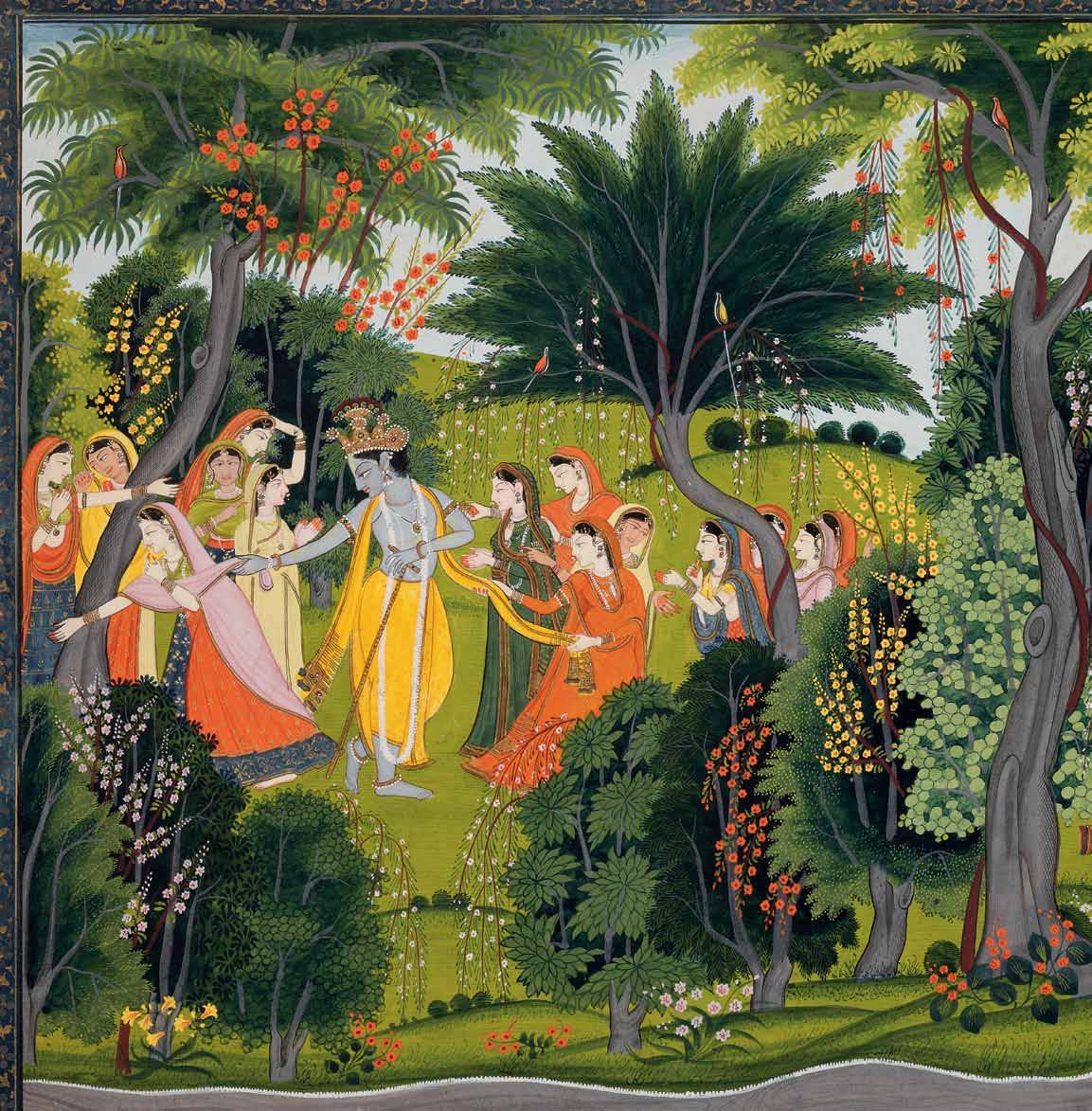
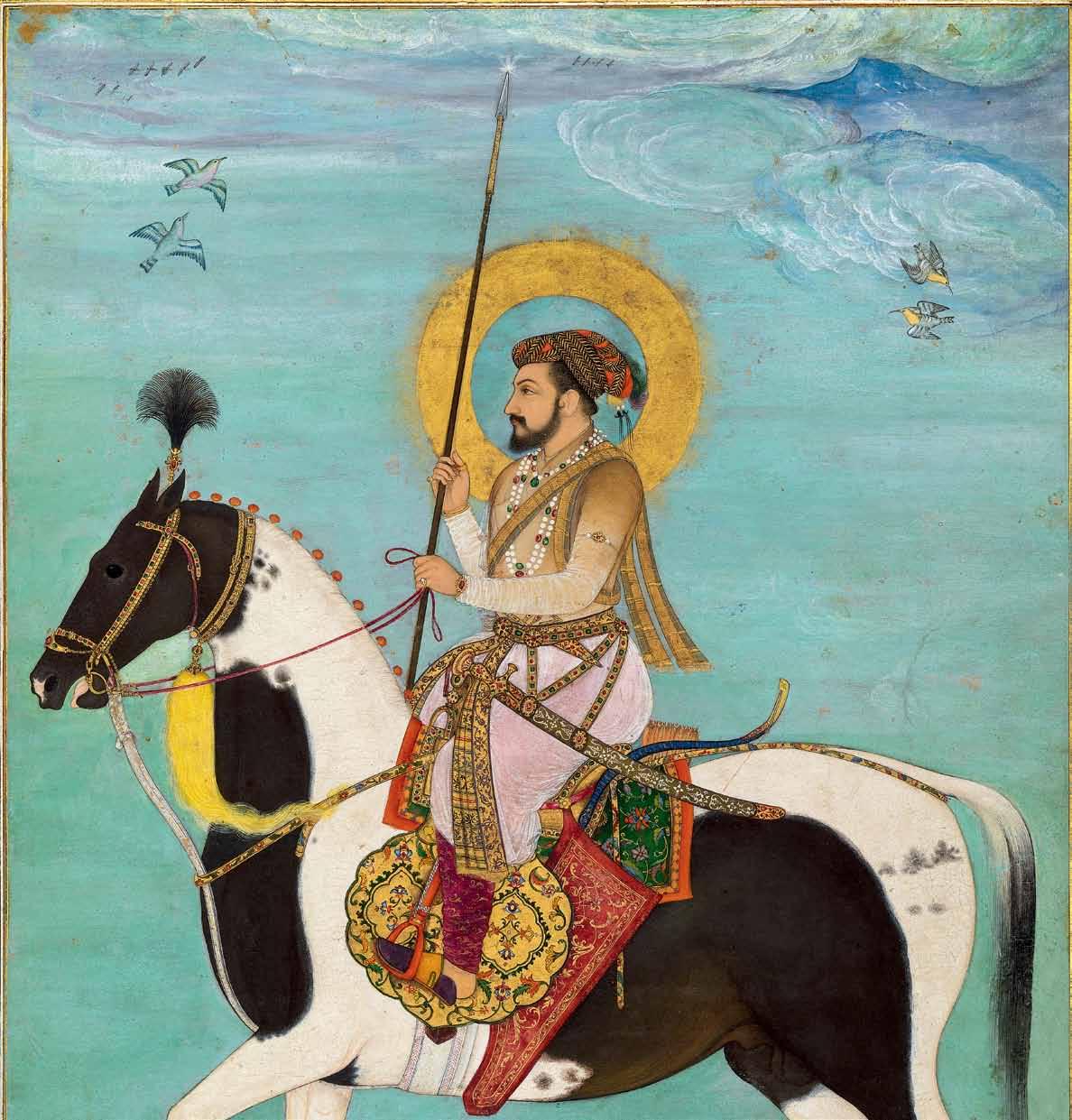
Jacket illustrations: (front) Shah Jahan riding a stallion: page from the Kevorkian Album, Mughal court at Agra, ca. 1628. Detail of No. 40; (back) Krishna flirting with the gopis to Radha’s sorrow: folio from a Gita Govinda series, Kangra, Himachal Pradesh, ca. 1760. Detail of No. 95
Jane S. Tai, Image Acquisition Manager Anandaroop Roy, Mapmaker
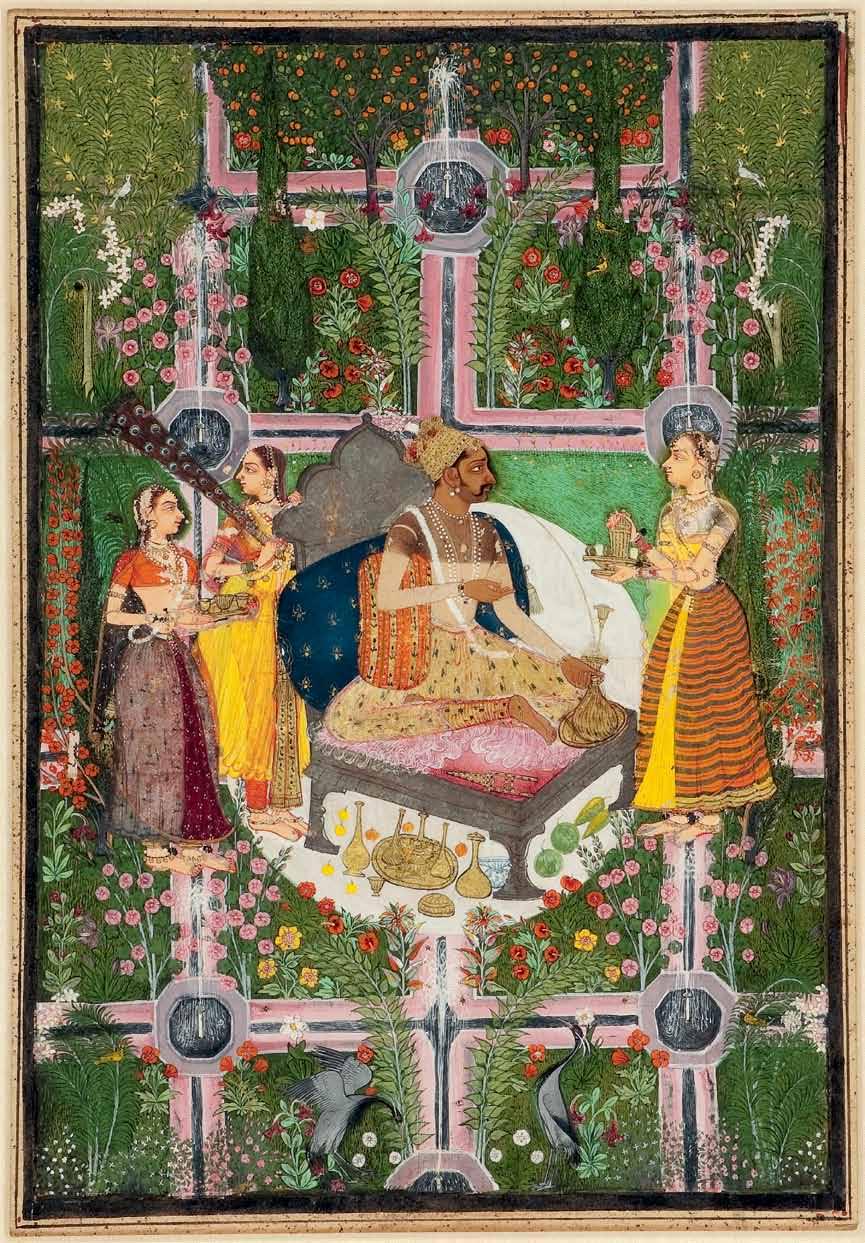
Frontispiece: Rao Jagat Singh of Kota at ease in a garden, Kota, Rajasthan, ca. 1660. No. 48
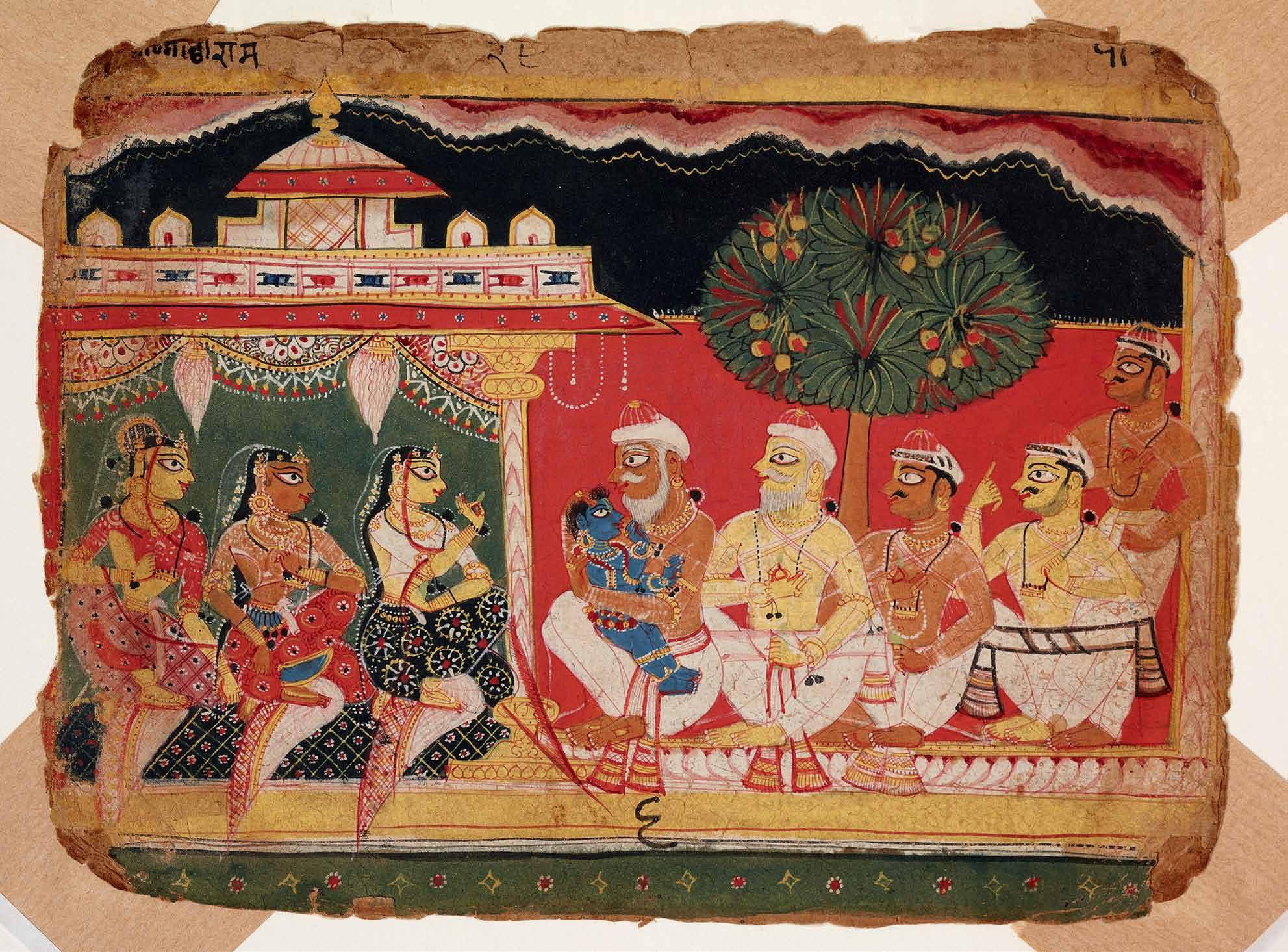
Page 14: Nanda touches Krishna’s head after the slaying of Putana: folio from a Bhagavata Purana manuscript, Delhi-Agra region, North India, ca 1540. Detail of No 7
Jacket illustrations: (front) Shah Jahan riding a stallion: page from the Kevorkian Album, Mughal court at Agra, ca. 1628. Detail of No. 40; (back) Krishna flirting with the gopis to Radha’s sorrow: folio from a Gita Govinda series, Kangra, Himachal Pradesh, ca. 1760. Detail of No. 95
Frontispiece: Rao Jagat Singh of Kota at ease in a garden, Kota, Rajasthan, ca. 1660. No. 48
Page 14: Nanda touches Krishna’s head after the slaying of Putana: folio from a Bhagavata Purana manuscript, Delhi-Agra region, North India, ca 1540. Detail of No 7
Separations by Professional Graphics, Inc., Rockford, Illinois
Edited by Barbara Cavaliere
Printed and bound by CS Graphics PTE LTD, Singapore
Designed by Rita Jules, Miko McGinty Inc.
The Metropolitan Museum of Art 1000 Fifth Avenue New York, New York 10028 metmuseum.org
Bonnie Laessig, Assistant Production Manager
Jane S. Tai, Image Acquisition Manager
Anandaroop Roy, Mapmaker
Typeset in Fleischman and FF Bau
Typeset in Fleischman and FF Bau
Printed on 150 gsm Leykam Matt Classic
Printed on 150 gsm Leykam Matt Classic
Separations by Professional Graphics, Inc., Rockford, Illinois
Separations by Professional Graphics, Inc., Rockford, Illinois
Printed and bound by CS Graphics PTE LTD, Singapore
Printed and bound by CS Graphics PTE LTD, Singapore
Jacket illustrations: (front) Shah Jahan riding a stallion: page from the Kevorkian Album, Mughal court at Agra, ca. 1628. Detail of No. 40; (back) Krishna flirting with the gopis to Radha’s sorrow: folio from a Gita Govinda series, Kangra, Himachal Pradesh, ca. 1760. Detail of No. 95
Frontispiece: Rao Jagat Singh of Kota at ease in a garden, Kota, Rajasthan, ca. 1660. No. 48
Page 14: Nanda touches Krishna’s head after the slaying of Putana: folio from a Bhagavata Purana manuscript, Delhi-Agra region, North India, ca. 1540. Detail of No. 7
Cataloging-in-Publication isBn 978-1-58839-430-9 isBn 978-0-300-17582-0
late M ughal P ainting and the renaissance 110 of the hindu courts , 1650–1730
JORRIT
Masters: Kripal, Devidasa, and Golu
at the Court of Mankot
Mughal a fterglow and the l ater c ourt s tyles 146 in the Pahari r egion and r ajasthan , 1730–1825
JORRIT
l ate i ndian c ourt Painting, c o MP any Painting, 186 and the c o M ing of Photogra P hy , 1825–1900
JORRIT BRITSCHGI
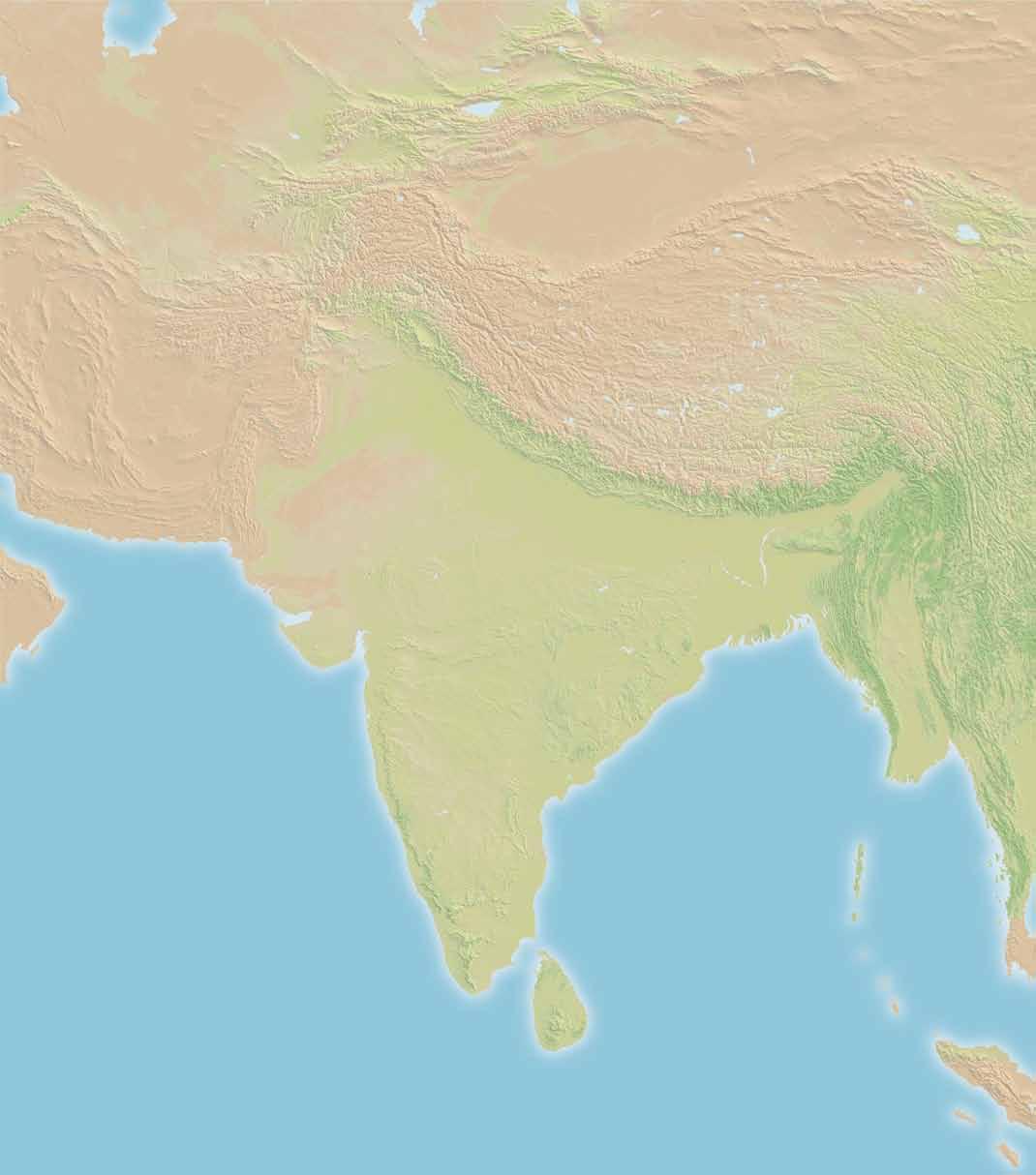
Maps appear on pages 16, 111, and 147.
director’s foreword
It is with great delight that The Metropolitan Museum of Art presents Wonder of the Age: Master Painters of India, 1100–1900. This publication and the exhibition it accompanies represent the collaboration between two museums and many scholars. The exhibition was conceived by three of the most eminent scholars in the field of Indian painting, Drs. Milo Beach, Eberhard Fischer, and B. N. Goswamy. Jorrit Britschgi, Curator of Indian Painting at the Museum Rietberg in Zurich, realized the exhibition in collaboration with John Guy, Florence and Herbert Irving Curator of the Arts of South and Southeast Asia at The Metropolitan Museum of Art, and they jointly prepared this publication.
This catalogue sets out to dispel the conventional view of Indian painting as an anonymous activity, akin to the practice of other crafts in traditional India, and asserts the critical role of named painters through the study of individual hands, filial relationships, and artists’ lineages. The forty identified artists in this publication were each seminal in shaping the development of Indian painting in their age. Some were celebrated in their time; others were assigned
identities later on the basis of an assembled corpus of works. Inscriptional evidence has been combined with the analytical tools of connoisseurship to define the authorship of many works. The sweep is broad, spanning the course of eight centuries, from the earliest surviving examples of the Indian art of the book in the twelfth century to the rise of photography in the nineteenth.
This publication provides a rare opportunity to study and savor works never brought together before, and acknowledgment is due to the many lenders who made this possible. Foremost, we are grateful to Her Majesty Queen Elizabeth II for her generous loans from The Royal Collection at Windsor Castle, and to the Government of India for sanctioning major loans from the nation’s collections.
We also extend our gratitude to MetLife Foundation for understanding the importance of such international collaborations and supporting the show so generously. In addition, the Metropolitan wishes to thank Novartis for its remarkable commitment to the project.
Thomas P. Campbell Director
The Metropolitan Museum of Art, New York
The forty eminent painters chosen for this exhibition are among the greatest in the history of Indian painting. Each could lay claim to the honorific titles bestowed by Mughal emper ors on their most prized painters: Nadir al-Asr, “ Wonder of the Age,” and Nadir al-Zaman, “Wonder of the Times.” These titles were awarded by the emperor Jahangir to his two favorite artists, Ustad (master) Mansur and Abu’l Hasan, respectively. Such spe cial recognition was in keeping with an Iranian tradition of award ing honorific titles to the most gifted artists of the day. Variants of these titles were awarded in the intense, somewhat hothouse atmosphere of the imperial Mughal workshops. Other eminent painters, such as Mir Sayyid ‘Ali, ‘Abd al-Samad, and Daswanth, were similarly esteemed, as was the famed Shiraz painter Khajah Abduccamad with the honorific Shirinqalam (Sweet Pen.)1 Abu’l Fazl, biographer of the emperor Akbar, wrote in the A’in-i Akbari:
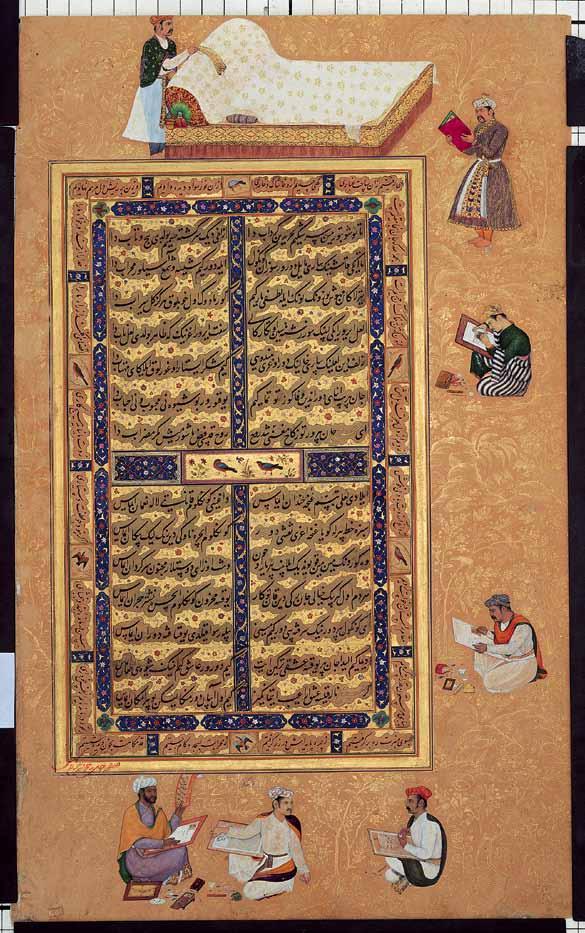
More than a hundred painters have become famous masters of the art, whilst the number of those who approach perfection, or those who are middling, is very large. . . . It would take too long to describe the excellence of each. My intention is “to pluck a flower from every meadow, an ear from every sheaf.” 2
Like Akbar, his son Jahangir boasted of his role as a guiding patron, nurturing his artists’ development. In the case of the master painter Abu’l Hasan, Jahangir recorded in his personal memoirs: “I have always considered it my duty to give him much patronage, and from his youth until now I have patronized him so that his work has reached the level it has.” 3 The signatures of the artists of course speak a very different language, reflecting the assumed humility required when addressing the emperor. They assume such epithets as “servant,” “least of the unworthy,” or “slave.” It is telling that in Abu’l Hasan’s Accession of Jahangir (No. 29),
he signed his work on the shovel used in cleaning up elephant dung as an expression of his humility. With few exceptions, the painters left no self-portraits. This makes the rare appearance of a self-portrait in imperial dardar (audience) scenes all the more remarkable, and it alludes to those artists, such as Payag and Balchand, as having a special relationship at court that allowed them to be admitted into the inner circle (No. 38).
The Rajput patrons were less effusive but nonetheless prized their finest painters. In the case of the Guler ruler Raja Balwant Singh and his court painter Nainsukh, the patron and artist clearly had a special relationship, as is witnessed by Raja Balwant Singh viewing a painting presented by the artist (No. 83). The appearance of artist’s portraits and especially self-portraits as early as the 1570s in Akbari studio circles marks a moment of change when painters were permitted to indulge in depicting themselves. Keshav Das’s remarkable self-portrait as the poor petitioner is a defining moment (No. 25).
This publication and the exhibition it accompanies challenge the conventional wisdom that extols the anonymity of Indian art, instead emphasizing how the combined tools of connoisseurship and inscriptional evidence can reveal the identities of both individual artists and their oeuvres through an analysis of style. The
f igure 1. Border illuminations with a self-portrait and portraits of the painters Govardhan and Bishandas (detail), by Daulat, ca. 1610. Golestan Palace Library, Tehran
igure 2.
f
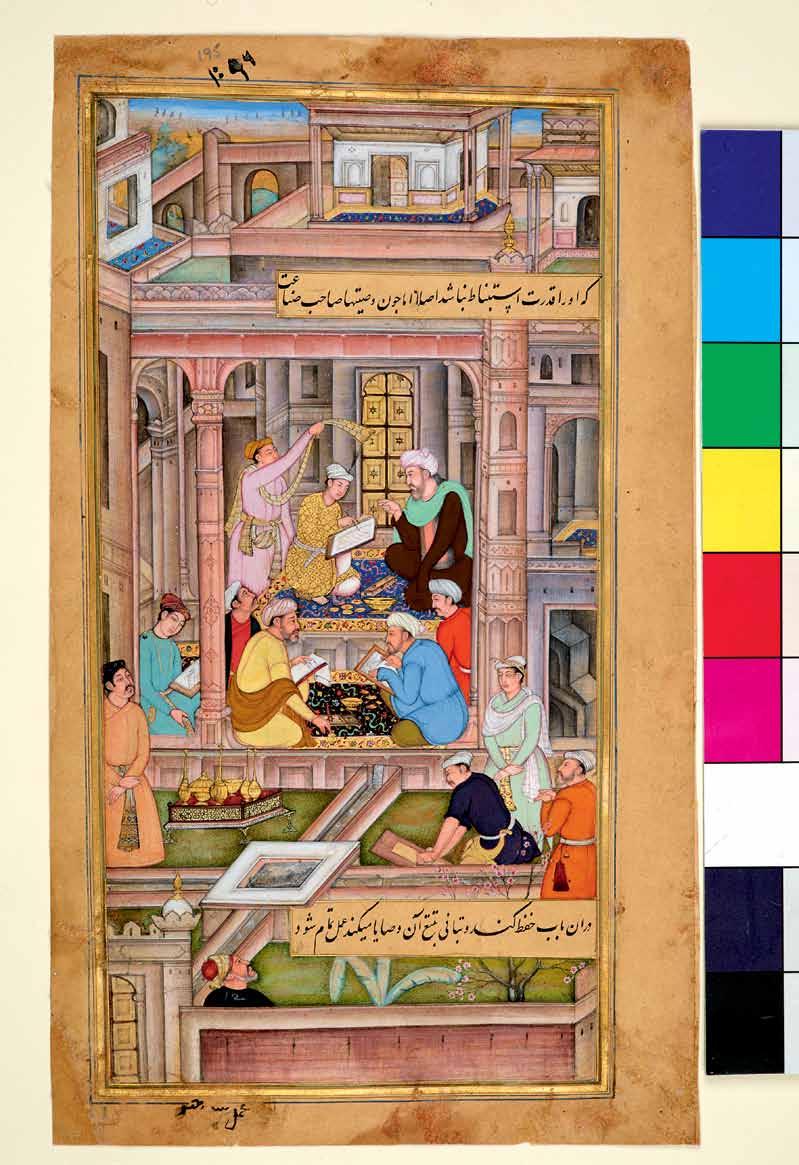
The Painters’ atelier (kitabkhana), from an Aklaq-i Nasri manuscript, attributed to Sajnu (or Sahu), ca. 1590–95. Aga Khan Trust for Culture, Aga Khan Museum Collection, Geneva
tified master painters comprises a transforming moment in the evolution of Indian painting. Scholarly research in recent decades has fundamentally changed our understanding of the paintings of India. The names of dozens of artists have been recovered; pictorial styles have been analyzed; contemporary references to the works have been evaluated; and literary sources, including palace archives and accounts, pilgrimage and land registers, have been combed for mention of artists. Today, we no longer think of Indian painters as anonymous craftsmen but as identifiable individuals working within an atelier or in a contractual relationship with a patron. One striking aspect of these studies has been the recognition of filial relationships between known artists. A surprising number of those presented here are related father and son or brothers who followed their father’s profession. When this relationship is recognized, it is usually readily detectable in the work. For example, the imperial Mughal painters ‘Abid and Abu’l Hasan, Balchand
and Payag, the Pahari Hill painters Manaku and Nainsukh, and Shivalal and Mohanlal of Mewar were pairs of brothers, and Aqa Riza, Basawan, Bagta, and Tara were fathers whose sons followed in their profession. When Abu’l Hasan signed an early work, he displayed due humility to his father, Aqa Riza, by adding after his name the phrase “dust of the threshold of Riza.” 4 Such lineages were a source of pride, as Nainsukh’s entry in a pilgrim’s register reveals: “Written by Naina [Nainsukh], carpenter-painter, native of Guler. Son of Seu. Grandson of Hasnu. Great-grandson of Bharathu. Great-great-grandson of Data.” 5
For the vast majority of artists, no biographical information has come down to us, but at least we have patrons’ observations in the case of the most distinguished Mughal artists, scribal notations from attentive librarians who assigned artists’ names to works, or a note by some archivist who inventoried his prince’s picture holdings, linking the works to a named patron. Only rarely is one fortunate enough to discover an artist’s portrait or self-portrait (Fig. 1). Nor did painters routinely sign their work. The absence of signatures on the majority of Indian paintings forces one to question the artists’ social position and self-image. As B. N. Goswamy among others has suggested, the painters’ relative anonymity also had to do with the fact that they saw themselves as part of a crafts tradition that drew from a common pool of pictorial ideas and established iconographies, and therefore considered it inappropriate to identify themselves as a picture’s creator. It was in the context of secular painting, such as much of the work undertaken for Mughal patrons, that the desire for recognition was first permitted to surface (Fig. 2).
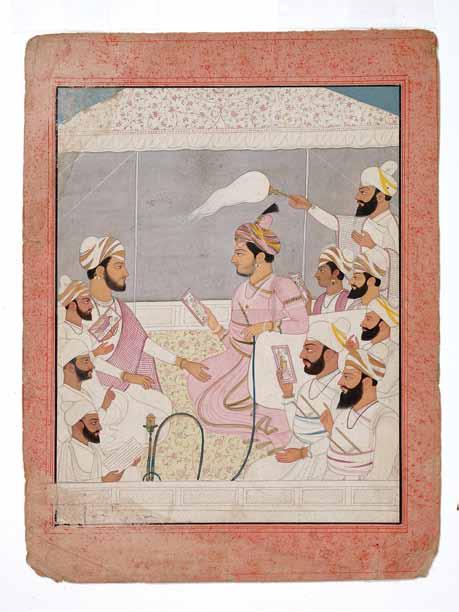
The connoisseurship of Indian painting has been shaped by the preferred medium of expression small-scale manuscript illustrations or larger format independent folios. The former lend themselves to private contemplation and enjoyment, to be shared with an intimate circle within a prince’s audience room (No. 83) or private apartment, or in the zenana with the ladies of the court. Larger scale paintings, such as those produced in Rajasthan and the Pahari Hill states of Himachal Pradesh in the eighteenth and early nineteenth centuries, were displayed, but again in private interiors of the palace. Others served as templates for mural paintings intended for these interiors. This was an art reserved for the enjoyment of the elite (Fig. 3).
Where biographical sources are scant or nonexistent, it is stylistic analysis that can support the construction of credible
f igure 3. Sansar Chand of Kangra admiring pictures with his courtiers, attributed to Purkhu, ca. 1788–1800. Museum Rietberg, Zurich, Bequest of Balthasar Reinhard
scenarios pending confirming evidence. Many of the attributions of works we present here are built on such informed judgments and are offered as a starting point for critical review and analysis. In many cases, they point out the direction that further research should take. The scope is ambitious, extending from a monastic artist of the early twelfth century to the court painters of Mewar who recorded the last flourishes of courtly life at Udaipur before the imposition of the Raj in 1857. This moment of political transition coincides with the appearance of the glass-plate camera, which effectively marked the end of the art of court painting in India. A vogue for the hand-painted photograph provided an interregnum phase, but by the 1870s, the camera had replaced the palette.
The mobility of artists, many of whom ventured across the subcontinent in search of new patronage, played a key role in the dissemination and diffusion of style. Many instances are recorded in the artists’ biographies included herein; the more notable are Nainsukh, who left his father’s workshop in Guler in order to work in Jasrota, and Bagta and his son Chokha, who after their training in Udaipur moved farther north to Devgarh. Bhavanidas, who began his career in the Mughal workshops, found later employment in the principality of Bikaner in Rajasthan. The most spectacular instance is that of Farrukh Beg, who from his native Iran, where he was an established painter, accepted an invitation to the Mughal court at Kabul, then Lahore, spent several years at the court of Bijapur in the Deccan, and ended his career back in Mughal employ at Agra. Since Mughal rulers and their retinues were on the move for much of the year, bringing new territories under their control or inspecting parts of their empire, painters were required to accompany them. Rajput princes also occasionally took their painters with them; Ruknuddin accompanied his patron on a military campaign into the Deccan. This mobility, combined with the practice of gift exchange between rulers that often included fine books, resulted in constant traffic in artistic styles and ideas.
Although single artists are featured in this volume, it is the groupings of painters that make it easier for viewers to appreciate visual links and the artistic legacy of a given school. The focus is thus not on patrons but on the individual painters and their lineages as well as their geographical and historical settings. The first section is devoted to artists who worked during the period between 1100 and 1500, before the Mughal conquest but already a period subjected to Muslim influence from the Sultanate courts
of India. The second grouping includes artists who were active at the various Mughal courts, beginning with the Persian emigrants who laid the foundation for the development of the Mughal style in India. Painting in Bundi and Kota was directly influenced by these artists. Pahari painting of the hill states of the modern Himachal Pradesh and Jammu-Kashmir comprises a major corpus of documented painters, many touched by subimperial Mughal influences. Painting from the courts of Rajasthan, provided by the group of Mewar painters who are documented from the early seventeenth century until the late nineteenth century, comprises the final grouping.
This project was conceived by three acharyas in the field of Indian painting studies, Milo Beach, Eberhard Fischer, and B. N. Goswamy, and reflects their substantial contributions to this field over the past thirty years. Much of what appears here is informed by the scholarship of these and other scholars who have helped define this field of study. The pioneering studies of Ananda Coomaraswamy, Moti Chandra, Karl Khandalavala, William Archer, Robert Skelton, Jagdish Mittal, and Saryu Doshi laid much of the groundwork upon which later scholars have built. Pramod Chandra, Stuart Cary Welch, and his protégé Mark Zebrowski advanced the study of Mughal and Deccani painting, as Daniel Ehnbom, Jeremiah Losty, Linda Leach, Andrew Topsfield, and John Seyller have done more recently in their respective fields. The Artibus Asiae publication Masters of Indian Painting that has been released to coincide with this exhibition reflects the research of many scholars: Molly Aitken, Milo Beach, Catherine Benkaim, Michael Brand, Sheila Canby, Asok Kumar Das, Saryu Doshi, Daniel Ehnbom, Eberhard Fischer, B. N. Goswamy, John Guy, Navina Haidar Haykel, Steven Kossak, Jeremiah Losty, Tryna Lyons, Terence McInerney, Jagdish Mittal, Amina Okada, Keelan Overton, John Seyller, and Andrew Topsfield. Suffice it to say that their contributions to the field have made this project possible.6
John Guy
Florence and Herbert Irving Curator of the Arts of South and Southeast Asia, Department of Asian Art
The Metropolitan Museum of Art, New York
Jorrit Britschgi
Curator of Indian Painting Museum Rietberg, Zurich
The partnership between the Museum Rietberg and The Metropolitan Museum of Art that generated this exhibition has necessitated the cooperation of many colleagues in museums in India, Europe, and the United States, as well as those within our respective institutions. We are indebted to the Museum Rietberg’s director Albert Lutz and to Thomas P. Campbell and Philippe De Montebello, present and former Directors of The Metropolitan Museum of Art, for their unstinting support of this complex project, which has drawn works of art from lenders in three continents.
The former director of the Museum Rietberg, Eberhard Fischer, together with his longstanding colleagues Milo Beach and B. N. Goswamy, conceived the exhibition and passed the baton to curator Jorrit Britschgi and registrar Andrea Kuprecht. Upon entering into a partnership with the Metropolitan, the Museum’s Associate Director for Exhibitions Jennifer Russell and Registrar Aileen Chuk gave their full support, and John Guy undertook the co-curatorship.
This exhibition could not have been realized without the generous cooperation of major lenders from three continents. Her Majesty Queen Elizabeth II graciously agreed to lend works from The Royal Collection. Major loans were generously provided by The Aga Khan Trust in Geneva, the Bodleian Library and the Ashmolean Museum at Oxford, The Institute of Oriental Studies at the Russian Academy of Sciences in St. Petersburg, the Museum of Islamic Art in Doha, the State Library in Berlin, the Ethnographic Museum of Munich, and the Musée Guimet in Paris.
As a result of the generous support of India’s Minister of Culture and the cooperation of the directors of the four lending institutions, Indian collections have a major presence in the exhibition. We thank India’s Secretary of Culture, Jawhar Sircar; the National Museum New Delhi, especially Dr. Jayshree Sharma; director Dr. D. P. Sharma and staff of the Bharat Kala Bhavan at Banares Hindu University, Varanasi; trustees and staff of the Chhatrapati Shivaji Maharaj Vastu Sangrahalaya, Mumbai, especially the director Mr. S. Mukherjee; the Udaipur City Palace Museum, Udaipur and His Excellency Arvind Singh of Mewar. The Indian Ambassador to the United States, Ambassador Meera Shankar and her staff were especially helpful. In India, the Swiss Ambassador Philippe Welti lent great support.
Colleagues in museums across Europe and the United States have responded with generous loans. The directors and staff of the
museums named in the List of Lenders herein must be acknowledged. In addition, we wish to thank those individuals who responded to our innumerable requests: Anita Chung, Debra Diamond, Sir Howard Hodgkin, Benoît Junod, Stephen Markel, Darielle Mason, Sonya Quintanilla, Julian Raby, Andrew Topsfield, and Laura Weinstein. A number of private collectors made highly significant loans to the exhibition, and they also appear in the List of Lenders.
A large number of people assisted in various ways to the exhibition’s realization, and we thank them here: Taryn Adinolfi, Jude Ahern, Catherine Benkaim, C. V. Ananda Bose, Michael Brand, Prahlad Bubbar, Allison Busch, Dr. Daljeet, Asok Kumar Das, B. G. Deshmukh, Nancy Fessenden, Kjeld von Folsach, Jürgen Frembgen Sven Gahlin, Chandrika Grover, Ludwig Habighorst, Sara Hardin, Diane Hart, Franak Hilloowala, Steven Kossak, Naval Krishna, Pramod Kumar, Vijay S. Madan, Terence McInerney, Mary McWilliams, Aldo Mignucci, Theresa-Mary Morton, Sarah Murray, Nahla Nasser, Kit Nicholson, Antony Peattie, Cynthia Polsky, Irina Popova, Vandana Prapanna, Neeta and Sushil Premchand, Bruno Rauch, Honorable Lady Roberts, Michael Ryan, Konrad and Eva Seitz, D. P. Sharma, Gursharan and Elvira Sidhu, Rajeswari Shah Amaresh Singh, Bhupendra Singh Auwa, R. P. Singh, Anita Spertus, Cynthia Talbot, Elena Tananova, Wheeler Thackston, Audrey Trusche, Oliver Watson, Edith Welch, Mary White, the late Doris Wiener, and Mrinalini Venkateswaran.
At The Metropolitan Museum of Art, thanks are due to colleagues in the Asian Art Department. James Watt, Curator Emeritus, and Maxwell Hearn, Curator-in-Charge, have given this project their fullest support. Administrator Judith Smith supported by Jill Wickenheisser and colleagues in the Collection Management team, led by Hwai-ling Yeh-Lewis, have been vital to the exhibition’s realization, and special thanks go to Alison Clark and Crystal Kui for their dedication to the management of the loans. For further assistance in supporting loans and research, we wish to thank Kurt Behrendt, Thelma Carter, Kristan Liu, and Karen Weissenborn. Use of the resources of the Museum’s great library was provided by Robyn Fleming, Jennie Pu, and Min Xu. Unfailing technical support was received from Imtikar Ally, Lori Carrier, Luis Nuñez, and Beatrice Pinto. Further assistance was provided by Taylor Miller and his construction team.
Colleagues Sheila Canby, Maryam Ekhtiar, and Navina Haidar Haykel, in the Metropolitan’s Department of Islamic Art,
generously agreed to loans from their department’s collection and responded to numerous questions. Sharon Cott and Kirstie Howard in the Counsel’s Office provided valuable guidance on legal matters and skillfully negotiated the loan agreements and contracts. In Paper Conservation, Yana Van Dyck brought her usual professionalism to bear on the works entrusted to her care; we are particularly grateful to her for curating the Materials and Techniques section of the exhibition, which was supported by Christopher Noey’s cinematic skills. The Exhibitions team, led by Linda Sylling, ensured that all the complexities of planning and implementing the installation went smoothly. The installation design was skillfully conceived by Dan Kershaw, as were the graphics by Sue Koch. Press was ably supported by Elyse Topalian and Naomi Takafuchi. Harold Holzer kindly assisted in External Affairs. The educational program was managed by Joseph Loh, Nicole Leist, and colleagues. The publication was beautifully designed by Rita Jules of Miko McGinty Inc. Finally, the Editorial Department team responsible for this catalogue saw it to press with efficiency and skill; particular thanks to Gwen Roginsky, Peter Antony, Michael Sittenfeld, Barbara Cavaliere, Bonnie Laessig, Jane Tai, and Robert Weisberg.
John Guy and Jorrit Britschgi
lenders to the exhi B ition
i nstitutional l enders
Aga Khan Trust for Culture, Aga Khan Museum Collection, Geneva
The Art and History Collection; Courtesy of the Arthur M. Sackler Gallery, Smithsonian Institution, Washington, D.C.
Arthur M. Sackler Gallery, Smithsonian Institution, Washington D.C.
Ashmolean Museum, University of Oxford
Bharat Kala Bhavan, Banaras Hindu University, Varanasi
Bodleian Library, University of Oxford
Chhatrapati Shivaji Maharaj Vastu Sangrahalaya, Mumbai
The Cleveland Museum of Art, Cleveland
David Collection, Copenhagen
Harvard Art Museums, Cambridge
Los Angeles County Museum of Art, Los Angeles
City Palace Museum, Udaipur. Maharana of Mewar
Charitable Foundation
Musée des asiatiques Guimet, Paris
Museum of Fine Arts, Boston Museum of Islamic Arts, Doha
Museum Rietberg, Zurich
National Museum, New Delhi
Philadelphia Museum of Art, Philadelphia
The Royal Collection, Windsor Castle
Russian Academy of Sciences, Institute of Oriental Manuscripts,
Saint Petersburg
The San Diego Museum of Art, San Diego
Staatliches Museum für Völkerkunde, Munich
Staatsbibliothek zu Berlin, Preussischer Kulturbesitz
Williams College Museum of Art, Williamstown
Private lenders
Barbara and Eberhard Fischer
Catherine and Ralph Benkaim
Cynthia Hazen Polsky
Danielle Porret
Eva and Konrad Seitz Collection
Gursharan S. and Elvira Sidhu
The Kronos Collections
Ludwig Habighorst Collection
Private Collection, U.K. Courtesy Prahlad Bubbar
Sir Howard Hodgkin
Anonymous private lenders
Wonder of the Age
Master Painters of i ndia
1100–1900
PAKISTAN
Kabul


KASHMIR

Lahore
Bikaner
LADAKH Indus
AFGHANISTAN NEPAL
Jaisalmer Jodhpur
Mankot MEWAR

HIMACHAL PRADESH
Delhi Devgarh
RAJASTHAN
Jaipur
Mathura
BRAJ
Agra

Lucknow
Jaunpur
Allahabad
Udaipur Patan
GUJARAT
Ahmedabad
MADHYA PRADESH
Ganges Yamuna Narmada Brahmaputra
BIHAR
Varanasi Vikramasila
Nalanda
Murshidabad
BENGAL
Kolkata (Calcutta) Cambay
Surat
Mumbai (Bombay)
Mandu
INDIA
MAHARASHTRA
Ahmadnagar
Bidar
Golconda
Bijapur
Goa
KARNATAKA
ANDHRA PRADESH
Mysore
TAMIL NADU KERALA
Chennai (Madras)
ORISSA
Krishna Kaveri Godavari Bay of Bengal
Sigiriya
Indian subcontinent, showing major centers of painting production
the art of the B ook in south asia
John Guy
o rigins of i ndian Painting
Painting in India is ancient, and of two kinds. It was used to decorate the interiors of both palaces and places of worship, and it was employed to illustrate texts in manuscripts, both secular and sacred. Early in their development, all Indian religions experienced the precariousness of relying exclusively on oral transmission and became aware of the necessity of a written tradition. Perhaps the most extreme case was that of the Jains, whose elders resolved perhaps as early as the third century BCe to commit the teaching of their historical founder Mahavira to writing to ensure that the lineage of knowledge transmission was not broken.1 Sometime around this period, the Buddhist Councils similarly resolved to commit the Buddha’s teachings to written form. Books, written on birchbark and palm-leaf, are assumed to have come into existence around this time. In addition, a vast body of Brahmanical literature had to be recorded.
The traditional medium throughout most of India’s past has been the palm-leaf manuscript. This humble form of the book, at once both fragile and resilient, provided the vehicle for transmitting the vast body of Indian thought for more than two thousand years and, for at least half of that period, was a medium for the visual arts in the form of illustrated manuscripts. It is not known when the practice of illuminating texts became a regular part of manuscript production, but it appears to have been an established convention by the twelfth century, the period from which dated illustrated manuscripts became a more regular feature of religious texts.
The other major stream of early Indian painting again, of which almost nothing survives was that of mural painting, both temple and palace decor. Connoisseurship of the visual arts was elucidated by both Vatsayana in his famous fourth-century guide to sensual pleasures the Kamasutra, and by Kalidasa, the great fifth-century Sanskrit poet and commentator on Indian aesthetics,
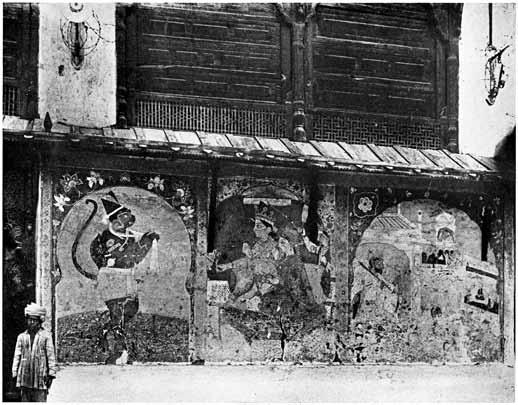
who celebrated the beauty of the Gupta age in drama and verse. In his lyric poem Meghaduta, he described the stuccoed palaces of the city of Ujjayini in Malwa as richly painted with scenes to delight the senses.2 No first millennium secular murals survive in India, but the rock-face murals at the fortified palace complex of Sigiriya, dated to around the seventh century, give us a glimpse of their sensuous nature as alluded to by the literary commentators of the era. Large-scale mural paintings that in the early twentieth century were still preserved beneath verandas in the northern courtyard of the temple adjacent to the Old Palace, Chamba, provide an insight into this largely lost tradition (Fig. 4), as do those in various states of preservation in a number of palace interiors in Rajasthan.3
Works of literature, notably dramas and romances, must have been a regular feature of court culture, and manuscript editions may well have incorporated illustrated covers from an early period. A rare survivor of this secular tradition of painting is a
f igure 4. Mural paintings dedicated to Vishnu and Hanuman, in the northern courtyard of the temple adjacent to the Old Palace, Chamba. Photograph by J. C. French, ca. 1920s
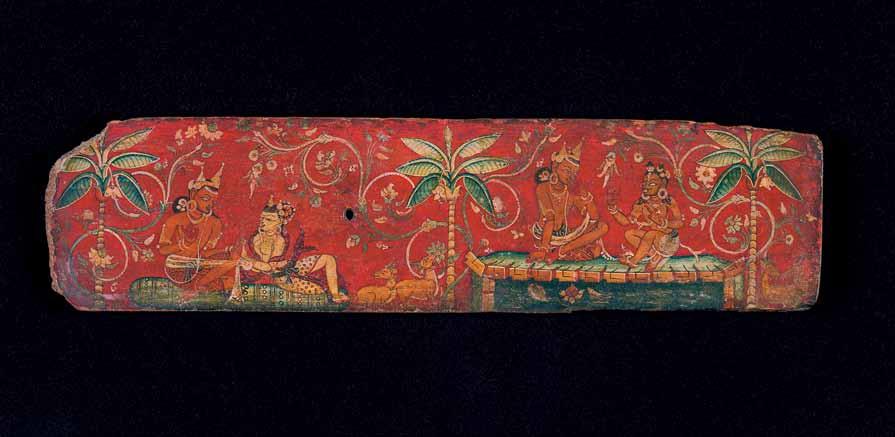
twelfth-century Nepalese manuscript cover illustrating scenes from Kalidasa’s play Sakuntala (Fig. 5). Regarded as the greatest of the Indian heroic romances, this play explores the gamut of human emotions and the power of memory through the love of King Dushyanta for Sakuntala, the adopted daughter of a forest sage.4 The work is renowned for the beauty of its imagery and for its blending of eroticism and tenderness, qualities that charge this miniature panel painting in equal measure. The drama is set against a red ground, and landscape elements are used to demarcate narrative sequences. The figures are rendered with finely controlled line and subtle use of form-defining tonality.
All these traditions of painting for temple, palace, and dramatic arts alike share a common ancestry. This can be termed the Pan-Indian style, providing a painting style and expressive language that span from the painted plaster cave interiors of the Buddhist rock-cut sanctuaries of fifth- and sixth-century Ajanta to the fragmentary murals still to be seen at the greatest of the Pallava temples, the eighth-century Kalaishanatha in Kanchipuram.5 These share an aesthetic in which a striving for fidelity to nature is balanced with a desire to generate powerful emotional states (rasa) through pictorial imagery and literary allusion. Kalidasa, in writing of the goddess Parvati in his Kumarasambhava, used the language of painting to describe her beauty: “Her body modeled by youth appeared as it were a red lotus in full bloom and as a modeled figure with contour line.” 6 Again, the poet employed pictorial imagery as a metaphor to evoke memories of love lost:
My heart’s affection made me feel.
The joy of seeing her
But you remind me again that my love is only a picture.7
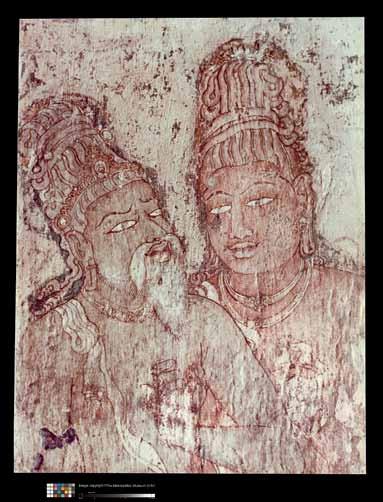
In describing a likeness so compelling that for a moment the separated lover allows his distressed mind to imagine that the painting is reality, the writer confirms the flavor of Gupta painting naturalism infused with a powerful humanist sentiment. This dimension also finds expression in portraiture, one of the earliest confirmed appearances of which is the celebrated dual portrait of the Chola king Rajaraja Chola (r. 985–1012) and his spiritual mentor Karuvur Devar, preserved in the ambulatory passage of the Brihadisvara temple at Thanjavur, dedicated in 1010 (Fig. 6).
The act of painting was described in early prescriptive texts; the most famous is the Chitrasutra, a short commentary outlining the requirements of good painting, preserved as a chapter in the Vishnudharmottara, dated variously from the fourth to the sixth century.8 This text is thus contemporaneous both with the murals at Ajanta and with the secular writings of Kalidasa and so provides a textual foundation for what is otherwise a largely lost Indian pictorial tradition. It is clear from at least one twelfth-century source that professional mural painters were expected to extend their skills to the art of manuscript painting. The Manasollasa (1129), a Sanskrit encyclopedic compilation attributed to the
f igure 5. Scene from Kalidasa’s romance-drama Sakuntala. Painted wooden manuscript cover, 2 x 8 in. (5.1 x 20.2 cm). Nepal, 12th century. The Metropolitan Museum of Art, New York, lent by The Kronos Collections
Western Chalukyan king Somesvara III (r. 1126–38), expressly states that an accomplished painter was “not only a fresco painter but was [also] well versed in the technique of miniature painting on palm-leaf ( patra-lekhana).” 9
While an important corpus of secular writing from the Gupta period confirms the importance of the art of painting, principally murals, it was religious expression that provided the most lasting inspiration in the premodern era. Indian religious texts are of three principal types. First, there is the Vedic literature, which claims a high level of divine authority and is the prime literature of Hinduism. Its authority is greater than the individual gods, transmitted by the thought of Brahma and heard by holy men (rishis), who are its custodians. Second, there are the Puranas, which are legendary accounts of ancient times, largely concerned with the legends of the gods and dynastic genealogies, and in effect, illuminate many aspects of ancient Indian history. They have been characterized as Vedas for the populace, as they present complex metaphysical notions through myth, legend, and storytelling. They serve as commentaries on the Vedas and embody generations of Indian philosophy, and they take the form of traditional history and complement the Epics. Third, there is the Epic literature, which provides the mythological framework for the Indian world cosmology and is expressed principally in the Hindu Mahabharata and the Ramayana. Finally, the Jatakas provide the closest equivalent to the Epics in the Buddhist context, as do aspects of the Jain Kalpasutra.
No illustrated Hindu texts from before the twelfth century are known, and it is most probable that when they do appear, as in Shaivite manuscript covers depicting the assembled high gods of Hinduism, or in Nepalese editions of the Devi Mahatmya (Glorification of the Goddess) manuscripts for example, they take their inspiration both from Buddhist practice and, as is witnessed by the Sakuntala book cover, from secular painting.10 Buddhist Jataka stories and scenes from the life of the Buddha, together with the hagiography of the twenty-four tirthankaras as recounted chiefly in the Kalpasutra, provided a reservoir of narrative and imagery for artists throughout the period leading up to the year 1100 and beyond. The commissioning of a copy of a religious text was, in all Indian faiths, a meritorious act for which the sponsor was understood to earn religious merit. The names of Buddhist and Jain donors frequently occur in the colophons of such manuscripts, which often were well preserved in temple libraries. Within
the Hindu temple, texts were routinely used for learning, and brahmins undertook the task of copying those that needed replacing. As a result, very few Hindu manuscripts of any great age survive today, despite the antiquity of the texts they bear. In Buddhist monasteries, transcribing and illustrating texts was seen as a worthy profession to be undertaken by monks. There is no evidence that the Jain clergy undertook this task; indeed, the Kalpasutra warns monks and nuns against the art of painting, as an activity prone to arouse sensuous thoughts.11 The jnana bhandars (knowledge storehouses) the temple library-cum-strong rooms so integral to the medieval Jain temples of western Indian and the Deccan were already assuming an important custodial role as storehouses of Jain religious art.
Earlier painted manuscript covers do survive, datable to the ninth century from Gilgit, a small kingdom west of Kashmir.12
f
igure 6. Presumed portraits of the Chola king Rajaraja Chola (r. 985–1012) and his spiritual mentor Karuvur Devar, preserved in the ambulatory passage of the Brihadisvara temple at Thanjavur, dedicated in 1010.
Photograph by V. K. Rajamani
Uniquely, these scenes are painted vertically on the panel, and one pair that accompanied a birchbark manuscript depicts a standing Padmapani gracefully blessing a kneeling devotee, very probably identifiable by comparison to donors depicted on Gilgit metal sculptures as a ruler of the Patoli (Palola) Shahi clan.13 The prototypes for these manuscript cover paintings are murals and undoubtedly banner cloth paintings.
That Buddhist painted images routinely existed earlier is verified by textual and visual evidence. A fourth-century Gandharan sculpture from Mohammad Nari, Pakistan, depicts the Buddha honored by multiple appearances of Past Buddhas, Bodhisattvas, and donors, together with two standards displaying hanging banners with raised-up Buddha images representing banner paintings.14 Late first-millennium examples survive in Central Asian monastic contexts such as Dunhuang, Murtuk, Khara Khoto, and Kyzil.15 A mural at the Buddhist cave complex of Kyzil, in Xinjiang Autonomous Region of China, provides confirming evidence datable to the first half of the seventh century (Fig. 7). In the scene, a Buddha is celebrated with a painted banner cloth depicting the legend of Ajatashatru, the king of Magadha who is famed for being present when the Buddha preached the Lotus Sutra. 16 The Chinese Buddhist pilgrim Fa Xian described seeing five hundred “brightly colored” bodily forms of the Buddha, past and present, lining both sides of the street at Anuradhapura, along which the tooth relic was carried in procession to Abhayagiri vihara, during his sojourn in Sri Lanka in the early fifth century.17 Painting in medieval India was increasingly linked to the art of the book. The watershed is the beginning of the second millennium, when palm-leaf manuscripts began to appear with pictorial elements. These may not be the oldest examples of the illustrated book in India; they are simply the oldest that have come down to us. Again, Central Asia provides an earlier precedent, as is witnessed by a unique hoard of Manichean manuscripts dating from the eighth to the tenth century in which pictorial components are integrated into passages of text. They embody Indic imagery, providing interesting parallels with the murals at Kyzil and elsewhere that have representations of Shiva as well as Buddha imagery. Such Indian imagery, we may assume, would have found its way to Central Asia via the Buddhist network and most probably would have been transmitted via illustrated manuscripts. No such manuscripts survive to prove this hypothesis.
Convention and i nnovation
This introduction presents in a summary manner much of what we know about Indian painting of the first millennium as it relates to the art of the book. The chapters that follow provide a synoptic account of the continuing development of Indian painting from 1100 to 1900, beginning with the earliest extant evidence, miniature cartouche illuminations on palm-leaf folios, and examining the major examples of the paintings on paper that began to appear
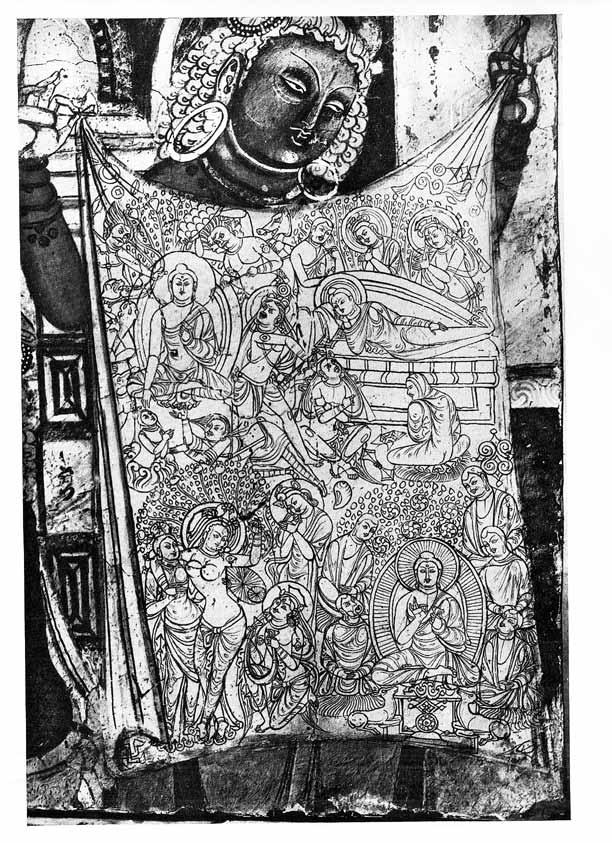
f igure 7. Banner painting depicting the legend of Ajatashatru, the king of Magadha, detail from a scene of the Buddha being adored by devotees. Mural painting from the Buddhist cave complex at Kyzil, Central Asia. Xinjiang Autonomous Region of China, ca. 600–650 Ce Formerly Museum für Völkerkunde, Berlin (destroyed)
in the fourteenth century. The Italian traveler Nicolo Conti, who visited Gujarat around 1440, observed that only the artisans of Cambay, the region’s renowned port and a known center of Jain religious art production, used paper, while others were still using “the leaves of trees, from which they make beautiful papers.” 18 At the time, Cambay served as India’s principal port for the Arabian Sea trade. It is known that Arabs settled in Ahmedabad soon after it was founded in 1411 by Sultan Ahmad Shah, and they introduced paper making to that city. The oldest dated paintings on paper in India appear in a Svetambara Jain manuscript edition of the Kalakacharyakatha, from Yoginipur (Delhi), dated 1366.19 At around that time, Sultanate manuscripts, the most popular of which were editions of the Persian Book of Kings, the Shahnama by Firdawsi, began arriving in India, suggesting new solutions to pictorial problems. By the second quarter of the fourteenth century, the Shahnama was copied routinely in India.20 Their influence was not confined to Muslim circles but quickly spread to Hindu and Jain artists active at this time for patrons in their own communities. The prevailing style of mid-fifteenth century western India is well documented by two remarkable dated cloth paintings produced in 1447 and 1451 at Ahmedabad, the commercial heartland of Gujarati Jainism. These works epitomize the mature style of the period. The victory banner ( Jayatra Yantra) was dedicated on the festival of Diwali in the year equivalent to 1447 Ce 21 The center field consists solely of sacred syllables (mantras) and numerals, configured to form a sacred diagram ( yantra), intended to serve as a visual aid to meditation. The borders carry beautiful and evocative passages of painting, depicting deities, landscape, and the natural world. This victory banner and a closely related cloth painting, the Vasanta Vilasa (Spring Sports) dated 1451, both display the same celebration of nature and joie de vivre, capturing evocatively and explicitly the spirit of the text’s theme, the arrival of spring.22
Innovations in Jain style form a critical bridge between the conventional western Indian style of the thirteenth and fourteenth centuries and the radical integration of Indian and Iranian elements in the early sixteenth century. New stylistic and iconographic features have appeared, reflecting a growing awareness in Jain painting studio circles of the manuscript art of Timurid Iran, with which the Sultanate courts of north and western India had routine contact.
By 1500, painting styles in India were on the cusp of a revolution, triggered by the Sultanate kingdoms of northern India that maintained active links with the court ateliers of Iran and Afghanistan. The workshops of the Sultanate courts of Delhi and Bengal provided imported models for their artists, but these ateliers were obliged to largely recruit Indian artists, trained in the Hindu and Jain traditions, as were their Mughal successors. The fusion of these Indian and imported painting styles was the catalyst for the radical developments that mark the first half of the sixteenth century and beyond. Indian painting was entering a new age.
Highly influential schools of Hindu devotional manuscript painting were being produced in northern India in the early to mid-sixteenth century, most probably concentrated around the prosperous commercial centers of the Sultanate Delhi-Agra region. A radical innovation had occurred, in which the pictorial component now predominated over the textual; we are witnessing the appearance of the independent painting, unshackled from the text to which it was traditionally bound. In the Bhagavata Purana series (Nos. 7, 8 ) the image has taken over the page entirely, and the text has been relegated to a synoptic line or two on the upper margin. The function of these paintings was to evoke the mood of the texts that inspired them, no longer merely to illustrate an accompanying text. Even the Hamzanama, the most ambitious painting project of the early Mughal period, was conceived for highly charged show-and-tell presentations at court. The text appears on the reverse, allowing the narrator to consult it while presenting these spectacularly large and dramatic paintings to the assembled audience (No. 10).23
Two streams of development prevail henceforth, the traditional Indian landscape format that embodies memories of the palm-leaf folio and the codex form introduced from the Islamic lands into Sultanante India (Nos. 3, 4). In the ongoing and evolving Muslim (Mughal) and Hindu (Rajput) schools, these two traditions continued to coexist. The coalescing of these styles in variant forms shaped the regional schools that evolved over the next three centuries. Both were largely swept away with the advent of new technology, the glass-plate camera, in the 1860s. This proved to be a transforming moment; the established genres of Indian court painting were swiftly taken up by professional photographers, and the art of the brush was finally abandoned.
from palm-l E af to pap E r
manus C ript
John Guy
painting 1100–1500
Indian painting around the year 1100 CE, as far as we can judge from the few dated works that can be assigned securely to the period, was devoted almost exclusively to the illustration of Buddhist and Jain manuscripts. We know from pilgrim descriptions that the great Buddhist monasteries of eastern India were richly painted with murals devoted to sacred images, although none have survived. The murals in the Sumtsek chapel at Alchi monastery, Ladakh, dated to around 1200, are among the most extensive mural paintings of this period extant, providing insight into the richness of the medieval mural painting tradition (Fig. 8).1 The great monasteries (mahaviharas) of northern India, from Kashmir to Bengal, undoubtedly had equally magnificent painted interiors, radiant with Mahayana Buddhist imagery. The multistoried libraries of these centers were renowned as treasure houses of learning and Buddhist knowledge, housing vast stores of both manuscripts and the finest paintings of the age (Fig. 9). The Jain temple also had its knowledge repository, the jnana bhandars, which over time assumed a critical role as the custodial preserver of Jain knowledge and religious art.
The overwhelming majority of Buddhist illustrated texts are devoted to the Ashasahasrika Prajnaparamita (Perfection of Wisdom in 8,000 Verses) and the Pancaraksa (Five Protective Goddesses). The mystic spells and charms (vidya) that comprise both collections came to be personified as female deities, their iconographic forms already codified by the twelfth century in the Sadhanamala (rosary/garland of invocations) and Nispannayogavali.2 These profoundly influential texts gave voice to the Mahayan ist preoccupation with compassion embodied in the cult of bodhisattvas and taras.
Buddhist artists mostly monks, we can assume produced a great corpus of illustrated palm-leaf texts in eastern India during the eleventh and twelfth centuries. They draw imagery from two prototypes temple sculptures that embody the elaborate
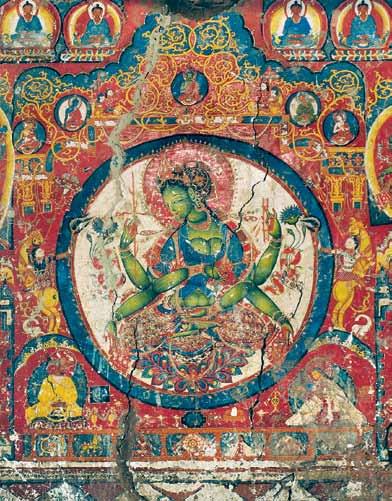
iconographic schema developed in the parent texts (Fig. 10) and mural paintings of which almost nothing survives from this period. In both instances, the manuscript artists had to miniaturize radically, which they achieved with consummate skill. The sophisticated linear and chromatic complexity of the Pala painting style is evident by the date of the oldest survivors, two editions of the Ashasahasrika Prajnaparamita manuscript produced in the
f igur E 8. Prajnaparamita, Sumtsek chapel, Alchi monastery, Ladakh. Mural painting on plaster, ca. 1200. Photograph by J. Poncar
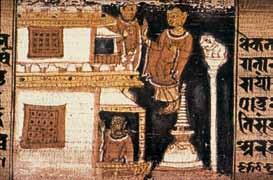
f igur E 9. Monks in a monastery with multistoried hall, stupa, and lion-stambha. Painting on palm-leaf manuscript, ca. 12th century. Nepal. National Archives, Kathmandu
eleventh century during the fifth and sixth year of the reign of Mahipala I (the later one at Nalanda monastery).3 A century or so later, an artist produced manuscript paintings of the unsurpassed quality seen in the Vredenberg manuscript commissioned by the donor Udaya-simha in the thirty-sixth year of Ramapala’s reign (first quarter of the twelfth century, a near contemporary of the Mahavihara Master manuscript (Nos. 1, 2).4 The place of production is not recorded for either work, but for the Vredenberg manuscript, in which the compositions are dominated by large-scale figures in compact settings, the monastic scriptoria at Nalanda or Vikramasila are real possibilities. Three of the only six provenanced Pala manuscripts are assigned to Nalanda, suggesting that this was a major center for the production of illustrated Buddhist manuscripts, along with Vikramasila and Uddandapura.5 The Mahavihara Master manuscript paintings, with their highly elaborated architectural and lush treescape settings, more likely are products of one of the great monastery scriptoria of Bengal.
No Buddhist paintings of this period carry an artist’s signature or a scribal attribution. Texts were written first, with space reserved for the artist to insert the painting, the latter routinely overlapping the script at the margins. Sometimes, the scribe wrote instructions for the painter, confirming their separate roles. Literate monks working in monastic scriptoria must have been responsible for both activities. In many instances, the iconography does not strictly conform to the iconographic prescriptions, suggesting that some painters were less than fully conversant with the authority texts. That scribes are often named in colophons, and painters never, indicates a hierarchy of activities that placed the learned skill of writing above that of picture making.
The Buddhist artists display an astute sensitivity of line and form, and they work in a confident if sometimes summary manner that suggests long familiarity with the conventions of this style. Figures are rendered in flat washes of intense color, with limited tonal modeling and assured silhouetting. A hierarchic ordering of deity and devotee is observed. Over a period of two centuries, the artists of this era redefined the possibilities of miniature painting, creating miniaturizations of large-scale mural painting into a format averaging 2 by 3 inches (5.1 x 7.6 cm). By the close of the twelfth century, Buddhist monastic painting had come to an abrupt end as the monasteries of eastern India fell victim to a series of devastating campaigns by the Sultanates of Bengal.
Painted narratives on Jain wooden manuscript covers ( pothi ) count among the earliest surviving examples of Indian manuscript art. The oldest datable painted manuscript cover can be assigned securely to the first half of the twelfth century, on the basis of its association with a revered Jain Svetambara guru, Sri Jinadatta Suri, who is depicted discoursing in the Discussion Hall (Vyakyana Sabha).6 This renowned teacher was elevated to the rank of Acharya in 1112 and died in 1154, and thus, this manuscript reasonably can be assigned to the period between those dates. Another Jain painted cover depicts an important contemporary event, a theological debate held in 1124 at the court of the Solanki dynasty ruler Siddharaja Jayasimha in Patan, Gujarat. The two leading Jain theologians of the day, the Digambara Kumuda Chandra and the Svetambara Vadi Devasuri, engaged in an extended debate in which the celebrated Svetambara monk prevailed.7 The last scene shows the defeated Digambara challenger banished from the palace, whereupon he is attacked by a cobra, no doubt to be understood as divine retribution for his misguided beliefs.8 This painting, which may be datable to within a few years of the event depicted, demonstrates the advanced state of the Jain pictorial style, with its strong use of linear silhouette and flat washes of intense color and inclusion of scene dividers.
Manuscript painting in the succeeding two centuries was largely the domain of the artists of western India, serving the needs of the Jain community and the occasional Hindu patron, as seen in illustrated editions of popular Hindu stories such as the Balagopalastuti (Praise of the Youthful Krishna), a devotional work of prose recounting the exploits of the young Krishna (Fig. 11).9
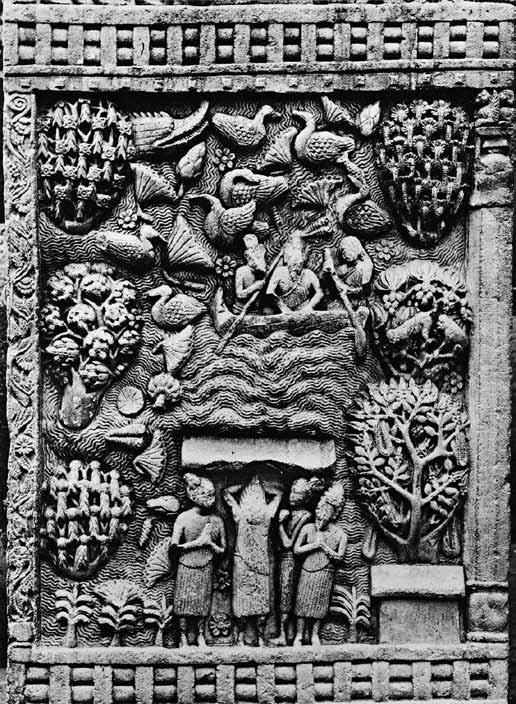
The style, best described as Western Indian, is archaic and conservative, echoing ancient compositions (Fig. 12). It is characterized by areas of flat color of saturated intensity, heightened by
the use of black linear outline. The painting style of the human figure is particularly distinctive. The silhouette is angular and sharp; the figure has a slender waist and swelling chest; the nose and chin are pointed; and the face in three-quarter profile has a projecting almond-shaped eye that appears alert and worldly. This eye convention became a hallmark of such paintings, and of figurative designs in other mediums, such as painted cotton textiles of the late fourteenth and fifteenth centuries.10 Manuscripts of this and later periods retain several anachronistic features, the most obvious of which is the long and narrow horizontal format of the palm-leaf, which persisted long after the widespread availability of paper. It is perhaps significant that the oldest dated paintings on paper in India appear in a Svetambara Jain manuscript edition of the Kalakacaryakatha, dated 1366 and produced in Yoginipur (Delhi).11 Yoginipur had become an important center in the thirteenth century for Jains, who were drawn there no doubt by the commercial opportunities offered by the Sultanate rulers of Tughlaq and Lodi Delhi.12
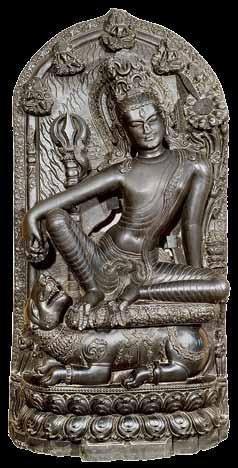
Western Indian painting underwent a number of changes during the first half of the fifteenth century. Artists responded enthusiastically to the availability of new colors and presumably so too did the clients who had to pay for these expensive ingredients. Lapis lazuli, which produced the most luminous ultramarine, became more widely available, and also a new crimson, probably produced from a native lac (a resin secreted by insects). This brilliant red quickly displaced blue as the preferred background color, as is demonstrated in a superb Kalpasutra painted at Mandu in 1439.13 Gold and silver were also introduced into the artist’s palette and became fashionable materials for the enrichment of commissioned manuscripts, often to the detriment of pictorial clarity; even the most finely executed painting was often rendered flat and lifeless by the indiscriminate application of gold or silver overpainting. These changes were largely of emphasis and embellishment rather than fundamental shifts in style. They were partly a result of the growing commercial contacts between northern India and the Islamic cultures of Mamluk Egypt and Timurid Iran. The circulation of illustrated Islamic manuscripts and their richly tooled and gilded bindings principally Korans but also editions of the Shahnama and other literary works together with luxury goods such as Timurid carpets, textiles, and metalware, contributed to the enriching of the visual landscape of the Indian subcontinent. By around 1400, paper folios had gained more height to accommodate greater pictorial decoration, no doubt inspired by Islamic codex books in circulation through the Sultanate courts. The enhanced scale also allowed artists to develop the border designs, some of which display direct Iranian influence, echoing decorative elements such as the flowering vine and tree that had become so prevalent in fifteenth-century Sultanate architecture and textile design. Other centers also witnessed the Jain patronage of finely painted manuscripts, a superb Kalpasutra painted at Mandu in 1439, for example.14 Two dated editions of the Kalpasutra, produced in Jainpur in 1465, and the so-called Devasano Pado Kalpasutra and Kalakacharyakatha produced in Ahmedabad about 1475 (Nos. 5, 6), represent important stages in the progression beyond conventional western Indian style with the gradual integration of Indian and Iranian elements in the early sixteenth century. Both display a growing awareness in Jain painting studio circles of the manuscript art of Timurid Iran. It is thus apparent that artists working for Jain clients had access to Islamic court culture, as can be seen most vividly in the frequent borrowings f igur E 10. Bodhisattva Simhanada Lokesvara. Reportedly from the site of Sultanganj monastery, Bhagalpur District, Bihar, late 11th–12th century. Black basalt. Birmingham Museums and Art Gallery, Gift of Samuel Thornton, 1864 (1885A1472.1)
of decorative schema interlaced vine border cartouches, for example and in a newfound confidence to add elaborate marginal decor that occupies a significant area of the page. Placement of the picture components also became more varied, and text size was reduced and often given a decorative treatment in gold on red or blue ground. The use of conspicuously expensive materials, notably gold, silver, and lapiz lazuli, is a prevailing feature of this final phase of the Western Indian style.
These innovations in Western Indian painting were not confined to Jain and Hindu manuscripts. A recently discovered edition of the Shahnama, the Persian Book of Kings by Firdawsi, datable to around 1450, establishes a Sultanate-period Islamic manuscript firmly in the Western Indian style (Nos. 5, 6).15 Its paintings observe the conventions of Central Asian dress of the Sahi nobility, no doubt following imported Iranian editions of the Shahnama as their model, while using the rich palette, including a brilliant red ground, of the Indian school.16 Although this manuscript is in a codex form and draws heavily on its Iranian model, the pictures are landscape format, sharing the page with text in various configurations. Conventions for rocks and clouds are of Iranian derivation, which seems to be filtered through a Jainesque prism, fused with other motifs, such as figure types and trees, of Western Indian style.
Over the course of the thirteenth to fifteenth century, the Muslim Sultanates had established power across northern India, from Gujarat to Bengal. Their center in Delhi was to have the most lasting importance for the history of Indian painting; there, a viable alternative to the western Indian style was created. Together with the highly influential school of Hindu devotional manuscript painting that emerged subsequently in the Delhi-Agra region in the early to mid-sixteenth century represented by the Caurapancasika and the Palam and Isarda Bhagavata Purana manuscripts this location became the new epicenter of artistic innovation.
By 1500, painting styles in India were on the cusp of a revolution, triggered by the Sultanate kingdoms of northern India, which maintained active links with the courts of Iran, Egypt, and Afghanistan. The workshops of the Sultanate courts of Delhi and Bengal provided imported Iranian models for their artists but were obliged to largely recruit Indian artists trained in the Hindu and Jain traditions, as were their Mughal successors.17 The fusion of these Indian and imported painting styles was the catalyst for the radical developments that mark the first half of the sixteenth century and beyond.
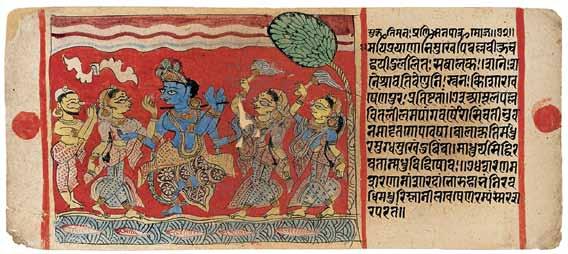
f igur E 11. Krishna playing flute and dancing to the delight of the gopis ; folio from a Balagopalastuti manuscript. Gujarat, ca. 1450. Opaque watercolor on paper. Museum of Fine Arts, Boston, Denman Waldo Ross Collection (30.106)
f igur E 12. Miracle of Sravasti. Relief sculpture from the gateway of Stupa No. 1, Sanchi, India. Early 1st century CE
Mahavihara Master
Active in the early 12th century, in Bengal
This master painter of the Pala-era Buddhist monastic tradition is known from one extant palm-leaf manuscript, now shared between New York and Lhasa. The illustrated manuscript is a deluxe edition of the Ashtasahasrika Prajnaparamita (Perfection of Wisdom in 8,000 Verses), a Mahayanist text of profound importance to the development of esoteric Buddhist practice. The paintings that accompany this text display not only highly sophisticated painting skills but also such a sensitivity and empathy for the subject matter that one cannot avoid assuming the artist was a monk, deeply versed in the text he was engaged to illustrate. This pious artistic venture, to fulfill a royal commission, was probably undertaken in the scriptorium of one of the great monasteries (mahaviharas) of eastern India at the height of Buddhist activity there. The colophon leaf is preserved in Lhasa and although providing no clue about place or date of production, does identity the edition as “the pious gift of the queen Vihunadevi.” 18 As this queen is otherwise unknown, we have no means of constructing a provenance or reign date for her. Nevertheless, naming her as the donor fits a well-established pattern of female royal patrons of Buddhist religious art.
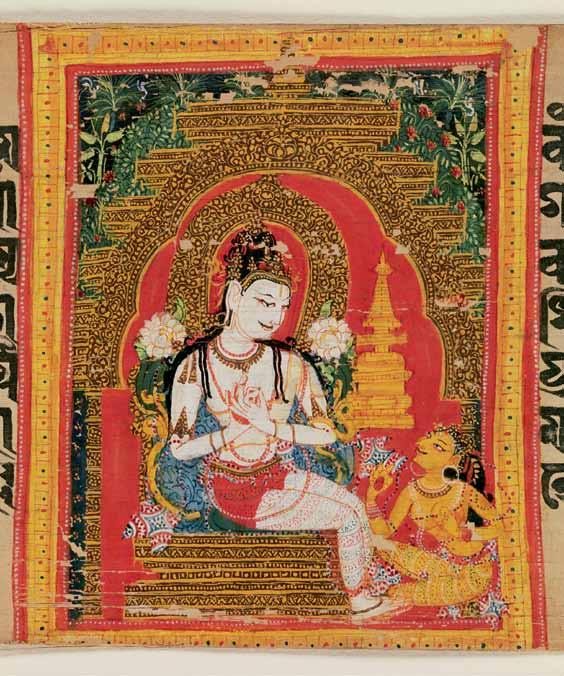
The Mahavihara Master displays a practiced ease combined with astute skill and sensitivity, resulting in miniature paintings of dazzling dexterity. His fluid lines and schematized color palette capture the sensuous flexing of the body profiles. The body colors are iconographically prescribed, as is the theatrical use of symbolic gestures (mudras). The subjects are standard, Buddhist saviors performing acts of charity and compassion: bodhisattvas and taras granting boons (No. 2) and expounding the dharma (No. 1), and Kurukulla protecting the faithful. The choices underscore the essentially talismanic function of these paintings, to extend protection to both the text they accompany and those who read it.
There is evidence, both in the text and beyond, that the Ashtasahasrika Prajnaparamita book became the focus of a cult of veneration and hence, worthy of extravagant embellishment. Certainly, these painted folios, among the oldest surviving masterworks of the Indian tradition, are appropriate to the task. The Mahavihara Master successfully miniaturized compositions originated for large-scale mural painting programs into a book format averaging 2½ by 3 inches (6.4 x 7.6 cm). That they convey the essence of the Buddhist dharma with grace, gravitas, and a sense of monumentality is all the more remarkable.
Bodhisattva Avalokitesvara expounding the dharma to a devotee: folio from an Ashtasahasrika Prajnaparamita manuscript Bengal, eastern India or Bangladesh, Pala period, early 12th century Opaque watercolor on palm-leaf,
23⁄4 x 161⁄2 in. (7 x 41.9 cm)
The Metropolitan Museum of Art, New York, Purchase, Lila Acheson Wallace Gift, 2001 (2001.445.f)
The enthroned Avalokitesvara, bodhisattva of compassion, who is crowned, bejeweled, and framed by two white lotus blooms, sits in a temple shrine setting with bhadra-style superstructure of the Pala style. His hands held in double vitarkamudra preach the Perfection of Wisdom sutra to the female devotee who looks up in rapture at her savior. In this scene of powerful humanist sentiment, the psychological drama follows textual prescriptions describing how devotees should gaze on the deity. The Buddha essence (dhatu) is evoked by the depiction of a stupa, embodying the presence of both the Buddha relics and Buddha teachings.

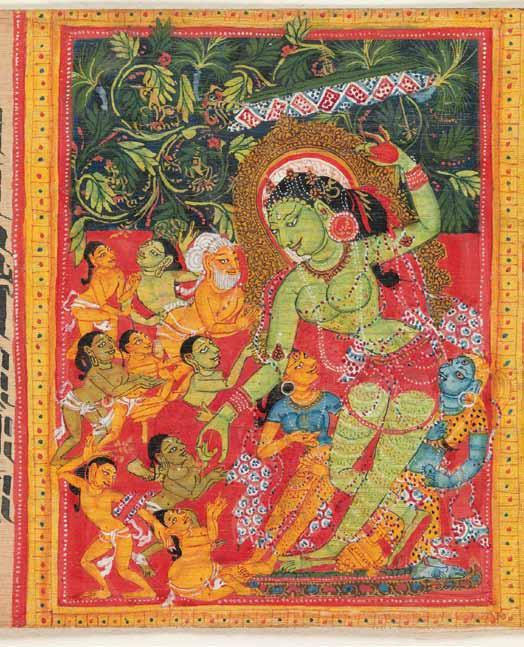
2
Green Tara dispensing boons to ecstatic devotees: folio from an Ashtasahasrika Prajnaparamita manuscript
Bengal, eastern India or Bangladesh, Pala period, early 12th century
Opaque watercolor on palm-leaf,
23⁄4 x 161⁄2 in. (7 x 41.9 cm)
The Metropolitan Museum of Art, New York, Purchase, Lila Acheson Wallace Gift, 2001 (2001.445.i)
Published: Kossak, “Recent Acquisitions . . . Tara, the Buddhist Savioress” (2002), p. 60
This painting evokes the ecstatic character of worship in Indian religions. Here Mahayana Buddhism employs the visual language of bhakti, fervent and passionate devotion to god as devotees appeal to share in the Green Tara’s benevolence. Strings of pearls and gold-set jewels adorn her hair; diaphanous muslin drapes her fulsome breasts and reveals a short dhoti; and a golden throne-back arches with her body. She is accompanied by two divine attendees who share her golden pedestal and gaze up at her rapturously. The dense foliage that fills the background bursts out of the upper margin of the composition like some lush creeping vine, a foretaste of spatial devices used in later Hindu painting styles.
Master of the Jainesque Shahnama
Active 1425–40, in western India, probably Malwa
Atevery turn, this artist reveals his origins as one trained in the western Indian style so closely identified with Jain and Hindu manuscript painting. That he turned these skills to the illustration of the most famous of all Islamic epic narratives, the Shahnama (Book of Kings) of Firdawsi, was a daring and challenging move. The catalyst must have been a commission from a Muslim patron who, wishing to have an edition of this illustrated epic, sought out an accomplished local artist. The patron with such a keen interest was probably a local Sultanate ruler well versed in Persian literature, who already maintained a library containing imported Iranian illustrated manuscripts. Access to such works would have been essential to provide visual models for the Indian artist unfamiliar with either the imagery or the conventions of Iranian painting. The specific treatment of armored soldiers with their caparisoned horses draws directly on Iranian models, as does the depiction of rocky landscapes, sky-cloud boundaries, and specific icons such as the mythical bird Simurgh. For the more routine pictorial building blocks, the artist reverted to the tradition in which he was trained, as examples show in the stylization of trees and water and use of the Hindu-Jain convention of a red ground, which makes no provision for spatial needs. Most compelling of all are the figures, seen routinely in three-quarter profile, in a manner closely related to the Caurapancasika style.19
This manuscript, in its original condition, was bound as a single codex format volume comprising 350 pages of Persian text, 66 of which are illustrated.20 The artist confined all his paintings to a landscape format, never daring to fill the entire page, betraying his origins as one trained in the illustration of palm-leaf and paper manuscripts in the potli tradition.21 Jain Kalpasutra and Hindu Balagopalastuti manuscripts provide contemporary models (No. 5 and Fig. 4).
This remarkable manuscript reflects a broader movement toward integration and cultural accommodation between occupier and occupied across Sultanate India, as foreign Muslim rulers imposed their authority over the Hindu majority. The culturally liberal approach for which the Mughal emperor Akbar (r. 1556–1605) is praised has its roots in the Sultanate era, as is vividly witnessed by these paintings. Unknowingly, this artist set in motion a series of dynamic exchanges between native Indian schools of painting and imported Iranian styles that would have profound consequences on the development of Indian painting in the century that followed.
3
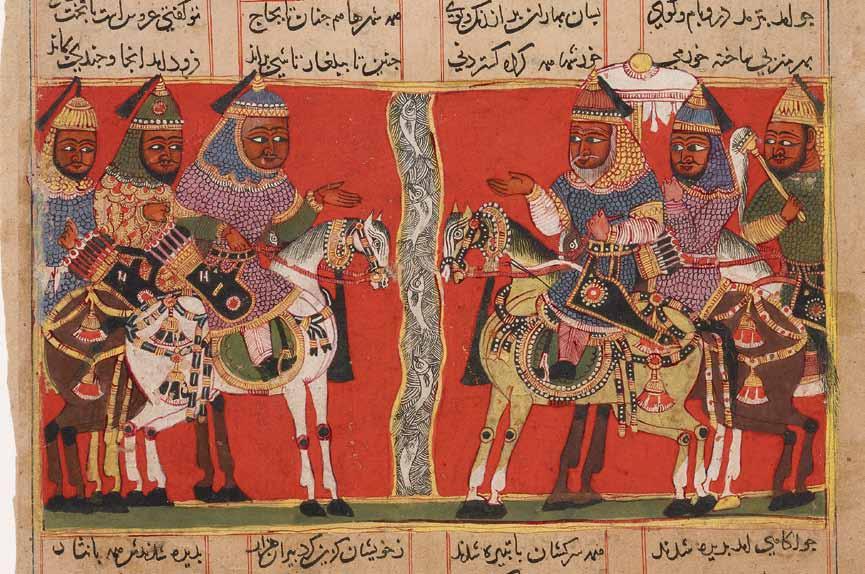
Siyavash faces Afrasiyab across the Jihun River: page from a Shahnama manuscript
Unknown workshop, possibly Malwa, ca. 1425–50
Inscribed: text of Firdawsi’s Shahnama
Opaque watercolor and ink on paper, painting: 77⁄8 x 413⁄16 in. (20 x 12 cm); page: 1211⁄16 x 91⁄4 in. (32 x 23.5 cm)
Museum Rietberg, Zurich, Gift of Balthasar and Nanni Reinhart (RVI 964, f. 108v.)
Published: Goswamy, A Jainesque Sultanate Shahnama (1988), fig. 10
The youthful prince Siyavash negotiates a peaceful accommodation of his clan’s rival king Afrasiyab. Both armies are represented in a style modeled after Iranian conventions of the period. The river divides the composition vertically and is treated in a basket-pattern design that can be traced back to Indian sculptures of the Shunga era. A narrow green band suggests a foreground space for the assembled armies, and the flat red middle ground fills the remaining space; no horizon or skyline is indicated. The aged king Afrasiyab is
attended by guards bearing a parasol and fly whisk (chauri ), insignia of office not seen in Iranian depictions of this subject, a confirmation of the Indian origins of this painter.
4
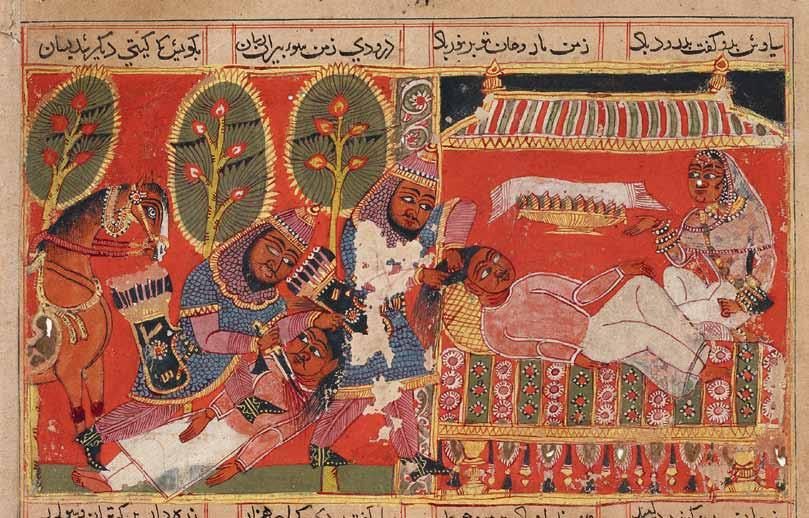
Siyavash is pulled from his bed and killed: page from a Shahnama manuscript
Unknown workshop, possibly Malwa, 1425–50 Opaque watercolor and ink on paper, painting: 47⁄16 x 713⁄16 in. (11 x 19.8 cm); page: 123⁄8 x 95⁄8 in. (31.5 x 24.5 cm)
Museum Rietberg, Zurich, Gift of Lucy Rudolph and Ursula Dohrn (RVI 1881, f.120v)
Published: Goswamy, A Jainesque Sultanate Shahnama (1988), fig. 18
In this dramatic murder scene, prince Siyavash is dragged by the hair from his bed chamber
while his hapless wife Farangish gestures in horror. In a rare instance of continuous narrative, the murder and (presumed) decapitation are seen in the outdoor scene marked by trees. The juxtaposition of the Iraniandressed soldier and the Indian-styled pavilion and stylized trees bears witness to the hybridism of this manuscript’s painting style. Farangish wears a diaphanous shawl (orhani ), rather than a tight-fitting choli bodice, a mode of dress unknown in Iranian painting. The intense red ground and other strident colors are the clearest indication that the artist’s origins are Indian.
Master of the Devasano Pado Kalpasutra
Active in the late 15th century, in Gujarat, probably at Patan
This manuscript, executed on paper in the palm-leaf ( potli ) format, is a masterpiece of the late Jain tradition of western India. It embodies a number of pictorial innovations that foretell imminent changes in Indian painting. The bulk of the original 201 folios are preserved in the temple library (bhandar) of the Devasano Pado temple in Ahmedabad.22 Its now incomplete colophon names members of the family of one Minister Deva, presumably a respected Jain serving in the Muslim Sultanate administration, and refers to the port city of Gandhar, on the Gulf of Cambay.
The Kalpasutra’s Prakrit text is written in gold paint on a red ground in an elegant Jain nagari script reminiscent of the royal editions produced under the pious Solanki king of Patan, Kumarapala (r. 1148–74) and deposited in the twenty-one royal endowed temple jaina-bhandaras he founded. Colophon evidence from the fourteenth and fifteenth centuries indicates that Patan remained the principal center for Jain manuscript production.23 Professional scribes often added their names to a text before passing the manuscript to the studio of painters. Artists’ names are rarely recorded, an established pattern seen in earlier Buddhist palm-leaf manuscript colophons. The first appearance of an artist’s name in a Jain context is in a Kalakacaryakatha manuscript produced at Patan in 1416, which names both the scribe, Somasinha, and the painter, Daiyaka.24 More common are donor names, which are invariably written in a different hand from that of the scribe, indicating that they were added later, when the finished manuscript was purchased. Clearly then, these are the activities of commercial workshops supplying lay Jain clientele rather than temple or court ateliers.
The paintings are in the conventional Jain tradition, with faces in three-quarter profile and a projecting eye. In the later fifteenth century, the highly confident linear style of earlier palm-leaf and paper editions, typically black ink silhouette and color wash against a red ground, gave way to two technical innovations learned from Iran that had a transforming effect on the aesthetic impact of these paintings. One is the introduction of lapis lazuli to produce a deep ultramarine blue ground; the other the use of painted gold, typically applied over the black silhouette figures to negative effect, obscuring the subtlety and expressiveness of line. A further innovation in this manuscript, also borrowed from the Iranian painting tradition, is the introduction of symmetrical and interlocking floral designs, which appear in the borders of Jain manuscripts for the first time. Gujarat came under Sultanate rule in the fourteenth century and became an independent Muslim state after 1407, the center shifting from Patan to the new capital of Ahmedabad in 1411. The artists working for Jain clients undoubtedly increasingly served Muslim patrons as well and so were exposed to Iranian and Sultanate models. As a result, Jain manuscript painting assumed unprecedented levels of lavishness.
5
The embryo is brought by Harinaigameshi before Indra: folio from a Kalpasutra manuscript
Gujarat, possibly Patan, ca. 1475
Inscribed: Seven lines of Prakrit text and numeral 23 in gold devanagari script, the ragini’s names in silver
Opaque watercolor, ink, and gold on paper, 47⁄16 x 109⁄16 in. (11.3 x 26.8 cm)
The San Diego Museum of Art, Edwin Binney 3rd Collection (1990:189, f. 23v)
Published: Goswamy and Smith, Domains of Wonder (2005), no. 4
The presentation of the embryo of the future Jina Mahavira to Indra (the king of the gods in Jain heavens) by Harinaigameshi, his horseheaded general, is the main narrative of this folio, complemented by the textual description provided by the Kalpasutra. A new innovation for Jain paintings is the presence of the four
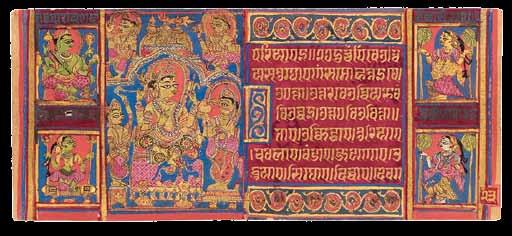
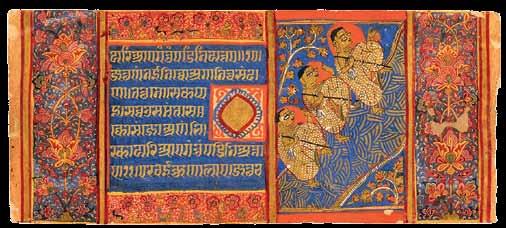
raginis, female personifications of ragamalas (musical modes).25 Ragamalas were emerging in this period as a subject for depiction in manuscript paintings, a theme that became important in Hindu painting a century later. Their appearance here seems to relate more to the celestial musicians who frequent Indra’s Heaven than to the later concept of vehicles for expressing independent emotional states.
6
Three monks fording a river: folio from a Kalpasutra-Kalakacharyakatha manuscript
Gujarart, possibly Patan, ca. 1475
Opaque watercolor, ink, and gold on paper, 45⁄16 x 101⁄4 in. (11 x 26 cm)
Los Angeles County Museum of Art, Gift of Dr. and Mrs. Pratapaditya Pal (M.87.275.3, f. 163)
Published: Pal, Indian Painting, vol. 1, 1000–1700 (1993), no. 20
This folio is illuminated on both sides, a rare occurrence in Jain manuscripts. It appears to illustrate a scene from the Kalakacaryakatha (Life of Kalacha), which often accompanies editions of the Kalpasutra as an appendix. This uniquely lavish manuscript is known as the Devasano Pado manuscript after the Jain temple library (bhandar) in Ahmedabad, Gujarat, where the other sections reside. The interlaced floral decor on the border panels clearly reflects the artist’s awareness of and responsiveness to fifteenth-century Islamic book illumination. The artists working for the wealthy Jain clients of this manuscript, identified in the colophon as bankers from the region of Broach, undoubtedly also enjoyed support from Muslim patrons.
th E gold E n ag E of mughal painting
1575–1650
John Guy
The period 1575 to 1650 encompasses the reigns of the Mughal emperors Akbar (r. 1556–1605), Jahangir (r. 1605–27), and Shah Jahan (r. 1628–58). The imperial court culture that developed under the direction of these three great emperors, resourced from the riches of an entire subcontinent, came to bedazzle the world. Ambassadors and merchants alike were sent from Iran, Spain, England, and many lesser powers to engage with this empire. Traders, missionaries, and diplomats first passed through the Portuguese enclave of Goa, and later the ports of Cambay and Surat, to do business with the Mughal court at Delhi, Fatehpur Sikri, or Agra.
When the young Akbar inherited this then fledgling empire, he also inherited a modest manuscript workshop, which his father, Humayun, had assembled during his exile in Kabul, and which came to Delhi with his invading army. Akbar clearly had empathy for the art of the book, and although reputedly semiliterate, he nurtured the creation of a great imperial library (kitabkhana) rich in illustrated manuscripts (Preface, Fig. 2).1 Akbar’s biographer Abu’l Fazl recorded that the emperor enjoyed daily readings of these works, adding that “among the books of renown there are few that are not read in His Majesty’s Assembly Hall.” 2 In a painting from the second edition of the Akbarnama, Akbar is seen in evening discourse with two Jesuits, the carpeted floor scattered with books (Fig. 15). This duo included Antonio Monserrate, whose memoirs of his visit to Akbar’s court at Fatehpur Sikri in 1580 provide an insight into the emperor’s inquiring mind.3
The kitabkhana was also home to the imperial atelier, whose scribes, painters, and librarians ensured that a steady flow of new manuscripts was added to the library. What manuscripts were produced was very much determined by the emperor himself. All three emperors of this period were instrumental in commissioning specific works and in many cases in directing which painter should receive the royal instruction. Abu’l Fazl tells us that Akbar visited
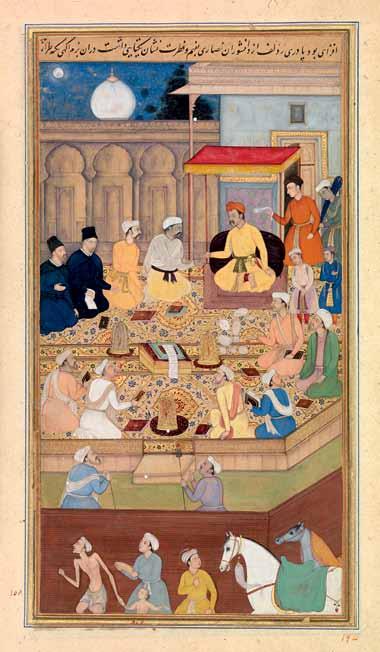
15. Akbar in discourse with the Jesuits Rudolf Aquaviva and Antonio Monserrate, at Fatehpur Sikri, 1580: page from the Akbarnama, painted by Nar Singh, 1597. Chester Beatty Library, Dublin (ms 3, f.263b)
the kitabkhana regularly, rewarding with salary increases those calligraphers and painters who pleased him with the excellence of their work.4 Over time, such intense royal attention inevitably shaped the development of style in the studio, as artists strived to win the attention and favor of their imperial patron. Each of the three emperors in turn directly and personally shaped style, although each in a different way, according to their own aesthetic and personal aspirations.
The imperial studio was not confined to the principal capital alone. Branch workshops appear to have functioned at secondary capitals, and painters who often held military rank and could be expected to serve in times of need routinely accompanied the emperor on tours and campaigns, recording events as instructed, rather in the manner of a war artist or photographer today. Manuscript paintings of the period provide accurate depictions of all the stages of book production, from paper making, burnishing, calligraphy and painting, marginal illumination, and gilding to finally binding (Fig. 16).5 For the first time in the history of Indian art, the artists were permitted to incorporate their own portraits in marginalia and, even more remarkably, on occasion in the primary pictures depicting the emperor himself.
Under Akbar, the imperial painting workshops expanded exponentially, employing some hundreds of artists and artisans recruited from across the subcontinent. Hindu painters made up a significant percentage and were singled out for praise in the A’in-i Akbari section of the Akbarnama for their remarkable skills.6 The catalyst for this expanded studio appears to have been the extraordinary demands that were placed on the atelier producing the Hamzanama. Iranian trained painters worked alongside Indian Muslim and Hindu artists, generating the fusion of styles that characterizes early Mughal art. To add to the mix, Akbar avidly collected all things exotic, and according to the contemporary observer Monserrate, he routinely had them copied in his imperial workshops.7 He was particularly fond of European paintings and engravings, which entered the imperial library collection largely as diplomatic gifts and as a form of evangelizing propaganda supplied by the Jesuits.8 A copy of the Royal Polyglot Bible (1568–72) was delivered to Akbar only two years after its publication in Antwerp (Fig. 17). These sources had an immediate impact on the direction of Mughal painting, providing new solutions to perspective and atmospheric rendering, tonal modeling and chiaroscuro, grisaille, and other modeling tools. Portraiture, especially
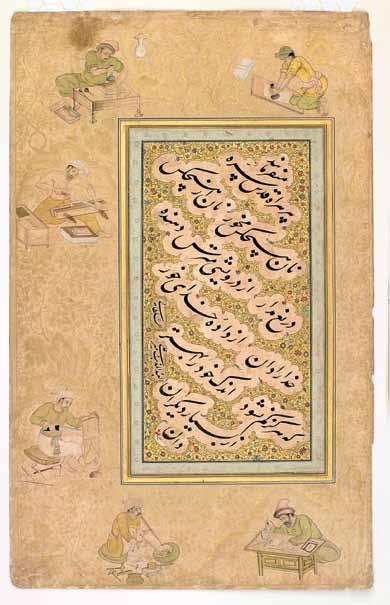
Calligraphic folio by Mir Ali, Iran, ca. 1550. Remounted with marginal paintings of the stages of manuscript production: page from a Jahangir album, ca. 1600. Freer Gallery of Art, Smithsonian Institution, Washington D.C., Purchase (F1954.116r)
the studied profile, took on a new importance as a signature motif of the imperial image.9 Again, the A’in-i Akbari provides the confirmation of this: “His Majesty himself sat for his likeness, and also ordered to have the likeness taken of all the grandees of the realm,” and “an immense album was thus formed,” the earliest reference to the assembly of an imperial muraqqa, a practice much favored by Jahangir and especially Shah Jahan.
25
Akbar with falcon receiving Itimam Khan, while below a poor petitioner (self-portrait of the painter Keshav Das as an old man) is driven away by a royal guard: page from the Jahangir Album
Mughal court at Lahore, dated 1589
Inscribed: signed and dated by Kesu Das, and scribal annotation identifying Itimam Khan
Opaque watercolor and ink on paper; painting 81⁄2 x 57⁄8 in. (26.7 x 15 cm); page: 211⁄8 x 151⁄2 in. (53.7 x 39.5 cm)
Staatsbibliothek zu Berlin, Preussischer Kulturbesitz (Ms. 117, fol. 25 a)
Published: Kühnel and Goetz, Indian Book Painting from Jahangir’s Album in the State Library of Berlin (1926), pl. 38; Beach, “Mughal Painter Kesu Das” (1976–77), fig. 17; Okada, Indian Miniatures of the Mughal Court (1992), fig. 99
An elderly man, stooped and emaciated, holds a scroll of paper upon which is written a salu tation to Emperor Akbar seen above with the artist’s name and date. Surprisingly, it is written in Hindi in devanagari Persian, the language of the Mughal court. This inscription makes clear that the humble petitioner is the artist himself. With great skill, Keshav Das created a rocky landscape in the Timurid manner to provide a two-tiered setting for his subject, ostensibly a scene depicting the emperor receiving a court peti tioner but in reality, concerned with the art ist’s plight and a sense of injustice. He is being prevented from meeting the emperor by a hostile guard in a scene that must be read as allegorical.
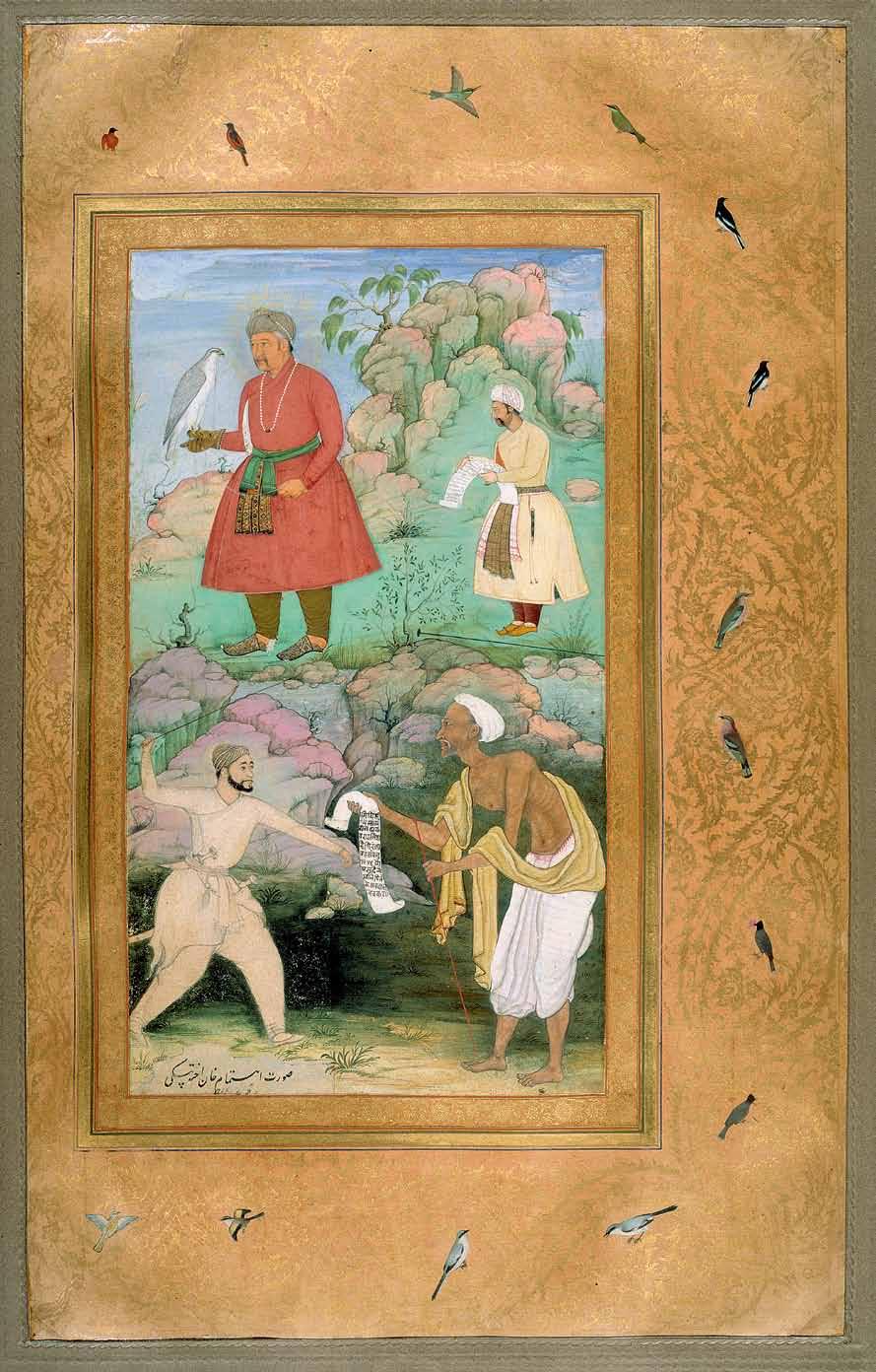
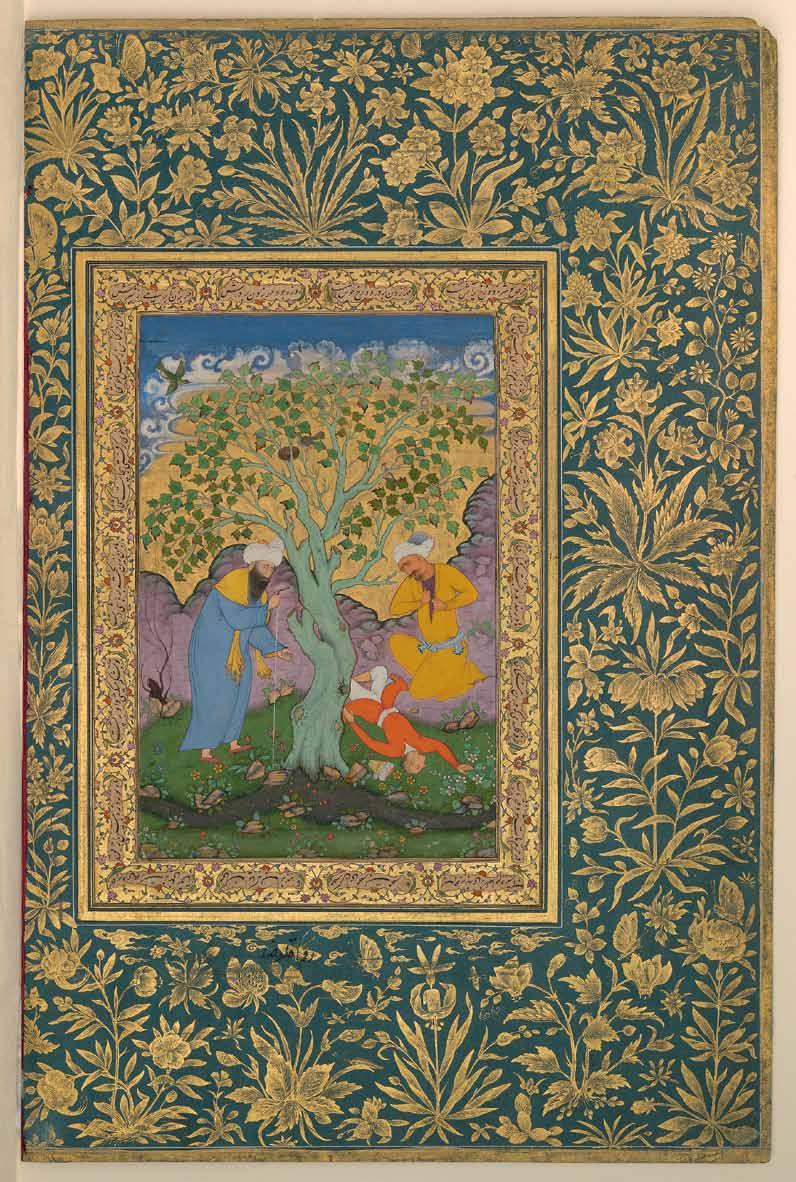
A youth fallen from a tree: page from the Kevorkian Shah Jahan Album
Inscribed: in Persian, “Painted by Aqa Riza,” “By its scribe, the sinful slave Mir ‘Ali,” and in the lower gilt margin, “Work of Fath Muhammad” Opaque watercolor, ink, and gold on paper; in. (21.7 x 13.7 cm);
The Metropolitan Museum of Art, New York, Rogers Fund and The Kevorkian Foundation Gift,
The Islamic World (1987),
This is a work of pure decorative abstraction, splendid in its descriptive detail and dazzlingly accomplished, yet devoid of any pathos and emotion that we might expect from the tragic event depicted, the death of a youth witnessed by his father. The pictorial elements the grassy landscape, the plane tree and its foliage, the surreally colored rocky outcrops, and all serve as foils for decorative excess. Color is used in a purely theatrical manner, the robes of the three actors forming a counterpoint to the gold backdrop of the tree foliage. Such an approach could not be removed further from the earthy realism increasingly in vogue at Akbar’s court. Aqa Riza was a master of the Safavid school, but in the context of Mughal painting of the early seventeenth century, his work appeared inherently conservative, indeed archaic.
Abu’l Hasan
Born in India ca. 1588–89, active at the Mughal courts in Allahabad and Agra 1600–1628; son of Aqa Riza
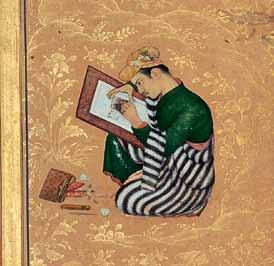
Asthe son of the eminent Mughal court artist Aqa Raza, Abu’l Hasan was tutored early in the skills of manuscript painting, a vocation to which he displayed precocious aptitude. The sensitively drawn and psychologically insightful Saint John the Evangelist (No. 28) was adapted after Durer’s original by Abu’l Hasan at the age of thirteen, and his first contribution to an imperial commission appears to be the 1604–10 edition of Anvar-i Suhayli (Lights of Canopus; British Library), while he was still in his teens. A portrait of the artist from this period by Daulat shows a youthful Abu’l Hasan working intently on his drawing board, his artist’s tools arranged in front of him (above). Major works followed, such as squirrels in a plane tree of about 1610 (British Library), which closely follows his father’s conservative Safavid style in its uncompromising flatness and gold ground, although some modulating of forms represents a concession to Mughal trends. Abu’l Hasan’s technical brilliance resulted in nature studies of dazzling fidelity; his spotted forktail (The Metropolitan Museum of Art) is certainly on a par with great hornbill (No. 36) by Mansur, who was regarded as the great naturalist painter of the Mughal age.
Abu’l Hasan’s heyday was in the last decade of Jahangir’s reign (r. 1605–28). His pictures appear prominently in collected works recording the celebrations of Jahangir’s accession, painted a decade after the event but incorporating portraits of contemporary personalities of the court, many identifiable through inscriptions in earlier portrait studies. Abu’l Hasan quickly emerged as the emperor’s favored portraitist and was given the singular honor of painting the frontispiece for Jahangir’s memoirs, the Jahangirnama. It was for this work that Jahangir awarded him the title Nadir al-Zaman (Wonder of the Times), in 1618.29 He was engaged by Jahangir to portray the emperor in a series of allegorical portraits. With the regime change in 1627, Abu’l Hasan ceased to be active. He was closely identified with the personality and patronage of Jahangir and so did not find favor when Shah Jahan succeeded, although one imperial portrait indicates this decline was not immediate.30 No work is known from beyond 1628.
Above: Portrait of Abu’l Hasan, by Daulat, from the Gulshan Album, ca. 1610. Golestan Palace Library, Tehran
Mansur
Active at Mughal courts in Delhi and Lahore in late 1580s, Allahabad 1600–1604, and Agra until ca. 1626
Ustad (master) Mansur received the highest accolade from emperor Jahangir, the title of Nadir al-Asr (the Wonder of the Age), for his ability to paint and preserve the likenesses of the animals and flowers that engaged the emperor’s attention. Jahangir devoted the longest passage given to any artist in Mughal history to Mansur, stating that “in painting, he is unique in his time.” 32 By studying the flora and fauna of India, Jahangir was continuing a tradition begun by his great-grandfather Babur, whose Baburnama has a section devoted to this subject.33 Jahangir prided himself in being the first to direct artists to record these marvels of nature in natural history paintings. And in this, no one surpassed Mansur.
Mansur appeared as a named painter in the late Akbari period, first as one working for a senior master (notably Kanha, Miskin, and then Basawan), and later independently. He is accredited by the library scribes for his contributions to the first edition of the Akbarnama (1589–90), Baburnama (1589) and Chinghiznama. It is the Baburnama that reveals for the first time Mansur’s unique gift for animal studies, for which he was quickly rewarded with the title of Ustad (master), presumably by Akbar himself. Mansur was also recognized for his gold illuminated and calligraphed frontispieces (sarlawh) and owner-title pages (shamsa), which were as esteemed as much as painting, if not more, in some connoisseur circles (No. 34). In one extraordinary joint work, Mansur employed his unsurpassed skills in gold work to depict the throne-dais on which Prince Salim sits imperially, in exile in Allahabad (No. 35).
Under Jahangir, whom he served first as a prince-in-exile at Allahabad, Mansur increasingly came to work on independent paintings intended to be gathered into imperial albums (muraqqas) rather than contribute to integrated illustrated manuscripts, Akbar’s favored format. Mansur worked principally in fine line brushwork with thin washes of pigment, capturing the exotic nature of his subject, which he placed against a lightly sketched ground sparingly described with tufts of grass or wildflowers. What set Mansur apart from his contemporaries, and natural history painters in general, was his deep empathy for his subject matter, the creatures and plants of India. He routinely accompanied the emperor on his numerous travels, witnessing and recording his subjects firsthand. In spring 1620, Jahangir toured Kashmir to admire its natural beauty, and he recorded in his Memoirs, “The flowers seen in the summer pastures of Kashmir are beyond enumeration. Those drawn by the Master Nadir al-Asr Mansur number more than a hundred.” 34 Mansur was always at hand to capture these wonders for Jahangir’s curiosity and aesthetic pleasure.
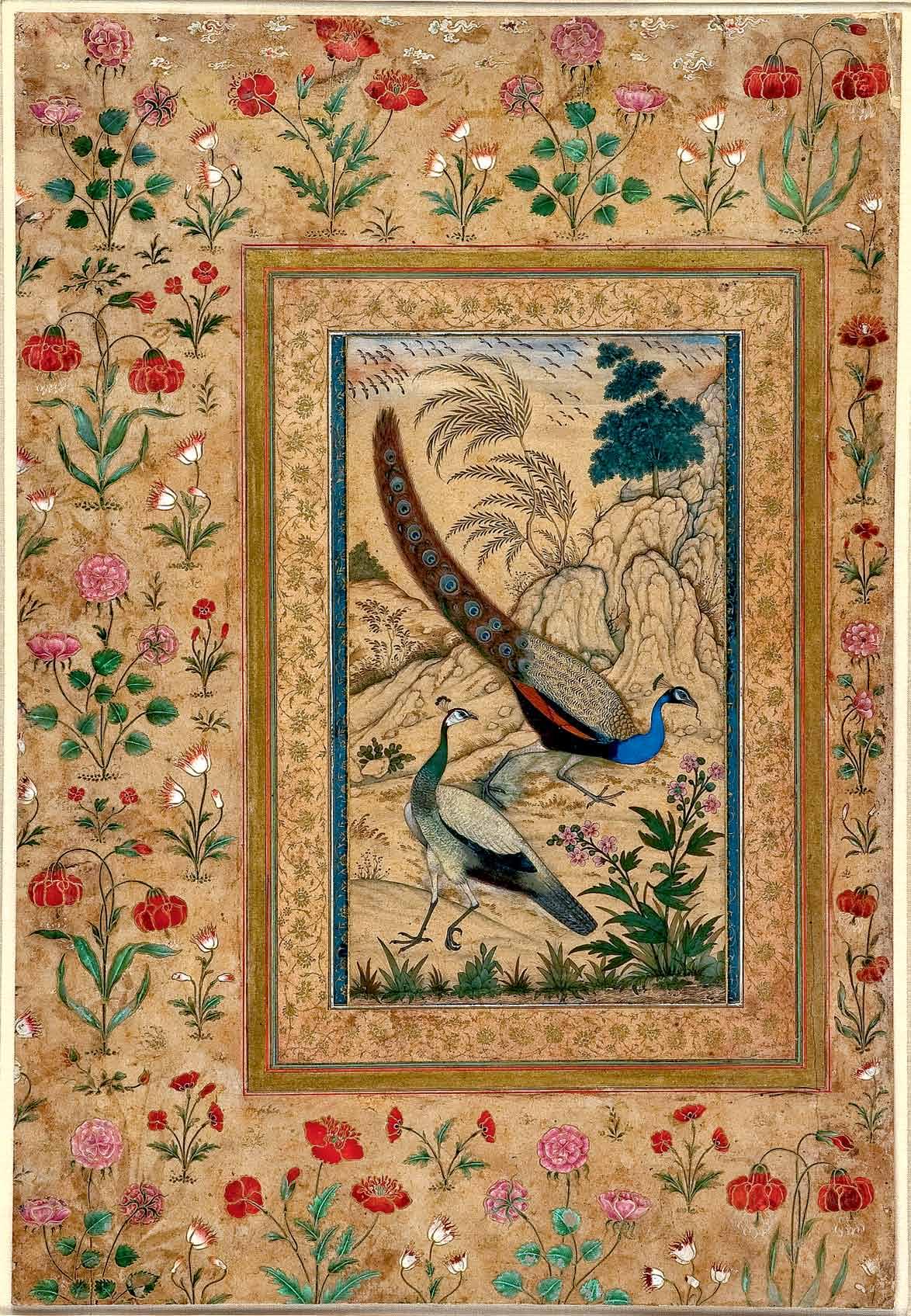
Balchand
Hindu artist active at the Mughal courts in Delhi, Lahore, Allahabad, and Agra, 1595–ca. 1650, brother of Payag
An Indian recruit who appears to have converted to Islam, Balchand entered the royal atelier in the last decade of Akbar’s reign and had a long career spanning the reigns of three emperors. He followed Prince Salam to his court-in-exile in Allahabad in 1600 and returned with him in 1605 to Agra, where he continued to serve at court under Shah Jahan into the early 1650s. As a junior member of the inner circle of painters at court, Balchand was entrusted in 1589 with a double spread in the Akbarnama (Victoria and Albert Museum, London) and in 1595 with painting the figures in the border decorations of a deluxe imperial edition of the Baharistan, rare privileges for his age.35 Although his work of this period does not warrant the confidence placed in him, he matured into a master painter excelling in portraiture and was entrusted with the most important commissions of his age. The grisaille-rendered figures termed nim qalam (half-colored) in Persian in the border decorations of a folio devoted to Faqir Ali’s celebrated calligraphy of 1606, demonstrate Balchand’s new mastery of figure studies. The marginalia of another folio in the series depict the stages of making a calligraphic album, notably paper making, burnishing, and the act of writing (compare Fig. 16).36
Balchand received his major imperial commissions under Shah Jahan, including a (retrospective) double-portrait of Jahangir and Akbar. As father and son are depicted in cordial and respectful attitudes, we can only assume that this was produced at Shah Jahan’s instruction to “re-write history.” Their relations were far from harmonious, the impatient Prince Salam having openly rebelled against his father. This and other works of the period demonstrate Balchand’s gift at psychologically penetrating portraiture, a talent he displayed to its fullest in the complex dardar scenes that Shah Jahan increasingly demanded. This reached its highest expression in the illustrations to the Padshahnama, prepared for the emperor under the direction of the historian Abdu’l Hamid Lahori (No. 38). Balchand’s paintings display a chromatic sophistication that enlivens and unifies his compositions.
That Balchand had some standing at court beyond that of a respected painter is indicated by the inclusion of a prominently positioned self-portrait in an imperial dardar scene (No. 38); 37 to do so otherwise would have been a dangerous presumption. He displayed a picture portfolio, emblematic of his trade, upon which is inscribed “the likeness of Balchand.” This is an artist who was confident of his place in the court order.
Above: Self-portrait of Balchand, ca. 1635. Detail of No. 38
38
Jahangir receives Prince Khurram at Ajmer on his return from the Mewar campaign: page from the Windsor Padshahnama
Mughal court at Lahore or Daulatabad, ca. 1635
Inscribed: signed below throne, “slave of the court, drawn by Balchand” and inscribed on portfolio held by figure at lower left, “likeness of Balchand” Opaque watercolor and gold on paper; painting: 1115⁄16 x 715⁄16 in. (30.4 x 20.1 cm); page: 2215⁄16 x 147⁄16 in. (58.2 x 36.7 cm)
The Royal Collection, Royal Library, Windsor (RCIN 1005025, fol. 43b)
Published: Beach et al., The Grand Mogul (1978), fig. 5; Losty, The Art of the Book in India (1982), no. 82; Smart, “Balchand” (1991), figs. 1–2; Beach and Koch, King of the World (1997), no. 5
Balchand was a master of composition, giving subtle form and strength to potentially unruly and congested darbar scenes, creating instead compact and ordered psychological dramas. In inferior hands, these scenes would become mere regimented formality, mechanical and routine. In Balchand’s, each participant has an individual presence, and the interactive dynamics among them creates an atmosphere of realism not encountered in darbars of lesser painters. His own portrait appears at lower left, with an artist’s portfolio under his arm.
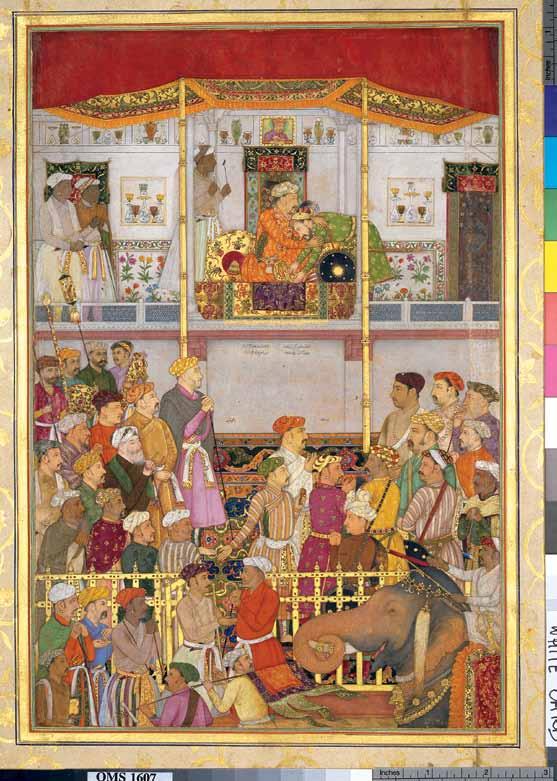
Bahu Masters
Active at the court of Bahu, Jammu region, ca. 1680–ca. 1720; possibly father and son or two brothers
The Ramayana, an extensive series that tells the story of Rama and Sita, serves as the first point of reference for the œuvre of these two masters at the court of Bahu, located near Jammu in the Pahari region. The manuscript, which originally consisted of more than 279 illustrated folios, exhibits stylistic variants suggesting that different painters worked on it at different times (and possibly even in different places). The pioneering scholar of Pahari painting William Archer was the first to distinguish four distinct styles in this vast work.13 While the folios that illustrate the first part of the epic are rendered in Styles I and II, the last parts of the story were painted in two disparate styles, a feature not uncommon in larger picture series that, we can assume, were produced over an extended period of time.
The world evoked in the pictures in Styles I and II, attributed to the first and second Bahu masters, is self-contained. Stylized fields of color and delicately executed patterns dominate in these works, which are related to the earlier pictures by Kripal and Devidasa in their color aesthetic. Here, stylized colors combine with thickly applied shell-lime white alternating with pricked gold.
To enhance the effect of the monochrome ground, the first Bahu painter frequently omitted a horizon line. His architectural elements have a purely decorative quality, while all his figures are related directly to the action; they recite, listen attentively, place a hand on a neighbor’s shoulder, or gesticulate. The second Bahu master shares the same color sense, but his picture elements are arranged more carefully. Certain facial types borrow from the repertoire of the first Bahu master (although with more rounded eyes). The narrative’s immediacy is broken by the horizon line inserted high above the picture, as though the painter wished to set the story of the gods in a recognizably earthly realm.
On the basis of stylistic indicators, other works that are not from the Ramayana series discussed here can also be attributed to both painters, notably pictures for musical scores (ragamalas) as well as princely portraits. One can assume that both the first and second Bahu masters were working in the same atelier and in all probability were related, possibly father and son, or brothers.
Above: Portrait of a Bahu Master, detail from a folio of the Shangri II Ramayama series. Bahu, Jammu, ca. 1680–95. National Museum, New Delhi (62.2487)
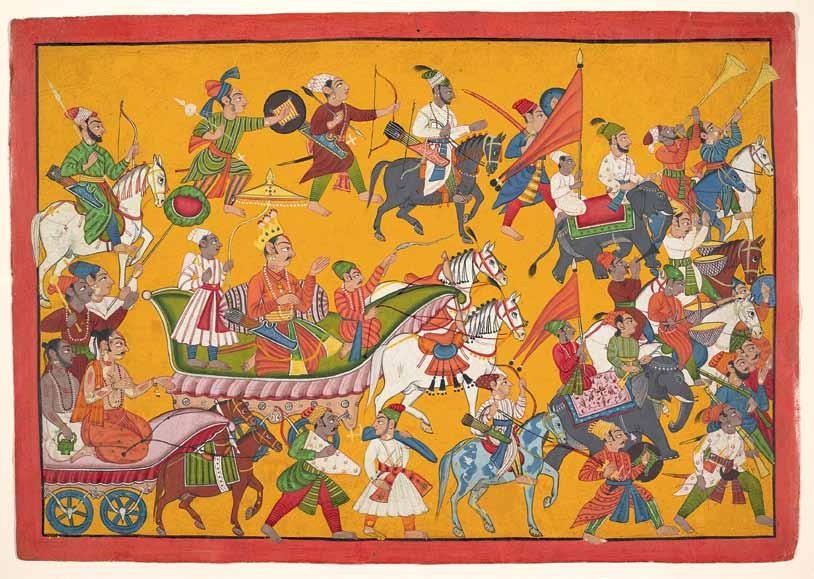
60
King Dasaratha and his retinue proceed to Rama’s wedding: folio from the Shangri II Ramayana series
Bahu, Jammu, ca. 1690–1710
Opaque watercolor and ink on paper; painting: 73⁄4 x 115⁄8 in. (19.7 x 29.5 cm); page: 83⁄4 x 121⁄2 in. (22.2 x 31.8 cm)
The Metropolitan Museum of Art, New York, Purchase, The Dillon Fund, Evelyn Kranes Kossak, and Anonymous Gifts, 1994 (1994.310)
Published: Czuma and Archer, Indian Art from the Bickford Collection (1975), no. 110; Kossak, Indian Court Painting (1997), no. 42
Rama’s marriage is the central event in the Ramayana. Here, King Dasaratha is seen on his way to the wedding, accompanied by an ostentatious retinue with standard bearers, trumpeters, and drummers. Similar compositions by the Second Bahu Master document
the return of the wedding party after the ceremony.14 A horizon line is included in those works, but it is missing in this one. The pictures of the Second Bahu Master also differ in other details, including the physiognomies of the figures. And, while here the wheels are spoked, they are solid in the pictures of the first masters.
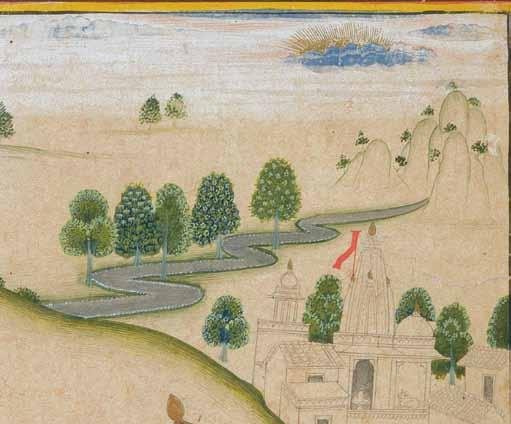
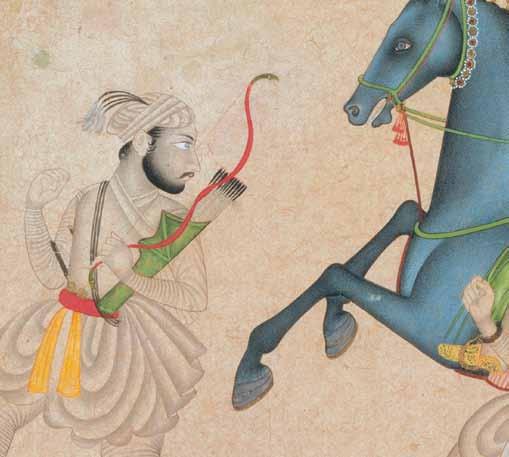
65
Maharana Amar Singh II riding a Jodhpur horse
Udaipur, Rajasthan, ca. 1700–1710
Inscribed: on reverse in devanagari script, “it is from Jodhpur”
Opaque watercolor and ink on paper; painting: 133⁄16 x 103⁄4 in. (33.5 x 27.3 cm); page: 1411⁄16 x 121⁄8 in. (37.3 x 30.8 cm)
The Metropolitan Museum of Art, New York, Cynthia Hazen Polsky and Leon B. Polsky Fund, 2002 (2002.177)
Published: Sotheby’s New York, December 10, 1982, lot 91, and March 22, 2002, lot 20
Numerous pictures exist that depict Amar Singh on horseback with attendants, clearly one of the Stipple Master’s favorite subjects. In such works, the focus is on the main subject, the horse, painted a radiant blue. The foreground is marked by only a few tufts of grass, and in the background, beyond the lightly shaded crest of the hill, there are a temple and a palace pleasure garden. The understated technique displayed by this artist has echoes of the Persian–Mughal painting technique of nim qalam, half-tone painting, a variant of European grisaille techniques of tonal painting.
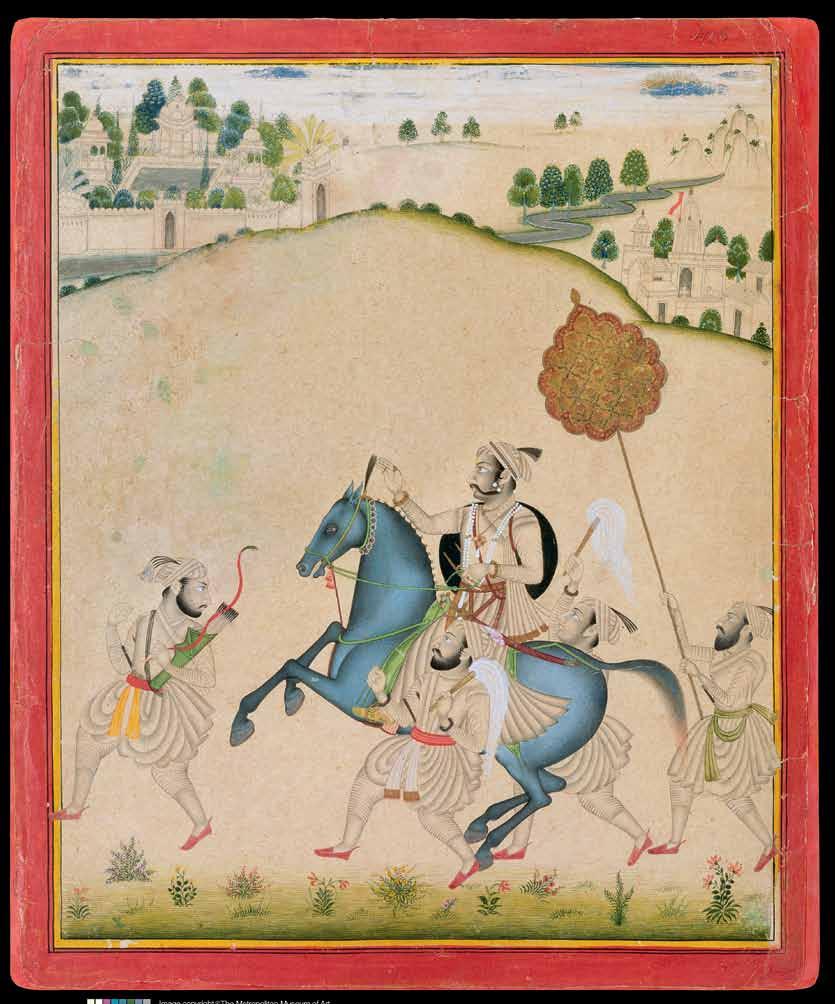
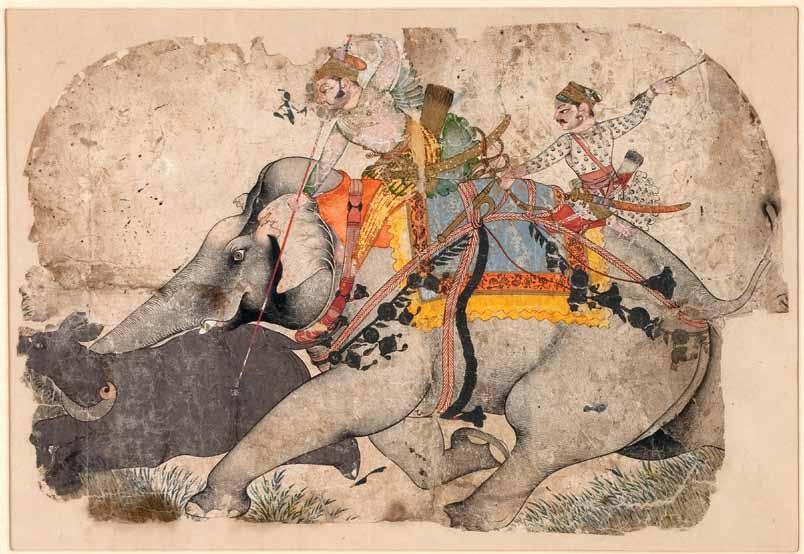
67
Ram Singh I of Kota hunting rhinoceros
Kota, Rajasthan, ca. 1700
Opaque watercolor on paper; page: 125⁄8 x 183⁄4 in. (32.1 x 47.6 cm)
Private Collection
Published: Lee and Montgomery, Rajput Painting (1960), no. 36; Beach, Rajput Painting at Bundi and Kota (1974), figs. 71–77; Welch, India: Art and Culture (1985), no. 242; Welch, Rajasthani Miniatures (1997), fig. 1
Although badly damaged, this hunting scene is one of the most dramatic known examples of the genre. The elephant as combatant was a favored subject in the court painting of Bundi, from which the Kota school evolved following the creation of that state by Shah Jahan in 1631. The subject of this painting, the elephant and two noble riders, are united as a single force, pitiless in pursuit of their prey. The Kota Master created one of the most
powerful renderings of the hunt in Indian art, with skilled tonal modeling of the beasts and restrained use of color that is confined to the elephant’s harnessings and blankets. Stuart Cary Welch wrote of this work that such is its compelling energy that it makes us “feel the thud of feet and the lashing of ropes, and hear the clang of bells.” 22
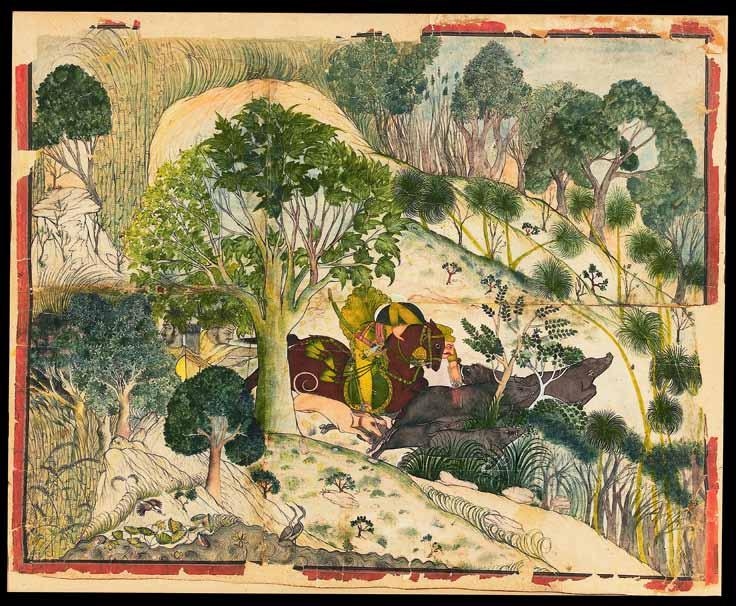
Rao Madho Singh of Kota hunting wild boar
Kota, Rajasthan, ca. 1720
Opaque watercolor on paper; page: 1911⁄16 x 241⁄2 in. (50 x 62.2 cm)
The Ashmolean Museum, Oxford, lent by Howard Hodgkin (LI.118.79)
Published: Topsfield and Beach, Indian Paintings and Drawings from the Collection of Howard Hodgkin (1991), no. 35; Bautze, “Portraitmalerei unter Maharao Ram Singh von Kota” (1988–89), fig. 14
The drama of the forest hunt depicted could hardly be surpassed. Madho Singh lunges forward, clutching the neck of his mount, to deal the deathblow to one of the boars with his punch-dagger (katara). The hunting dog and the rider’s tassels flying out behind underscore the dramatic movement as they dash through the wooded landscape. Despite the apparent spontaneity of this work, with its
confident application of light brushwork, the composition is in fact directly modeled on an earlier mural painting preserved at the neighboring state of Bundi.23 This relationship between wall paintings and works on paper underscores a wider phenonemon in Indian painting that, however, can be securely documented only rarely.
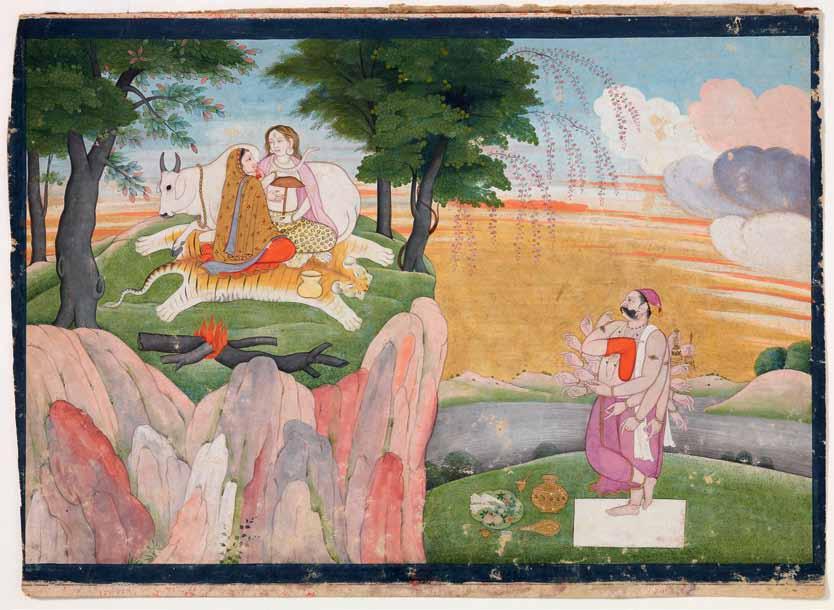
88
Banasura’s penance, his vision of Shiva and Parvati: folio from an Usha-Aniruddha series
Probably Chamba, Himachal Pradesh, ca. 1775
Opaque watercolor on paper;
painting: 81⁄16 x 11 15⁄16 in. (20.5 x 30.4 cm); page: 815⁄16 x 123⁄8 in. (22.7 x 31.4 cm)
Museum Rietberg, Zurich, Collection Eva and Konrad Seitz (B 41)
The subject of this series, the story of Usha and Aniruddha, is found in the tenth book of the Bhagavata Purana. One night, Banasura’s daughter Usha dreams of the handsome prince Aniruddha and surrenders her virginity to him. Banasura goes to war against Krishna over this stain on his family honor. But his life is saved thanks to the intervention of Shiva, and in the present painting, Banasura is seen
worshipping Shiva and Pavati enthroned on Mount Kailash. This work is attributed to Nikka (ca. 1745–1833), third son of Nainsukh, who enjoyed the patronage of Raja Raj Singh of Chamba and was granted land there, which his descendants still occupy to this day.
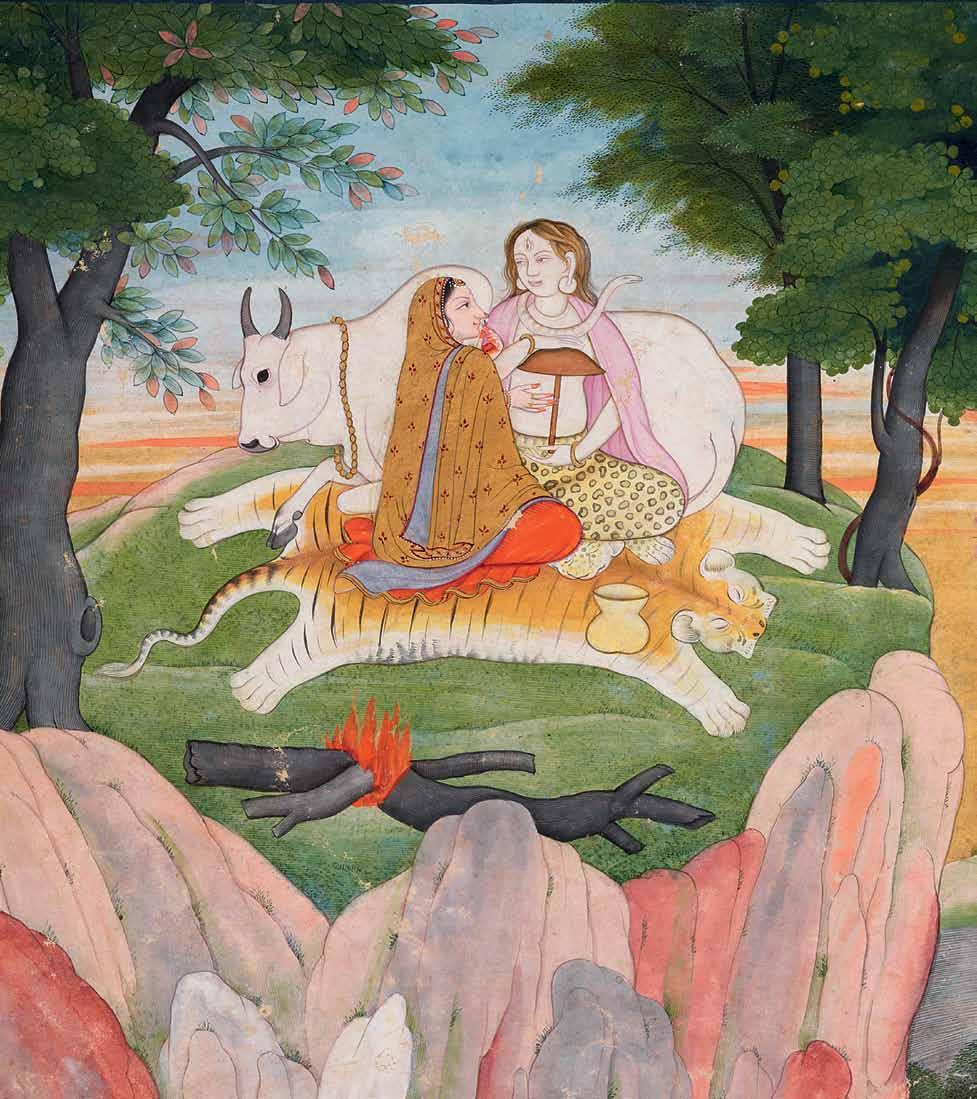
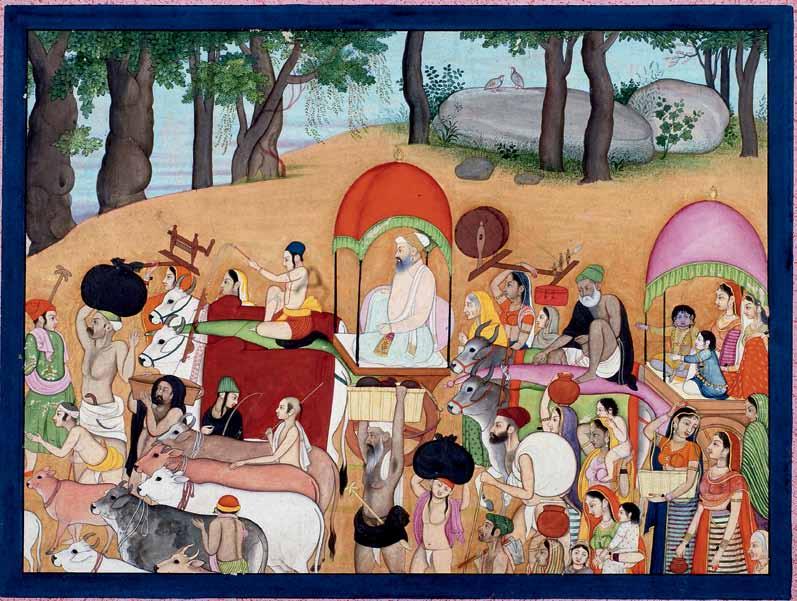
The Infant Krishna journeying from Gokula to Vrindavan: folio from a Bhagavata Purana series
Guler, Himachal Pradesh, ca. 1780
Opaque watercolor on paper, 107⁄8 x 14 in. (27.6 x 35.6 cm)
National Museum, New Delhi (49.19/239)
Published: Randhawa, Kangra Paintings of the Bhagavata Purana (1960), pl. 5
In the classic image of journeying in India, we are so taken up with the evocative description of the everyday toils of traveling that we
could overlook the subject of the painting, the infant Krishna, who is seen at right seated on a simple buffalo-drawn carriage. This is Krishna’s version of the biblical Flight into Egypt; he was sent from his palace to the countryside to live with foster parents in order to escape a prediction of infanticide. The intensity of the foreground activity contrasts with the quiet calm of the landscape beyond, which is a forecast of Krishna’s happy childhood years to be spent in the village of Vrindavan with his foster parents, Yasoda and Nanda.
“The most important Indian painting exhibition for decades, “Wonder of the Age” has much to engage, delight and educate specialists and is as inspiring an introduction as a neophyte could hope to find. If you cannot go in person to New York, be sure to buy the catalogue. It is an education and a treat.”
—The Economist
ART
Wonder of the Age
Master Painters of India 1100–1900
John Guy and Jorrit Britschgi
224 pages, 165 colour illustrations
3 maps
9.25 x 10.25” (235 x 267 mm), hc
ISBN: 978-81-89995-60-7 (Mapin)
₹2100 | $45 | £30
2011 • World rights
John Guy is Florence and Herbert Irving Curator of the Arts of South and Southeast Asia, Department of Asian Art, The Metropolitan Museum of Art , New York.
Jorrit Britschgi is Curator of Indian Painting, Museum Rietberg, Zurich.
Jacket illustrations: (front) Shah Jahan riding a stallion: page from the Kevorkian Album, Mughal court at Agra, ca. 1628. Detail of No. 40; (back) Krishna flirting with the gopis to Radha’s sorrow: folio from a Gita Govinda series, Kangra, Himachal Pradesh, ca. 1760. Detail of No. 95
Jacket design by Rita Jules, Miko McGinty Inc.
other titles of interest:
The Metropolitan Museum of Art 1000 Fifth Avenue New York, New York 10028 www.metmuseum.org
The Imperial Image: Paintings for the Mughal Court by Milo Beach
Vishnu: Hinduism’s Blue-Skinned Saviour Edited by Joan Cumins
Mapin Publishing www.mapinpub.com
o ther titles of interest:
The Imperial Image: Paintings for the Mughal Court by Milo Beach
John Guy is Florence and Herbert Irving Curator of the Arts of South and Southeast Asia, Department of Asian Art, The Metropolitan Museum of Art , New York.
Vishnu: Hinduism’s Blue Skinned Savior edited by Joan Cumins
Mapin Publishing www. mapinpub.com printed in singapore
Jorrit Britschgi is Curator of Indian Painting, Museum Rietberg, Zurich.
P rinted in sin G a P ore
Jacket illustrations: (front) Shah Jahan riding a stallion: page from the Kevorkian Album, Mughal court at Agra, ca. 1628. Detail of No. 40; (back) Krishna flirting with the gopis to Radha’s sorrow: folio from a Gita Govinda series, Kangra, Himachal Pradesh, ca. 1760. Detail of No. 95
John Guy is Florence and Herbert Irving Curator of the Arts of South and Southeast Asia, Department of Asian Art, The