Himalayas THE WATER TREASURES OF
43augmente d ytilaer soediv

43augmente d ytilaer soediv
A billion lives depend on the waters of the Himalayas; sixty million live in this mountain range, while the rest live in its foothills, on the plains of the Indian subcontinent. For them, the Himalayas are a providential water tower. Despite their astonishing diversity, all these peoples share the common belief that this is a “Sacred Land”, and this mountain range is, above all, the “Abode of Snow” where pure water springs, rivers gush and lakes are crystal-clear.
Born from the eternal snows, in the most mystical land on earth, water perfectly embodies the essence of purity. In the Himalayas, water inspires a growing number of people even while it continues to frighten them. It can at times unite them and at other times divide them, provide for them and bring death. In this mosaic of peoples, languages, religions and lands, it plays a vital part in the geographical distribution of the various ethnic groups, their social organization and the way they see themselves.
This volume offers a complete view of the great Himalayan mountain range by taking an itinerary which follows the water and contrasts the two flanks of this formidable climatic barrier. By doing so, it stresses both the importance of this water tower of Asia, which provides for a thousand million people, and the scope of the current economic and ecologic issues which are at stake. It also offers an anthropological insight into the various bonds formed between man and water in the Himalayas.
This book has been enhanced with 43 augmented reality videos, each linked to a photograph marked with the symbol. To play the videos, please follow the instructions given on the copyright page.
With 215 colour photographs.
Serge Verliat and Jean Philippe
Publishing
First published in English in India in 2017 by Mapin Publishing Pvt. Ltd
706, Kaivanna Panchvati, Ellisbridge Ahmedabad-380006
T: +91 79 40 228 228 | F: +91 79 40 228 201 E: mapin@mapinpub.com | www.mapinpub.com

The work is published with the support of the Publication Assistance Programmes of the Institut français.
Originally published in French in 2013 by ARPEC, Reunion Island, France
All rights reserved under international copyright conventions. No part of this book may be reproduced or transmitted in any form or by any means, electronic or mechanical, including photocopy, recording or any other information storage and retrieval system, without prior permission in writing from the publisher.
Text © Serge Verliat
Photographs © Jean Philippe
ISBN: 978-81-89995-89-8 (Mapin)
ISBN: 978-1-935677-57-4 (Grantha)
LCCN: 2015952927
English Translation by: David Jones and Sarah Patel Jones
Edited by: Suguna Ramanathan / Mapin Editorial
Proofreading: Ankona Das / Mapin Editorial
Editorial Assistance: Neha Manke / Mapin Editorial
Production Assistance: Gopal Limbad / Mapin Design Studio
Designed by: Jean Philippe
Printed at Tien Wah Press, Malaysia
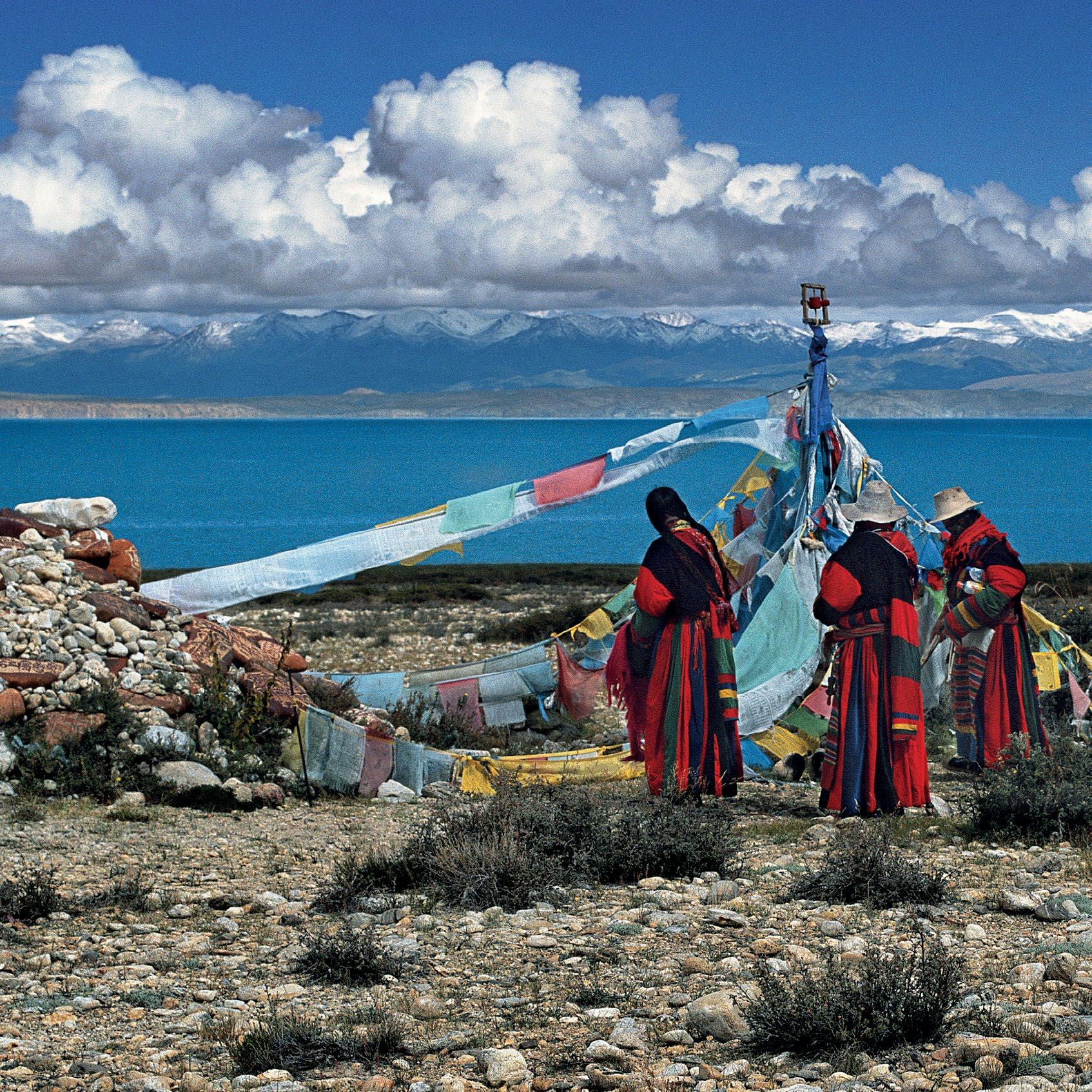
front cover Prayers during the khora around Mansarovar Lake (see pp. 208–209)
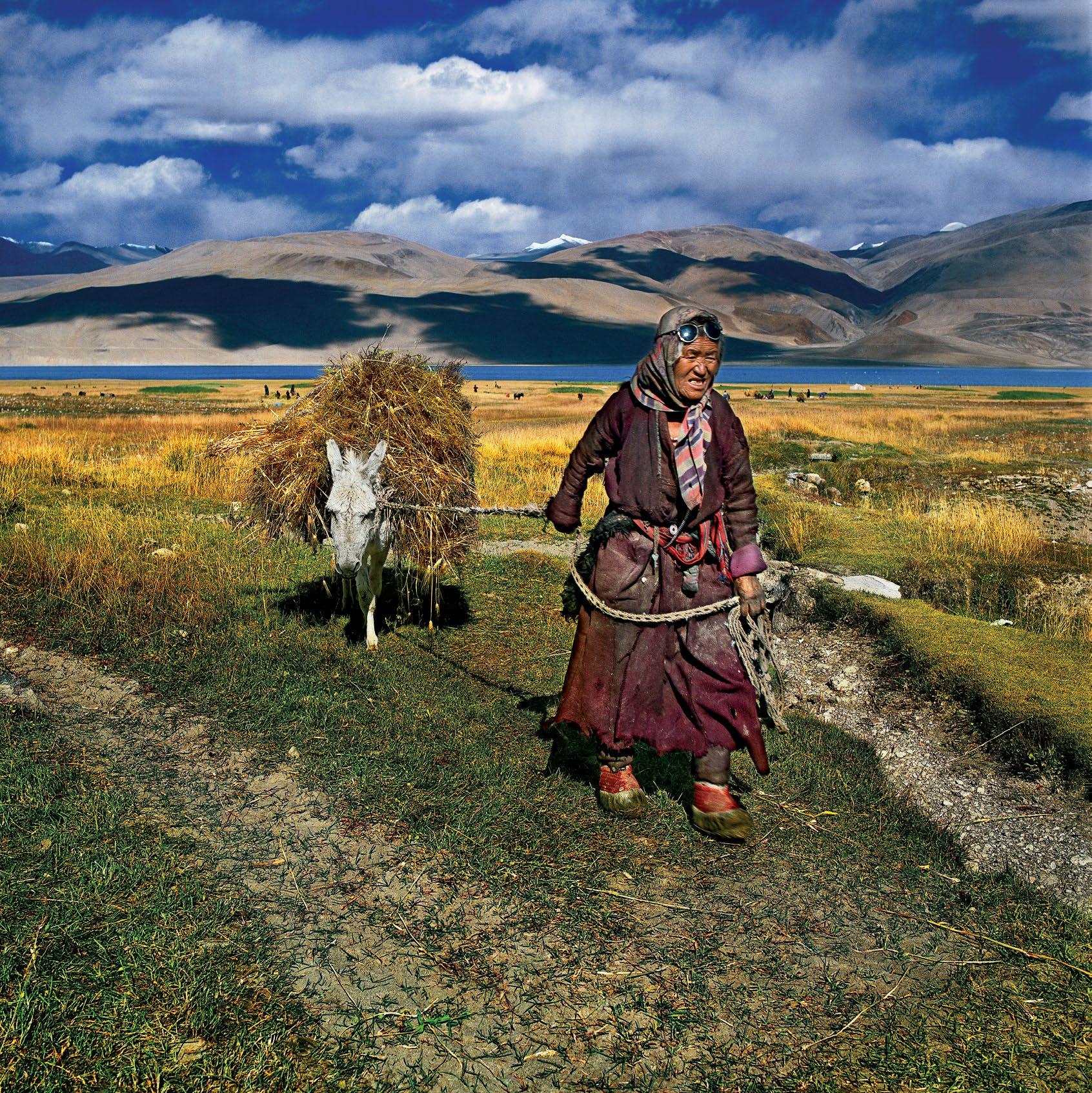
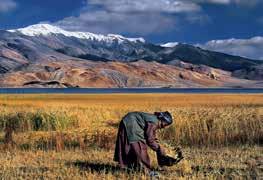
back cover Reaping the barley, Korzok Oasis, Ladakh (see pp. 39)
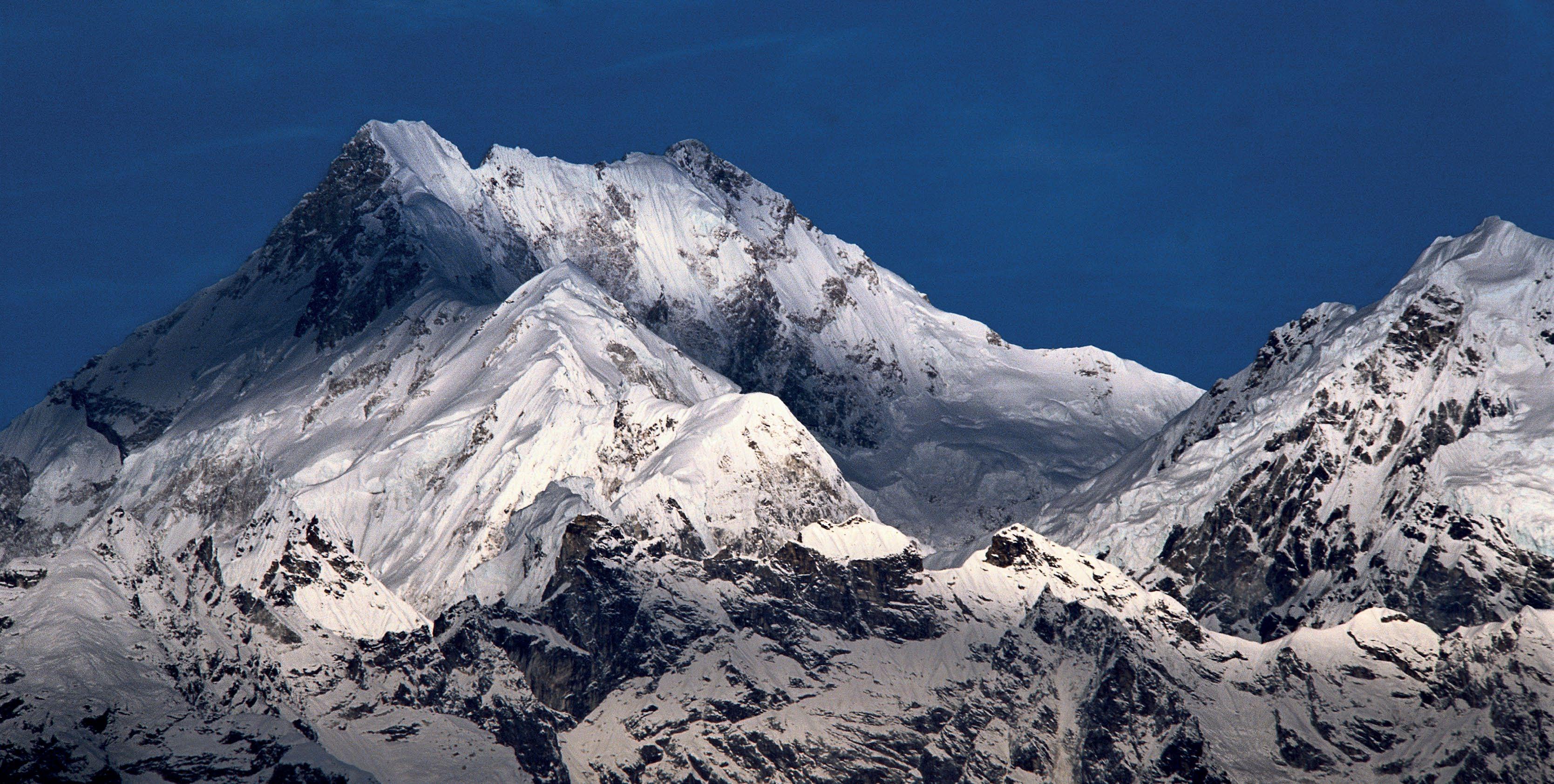
pages 2–3 Mount Kanchenjunga, 8586m high, view from Singhit (Sikkim)
Legend has it that its pure and untouched snow was used to create and shape the original human couple, from whom the Lepchas, the first inhabitants of this massif, are descended. Tibetans from Sikkim, who arrived later, worship it under the name of Kuvera, the God of Abundance. For Indians, it is simply the purest of the pure.
This book has been enhanced with 43 augmented reality videos, each linked to a photograph. These are marked with the symbol in the bottom corner.
To view the linked videos, please download the Aurasma app (available for iOS and Android). Once you have registered, search for the channel ‘Water4epub’, and click ‘Follow’.
Open the app, point your mobile camera at the photograph and the video will begin to play automatically.
Page numbers for pictograms with Augmented Reality videos: 14–15, 17, 18–19, 28, 32, 36–37, 38, 46, 50, 54–55, 59, 66, 73, 79, 82–83, 87, 89, 93, 94–95, 96, 99, 100–101, 120, 121, 127, 133, 138–139, 149, 157, 161, 165, 169, 172–173, 181, 182–183, 192, 194, 200, 202, 206–207, 208–209, 210, 214–215.
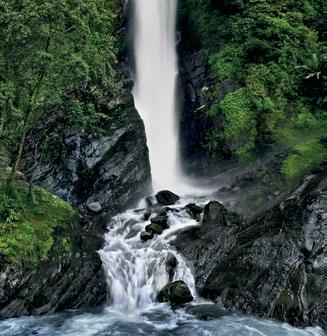
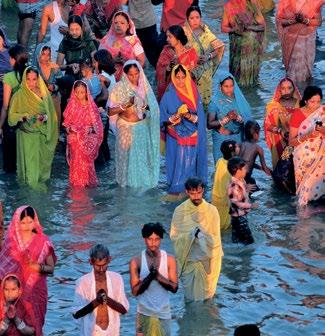
White peaks, spearing the sky and shrouded in snow, look broodingly down over the millions living in the folds and at the foothills. We are in the Himalayas, the highest mountains in the world, givers of water and life. Water, pure and crystal clear, is the gift of these mountains to those who live there.
The Sanskrit word Himalaya means Abode of Snow. When the sun shines the snow melts, the landscape is magically transformed by springs, gushing rivers and glittering lakes. The people in the mountains and at the foothills may be astonishingly diverse, but all are bound by a common belief that this is Sacred Land. The ice, turning into stalagmites that look like eternal flames, seems to bear witness to the divine forces that dwell here. Each mountain is a god; the entire universe is a temple.
So striking is the beauty of the place, so pure the air and radiant the light, it is no wonder that the clear water seems to embody the very essence of purity. It comes as free gift, bearing life and joy, a sign of the benevolence of the gods.
One coming from the West sees it quite differently. The first glimpse is from the air, and as the aircraft sweeps the sky and we look down, the great range appears as an effective barrier between two worlds. South of the range lies the green and wooded Indian flank receiving the full force of the monsoon rains. To the north, behind the highest peaks, the eye picks out the ochre deserts of the Tibetan plateau where little rain falls.
From the air the Himalayas look like, and indeed are, an impressive water tower, from which those springs and rivers flow. We may be in a sub-tropical region of the world, but more than 15,000 glaciers in these mountains feed into as many rivulets, which in turn merge into three mighty rivers, the largest in Asia. The Indus waters the driest
western part of the range; the Ganges collects all the waters from the southern slopes that tower over the vast Indian plains; and the great Brahmaputra is formed by the waters from the northern slopes, above which the Tibetan plateaus lie under the blue skies at a height of 4000 feet.
The daily volume of fresh water flowing from the Himalayas would, we are told, fill an enormous tank one kilometre wide, six kilometres long and one kilometre high. If one is thinking of tanker trucks, this is roughly equivalent to a convoy from the Earth to the Moon and back. The Himalayas are truly the impressive ‘Water Tower of Asia’.
This uninterrupted series of valleys and crests makes one wonder where exactly the beginning and the end of the Himalayas might be. It seems arbitrary to mark boundaries to a mountain range. The issue can be debated but it seems reasonable to say that it stretches, both geologically and ecologically, from the Karakoram and Hindu Kush mountains in the west, to the Indo-Burmese ranges of South-East Asia in the east.
For the sake of convenience, geographers use the major gaps in the landscape that comprise the valleys of the greatest rivers: the Indus to the west and the Brahmaputra to the east. Thus defined, the Himalayas extend over 2700 km.
The height of the mountains, their vertical extension, is stupendous. To appreciate its prodigious scale, there is nothing better than walking. One has to climb steep paths, go down into deep ravines, climb interminable stone steps, go round dangerous piles of fallen rocks, all to gaze upon the still-distant, ever-inaccessible peaks glowing in the light of the setting sun long after the valley has begun to shiver in the dark. By day there are other rewards on offer, as when, through a gap in the clouds, a snow-covered peak
appears against a patch of blue sky. It is then that the height of the mountain seems prodigious. Cut off from its base, as if uprooted, the summit seems to float in the sky, high above the human world. For visitors from the West, the Himalayas open up a world of wonder. As the extraordinary spectacle evokes romantic dreams, all marvels seem possible! Apart from the poetry and pristine beauty of the landscape, one cannot but be struck by the power of this mountain range.
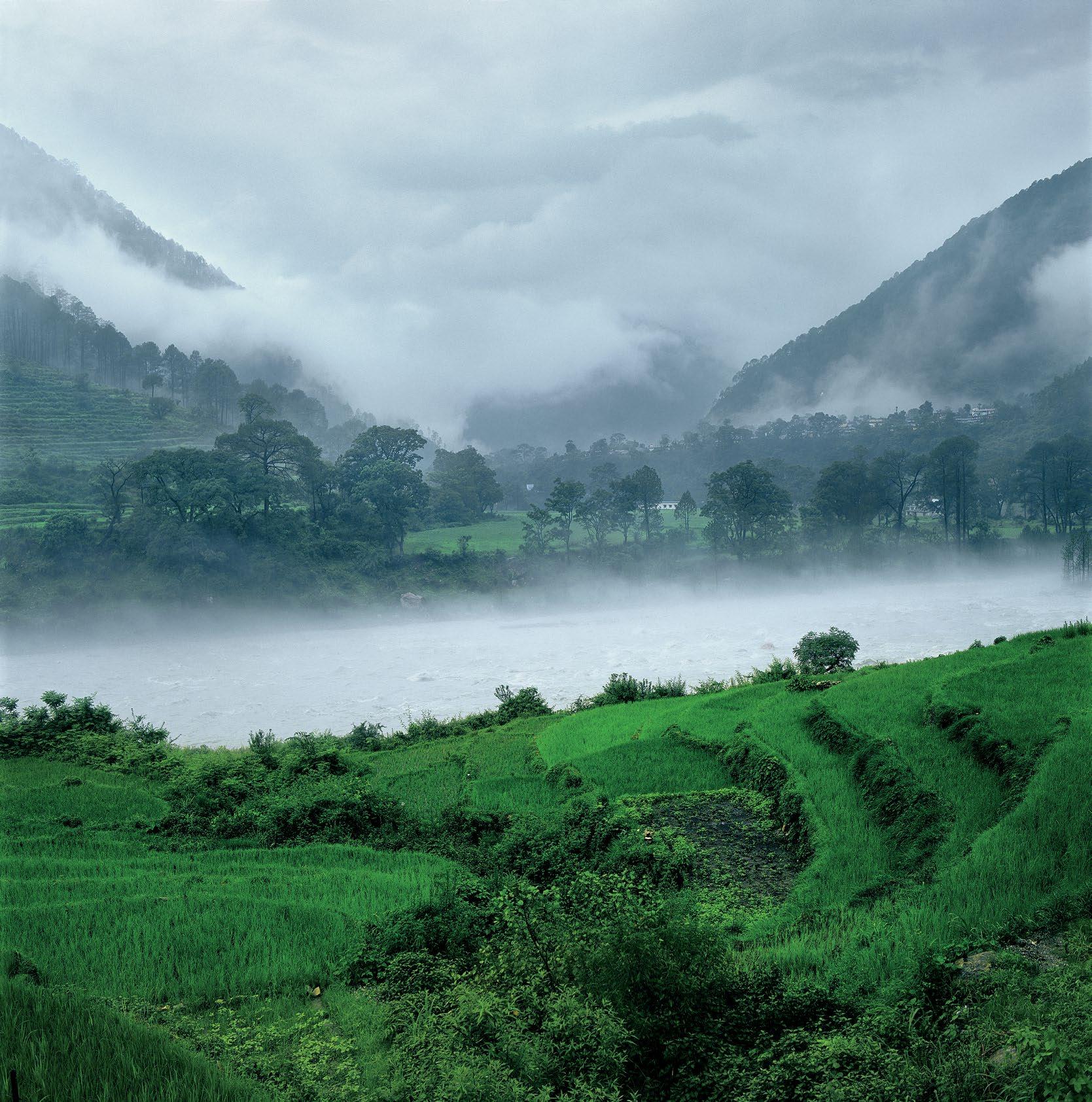
From the glaciers to the foothills, the Himalayan rivers take an impressive geographical short-cut. In the space of a mere hundred kilometres, they go from a polar region to an overheated tropical plain, tumbling from an altitude of over 5000 to 300 metres. No wonder the gorges are so deep and the rivers foam white!
Crossing them is not to be taken lightly. The bottoms of the gorges are such hostile places that men and women prefer the heights. On the southern flank, in the hilly region which spreads from 1000m to 4000m altitude, the rivers have long kept people apart. Conversely, on the other side of the Himalayas, about 30 kilometres away as the crow flies, people gather round the rare streams that can be used for irrigation.
In the Himalayas, while water divides people geographically, it is people who are divided over the question of water. For some, it is natural to share the water, but for others it is much more complicated. How can one share this pure and precious water with someone considered less pure? The gift of the gods has become a cause for discrimination!
However, all are subject to the same vagaries of the water cycle. Here, in these pastoral farming communities,
everyone is aware of the impact of the rains on their lives. Drought is synonymous with famine for these peasants who are practically self-sufficient. But these much-awaited, life-giving rains are also much feared. In these Dantesque mountains, each storm casts a shadow of death and desolation.
For almost everybody here, water has always been above all the essential factor for farming. Today, however, new factors must be taken into account: demographic growth, urbanization and globalization are creating new needs.
The water resources of the Himalayas are like virtual hydroelectric ‘manna’ from heaven. Nepal, with a potential production of 80,000 megawatts, could become the second highest producer in the world, behind Brazil but ahead of the United States! A tantalizing prospect in a country where power cuts occur as often as three times a week in parts of its capital city!
In the Himalayas, water inspires a growing number of people even while it continues to frighten them. It unites them at certain times and divides them at others, provides and deprives, gives life and brings death. In this mosaic of peoples, languages, religions and lands, it plays a vital part in the geographical distribution of various ethnic groups, their social organization, and the way they see themselves.
The aim of this book is to share with you the astonishing variety of bonds formed between human beings and water in the Himalayas. So let us follow the course of the Himalayan rivers, starting from the northern region.
Double page précédente :
Le mont Kanchenjunga, 8586 m - Vue depuis Singhit (Sikkim)
Ses neiges pures et vierges auraient servi à modeler le couple humain originel dont les premiers habitants de ce massif, les Lepchas, sont les descendants. Arrivés plus tard, les Tibétains du Sikkim le vénèrent sous le nom de Kuvera, dieu de l’Abondance. Pour les Indiens, il est le plus pur des purs.
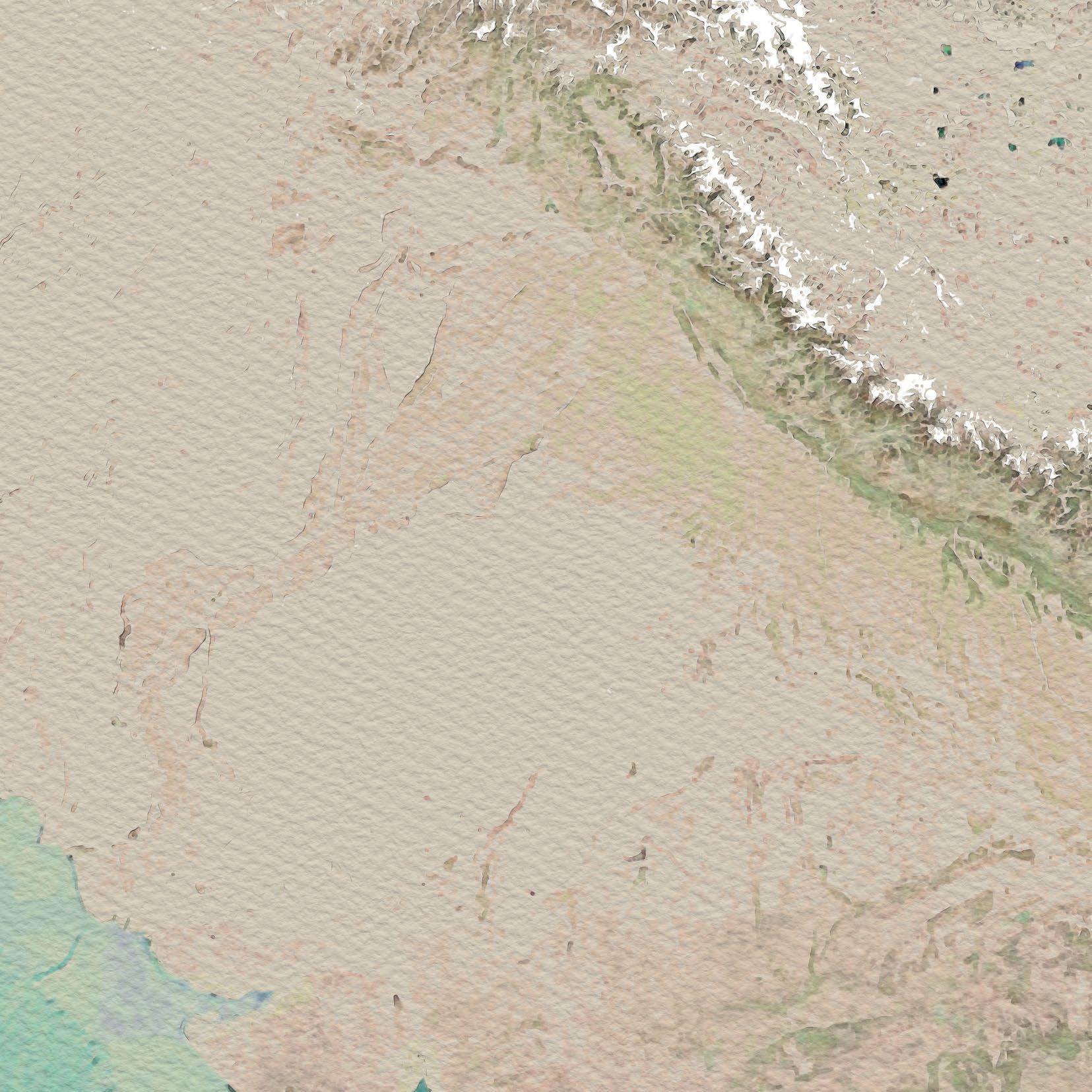
Based upon Survey of India maps with the permission of the Surveyor General of India. ©2017, Government of India. Responsibility for the correctness of internal details shown on the main map rests with the publisher.
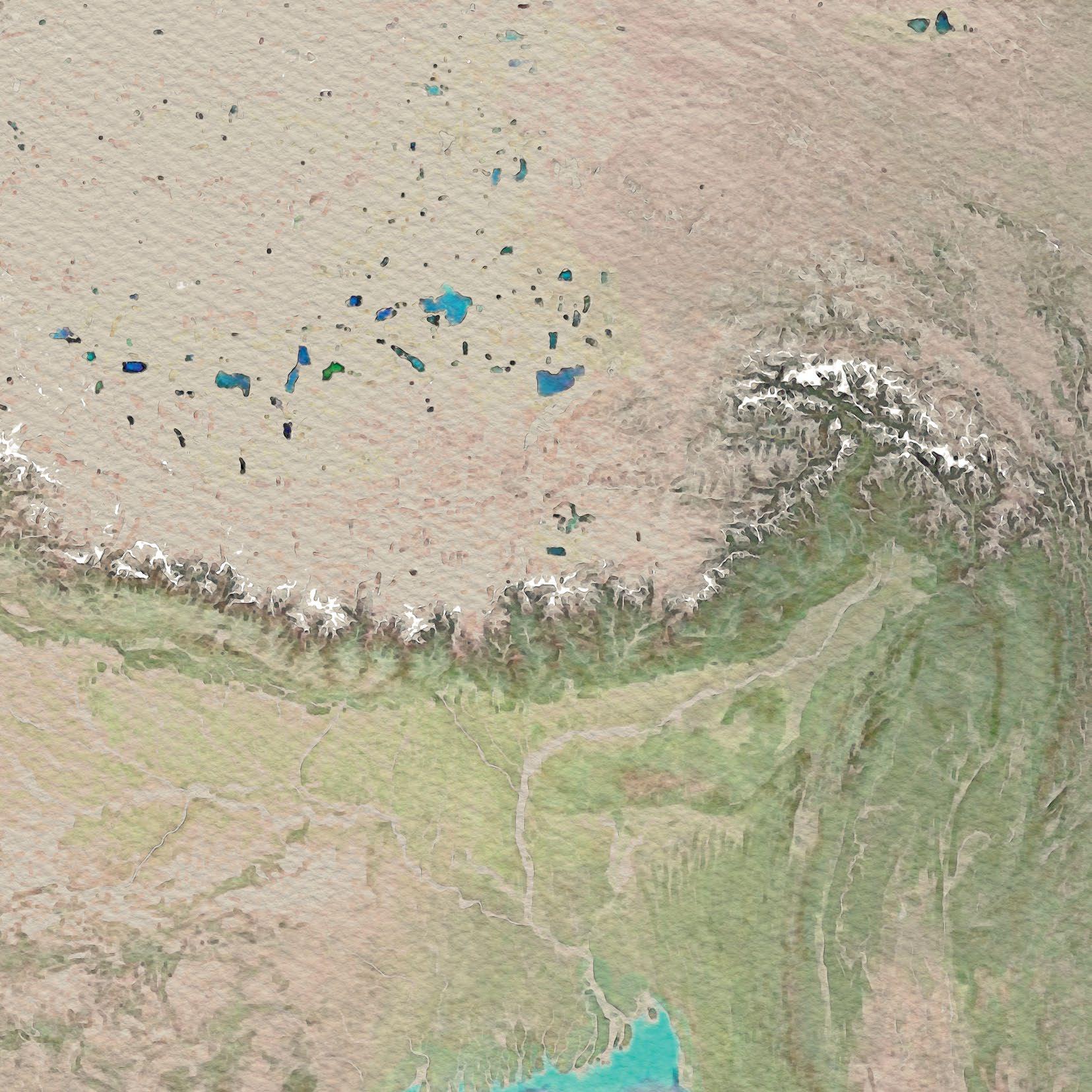
Karnali Salween
Annapurna
Phewa
Pokhara
Yarlung Tsangpo
Shigatse Patna
Peku tso
Everest
Kathmandu
Janakpur
Kanchenjunga
Sikkim
Gangtok
Darjeeling
Assam
Arunachal Pradesh
Brahmaputra
Mekong Yangtze
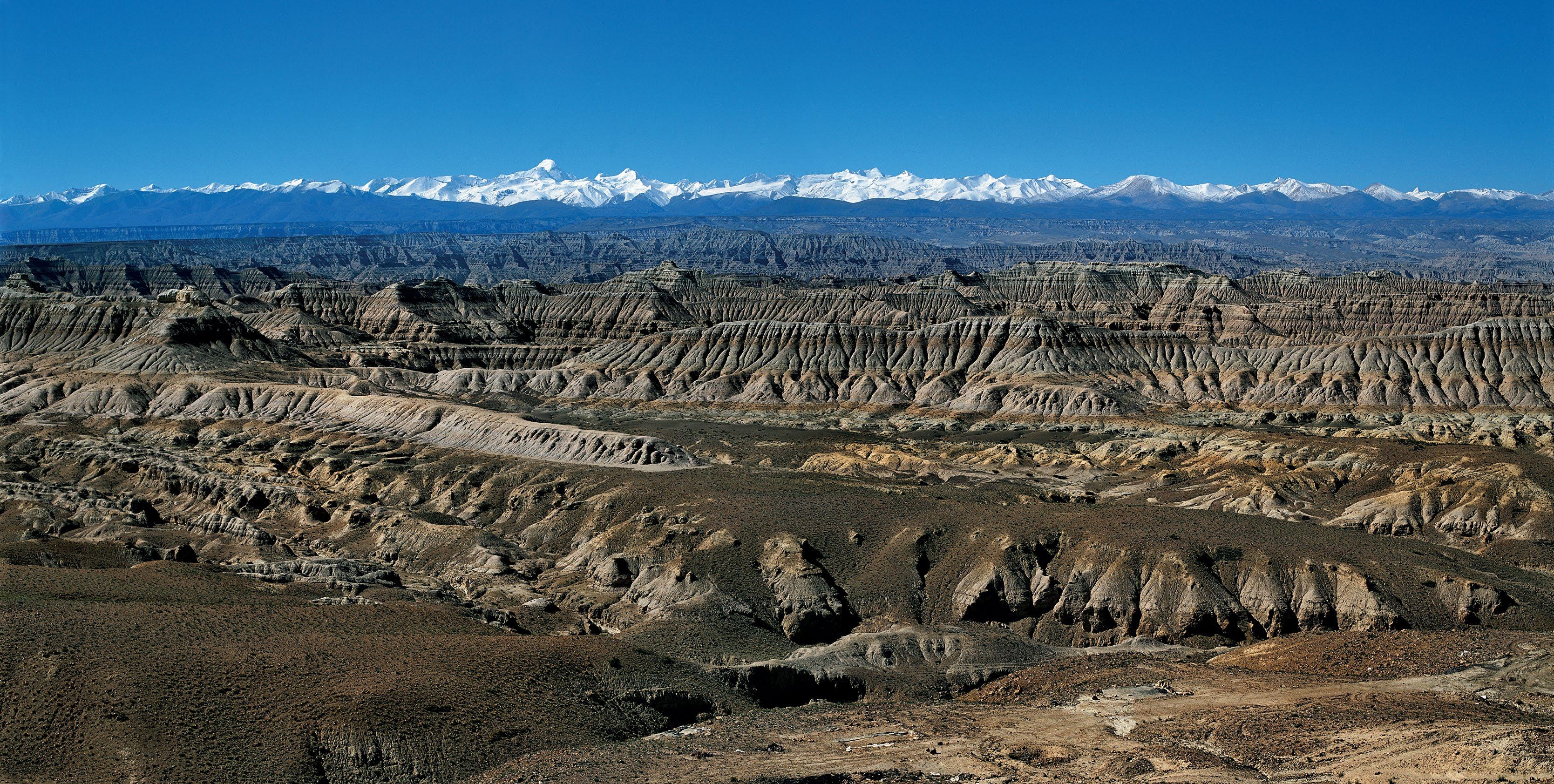
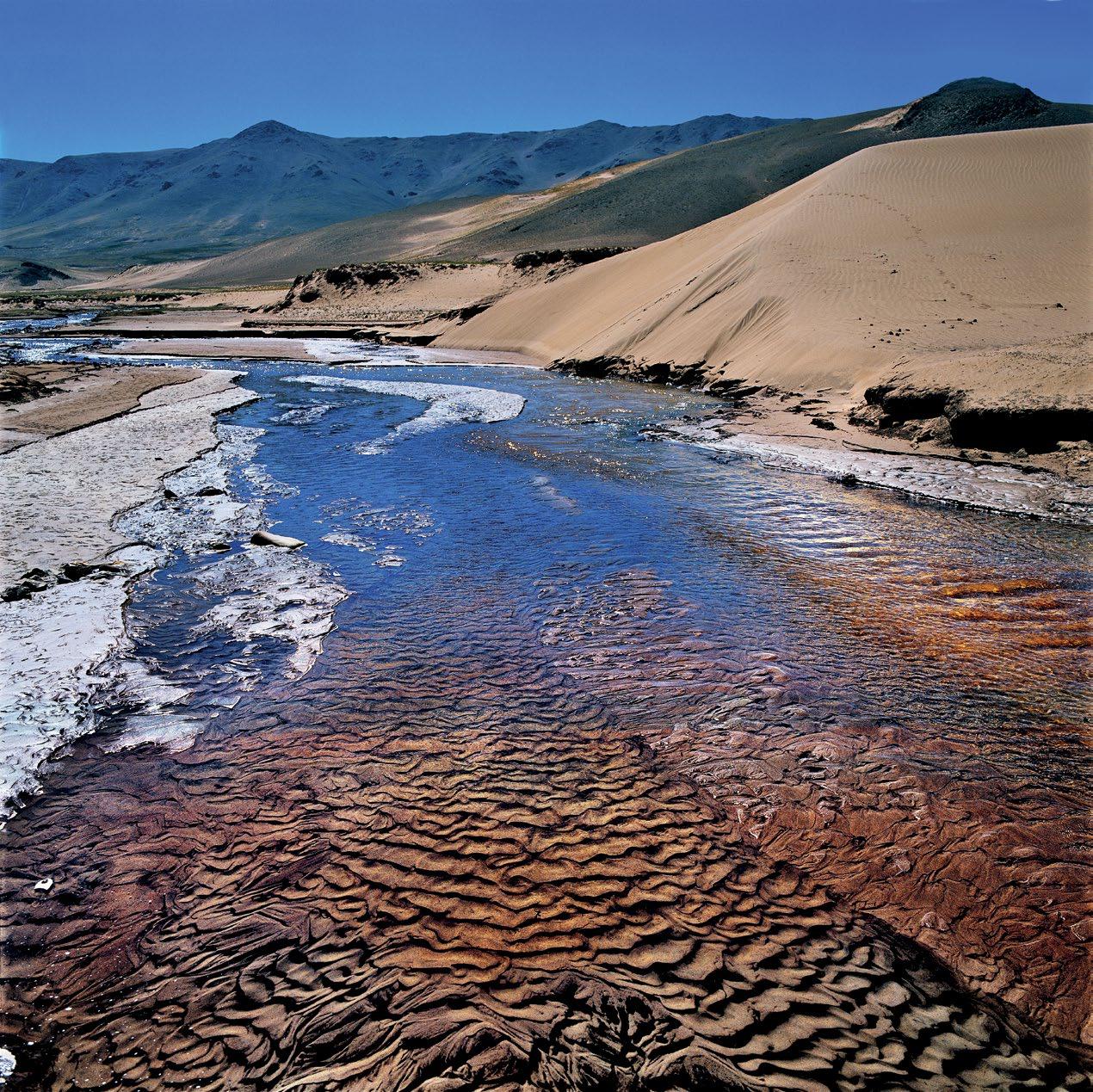
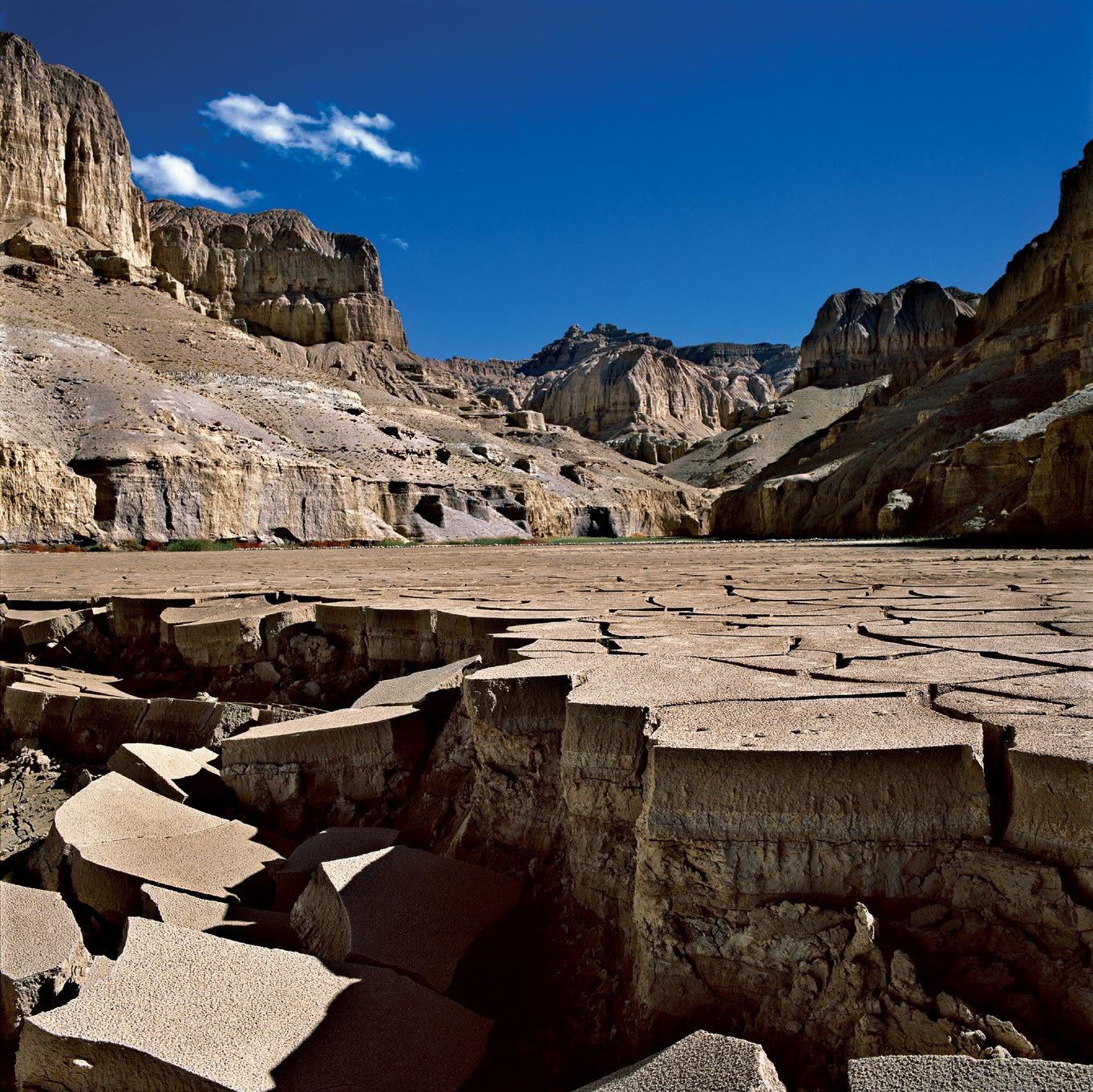
previous pages Mawantang, or ‘Earth Forest’, at the altitude of 4400m, western Tibet
The hydrographic network formed by the Sutlej and its tributaries has deeply eroded the lake and sea sediments deposited in this Himalayan hinterland.
de la
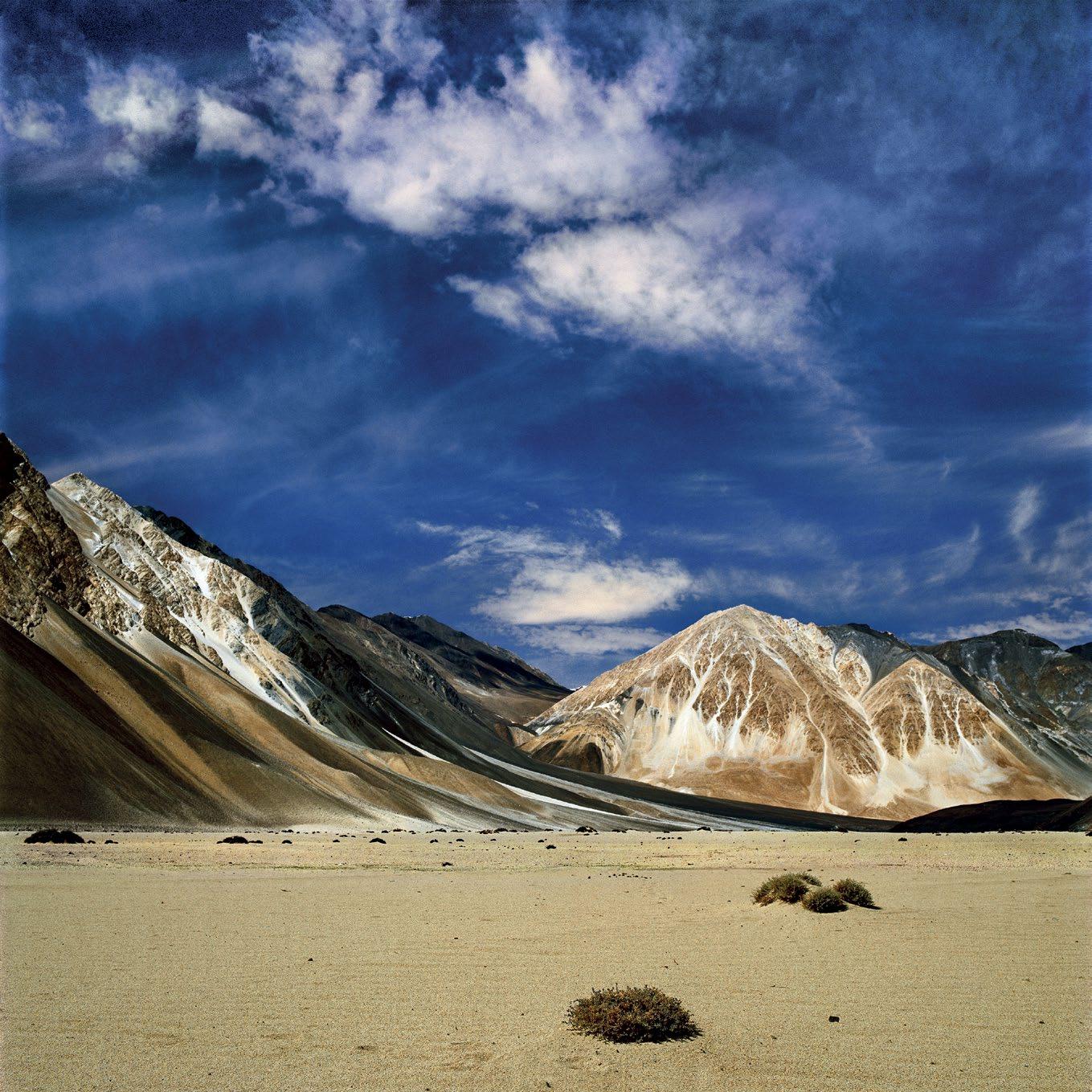
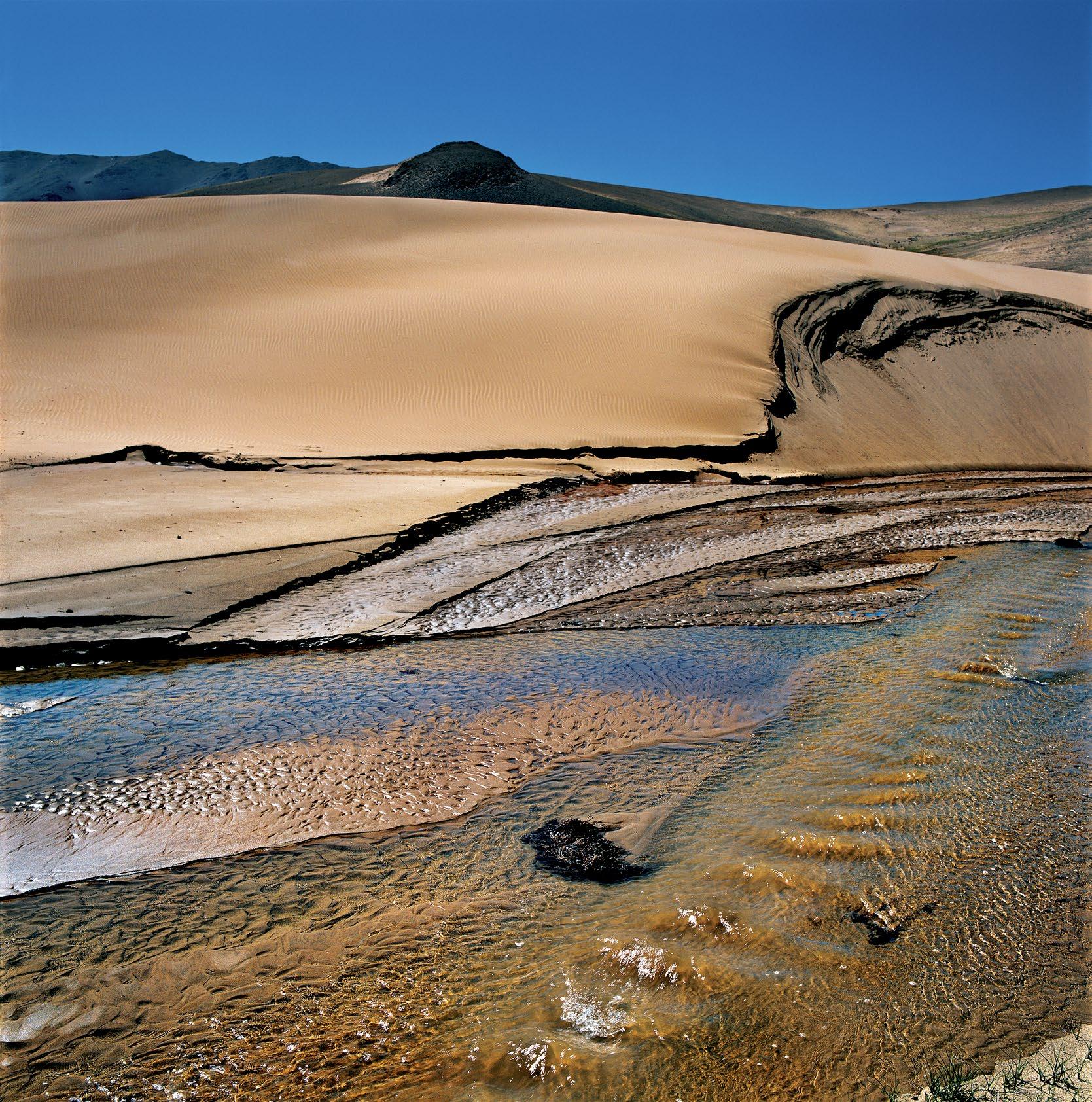
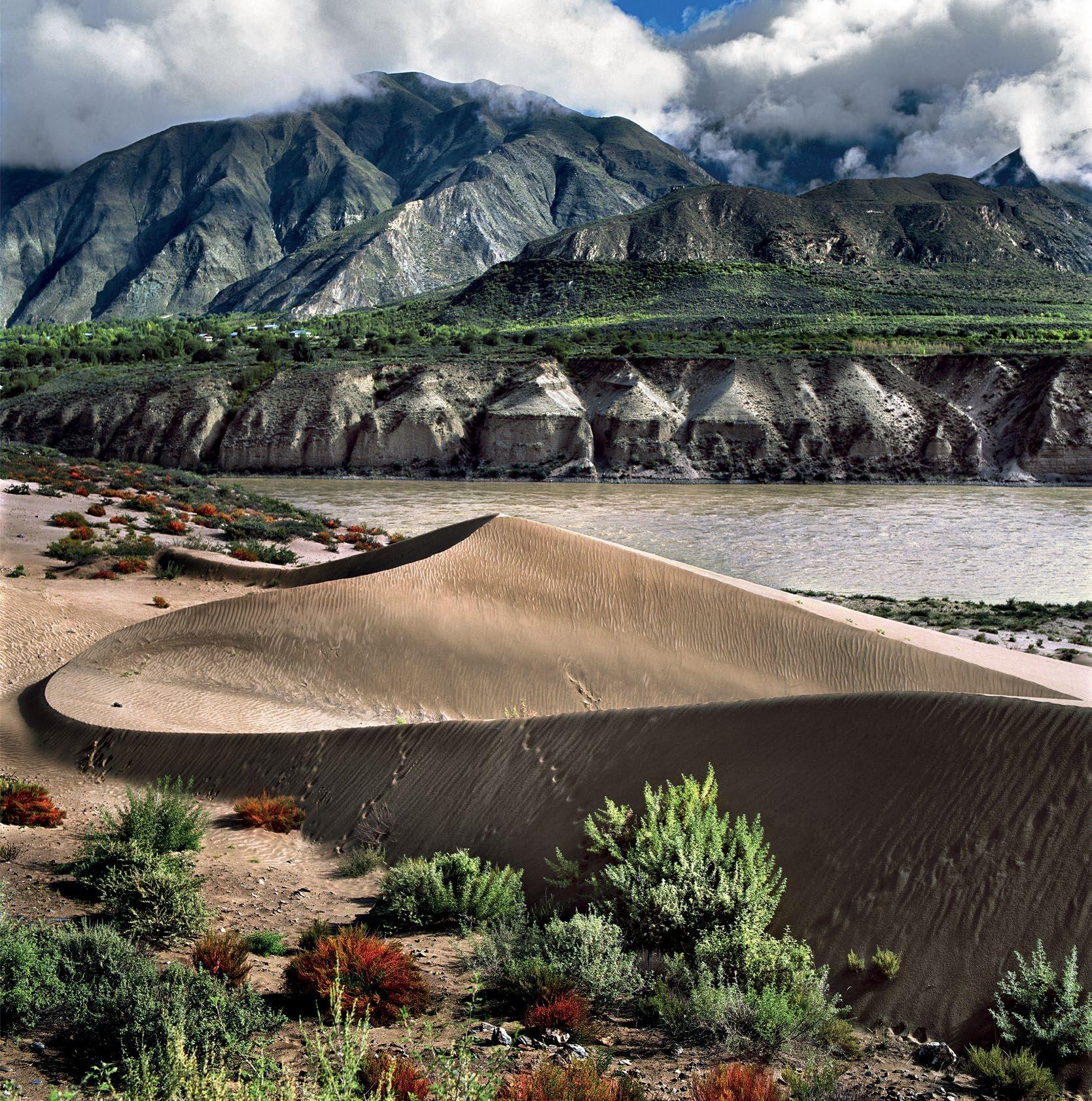
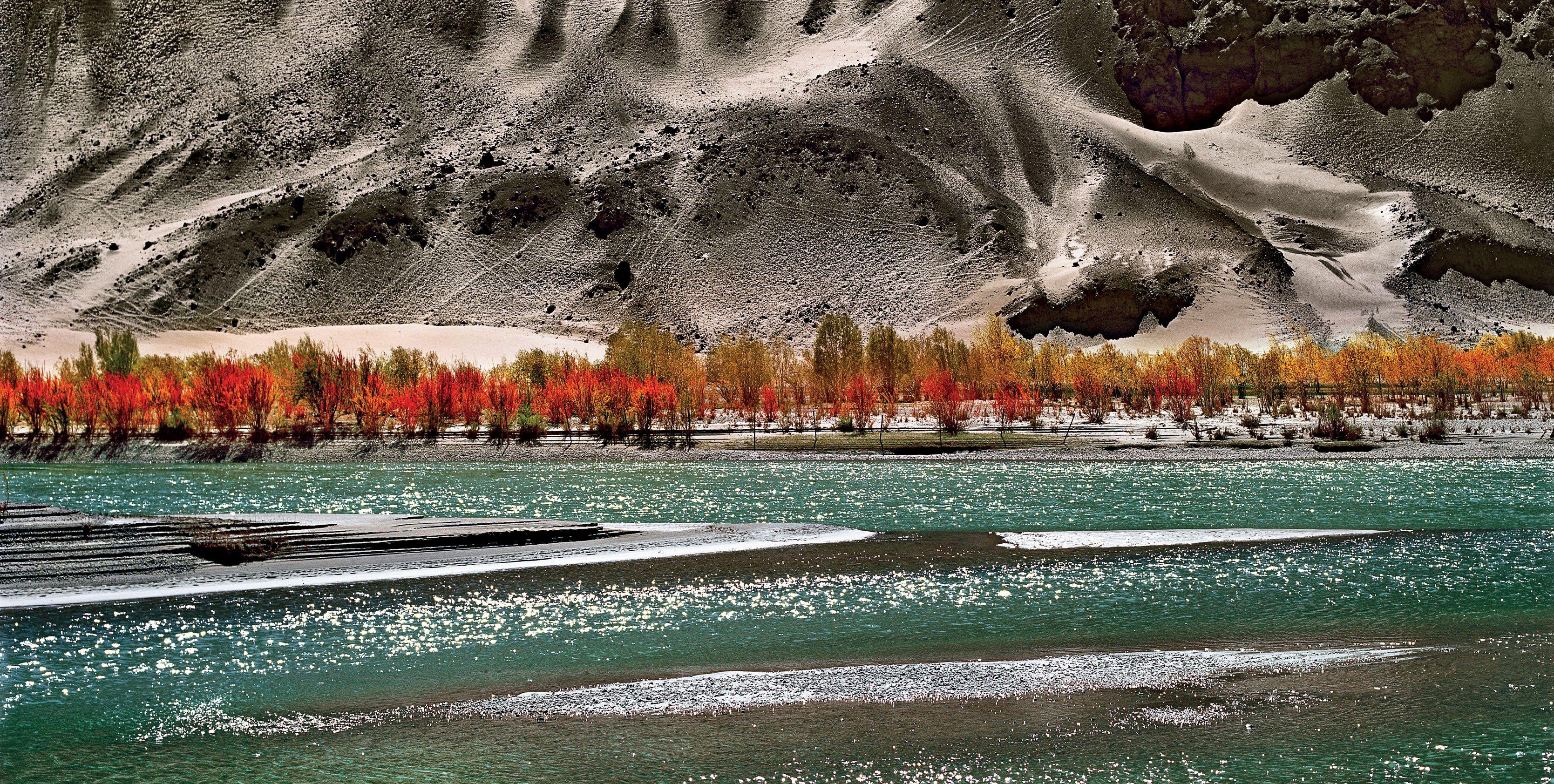
above Dunes in the region of Paryang, 4502m high, Tibet
Dune de la région de Thöling (Tibet occidental)
facing page Dunes in the region of Thöling, western Tibet
Double page précédente : Mawangtang, ou «Forêt de terre», 4400 m
Le réseau hydrographique de la Sutlej et de ses affluents a profondément érodé les sédiments lacustres et marins déposés dans cet arrière-pays himalayen.
Un désert riche en eau
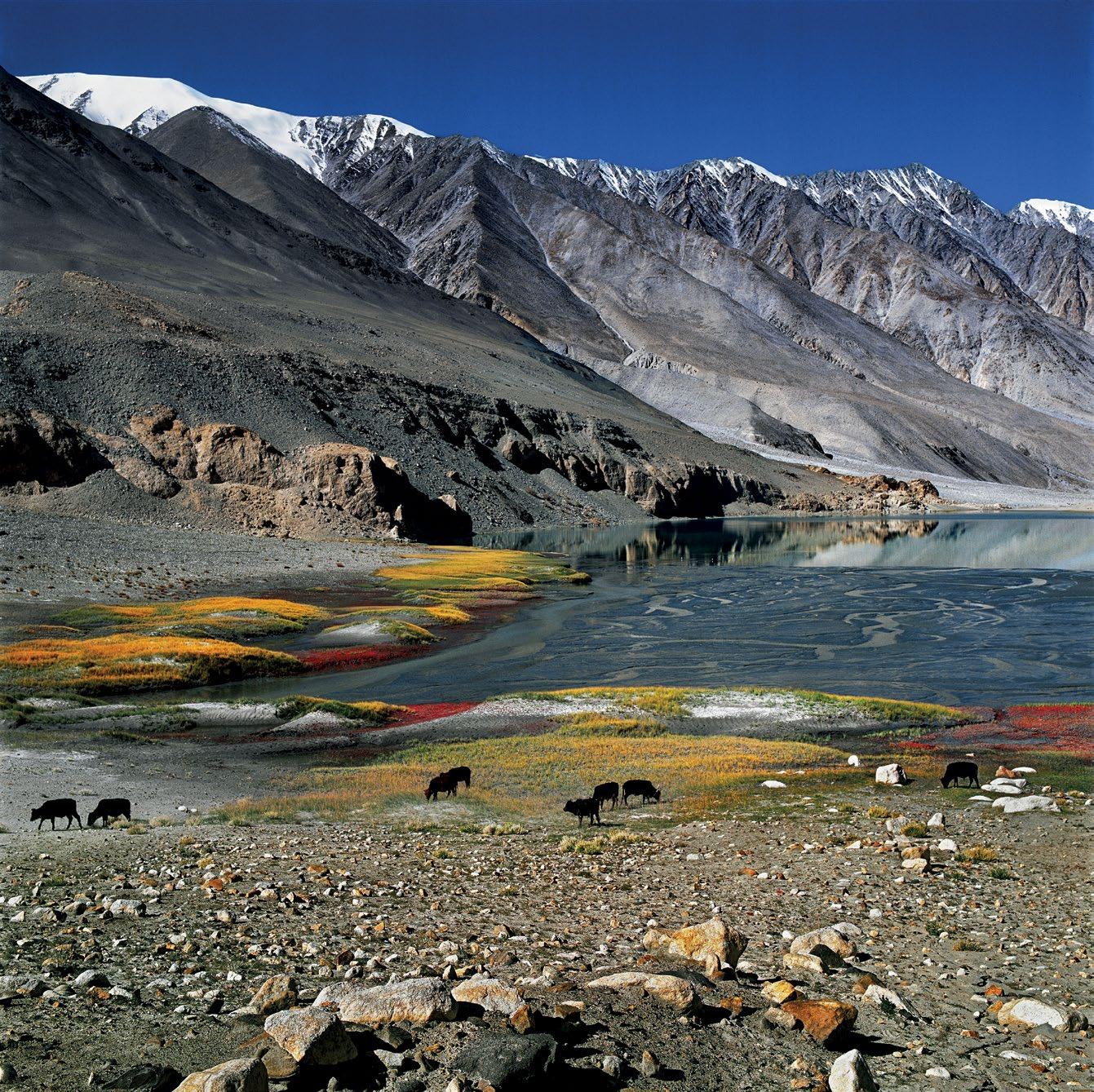
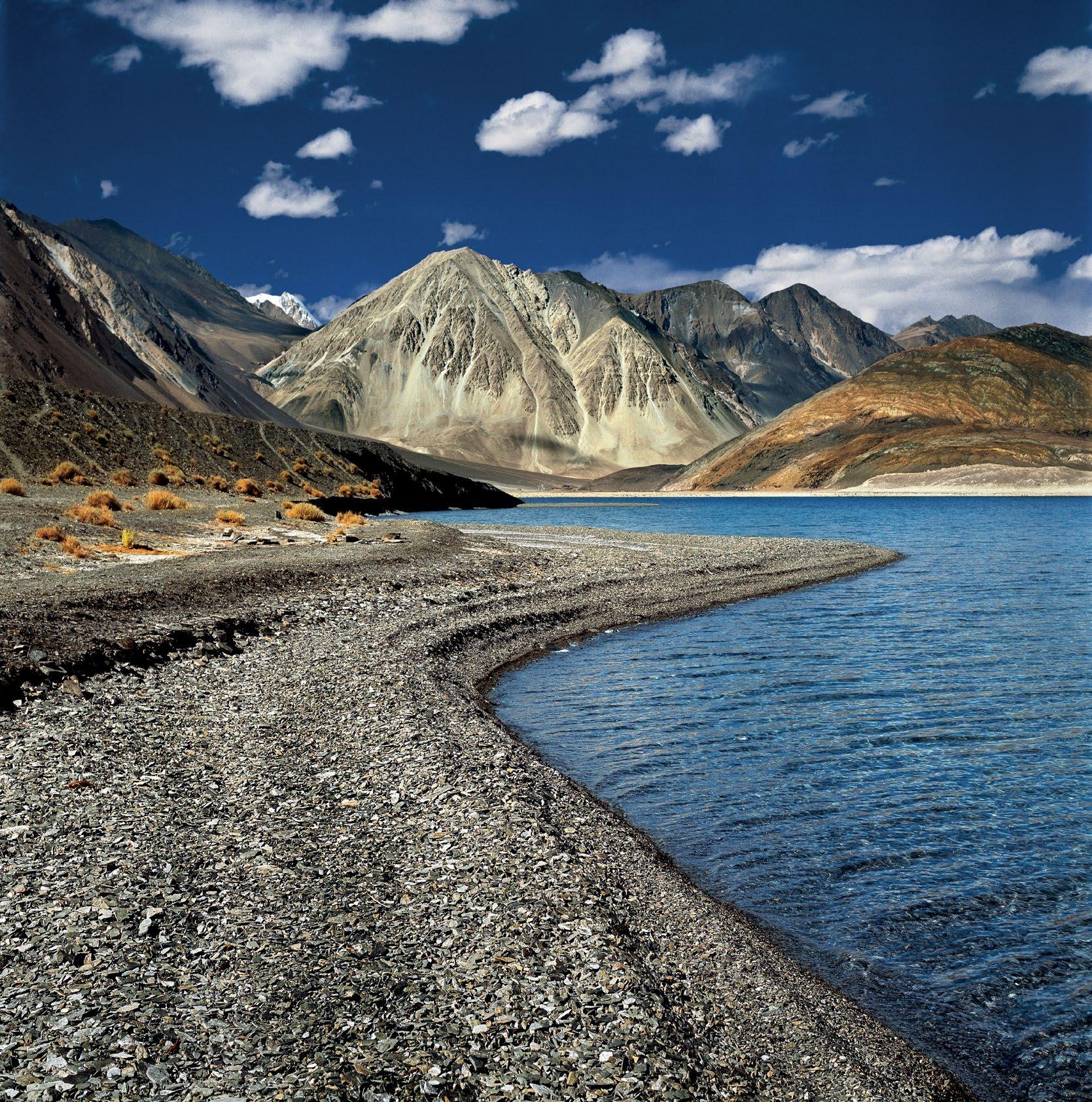
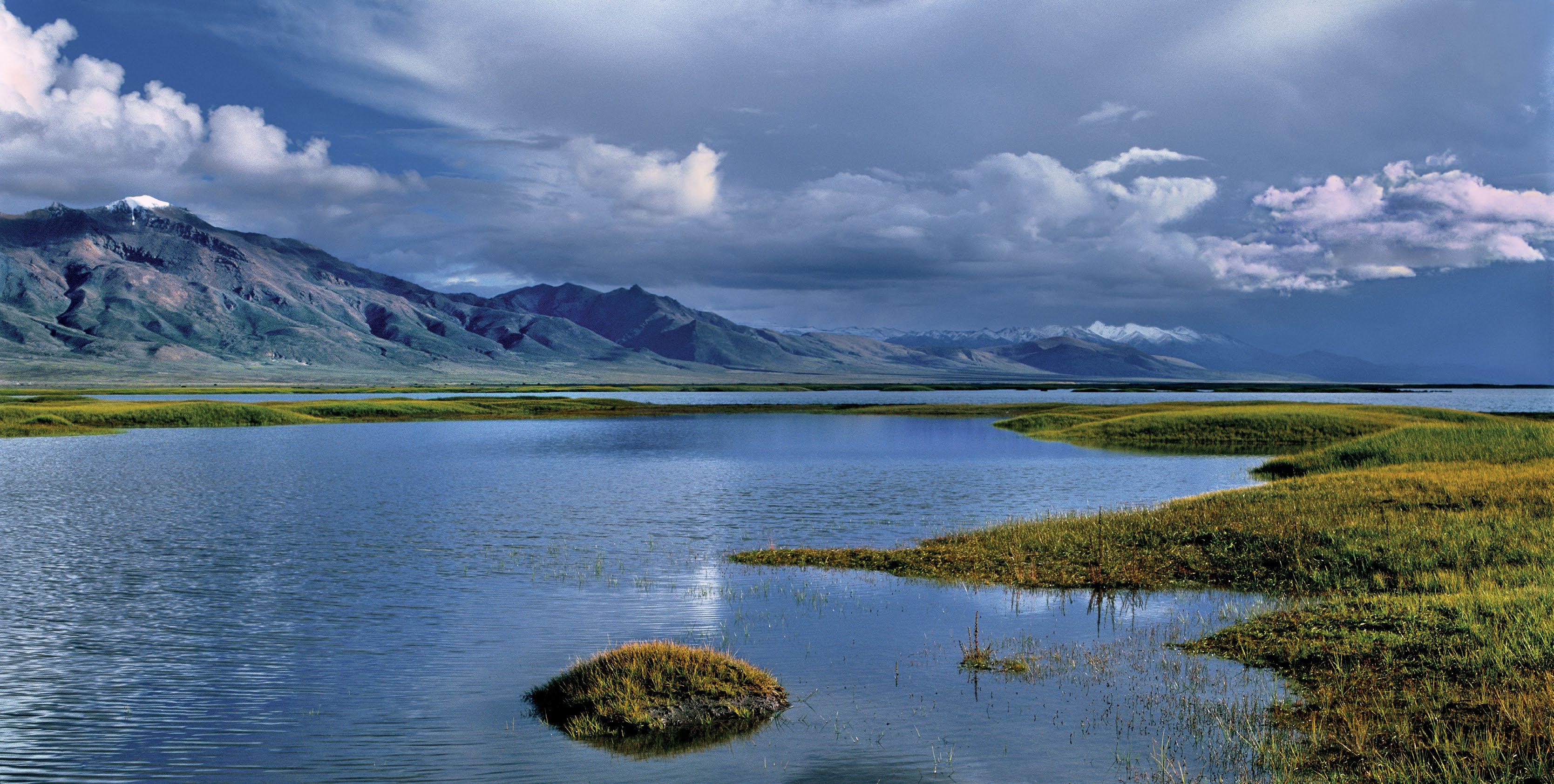
Dans ce désert d’altitude, l’eau est pourtant abondante. Elle s’étale même en d’innombrables lacs. Les plus étendus peuvent atteindre plusieurs dizaines de kilomètres de long. C’est le résultat d’une géologie complexe marquée par la juxtaposition de chaînons et de dépressions dans laquelle l’eau a du mal à trouver sa voie pour s’échapper.
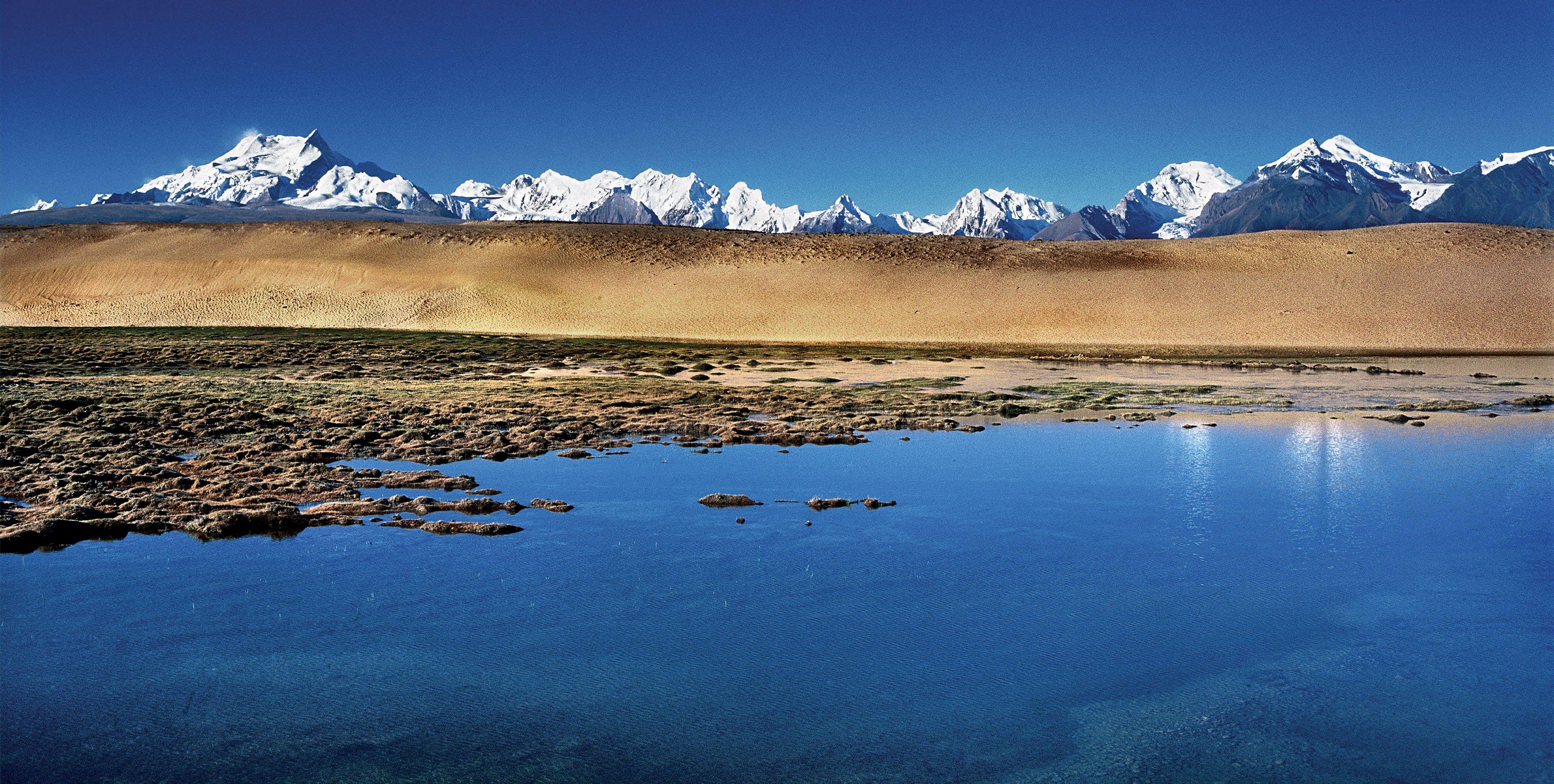
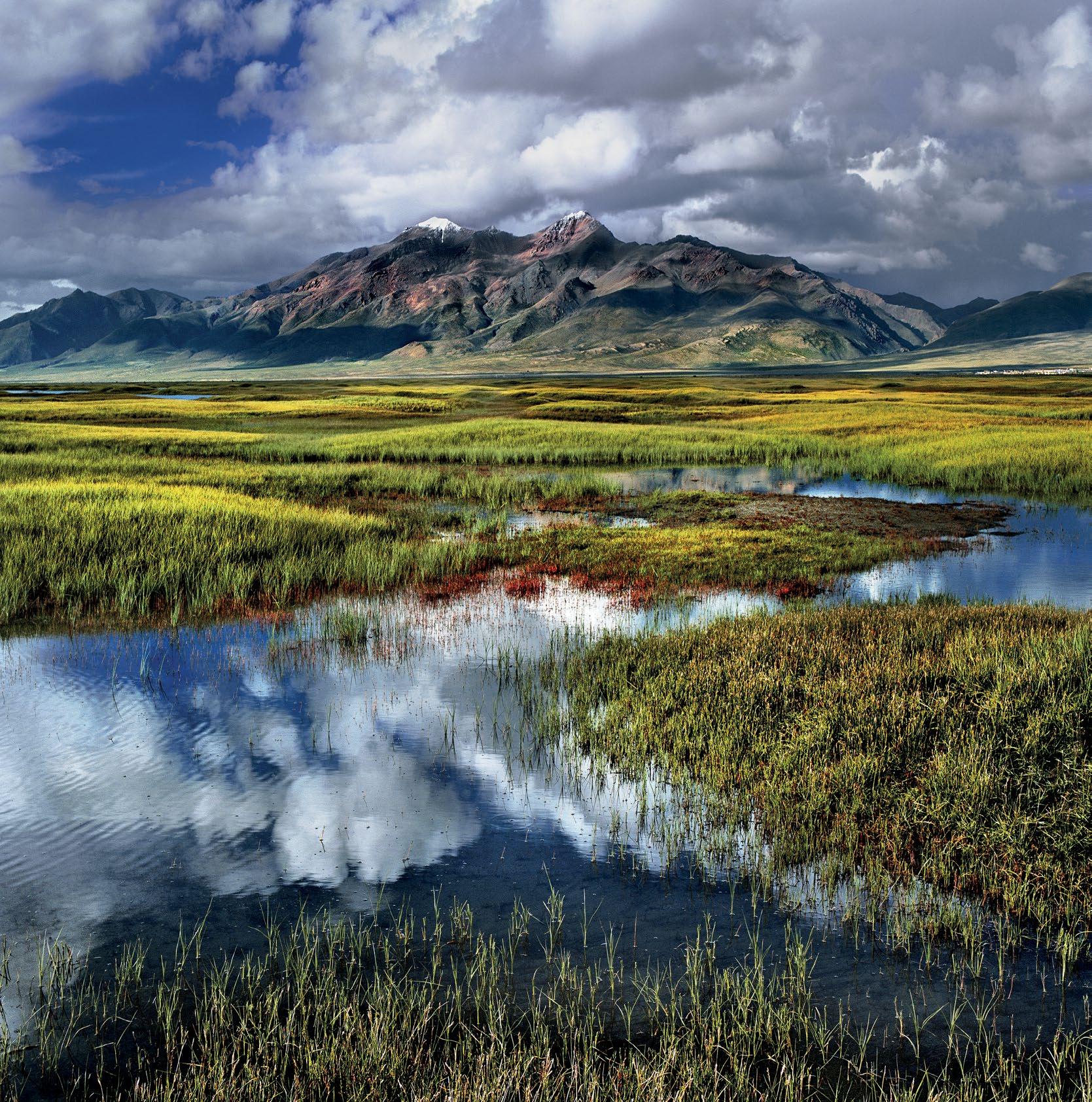
Surprisingly, in this high altitude desert area, there is abundant water, spread across innumerable lakes, some of great length. This unexpected appearance of water at such immense heights may be attributed to secondary ranges and depressions juxtaposed in a way that stops the water from flowing away. In these topographical basins, hollowed out and enlarged by erosion, water streaming down from the melting snows collects in the lakes which are also fed by springs of water at the foot of the great range.
Dans les cuvettes topographiques creusées et agrandies par l’érosion, ces lacs recueillent l’eau de ruissellement née de la fonte des neiges. Ils sont aussi très souvent alimentés par des sources, abondantes au pied de la Grande Chaîne.
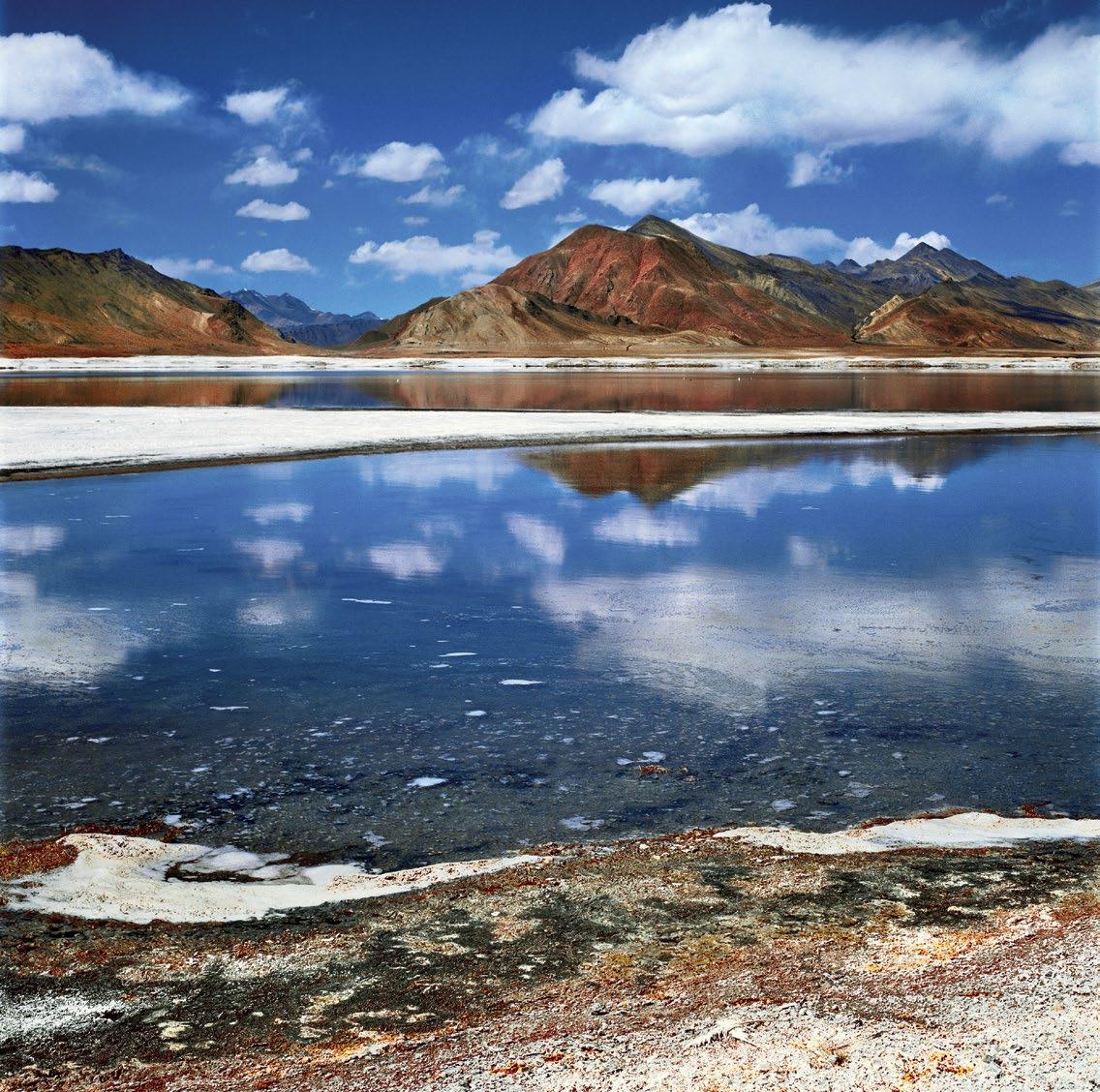
Some of the lakes, such as Tso-Khar on the high plateaus or Rupchu in Ladakh, are fed by streams that cross pockets of salt deposited long ago in the depths of the ancient Tethys Sea. The salty lake water, trapped at the bottom of a geographical basin, evaporates and deposits salt on the shores of the lake. This is a godsend for the herdsmen’s livestock, which thrive on this salty treat.
Quelques-uns de ces lacs sont salés. C’est le cas du Tso-Khar sur les hauts plateaux du Rupchu au Ladakh.
Ils sont alimentés par les eaux de ruissellement qui traversent les poches du sel abandonné jadis dans les profondeurs de la mer de Thétys. Ces eaux, piègées au fond d’un relief en cuvette sans sortie possible, déposent, en s’évaporant, ce sel au bord des rives. C’est une aubaine pour les éleveurs qui y conduisent leurs troupeaux, friands de cette gâterie salée.
Étang près du lac Manasarovar, 4582 m - Tibet
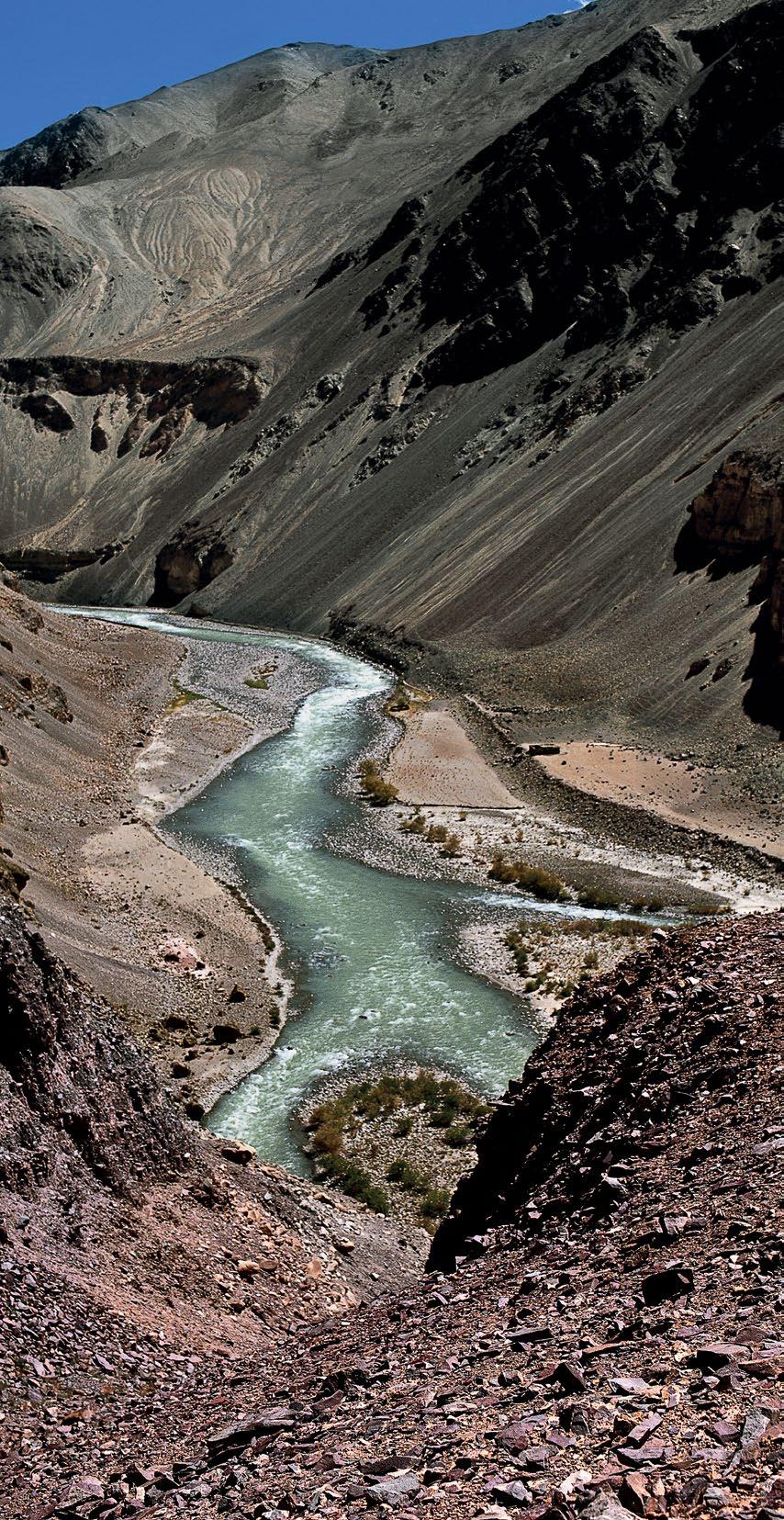
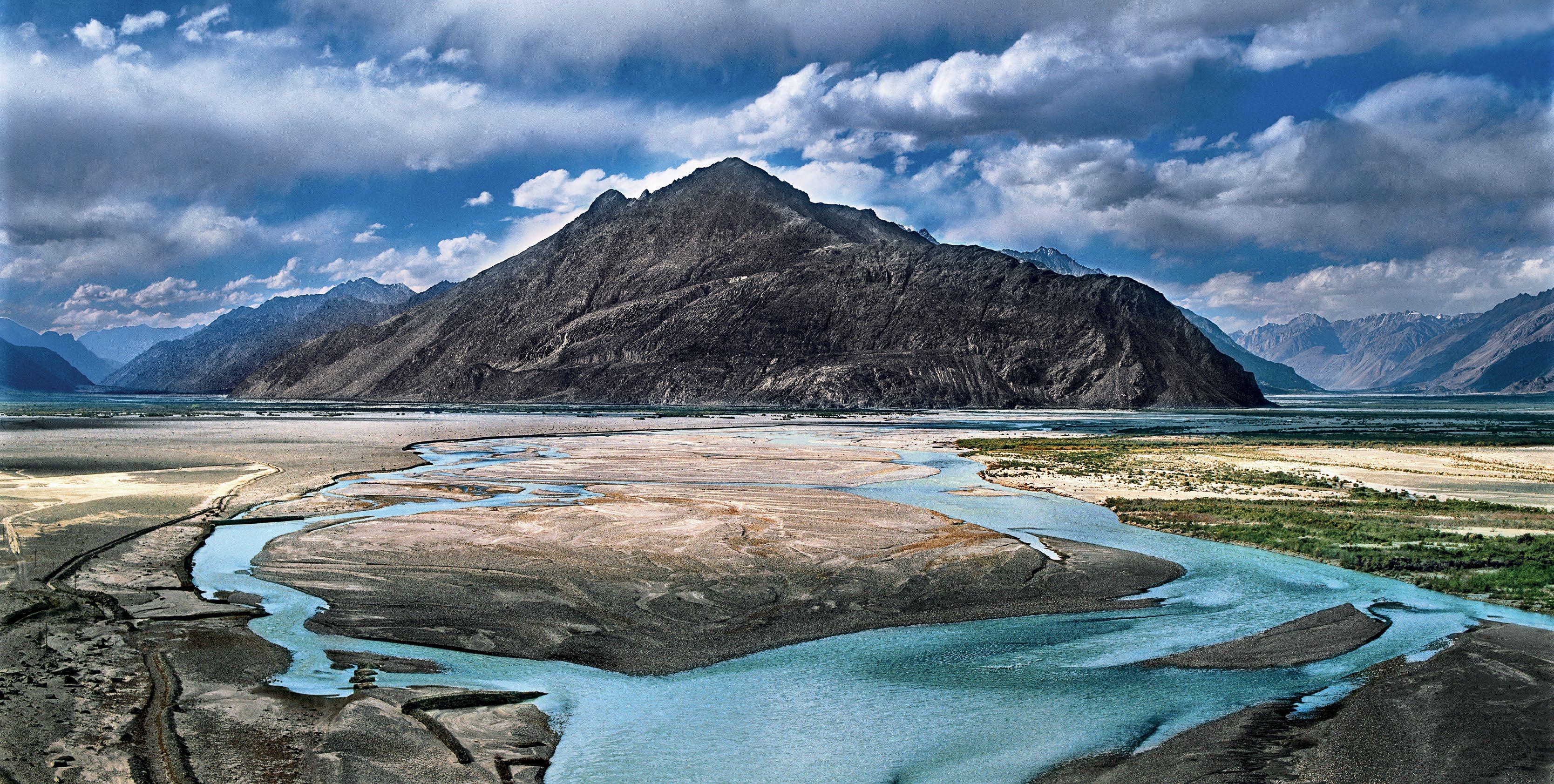
Double page suivante : Confluence de la Shyok et de la Nubra - Ladakh
The complete technology solution to enhance your books with digital content
Download the free app ‘BooksPlus: Augmented Reality’ from the App Store or Play Store.
A good book takes you to a place where reality and your imagination mingle. transports you to this place with the use of augmented reality and rich content. Just scan the pages of the book you’re reading and get immersed in the digital content. 01 02
The complete technology solution to enhance your books with digital content
The complete technology solution to enhance your books with digital content
Download the free app ‘BooksPlus: Augmented Reality’ from the App Store or Play Store.
Download the free app ‘BooksPlus: Augmented Reality’ from the App Store or Play Store.
EXPERIENCE IT FOR YOURSELF
Hover the mobile or tablet over the enhanced images below and immerse yourself into rich interactive content!
mingle. transports you to this place with the use of augmented reality and rich content. Just scan the pages of the book you’re reading and get immersed in the digital content. 01 02
Hover the mobile or tablet over the enhanced images below and immerse yourself into rich interactive content!
Download and launch the app. Point your camera at these images:
Download and launch the app. Point your camera at these images:
Download
Download
Scan these images with the app to experience the magic
Scan these images with the app to experience the magic mingle. transports you to this place with the use of augmented reality and
Download and launch the app. Point your camera at these images:
Scan these images with the app to experience the magic
CELEBRATING RAHIM
CELEBRATING RAHIM
CELEBRATING RAHIM
ABDUR RAHIM KHAN-I-KHANAN
ABDUR RAHIM KHAN-I-KHANAN
ABDUR RAHIM KHAN-I-KHANAN
Hover the mobile or tablet over the enhanced images below and immerse yourself into rich interactive content! augmented reality audios 10 augmented reality videos 5 augmented reality videos 43
audios
augmented reality audios
PUBLISHERS:
PUBLISHERS:
The complete technology solution to enhance your books with dig EXPERIENCE IT FOR YOURSELF
Download and launch the app. Point your camera at these images:
Brigitte Sing h Printress of the Mughal Garden
Brigitte Sing h Printress of the Mughal Garden
Brigitte Sing h Printress of the Mughal Garden
WATER TREASURES OF
Himalayas THE WATER TREASURES OF
Himalayas THE WATER TREASURES OF
augmented reality videos 5 augmented reality videos
INTERACTIVE EXPERIENCES
INTERACTIVE EXPERIENCES
INTERACTIVE EXPERIENCES
ADDITIONAL REVENUE STREAMS
ADDITIONAL REVENUE STREAMS
ENHANCE YOUR BOOKS
ENHANCE YOUR BOOKS
PUBLISHERS: ENHANCE YOUR BOOKS
ENHANCE YOUR BOOKS

ADDITIONAL REVENUE STREAMS
Unlock the power of Augmented Reality and Interactive Content
Unlock the power of Augmented Reality and Interactive Content
Unlock the power of Augmented Reality and Interactive Content
Unlock the power of Augmented Reality and Interactive Content
Unlock the power of Augmented Reality and Interactive Content
ENHANCE YOUR BOOKS
Interactive Experiences
Multimedia Content
Unlock the power of Augmented Reality and Interactive Content
Social Sharing & Vital Growth
For further information contact:
For further information contact:
For further information contact:
Anand Shah
For further information contact:
For further information contact:
For further information contact:
Anand Shah
Anand Shah
Anand Shah
Anand Shah
Anand Shah
anand.shah@booksplusapp.com www.booksplusapp.com
For more information, contact:
anand.shah@booksplusapp.com
Bipin Shah
anand.shah@booksplusapp.com www.booksplusapp.com
anand.shah@booksplusapp.com www.booksplusapp.com
www.booksplusapp.com
anand.shah@booksplusapp.com www.booksplusapp.com
anand.shah@booksplusapp.com www.booksplusapp.com
BooksPlusTM is a trademark of Ignite Solutions India Pvt. Ltd.
BooksPlusTM

MULTIMEDIA CONTENT
INTERACTIVE EXPERIENCES
MULTIMEDIA CONTENT
MULTIMEDIA CONTENT
ADDITIONAL REVENUE STREAMS
USAGE & ENGAGEMENT REPORTS
USAGE & ENGAGEMENT REPORTS
MULTIMEDIA CONTENT
SOCIAL SHARING & VIRAL GROWTH
& VIRAL GROWTH USAGE & ENGAGEMENT REPORTS
SOCIAL SHARING & VIRAL GROWTH
SOCIAL SHARING & VIRAL GROWTH
USAGE & ENGAGEMENT REPORTS
SOCIAL SHARING & VIRAL GROWTH
FREE APP! TRY IT NOW!
FREE APP! TRY IT NOW!
APP! TRY IT NOW!
FREE APP! TRY IT NOW!
USAGE & ENGAGEMENT REPORTS www.booksplusapp.com
BooksPlusTM is a trademark of Ignite Solutions India Pvt. Ltd.
BooksPlusTM is a trademark of Ignite Solutions India Pvt. Ltd.
Mapin Publishing bipin@mapinpub.com
© Copyright 2018, Ignite Solutions India Pvt. Ltd. www.ignitesol.com
BooksPlusTM is a trademark of Ignite Solutions India Pvt. Ltd.
trademark of Ignite Solutions India Pvt. Ltd.
BooksPlusTM is a trademark of Ignite Solutions India Pvt. Ltd.
Anand Shah Ignite Solutions anand.shah@ignitesol.com
© Copyright 2018, Ignite Solutions India Pvt. Ltd. www.ignitesol.com
© Copyright 2018, Ignite Solutions India Pvt. Ltd. www.ignitesol.com
© Copyright 2018, Ignite Solutions India Pvt. Ltd. www.ignitesol.com
© Copyright 2018, Ignite Solutions India Pvt. Ltd. www.ignitesol.com
© Copyright 2018, Ignite Solutions India Pvt. Ltd. www.ignitesol.com
PHOTOGRAPHY
Serge Verliat and Jean Philippe
216 pages, 215 colour photographs
11 x 11” (280 x 280 mm), hc
ISBN: 978-81-89995-89-8 (Mapin)
ISBN: 978-1-935677-57-4 (Grantha)
₹2950 | $65 | £50
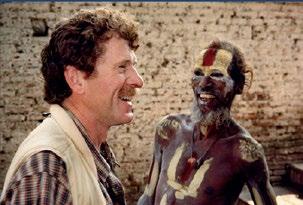
Serge Verliat is a professor of geography in Reunion Island, France, and author of several research papers on the Himalayas since 1980. He has a PhD in geography and a post-graduate diploma in anthropology. Verliat is fluent in Nepali. He has made several documentaries and films, including Living in the Himalayas (2004) and The Himalayas: Confidences of Water (2011).
santosdahi@wanadoo.fr
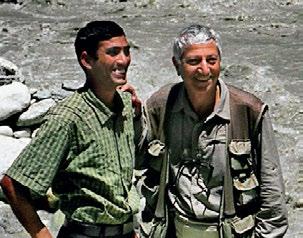
Jean Philippe, a photographer, has exhibited his black and white silver prints at the Museum of Man in Paris as part of the exhibition ‘Reunion Island: Two Viewpoints’ in 1995. He is also the author of two specialized works on the Cilaos Cirque in Reunion Island.
His photographs also appear in the book The Furnace: The Volcano of Reunion Island. photographiejean.philippe@orange.fr
Dr. David Jones teaches Mathematics and English at the Department of Réseaux et Télécommunications in Reunion Island, France. He has published various papers in his fields of study in Mathematics as well as translated from French to English numerous academic articles and the book Vivre à Mafate by Jean Philippe.
Sarah Patel Jones currently teaches English at Collège Trois Mares in Reunion Island, France, and has taught French at the University of the West of England, Bristol. Her other interests lie in cinema and film studies, glass painting and travelling.
CELEBRATING RAHIM
Abdur Rahim Khan-i-Khanan
Edited by Shakeel Hossain, Co-editor & Research Manager Deeti Ray
Brigitte Singh
The Printress of the Mughal Garden Bishwadeep Moitra
Paper Jewels
Postcards from the Raj Omar Khan
2017 • World rights Printed in Malaysia
Mapin Publishing www.mapinpub.com