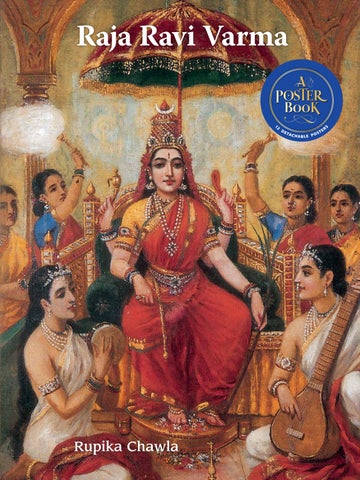
Raja Ravi Varma A POSTER BOOK 12
Rupika Chawla
DE
TA C
HABLE P
T OS
ER
S
Raja Ravi Varma A Poster Book
Rupika Chawla
R
aja Ravi Varma (1848–1906) was among the first Indian painters to successfully adapt academic realism to the visual interpretation of
Indian mythology and adopt Western painting techniques of portraiture. His genre of paintings, which eventually led to chromolithographs (oleographs), has maintained a lasting effect on the Indian sensibility, making him the best-known classical painter of modern times. Many royal families of India and several rich and powerful personalities were patrons of Ravi Varma, and whose portraits he painted in large numbers. His range of Puranic and religious paintings, reflecting his deep understanding of Sanskrit and Malayalam literature, have deeply influenced the forms of gods and goddesses in 20th-century visual culture of India. Ravi Varma’s fascination for feminine beauty and the ability to capture it masterfully is abundantly evident in his numerous portrayals of Shakuntala, Sita and Damayanti, and of the Indian woman. His lingering influence on the Indian mindset is also seen in the works of Indian contemporary painters and artists, who continue to be inspired by his art.
Rupika Chawla is a conservator of paintings based in Delhi. She has restored several Ravi Varma paintings at her studio in Delhi and she also gives training in conservation. Together with artist A. Ramachandran she had organized the seminal exhibition on Raja Ravi Varma in 1993 at the National Museum, New Delhi, which brought about a strong revival of the artist and his work. She has written extensively on contemporary Indian art, and is the author of Surface and Depth: Indian Artists at Work (Viking), A. Ramachandran: Art of the Muralist (Kala Yatra & Sistas) and Icons of the Raw Earth (Kala Yatra). She also maintained a column in The Indian Express from 2001 to 2004.
First published in 2026 by Mapin Publishing Pvt. Ltd 706 Kaivanna, Panchvati, Ellisbridge, Ahmedabad 380006 INDIA T: +91 79 40 228228 • E: mapin@mapinpub.com www.mapinpub.com All rights reserved under international copyright conventions. No part of this book may be reproduced or transmitted in any form or by any means, electronic or mechanical, including photocopy, recording or any other information storage and retrieval system, without prior permission in writing from the publisher. Text © Rupika Chawla Illustrations © as listed ISBN: 978-93-94501-99-7 Printed in China
Front-cover: Ambika, oil on canvas, 13.5 x 19.5”, undated, Private Collection
O
ver the years I have often pondered over the enigma
greater advantage to adopt the more familiar Raja than the unfamiliar
of Ravi Varma, the man who painted portraits and
“Koil Thampuran” while outside Travancore. Ravi Varma inscribed
mythological paintings, who spawned the beginning
Koil Thampuran together with his name on paintings whenever he
of popular visual culture and unbeknown to many
wished to communicate his status.
Indians past and present, influenced their visual perception down the century. Who was this man who had breathed life into these
“Varma” is a caste name of the Kshatriyas, who are the warrior
mythology-based paintings, moved with his times and ahead of them
class and second in the four-tier caste system in India. Strict codes
as well, taken a farewell bow in the prime of his life and reluctantly
of behaviour and a rigid hierarchic system had bound the social
left the sphere of living beings with so much yet to accomplish? He
structure of this particular Kshatriya community into which Ravi
had proved to be both provocative and elusive, yet had beckoned,
Varma was born. This insulated them from the outside world for more
wanting to be known and discovered. I had to seek him out, pursue
reasons than just their geographic isolation, which produced in them
his trail and unravel something of this man whose quicksilver
a perception uniquely their own.
thoughts and rich emotional reserves guided his actions and his creativity for fifty eight years.
Mavelikkara, some 80 kilometres north of Kilimanur, was the seat of another important Kshatriya family and the home of Bharani Thirunal
I have not been able to track down every source or run every bit of
Mahaprabha Amma Thampuran, mother of Ravi Varma’s wife
information to the ground; neither do I believe it possible to do so.
Mahaprabha Amma Thampuran. Mavelikkara could not have marital
After a hundred years there is so much that has vanished with time’s
alliances with the royal family because the caste structure of the two
merciless sweep and the indifference of unwilling custodians of
houses did not permit it. But the Mavelikkara family could, and did,
tangible evidence. Yet, there was much that was retrieved.
marry into the Kilimanur clan. Mahaprabha’s eldest sister, Lakshmi Bayi, married Kerala Valiya Koil Thampuran, known as Kerala
I followed Ravi Varma’s fading footsteps, discovered his environment
Kalidasa, and Parvathi Bayi, the middle sister married Kerala Varma
and family, heard anecdotes, unearthed his friends and their present
Kochu Koil Thampuran (after his early death in 1872, she was married
families, exhumed period letters, newspapers and photographs, and
to Raja Raja Varma Kochu Koil Thampuran, also from Kilimanur).
correlated him with the India of his times. Slowly, I found him as he emerged from the mists of nothingness, conjured up through the
Lakshmi Bayi and Parvathi Bayi lived lives quite different from their
information I had gathered and through my reflections that willed
younger sister, Mahaprabha. Apart from links through marriage,
him into manifestation. I will never fully know him but I found much
the social structure of aristocratic Travancore at times necessitated
to admire in this bright-eyed charismatic man of easy laughter, so
the adoption of girls into the Travancore royal family. According to
capable of balancing the traditional with the avant-garde, gifted
the matrilineal system in Kerala, it is the eldest male member in the
with well-honed senses and sensibility, energetic, enterprising and
royal family who becomes the king. In the likelihood of there being
entrepreneurial, a man indeed, of the twenty-first century.
no female members, the Maharaja had to necessarily adopt one or two “sisters” or “nieces”. These girls were adopted from Mavelikkara
Thiruvananthapuram, the capital of Kerala, has always been known
because the caste structure of the two families allowed it. Such an
by that name except for the time when the British referred to it as
adoption occurred several times in the royal history of Travancore.
Trivandrum. There was no single state but three separate regions— Travancore, Cochin and Malabar—till they were amalgamated
Both Lakshmi Bayi and Parvathi Bayi were adopted into the royal
in 1956 to form Kerala. Trivandrum, which had earlier been the
family as young girls and were subsequently known as the Senior
capital of Travancore, continued to be the capital of Kerala after
Rani Lakshmi Bayi and the Junior Rani Parvathi Bayi of Travancore.
the merging of the three states. In 1991, the city’s original name,
A different situation endangered the royal line when Kerala Varma
Thiruvananthapuram, was reinstated and Trivandrum, as it was
Kochu Koil Thampuran, Parvathi Bayi’s first husband, died early in life
known during Ravi Varma’s time, disappeared into history.
leaving her childless. Her remarriage became imperative, as the royal line would otherwise have been at risk. She was wedded to Raja Raja
About 40 kilometres out of Thiruvananthapuram is Kilimanur, Raja
Varma Kochu Koil Thampuran a year later in 1873. But it proved to be
Ravi Varma’s birthplace, which during his lifetime was a prosperous
of no avail, as Parvathi Bayi too died young, having given birth to four
estate inhabited by about 200 members of the Kilimanur clan. It is
sons and no daughters, while Lakshmi Bayi, unfortunately, remained
today almost desolate, and a bleak, shuttered air hovers over the
childless. This complicated matters further and it became obligatory
place. Some family members continue to live in Kilimanur, while
on the Senior Rani to adopt two of her Mavelikkara grand-nieces, the
most of them have scattered in different directions. The Kilimanur
granddaughters of her sister Mahaprabha and Ravi Varma in 1900.
clan originally descended from the rulers of Beypore (near Kozhikode on the northern coast of Kerala), who, for their valorous defense of
The former Dewan (Prime Minister) of Travancore, Sir A. Seshaiah
the Travancore royal family were rewarded with the large estate of
Sastri, who had retired in the late 1890s and returned to live in
Kilimanur. They were known as the “Koil Thampuran,” which was a
Kumbakonam (formerly in Madras Presidency, now a town in Tamil
great honour, as only the Koil Thampurans were permitted to make
Nadu), wrote to Lakshmi Bayi in 1896, entreating her to adopt her
endogamous marriages with the Travancore royal family. The prefix
nieces. The “two girls” in their turn, were to become the Senior Rani
of “Raja” to Ravi Varma’s name does not connote kingship even
Setu Lakshmi Bayi and the Junior Rani Setu Parvathi Bayi when the
while it finds a connection with his royal antecedents. It is perhaps
earlier Rani Lakshmi Bayi died in 1901. Setu Lakshmi Bayi was Ravi
more strongly linked with the recognition and acknowledgement he
Varma’s older granddaughter and the progeny of Mahaprabha, his
received as a painter, from the British and also the Indian elite. For
eldest daughter, acknowledged as being the beauty of the family.
a socially mobile person like Ravi Varma, it would have been of a
Mahaprabha and her mother were known by the same name, as there
The Swan Messenger (detail), oil on canvas, 26 x 73.6”, 1906, Collection: Her Highness Dr. Pramoda Devi Wadiyar, Maharani of Mysore, Chairperson Sri Jayachamarajendra Art Gallery Trust, Jaganmohan Palace, Mysore
Shiva Parivar, oil on canvas, 10 x 14”, 1895, Private Collection
Raja Ravi Varma A POSTER BOOK
Rupika Chawla 28 pages, 14 illustrations 12 x 16” (305 x 406 mm), SC, produced on art card ISBN: 978-93-94501-99-7 ₹1750 | $35 | £25 Spring 2027 | World rights
Back-cover: Matsya Avatar, exemplar for oleograph by Raja Ravi Varma, oil on canvas, 10 x 14”, 1895, Private Collection
₹1950 | $35 | £25 ISBN 978-93-94501-99-7
www.mapinpub.com