P A R V A T I
Goddess
of Love
Art in India is never removed from life, intimately tied as it is to religion, aesthetics and utility. A walk into a temple or a place of worship becomes an experience at many levels, tactile, olfactor y, sensor y and visual, spiritual and religious. Taking any of the elements individually is thus a part experience at best.
In this book the author brings to the reader the Goddess Par vati, the Female Principle, consort of the God Shiva, lover, mother, provider, embodiment of beauty. In showing her in each of her manifestations, he tries to create the ambience that would normally exist around her to show her in her true glor y.
The images in stone come mostly from the classical period in North India. The dominant theme in he stone sculptures is the amorousness togetherness of Shiva and Par vati, and of their form as Uma-Maheshvara. Also included are iconic Chola bronzes, Thanjavur paintings and images from folk tradition.
With 45 colour illustrations
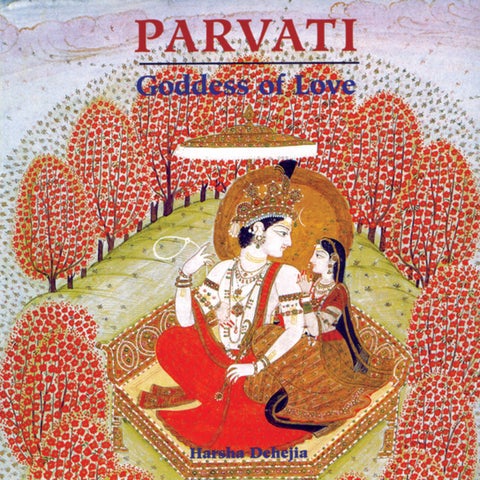
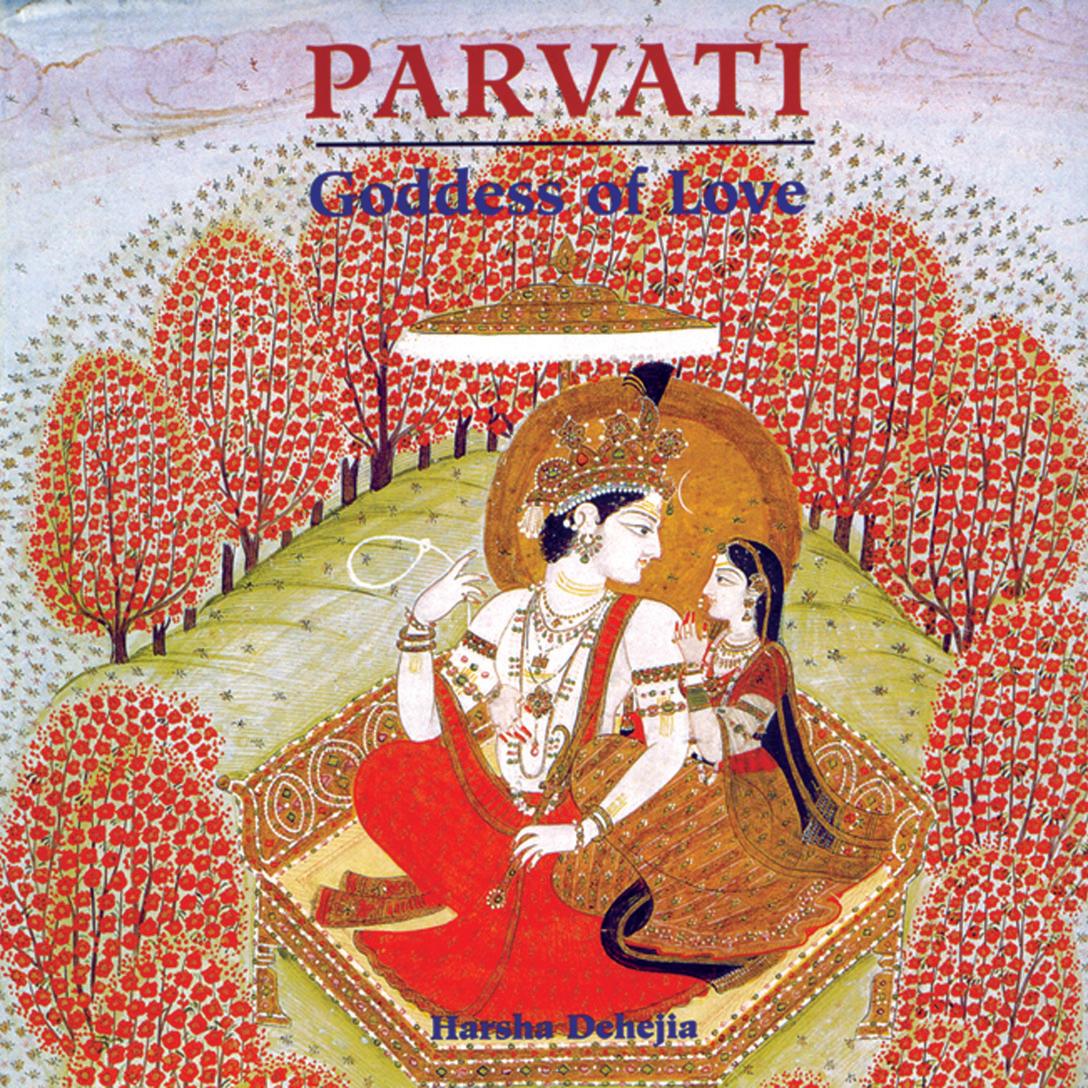
Front jacket: Shiva and Par vati in a grove (see page 86)
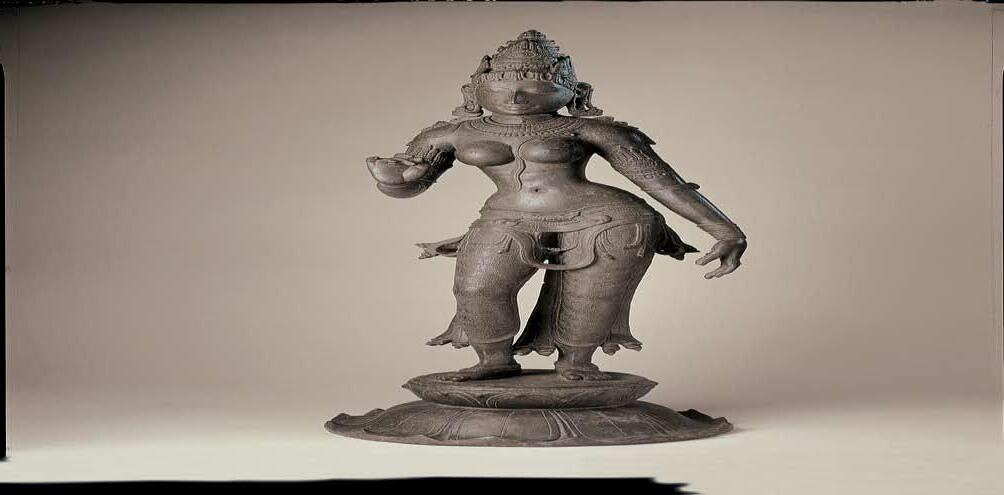
Back jacket: Standing Par vati (see page 77 )
P A R V A T I
Goddess of Love
P A RV A T I
G o d d e s s o f L o v e
Publishing Pvt. Ltd.
Harsha Dehejia
Mapin
First published in the United States of America in 1999 by Grantha Corporation
80 Cliffedgeway, Middletown, NJ 07701 in association with Mapin Publishing Pvt. Ltd.
Chidambaram, Ahmedabad 380013 India
web-site: www.mapinpub.com
Distributed in North America by Antique Collectors’ Club
Market Street Industrial Park Wappingers’ Falls, NY 12590
Tel: 800-252-5321 � Fax: 914-297-0068
web-site: www.antiquecc.com
Distributed in the United Kingdom & Europe by Antique Collectors’ Club
5 Church Street, Woodbridge Suffolk IP12 1DS
Tel: 1394-385-501 � Fax: 1394-384-434
email: accvs@aol.com
Text © Harsha Dehejia
Photographs © as listed
Photographs of the author’s personal collection by Richard Garner
All rights reserved under international copyright conventions. No part of this book may be reproduced or utilised in any form or by any means, electronic or mechanical, including photocopying, recording or by any information storage and retrieval system without prior permission in writing from the publishers.
ISBN: 1-890206-14-8 (Grantha)
ISBN: 81-85822-59-x (Mapin)
LC: 98-68332
Edited by Mallika Sarabhai
Designed by Paulomi Shah / Mapin Design Studio
Colour Separations by Reproscan, Mumbai
Printed in Singapore
Captions:
Front Jacket
Shiva and Parvati in a grove Kangra, 19th centur y (see page 86)
Back Jacket
Standing Parvati
Chola bronze, 11th centur y
Collection: Asia Society, New York
Gift of Mr. and Mrs. John D. Rockefeller 3rd (see page 77)
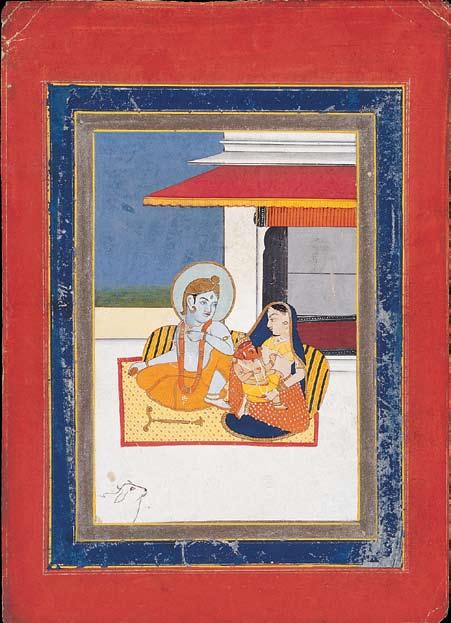
Frontispiece
Shiva, Parvati and Ganesh Jaipur, 19th centur y
Collection: Harsha Dehejia
Enclosed within strong borders is this simple but eloquent depiction of the Shiva family. Seated on a terrace with the haveli in the background the dominant colours of the composition are yellow and blue. The large bolster, the carpet, Ganesha’s dhoti and the frill of the awning are painted in a pleasing yellow while Par vati and the canopy make a strong impact in red. The light blue of Shiva’s body and his halo are in contrast to the deep blue of the space outside. Having deposited the arm rest on the carpet Shiva’s left hand is ready to embrace Par vati and Ganesha while he looks expectantly at the mother and child. Demure looking Par vati seems ver y motherly as she caresses the baby Ganesha. Nandi depicted in bare outline completes the composition. The artist in creating this beautiful picture pays a tribute to the motherhood of Par vati.
Prarambh, As We Begin
vagarthaviva sampraktau vagarthapratipattaye
jagataha pitarau vande parvati paremeshvarau
I salute Par vati and Shiva, the parents of the universe who are together like word and its meaning to understand speech.
Kalidasa. Raghuvamsha
Thisbook is an appreciation not an anthology, a vandana not a shastra, a portrait of adoration and not an encyclopaedic account of the many manifestations and meanings of Par vati. Painters and potters, poets and playwrights, pundits and philosophers have given us glimpses of her persona. Many are her songs, countless her stories, numerous her names. She is the daughter of the Himalayas and the queen of Madurai. She is the consort of Shiva and the mother of Ganesha. She is the eternal shakti and the objectification of all that is beautiful. She is both tapasvini and vimarshini, vama and ardhanari. She is the subject of the Puranas and the inspiration for Adishankara and Kalidasa. She is found in Pahadi paintings and is chiselled in Chola bronzes. She is car ved in stone in cave sanctuaries and adorns the walls of temples. Devotees in Maharashtra call her Gauri; those in Madurai worship her as Minakshi, poets eulogise her as Girikanya or daughter of the mountain or Saubhagyajanini or mother of prosperity, while the mountain people celebrate her as Nandadevi. Her names may be different but no matter what form she takes she is always the adorable Par vati.
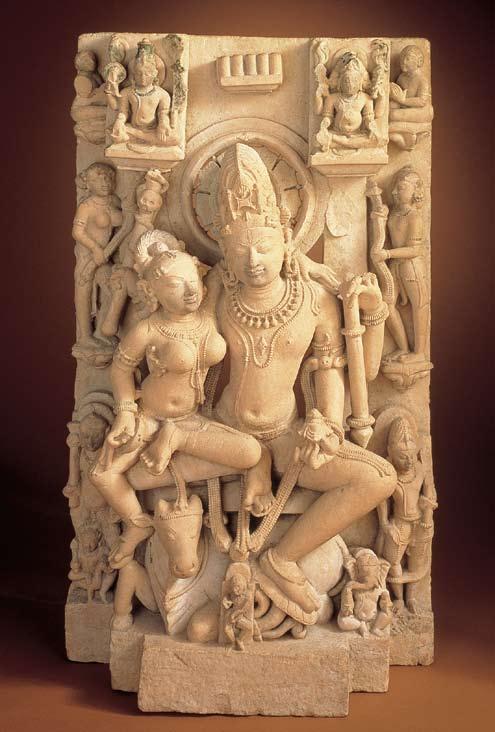
Uma-Maheshvara
10th centur y, sandstone
Uttar Pradesh
Collection: Los Angeles County Museum of Art
Gift of Harry & Yvonne Lenart
This elaborate relief of Shiva and Par vati is an inset from the junction-wall between the rangamandapa and the sanctum of a temple, a site where such images are commonly placed. The Shiva pantheon is depicted here in an iconic manner. Par vati rests on Shiva’s left thigh and amorously embraces him with her left hand while she holds a mirror in her other hand. The four-armed Shiva holds a trident in his upper right hand, a lotus in the lower, and a skull staff entwined with a serpent behind Par vati’s head. Below their seat rests Nandi the faithful bull. The emaciated sage Bhringi dances in the centre. Ganesha adorns the right of the panel while Skanda, astride his peacock, rests on the left. Guardian figures make up the borders of the relief. The top of the relief is dominated by Shiva’s head with a floral halo and with Brahma and Vishnu with devotees on either side. The mood of the couple is one of serenity and strength in their togetherness. 7
My serious introduction to Par vati came during my study of Kashmir Shaivism. In its rich epistemological discourses Parvati was conceptualised as the door way to higher knowledge, not to be rejected as an illusion but to be affirmed, not to be negated but to be celebrated, not just instrumental but inherent in that transcendent experience of bliss. According to Kashmir Shaivites she is the ver y being of Shiva.
Even in the celebrator y ethos of Kashmir Shaivism epistemology Par vati is at best a concept, a consciousness that cognises the world only to reflect it back thereby exalting our state of being. But the erudite discourses and scholarly arguments of the masters of Kashmir Shaivism were able to give me only a glimpse of Par vati and that too as an aesthetic concept. But concepts are formless. They are like a melody without words, an aroma without a flower, a bhakta without a deity and love without the beloved. In keeping with the agamic tradition I accepted the ultimate as formless but longed for a form that I could sensually celebrate. I longed to discover the Par vati in our arts, the real Par vati, the Par vati that has inspired our poets and potters over the millennia, the Par vati that is celebrated in our songs and stories, through stone and paint. And thus it was that I undertook a quest for that real Par vati.
Ver y soon I started discovering that real Parvati in our arts: visual, literar y and performing. No sooner did I feel that I had seen all the Pahadi miniatures, a new painting would appear before my eyes. After I felt I had seen all the Chola bronzes of Parvati I would discover one more, more beautiful than the other. And so it went. I discovered images of Par vati in museums and libraries, private collections and public temples. I gathered and collected and admired all these images and was wonderstruck by the many
images of Par vati. I was like a bhakta who was collecting parijataka flowers for his morning worship. When he had collected all the flowers that he could find a soft wind blew through the tree and there were more flowers to pick.
Par vati richly revealed herself to me in her variegated and splendorous forms and when my mind was elated with a sense of excitement it was Par vati herself who drew my mind back from the form to the formless. It was she who showed me a mirror that she was holding in her hands, as if to say that in seeking a vision of Par vati I obtained atmadarshan, a vision of myself. It was at that stage of my quest that I was able to exclaim “Shivoham!” I am Shiva.
Harsha Dehejia
October 20, 1998 9
The Narrative of Parvati
TheIndian tradition is rich with goddesses. So varied are her manifestations and names that every village and ever y scripture, ever y Purana and poet create their own unique image of her. While sometimes she is a consort, at other times she is a fertility goddess; at times she is a benevolent figure yet at others she is horrific and malevolent. The Shaiva tradition is especially replete with a number of goddesses who are associated with Shiva. Of all the consorts of Shiva the one that is artistically and lovingly the most celebrated is Parvati. Unlike Durga and Kali who assume their own independent religious status in the Hindu pantheon and are worshipped and venerated ritually, Par vati engages the greater attention of poets and painters, musicians and dancers. Numerous are her aspects, varied her persona, multiple her attributes and many her names. Of all the mythic beings in the Hindu pantheon she is perhaps the most loved and undoubtedly the most giving of her love. In her we have the true celebration of Hindu womanhood. Of unsurpassed sensual beauty, her endowment is not merely physical but spiritual, not narcissistic but meant as an offering. In her, it can be said that we have the grand personification of the Hindu expression, as well as the concept of beauty.
As a young girl, daughter of the mountain king Par vat and mother Mena, she is demure and charming. As a young woman she grows into unsurpassed grace and elegance and is the
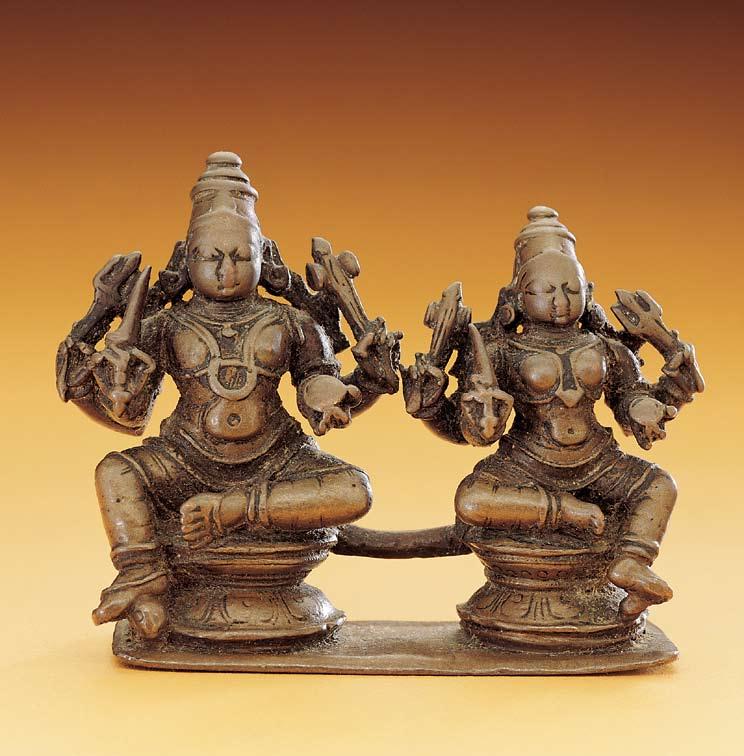
Shiva and Parvati 16th centur y, Vijayanagara Collection: Harsha Dehejia
This small Vijaynagara bronze meant for a home shrine inherits the Chola tradition but departs from it in both style and format. Shiva and Parvati are seated in mirror image poses on a double inverted lotus, both holding a trident, a battle axe and a mirror. Absent is the embrace of affectionate togetherness, Nandi and Skanda, but in its place there is a divine presence of the god and goddess ready to receive and bless the devotee. The polished rubbed down forehead of the images suggest that it was worshipped with vermilion.
The Literature of Parvati
Under the generic term devisahitya there is a vast corpus of literature of the goddess that straddles both the sacred and the secular, ancient and modern. The overlap between different goddesses and especially between the shaktis, consorts of Shiva, is perhaps more evident in literature than in plastic or pictorial images. The cohesion is particularly marked between Parvati and Durga as the dividing line between them gets hazy. Even more interestingly Par vati, who belongs to the Shaivite tradition, is sometimes given a Vaishnavite colouring in some songs. Despite these ambiguities Par vati in and of herself, and in her own right, has a secure place in literature. In prose and poetry, through songs and drama, she is eulogised and celebrated in many different ways. In gathering and sifting through this literature one is constantly aware that the extant literature is only a small part of what must have been written, and even more so, many songs and stories of Par vati form a part of the rich, diverse and vast oral tradition. In some ways this applies more to Parvati than any other goddess. She has inspired not only poets and princes but common peasants and the proletariat, not only the women of the nobility but equally the common household woman. She is remembered not only at fairs and festivals but equally at bazaars and weddings, not just at courts but equally in homes and havelis. For Par vati is the darling of the community, dear to poets, a friend of the common woman, an inspiration for rasikas. And for Parvati, as it is in the Indian arts in general, this rich oral tradition remains the bedrock of the various visual and performing arts.
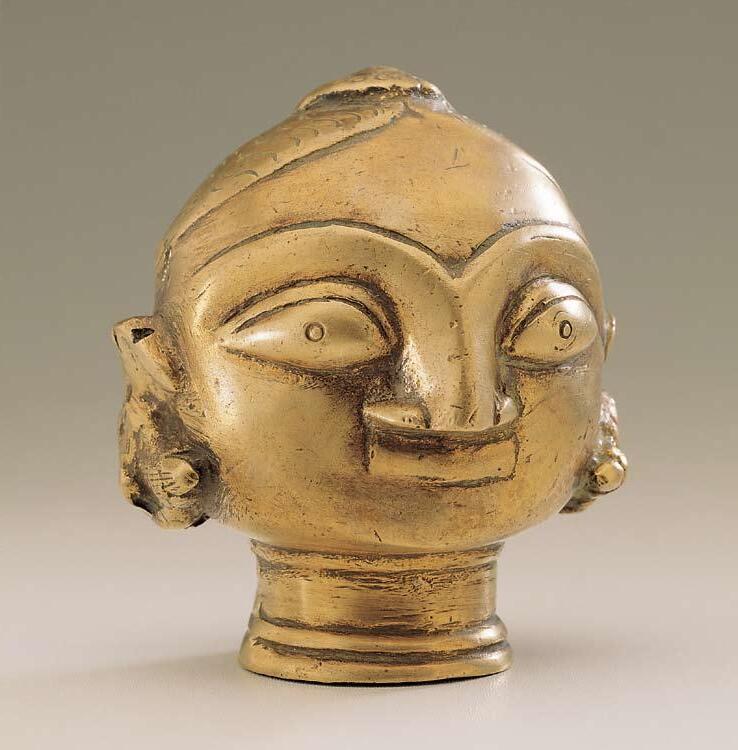
Head of Gauri
Collection: Harsha Dehejia
The Images of Parvati
Artin India is never far removed from life, intimately tied as it is either to religion, aesthetics or utility. A portfolio of images, presented in this format is therefore out of context in many different ways. In the first place these images were never meant to be enjoyed as such. These images were part of a larger experience. Most of the stone images were part of a temple, usually the outer wall. Within the ambit of the temple the devotee gazed at these images during the pradakshina, circumambulation, and the images of Shiva and Parvati resonated with multiple others to provide the total experience. They were deeply meaningful only when visualised along with a universe of other images such as those of divine and semidivine beings, cosmic manifestations, the world of animals and tress, mountains and rivers. They were seen, touched, loved, venerated and deeply felt, not just once but again and again, till they became a part of one’s being. The bronze images came from the strong and sustained culture of temple images especially from the Chola period of Tamil Nadu. Most of them were festival images and seem singularly lonely in the present format, devoid as they are of throngs of faithful worshippers. The miniature paintings come from the courtly culture of the Himalayan kingdoms where they were enjoyed in elite company, often accompanied by the recitation of poetry. The folk images are part of festivals and rituals or the spontaneous earthy expression of ordinar y people. The sensitive reader of this portfolio of images then is charged with the responsibility of
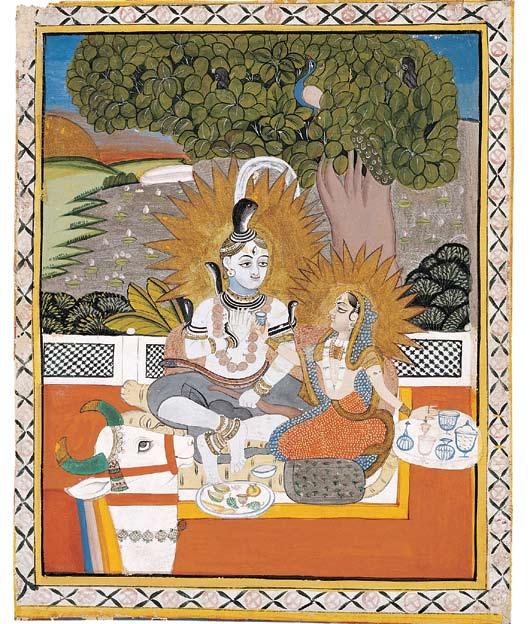
Parvati offering a drink to Shiva 1850, Jodhpur Collection: Harsha Dehejia
On a terrace in Kailasa and behind a lotus pond it is time for an intimate repast. Seated on a tiger skin on a terrace and under the canopy of a tree it is time not only for a meal but equally to experience the pleasure and the joy of togetherness. Spread out in front of them on the terrace are two platters one of fruits and the other of drinks. Par vati affectionately offers a drink in a goblet to Shiva and Shiva in turn gladly accepts. Even though Parvati is involved in the process of feeding Shiva and both her hands are occupied she keeps her gaze steadfast on Shiva, for it is as important for her to quench his hunger and thirst as it is to receive and cherish his loving looks. While two owls keep a watch the peacock on the tree has turned his gaze upwards as if to invoke rain and the everfaithful Nandi, richly decorated, stands guard at the foot of the painting. The Jodhpur kalam borrows a lot from the Kotah artists in creating iconic figures without losing the tenderness of feeling.
understanding and enjoying these images in their original context and not as mere art objects.
The pristine conceptions of Parvati are to be found not in plastic images but in the oral tradition, in the songs and stories of itinerant story tellers, and equally the dance dramas of a bygone era, a tradition that later evolved into the many structured Puranas. The Puranas, through the kathas and gathas, songs and stories, are the treasure-house of the Indian civilisation, and live not only through the many images they created but equally through the hands of kirtankars and patua singers, musicians and dancers who perform at fairs and festivals, in village squares and in temple precincts. An equally strong repository of the lore of Parvati is natya, dance dramas, where she comes alive in the gestures and movements of the dancer and in the lyrics and rhythm of the music. The literary arts, namely sahitya, have also eulogised Parvati, in many different ways. It is these ancient oral and literary artistic traditions that serve as the treasure house of the later manifold images of Parvati. The foundational source of the classical images of Parvati are therefore to be found in our literary and performing arts and it is to these that we must relate when we enjoy her visual and plastic images.
Our visual artists inspired by the rich oral and literary lore of Parvati have equally celebrated Parvati in stone and bronze, ivory and paper, and in a variety of styles. The visual expression of Parvati has depended not only on patronage and regional artistic styles but on the living presence of Shiva and Parvati in the artist’s consciousness. The Indian artistic mind roams through vast vistas of creativity, where myth has a reality of its own, where the songs and stories of the tradition are never forgotten, where the immediate and the ultimate are a continuum; where colour is
not just a medium but a language, and line not just an outline but the creation of a living space, where life pulsates through the movement of breath and the pulsation of blood; where the shrubs and the trees, blossoms and the birds are not just a part of the landscape but an expression of the relationship between humanity and nature, and where Shiva and Parvati are not deities to be portrayed but to be realised in and beyond their artistic manifestations. The images that follow are not cult images for Parvati, unlike Durga or Kali, is not a cult goddess. These images are primarily those of Shiva, but equally of his consort with whom he dallies romantically in Kailasa; of his queen who presides in his court, of his consort who also occupies half of his body, of the mother of his two sons Ganesha and Kartikeya; of his family for whom he is the provider and more than anything else of their relationship which moves from the duality of love and romance to oneness of ultimate realisation. Parvati can be seen, celebrated and understood only through Shiva, in art as in thought.
The images in stone are mainly from the north and come from what is called the classical period of Indian sculpture. The dominant theme is the amorous togetherness of the divine couple, and the images go by the generic term Uma-Maheshvara. Here there is no story to be told, neither is there a representation of a heroic act; it is not a manifestation of divinity, but a visual testament of the romantic commitment as shown through their loving embrace. In these images there is not only the romantic submission of Parvati to her consort but equally the affectionate embrace and acceptance by Shiva of her. In the tender amorousness and the wistful gaze of this celestial couple there is the bold expression of shringara rasa. And as witness to this divine love there are not only the faithful Nandi but equally their two children and celestial beings. The play of light and shade on
ART Parvati Goddess of Love Harsh Dehejia
120 pages, 45 illustrations,
7.25 x 7.25” (184 x 184 mm), hc
ISBN: 978-81-85822-59-4
₹750 | $19.95 | £13.50
1999 • World rights
Harsha V. Dehejia has a double doctorate, in Medicine and in Ancient Indian Culture, both from University of Mumbai. He is a member of the Royal College of Physicians of London, and Glasgow, and Fellow of the Royal College of Physicians and Surgeons, Canada. He is Professor of Religion at Carleton University in Ottawa, Canada, and is a practising physician. His special interests are in Indian aesthetics. His first two books, The Advaita of Art and Parvatidarpana, published from Delhi have been acclaimed.
Other titles of interest:
Devi: The Great Goddess
Vidhya Dehejia
Sri Aurobindo on Indian Art
Selections from His Writings
Photographs by Elizabeth Beck
Symbolic Heat
Gender, Health & Worship among the Tamils of South India and Sri Lanka
Dennis McGilvray
For a complete catalogue of books on Indian Art and Culture, please write to:
Mapin Publishing Pvt. Ltd.
Chidambaram, Ahmedabad 380 013 India web-site: www.mapinpub.com