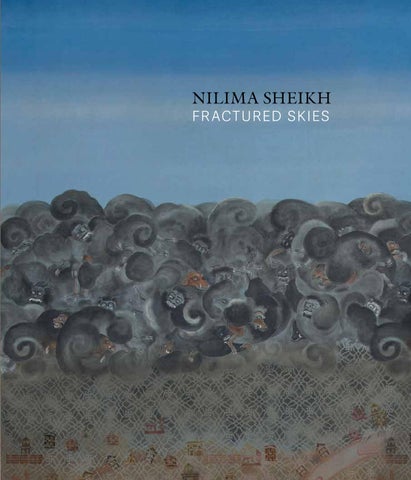
NILIMA SHEIKH FR ACTURED SKIES
Nilima Sheikh works by gathering. Into a single scroll, she will bring a twelfth-century chronicle of Kashmir, a Mughal emperor’s notes on an antelope, the verses of a fourteenth-century mystic poet, and writing by a contemporary historian. Trained in Baroda, she is among the most inventive painters at work in India today. Since 1969 she has built paintings one layer at a time, at every imaginable scale, from small works on paper to two-sided scrolls you need to walk around. Her paintings take on subjects that refuse to simmer down—migration, gender, labour, war. They hold beauty and violence in the same frame, neither subsumed by the other. Nilima Sheikh: Fractured Skies asks what makes such work possible. Curators, art historians and family write from strikingly
different distances; their essays are followed by a montage of Sheikh’s own writing from the 1970s to 2023, most of it unpublished and gathered here for the first time. Together they map the sites and relationships that animate Sheikh’s practice: a household, a neighbourhood, a university department, a valley—five decades of work made in the company of others. Sheikh’s paintings mobilize the past to speak of the present, placing historical and literary references in conversation with contemporary concerns. This book is published by the Kiran Nadar Museum of Art, New Delhi, and Mapin Publishing, on the occasion of the exhibition Nilima Sheikh: Fractured Skies, organized by the KNMA and the Museum of Modern Art, New York.
NILIMA SHEIKH FR ACTURED SKIES
NILIMA SHEIKH FR ACTURED SKIES
NILIMA SHEIKH FR ACTURED SKIES
Published on the occasion of the exhibition Nilima Sheikh: Fractured Skies Curated by Cara Manes and Roobina Karode Organized by the Kiran Nadar Museum of Art, New Delhi and The Museum of Modern Art, New York 27 September 2026–13 June 2027
First published in 2026 by Kiran Nadar Museum of Art 145, DLF South Court Mall, Saket New Delhi 110017, India T: +91 11 4916 0000 www.knma.org and Mapin Publishing Pvt. Ltd 706 Kaivanna, Panchvati, Ellisbridge Ahmedabad 380006, India T: +91 79 4022 8228 E: mapin@mapinpub.com www.mapinpub.com KNMA ISBN: 978-81-983821-5-3 Mapin ISBN: 978-93-94501-24-9 Editor: Roobina Karode Project Editors: Parth P. Mehrotra and Ranjana Dave Designers: Siddhartha Das and Chiara Nath Editorial Assistance: Avijna Bhattacharya, Neha ‘Zooni’ Tickoo, and Rachel Issac Copy Editors: Shreya Chakravertty and Padmini Smetacek Proofreader: Padmini Smetacek Production: Mapin Design Studio Printed and bound in India © 2026 Kiran Nadar Museum of Art Prefaces and essays © their respective authors All other original text © Kiran Nadar Museum of Art Artworks © Nilima Sheikh, except where specified otherwise Photographs © their respective photographers Stills from The Garden of Forgotten Snow © Avijit Mukul Kishore Textual excerpts quoted in the catalogue section © the respective rights holders, as credited in the accompanying notes, except where such material is in the public domain. Every reasonable effort has been made to trace and contact copyright holders of the material reproduced in this publication. The publishers apologize for any errors or omissions and will be pleased to make appropriate corrections in future editions upon written notification. All rights reserved. No part of this publication may be reproduced, stored in a retrieval system, or transmitted in any form or by any means, whether electronic, mechanical, photocopying, recording, or otherwise, without prior written permission of the publishers and the respective copyright holders. The moral rights of the authors are hereby asserted.
Cover: Sheher (recto; detail), 2025–2026, Shahid/Witness series, casein tempera on canvas, painted on both sides. Collection: Kiran Nadar Museum of Art Pages 2–3: Home, Land 3 (set of three panels; detail), 2024, Home, Land series, mixed tempera on Sanganer paper. Collection: Udit Bhambri Page 5: Home, Land 2 (detail), 2024, Home, Land series, mixed tempera on Sanganer paper. Collection: Sunita and Vijay Choraria Pages 8–9: Valley (recto; detail), 2003–2010, Each Night Put Kashmir in Your Dreams series, casein tempera on canvas, painted on both sides. Collection: Amrita Jhaveri
6
CONTENTS F O R E WO R D S
Kiran Nadar Glenn Lowry I N T RO D U C T I O N
Ranjana Dave E S SAY S 18
Nilima Sheikh: Fractured Skies by Roobina Karode
40
Reading 'We Must Bear' by Cara Manes
46
Carrying Across: Transcultural Memories and Creative Lineages by Avijna Bhattacharya
60
Acts of Care by Deeksha Nath
72
Lives Drawn Together: Friendship, Motherhood, and Community in Nilima Sheikh’s Painted Drawings by Khushmi Mehta
86
The Privilege of Painting: Texts and Interviews, 1970s–2023 by Nilima Sheikh
102
C ATA LO G U E
18 2
About the Artist
18 4
List of Key Exhibitions
19 0
List of Artworks
19 8
About KNMA
200
Acknowledgements
FOR EWOR D Look at one of Nilima Sheikh’s scrolls and you will be drawn into a world of sheer beauty. In Son et Lumiere, you encounter water bodies, chinar trees, and mountains— all the things that you think of when Kashmir, that slice of heaven on earth, is mentioned. But stay with the picture and a sombre background score begins to surface: a series of decapitations, demons in lakes and trees. The beauty of Nilima’s works is deceptive; they are not just pretty pictures. They are saturated with hidden meanings and codes, myth and history, violence and sadness. The stories in Nilima’s work reveal themselves rather slowly. I began seriously reflecting on her practice over a decade ago, when I saw her Rozgar series. With ‘livelihood’ as its title, it pays homage to Kashmir’s craftspeople, whose perseverant production of life-affirming beauty in the most trying human circumstances is deeply moving. From there I didn’t look back: her documenta 14 work, Terrain, and her Kochi-Muziris Biennale work, Salam Chechi, which is a sensitive reflection on the labours of carers and nurses, entered the KNMA collection soon after.
It is my pleasure then to place this book, Nilima Sheikh: Fractured Skies, in your hands. Published on the occasion of a landmark exhibition, this book is a larger exploration of Nilima’s practice that will be read for many years to come. And it is my hope that readers who encounter Nilima’s works—whether they come to them knowing Kashmir and India intimately or not at all—will carry something of what I have carried from Nilima’s work for years: a refusal to look away—from what is beautiful, or from what beauty hides. Kiran Nadar Founder and Chairperson Kiran Nadar Museum of Art
To see Nilima’s work travel now to the Museum of Modern Art (MoMA) in New York, the first solo presentation of a woman artist from India, is an important moment for KNMA and for MoMA. Fractured Skies brings together three bodies of work made over two decades of practice— Each Night Put Kashmir in Your Dreams, painted between 2003 and 2014; Home, Land, a 2020s series on displacement and the nomadic Bakarwals of Kashmir; and Shahid/ Witness, a new suite of ten monumental scrolls commissioned by KNMA, shown publicly for the first time. Generations of global audiences have encountered modern and contemporary art through exhibitions at MoMA. But for some, this might be their first encounter with a woman artist from India. This is important for two reasons. One, to show that the histories of modernism are plural, and have never belonged to a single geography. And two, that women are as much a part of its vanguard as men. Artists such as Nilima Sheikh have long been writing chapters of it that the world is only now fully reading.
Opposite: Surveillance (verso; detail), 2025–2026, Shahid/Witness series, casein tempera on canvas. Collection: Kiran Nadar Museum of Art
11
FOR EWOR D This volume is published on the occasion of Nilima Sheikh: Fractured Skies, an exhibition organized by the Kiran Nadar Museum of Art, New Delhi, and the Museum of Modern Art, New York. The exhibition is curated by Roobina Karode, Artistic Director and Chief Curator, KNMA, and Cara Manes, Associate Curator, Department of Painting and Sculpture, MoMA. It is on view at MoMA from 27 September 2026 to 13 June 2027. Sheikh stands out among her peers from the Baroda School and beyond, as a singular talent and one of the most daring and innovative artists of her generation. It is for this reason that when the Museum of Modern Art and the Kiran Nadar Museum of Art began discussing ways to collaborate to advance interest in modern and contemporary art from South Asia, they decided to focus on her work. Both the exhibition and this publication provide a unique opportunity to present her work to a broad audience and introduce them to the many important questions raised by her practice, which now extends for almost six decades. Sheikh’s paintings and installations stand out for their remarkable ability to envelop us in a world in which time unfolds slowly, in loops and switchbacks that take us forward and backward, up and down, in breathtaking flights of the imagination. She builds her works up in interlocking registers that draw you in with their richly textured narratives. Details—a small flower here, a cat there, a hand gesture elsewhere, the wisp of a cloud above—accumulate from one image to the next, requiring you to look closely and intently. Her paintings are at once beautiful and demanding. Sheikh has an unerring ability to make you enter each of her paintings as if you were a participant in the action. She places you in her stories and encourages you to become part of her world—a world in which time and space reveal themselves in a sedimentary way. Her paintings, like the stories they tell, are built up in layers. They have a stratigraphic quality to them—they are constructed with an archaeological mindset.
In a remarkably short time, KNMA has built an especially strong collection of Sheikh’s work. As it prepares to open a new purpose-built museum building in the next couple of years, it seems particularly timely to do a deep dive into these holdings. The exhibition that has emerged centres on KNMA’s collection, alongside a number of strategic loans that amplify these holdings in order to signpost the breadth and complexity of Sheikh’s work. Meanwhile, this publication brings together the perspectives of leading scholars who locate Sheikh within the larger context of contemporary South Asian art. For anyone with a passing interest in Indian and Islamic art, Sheikh’s reworking of traditional manuscript and album painting (her sources include Mughal, Rajput, and Pahari paintings) forges a conceptual bridge between the past and the present. For those interested only in contemporary questions of identity, social justice, climate change, and political activism, her work offers unique insights into how these complex and often contentious issues are negotiated in India. Her paintings are deeply rewarding and endlessly fascinating and merit a great deal of attention. Her ability to use the language of the past to explore the problems of today while creating an art that is unique and compelling reflects her remarkable gifts as an artist. Glenn Lowry Former Director, The Museum of Modern Art, New York, 1995–2025 Advisory Board Member, Kiran Nadar Museum of Art, New Delhi
Opposite: Forest Fire (recto; detail), 2025–2026, Shahid/Witness series, casein tempera on canvas, painted on both sides. Collection: Kiran Nadar Museum of Art
13
INTRODUCTION Nilima Sheikh’s Hunarmand (2014) is an account of Kashmir as a place of industry. Three men apply finishing touches to a shawl, a design of patterned fish at its centre. Another man laboriously combs through raw wool, coaxing it into smooth, individual fibres. A woman rows a boat through tranquil green waters, a fishing net suspended over its edge. Everywhere, densely patterned stencils make an appearance—as borders, backdrops, and subject matter. One could imagine these people cut and pasted into a school project on occupations—weavers, carders, fisherfolk—assembled from sheets of stickers you can find in Indian stationery shops. But while they are frozen in time as labels and categories on a sticker chart, in Hunarmand, which translates to ‘one who has a gift or talent’, these tradespeople are read in the frame of broader histories, surrounded by quotations from scholars who describe centuries of flourishing trade in Kashmir, all the way to Sultan Zain-ul-Abidin’s reign in the fifteenth century. In over fifty-five years of practice, Sheikh has sourced from historical records, literary and poetic sources, personal observation, and collaborations with craftspeople; her works are less singular ‘paintings’ focused on a lone subject, and more assemblages around broader preoccupations—trade, migration, conflict, gender, and labour. She paints with the sensibility of an archivist, citing, juxtaposing, and putting together—across space and time—where a myth might rub shoulders with a news story from a few months ago. Nilima Sheikh: Fractured Skies makes its argument the way Sheikh builds her scrolls, through a process of accumulation. Curators, art historians, Sheikh’s family— and Sheikh herself—writing from different degrees of intimacy with and distance from her practice, share space in the book, which accompanies an exhibition organized by the Kiran Nadar Museum of Art, New Delhi, and the Museum of Modern Art (MoMA), New York. While the exhibition gathers eighteen artworks that collectively represent twenty-five years of artistic engagement with Kashmir, the book probes what makes them possible. Sheikh is not just a woman and mother whose daily life deliberately informed her work. She is not just a Baroda-
14
trained artist who has substantively engaged with tradition, through her research on pichhwai painting and her long collaboration with the sanjhi stencil makers of Mathura. She is not restricted by formats or themes; she has painted small-scale works and gigantic two-sided scrolls you need to walk around, designed theatre sets, and illustrated children’s books. She has painted her children into her works, shrugging off the disapproval of older artists, and taken on the sociopolitically complex subject of Kashmir—not as a territory to be claimed or mapped, but through the people who have populated its landscape over the ages, and who bear the impact of decisions made about them and for them by others. The six texts in this book cover form, pedagogy, geopolitics, ideology, family, and community in relation to Sheikh’s work. Roobina Karode, writing from a decades-long familiarity with Sheikh’s practice, delves into the chequered history of Kashmir—both within and beyond Sheikh’s work—as disputed territory, but also as a place of continuous activity, beyond its polarized representations as ‘paradise’ or ‘war zone’. Through the artist’s latest series, Shahid/Witness (2025–2026), Karode comments on the emotional and political cost of living in a world in conflict. Cara Manes offers a close reading of We Must Bear (2014), placing Sheikh within a global lineage of modernist artists who source from traditional practice and experimental techniques in their work. Avijna Bhattacharya describes another modernist trajectory—the pedagogic lineage that shaped Sheikh’s artistic interests, tracing shifts in art education through the late-colonial era and post-Independence India, particularly the turn towards traditional and indigenous practice as a reference point in Santiniketan and Baroda, each with its own distinct flavour. She brings these influences together in a reading of Sheikh’s sixteen-panel work Terrain: Carrying Across, Leaving Behind (2016–2017). Deeksha Nath contributes a sweeping profile of Sheikh from her dual perspective as a family member (she is
married to Sheikh’s son) and as a critic and curator of South Asian art, dwelling on formative experiences from Sheikh’s childhood and time as a young mother. We begin to see how Sheikh draws inspiration from her surroundings, with daily life becoming an entry point into the world beyond the domestic sphere.
map of Srinagar: its homes, houseboats, streets, and rivers filling the frame, but refusing to be contained by it. Ranjana Dave Senior Manager, Publications Kiran Nadar Museum of Art
Khushmi Mehta deepens this reading of Sheikh as an artist embedded in collective life—in communities brought together by proximity, identity, or artistic interests. She offers varied examples from Sheikh’s work in the 1980s to illustrate this interdependence: small-scale paintings that draw on neighbourhood life, artistic responses to gender-based violence, and Sheikh’s work in theatre. These texts are followed by a montage of Sheikh’s writing, largely unpublished, from the 1970s to 2023, spanning informational briefs supplied to curators; her reflections on a particular subject, like narrative painting, or a specific series from her body of work; speaker notes for presentations she has made over the years; and edited excerpts of on-camera interviews in two documentary films. The montage captures the clarity of thought that Sheikh brings to works of breathtaking scale. In her early writing, she begins to give form to ideas of repetition and citation drawn from narrative traditions across Indian art. These later inform how she works with poetic and academic references across her paintings, particularly her Kashmir works. The montage is composed much as Sheikh makes her own work—citing, juxtaposing, and putting together—this time, from her own reflections. A book put together in this way asks something of its reader. How do you read a painting? Does your gaze land on its vanishing point? Do you survey it from left to right, or top to bottom? Do you hold on to one thing, or remember it in its entirety? The essays in Nilima Sheikh: Fractured Skies all make self-contained arguments. You don’t have to start from the beginning. As Sheikh notes, ‘Every time you see a thing, it is never complete.’ Her work embodies that notion. Walk around to the other side of Hunarmand, and the scroll becomes a teeming
Overleaf: Asifa (verso; detail), 2025–2026, Shahid/Witness series, casein tempera on canvas. Collection: Kiran Nadar Museum of Art
15
ESSAYS
Nilima Sheikh: Fractured Skies Roobina Karode
My body reduced to ashes by hate is carried away by the cool wind. I shall be back as a moment in history. Subbu Holeyar1
Firdaus, or ‘paradise on earth’, is a popular epithet for Kashmir, invoked by emperors and poet-saints alike. In Nilima Sheikh’s practice, it is also a paradox she refuses to resolve. Her works evince a Kashmir where beauty is inseparable from terror, a ravaged dream combining the tragic with the poetic, provoking simultaneous states of longing and loss. Her deep pictorial understanding of manuscript traditions, coupled with a sense of architectural framing learned from mural practices, imbues her return to modes and materials from Asian painting, with the mythical and historical past of Kashmir brought forth to accentuate its precarious present. In Sheikh’s artistic practice, multiple universes, cultural and artistic traditions, literary and poetic references, formats and pictorial methodologies, are brought together on a single plane of a painted scroll. Here, reiterating a line or an image is an act of persistent witnessing. Recurring motifs such as a fading border, an archway, a destroyed garden, a sunken grave, or a silent figure, moulded in touches of soft tempera tones, signify that the process of remembering is never complete. Human memory provides us with a surface that frays as we try to trace it, even retrace it. It is never a pristine archive of what happened. Sheikh is distinctive in Indian contemporary art for her sustained engagement with the scroll format. Her preoccupation with the hanging scroll and its expressive and pictorial potential is examined here primarily across two large bodies of work, Each Night Put Kashmir in Your Dreams (2003–2014) and Shahid/Witness (2025–2026), and Home, Land (2023–2025). If one were to look back over the years to reflect on Sheikh’s artistic (painterly) beginnings in the 1970s–1980s, her modest-sized paintings were a response to domesticity—
20 Nilima Sheikh: Fractured Skies
tending home, raising kids, and engaging the immediate everyday world around her, portraying her family, children, and familiar characters from the neighbourhood. Shaken at the time by the tragic fate of Champa, a girl she knew, who grew up playing with her children, and was married off very young and killed soon after due to dowry demands, Sheikh was not prepared to let this occurrence slip into oblivion. She felt an inner compulsion to paint Champa’s story, but did not know how to go about it. She told me, ‘The fragility of the narrative brought a feeling of dissatisfaction with the idea of a framed image on the wall, painted in oils. I was looking for a format that could tell the story page by page, in the manner of a life unfolding, bringing us to the abrupt end and mourning thereafter.’2 Sheikh turned towards several Indian storytelling traditions, such as the pattachitra and pichhwai, to work on When Champa Grew Up across twelve wasli paper folios. While arriving at compositional techniques for the Champa series, Sheikh, wanting her images to be accessible, adapted her methods to work with sparse elements that were more suggestive than illustrative, conveying expressions ranging from innocence to evil. In one of her earlier conversations with me, Sheikh had shared how inspired she was by the pre-Renaissance painter Fra Angelico who, in his depiction of the Flagellation of Christ, did not paint the actual flagellation but suggested it powerfully through implements of torture.3 This became an interesting device for Sheikh to use. Angelico painted the whip, while Sheikh painted the belt, rolling pin, and kerosene stove as symbols of physical brutality. Sheikh was also drawn to incorporating some poems and songs in Gujarati, which came very close to what she was painting. She had then said, ‘It came as a bit of a shock to me that the anguish I was trying to record had already been expressed . . . by women over the years in song.’4 This was a distressingly common story at the time: a young bride killed by her in-laws. It was the first time that Sheikh introduced words into her work, and since then, inscribing text on her scrolls has become an integral and inseparable part of her painting. The story in its delicate rendering, interspersing image and text, is presented solely from a woman’s vantage point. Sheikh said, ‘I was not aware of the word feminism or feminist then, but had a growing awareness within of how important it was for me to choose whom to speak for, and invoke acts of resistance
embedded in different forms such as poetry, folklore, and literary traditions from different regions in India.’5 Sheikh is constantly seeking and devising visual techniques that enhance spatial experiences in her paintings. Her narrative flow is distinguished by its intimacy and fluidity. She notes, ‘The struggle was not so much about how to defer the tenets of modernism as about seeking a feminine voice.’6 From the Champa series to individual works such as Wakeful Night 1 (1986), Shamiana (1996), and later Each Preceding pages: Detail of Plate 1.7 Plate 1.1. Dust Storm, 1993, Song, Water, Air series, casein tempera on cloth. Private collection Plate 1.2. Bhadon 1, 1992, Song, Water, Air series, gum tempera on cloth. Private collection.
Night Put Kashmir in Your Dreams (2003–2014), Sheikh abandoned linear narration and started working on confluencing rather than sequencing her stories. She placed them within a painted architecture which segued from interior domestic spaces into an expanded pictorial field. In Wakeful Night 1 (1986), the architecture anchors the framing of the inside and outside spaces, with the enclosure and the steps leading up to a room, directing the viewer’s gaze to a woman seated in the centre, nursing a baby. She is surrounded by family members who are already asleep, around her and on the rooftop above her. But the most ominous detail is the predator outside, somewhat indistinct yet definite, camouflaged in the darkness of the night. A sense of vulnerability and danger is amplified by the stillness of the night. ‘I needed to
Plate 1.3. An Evening after Monsoon Rain, 1981, oil on canvas. Private collection
Roobina Karode 21
Reading 'We Must Bear' Cara Manes
To look at Nilima Sheikh’s We Must Bear (2014) is to read one’s way across it, and in doing so to discover that looking and reading are inseparable activities. The painting unfolds slowly, through a network of visual and textual connections: from a verse of poetry to a figure, from a figure to a grave, from the curve of a tombstone to the outline of a house, and so on. In turn, reading reveals how words and images inflect what and how we see. Sheikh builds this reciprocity into the very structure of the painting, asking us to undo the distinction between looking and reading. We Must Bear is the penultimate work in Each Night Put Kashmir in Your Dreams (2003–2014), Sheikh’s extended artistic engagement with the Kashmir Valley. Here, a vibrant topography of the region’s mountains, rivers, and pastures is interwoven with visual vignettes, shimmering filigree patterns, and text. The series’ eleven suspended, double-sided scrolls were made over more than a decade in casein tempera on unstretched canvas, bringing together painting, text, and stencilled patterning. Sheikh has described the texts embedded in the series as a kind of ‘bibliography’,1 traces of what she was reading and researching as she worked. In the paintings, literature, history, and memory become materials through which she constructs a prismatic portrait of Kashmir: a composite of the ways it has been described, pictured, remembered, and imagined. In We Must Bear, that process begins with the title. At upper left, Sheikh reproduces, in stencilled paint, a verse by the Kashmiri poet, mystic, and saint Nund Rishi (Nooruddin Noorani, 1377–c. 1438). His short poems, or shruks, were written in Kashmiri for a local audience, and they articulate a moral vision grounded in peace, tolerance, and equality. The passage occupies a position akin to a title page at the beginning of the scroll, if read from left to right and top to bottom, and its repeated injunction sets a rhythm for what follows: We must bear the lightning and thunder We must bear the darkness at noon We must bear the mountain on our shoulders We must bear the fire we place on our palms We must bear our bodies milled to dust We must bear to swallow the poison load together.2
42 Reading 'We Must Bear'
These compact lines sit directly within the painted field, their repetition echoing both within the poem and outward across the canvas. They establish a way of reading what follows, as the eye moves downward and across the surface, into a landscape whose beauty becomes increasingly charged by what it contains. At lower right, a solitary figure surveys a field scattered with bodies. The scene was inspired by Kashmiri writer Mirza Waheed’s debut novel, The Collaborator (2011), 3 in which an unnamed protagonist, freshly inducted by the Indian army, is tasked with counting and clearing the bodies of those killed along the border. Among the dead, he fears, may be his childhood friends, who had crossed the border into Pakistan to receive military training and join the armed struggle for Kashmiri independence. Sheikh translates this literary scene into a complex pictorial arrangement: The protagonist stands upright, surveying
Preceding page, below, and opposite: Plate 2.1. We Must Bear (recto, details), 2014, Each Night Put Kashmir in Your Dreams series, casein tempera on canvas, painted on both sides. Collection: The Art Institute of Chicago
bodies rendered through a combination of freehand line and brushwork interwoven with fragments of stencilled pattern. These strewn, limp, prone bodies follow the contours of the surrounding rolling hills, reiterating the same combination of freehand and stencilled paint, at times appearing to dissolve into the landscape. On the painting’s verso, Sheikh makes the literary source of the vignette more explicit, stencilling an excerpt in which Waheed’s protagonist describes a makeshift ‘martyrs' graveyard’.4 The passage is one of several texts inscribed on the verso that provide varying degrees of context for the pictorial narratives unfolding on the recto, in keeping with the compositional approach she takes throughout the series. Across the painting’s surface, elongated octagonal lozenge forms recur as stand-ins for grave markers. Their repetition turns individual symbols of burial into a pattern extending across the landscape, setting a visual rhythm. As with the bodies in the landscape, Sheikh complicates these grave markers through her use of sanjhi, the North
Indian tradition of hand-cut paper stencilling associated with devotional practice. Developed through her work with artisans in Mathura, the technique introduces another history of image-making into the painting. Organic and geometric motifs appear within and around the octagonal forms and throughout the composition, by turns delineating form and organizing space. The contrast between these finely cut stencilled patterns and the larger expanses of fluidly painted ground provides a particular layered density. From a distance, the painting reads as an atmospheric landscape; up close, it resolves into innumerable marks, patterns, figures, and fragments of text. At the centre of the composition, a large octagonal frame brings these different sources and processes into a single form. Within it, Sheikh paints a small landscape —a ‘cameo’, as she has described it5 —of the town and lake referenced in The Collaborator. A literary place becomes a painted geography enclosed within the form of a grave. A similar compression of space and shift in scale appears in a cutaway vignette along the upper left
Cara Manes 43
CAR RYING ACROSS Transcultural Memories and Creative Lineages Avijna Bhattacharya
A cultural past seeps through The history of image-making predates the written word. Cave walls, architectural spaces, and print traditions evince a genealogy of narrative through murals, inscriptions, scripture, and even their portrayal of oral storytelling traditions. Take the Ajanta murals:1 dating from the second century bce to 480 ce, they depict the religious and sociopolitical climate of their times, with their elaborate illustrations of the Jataka tales.2 Their compositional panels are arranged both vertically and horizontally, with stories exploding on the walls and ceilings of the caves. Even architectural details like pillars and frieze bands dotted with motifs serve a purpose, framing the narrative within relational circuits of pattern and ornamentation, ones that occur and reoccur across mediums and eras. Nilima Sheikh’s multipanel artworks, crafted as scrolls, draw from this genealogy of images, both in their technique and aspirations. Focusing on Sheikh’s practice as an acknowledgement that artistic techniques extend beyond their original creators, resonating through repetition and adaptation, this essay asks how the histories of Santiniketan and Baroda might converge in an art-historical map of the subcontinent. It traces her stylistic lineage along a timeline of a twentieth-century arts education in two formative arts institutions in India, Kala Bhavana (established in 1919) at Visva Bharati in Santiniketan, and the Faculty of Fine Arts (founded in 1950) at M.S. University in Baroda, and describes the culturally rooted experimentation these institutions embraced, encouraging research on form, methods, and material, with artist-teachers leading the charge through both their practice and their pedagogy. Their efforts pushed students to discover subject and materiality through lived experience and historical research. The trajectories of these institutions were shaped not only by the search for a distinct regional identity, informed by extant premodern and medieval sources like murals, sculpture, and painting, but also by an interest in looking outward, to the rest of Asia and to Europe, for new influences, as alternatives critical of the colonial parameters of art education. This approach, cultivated over generations of pedagogues, may have sparked
48 Carrying Across
in Sheikh her propensity to draw from diverse literary, mythical, and sociopolitical sources, with stories, truths, and myths informing the opinions that surface in her lyrical yet incisive images. Despite being carried out in a studio, Sheikh’s work drew inspiration from her travels and encounters with local and indigenous cultural expressions, which translated into an interrogation of modes of composition, spatial distribution, and pigments—particularly their capacity to absorb and proliferate specific hues—and the effect they would have on the image. Her curiosity was nurtured by a curriculum that was deliberately positioned as a counterpoint to colonial pedagogies and perspectives. It is this line of inquiry that the essay brings to two of Sheikh’s works, Terrain (2016–2017) and Rozgar 1–4 (2011) (Plates 3.2–3.5) while also emphasizing, to a lesser extent, their structural and material connections to a range of historical sources Sheikh references in her work. Negotiating tradition The integration of art into university education necessitated a redefinition of the artist’s role. In the pre-Independence era, at colonial art schools, like the Government School of Art, Calcutta, and the Sir J.J. School of Art, Bombay, the training was geared towards equipping students with draughtsmanship skills, and not on emphasizing emotion or subjectivity in the image.3 Individual artists like Raja Ravi Varma adopted the academic realism of European painting to portray mythological themes; Varma studied oil painting in secret with Arumugham Pillai at the Travancore Court, bringing the women in his paintings to life in a medium European painters had worked in since the fifteenth century. The Bengal School of painting was oriented differently, with its objective of nationalist engagement. Art historian and educator Ernest Binfield Havell (1861–1934), the principal of the Government School of Art in Calcutta, worked on revising its curriculum, promoting the study of premodern temple sculpture and Mughal, Rajasthani, and Pahari painting techniques for line work, colour harmony, and narrative depth. Abanindranath Tagore (1871–1951), Havell’s colleague and, from 1905, vice principal
at the school, offered examples of this artistic direction in works like Bharat Mata (1905, first titled Banga Mata), believed to personify the nation as a four-armed mother figure, created in response to the Partition of Bengal. Tagore’s interaction with Japanese cultural figures such as art historian Okakura Kakuzō and artists Yokoyama Taikan and Hishida Shunsō shaped his approach, which blended Japanese brushwork and Indian iconography. His work, characterized by a flat two-dimensionality, contrasted with Western naturalism and reflected a deep-seated indigenous nostalgia. Partha Mitter, writing on regional Asian avant-garde art in the twentieth century,4 highlights the morotai (indistinct form)5 technique, which inspired Tagore to imbue his watercolours with melancholy, maintaining elements of Mughal miniatures while softening their rigid outlines. In 1907, he co-founded the Indian Society of Oriental Art with his brother Gaganendranath, and with support from Havell, as a counter to the predominance of Western realism in Indian art practice. A decade later, at Kala Bhavana in Santiniketan, artists tended to operate by stepping outside their studios to observe their surroundings, interacting with landscapes and people. In this manner, they were moving away from both colonial academic realism, believed to be restricted to easel work, and art emerging from court patronage. The Bengal School gave primacy to India’s spiritual and indigenous heritage, which was invisibilized by colonial art education, while Santiniketan trained artists to unpack cultural idioms from their study of the ancient Ajanta and Bagh murals, medieval and premodern artistic traditions (miniatures and manuscripts), and local forms of expression, including wood engravings and the pata paintings of Kalighat. An iterative practice
Preceding pages: Detail of Plate 3.1 Plate 3.1. Drifting Drowning, from the Terrain: Carrying Across, Leaving Behind ensemble (one of sixteen panels), 2016–2017, casein tempera on Sanganer paper. Collection: Kiran Nadar Museum of Art
Tagore’s student Nandalal Bose (1882–1966) joined British artist and patron Christiana Herringham on the 1909–1911 campaigns to trace and copy the Ajanta cave murals. In 1921, he visited the Bagh caves in Madhya Pradesh along with Asit Kumar Haldar and Surendranath Kar from Kala Bhavana to study the fifth- to sixth-century rock-cut cave murals. Bose, who was known for carrying
Avijna Bhattacharya 49
ACTS OF CAR E Deeksha Nath
Nilima Sheikh’s paintings are rooted in a careful observation of relationships—between people and landscapes, memory and history, poetry and politics, private experience and collective life. Few artists have spoken so candidly about the tension between painting as a solitary pursuit and the requirements and expectations of a collective and professional life. Yet, this apparent contradiction has, over more than five decades, become the very foundation of Sheikh’s work. Having developed into one of the most sustained meditations on how private acts of looking might become public acts of care, her paintings ask us not simply to look, but to remain with what we see long enough for its complexities to surface. This text emerges from being in the unique position where I studied at the same institution as Sheikh, thus belonging to the same artistic milieu, and eventually becoming a member of her family some decades later. From here I have been afforded an intimate view of both her practice and her person.1 An inheritance of care Born in Delhi in 1945, Sheikh grew up in a family where education and public service were regarded as inseparable responsibilities. Her parents and one of her grandparents were distinguished medical professionals, and their work extended beyond hospitals into institution-building and community care. Her mother Dr. Leila Dhanda, a pathologist and keen naturalist, and father, Dr P.C. Dhanda, who later became dean of Maulana Azad Medical College, belonged to a generation deeply shaped by the ideals of the freedom movement, where professional life was understood as a form of social commitment. Knowledge, in this household, was not simply an acquisition but something that was to be shared. This belief that learning carries obligations towards others has quietly underpinned Sheikh’s life as an artist. She recalls her father carrying medical supplies into remote communities in the mountain regions and setting up temporary clinics and screening camps in places where healthcare was difficult to access. This facilitated an early understanding of care as something enacted through everyday labour rather than extraordinary gesture. Looking, listening, and tending became
62 Acts of Care
intertwined experiences, allowing for a reciprocal relationship between people and places (Plate 4.1). Among her most enduring childhood memories are the journeys her family undertook to Kashmir and Himachal Pradesh. The mountains were experienced as places where ecology, architecture, labour, language, and culture existed in visible relation to one another. Sheikh said in a conversation, ‘When one is walking in the mountains you see the wildflowers at your feet and then you turn a curve and you see a vista; there is an excitement in this visualization of a space. On observing the flowers there is novelty, but then the expanse turns into wonder.’ If attention became Sheikh’s first education, landscape was its earliest companion. The mountains also offered an early awareness that landscapes are repositories of memory. Kashmir entered Sheikh’s imagination long before it became synonymous with conflict. It was first encountered through poetry, gardens, music, architecture, and remarkable traditions of craftsmanship, and equally through the people whose lives sustained these cultural forms. This experience would become critical decades later, when Kashmir increasingly came to occupy public discourse as a territory defined almost exclusively by violence. At Delhi’s Modern School, Sheikh encountered teachers who encouraged curiosity rather than conformity. She studied dance under Narendra Sharma, one of India’s pioneering choreographers, whose classes introduced movement as a form of thinking. Dance left a lasting imprint on her understanding of pictorial rhythm, and even her most apparently still paintings possess an underlying choreography. Sheikh has talked at length about her engagement with theatre and its impact on her work. Her scenographic work, along with the early training in dance, lends to her figures a performative presence, a self-awareness that drives them in their endeavour, be it in building a shelter, swimming across waters to meet a lover, or aiding a woman in hospital. At Modern School, art was taught by Kanwal and Devyani Krishna, whose lives had been shaped by years spent travelling and living in the Himalayan regions, including Sikkim, near the Tibetan border. Their teaching expanded the idea of what Indian art might encompass,
Preceding pages: Salam Chechi (detail of Plate 4.6, one of five panels), 2018, tempera on board. Collection: Kiran Nadar Museum of Art Plate 4.1. The artist on a trip to Chandanwari in Kashmir, c. 1960. Leila Dhanda. Courtesy: Nilima Sheikh and Asia Art Archive
Deeksha Nath 63
LIV ES DR AW N TOGETHER Friendship, Motherhood, and Community in Nilima Sheikh’s Painted Drawings Khushmi Mehta
In 1969, artist Jyoti Bhatt photographed a group of students in the painting department studio at the Faculty of Fine Arts in Baroda. The students are seated at various heights, either on the floor or precariously perched on top of cabinets and chairs, amidst a jumble of in-progress paintings, empty frames, and painting supplies. They hold hands and lean on one another for support, creating an entangled web of interlocking arms. On the right, their teacher Feroz Katpitia pretends to be a strict disciplinarian, staring at the camera with a stern expression. He poses with one hand on his hip and the other holding a cardboard roll pointed at the students, who seem to be in on the joke and are caught midlaughter. Included in this cacophony is Nilima Sheikh, dressed in a simple white saree and seated perfectly
Preceding pages: Before Nightfall (triptych; detail of Plate 5.4), 1981–1982, oil on canvas. Private collection. Courtesy: Nilima Sheikh and Asia Art Archive Plate 5.1. A group of graduating students, including Nilima Sheikh, with their teacher Feroz Katpitia at the Faculty of Fine Arts, M.S. University, Baroda, 1969. Photo: Jyoti Bhatt. Courtesy: Jyoti Bhatt and the Museum of Art and Photography, Bengaluru
74 Lives Drawn Together
poised atop a cabinet. Unlike the other students who pose with their artworks, she smiles and holds up a stretcher bar around her face, as if framing a self-portrait. Sheikh nostalgically remembers orchestrating these poses with her classmates. The photograph, taken to commemorate the last day of their BA studies, encapsulates the camaraderie at the core of pedagogical and artistic practices at the Faculty, which has shaped Sheikh’s life and work in Baroda since she first moved to the city in 1965. Over the course of my meandering conversations with Sheikh, as she recounts the trajectory of her five-decade-long practice, she often interjects her own narration with anecdotes, jokes, and memories created with her artist friends. She speaks of impromptu seminars and workshops that were often hosted at their teachers’ homes; of hangouts that took place in the college canteen or outside the studios on campus; of her and Gulammohammed Sheikh’s home being a welcoming space for the community to gather; and of lifelong friendships she has formed with other artists. In situating her practice within the context of this artists’ community
that she was both a participant in and witness to, her works navigate the interstices between her domestic life and the communal spaces she belonged to; between the solitude of her studio and the collaborations she frequently sought out; and between her roles as a mother and an artist. Reading her paintings through a lens of community and camaraderie allows us to see the affinities between her own life, preoccupations, and struggles, and those of the women around her. In many ways, the kind of progressive pedagogy that Sheikh experienced in Baroda was one that she had already been inducted into in her time at Modern School in Delhi. The school employed practising artists and dancers as pedagogues, who allowed students to work in the art room and dance studios after hours. Sheikh attributes the germination of her artistic practice
Plate 5.2. Dushyant Rathore, Nilima Dhanda (Sheikh), Mrinalini Mukherjee, and Rini Dhumal at the Faculty of Fine Arts, Baroda, 1970. Photo: Jyoti Bhatt. Courtesy: Jyoti Bhatt and Asia Art Archive
to the influence of two teachers: painters and printmakers Kanwal and Devyani Krishna. The artist couple drew inspiration from sociocultural practices, folk traditions, and the visual cultures of the regions they visited. Their studios on campus were adjacent to the art room and open for students to visit. Beyond just the freedom to experiment with painting styles, they also introduced students to printmaking techniques like etching that were not commonly known at the time. By the time Sheikh joined the Faculty, she was ‘familiar with many of the ethics of Baroda’, such as the familial relationships among students and teachers, the encouragement to experiment with new mediums and techniques, and the lack of inhibitions in the studio. What was surprising to her, however, was the newfound sense of independence she gained in Baroda as a young woman arriving from a metropolitan city. She says with a smile, ‘Aha! It was nice for a girl to be given the freedom to stay in the studios until ten o’clock in the night. It was unusual. It was wonderful because it allowed us to work
Khushmi Mehta 75
THE PR IV ILEGE OF PAINTING Texts and Interviews, 1970s–2023 Nilima Sheikh
‘small pleasures and private pains’ I think I am an artist because I am a painter, not a painter because I am an artist.1 I find fiddling around with brushes and paints a very productive activity. I am always amazed at the way the rules of painting can be made to work, how many linguistic inflections they yield, and how many meanings they can recall, mutate, and perhaps even invent.2 Despite the presence of an opinion, for the most part of my working life that ‘painting’ had run its course, I don’t think I could have chosen a better time to paint.3 When I say this, I find that I still often have to explain that, for me, painting—and I am sure for many other people in the world—does not necessarily mean working with oils on a canvas stretched on a frame. Things have changed now, but till a few years ago even artist friends would ask me, ‘So when are you getting back to painting?’ as though working outside the easel format was something else, preparatory or secondary.4 Perhaps the only other
Preceding pages: River: Carrying Across, Leaving Behind (detail of Plate 6.7), 2001, casein tempera on canvas. Collection: Anu and Arjun Aggarwal Plate 6.1. A scene from Umrao, directed by Anuradha Kapur, produced by Vivadi Theatre Group, featuring scenography and hand-painted screens by Nilima Sheikh. Courtesy: Shri Ram Centre, New Delhi, 1993. Photographer unknown
88 The Privilege of Painting
category that may work for me is that of an aspiring illustrator. As Gulam first pointed out to me, most of the greatest paintings of all time from the world are illustrations of some kind. I have painted from the Jatakas for the pleasure of illustrating. Despite the seemingly pervasive misogyny in the translations available to us, one can encounter strains that seem to come from other sources, and therein female characters from other levels of being are spared vilification. The Bhallatiya Jataka and Canda Kinnara Jataka are delightful love stories, redolent of the miracles of female passion. At least that is the way I like to read them!5 I like painting on paper, on silk, on board, on wood, and for that matter on canvas too, even though I do not usually stretch it out on a frame. I like canvas because you can paint endless lengths on it and then roll it up and take it away under your arm, so to speak. I like painting pictures on little pieces of paper. I do not think there is a better way of talking about small pleasures and private pains. When I work on a large scale and deal with a metaphorized projection, the desire of the imaginative to soar takes its meaning from this very intimacy. I also like to paint for theatre, to take my painted images out to interact with real actors (Plate 6.1). I like not only to
engage other kinds of painters, but invite collaboration with sculptors, calligraphers, and other craftspeople for intervention into my imaginative space.6 ‘to crack its code’ I think I like to sidestep the finality attributed to works of art. The desire is not just about form; it is equally conceptual. That is why the slippage between painting and drawing helps me.7 Since I usually draw with a brush, it becomes redundant to abide by any—‘now I draw, then I paint’—sequence. I often think [of] my works on paper as painted drawings. 8
Below: Plate 6.2. Sanjhi stencil of deer escaping a hunter, based on a Kota painting, year unknown, by craftsperson Sanjay Soni Bottom: Plate 6.3. Sanjhi stencil of a Simurgh, based on a Persian painting, year unknown, by Sanjay Soni
The one difference between drawing and painting that does engage me is the learning factor. Drawing, as a rule, does not obscure its process. If I admire a drawing I often feel that I would like to draw like that—to crack its code.9 Tomorrow it may be another kind of drawing I might want to decode. And I am not bothered by this inconsistency; the notion of authenticity does not dog me as it does when I create a painting which claims to ‘express’ (Plates 6.2 and 6.3).10 If I aspire to draw like Nainsukh, it is not because I ever can—it is because his drawing at least shows me the way; what I do with it is of course another matter. . . . There are many artists who may not draw to communicate with their audience. I suppose most artists, at least some of the time, draw for themselves—not to exhibit or sell, but just to memorize, record, describe, make notes, organize or feel out thoughts, sensations or perceptions. I will never forget this Kota tiger hunt/forest scene drawing in the collection of Jagdish Mittal. It was a veritable series of notes and jottings the artist had made to visualize for himself a complete painting. Not a mark was made on the paper which was not necessary in this data collection and organization process.11 And yet, what a variety of marks to enumerate different planes, surfaces, sensations, tensions, and the movements of wind and the animals. Colour was as economically used but differentiated with an acumen that could bring into play a score of visual registers. Notations were even made through written words where economy would deem that necessary. A rich and complex vision: precisely coded, executed with spontaneous élan. Here, there is
Nilima Sheikh 89
CATALOGUE
Preceding pages: Construction Site (recto; detail of Fig. 4), 2009–2010, Each Night Put Kashmir in Your Dreams series, casein tempera on canvas, painted on both sides. Collection: Chemould Prescott Road Fig. 1. Valley (recto), 2003–2010, Each Night Put Kashmir in Your Dreams series, casein tempera on canvas, painted on both sides. Collection: Amrita Jhaveri
Opposite and pages 108–109: Details of Fig. 1
106
This lake, even a mustard seed’s too large to sink in it, yet everybody comes to drink its water. Deer, jackals, rhinos, cloud-elephants are born, and barely born, fall back into its waters. Lal Ded, a fourteenth-century Kashmiri mystic poet1
Catalogue 107
About KNMA The Kiran Nadar Museum of Art (KNMA) is India’s pioneering private museum for modern and contemporary art, located in New Delhi and oriented to South Asia and the rest of the world. Established in 2010 by collector and philanthropist Kiran Nadar, the museum is now broadening its scope to include classical, folk and tribal, and premodern art, with works ranging from the third century CE to the twenty-first century. KNMA’s growing collection—currently at over 16,000 works—is a catalyst for critical engagement with art. Through research-driven exhibitions, publications, residencies, and public programmes, it actively engages with diverse audiences, expanding the global understanding of South Asian art. KNMA is entering a new phase with the development of a landmark building in New Delhi, imagined as the largest integrated cultural centre in India, helping realize the institution’s vision of operating at the highest international standards while remaining rooted in the region.
Architectural model by Adjaye Associates for the Kiran Nadar Museum of Art at the 18th Biennale Architettura, Venice 2023. Photo: Timothy Casten. Copyright: Kiran Nadar Museum of Art
ACKNOWLEDGEMENTS
The Kiran Nadar Museum of Art extends its deepest gratitude to Nilima Sheikh, for her generosity and patience throughout the making of this exhibition and publication.
For data collation and editorial facilitation towards this book, we are indebted to Stuti Bhavsar and Rashmimala. And to Bipin Shah, publisher and managing director of Mapin Publishing, for his invaluable advice.
The Museum extends its sincere thanks to the Museum of Modern Art, New York, for their collaboration on the exhibition Nilima Sheikh: Fractured Skies. Special thanks are due to Roobina Karode and Cara Manes, curators of the exhibition, and to Avijna Bhattacharya, Senior Curator (Visual Arts) at KNMA, and Elizabeth Wickham, Curatorial Assistant, Department of Painting and Sculpture, MoMA.
The title of the series Each Night Put Kashmir in Your Dreams is drawn from ‘I See Kashmir from New Delhi at Midnight’, in the late Agha Shahid Ali’s The Country Without a Post Office: Poems, 1991–1995 (Delhi: Ravi Dayal Publisher, 2000). For the five scrolls in this series, the artist would like to thank: for sanjhi stencils, Sanjay Soni, of the family of Vishnu Prasad Soni of Mathura; for assistance in painting, Omprakash Sharma, Soumen Das, Chandrashekar Koteshwar, and Rashmimala; and for editorial assistance, Samira Sheikh.
We are grateful to Kiran Nadar and Glenn Lowry for their forewords to this volume. We are profoundly thankful to the lenders to the exhibition: the Ark Foundation for the Arts; the Art Institute of Chicago; Udit Bhambri; Sunita and Vijay Choraria; Shireen Gandhy; Amrita Jhaveri; and Lekha and Anupam Poddar. We are indebted to our contributors for their insight and scholarship: Avijna Bhattacharya, Roobina Karode, Cara Manes, Khushmi Mehta, and Deeksha Nath; and to Ranjana Dave for her Introduction.
For the Shahid/Witness series, the artist would like to thank: for sanjhi stencils, Sanjay Soni; for assistance in painting, Chandrashekar Koteshwar, with Animesh Maity, Chirag Panchal, and Abela Ruben; for text research collaboration, Rashmimala, with inputs from Indu Chandrasekhar and Kabir Sheikh; for digital facilitation, Chirag Panchal and Vinod Velayudhan; and for production assistance, Rajesh Parmar.
We are thankful to the following individuals and institutions for generously permitting the reproduction of images and for their assistance with image files: the Asia Art Archive; Chemould Prescott Road; the Estate of K.G. Subramanyan, on behalf of Uma Padmanabhan; the Mrinalini Mukherjee Foundation; the Museum of Art and Photography, Bengaluru; and to Jyoti Bhatt, Mukul Kapoor, Gurman Kaur, Avijit Mukul Kishore, Nilima Sheikh, Max Colson, and Sanjay Soni. We are grateful to the following writers, translators, and journalists whose words we have quoted: Laxmi Chandrashekar; Catherine Cobham; the late Mahmoud Darwish; Aakash Hassan; Subbu Holeyar; Ranjit Hoskote; Smita Tewari Jassal; Fady Joudah; Vidya Rao; Salman Rushdie; Anita Sharma; the late M.A. Stein; the late G.L. Tikku; Mohd. Tufail; Shabnam Virmani; and Sameer Yasir.
Opposite: Climate Change/Flood 2 (recto; detail), 2025–2026, Shahid/ Witness series, casein tempera on canvas, painted on both sides. Collection: Kiran Nadar Museum of Art
Page 202: Installation view of Nilima Sheikh: Fractured Skies on view at The Museum of Modern Art, New York, from September 27, 2026, through June 13, 2027. Photo by Jonathan Dorado. Digital Image © 2026 The Museum of Modern Art, New York.
201
MODERN & CONTEMPORARY ART
Nilima Sheikh: Fractured Skies
Edited by Roobina Karode • with contributions by Cara Manes, Avijna Bhattacharya, Khushmi Mehta and Deeksha Nath 204 pages, 145 illustrations 9 x 10.5" (229 x 267 mm), sc with gatefold ISBN: 978-93-94501-24-9 ₹3500 | $65 | £45 Nov. 2026 • World Rights
Avijna Bhattacharya is senior curator (visual arts) at the Kiran Nadar Museum of Art, New Delhi. Her recent projects include, ‘Extraordinary’ Line (2025) and ‘Purvaee: Evoking Pedagogic Lineages’ (2024), and, as assistant curator, ‘The Rooted Nomad: M.F. Husain’ (2024) and ‘Pop South Asia’ (2023). Roobina Karode is artistic director and chief curator at the Kiran Nadar Museum of Art, New Delhi. She is co-curator of the exhibition Nilima Sheikh: Fractured Skies and editor of this volume. Karode is on the advisory council of the Asia Society India Centre. Cara Manes is associate curator in the department of painting and sculpture at the Museum of Modern Art, New York. She is co-curator of the exhibition Nilima Sheikh: Fractured Skies. Manes has organized or co-organized numerous exhibitions, including Ruth Asawa: A Retrospective (Oct 2025 – Feb 2026) and Alexander Calder: Modern From the Start (2021). Khushmi Mehta is completing a Ph.D. in art history at the City University of New York on the Baroda School. She is the 2025–27 Andrew W. Mellon Predoctoral Fellow at the
National Gallery of Art in Washington, D.C. She has previously held curatorial and research positions at the Art Institute of Chicago, the Newark Museum of Art, the Museum of Art and Photography in Bengaluru, Christie’s New York, and the Museum of Contemporary Art, Chicago. Deeksha Nath is a curator and cultural theorist. Her exhibitions and research have been presented internationally at institutions including the Devi Art Foundation and Kiran Nadar Museum of Art in New Delhi, Asia House, London, and Haus der Kulturen der Welt, Berlin. Nath was Desk Editor at ArtAsiaPacific for over 20 years. She is a Trustee of Artreach India, an arts education charity working with vulnerable communities across India. Nilima Sheikh is a Baroda-based artist. Her research-based art practice investigates historical art forms through the lens of personal subjectivities. Major exhibitions include The Imaginary Institution of India: Art 1975–1998, London (2024) and presentations at Sharjah Biennial 15 (2023) and documenta 14 (2017). Her solo Each Night Put Kashmir in Your Dreams showed at the Art Institute of Chicago in 2014.
‘Sheikh is exceptional among Indian modernist artists in her unflinching focus on divisive social and political issues.’ ARTHUR LUBOW, THE NEW YORK TIMES on Nilima Sheikh: Fractured Skies at MoMA
‘[Sheikh’s] work was part of my learning experience. I took it for granted.’ SHAHZIA SIKANDER
‘At first glance, these are ravishing images: richlycoloured scenes of bucolic joy are interspersed with visual quotes from ancient miniatures and Kashmiri folktales. Yet, stay with them and something more troubling emerges.’ JENNIFER HIGGIE, FRIEZE on Sheikh's work at documenta 14, Athens, 2017
‘One of South Asia’s most prominent artists, whose paintings deal with some of the most pressing issues in the region through her brilliant visual language of color and form.’ JINAH KIM, Professor of Indian and South Asian Art, Harvard University