
2023–24Mapin
ELLORA
archaeology
240 pages, 200 illustrations
9.5 x 11.5” (241 x 292 mm), hc
ISBN: 978-93-85360-80-0
3500 | $65 | £45 Spring 2024 |
Ellora
Cross-Fertilization of Style in Buddhist, Hindu and Jain Cave Temples
Edited by Deepanjana Klein • Photographs by Arno Klein
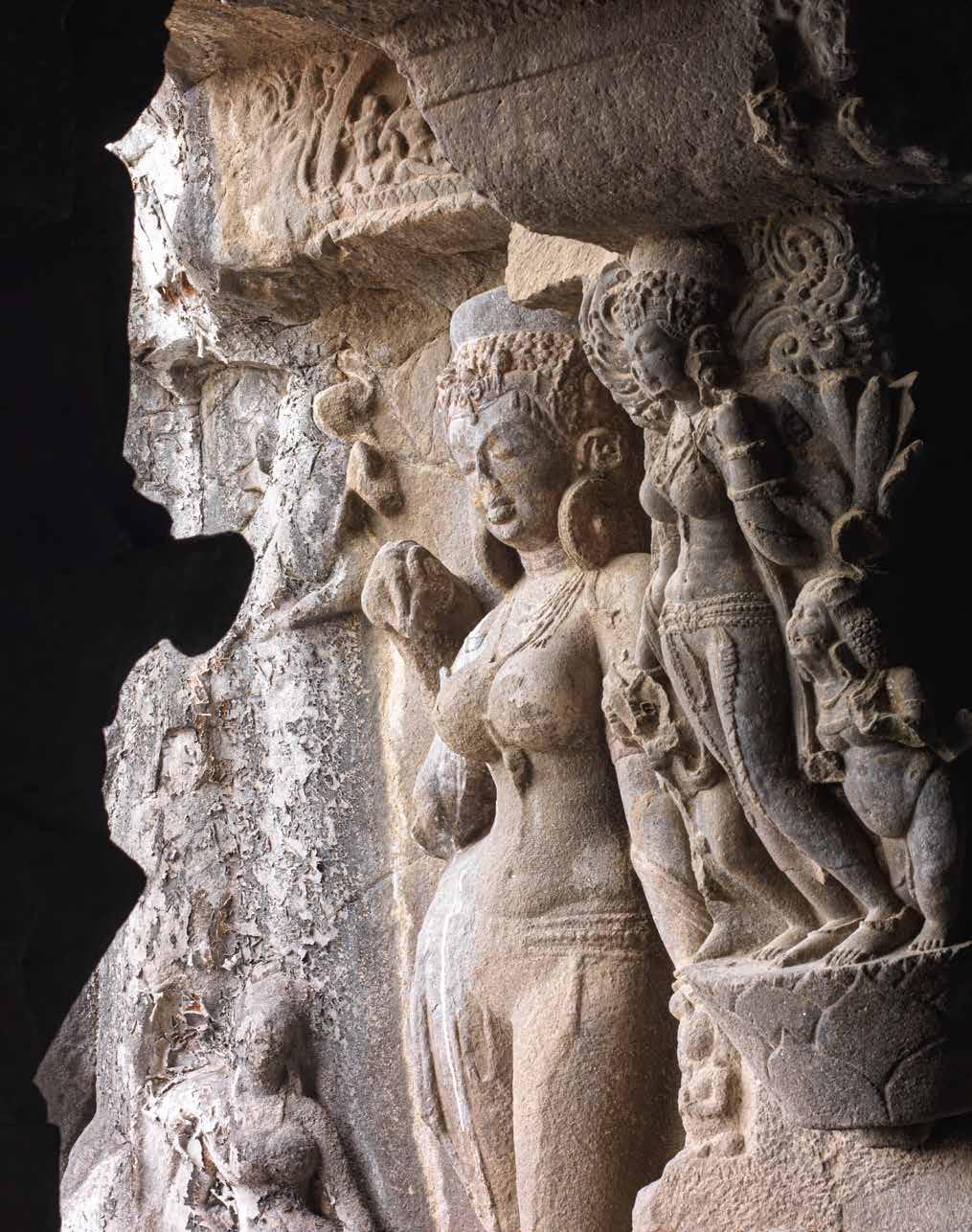
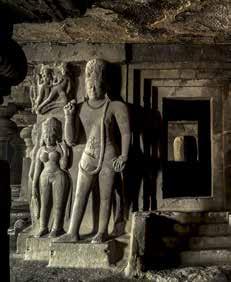
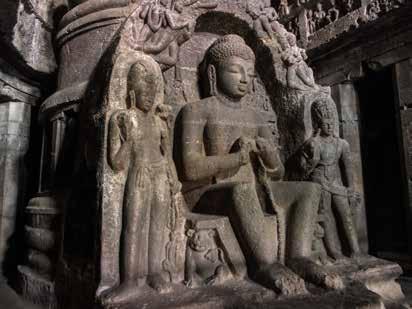
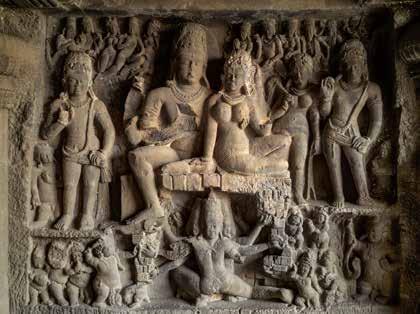
Ellora attempts the first systematic overview of the Ellora cave temples, a UNESCO World Heritage Site, excavated between 600–1000 CE and the only cave temple site that houses Buddhist, Hindu, and Jain caves.
This volume looks at each of these three groups of rock-cut temples and the stylistic influences they drew from each other and from surrounding regions.
Essays and analyses by scholars bring a comprehensive understanding of the chronology and stylistic development of the 34 main caves and lesser caves of the site. Ellora also includes extensive photographic documentation, ground plans, and rarely seen early 19th-century etchings of the most significant caves.
With contributions by Stanislaw J. Czuma, Nicolas Morrissey, Lisa N. Owen, Vidya Dehejia, Pia Brancaccio and Arno Klein.
Deepanjana Klein is the Director of Acquisitions and Development at the Kiran Nadar Museum of Art. Stanislaw J. Czuma was the George P. Bickford Curator of Indian and Southeast Asian Art at the Cleveland Museum of Art for over 30 years. Nicolas Morrissey is an Assistant Professor of Asian Art and Religion at the University of Georgia’s Lamar Dodd School of Art. Lisa N. Owen is an Associate Professor at the University of North Texas. Vidya Dehejia is the Barbara Stoler Miller Professor of Indian and South Asian Art at Columbia University. Pia Brancaccio is an Associate Professor of Art History at Drexel University. Arno Klein is a scientist at the Child Mind Institute in New York City.
Deepanjana Klein & Arno Klein
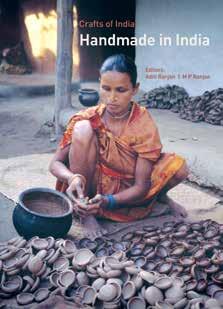
Crafts of India Handmade in India
Aditi Ranjan and M. P. Ranjan
crafts
576 pages, 3500 colour photographs & 140 maps
9.5 x 13.5” (241 x 343 mm), hc
ISBN: 978-81-88204-57-1
5000 | $80 | £65 3rd reprint Fall 2024 |
Published in association with COHANDS and National Institute of Design
Handmade in India is a unique compendium that probes into all aspects of handicrafts—historical, social and cultural influences on crafts, design and craft processes, traditional and new markets, products and tools— unravelling a wealth of knowledge. Based on extensive field work and research, Handmade in India maps out the regional craft clusters identified across the country on the basis of prevailing craft-work patterns. Some of the crafts are unique to a place, like the pinjrakari and khatumb and wood work of Kashmir, blue pottery of Jaipur, chikankari embroidery of Lucknow, the kannadi or metal mirrors from Aranmula, chappal s or footwear from Kolhapur, and the bamboo craft of Assam. Other, lesser known, crafts like the paabu or stitched boots from Ladakh, jadupatua paintings from Jharkhand, the making of Kathakali and Theyyam headgear, khadi or tinsel printing in Ahmedabad have also been described in striking detail.
The first-of-its-kind ever attempted, this volume with stunning photographs has proven to be tremendous resource for product and textile designers, artists, architects, interior designers, collectors, development professionals and connoisseurs alike.
Aditi Ranjan is an Indian textile designer, educator and researcher in the field of Indian crafts. She taught at the National Institute of Design, Ahmedabad, from 1974 to 2012. M.P. Ranjan was an independent academic and industrial designer. He taught at the National Institute of Design for several years.
“... takes on the monumental task of examining the eye-popping variety of handicrafts made across India’s vast landscape... The thousands of objects pictured here, and accompanied by detailed notes, include terra-cotta jewelry, leather puppets, wood carvings, bamboo baskets and silver ornaments. ... visually stunning display.”
The Wall Street Journal
“This is a magnificent work, a fabulous reference book, a virtual encyclopaedia of Indian handicrafts... As an encyclopaedia of Indian crafts, Handmade in India is pioneering and comprehensive. Nothing of this kind has ever been published before.”
—Jyotindra Jain in Biblio: A Review of Books
“An important book... craft values are important for a sustainable future... an astounding 516 types of specific regional crafts are covered... All readers will be impressed.”
—Library Journal
Gold Medal in Crafts category at ForeWord Book of the Year Award
crafts, design & fashion
264 pages, 331 images
9.9 x 12.5” (252 x 318 mm), hc
ISBN: 978-93-85360-88-6
3950 | $75 | £60 Spring 2024 |
Published in association with Amrapali Museum, Jaipur
the
amrapali
collection Silver and Gold Visions of
Arcadia
Usha R. Balakrishnan
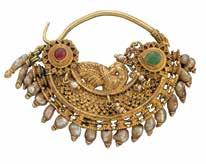
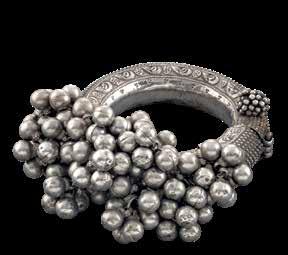
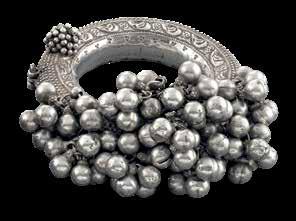
For as long as Indians have adorned themselves, they have sought to wear jewels that conveyed beauty, power and status. Jewels are believed to provide protection, hope, luck and well-being. More than 40 years ago, two friends, united by a passion for the decorative arts, embarked on an exploration of these unique jewels of India. They were motivated by the everyday jewels of the people in the villages—to discover the sources of their inspiration and to unravel the complex ritual of adornment that resulted in ornaments being fabricated for every part of the body, from the top of the head to the toes. What resulted were visions of Arcadia, leading to the creation of the Amrapali Collection of Indian Jewellery, one of the largest collections of pastoral silver jewellery in the world.
The manifold communities that this collection represents come from different religions, with linguistic differences and diverse cultural sensibilities, but the land that the jewels encompass is geographically contiguous. Beyond adornment, the Amrapali collection presents a vision of harmony with nature, with forms and motifs that draw upon nature and the cosmos, and materials such as shells, grass and bone. They exhibit the amazing technical expertise of simple gold- and silversmiths. This volume presents the jewels in all their glory, not as museum objects or as relics of the past but as a visual language communicating design, aesthetics, tradition and, above all, the artistic expression of adorning the body.
Dr. Usha R. Balakrishnan is the Chief Curator of the World Diamond Museum and a pre-eminent historian of Indian jewellery. She is the author of several publications, including Alamkara: The Beauty of Ornament, and has co-authored most recently Treasures of the Deccan: Jewels of the Nizams, one of the two-volume publication devoted to the fabulous jewels and seminal collection of paintings inherited by the Nizams of Hyderabad. Her curatorial projects include ‘India: Jewels that Enchanted the World’ at the Moscow Kremlin Museum, ‘Enduring Splendor: The Jewelry of India’s Thar Desert’ at the Fowler Museum, Los Angeles, and ‘Shringara: Adornment’ at the Chhatrapati Shivaji Maharaj Vastu Sangrahalaya (CSMVS) Museum, Mumbai.
Visions of Arcadia
Silver and Gold
Usha R. Balakrishnan
THE AMRAPALI COLLECTION
Ravissant A world of ultimate elegance
Ravi Chawla

lifestyle, design
236 pages, 219 colour and 75 b/w photographs
9.45 x 11” (240 x 279 mm), hc ISBN: 978-93-94501-17-1
9000 | $195 | £150 Nov. 2023 |
Ravissant
Art, culture and the finer things in life were integral components of the highly sophisticated societies that existed in ancient and medieval India. Throughout history, South Asia has introduced many different luxury materials and technologies to the world, including fine textiles, jewellery and other objects crafted in precious metals, often with rare gemstones, as well as works in stone and wood. These centuries-old works of art and handicrafts reveal a breathtaking level of skill and refinement. India has been the birthplace of distinctive traditional designs, and it has also absorbed influences from Persia, Europe and East Asia.
In the decades following Independence, the Indian economy has followed a strong growth trajectory, gathering pace considerably in the 1990s with the country opening up to the globalised world. While the world’s best-known luxury brands were developed over generations in the wealthy industrialised nations of the Global North, modern India’s domestic luxury market has been rebuilt and progressed under different circumstances and at a different pace. This is the backdrop for the success story of Ravissant. Two young entrepreneurs, Mina and Ravi Chawla, developed a deep and keen understanding of India’s rich heritage and European standards of luxury, and created Ravissant—a brand that uncompromisingly fulfils the wishes of the most discerning international connoisseurs.
Beginning with the goal to showcase the best of India for the world, over the course of five decades of outstanding entrepreneurship, Mina and Ravi have also brought the best of the world’s design aesthetics and practices to India. Ravissant, which means ‘delightful’, ‘ravishing’, ‘enchanting’ in French, takes us on a journey to the heart of luxury.
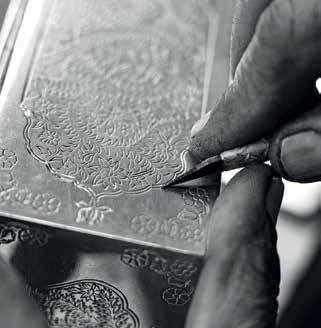
Ravi Chawla, along with wife Mina Chawla, is the co-founder of Ravissant Pvt Ltd. The Chawlas ventured into entrepreneurship in the 1960s soon after getting married and went on to establish Ravissant in 1982. With over two decades’ experience in working with Indian handicrafts, Ravi and Mina blended the unorthodox and ultramodern with the traditional to create a brand that introduced a new dimension to the world of luxury living and dressing in India. Building a standing along with the global names such as Dior, Channel, Hermes and Cartier, the Chawlas placed India firmly back on the map of modernday world of luxury. They also tied up with Cartier to open boutiques in Delhi and Mumbai.
Forever Irreverent
Design Quotes and 'Con'ventional Wisdom of Dhun Karkaria
Dhun Karkaria
design
326 pages with illustrations 4.75 x 4.75” (120 x 120 mm), hc Boxed edition
ISBN: 978-93-85360-38-1 2500 | $50 | £37 Spring 2024 |
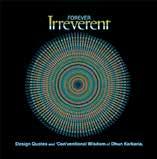

Dhun Karkaria, who passed away in 2019, was part of the first batch of students to graduate from the prestigious National Institute of Design, Ahmedabad. A respected designer, he was also part of the core group which started the Centre for Environment Education, and he had a keen interest in the natural world and in heritage sites.
In this lively and engaging book, Karkaria proposed to start a conversation about his philosophy of design and life. Striking a defiant, witty note against the prevailing ethos of greed and complacency, along with a profound concern for the natural world, he urged the young designer to disregard dogma and produce work that is honest and courageous.
With more than 300 illustrated quotations, this volume distills Karkaria’s humanitarian and pluralistic approach to design, work and life, making it an invaluable resource for the young designer and the seasoned professional alike.
Dhun Karkaria enjoyed a long and distinguished career in design and headed Karizma Communications, based in Ahmedabad.
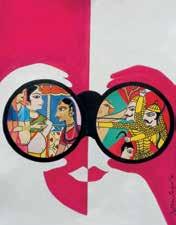
Whose Ramayana Is It Anyway?
Natasha Sarkar
whose
ramayana is it anyway?
art & culture
144 pages, 90 colour illustrations
8 x 10.25" (203 x 260 mm),
sc with gatefold
ISBN: 978-93-85360-54-1
1500 | $25 | £20
Fall 2023 |
If there is one grand tale that has impacted Asia, it has to be the Ramayana, the great Indian epic. In this sumptuously illustrated volume, the author highlights the various South and Southeast Asian traditions and variations of the tale, with nearly a hundred superb watercolour paintings.
From India, the Rama tale is presumed to have travelled along three routes—by land, the northern route took the story from Punjab and Kashmir into China, Tibet, and East Turkestan; by sea, the southern route carried the story from Gujarat and South India into Java, Sumatra, and Malaya; and again by land, the eastern route delivered the story from Bengal into Burma, Thailand, Laos, and to some extent, Cambodia and Vietnam. In Indonesia and Malaysia, the epic has been incorporated into the Islamic tradition; Theravada Buddhism in Thailand and Cambodia adopted Hindu divinities from the Rama story into its fold.
With stunning original art, this volume celebrates this all-inclusive tradition of the epic, foregrounding it as a cultural phenomenon across time and space.
Natasha Sarkar is an artist and academic who has engaged in teaching and research across Asia and the United States.
CELESTIAL
poetry & art
160 pages, 46 illustrations 6.75 x 8.75” (171.5 x 222 mm), hc-plc
ISBN: 978-93-94501-15-7
1199 | $25 | £ 20
Oct. 2023 |
Celestial A Love Poem
Abhay K.
Celestial is a love poem of 100 rhyming couplets wherein the poet restlessly seeks his beloved, who is playing a game of hide-and-seek in the remote corners of the universe. This breathtaking poem takes you on a poetic journey to all the 88 star constellations visible from Earth and introduces you to the hidden mysteries of the universe.
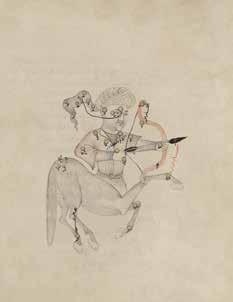
Accompanied with exquisite illustrations by the tenth-century Persian astronomer ‘Abd al-Rahma¯n al-Su¯fı¯, Celestial makes a delightful read.
Abhay K. is the author of a dozen poetry collections, including Stray Poems (Poetrywala), Monsoon (Sahitya Akademi, 2022) The Magic of Madagascar (L’Harmattan Paris, 2021), The Alphabets of Latin America (Bloomsbury India, 2020), and the editor of The Book of Bihari Literature (HarperCollins, 2022), The Bloomsbury Anthology of Great Indian Poems, CAPITALS, New Brazilian Poems and The Bloomsbury Book of Great Indian Love Poems. His poems have appeared in over 100 literary magazines, including Poetry Salzburg Review, Asia Literary Review among others. His ‘Earth Anthem’ has been translated into over 150 languages. He received the SAARC Literary Award 2013 and was invited to record his poems at the Library of Congress, Washington DC in 2018. His translations from Sanskrit of Kalidasa’s Meghaduta (Bloomsbury India, 2021) and Ritusamhara (Bloomsbury India, 2021) have won KLF Poetry Book of the Year Award 2020–21.

“Here is the perfect companion to any stargazing app—Abhay K’s delightful poem Celestial distills the poetic wisdom of the ages in splendid rhyming couplets.”
—Christopher Merrill, Poet, Director, International Writing Program, The University of Iowa
“These starry-eyed poems are born of a sorcery of voice and discovery, and strike a delicate balance between solitude and waywardness.”
—Jayanta Mahapatra, Poet, translator
“Whether one is into stargazing for ‘frolicking with Regil Kentaurus’ or for ‘ploughing the celestial bog’, Abhay K offers love-laced couplets of stellar delight. One will read this book and find one’s poetic star.”
—Ko Ko Thett, Poet, author, translator
Abhay K.
Textiles of Undivided Bengal
Edited by Tirthankar Roy, Sonia Ashmore and Niaz Zaman
Foreword by Rosemary Crill
Textiles of Undivided Bengal
crafts
360 pages, 175 illustrations
10 x 11" (254 x 279 mm), hc
ISBN: 978-93-94501-26-3
3950 | $65 | £49 Fall 2024 |
Published in association with Weavers Studio Resource Centre, Kolkata
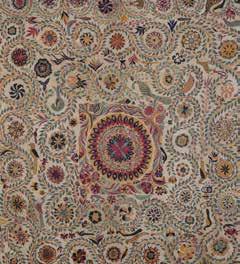
The famed Bengal textiles which once ‘clothed the world’ have been neglected, with little scholarly attention, for the last few decades. With the systemic destruction of Bengal’s textile industry, prompted by the Industrial Revolution in Europe, the muslins and baluchari s of Bengal were lost in obscurity. The scholarship too has been a victim of the partition of the Indian subcontinent and the consequent different cultural and societal identities of present-day India and Bangladesh. This volume revives the lost textile traditions of Undivided Bengal from the 16th to the 20th century and traces its impact on the historical and cultural processes of Bengal, and vice-versa.
This is an aesthetic compilation of research and is conceived as a dialogue between historians, anthropologists, art historians, textile practitioners and textile scholars who bring their diverse perspectives and expertise on the fundamental catalysts of change in the textile tradition of Undivided Bengal. This book serves as a public history, with engaging chapters on specific topics presenting a unique perspective of the Bengal textiles supported by stunning illustrations of textiles, maps and trade documents from the past, most of which have never been published before. This volume will inspire the reader, reorient scholarly attention and provoke them to rethink what Bengal textiles really were and what it has now become.
With contributions by Hameeda Hossain, Giorgio Riello, Ghulam Nadri, Barbara Karl, Ritu Sethi, Paola Manfredi, Susan Bean, Rosie LlewellynJones, et.al.
Tirthankar Roy is Professor at Department of Economic History, London School of Economics. His research interests include the history and development of South Asia, global history, empires, and environmental history. Sonia Ashmore is a design historian, with particular interest in cultural exchange. As a fellow in the Victoria and Albert Museum’s Research Department, she published extensively on the museum’s South Asian textiles and other collections and has lectured widely. Niaz Zaman is Advisor, Department of English, Independent University, Bangladesh. She has extensively worked on textiles and embroidery, particularly kantha and has also published on tribal textiles.
Edited by Tirthankar Roy, Sonia Ashmore and Niaz Zaman
Unmyth
Works and Worlds of Mithu Sen
Edited by Irina Aristarkhova
modern & contemporary art
380 pages, 180 photographs
8.25 x 10.25” (209.5 x 254 mm), hc-plc
ISBN: 978-93-94501-87-4
3500 | $70 | £49 Fall 2024 |
Published in association with Chemould Prescott Road, Mumbai
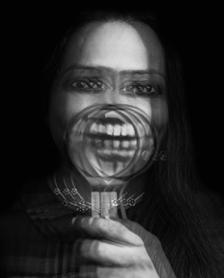
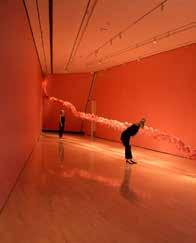
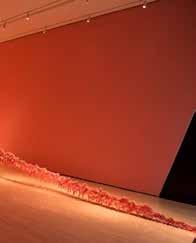
This artist monograph presents a first comprehensive study of the artwork of Mithu Sen, a major contemporary artist and poet based in New Delhi, India. Sen’s work spans over two decades of making and hundreds of exhibitions, projects, performances, and word art, unveiling an unparalleled history of experiments with materials and concepts. The book’s title ‘UNMYTH’ speaks to Sen’s impactful and impacting work in all its multiplicity and complexity.
Sen’s art imagines new worlds for us, including to escape to and from. Some elements are familiar, others are alien. As with myths, they are lulling and disturbing at the same time. These worlds are built around the key concepts in Sen’s work: ‘mything’, ‘unmything’ and ‘postmything’; radical hospitality; ‘untaboo’ sexuality; lingual anarchy; critiquing institutions and countering capitalism; ‘unmonolith’ identity; byproducts and contract. These and other concepts are engaged with systematically in wide-ranging essays, written by eminent scholars, curators, and critics who have followed Sen’s work for many years. The artist herself contributes conceptual captions, dispersed citations, and the experimental ‘Fictional Interview’.
With contributions by Nancy Adajania , Irina Aristarkhova , Sushmita Chatterjee, Max Delany, Mithu Sen, and Karin Zitzewitz
Nancy Adajania is a cultural theorist and curator based in Bombay who has curated a number of pathbreaking exhibitions. Irina Aristarkhova is Professor at Penny W. Stamps School of Art and Design and Digital Studies Institute at the University of Michigan. Dr. Sushmita Chatterjee is Professor and Chair of the Department of Ethnic and Gender Studies at Colorado State University in Fort Collins. Max Delany is Artistic Director at the Australian Centre for Contemporary Art, Melbourne. Karin Zitzewitz is Professor and Chair of the Department of Art History and Archaeology at the University of Maryland.

MITHU SEN uNmyth
modern & contemporary art
130 pages, 81 illustrations 9 x 11” (229 x 279.5 mm), sc with gatefold ISBN: 978-93-94501-42-3 1950 | $39.50 | £26 Fall 2023 |
Published in conjunction with the 18th Carte Blanche at Musée Guimet to Manish Pushakale from 18 Oct. 2023 to 4 Mar. 2024
In association with Akar Prakar, Kolkata and New Delhi and National Museum of Asian Arts–Guimet, Paris
Carte Blanche à Manish Pushkale To
Whom the Bird Should Speak?
Edited by Claire Bettinelli
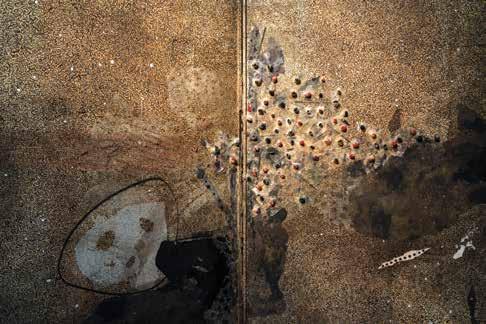
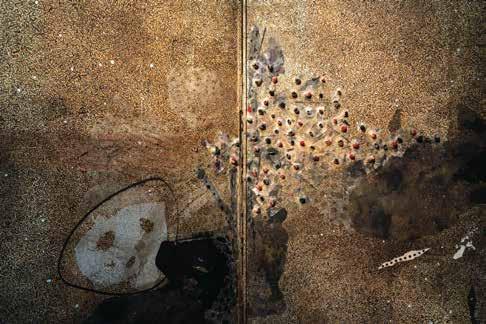
Manish Pushkale, born in Bhopal, Madhya Pradesh, is an autodidact who honed his artistic style and sensibility at Bharat Bhavan’s fertile and creativity-filled ambience of the time. His engagement at the art centre cemented Pushkale’s deep engagement with indigenous folk and tribal traditions. The installation To Whom the Bird Should Speak? is a visual enquiry into the significance of language as a medium of communication. Pushkale’s artistic research into indigenous cultures was inspired by the story of the Aka-Bo tribe in the Andaman Islands and their oral tradition of communicating with birds that was lost to the world after the death of its last speaker, Boa Sr.
As a contemporary artist and an abstract painter, Pushkale works at the intersection of linguistics and archaeology in an immersive 125 square metres of hand-painted installation, as he imagines a visual ‘script’ of a lost history that we would like to recover, or should it be allowed to fade inexorably into oblivion?
With contributions by Claire Bettinelli, Yannick Lintz, Ganesh Devy and Devika Singh, and a poem by Ashok Vajpeyi
Claire Bettinelli is in-charge of exhibition production and the contemporary collections at the National Museum of Asian Arts-Guimet. She curates the Carte blanche exhibitions and a number of modern and contemporary projects and contributes to publications on these subjects. Dr Yannick Lintz is President of the French National Museum of Asian Arts-Guimet. Prior to this, she had been the Director of the Islamic Arts Department at the Louvre since 2013. Ganesh N. Devy is a literary critic, thinker, cultural activist, and institution-builder, best known as the founder of the People’s Linguistic Survey of India and the Adivasi Academy. Devy is the recipient of several awards, including the Padma Shri. Devika Singh is a Senior Lecturer in Curating at the Courtauld Institute of Art. She was previously the Curator of International Art at Tate Modern. Ashok Vajpeyi is a New Delhi-based Hindi poet-critic who has written poetry and criticism of literature, music and visual arts in many publications.
Somnath Hore
Art of Wounds
Atanu Bhattacharya
modern & contemporary art
88 pages, 63 illustrations
6.6 x 10.25” (168 x 260 mm), sc with gatefold
ISBN: 978-93-94501-00-3
1500 | $37.50 | £23 Fall 2023 |
Published in association with Akar Prakar, Kolkata and New Delhi
Somnath Hore was born in Chittagong (now in Bangladesh) in 1921. He received a diploma from the Government College of Art and Craft, Calcutta, where he learned the methods and nuances of printmaking, mainly lithography and intaglio. By the 1950s, he earned a name as one of the premier printmakers in India, and headed the Graphics and Printmaking Department at Kala Bhavan, Santiniketan.
Hore started the paper pulp print series Wounds in the late 1960s as a response to the Naxalite movement in India and the social unrest around the world. The artist felt an intense need to translate his witnessing of the problematic realities into art in the form of ‘wounds’. He wanted to reproduce the essence of a cut or injury using printmaking, turning to intense research and experimentation with the red and white colours and the light and shadow effect on a three-dimensional model to reach a satisfactory outcome. This volume talks about the series, its inception, making, and perceptions about and around the main theme.
Atanu Bhattacharya, a graphic artist, is known for his abstract paintings, experimenting with printing ink and acrylic. His first solo exhibition was held at the Society of Contemporary Artists’ Gallery, Kolkata, in 2008 and he has participated in various group shows. Bhattacharya’s works are part of numerous collections in India and abroad, including National Gallery of Modern Art and Lalit Kala Akademi, New Delhi.
Jayashree Chakravarty
A wired ecology • feeling the pulse
Roobina Karode
modern & contemporary art
96 pages, 44 illustrations and 5 photgraphs
10 x 11” (254 x 280 mm), sc with gatefold
ISBN: 978-93-94501-08-9
1950 | $39.50 | £26 Spring 2023 |
Published in association with Akar Prakar, Kolkata and New Delhi
Jayashree Chakravarty (b. 1956) completed her Graduation at Visva Bharati in the sprawling natural environs of Santiniketan. She pursued her Master’s degree at the Faculty of Fine Arts at the Maharaja Sayajirao University of Baroda, Vadodara, where she was exposed to an urban sensibility. She was also an artist in residence at the Ecole d’ Art, Aix-en-Provence from 1993 to 1995 where she was in fl uenced in the formative years of her practice by the French movement Supports/Surfaces, especially by Claude Viallat, and also had conversations with some of the group members at the time.
Chakravarty has had exhibitions both in India and internationally, with shows at various museums. Inventing her own creative techniques, using organic material and varied kinds of papers, Chakravarty’s installations in the form of paper scrolls remain unique in their conceptions and execution. The artist lives and works in Kolkata, India.
Roobina Karode has been the Director and Chief Curator at the Kiran Nadar Museum of Art (KNMA), New Delhi, since 2010. As an art educator, writer and curator, Karode has extensively contributed to the field, teaching Art history—both Indian modern and Western art—at various institutions in Delhi. She was awarded the Fulbright Fellowship in 2000 and the Ford Teaching Fellowship in 2005–07. Karode has, over the years, curated numerous exhibitions within India and abroad.
learning from india series
Learning from Ahmedabad
Practising Architecture in Urban India
Gert-Jan Scholte, Pelle Poiesz and Sanne Vanderkaaij Gandhi
architecture
212 pages, 60 photographs, 2 drawings and 7 maps
6.5 x 9.5” (165 x 241 mm), sc with gatefold
ISBN: 978-93-85360-96-1
1750 | $35 | £25
Spring 2024 |
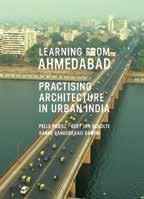
After the success of Learning from Mumbai and Learning from Delhi (Mapin 2013, 2016), the authors of the Learning from India series continue to unravel the lessons that can be learned from practising architecture and urban planning in India’s first World Heritage City—Ahmedabad.
With several essays and maps, Learning from Ahmedabad lays the ground for a series of interviews with architects, planners, educators and artists who live and work in the city. Locating these explorations within a local framework are perspectives from scholars such as pre-eminent architect B.V. Doshi and danseuse Mallika Sarabhai. These narratives are balanced by the take of historians such as Esther David and veteran social worker Elaben Bhatt. A special place is reserved in this volume for the photo essays of Bas Losekoot.
Learning from Ahmedabad will be of significance to both students and practitioners of architecture and planning, as well as people interested in Ahmedabad and its built environment.
Dutch architects Pelle Poiesz and Gert-Jan Scholte studied architecture at Delft University of Technology in the Netherlands and at Sir J.J. College of Architecture in Mumbai. Sanne Vanderkaaij Gandhi is a researcher and writer based in Mumbai.
Learning from Patna Riverfront
Nishant Lall
LEARNING FROM PATNA RIVERFRONT

architecture
128 pages, 108 photographs, 36 drawings and 18 maps
7.16 x 9.25” (182 x 235 mm), sc with gategold
ISBN: 978-93-85360-97-8
995 | $25 | £20
Fall 2024 |
Learning from Patna Riverfront chronicles a unique revitalization programme at the River Ganges in Patna. For a city with its back to the river, with isolated ghat s, this project proposes a comprehensive development solution addressing vital concerns such as public space and civic amenities, along with environmental awareness and ecological restoration. The project connects existing fragmented open spaces to provide a continuous public space along the river, aiding in religious festivities and recreation. Engaging a long stretch along the river, the proposed development includes 6.5 kilometres of promenades, community, education and recreational buildings, as well as food kiosks, ecological landscaping and other public amenities. The project received funding from the World Bank and was supported by Ministry of Water Resources (Ministry of Jal Shakti).
Designed as a multi-purpose space, the project also aims to develop ghat prototypes that could create a typology for the river’s edge, integrating heritage buildings and being sensitive to the local context. As a holistic development, the proposal promotes a walkable city, creating larger usable open spaces and attracting people of all ages.
Nishant Lall, an urban designer and architect from UCLA (University of California Los Angeles), is currently an expert on urban design with the Climate Change and Disaster Risk Management Group at World Bank India.
Jali
Lattice of Divine Light in Mughal Architecture
Navina Najat Haidar
architecture
268 pages, 246 colour photographs
9.5 x 11.6” (241 x 295 mm), hc
ISBN: 978-93-85360-74-9
2950 | $65 | £49
Fall 2023 |

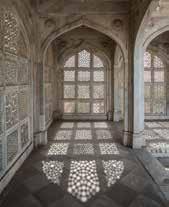
A jali is a perforated stone or latticed screen, with ornamental patterns that draw on the compositional rhythms of geometry and calligraphy. In the parts of India, western Asia and the Mediterranean where solar rays are strongest and brightest is where ustad s, or master artisans, were able to evolve an aesthetic language of light, giving it form and shape through lattices of stone and other materials.
This book explores the delicate beauty of more than 200 jali s across India, from the temple-inspired designs of the Gujarat Sultanate to imperial symbolism and Sufi allusions in Mughal jalis, the innovations and adaptations of jali s across Rajasthan and central India and, further south, calligraphy in pierced stone in the Deccan.
With contributions by art historian Mitchell Abdul Karim Crites, George Michell, an authority on South Asian architecture, Ebba Koch, art and architectural historian, and Afterword by film director James Ivory, this lavishly illustrated publication reveals the poetry etched in these stone screens.
Navina Najat Haidar is Nasser Sabah al-Ahmad al-Sabah Curator-in-Charge of the Department of Islamic Art at The Metropolitan Museum of Art.
“The book moves effortlessly...makes one wonder of the draftsmanship of artisans...Nothing by half measures here!! ”
—Zeyba Rahman, Director, Building Bridges Program, Doris Duke Foundation
Courtyard Houses of India
Yatin Pandya
Courtyard Houses of India
architecture
468 pages, 352 photographs, 333 drawings and 18 maps
10 x 10” (254 x 254 mm), hc
ISBN: 978-93-85360-09-1
4500 | $75 | £55
Nov. 2022 |
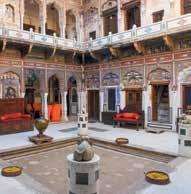
In ancient Indian sciences, the courtyard assumes the central position as brahmasthana , the nucleus of the living environment. It provides for an open-tosky outdoor space while being away from the public eye. In this book, the author traces the metaphysical, mythical, socio-cultural, environmental and spatial roles of the courtyard in the domestic architecture of India—from early civilization and Vedic times to Islamic and colonial influences.
This volume documents the traditional and vernacular courtyard dwelling types across India within diverse climatic, cultural as well as geographic zones. Lavishly illustrated, this volume attempts to understand the presence and resolution, continued use and adaptation as well as the diverse interpretations and abstractions of the courtyard.
Yatin Pandya is an author, academician, researcher as well as practising architect with his firm FOOTPRINTS E.A.R.T.H. He has authored numerous papers and several books, and has produced many documentary films on architecture. Pandya is a recipient of numerous national and international awards for research.
“a survey of very scholarly expedition, carefully documenting the unearth[ed] treasures in series of drawings that together constitute a piece of art by themselves.”
Manguesh R. Prabhugaonker, Journal of the Indian Institute of Architects
Yatin Pandya
Lattice of Divine Light in Mughal Architecture
Navina Najat Haidar
Balkrishna Doshi Paths Uncharted
architecture
440 pages, 182 illustrations, 5.8 x 8.27” (148 x 210 mm), sc with gatefold
ISBN: 978-93-85360-62-6
1695 | $34 | £29
Reprint 2023 |
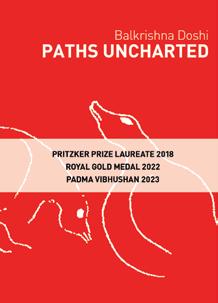
Dr. Balkrishna Doshi (1927–2023) has been foremost among the modern Indian architects. An urban planner and educator for the past 70 years, Dr. Doshi is a Fellow of the Royal Institute of British Architects and a Fellow of the Indian Institute of Architects.
After initial studies at the JJ School of Architecture, Bombay, Doshi worked for four years with Le Corbusier in Paris as Senior Designer (1951–1954) and four years in India to supervise his projects in Ahmedabad. Doshi’s office Vastu-Shilpa (Environmental Design) was established in 1955. Doshi has to his credit outstanding projects ranging from dozens of townships and several educational campuses, including those for CEPT University, Ahmedabad, NIFT, New Delhi, and IIM Bangalore.
Apart from his international fame as an architect, Doshi is equally known as an educator and institution builder. He has been the first Founder–Director of School of Architecture (1962–72) and School of Planning (1972–79), Ahmedabad, and Doshi has held important chairs at American universities. Dr. Doshi received several international and national awards and honours and himself has been on the jury for several international and national competitions.
This autobiography captures Doshi’s career from his childhood to his studies in Bombay and London, his work at Atelier Le Corbusier in Paris and collaboration with Louis I Kahn for IIM Ahmedabad. It recounts his meetings with the most remarkable persons in his own and allied fields, and his equally remarkable patrons, who include the likes of Dr. Vikram Sarabhai, Sheth Kasturbhai Lalbhai, and the story of his own family.
Doshi’s life—from the time he was born into a modest family in the by-lanes of Pune, and his struggles and tenacity to excel in his chosen fields—is a fascinating and inspiring story. Put together, for the first time, from the lifelong diaries and notes maintained by him, Paths Uncharted is a personal recounting of this remarkable journey unfolding over more than 80 years and across all the continents.
In 2018, Doshi was selected as the Pritzker Architecture Prize Laureate, internationally known as architecture’s highest honour. With the continued interest worldwide in his work, this volume brings to the reader invaluable insights into the course of Doshi’s illustrious life, the paths it has taken over the years, the experience and the learnings.
Concepts of Space in Traditional Indian Architecture
Yatin Pandya • Vastu-Shilpa Foundation
architecture
148 pages, 294 colour photographs, 26 colour and 143 b&w drawings
9 x 9” (229 x 229 mm), sc with gatefold
ISBN: 978-81-89995-75-1
1395 | $35 | £25
4th Reprint 2023 |

Elements of Spacemaking
Yatin Pandya • Vastu-Shilpa Foundation


Published in association with Vastu-Shilpa Foundation for Studies and Research in Environmental Design, Ahmedabad
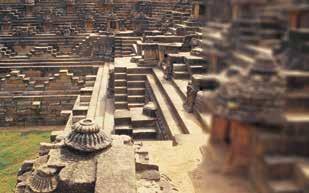
The manifestation of an idea—architecture—is a celebration of life. Traditional Indian architecture has ably demonstrated the universality of it communication as well as its validity within multiple value systems.
This book is an attempt at understanding the very roots of what constitutes the Indian context by examining its notions of time, space, and existence inferred and exemplified in a range of traditional Indian architectural examples. Discussion of each site is illustrated with a wealth of visual materials— photographs, architectural plans with analytic overlays and volumetric constructs.
Yatin Pandya is an author, academician, researcher as well as practising architect with his firm FOOTPRINTS E.A.R.T.H. He has authored numerous papers and several books, and has produced many documentary films on architecture. Pandya is a recipient of numerous national and international awards for research, design and dissemination.
“A monumental effort.”
—The Indian Express
“The strength of the book is its sumptuous illustrations. The diagrams that accompany the illustrations help convey the analysis.”
—The Hindu
architecture
216 pages, 1400 line drawings
9 x 9” (229 x 229 mm), sc
ISBN: 978-81-89995-74-4
1195 | $26 | £19
7th Reprint 2023 |

Published in association with Vastu-Shilpa Foundation for Studies and Research in Environmental Design, Ahmedabad
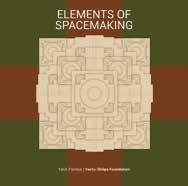
The notions of space are made physically manifest in architecture through the different elements that constitutes the basic identifiable parts of the manmade or built environment. Each of these elements possesses attributes inherent to their morphological construct which endow them as particular spatial properties, providing potential for their use and design in architectural compositions.
This book examines the inherent attributes of ‘spacemaking’ elements such as roofs, walls, doors, windows, columns, stairs and floors and analyses their implicit influences in the design of space. It traces the evolution of each element through history— from primeval structures to modern architecture. The effective applications of these are illustrated through extensive drawings and sketches of detailed case studies from all over the world.
Yatin Pandya is an author, academician, researcher as well as practising architect with his firm FOOTPRINTS E.A.R.T.H. He has authored numerous papers and several books, and has produced many documentary films on architecture. Pandya is a recipient of numerous national and international awards for research, design and dissemination, most recently the special mention for United Nation’s World Habitat Award and the Curry Stone Foundation Design Prize for sustainable practice.