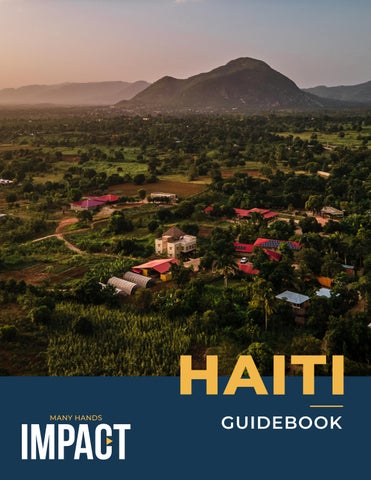
HAITI GUIDEBOOK
CONTENTS MISSION & VISION............................................................................................................04 TWO PATHS TO TRANSFORMATION..........................................................................05 FUNNELS & PYRAMIDS...................................................................................................06 OUR FOCUS AREAS IN HAITI........................................................................................07 PIGNON MAP......................................................................................................................08 CAMPUS MAP.....................................................................................................................09 PACKING LIST......................................................................................................................10 PACKING REQUIRMENTS.................................................................................................11 THINGS TO REMEMBER...................................................................................................12 CULTURAL DIFFERENCES...............................................................................................13 LINES NOT TO CROSS.......................................................................................................14 KREYOL LANGUAGE SKILLS...........................................................................................15 ORIENTATION VIDEOS.....................................................................................................16 TEAM LEADERSHIP ROLES............................................................................................ 17 DAILY REFLECTION GUIDELINES................................................................................ 19 IMMIGRATION INSTRUCTIONS.................................................................................... 20 CONTACT INFORMATION................................................................................................ 21
Guidebook - Haiti
TRANSFORMING TOGETHER, TO BE LOVE IN ACTION, IN A BROKEN WORLD
MISSION AND VISION Transform
Together
Love
Action
Broken World
Romans 12 transformation, a whole person transforming mentally, physically, and spiritually
We do this in unity, giving our strengths and allowing others to help in our weakness
Ephesians 4:2 love to bear with one another in carrying burdens with humility, gentleness, and patience
Luke 4:18-19 action, proclaiming the Good News giving freedom to those held captive, physically healing people, and setting the oppressed free
Our world is moaning in brokenness. All are broken and in need of a Savior
Vision Many Hands envisions a world where people transform together, through the presence of Jesus Christ, to be called people, living with purpose, unleashing God-given talents and resources to bring Good News in a broken world.
Core Values We are Image-bearers of God. We believe that all have a God-given identity and all have a purpose in God’s plan. All are called to serve their purpose, not have the purpose serve them. In relationships, we will help people understand their true calling and stand by them as they unleash their God-given talents to bring the Good News within their circles of influence. We are the Sent People of God. Just as God sent his son Jesus and Jesus sent the Holy Spirit, we are to be the sent people of God, bringing the Good News to people wherever we are called. Jesus is waiting for us when we get outside of ourselves in faith and will meet us to help us fulfill our purpose. We believe in Saved Wholes, not just Saved Souls. Jesus didn’t come to be an insurance policy after one dies. He came to bring life and life to the full. We are called to fulfill Jesus’s mission in Luke 4:18-19 to proclaim the Good News, to physically restore that which is broken, and to release people from oppression spiritually, relationally, and economically from that which binds. We are Better Together. As states in Romans 12:3, we are all broken and in need of a savior, we are just broken in different ways. As we enter into each other’s poverty with our riches, we are all transformed. Through this process, our image of God gets bigger, as it should, as God has a global heart for His people. We go an Inch Wide, Mile Deep. We believe in focused impact, not random activity. Breaking the chains of generational poverty, both physical and spiritual, is incredibly complicated. To work in this environment, we break it down into focused building blocks that stack on each other, moving towards a common goal. One person, one family, one community, one region, one country, one world. We work in Integrity to create Sustainability. We seek systematic God-sustaining change to fulfill Jesus Christ’s Kingdom purposes. We strive to honor God in a fiscally responsible way, making every effort to create transparency in our organization’s doings. We acknowledge and live in the tension of short-term giving while seeking long-term God-sustaining change. God is one of abundance and we will honor His generosity in the resources given to us.
04
Guidebook - Haiti
TWO PATHS TO TRANSFORMATION Our mission is to see lives transformed in Christ, but we recognize the path is not the same for everyone. The barriers we face are different depending on our circumstances. Therefore, our strategy is twofold: a funnel for cultures of abundance and distraction, and a pyramid for communities facing scarcity and instability. Both lead to a flourishing life of purpose in Christ.
The Pyramid: Building the Foundation In communities facing scarcity, the barrier is the lack of a stable foundation; basic needs hinder hearing Good News. Our strategy builds a lasting Pyramid of support, empowering communities to flourish. We go “an inch wide and a mile deep,” committing for the long haul. We partner with local leaders to build this foundation holistically, starting with essentials: education, safe structures, and sustainable agriculture. We add health assistance, skill development, and economic opportunity. This work is done through relationship, where true discipleship happens in shared work. The true gospel is caught, not just taught, in everyday life. A secure foundation creates an immense ripple effect, transforming individuals, families, and communities. The goal is multiplication; a thriving community becomes a living example, equipped to spread hope.
The Funnel: Focusing the Distracted In cultures like ours, the greatest barrier to deep, transformative faith is distraction. Our Funnel channels unfocused energy into purpose. The journey begins simply, through accessible entry points like our Many Hands Thrift Markets and purpose-driven businesses, inviting deeper service and generous giving. True transformation requires a change of heart and mind, fostered through classes, books, and retreats. Profound change often occurs during our Impact Trips. Serving global brothers and sisters reveals faith forged in hardship and God’s love in action. Individuals return with a profound revelation: the mission field is “right here”—in our families, churches, and communities. The Funnel turns a distracted life into a focused calling to serve daily.
Where the Funnel Meets the Pyramid The Funnel and the Pyramid are two strategies for a single, unified calling. One removes distraction; the other builds a foundation. Both converge to a life fully alive in Christ, empowered by His love, ready to serve, build, and multiply— wherever called.
Guidebook - Haiti
05
FUNNELS AND PYRAMIDS
06
Guidebook - Haiti
OUR FOCUS AREAS IN HAITI Education Educating the next generation can break the cycle of poverty. Through our programs, we focus on a holistic approach to education. First, we support families’ physical and financial needs, through our Power to the Parents initiatives. Then we create world-class learning environments in the classroom with fully-trained and equipped teachers through the School of Light. We also support 19 area schools through feeding programs, providing over 1,000,000 meals each year.
Leadership Development We desire to equip and strengthen leaders to transform their communities and bring hope. Our programs encourage and challenge individuals to be servant-hearted, focusing on the needs of their community. Through our community Bible studies and our culturally relevant Lead Like Jesus curriculum, we create a solid foundation for change by investing in local women and men who lead in love.
Agriculture Our programs are focused on meeting the food challenges rural Haitians face. We provide farming resources, create scalable solutions, and further the agricultural education of local farmers. Overseeing 700+ family-owned goats and cultivating 20 acres of farm ground, each year we can produce over 30,000 lbs of food. By focusing on sustainable farming solutions that meet the community’s needs, we tackle food insecurity, giving families the power to feed themselves.
Safe Homes One of our goals is to provide each family enrolled in our Love in Action initiatives with a cement floor. New floors reduce sickness in children, dramatically decreasing infant deaths from preventable diseases and increasing school attendance in older children. It can also save parents on unnecessary future medical expenses. We also build new homes, with over 125 homes built to date. We strive to source local materials and labor, creating a benefit not just for the family receiving the house but for the local economy too.
Medical Assistance A major key to future success and productivity for children in Haiti is healthy physical, emotional, and cognitive development. Through the First 1,000 Days Program, we provide at-risk families access to better nutrition, health care, protection, stimulation, and spiritual development. Because of this program, we reduce childhood stunting, maternal mortality, and infant mortality, as well as increase health education, cognitive development, and overall well-being of mother and child. We also serve hundreds more annually on a case-by-case basis through our work in the community.
Economic Development We recognize the need for sustainable employment opportunities and believe in supporting families to live a purposeful life. To accomplish this, we provide hundreds of jobs in the region through agriculture, construction, education, and jewelry making. We partner with Vi Bella, a social enterprise ministry that empowers artisans through creating handcrafted jewelry.
Guidebook - Haiti
07
PIGNON 5K FOCUS MAP A
B
C
D
E
F
G
H
I
J
1
Mt Pignon
Bouquet D Homme
Krebapied
2
Fontaine
Savanne Pignon
Pignon 3
G oni ve
Bou
Tinòt
ya
ja R
R ive
r
Go n i v e River
Jean Boule
iv er
Jean Boule Campus
Charles
4
Kandelon B o uy
er a j a R iv
Quanalope
Maliarette
LaCoste
5 Twa Poto
Maliarette Campus
Youth Action For Haiti
6
Sylvain Campus
Katherine Flor School
Lapila
Goat Land Bo
u y a j a R i ve r
Sylvain B ou
ya
ja
Riv
Bewout
er
7 Jean Mbè
Nan Id
La Cour Beje
United Christians International CCRON Deaf School Sylvain Swing Bridge
8
Kle
Lejene
Kecido
Mè Bel Mè
Bohoc
Kareton
Djepois Lewoche Riv
a aj
uy
Savanne Tabac
Hadanm
er
Vincent
9
Bo
10 Potosyd
Sylvain Campus (2016) Maliarette Campus (2019) Jean Boule Campus (2021) Mè Bel Mè Campus (2023) Savanne Tabac Campus (2024) 08
Guidebook - Haiti
SYLVAIN CAMPUS MAP N 25 ft
100 ft 50 ft
SPORTS FIELDS
AGRICULTURE FIELDS
AGRICULTURE FIELDS
AGRICULTURE FIELDS
Agriculture Center
Well
Shade Houses
Irene’s Place
Preschool
Guest House
7-9 Grade Classrooms
Latrines
Fundamental School
Admin Building
School Administration
Kitchen
Food Depot
Love in Action Center
Guidebook - Haiti
09
PACKING LIST Basics
Toiletries
• •
• • • • •
• • • • • • • • •
Bible $100-$200 Cash with plenty of $1’s & 5’s (no torn bills) Disinfecting Wipes Hand Sanitizier (travel size) Headphones Journal/Pens Passport / Visa Phone / Camera Reading Material Snacks (granola bars, jerky, dried fruit) Water Bottle (covered spout encouraged)
• • •
Comb/Brush Deodorant Eyeglasses / Contact Lenses Femine Hygiene products Prescriptions and OTC medicine • Anti-Malarial • Imodium (Traveler’s Diarrhea) Shampoo / Conditioner Soap Toothbrush / Toothpaste
Clothes
Additional Items
• • • • • • • • • • • •
• • • • • • • • •
• •
Collared Shirt (MEN - Church Attire) Dress Pants (MEN - Church Attire) Dress Shoes (Church Attire) Lightweight Long Sleeve Shirt (Mt Pignon climb) Paint Clothes Pajamas Sandals (Flip-Flops for showering) Shorts (mid-thigh or longer) Skirts / Dresses (mid-thigh or longer) Sneakers Socks Sweatshirt/Jacket (MFI flight and evenings can be chilly) T-Shirts (no sleeveless shirts) Underwear
Backpack / Fanny Pack / Drawstring Bag Cards / Games Chargers Copies of Travel Documents (passport/visa) Emergency Contacts Gloves (Mt Pignon climb/projects) Hat / Visor / Bandana Headlamp / Flashlight (Mt Pignon climb) Sunglasses / Reading Glasses
NOTE: Aerosols are not permitted on MFI flights ALLERGIES: We do not supply any allergy reaction relief or preventatives (i.e. EPI Pens, inhalers, etc.) FOOD ALLERGIES: If a team member can’t eat a common food group like meat, gluten or dairy, he/she must bring meal replacements or supplements and snacks to ensure adequate nutrition.
10
Guidebook - Haiti
PACKING REQUIREMENTS MFI Restrictions
Guidebook - Haiti
11
THINGS TO REMEMBER Water On our campus, the water that comes from the faucet is safe for drinking. Remember to fill a water bottle to take with you when outside the campus, as water outside of Many Hands property is NOT safe for drinking.
Food While in Haiti, it is best to eat only foods prepared by the Many Hands staff. If you will be away from the Many Hands campus for an extended time, bring snacks in a backpack. It would be best to eat granola bars and/or dried fruit for snacks. Do not each public foods, unless approved by your team leader.
Dress Code Please dress modestly while in Haiti. Because of cultural differences, it is generally not acceptable for foreigners to wear short shorts, tank tops, sleeveless tops or have bare midriffs. We require women to wear dresses, skirts, or longer shorts (at least mid-thigh) in public, with shoulders covered at all times. Skirts need to be near knee-length. Guys may wear shorts or pants, but must always have their shoulders covered as well. Guys please wear a nice collared shirt, pants, and dress shoes for church (and bring a tie if preaching). Bring one or two pairs of comfortable shoes, as you will walk a lot. NOTE: Skirts are required for women when attending church.
Begging and Gift Giving While in Haiti you will observe, as well as experience, Haitians asking for money or gifts. How you respond to those requests significantly impacts the ongoing mission of Many Hands in the area. It is important you do NOT respond to those requests by giving to those asking. This includes handing out free items such as toys to kids, candy, clothing, etc. We STRONGLY discourage all team members from handing out gifts of any kind to our Haitian neighbors. If you feel led to give gifts of any kind, please talk to one of the Many Hands staff to find the best avenue for your gift.
Money and Valuables The amount of money you bring will be dependent upon your desire to purchase souvenirs. Do not bring travelers checks. We recommend bringing $100-$200 in cash for souvenirs and emergency situations, Sunday offering, tips for cooks, souvenirs, and cold drinks. We also have a safe at the guest house to secure money and passports. Bring 1’s, 5’s, and 10’s with no rips in the bills.
Conservation of Resources In order to conserve resources while on our campus in Haiti, we ask you to follow these guidelines: Showers - keep your showers short to conserve our water supply. Do not use blow dryers, curling irons or straighteners Turn off lights and fans when not in use Please place toilet paper in the wastebaskets in the stalls - do not flush toilet paper.
12
Guidebook - Haiti
CULTURAL DIFFERENCES No matter where you travel, there are cultural differences that can help open our eyes to the unique ways God’s people live. Haiti is no exception. Here are some of these differences from an American perspective: Americans focus on productivity; Haitians focus on mutual respect and relationship. • Americans get right down to business; Haitians take time to develop the relationship and hold business conversations for the very end. • It’s rude to ask for directions, or anything else, without first taking the time to greet someone, even if you don’t know them. Americans focus on the future; Haitians typically focus on today. Americans focus on the clock; Haitians focus on the event. Americans prioritize authenticity over appearance; Haitians prioritize appearance over authenticity. • Americans will come to church in very casual attire; Haitians wear their best. Americans think about the future and how to make things better; Haitians think about today and how to meet basic needs. • Americans have the luxury (time, wealth, opportunity) to think about the future; Haitians do not and therefore focus on fighting to survive today. • Americans are always trying to make things better; Haitians will make do with what they have. • Americans are crippled when they don’t have the resources they desire; Haitians find a way to continue. Americans trust their fellow man; Haitians typically distrust those they don’t know, especially government authorities and institutions who have burned them in the past. Americans are emotionally reserved, often misinterpreted as cold disinterest; Haitians are passionate, emotionally demonstrative and expressive, often misinterpreted as anger. Americans think EVERYTHING is natural (science, flesh, earthly); Haitians think everything is supernatural (divine, spiritual). • Americans will assume someone with mental illness has a chemical imbalance; Haitians will assume they are demon-possessed. • Americans pray little; Haitians pray a lot. Americans emphasize the individual; Haitians focus on community. • Americans take care of themselves; Haitians take care of everyone in their sphere of influence. American children are expressive and involved; Haitian children are to be seen but not heard. It’s not weird; it’s just different.
Guidebook - Haiti
13
LINES NOT TO CROSS When visiting Haiti, it is natural to feel affection for the people with whom you are building relationships. But remember, you are coming as a part of Many Hands and now are a part of a delicate and complex community that existed before you came and will continue to exist after you leave. To protect the community and make sure every group is contributing to the mission’s ministry, we ask that all Impact Trip attendees adhere to the following to avoid forfeiture of future trips with Many Hands.
Adoption and Hosting As a member of Many Hands Impact Trip, you understand that: • Many Hands does not adopt children from any orphanages. We will not facilitate adoption that takes children out of Haiti. If this is the intent of the trip, this should not be done with Many Hands. • Visitors are in no way permitted to attempt to bring Haitians to the United States, even for “visits” or future “schooling”. This is a complicated and risky endeavor. More importantly, it can encourage greedy attitudes toward Americans. The mission exists to reach Haitian communities for Christ, not to facilitate travel to the United States.
Our Belief We believe that by walking with children and their caregivers from the beginning of a child’s life, we can break the cycles of poverty and create lasting change. To do this, Many Hands focuses on a 4 step process that runs over seven years. This process aims to REBUILD the foundation, RESTORE the family, and RENEW the community.
REBUILD THE FOUNDATION
RESTORE THE FAMILY
RENEW THE COMMUNITY
Every child deserves to be fed, especially from ages 0-2
Every parent deserves the power to take care of their family
Every community deserves the opportunity to thrive
Through this process, we aim to strengthen impoverished families, building a solid foundation for them and their communities. We want to prepare them for a time when we will end our services and investment in the family, and they, in turn can invest in eachother.
“Many Hands is not the answer for Haiti only Christ is. Only God can move that mountain. But when we pray those powerful prayers, He asks us to get engaged as well.” -Tim Brand | Founder & CEO, Many Hands
14
Guidebook - Haiti
KREYOL LANGUAGE SKILLS God Bless You Bondye Beni Ou God is Good Bondye Bon Good morning Bonjou Good afternoon/evening Bonswa Good night Bon Nwit Goodbye Orevwa Have a good day Pase yon bon joune See you later today Na wè pita Please Tanpri Thanks Mèsi You are welcome Padekwa What is your name? Kijan ou rele? What is your name? Kòman ou rele? My name is Mwen rele How about you? And you? E ou menm? How are you? Kijan ou ye? How are you? Kòman ou ye? I am fine Mwen byen I am sorry Mwen règret sa I am glad to see you Mwen kontan wè ou I don‘t speak Creole Mwen pa pale Kreyòl Where is the toilet? Ki Kote twalèt Please speak slowly Pale Dousma tanpri I will pray for you Mwen va priye pou ou No problem M’ pa gen pwoblem Excuse me please Eskize-m-silvouple How is it going Como sa va? It’s going well Sa va byen Not so bad Pa pi mal Happy Kontan Let’s go N’ale Everybody works Tout moun travay
Guidebook - Haiti
Child Ti moun Enough Ase Church Legliz Where? Ki kote Food Manje Hungry Grangou The rice is good Diri a bon anpil Good job Bon travay Goat Kabwit Dog Chen Chicken Poul Donkey Bouwik Horse Cheval Work Travay Hammer Mato Cement Siman Water Dlo Shovel Pèl Bucket Bokit Sand Sab How much? Konbyen Yes/No Wi/Non I will miss you Mwen manke ou What’s happening? Sak pase? Not much N’ap Boule Don’t touch Pa Touché Right Adwat Left Agoch Fast Rapid Slow Dousma
15
ORIENTATION VIDEOS Orientation 1
SCAN TO WATCH Section 1:
God Has Called You
SCAN TO WATCH Section 2:
Many Hands Mission
Orientation 2
SCAN TO WATCH Section 3:
History of Many Hands
SCAN TO WATCH Section 4:
Cross Cultural Missions
Orientation 3
SCAN TO WATCH Section 5: Facilities
SCAN TO WATCH Section 6: Haiti Basics
16
Guidebook - Haiti
TEAM LEADERSHIP ROLES Logistics Leader During travel to Haiti • If your team has not checked in online prior to airport arrival, guide your team through the check-in process. Ensure each traveler has their passport in hand. • Continue to monitor the departure/arrival boards and communicate any necessary gate changes for connecting flights. • Share with team members the link to the Customs and Immigration form that must to be completed 24-48 hrs. prior to arrival or departure in Haiti. https://delidoc.gouv.ht/ikat/en/formulaire (Best results please use Chrome and a laptop) A QR will be generated after the form is completed and submitted. Instruct team members to keep the QR code on their phone or print it, because this is required at the Cap Haitien Airport. • Upon arrival at Cap Haitian Airport, guide your team through Immigration and Customs. While at the Sylvain Campus • Collect all passports, money or valuables to be locked in the safe. • Communicate to team members the departure times for outings off camp and ensure all team members are present and are loaded into vehicles. • If activities require teams to divide up into smaller groups, the Logistic Leader is responsible for dividing up the group and assigning them to various activities. • Ensure there is a first aid kit at each work site. During travel back to the U.S. • Remind team members to wear their Impact t-shirts during travel back to the U.S. This is helpful when identifying the group and may lead to discussions with other travelers about the trip. • Remind team members to have their passports and Immigration QR Code ready to show at the check-in counter at the Cap Haitian Airport. • Upon arrival in the first U.S. airport, guide team members through the Immigration and Customs process. • Continue to monitor the departure/arrival boards and communicate any necessary gate changes for connecting flights.
Hospitality Leader •
• • • • •
Wipe tables after each meal. Meals are typically scheduled as follows: • 8am - Breakfast • 12:00pm - Lunch • 6:00pm - Supper • Times may change depending on team activities. Restock sodas in the refrigerator. Notify Many Hands staff if any soda supply is low - before supply is gone. Remind team members to fill water bottles before leaving camp each morning. If team members need blankets, sunscreen, bug spray or over the counter medication, the hospitality leader should ensure they find what they need. Communicate laundry day to team members. Laundry may be done one time during the week. To conserve solar energy, this service is reserved for necessary items to get team members through the week. All laundry will be line dried. Please do not wash all items prior to departure. The last morning at camp is reserved for cleaning the dormitories. Communicate what needs to be done and ensure team members have necessary supplies to finish cleaning. • Sweep the bathrooms and dorm area • Strip sheets off beds and collect used towels in laundry bags • Empty trash from dorm and bathrooms
Guidebook - Haiti
17
TEAM LEADERSHIP ROLES Spiritual Leader • • • • •
Lead devotions or assign team members to lead the team in devotions each morning. May lead the team in praise music by connecting to a bluetooth speaker and playing songs previously downloaded to their phone. Bring printed lyrics if you want the team to sing along. Pray by name for the team members on the trip. If there is a need for spiritual guidance with team members, be prepared to lead or assist the team leader in nurturing their spiritual development. The Impact Coordinator will lead the teams through the Impact Books in the evening. The Spiritual Leader should provide support by reminding team members to journal and complete the reflective questions throughout the week.
Socials Captain • •
18
Assign team members to write daily reflections each evening. Review Expectations for Daily Reflections (on the following page) with writers. Assist writers each evening in gaining access to the laptop in Haiti and check in periodically to ensure they are equipped to complete the reflection. Capture a few photos and short videos of the main team activities throughout the trip. Work with the Many Hands Staff each evening while in Haiti to share photos (via a link to Google shared folder or Google photo album or AirDrop) to be used for social media and daily reflections.
Guidebook - Haiti
DAILY REFLECTION GUIDELINES Hello Team! Thank you for sharing your daily reflections from your trip. By writing about your experience (observations, feelings, insights), you have the opportunity to process your day and share your story with a wider audience. To help you capture the true heart of your day rather than a simple schedule of events, please follow these storytelling guidelines: • • • • • •
Focus on the “Heart,” Not the “Schedule”. Readers want to know how the day changed you, not just what time you woke up. Avoid hour-by-hour recaps of activities. Instead, pick one or two specific moments, interactions, or stories that left an impression on you. Describe what you saw, what you learned, and how it affected you. Be open and honest about your day Avoid inappropriate language or slang Share your story, not someone else’s. Only share what you are comfortable sharing, as these daily reflections will be posted online. Encourage your friends and family to check for your daily reflections on wearemanyhands.org and our Facebook and Instagram accounts (Many Hands Impact).
The Impact staff and Many Hands Marketing team want you to know: • • • •
We will keep your writing as close to the submitted version as possible, but the Marketing team reserves the right to edit team members’ work to ensure it best reflects our organization and mission. We will post your daily reflection on wearemanyhands.org within 24-48 hours of its submission. There will also be posts on the Many Hands Impact Facebook and Instagram accounts when the content is ready. A delay in posting will happen when daily reflections are written over the weekend. Our staff works to catch up at the beginning of every week. We can guide you through the writing process and are available to answer any questions.
Guidebook - Haiti
19
IMMIGRATION INSTRUCTIONS Form to complete 2 days prior to entering Haiti
20
Guidebook - Haiti
CONTACT INFORMATION Riley Sorheim - Office Administrator Point of contact for trip details and travel information Cell: 641-780-3676 Email: riley@wearemanyhands.org Pam Osborn - Impact Trip Manager Point of contact for future Impact Trip planning and general Impact information Cell: 641-840-0292 Email: pam@wearemanyhands.org Many Hands - US Office Phone: 641-629-6633 Email: info@wearemanyhands.org
Guidebook - Haiti
21
“God has given each of you a gift from his great variety of spiritual gifts. Use them well to serve one another.” -1 Peter 4:10
Copyright © 2026 Many Hands. All rights reserved. For more information on this publication: info@wearemanyhands.org