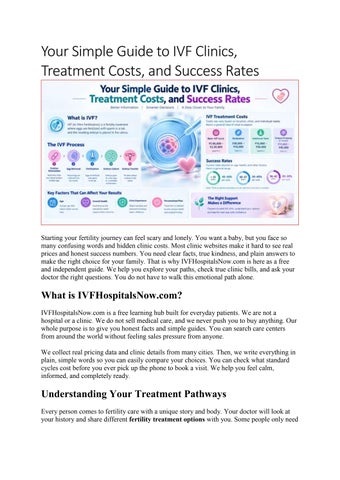
Your Simple Guide to IVF Clinics, Treatment Costs, and Success Rates
Starting your fertility journey can feel scary and lonely. You want a baby, but you face so many confusing words and hidden clinic costs. Most clinic websites make it hard to see real prices and honest success numbers. You need clear facts, true kindness, and plain answers to make the right choice for your family. That is why IVFHospitalsNow.com is here as a free and independent guide. We help you explore your paths, check true clinic bills, and ask your doctor the right questions. You do not have to walk this emotional path alone.
What is IVFHospitalsNow.com? IVFHospitalsNow.com is a free learning hub built for everyday patients. We are not a hospital or a clinic. We do not sell medical care, and we never push you to buy anything. Our whole purpose is to give you honest facts and simple guides. You can search care centers from around the world without feeling sales pressure from anyone. We collect real pricing data and clinic details from many cities. Then, we write everything in plain, simple words so you can easily compare your choices. You can check what standard cycles cost before you ever pick up the phone to book a visit. We help you feel calm, informed, and completely ready.
Understanding Your Treatment Pathways Every person comes to fertility care with a unique story and body. Your doctor will look at your history and share different fertility treatment options with you. Some people only need
gentle pills to help their ovaries release healthy eggs. Other people try simple office visits like IUI, where a doctor places washed sperm right into the womb. If simple steps do not work, IVF is the next path. In IVF, doctors mix eggs and sperm inside a clean lab dish to make an embryo. An embryo is an early developing baby. Understanding all your fertility treatment options gives you hope and keeps you in control of your journey.
Comparing Key Lab Techniques Inside the laboratory, scientists use special tools to help eggs join with sperm. Many patients ask their doctors about ICSI vs IVF during their first visit. In standard IVF, thousands of swimming sperm surround an egg in a dish. The strongest sperm gets inside the egg naturally on its own. Sometimes sperm are slow, weak, or low in number. When weighing ICSI vs IVF, your doctor checks your semen test first. In ICSI, a scientist picks up one single healthy sperm with a tiny needle. The scientist injects that sperm straight into the egg. Both paths create embryos, and your doctor will help you pick the best one for your care.
Preserving Fertility for the Future You might want to focus on your health, work, or life before having a baby. Freezing your eggs today protects your family dreams for the future. Before you begin, you must check the full egg freezing cost. The total egg freezing cost includes your daily hormone shots, doctor visits, the egg pickup surgery, and annual storage. You take medicine shots for two weeks to help your eggs grow. Then, a doctor collects the mature eggs while you take a short nap. Lab scientists freeze the eggs fast so they stay safe for years. Always ask your clinic how their egg freezing cost changes after the first year of storage.
Finding Care Close to Home Location matters a great deal when you go through an active treatment cycle. You must visit your clinic every two or three days for quick blood tests and morning scans. Because you visit so often, most families begin by searching for top IVF clinics. Typing IVF clinics near me on your phone helps you find nearby medical teams. Local IVF clinics save you from long, exhausting car rides before work. When you search for IVF clinics near me, be sure to check their morning monitoring hours and weekend availability. Choose friendly IVF clinics that listen closely to your worries and answer your phone calls fast.
Fertility Treatment and Planning Factors
Treatment Type
Primary Purpose
Key Stage
Practical Tip
Hormone Pills
Helps ovaries grow healthy eggs
Taking daily pills at home
Mark your pill days on a calendar
IUI Insemination
Places sperm inside the womb
Quick doctor visit during ovulation
Rest quietly for ten minutes after the visit
Standard IVF
Joins eggs and sperm in dishes
Egg collection and embryo transfer
Ask for a full price list of all steps
ICSI Procedure
Injects one sperm into an egg
Lab work with tiny glass needles
Test sperm health before starting your cycle
Egg Freezing
Keeps unfertilized eggs safe for later
Fast freezing in the lab
Check the yearly storage bills before signing
Breaking Down Treatment Expenses Fertility care has many small steps, and every step comes with its own bill. A clinic quote often covers only the doctor fee and the egg retrieval surgery. You must ask for a complete breakdown of your full IVF treatment cost. The biggest hidden expense in your IVF treatment cost is almost always the pharmacy medicine. You must take hormone shots every day, and pharmacies charge thousands of dollars for them. You also pay for blood work, ultrasound scans, sleep medicine during surgery, and embryo freezing. Checking your complete IVF treatment cost ahead of time keeps your family budget safe from stressful surprises.
Evaluating Cross-Border Care Many hopeful parents travel to other countries to get high-quality medical care at a lower price. Choosing IVF treatment abroad can cut your medical bills by half or even more.
Some families also choose IVF treatment abroad to find donor eggs or donor sperm with shorter waiting times. However, you must research the total IVF cost by country very carefully before booking flights. Looking at the IVF cost by country shows that flights, hotels, food, and local rides add up fast. You must also pay a local doctor at home to run your morning scans. Comparing the full IVF cost by country helps you see if traveling overseas truly saves you money.
Understanding Clinic Results Without the Hype Clinics often put huge percentages and bold claims on their front pages. But big headline claims can mislead hopeful parents who want honest answers. You must always check verified IVF success rates sorted by patient age groups. A clinic might advertise very high IVF success rates, but that data may only come from young egg donors. Look for the live birth rate instead of a chemical pregnancy rate. A chemical pregnancy is just an early positive test, but a live birth means you bring a healthy baby home. Demand to see verified IVF success rates that match your exact age and medical background.
How to Objectively Compare Centers Take a deep breath and take your time when you compare IVF clinics. When you compare IVF clinics, check their laboratory credentials and clean-room licenses first. A clean, modern lab protects your fragile embryos while they grow. Next, pay attention to how the staff treats you during your first call. Will you see your own doctor at every visit, or a different nurse each time? When you compare IVF clinics, ask for an itemized list of all hidden fees. Honest clinics give you clear price sheets with a warm, open smile.
Clinic Comparison Checklist Evaluation Factor
What to Check
Why It Protects the Patient
Lab Quality
Clean air certifications and modern tools
Keeps fragile growing embryos safe from harm
Clear Prices
Written sheets with medicine and storage
Stops surprise bills from hurting your savings
Evaluation Factor
What to Check
Why It Protects the Patient
Doctor Access
Direct time with your primary doctor
Gives you steady care made for your body
Age Data
Real birth numbers matching your age
Gives honest hope instead of marketing hype
Fast Help
Clear rules for weekend and night calls
Keeps you safe if unexpected pain happens
Real-Life Scenarios and Patient Journeys
Sarah and Mark Budget for Multiple Rounds: Sarah and Mark knew their first cycle had a thirty percent chance of success. Instead of spending all their savings at once, they bought a two-cycle package. This plan capped their lab costs early. Having a backup plan kept them calm when their first round did not work. Elena Balances Local Care with Travel: Elena flew to another country to save money on her medical bills. She found a clinic near her home for her early morning ultrasound scans. She sent the scan photos to her overseas doctor every day. This smart plan allowed her to miss only one week of work. David and Maya Face Diagnostic Delays: David and Maya spent six months taking random vitamins they found online. When they finally saw a specialist, testing showed blocked fallopian tubes. Blocked tubes stop sperm from reaching eggs naturally. Getting real medical tests early saved them months of wasted time and money.
Common Mistakes to Avoid in Fertility Research Many hopeful parents make easy mistakes simply because fertility care is so new to them. First, never trust price quotes that leave out pharmacy medicine costs. Hormone shots can easily add thousands of dollars to your final bill. Second, do not look at raw clinic percentages without checking the patient age brackets. High numbers often come from young donor cycles. Third, do not forget the yearly fees to keep your frozen eggs and embryos in storage. Fourth, always check local donor laws before you travel to another country for care. Fifth, do not skip semen testing for the male partner during your first visit. Male factors cause half of all fertility issues.
Sixth, do not pick a clinic just because the waiting room has fancy chairs. A clean, modern lab matters far more than luxury furniture. Seventh, do not assume your health insurance covers all lab work. Many plans pay for doctor visits but refuse to pay for IVF. Eighth, do not stay with a clinic that brushes off your questions or hides prices.
How IVFHospitalsNow.com Can Help IVFHospitalsNow.com helps you explore your choices with peace of mind. We provide transparent cost breakdowns so you can plan your family budget early. You can browse our free educational clinic directories across many cities and countries. We do not sell treatments, and we never push you toward any specific doctor. Instead, we give you the facts you need to make your own choices. You can print out our doctor question checklists to take to your visits. You can also read simple guides that explain lab steps in plain, everyday words. IVFHospitalsNow.com helps you walk into clinic appointments feeling calm, strong, and ready.
A Simple 7-Step Research Roadmap 1. 2. 3. 4. 5. 6. 7.
Goal: Write down your budget, your timeline, and your family dreams. Search: Look for certified fertility centers near your home or trusted travel hubs. Shortlist: Pick three or four clinics with clear prices and positive patient reviews. Compare: Lay their price sheets, lab tools, and age-based birth rates side by side. Ask: Meet doctors for a first visit and ask about all extra costs. Verify: Check government boards to make sure the clinic holds active licenses. Decide: Pick the medical team that treats you with clear facts, fair prices, and real warmth.
Frequently Asked Questions (FAQ) Question 1: What is the primary difference between IUI and IVF? IUI is a simple visit where a doctor places sperm right into your womb. The sperm must swim to the egg inside your body. IVF is different because eggs come out of your body first. Doctors join eggs and sperm in a lab dish to create embryos. Then, the doctor transfers an embryo back into your womb.
Question 2: How long does a single cycle of IVF take from start to finish? A single IVF cycle usually takes about four to six weeks from start to finish. You take daily medicine shots for two weeks to help your eggs grow. Next, the doctor collects the eggs during a short visit. The lab grows embryos for five days. Finally, the doctor places an embryo in your womb or freezes it.
Question 3: Are hormone injections painful during the stimulation phase?
Most patients say the shots only pinch for a quick second. The needles are very small and go just under the skin on your belly. You might feel a little full or bloated in your tummy. You can hold an ice pack on your skin before the shot to numb the area and stay calm.
Question 4: What is the best age to consider freezing my eggs? Doctors suggest freezing your eggs in your late twenties or early thirties. Younger bodies have a higher number of healthy eggs. But women in their mid-thirties can freeze eggs with good success too. A quick blood test shows your doctor how many eggs you have left. That test helps you make a safe plan.
Question 5: Does health insurance cover the cost of fertility care? Insurance coverage depends on your job, your plan, and where you live. Some plans pay for doctor visits and blood tests. But many plans refuse to pay for lab work or daily hormone shots. You should call your insurance company directly. Ask them for a written list of what they cover before you begin.
Question 6: How many embryos should a doctor transfer at one time? Doctors now suggest moving just one single embryo at a time. Transferring one embryo lowers the health risk of having twins. Carrying twins can cause early labor and low baby birth weight. Having one healthy baby at a time is much safer for you. Doctors only transfer two embryos in rare cases after careful talks.
Question 7: What does ICSI cost compared to standard lab fertilization? Adding ICSI to your cycle usually adds one to two thousand dollars to your bill. This fee pays for special tiny needles and expert scientist lab time. Standard IVF does not have this fee because sperm fertilize eggs on their own. Your doctor will only recommend ICSI if sperm tests show low numbers or slow swimmers.
Question 8: Can I exercise and work normally during an IVF cycle? You can work your normal job during most of your treatment cycle. But doctors say you must avoid heavy gym lifting, running, and jumping. Your ovaries get big and heavy while making eggs. Fast twists can hurt your body. Light walks and good rest are the safest choices for your health during your shot days.
Question 9: What is pre-implantation genetic testing and do I need it? This lab test checks tiny cells from an embryo before transfer. It checks for missing or extra parts inside the cells. Normal cells help embryos attach to the womb and grow into healthy babies. This test costs extra money and takes a few weeks. It helps older parents or families with known medical risks.
Question 10: How many mature eggs do doctors hope to collect in a cycle?
Doctors hope to collect ten to fifteen eggs during one retrieval surgery. This gives the laboratory team a healthy group of eggs to work with safely. Not every egg joins with sperm, and not every egg becomes an embryo. Collecting ten to fifteen eggs protects your body from swelling and gives you good odds.
Question 11: What questions should I ask at my first clinic consultation? Ask for a complete written list of all prices, including daily shots and embryo storage. Ask who answers your phone calls on weekends and late at night. Ask to see live birth rates for people of your exact age. Also, ask what happens to your embryos if the clinic ever loses power.
Question 12: Why do treatment prices vary so much between different countries? Prices change because rent, doctor pay, and clinic bills vary across countries. Some countries in Europe have lower clinic running costs. These clinics pass the savings to visiting patients through lower package bills. But top global clinics still use the very same modern incubators and clean lab tools as clinics at home.
Conclusion Starting fertility care takes courage, patience, and clear facts. Always verify extra costs like medications and storage fees before paying any clinic deposit. Look past shiny advertisements and focus on verified live birth rates for your age group. Consult qualified doctors who take time to listen to your worries and explain each step kindly. Bring written questions to your visits so you always feel confident and informed. To compare your choices and read independent pricing guides, explore IVFHospitalsNow.com as you begin your family journey.