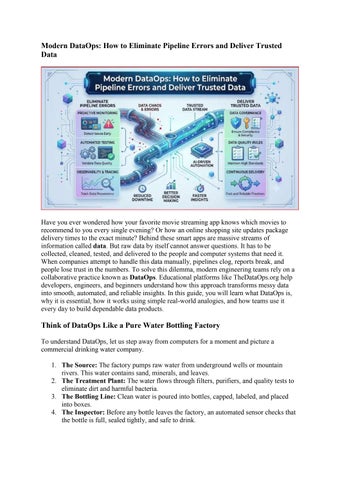
Modern DataOps: How to Eliminate Pipeline Errors and Deliver Trusted Data
Have you ever wondered how your favorite movie streaming app knows which movies to recommend to you every single evening? Or how an online shopping site updates package delivery times to the exact minute? Behind these smart apps are massive streams of information called data. But raw data by itself cannot answer questions. It has to be collected, cleaned, tested, and delivered to the people and computer systems that need it. When companies attempt to handle this data manually, pipelines clog, reports break, and people lose trust in the numbers. To solve this dilemma, modern engineering teams rely on a collaborative practice known as DataOps. Educational platforms like TheDataOps.org help developers, engineers, and beginners understand how this approach transforms messy data into smooth, automated, and reliable insights. In this guide, you will learn what DataOps is, why it is essential, how it works using simple real-world analogies, and how teams use it every day to build dependable data products.
Think of DataOps Like a Pure Water Bottling Factory To understand DataOps, let us step away from computers for a moment and picture a commercial drinking water company. 1. The Source: The factory pumps raw water from underground wells or mountain rivers. This water contains sand, minerals, and leaves. 2. The Treatment Plant: The water flows through filters, purifiers, and quality tests to eliminate dirt and harmful bacteria. 3. The Bottling Line: Clean water is poured into bottles, capped, labeled, and placed into boxes. 4. The Inspector: Before any bottle leaves the factory, an automated sensor checks that the bottle is full, sealed tightly, and safe to drink.
5. The Delivery Fleet: Trucks carry clean water bottles to supermarkets so thirsty shoppers can drink safely. Now, imagine what happens if the factory has no automated inspectors. A dirty filter could tear, and murky water would flow into thousands of bottles without anyone noticing until angry customers complain. DataOps acts as the automated testing, filtering, and delivery system for digital information. Raw information is like muddy river water. Decision-makers and artificial intelligence (AI) models need crisp, clean water. DataOps builds automated pipelines equipped with built-in filters and quality sensors. If bad numbers enter the flow, the pipeline flags the issue immediately, ensuring only clean, verified data reaches dashboards and reports.
Where Did DataOps Come From? The word DataOps is a blend of three core disciplines:
Data: The facts, numbers, dates, and text collected from mobile apps, websites, and sales registers. Dev (Development): The software engineering practices used to write code, design features, and solve bugs. Ops (Operations): The day-to-day work of keeping computer systems, cloud servers, and networks running smoothly without crashing.
Before DataOps existed, software teams used a popular framework called DevOps to release applications quickly and safely. DevOps introduced automated tests so programmers could update an app on your smartphone without breaking it. Data teams realized they needed the same reliability for data. Unlike traditional software code—which only changes when a programmer rewrites it—data changes constantly every second. Customers make purchases, cancel orders, and update addresses around the clock. DataOps takes the best habits of DevOps and Agile project management and adapts them to handle ever-changing streams of data.
The Three Pillars of DataOps DataOps rests on three foundational pillars: people, automated process, and technology. +-----------------------------------------------------------+ | DATAOPS | +-----------------------------------------------------------+ | 1. People & Culture | Shared goals and collaboration | | 2. Agile Process | Small, frequent, safe updates | | 3. Automated Tools | Continuous tests and deployment | +-----------------------------------------------------------+
1. People and Collaboration
In traditional organizations, data engineers (who build pipelines), data analysts (who create charts), and business managers (who make decisions) often worked in isolated silos. When a dashboard showed incorrect numbers, teams spent days blaming one another. DataOps brings these groups together so everyone shares responsibility for data health. 2. Agile Process Instead of spending six months building an enormous data project that might be outdated before completion, teams work in small cycles called sprints. They deliver small, working improvements every week or two, test them with real users, and refine their work based on feedback. 3. Automation and CI/CD Continuous Integration and Continuous Delivery (CI/CD) means that every time an engineer writes a script to transform numbers, automated software tests check the logic against potential errors before it touches live business systems.
How a DataOps Pipeline Works: Step by Step To see DataOps in action, let us trace how a modern company processes order information from an e-commerce website. Step 1: Data Ingestion (Collecting) Information arrives from various sources: customer clicks, warehouse scans, and payment processors. Ingestion tools gather these inputs continuously. Step 2: Data Validation at the Border (Early Check) Before accepting incoming records, automated tests verify baseline structure:
Is the customer's age a positive number? Does every order contain a valid email address? Are purchase amounts missing negative signs?
If records fail these sanity checks, they are routed to a quarantine zone for review rather than corrupting downstream reports. Step 3: Transformation (Cleaning and Organizing) Raw data is rarely uniform. Dates might be formatted as MM/DD/YYYY in one database and YYYY-MM-DD in another. Automated transformation scripts reformat fields, remove duplicates, and organize tables so information can be queried efficiently. Step 4: Continuous Testing (Quality Assurance) Automated assertions check aggregate balances across processing steps:
Did the sum of daily sales match the total processed by credit card providers?
Did any pipeline step drop 20% of customer records unexpectedly?
Step 5: Deployment and Observability (Delivery and Monitoring) Clean data arrives in analytics warehouses where dashboards update automatically. Throughout the process, monitoring tools watch the entire journey. If a pipeline runs slowly or stalls, on-call engineers receive alerts before executive teams view incorrect metrics.
Comparing Traditional Data Work with Modern DataOps The differences between older manual workflows and modern automated DataOps workflows illustrate why organizations are making this transition:
Feature
Old-Fashioned Data Work
Modern DataOps Approach
Testing
Manual checks performed after complaints arrive
Automated tests executed at every step
Deployments
Infrequent updates every few months
Small, continuous updates delivered weekly or daily
Error Handling
Silent pipeline failures noticed by executives
Instant automated alerts sent directly to engineers
Teamwork
Siloed teams working in isolation
Unified collaboration across engineers, analysts, and business teams
Data Quality
Assumed accurate until proven broken
Continuously verified, measured, and documented
Speed to Insight
Weeks or months to build a single report
Hours or days using reusable, automated components
Real-Life Scenarios: DataOps in Action
1. The School Bus Fleet Imagine a school district running 100 school buses equipped with GPS trackers.
Without DataOps: A tracker on Bus #12 freezes and reports the bus parked at school when it is actually stuck in traffic. Parents panic because the tracker is wrong. With DataOps: An automated rule notices that Bus #12 has not changed coordinates in 10 minutes while its engine is running at 30 miles per hour. The pipeline flags the GPS anomaly immediately, switches to estimated cell-tower location data, and alerts the mechanic to replace the sensor.
2. The Online Grocery Store An online grocery store uses an algorithm to reorder milk when supplies run low.
Without DataOps: A database bug writes the stock count of milk as a negative number (-50 cartons). The inventory dashboard breaks, no milk is ordered, and store shelves sit empty the next morning. With DataOps: A pre-ingestion validation test asserts that inventory counts must always be zero or greater. The pipeline intercepts the negative value, flags the database glitch, retains the last known good inventory count, and alerts the platform team without stopping operations.
Practical Benefits of Adopting DataOps 1. Higher Data Quality: Automated tests catch invalid formats, empty columns, and duplicate entries before data reaches dashboards. 2. Faster Delivery: Teams release new dashboards, reports, and predictive models in days instead of months. 3. Decreased Operational Stress: Engineers spend less time fixing emergency breakages on weekends and more time building useful features. 4. Enhanced Business Trust: When leaders trust that numbers reflect reality, they make strategic decisions with confidence. 5. Cost Reduction: Catching bugs early in the ingestion stage requires far less cloud computing spend and engineer time than diagnosing errors across months of corrupted storage.
Frequently Asked Questions (FAQs) What is DataOps in simple terms? DataOps is a set of practices, cultural habits, and automated tools designed to make data collection, cleaning, and delivery faster, safer, and more reliable for everyone who uses it. Is DataOps a software tool you can buy? No. DataOps is not a single software application. It is an operational methodology that combines teamwork, continuous testing, workflow automation, and specialized software tools.
How is DataOps different from DevOps? DevOps focuses on building, testing, and deploying software code, such as web applications and mobile apps. DataOps applies similar principles to data pipelines, where the underlying inputs change constantly even if the code remains the same. Who works in a DataOps environment? Data engineers, data analysts, data scientists, software developers, database administrators, and business stakeholders collaborate within a DataOps framework. Why do traditional data pipelines fail so often? Traditional pipelines rely heavily on manual verification and lack automated sensors. When incoming data structures change unexpectedly, unmonitored scripts break silently, allowing bad data to reach end users. What is data observability? Data observability is the practice of monitoring data pipeline health across key indicators, such as data freshness, volume changes, schema consistency, lineage tracking, and error rates. Can small companies benefit from DataOps? Yes. Even small teams benefit from basic automated testing and clear data validation rules, preventing expensive data cleanup projects as companies grow. What role does automation play in DataOps? Automation handles repetitive tasks, including running daily pipeline quality checks, reformatting messy entries, testing code updates, and alerting engineers when processing delays occur. What happens when bad data enters a pipeline? In a mature DataOps setup, automated validation rules quarantine incorrect records into a separate review table, preventing downstream dashboards from breaking while alerting engineers to the error. How can beginners start learning DataOps? Beginners can start by learning basic SQL, understanding how databases store records, exploring Python for simple transformations, and reading educational resources on workflow automation and pipeline reliability.
Conclusion Data powers modern business decisions, medical breakthroughs, navigation tools, and educational systems. However, raw data is only as valuable as it is reliable. Without
disciplined processes, pipelines become fragile, numbers drift out of alignment, and decisionmakers lose confidence in their analytics. DataOps solves this challenge by bringing structure, continuous testing, clear team collaboration, and automated monitoring to modern data workflows. By treating data like a manufactured product that must meet strict quality standards before delivery, organizations can innovate rapidly while maintaining reliability. Whether you are an aspiring data engineer or a curious beginner, understanding DataOps is a foundational step toward mastering the modern digital economy.