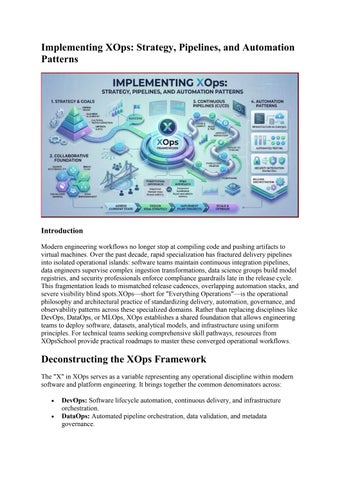
Implementing XOps: Strategy, Pipelines, and Automation Patterns
Introduction Modern engineering workflows no longer stop at compiling code and pushing artifacts to virtual machines. Over the past decade, rapid specialization has fractured delivery pipelines into isolated operational islands: software teams maintain continuous integration pipelines, data engineers supervise complex ingestion transformations, data science groups build model registries, and security professionals enforce compliance guardrails late in the release cycle. This fragmentation leads to mismatched release cadences, overlapping automation stacks, and severe visibility blind spots.XOps—short for "Everything Operations"—is the operational philosophy and architectural practice of standardizing delivery, automation, governance, and observability patterns across these specialized domains. Rather than replacing disciplines like DevOps, DataOps, or MLOps, XOps establishes a shared foundation that allows engineering teams to deploy software, datasets, analytical models, and infrastructure using uniform principles. For technical teams seeking comprehensive skill pathways, resources from XOpsSchool provide practical roadmaps to master these converged operational workflows.
Deconstructing the XOps Framework The "X" in XOps serves as a variable representing any operational discipline within modern software and platform engineering. It brings together the common denominators across:
DevOps: Software lifecycle automation, continuous delivery, and infrastructure orchestration. DataOps: Automated pipeline orchestration, data validation, and metadata governance.
MLOps: Model tracking, training reproducibility, model registry pipelines, and serving infrastructure. AIOps: Automated event correlation, anomaly detection, and operational intelligence. SecOps / DevSecOps: Static analysis, software supply chain security, and continuous runtime compliance. FinOps: Real-time cloud unit economics, resource rightsizing, and cost visibility.
Rather than maintaining separate tools and release gates for each specialty, an XOps model applies shared design patterns: declarative configuration, version control as the single source of truth, automated verification, and end-to-end telemetry. +---------------------------------------------------+ | XOps Core | | Declarative State | CI/CD | Policy | Observability| +---------------------------------------------------+ | | | | +-----v-----+ +-----v-----+ +-----v-----+ +----v----+ | DevOps | | DataOps | | MLOps | | SecOps | | (Code/Inf)| | (Pipelines| | (Training/| | (Gates/ | | | | & Quality)| | Serving) | | Runtime)| +-----------+ +-----------+ +-----------+ +---------+
How XOps Operates Across Disciplines The primary objective of XOps is eliminating friction where operational disciplines touch. In a conventional setup, a predictive recommendation service illustrates the typical breakdown: 1. The Software Team pushes an update to a microservice using Git-driven CI/CD pipelines. 2. The Data Team schedules ingestion jobs that populate raw feature stores on separate cron triggers. 3. The Data Science Team trains a model artifact on local instances, struggling to package it within containerized production limits. 4. The Security Team flags outdated Python dependencies just before the deployment window opens. Under an XOps approach, these discrete steps execute against unified operational standards. The microservice definition, the declarative data pipeline step, the model artifact metadata, and the policy checks run through coordinated continuous delivery pipelines managed by a platform engineering team.
Operational Comparison Across Core Disciplines
Operation al Discipline
Primary Asset Under Management
Key Engineering Focus
Typical Bottleneck Addressed
Core Tooling Ecosystem
Application source code, container images, infrastructure state
Repeatable deployments, build throughput, infrastructure provisioning
Manual server provisionin g, slow release cadences
Kubernetes, Terraform, GitHub Actions, Argo CD
Structured/unstructu red data schemas, ETL/ELT pipelines
Data freshness, schema evolution, pipeline resiliency
Broken upstream schemas, silent data corruption
Apache Airflow, dbt, Dagster, Great Expectations
MLOps
Feature tables, weights, hyperparameters, model endpoints
Reproducibili ty, concept/data drift mitigation
Models stuck in developme nt notebooks, unmonitore d inference drift
MLflow, Kubeflow, Feast, Triton Inference Server
SecOps
Identities, secrets, compliance policies, vulnerability reports
Shift-left vulnerability detection, runtime authorization
Security reviews delaying production releases
Trivy, Falco, Open Policy Agent (OPA), HashiCorp Vault
AIOps
Traces, metrics, log streams, system events
Incident remediation, alert deduplication
Alert fatigue, manual root cause analysis across
Prometheus, OpenTelemet ry, Grafana, Datadog
DevOps
DataOps
Operation al Discipline
Primary Asset Under Management
Key Engineering Focus
Typical Bottleneck Addressed
, anomaly identification
distributed nodes
Core Tooling Ecosystem
Core Pillars of an XOps Strategy Declarative Everything Every component—whether a Kubernetes manifest, a Snowflake table definition, or an inference pipeline—is expressed declaratively in version control. Git acts as the authoritative ledger for desired operational state.
Automated Verification Gates Unit and integration tests are standard in DevOps, but XOps extends automated checks across data and machine learning workloads:
Data quality assertions run before loading tables into consumption layers. Statistical distribution checks trigger automatically on incoming model training sets. Security scanners inspect infrastructure-as-code scripts for misconfigured network policies during the pull request phase.
Unified Observability Telemetry data cannot remain siloed within separate dashboards. Logs, distributed traces, system metrics, and domain-specific metrics (such as data freshness latency or inference response drift) are routed through common aggregation protocols like OpenTelemetry. This unified visibility enables incident response teams to pinpoint whether an outage originates in application logic, infrastructure saturation, or upstream data corruption.
Practical Implementation Patterns Adopting an XOps posture does not require scrapping existing tools. Teams implement convergence incrementally through platform-centric practices: 1. Establish an Internal Developer Platform (IDP): Provide application engineers, data professionals, and ML engineers with pre-vetted service templates that automatically incorporate security, telemetry, and deployment hooks. 2. Standardize Infrastructure as Code: Migrate bespoke provisioning tasks to declarative systems like Terraform, OpenTofu, or Crossplane to maintain consistent networking and compute configurations.
3. Harmonize Scheduling and Orchestration: Run data preparation tasks, model training jobs, and production microservices on containerized compute layers (such as Kubernetes), optimizing resource scheduling and cost allocations. 4. Implement Continuous Verification: Integrate tools like Great Expectations (for DataOps) and automated container vulnerability scanners (for SecOps) directly into core continuous integration workflows.
Common Adoption Pitfalls
Treating XOps as a Single Tool: XOps is a governance and operational model, not a commercial software package. Purchasing an "XOps platform" without restructuring cross-team workflows inevitably fails. Ignoring Domain Differences: Forcing data science experimentation into rigid microservice deployment tempos without accommodating iterative exploration damages developer productivity. Neglecting Organizational Friction: Silos persist because teams maintain separate incentives and budgets. Unified operations require coordinated management backing, aligned key performance indicators, and cross-disciplinary knowledge sharing.
Frequently Asked Questions What does XOps stand for? XOps stands for "Everything Operations." It is an umbrella term encompassing DevOps, DataOps, MLOps, SecOps, AIOps, CloudOps, and related operational disciplines under a standardized architectural framework. How does XOps differ from traditional DevOps? DevOps focuses primarily on the software development lifecycle, continuous deployment, and infrastructure operations. XOps broadens this scope to include non-traditional assets like data pipelines, machine learning models, and security governance within the same delivery principles. What is the main goal of adopting XOps? The primary goal is removing operational friction between specialized engineering units, reducing duplicate tooling, enforcing standardized security and compliance, and providing complete end-to-end visibility across hybrid production environments. Does an organization need to dismantle existing DevOps or MLOps teams to adopt XOps? No. Specialized practitioners retain their domain expertise, while platform engineering teams build standardized pipelines and shared infrastructure that all disciplines leverage. What role does Kubernetes play in an XOps architecture?
Kubernetes provides the converged compute substrate. It orchestrates standard web microservices, scalable distributed data processing jobs, and GPU-accelerated model serving workloads under a single API. Is XOps only relevant for enterprise organizations? While large enterprises with sprawling, disconnected engineering departments experience the highest immediate return, mid-sized organizations benefit by avoiding tool sprawl and operational silos early in their growth cycles. How does AIOps fit into the broader XOps picture? AIOps supplies the automated intelligence layer for XOps. It processes metrics, events, and telemetry generated across DevOps, DataOps, and MLOps workloads to automate root-cause analysis and incident mitigation. What skills are required to become an XOps-focused engineer? Engineers need foundational knowledge in container orchestration (Kubernetes), Infrastructure as Code (Terraform), continuous integration systems, basic data pipeline concepts, and distributed observability standards like OpenTelemetry. How does FinOps integrate into an XOps approach? FinOps supplies cost governance directly within deployment pipelines. It monitors infrastructure, compute-heavy data jobs, and ML training cluster expenses, flagging cost anomalies before they generate massive cloud bills. Where can teams access training to build cross-functional XOps capabilities? Specialized technical portals such as XOpsSchool deliver curriculum pathways focusing on convergence topics, container management, deployment automation, and modern infrastructure governance.
Conclusion The proliferation of specialized operations—DevOps, DataOps, MLOps, and SecOps— addressed critical complexity across individual engineering segments, but it introduced new silos that slow down organizational agility. XOps resolves this fragmentation by establishing a common operating baseline: declarative configurations, unified continuous validation pipelines, shared container infrastructure, and end-to-end observability. By breaking down the barriers between software developers, data practitioners, machine learning teams, and infrastructure operators, the XOps philosophy transforms isolated deployment efforts into an integrated operational engine. Organizations that embrace these unified workflows cut debugging overhead, accelerate product iteration, and ensure that operational reliability scales in tandem with technical innovation.