How to Find a Chartered Accountant for Tax and Compliance Introduction Finding the right Chartered Accountant is an important decision for individuals, freelancers, startups, MSMEs, company directors, and NRIs. The best choice is not necessarily the nearest professional or the lowest-priced option. It is the person or firm whose experience, processes, communication, and service scope fit your actual financial needs. A freelancer may be looking for help with income tax filing and TDS records. A founder may need a CA for company registration, GST registration, bookkeeping, payroll coordination, financial statements, and ROC compliance. An NRI may require an NRI tax consultant in India who understands documentation, timelines, and cross-border considerations. These needs require different levels of specialization. BestCaNow is designed to help users begin this search by discovering Chartered Accountant profiles and comparing options for remote or in-person professional consultations. Use it as a starting point, then evaluate credentials, relevant experience, fees, and engagement terms before making a decision.
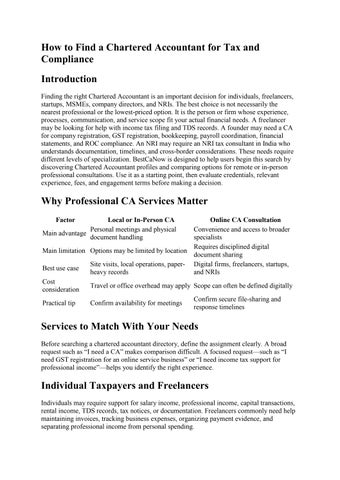
Why Professional CA Services Matter Factor
Local or In-Person CA Personal meetings and physical Main advantage document handling
Online CA Consultation Convenience and access to broader specialists Requires disciplined digital Main limitation Options may be limited by location document sharing Site visits, local operations, paper- Digital firms, freelancers, startups, Best use case heavy records and NRIs Cost Travel or office overhead may apply Scope can often be defined digitally consideration Confirm secure file-sharing and Practical tip Confirm availability for meetings response timelines
Services to Match With Your Needs Before searching a chartered accountant directory, define the assignment clearly. A broad request such as “I need a CA” makes comparison difficult. A focused request—such as “I need GST registration for an online service business” or “I need income tax support for professional income”—helps you identify the right experience.
Individual Taxpayers and Freelancers Individuals may require support for salary income, professional income, capital transactions, rental income, TDS records, tax notices, or documentation. Freelancers commonly need help maintaining invoices, tracking business expenses, organizing payment evidence, and separating professional income from personal spending.
For example, a consultant working with several clients may receive payments at different times, incur software and travel expenses, and see TDS deductions in some client payments. A CA can help establish a practical records process and identify the information needed for income tax filing. The goal is not simply to file at the last minute; it is to maintain accurate records during the year.
Startups, MSMEs, and Companies
Business structure
Advantages
Simple to Sole establish and proprietorship operate Separate legal identity with LLP operational flexibility Structured Private limited ownership and company investment readiness
Best use cases
Cost consideration
Owner and Independent business finances consultants and can become small local mixed ventures
Usually lower setup complexity
Limitations
Recurring Professional firms Moderate setup compliance and co-founder and compliance obligations apply businesses effort More formal Scalable startups Higher ongoing reporting and seeking formal compliance governance needs structure requirements
GST, Audit, and Financial Reporting
Service
Main purpose
Bookkeeping
Record routine transactions
Internal audit
Review controls and processes
Statutory audit Tax audit
Meet applicable reporting requirements Review taxrelated records and reporting
Advantage Improves visibility over income and expenses
Limitation
Best use case Freelancers, Needs timely MSMEs, and source documents startups Does not replace Growing Identifies control statutory businesses with gaps early requirements operational risk Supports formal Scope is Eligible entities compliance and structured by rules and companies reporting or contracts Depends on Businesses Promotes disciplined applicability and meeting relevant tax documentation facts conditions
How to Choose the Right Chartered Accountant
Selecting a CA should be a structured process rather than a quick response to an approaching deadline. Start by listing your immediate need, the likely annual support required, and the documents you already maintain. Then compare professionals against the same criteria.
Best Practices for Tax, Accounting, and Compliance Create a monthly financial routine. Store sales invoices, purchase bills, contracts, bank statements, payment proofs, payroll records, and tax-related documents in organized folders. Use consistent file names and keep a simple checklist of missing documents. Regular organization reduces stress at return-filing time and improves the quality of accounting records.Separate personal and business finances as early as possible. A dedicated business bank account, distinct payment methods, and clear expense categorization make bookkeeping easier. Reconcile bank transactions regularly so that unexplained entries do not accumulate for months.
Expert Tips for Better Financial Management Choose specialization over generic claims. If your main issue is GST compliance, look for relevant GST experience. If you are an NRI, prioritize an NRI tax consultant in India with demonstrated familiarity with cases similar to yours. If you are establishing a company, look for a CA who can explain the finance and compliance implications of each stage.Compare value, not just price. A low fee may be appropriate for a narrow, routine scope, but it may not include reconciliations, notice support, reporting, or urgent consultations. Ask for a detailed fee proposal and compare what is actually included. Transparent pricing is generally more useful than an unexplained low quote.
Common Mistakes to Avoid The most common mistake is delaying financial work until a deadline is close. When documents are collected at the last minute, invoices may be missed, transactions may be wrongly classified, and questions may remain unresolved. Establish a monthly process instead of attempting a year-end reconstruction.Poor bookkeeping is another frequent problem. Businesses often mix personal and business payments, fail to retain bills, or record transactions only when a filing is due. The solution is simple but requires consistency: maintain source documents, reconcile accounts frequently, and use an accounting method appropriate to the business size.
Frequently Asked Questions 1. How do I find a chartered accountant for my needs? Begin by identifying the exact work required, such as income tax filing, GST registration, bookkeeping, audit, company registration, or NRI taxation. Compare professionals on qualifications, relevant experience, service scope, responsiveness, and fees. A platform such as BestCaNow can help you discover profiles, but you should independently evaluate credentials and engagement terms before hiring.
2. Should I choose a chartered accountant near me? A nearby CA can be helpful for physical records, local meetings, site visits, and businesses that prefer face-to-face communication. However, location should not be the only selection factor. An online CA consultation can work well for digital businesses, remote founders, freelancers, and NRIs when document sharing, timelines, security, and communication expectations are clearly established.
3. What should I ask in an online CA consultation? Ask about experience with your income type, business model, entity structure, or compliance need. Confirm the expected deliverables, documents required, turnaround time, fees, communication process, and exclusions. If there is a deadline, ask whether the professional can realistically take the assignment. A clear first consultation prevents misunderstandings after work begins.
4. Can a CA help with company registration? A CA may help explain the tax, financial, accounting, and compliance implications of business registration and entity selection. Depending on the assignment, legal or companysecretarial support may also be necessary. Before proceeding, ask which registrations, filings, documents, and post-registration actions are included. Obtain the scope and fee arrangement in writing for clarity.
5. What does a GST consultant do? A GST consultant may assist with GST registration, invoice processes, GST return filing, reconciliations, documentation, and compliance planning. The precise service depends on the business model and facts. Explain your products or services, customer locations, turnover, billing process, and current records before requesting help. This allows the consultant to propose an appropriate scope.
6. Do freelancers need a Chartered Accountant? Freelancers can benefit from CA services when they have multiple clients, TDS deductions, significant business expenses, overseas payments, or difficulty organizing records. A CA can help establish a workable documentation and bookkeeping routine. The right level of support depends on the complexity of income and transactions, not simply on whether someone is self-employed.
7. How should startups choose a CA? Startups should look for a professional experienced in early-stage operations, bookkeeping, GST, payroll coordination, financial statements, compliance calendars, and founder communication. Ask whether they have worked with businesses at a similar stage or in a comparable industry. The ideal CA builds a repeatable finance process rather than only responding when a filing deadline approaches.
8. What financial documents should I retain? Keep invoices, bills, bank statements, payment evidence, contracts, payroll records, TDS information, previous returns, filing acknowledgements, and important business correspondence. Businesses should organize sales and purchase records consistently. The exact documents needed depend on your circumstances, so ask your CA for a tailored checklist and retain records for the period applicable to your situation.
9. Is a tax consultant the same as a Chartered Accountant? Not necessarily. A tax consultant may focus mainly on tax-related work, while a Chartered Accountant has a distinct professional qualification and may offer broader accounting, audit, reporting, and advisory services within their authorized scope. Evaluate the individual’s credentials and specialization rather than relying only on a title. The right choice depends on your required service.
10. How should NRIs select a tax consultant in India? NRIs should look for a professional with relevant experience in NRI taxation, documentation, property transactions where relevant, and cross-border reporting considerations. Share complete and accurate background information before seeking guidance. Confirm whether the professional supports remote communication, secure document exchange, and written fee proposals. Complex cases require advice based on the individual’s facts, not generic guidance.
Conclusion Finding the right Chartered Accountant is a practical investment in better records, clearer compliance processes, and more informed decisions. Start with your actual need, whether it is income tax filing, GST compliance, accounting services, company incorporation, audit support, payroll, financial reporting, or NRI taxation. Then compare professionals based on competence, specialization, communication, security, availability, and written scope.