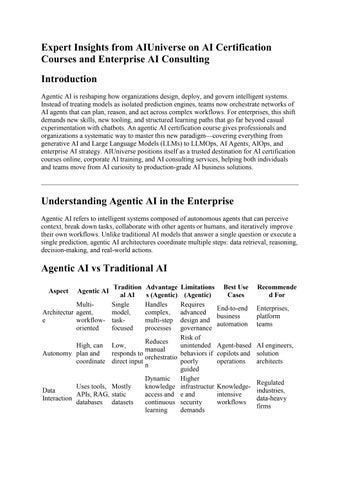
Expert Insights from AIUniverse on AI Certification Courses and Enterprise AI Consulting
Expert Insights from AIUniverse on AI Certification
Courses and Enterprise AI Consulting
Introduction
Agentic AI is reshaping how organizations design, deploy, and govern intelligent systems. Instead of treating models as isolated prediction engines, teams now orchestrate networks of AI agents that can plan, reason, and act across complex workflows. For enterprises, this shift demands new skills, new tooling, and structured learning paths that go far beyond casual experimentation with chatbots. An agentic AI certification course gives professionals and organizations a systematic way to master this new paradigm covering everything from generative AI and Large Language Models (LLMs) to LLMOps, AI Agents, AIOps, and enterprise AI strategy. AIUniverse positions itself as a trusted destination for AI certification courses online, corporate AI training, and AI consulting services, helping both individuals and teams move from AI curiosity to production-grade AI business solutions.
Understanding Agentic AI in the Enterprise
Agentic AI refers to intelligent systems composed of autonomous agents that can perceive context, break down tasks, collaborate with other agents or humans, and iteratively improve their own workflows. Unlike traditional AI models that answer a single question or execute a single prediction, agentic AI architectures coordinate multiple steps: data retrieval, reasoning, decision-making, and real-world actions.
Agentic AI vs Traditional AI
Aspect Agentic AI
Architectur
Tradition al AI
e Multiagent, workfloworiented Single model, taskfocused
Autonomy High, can plan and coordinate Low, responds to direct input
Advantage s (Agentic)
Handles complex, multi-step processes
Reduces manual orchestratio n
Limitations (Agentic)
Requires advanced design and governance
Risk of unintended behaviors if poorly guided
Best Use Cases
Recommende d For
End-to-end business automation Enterprises, platform teams
Agent-based copilots and operations AI engineers, solution architects
Tradition al AI Advantage s (Agentic) Limitations (Agentic)
Easier to monitor single model
Scales via agent orchestratio n Scales via bigger models
Can embed compliance logic and guardrails
More flexible, modular scaling
Complex to audit across agents
Requires expertise in orchestratio n patterns
Best Use Cases Recommende d For
Enterprise AI transformatio n CIOs, AI governance teams
Long-term AI strategy and platforms CTOs, AI platform leaders
. Why Agentic AI Skills Matter for Modern Teams
Enterprise teams are under pressure to move beyond proof-of-concept chatbots and build AI solutions that deliver measurable outcomes higher productivity, better decision-making, and new revenue streams. Agentic AI skills provide the foundation for this transformation.
AI Engineers and Machine Learning Engineers need to integrate LLMs with existing data systems, APIs, and microservices. DevOps and MLOps Engineers must learn how to deploy agent-based workloads reliably, monitor them in production with AI observability tools, and manage model serving at scale. AIOps Engineers and IT Operations teams are tasked with using autonomous AI to detect incidents, correlate signals, and trigger remediation steps across hybrid infrastructure.
Key Roles: AI Engineers, MLOps, and Platform Teams
AIUniverse’s approach to education and consulting recognizes that each role engages with agentic AI differently:
AI Engineers focus on agent design, tool integration, and prompt engineering.
MLOps Engineers build robust deployment pipelines, experiment tracking workflows, and model monitoring dashboards.
Platform Engineers and Cloud Architects design the AI infrastructure including vector databases, federated learning platforms, and secure data connectors.
An effective agentic AI certification course must speak to all these perspectives, turning siloed knowledge into coordinated enterprise AI workflows.
Core Pillars of an Agentic AI Certification Course
A well-designed agentic AI certification course goes beyond theory. It weaves together technical depth, hands-on labs, and enterprise case studies to help learners apply their skills in production environments.
Typical pillars include:
Generative AI and LLM Fundamentals: Understanding how LLMs like OpenAI, Anthropic, and Google Gemini work, where they excel, and where they fail.
Prompt Engineering and Prompt Management: Crafting robust prompts, using best prompt management tools, and designing reusable prompt libraries.
Agent Design and Tooling: Building agents with frameworks such as LangChain, CrewAI, AutoGen, or MCP; integrating them with APIs, databases, and internal services.
LLMOps and MLOps: Managing deployments, versioning models, model serving, experiment tracking, and AI observability.
AI Governance and AI Security: Ensuring responsible AI usage, applying guardrails, monitoring for misuse, and complying with organizational policies.
How AIUniverse Enables AI Engineers and Enterprises
AIUniverse positions itself as both a learning hub and a consulting partner for organizations navigating the AI transformation journey. Instead of offering generic AI tutorials, it aligns AI certification courses online with the realities of enterprise AI deployment, AI strategy, and AI business solutions.
For individual learners AI Engineers, Data Scientists, DevOps and MLOps Engineers
AIUniverse’s Agentic AI certification course, MLOps certification course, and AIOps certification course create a clear progression. Learners move from foundational LLM skills to advanced multi-agent systems, then into infrastructure-focused MLOps and AIOps practices. Practical labs using best MLOps tools and AI observability platforms help bridge the gap between theory and production.
AIUniverse’s Role in Enterprise AI Strategy
AIUniverse’s consulting approach typically involves:
Assessing AI maturity across teams and infrastructure.
Prioritizing high-impact, realistic agentic AI use cases.
Selecting best AI tools for business, including federated learning platforms and prompt management tools.
Designing AI governance frameworks aligned with industry regulations.
This combination of education and consulting enables enterprises to grow AI capabilities sustainably rather than chase short-lived trends.
Comparing MLOps and DevOps in Real Projects
Aspect MLOps DevOps
Primary Focus Models, data, experiments
Applications, infrastructure
Advantages (MLOps)
Limitations (MLOps)
Best Use Cases
Recommended For
Handles data drift, model lifecycle, monitoring More complex toolchain and workflows AI products, predictive systems AI, ML, data science teams
Pipelines
ML-specific pipelines and features
CI/CD for code and services
Metrics
Accuracy, drift, fairness, latency
Tooling Experiment tracking, feature stores
Uptime, errors, performance
CI/CD pipelines, monitoring tools
Enables reproducible experiments and model serving Needs specialized expertise LLMOps, model retraining, model serving MLOps engineers, platform engineers
Encompasses technical and ethical metrics
Harder to standardize across teams AI governance and responsible AI CIOs, risk and compliance teams
Focused on AI observability and AI analytics Integration with legacy systems End-to-end AI workflows Enterprises scaling AI across units
Business Use Cases for Agentic AI and LLMOps
Agentic AI becomes most valuable when tied to concrete business workflows. Common enterprise use cases include:
Customer Support Automation: AI agents orchestrate knowledge retrieval, response synthesis, and escalation decisions using RAG and vector databases.
Knowledge Management and Documentation: LLMs and agents keep documentation up to date, summarize changes, and assist internal search.
Sales and Marketing Operations: Agents coordinate campaign creation, lead scoring, content generation, and performance analytics.
IT Operations and Cloud Management: AIOps agents monitor logs and metrics, predict incidents, and propose or execute remediation steps.
Step-by-Step Path to Agentic AI Implementation
A typical enterprise journey from experimentation to production-grade agentic AI involves several stages:
1. Discovery and Strategy
Define AI business goals, prioritize use cases, and assess readiness across data, infrastructure, and skills. AIUniverse’s AI consulting services often start here, engaging CTOs, CIOs, and product leaders.
2. Skill Building and Certification
Enroll key team members in the Agentic AI certification course, MLOps certification course, and AIOps certification course. This ensures a shared vocabulary and baseline competence in generative AI, LLMOps, and AI infrastructure.
3. Proof of Concept (PoC)
Implement small agentic AI pilots such as an internal support agent or a data analysis assistant using best AI tools for business and modern AI workflows. Focus on measurable impact and clear governance.
4. Platform and Tool Selection
Evaluate best MLOps tools, best prompt management tools, and federated learning platforms where needed. AIUniverse’s corporate AI training often includes guided evaluations based on enterprise needs.
5. Production Deployment and Monitoring
Deploy agents within secure environments, integrate AI observability, model monitoring, and AI security controls. Use AI analytics to track usage, quality, and business impact.
6. Scaling and Governance
Formalize AI governance frameworks, standardize AI workflows, and extend agentic AI across departments. At this stage, AIUniverse’s AI consulting services help organizations refine policies and strategic roadmaps.
Best Practices for
AI Certification and Corporate AI Training
Organizations that successfully develop sustainable AI capabilities follow several best practices:
Align Training with Real Roles: Map AI certification courses to actual job roles AI Engineers, MLOps Engineers, SRE, Platform Engineers, Cloud Architects, and AI Product Managers rather than generic “AI courses”.
Blend Theory and Practice: Combine conceptual modules on LLMs, agentic AI, and AI governance with hands-on labs that use modern frameworks (LangChain, CrewAI, AutoGen, MCP) and enterprise-grade tooling.
Emphasize Governance and Security: Ensure every course section addresses AI safety, data privacy, access control, and compliance. Teach learners how to implement guardrails and audit trails.
Use Realistic Case Studies: Base exercises on enterprise scenarios IT incident management, customer support, financial analytics, marketing operations so learners understand AI’s operational context.
Create Cross-Functional Cohorts: Train AI, data, DevOps, and business stakeholders together. This breaks silos and fosters shared understanding of AI constraints and opportunities.
Expert Tips for Selecting Tools, Platforms, and Courses
Choosing the right AI learning path and technology stack can be overwhelming. These expert tips can help organizations and professionals navigate the complexity:
Start from Business Outcomes, Not Tools: Before evaluating best AI tools for business or best MLOps tools, define the outcomes you need faster incident resolution, better customer support, improved analytics. Use these outcomes to guide tool selection.
Prioritize Interoperability: Choose platforms that integrate well with your existing cloud providers, data warehouses, observability stacks, and identity systems. This simplifies AI deployment and governance.
Treat Prompt Management as a First-Class Discipline: Adopt best prompt management tools early to manage versions, templates, and access controls for prompts. Good prompt engineering and management reduce risks and improve consistency.
Use AIUniverse’s Courses as Core Curriculum: Consider Agentic AI certification course, MLOps certification course, and AIOps certification course as foundational tracks. Supplement them with domain-specific modules as needed.
Pilot Federated Learning Where Data Is Sensitive: If your organization cannot centralize data due to privacy or regulatory constraints, explore federated learning platforms guided by AIUniverse’s consulting team.
Common Mistakes in Enterprise AI Adoption
Many organizations struggle with AI initiatives because they repeat predictable mistakes. Recognizing these pitfalls early can save significant time and resources:
Tool-First, Strategy-Later: Buying AI platforms without a clear AI strategy or prioritized use cases leads to shelfware and fragmented experiments. Start with outcomes and use cases.
Ignoring Governance and Security: Treating agentic AI agents and LLMs as harmless toys can expose sensitive data and create compliance risks. Build AI governance and AI security policies from day one.
Underestimating MLOps and LLMOps: Deploying models or agents without robust MLOps pipelines, model monitoring, and AI observability makes it hard to detect drift, failures, or misuse.
Over-Relying on Self-Learning: Expecting teams to “figure out AI” casually through online tutorials often leads to uneven skills and inconsistent practices. Structured AI certification courses online provide a more reliable path.
Insufficient Cross-Functional Collaboration: Isolating AI initiatives within a single team can produce technically impressive but operationally unusable solutions. Engage operations, security, and business stakeholders together.
Future Trends: Autonomous AI, Agents, and AI Governance
The next wave of enterprise AI will be defined by the interplay between autonomy and governance. Agentic AI systems will increasingly:
Operate as autonomous AI copilots across IT operations, security, customer support, and analytics.
Collaborate with human engineers and analysts, recommending actions and executing routine tasks.
Integrate deeply with AI infrastructure, generative AI models, and data platforms.
Why Choose AIUniverse for AI Learning and Consulting
AIUniverse stands out by combining AI education, AI consulting services, and enterprise AI solutions within a single ecosystem. Rather than offering isolated courses, it builds coherent learning paths aligned with modern AI roles and decision-making responsibilities.
For AI Engineers, MLOps Engineers, AIOps Engineers, DevOps Engineers, Platform Engineers, Cloud Architects, and AI Product Managers, AIUniverse provides:
Agentic AI certification course focused on multi-agent architectures and modern LLM workflows.
MLOps certification course covering experiment tracking, model serving, AI observability, and AI deployment.
AIOps certification course for autonomous incident detection, remediation, and IT operations analytics.
For organizations and corporate training teams, AIUniverse offers:
AI certification courses online tailored to enterprise contexts.
Corporate AI training programs aligned with strategic AI initiatives.
AI consulting services for AI strategy, enterprise AI implementation, and AI tool comparisons.
Frequently Asked Questions (FAQs)
1. What is an agentic AI certification course?
An agentic AI certification course teaches you how to design, deploy, and govern AI systems built from autonomous agents rather than single models.
2. Who should enroll in an agentic AI certification course?
This type of course is ideal for AI Engineers, Machine Learning Engineers, Data Scientists, DevOps and MLOps Engineers, Platform Engineers, Cloud Architects, AI Product Managers, and technical leaders.
3. How does AIUniverse’s Agentic AI certification differ from generic AI courses? Generic AI courses often focus on isolated models or basic machine learning techniques. AIUniverse’s Agentic AI certification course emphasizes multi-agent architectures, LLMOps, prompt management, AI governance, and enterprise use cases.
4. Why are MLOps and AIOps certification courses important? MLOps and AIOps certification courses help you understand how to deploy, monitor, and operate AI systems at scale.
5. Can AIUniverse support corporate AI training programs? Yes. AIUniverse offers corporate AI training tailored to organizational needs. Programs can be role-based (for engineers, operations teams, and managers) and aligned with specific AI initiatives.
6. How do AI consulting services from AIUniverse work in practice?
AIUniverse’s AI consulting services typically start with an assessment of your current AI maturity, infrastructure, and business priorities.
7. What are the best prompt management tools and why do they matter? Best prompt management tools provide version control, collaboration, and access control for prompts used with LLMs and AI agents.
8. How do federated learning platforms help regulated organizations? Federated learning platforms allow models to be trained across multiple data sources without moving or centralizing sensitive data. This is valuable in finance, healthcare, and government, where data privacy and regulatory compliance are critical.
9. What are some common mistakes enterprises make in AI adoption? Common mistakes include buying tools before defining AI strategy, ignoring AI governance and security, underestimating the importance of MLOps and LLMOps, relying solely on self-learning, and isolating AI initiatives within single teams.
10. How can AIUniverse help with tool comparisons and technology selection?
AIUniverse guides organizations through evaluating best MLOps tools, best AI tools for business, prompt management solutions, and federated learning platforms. Consultants align recommendations with your existing infrastructure, AI maturity, and regulatory requirements.
Conclusion
A well-designed agentic AI certification course is more than a learning resource it becomes a strategic lever for enterprise AI transformation. By focusing on agent-based architectures, generative AI, LLMOps, MLOps, and AIOps, organizations can move beyond isolated experiments and build reliable, governed AI workflows that deliver measurable business value. When these skills are developed systematically across AI Engineers, MLOps Engineers, SREs, Platform Engineers, Cloud Architects, and decision makers, AI stops being a collection of prototypes and becomes a core part of the organization’s operating model.