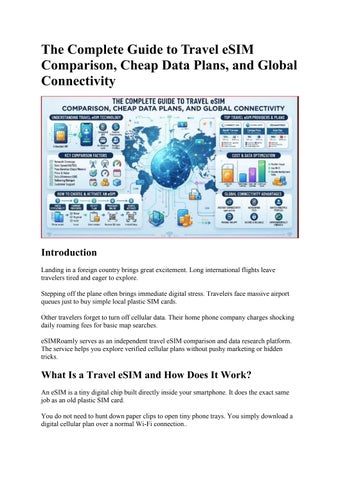
The Complete Guide to Travel eSIM Comparison, Cheap Data Plans, and Global Connectivity
Introduction Landing in a foreign country brings great excitement. Long international flights leave travelers tired and eager to explore. Stepping off the plane often brings immediate digital stress. Travelers face massive airport queues just to buy simple local plastic SIM cards. Other travelers forget to turn off cellular data. Their home phone company charges shocking daily roaming fees for basic map searches. eSIMRoamly serves as an independent travel eSIM comparison and data research platform. The service helps you explore verified cellular plans without pushy marketing or hidden tricks.
What Is a Travel eSIM and How Does It Work? An eSIM is a tiny digital chip built directly inside your smartphone. It does the exact same job as an old plastic SIM card. You do not need to hunt down paper clips to open tiny phone trays. You simply download a digital cellular plan over a normal Wi-Fi connection..
You browse city guides and order rides without paying home carrier rates. Selecting the Best Travel eSIM before your overseas vacation ensures a relaxing, fully connected journey.
Comparing Travel Connectivity: eSIM vs Physical SIM vs Carrier Roaming Connection Method
Setup Convenience
Average Cost
Physical SIM Swapping Needed
Risk of Bill Shock
Digital Travel eSIM
Instant setup via QR code at home
Low to medium prepaid pricing
No physical card swapping
Zero surprise charges
Local Airport Physical SIM
Long waiting queues after landing
Moderate local retail cost
Requires opening tiny phone tray
Zero surprise charges
Home Carrier Daily Roaming
Automatic connection upon landing
Very expensive daily flat fees
Keeps original card in phone
High risk of hidden bills
Public Pocket Wi-Fi Rental
Must pick up and return hardware
High daily device rental fees
Connects via separate router
Low risk of extra bills
Travel eSIM Comparison: What Smart Travelers Look For Picking a great mobile plan requires looking past bright banner ads. An experienced traveler checks technical details before entering payment details. Conducting a thorough Travel eSIM Comparison protects you from frustrating connection drops. You want to see whether a plan connects to fast 4G or modern 5G towers. Some budget plans force your phone onto slow 3G frequencies. These sluggish networks struggle to open simple train schedules or city maps.
Smart shoppers take a moment to Compare eSIM Plans across validity windows. A ten-day trip needs a plan that covers the full stay without early cutoffs.
How to Find Cheap eSIM Plans Without Falling for Traps Finding affordable data helps stretch your overall vacation budget. However, ultra-cheap offers often hide frustrating restrictions inside the fine print. Always calculate the true cost per gigabyte of usable data. A two-dollar plan looks cheap until you notice it only provides two hundred megabytes. You burn through that tiny data limit within twenty minutes of navigation. Quality Cheap eSIM Plans provide balanced daily allowances at fair, transparent rates. Watch out for tight expiration timers that begin counting down too early. Some providers start the clock the exact second you complete purchase.
International eSIM Plans for Multi-Country Adventures Exploring multiple foreign countries on one holiday is thrilling. You might ride cross-border trains across France, Switzerland, and Italy in one week. Buying separate local phone cards in every new city wastes precious vacation time. Modern International eSIM Plans solve this headache with wide regional bundles. A single European or Asian package keeps you online across dozens of borders. Your mobile phone hops between local partner networks automatically. You never need to find airport Wi-Fi or scan new QR codes mid-trip. Global packages can even cover more than one hundred countries on a single digital profile.
Unlimited Data eSIM Comparison: The Truth About Fair Use Many popular travel advertisements promise unlimited internet data for low prices. However, these marketing claims rarely tell the complete operational story. Running an Unlimited Data eSIM Comparison reveals important fair use rules. Telecommunications companies use Fair Use Policies to protect local cell towers from heavy traffic. A provider might advertise unlimited daily data on their main website. In reality, they may throttle your download speed after using one gigabyte that day. Your connection drops from lightning-fast 5G down to painful 128 kbps speeds. At that crawl, simple map applications refuse to load directions.
Evaluating the Best eSIM Providers in the Market The digital travel market contains dozens of competing mobile shops. Knowing how to evaluate top companies saves you time, money, and stress. The Best eSIM Providers offer clean mobile apps and responsive customer service. They provide active 24/7 live chat support with real human agents. If your connection drops at midnight in Tokyo, you need fast troubleshooting help. Reliable brands also publish clear refund policies for broken or incompatible profiles.
Destination Focus: Best eSIM for Japan Japan offers a wonderful mix of neon cities and peaceful nature trails. Visitors explore crowded subway stations in Tokyo, historic temples in Kyoto, and snow-capped northern mountains. Navigating complex Japanese rail maps requires a rock-solid internet connection. Finding the Best eSIM for Japan means selecting plans connected to top local networks. NTT Docomo and SoftBank operate the strongest cell networks across the country. NTT Docomo delivers exceptional coverage deep inside subway tunnels and rural mountain paths.
Destination Focus: Best eSIM for USA Visiting the United States often involves extensive cross-country travel. You might explore dense city streets in New York before hiking through distant national parks. American geography requires careful network selection for foreign visitors. Choosing the Best eSIM for USA journeys depends on your travel itinerary. T-Mobile provides lightning-fast 5G coverage throughout major American cities and suburban highways. AT&T delivers outstanding wireless range across rural country roads and mountain states.
Pre-Purchase Travel eSIM Evaluation Checklist Evaluation Area
What to Inspect
Why It Matters
Device Compatibility
Check if phone is carrierunlocked and eSIM-ready
Locked phones cannot install third-party profiles
Evaluation Area
What to Inspect
Why It Matters
High-Speed Cap
Look for daily full-speed data limit (FUP)
Prevents unexpected speed slowdowns in the middle of a trip
Hotspot & Tethering
Verify personal hotspot sharing permissions
Crucial if sharing data with a laptop or traveling partner
Network Partner Quality
Confirm which local cellular operator provides signal
Determines download speeds and rural coverage
Activation Timing
Check if validity starts on install or when landing
Avoids wasting prepaid days while still at home
Voice & SMS Inclusions
Check if plan is data-only or includes a phone number
Important if you need to receive local phone calls
Finding Verified eSIM Deals and Discounts Mobile data costs drop significantly when you shop with smart promotional timing. Cellular providers run regular holiday promotions around major global travel seasons. You can find genuine eSIM Deals and Discounts ahead of summer vacations and winter holidays. Many trusted platforms share seasonal voucher codes for first-time buyers. However, avoid suspicious coupon scraper websites that promise eighty percent savings. These unverified coupon portals post expired codes designed to collect advertising clicks.
How eSIMRoamly Helps Travelers Make Informed Choices Navigating modern telecommunications should not feel like an overwhelming chore. eSIMRoamly gathers complex international mobile data into clean, transparent comparison tools.
The platform operates as an independent discovery site focused on real traveler value. You see the true landed cost per gigabyte across hundreds of destinations worldwide.
Real-Life Travel Scenarios
A solo backpacker hops across five European countries using a single regional Europe eSIM to share live navigation maps and social updates, avoiding the hassle of buying plastic SIM cards at every international train border. A remote professional works from a neighborhood cafe in Tokyo using a highallowance Japan data plan to join video meetings, bypassing sluggish public cafe WiFi with steady, private high-speed cellular data. A family drives across California using personal hotspot sharing on a prepaid USA eSIM to keep navigation tablets and travel phones fully connected along scenic Pacific Coast Highway routes.
Common Mistakes to Avoid When Buying Travel eSIMs
Buying an eSIM before checking if your smartphone is carrier-unlocked. Ask your home carrier to unlock your handset before departure so third-party digital profiles install cleanly. Installing an eSIM that starts its expiration clock immediately upon QR scan while still at home. Check activation terms to make sure validity begins only when connecting to foreign towers. Purchasing an unlimited plan without reading the fine print regarding daily 128 kbps speed throttling. Look for transparent daily high-speed gigabyte limits to ensure maps load quickly all day. Deleting an active eSIM profile from phone settings when troubleshooting rather than toggling flight mode. Reinstalling a deleted profile often fails, requiring you to purchase an entirely new plan. Turning on data roaming on your primary home SIM line by mistake, triggering expensive domestic carrier roaming fees. Keep data roaming active strictly for your secondary travel profile. Forgetting to turn off background app updates, causing heavy cloud syncs to burn through prepaid travel data in hours. Switch your photo backups to run only over private hotel Wi-Fi connections.
Simple eSIM Setup and Activation Checklist
Open your phone settings menu and confirm your device supports eSIM cards. Contact your home network provider to ensure your device is completely carrierunlocked. Buy your preferred travel plan and save the activation QR code image on a computer screen or paper sheet. Connect to your home Wi-Fi network and scan the QR code to install the digital profile before your flight. Label your new line as "Travel Data" in phone settings so you identify it easily. Turn on your travel eSIM line and switch on Data Roaming for that specific profile once your flight touches down.
Frequently Asked Questions 1. What is the difference between an eSIM and a physical travel SIM card? An eSIM is a digital chip built directly inside your phone's internal hardware. A traditional SIM is a small piece of plastic you insert into an external tray.
2. How can I tell if my smartphone is unlocked and compatible with travel eSIMs? Check your phone settings menu under general device information. Look for a section labeled Carrier Lock or Network Lock.
3. When should I install my travel eSIM profile—before leaving home or after landing? Install your digital profile the day before departure while connected to reliable home Wi-Fi. Most travel profiles remain dormant until they detect local partner radio towers abroad.
4. Can I use my WhatsApp and home phone number while using a travel eSIM? Yes, you can keep your primary WhatsApp account connected to your home telephone number. When WhatsApp asks if you want to update your number, select the option to keep your existing account.
5. What does Fair Use Policy (FUP) mean on unlimited data eSIM plans? A Fair Use Policy places a daily limit on high-speed cellular downloads. Even on plans advertised as unlimited, carriers often slow down speeds after using one or two gigabytes.
6. Can I share my mobile data using personal hotspot with a travel eSIM? Most digital travel plans permit mobile personal hotspot sharing with laptops and tablets. However, some budget providers block tethering permissions inside their network settings.
7. Which local network provides the best cellular coverage for tourists in Japan? NTT Docomo and SoftBank deliver the strongest mobile network performance across Japan. NTT Docomo provides outstanding reception inside underground metro stations and distant rural areas.
8. How does coverage differ between major mobile networks when visiting the USA?
T-Mobile and AT&T provide the best cellular experience for international visitors traveling in America. T-Mobile leads in fast 5G data speeds throughout major urban centers and suburbs.
Conclusion Staying connected while traveling overseas does not require overpriced carrier roaming packages or chaotic airport SIM queues. Understanding how digital profiles work helps you choose balanced data allowances, fast cellular speeds, and fair prices for your vacation. Comparing verified travel plans protects you from hidden speed slowdowns and unexpected fees. With a reliable digital profile installed on your smartphone, you can navigate foreign cities, translate menus, and share memories with confidence. Smart digital preparation keeps your international vacation smooth, relaxed, and wonderfully connected wherever your journeys lead.