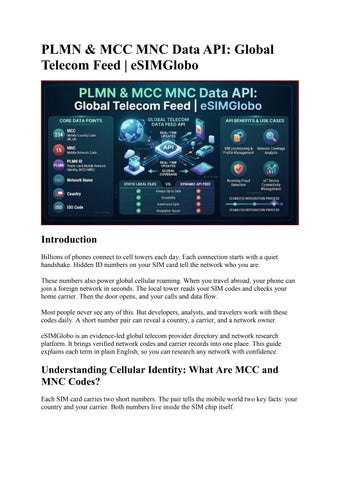
PLMN & MCC MNC Data API: Global Telecom Feed | eSIMGlobo
Introduction Billions of phones connect to cell towers each day. Each connection starts with a quiet handshake. Hidden ID numbers on your SIM card tell the network who you are. These numbers also power global cellular roaming. When you travel abroad, your phone can join a foreign network in seconds. The local tower reads your SIM codes and checks your home carrier. Then the door opens, and your calls and data flow. Most people never see any of this. But developers, analysts, and travelers work with these codes daily. A short number pair can reveal a country, a carrier, and a network owner. eSIMGlobo is an evidence-led global telecom provider directory and network research platform. It brings verified network codes and carrier records into one place. This guide explains each term in plain English, so you can research any network with confidence.
Understanding Cellular Identity: What Are MCC and MNC Codes? Each SIM card carries two short numbers. The pair tells the mobile world two key facts: your country and your carrier. Both numbers live inside the SIM chip itself.
The first is the Mobile Country Code, or MCC. An MCC is a three-digit number showing which country a network belongs to. One code marks the United States. A second marks the Netherlands. The International Telecommunication Union, or ITU, assigns these blocks. The second is the Mobile Network Code, or MNC. An MNC is a two- or three-digit number showing the exact phone carrier. It points to one carrier inside one country. Each country's telecom office assigns these codes.
Decoding the Telecom Stack: Codes, Networks, and Operators Cellular IDs work in layers. Each layer answers one question. Country codes mark the land. Network codes mark the carrier. Subscriber IDs mark one single SIM line. Keeping these layers apart prevents most research errors. The table below shows how each part fits. Telecom Identifier
Number Length
Mobile Country 3 Digits Code (MCC) Mobile Network 2 or 3 Code (MNC) Digits PLMN Code 5 or 6 (MCC + MNC) Digits Up to 15 IMSI Identifier Digits
Primary Purpose
Real-World Example
Identifies geographic 310 (United States) / territory or international 204 (Netherlands) scope Identifies specific mobile 260 (T-Mobile) / 04 carrier within a country (Vodafone) Identifies unique wireless 310260 / 20404 network operator Identifies the unique Stored securely on individual subscriber line SIM card chips
Managing Body ITU-T National Regulators Cellular Industry Mobile Operators
Inside the SIM Card: A Tour of Its Hidden Data A SIM card is a tiny computer, not just a plastic chip. It holds data, runs small programs, and keeps secrets safe. Most of its work stays hidden from you. The card stores your IMSI first. That is your line's full ID number. It also stores a secret key. A key is a secret code used to prove who you are without sending your password over the air. The network checks this key each time you connect. Your SIM also keeps a list of preferred networks. This list ranks foreign networks by code. It tells your phone which partner to try first when you roam. Some older cards still store contacts and texts. Newer phones keep those on the device itself. So the modern SIM mostly holds network data.
MCC MNC Lookup and Identifying Wireless Carriers A digital lookup tool works like a phone book for network codes. Type in a five- or six-digit code. The tool shows the legal firm behind it. You also see the country, the brand, and the network type.
Behind the scenes, the tool checks official records. The ITU-T E.212 standard is the global registry for these codes. E.212 lists each country block and each assigned network code. Carriers and officials cite it as the legal source. So a strong MCC MNC Lookup traces each answer back to this baseline. Many people rely on these lookups. Developers check codes before routing traffic. Fraud analysts verify incoming signals. Engineers confirm roaming partners before a launch. Each task starts with the same question: who truly owns this code? Consider cross-border traffic next. Carriers exchange calls and texts across borders all day. Each signal arrives tagged with a network code. Analysts match that tag against the records. A clean match means safe routing.
PLMN Code Lookup and Cellular Network Routing PLMN stands for Public Land Mobile Network. It is the full pairing of country code and carrier code. Think of it as one complete network address. The country part comes first. The carrier part follows. The pair names one exact wireless network. A PLMN Code Lookup answers a routing question: which precise network is this? Your phone runs this check often. It stores a list of preferred networks on the SIM. When a few networks appear in the air, the list ranks them. Roaming makes this list vital. Roaming means using a foreign network while you travel. Your home carrier signs roaming agreements with foreign carriers. A roaming agreement is a business deal that opens a partner network to your phone. Cross-border travel shows the system at work. You land in a new country and switch on your phone. The device scans local towers and finds a few PLMNs. It checks your preferred list and your carrier's partner deals. Then it picks the best match.
How Roaming Agreements Welcome Foreign Phones Roaming rests on a chain of trust. Your home carrier does not own the foreign tower. Yet your phone works on it within seconds. Here is how that happens. The visited network spots your SIM codes first. It sees a foreign PLMN pair. So it checks its list of roaming partners. Your home carrier's name must appear on that list. Next, the visited network contacts your home carrier. This exchange happens over secure signaling links. Signaling is the quiet system networks use to talk to each other. Your home carrier then vouches for you. It confirms your line is real, active, and paid up. The visited network opens the door after that check. Finally, records flow for billing. The visited network logs your calls, texts, and data. It sends those records to your home carrier. Your monthly bill merges both sides.
Mobile Network Operator Directory and Verified Network Holders Mobile Network Operators, or MNOs, are the builders of the real network. An MNO owns radio towers, base stations, and spectrum licenses. A base station is the tower gear that talks to phones. So each code you look up belongs to some firm's real hardware. But the retail brand you see on a storefront is not always the licensed owner. Big telecom groups often run many brands on one shared network. This is why verified assignees matter. The assignee is the legal firm that holds the network code and the license. One licensed network may carry many retail brands. The brands come and go. The licensed holder stays on record. A Mobile Network Operator Directory links each code to its verified holder. It shows the legal firm name, not just the marketing logo. Researchers use this to see who truly owns the towers.
The Life Cycle of a Network Code Each network code has a story. It is born in a filing, lives through many brands, and often retires after a merger. Reading that story is a core research skill. Life Stage What Happens Where It Is Recorded Assignment A carrier applies and receives a new code ITU-T E.212 and national filings Launch The code goes live on real towers Carrier announcements and filings Growth More brands ride on the same code MVNO and brand filings Merger Codes combine or move to new owners Regulator approval papers Retirement The code leaves the global record E.212 updates and audits
Global Telecom Provider Directory and International Coverage The mobile world covers more than two hundred countries and regions. Each one has its own code blocks and licensed carriers. Researchers need one clean place to explore all of them. Some networks do not belong to any single country at all. The ITU sets aside special shared code ranges for global services. These ranges serve networks that cross borders by design. Satellite carriers use shared codes. Their signals cover oceans, deserts, and mountains. Maritime networks use them too. Ships at sea stay linked through satellite and coastal networks. Cross-border data routing also relies on shared ranges.
A Global Telecom Provider Directory covers both worlds. It lists national carriers country by country. It also lists shared-range networks that serve the whole planet. Researchers can trace a code from a satellite service to a village carrier in one place.
Mobile Network Codes by Country and Regional Numbering Each country runs its own numbering plan. A national telecom office assigns network codes to local wireless carriers. That office also licenses radio spectrum and approves carrier mergers. So national filings hold the freshest facts. Codes differ by market size. A large country may host dozens of assigned MNCs. A small island state may host only two or three. The count shows how crowded the market is, not how many people live there. Exploring codes region by region reveals real patterns. Europe shows dense cross-border roaming markets. The Americas mix large national carriers with many virtual brands. Asia shows rapid growth and huge subscriber bases. Africa shows fast-growing markets with young carriers. Mobile Network Codes by Country research has practical uses. Marketers size up rivals by counting licensed carriers. Engineers check local partners before device launches. Travelers see which carriers await them abroad.
Mobile Country Code List for Global Travelers and Researchers Mobile country codes form a simple, standard list. Each country or territory gets a clean three-digit block. The ITU assigns these blocks under its numbering plan. No two countries share a standard block. The ITU is the United Nations agency for telecom. Its members include governments, carriers, and gear makers. The union sets global standards so networks can talk across borders. A Mobile Country Code List helps travelers and researchers alike. A traveler can match a foreign SIM card to its country block. A researcher can map each carrier inside one country block. Roaming partners also come from this list. Your home carrier picks partners country by country. Knowing the country block helps you predict which networks your phone may join abroad.
Radio Spectrum and Frequency Bands Explained Simply Codes tell your phone which network to join. Bands decide whether the link can happen at all. A band is a slice of radio spectrum. Each carrier runs its gear on licensed slices.
Spectrum comes in low, mid, and high ranges. Low bands travel far and pass through walls. They carry modest speeds. Mid bands balance reach and speed. High bands carry huge speeds over short ranges. So a carrier with strong low-band gear reaches rural areas well. A city network may lean on high bands for capacity. Each band choice shapes the real coverage you feel. Your phone matters too. Each model supports a fixed list of bands. An imported phone may miss the local carrier's main band. Then the PLMN codes match, but the link still fails.
Network Data Validation and Carrier Research Checklist Good research follows a fixed path. Each step checks one layer of the record. Start with the global baseline. Then confirm the national filing. Then match the brand to the license. The table below shows the full sequence. Research Step ITU-T E.212 Baseline National Regulator Filing Commercial Role Check Active Brand Matching International Shared Codes Data Timestamp Review
What to Check Official Assignment Status Local Frequency Licenses MNO vs MVNO Designation Retail Trade Name 901/902 Global Allocations Date of Last Assignment Audit
Why It Matters Confirms legal code ownership from international records Shows domestic operational approval and spectrum rights Clarifies whether the provider owns physical cell towers Connects technical network numbers to consumer brand logos Identifies satellite, maritime, and specialized IoT networks Ensures decommissioned or merged network codes are updated
Telecom Operator Database and Evidence-Led Research Hard proof is the heart of network research. A code alone proves nothing. The question is always: what source stands behind it? An evidence-led Telecom Operator Database answers that question. Each listing links a network code to a source. The baseline comes from the ITU-T E.212 record. That record confirms the country block and the assigned code. But the baseline is only the start. Codes move when firms merge. Licenses transfer when carriers restructure. So strong research links each baseline entry to primary government filings. A filing is a formal paper from the national telecom office.
MVNO Directory: Virtual Operators and Wholesale Networks
Mobile Virtual Network Operators, or MVNOs, are firms that sell cellular service without owning towers. They have no radio hardware of their own. Instead, they buy network access from a host MNO. The host sells capacity in bulk. This is wholesale network access. The MVNO then packages that access into consumer plans. Some target students. Others target travelers or small firms. For customers, the phone feels the same. Calls, texts, and data all flow over the host's towers. The difference hides in the business layer.
Machine SIM Cards: IoT Devices on Global Networks Phones are not the only things with SIM cards. Trackers, cars, meters, and sensors carry them too. This world is called the Internet of Things, or IoT. IoT SIM cards behave unlike phone SIMs. A phone SIM sticks to one home carrier. An IoT SIM often roams across many networks by design. The device simply picks the strongest local signal. Special IoT carriers serve this market. Many are MVNOs that lease capacity from many host networks at once. Some hold codes in the global 901 range instead of one country block.
eSIM Provider Directory and Modern Digital Connectivity An eSIM is a tiny digital chip built inside your phone. It replaces the plastic SIM card. You download a mobile plan onto it directly. No card swap is needed. The letters stand for embedded SIM. The chip is embedded in the device at the factory. Travelers love eSIMs for good reason. They buy a local plan before landing. The phone links up the moment they arrive. Not all eSIM providers are equal. Each one runs on partner networks in each country. One provider may use the strongest local carrier in one country. Elsewhere, it may run on a weaker network. The partners behind the plan decide your real coverage.
Developer Workflows: MCC MNC Lookup API and Data Integration Software engineers need machine-readable data. An API is a way for software to request data directly. A good API returns clean answers in real time. An MCC MNC Lookup API fits many workflows. Your app reads the SIM codes from the device. It sends the codes to the API. The API returns the country, carrier, and network type.
Fintech platforms use this to fight fraud. A bank sends a one-time SMS code before a payment. The bank checks the SIM's network first. A sudden country change can flag account takeover risk. SMS routing is another case. Texts travel through carrier routes with different costs and speeds. A live lookup finds the local network for each number. Routing engines then pick the best path.
Real-Life Telecommunications Scenarios
A mobile app developer builds two-factor login for a fintech service. Each sign-in triggers an automated network lookup. The system reads the SIM codes and routes each SMS code through the lowest-cost local carrier. Login texts arrive faster, and routing costs drop in each market the app serves. An international business traveler lands abroad with a roaming eSIM. The phone shows a local network name that is unknown. The traveler opens an online listing site and types the PLMN code. Within seconds, the site reveals the exact local partner behind the eSIM connection abroad. A telecom security analyst spots an unfamiliar PLMN code in signaling traffic. The code does not match any expected partner network. A quick lookup flags suspected SIM-swap fraud. The analyst then checks for unauthorized network spoofing and blocks the risky route within minutes. An IoT fleet manager runs tracking sensors across twelve countries. Before each rollout, the manager verifies country codes and network assignees. The checks confirm which licensed carrier will host each sensor. The fleet then connects without fail across each foreign border.
Common Mistakes to Avoid in Telecom and Network Code Research
Confusing a retail brand with the licensed owner. The shelf brand often differs from the firm holding the code. Always check the assignee record to learn who truly owns the towers behind the retail name. Assuming an international dialing code equals an MCC. A dialing code like +1 or +44 routes calls between countries. An MCC marks mobile networks only. The two systems are separate, so never mix them in research. Relying on outdated carrier lists. Telecom mergers retire and reassign codes each year. An old list may name a network that no longer exists. Always confirm the current holder before you publish or build on any record. Overlooking global shared ranges. Codes under 901 or 902 do not belong to any single country. They serve satellite, maritime, and global IoT networks. Treating them as national codes creates routing and research errors. Trusting unsourced blog lists. Some websites invent network assignments without citing ITU E.212 records. A single copied error can spread across the web. Check each claim against the official registry before you rely on it. Forgetting that MVNOs share host gear. A virtual carrier uses the host's towers and PLMN codes. So a lookup may show the host network, not the brand. Map each virtual brand to its host to read results right.
Simple Telecom Data Research Checklist
Verify the three-digit Mobile Country Code (MCC) against the official ITU list. The ITU block confirms the code's country scope before deeper research begins. Confirm the Mobile Network Code (MNC) length (two digits versus three digits). A wrong length produces broken lookups and false results in each query you run. Check the combined five- or six-digit PLMN code in a verified operator database. The full code names the exact network behind any signal you study. Identify the legal corporate assignee holding the frequency license. The assignee reveals the true owner of the towers behind each retail brand. Review official national regulator filings for recent changes or license transfers. Filings catch mergers and code retirements that older global lists often miss.
Frequently Asked Questions 1. What is the difference between an MCC and an MNC? An MCC is a three-digit number naming the country of a mobile network. An MNC is a twoor three-digit number naming the specific carrier inside that country. The MCC always comes first in the pair. The two numbers form a complete network address called a PLMN. Each SIM card stores both values. Each cell tower reads them when your phone connects.
2. How do mobile phones use PLMN codes to select a cellular network? When you switch on your phone, it scans for nearby radio signals. Each tower broadcasts its PLMN code into the air. Your SIM holds a preferred network list and its own home code. The phone compares what it hears with what it stores. A match with your home code means normal service. A foreign code means roaming, checked against partner lists.
3. Where do official Mobile Country Code and Network Code records come from? The global baseline comes from the ITU-T E.212 standard. That record lists each country block and each assigned network code in the world. National offices then add local detail. Their filings show spectrum licenses, ownership, and running status. Strong research checks both layers before trusting any carrier list. Both layers also carry dates, so you can judge how fresh each record is.
4. What is the difference between an MNO and an MVNO in a telecom directory? An MNO, or Mobile Network Operator, owns real radio hardware. It builds towers, holds spectrum licenses, and runs the whole network. An MVNO, or Mobile Virtual Network Operator, owns no towers. It buys wholesale capacity from a host MNO and sells its own plans. A good index maps each virtual brand back to its host network. The host runs the towers. The virtual brand runs the shop front.
5. Why do some international networks use 901 or 902 country codes?
The 901 and 902 blocks are shared global ranges. The ITU set them aside for services that cross borders by design. Satellite carriers, maritime networks, and global IoT services use these codes. So a 901 code does not belong to any single country. Treat it as a special global network instead. Ships, planes, and remote sensors all rely on these shared code blocks.
6. How does an MCC MNC lookup tool help stop financial and SMS fraud? Each signal and SIM carries network codes. A lookup tool checks those codes against official records in real time. Banks use this before sending one-time payment codes. A mismatch or sudden country change can flag SIM-swap fraud. Analysts also catch spoofed network tags hiding the true source of spam traffic. The whole check runs in real time and stops risky traffic early.
7. Can two different telephone companies share the exact same MCC and MNC? One unique code pair names one licensed network inside one country. Offices keep these pairs separate on purpose. However, many brands can run on one licensed network. MVNOs often share the host's PLMN codes. And after mergers, old pairs may pass to new owners over time. The key point is simple: a code pair names a network, not a brand.
8. How does an eSIM profile connect to local physical cell towers abroad? An eSIM profile is a downloaded plan file. It holds your line details and a list of allowed networks. When you land abroad, your phone scans local towers and reads their PLMN codes. The profile and roaming agreements decide which networks you may join. Your phone then locks onto the best allowed signal. The whole switch happens without a single plastic card swap.
Conclusion Global cellular identity is simpler than it looks. A three-digit country code and a two- or three-digit carrier code name each mobile network on Earth. Combined as PLMNs, these pairs steer your calls, texts, and data across borders. Official ITU records give each code a legal owner. National filings show who holds the towers and licenses behind each brand. MVNO lists reveal the virtual carriers riding on host networks. eSIM lists map the digital plans travelers download each day. So keep your research evidence-led. Verify codes against formal records, check filings, and demand a source for each claim. Reliable, evidence-backed telecom data powers seamless global communication. Your next lookup is the perfect place to begin.