DevOps Training China: Practical Guide to Modern Engineering and Cloud Automation Introduction Software development teams often face a familiar bottleneck: developers write code locally, test it within isolated staging setups, and throw it over an operational wall. Operations teams, measured strictly on system stability, struggle with manual deployments, unversioned server drift, and production incidents occurring during midnight rollouts. This operational wall causes delayed releases, unstable staging environments, and poor cross-team collaboration. Understanding modern DevOps engineering is the standard solution to these structural delivery failures. DevOps unifies development, security, and operations into an automated, feedback-driven delivery loop. For engineering teams, system administrators, software engineers, and IT leaders exploring DevOps Training China through platforms like DevOpsSchool.cn, mastering these principles is essential for scaling infrastructure reliably. This guide breaks down core DevOps concepts, end-to-end delivery pipelines, foundational tools, and production engineering practices.
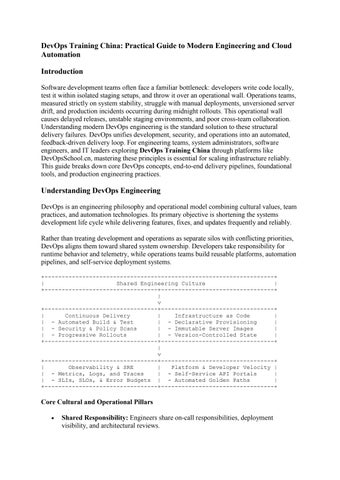
Understanding DevOps Engineering DevOps is an engineering philosophy and operational model combining cultural values, team practices, and automation technologies. Its primary objective is shortening the systems development life cycle while delivering features, fixes, and updates frequently and reliably. Rather than treating development and operations as separate silos with conflicting priorities, DevOps aligns them toward shared system ownership. Developers take responsibility for runtime behavior and telemetry, while operations teams build reusable platforms, automation pipelines, and self-service deployment systems. +-------------------------------------------------------------------+ | Shared Engineering Culture | +---------------------------------+---------------------------------+ | v +---------------------------------+---------------------------------+ | Continuous Delivery | Infrastructure as Code | | - Automated Build & Test | - Declarative Provisioning | | - Security & Policy Scans | - Immutable Server Images | | - Progressive Rollouts | - Version-Controlled State | +---------------------------------+---------------------------------+ | v +---------------------------------+---------------------------------+ | Observability & SRE | Platform & Developer Velocity | | - Metrics, Logs, and Traces | - Self-Service API Portals | | - SLIs, SLOs, & Error Budgets | - Automated Golden Paths | +---------------------------------+---------------------------------+
Core Cultural and Operational Pillars
Shared Responsibility: Engineers share on-call responsibilities, deployment visibility, and architectural reviews.
Continuous Feedback: Telemetry flows from production back into developer backlogs to guide improvements. Automation-First Operations: Repetitive manual actions—known as toil—are systematically replaced with code. Small, Frequent Batches: Shipping smaller code deltas reduces delivery blast radius and simplifies rollback.
The End-to-End DevOps Lifecycle A mature engineering delivery workflow transitions code through defined stages. Each stage uses automated gates to validate quality, security, and stability before changes reach production environments. The continuous delivery workflow follows this standard progression: Source Code → Build → Test → Security → Package → Deploy → Monitor → Improve [Developer Workstation] | | git push v +---------------+ | Git Source | --> Version Control, Branch Protections +---------------+ | | Webhook Trigger v +---------------+ | Build Stage | --> Compile binaries, resolve dependencies +---------------+ | v +---------------+ | Test Stage | --> Run unit, integration, and lint checks +---------------+ | v +---------------+ | Security Scan | --> SAST, SCA, and secrets detection +---------------+ | v +---------------+ | Package Stage | --> Build OCI container, scan base image, push to registry +---------------+ | v +---------------+ | Deploy Stage | --> GitOps sync, Canary/Blue-Green release +---------------+ | v +---------------+ | Monitor/Track | --> Metrics, structured logging, distributed tracing +---------------+ |
v +---------------+ | Improve Stage | backlog fixes +---------------+
--> Root cause analysis, blameless post-mortems,
1. Source Code: Developers commit code in small, incremental branches to versioncontrolled repositories using Git. Branch protection rules prevent direct commits to primary branches. 2. Build: Continuous Integration (CI) runners detect changes, pull code, resolve external dependencies, and compile binaries or assets. 3. Test: Automated test suites execute unit, component, and integration tests. Pull requests halt if any test fails. 4. Security: Static Application Security Testing (SAST) and Software Composition Analysis (SCA) identify vulnerabilities and license conflicts early. 5. Package: Applications are packaged into standard Open Container Initiative (OCI) container images, signed cryptographically, and pushed to secure registries. 6. Deploy: Continuous Deployment (CD) or GitOps controllers deploy packaged applications across environments (Staging, Pre-Production, Production) using BlueGreen or Canary strategies. 7. Monitor: Running workloads generate operational telemetry—metrics, structured logs, and distributed traces—routed to centralized monitoring dashboards. 8. Improve: Operational incidents lead to blameless post-mortems, tracking reliability metrics to refine architectures and automation.
Foundational DevOps Tools and Technology Ecosystem Selecting a toolchain depends on team scale, operational constraints, compliance rules, and workload characteristics. A modern toolchain organizes around distinct capabilities: Representative OpenSource & Enterprise Tools
Core Engineering Purpose
Source Control
Git, GitLab, GitHub
Distributed version tracking, code reviews, and workflow triggers.
Continuous Integration
Jenkins, GitLab CI, GitHub Actions
Automated build execution, test runners, and artefact generation.
Category
Category
Representative OpenSource & Enterprise Tools
Core Engineering Purpose
Containerization
Docker, Podman, containerd
Packaging applications and dependencies into reproducible runtime images.
Orchestration
Kubernetes, Helm, Kustomize
Managing container lifecycles, scheduling, networking, and cluster state.
Infrastructure as Code
Terraform, OpenTofu, Ansible
Declaratively defining, provisioning, and configuring cloud resources.
Continuous Delivery
Argo CD, Flux, Spinnaker
Implementing GitOps, declarative delivery, and progressive rollouts.
Observability
Prometheus, Grafana, OpenTelemetry
Collecting metrics, monitoring service thresholds, and visualizing traces.
Security & Compliance
SonarQube, Trivy, Vault
Static code scanning, container vulnerability analysis, and secrets management.
Core Disciplines: SRE, DevSecOps, and Platform Engineering Modern infrastructure has expanded beyond basic CI/CD scripts into specialized, interdependent engineering domains. Comprehensive technical education covers these disciplines: +-----------------------------------+ | Modern DevOps Core | +-----------------+-----------------+
| +--------------------------+--------------------------+ | | | v v v +-----------------+ +-----------------+ +-----------------+ | DevSecOps | | SRE | | Platform | | Engineering | | Engineering | | Engineering | | | | | | | | - Shift-Left | | - SLIs / SLOs | | - Golden Paths | | - SAST / DAST | | - Error Budgets | | - Internal Dev | | - Image Scans | | - Toil Reduction| | Platforms | | - Secret Mgmt | | - Incident Resp | | - Self-Service | +-----------------+ +-----------------+ +-----------------+
DevSecOps: Shift-Left Security Integration Security can no longer wait for manual reviews right before production release. DevSecOps embeds automated checks throughout the entire software development lifecycle (SDLC):
Static Analysis (SAST): Scanning source files for insecure coding practices and injection flaws. Dependency Scanning (SCA): Verifying third-party libraries and modules against known CVE databases. Container Vulnerability Scanning: Checking OS packages and dependencies embedded in container base layers before registries accept them. Secrets Management: Preventing API keys, database credentials, and certificates from being hardcoded into source control using tools like HashiCorp Vault.
Site Reliability Engineering (SRE): Quantifiable Reliability Site Reliability Engineering treats operational health as a software problem. Instead of aiming for 100% uptime, which is impractical and halts release velocity, SRE balances feature delivery against measured system stability:
Service Level Indicators (SLIs): Quantitative measurements of service performance, such as request latency or error percentages. Service Level Objectives (SLOs): Target reliability thresholds agreed upon with product stakeholders (e.g., 99.9% of successful HTTP requests over rolling 30-day windows). Error Budgets: The acceptable margin of unreliability ($100\% - \text{SLO}$). When budgets are exhausted, teams redirect focus toward reliability engineering, automated rollbacks, and bug fixes rather than pushing new features. Toil Reduction: Writing software to automate repetitive, manual administrative tasks.
Platform Engineering: Internal Developer Platforms (IDPs) As cloud-native architectures grow more complex, expecting every software engineer to master raw Kubernetes manifests, network peering, and IAM policies causes developer cognitive overload. Platform engineering solves this by treating the development platform as an internal product:
Golden Paths: Standardized, supported routes for building, deploying, and monitoring services using predefined templates. Self-Service Infrastructure: Giving developers access to databases, queues, and test environments via APIs or dashboards without waiting on ticketing queues. Balanced Governance: Embedding security guardrails, policy checks, and cost allocation directly into the platform templates.
Benefits and Implementation Challenges Adopting modern DevOps practices provides clear operational benefits, but engineering teams must also navigate real-world organizational and technical hurdles:
Operational Dimension
Realized Engineering Benefits
Common Challenges & Pitfalls
Practical Engineering Mitigations
Release Frequency
Small, frequent code updates deployed safely with reduced cycle time.
Pipeline instability, brittle test cases, and slow test suites.
Parallelize test stages, isolate flaky tests, and enforce test hygiene.
System Stability
Fast detection of regressions through automated rollback mechanisms.
Incomplete metric dashboards and missing application-level alerts.
Instrument applications with OpenTelemetry and define explicit SLO thresholds.
Infrastructure Scalability
Consistent, reproducible environments using versioncontrolled IaC.
Cloud resource sprawl, unmanaged drift, and unexpected infrastructure costs.
Run automated drift detection in CI and apply strict resource tagging policies.
Security Posture
Vulnerabilities caught early in pipelines before reaching production.
Security scans generating high volumes of falsepositive alerts.
Tune scanner severities, filter non-exploitable packages, and establish triage rules.
Operational Dimension
Realized Engineering Benefits
Common Challenges & Pitfalls
Practical Engineering Mitigations
Team Velocity
Reduced dependency on manual operational approvals and handoffs.
Resistance to changing legacy processes and siloed team responsibilities.
Start with low-risk pilot services and build crossfunctional team ownership.
Skills Development and Learning Roadmaps Building a career or upskilling enterprise teams requires a structured approach. Trying to learn every tool at once leads to cognitive overload. Instead, technical proficiencies should be developed across structured experience tiers: Tier 1: Core Systems & Foundations
Operating Systems & Scripting: Linux system administration, process lifecycles, permissions, package managers, and Bash or Python scripting. Networking Fundamentals: TCP/IP, DNS configuration, reverse proxies, HTTP status flows, and TLS certificate termination. Source Control & Git Hygiene: Git branching strategies, rebasing, pull request reviews, and semantic versioning. Basic CI Automation: Writing automated build and test scripts within continuous integration runners.
Tier 2: Cloud-Native Delivery & Infrastructure
Container Architecture: Writing efficient, multi-stage Dockerfiles, managing container image layers, and reducing container attack surfaces. Container Orchestration: Deploying and troubleshooting workloads on Kubernetes, configuring Services, Ingress, Persistent Volumes, and ConfigMaps. Infrastructure as Code (IaC): Modular infrastructure provisioning using Terraform or OpenTofu, managing remote state locking, and planning changes safely. Observability & Alerting: Instrumenting services, scraping endpoints with Prometheus, building dashboard panels in Grafana, and managing log ingestion.
Tier 3: Advanced Architecture & Reliability
Site Reliability Engineering: Establishing measurement frameworks using SLIs and SLOs, defining error budgets, and conducting blameless post-mortems. Platform Engineering: Designing Internal Developer Platforms (IDPs), defining golden paths, and streamlining self-service infrastructure.
Security Automation (DevSecOps): Implementing policy-as-code engines, automating container image signing, and managing secrets engines securely. Advanced Networking: Implementing service meshes for mTLS encryption, finegrained traffic shifting, and distributed tracing.
Certification vs. Practical Production Experience Engineers and engineering leaders evaluating career progression or corporate training programs often ask how professional certifications compare to hands-on experience. Both serve distinct, complementary purposes in an engineer's career:
Professional Certifications: Structured programs establish well-rounded foundational knowledge. They push engineers to study edge cases, CLI commands, and architectural components they might not encounter in their daily projects. They also provide hiring teams with an objective baseline of technical terminology and operational concepts. Hands-on Production Practice: Real-world operations teach what certifications cannot: how to triage distributed system outages during high-traffic events, how to safely upgrade live database schemas, and how to balance technical debt against urgent business timelines.
The most effective learning models combine structured technical instruction with extensive sandbox labs. This pairing allows engineers to break clusters, fix misconfigurations, and practice recoveries in safe, controlled environments.
Enterprise DevOps Adoption in China Enterprise environments across China navigate a distinct mix of large-scale consumer services, hybrid corporate systems, and unique infrastructure considerations. Varied Cloud Ecosystems Enterprises in China run workloads across diverse cloud providers, including Alibaba Cloud, Tencent Cloud, Huawei Cloud, and private enterprise OpenStack clusters. Engineering approaches must prioritize portable, cloud-agnostic architectures:
Relying on open, declarative frameworks like Kubernetes, Terraform, and standard OCI containers minimizes vendor lock-in. Infrastructure automation must accommodate diverse API models and hybrid data center connections.
Massive Scale and Concurrency Enterprises managing high-concurrency mobile user bases and massive retail events require resilient architectures:
Automation must support rapid cluster autoscaling during traffic spikes. CI/CD pipelines need local artifact caching and private container mirrors to handle concurrent multi-node image pulls efficiently.
Enterprise Engineering Governance Large organizations balance developer autonomy with regulatory and data compliance rules:
Pipelines need automated policy enforcement to prevent unauthorized configuration updates or unsecured external network routes. Platform teams use centralized developer platforms to ensure consistent security baselines across hundreds of internal projects.
Frequently Asked Questions (FAQs) What is covered in modern DevOps training? Modern training covers Linux fundamentals, source control with Git, automated CI/CD pipeline creation, containerization using Docker, and cluster orchestration with Kubernetes. Courses also cover Infrastructure as Code tools like Terraform, observability using Prometheus and Grafana, and practical site reliability engineering methods. Why is DevOps training important for engineering teams in China? Training helps engineering teams transition away from manual deployments and siloed operations. It provides practical automation skills across diverse multi-cloud environments, container platforms, and hybrid systems, helping organizations deliver updates quickly and maintain high system reliability. How does DevSecOps differ from traditional DevOps? Traditional DevOps focuses on collaboration and deployment velocity between development and operations teams. DevSecOps integrates security automated gates—such as static code analysis, open-source license scanning, and container vulnerability checks—directly into the delivery pipeline rather than deferring security to an isolated phase. What is the role of Kubernetes in enterprise DevOps? Kubernetes acts as the underlying container orchestration layer. It automates container scheduling, handles service discovery, balances network traffic, scales compute pods dynamically, and restarts failed workloads. This operational abstraction lets teams manage microservices predictably across varied infrastructure setups. How does Site Reliability Engineering (SRE) support DevOps? SRE provides a practical, mathematical framework for running reliable systems. By setting Service Level Objectives and tracking error budgets, SRE helps development and operations teams make balanced, data-driven decisions on when to deploy new features and when to focus on infrastructure stability. What is the purpose of Platform Engineering? Platform engineering creates structured, self-service Internal Developer Platforms (IDPs). These platforms offer developers standardized deployment workflows and golden paths,
reducing cognitive overload and removing manual operations tickets while maintaining enterprise security and compliance guardrails. Can beginners learn DevOps without prior software development experience? Yes, beginners with system administration, IT support, or quality assurance backgrounds can learn DevOps successfully. Starting with core Linux system administration, networking fundamentals, and basic scripting builds the essential foundation needed before progressing into container orchestration, pipeline automation, and cloud-native architectures. Are DevOps certifications alone enough to secure an engineering role? Certifications validate structured foundational knowledge, operational concepts, and familiarity with specific tooling. However, enterprise hiring teams place equal or greater weight on practical troubleshooting abilities, code repository contributions, and hands-on experience handling real-world production incidents. What tools are commonly taught in cloud computing and DevOps courses? Most curricula center on Git, Jenkins, GitLab CI, Docker, Kubernetes, Helm, Terraform, Ansible, Prometheus, and Grafana. Training also covers cloud-agnostic tools alongside major public cloud infrastructure APIs to ensure engineers can operate across varied enterprise tech stacks. How should organizations evaluate corporate DevOps training programs? Organizations should look for programs that offer hands-on lab environments, evaluate the team's current technical maturity, and align coursework with their actual cloud and onpremises technology stack. Effective training emphasizes day-to-day operational skills over purely theoretical slide lectures.
Conclusion Modern software delivery depends on moving away from manual configuration handoffs, unversioned server environments, and isolated operational silos. Realizing the full potential of cloud infrastructure requires engineering teams to build automated, secure, and reliable pipelines that take code safely from commit to production. Mastering these systems requires developing practical skills across version control, container platforms, declarative infrastructure, observability systems, and reliability metrics. Organizations and individual engineers looking to build these capabilities can explore structured, hands-on learning pathways through DevOpsSchool.cn, which focuses on practical engineering architectures and real-world production workflows.