THE FUTURE OF REAL ESTATE ISSUE NEW YORK LOS ANGELES MIAMI HAMPTONS
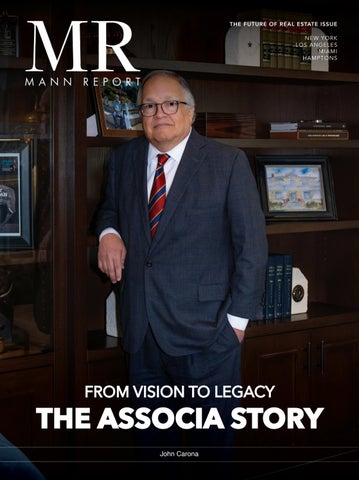
FROM VISION TO LEGACY
THE ASSOCIA STORY John Carona
THIS.
And so much more. For decades, we have built a real estate practice unparalleled in the US. Now, as the global legal powerhouse HSF Kramer, we are so much more. As the only law firm ranked in Chambers Band 1 on three continents, we continue to transform skylines and reshape landscapes. Please visit our website to learn more.
Kramer Levin is now HSF Kramer HSFKRAMER.COM
Helping Our Clients Build And Sustain Generational Wealth For over 25 years, Metropolitan Commercial Bank has been dedicated to helping clients grow their business and build generational wealth through our solutions-oriented, relationship-focused approach to banking.
MCBankNY.com Manhattan | 99 Park Avenue • 212 365-6700| 1431 Broadway • 212 643-6981 | 16 West 46th Street • 212 938-0770 | 1270 Lexington Avenue • 646 930-3386 Brooklyn 5102 13th Avenue • 718 851-2105 | Great Neck 111 Great Neck Road • 516 441-5232 © 2020-2025 Metropolitan Commercial Bank “Metropolitan Commercial Bank” is a registered trademark of Metropolitan Commercial Bank.
mannpublications.com
NOVEMBER/ DECEMBER 2026
| MANN REPORT 1
40 YEARS OF PROVEN PROPERT Y M AN AGEMENT Trusted by Co-op and Condo Boards Across New York City Since 1986, Maxwell-Kates, Inc. has helped New York City co-op and condo communities protect their properties, strengthen operations, and plan confidently for the future. Today, nearly 200 buildings representing more than 15,000 units rely on our comprehensive management expertise: •
Strategic board guidance
•
Responsive resident relations
•
Effective building staff oversight
•
Transparent financial management and planning
•
Legal and regulatory support
•
Practical technology solutions
•
Capital planning and project management
•
A dedicated team focused on your building’s success
DISCOVER how 40 years of experience can help your board operate more effectively and plan with confidence. Contact us today to start the conversation. Andy Marks Executive Vice President, New Business & Client Success amarks@maxwellkates.com | 212-545-6624
OF SERVICE EXCELLENCE
2 MANN REPORT | NOVEMBER/ DECEMBER 2026
9 East 38th Street (Sixth Floor) | New York, NY 10016 www.maxwellkates.com mannpublications.com
mannpublications.com
NOVEMBER/ DECEMBER 2026
| MANN REPORT 3
TUESDAY MARCH 9, 2027
5:30 p.m. Cocktail Reception 7 p.m. Dinner Cipriani 42nd Street New York City
Honoring
Benefiting National Jewish Health
Otterbourg P.C.
Funds raised will help support groundbreaking medical research and treatments for patients with lung, heart, immune and related disorders.
Dinner Chair
RICHARD L. STEHL KEVIN J. GILLESPIE
Wells Fargo Capital Finance
Dinner Treasurer Register Today njhealth.org/FID Event Contact: Mattie Shepheard 212.297.0857 ShepheardM@njhealth.org
4 MANN REPORT | NOVEMBER/ DECEMBER 2026
DANIEL F. FIORILLO
Otterbourg P.C.
mannpublications.com
LET US HELP YOU NAVIGATE THE MAZE EMPOWERING CLIENTS to cut through complexity and make informed, fearless decisions that turn obstacles into opportunities, across construction, real estate, commercial litigation, bankruptcy, and trusts and estates law.
1325 Avenue of the Americas New York, NY 10019 212.695.8100 goetzplatzer.com
mannpublications.com
NOVEMBER/ DECEMBER 2026
| MANN REPORT 5
PRESIDENT/CEO Jeff Mann
EDITORIAL Editor Debra Hazel
Director of Communications and Marketing Penelope Herrera Director of Newsletter Division Kristen Pooran
West Coast Office: 578 Washington Blvd., Suite 827 Marina Del Rey, CA 90292 866-306-MANN (6266)
ART
Art Director Virginia Sanchez Cover Photography Tina Marie Photography
BUSINESS
Technology Consultant Eric Loh Distribution Mitchell’s Delivery Service
DIGITAL MEDIA CONTRIBUTORS Louis Adler Ori Birnbaum Al Blecher Ran Eliasaf Lenka Ilic Paul Jacobowitz Kenny Kelley Merilee Kern Kris Kiser Bob Knakal Chaitanya NK Stuart Saft Carol A. Sigmond Adam Stark
mannpublications.com
Designers Virginia Sanchez
Editors Debra Hazel Penelope Herrera Rose Leveen Web Developer CS Designworks
East Coast Office: 450 7th Ave, Suite 2306 New York, NY 10123 212-840-MANN (6266)
The opinions expressed by our columnists are not reflective of the views and opinions of the publisher or the editorial staff of Mann Report. Publication of such views and opinions does not constitute endorsement by Mann Report. Any reproduction, including but not limited to internet usage, is prohibited without the express written permission of the publisher.
6 MANN REPORT | NOVEMBER/ DECEMBER 2026
mannpublications.com
The Global Asset Experts Since 1903, Gordon Brothers has maximized liquidity through realizable asset value by providing the people, expertise and capital to solve business challenges. Through our firm’s comprehensive offering, we deliver integrated, custom solutions across the asset lifecycle all under one platform.
Asset Services
We provide businesses an understanding of the true value of their assets.
Asset Lending & Financing
We provide the capital to unlock the future.
Asset Trading
We monetize assets for companies while protecting their reputation. Our holistic solutions span the full spectrum of assets with deep areas of expertise in retail, industrial, real estate and brands.
©️ 2026 Gordon Brothers Group, LLC
mannpublications.com
GORDONBROTHERS.COM
NOVEMBER/ DECEMBER 2026
| MANN REPORT 7
Ready for tomorrow. Reach new heights with your insurance program, work with the real estate industry experts. o
Property and Casualty
o
Risk Management
o
Environmental Liability
o
Personal Lines
o
Employee Benefits & Life
o
Retirement and Private Wealth
Let’s protect what matters most to you.
hubinternational.com
HUB International Northeast
Frank DeLucia Senior Vice President (212) 338-2395 frank.delucia@hubinternational.com
Risk & Insurance | Employee Benefits | Retirement & Private Wealth 8 MANN REPORT | NOVEMBER/ DECEMBER 2026
mannpublications.com
ONE MANN’S OPINION Welcome to the last issue of 2026! As a young man with a lawn mower, John Carona learned that trust is built one house, one client at a time. That lesson helped him to create Associa, the global residential management company, with more than 2,300 employees in five countries. His philosophy is simple: local relationships backed by massively sophisticated systems, a idea that was rare in 1979, when he founded Associa. Today, he still leads and pioneers ways for managers to serve, one home at a time. Our cover story is a fascinating read and one that we’re privileged to bring to you. Elsewhere, you’ll see some photos from the Mann Charitable Foundation’s annual gala at the Fresh Meadow Country Club. Unfortunately, the weather kept us from the golf course, but it was deeply gratifying to see so many friends gather to honor Brian Steinwurtzel of GFP Real Estate LLC, Jason M. Goldberg of CIT Commercial Services and Aaron Boyajian of Goetz Platzer, and help us support medical and social causes that will benefit so many. As always, we’ll be taking a month away to celebrate the season. From all of us at Mann Publications, we wish you a happy and healthy holiday, and a 2027 filled with promise, profits and peace. Happy New Year!
“The future belongs to those who believe in the beauty of their dreams.” — Eleanor Roosevelt
mannpublications.com
NOVEMBER/ DECEMBER 2026
| MANN REPORT 9
TABLE OF CONTENTS
NOVEMBER/ DECEMBER 2026 Photo by Bruce Damonte
EVENTS
84
14
Mann Charitable Foundation Hosts Annual Gathering
16
Samaritan Daytop Foundation Gala Sets Fundraising and Attendance Records
18
Jewish National Fund-USA’s Long Island Golf Classic Marks 18 Years of Impact
20
Rosenberg & Estis Hosts Women’s Group Reception
NEWS BRIEFS 22
Commercial News
26
Residential News
28
Management News
32
Tech Talk
36
Breaking News
FEATURES 46
A New Shine for a New York Icon
48
Does A Broker's Online Presence Really Matter?
50
AI Can Find the Home. Local Experts Find the Right One.
52
Getting Beneath the Controversy: Understanding the 485-x Wage Requirements
54
The Progress Insight Gap: Why the Party Carrying the Most Risk Has the Least Reliable Data
10 MANN REPORT | NOVEMBER/ DECEMBER 2026
mannpublications.com
NOVEMBER/ DECEMBER 2026
TABLE OF CONTENTS
DEPARTMENTS
COVER FEATURE
9
One Mann’s Opinion
13
Editor’s Letter
58
Columns
90
Executive Changes
94
Commercial Corner: Benay Josselson, Executive Vice President/Head of North America’s Workplace Strategy and Change Management Savills
96
By the Numbers: Forward Thinking
40
From Vision to Legacy: The Associa Story
Photo by Tina Marie Photography
COLLEGES 80
Curiouser and Curiouser: The Goddard School to Open at The Village at Tuxedo Reserve
AEC 84
Construido Por y Para la Comunidad: The People’s Theatre’s Centro Cultural Inmigrante
86
Reducing Legionella at 3333 Broadway
50 mannpublications.com
NOVEMBER/ DECEMBER 2026 | MANN REPORT 11
EXCELLENCE IN PROPERTY MANAGE MANAGEMENT PPM
POWERED BY PRECISION BACKED BY HOSPITALITY
We elevate properties with integrity, precision, and a hospitality- first approach WH AT S E T S U S A PA RT
PROACTIVE
NEW DEVELOPMENT
SMART
MANAGEMENT
SERVICES
COST CONTROL
FINANCIAL
NYC COMPLIANCE
REAL-TIME
CLARITY
EXPERTISE
TECHNOLOGY
WHY PPM?
DIRECT ACCESS
HOSPITALITY
TRUSTED VENDORS
B OA R D PA RT N E R S H I P
TO LEADERSHIP
DRIVEN SERVICE
NETWORK
& ADVOCACY
390 5th Ave Suite 802
N e w REPORT Yo r k , N Y 10018 12 MANN | NOVEMBER/ DECEMBER 2026
www.ppmnyc .com
T R A N S PA R E N T OPERATIONS
c o n t mannpublications.com act@ppmnyc.com
EDITOR’S
LETTER Welcome to our last issue of 2026, in which we look forward to the future of real estate in 2027 and beyond. Not surprisingly, the proper way to blend technology with human perspectives, a topic of concern worldwide, is at the fore. Bob Knakal discusses how the use of social media can help create a presence that will lead to real-world relationships. Track 3D’s Chaitanya NK warns us about the importance of reliable data. And our friend Merilee Kern describes how Generation Z uses artificial intelligence as they search from homes in a interview with her daughter Devyn, a broker at Serhant. Legislation is also a concern. Real New York’s Louis Adler gives us a primer on the 485-x program, while CBIZ’s Alan Blecher offers an overview of the opportunities in Opportunity Zones 2.0. This year has been tumultuous, with unexpected wars, interest rate hikes and more. But real estate remains one of our most resilient industries. Somehow, we always find a way. Have a wonderful holiday season, and see you in January.
VISIT US ON
mannpublications.com
FOLLOW US ON INSTAGRAM @mannreport
mannpublications.com
NOVEMBER/ DECEMBER 2026 | MANN REPORT 13
EVENTS
Photos by Jack Miller
Mann Charitable Foundation Hosts Annual Gathering The remnants of an early season Nor’easter may have kept guests off the golf course, but more than 100 luminaries of real estate, fashion and more gathered at the Fresh Meadow Country club to raise money for the Mann Charitable Foundation (MCF) annual gathering. The Mann Charitable Foundation was founded 20 years ago in memory of Marion and Irving Mann. Its mission is to fund research for geriatric diseases, Crohn’s and colitis, breast cancer, lymphoma, macular degeneration and liver diseases and to ultimately find a cure for Alzheimer’s disease. The foundation also supports areas of New York City that need support, including Bronx Historical Society, Community Mainstream, National Jewish
Bobby Mann, Jeff Mann and Dean Palin
Museum, Jewish National Fund, Catholic Faith Network and Nassau County Law Enforcement Exploring. This year’s event honored Brian R. Steinwurtzel of GFP Real Estate LLC and Jason M. Goldberg of CIT Commercial Services and presented Aaron Boyajian of Goetz Platzer LLP with its Humanitarian Award.
Stephanie Wong, Jason Goldberg, Amna Mahmood, Marc Federbush and Michael Hudgens
“Not even the greatest businesspeople in New York can defeat Mother Nature, but we were thrilled that so many came to dine, talk and support MCF, founded in memory of my parents,” said Jeffrey Mann, president and CEO of Mann Publications and president of MCF. “Huge thanks to everyone who made this day possible. And we know that next year, we’ll all be back on the links!”
14 MANN REPORT | NOVEMBER/ DECEMBER 2026
Rebel Strings
mannpublications.com
EVENTS
Donald Carbone, Christi Hoffman, Aaron Boyajian, Alison Besunder, Bradley Marks and Brian Howley
Mitti Liebersohn, Andrew Levy and Adam Goldenberg Jason Goldberg, Brian Steinwurtzel, Jeff Mann, Brian Nuzio and Aaron Boyajian
Jeff Mann, Carlo Seneca, Thomas Linter, Mauri ce Gargano, Mark Petrone and Bruce Moshier
mannpublications.com
NOVEMBER/ DECEMBER 2026 | MANN REPORT 15
Photos courtesy of Tim Correira Photography
EVENTS
Samaritan Daytop Foundation Gala Sets Fundraising and Attendance Records Samaritan Daytop Village and Health brought together over 350 supporters at Tribeca 360° for Samaritan Daytop Foundation’s annual gala, celebrating the community of supporters who have sustained its life-saving services for more than 65 years. The evening raised a recordbreaking $1.1 million-plus to support the programs that directly serve more than 36,000 New Yorkers every year, including substance use treatment, mental health care, veterans services, housing and educational and vocational support. With the theme “Stronger With You,” the gala recognized three honorees: Mega Contracting Group, the general contractor for the Highbridge development in the Bronx that will provide affordable, supportive and transitional housing; Errol Louis, political anchor at Spectrum News NY1 and Ronald L. Savarese, a Samaritan Daytop Village board member and former board chair. The evening was hosted by Erin Billups, national health reporter for Spectrum News NY1, and longtime SDV supporter. Al Roker, host and weatherman of NBC’s Today Honoree Ronald L. Savarese and Emcee Erin Billups
16 MANN REPORT | NOVEMBER/ DECEMBER 2026
show, served as the event’s honorary chair. “Tonight’s gala was a powerful demonstration of what happens when we come together. Thanks to the generosity of our gala champions, sponsors and honorees, and the hard work of our staff and volunteers, we will continue to help New Yorkers build better lives and brighter futures,” said Mitchell Netburn, president and CEO of Samaritan Daytop Village and Foundation. The gala was made possible by support from Gala Champions Mega Contracting Group, The Nancy and Edwin Marks Family Foundation and SterlingRisk Insurance; Platinum Sponsor Magnusson Architecture and Planning PC and Titanium Sponsors The Ametrine Group, CVM Construction, Dual Fuel Corp, PharMerica, Precision Pharmacy, Regina Caterers and Colleen Taylor. Gold Sponsors were Alliant LLC, Louise Armour, BedStuy Beacon LL, The Charles H. Revson Foundation, Cosan Construction Corp., CSI Security & Electric Inc., Lemle & Wolfe, Napoli Painting Services Inc., SKF Development, Tristate Apartment Furnishers LLC and Turf Office LLC.
mannpublications.com
EVENTS
CEO Mitchell Netburn and Board Member Constance Marks
Honoree Errol Louis and Juan
ita Scarlett
Comedian Chuck Nice leads Paddle Raise
Honorees George Poulon and Hercules Argyriou of Mega Contracting Group with SDV CEO Mitchell Netburn (center)
mannpublications.com
John Iammatteo, Bernard Kaplan, Colleen Taylor, Alicia McFarlane and Mitchell Netburn
NOVEMBER/ DECEMBER 2026 | MANN REPORT 17
Photos by Rob Kim, from Ben Gabbe Photography
EVENTS
Jewish National Fund-USA’s Long Island Golf Classic Marks 18 Years of Impact Nearly 200 Long Island philanthropists and corporate executives in the real estate and finance industries teed off at The Mill River Club for Jewish National FundUSA’s 18th annual Long Island Golf Classic honoring philanthropist Steve Pinchasick, principal, EBMG LLC and Accredited Property Management. Pinchasick and his wife, Lori, are supporters of Jewish National Fund-USA and are members of the organization’s Eretz Society and Legacy Society. Pinchasick is also a member of Jewish National Fund-USA’s Real Estate Division, a group of professionals representing real estate development, brokerage, finance and law, construction, architecture and hospitality, who are united in their support for the land and people of Israel. Chaired by Jewish National Fund-USA’s former Long Island President Mark Engel, Langsam Property Services Corp., the event brought together the organization’s partners (donors) and first-time participants for a day of golf, networking and philanthropy. The goal is to drive support for Jewish National FundUSA ’s critical work making Israel’s North and South places where families can build full, vibrant lives with access to medical care, emergency response, water solutions, parks, playgrounds, jobs and economic opportunity. “Being involved with Jewish National Fund-USA means
being part of something bigger than ourselves, helping build a stronger, more resilient future for the land and people of Israel,” said Engel. Golf tournament winners included: • Team Low Gross 1st Place: Matthew Lesser, Craig Price, Zachary Price and Rob Rynarzewski • Team Low Gross 2nd Place: Steve Ball, Steven Birbach, Glen Edelman and Justin Resnick • Team Low Net 1st Place: Zach Azus, Alex Hirsch, Evan Jacobs and Christian Mazzie • Team Low Net 2nd Place: Joseph Bencivenga, Paul Chung, Jesse Fein and Denny Wu • Individual Low Gross 1st Place: Matthew Lesser • Individual Low Net 2nd Place: Joseph Bencivenga • Long Drive: Steve Wilson • Closest To the Pin: Rob Rynarzewski • Closest To the Line: Jeff Rosen “Over the years, this tournament has raised more than $4 million, which has had a profound impact on the land and people of Israel,” said Rosemarie Klipper, president of Jewish National Fund-USA’s Long Island board of directors. “It is important that you know no project, program or initiative is a standalone endeavor. Everything we do creates circles of impact that directly and indirectly create jobs, economic development and population growth in Israel’s North and South, and none of this would be possible without your support.”
Bruce Azus, Affiliated Adjustment Group; Josh Goldman; Ken Lovett, Lovett & Associates; Steve Pinchasick, EBMG; Michael Kesselman, Meridian Capital Group; Mark Engel, Langsam Property Management and Michael Kessler, Douglaston Development
18 MANN REPORT | NOVEMBER/ DECEMBER 2026
Charles Gay and Stephen Raccuia, RMDG
mannpublications.com
EVENTS
Matt Weinstein, Shaun Yudin and Michael Kessler, Douglaston Development and Brad Reiner
Joseph Bencivenga, Keller Williams Realty; Paul Chung, Paul Chung Homes; Denny Wu, Wu Advisors and Jesse Fein, ATI Restoration
Rob Rynarzewski, Fairbridge Asset Management; Matthew Lesser, Leslie J. Garfield and Craig Price, Belkin, Burden Goldman
Rosemarie Klipper, L. I. Board of Directors and Mark Engel, Langsam Property Management
Steve Pinchasick, EBMG and Lori Pinchasick
mannpublications.com
Steven Birbach, Vanderbilt Equities and Glen Edelman, Okin Edelman
NOVEMBER/ DECEMBER 2026 | MANN REPORT 19
EVENTS
Photos by Kelly Mueller
Rosenberg & Estis Hosts Women’s Group Reception Rosenberg & Estis P.C. hosted a Women’s Group Cocktail Reception on the outdoor terrace at the firm’s offices at 11 Grand Central East. The event brought together R&E’s female attorneys and women professionals from across the real estate community to connect, exchange ideas, strengthen existing relationships and build new ones in a relaxed and engaging setting. The reception reflects R&E’s continued commitment to supporting and advancing women in the real estate industry and creating meaningful opportunities for connection, collaboration and professional growth. Sivan Bruce, Enterprise Community Partners Inc.; D’Shandi Coombs, Rosenberg & Estis; Valerie Barton-Richardson, CAMBA Inc./CAMBA Housing Ventures and Ashley Williams, Rosenberg & Estis
Albena Ramcheva, AFIAA and Jolie Meer, Rosenberg & Estis
20 MANN REPORT | NOVEMBER/ DECEMBER 2026
Elizabeth Owen, Rosenberg & Estis; Laura Davidov, Bldg Management Co. Inc. and Laura Raheb, Rosenberg & Estis
mannpublications.com
Sara O’Toole, Vornado Realty Trust with Luise Barrack, Jolie Meer, Meghan Paola and Cathryn Ricciardelli, Rosenberg & Estis
Jeanne Davis, JLL; Isil Yildiz, Compass and Jeanine Floyd and Deborah Riegel, Rosenberg & Estis
mannpublications.com
NOVEMBER/ DECEMBER 2026 | MANN REPORT 21
COMMERCIAL NEWS
Conduct AI Opens First U.S. Office at 140 Crosby Street together in a sleek, modern space as we continue to scale. Max and John understood these goals and identified a space that provides a strong foundation to build on the momentum we’ve established in London.” Capstone Equities is preparing to make new investments in the property, including a renovation of its communal rooftop deck. Photo courtesy of JLL Capstone Equities, its partners Rugby Realty and Republic Investment Company and JLL announced that Conduct AI will open its first U.S. office at 140 Crosby Street, a boutique Class A office building in Manhattan’s Soho. The lease encompasses the entire 6,705-square-foot third floor and represents the first transaction at the property since Capstone Equities took ownership. Founded in London in 2024, Conduct is building an AI operating system for enterprise software, using agentic AI to help businesses understand, operate and transform complex enterprise systems. The company raised $60 million in its Series A funding round in June and is expanding its engineering and go-to-market teams as it grows internationally. Its new Soho headquarters will mark its first permanent U.S. location and accommodate more than 60 employees. JLL Executive Managing Director Clark Finney, Director Alex Riguardi and Senior Associate Dana Goldman represented Capstone Equities. Max Mond and John Brennan of Savills represented Conduct AI. “Establishing a headquarters in New York was a crucial next step in building our U.S. presence,” said Will Sherman, head of U.S. operations at Conduct. “We needed a space that could accommodate our rapidly growing team and reflect our ambitious and collaborative culture. New York gives us access to an exceptional talent pool, with 140 Crosby providing the kind of environment that allows us to bring that talent
“Signing a fast-growing company like Conduct AI as our first new tenant speaks to the appeal of 140 Crosby and the kind of companies this property attracts,” said Daven Roshan, director of acquisitions at Capstone Equities. “With committed new ownership, a clear plan for the property and a strong partnership with JLL, we’re bringing a focused leasing and marketing strategy to a building that offers tenants a modern, purpose-built office at a scale that still feels intimate and distinctly Soho.” Developed in 2019 and designed by S9 Architecture, 140 Crosby Street is a six-story, 34,500-square-foot Class A office building located along Houston Street between Broadway and Crosby Street. It features bright, open floor plates ranging from approximately 4,648 square feet to 7,623 square feet, and ceiling heights of nearly 18 feet. The building has a dedicated Crosby Street office entrance, private outdoor space and a communal rooftop deck that Capstone plans to renovate to create an enhanced amenity for tenants. Its location at the intersection of Soho and Noho provides immediate access to restaurants, retail and multiple subway lines. “Soho continues to benefit from companies that want an office environment that feels distinctive and connected to the neighborhood around it, and that is especially true at the boutique end of the market,” said Finney. “140 Crosby offers the combination of modern, efficient space, great natural light, high ceilings and a prime Soho location. Conduct AI choosing the building for its first New York office is a strong endorsement of that offering.”
Peter Lik Opens Gallery at 689 Fifth Avenue around the world. Two monumental works anchor the gallery: “Sunday 5:47AM” and “Boulevard of Dreams,” each extending more than 12 feet across multiple panels. Their scale allows visitors to explore details and perspectives that are difficult to appreciate in smaller reproductions. Other featured photographs include “Empire” and “Vintage Road.” Photo via PRNewswire Lik Fine Art has opened a new Peter Lik fine-art photography gallery at 689 Fifth Avenue, occupying space within the landmark former Aeolian Building at Fifth Avenue and 54th Street, near Rockefeller Center.
“New York has challenged and inspired me for years,” said Peter Lik, founder and photographer of Lik Fine Art. “The city is constantly moving, and the light can transform a familiar scene in seconds. Opening on Fifth Avenue gives this body of work a home in the place where so much of it began.”
Peter Lik’s large-format landscape and cityscape photography, including The Chrysler and Vintage Road, on display inside Lik Fine Art’s Fifth Avenue gallery.
Multiple viewing rooms accommodate photography in sizes ranging from smaller-format photographs to expansive, multi-panel Epic Editions. Artwork is printed, mounted, framed and finished in-house at Lik Fine Art’s Las Vegas studio. Acrylic presentation and controlled gallery lighting reveal the color, contrast and detail of the finished photographs.
The opening builds on Lik’s longstanding creative relationship with New York. For more than three decades, the Australian-born photographer has returned to capture the city’s skyline, bridges, architecture, parks and changing light. The new gallery presents selections from that body of work in the city that inspired it, alongside photographs from his travels
Designed by Warren & Wetmore, the firm associated with Grand Central Terminal, the former Aeolian Building was built between 1925 and 1927 for the Aeolian Company’s musical-instrument showrooms and performance spaces. The building received New York City landmark designation in 2002.
22 MANN REPORT | NOVEMBER/ DECEMBER 2026
mannpublications.com
WELCOME TO ONE NOMAD. NOW GO PLACES.
Boutique office spaces with a single purpose— to be at the center of what’s next.
875 Sixth Ave • New York, NY Michael Kaufman • 212.471.4320 • michaelk@kfmn.nyc Ready for what’s next? Visit onenomad.com or kfmn.nyc to get in touch. mannpublications.com
NOVEMBER/ DECEMBER 2026 | MANN REPORT 23
COMMERCIAL NEWS
The Summit, Alabama, Sells for $508M Newmark Group announced that it arranged the $508 million sale of The Summit, an 870,000-square-foot, mixeduse lifestyle destination in Birmingham, Alabama. The transaction is the largest singleproperty commercial real estate transaction in Alabama history by purchase price. Photo by Images for Business
Located at the intersection of Interstate 459 and U.S. Route 280, The Summit is among the Southeast’s most prominent open-air retail destinations. Newmark President and Head of Retail Capital Markets for North America Conor Lalor represented JDJ, a privately owned retail investor, in the sale of the asset to Federal Realty. “The Summit is an irreplaceable asset with a dominant market position,
exceptional demographics and meaningful growth potential,” said Lalor. “Investor demand for high-quality lifestyle retail continues to strengthen nationwide, and opportunities to acquire assets of this scale and quality are increasingly rare.” The property features more than 110 retailers, restaurants and entertainment concepts, including Trader Joe’s, Apple, Lululemon, Restoration Hardware, Nordstrom Rack and Alo Yoga. At the time of sale, the property was approximately 95% leased and experiencing strong leasing momentum, with recent commitments from leading retailers including Vuori, Reformation, Arizona, Alo Yoga, LoveShackFancy and Brandy Melville. The asset also offers substantial embedded rent-growth potential, as in-place rents remain below those achieved at comparable lifestyle centers nationally. The Summit benefits from affluent demographics, significant traffic volumes and a differentiated tenant mix. More than 40 retailers operate their only Birmingham-area location at the property, while approximately 30 brands maintain their only Alabama location at the center.
Brixmor Property Group, EverView Partners to Acquire Slate Grocery REIT for $2.34B executive officer. “We believe the portfolio is a high-quality collection of centers in attractive markets with meaningful embedded upside. We are excited to be acquiring it alongside Brixmor, whose strong operating platform, retailer relationships and redevelopment capability make them a great partner.” Under the agreement, Brixmor will acquire 23 grocery-anchored shopping centers (representing a 100% interest in 22 centers and a 50% interest in one center) aggregating approximately three million square feet and located entirely within Brixmor’s existing operating footprint, predominantly across Florida, Georgia, and the Carolinas. Brixmor Property Group Inc. and Everview Partners have entered into definitive agreements to acquire Slate Grocery REIT in a transaction valued at $2.34 billion. Under the terms of the transaction and joint venture agreements, Brixmor will effectively acquire a portfolio of 23 grocery-anchored shopping centers aggregating approximately three million square feet for $636 million, and a newly formed institutional joint venture between Brixmor and affiliates of Everview Partners will acquire the remaining 92 assets for $1.71 billion. “This immediately accretive transaction is directly aligned with our growth strategy, adding 23 grocery-anchored centers in markets we know well, with long-standing grocer relationships we plan to grow, while further leveraging our operating platform in a capital efficient joint venture with Everview,” commented Brian T. Finnegan, Brixmor’s chief executive officer and president. “We are pleased to partner with Everview and look forward to leveraging our combined strengths to capitalize on the significant opportunities across this portfolio.” Additionally, a wholly owned subsidiary of the Abu Dhabi Investment Authority (ADIA) will act as a strategic investor alongside Everview in the transaction. The 23-asset portfolio Brixmor is acquiring is approximately 96% leased and located entirely within Brixmor’s existing operating footprint, predominantly across Florida, Georgia and the Carolinas. “This transaction reflects our conviction in grocery-anchored, open-air retail, which we expect will continue to benefit from limited new supply and durable tenant demand,” said Billy Rahm, Everview’s founder and chief
24 MANN REPORT | NOVEMBER/ DECEMBER 2026
Brixmor will hold a 20% common equity interest and Everview will hold an 80% common equity interest in 92 shopping centers aggregating approximately 12 million square feet. Brixmor will also serve as the asset manager, property manager and leasing representative for this. Brixmor will also make a preferred equity investment of approximately $174 million in the joint venture, which will generate a 9% dividend. The transaction, which is not subject to any financing conditions, has been approved by Brixmor’s board of directors and Slate’s board of trustees and is expected to close in the first quarter of 2027, subject to the receipt of approval of Slate unitholders and satisfaction of other customary closing conditions. RBC Capital Markets LLC is acting as lead financial advisor and Wells Fargo Securities is acting as a financial advisor to Brixmor and to the joint venture entity formed by Brixmor and Everview for purposes of the transaction. Cushman & Wakefield is acting as real estate advisor, and Hogan Lovells Cadwalader US LLP is acting as legal counsel to Brixmor. Simpson Thacher & Bartlett LLP is acting as legal advisor to Everview. Davies Ward Phillips & Vineberg LLP is acting as Canadian counsel for Brixmor and Everview. Royal Bank of Canada provided Brixmor with a bridge commitment to fully fund Brixmor’s required capital for the transaction for both portfolios. Wells Fargo Bank, N.A., as Administrative Agent, and Royal Bank of Canada provided a debt commitment to the joint venture. Wells Fargo Securities and Royal Bank of Canada will serve as Joint Bookrunners for the joint venture financing.
mannpublications.com
EXPERIENCE. EXCELLENCE. RESULTS. Holland & Knight’s New York Real Estate Practice Group and Real Estate Capital Markets Practice Group successfully closed deals worth more than $11.35 billion in 2024. From acquisitions, dispositions, development, condominium and cooperative formation and operation to hospitality, financing, leasing, land use and real estate capital markets, our attorneys do their utmost to deliver clients with exceptional results across all sectors.
$11.35 BILLION Real Estate Practice Group Acquisitions and Dispositions: $1.93 billion Financing: $4.1 billion Leasing: $3.2 billion Land Use: $290 million
Real Estate Capital Markets Defaulted Loans, Workouts and Liquidations: $1.83 billion
www.hklaw.com Stuart M. Saft, Partner | Real Estate Practice Group Keith M. Brandofino, Partner | Real Estate Capital Markets Practice Group New York, NY | +1.212.513.3200
mannpublications.com
Copyright © 2025 Holland & Knight LLP All Rights Reserved
NOVEMBER/ DECEMBER 2026 | MANN REPORT 25
RESIDENTIAL NEWS
Douglaston Development Launches Condo Sales at 175 East 82nd Street Douglaston Development has begun sales at 175 East 82nd Street, a 38-story condominium tower on the Upper East Side. Designed by architecture and interior design firm CetraRuddy and located at the corner of East 82nd Street and Third Avenue, the building offers 73 oneto six-bedroom residences, including four penthouses with Central Park views. Photo courtesy of CetraRuddy
The building has an estimated completion of Fall 2027.
“This development is emblematic of iconic Upper East Side living, thoughtfully positioned on a corridor that delivers the refined ‘quiet luxury’ lifestyle today’s discerning condominium buyers seek,” said Jeffrey Levine, chairman of Douglaston Development, Levine Builders and Clinton Management. Rising 478 feet above the skyline, the residences feature gracious entry foyers with wide plank flooring, separate laundry rooms, powder rooms, ample closets and storage, oversized living and dining rooms and a variety of kitchen layouts designed to be the centerpiece of the home. Most bedrooms include en-suite bathrooms, and primary suites will showcase custom vanities and warm wood detailing throughout. Kitchens include hand-selected stone, the latest in appliance technology and custom proscenium-inspired millwork.
A defining feature of the building is its hand-laid brick façade, crafted from custom Endicott Desert Ironspot brick, an iron-rich clay chosen for its natural variation and character. Inspired by the Art Deco architecture that defines the neighborhood, the handcrafted brick creates subtle shifts in color and texture as natural light moves across the façade. Deeply rooted in its surroundings, the building reflects the same exceptional detail found throughout the building. “Our approach was to create a building that feels rooted in the Upper East Side, balancing the scale, materiality, rhythm and character of the streetscape with a distinctly contemporary perspective,” said John Cetra, founding principal of CetraRuddy. “The hand-laid brick façade draws on the craftsmanship and ingenuity of traditional masonry construction, while crisp detailing gives the building a fresh expression and creates an ideal setting for today’s modern and sophisticated buyer.” Amenities span the 24th and 25th floors and include a 40-foot indoor pool, fitness center complete with a dedicated yoga and Pilates studio and sauna, a resident lounge, outdoor terrace loggia, screening lounge and children’s playroom. The lobby is anchored by a limestone colonnade, a sculptural stone reception desk and a suspended chandelier. The building also features 3,000 square feet of ground-floor retail and private automated parking included with the purchases of penthouse residences. “New condominium inventory on the Upper East Side remains extremely limited, particularly for buyers seeking generously proportioned homes with exceptional contextual design, quality construction and access to one of the city’s most sought-after neighborhoods,” said Joshua Young, founder of the Young New Development Group at Brown Harris Stevens, the exclusive sales and marketing agent.
Luxury Real Estate Veteran Kimball Launches Landfall Real Estate Advisory for Los Cabos Buyers Cameron Kimball, a 30-year sales and marketing veteran of ultra-luxury real estate in Los Cabos, Mexico announced the launch of Landfall Real Estate Advisory, a dedicated buyerside consultancy focused on the region’s super-prime market.
Cameron Kimball (Photo via PRNewswire)
The firm provides dedicated representation, insider access to off-market homes and the institutional knowledge to decode pricing models on a buyer’s behalf.
A developer-side sales and marketing director for elite hospitality brands such as Aman, St. Regis, Four Seasons, Rosewood and Montage, Kimball built and led sales teams at ultra-private club communities including Querencia, Costa Palmas, Maravilla and Cabo del Sol’s Cove Club. He now leverages his institutional expertise in branded residences and ultra-private clubs to advocate for high-networth buyers.
26 MANN REPORT | NOVEMBER/ DECEMBER 2026
Landfall enters the market as Los Cabos’ luxury sector undergoes its most significant growth cycle in decades. Five-star hospitality names like Aman, St. Regis and Park Hyatt are planting their flags alongside the first-ever residential outpost from Soho House, cementing the region’s status as a premier enclave for the global elite and driving property values to record highs. As a result, buyers are navigating an increasingly complex landscape, where pricing, membership terms and community cultures vary widely between developments. “Bringing the world’s best hospitality brands to life has been the hallmark of my career, and moving into buyer-side advocacy is simply a natural next phase,” said Kimball. “My focus now is entirely on the families making these investments, using my insight to help them navigate this incredible market and secure their dream legacy property.” Kimball’s transition to buyer representation follows a career overseeing more than $1 billion in luxury transactions. Most recently, as vice president of sales and marketing for The Residences at The St. Regis Los Cabos, he achieved a pre-opening sell-out that outpaced developer targets by 45%. The project closed $278 million across 43 transactions, highlighted by the successful sale of all ten beachfront villas, including a $15.5 million closing that The Wall Street Journal reported as a record for the Los Cabos market.
mannpublications.com
RESIDENTIAL NEWS
Aging Owners Will Free Up 13.9 Million Homes Over the Next Decade The 13.9 million home handoff is real but will arrive gradually, unfolding over the next decade rather than all at once, so it will take time to meaningfully impact the current four million-home shortage on its own, the study said. This is a 34% increase over what older households relinquished a decade ago. This is a milestone year for housing. In 2026, the oldest Baby Boomers are turning 80, and even the youngest members of the Silent Generation are past that mark. That matters because homeownership among older Americans generally holds steady into the mid-70s, begins to slip in the early 80s, and falls off more steeply in the mid-to-late 80s.
The generational housing handoff is underway — over the next decade, Baby Boomers and members of the Silent Generation are expected to release 13.9 million homes, 34% more than older households did in the last 10 years, according to research by Realtor.com. But first-time buyers shouldn’t expect a windfall; nearly all of those homes are family-sized or larger. Starter homes make up just a sliver.
Boomers will overtake the Silent Generation as the main source of inventory around 2029, with the peak likely coming after 2036. Family homes make up 9.9 million of the total, or 71.2%. Large homes see the biggest relative jump in supply, while only 380,000 starter homes are expected to be relinquished by these older cohorts, in part because owners of smaller homes are more likely to have paid off their mortgages and stay put. But the softening won’t be felt evenly or where buyers need them most. The National Association of Home Builders found that homes are being released fastest in the Rust Belt and Midwest, not in expensive coastal markets. As a result, the added supply is expected to ease prices gradually, mostly in family and large homes and in slowergrowing markets, not trigger a nationwide drop.
Sotheby’s International Realty Expands into Panama dollar-based economy, sophisticated healthcare infrastructure and one of the region’s leading international airports. A new generation of branded residences, waterfront developments and architecturally significant projects is elevating Panama’s luxury market, attracting buyers who view the country as both a lifestyle destination and a longterm investment opportunity. Panama Sotheby’s International Realty draws on nearly two decades of experience in Panama’s luxury residential real estate market. As part of its next phase of growth, Panama Sotheby’s International Realty plans to expand its presence across the country while growing its team of affiliated real estate professionals.
Sotheby’s International Realty has announced that Punta Pacifica Realty, located in Panama City, Panama, is joining the network, and its offices will now operate as Panama Sotheby’s International Realty. This addition marks the brand’s 65th office in the Caribbean and Latin American region. Panama has emerged as one of Latin America’s most compelling luxury real estate markets, attracting international buyers seeking a combination of lifestyle, investment opportunity and global connectivity. The market benefits from several global trends, including wealth migration, corporate relocation, retirement, second-home ownership and international investment. The country offers a unique blend of cosmopolitan city living, beachfront communities and mountain retreats, supported by a U.S.
mannpublications.com
The firm is led by Duncan McGowan, chief executive officer; Jeff Barton, managing partner and Brian Kelly, vice president. McGowan first arrived in Panama in 1998 and later co-founded Punta Pacifica Realty. Barton relocated to Panama in 2007 and led sales at The Ocean Club during a transformative period for the market. Kelly has called Panama home for more than 15 years. Ana Patricia Hassan de McGowan, principal broker, has become a trusted voice in Panama real estate through Spotlight to Panama, an informative platform for those considering relocation. “Panama has become one of the most desirable destinations in the Americas for luxury real estate, appealing to buyers who are attracted by its global connectivity, investment potential and exceptional lifestyle offerings,” said Philip White, president and CEO, Sotheby’s International Realty. “We are proud to welcome Panama Sotheby’s International Realty to our network and look forward to supporting the firm as it continues to serve buyers and sellers throughout the country.”
NOVEMBER/ DECEMBER 2026 | MANN REPORT 27
MANAGEMENT NEWS
New Efficient Homes New York Program Launches In an effort to deliver more affordable, highperformance and healthier energy-effi cient housing for New Yorkers, New York Governor Kathy Hochul announced the launch of the New Effi cient Homes New York Program. Administered by the New York State Energy Research and Development Authority (NYSERDA), the program is a suite of offerings intended to strengthen New York’s support for the full life cycle of residential new construction projects by helping owners, developers and design teams incorporate energyeffi cient design and offset the cost of construction. The program includes support for new heat pumps and other enhanced design support and is part of Hochul’s “Let Them Build” agenda. “New York is committed to building the housing we need while ensuring future homes are energy-effi cient, comfortable and affordable,” Hochul said. “[This] is another example of how we are advancing the ‘Let them Build’ agenda by implementing programs that lower upfront costs and provide the necessary tools and resources to construct modern homes in communities across New York State.” The $135 million investment includes $100 million now available to
support residential new construction at every stage of development through the state’s New Effi cient Homes New York program. In addition, more than $12 million has been awarded to 10 demonstration projects that are advancing best-in-class, climatefriendly multifamily buildings across the state through the Buildings of Excellence Competition, which is also making $20 million in new funding available through the competition. NYSERDA President and CEO Doreen M. Harris said, “New construction projects represent an opportunity to integrate the latest high-performance technologies and building solutions into our homes. With strong support from Governor Hochul, NYSERDA’s new suite of residential programs support projects from start to fi nish — from design and construction through to delivery — and demonstrates how homes across New York State can be built to use energy more effi ciently, improve comfort and protect against extreme weather.” The support includes $75 million available in the New Effi cient Homes New York: Heat Pump Incentive program, which supports the adoption of cold climate air source heat pumps (ASHP) and ground source heat pumps (GSHP) throughout new single-family and small homes, as well as new multifamily buildings under 50,000 square feet across New York State. Also available is $25 million for New Effi cient Homes New York: Enhanced Design Support program, which provides funding for fl exible design support and planning activities, including training and resources for residential new construction, gut rehabilitation or adaptive reuse projects across the state.
Altus Power and The Arc of Rensselaer County Launch Community Solar Partnership As electricity prices continue to rise, Altus Power, a commercial-scale solar power company, announced a new partnership with The Arc of Rensselaer County (New York) to expand access to affordable, local clean energy while providing support to the organizations employees. Through the partnership, eligible employees, members, families and supporters of The Arc can subscribe to a local community solar project and receive credits that reduce their monthly electricity costs, without any upfront investment or changes to their homes or existing utility service. Participants who successfully complete enrollment through The Arc’s program will receive a $50 sign-on bonus. In addition, Altus will donate $50 to The Arc’s Employee Emergency
28 MANN REPORT | NOVEMBER/ DECEMBER 2026
Fund for every eligible enrollment, helping provide critical assistance to employees facing unexpected fi nancial hardships. “Community solar is available to renters and homeowners alike, which makes it one of the most accessible tools available for lowering soaring electric bills,” said Skylar Werde, head of community solar, Altus Power. “The Arc of Rensselaer County has spent 75 years building a more inclusive community and we’re glad this partnership can ease electricity costs for its employees, members and supporters while strengthening the fund that backs them up.” “We are thankful to Altus Power and Capital Energy Partners for bringing this opportunity to our community. With the cost of living continuing to rise, we are proud to offer a program that helps people lower their energy bills while also supporting the employees,” said Don Mullin, CEO, The Arc of Rensselaer County. “This partnership not only provides savings for participants but also helps advance New York State’s clean energy goals.” The partnership was made possible with the assistance of John B. Hamor and Capital Energy Partners, who helped connect The Arc with Altus Power. Altus Power has more than 267 MWs of operating assets in the Empire State, serving more than 17,000 community solar subscribers.
mannpublications.com
WHERE AMBITION TAKES SPACE. For over a century, Kaufman has shaped New York City’s commercial real estate landscape. We combine deep market intelligence, trusted relationships, and tire eless dedication to deliver results that build lasting value.
FROM VISION TO VALUE. NEW WORK STARTS HERE.
TENANT REPRESENTATION LANDLORD REPRESENTATION PROPERTY MANAGEMENT CONSTRUCTION & OPERATIONS ACCOUNTING & FINANCE CONSULTING & EXPERTISE
www.kfmn.nyc
450 Seventh Ave
mannpublications.com
NOVEMBER/ DECEMBER 2026 | MANN REPORT 29
MANAGEMENT NEWS
Currie & Brown Research: Uncertainty Adds Almost $2 Trillion to Global Construction Costs chain disruption (59%). Organizations expect most risks to intensify. The consequences are already visible. On average, respondents report that 30% of projects have been delayed over the past year and 27% descoped. A further 31% of potential projects have not started or progressed beyond planning because of uncertainty.
Applied to forecast global construction spending, that equates to almost US$2 trillion in 2026.
“Organizations can’t afford to lurch from one crisis to the next or simply wait for calmer conditions. Those that are resilient to uncertainty share common characteristics,” Alan Manuel, group chief executive offi cer at Currie & Brown, said. “They’re investing in the people, technology and data that enable them to gain an earlier, clearer view of where they are exposed — and the judgment and skills they need to take action.”
The fi ndings come from Currie & Brown’s annual Construction Certainty Index, based on a survey of more than 1,300 construction and infrastructure decision-makers across the Americas, Europe and Asia-Pacifi c.
The research identifi es a distinct group of “higher-maturity” organizations that follow this approach. Representing 32% of respondents, they invest strategically in AI, digital technology, data analytics, sustainability, skills and training.
Confi dence has fallen in meeting every project target. Fewer than half of organizations (46%) are now confi dent they can meet deadlines. Only 40% are confi dent about staying within budget–falls of 12 and 14 percentage points, respectively, from last year.
These organizations are considerably more confi dent of meeting their targets. Almost six in 10 (58%) are confi dent that they will meet project deadlines, compared with 41% of the rest of the sample. They also experience fewer severe impacts from uncertainty.
Material cost infl ation has a high impact on project delivery for 70% of respondents, followed by energy price volatility (64%) and supply
Currie & Brown Construction Certainty Index explores the drivers and impact of uncertainty and how organizations can build resilience.
Uncertainty has added an average 12.4% to construction project pipeline costs globally over the past year.
Green Business Certification Inc. Celebrates the 2026 Class of LEED Fellows U.S. Green Building Council (USGBC) and GBCI. “LEED Fellows have earned this distinction through careers defined by leadership, technical excellence and meaningful contribution to market transformation. This year’s class reflects the depth of expertise and commitment that drives the LEED community and inspires the global green building movement.”
Green Business Certification Inc. (GBCI), an organization independently recognizing excellence in green business industry performance and practice globally, announced the 2026 class of LEED Fellows. Twentyone professionals from around the world are being recognized for their mastery of LEED, the world’s most widely used green building rating system, and for their work advancing green building practices. The LEED Fellow distinction is awarded to individuals who have demonstrated expert-level technical knowledge and a history of exemplary leadership, commitment and service over a minimum of 10 years as a LEED professional. “LEED Fellows represent the highest level of professional achievement in green building practice,” said Peter Templeton, president and CEO,
30 MANN REPORT | NOVEMBER/ DECEMBER 2026
The 2026 Class of LEED Fellows are: Sandra Friederike Baer, Beyond Sustainability; Nadia Bini, Menkès Shooner Dagenais LeTourneux Architectes; Amanda Brookes, Catalyst Partners; Charline Cormier, Eastpoint; Madeline Dunaway, Alma Environmental Partners; Ana Garcia, Ineria Management; Joshua Hatch, Brightworks Sustainability; Bina Indelicato, Eco evolutions; Dawn James, Stantec; Julie Janiski, Buro Happold; Nandana Dilip Kumar, LEAD Consultancy & Engg. Services (I) Pvt. Ltd.; James Lemmon, DLR Group; Maria Matamoros, Ambito Arquitectura y Sostenibilidad; Hendrick Munoz, Kin Energy Internacional; Boyka Ognyanova, Urbanistas; Ben Roush, FSi Engineers; Rafael Ribeiro Sabetzki, Petinelli; Jennifer Wehling, HMC Architects; Brigitte Solis Wolffson, Johnson Controls; Hamoda Youssef, Regeneology Ltd. and Heather Zeto, Guidon. Candidates for LEED Fellow are nominated by their peers and undergo an extensive review by a committee comprised of current LEED Fellows, which recommends finalists to the GBCI board of directors. At press time, the 2026 LEED Fellows were to be recognized in New York City on October 21 at the USGBC Leadership Awards Celebration held during the Greenbuild International Conference & Expo.
mannpublications.com
LEASING | MANAGEMENT | INVESTMENTS
A MODERN APPROACH TO COMMERCIAL REAL ESTATE, POWERED BY A CENTURY'S WORTH OF EXPERIENCE.
We would like to take this opportunity to thank the following people: Our team & staff for their endless dedication and support Our tenants for their cooperation to keep our buildings safe Our partners for their trust and confidence in these challenging times All New Yorkers working tirelessly to keep our city moving We hope everyone continues to be healthy and safe in 2021. KAUFMANORGANIZATION.COM mannpublications.com
NOVEMBER/ DECEMBER 2026 | MANN REPORT 31
TECH TALK
HubStar Brings AI-Powered Dynamic Planning to Corporate Real Estate company said. Organizations can maintain a living view of demand, space allocation and actual attendance; test scenarios in seconds; solve complex allocation and restacking problems across buildings and floors and carry approved plans through to execution. “Corporate real estate has spent years becoming more data-rich. The next step is becoming more decision-capable,” said Steve Vatidis, executive chairman, HubStar. “Dynamic Planning gives workplace leaders a fundamentally different way to operate.”
Photo via EINPresswire HubStar, a provider of artificial intelligence (AI) dynamic workplace solutions, announced the launch of HubStar Dynamic Planning, a strategic occupancy planning capability that helps corporate real estate teams understand employee demand for space, model change, optimize space and turn decisions into action. Workplaces are increasingly dynamic. Teams grow and shrink, policies change, attendance varies and reorganizations, acquisitions and lease events rapidly alter demand. Yet occupancy planning relies on periodic exercises, fragmented data and manual processes that take weeks or months produce answers. HubStar Dynamic Planning changes that operating model, the
Dynamic Planning derives demand continuously from workforce, organizational and policy data, creating a living model that changes as the organization changes. Built on HubStar’s portfolio of patented AI technology, Fit&Fill and AutoFit apply intelligent automation to stacking and blocking while planners retain control over assumptions, disruption levels and outcomes. Teams can model scenarios including policy changes, headcount growth, sharing ratios, lease events and space reductions without rebuilding the planning process. HubStar estimates Dynamic Planning can eliminate 90% of the lowvalue mechanical work in traditional occupancy planning, allowing planners to focus on strategic decisions and stakeholder alignment. HubStar Dynamic Planning is part of HubStar’s H2O platform, which connects workplace experience, space management, occupancy intelligence and strategic planning through a trusted workplace data foundation.
Qbiq Unveils Agentic SpacePlan for Real-Time Commercial Real Estate Qbiq. “Why was a layout chosen? Which requirements shaped it? What alternatives were explored? Agentic SpacePlan connects those decisions to the floor plan itself. Architects can direct AI to reshape a space while preserving the context behind each change, bringing design exploration and commercial space intelligence into one continuous workflow.” That intent is captured through Design Threads: a connected history of design conversations, alternatives and restorable plan snapshots. Architects can revisit a scheme, explore another direction and trace the decisions that shaped it.
Qbiq.ai, a provider of “space intelligence” for commercial real estate, unveiled Qbiq Agentic SpacePlan, which architects can use to direct artificial intelligence (AI) to develop layouts, test alternatives and evaluate the impact in real time, with the intent behind each decision preserved as the design evolves. The product brings Qbiq’s proprietary commercial space intelligence into a live planning environment, with architects controlling the work. Planning a commercial floor means balancing critical design decisions: access to daylight, furniture placement, comfortable circulation and the right mix of spaces for the client. When the brief changes, architects must develop another option, measure its impact and explain the tradeoffs. Qbiq’s Agentic SpacePlan brings that work into the design conversation in real time, empowering professionals to test alternatives and give clients clear evidence to move forward with confi dence. “BIM gave the industry a way to capture building information. We’re adding another ‘I’: intent,” said Eyal Nir, chief innovation officer at
32 MANN REPORT | NOVEMBER/ DECEMBER 2026
The embedded agent acts on live floorplan geometry to generate circulation, assign space functions, split or merge zones and prepare room schedules. Professionals move between natural-language instructions and direct spatial controls, using analysis and reports to compare capacity, area allocation and space efficiency. Those comparisons help architects explain how each option responds to the client’s requirements. That capability is grounded in Qbiq’s proprietary Space Intelligence, developed through years of AI-driven commercial floor planning, with architects in the loop to review and verify the results. “Architects need AI that improves plan quality and makes economic sense,” said Ronit Amitay, CPTO at Qbiq. “Our agent draws on anonymized data from tens of thousands of architect-verified designs and hundreds of thousands of rooms. General-purpose AI models alone don’t come with that space intelligence connected to a live floor plan. We put it to work in real time to help architects reduce repeated prompting, rework and wasted AI spend.”
mannpublications.com
TECH TALK
Cotality’s Property Intelligence Joins Inside Real Estate’s AI Platform layer — including the home’s value, the owner’s equity and ownership duration, so the agent can call or text already knowing how to deliver immediate value. Outcome-built workflows. Most property data products end with a dashboard. Streams Studio starts with a question: what outcome do you want to improve? A team picks the outcome, like winning more listings, and Studio maps the Cotality variables that matter into a workflow ready to activate.
Inside Real Estate announced a strategic alliance with Cotality, integrating Cotality’s property intelligence directly into Inside Real Estate’s AI platform, Streams. The integration surfaces predictive analytics, repair-informed home values, ownership history and real-time propensity signals showing when a homeowner may be ready to buy or sell within every workflow. This plays out in three ways: Sharper signals. Cotality’s predictive propensity scoring tells agents which leads are worth a call right now and which are worth nurturing, turning every alert into a highly accurate read on intent, not just activity. Richer conversations. When a buyer saves a home on an agent’s website, Streams flags the lead already loaded with Cotality’s property
“Agents do not wake up wanting more data,” said Joe Skousen, CEO of Inside Real Estate. “They want more listings, stronger conversations and a faster path from opportunity to action. Streams Studio lets a team start there, then brings the right data and tools together around the work.” “We’re excited to work with Inside Real Estate to bring Cotality’s trusted property data into their market-leading platform,” said Devi Mateti, president of Enterprise Digital Solutions at Cotality. “More than a million agents rely on Cotality to understand their markets. By embedding our predictive data and real-time signals directly into Inside Real Estate solutions, including their free tier available to every agent from day one, we are further empowering agents across the industry to identify, engage and close prospects faster than ever before.” Cotality gives Streams Studio users property and market variables, including buyer and seller propensity, home-value estimates, equity and mortgage indicators, ownership and transfer history, investor and absentee-owner signals, and local price, rent and appreciation trends.
Miter, AI Platform for Construction, Raises $40M owned, union-strong infrastructure services organization with more than 1,600 employees, delivering integrated solutions across energy, heavy civil, marine and logistics, and technology and engineering. Roughly two of every 100 American construction workers now are paid through Miter, the company said, while contractors use the platform to coordinate workforce management, field operations, job costing and expenses across hundreds of thousands of active jobs each month. The company is building out related products for the field and back office in areas such as safety, accounts payable and project intelligence to keep up with new demand. Image via PRNewswire Miter, an AI-powered workforce management platform for the construction industry and the built world, announced it has raised a $40 million Series B round of financing led by Battery Ventures, bringing its total capital raised to $78 million. Existing investors Bessemer Venture Partners and Coatue also participated. Miter intends to use the funds to continue investing in AI products that help customers run their back offices and jobsites. The company will also significantly grow its engineering team based in San Francisco and New York and add to its go-to-market teams across the United States. Miter’s products are already in use by major general and specialty contractors, SMBs and other enterprises. Current customers include Clayco, a design-build firm that delivers complex, high-performance projects, and Haugland Group, a family-
mannpublications.com
“The U.S. has never needed this much new infrastructure this fast. We need to unleash the potential of electricians, welders, carpenters and ironworkers everywhere,” said Connor Watumull, who co-founded Miter with Tobin Paxton and serves as CEO. “Miter is helping contractors modernize their operations and unify their workforce, jobsites and financials in one system.” Miter has also embedded deep AI capabilities across the platform, giving superpowers to the teams building the world we live in. In the back office, Miter’s technology parses and structures the data buried in invoices, receipts and pay rate tables; runs the complex workflows contractors previously did by hand and surfaces labor and job cost trends while the job is still running rather than weeks after it closes. In the field, Miter’s AI creates safety reports from photos or voice notes and summarizes job status using inputs from across the platform. The company plans to extend AI capabilities further to help contractors build stronger teams and increase profits.
NOVEMBER/ DECEMBER 2026 | MANN REPORT 33
More than 35 years of real estate, condominium & cooperative experience WilkinGuttenplan uses expert industry knowledge in accounting, audit, and tax services to assist New York City real estate owners, developers, and investors of commercial and residential properties identify opportunities and guide them on implementing strategies to stay ahead of changing times.
34 MANN REPORT | NOVEMBER/ DECEMBER 2026
New York | New Jersey 212.247.9000 | 732.846.3000 wgcpas.com mannpublications.com
Financing solutions built to match your vision
With over 75 years of experience and deep understanding of industry challenges, IDB’s Commercial Real Estate team supports property owners, developers and builders across every type of financing requirement. We can help you keep pace with changes in the marketplace, while maintaining high credit quality levels and providing the personalized service, efficiency and flexibility to fit your specific needs.
For more information about financing solutions that meet your specific needs, visit idbny.com.
Office
Mixed-Use
Multifamily
Industrial
Land
Retail
Hospitality
mannpublications.com DECEMBER ©2025. IDB Bank® is a registered service mark of Israel Discount Bank of NOVEMBER/ New York. Member FDIC. 2026 | MANN REPORT 35
BREAKING NEWS
USGBC and NOMA Collaborate to Expand Diversity in Green Building “Creating a more sustainable built environment requires us to expand who has access to the knowledge, relationships and opportunities that shape our industry,” said Tiki Ayiku, vice president, education and events, USGBC. “Our collaboration with NOMA creates an opportunity to connect more professionals to the green building movement while also strengthening the relationships and perspectives that make our work more effective. Through convenings and other opportunities we develop together, we can create meaningful pathways for people to learn, connect, contribute and lead.”
The U.S. Green Building Council (USGBC) — developers of LEED, the most widely used green building rating system in the world — and the National Organization of Minority Architects (NOMA) announced a new collaboration to advance environmental equity, expand professional development opportunities and strengthen pathways into the green building and sustainability industries.
During the first year of their partnership, NOMA and USGBC will begin activating the collaboration through education, professional development and engagement opportunities throughout the remainder of 2026 and into 2027, while strengthening connections among their national, regional and local networks. These initial activities will allow the organizations to learn from participants, test approaches and inform the collaboration’s future. Over time, the organizations’ collaboration will support scalable joint programming, broader participation in USGBC’s membership and volunteer networks, and increased representation throughout the green building movement.
NOMA and USGBC will work together to connect their members, chapters, students and professional communities with education, credentials, industry networks and increased opportunities for leadership and engagement.
The collaboration builds on Shades, a USGBC initiative launched at Greenbuild 2025 to expand access to resources that support participation and advancement in the green building industry. The organizations are also exploring opportunities to expand the collaboration through education, programming, credentialing, volunteer, student engagement and volunteer participation.
At the center of the collaboration is a shared recognition that building a more sustainable future requires expanding access to knowledge, relationships and professional opportunities shaping the built environment. By bringing together NOMA’s and USGBC’s professional networks and education offerings, the organizations aim to help professionals from historically underrepresented communities gain greater access not only to sustainability education but also to the relationships, experiences and opportunities that support long-term professional advancement.
“USGBC has shown leadership by bringing human impact and environmental justice into the tools that guide sustainable design, and NOMA brings a diverse network of architects and designers whose perspectives, lived experiences and relationships with communities can help put those principles into practice,” said Tiffany Brown, executive director, NOMA. “Climate resilience and equity must advance together. Together, we can help ensure the climate response reaches the people and places most affected — and that those communities have a voice in shaping it.”
Bravo Property Trust Finances $80M Million for East Harlem High Rise New York. The financing will fund construction of a new residential tower in a supply-constrained New York City market with strong renter demand. The project will feature 194 residential units and a robust amenity package, including a gym, playroom, pet spa, bike storage, co-working space, lounge, roof deck and patio. The property has convenient access to multiple subway lines, including the 4, 5, 6, 2 and 3 trains, as well as MetroNorth at Harlem-125th Street.
Photos via PRNewswire Bravo Property Trust, a balance sheet real estate lender, announced the financing of an $80 million construction loan for the development of a 194unit, Class A multifamily high-rise at 2201 Third Avenue in East Harlem,
36 MANN REPORT | NOVEMBER/ DECEMBER 2026
“This was exactly the kind of asset we look for: a high-quality multifamily development in a supply-constrained New York City market, with strong renter demand and proximity to major employment centers. It is an area with a lot of potential. With this financing, Bravo continues to support high-quality multifamily properties in dynamic urban markets,” said Aaron Krawitz, founder and CEO of Bravo Property Trust. Since its inception, Bravo Property Trust and its affiliate Bravo Capital have financed more than $2.5 billion of primarily multifamily and healthcare real estate transactions nationwide.
mannpublications.com
DELIVERING THE FLEXIBILITY THAT TENANTS DESIRE Suites from 1,947 RSF, Full Floors 12,000 RSF Pre-Built and Furnished Space Move-In Condition Flexible Lease Terms
3,000 RSF High Fashion Showroom The Chelsea Arts Centre Abundant Natural Light Hudson Yards + High Line + Chelsea Piers
Move-In Ready Suite - 3,606 RSF Glass Front Offices, Delivered Furnished Possession March 1, 2026 Between Union Square + Madison Square
1,334 & 2,432 RSF Medical Suites Move-In Ready - Fully Built Immediate Possession Steps to Leading Medical Institutions
1001 Avenue of The Americas William Carr 212-400-6078
210 Eleventh Avenue Audrey Novoa 212-400-6091
915 Broadway Ben Waller 212-400-9515
380 Second Avenue James Caseley 212-400-6075
A CLOSE UP OF TWO WINNING OPPORTUNITIES UP
UP
AVENUE OF THE AMERICAS
DN
AVENUE OF THE AMERICAS
DN
tv
WEST 37TH STREET
WEST 37TH STREET
ENTIRE 16TH FLOOR
12,017 RSF - 8 PRIVATE OFFICES - 46 WORKSTATIONS TEST FIT - 1
PROPERTY FEATURES 16TH FLOOR
SCALE:
3
32 " = 1'-0"
JOB NO.:
43007.00
DRAWN BY:
JS
TULLER McNEALUS FELD
ENTIRE 20TH FLOOR
10,399 RSF - 12 PRIVATE OFFICES - 56 WORKSTATIONS
•
All space can be divided, fully furnished, turnkey
•
Private restrooms, full wet pantry with seating/lounge areas
•
Glass-front private workspaces for conference/meeting, office or
•
Walk to Times Square, Grand Central Terminal, Grand Central
•
1 0 0 1
6 T H
A V E N U E
.
N E W
Y O R K ,
N Y
DATE:
01/17/2024
collaboration use
Madison LIRR concourse, Penn Station with connection to Moynihan
Three sides of operable windows providing excellent natural light
Train Hall, and Bryant Park transportation hubs
We Build Partnerships That Last
For Information About ABS or The Services We Provide to Property Owners, Please Contact Company President, Gregg Schenker - 212.400.6060 - www.absre.com All information is from sources deemed reliable but is subject to errors or omissions of any magnitude, withdrawal from market, or changes in terms, all without notice. Brokers employment and payment only by written agreement.
mannpublications.com
NOVEMBER/ DECEMBER 2026 | MANN REPORT 37
BREAKING NEWS
JLL Arranges $463M for Eight-Property Multifamily Portfolio JLL’s Capital Markets group has arranged $463 million in bridge financing for Thompson Thrift’s eight-property multifamily portfolio comprising 2,412 Class A apartment units across Florida, Georgia and Arizona.
Photo via PRNewswire
Working exclusively on behalf of Thompson Thrift, JLL secured the floatingrate construction takeout loan through Barings, with Daniel Hedgepeth leading the financing. The proceeds retired existing construction loans across all eight properties, which were delivered on a phased basis throughout 2025 and 2026.
The portfolio consists of brand-new Class A communities strategically located across seven MSAs: Standard441 in Orlando (300 units); The Quinn in Pensacola, Florida (324 units); The Pullman in Atlanta (276 units); Stella in Phoenix (308 units); The Stadler and The Hadley in North Port-Sarasota-Bradenton, Florida (280 and 268 units, respectively); Verity in Vero Beach, Florida (276 units) and The Junction at Rockledge in Palm Bay-Melbourne-Titusville, Florida (380 units). The properties have an average unit size of 1,023 square feet. Each property features luxury amenities and premium finishes, such as 24-hour fitness centers, resort-style swimming pools, resident social hubs with coffee bars, pickleball courts, dog parks with pet spas, business centers and thoughtfully designed outdoor spaces. Unit interiors feature gourmet kitchens with stainless steel appliances, quartz or granite countertops, smart home technology, full-size washers and dryers and private balconies or patios. The properties are strategically positioned near retail corridors, major employers, military and aerospace facilities and major transportation arteries. JLL’s Capital Markets Debt Advisory team representing the borrower was led by Senior Managing Director Danny Kaufman, Director Medina Spiodic, CEO and Executive Managing Director Mark Gibson and Executive Managing Director Matthew Lawton.
Ploti Launches Real Estate Data Layer for AI Ploti’s own data agents find local sources, work through GIS servers, permit portals, recorder sites and meeting archives, read PDFs, compile records and keep them current. When a county doesn’t publish a dataset, Ploti’s agents email the county and manage the exchange. Because the work is automated end to end, Ploti acquires a dataset for a small fraction of what manual collection costs and passes those savings on to its customers. “The cost of real estate data was never the data. It was the labor of collecting it from thousands of places,” said Brennen Fountain, founder and CEO of Ploti. “Agents can now do that labor. We built a data company where agents acquire the data and agents use it, and we can offer it at a price that makes sense to every team, not just the largest firms.” Ploti has identified 57,818 local datasets and provides queryable data across 40 states, with more added every day. Each dataset is fetched once, stored in full, and traced to its source, so an agent can query the entire record rather than one lookup at a time. In one customer request, Ploti’s agents rebuilt 20 years of rezoning votes from 1,823 meeting documents in two and a half days, the company said. As part of a goal to make real estate data source-verifiable, cost-effective and accessible, Ploti launched the real estate data layer for AI: a single place where any AI agent can query zoning, permits, ownership, rezoning history, flood and utility data, pulled directly from the county and city governments that keep those records. For decades, real estate data has been sold one way. A small group of incumbent providers pay people to collect records from thousands of local governments, then license the result through negotiated contracts that run from tens of thousands to millions of dollars a year, with limits on seats, lookups and exports. That model was built for analysts logging into a platform. It was not built for AI agents, which are quickly becoming the main way real estate teams do their research.
38 MANN REPORT | NOVEMBER/ DECEMBER 2026
“Real estate data is local, and it lives in systems that were never designed to be read by software,” said Denielle Abaquita, chief technology officer at Ploti. Ploti works with the assistants that teams already use. Claude, ChatGPT, Gemini, Cursor, Codex, Grok Bot, Meta Muse, Instinct AI, GPT Dots and any other assistant that supports the Model Context Protocol (MCP) can connect in a few minutes. Teams without an assistant can use Ploti’s own agent on the web, Mac or Windows. Pricing is self-serve with no contract. Teams pick the counties they work in, starting at $50 per county per month, and get full access to every dataset in those counties.
mannpublications.com
We’re banking experts. People experts, too. Customized banking solutions for every customer.
We may be one of the 10 largest banks in the U.S., but we never lose sight of the individual. Our Relationship Managers personally get to know your business, taking the time to understand your unique needs before offering their custom solutions. And with over 150 years of industry experience, you won’t just like working with us. You’ll love it.
tdbank.com/commercialbanking TD Bank, N.A.
mannpublications.com
NOVEMBER/ DECEMBER 2026 | MANN REPORT 39
COVER STORY
THE ASSOCIA STORY
Before John Carona built the largest community management company in the world, he learned the basics of business from a lawn mower.
His vision was to build a company that could combine local relationships with the resources of a larger enterprise. Communities needed people who understood their markets and residents, but they also needed stronger systems, better training, technology and support that could keep pace with the growing complexity of residential life.
At 12 years old, growing up in East Dallas, Texas, Carona began mowing lawns for eventually two dozen neighbors to help support his family. Though the Photo courtesy of Associa work itself was straightforward, the That balance became the core of lessons he learned were invaluable. He Associa’s identity. discovered that trust is earned one home at a time, that people remember reliable service, and that caring Carona was early to understand that scale could improve service for a property means caring for the people in it. rather than dilute it. He helped bring together local firms under a Those early lessons would follow him through a career that has broader operating platform, allowing Associa to invest in shared spanned entrepreneurship, public service, banking, philanthropy services, standardized processes, customer support, training and and authorship. They also helped shape Associa, the company technology in ways that smaller companies often could not. The he founded in Dallas in 1979. He grew it from a small property company later opened the industry’s first client shared-service management firm into a global organization that serves more center, centralizing enterprise accounting and support functions than 7.5 million residents through more than 340 branch offices to create stronger controls, automation and more consistent service for communities. and 23,000 team members across five countries. Carona’s story is not simply one of scale. It is the story of a founder who saw structure, professionalism and long-term value in an industry that was still finding its footing. When he launched Associa, community association management was largely fragmented and local. Homeowners associations and condominium communities relied on small operators, informal systems and inconsistent service standards. Carona saw something different. He believed the industry could be more transparent and more valuable to the homeowners and volunteer board members it served. “We started out with just two employees, myself and one rather elderly assistant who I loved dearly. And from that we built this twenty-three thousand employee operation.”
40 MANN REPORT | NOVEMBER/ DECEMBER 2026
“Growth only matters if it makes you better at serving people. If scale creates distance between a company and its customers, then you have grown in the wrong direction.”
mannpublications.com
Photo by Tina Marie Photography
Carona’s approach to management has always carried a broader civic dimension. A former Texas state representative and state senator, he served Dallas for 24 years in the Texas Legislature and was elected president pro tempore of the 80th Legislature. That public service background gave him an uncommon perspective on issues that intersect daily with homeowners associations and residential communities: governance, housing, infrastructure, regulation and community development. Public service taught Carona that governance is personal. Rules, budgets, infrastructure and long-term planning affect how people live. The same holds true in residential communities, where volunteer board members are asked to make crucial decisions about finances, maintenance, standards and neighborhood expectations. That understanding helped Carona position community management as more than a service business. Over the years, he has extended that point of view through writing and public thought leadership. His three-volume “In the Common Interest” series offers guidance for board members, managers and residents navigating the changing expectations of community living. Across the series, Carona returns to a consistent idea: Strong communities require more than compliance. They require communication, shared responsibility, customer service and a willingness to adapt.
mannpublications.com
Carona’s career also reflects a rare breadth of business experience. In addition to serving as founder and CEO of Associa, he is the sole shareholder and chairman of Harmony Bank, where he has helped strengthen North Texas community banking. His work spans community management, real estate, banking, technology and public policy, giving him a multidimensional view of growth and governance. That perspective has kept Associa moving forward. In 2026, the company expanded into Europe through the acquisition of a majority stake in Mediterráneo Global, one of Spain’s largest community management companies. The move marked Associa’s first European expansion and advanced its Vision 2030 strategy to broaden the company’s global footprint. The expansion was a continuation of a philosophy Carona has followed for decades: See where the industry is going, then build the infrastructure to meet it. Associa’s recent corporate headquarters relocation to a 260,000-square-foot campus in Richardson, Texas, reflects that same thinking. The move was more than a real estate transaction. It was an investment in a modern workplace designed for collaboration, training, wellness and performance. With amenities such as a café, fitness facility, meeting space and technology-forward work areas, the campus reflects Carona’s belief that offices must earn the commute and that employees do their best work in environments designed with purpose.
NOVEMBER/ DECEMBER 2026 | MANN REPORT 41
COVER STORY That people-first philosophy has become one of Associa’s defining characteristics. The company has earned Great Place To Work Certification in the United States for 10 consecutive years, in Canada for seven years and five in Mexico. Carona was also named an EY Entrepreneur of the Year in the Southwest region in 2014, and Associa has been honored multiple times as a U.S. Best Managed Company. In 2026, the company earned Platinum Honoree status, a distinction reserved for companies recognized for seven or more years.
“You can buy technology. You can acquire companies. You can build facilities. But you cannot manufacture commitment. That comes from people who believe in what they are doing.” For Carona, culture is not a soft measure. It is a business discipline. Community management depends on people who can solve problems, manage pressure, communicate clearly and build trust with homeowners and boards. A strong internal culture directly affects the experience communities receive.
Photo courtesy of Associa
Associa Cares Canada, the organizations have provided more than $6.4 million in assistance to more than 4,500 families and communities in crisis. His philanthropy, often alongside his wife, Helen Carona, has strengthened institutions across Dallas and Texas. The Caronas have supported Children’s Health, Fair Park First, Baylor University, The Salvation Army of North Texas and The University of Texas at Austin’s Mulva Hall.
But some of the clearest measures of Carona’s legacy can be found outside the walls of the company.
These investments reveal a consistent pattern. Carona builds institutions, whether in business, public service, education, banking or philanthropy.
In 2005, he founded Associa Cares, a nonprofit created to provide direct financial relief to families and communities affected by natural and man-made disasters. In partnership with
“The goal was never simply to build the biggest company. The goal was to build something that would still matter to people long after we were finished building it.” Nearly five decades after Associa’s founding, the company’s scale is significant. But the more interesting story is how it got there. Carona did not simply enter an industry. He helped define one. He saw that community associations would need stronger governance, better financial systems, more responsive homeowner service and professional support capable of adapting to changing laws, rising expectations and more complex residential environments. He built Associa around those needs before many of them became obvious. Today, as residential communities face aging infrastructure, insurance pressures, affordability concerns and higher expectations from homeowners, the role of professional community management is more important than ever.
John and Helen Carona (Photo courtesy of Associa)
42 MANN REPORT | NOVEMBER/ DECEMBER 2026
From East Dallas lawns to international boardrooms, John Carona has spent his life working in the common interest. He has built companies, shaped policy, supported institutions and written about the deeper purpose of community. Through Associa, he has turned a practical business into a global platform for service, governance and connection. The result is more than a company story. It is a legacy story and built on one community at a time.
mannpublications.com
“The goal was never simply to build the biggest company. The goal was to build something that would still matter to people long after we were finished building it.”
Photo by Tina Marie Photography
mannpublications.com
NOVEMBER/ DECEMBER 2026 | MANN REPORT 43
263 West 38th | Between 7th & 8th
High-end Midtown Pre-built
Partial Floor Availability: 3,500 - 4,800 RSF AVAILABLE IMMEDIATELY Commission Paid on Signing | High Ceilings | Fully Furnished Virtually Column Free | Attended Lobby with 24/7 Access Easy Access to: A, C, E, B, D, F, M, N, Q, R, W, S, 1, 2, 3, 7, PABT, Penn Station & PATH
Darell Handler, COO 646.597.6171 dhandler@handler-re.com Richard Farley, SVP 646.597.6179 rfarley@handler-re.com
44 MANN REPORT | NOVEMBER/ DECEMBER 2026
212.398.1888 Handler-re.com
Kyle Galin, Vice President 646.998.6012 kgalin@handler-re.com Alex Bush, Senior Director 646.517.8782 abush@handler-re.com
mannpublications.com
SOPHISTICATED COUNSEL FOR COMPLEX CONSTRUCTION. Zetlin & De Chiara LLP, one of the country’s leading law firms, has built a reputation on counseling clients through complex issues. Whether negotiating a contract, resolving a dispute, or providing guidance to navigate the construction process, Zetlin & De Chiara is recognized as a “go-to firm for construction.”
WWW.ZDLAW.COM 801 SECOND AVENUE • NEW YORK, NY mannpublications.com
NOVEMBER/ DECEMBER 2026 | MANN REPORT 45
A NEW SHINE FOR A
NEW YORK ICON
Photo via PRNewswire
46 MANN REPORT | NOVEMBER/ DECEMBER 2026
mannpublications.com
A
FEATURES | COMMERCIAL lready a global icon of the 20th century, the Chrysler Building will be reinvented for the rest of the 21st thanks to a 150-year ground lease and a $235 million investment in the building that will bring new amenities and a boutique office plan. The redevelopment will also benefit students at the The Cooper Union for the Advancement of Science and Art, owner of the land under the skyscraper, which for a time in 1930 was the tallest building in the world.
The revitalization will be the result of a 150-year ground lease agreement between Tishman Speyer and The Cooper Union for the Advancement of Science and Art, a private college founded by inventor, industrialist and philanthropist Peter Cooper in 1859. Cooper Union has owned the land on which the Chrysler Building was built since it was granted to the institution by Cooper’s children in 1902. The land is intended to serve as a permanent source of financial support for the school’s mission. The long-term lease to Tishman Speyer comes as the college is amid a plan to restore fulltuition scholarships for all undergraduates. “The significance of this agreement is ultimately about what it makes possible for generations of Cooper Union students,” said Steven W. McLaughlin, president of The Cooper Union. “For more than a century, the Chrysler Building has helped sustain Peter Cooper’s vision of opening access to education by removing financial barriers. We have a responsibility to be caretakers of that promise, to build upon it, and to leave Cooper stronger for those who come after us. This agreement is part of an integrated financial plan that gives us the framework to confidently pursue that goal.” The lease includes an investment of $235 million and ground lease payments to The Cooper Union. Tishman Speyer will restore the landmark 77-story Grand Central office tower located at 405 Lexington Avenue. Tishman Speyer is joined in the transaction by multiple global institutional investors with the Public Sector Pension Investment Board (PSP Investments) as a lead investor. “We are pursuing an ambitious plan for the Chrysler Building at a historically strong moment for the Manhattan office market,” said Tishman Speyer CEO Rob Speyer. “We are thrilled to lead this beloved building’s next chapter. Just as we have done through new developments like The Spiral and our continuous reinvention of Rockefeller Center, we will create an environment that will make our customers proud and excited to work here every day.” Originally built to house the Chrysler Corporation, the William Van Alen-designed building features decorative elements inspired by automobile parts and once held a car showroom in the lobby. The Chrysler Corporation was headquartered in the building for more than two decades. Considered the world’s first supertall skyscraper at 1,046 feet, the tower held the distinction as the world’s tallest when it opened in 1930. Located on Lexington Avenue between 42nd and 43rd Streets, the tower features direct access to Grand Central Terminal. Tishman Speyer will undertake an extensive building improvement and hospitality program at the 1.3 million-square-foot tower. The investment aims to reposition the Chrysler Building as a boutique office building, pairing one of the world’s most iconic addresses with a workplace experience designed for today’s customers. Tishman Speyer and its partners will deploy 100% equity to finance the ground lease and its redevelopment plan.
mannpublications.com
“This was a singular opportunity to identify the best partner for the long-term stewardship of an extraordinary New York City landmark and for The Cooper Union as we work to advance and sustain fulltuition scholarships for all undergraduates,” said Cooper Union Vice President of Finance and Administration John Ruth. “Our leadership team and board of trustees, informed by expert advisors, conducted a deliberate, strategic, and thorough process, and there was great interest in the property as evidenced by the competitive proposals we reviewed and considered. Tishman Speyer emerged as the clear leader. We are confident that the Tishman Speyer team is the right team and understands the significance of this ground lease to the city and to the mission of The Cooper Union.” Tishman Speyer will reserve the Chrysler Building’s 61st floor — renowned for its massive eagle gargoyles modeled after the hood ornament on the 1929 Plymouth — for an indoor-outdoor amenity program. The floor will feature an upscale lounge with outdoor access boasting spectacular views, premium food and beverage offerings and gathering space. A second amenity program, featuring fitness, wellness and meeting spaces, will be located in the building’s underground arcade. In what it said will be “a distinct competitive advantage,” Tishman Speyer will prebuild 75% percent of the Chrysler Building’s current and upcoming vacancy with ready-to-occupy suites. The prebuild approach, which Tishman Speyer successfully applied to its neighboring 6 Grand Central tower, allows for customers — particularly smaller users — to move in quickly. The transformation will also include restoration of the building’s façade and polishing and renewal of its distinctive crown. (Both the façade and the interior were became New York City Designated landmarks in 1978.) Within the building, Tishman Speyer will modernize the mechanical, elevator, electrical and air handling systems, and optimize the cooling towers for energy efficiency. As a long-term investor in real estate, PSP Investments is partnering with Tishman Speyer and other institutional investors to support the repositioning of one of New York City's most iconic office buildings. “This transaction reflects our deliberate investment strategy in prime office: acquiring high-quality assets in the strongest locations and executing a clear business plan alongside a proven global partner,” said Simon Marc, senior vice president and global head of private equity and real estate investments at PSP Investments. “The Chrysler Building is one of the world’s most renowned landmarks, directly connected to Grand Central, and we are proud to be part of its transformation.” The Cooper Union was advised in this matter by Steve Klein, partner, Gibson Dunn and David Heller, vice chairman, Capital Markets Group, Savills North America. NOVEMBER/ DECEMBER 2026 | MANN REPORT 47
Does a Broker's Online Presence Really Matter? By Bob Knakal
For most of my 42 years in the real estate brokerage business, a broker’s online presence did not matter much because there was no such thing as an online presence. Business was built the old-fashioned way. You made calls. You attended meetings. You built relationships. You cultivated referral sources. You completed transactions. If you did a good job, clients told other people. Your reputation spread through personal interactions and word-of-mouth recommendations. Success was largely determined by the quality of your relationships, the depth of your market knowledge and your ability to consistently deliver results. That world has changed. Today, if a property owner is considering hiring a broker, there is a very good chance that the owner will conduct extensive research long before scheduling a meeting. They may receive a referral from an attorney, accountant, lender, friend or business associate. Referrals remain one of the most powerful sources of new business. But increasingly, the referral is simply the starting point rather than the conclusion. Before making a phone call, owners go online. They search. They read.
48 MANN REPORT | NOVEMBER/ DECEMBER 2026
They watch. They listen. They compare. And increasingly, they ask artificial intelligence (AI) platforms such as ChatGPT for information and recommendations. Questions such as, “Who is the best broker to sell my building?” “Who specializes in development sites?” “Who dominates multifamily sales?” or “Who should I interview before making a decision?” are becoming more common every day. So, does a broker’s online presence really matter? The answer is yes, but probably not for the reason many people think. A strong online presence does not make someone a great broker. It does not create expertise, experience, judgment or relationships. But it can help property owners determine whether someone possesses those qualities. That distinction is critically important. Too often, people confuse visibility with competence. The two are not the same. A broker can be highly visible and ineffective. Conversely, a broker can be highly effective and relatively invisible. The ideal situation, of course, is to possess both expertise and visibility. What has changed over the last several years is that visibility has become one of the primary ways expertise is discovered. Imagine that a property owner receives recommendations for three brokers. Twenty years ago, the owner might simply have called
mannpublications.com
FEATURES | COMMERCIAL all three and scheduled meetings. Today, before making any of those calls, the owner may spend an hour or more researching each individual. They may review websites, articles, videos, interviews, podcasts, social media profiles, market reports and transaction histories. They may search for additional evidence that supports the recommendation they received. In many respects, the interview process now begins before the interview itself. Artificial intelligence is accelerating this trend. One of the biggest misconceptions about AI is that it is replacing referrals. In reality, AI is validating referrals. Years ago, if a trusted attorney recommended a broker, that recommendation frequently led directly to a meeting. Today, the owner receives the recommendation and then often conducts independent research to determine whether it is supported by evidence. AI systems help facilitate that process. They do not know who gives the best presentation or has the best personality. They evaluate information. They analyze transaction history, specialization, published content, interviews, podcasts, market studies, research and other publicly available evidence. In short, they look for proof. This creates an interesting challenge for brokerage professionals. For decades, many brokers operated under the assumption that expertise alone was enough. If you knew more than your competitors and consistently produced superior results, clients would eventually find you. There is certainly truth in that philosophy. Results will always matter. Market knowledge will always matter. Relationships will always matter. But in today’s environment, expertise that is invisible can be difficult to discover. Owners can only evaluate information that is available to them. This evolution also creates a fascinating challenge for many large brokerage firms. Historically, the largest firms built their brands by emphasizing the institution rather than the individual. Brokers were often encouraged to promote the company first and themselves second, if at all. The firm’s reputation was intended to overshadow the broker’s reputation. That model may become increasingly difficult to maintain. Artificial intelligence rewards demonstrated expertise, specialization, authorship and thought leadership. Those attributes are typically associated with individuals rather than institutions.
As a result, some of the industry’s largest firms may face one of the most important talent and branding challenges of the next decade: how do you attract entrepreneurial professionals who want to build visible personal brands while maintaining a corporate structure that historically emphasized institutional branding above individual recognition? This does not mean brokers need to become influencers or spend their days chasing social media trends. It does not mean every broker should start recording videos or trying to go viral. What it does mean is that sharing knowledge has become increasingly important. The brokers who consistently educate the marketplace create a body of evidence that demonstrates expertise. Articles, market reports, podcasts, interviews, research studies, speaking engagements, white papers and educational content all contribute to a broker’s digital reputation. Over time, these pieces accumulate and create a transparent record of how a broker thinks, what they know and where they specialize. At BKREA, we have become increasingly aware of this dynamic. Over the past several years, we have invested heavily in proprietary market intelligence and educational content. We developed resources such as the Knakal Land Index, the Knakal Map Room and the Developer Ranking System. We publish white papers, market studies, articles, podcasts, videos, interviews and educational content designed to help property owners better understand the marketplace. These initiatives were not created because we wanted a larger online presence. They were created because we believed they would help owners make better decisions. However, an interesting secondary benefit emerged. The same information that educates property owners also helps property owners understand who we are, how we think and what we know. The same content that informs the marketplace creates transparency. This trend will continue to accelerate. The brokerage firms that thrive over the next decade will continue doing the things that have always mattered. They will build relationships. They will provide exceptional service. They will create trust. They will develop expertise. And they will deliver results. But they will also recognize that reputation itself has evolved. For generations, reputation lived primarily in people’s heads. Today, reputation increasingly lives online. It lives in articles, videos, podcasts, interviews, research studies, market reports, speaking engagements, search results and increasingly, in AI systems that help property owners gather information and evaluate potential advisors.
Owners do not ask AI systems which company has the most offices. They ask who the best broker for their situation is. The answer frequently points to a person rather than a platform.
So, does a broker’s online presence really matter?
This creates a significant tension for many large organizations. The larger and more diversified a company becomes, the harder it often becomes for individual professionals to establish visible personal brands. At the same time, younger generations entering the workforce have spent their entire lives building personal identities online. Social media, podcasts, videos, newsletters and digital content are normal forms of communication for them.
Not because visibility creates expertise.
mannpublications.com
Absolutely.
But because visibility helps expertise get discovered. And in a world where owners are conducting more research than ever before, being discoverable may be more important than it has ever been.
NOVEMBER/ DECEMBER 2026 | MANN REPORT 49
AI CAN FIND THE HOME. LOCAL EXPERTS FIND THE RIGHT ONE. By Merilee Kern
For Generation Z, artificial intelligence (AI) has become the first stop for navigating many of life’s biggest decisions, including buying a home. Rather than replacing real estate professionals, however, AI is increasingly serving as a powerful educational tool that prepares buyers before they ever contact an agent.
or fear asking what they believe are basic questions, Devyn said. AI removes much of that anxiety by allowing buyers to educate themselves privately and at their own pace. Instead of replacing the real estate professional, it often prepares buyers to have far more productive conversations once they do engage one.
That shift is already measurable. According to the National Association of Realtors (NAR), citing Bank of America’s Homebuyer Insights Report, 32% of Gen Z prospective buyers have used AI tools during their homebuying journey, compared with 20% of buyers overall. AI is helping consumers compare neighborhoods, estimate ownership costs, understand financing terminology and organize information long before they begin touring properties.
“AI gives young buyers something they often lack during the earliest stages of homeownership: confidence,” Devyn said.
For my daughter Devyn Kern, a New York City real estate advisor with the Kantha Team at Serhant, the distinction is important. “AI is not replacing agents,” she observed. “It is changing how buyers prepare before they ever contact one.” Today’s buyers often arrive with a stronger understanding of mortgages, monthly carrying costs and neighborhood comparisons than previous generations. AI allows them to ask unlimited questions privately and build confidence before making one of the largest financial decisions of their lives. Many first-time buyers hesitate to contact an agent because they worry they are not knowledgeable enough
Generation Z remains a relatively small share of today’s buyers, representing roughly 4% of all purchasers nationally, yet the group is rapidly growing. Nearly 62% are first-time buyers, 53% purchase on their own and 35% are single women, the highest percentage of any generation, NAR said. Freddie Mac projects Millennials and the oldest members of Gen Z will continue driving first-time homebuyer demand for years. AI excels during the research phase. It can explain financing concepts, estimate payments, compare neighborhoods, summarize listings and narrow thousands of homes into realistic options within minutes. Housing analytics firm Cotality also reports that 81% of Gen Z buyers expect AI to be integrated throughout the homebuying process, while half say the technology increases their confidence. That is precisely where AI delivers value, Devyn noted. Rather than beginning the process overwhelmed by thousands of listings and unfamiliar terminology, buyers can use AI to organize information into
Devyn Kern
50 MANN REPORT | NOVEMBER/ DECEMBER 2026
mannpublications.com
FEATURES | RESIDENTIAL Photo courtesy of Merilee Kern
something far more manageable. They can compare neighborhoods based on lifestyle preferences, estimate monthly ownership costs beyond the mortgage payment, model renovation expenses, understand financing terminology, identify questions they should ask lenders and narrow an enormous inventory of properties into a realistic shortlist before ever scheduling a showing. Yet confidence is not the same as experience. According to Devyn, “Residential real estate remains one of the most nuanced, hyperlocal asset classes in the economy. Markets can change dramatically within a matter of blocks.” That observation is especially true in New York City, where neighborhood dynamics, co-op boards, condominium finances, building management and future development plans can significantly influence long-term value. AI can summarize available information, but it cannot observe local conditions or interpret years of market behavior. As Devyn explained, AI can analyze listing information and historical sales, but it cannot walk a neighborhood on a Tuesday afternoon and compare it with a Saturday evening. It cannot recognize that one side of a particular street consistently commands a premium because of sunlight, views, traffic patterns or future development plans. It cannot anticipate how a specific condominium board evaluates buyers, understand the unwritten dynamics of a co-op interview or recognize subtle indicators that a property may present resale challenges years later. Those judgments, Devyn said, are not merely datadriven. They are built through sustained market immersion, thousands of property tours, countless negotiations and years of observing how buyers actually behave. This distinction becomes even more important once buyers move beyond the search phase. Devyn pointed out that the most consequential decisions in a transaction rarely involve finding the property. They involve deciding what that property is actually worth to a specific buyer. Negotiation strategy, seller motivation, inspection findings, resale potential and hidden risks all require judgment developed through experience. According to NAR, 88% of buyers and 91% of sellers still rely on licensed real estate professionals to complete their transactions.
mannpublications.com
AI is helping level the playing field, Devyn said, but perhaps not in the way many people assume. It is reducing the information gap that has traditionally existed between first-time buyers and experienced participants in the housing market. Young buyers who may not have parents with real estate experience or extensive professional networks can now access explanations, financial modeling and educational resources that previously required significant research or personal connections. Artificial intelligence is also reshaping the industry behind the scenes. The Urban Institute notes that AI is increasingly being used in mortgage underwriting, fraud detection, property valuation and operational workflows. Meanwhile, Realtor.com research shows consumers continue to value experienced agents even as AI adoption accelerates. “What AI cannot level is the experience gap,” Devyn added. “Experience is what allows an advisor to recognize that the ‘perfect’ listing may actually carry hidden financial risk.” Rather than competing with experienced advisors, AI is making them more effective by allowing buyers to arrive better informed and conversations to become more strategic. Technology can accelerate research and reduce complexity. Local professionals provide the context, negotiation skills and judgment that algorithms cannot replicate. As Devyn sees it, technology excels at accelerating research, organizing information and increasing transparency. Experienced advisors excel at interpreting ambiguity, navigating human behavior, identifying opportunity and managing risk when decisions become irreversible. For Generation Z, the future of homebuying is unlikely to be defined by AI versus human expertise. Instead, it will belong to buyers who know how to leverage both. AI may help identify a home worth considering. An experienced local advisor helps ensure it is the right investment, purchased under the right terms and positioned to meet the buyer’s long-term goals. Entrepreneur Leadership Network member Merilee Kern, MBA is an internationally-regarded brand strategist and analyst who reports on cultural shifts and trends as well as noteworthy industry change makers, movers, shakers and innovators across all categories, both B2C and B2B.
NOVEMBER/ DECEMBER 2026 | MANN REPORT 51
FEATURES | RESIDENTIAL
Getting Beneath the Controversy: Understanding the 485-x Wage Requirements By Louis Adler, Real New York
The 485-x program, formally known as Affordable Neighborhoods for New Yorkers, replaced 421-a as New York City’s tax exemption for new rental construction. According to the New York City Department of Housing Preservation and Development (HPD), the program was enacted on April 20, 2024. It applies to projects commencing between June 15, 2022 and June 15, 2034, with completion required by June 15, 2038.
The five options scale by size and location, as detailed in Table 1 below.
Local coverage over the past year has focused on developers capping projects at 99 units to bypass the wage mandate entirely. According to The Real Deal this spring, “A push for 485x reform is coming from both sides: Developers and their lobbying groups want the wage standard weakened and Gary LaBarbera, head of the Building and Construction Trades Council of Greater New York, wants it strengthened.”
Table 1. Comparison of the five 485-x program options.
More recently, the publication reported union leaders calling out developers for configuring multi-building sites with shared walkways, facades and amenities while keeping each certificate of occupancy capped at 99 units to escape the $40-plus-per-hour wage mandate. “With such a polarizing bit of legislation causing controversy it’s important to fully understand the construction wage requirements – particularly which projects they apply to, and the consequences of noncompliance,” said Robert Rahmanian, co-founder of Real New York, a full-service brokerage with 3,000 units in the pipeline, many subject to 485x. How the Exemption Works When new construction replaces a vacant lot or existing building, the New York City Department of Finance reassesses the property, usually well above its prior value. Since property tax runs off assessed value, 485-x exempts some or all of that increase for a set term, though the land’s pre-construction value stays taxable throughout. Under Real Property Tax Law Section 485-x, the benefit is as-ofright: a project meeting one of five options qualifies automatically, and HPD confirms eligibility rather than approving it. In exchange, developers commit to an affordable, rent-stabilized unit set-aside and above certain unit counts, a construction wage floor, both for the life of the benefit.
52 MANN REPORT | NOVEMBER/ DECEMBER 2026
Exhibit 1. 485-x benefit term by project type.
The Wage Floor Structure The wage requirement marks the sharpest break from 421a’s single site-wide average: 485-x sets a trade-by-trade floor, measured against whichever rate is highest and capped, and the figure includes benefits and supplements, not just cash pay. Projects with 100 or more units, anywhere in the city, face a wageand-benefit floor that started at $40.00/hour and rises 2.5% each July 1, reaching $42.03 in 2026. At 150 or more units in Zone A (Manhattan below 96th Street, Long Island City/Hunters Point, Williamsburg/Greenpoint), the cap is the lesser of $76.11/hour or 65% of the prevailing trade rate. In Zone B (parts of Astoria, Queensbridge, and several Brooklyn neighborhoods), it’s the lesser of $66.19/hour or 60% of prevailing.
mannpublications.com
FEATURES | RESIDENTIAL
Exhibit 1. 485-x benefit term by project type.
Exhibit 4. Illustrative payable-tax comparison, with and without exemption, for a hypothetical 99-unit Modest Rental project over the benefit term.
Splitting sites carries its own costs: elevators, cores, lobbies and life-safety systems don’t get cheaper per unit in a smaller building, so per-unit construction costs rise even as wage expense falls. The Real Deal reports developers criticizing 485-x for encouraging this fragmentation over production at scale. Exhibit 2. 485-x construction wage floor by unit-count tier, current (2026) rates.
Covered workers now include materials and equipment haulers, and projects above 100 units inherit public-works rules from NY Labor Law §§220 and 220-b: an eight-hour day, five-day week, mandatory subcontractor language, apprenticeship ratios and advance Comptroller reporting. The 99-Unit Threshold For buildings with fewer than 100 units, none of these rules apply. According to Bloomberg, that cliff has driven a documented trend toward 99-unit buildings, since staying under it avoids the wage mandate entirely. MaryAnne Gilmartin, founder and CEO of MAG Partners, is a case in point: she once envisioned a pair of 400-unit rental towers on a New York City lot but is now considering as many as six smaller buildings to sidestep the wage mandates. The wage requirements “are a huge burden,” Gilmartin told Bloomberg. “We’ll build less housing, less quickly, and it’s less financially viable. Frankly, we just have less ability to address this housing crisis.” The math compounds the incentive. A 99-unit project sets aside 20% of its units as affordable but gets a full exemption for only 25 of its 35 years. Crossing to 100 units raises the set-aside to 25% but extends the full exemption across the entire term. For many projects, that trade-off is not worth the added wage cost.
Commercial Observer and The City both report the pattern has done little for the city’s broader housing shortfall. The tax break’s affordable-housing and wage goals have been flipped by workarounds, resulting in fewer apartments and lower pay. “It feels very counter to the overall goal of what we’re trying to achieve here,” one critic noted to The City. A brokerage estimate cited by the publication found that more than 5,000 separate 99-unit buildings would be needed to close New York’s housing gap this way alone. Enforcement and Noncompliance The New York City Comptroller enforces compliance. Projects with 100 or more units must notify the Comptroller and HPD at least three months before construction begins. Missing that filing brings a $5,000-a-day fine and can forfeit the benefit outright. Once underway, contractors must post a wage notice, submit certified payroll and keep records for six years after completion. Per the Comptroller’s rules, three uncured wage violations within five years can trigger termination or recapture of a project’s benefits. A confirmed violation proceeds through a subpoena, a back-pay calculation with interest and a settlement window before unresolved cases reach a hearing at the Office of Administrative Trials and Hearings. As law firm Rosenberg & Estis has noted, HPD approval and wage compliance are separate tracks: an approved project can fall out of compliance later, and the obligation follows the property through a sale. “The 485-x program trades a longer tax exemption for permanent affordability and an annually rising wage floor,” Rahmanian said. “Which option fits a site depends on unit count and location, and the 2034 and 2038 deadlines don’t move with the market. Because the wage floor escalates every July, labor budgeting on a multi-year build stays a moving target.” ALL CHARTS COMPILED EXCLUSIVELY BY REAL NEW YORK BASED ON THE FIRM’S DATA, POLICY AND RESEARCH
Exhibit 1. 485-x benefit term by project type.
mannpublications.com
NOVEMBER/ DECEMBER 2026 | MANN REPORT 53
The Progress Insight Gap: Why the Party Carrying the Most Risk Has the Least Reliable Data
By Chaitanya NK, Co-founder and CEO, Track3D
Real estate technology has spent the past decade getting very good at the parts of a building people can see and touch after it opens. There are capable platforms now for tenant experience, building operations, energy management, leasing and asset management, and all of them earn their keep. What almost none of them touch is the stretch of time when a developer’s cost basis, cash flow and schedule risk are actually decided, which is during the physical build. Real estate developers carry the ultimate financial risk on a project. They sign the construction loan, they answer to the equity and they absorb the consequences when a building opens late. Yet they remain among the most underserved participants in construction technology, largely because the tools built over the past decade were designed for the general contractor, leaving the developer to consume whatever summary the contractor chooses to produce. That arrangement was tolerable when capital was cheap. It’s considerably less tolerable now. Deloitte’s 2026 Commercial Real Estate Outlook, built on a survey of more than 850 C-level executives at firms holding at least $250 million in assets under management, found that over half of respondents face a property loan maturity in the coming year and that only 21% expect to be able to pay it off in full. When refinancing is that tight, a schedule that slips two months turns into a financing event. The Reality Capture Myth Walk a large jobsite today and you’ll find it documented more thoroughly than at any point in this industry’s history. Superintendents wear 360-degree cameras on their walks, drones fly the site weekly and laser scanners record interiors before they’re closed up. Developers fund most of that capture, either directly or through the general contractor’s general conditions, and the archives it produces are enormous.
Risk Compounds Quietly Projects rarely fail in one visible event; they fail through accumulated deviations nobody quantified in time. McKinsey found that the average capital project reached completion 20 months behind schedule and 80% over budget. The mechanics behind a number like that are unglamorous. A trade installing at 750 linear feet per week against a plan that assumed 1,000 is a manageable variance in week two, and by week 10 that same shortfall needs premium labor, resequencing and a formal recovery plan. It reaches the developer as a change order instead of a warning. Deloitte’s 2026 Engineering and Construction Outlook comes at the same problem from the data side, noting that poor-quality data keeps undermining the reliability of analytics and AI on projects and drags down the return on those investments. More imagery won’t repair a project nobody is measuring. Evidence-Based Draw Validation The place a developer feels this gap most sharply is the monthly draw. A request arrives with a schedule of values and a set of percentages, a contractor asserts that an activity is 80% complete, and somebody on the owner’s side must decide whether to believe it. In practice, that means a field walk, a review of photographs, a round of phone calls and a judgment made under time pressure, because the payment cycle doesn’t wait for certainty. On a large project, that verification can run past 20 hours per cycle and still end in an estimate rather than a measurement. “Looks about 80% complete” and “847 of 1,000 linear feet are installed” are not the same sentence, and the distance between them is
Photo courtesy of Adobe/ jirsak
The difficulty is that documentation and measurement aren’t the same thing. A complete visual record of a floor tells a developer what that floor looked like on a given Tuesday and very little beyond it. It doesn’t say how much of the planned work went in, whether the installation rate is speeding up or slowing down, or whether the trades are working in the sequence the schedule assumed. Answering any of that still takes a person who opens the imagery, marks up progress against a plan and reconciles it against the schedule by hand. In our experience across owner and contractor projects, the great majority of the visual data captured on a jobsite is never used to make a single decision. It sits in shared archives, technically available and practically inert, which is to say the industry has solved capture and left interpretation roughly where it found it. There’s a second-order problem here that developers should find genuinely uncomfortable. Dodge Construction Network reported in September 2024 that only 11% of field personnel always have access to needed information about what and where to build. The monthly progress report that a developer accepts and acts on starts from that same incomplete picture.
54 MANN REPORT | NOVEMBER/ DECEMBER 2026
mannpublications.com
FEATURES | TECHNOLOGY worth real money at the moment a draw gets certified. Time-stamped quantities, pulled automatically from captures the project is already paying for and mapped against the schedule of values, change the character of that conversation. We’ve seen owner teams take draw verification from more than 20 hours to under three, though the more consequential shift is that the answer becomes defensible: a quantity tied to a dated capture is evidence, where a percentage in a spreadsheet is only an assertion. This works in the contractor’s favor too, which developers sometimes miss. In 2025, construction finance software company Rabbet reported that 91% of general contractors factor an owner’s payment reputation into their bids, and that 88% had declined to bid on at least one project in the previous year because of a slow-pay reputation. An owner who can verify progress quickly and pay against evidence becomes a better counterparty to work for, and that turns up in pricing and in the quality of the bidder pool. Standardizing the Portfolio For a developer running several projects at once, the deeper problem is comparability. Every general contractor reports differently: formats vary, definitions of percent complete vary, capture discipline varies and so does the level of candor. A developer with six active projects ends up reading six different languages while trying to determine which building is in trouble, and by the time the pattern is legible the window to fix it cheaply has usually closed. An objective measurement layer sitting on top of the imagery lets a developer set that standard rather than inherit it, with the same capture cadence, the same quantities, the same schedule alignment and the same definition of complete applied to every job regardless of who is executing the work. The contractor still runs the job, and the developer stops depending on the contractor’s
mannpublications.com
reporting conventions to understand their own portfolio. The evidence suggests that’s where the returns are. Dodge Construction Network and the National Institute of Building Sciences surveyed nearly 200 United States owners managing at least $5 million in annual construction for a July 2025 report funded by Autodesk, Esri and Trimble. Only 23% were highly engaged in data-centric practices and just 18% reported using digital twins, but among those who were highly data-centric, 86% reported improved cost, schedule, quality, safety and sustainability outcomes against 74% of owners generally. What separates those two groups isn’t how much technology they own; it’s whether they’ve organized the data well enough to act on it. Putting Intelligence in the Owner’s Seat This is the shift our partnership with Zero RFI is built around. Zero RFI is an AI-native platform company founded by KP Reddy and backed by General Catalyst, and it operates owner’s representative firms through its Foundation Zero platform. In July, we announced an agreement that integrates our progress tracking software into that service delivery. We convert site captures from 360° cameras, drones and laser scanners into schedule-aligned progress data. An owner’s rep can walk into a monthly meeting carrying quantified, schedule-aligned progress instead of a narrative compiled after the fact. That combination works because owner representation is where a developer’s judgment actually gets exercised. Documentation Was Never the Destination Construction will always be physical, local and complicated, but it doesn’t have to be opaque to the person financing it. The developers who pull ahead over the next few years won’t be the ones with the most cameras on site. They’ll be the ones who turn the imagery they’re already paying for into a quantitative system of progress data, and who use it to certify draws, defend schedules and see risk across a portfolio while it’s still small enough to manage. The capture infrastructure is already installed on most job sites; what’s left is the discipline to measure what it gives us.
NOVEMBER/ DECEMBER 2026 | MANN REPORT 55
Saving Lives in Israel 26th Annual Gala MONDAY, NOVEMBER 9, 2026 • 5:30PM
THE PLAZA HOTEL, NYC HONORING
Yitzhak Rabin Real Estate & Legal Leadership Award
Jason Barnett
RXR • Vice Chairman & Chief Legal Officer Yitzhak Rabin Real Estate & Business Leadership Award
Richard Chera Crown Acquisitions • Principal American Friends of Rabin Medical Center EXECUTIVE BOARD
BOARD OF DIRECTORS
A. Mitti Liebersohn Stephen Siegel Warren Diamond David Schwartz, Esq. Bess Freedman Gary Jacob Robert Sorin, Esq.
Richard Chera Michael Frain Magalie Laguerre Wilkinson Beth Miller Eidman Mitchell Moinian Bruce E. Mosler
Supporting Israel’s Rabin Medical Center During A National Emergency 56 MANN REPORT | NOVEMBER/ DECEMBER 2026
Mitchell E. Rudin Harrison Sitomer Phyllis B. Trobman Philippe Visser
Register for Gala Attendance & Journal Ads: afrmc.org/gala-registration Contact 212-279-2522 • afrmc.org mannpublications.com
ABRAMS GARFINKEL MARGOLIS BERGSON, LLP
DYNAMIC LEGAL REPRESENTATION FOR YOU AND YOUR BUSINESS Abrams Garfinkel Margolis Bergson, LLP is a full-service law firm dedicated to smart, practical and cost-effective counsel.
Please contact Neil B. Garfinkel, Managing Partner, to see how AGMB can assist you.
NEIL B. GARFINKEL, ESQ. Broker Counsel to REBNY Abrams Garfinkel Margolis Bergson, LLP (212) 201-1173 Efax: (646) 778-3710 ngarfinkel@agmblaw.com www.agmblaw.com
Offices: New York City Office: 1430 Broadway, 17th Floor, New York, New York 10018 Long Island Office: 225 Broadhollow Road, Suite 102, Melville, New York 11747 Los Angeles Office: 5900 Wilshire Boulevard, Suite 2250, Los Angeles, California NOVEMBER/ 90036 mannpublications.com DECEMBER 2026 | MANN REPORT 57
COLUMNS
Condo-Co-op Helpline: New York City Co-ops and Condos Face Headwinds
Carol A. Sigmond Partner Nossaman LLP
12 East 49th Street 22nd Floor New York, NY 10017 (212)931-7251
New York City cooperative and condominium buildings face four regulatory and financial issues that are driving down property values and driving up costs for the shareholders and unit owners. These include: the impacts on property values of the pied-à-terre tax (PAT); the costs for compliance with Local Law 97 of 2019; increasing fuel, insurance and staff health care costs and square footage discrepancies and other issues in NYC Department of Finance property tax calculations. For some buildings, these financial pressures may force receivership and dissolution; for others lobbying and litigation may be the answer. Either way, for many of these buildings, absent relief from the regulatory and tax pressures, there may not be a good outcome for the shareholders or unit owners. Pied-à-Terre Tax The PAT is openly targeted at well-off individuals with second homes in New York City. The purpose is to obtain, via PAT, revenue that has been lost by the erosion of the income tax base in the state. Two legal cases are challenging the PAT. O’Brien v. City of New York maintains that the rollout is flawed because, in part, the burden of claiming exemptions has been improperly placed on the homeowners. The rollout was stayed by the trial judge. The Appellate Division 2nd Department has temporarily blocked the stay, pending the appeal. The second action, Ross v. State of New York, maintains that PAT is unconstitutional under the New York State and United States Constitutions. The core of the attack is that any tax targeted on non-residents violates the Dormant Commerce and the Privileges and Immunities Clauses of the United States Constitution. The former clause provides that individual states may not regulate interstate commerce. The latter clause provides that all citizens of the United States are entitled to the same treatment by states regardless of residency. The argument is that a tax targeted on non-residents interferes with interstate commerce and prejudices the rights of the non-residents to equal treatment by New York State. If non-resident owners must pay this tax, they may withdraw from the market, resulting in an adverse impact on property values. Local Law 97 – 2019 Perhaps the most oppressive cost facing cooperatives and condominiums is compliance with Local Law 97 of 2019. On its face, the law is intended to address climate change. In its application, it targets cooperative and condominium buildings, as all
58 MANN REPORT | NOVEMBER/ DECEMBER 2026
other classes of buildings have access to exemptions, delays and other benefits. The cooperative and condominium buildings have no such relief. While Local Law 97-2019 has survived challenges to date, it is facing new challenges, including lobbying efforts by the residential buildings to extend deadlines, alter compliance methods and reduce fines based on fairness. The next step may be litigation. New York City may lawfully impose regulations that make a group poorer, and even drive some owners into distress, if the regulation genuinely advances a legitimate public purpose. It cannot intentionally use regulation as a tool to financially punish a targeted class. The current implementation of Local Law 972019 may be so arbitrary that the cooperative and condominium owners may prevail in litigation. The Department of Buildings is studying this issue and is expected to make recommendations soon. Operating Costs There is little doubt that the tariffs and Iran War, as well as certain archaic New York State statues including the Scaffold Law are driving up costs to operate cooperative and condominium buildings. The loss of the SALT deduction for state and local taxes has only enhanced the impact of these burdens. Buildings have seen insurance costs double between 2019 and 2024. All other operating costs have increased 20% in that same period. The tariffs and rising oil prices have only served to make this situation worse. Property Tax Square Footage Discrepancies There may be issues with the way the New York City Department of Finance computes property taxes for older buildings. Some believe that the City has overestimated the size of 70% of older buildings. For older cooperative and condominium buildings, your counsel should check the size of the building in the Department of Finance records and compare that to the offering plan documents and other evidence. If the Department of Finance includes cellar space or other non-taxable space in the computation or overstating the size of the building, you must file to correct the clerical error. To date, the City has refused refunds on these overcharges, some of which have been significant for many years. Buildings may need to lobby Albany for relief. This column presents a general discussion. This column does not provide legal advice. Please consult your attorney for specific legal advice.
mannpublications.com
Kaufman Leasing Company consists of highly qualified professionals with a thorough knowledge and understanding of the New York City office, retail and specialty-use real estate sectors.
NOW LEASING 155 West 23rd Street 450 Seventh Avenue 100-104 Fifth Avenue 27-35 West 24th Street 13-15 West 27th Street 45-47 West 27th Street 19 West 24th Street 119-125 West 24th Street 111 West 19th Street
212 West 35th Street 132 West 36th Street 242 West 36th Street 237 West 35th Street 275 West 39th Street 462 Seventh Avenue 470 Seventh Avenue 519 Eighth Avenue 22 West 19th Street
www.kaufmanorganization.com mannpublications.com
NOVEMBER/ DECEMBER 2026 | MANN REPORT 59
COLUMNS
From Curb Appeal to Functional Living Space: Why the Future of Real Estate Includes the Yard For years, the real estate market measured a home’s worth primarily by its indoor footprint. Priceper-square-foot ratios, layout and master suite dimensions were real estate measuring sticks. But over the last several years, the definition of “home” has fundamentally transformed. Today’s buyers view the property line — not the exterior walls — as the true boundary of their living space.
Kris Kiser
Outdoor Power Equipment Institute TurfMutt Foundation Equip Expo 1605 King St. Alexandria, VA 22314 turfmutt.com opei.org (703)549-7600
This shift has given rise to the “backyarding” revolution, defined by taking activities typically done inside into the green space around us. In an era where flexible living spaces, well-being and lifestyle integration dictate buying decisions, the yard has transformed into a primary selling point. The Rise of “Backyarding” and Extended Living Driven by a cultural shift toward flexible living and working, backyarding has become a permanent fixture of American lifestyle habits. Homeowners are no longer content with a patch of grass viewed solely through a back window. They want functional, seamless extensions of their indoor living space. This means stone patios with built-in grills and pizza ovens; outdoor home offices under the shade of a pergola; outdoor living rooms that spill seamlessly from the indoor areas and cozy conversation seating around a fire pit. When a property successfully bridges the gap between indoor comfort and outdoor utility, it effectively increases its usable square footage without the immense cost and strain of adding a physical home addition. The ROI of a Living Landscape Beyond lifestyle benefits, the economic reality of a well-maintained yard is impossible to ignore. Industry data consistently shows that thoughtful landscaping can boost a property’s overall resale value by up to 17%, while offering one of the highest returns on investment (ROI) of any home improvement project. In a competitive housing market, curb appeal sets the first impression, but a functional backyard seals the deal. Buyers are willing to pay a premium for movein-ready outdoor spaces that require zero immediate investment. A healthy lawn of hearty turfgrass surrounded by layered, thoughtfully planned trees,
60 MANN REPORT | NOVEMBER/ DECEMBER 2026
shrubs and flowering beds signals to prospective buyers that the home has been meticulously maintained — inside and out. Designing Purpose-Driven Outdoor Zones As buyers demand more from their yards, the design philosophy must shift toward purpose-driven zoning. Just as an interior designer delineates formal dining areas from quiet reading nooks, modern landscape design creates “rooms” in the open air. •
•
•
The Active Zone: Durable, healthy grassy areas designed for recreation, play and family gatherings. This is where the physical connection to nature happens, providing a soft, safe surface for everyday foot traffic for family members, including the furry ones. The Dining and Entertaining Zone: Hardscaped patios or decks positioned for effortless hosting, often featuring integrated lighting and seasonal plantings that frame the space. The Sanctuary Zone: Quiet corners incorporating native trees, shrubs and flowering perennials that attract pollinators, lower ambient temperatures through natural cooling and offer a private retreat for mental decompression.
The Future of Real Estate is Open-Air As we look toward the future of real estate, properties that successfully market their outdoor spaces as integrated and integral living zones will lead the market. The yard is no longer an empty perimeter; it is a vital ecosystem that supports our mental health, enhances our daily routines and commands top-tier market value. For real estate professionals and developers, the message is clear: when you sell a home today, you are not just selling four walls and a roof. You are selling an entire landscape of possibility. By investing in and highlighting the power of managed green spaces, realtors can help their sellers meet the demands of tomorrow’s buyers and redefine the definition of “home.” For inspiration on creating a purposeful and beautiful backyard, visit turfmutt.com.
mannpublications.com
PROVIDING CAPITAL FOR TODAY’S NEEDS TO FUEL TOMORROW'S GROWTH
ASSET-BASED LENDING CPG+ FACTORING PO FINANCING EQUIPMENT FINANCING
Visit the difference at
rosenthalcapitalgroup.com mannpublications.com
NOVEMBER/ DECEMBER 2026 | MANN REPORT 61
COLUMNS
Holiday Roundup Another year-end issue, another set of holiday predictions — and despite major economic challenges, this season is looking to be a big one, with year-over-year sales gains above 4.0%, according to multiple analysts. Some of that increase is due to inflation, of course, as well as more affluent shoppers feeling confident because of strong employment and stock market figures. But some of these gains clearly could lead to problems in the future as consumers rely on credit to keep their holiday happy.
Debra Hazel
Debra Hazel Communications North Las Vegas, NV 89084 (201)618-5247
“Consumers want to spend less, believe they should spend less, and say they are spending less, but their actual purchasing behavior shows they are finding sophisticated ways to maintain and even grow their spending while appearing to be budget-conscious and value-focused,” said AlixPartners in its 2026 U.S. Retail Holiday Report. First, the numbers. Holiday retail sales are projected to total between $1.70 trillion and $1.71 trillion during the November 2026 through January 2027 period, representing an increase of 4.0% to 4.8% from the same period in 2025, according to Deloitte’s annual holiday retail forecast. In 2025, holiday sales increased by 4.1%. Shoppers clearly don’t want to disappoint their children but will be looking for value. “Disposable personal income (DPI) remains an important input to our holiday retail forecast,” said Akrur Barua, economist, Deloitte Insights. “We project DPI to grow between 4.5% to 5.2% during the holiday season, which we believe to be a strong predictor of retail and e-commerce sales. The continued growth in e-commerce sales is also expected to be aided by consumers’ ongoing use of digital tools to research, compare and complete purchases across all categories.” Bain forecasts 4.5% growth, slightly above the last few years. In-store sales are expected to grow by 2.5%, in line with the last two years, while nonstore sales increase by 9%. “Despite many headwinds, shoppers keep spending. Retail sales are up 5.3% year-over-year as of July,” Bain reported. Mastercard is predicting 5.5% year-over-year gains but warned that 2.8 percentage points should be attributed to inflation. “A key question is what role higher-income households play in driving spending,” Mastercard’s report said. “They have been an important contributor to spending growth in recent years, benefiting from rising household wealth that has supported discretionary spending. At the same time, the consumer story remains
62 MANN REPORT | NOVEMBER/ DECEMBER 2026
broader than affluent households. We continue to observe steady spending activity and meaningful contributions across income cohorts, supported by the labor market and wage gains along with overall healthy household balance sheets. In other words, higher-income consumers may be setting a higher pace of spending growth, but consumption remains supported by a broad base of households.” AlixPartners predicts gains of 4% to 7%, with shoppers strategically trading down as they try to stay on budget. Even so, consumer spend has outpaced inflation throughout 2026. Many shoppers may already be well into their purchasing, with AlixPartners observing many began in August to preserve budget. ICSC’s annual holiday survey falls in line, too. Eighty-eight percent of U.S. adults — some 237 million people — plan to purchase holiday gifts and other holiday-related items this season, with 78% planning to spend the same or more than last year. Again, value will be key. The real concern is how they will pay, the association said, as nearly half (49%) expect to borrow money to pay for their generosity. Welcome to the new credit crunch, because lots of those gifts and dinner items with be paid with plastic, at the price of consumers’ fiscal health. Bain noted that the personal savings rate fell to 2.7% in June, and inflation is outpacing wage growth. Meanwhile, credit card balances reached $1.26 trillion in the second quarter of 2026, said Lending Tree. Not everyone expects a spending spree. Our friends at Circana also note what they call “a more intentional approach to spending,” balancing budget with celebration. It predicts fourth-quarter holiday spending to range from a 1% decline to a 2.5% increase year-over-year. Promotions alone may not be enough to drive demand, as shoppers begin early and look for deals. “Consumers are not abandoning holiday spending, they’re becoming increasingly purposeful about where and how they spend,” said Kiara Barrett, head of global thought leadership at Circana. “Throughout 2026, we’ve seen shoppers shift toward a new definition of value, one that extends beyond price alone. While affordability remains important, consumers continue to prioritize purchases that create meaningful moments, strengthen personal connections, improve everyday life or simply deliver a sense of joy.” Are shoppers today optimistic about the future or delusional about the present? Maybe a bit of both. But the financial hangover from Holiday 2026 may last for years to come.
mannpublications.com
LANGSAM PROPERTY LANGSAM PROPERTY SERVICES CORP., AMO SERVICES CORP., AMO
Langsam Property Services Corp. is a Bronx-based real estate management company. These buildings areislocated in the Bronx, Manhattan, Queens, Langsam Property Services Corp. a Bronx-based real estate management Brooklyn, and buildings lower Westchester company. These are locatedCounty. in the Bronx, Manhattan, Queens, Brooklyn, and lower Westchester County. Langsam is designated as an Accredited Management Organization (AMO), a standard of excellence management conferred by the Institute of aReal Langsam is designated as an in Accredited Management Organization (AMO), EstateofManagement standard excellence (IREM). in management conferred by the Institute of Real Estate Management (IREM). 1601 Bronxdale Avenue New Avenue York 10462 1601Bronx, Bronxdale Tel: 718. 518. 8000 Bronx, New York 10462 Fax: 718.518. Tel: 718. 518. 80008585 Fax: 718.518. 8585
Mark Engel, CEO Mark Engel, CEO
mannpublications.com
Matt Engel, Matt President Engel, President
NOVEMBER/ DECEMBER 2026 | MANN REPORT 63 www.langsampropertyservices.com
COLUMNS
What Opportunity Zones 2.0 Reveals About the Future of Real Estate Investment Real estate investors today are looking past the usual question of which asset class will outperform in the next cycle — instead, they are looking to where capital will first show up. That answer won’t come from tax policy alone; rather, it will take shape in markets where infrastructure, population changes, public policy and private capital start moving in the same direction.
Alan Blecher, J.D. Managing Director CBIZ New York, NY
This is what makes Opportunity Zones 2.0 worth watching. Signal Beyond Incentives Many investors view the next phase of the Opportunity Zone program primarily through the lens of tax incentives. While understandable, that perspective overlooks a broader story. The legislation may provide one of the clearest signals yet about how policymakers, investors and developers are approaching the next generation of real estate investment. Opportunity Zones 2.0, effective January 1, 2027, aims to make the program more permanent, targeted and strategic. Mechanics matter, but the market implications matter more. The updated framework may influence where investors focus, which projects become viable and how emerging markets attract capital. The key question isn’t simply whether the incentives are attractive, but what they reveal about the next investment cycle. Where Capital May Move Next Capital has become more disciplined. Investors are operating in a market defined by higher borrowing costs, elevated construction expenses, tighter underwriting standards and greater scrutiny of risk-adjusted returns. They’re no longer pursuing growth at any price. Instead, they’re searching for opportunities supported by durable, long-term fundamentals. Rather than emphasizing short-term tax planning, the framework encourages long-term market positioning. Investors are looking beyond traditional gateway markets. Developers are evaluating growth corridors influenced by demographic trends, infrastructure investment, workforce needs and economic development initiatives. Markets that previously received limited attention are attracting interest as investors seek value ahead of broader market recognition. That shift has implications beyond projects located
64 MANN REPORT | NOVEMBER/ DECEMBER 2026
inside designated zones. Even investors who never use the incentive directly may feel its effects. When capital concentrates in targeted markets, nearby areas can begin to benefit from stronger tenant demand, improved infrastructure, rising visibility and new development momentum. As a result, Opportunity Zones 2.0 may become as much a market intelligence tool as an investment incentive. For real estate leaders, the point isn’t simply to track designated zones. It’s to understand what investment activity in and around those zones may signal about future demand, pricing and competition. For developers, the legislation reinforces an important lesson. Success increasingly depends on understanding the intersection of public policy, economic development, private capital and local market fundamentals. Some of the most compelling opportunities may emerge from recognizing the forces shaping future demand rather than simply identifying the right asset. The rural investment provisions may be especially significant. Opportunity Zones have traditionally been viewed through the lens of urban redevelopment, but the next phase could broaden the conversation. Industrial, logistics, workforce housing, health care and infrastructure-adjacent projects may attract greater interest in markets with strong fundamentals but limited access to capital. The Real Opportunity for Investors The real estate industry is entering a period where portfolio strategy may matter as much as property selection. Investors will need to evaluate where growth is likely, which incentives can improve feasibility, and which markets are positioned to attract patient capital. Opportunity Zones 2.0 will not define the next real estate cycle on its own, but it may help identify where that cycle begins. Still, the fundamentals have to come first. The tax incentives may make a strong investment more compelling, but they cannot turn a weak deal into a sound one. The investors best positioned for the next cycle will likely be those who recognize capital movement before broader market consensus emerges. For investors, developers and owners preparing for 2027, that may be the real opportunity.
mannpublications.com
mannpublications.com
ATTORNEY ADVERTISING
NOVEMBER/ DECEMBER 2026 | MANN REPORT 65
COLUMNS
Financing the Next Wave of Officeto-Residential Conversions
Ran Eliasaf
Founder and Managing Partner Northwind Group 489 Fifth Ave., 28th Floor New York, NY 10017 (646) 937-6101
New York has a housing shortage and an office leasing challenge, and for the first time in a generation the two are starting to solve each other. Office-to-residential conversions have become a real actionable pipeline, with Manhattan on pace for a record year of units delivered by conversion projects.
How Lenders Evaluate a Conversion We start with the building itself: its configuration, floor plate depth, structural condition and the engineering reports about the work cost and schedule. Location, basis and the sponsor’s experience are the three most important considerations.
To date, Northwind has financed eight conversion projects. That experience has taught us two things. Conversions can be a meaningful source of new housing. And the difference between a project that delivers and one that stalls is usually visible well before the first wall comes down.
We weigh sponsor experience heavily. A conversion layers permitting, complex construction and lease-up risk on top of each other, and a sponsor who has done it before is a fundamentally different credit than one learning on the job. The time it takes to start and finish the conversion is one of the most important factors.
Why Conversions Matter New York City needs new housing in volume, in neighborhoods where transit, jobs and amenities already exist. Ground-up development in those areas is slow, expensive and limited by scarce sites while many partially vacant office buildings are already there.
Finally, we stress the economics: higher construction costs, slower lease-up, longer timelines. If a project only works in the base case, it doesn't work.
Converting them turns a struggling asset into apartments, brings life back to commercial districts after 6 p.m., and, through the 467-m program, adds income-restricted units. Conversions won’t close the housing gap on their own. But few other tools can add thousands of homes in Midtown and Lower Manhattan relatively quickly. Not Every Building is a Candidate The conversation often starts with vacancy rates, which is the wrong place to start. An empty building is not automatically a viable conversion. The projects that work tend to share a few traits. Floor plates are not too deep, so every apartment gets light and air. The column grid and window line allow efficient unit layouts. The core and mechanical systems can be re-plumbed without heroic structural work. And the location is one where people want to live, not just work. Basis matters just as much. A building acquired at a price that reflects its future as housing can absorb surprises. The basis also needs to be low enough to absorb potential construction budget overruns and schedule delays as conversions are more complex to execute than ground-up construction. The Case for Partial Conversions Some of the most compelling projects we see don’t convert the entire building. When a property has a stable office component, with credible tenants and durable cash flow, it can make sense to convert only part of it and preserve that income. The office rent helps carry the project through construction, reduces the capital required and diversifies the asset’s long-ter m income. The structuring is more complex, but in the right building a partial conversion is a lower-risk path to the same result: more housing.
66 MANN REPORT | NOVEMBER/ DECEMBER 2026
The Role of Private Credit Banks remain cautious on transitional assets, particularly office-related. Private credit has stepped into that gap. Private lenders can move faster, structure around a project’s specific risks and stay with a deal from acquisition through construction, rather than forcing a sponsor through multiple refinancings. Flexibility is not the same as leniency. Disciplined underwriting is precisely what allows us to commit to projects others pass on, and our goal on every loan is the same: get a viable project built and stabilized. What to Expect in 2027 For the past two years, the 467-m tax incentive has set the pace. Its most generous benefit, a 35-year exemption, required projects to start construction by June 30, 2026, and many sponsors raced to meet that date. Projects that start now can still qualify, but for a shorter exemption. That makes the economics harder for the next round. As a result, I expect 2027 to be more selective, especially in the current interest rate environment. Fewer buildings will make financial sense, and the ones that do will have the right physical layout, a realistic purchase price and an experienced sponsor. I also expect more partial conversions, which keep some office income in place to help the numbers work. The year will also be a test of execution. Many projects launched in 2025 and 2026 will finish construction and sign tenants. If they lease well, more lenders will enter the market and financing will get cheaper. If they struggle, capital will pull back. Conversions are not a cure-all for the office market or the housing shortage. But in the right buildings, with the right partners and the right capital, they are one of the most practical strategies to turn underused space into homes New Yorkers need. Lenders who can tell the difference will shape how quickly the next wave gets built.
mannpublications.com
Join Our Private Community
The Knakal Dealmakers Knetwork A Knakal Mentoring Program
The Fastest Way to Become a Top Broker. Learn from One. The Knakal Dealmakers Knetwork delivers the tools, training, and mentorship used to build a brokerage firm that sold for $100M and close over 2,394 deals…and counting! mannpublications.com
Scan the QR code and join now! NOVEMBER/ DECEMBER 2026 | MANN REPORT 67
COLUMNS
POSSIBLE NEW YORK CITY SMALL BUSINESS RENT STABILIZATION LAW The New York State Legislature is considering enacting A.5568A/S.8319, the New York City Small Business Rent Stabilization Act (the “Act”), to institute a commercial rent control system in the City of New York and create a Commercial Rent Guidelines Board (the “Board”), which would set initial rents and rent increases. This Legislation would create a monumental burden and expense on landlords, and it is questionable as to who will benefit from it.
Stuart M. Saft
Partner and Real Estate Practice Group Leader Holland & Knight LLP 787 Seventh Avenue, Suite 3100 New York, NY 10019 stuart.saft@hklaw.com (212)513-3308
The Legislation would require the establishment of an agency (the “Agency”), require all owners of commercial space to register with the Agency, have landlords provide confidential information to the Agency, and pay a fee. The Board would set rents and rent adjustments. Landlords would not be permitted to charge or collect a rent exceeding the rent set by the Agency. For multiple-year leases, the rent could not exceed the subsequent guidelines regardless of the provisions of the lease. Initial rents would be the rent charged on the last lease. In a claim of tenant harassment, the landlord would be liable for damages of the greater of ten times the proposed rent or $150,000 in addition to consequential damages. An “at will tenant” would have the right to receive a written lease. If a landlord is found to have overcharged a tenant, the landlord would have to pay reasonable costs and attorney’s fees plus interest. All leases could be renewed for a minimum of 10 years. If the landlord intends to demolish the space, the tenants must receive one year’s prior written notice. The Act would be a disaster for landlords and consumers in general and is bad public policy. If enacted, this legislation will turn every lease expiration into either a litigation or an opportunity for commercial tenants to extort money from landlords to avoid litigation or moving. The title of the Bill is entirely misleading because there is nothing limiting the proposal to small businesses. The word “small” refers to the size of the space (10,000 square feet or less for retail stores, professional offices and service offices, and 25,000 square feet or less for manufacturing, art or cultural establishments.) This legislation would apply to every single lease or
68 MANN REPORT | NOVEMBER/ DECEMBER 2026
rental agreement in the City of New York that is not residential and under the size limitations. It would apply to office tenants and retail tenants. A jewel box on Fifth Avenue could rent for hundreds of thousands of dollars a year, but would be subject to the Act. The proposal places a burden on New York City residents, taxpayers and voters and benefits commercial tenants who do not necessarily live or pay taxes in New York City. In fact, even if the operator of the store lives in New York City, the owner of the store could live anywhere in the world. So, this legislation places a cost on New York owners and does not necessarily benefit New Yorkers. The Legislature will not protect people working in the coffee shop or market, who at will employees. This legislation, that is intended to help someone, somewhere, will make it more difficult for property owners to obtain financing and lower City tax revenue. How will lenders determine the impact of a lease expiration when in addition to the Landlord and Tenant, there will be a City Agency participating in the lease renewal process? Moreover, at any time the commercial tenant can complain to the Agency that they are being harassed and the landlord will have to respond to the City Agency and expend time and money defending itself. Who is paying for all the tenants who will be commencing lawsuits to buy time and pressure the landlords into doing what the tenant wants? Tenant’s lawyers will take these cases on contingency and the landlords will see their costs increase as these cases languish in court and the tenants remain in possession paying a rent that may be less than inflation or, as we now see in the residential setting, frozen. This Legislation will decrease property values and tax revenues. Limiting rent growth limits the potential income a building can generate, which directly lowers the market valuation of commercial properties. Because New York City relies heavily on property tax assessments, lower commercial property values will result in a smaller property tax base, leading to less tax revenue for public services. This Bill is unnecessary, unworkable and unfair and should be rejected.
mannpublications.com
MODERN BANKING GROUP
Sophisticated Financial Solutions For Middle Market Entities Whether you’re exploring new financial solutions or strategic partnerships, contact our team to learn more about our permanent financing, bridge loans, equipment finance, and working capital solutions.
MBG Lending Team
Steven Caligor
Lauren Calantone
Max Furman
Chief Lending Officer C&I / Middle Market Middle Market 212.323.1138 212.323.1178 212.323.1175 Scaligor@modernbank.com Lcalantone@modernbank.com Mfurman@modernbank.com
410 Park Avenue New York, NY 10022
mannpublications.com
Joseph Petrelli
Adam Reiss
Commercial Real Estate Commercial Real Estate 212.323.1137 212.323.1184 Jpetrelli@modernbank.com Areiss@modernbank.com
www.modernbank.com 212.323.1100 NOVEMBER/ DECEMBER 2026 | MANN REPORT 69
COLUMNS
Private Offices, Higher Expectations The New York office market is becoming more selective for occupiers. As employers bring people back to the office, they are thinking more carefully about the experience they are asking employees to return to and the impression that the workplace makes on clients. At the same time, the flight to quality has become more pronounced. Companies that want an office are increasingly directing their attention toward better buildings, stronger locations and workplaces that feel worthy of their business.
Adam J. Stark
President and CEO Stark Office Suites and Excelsior by Stark 825 Third Avenue, 21st Floor New York, NY 10022 (212)601-9280
That shift has changed the flexible office conversation as well. For years, the category was largely defined by coworking, open layouts and short commitments. That model serves a real part of the market, but it does not address the needs of many established businesses. A professional services firm, investment firm or growing company may want privacy, a polished environment and an office that gives clients confidence, while still avoiding the cost and responsibility of a conventional lease. At Stark Office Suites, we have built our business around the belief that a company needing only a few offices should still be able to have a workplace that reflects its standards. A smaller space requirement does not mean lower expectations for location, privacy, service or the quality of the space. In fact, successful smaller businesses are often the most deliberate about where they meet clients and how their office represents them. This is particularly relevant in premier and trophy buildings. A business may value the address and want to be in a building where its clients feel comfortable visiting yet not need enough space to justify a conventional suite, the capital commitment of a buildout or a long lease. A fully serviced private office gives that business a practical way to establish a presence in the building without compromising the quality of its workplace. We see this demand at Excelsior by Stark. At 825 Third Avenue, a Class A Midtown building, and at 717 Fifth Avenue, on one of Manhattan’s most prestigious business corridors, we have created fully-serviced private office environments designed to match the standard of the address. 717 Fifth Avenue is our most elevated offering, with exceptional design, hospitality and privacy. Both locations attract businesses that want a high caliber of setting, a professional welcome for their visitors, meeting rooms that work and a team that takes responsibility when something needs
70 MANN REPORT | NOVEMBER/ DECEMBER 2026
attention. The address matters, but the experience inside the suite has to live up to it. For building owners, the implication is a broader leasing strategy. A company needing 10,000 square feet or more may want a custom office designed around its needs. Businesses in the 3,000-squarefeet to 5,000-square-foot range may be best served by strong prebuilt space that lowers upfront costs and provides more flexibility. Below that range, the right office suite operator can serve businesses that still want the quality of the building but only need a smaller, fully serviced solution. Together, those options allow a building to meet a wider range of demand without compromising its standards. That is more than an accommodation for smaller businesses. It allows a premier property to capture demand that might otherwise be lost because the available traditional space is too large or requires too much upfront investment. Some of these businesses will grow into larger conventional space. Others will remain successful in a smaller footprint for years because that is what makes sense for their business. In either case, the building has a way to serve a company that might otherwise have looked elsewhere. The choice of operator is therefore critical. An office provider is operating a business that shapes how clients and visitors experience the property. A beautiful buildout can make a strong first impression, but operating history, financial discipline, staff continuity and service standards are what sustain the relationship. Building owners should consider those factors as closely as they consider the design. Business owners should do the same. A tour can show finishes and views, but it cannot by itself tell you how the office will be run or whether the provider will take care of its clients over time. The future of flexible office space is not simply about shorter terms. In a market where quality, location and the employee and client experience matter more than ever, it is about creating another way for businesses to occupy the buildings they want to be in. For smaller companies, a fully serviced private office can provide the privacy, service and credibility they need. For owners, the right operator can make that part of the building’s leasing strategy stronger.
mannpublications.com
Bringing Innovation to
property management Matthew Adam Properties is a long-time leader in bringing innovative ideas and programs to the properties we manage. Contact us to find out how we can innovate your building to a new level.
Ira Meister, President | 375 Pearl Street - 14th Floor | New York, NY 10038 T: 212.699.8900 F: 212.699.8939 imeister@matthewadam.com | matthewadam.com mannpublications.com NOVEMBER/ DECEMBER 2026 | MANN REPORT 71
COLUMNS
The Sidewalk Shed Isn't the Problem If you’ve followed the conversation around sidewalk sheds in New York City over the last few years, you could be forgiven for thinking that the sidewalk shed itself is the villain. The city’s initiative is literally called “Get Sheds Down.” And former Mayor Eric Adams called long-standing sheds “eyesores” that were “crowding our sidewalks, stifling our small businesses and darkening our city.”
Paul Jacobowitz Business Development Rize NYC
350 Beach 80th Street Far Rockaway, NY 11693 (718)878-4687
Now, to be fair, nobody wants to walk under the same sidewalk shed for five or 10 years. Property owners don’t want them. Tenants don’t want them. Store owners certainly don’t want them. I work in this industry and, heck, I don’t want them, either. But we’re blaming the wrong thing. A sidewalk shed is not the underlying problem. It’s a safety measure put in place because there is a problem. When a building has an unsafe façade or construction is taking place overhead, the shed is there to protect the people walking below. Even the city’s own messaging acknowledges that sidewalk sheds are important public-safety tools. So if we really want to understand why sheds stay up for years, the better question isn’t, “Why is that shed still there?” It’s “Why hasn’t the problem behind it been resolved?” From working in this field, I’ve seen a few reasons that tend to be behind the sheds that stay up the longest. Sometimes, the repair simply isn’t moving. This is probably the most obvious one. A building discovers an unsafe façade condition and installs a sidewalk shed to protect the public. But installing protection is much less expensive and complicated than completing a major façade restoration. The repair itself may require engineers, contractors, permits, financing and significant coordination. In some cases, owners simply delay the work. In others, particularly smaller buildings, the money required for a major repair may be a real obstacle. The city itself has acknowledged both sides of this issue. Officials have criticized owners who find it cheaper to leave a shed in place than make the repairs, while also recognizing that some buildings are genuinely in financial distress and may need help financing the work. Either way, the shed isn’t causing the delay. It’s sitting there waiting for the underlying problem to be fixed. And that’s an important distinction because putting up the shed can happen relatively quickly. Fixing what is above it usually can’t. Once an unsafe condition is discovered, protecting the sidewalk becomes the immediate priority. The much longer process of figuring out exactly what needs to be repaired, who is going to do it and how
72 MANN REPORT | NOVEMBER/ DECEMBER 2026
it is going to be paid for comes afterward. From the street, though, all anyone sees is the shed. So the clock feels like it started the day the shed went up, even if the actual repair project is still being figured out. Sometimes, the job is more complicated than it looks from the sidewalk. From street level, façade work can look pretty straightforward: put up scaffolding, fix the problem and take everything down. In reality, projects can get held up for reasons that have very little to do with the sidewalk shed. One surprisingly common issue is access. A repair may require a contractor to work over or from a neighboring property, and getting an access agreement can take time. That may mean negotiations between owners, attorneys and contractors before anyone can even get into position to perform the work. A building may be ready to move forward, but if part of the repair can only be reached through the property next door, the project can still sit. Materials can cause delays, too. Certain façade materials, particularly custom terracotta, can have significant fabrication lead times. Landmark requirements can add another layer to that process. To the person walking underneath the shed, nothing may appear to be happening. Behind the scenes, there can be a lot happening. And sometimes, yes, a shed really has been there too long. There is no reason to pretend otherwise. Perhaps the most famous example is 409 Edgecombe Avenue in Harlem, where a sidewalk shed stood for 21 years. When it finally came down in 2023, Mayor Adams held a press conference at the building, celebrating its removal as part of his Get Sheds Down initiative. Twenty-one years is a long time for anything to be considered temporary. That shouldn’t be normal. The city is right to push owners to make repairs, create accountability and prevent temporary protection from becoming a permanent part of the streetscape. But there’s an important distinction between getting sheds down and simply having fewer sheds. The goal should be to fix the condition that required the shed in the first place, and then remove the shed as quickly as it is safely possible to do so. Because at the end of the day, the sidewalk shed isn’t the problem. It’s usually just the most visible sign that there is one.
mannpublications.com
Complexity Simplified. Opportunity Realized. We turn what’s next into what’s possible, giving your business the clarity and confidence to grow. CBIZ. Insights that Impact. Accounting | Tax | Advisory | Benefits | Insurance | Technology Discover more at cbiz.com CBIZ is a consulting, tax and financial services provider that works closely with CBIZ CPAs P.C., an independent CPA firm that provides audit, review and other attest services. © Copyright 2026. CBIZ, Inc. NYSE Listed: CBZ. All rights reserved
mannpublications.com
CBIZ.COM
NOVEMBER/ DECEMBER 2026 | MANN REPORT 73
COLUMNS
Do NYC Apartment Renovations Require Weekly TPP Special Inspections? On an apartment renovation in a co-op and condo apartment building, an architect or an engineer of record shall identify the progress and special inspections based on the defined scope of work prior submitting the construction drawings to the Department of Buildings (DOB) for approval.
Lenka Ilic, RA, SIA, NCARB Principal Architect Lenka Ilic Architecture D.P.C.
322 West 52nd Street, Unit 236 New York, NY 10101 office@lenkailic-architecture.com (646)331 5444
One of the commonly required special inspections is Tenant Protection Plan (TPP) compliance, as referenced in building code NYC BC 1705.26. It is required when an alteration is performed at occupied multiple dwellings structures. Are TPP special inspection and TPP synonymous? They are not. Tenant protection plan is filed with DOB along with construction drawings for alteration by an architect or a professional engineer. TPP special inspections are performed by a New York City DOB registered special inspection agency, with a technical director being a registered architect or a professional engineer. When is a TPP special inspection needed? TPP special inspections shall be performed throughout the duration of the tenant protection plan at sufficient periodic intervals to verify compliance with the tenant protection plan throughout the course of work. At a minimum, inspections shall be performed once per week during construction and/or demolition. What is Exception No. 2 of Section NYC Building Code 1705.26? This refers to, “The interior of a single dwelling unit of an occupied multiple dwelling with no disruption to the essential services of other units, where such dwelling is owner-occupied. For a dwelling unit within a property that is owned by a condominium or held by a shareholder of a cooperative corporation under a proprietary lease, the unit must be occupied by the owners of record for such unit.” To put this in perspective, most kitchen and bathroom remodels require risers shut-off and replacement of existing shut-off valves. Those requirements are imposed by co-op and condo alteration agreements so that existing building conditions may be improved when partitions enclosing building risers are removed and plumbing exposed over the course of apartment renovations. This is one way to maintain buildings in New York City. If we look back at the Exception No. 2, TPP special inspections are not required if there is no disruption to the essential services of other units. Shutting off building risers is indeed a disruption to the essential services of other units because building risers service multiple apartments. We may conclude that this exception would not apply to apartment renovations typically, unless the scope of work that triggers the disruption to essential services is carried in a separate DOB application, such as Limited
74 MANN REPORT | NOVEMBER/ DECEMBER 2026
Alteration Application (LAA) for plumbing work, for instance. Is a weekly TPP special inspection needed? A two-bedroom apartment renovation in New York City accounts for approximately four months in the construction phase to complete. Tenant protection plan is associated with Alteration Type 2, which triggers TPP special inspection for the entire course of a renovation project, as a starting point. As an architect of record representing the co-op shareholders and condo unit owners, I have noticed that very few architects and engineers on the co-op and condo reviewing teams have recognized the inflexibility of the building code when it comes to weekly requirement for TPP special inspections and incorporated alternatives into alteration agreements. Their take on this matter was very elegant and efficient. What is an alternative to expensive weekly TPP special inspections? For instance, an alteration agreement for a co-op in Upper West Side calls for plumbing work related to replacing and installing new shut-off valves to be removed from apartment renovation construction drawings and therefore from Alteration Type 2 DOB NOW application to avoid excessive DOB TPP weekly inspections. It further recommends that this type of work be done as a repair and filed separately with the DOB from the main alteration scope of work. It is hard to visualize an owner or a shareholder being okay with paying a special inspection agency for weekly TPP special inspections over months while the work related to the matter of inspection occurs within hours. This seems to be a reasonable approach. Building risers are shut off for a few hours while valves are replaced in the unit undergoing renovation. The disruption of essential services does not occur for the entire duration of the project, on an average apartment renovation in New York City. This win-win approach is an excellent example of how architects and engineers could navigate the DOB filing procedures and code regulations while in their reasonable professional judgment addressing the projects’ scale and complexity at hand. The building code may be robust from time to time. How can management firms improve? It would be beneficial for the entire team on an apartment renovation project to have TPP special inspections requirements clarified at the level of alteration agreement rules prepared by a building management and their architects and engineers. This would avoid bringing this topic for the first time in focus during an individual alteration application review, which may take unanticipated time to address.
mannpublications.com
FLEXIBLE FINANCING THAT MAKES MORE POSSIBLE. Your business is unique. That’s why our flexible financing solutions are customized around you, so you always have the working capital you need to achieve your goals, today and in the future.
• Factoring • Asset Based Revolvers • Inventory Financing Facilities CONTACT US
mannpublications.com
(212) 887-7999 whiteoaksf.com/commercialfinance info@whiteoakcf.com
NOVEMBER/ DECEMBER 2026 | MANN REPORT 75
COLUMNS
The Safety Blind Spot Facing Real Estate Agents Who Work Alone: Emergency Response Time
Kenny Kelley Founder and CEO Silent Beacon
9200 Corporate Blvd #250 Rockville, MD 20850 (888)652-1172
Open houses. Private showings. Meeting new clients inside vacant homes. For real estate agents, working alone in unfamiliar environments isn’t the exception. It’s the job.
How Wearable Safety Technology Can Speed Up the Response Times Wearable technology is one innovative way the real estate industry can help close that gap.
According to the National Association of Realtors’ 2024 Member Safety Residential Report, 86% of residential agents showed a property alone, while 22% experienced a situation that made them fear for their personal safety.
A key advantage is accessibility. A wearable device can remain on the agent rather than sitting in a purse, on a countertop or somewhere else in the property, giving the agent another way to reach help when using a phone may not be practical.
Those numbers reflect a challenge the industry knows well. Agents regularly meet people they don’t know, travel from property to property and enter homes without coworkers, security or anyone else nearby.
Panic button devices, like Silent Beacon, allow an agent to simultaneously alert 911, their brokerage and personal contacts while also sharing the agent’s real-time GPS location.
But one part of the safety conversation deserves more attention: what happens in the first seconds after something goes wrong? That is the safety blind spot real estate needs to address. When an Emergency Happens, Calling for Help Isn’t Always Easy Most brokerages already encourage practices such as meeting clients in public first, sharing showing schedules, using buddy systems, verifying prospective clients and keeping a phone close by. Those precautions matter. But they can’t prevent every emergency. An agent could be touring a basement when an interaction suddenly turns threatening. Another could fall on a staircase while alone in a home. A client could become aggressive during a showing. In those moments, the question is not simply whether an agent has a phone. It’s how quickly they can actually use it. A cell phone may be inside a handbag, tote or pocket, across the room or difficult to reach. The agent may need to unlock it, dial 911 or open a safety app. In a threatening situation, visibly reaching for a phone could also draw attention or escalate the situation. Can they call for help without drawing attention? Can they quickly communicate exactly where they are? Every extra step can cost valuable time when seconds matter. That’s what makes response time different from many of the other safety issues brokerages already plan for. Once an emergency is underway, the focus shifts from preventing risk to getting the right information to the right people as quickly as possible. An agent may not have the time, ability or physical freedom to explain what is happening in the moment. That is the emergency response gap.
76 MANN REPORT | NOVEMBER/ DECEMBER 2026
That direct connection is especially important when an agent can’t safely stop to explain what is happening or where they are to emergency responders. Silent Beacon supports two-way communication, so responders have more information as the situation unfolds. In situations where drawing attention could make things worse, the device’s “Silent Mode” allows an agent to send an alert discreetly. Ultimately, the value of wearable technology is how quickly the right information can reach emergency responders so they can deliver help. Knowing who needs help, where they are and what is happening can help eliminate steps that might otherwise slow a response. For brokerages, that changes the safety conversation. The question becomes not only what agents should do to avoid dangerous situations, but what systems are in place to support them when a situation changes unexpectedly. Real Estate Safety Plans Need to Address What Happens When Prevention Fails The real estate industry will always require agents to work independently, enter unfamiliar properties and meet new people. That makes prevention essential. But it can’t be the entire safety strategy. Brokerages also need to prepare for the moment when precautions are not enough. The industry has spent years teaching agents how to recognize risk and make safer choices. That work should continue. But the next step is making sure agents have options when even the best precautions fail and an emergency becomes a reality. Because when an agent is alone inside a property and something goes wrong, the effectiveness of a safety plan may come down to those first critical moments: how quickly the agent can signal for help, communicate their location and start a response.
mannpublications.com
mannpublications.com
NOVEMBER/ DECEMBER 2026 | MANN REPORT 77
COLUMNS
The Future of Real Estate: AI Is Here. Now What?
Ori Birnbaum Executive Chairman and Co-Founder GoSource 3130 Wilshire Blvd., Suite 300 Santa Monica, CA 90404
Artificial intelligence (AI) is no longer a future concept for commercial real estate. It is here, and it is fast becoming one of the most efficient tools available to owners and operators.
ordering and delivery as one continuous flow, combining autonomous sourcing, volume-based pricing and white-glove logistics so context is never dropped between steps.
The industry has been slow to adopt new technologies and not without reason. Real estate runs on relationships and conversations: phone calls, texts, site walks and negotiations. For two decades, software asked the industry to change how it works, and the industry largely declined. AI changes the equation, because for the first time technology can read the documents, understand the conversations and act on the information, without asking anyone to work differently. Companies such as TruAmerica and Tishman Speyer are already exploring how AI can improve decision-making and automate repetitive work.
The value is not simply convenience. By automating routine sourcing work, AI gives professionals more time to focus on decisions that require experience and expertise. Greater visibility into suppliers, products and pricing helps buyers make more informed decisions and identify cost savings. But that visibility depends on something the industry has rarely had — structured product data and AI are only as intelligent as the data beneath it. Platforms that organize this information create value in both directions: vendors that surface their catalogs reach buyers at the moment products are specified and see real demand, while buyers gain broader options, sharper pricing and dependable availability. Each side makes the platform more useful to the other.
The question is no longer whether real estate will use AI, but where it makes the biggest difference today. Some of the most valuable applications are not the most visible: they live in the everyday processes that support operations including procurement. From Technology Adoption to Efficiency Real estate is an information-intensive business. Construction and property operations involve bids, product specifications, pricing, vendor information, invoices, contracts and delivery schedules. Much of that information is still scattered across emails, spreadsheets, PDFs and legacy systems, and the biggest cost is not in any one step. It is in the handoffs between them where context can get dropped, data can be re-keyed and margin quietly leaks, because no one owns that connective tissue. Professionals spend significant time finding products, comparing suppliers, negotiating pricing and coordinating deliveries. Many of these tasks are repetitive and data-intensive, and well-suited for AI. The first wave of real estate technology largely focused on digitizing manual processes. AI can take that evolution further by making those processes intelligent. AI can analyze information, identify patterns, surface options and prioritize what needs human attention.
The Human Element Still Matters AI adoption is not a choice between technology and people. The real magic of AI is when it shows up where people work — with the right context, the right workflows and the right people. AI can identify a lower-cost product, but price is only one consideration. Quality, specifications, availability, lead times and reliability all matter. Experienced professionals still need to evaluate those factors and make the final decision. The most effective applications of AI keep humans in the loop. The same principle applies to logistics. Materials need to arrive at the right place, at the right time and in the right condition. By pairing autonomous sourcing with white-glove logistics management, and experienced people making the final calls, GoSource approaches procurement as a broader workflow rather than simply an online transaction. The Opportunity for Owners and Operators For large organizations, AI’s value may come from improving hundreds of processes rather than transforming one. Even modest gains in managing expenses, vendors, projects and data can translate into meaningful efficiencies across a portfolio.
AI in Procurement Procurement is one area where the impact is particularly tangible. A single construction project can require hundreds of products across multiple categories, vendors and locations.
There are still challenges, particularly around fragmented platforms, legacy systems and data quality. But AI is already here. The organizations that benefit most will be those that move beyond experimentation to where the use of AI creates measurable value.
GoSource was built around this challenge; not as another point solution, but as the connective layer for the materials workflow. Its AI-driven platform carries a project from sourcing through pricing,
Real estate may have been slow to adopt new technologies, but AI gives the industry the opportunity to change that, making everyday operations faster, smarter and more efficient.
78 MANN REPORT | NOVEMBER/ DECEMBER 2026
mannpublications.com
Your Legal Partner for Financial Excellence
RICHARD SIMON, ESQ. | PARTNER CHAIR, BANKING AND FINANCIAL SERVICES
JEFFREY ROSENTHAL, ESQ. | PARTNER CHAIR, BANKRUPTCY AND CREDITORS RIGHTS
Since 1930, Mandelbaum Barrett PC has prioritized providing clients with proactive legal protection spanning over 30 practice areas: Alternative Dispute Resolution Appellate Advocacy Banking & Financial Services Banking Litigation & Consumer Finance Defense Bankruptcy & Creditors Rights Cannabis Commercial & Corporate Litigation Construction Corporate CONTACT US: WWW.MBLAWFIRM.COM (973) 736-4600 mannpublications.com
Education Elder Emerging Markets Environmental ERISA & Employee Benefits Healthcare Hospitality Services Immigration Intellectual Property & Brand Management Internet Labor & Employment Life Sciences
Dental Matrimonial & Family Mergers and Acquisitions Personal Injury Privacy & Cybersecurity Real Estate Securities Special Needs Tax Trusts & Estates Veterinary White Collar & Criminal Defense Workers’ Compensation NEW YORK | ROSELAND | EDISON ELIZABETH | EATONTOWN | LYNDHUSRT DENVER | BOCA RATON | NORTH PALM BEACH
NOVEMBER/ DECEMBER 2026 | MANN REPORT 79
COLLEGES
Curiouser and Curiouser The Goddard School to Open at The Village at Tuxedo Reserve Related Companies’ The Village at Tuxedo Reserve, a community hub of the Tuxedo Reserve neighborhood in the Town of Tuxedo, New York, is set to open a new location of The Goddard School, a nationally acclaimed early childhood education franchise, in the Hudson Valley in fall 2027. Guiding the curriculum is the school’s signature inquiry-based education program, Wonder of Learning, a teaching and learning approach that focuses on the natural curiosity and sense of wonder children bring into the classroom.
“From the moment we began exploring this opportunity, we saw a strong need for high-quality early childhood education in the area. Our school will provide a safe, engaging and inspiring environment where children can learn through inquiry, exploration and play, all while giving families convenience and
education and daycare offerings for families in Tuxedo and the surrounding region, while offering Tuxedo Reserve residents the convenience of walking to school. The school is designed to complement the area’s established schools and give young families of Tuxedo a full continuum of excellent education options nearby.
“Our school will provide a safe, engaging and inspiring environment where children can learn through inquiry, exploration and play, all while giving families convenience and peace of mind.”
Developed by a diversely skilled group of educators, researchers, physicians and early — Carey Upton childhood experts, the cuttingedge curriculum also includes built-in assessment of academic and peace of mind.” social-emotional progress and family communication via a proprietary app. Serving children from six weeks to six With teacher-guided inquiry topics, years old with full-day, year-round care, children can learn about themselves and the 10,000-square-foot early childhood the world by exploring their interests, education center will sit on a two-acre investigating concepts and asking landscaped lot, with 5,000 square feet questions. of surrounding play yards and dedicated adjacent parking for easy drop-off. It “The Village at Tuxedo Reserve is will accommodate 130 students in 11 creating an exceptional destination for classrooms and create approximately 20 families, and we are honored to be part staff positions. of that vision,” said Jason Cho, owner of The Goddard School of Tuxedo. The school will expand early childhood
80 MANN REPORT | NOVEMBER/ DECEMBER 2026
Many students will go on to the Tuxedo Union Free School District, a walk or bike ride from Tuxedo Reserve, or private education opportunities including Tuxedo Park School, a few minutes away in Tuxedo Park.
“The Goddard School is one of the most trusted names in daycare and early childhood education and will seamlessly complement the strong educational network already serving the area,” said Greg Gushee, executive vice president at Related Companies. “We are thrilled to welcome The Goddard School of Tuxedo as a new resource for residents and the broader community — one that will help shape the next generation of students while advancing our vision for The Village at Tuxedo Reserve as an intentionally designed destination where the community can live, play, learn and grow together.” Surrounding the school, The Village will
mannpublications.com
Photo courtesy of Related Cos.
offer families convenient access to shopping, dining, wellness, and year-round community programming. The first new built-fromthe-ground-up village in generations and inspired by small towns and hamlets across America, The Village is anchored by Market Square, which features a timberframed destination food market (the Barn Market); a Stagehouse for performances and entertainment for all ages and The Village Green, which will serve as a hub for familyfriendly events, seasonal activities and later as a seasonal skating rink that will welcome community members for skating, lessons, hockey programming and birthday parties. A playground, sports field and hiking trails
mannpublications.com
COLLEGES
will provide families with opportunities to explore and play as well, while serving as shared spaces for residents and locals to connect and enjoy the neighborhood. At press time, The Village’s ice-skating rink was slated to officially open this fall, following first move-ins for the rental apartments in October. The shops, dining, retail offerings, amenities and more will begin opening throughout the winter and spring of 2027 Beth Reichgott of Nova North Commercial represented the landlord, while Brian Knowles of Sullivan Hayes Group represented The Goddard School.
NOVEMBER/ DECEMBER 2026 | MANN REPORT 81
Herrick Does That C O R P O R AT E CYBERSECURITY D I S T R E S S E D R E A L E S TAT E E M P LOYM E N T E N V I R O N M E N TA L FA M I LY O F F I C E S FINANCE
Come visit 2 Park in 2026
GOVERNMENT REL ATIONS
Purposefully Redesigned Built for What’s Next Herrick is a prominent, full-service firm headquartered in New York City, providing top-tier legal services.
INSURANCE & REINSURANCE I N T E L L EC T UA L P RO P E RT Y I N T E R N AT I O N A L
L I T I G AT I O N P R I VAT E C L I E N T S R E A L E S TAT E RESTRUCTURING SPORTS TA X
ww.herrick.com 82 MANN REPORT | NOVEMBER/ DECEMBER 2026
Attorney Advertising
mannpublications.com
KNOW GREATER VALUE From financing considerations, to property performance metrics, today’s real estate business is inundated with both challenges and opportunities. PKF O’Connor Davies has decades of experience working with a variety of assets including industrial, office and residential sites. Our experience in this complex field gives us the expertise to deliver strategic advice that drives real value. With the PKF O’Connor Davies Real Estate Team, our clients know greater service, know greater insights, Know Greater Value.
Edward O’Connor, Partner 201.712.9800 eoconnor@pkfod.com
pkfod.com mannpublications.com
NOVEMBER/ DECEMBER 2026 | MANN REPORT 83
ARCHITECTURE | ENGINEERING | CONSTRUCTION
Construido Por y Para la Comunidad
The People’s Theatre’s Centro Cultural Inmigrante
Photo by ReelTrack Media
The recent completion of The People’s Theatre’s Centro Cultural Inmigrante, a new, 19,000-square-foot performing arts center designed to amplify the voices of New York City’s immigrant communities and cultivate work by local artists and organizations is more than a tribute to a culture — it was a creation by the very people it celebrates. The Centro’s construction team reflects the people it was intended to serve, with 59% of suppliers, vendors and trade partners minority-, women-, local- or immigrant-owned businesses, noted Shawmut Design and Construction, which led the building. “Projects like El Centro stay with you. Beyond the technical challenge, there was real meaning in knowing our work reflected the same community this theatre was shaped around. Mino’s vision was clear from day one, and I couldn’t be prouder of how our team helped bring it to life,” said David Margolius, Shawmut’s executive vice president for the New York Metro Region, referring to Mino Lora, cofounder and executive artistic director of The People’s Theatre. Located at 419 West 206th Street in Manhattan’s Inwood neighborhood, El Centro is the first flexible theatre space north of Harlem. The theatre, which has support from Lin-Manuel Miranda, the playwright, composer and actor who grew up in the neighborhood, will explore the breadth of immigrant experiences through live music, dance and film and will host other civic and local events. For children and families, the center will offer classes, festivals and student matinee field trips. Designed by architecture firm WorkAc, with Charcoalblue as theatre and acoustic consultant, the theatre was constructed with a rare complexity of detail to create the highest level
84 MANN REPORT | NOVEMBER/ DECEMBER 2026
mannpublications.com
Architecture by WORKac; Rendering courtesy of Photography by Bruce Damonte Marsh and Associates
of acoustical experience. The building includes a two-level lobby, mainstage flexible theatre, a studio theatre with a smaller performance space, five rehearsal studios, a soundproof practice room and a gallery area. The mainstage theatre space, including the balcony, was built as a steel structure completely independent of the base building for acoustical separation to minimize vibration and sound transfer. The structure is a completely freestanding steel box, with a floating slab and columns on top of acoustical pads. The systems and components that provide essential services like heating, ventilation, air conditioning, power, lighting and water supply were constructed with vibrational isolators.
“Projects like El Centro stay with you. Beyond the technical challenge, there was real meaning in knowing our work reflected the same community this theatre was shaped around.” — David Margolius, Shawmut
Shawmut-led teams used the latest in 360-degree imaging and 3D technology to guide the build within the core and shell of the building, which was completed this summer. Due to the complexity, sequencing was crucial. The challenge was to methodically follow all the steps for installation of the steel structure, framing and drywall and including the mechanical, electrical and plumbing systems — with consideration for sound. All mechanical, electrical and plumbing systems were coordinated in 3D. “We’ve been thrilled to partner with Shawmut to open a new home for The People’s Theatre, our Centro Cultural Inmigrante in Inwood,” Lora said. “This project was a labor of love and teamwork, and we are so grateful for the dedicated design, construction, project management and development partners who brought our vision to life. We look forward to building community, gathering audiences and presenting live music, theater, dance and art in this truly exquisite new space in Manhattan.”
Photo by ReelTrack Media
Architecture by WORKac; Photography by Bruce Damonte
mannpublications.com
NOVEMBER/ DECEMBER 2026 | MANN REPORT 85
REDUCING LEGIONELLA AT 3333 BROADWAY
U
rban American, a sponsor, owner and operator of multifamily housing, and LiquiTech, a provider of smart water management for buildings, announced that remediation measures have been completed in compliance with the New York City Department of Health and Mental Hygiene Commissioner’s Order dated January 6, 2026, relating to Legionella bacteria in the building water system at 3333 Broadway, the largest residential structure in Manhattan. In response to the DOHMH Order, Urban American implemented a multi-barrier water
86 MANN REPORT | NOVEMBER/ DECEMBER 2026
management system from LiquiTech as part of a remediation program under which subsequent sampling in August 2026 detected no Legionella at the locations tested. Commonly found occurring naturally in source water, Legionella can cause Legionnaires’ Disease, an often fatal form of pneumonia. The bacteria grows in warm water systems such as cooling towers or complex plumbing, and people can become infected by inhaling droplets or mist containing it. The bacteria was discovered and named after a 1976 outbreak among attendees at a Philadelphia convention of the American Legion.
mannpublications.com
Photo courtesy of the Centers for Disease Control
ARCHITECTURE | ENGINEERING | CONSTRUCTION
“There is no higher priority than providing a safe and healthy living environment for the residents in our buildings.” —James Eisenberg In September, an independent study by the Alliance to Prevent Legionnaire’s Disease found live Legionella bacteria in 17% of samples from Upper East Side buildings in sinks, showers, hose bibs and other points of potential exposure. At 3333 Broadway, a U.S. Environmental Protection Agency review of the scientific literature reported detection of Legionella at nearly half the taps sampled in the studies surveyed. Traditional approaches to remediation rely on the use of oxidantbased chemicals like chlorine for disinfection. Adoption of this method is rooted in a perception of low upfront cost, but total cost of remediation often grows dramatically when such approach ultimately proves ineffective. A Commissioner’s Order was originally issued on December 29, 2025, and updated January 6, 2026. Baseline sampling at 3333 Broadway confirmed the presence of Legionella in the building water system. Urban American determined that efficacy was the most important criteria for selecting a solution to support their remediation. The commitment to finding a solution that would not just ensure DOHMH compliance, but support the longterm wellness and satisfaction of residents, led the company to choose LiquiTech. LiquiTech copper-silver ionization, which uses copper and silver ions to deliver ongoing bacterial kill in building water systems, was implemented at 3333 Broadway. It was supplemented by LiquiTech’s patented sediment filtration,
mannpublications.com
deployed at the point of entry for city water into the affected towers, to reduce the particulate matter that provides food and shelter to Legionella bacteria. The building’s multibarrier solution was completed with the implementation of LiquiTech UV light disinfection, which can kill nearly all bacteria associated with waterborne pathogens, as well as smart water sensors that provide Urban American with realtime visibility into key aspects of their water system. In the wake of these improvements, sampling conducted in August 2026 by an independent certified industrial hygienist detected no Legionella at the locations tested at 3333 Broadway, at the reporting limit of the analytical method used. “There is no higher priority than providing a safe and healthy living environment for the residents in our buildings,” said James Eisenberg, president of Urban American. “When Legionella was identified at one of the towers at 3333 Renderings by ODP Architects Broadway, we immediately took action to address the problem and protect our tenants. LiquiTech’s system played an important role in helping us eliminate the issue without repeated service shutdowns which seriously affect the quality of life for hardworking families in the building. Most importantly, we were able to resolve the problem safely and effectively, protect the plumbing infrastructure and layer in protection against future potential exposure for the entire 1,200-unit complex.” In addition to reducing Legionella positivity, key criteria for Urban American included a system that would not require the building water service to be interrupted, did not employ potentially toxic chemicals, and would not corrode pipes and equipment. LiquiTech’s approach is specifically designed to improve the efficiency and longevity of water-bearing equipment by reducing the corrosion and buildup associated with high sediment levels and oxidant-based chemicals. “For owners and operators of apartment buildings, hotels, hospitals — really any large, occupied building — Urban American is an example of putting occupants first by taking decisive action to address the root cause of the problem,” said Tory Schira, CEO of LiquiTech. “After a review of the available solutions, Urban American selected LiquiTech’s multi-barrier system. We are proud to have partnered with them.”
NOVEMBER/ DECEMBER 2026 | MANN REPORT 87
88 MANN REPORT | NOVEMBER/ DECEMBER 2026
mannpublications.com
mannpublications.com
NOVEMBER/ DECEMBER 2026 | MANN REPORT 89
Executive Changes Vesta Home Taps RH Veteran Brown to Lead Luxury Furnishings & Design Vesta Home, a luxury home staging, interior design and furnishing company, announced the appointment of Michael Brown as chief creative officer, marking what it called a significant step in the continued growth of the company’s luxury home furnishings and interior design business. Brown joins Vesta Home following more than 15 years at RH, where he most recently served as senior vice president for RH Interior Design. As chief creative officer, Brown will develop Vesta Home furniture collections, drawing inspiration from the spaces it designs, the clients it serves and the way people live. He will also lead the continued expansion of Vesta Home’s luxury interior design division, defining its creative vision and shaping projects across markets.
Michael Brown
Photo courtesy of Vesta Home
“In addition to Michael’s distinguished career at RH, he is also a published and tenured interior designer, and that was incredibly important to us,” said CEO Julian Buckner. “He understands that great interior design starts with how someone wants to live, and that the furniture, materials, art and objects all have to be in harmony to tell that story. He also has a rare combination of creative instinct, operational savvy and an ability to turn ambitious ideas into scalable, profitable businesses. As we deepen Vesta Home’s interior design offering and continue to develop our own collections,
Michael brings his proven creative leadership and perspective to help define where we go next.” At RH, Brown also helped launch several of the company’s interior design innovations, including its embedded design offices and ateliers, its first standalone RH Interior Design studio in Palm Desert and Bespoke RH Interior Design, a full-service residential interior architecture and design offering operating independently from RH galleries. Before joining RH, Brown co-founded Los Angelesbased design-build firm Custom Lime, where he designed and renovated residences and created custom furniture for high-net-worth and celebrity clientele. Together, those experiences have shaped a design philosophy rooted in the relationship between architecture, interiors and furniture, and in creating homes around how people actually live. Vesta Home continues to expand beyond its staging roots into a broader luxury design and furnishing platform. The company completes approximately 2,500 projects annually across New York, Los Angeles, Miami, Palm Beach, San Francisco, the Hamptons and other major luxury markets. In 2025, Vesta Home staged more than 5.2 million square feet of real estate.
Jonathan Rose Companies Names Rice as Managing Director of Investor Relations and Capital Formation Development and management firm Jonathan Rose Companies has named Alix Rice as managing director of investor relations and capital formation. Rice brings more than 20 years of experience across investor relations, capital formation, real estate development, sustainability and communications. In her new role, she will leverage this expertise to oversee investor relations and capital formation initiatives across the firm’s investment platform, including supporting existing investor relationships, growing the investor base, guiding capital-raising efforts and communicating the firm’s strategy, performance and impact to current and prospective capital partners. Alix Rice
Photo courtesy of Jonathan Rose Cos
“Alix has a deep understanding of how mission driven real estate can create lasting value for investors,” said Brandon Kearse, president and chief investment officer of Jonathan Rose Companies. “She brings a valuable combination of institutional investor perspective, real
90 MANN REPORT | NOVEMBER/ DECEMBER 2026
estate expertise and a clear appreciation for what sets mission-driven investing apart, which will enable her to continue to grow the trusted relationships that are essential to our work. We look forward to her contributions as we continue to execute with the level of discipline, performance and impact-oriented approach that have long defined Jonathan Rose Companies.” The firm has built long-standing relationships with a diverse institutional investor base that includes pension funds, foundations, banks, endowments and family offices, bringing together institutional capital and a mission-driven approach to real estate. Prior to joining Jonathan Rose Companies, Rose spent nearly two decades with Jamestown, a global real estate investment and management company with $14 billion in assets under management. Most recently, she served as managing director, head of investor relations, where she led institutional investor relations efforts globally.
mannpublications.com
Opus Names Kunkel as Senior Vice President of Capital Formation and Investment Strategy Opus, a national commercial real estate development and construction company, announced that Mark Kunkel has joined its capital markets team as senior vice president of capital formation and investment strategy. He reports directly to CFO Pete Conlon. In his new role, Kunkel is responsible for helping design, execute and scale Opus’ capital formation and investment strategy, serving as the primary bridge between Opus and institutional investor partners. The development of new investment vehicles and fund strategies that expand the company’s existing capital base beyond joint venture equity partnerships will drive long-term value creation across the enterprise. Mark Kunkel
Photo Courtesy of PRNewwire
“We’re thrilled to welcome Mark as a key leader within our capital markets group and a valued member of the Opus team,” said Pete Conlon, chief financial officer and head of capital markets. “His 25-year track record of raising and investing capital across product types
and major U.S. markets makes him the ideal leader to advance our fund formation strategy and grow our institutional investor base. His expertise in fund management and structuring investment vehicles and his deep industry relationships will further accelerate our platform’s growth and capital formation strategies.” Kunkel’s career has helped lead fund strategies and successfully managed the acquisition, financing and disposition of over $3.0 billion in investments and led portfolio management for over 12 million square feet. Prior to joining Opus, Kunkel led capital formation for Doran Companies, primarily raising equity development capital from institutional investors including insurance companies and public pensions. Earlier in his career, he held senior leadership roles at Northmarq Fund Management, where he launched the company’s fund management business, and AB CarVal (formerly CarVal Investors).
Stonehenge NYC Promotes Shepelskiy to CFO Stonehenge NYC announced that it has promoted Mark Shepelskiy to chief financial officer. The appointment comes as Stonehenge broadens its investment activities across the New York City multifamily market and reinforces the institutional strength and financial leadership driving the firm’s long-term strategy. Shepelskiy will oversee corporate finance, accounting, financial reporting, audit, treasury, forecasting, tax and financial controls across the Stonehenge platform. He will continue to be responsible for the financial infrastructure, reporting and analysis that underpin investment and operating decisions across the organization.
Mark Shepelskiy
Photo via PRNewswire
“Over nearly two decades at Stonehenge, Mark has earned the confidence of our entire team through his expertise, sound judgment, and deep understanding of our business,” said Ofer Yardeni, chairman and chief executive officer of Stonehenge. “He has advanced the systems, reporting capabilities and financial controls that support our operating platform and investment activities. His promotion recognizes the significance of
his contributions and our confidence in the direction he will provide in the years ahead.” Since joining Stonehenge in 2008, Shepelskiy has assumed progressively senior responsibilities across the firm’s finance and accounting functions, most recently serving as chief accounting officer. He has played an instrumental role in advancing Stonehenge’s financial reporting and corporate finance, implementing systems and controls, improving operating efficiency and building the infrastructure that supports Stonehenge’s multifamily investment portfolio. Prior to Stonehenge, Shepelskiy held senior financial positions at a publicly listed real estate investment trust, where he managed financial operations, improved financial processes and coordinated key financial functions during the company’s initial public offering. Earlier in his career, he worked in public accounting, providing audit, tax and advisory services to major real estate clients. He is a certified public accountant (CPA) in the State of New York.
Newmark Appoints Whitaker as Group Chief Information Officer Newmark Group Inc. has appointed Mike Whitaker as its group chief information officer. Reporting to Chief Operating Officer Luis Alvarado and working closely with Chief Strategy Officer Kyle Lutnick, he will work to advance Newmark’s technology, data and information strategy and serve on the company’s executive committee. Sridhar Potineni, Newmark’s chief information officer, and the technology leadership team will report to Whitaker.
Mike Whitaker
Photo via PRNewswire
mannpublications.com
“Technology and information are increasingly central to how Newmark advises clients, operates globally and executes its growth strategy,” said Alvarado. “As the pace of innovation continues to accelerate, it is critical that we remain focused on building scalable, secure and data-driven capabilities across the company. Mike brings
an extraordinary depth of experience leading global technology organizations, and his guidance will play an important role in helping the company execute its strategic priorities and continue evolving for the future.” Whitaker also serves as group chief information officer across Cantor Fitzgerald and previously was COO. He joined the company in 2024 from Citi, where he spent 15 years in senior technology leadership roles, ultimately serving as head of operations and technology and a member of its executive management team. Whitaker held senior technology leadership positions at Deutsche Bank and Barclays Capital, including responsibility for Global Fixed Income, Global Equities and Prime Finance, e-commerce and algorithmic trading technology functions.
NOVEMBER/ DECEMBER 2026 | MANN REPORT 91
Absolute Electrical Contracting of NY services commercial, industrial, residential and retail clients. Our construction division has the ability to do any task that is required of an electrical contractor. Our low voltage division provides electronic security, voice & data, fiber solutions and fire alarm installations for any size project. The project management team has over 100 years of experience.
Robert Romanoff, President 307 West 38th St., Suite 1301, New York, NY 10018 917.693.5416
92 MANN REPORT | NOVEMBER/ DECEMBER 2026
•
Absoluteelectric.com
mannpublications.com
MEET THE TRI-STATE’S MOST ACTIVE UNDERLYING COOPERATIVE FINANCE TEAM Meridian negotiates and closes more than $1 billion in underlying cooperative loans and lines of credit annually
Steve Geller Managing Director 212.612.0222
Nicoletta M. Pagnotta Senior Vice President 212.612.0219
Avi Geller Vice President 212.612.0249
Dawn Conforti Vice President 212.612.0227
Jordan Hill Associate 646.502.3425
NO OTHER FIRM IS MORE EFFECTIVE, HAS BETTER RELATIONSHIPS OR UNDERSTANDS THE NEEDS OF COOPERATIVES BETTER THAN MERIDIAN Learn how our unique vantage point and proprietary products can help your cooperative plan for 2026 and beyond!
mannpublications.com
NOVEMBER/ DECEMBER 2026 | MANN REPORT 93
COMMERCIAL CORNER
Benay Josselson Executive Vice President/Head of North America's Workplace Strategy and Change Management Savills Benay Josselson is Savills’ newly appointed executive vice president/head of North America’s Workplace Strategy and Change Management, based in New York. Her expertise guides organizations on how business strategy, workplace and people intersect, helping executive teams make decisions about the future of work. She leads multidisciplinary teams that translate those insights into workplace solutions — integrating workplace strategy, change management, project management, relocation and occupancy planning. Prior to joining Savills, Josselson was a practicing attorney and founding partner of Josselson Law PLLC, where she worked on employee relations matters. How long have you been in the industry? I’ve been in commercial real estate for about nine years, but my path into the industry wasn’t traditional. My broader career spans more than 25 years across law, human resources, communications, operations and organizational leadership.
experiences. My son Rafi has probably taught me more about that than anyone. He is autistic and has become a strong self-advocate. Watching him learn to understand what he needs to be successful, communicate those needs and navigate environments that weren’t necessarily designed with him in mind has profoundly influenced the way I think about leadership and the workplace. Why is combining workplace strategy and change management a good idea? Bringing workplace strategy and change management together allows us to think about the workplace experience from the beginning, rather than designing a solution and then asking, “How do we get people on board?” How people experience change should inform the strategy itself.
How did you get into the business? By accident. I started my career in political communications, working on Capitol Hill, then went to law school and practiced employment law. My work evolved into HR consulting and organizational strategy. I joined Macro in 2017 to build out its infrastructure. When Savills acquired Macro in 2020, I managed our integration.
What major changes are you seeing? AI is changing the landscape almost daily, and I think many organizations are struggling with how quickly they’re supposed to respond. Leaders are trying to determine which tools to use, how to train people, how to drive adoption and what AI ultimately means for their workforce. That makes something as fundamental as future headcount planning incredibly difficult. Companies are being asked to make long-term decisions without necessarily having a reliable path forward.
Who inspires you? I’m inspired by people who challenge assumptions and advocate for what they need while still making room for others’
We’re seeing something similar with organizational flattening. Companies have been removing layers of management ... but those layers often provided mentorship,
94 MANN REPORT | NOVEMBER/ DECEMBER 2026
training, institutional knowledge and day-today leadership. That makes adaptability much more important. We need to help companies make thoughtful decisions based on what they know today without designing a workplace or workforce strategy that assumes we already know what tomorrow looks like. How will the workplace evolve? The workplace will become more adaptable, but adaptability doesn’t mean having no structure. The role of leadership will continue to evolve along with it. Leadership can’t simply set a policy and expect people to follow it. Leaders must be clearer about what the business needs, more intentional about their expectations and better able to explain the reasoning behind their decisions. They also must listen, even when the ultimate decision may not be what every employee wants. The challenge is creating enough structure to provide clarity while retaining flexibility to respond as the organization and its people change. Data will help us make those decisions, but it shouldn’t make them for us. What keeps you up at night? The pace of change. Organizations are being asked to make significant decisions about real estate, technology, AI, talent and ways of working while many of the underlying assumptions are still shifting. What concerns me is when organizations move so quickly toward a solution that they skip the work of understanding the people who will have to live with it.
mannpublications.com
BHI IS THE FINANCIAL PARTNER YOU NEED TO HELP YOU GROW YOUR BUSINESS SECTOR EXPERTISE. TAILORED SOLUTIONS. The financial backing of a global bank, and the streamlined structure and agility of a boutique bank that will keep your business moving forward. BHI offers full commercial banking services that combine the personal attention of a prestigious boutique bank with the expertise and financial strength of Bank Hapoalim – the leading financial institution in Israel. With a footprint in the largest U.S. metropolitan areas, we are committed to creating innovative funding solutions for your short– and long-term needs and providing convenient banking and liquidity products for your everyday business needs.
www.bhiusa.com BHI is a registered service mark of Bank Hapoalim B.M. Member FDIC. Deposit accounts offered by the New York Branch are fully insured by the FDIC to the maximum extent permitted by law. Deposit accountsoffered by the Americas Tower Branch and Plaza Branch are not FDIC insured.
mannpublications.com
NOVEMBER/ DECEMBER 2026 | MANN REPORT 95
BY THE NUMBERS
Forward Thinking The current year has been one of ups, downs and more than a few surprises, including unexpected interest rate hikes, rising inflation, sluggish home sales and more. But going forward, there are some highlights, as discipline in the office sector can result in occupancy rebounds and more , as we can see by the numbers.
8% The percentage of survey respondents who said that they have integrated AI solutions into their business, while 92% say they are in the pilot or research phase. (Deloitte, “2027 Commercial Real Estate Outlook”)
14.5% The projected office vacancy rate in 2031, down from 18.3% in 2026, as market runs out of prime space by the end of 2027. (CBRE, “AI’s Impact on Office Demand”)
3% The predicted increase in housing prices in 2027. (J.P.Morgan, “U.S. Housing Market Outlook: Will Affordability Pressures Persist?”)
6.7% The predicted rate for a 30-year mortgage in 2027. (Fannie Mae, Mortgage Bankers Association)
2.0% Predicted rent growth in the industry sector by year-end 2027. (CoStar)
2.1% Predicted gain in hotel RevPAR in 2027. (STR)
Photo courtesy of Adobe/ronstik
96 MANN REPORT | NOVEMBER/ DECEMBER 2026
mannpublications.com
40 YEARS OF PROVEN PROPERTY MANAGEMENT Trusted by Co-op and Condo Boards Across New York City Since 1986, Maxwell-Kates, Inc. has helped New York City co-op and condo communities protect their properties, strengthen operations, and plan confidently for the future. Today, nearly 200 buildings representing more than 15,000 units rely on our comprehensive management expertise: •
Strategic board guidance
•
Legal and regulatory support
•
Responsive resident relations
•
Practical technology solutions
•
Effective building staff oversight
•
Capital planning and project management
•
Transparent financial management and planning
•
A dedicated team focused on your building’s success
DISCOVER how 40 years of experience can help your board operate more effectively and plan with confidence. Contact us today to start the conversation.
OF SERVICE EXCELLENCE
Andy Marks Executive Vice President, New Business & Client Success amarks@maxwellkates.com | 212-545-6624 9 East 38th Street (Sixth Floor) New York, NY 10016 www.maxwellkates.com
Complex Markets. Clear Decisions. Looking for clarity in a market filled with trade-offs — growth, risk, and profitability? CBIZ turns complexity into opportunity with integrated insights and solutions. From strategy to operations, we help you protect margins, navigate change, and unlock growth.
Abe Schlisselfeld National Real Estate Leader CBIZ is a consulting, tax and financial services provider that works closely with CBIZ CPAs P.C., an independent CPA firm that provides audit, review and other attest services. © Copyright 2026. CBIZ, Inc. NYSE Listed: CBZ. All rights reserved
CBIZ.COM